Category Archives: 5th North Carolina Cavalry

1864: John Leander Jamison to his sister

The following letter was written by John Leander Jamison (1827-1904), a farmer from Mecklenburg county, North Carolina, who enlisted in July 1862 to serve as a private in Co. F, 5th North Carolina Cavalry. He was married to Sarah Alexander (1831-1913) in 1849 and had at least four children before he entered the Confederate service.

The 5th North Carolina Cavalry was formed at Garysburg, North Carolina. The men were from the counties of Cumberland, Lenoir, Greene, Sampson, Rockingham, Chatham, Randolph, Guilford, Davie, Mecklenburg, Lincoln, and Catawba. With more than 1,000 men, the unit skirmished in North Carolina around Washington and Plymouth. Later it moved to Virginia and served under Generals Robertson, L.S. Baker, James B. Gordon, and Barringer. The 5th Cavalry fought at Brandy Station, Middleburg, Upperville, Fairfield, Auburn Mills, Brooks Turnpike, The Wilderness, Spotsylvania, Black’s and White’s, Hampton’s Cattle Raid, Boydton Plank Road, and Five Forks. This regiment had 458 effectives during the Pennsylvania Campaign and surrendered only 5 at Appomattox. 

John Leander Jamison and Sarah (Alexander) Jamison in later years (Ancestry.com)

Transcription

Camp near Stony Creek, [Sussex county] Virginia
September 26, 1864

Dear Sister,

I seat myself to answer your very welcome letter which I received a few moments ago. I am glad to hear that you were all well. I am in good health at this time and hope those few lines will find you and all well. I have not much now to write to you, We have had a few weeks of rest but I don’t think it will last long. We had a General Review today and we always have some move in a short time after that. We have drawed a full suit of clothes today. I am mighty well clothed now but if you had seen me some time ago, I know you would of laughed at my old hat and ragged clothes.

I heard from home the 18th. They were all well except the cold, but I see from your letter that it may be the whooping cough that my folks has. I thought very strange of them having the cold so long but I hope they won’t be bad with it. I have not heard from William in two or three weeks. He was well the last time [I] heard from him.

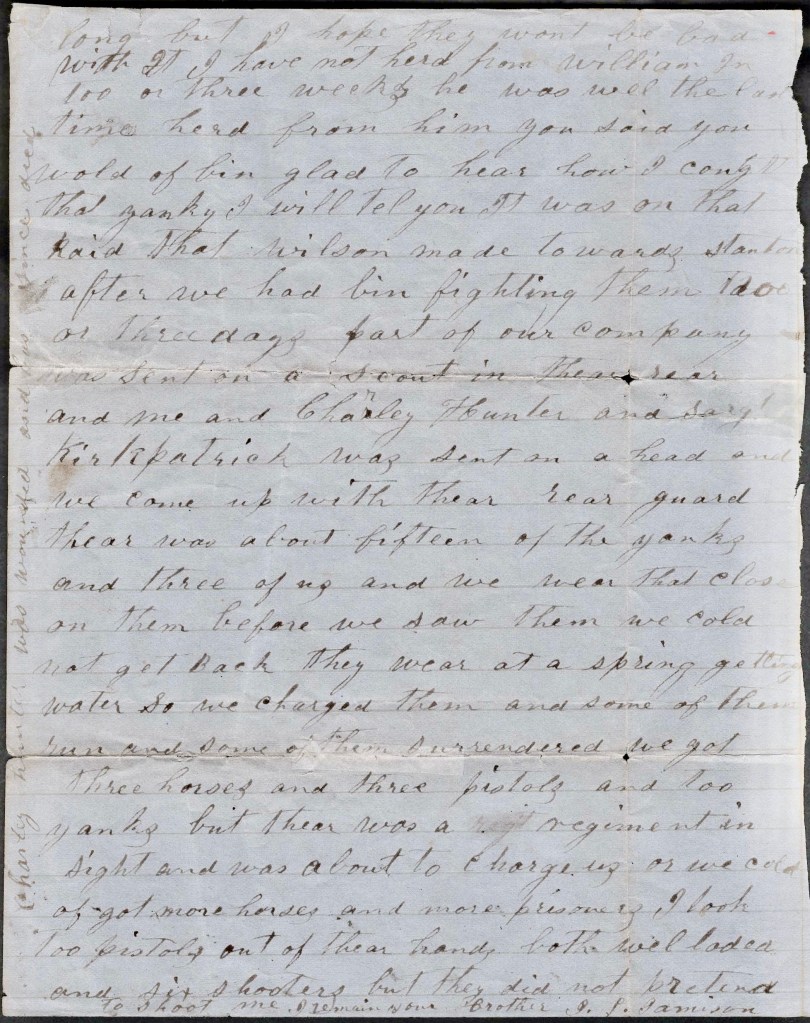
You said you would of been glad to hear how I caught that Yankee. I will tell you. It was on that raid that Wilson made towards Staunton [see The Wilson-Kautz Raid]. After we had been fighting them two or three days, part of our company was sent out on a scout in their rear and me and Charley Hunter and Sergt. [Jonathan R.] Kirkpatrick was sent on ahead and we came up with their rear guard. There was about fifteen of the Yanks and three of us and we were that close on them before we saw them. We could not get back. They were at a spring getting water so we charged them and some of them run and some of them surrendered. We got three horses and three pistols and two Yanks. But there was a regiment in sight and was about to charge us or we could of got more horses and more prisoners. I took two pistols out of their hands, both well loaded and six shooters, but they did not pretend to shoot me.

I remain your brother, — J. L. Jamison

Charley Hunter was wounded and has since died. 1


1 Muster Rolls of the regiment inform us that Charley died of a gunshot wound on 12 September 1864.

1862: Bryant Green Dunlap to Richard Bray Paschal

Bryant Green Dunlap, 26th N. C.

The following letter was written by Bryant Green Dunlap (1833-1867) of Moore County, North Carolina, where he was practicing medicine prior to the Civil War. Bryant attended Jefferson Medical College in Philadelphia and graduated in 1860. With the war, Bryant returned to his home in Chatham county to offer his services in the 26th North Carolina Regiment known as the “Chatham Independent Guards.” Enlisting in May 1861, Bryant was quickly appointed as regimental Quartermaster and transferred to the Field and Staff of the regiment. His tenure in this position was short-lived as he was unable to post the necessary bond for an appointment to a quartermaster’s position. After resigning from this position in February 1862, he offered his services as a private in Co. E (The Vance Troop) of the 5th Regiment N. C. Calvary (63rd North Carolina Infantry). On October 29th, 1862 he was appointed Hospital Steward for the 5th Cavalry and transferred to the Field and Staff of that regiment.

While serving in one of the field hospitals he helped treat the wounds of Col. John R. Lane of the 26th and other members of his old troop after the battle of Gettysburg. In June of 1865 he was reported as a paroled prisoner in Richmond, Va.; likely serving in one of the military hospitals in that city after its April evacuation. Dunlap resumed his medical practice in Moore County after the war; however a wartime injury caused his early death in 1867. He is buried in the Short Family Cemetery in Moore County, North Carolina.

Bryant wrote the letter to his friend, Richard Bray Paschal who was elected sheriff of Chatham county on 1854 and served six consecutive terms. In addition to his career as sheriff, Paschal served in the House of Delegates in 1865 and North Carolina Senate in 1866. Paschal’s diary is available on-line at the North Carolina Digital Heritage Center. It includes accounts of Paschal overseeing the trade of enslaved people in Chatham County, a reminder of the duties assigned to the position of sheriff.  Place names and people’s names, white and Black, are included in the diary.  [See R. B. Paschal Diary Transcript Now Available]

See also—1865: John W. Ellis to Richard Bray Paschal on Spared & Shared 22.

Transcription

Goldsboro, North Carolina
October 9th 1862

Sheriff R. B. Paschal,

Dear friend, I have the pleasure of acknowledging the reception of your kind letter which came duly to hand. It found me with no particular news, having passed through no thrilling scenes not made no hair breadth escapes. I am not prepared as the most of the soldiers and in these times to interest my friends in a correspondence. But as I wrote to a young lady once, ” will presume that it is me you want to hear from instead of news that you want” and proceed to tell you something of my own life and how I enjoy it.

I am in tolerable good health. The most of my time I have spent since I left home has been attending to the sick and I am now in Goldsboro on my way to Garysburg with ten sick men in [my] charge. I am stopping with them at the hospital until the Battalion can get to Garysburg and be prepared to do something with them. I have been acting Steward of the Hospital ever since I came to Goldsboro, but I do not know whether I will hold my office any longer or not as we are going into a regiment and I do not know who will be our surgeon. There is no responsibility in the office and take it every way. I think if I can get the permanent appointment, I shall be satisfied to hold it.

One of our company died the other night. His name was John A. Phillips of Moore county—a son of Martin Phillips. He was a good soldier and clever man. He leaves a wife and six children to mourn the loss. He died with Typhoid Fever. We have some other sickness in camp and some hard cases of Typhoid Fever.

Well, you spoke of the association. I should have been highly ratified to have been there—especially with so many inducements to enjoyment as you promised me, all of which I am very fond of. And as you know a soldier’s life is by no means a life of luxury and ease, it makes the enjoyment greater when they have an occasional chance of refreshments and fair Ladies. But I must beg to differ with you in one case and that is Miss Mag Fox thinking anything of your humble servant. I imagined on one occasion that, nothwithstanding, “I was a youth unknown to fame and fortune,” that I would be bold enough to write to her. I did so and silent contempt was my only response. That is, she never answered my letter. I did not blame her for there is such a mania for letter writing with young men in the army that I was ashamed of myself after I did the act, and could not keep from feeling like a poor man at a frolic.

But enough of this. I hope I have convinced you that I am neither insensible to the fair ladies charms or to your good opinion of my living in her affections, but that my only response to the case is what the man said about the Bull—Can’t quite come it. As I shall be in Garysburg after this, I shall be pleased to get a letter from you at any time. Direct to Garysburg, Col. Evans’ Regt., Partizan Rangers. Care of Capt. Harris, and remember me as ever your friend, — B. G. Dunlap

Confound this paper

1865: George R. Adderton to Adline Norwood (Kearns) Adderton

I could not find an image of George but here’s an unidentified Rebel believed to have been a cavalryman (Larry Lingle Collection)

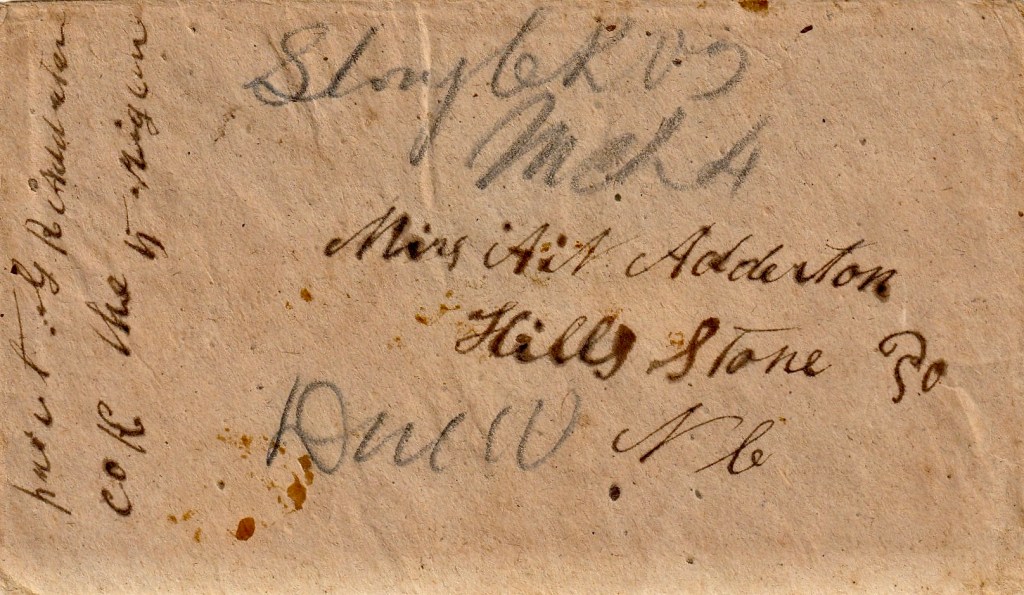
This letter was written by Pvt. George R. Adderton (1830-1893) of Hills Store, Randolph county, North Carolina. He enlisted on 23 March 1863 and mustered into Co. K, 5th North Carolina Cavalry. George experienced periods of time when he was not able to do duty due to sickness and others when he was without a horse. As far as we can learn, George was otherwise with his regiment during their very active campaigns in 18663-65.

Though he could not know it at the time, war’s end was just around the corner even though he yet held out hope for a Southern Independence. For George, any prospect for peace was “knocked in the head” when the Yanks made it clear that slavery would be abolished. Presumably George was with his regiment in their last few battles at Five Forks, Scott’s Crossroads and Battle of Namozine Church. Only 5 of the enlisted men actually surrendered at Appomattox; most of the cavalry cut their way out and escaped surrender.

[Note: This letter is from the personal collection of Richard Weiner and is published by express consent on Spared & Shared.]

Transcription

Camp near Stoney Creek, Virginia
March 2nd 1865

Dear wife, It is through the kind Providence of God that I am permitted this evening to drop you a few lines to let you all know that I am well at present. I hope when these few lines come to hand, they may find you all well at home.

I hant got any news to write. P. T. Kearns is well and hearty. I hant had a letter from home this week. I want to hear from you all. I hear that all you in North Carolina are all scared to death about the Yankees. I don’t think there is much danger. I recon the home guard is scared to death but I think they will hear the elephant bellow before before this war comes to a close.

I hear there is a good many desertions in Randolph county but I think they will be caught and punished. The times look gloomy but I think we will gain our independence yet. You wrote something about the slaves. They have knocked that in the head. They aren’t going to take out.

I have drawn a very good overcoat. In closing, write soon.

— G. R. Adderton