Category Archives: 65th New York Infantry

1862-3: Charles S. Crockett to John Gifford

A pre-War image of Charles Crockett

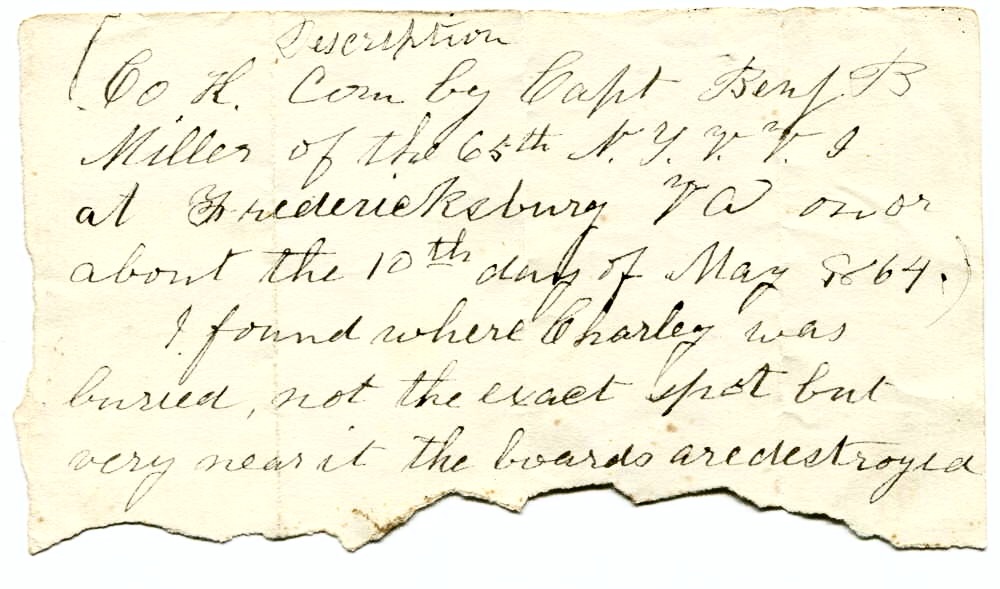
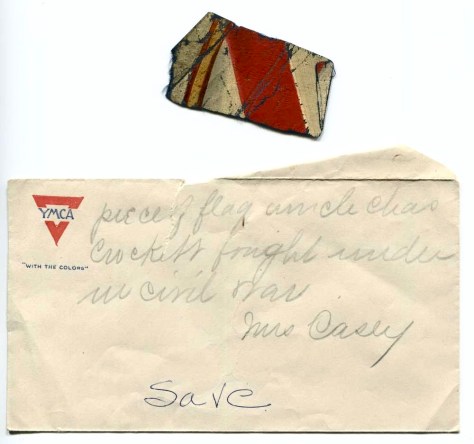
These letter was written by Pvt. Charles S. Crockett (1838-1864) of Co. K, 65th New York Infantry (a.k.a. the 1st U.S. Chasseurs). The regiment was primarily raised in New York City, but also recruited in Connecticut; Seneca, Ohio; and Providence, Rhode Island. Crockett of Company K was from Adams township, Seneca county, Ohio. He was the son of James Crockett (1798-1874) and Mary Parsons Haskell (1801-1874). When he enlisted, he was described as 6 foot 1 inches tall, with blue eyes and dark hair—a farmer. He reenlisted in the regiment in December 1863 but did not survive the war. He died at Fredericksburg from wounds received in the Battle of the Wilderness on 6 May 1864. His death occurred on 10 May 1864.

Crockett’s 2nd letter alludes to the losses of the regiment at Gettysburg and of the more recent action at Wapping Heights (Manassas Gap) where they participated in the attack by the Excelsior Brigade led by Gen. Spinola in the evening of July 23, 1863. See “Too Good to be True: At Manassas Gap,” by Rick Barram (2018).

Charles Crockett (at right) wearing his Chasseurs uniform, holding his Hardee Hat on his leg.

Letter 1

Camp near Harrison’s Landing
On James River, Va.
July 22, 1862

John Gifford, Esq., Laurens, N. H.
Friend John,

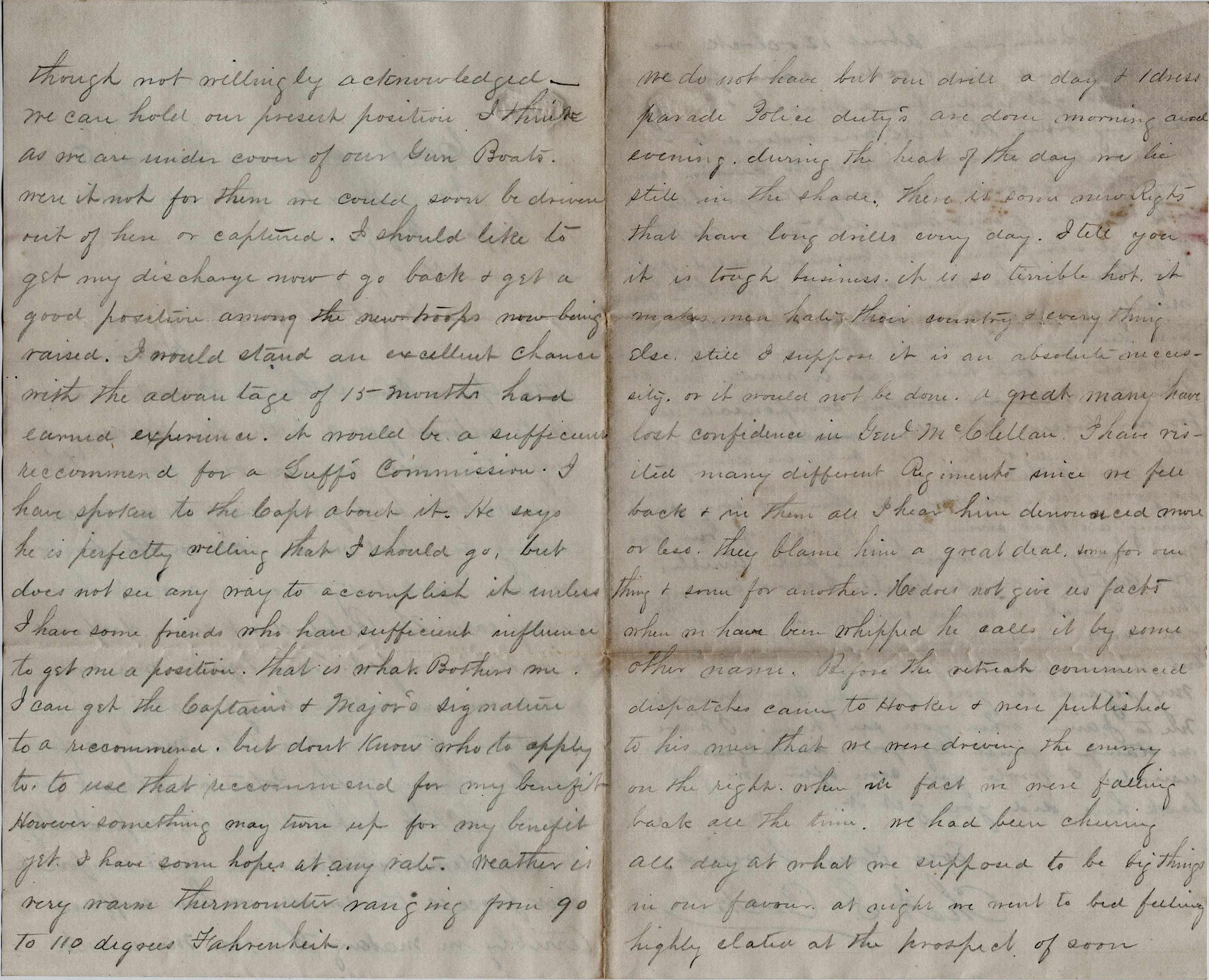
Having a little spare time I thought I would devote it to interest you a little. The heading of my letter will tell you our present location. We have had quite easy times since coming here but we are still on the front. We have picket duty once in a week, but it is very easy. The Rebels don’t seem disposed to molest us yet. Their pickets are very quiet. We are entrenching & making our position strong as possible. Many a farm has this Army of the Potomac almost ruined by the pick and shovel. We shall probably make no demonstration here until reinforced, Our force is too small, We have suffered terribly in making this rear movement though not willingly acknowledged. We can hold our present position I think as we are under cover of our gunboats. Were it not for them, we could soon be driven out of here or captured.

I should like to get my discharge now & go back & get a good position among the new troops now being raised. I would stand an excellent chance with the advantage of 15 months hard earned experience. It would be a sufficient recommend for a Lieutenant’s commission. I have spoken to the Captain about it. He says he is perfectly willing that I should go, but does not see any way to accomplish it unless I have some friends who have sufficient influence to get me a position. That is what bothers me. I can get the Captain and Major’s signature to a recommend but don’t know who to apply to to use that recommend for my benefit. However, something may turn up for my benefit yet. I have some hopes at any rate.

Weather is very warm—thermometer ranging from 90 to 110 degrees Fahrenheit. We do not have but one drill a day & 1 dress parade. Police duty’s are done morning and evening. During the heat of the day, we lie still in the shade. There is some new regiments that have long drills every day. I tell you, it is tough business. It is so terrible hot, it makes men hate their country & everything else. Still I suppose it is an absolute necessity or it would not be done.

A great many have lost confidence in General McClellan. I have visited many different regiments since we fell back & in them all I hear him denounced more or less. They blame him a great deal, some for one thing & some for another. He does not give us facts when we have been whipped. He calls it by some other name. Before the retreat commenced, dispatches came to Hooker & were published to his men that we were driving the enemy on the right when in fact we were falling back all the time. We had been cheering all day at what we supposed to be big things in our favor. At night we went to bed feeling highly elated at the prospect of soon being in Richmond. About 12 o’clock we were all called up & orders came for every man to get ready for a march & in light marching order. The sick ones were ordered to start immediately & we were ordered to destroy everything that we could not carry—knapsacks, tents, & even guns were destroyed, clothing of every description were burned instead of giving them to the men when half of them were nearly naked. Ammunition & subsistence were destroyed all along the lines the amount of which no one has dared to make an estimate. Millions wouldn’t compensate us for our losses. These stores did not fall into the hands of the rebels but were destroyed—that is, the most of them.

The Battle and Burning of Savage’s Station, Virginia, on June 29, 1862

The retreat, however, was made in good order. We whipped them at every point during all that seven days fighting. If our loss was heavy, there must have been terrible. Our artillery made terrible havoc among them. I wish I could explain to you so that you could understand it as I have seen it but it is impossible. But I must close, My regards to your family. Also remember me to James when you see him. I have no stamp & must beg your indulgence as usual. I wrote you soon after we got back here. Did you. get it? Ever your friend, — Charles S. Crockett

Letter 2

Note: This letter is from the private collection of Greg Herr and was made available for transcription and publication on Spared & Shared by express consent.

Wagon Park of 1st Regt., Ex[celsior] Brigade
Near Warrenton, Va.
July 29th 1863

Jno. Gifford, Laurens, New York

Friend John, after so long a time I have again got a moment’s time to write to you. I assure you I could not well do it sooner. We arrived here on the afternoon of July 26th & are here yet. Everything goes to show, however, that today will be our last day here. We have had quite a rest. Have got new clothes for the most needy. Have got our wounded taken care of. Have got harnesses & wagons repaired & are in pretty good condition to go on again. Which way through, I cannot tell.

Our Colonel—Major—Adjutant with one sergeant and six privates have gone to New York after drafts to fill up our ranks. Each regiment of the Brigade & Division have sent in the same manner & I expect we will soon have our Division as large as ever. We had come down to our last hard tack when we arrived here. It seems that the Rebel guerrilla parties annoyed our trains so much between Upperville and Harper’s Ferry that communication was stopped. The consequence was I had a half day’s ration to issue to get from Piedmont Station to Warrenton. The Rebs held Warrenton until the day before we came here.

I assure you, we have done some tall marching since we left Falmouth, Virginia, the 10th day of June last. I never had so hard a time in my life to my end up. It has been night and day, rain and shine, day after day, week after week. Nothing we have ever been called on to do could begin [to compare] with the last campaign. We have all suffered severely in wear and tear, in loss of men, and everything belonging to war. But I think the campaign is about over until we get the drafts in proper order & our ranks filled.

Our regiment lost in the Gettysburg battle 108 men in killed, wounded, and missing. And in a charge made on the 25th [23rd] of July at Manassas Gap we lost 38 men in killed & wounded. Besides [this], we have lost a great many by sickness, &c., consequently in making such long fatiguing marches. I am astounded that men can stand as much as they have done. I have had a good horse to ride during all the marching & yet I have been so worn and tired many a time that I have fallen asleep in the saddle & it seemed as though I must give up. Still I have made out to stand it so far.

I have not time to write more as I have just got an order to go to the regiment. Excuse briefness & do not think amiss if I fail to write you often. In friendship yours, — Charles Crockett

1862: Unidentified “Josie” to his Parents

An unidentified member of Co. K, 1st US Chasseurs (65th NY Infantry) wearing the distinctive uniform and M1858 Hardee Hat (W. Griffing Collection)

The following letter was written in pencil by a soldier who served in the 65th New York Infantry, otherwise known as the 1st U. S. Chasseurs. The companies in this regiment were recruited principally as follows: A, C, G and I in New York City; B in Maine, Rhode Island and the Hudson river counties; D in New York city and Troy; E in New York City, Connecticut and Rhode Island; F and H in New York City and Rhode Island, and K in New York City and Ohio. The Chasseurs faced their baptism of fire at the Battle of Fair Oaks on 31 May-June 1, 1862 during McClellan’s Peninsula campaign. In addition to wearing a chasseur uniform, the regiment were distinct for choosing to wear M1858 uniform hats (more popularly known as Hardee hats) rather than the kepis.

Though it is certain the author served in the 1st US Chasseurs—most likely in Co. D or Co. K—he only signed his name “Josie” and there is no accompanying envelope nor additional identifying information in the letter itself to state with certainly who he was. The letter came to me for transcription attributed to Joseph P. Baugher [Actually Joseph T.] (1844-1921) of Co. K but a search of the company records reveals that Joseph was detached from the regiment in February 1862 “on western gunboat service and was discharged therefrom.” This record could have been an error, however. Joseph lived his entire life near Tiffin, Ohio, and his burial record only lists his service in the 65th New York Infantry—nothing else.

Regardless of who wrote the letter, it is a great first hand account of the Battle of Fair Oaks from the perspective of a member of the 1st US Chasseurs who “covered themselves with glory” and where “not a man flinched” on the field.

Transcription

Camp on battlefield of Seven Pines
June 7th 1862

My dear parents,

I suppose by this time you have heard of the great battle near Richmond which commenced at one o’clock on Saturday [31 May] and ended about noon the next day [1 June] by the enemy skedaddling & leaving the field in possession of the brave soldiers of the North. I received a letter from home on Saturday a short time after writing & mailing an answer.

The noise of cannons and musketry was heard directly to the front of our camp. We were soon under arms, ready to take part in the encounter with the hated rebels. Our Colonel was ordered to take the regiment to the right of the [York River] railroad to prevent being flanked. At this place the shell flew over our heads like fun, doing no damage however as the range was too high. The noise as they came whizzing by sounded rather unpleasant at first, causing the men as well as officers to bob their heads, but we soon became used to that & we stood like men & soldiers ready to do our best for the glorious cause in which we had enlisted.

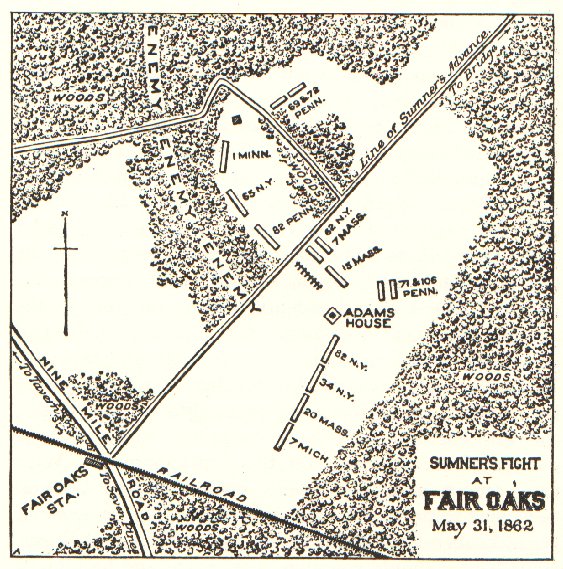
The Union line after Sumner’s troops arrived to join the 65th New York Infantry who were deployed behind a fence from which they “were loading and firing like demons.”

We soon received news that the Union forces were being driven back & that the rebels were at that time in the camps we had occupied not thirty minutes before. Such news made us feel of course rather low spirited. We fell back about half a mile and awaited anxiously for the rebels to make their appearance. After remaining at this place about 15 minutes, the right of Sumner’s line of reinforcements could be seen coming through the woods to the rear. This I can assure you was a welcomed sight. As soon as Sumner’s men had reached the field, we were ordered to double quick & take position in front of the woods on our right. We had no sooner halted than we received a sharp volley from the rebels who were at that time concealed in the woods. Without waiting for orders, we gave one in return.

“After I had fired, I hardly knew what to do but a second volley from the enemy brought me to my senses & I came to the conclusion that I had better reload. After this, I became perfectly cool and we let them have it thick and heavy for over two hours and a half…”

After I had fired, I hardly knew what to do but a second volley from the enemy brought me to my senses & I came to the conclusion that I had better reload. After this, I became perfectly cool and we let them have it thick and heavy for over two hours and a half—the enemy attempting several times to charge upon us but we would reserve our fire and when they came near, let them have it again & back they would go. I fired over 30 rounds, several times taking deliberate aim. The enemy skedaddled a little after dusk & the Chasseurs have the satisfaction of knowing that their first fight has been a victory.

After the firing was over, we turned our attention to our dead and wounded comrades. Our company lost three in killed and seven wounded; the regiment about forty & the brigade 650. The man to my right was killed; the one in front of him wounded, & I came so near that there was no fun in it—my cheek being grazed. It did not hurt me, however, so I am ready for the next battle which we expect will take place before the week is out. McClellan says it will no doubt be more bloody than the last. 1

After I had assisted in removing the wounded to the hospital and placing the dead together, I took a smoke out of the pipe which Pa gave me before leaving home & lay down where I had stood fighting and slept sound until morning—or at least daybreak when we stood under arms until about six o’clock when the rebels made their appearance intending to give us a second trial. Our regiment fired a couple of volleys when we were relieved by another regiment that had not been engaged the day previous & took a position in the woods where we remained during the day. The engagement ended about noon, the enemy being defeated.

For over 24 hours I had nothing to eat as our rations were left in camp. The next day a few crackers were brought to us and I can tell you they tasted good. We have lost all our clothes, &c. except what was on our backs as our knapsacks were left behind & destroyed by the rebels when they entered our camps. The government is going to make them good to us, I believe. I can tell you soldiering is a hard life. After our next battle, if I live through it & we reach Richmond, I shall try to get my discharge if it is possible. I can then retire with honor as I think I shall have done my share of duty in the way of fighting, &c.

When I write again, I shall no doubt have a bloody battle to describe. I hope I may come out of it safe but I am ready for it. My powder is dry, my musket (my best friend at present) in perfect order, & I shall have to take my chance with the rest. The enemy have commenced shelling us again so we will have to stand under arms again I suppose. So I must close. Goodbye. Love to all. Write very soon and often to your son, — Josie


1 According to Capt. William Halsted of Co. D, 65th New York Infantry, “Capt. Higgenbotham’s Co. [K] and mine took the worst of the fight….I lost in killed and wounded more than one-fifth of my company. Our regiment lost in killed and wounded 32 [actually 9 killed and 22 wounded]. Our men have covered themselves with glory. Not a man flinched in the field….We held our post for nearly two hours under a terrific fire. Not a cartridge was wasted. We went to work with 60 cartridges and my company averaged 40 left at night.” [Calvin Packard Civil War Battlefield Collection]