The following letter was written by Edward G. Mabry (1839-1864), the son of Joel Mabry (1787-1840) and Sarah McKinzie (1802-1886) of Posey township, Washington county, Indiana. He wrote the letter to his brother, Joel Mabry. He mentions someone named “Wood” in his letter whom I believe was his older brother, William Woodford Mabry (1829-1892). He had another brother named James S. Mabry (1832-1863) who died in the service from pneumonia in 1863.
Edward wrote this letter while serving in Co. H, 66th Indiana Infantry. It was datelined from Corinth, Mississippi, in mid-May 1863. Edward did not survive the war, however. He died on 21 August 1864 at Rome, Georgia.
Corinth, Mississippi
T R A N S C R I P T I O N
Corinth, Mississippi May 13, 1863
Dear Brother,
I take the pleasure to send you a few lines to let you know that I received your letter a few days ago. It found me in good health and I hope when these few lines comes to hand, they may find you all in good health.
We are well at this time. I got a letter from Wood. He was well. He is at Helena, Arkansas. He wrote that he was to try and get a furlough and come to see us. I would be glad to see him.
Well, I will tell you about [our] tramp we have taken down in Alabama which was about ninety miles from Corinth. We was gone eighteen days you know. We saw some good old times. We saw some Rebels but they would not stand fire. The cavalry and them had some fighting but we did not get at them. We found them at Little Bear Creek. We run them to Town Creek. We formed a line of battle three times. When we got to Town Creek we got there late in the evening. We shelled them some and commenced in the morning at half past five o’clock the next morning and continued till 3 in the evening and by that time we had a pontoon bridge across the creek [and] we went over. They left the 10th Kansas Jayhawkers. When we came back, they burnt all the houses eight miles wide and captured all the negro and all the mules and all the horses. They destroyed all the cotton that they could not fetch with them. We swept everything clean. That is the way to do it.
You wrote that you was not going to set yourself up for a target for them to shoot at. Well I am up for them and I think it is every man’s duty that is able. I think the backbone is broke now. I don’t think they can hold out much longer. I think that I will be at home against the 1st of November.
We was all paid off up to the 1st of March which was four months—52 dollars. I sent home forty dollars. I got a letter from Charles last month. They are all well. He wrote he had got him a duck. Well, I must bring to a close. I still remain yours so write soon, — Edward G. Mabry
The following letter was written by Corp. William H. Thompson (1829-1864) of Co. H, 66th Indiana Infantry. He mustered into the regiment in August 1862 and was killed in the fighting near Atlanta on 9 August 1864. William was the son of John Calvin Thompson (1806-1876) and Amanda Vaughn Garriott (1809-1853) of Little York, Washington county, Indiana. A cooper by trade, William was residing in Washington county with his wife of nearly 7 years, Lydia Jane (Graham) Thomson (1830-1863) when he enlisted. The baby, Douglas Graham Thompson, born in 1860, appears to have survived.
William’s letter was addressed to his cousin, John Royse, in Washington county, Indiana. See also the letter by John Royse’s brother, Simeon G. Royse (1837-1867), the son of John W. and Mary (Garriott) Royse of Fredericksburg, Washington county, Indiana. Simon enlisted as a private in Co. H, 66th Indiana Infantry on 19 August 1862 and mustered out of the service on 13 June 1865. 1863: Simon G. Royse to Mary (Garriott) Royse.
T R A N S C R I P T I O N
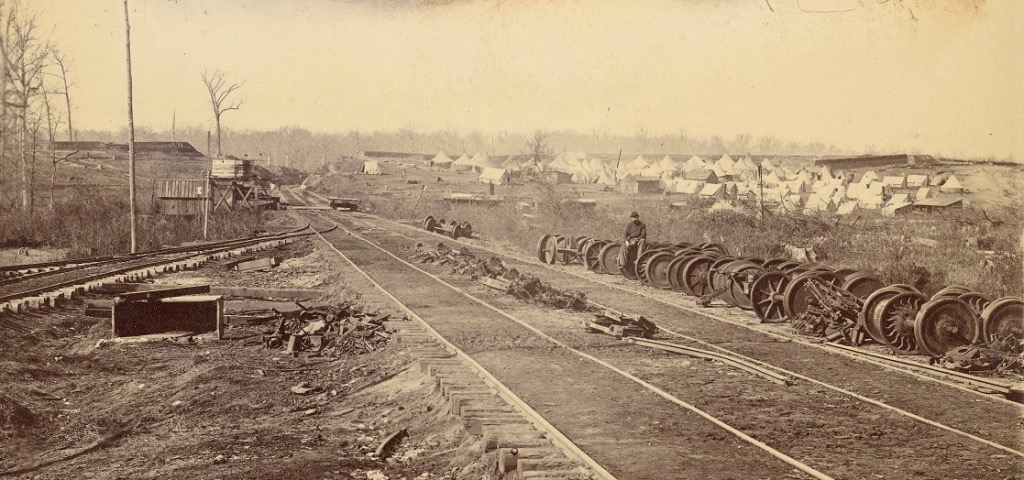
[Guarding the Memphis & Charleston Railroad] September 14, 1863
Dear cousin,
I sit down tonight to answer your kind letter which came duly to hand and should have been answered before this time but I know you will excuse me for not writing sooner when I tell you that since I came to Lafayette, Tennessee, and heard the report that [John] Hallenbeck and [Martin] Edmonson brought concerning my poor wife, my mind has not been composed enough to write and intelligible letter and you must not expect much from me at this time for I have no word from any family since the first and I suppose that my dear wife and child was not expected to live. You may form some idea of my feelings at the present time, not knowing whether I have a dear wife and sweet little babe or not. But the Lord giveth and the Lord taketh away and Blessed be the name of the Lord.
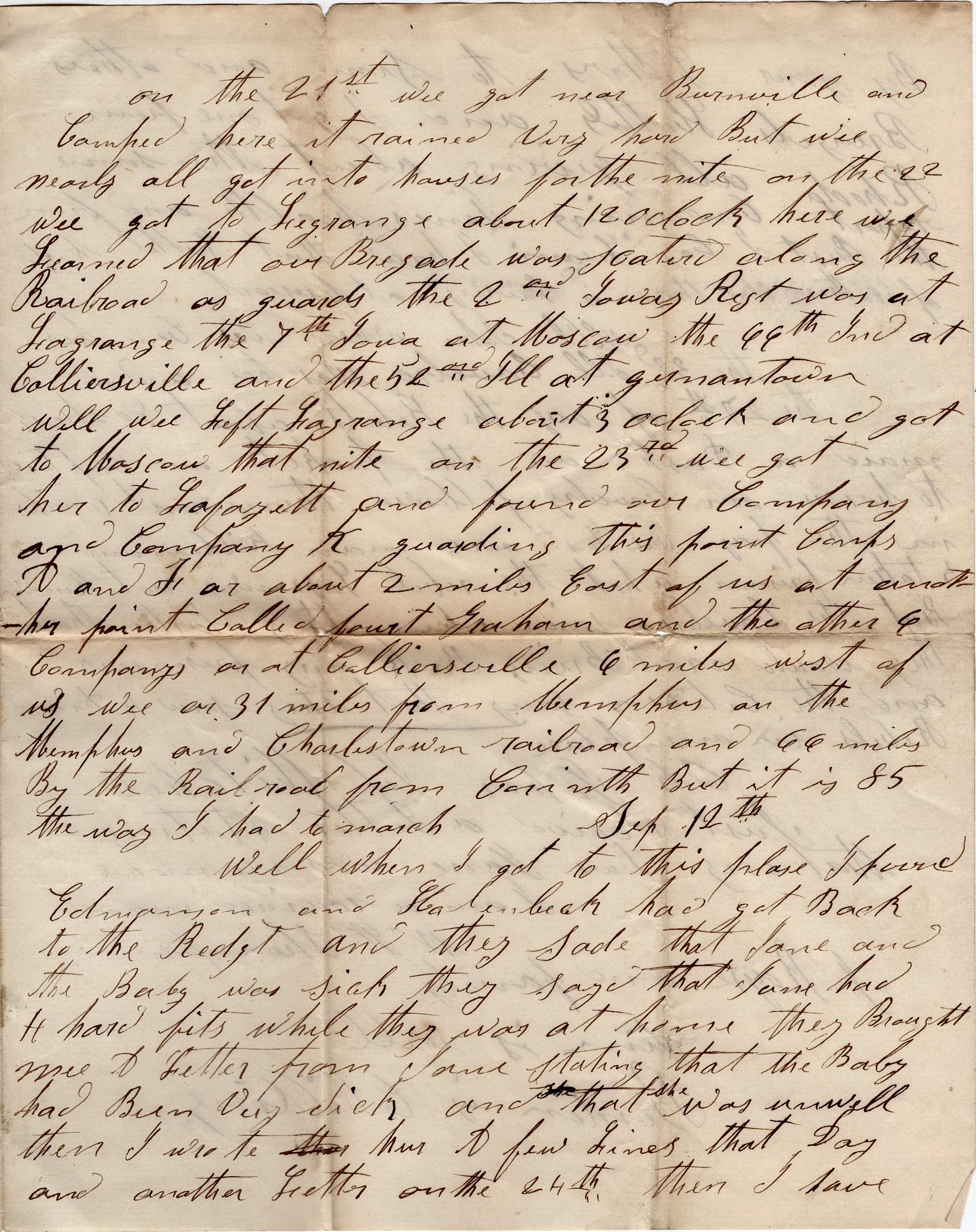
Well, John, I hardly know what to write to you for there is nothing here of interest to me and I am in a poor condition to select anything to interest anyone. But I will do the best I can and let ignorance plead my excuse. In the first place, I will give you a history of our move from Corinth to this place. It was a pretty rough move to me but nearly all the Boys got through on the cars. I will tell you how it happened. On the 18th day of August, I was detailed with six others of our company to go out on picket. Well just about 5 o’clock that evening our Brigade of four regiments was ordered to Lagrange, Tennessee, and the order was for all but those on picket to go on the cars and for those that was on picket, when they was relieved the next morning, to march through as a guard for the wagon train.
Well we was relieved about 9 o’clock on the 19th and went into camp and eat our dinners and prepared for a march of sixty miles which turned out to be about 80 more or less. Well we started about 3 in the evening with 40 wagons and 175 men, 56 of our regiment and about 45 apiece of the 52nd Illinois and the 2nd and 7th Iowa. Well, after a march of 15 miles, we stopped to camp where the town of Chewalla once stood before it was burnt. Here the 18th Missouri is stationed. Here our strength was increased by the addition of two companies of the 2nd Iowa that had been guarding a bridge out in the country.
When we started from Chewalla on the 20th, we got an escort of 30 cavalry to go with us as far as Pocahontas so you see our guard amounted to some 350 men. Well, we passed Pocahontas about three miles that day. On the 21st we got near Burnville and camped here. It rained very hard but we near all got into houses for the night. On the 22nd, we got to Legrange about 12 o’clock. Here we learned that our Brigade was scattered along the railroad as guards. The 2nd Iowa Regiment was at Lagrange, the 7th Iowa at Moscow, the 66th Indiana at Colliersville, and the 52nd Illinois at Germantown.
Well we left Lagrange about 3 o’clock and got to Moscow that night. On the 23rd we got here to Lafayette and found our company and Co. K guarding this point. Companies A and F are about two miles east of us at another point called Fort Graham and the other six companies are at Colliersville, six miles west of us. We are 31 miles from Memphis on the Memphis and Charlestown Railroad and 66 miles by the railroad from Corinth, but it is 85 [miles] the way I had to march.
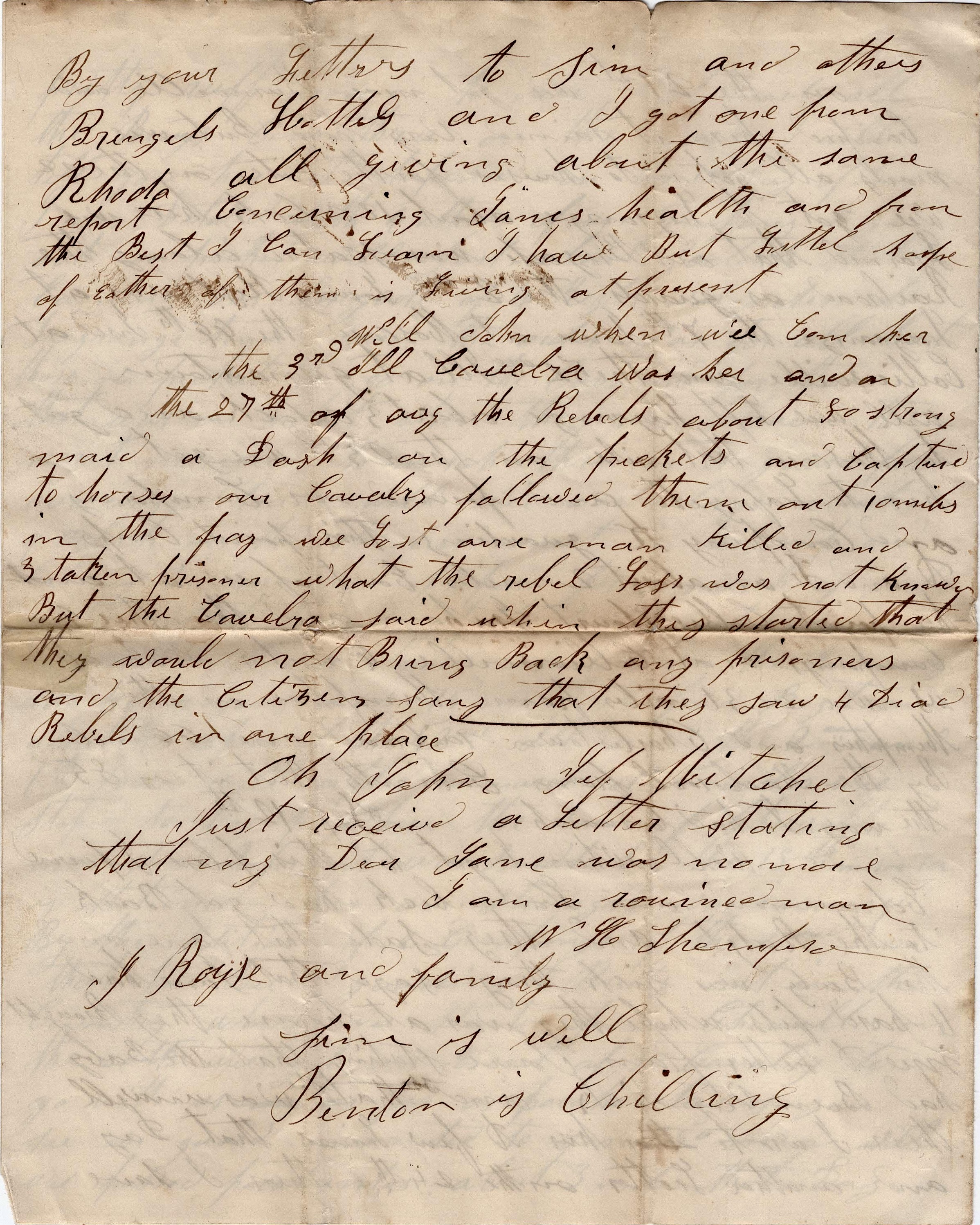
September 12th. Well, when I got to this place, I found Edmonson and Hallenbeck had got back to the regiment and they said that Jane and the baby was sick. They said that Jane had four hard fits while they was at home. They brought me a letter from Jane stating that the baby had been very sick and that she was unwell then. I wrote her a few lines that day and another letter on the 24th. Then I have [news] by your letters to [your brother] Sim[eon] and others, and I got one from Rhoda all giving about the same report concerning Jane’s health and from the best I can learn, I have but little hope of either of them in living at present.
Well, John, when we come here, the 3rd Illinois Cavalry was here and on the 27th of August, the Rebels about 80 strong made a dash on the pickets and captured two horses. Our cavalry followed them out ten miles. In the fray, we lost one man killed and three taken prisoner. What the Rebels lost was not known but the cavalry said when they started that they would not bring back prisoners and the citizens say that they saw four dead Rebels in one place.
Oh, John, Jef. Mitchell just received a letter stating my dear Jane was no more. I am a ruined man. — W. H. Thompson
[to] J. Royse and family. Jim is well. Benton is chilling.
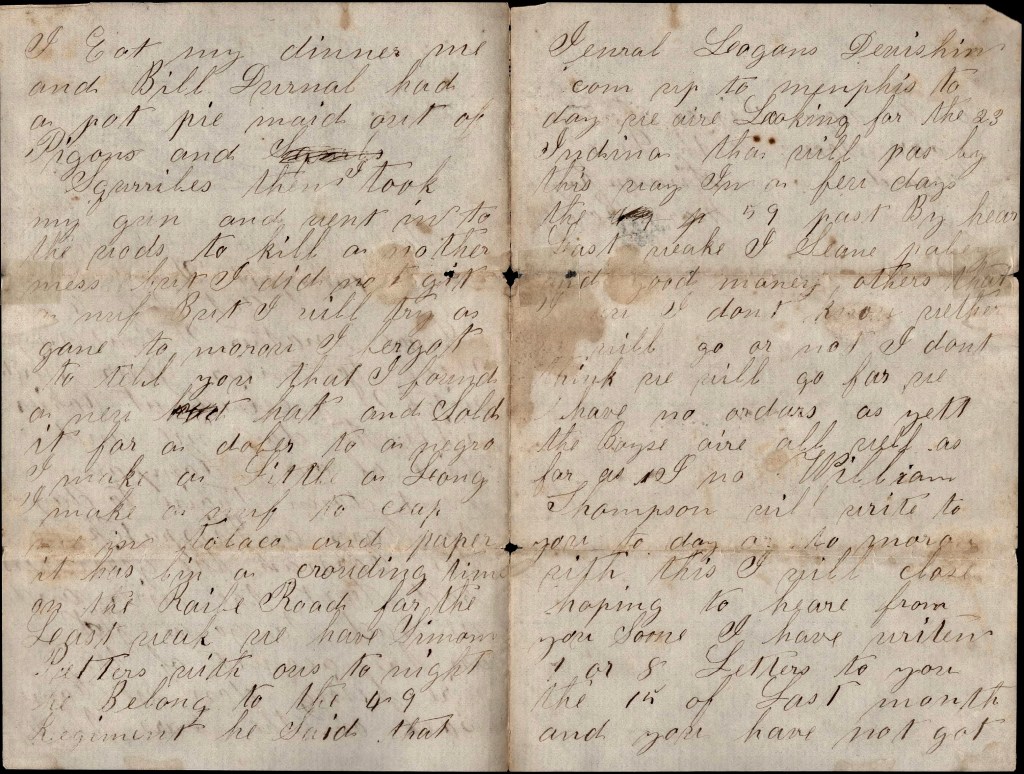
The following letter was written by Simeon G. Royse (1837-1867), the son of John W. and Mary (Garriott) Royse of Fredericksburg, Washington county, Indiana. Simon enlisted as a private in Co. H, 66th Indiana Infantry on 19 August 1862 and mustered out of the service on 13 June 1865.
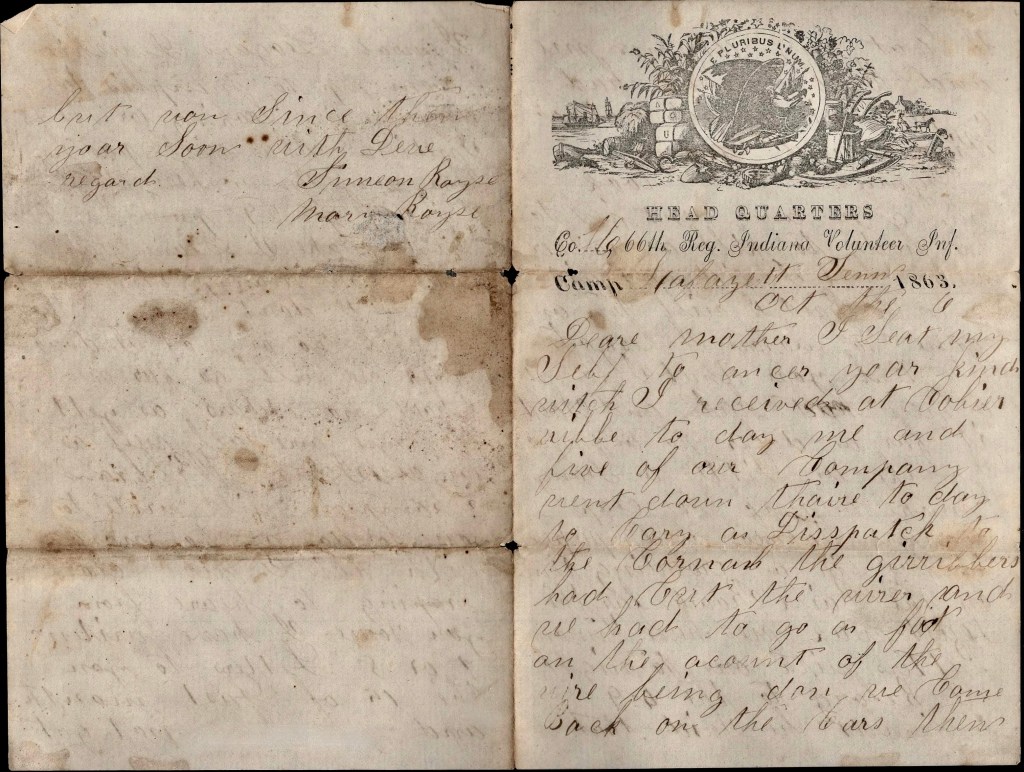
I seat myself to answer your kind [letter] which I received at Collierville today. Me and five of our company went down there today to carry a dispatch to the Colonel. The guerrillas had cut the wire and we had to go on foot on the account of the wire being down. We come back on the cars then.
I eat my dinner. Me and Bill Durnill had a pot pie made out of pigeons and squirrels. Then I took my gun and went into the woods to kill another mess but I did not get enough. But I will try again tomorrow. I forgot to tell you that I found a new hat and sold it for a dollar to a negro. I make a little along. I make enough to keep me in tobacco and paper.
It has been a crowding time on the railroad for the last week. We have Simon Potters with us tonight. He belongs to the 49th Regiment. He said that General Logan’s Division come up to Memphis today. We are looking for the 23rd Indiana. They will pass by this way in a few days. The 59th passed by here last week. I seen Paleys and a good many others that I knew. I don’t know whether we will go or not. I don’t think w will go for we have no orders as yet. The boys are all well as far as I know.
William Thompson will write to you today or tomorrow with this. I will close hoping to hear from you soon. I have written 7 or 8 letters to you the 15th of last month and you have not got but one since then. Your son with due regard, — Simeon Royse



 Spared & Shared 23