Category Archives: 6th Iowa Infantry

1861: Robert H. Osborn to Emily (Lathrop) Osborn

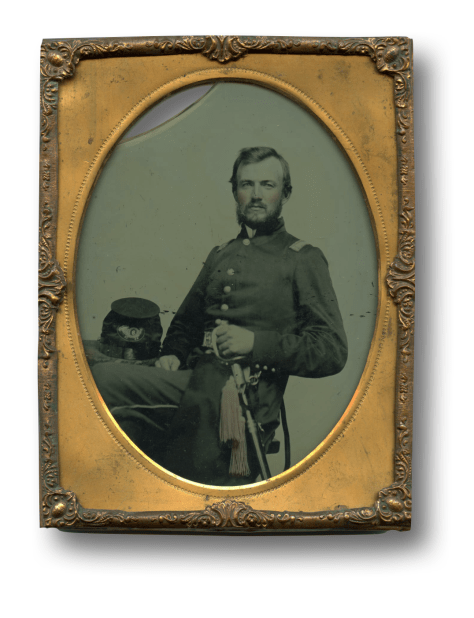
I could not find an image of Osborn but here is one of Edwin Finefield who also served in Co. C, 6th Iowa Infantry Iowa Civil War Images)

The following letter was written by Robert H. Osborn (1837-1864), the orphaned son of Zimri Osborn (1793-1850) and Nancy Hathaway (1805-1857) of Belmont county, Ohio. He was married in 1861 to 15 year-old Emily Lathrop (1846-1892) before he was mustered into Co. C, 6th Iowa Infantry, on 17 July. His references to “Father” and “Mother” in the letter refer to Emily’s parents, Ichabod Lathrop (1814-1896) and Catherine Humphreys (1814-1897) of Hardin county, Iowa.

The letter was datelined from Lafayette Park in St. Louis in early September 1861. The regimental history confirms their presence there: “It was stationed for a time at Jefferson Barracks, then at the United States Arsenal and, later, at Lafayette Park and Benton Barracks. On the 19th of September, 1861, the regiment left Benton Barracks, and was transported by rail to Jefferson City, and from that place started upon an active campaign in the State of Missouri, in which it learned its first severe lesson in marching, and the endurance of hardships.”

In January 1864, Robert reenlisted as a veteran in his company but did not return home to his Emily. He was killed in action on 28 May 1864 at Dallas, Georgia.

T RA N S C R I P T I O N

Camp Jessie
Lafayette Park, Missouri
September 4, 1861

My Dear Companion,

It is with pleasure that I get to converse with you even in this way for it is the only way that we can converse at this time. Emily, I am not very well at present but not so unwell but I am able to get around. Emily, I hope that you are well.

Emily, I am anxious to hear from you for I have wrote you two letters to you and this is the third once since I had got any from you. My dear, I think your letters must have been miss laid on the route for I don’t think you would want me to go so long without hearing from you.

Emily, we have good news of late. First we took 1500 prisoners in two places in Mis. Jeff Davis dead, 400,000 prisoners taken at Washington. I hope these reports is true. Every paper being a good on our side.

Emily, I don’t think it will be long till I can fold my only love in my arms once more. One more sweet kiss from you would pay me for all of my trouble. But I cannot get it now for you are too far off. But I will be close enough as quick as I can. Emily, I wished last night when I got very thirsty that you was here to give me a drink for I did not feel like getting it myself and it seemed to me like if you could give me a drink, it would be worth a thousand that anybody else would give me. Emily, I want to see you all the time but when I get sick, it seems like it will kill me to stay away from you. Emily, I hope that I never will need to part from you again in this world and when parted for the next, that I may go fast for how can I stay if you was gone?

Emily, [General] Fremont has give our Colonel his choice to be stationed here for the war to protect this city. The people of this city made applications to Fremont for us to stay here saying that we was the best soldiers in every respect that had ever been here—the soberest and best behaved, and hearty, robust, and young men in general. We thanked the people for their good opinion. When I said we, I meant our regiment.

[Joseph J.] G. Knoles and J[ohn] Dorte [Dourtey] is about well. J. Dorte and O[zro]. Sawyer is writing letters now.

Emily, what little money I had [has] taken legs and waled out of my pocket—maybe lost it. But that one dollar bill that father got off Frank was not gone. But let it go the way of the world.

Emily, if we left here to protect the city, perhaps we will have to stay here for the three years if peace is made sooner and if we do, will you come and stay with me if I get a good room for us to stay in near to my quarters? If I can come after you in January, let me know the next letter. I am not afraid but you will. I do not want you to come if I think there is any danger here but again we may be disbanded soon after peace is made.

The First Cansis [Kansas] Regiment came here while I am writing. They was in the Springfield fight [at Wilson’s Creek]. They have had pretty hard usage. They say fighting is no fun when you see your best friends lying dead around you.

We had a nice rain night before last, The weather is pleasant. Everything is quiet about town since the martial law has been put in force. I was to church twice last Sabbath. Good sermons. Plenty of citizens to see us. The very best of order. People likes the soldiers. Make many presents to them. Perhaps they are too clever with their print for one’s good. Tell father to read the 9th Chapter of Romans.

Tell father and mother that I would like to see them and tell them about what times we have had for they are too many to write. Tell Elizabeth and Warren they must not spell all of the folks down up there this winter for if they do that I will get after them. Tell Harrison and the rest of them that I would like to see them and have some fun with them.

Emily, I will send you a watch locket. It cost me a ten cent ticket.

Emily, I am tired out writing and I must quit for the present. Emily, please write as soon as this comes to hand for my sake. Your companion, – R. H. Osborn

To my dearest Emily Osborn

1861: David Spencer Sigler to Lyman Perry Sigler

This letter only carries the signature “David” but the content leads me to the conclusion it was penned by David Spencer Sigler (1842-1892), the son of John Sigler (1804-1882) and Huldah Elsworth Wilson (1808-1849). In 1860, the Sigler family was living in Upper Sandusky, Wyandot county, Ohio. By that time, David’s father had remarried to Ursula C. Adams (in 1849). David was working then as a clerk and his older sister Samantha (mentioned in this letter) was employed as a school teacher. Davis wrote this letter to his only brother, Lyman Perry Sigler (1848-1911) who was at the time still living in Upper Sandusky. He and his father did not come west to live in Garden Grove, Iowa, until 1863.

Davis was living and working in Osceola, Iowa, when the Civil War began and so it was there that he chose to enlisted on 1 July 1861, as the Eighth Corporal in Co. B, 6th Iowa Infantry. They were mustered into service on 17 July 1861. He was then promoted to Seventh Corporal on 10 October 1861; to Sixth Corporal on 10 January 1862; to First Sergeant on 1 July 1862; and then commissioned a Second Lieutenant on 24 January 1863. He resigned his commission on 3 August 1864.

I could not find an image of David but here is one of Emmett Bostwick Woodward who helped raise Co. B, 6th Iowa Regiment, and who was promoted to Captain of the company following the Battle of Shiloh. (Iowa Civil War Images)

Transcription

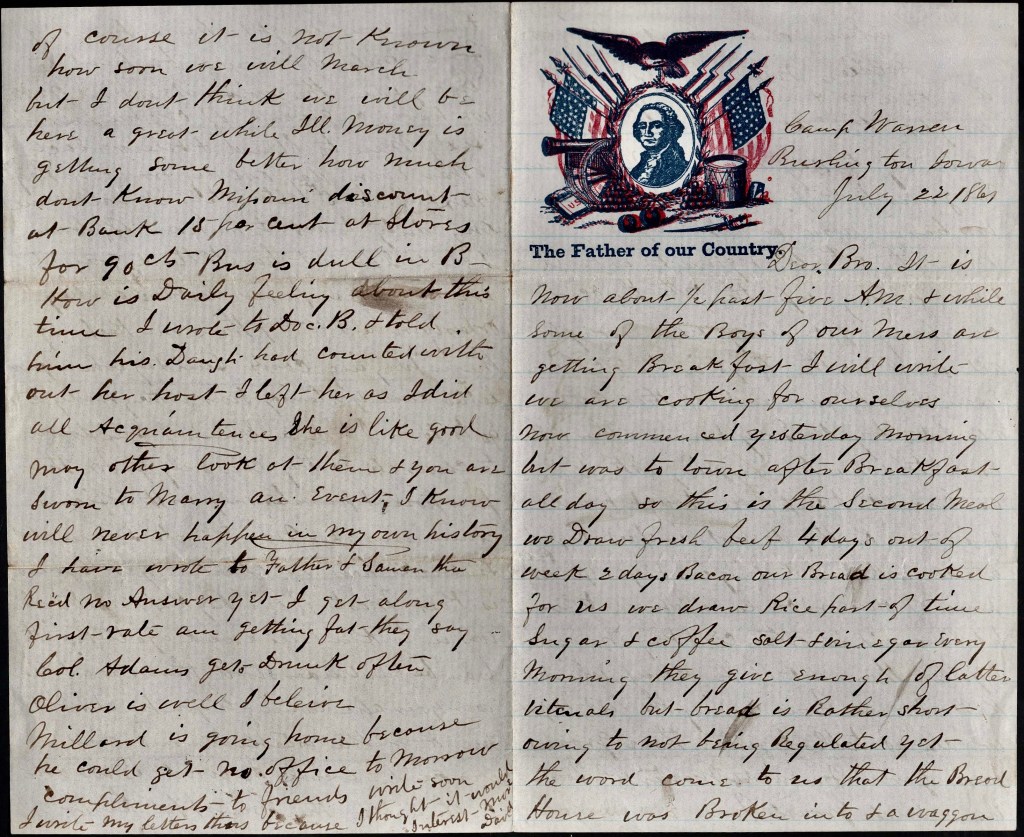
Patriotic letterhead on David’s letter of 22 July 1861

Camp Warren
Burlington, Iowa
July 22, 1861

Dear Brother,

It is now about half past five a.m. & while some of the boys of our mess are getting breakfast, I will write. We are cooking for ourselves now. Commenced yesterday morning but was to town after breakfast all day so this is the second meal. We draw beef four days out of week, 2 days bacon. Our bread is cooked for us. We draw rice part of time. Sugar and coffee, salt & vinegar every morning. They give enough of latter victuals but bread is rather short owing to not being regulated yet. The word come to us that the bread house was broken into & a wagon load taken out last night by the soldiers. May be so. They are ripe for anything you might think of.

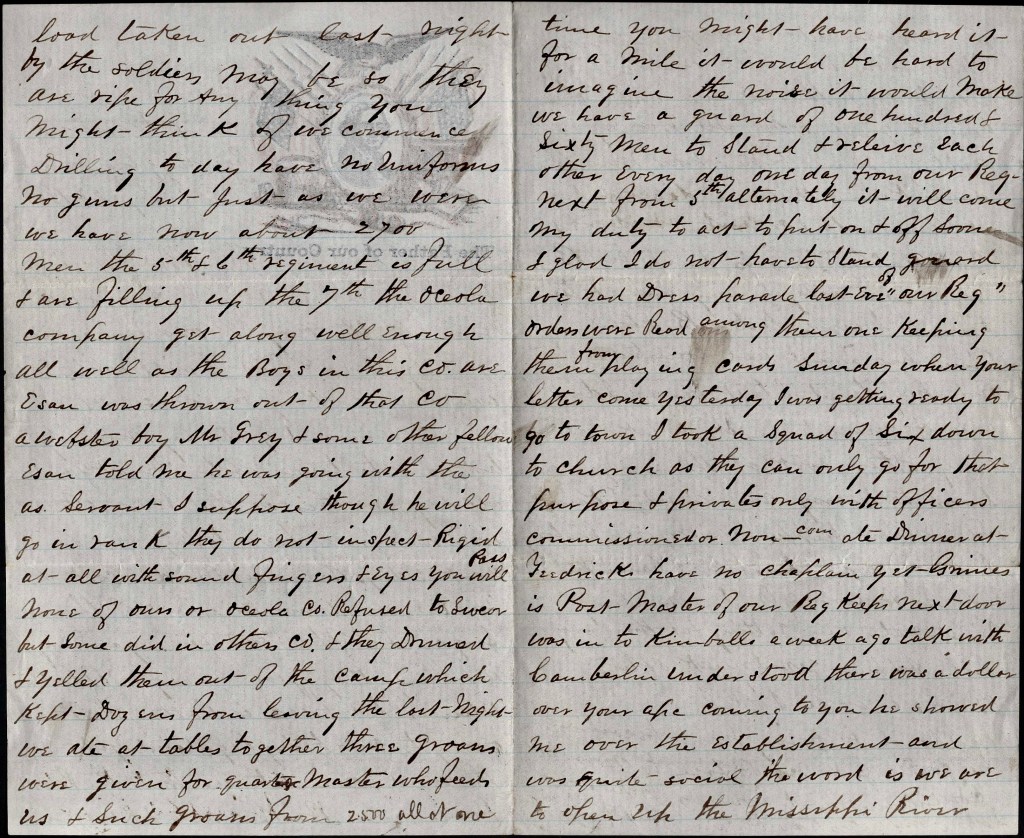
We commence drilling today. Have no uniforms—no guns—but just as we were. We have now about 2700 men. The 5th and 6th regiments is full and are filling up the 7th. The Osceola Company [Co. F] get along well enough. All well as the boys in this company are. Esau 1 was thrown out of that company. A Webster boy, Mr. Grey and some other fellow. Esau told me he was going with them as sergeant. I suppose though he will go in the ranks. They do not inspect rigid at all. With sound fingers and eyes you will pass. None of ours or [the] Osceola Company refused to swear but some did in other companies & they drummed and yelled them out of the camp which kept dozens from leaving. The last night we ate at tables together. Three groans were given for the quartermaster who feeds us, and such groans from 2500 all at one time! You might have heard it for a mile. It would be hard to imagine the noise it would make.

We have a guard of one hundred and sixty men to stand and relieve each other every day—one day from our regiment, next from 5th [Regiment] alternately. It will come my duty to act to put on and off soon. I’m glad I do not have to stand guard. We had dress parade last eve. Our regiment orders were read. Among them [was] one keeping them from playing cards Sunday. When your letter came yesterday, I was getting ready to go to town. I took a squad of six down to church as they can only go for that purpose & privates only with officers, commissioned or non-commissioned. Ate dinner at Fredrick. Have no chaplain yet. [Lt. John T.] Grimes is post master of our regiment. Keeps next door. Was into Kimball’s a week ago. Talk with Camberlin. Understood there was a dollar over your [ ] coming to you. He showed me over the establishment and was quite social.

The word is we are to open up the Mississippi river. Of course it is not known how soon we will march but I don’t think we will be here a great while. Illinois money is getting some better. How much, don’t know. Missouri discount at bank 15 percent at stores for 90 cents. Business is dull in Burlington. How is Daily feeling about this time? I wrote to Doc B. & told him his daughter had counted without her host. I left her as I did all acquaintances. She is like a good many others. Look at them and you are sworn to marry an event. I know will never happen in my own history.

I have wrote to Father and Samantha. Received no answer yet. I get along first rate. Am getting fat they say. Col. Adams gets drunk often. Oliver is well, I believe. Millard is going home because he could get no office tomorrow. Compliments to friends. Write soon. I write my letters thus because I thought it would interest most. — David


1 Possibly Esau McBride of Osceola, Iowa. He enlisted in mid-November 1861 and then again as a veteran in January 1864. He was taken prisoner while on a foraging detail in March 1865 but paroled and mustered out in July 1865.