Category Archives: 6th U. S. Cavalry

1863: Tattnall Paulding to Hiram Paulding

Tattnall Paulding in later life

The following letter was written by Capt. Tattnall Paulding (1840-1907) of the 3rd US Cavalry while in captivity at Libby Prison in Richmond, Virginia.

Paulding received his commission as a 2nd Lieutenant on 14 May 1861 and was appointed to the 3rd US Cavalry. He “quickly adjusted to cavalry life, and was mentioned favorably on several occasions by his superiors in the regiment over the winter. When the unit saw its first action at Williamsburg the following May, he was mentioned in his commander’s report for his coolness and gallantry in action. He was selected to lead the regiment’s detachment assigned to the Army of the Potomac’s provost guard under Brigadier General Marsena Patrick following the engagement.

“He continued to distinguish himself through the campaigns of 1862, Stoneman’s Raid and the battle of Brandy Station. During the Gettysburg Campaign, though only a lieutenant and now serving in the 6th US Cavalry, Paulding found himself commanding a squadron of men when they encountered elements of a Confederate brigade commanded by “Grumble” Jones. His men “fought dismounted from the protection of a fenced ridgeline. They blunted a charge by the 7th Virginia Cavalry with deadly fire from the muzzles of their .52 caliber carbines. Then, the 6th’s major ordered Paulding’s squadron to pursue the defeated foe. As they saddled up, the balance of Jones’ brigade came up, drew sabers and attacked. Unable to reach their horses in time, Paulding’s men were overrun by saber-swinging rebels. “My men were scattered through the field, and being pursued by the mounted foe were soon captured,” Paulding reported.” 1 Although a disastrous defeat for his outnumbered regiment, Paulding received a brevet promotion to captain for ‘gallant and meritorious service’ during the battle.

“Following the battle of Fairfield, he was reported by Lieutenant Nicholas Nolan as ‘missing, and supposed to be in the hands of the enemy.’ This was quickly confirmed, and Paulding spent the next nine months confined in Libby Prison. He was a prolific correspondent with his family during his internment, and these letters are very good primary source accounts of both the battle of Fairfield and life in Libby Prison.

“August 1864 was a good month for Paulding. Not only was he finally released from Libby Prison, but he was also promoted to captain in the 6th U.S. Cavalry on August 20th. Upon his release, Captain Paulding was assigned to operate the Mounted Recruiting Service station in New York City. Although the station notionally recruited for the army as a whole, the overwhelming majority of these men were sent to bolster the dwindling number of veterans in the ranks of the regular cavalry regiments of the Army of the Potomac. Captain Paulding received brevet promotions to major and lieutenant colonel on November 11, 1865 for meritorious services during the war. He relinquished command of the recruiting station when he resigned his commission on July 1, 1866.” [Source: Regular Cavalry in the Civil War]

Tattnall was the son of Rear Admiral Hiram Paulding (1797-1878) and Ann Marie Kellogg (1807-1894). He wrote the letter to his younger brother, Hiram Paulding, Jr. (1846-1924).

[Note: This letter is from the collection of Sal Terregino and was made available for transcription and publication on Spared & Shared by express consent.]

Transcription

Addressed to Hiram Paulding, Esq. Jr., Care of Admiral Paulding, Navy Yard, New York

Libby Prison
November 28th 1863

My dear brother,

Yours of 13th inst. came to me yesterday bringing the latest news I have received from home and I need not tell you that it was a welcome visitor. With it came Becca’s of 12th and Father’s of the 7th. Although a letter sent and received as is necessary for one in my position is all that we usually look for, it cheers a dreary prison life, when it comes from those we love, and brings tidings of their health and welfare. I congratulate you upon your promotion of which Father told me some time ago. I think that by this time you are quite a man of business. Your writing shows practice and if I may compliment you, improvement. I hear too that you are studying Spanish. My letter would be in that lingo if consistent with the prison rules. I studied for some time & made considerable improvement but our teacher became ill and the class was broken up. Time often hangs heavily but by keeping employed in one way and another, nearly five months of captivity have passed, cheered by hope of better days. Thanksgiving day was like other days with a rice pudding being the principal feature. A box has just come for B. F. Mead which I will try to push forward to him. Please send me the Cavalry Tactics (double back formation), Shakespeare (cheap edition) and a welcome & especially so now as we can send surplus to our enlisted me. 200 of my men are here yet. I am very well. Exchange is again below par. With love to all, your affectionate brother, — T. Paulding

[to] H. Paulding, Esq. Jr.
Navy Yard, New York

I have just received the box shipped 16th with no letter. The letter & papers & some baking powder are desirable parts of the box. The cans are fine & I will grow fat and defy scurvy.


1 Three Days in July: Faces of Union and Confederate Soldiers at the Battle of Gettysburg, Edited by Charles Joyce, Military Images Digital, June 8, 2020

1862: James Sanks Brisbin to Mary Jane (Wagner) Brisbin

This letter was written by James Sanks Brisbin (1837-1892), the son of Ezra Dougherty and Margaret (Packer) Brisbin of Centre county, Pennsylvania.

James Sanks Brisbin (seated), later in the war (Heritage Auctions)

When the American Civil War began in 1861, Brisbin was a lawyer in practice. He enlisted in the Pennsylvania volunteer services that April as a private. On April 26, he was appointed a second lieutenant in the mounted 2nd U.S. Dragoons. In the First Battle of Bull Run, Brisbin received two wounds, one in his side and the other in an arm, and was praised by his superiors for his performance during the fight.

On August 3, 1861, Brisbin transferred to the 1st U.S. Cavalry (previously known as the 1st Dragoons until a reorganization of the army) but then was appointed a captain in the 6th U.S. Cavalry two days later. On June 9, 1862, while fighting near Beverly Ford, Virginia, he was again wounded when he fell off of his horse. Exactly one year later Brisbin was brevetted to the rank of major for his conduct at Beverly Ford. In 1863 he very briefly led the cavalry forces in the Federal Department of the Susquehanna, and was wounded in a leg during combat near Greenbrier, Virginia, on July 26.

Brisbin was promoted to colonel on March 1, 1864, and organized the 5th United States Colored Cavalry. He served as the acting head of cavalry on the staff of Brig. Gen. Albert L. Lee during the Red River Campaign, and was again wounded during the Battle of Mansfield in Louisiana on April 8, this time in the right foot. On December 12, 1864, Brisbin was brevetted to brigadier general in the Union Army, and seven days later was appointed a brevet lieutenant colonel in the regular army for his performance at Battle of Marion in Tennessee. In 1865, he was on recruiting duty in Kentucky, serving on the staff of Maj. Gen. Stephen G. Burbridge. On March 13, Brisbin was brevetted to colonel in the regular army as well as brevetted major general in the Union Army, and on May 1 he was promoted to brigadier general. Brisbin was mustered out of the Union Army as a volunteer on January 15, 1866. [Wikipedia]

This letter was written just a few days before the Battle of Fredericksburg. The 6th US Cavalry had been encamped in the vicinity of the Rappahannock river since 24 November 1862. During the battle, the 6th sent a squadron across the Rappahannock on a pontoon bridge to reconnoiter the enemy positions but had to withdraw when they received enemy artillery fire, losing 2 men and eight horses. After making their report to Gen. Burnside, they were held in reserve near Falmouth where they remained several months. I have not learned whether Capt. Brisbin was with the squad that entered Fredericksburg or not. From this letter we learn that he had been placed under arrest on some unidentified charge though he or someone else tried to conceal that piece of information by attempting to cross out those words that I indicated with a strikethrough.

Transcription

Camp 6th US Cavalry
Belle Plaine, Virginia
December 9th, 1862

My Dear Wife,

I wrote you this morning but as it is my duty to write you every day, I will write you again. Te sun came out today but the air was quite cold all day. The river is now frozen over but not hard enough to bear. If the river gets solid, I think we will either go over or the Rebs will come over. All the people of Falmouth and Fredericksburg are camped out. It must be pretty cold on the women & children.

I think the great battle of the war is at hand. All other battles will be as nothing when compared with it. They say we have four hundred thousand men here. I think not so many as that but we certainly have three hundred thousand and that is a good many men. The Rebels must have two hundred and fifty thousand so we will be able to get up quite a respectable fight. Half a million of men fighting will raise considerable smoke and dust and make quite a noise.

I am afraid they will keep me under arrest and if so I can’t fight. Men under arrest can’t fight. I suppose you would not care if there was a fight & they did keep me under arrest and keep me out of it, but I would not miss the next battle for anything. I would rather lose a leg. Our men are all anxious for a fight & confident they can whip the Rebels. The next battle will end the war, one way or the other. If we are defeated, I think the Confederacy will be acknowledged. But if we whip them, they will make peace. God grant the war may soon end.

I did not get any letters today and so am disappointed. I missed the mail this morning and had to send one of my men 5 miles with your letter to get it mailed. They say we will get a mail every day hereafter so you can now write and be certain I will get your letters.

We get plenty to eat. Have flannel [pancakes] cakes, ham, butter, sugar, coffee &c. Butter is a dollar a pound but we can trade coffee for butter. Coffee is $2 a pound but we can buy it at 26 cents. Salt is any price but we get it at a cent a pound. The people of Virginia will give anything they have for a little sugar, coffee, or salt. Madden’s brother has come. Madden still has a little diarrhea. Lt. Tupper and I are now living together. Tupper is a nice, quiet fellow. Lt. Madden’s brother is coming up.

I do hope you will try and be happy and patiently bear this separation. I can assure you it is a bitter pill to me but all things have an end and so will the war. You must never quarrel with me anymore when I come home again. Wy did you not get coal? Tell them to get you coal at once. If this coal matter is not attended to, I will take some very decided action about it that will surprise you all. I would give a month’s pay to be home tonight and sleep in your arms. You can’t send a box. I would never get it. Capt. Saunders has got a leave at last & gone to Kentucky.

Do not fret about me. I am all right. The Rebs can’t kill me—at least I am not uneasy. Who is to be—what do you call them? brideswoman to Sallie? I think Josh would make a good groomsman. Your Pap made a very good one when we were married. But I will close. It is getting warmer. How I would like to be at home and get some apples tonight.

Goodbye darling. Pray for your, — Jim

1864: Charles Gordon Austin to Zadok Baldwin Austin

This letter was written by Charles Gordon Austin (1814-1899)—a Canadian by birth—and his wife Pamelia Anna Tyler (1817-1897) of Rossie, St. Lawrence county, New York. Several of their children are mentioned in the letter, including: Benjamin M. Austin (1840-1885) who enlisted as a corporal in Co. C, 60th New York Infantry and transferred in November 1862 to the 6th US Cavalry; Elizabeth Tirzah Austin (1835-1909) who would later marry Charles F. Northrop; and Lucy Maria Austin (1843-1914).

Charles wrote the letter to his son Zadok Baldwin Austin (1837-1925) who enlisted on 7 August 1862 as a private in Co. F, 10th New York Heavy Artillery (106th New York State Volunteers). At the time of his enlistment he was described as 24 years-old, with blue eyes, light hair, and standing 5 feet 7.5 inches tall. Zadok mustered out of the regiment on 23 June 1865 with his company at Petersburg, Virginia.

Transcription

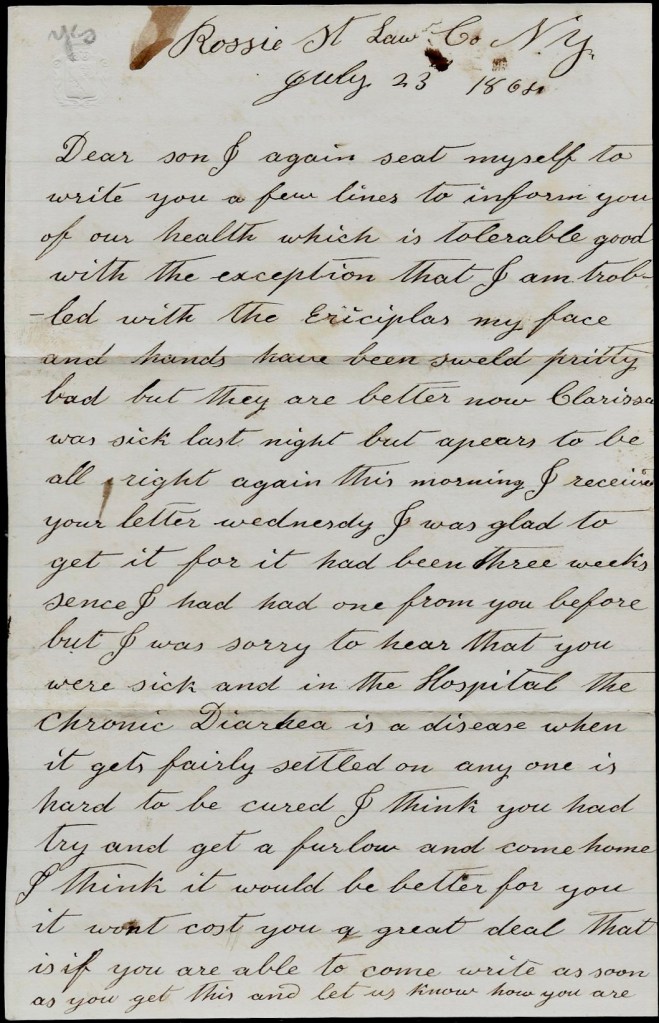
Rossie, St. Lawrence county, New York
July 23, 1864

Dear Son,

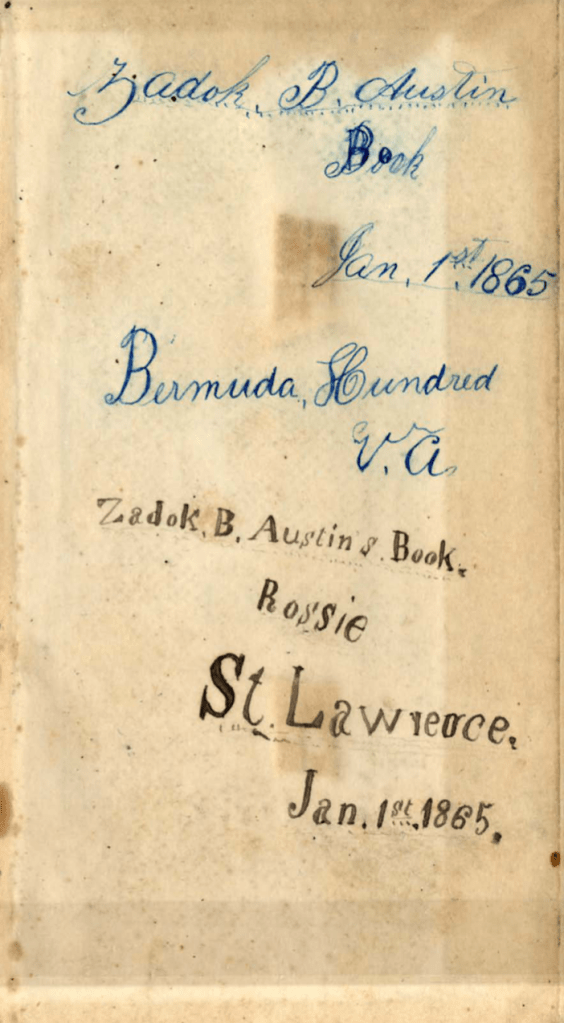
Digital images of Zadok’s 1865 Diary & a transcript are available at the Auburn University Digital Library

I again seat myself to write you a few lines to inform you of our health which is tolerable good with the exception that I am troubled with the erysipelas. My face and hands have been swelled pretty bad but they are better now. Clarissa was sick last night but appears to be all right again this morning.

I received your letter Wednesday. I was glad to get it for it had been three weeks since I had had one from you before but I was sorry to hear that you were sick and in the hospital. The chronic diarrhea is a disease when it gets settled on anyone is hard to be cured. I think you had [better] try and get a furlough and come home. I think it would be better for you. It won’t cost you a great deal—that is, if you are able to come. write as soon as you get this and let us know how you are.

I received a letter from Benjamin last week Wednesday. He was well when he wrote. That was July 6th, 1864. He was twelve miles from Richmond. He said they would stay there a spell to rest their horses. I have received two letters from Tirzah since I write to you last. Robert is killed. He was out on a raid forty miles from camp when he was shot by a rebel through the neck and killed instantly. He was carried back to Newbern and buried. Tirzah is well and so is Priscilla and George Gibson. The folks in Hammond are well. Lucy is at home now and is well. I have not got your things yet. Write as soon as you get this. We remain your loving father and mother.

— Charles G. Austin & Pamelia A. Austin

To Zadock B. Austin