Category Archives: 70th New York Infantry

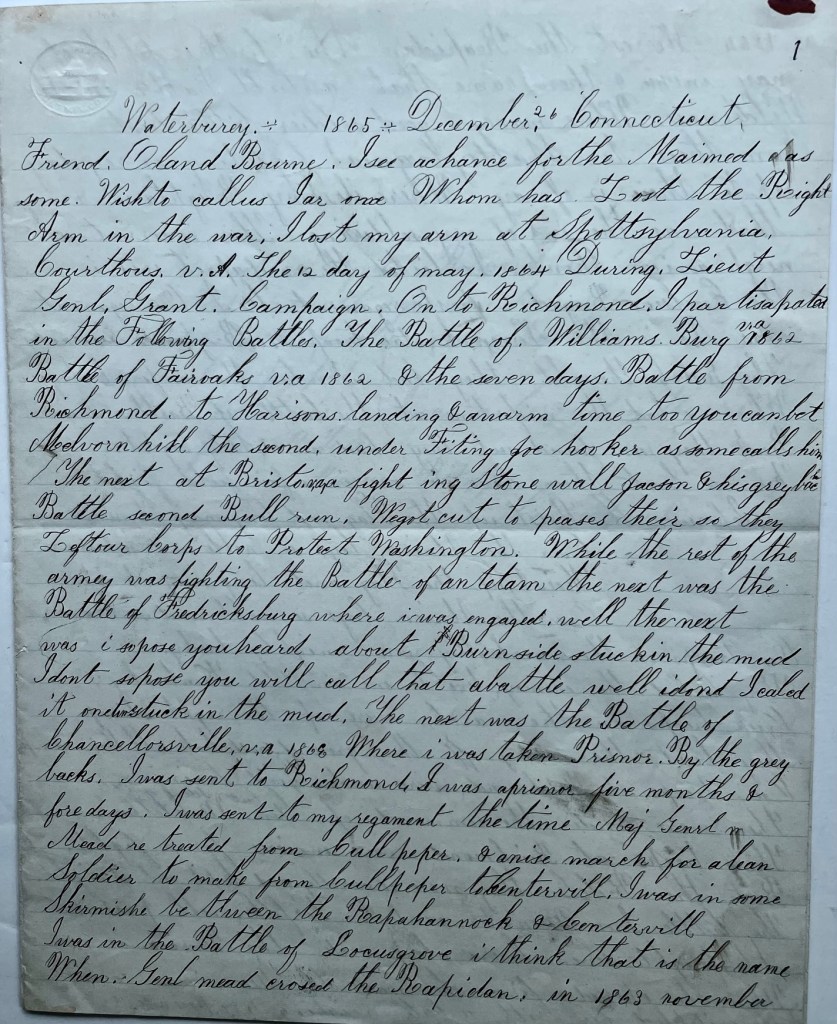
1865: John M. Tures to William Oland Bourne

This letter was written by John M. Tures although he was carried on the Roster of the 70th New York Infantry as John M. Touris, Tours, or Turse. John enlisted on 24 April 1861, at Paterson, N. J., when he was 21 years old to serve three years in Co. I. He mustered in as private, and was later promoted to corporal. He was captured in action on 2 May 1863, at Chancellorsville and paroled five months later. He was seriously wounded in the battle of Spottsylvania Court House on 14 May 1864 and was mustered out on 1 July 1864, at New York city.

John wrote the letter to William Oland Bourne (1819-1901), editor of The Soldier’s Friend, who sponsored a contest in 1865-1866 in which Union soldiers and sailors who lost their right arms by disability or amputation during the Civil War were invited to submit samples of their penmanship using their left hands. The contest, which awarded a total of $1,000 in prizes for the winning entries, was followed in 1867 by a second contest, which awarded $500 in prizes. A very large number of letters were submitted to Bourne which are now housed in the Library of Congress along with some photographs on the contestants. Most likely the following letter was a personal copy (or first draft) of the letter that John submitted. It’s also possible that John never sent the letter or missed the deadline for submission. See Wm. Oland Bourne Papers. Readers hoping to learn more about “The Left Armed Corps” can listen to Episode 1932 of Civil War Talk Radio wherein Allison M. Johnson is interviewed by Gerry Prokopowicz regarding her book on the subject.

[Note: This letter is from the personal collection of Greg Herr and was offered for transcribed and publication on Spared & shared by express consent.]

Transcription

Waterbury [Connecticut]
December 26, 1865

Friend Oland Bourne,

I see a chance for the “maimed” as some wish to call us. I are one whom has lost the right arm in the war. I lost my arm at Spottsylvania Court House, Va., the 12th day of May 1864 during Lieut. Gen. Grant’s Campaign on to Richmond. I participated in the following battles. The Battle of Williamsburg, Va. 1862; the Battle of Fair Oaks, Va., 1862; and the Seven Days Battle from Richmond to Harrison’s Landing, and a warm time too, you can bet. Malvern Hill the second under Fighting Joe Hooker as some calls him. The next at Bristoe, Va., fighting Stonewall Jackson & his grey backs; Battle of Second Bull Run—we got cut to pieces there so they left our trooops to protect Washington while the rest of the army was fighting the Battle of Antietam. The next was the Battle of Fredericksburg where I was engaged. Well, the next was I suppose you heard about Burnside stuck in the mud. I don’t suppose you will call that a battle. Well I don’t. I called it one time stuck in the mud.

The next was the Battle of Chancellorsville, Va. 1863 where I was taken prisoner by the grey backs. I was sent to Richmond. I was a prisoner five months & four days. I was sent to my regiment the time Maj. General Meade retreated from Culpeper & a nice march for a lean soldier to make from Culpeper to Centreville. I was in some skirmishes between the Rappahannock & Centreville. I was in the Battle of Locust Grove—I think that is the name, when Gen. Meade crossed the Rapidan in 1863 November.

We crossed the Rapidan the fourth or fifth of May in 1864 and then came that awful Battle in the Wilderness where many a good soldier but the dust. From there to Spottsylvania, fighting every day up to the 12th of May where I lost my right arm & that was the end of my soldiering. This is correct as nigh as I can think. I enlisted the 26th of April 1861 in the Excelsior Brigade, 1st Regiment, Co. I. Our regiment was numbered in the New York State Troops, 70th Regiment.

The rebels thought they had us when the war first begun
When we had the misfortune at the battle of Bull’s Run;
But they soon found out they had no earthly sight
For we beat them two to one in a fair, field fight.

Chorus:

Hoist up the Flag and long may it wave
Over the Union, boys, so noble and so brave;
Hoist up the Flag and long may it wave
Over he Union boys so noble and so brave.

Our troops on the march they were mighty lucky,
They licked the enemy, two to one in Old Kentucky;
Our troops on the march were of the right stamp
They beat the enemy off the ground, and took all their camp

Our troops at Richmond 1 were under good training
They were under the command of Gen. McClellan (but I don’t see it)
The troops at Richmond 1 were anxious for a fight
But the rebels they were cowardly and kept out of sight.

The little Iron Monitor went to Norfolk, well packed,
She fought seven hours along side the Merrimac
When she opened fire she made the Merrimac sound
She crippled her with a ball weighing 480 pounds.

I did not see your reward until about a month ago so I have not had much practice and practice makes perfect. I was a corporal in the 7-th New York Vols., Co. I

My address is John M. Tures, Mianus Post Office, Connecticut


1 I think John must have meant Washington here, not Richmond. This poem appears to be original. I can’t find any evidence that it was copied from published sources.
The Partial 1862 Diary of Averill Jacob Roundy, 70th New York Infantry

This diary was kept by Averill Jacob Roundy (1835-1916), the son of Marvin Roundy (1808-1893) and Frienda Louisa Averill (1812-18xx) of Huron, Wayne county, New York. Averill enlisted on 22 April 1861 in Co. C, 70th New York Infantry. He was seriously wounded at the Battle of Williamsburg on 5 May 1862 (as stated in his diary) where 8 members of his company were killed and 22 others were wounded. On account of this wound, he was discharged from the hospital at Albany, New York, in October, where he was eventually sent. Later in the war, he sought permission to re-enter the service but was not permitted. Averill married Ellen Southwell (1841-1893) in 1865 and the couple had four children.

This uncased ambrotype of a Union soldier was included among the personal items in the collection of Averill Jacob Roundy and may actually be him although it is unmarked.

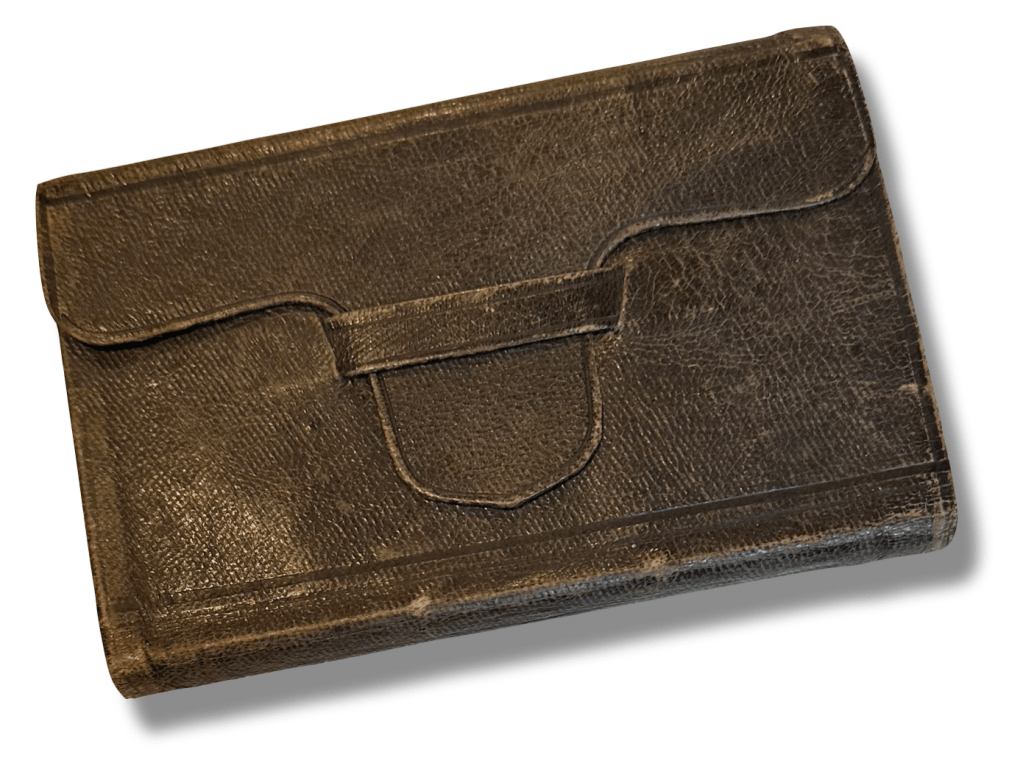
The leather pocket diary measures 3.25 x 5 inches and was most likely purchased at the sutler’s tent near Fortress Monroe on 12 May 1862—one week after Averill was wounded in the Battle of Williamsburg while serving in the ranks of the 70th New York Infantry. This regiment was recruited by Dan Sickles who served as its temporary colonel until promoted to Brigadier General of the “Sickles Brigade” of which the 70th New York was a part. At the Battle of Williamsburg—the first battle of consequence in which the 70th participated—the regiment lost 339 killed, wounded, or missing, of the 700 engaged. For Averill, it would be his first and last battle.

Averill’s handwriting is clear and easily read, even though the entries are in pencil. I have only transcribed that portion of the diary that pertains to his military service. The latter portion of the diary includes entries made in Effingham and Galesburg, Illinois, where Averill attempted to make a living as a teamster, I believe, though he did not appear to be much satisfied with the work or the location.

See also two letters written by Lt. Charles Trowbridge Dwight who served in Co. B, 70th New York Infantry.

[Note: This diary is from the personal collection of Greg Herr and was made available for transcription and publication on Spared & Shared by express consent.]

Transcription

The pocket diary Averill purchased at the Sutler’s Tent near Fortress Monroe on 12 May 1862

May 12th—Averill J. Roundy’s book. In Chesapeake General Hospital, Fortress Monroe

Chesapeake General Hospital (large building) near Fortress Monroe

May 5th—Got wounded in a battle at Williamsburg

May 6th—Wound very sore. Had the ball cut out [of left shoulder].

May 8th—Got aboard the boat for Fort Monroe

May 11th—Landed at Ft. Monroe. Was taken to the Chesapeake General Hospital.

May 12th—Went to the sutlers and back. Got tired most out.

May 13th—Feel rather sore today but guess my wounds will come out all right. Hear all kinds of stories about the success of our troops. Hope they are true.

May 14th—Feel very well today. Guess I shall get so as to go home before long. Have not heard from the company since I left.

May 15th—Feel very well today. If I have no serious drawback, shall soon be well. Wrote a letter to E.

May 16th—It is pleasant today but cool. Wounds feel easy. Surgeon gives hopes of soon being able to go home. Hope to be able to go on the next boat.

May 17th—Is a lovely morning—cool and pleasant. Sun shines out clear. Am going to try and see Crow today. My wounds seem to be doing well. Went and saw Crow. Found him doing very well.

May 18th—[Sunday] It is a very pleasant day. Don’t feel quite as well today. Guess it was most too much for me going over to Crow’s yesterday. Have hopes of soon going home but don’t know how soon for we can’t go away from here just yet. Had a short but very pleasant sermon today. It was good to see.

May 19th—Is a very pleasant morning—cool and nice. Feel very well today.

May 20th—Nice morning—cool and pleasant. Feel very well but don’t hear any more about going home. Guess they mean to keep us here until we get well. Hope they won’t though.

May 21st—Passed the worst night I have seen since I came here. Could not sleep nor rest. Feel quite unwell today. Head aches some. Back aches some. Not a very pleasant morning. Cool but cloudy and misty.

May 22nd—Passed a very easy night. Rested well. Feel very well this morning. Nice and pleasant, dry, cool and comfortable. Report is that we are going to be sent to New York today. Hope it is so. Guess I can stand it. Have got on the boat at last to go home. Guess I shall make a go of it.

May 23rd—Have not started yet. Been kept on the boat all night. Got no supper last night. Don’t see as we are going to get any breakfast today. Have got started at last and are going at pretty good speed for New York.

May 24th—Are within about forty miles of Sandy Hook. Expect to see New York City this afternoon. Have heard that that the boat is to go to Albany to take some as far as there on the road to their homes. Hope it is so for there is where I want to go, you may be sure.

May 25th—This morning landed in New York City and was taken to the Park Barracks where we had our wounds dressed and taken care of for the first time since we left Fortress Monroe.

May 26th—Have concluded to go on home and have got on the boat for Albany and we have got started and are moving with good speed towards our destination.

May 27th—Landed in Albany this morning and took the cars for Clyde. Got there and from there home a little before sunset.

June 3rd—Went over to Uncle Daniel’s and had a good time. Got home about dark.

June 5th—Feel first rate today. Am getting along finely. Have been most all over the farm.

June 8th—Am at Uncle Botham’s today. Is a very pleasant day—cool and pleasant.

June 10th—Am at Uncle Daniel’s out in the logging field.

June 20th—Got a good long letter from [ ].

June 22nd—Got my coat on for the first time since I got hurt May 5th ’62.

July 11th—Got a certificate of disability for duty from Dr. Willson.

July 16th—Got a letter from Capt. Mooney.

July 17th—Went to Rochester and from there to Albany…

July 24th—Have been writing a little, reading a little, and doing a great deal of nothing. But it is dull work here. I must wait and watch for better times…

July 31st—Have been to the City [of Albany] to have my likeness taken.

August 1st—The most of the wounded have been sent from here [Albany] today.

August 2nd—Sent a letter home with a photograph in it. Also one to Henry Mayo and one to Ell. and have got four left. One to K___ and one to Justin leaving only two.

August 3rd—Gave a photograph to Miss Rawson and one to Miss Mary Carey.

August 8th—Am still in the hospital and likely to stay there for some time yet. Very lonesome and dull here. Almost dead with ennui.

August 11th—It is very warm this morning and I cannot find much to satisfy myself. Must go down to the City today and got my photographs.

August 13th—Got a letter from Almira this morning adn have written an answer to it. Gave a photograph to Dr. R. S. Havens.

August 17th—Gave a photograph to E. W. Merrill and down to the City this forenoon heard some splendid singing at the Cathedral.

August 18th—There went a regiment from here today, about twelve hundred strong.

August 23rd—Feel rather bad today. Curious I don’t receive any letters. Guess the folks have forgot me.

Capt. William H. Hugo of Co. C, 70th New York
(Military Images)

August 29th—It begins to look and feel like fall and I begin to think I shall have to spend another winter in the army.

September 7th—Sunday and a cool and pleasant day. Have been over to an orchard and got all the apples I could eat.

September 27th—Received my Descriptive List today from Capt. [William H.] Hugo.

October 6th—Have got my discharge and am at home once more—a free man.

October 27th—The snow is about three inches deep and it is snowing like fun….

December 18th 1862—Effingham, Illinois. Commenced work for Samuel Fleming at $12/month.


1862: Charles Trowbridge Dwight to Elizabeth (Wilder) Dwight

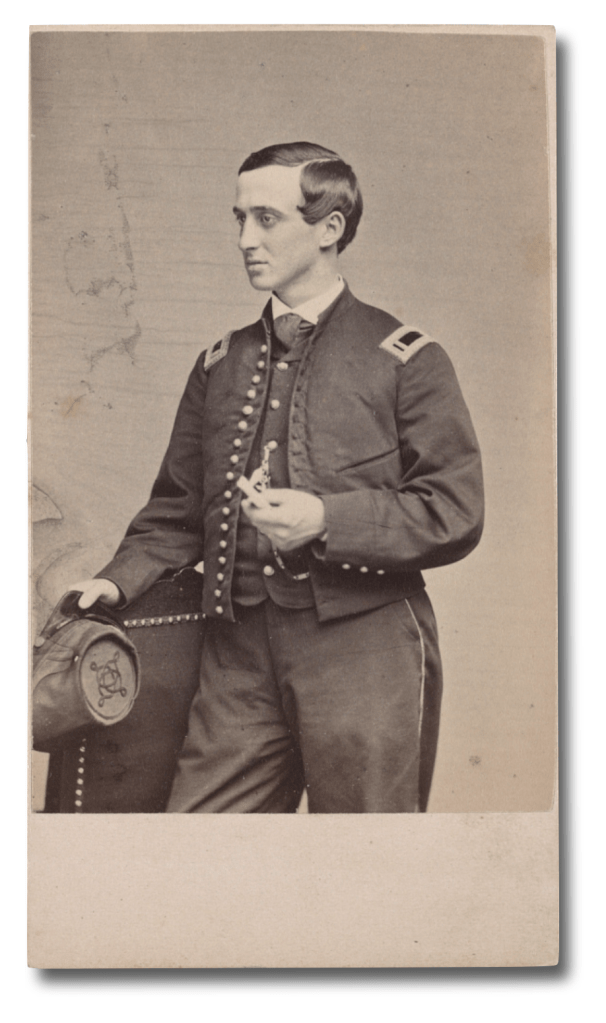
2nd Lt. Charles Trowbridge Dwight

These letters were written by Charles Trowbridge Dwight (1842-1884), the son of William Dwight (1805-1880) and Elizabeth Amelia Wilder (1809-1883). Charles was a student at Harvard when the war erupted and he dropped out of school to accept a commission as 2nd Lieutenant in Co. B, 70th New York Infantry. He was mustered in on 1 November 1861 and discharged from the service on 30 June 1864. Charles’ brother, William Dwight, Jr., mustered in as Lt. Colonel of the same regiment and was promoted to Colonel on 30 November 1862 when the regiment’s first Colonel, Dan Sickles, was promoted to Brigadier General.

Charles wrote these letters during the Peninsula Campaign in the summer of 1862. In the battle of Williamsburg, the first battle of consequence in which the 70th took part it met with the heaviest loss of its service. Out of 700 engaged the loss was 330 killed, wounded or missing. At Fair Oaks and in the Seven Days’ battles the regiment was also active. In the letter datelined “In the Field before Richmond” on 15 June 1862, Charles reassures his mother that he is yet alive and informs her that, “McClellan is moving slowly along in his plans as usual and we are undergoing the tedium of another siege instead of ending it by a good, smart fight.”

Letter 1

In the field before Richmond
June 15th 1862

My dearest Mother,

Although I wrote a letter last night, still as I have just received yours of the 10th in which you express so much anxiety on my account, I feel that it is to say the least my duty to do all I can to relieve your fears. To begin them, I am in splendid health except thin from the excessive heat from which we are now suffering. A thunderstorm has just cooled the atmosphere somewhat.

McClellan is moving slowly along in his plans as usual and we are undergoing the tedium of another siege instead of ending it by a good, smart fight. Every third day we either go out on picket or into the trenches. Our pickets are so close that we can hear them talk but we have orders positive not to fire unless they advance. We daily have skirmishes between the pickets and now and then (as for instance, today) they throw a few shell at us. Some came into our camp doing no injury to us although they wounded two or three in the trenches in front.

The army awaits with impatience the order to move. Sickness is prevalent. How I should like to have an opportunity to be at class day but it is not my good fortune.

There is nothing new. I am sorry Chip is so anxious to come out and I wrote him so. There are enough here now. If you wish me to write, you must send me postage stamps.

Give my love to Eliza Chapman, father & Wilaver.

With much [love] to you. Every your affectionate son, — Charley


Letter 2

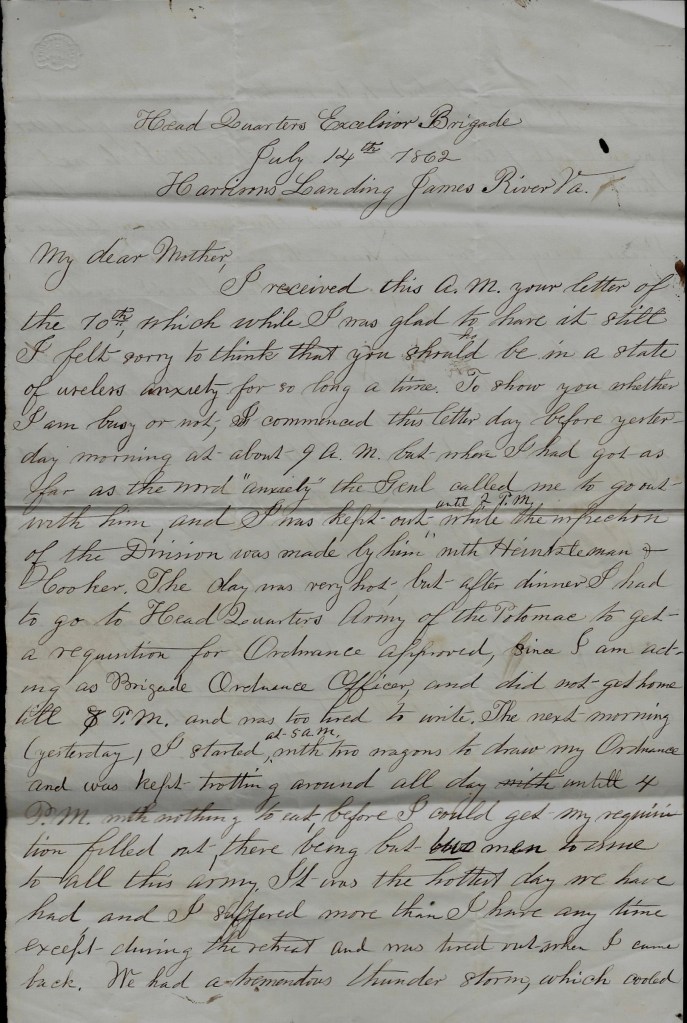
Headquarters Excelsior Brigade
Harrison’s Landing James River, Va.
July 14th 1862

My dear Mother,

I received this a.m. your letter oof the 10th which while I was glad to have it, still I felt sorry to think that you should be in a state of useless anxiety for so long a time. To show you whether I am busy or not, I commenced this letter day before yesterday morning at about 9 a.m. but when I had got as far as the word “anxiety” the General called me to go out with him, and I was kept out until 2 p.m. while the inspection of the Division was made by him with Heintzelman & Hooker. The day was very hot, but after dinner I had to go to Headquarters, Army of the Potomac, to get a requisition for ordnance approved., since I am acting as Brigade Ordnance Officer, and did not get home till 8 p.m. and I was too tired to write.

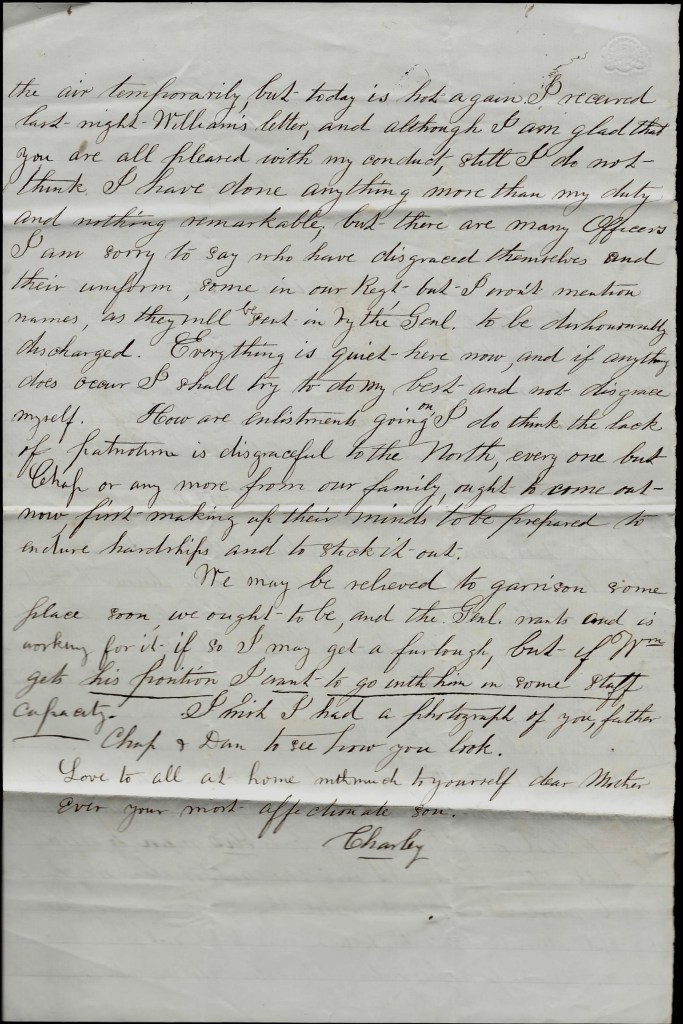
The next morning, yesterday, I started at 5 a.m. with two wagons to draw my ordnance and was kept trotting around all day until 4 p.m. with nothing to eat before I could get my requisition filled out, there being but two men to issue to all the army. It was the hottest day we have had and I suffered more than I have any time except during the retreat and was tired out when I came back. We had a tremendous thunder storm which cooled the air temporarily but today it is hot again.

I received last night William’s letter and although I am glad that you are all pleased with my conduct, still I do not think I have done anything more than my duty and nothing remarkable. But there are many officers, I am sorry to say, who have disgraced themselves and their uniform—some in our regiment, but I won’t mention names as they will be sent in by the general to be dishonorably discharged. Everything is quiet here now and if anything does occur, I shall try to do my best and not disgrace myself.

How are enlistments going on? I do think the lack of patriotism is disgraceful to the North. Everyone but Chap or any more from our family ought to come out now, first making up their minds to be prepared to endure hardships and to stick it out.

We may be relieved to garrison some place soon. We ought to be and the General wants and is working for it. If so, I may get a furlough but if William gets his position, I want to go with him in some staff capacity. I wish I had a photograph of you, father—–Chap & Dan to see how you look.

Love to all at home, with much to yourself, dear Mother. Ever your most affectionate son, — Charley