This partial letter was written by a member of Co. D, 72nd Illinois Infantry—the “First Chicago Board of Trade Regiment.” Raised in Cook county. The letter was addressed to his friend Rocelia Lucretia Hemingway (1808-1886), the daughter of Allen Hemingway (1808-1886) and Marietta Linsley (1808-1842) of Leydon, Cook county, Illinois. Mentioned in the letter are Rocelia’s two brothers, Rodney A. Hemingway (1835-1863) and (her half-brother) Anson Tyler Hemingway (1844-1926) who also served in Co. D. Rocelia was married to George Andrew Stoughton (1834-1914) in March 1855.
The letter pertains to the scouting expedition made by four companies in the 72 Illinois Infantry (240 men) from Columbus, Kentucky, to Covington, Durhamville, & Fort Radolph, Tennessee to rout out rebel guerrillas. For a full description of the orders and actions taken on this scout, see September 18, 1862-October 5, 1862, Anti-guerrillas expedition.
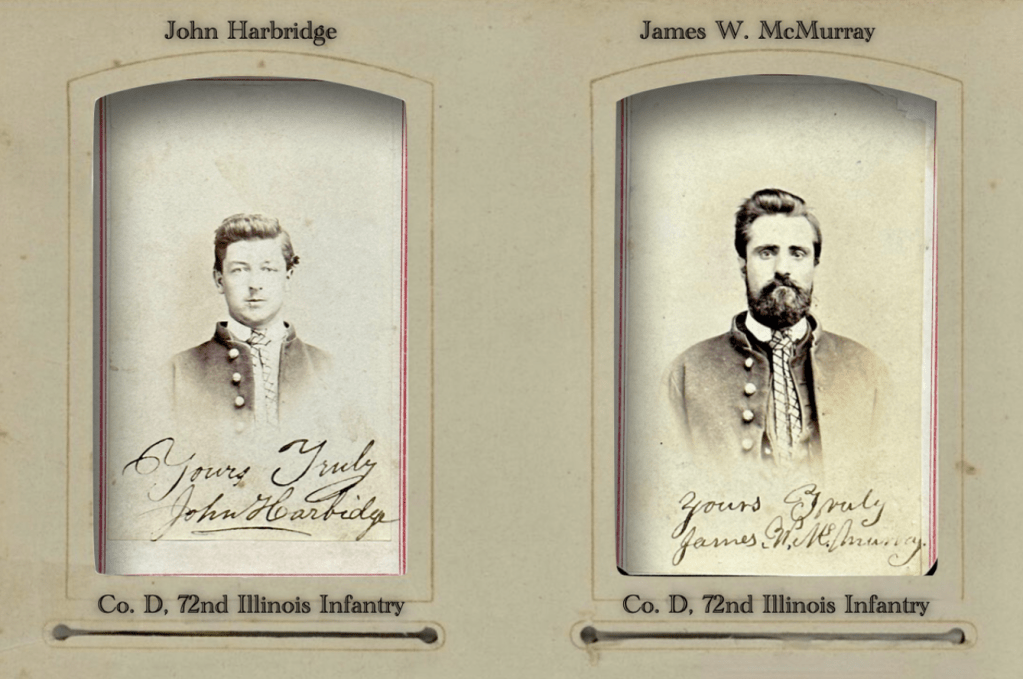
Harbridge & McMurray, two members of Co. D, 72nd Illinois (Al & Claudia Niemiec Collection)
Transcription
Columbus [Kentucky] Wednesday, October 9, 1862
Rocelia, dear friend,
You must excuse me for not writing to you sooner but if you would only stop to think of the conveniences that soldiers have to write, you would wait patiently for one to come if not oftener than twice a year. When we sit down to write we are sometimes called away three or four times before we get it wrote. But I suppose you won’t believe that I am writing the truth. But never mind. If you was a soldier you would find it out.
It is raining now almost as fast as it did the night that we was at your house when [your husband] George was home and there is a little river running through our tent. If it keeps on, we may make a small boat to keep us from getting drowned.
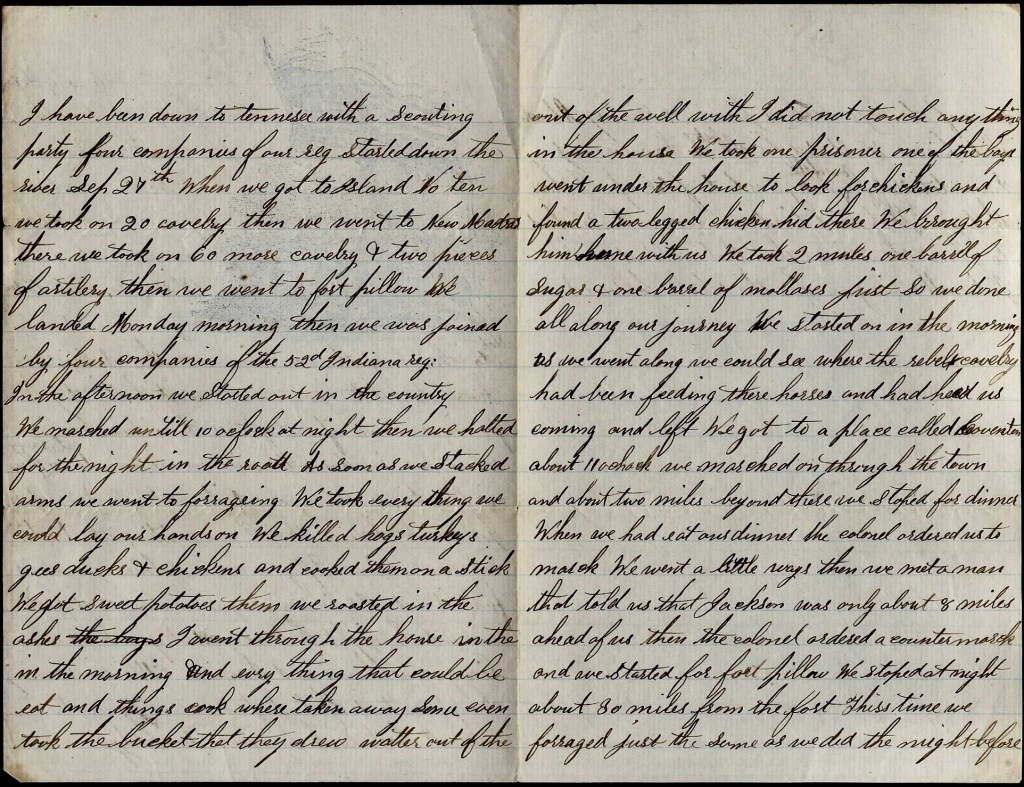
I have been down to Tennessee with a scouting party. Four companies of our regiment started down the river September 27th. When we got to Island No. 10, we took on 20 [from Co. L, 2nd Illinois] cavalry. Then we went to New Madras. There we took on 60 more [from Co. D, 2nd Illinois] cavalry & two pieces of artillery [from Capt. De Golyer’s Batter]. Then we went to Fort Pillow. We landed Monday morning [29 September]. Then we was joined by four companies of the 52nd Indiana Regiment. In the afternoon we started out in the country. We marched until 10 o’clock at night. Then we halted for the night in the road. 1 As soon as we stacked arms, we went to foraging. We took everything we could lay our hands on. We killed hogs turkeys, geese, ducks, & chickens and cooked them on a stick. We got sweet potatoes. Them we roasted in the ashes. I went through the house in the morning and everything that could be eat and things cooked were taken away. Someone even took the bucket that they drew water out of the well with. I did not touch anything in the house.
We took one prisoner. One of the boys went under the house to look for chickens and found a two legged chicken hid there. We brought him home with us. We took two mules, one barrel of sugar, and one barrel of molasses just so we done all along our journey.
We started on in the morning. As we went along, we could see where the rebel cavalry had been feeding their horses and had heard us coming and left. We got to a place called Covington about 11 o’clock. We marched on through the town and about two miles beyond there we stopped for dinner. When we had eat our dinner, the colonel ordered us to march. We went a little ways, then we met a man that told us that Jackson was only about 8 miles ahead of us. Then the colonel ordered a countermarch and we started for Fort Pillow. We stopped at night about 30 miles from the fort. This time we foraged just the same as we did the night before. Some of the boys broke a piano and sewing machine all to pieces.
We started for the fort in the morning. I was detailed for one of the rear guard to fetch up all those that fell back that was tired and worn out. We had to force them on and them that couldn’t walk put on the wagons for the rebels followed to pick up all the stragglers. We got to the Fort 10 o’clock at night. As soon as the regiment at the fort heard that we were coming, they sent out wagons to meet us & get the sick. When we got to the fort, we was all pretty tired. I stood the march as well as anyone in the regiment. We took on the march 42 mules and horses, 5 wagons, 4 or 5 barrels of sugar and molasses, two wagon loads of cotton, and about 12 prisoners, 1 rebel captain and one we shot dead. I had a pretty mule but it was so wild I could not ride him so I let him go. We slept 8 nights in the open air with half of our blanket under and half over us. We didn’t take our knapsack or dress coat or overcoat with us; just our blouse and blanket. Anson and Rodney [Hemingway] did not go with us for they were sick. [unsigned]
1 The party bivouacked for the night at the plantation of a notorious and avowed secessionist named Overall.
The following letters were written by Samuel Dill Cole (1819-1903), who enlisted as a private in Co. I, 72nd Illinois Infantry in mid-August 1862. At the time of his enlistment, Samuel was described as a 5’7″ tall, brown-haired, married, 44 year-old farmer residing in Prairie City, McDonough county, Illinois. When he wrote these letters in 1864, Samuel was in the Fifth Veteran Reserve Corps (VRC), having been transferred in August 1863 after only one year of service in the 72nd. We learn from these letters that Samuel had been wounded in his right arm on 22 May 1863 in the fighting before Vicksburg. The Fifth VRC was garrisoned in Burnside’s Barracks in Indianapolis where their regular duty was to guard Confederate prisoners in nearby Camp Morton.
Samuel was the son of Alva Cole (1774-1846) and Rosamond Freeman (1787-1847) of Cattaraugus county, New York. He was married to Myrna Miriam Brenenstall (1820-1887) and had at least three children, Martha Lovina (1854-1939), Rufus Rozel Cole (1858-1861), and Alva Abram Cole (1861-1925). He wrote these letters to his sister, Ruba Eloise (Cole) Merrill (1816-1887) who lost both her husband, Barzilla Merrill and her son, Alva Merrill, in the Battle of Chancellorsville in May 1863. Both were serving in Co. K, 154th New York Infantry.
Letter 1
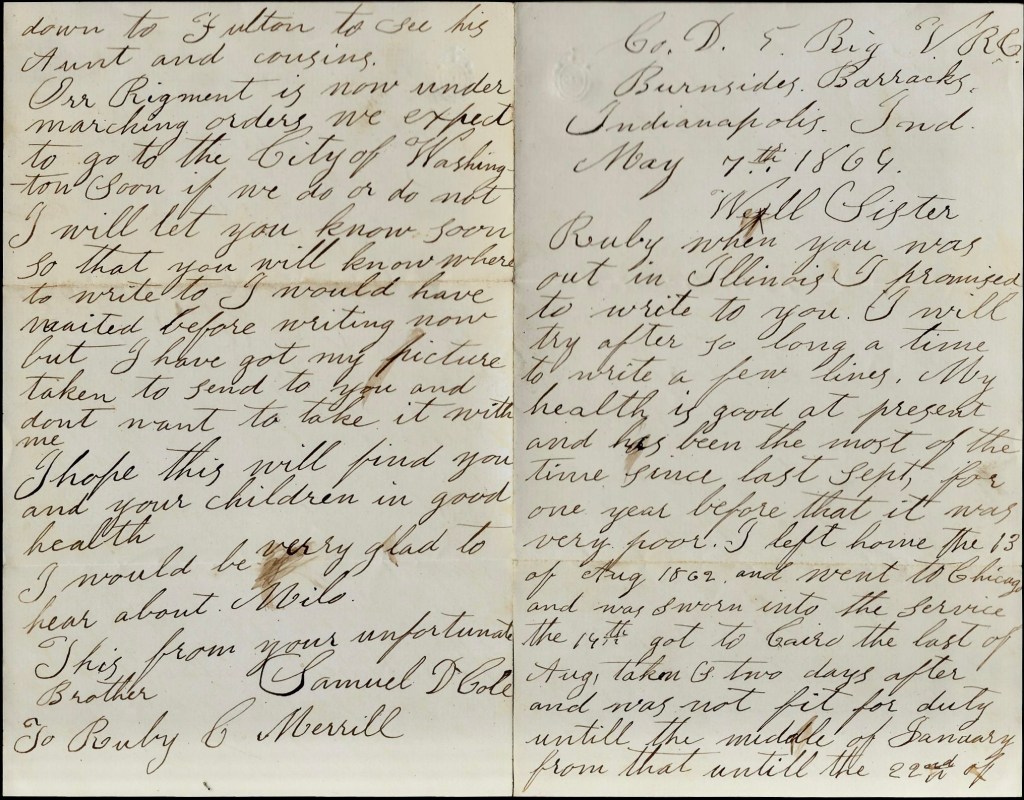
Co. D, 5th Veteran Reserve Corps Burnsides Barracks 1 Indianapolis, Indiana May 7th 1864
Well sister Ruba, when you was out in Illinois, I promised to write to you. I will try after so long a time to write a few lines. My health is good at present and has been the most of the time since last September, for one year before that it was very poor.
I left home the 13th of August 1862 and went to Chicago and was sworn into the service the 14th, got to Cairo the last of August, taken sick two days after, and was not fit for duty until the middle of January. From that until the 22nd of May I was on duty most of the time. Was in the fight at Vicksburg the 22nd of May five hours and got four holes through the hide in my right arm and was sent to the hospital at Memphis, Tennessee. From there to St. Louis, Mo. In the hospital there until the 1st of August 1863 [when I] was put in the Invalid Corps and have been guarding rebels at Indianapolis since the first of October.
I have been home on furlough of 10 days in 21 months. Went home the 15th and came back the 25th day of April, 1864. Found my family in tolerable health. Miriam and Philip had the measles in February and had not entirely got over the effects of them yet but are able to work part of the time. Lovina is not a very stout girl but Alva is a stout, fleshy little chunk and as mischievous as need be. I made Phebe Ann a visit when I was at home. David and Phebe Ann’s health is poor and their youngest girl was quite sick. Their oldest boy is to work for 13 dollars per month this summer. Elvira’s health is tolerable good.
Peter’s family all well. Your Aunt Ruba’s health is poor. She is grunting around and working most of the time. The rest of the relatives is well. I had quite a visit with Elisha Dye when I was at home. He and Faila had been to see their girl that is married and living in Dekalb, Illinois. She was very sick and got some better and Elisha come down to Fulton to see his aunt and cousins.
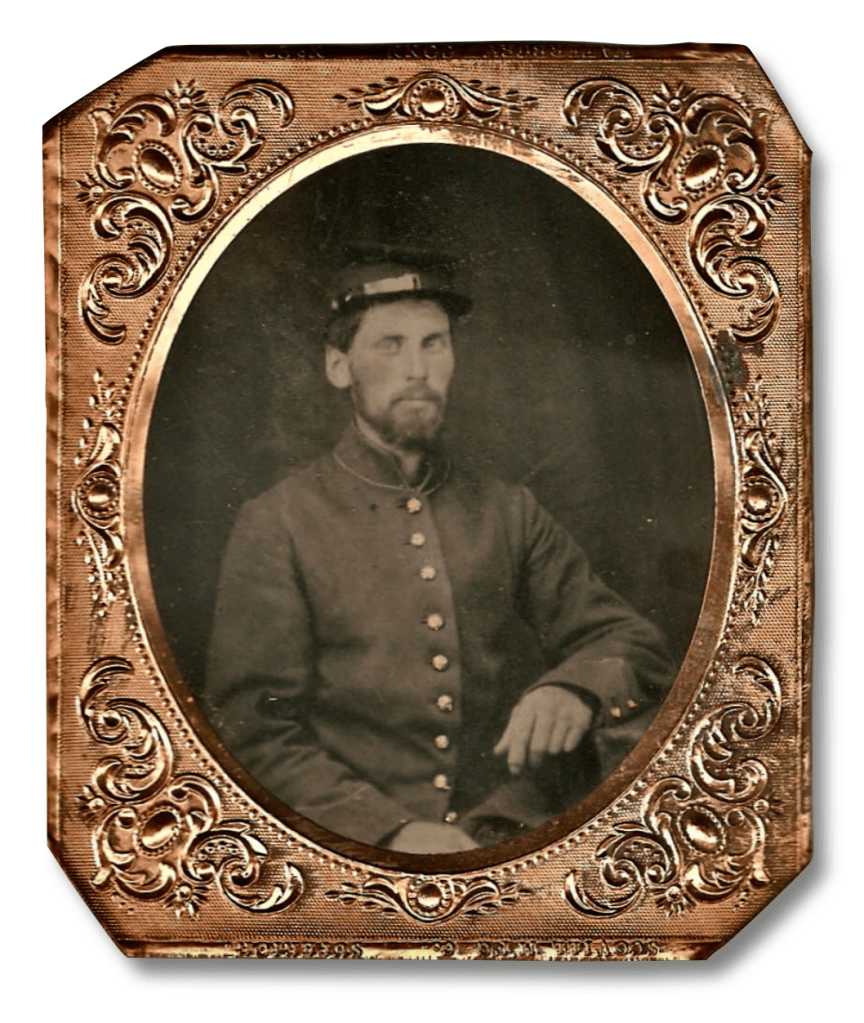
Our regiment is now under marching orders. We expect to go to the City of Washington soon. If we do or do not, I will let you know soon so that you will know where to write to. I would have mailed before writing now but I have got my picture taken to send to you and don’t want to take it with me.
I hope this will find you and your children in good health. I would be very glad ot hear about Milo. This from your unfortunate brother, — Samuel D. Cole
To Ruba C. Merrill
1 To accommodate the necessary prison-camp garrison, commanders constructed additional military facilities adjacent to Camp Morton. Burnside Barracks, named after Indiana native Gen. Ambrose E. Burnside, was located just south of the prison camp.
Letter 2
Co. D. 5th Regt. V. R. C. Burnsides Barracks Indianapolis, Indiana [May 1864]
Dear sister, I wrote you a letter a few days ago in which I sent my likeness not expecting to remain here long enough to receive an answer but the prospect is that we will remain here some time—maybe all summer. Colonel Stevens has received orders to prepare to receive 5,000 more prisoners. We have 3,000 now and looking for more every day. Two hundred came in last week.
I had a letter from home last week. My family was all well. Walter Giles died about the first of May of consumption. He has been sick a long time. Was not much loss to his family or the neighborhood or country.
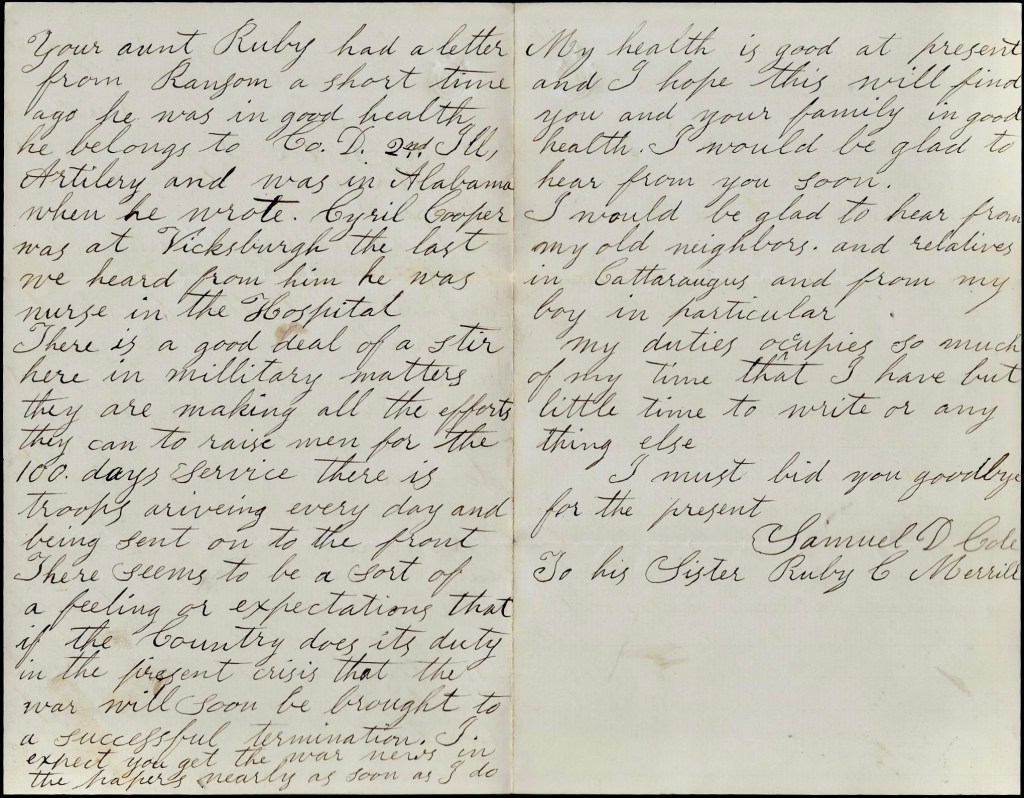
Your Aunt Ruby had a letter from Ransom a short time ago. He was in good health. He belongs to Co. D, 2nd Illinois Artillery and was in Alabama when he wrote. Cyril Cooper was at Vicksburg the last we heard from him. He was nurse in the hospital.
There is a good deal of a stir here in military matters. They are making all the efforts they can to raise men for the 100 days service. There is troops arriving every day and being sent on to the front. There seems to be a sort of a feeling or expectations that if the country does its duty in the present crisis, that war will soon be brought to a successful termination. I expect you get the war news in the papers nearly as soon as I do.
My health is good at present and I hope this will find your family in good health. I would be glad to hear from you soon. I would be glad to hear from my old neighbors and relatives in Cattaraugus and from my boy in particular.
My duties occupy so much of my time that I have but little time to write or anything else. I must bid you goodbye for the present. — Samuel D. Cole
T his sister, Ruby C. Merrill
Letter 3
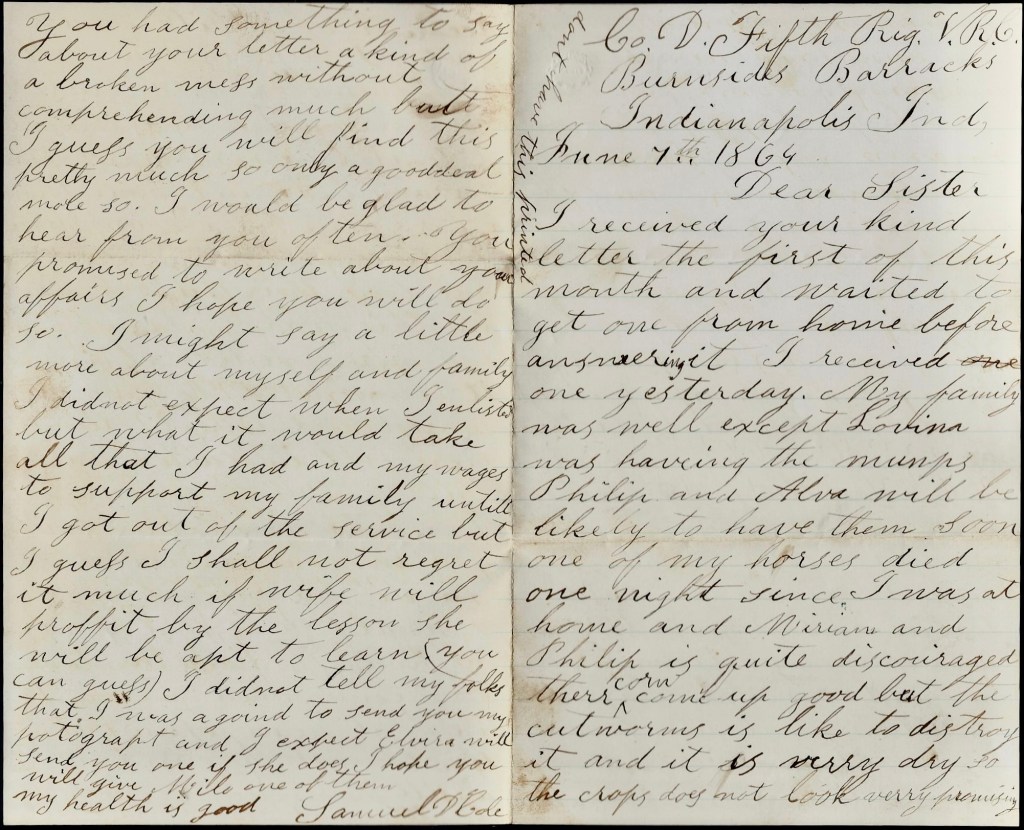
Co. D, Fifth Regt. V. R. C. Burnside’s Barracks Indianapolis, Indiana June 7th 1864
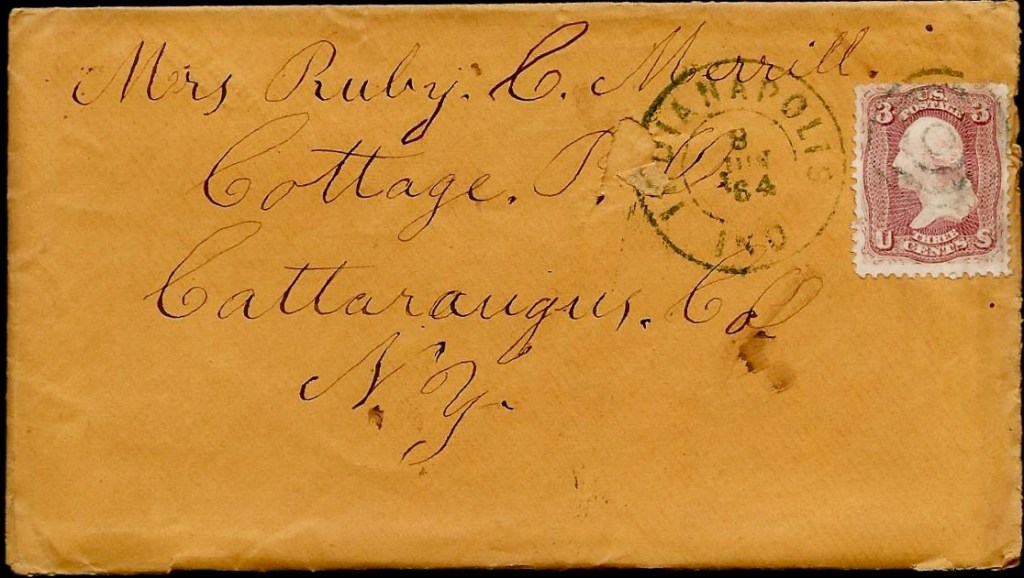
Dear Sister, I received your kind letter the first of this month and waited to get one from home before answering it. I received one yesterday.
My family was well except Lovina was having the mumps. Philip and Alva will be likely to have them soon. One of my horses died one night since I was at home and Miriam and Philip is quite discouraged. They corn come up good but the cut worms is like to destroy it and it is very dry. The crops does not look very promising so you may guess they have some cause to be somewhat discouraged. Last year it was extremely dry in parts of Illinois and some of my old neighbors said that there had never been so near a total failure of crops as there was last year. My family had to buy everything to live on except bread. I raised wheat enough before I enlisted to last them until after harvest but I guess there will be some way for them to get along. I have sent home $180 since I have been in the service and I guess they have nearly enough to buy a horse on hand now.
I was very glad to hear about so many of my old neighbors and much pleased to hear as good account of Milo as you wrote. I hope that he will not think of going into the army unless he is compelled to. It is a very hard place for anybody and more than a hard place for a young man. I think that our connections has done their full share in this war so far without anymore enlisting at present. It seems hard to have our nearest and dearest friends sacrificed in such a war as this. You may be sure that I feel to sympathize with you in your bereavement. Such is the fate of war. I should be glad as anyone living to have the time soon come when our country can be at peace again but I do not want the war to close until the rebellion is crushed to atoms and slavery wiped out.
You had something to say about your letter a kind of broken mess without comprehending much but I guess you will find this pretty much so, only a good deal more so. I would be glad to hear from you often. You promised to write about your affairs, I hope you will do so. I might say a little more about myself and family.
I did not expect when I enlisted but what it would take all that I had and my wages to support my family until I got out of the service but I guess I shall not regret it much if wife will profit by the lesson she will be apt to learn (you can guess). I did not tell my folks that. I was a going to send you my photograph and I expect Elvira will send you one. If she does, I hope you will give Milo one of them. My health is good. — Samuel D. Cole
Letter 4
Co. D, 5th Regiment V. R. C. Burnsides Barracks Indianapolis, Indiana June 28th 1864
Dear Sister, I have just received yours of June 23rd and am glad to hear that you and yours are in good health and hope that you will continue to enjoy the same. My health is good at present. I had a letter from home dated June 17th. My family was in good health and our relatives about there generally are well. [Brother] P[eter] B[urr] Cole [of Fulton county, IL] has 7 girls and one boy. The boy [Clarence] was born in May or June. They don’t say exactly when. I am very much pleased with your letter and would be glad if I could write one that would be as interesting to you as yours was to me.
29th. It is raining a little today. It has been rather too dry and hot so far this season for successful crop raising. Grain will be rather light. It has been very dry in Fulton county, Illinois. You wanted to know how or where my wound was. Well I will tell you as near as I can. Just as I fired my gun, before I had moved from the position my arm was then in, the ball struck struck just below my elbow on the under side of my arm and cut across and come one inch and a half below the elbow. Then went in about two inches above the elbow and come out one inch and a half from my body. It did not touch my body or shoulder at all. It cut off a nerve just below the elbow. That weakens my hand some and my little finger are numb and feel as though they was asleep all the time. When I use my hand a little too much or lift much with it. I have some pain in my hand and wrist, but no pain where the wound was.
At the time I was wounded I lost a great deal of blood. It was as much as I could do to walk one mile from where I was wounded to get to the ambulance. Then I had to ride two miles before I could get my arm dressed. The third morning after when they went to dress my arm, he said it was mortified. It was black and yellow from three inches below my elbow to my shoulder. He called the doctor to me and he looked two minutes before he said anything. Then he said it was not mortified yet. He had flaxseed poultice 1 put on it and had it changed three times a day for nine days before the inflammation got out. Two days after it got to aching severely and soon the pain began to run in my side and came very near throwing me into lockjaw. The doctor attended to me pretty close for a while and gave me some powerful doses of medicine and poulticed my arm or I should not be here. Well, I guess enough about that.
A piece of a cap struck in my right eye and cut through the film and the inflammation got in it and from that to the other and made me almost blind for 6 weeks and they was very weak until in the winter. They are pretty good now though not as good as before.
We have bakers bread and beef, pork and beans, and some new potatoes to eat & coffee 3 times a day to drink. Have tolerable good barracks, board bunks, straw bed, and one woolen blanket and overcoat for bed and bedding. The work is guard duty one day and night in three—sometimes oftener and sometimes not quite so often—drills and dress parade, and cleaning up our streets and quarters, and many other things that our benevolent officers can contrive to keep us out of mischief.
Confederate Prisoners in the “Bull Pen” of Camp Morton Prison Camp in Indianapolis
We are having a little easier time just now than we have had before since we have been here. The 28th Ohio Regiment is here helping guard the prisoners of which there is 4,500 now and more on the way here. The 28th Ohio brought 1,000 when they came here. The prisoners had as good grub as we did until 1 month ago [when] they cut down their rations about one half by order of the War Department in retaliation of their treatment of our men. Their quarters is nearly as good as ours. There is twenty acres in the prison yard (or bull pen as we call it). There [are] near 20 barracks 50 feet long, 20 wide, and one about 300 feet long besides a good many smaller buildings and about two or 300 tents. They have hospitals and doctors and nurses to take care of the sick.
Last winter was rather hard on the rebel prisoners. Some days there was 8 or ten died a day. Now they do not more than one die a day on an average. The burying ground where they bury the rebels we call Governor Morton’s Colony 2 and there is a great many in it all ready and I wish they was all there. I guess I have wrote enough about the rebs for this time.
Alva was born August 20, 1861. Lovina [was born] December 8th 1854. I would like to know Osman Markham’s Post Office address. Uncle Sam has got some land for me somewhere and I guess I shall try to find it when I get out of the service if I do not find it before. I hope you will write again soon. What of Old John H. Rice?
I remain your brother with respect and esteem, — Samuel D. Cole
To Ruby C. Merrill
Do not send any more stamps. I had 21 when I got your letter.
1 Flax has been described as the quintessential drawing herb in the herbal first-aid world. As a poultice, flaxseed drains wounds and draws out infection while killing pain, soothing inflammation, and healing the tissue. It was a commonly used treatment for gunshot wounds during the Civil War.
2 I could not find this term being used by others to describe the Confederate soldiers burial ground in Indianapolis. It is not known for certain, but it is estimated that approximately 1,700 prisoners died at Camp Morton between 1862 and 1865. Confederate prisoners were buried in wooden coffins in trenches on five lots purchased near the City Cemetery, which was later expanded and became known as Greenlawn Cemetery. The individual gravesites were marked with wooden boards bearing painted identification numbers that were worn away by the passage of time. Some of the Confederates buried in Indianapolis’s City Cemetery were exhumed and returned to their families; however, the remains of 1,616 Confederate prisoners were left at Greenlawn. In 1866 a fire ravaged the cemetery office, destroying the records that gave the precise location of the burials .
Letter 5
Co. D, 5th Regiment V. R. C. Burnsides Barracks Indianapolis, Indiana July 28, [1864]
Dear sister, I have but one excuse to make for not writing sooner. I have been waiting to get a letter from home. The last was dated July 8th. I have wrote home twice since then. Miriam was quite unwell. Philip was having the mumps pretty hard. Lovina was having a large boil on her arm and Alva had a swelling on his foot. They complain of its being very dry there. It is very dry here. The crops is suffering severely for the want of rain. It begins to look as though there was some danger of famine. 1
My health is not very good but I can do my duty. The guard duty comes pretty hard on us this hot weather. We are guard every third day, sometimes every other day. The 28th Ohio [Infantry] has left us so we have to do it all again. We expect to have more help soon. The country is quite level about here and we have first rate well water and a plenty of it. The general health of the 5th & 17th Regiment V. R. C. is good. There is now near 700 men in our two regiments for guard duty and near 200 on other duties and probably near 200 that is not fit for duty. There is about 300 men just arrived here to fill up our regiment. They are from Madison Hospital, Indiana. Uncle Sam is making good use of the condemned soldiers by putting them into the V. R. C. and making them do guard and garrison duty. It saves more than an equal number of men that is fit for field service.
I had been thinking of trying to get my discharge this fall but since U. S. has called for 500,000 more men, I guess I had better stay where I am. If I should get my discharge, they could raft Philip but they cannot do it while I am in the service. His health is so poor that I do not think he could stand the service three months.
There is 5,000 prisoners in Camp Morton now. 2 There has none been brought in in the last two weeks. I was on guard Monday and again Wednesday and too tired and sleepy to write more this time. There is no prospect of our leaving here at present. I would not be disappointed if we should stay here until my term of service expires.
Confederate POWs in the “Bull Pen” at Camp Morton Prison in Indianapolis
If you will continue to write, I will try and answer your letters. I remain your affectionate brother, — Samuel D. Cole
To Ruby C. Merrill
1 “In Springfield [Illinois] during the first week of August the heat peaked on the 2nd at 108 degrees, but on Wednesday and Thursday (August 3-4) The Republican [newspaper] made note that .97 inches of rain fell. “More than during the two full months previous.” It was the worst drought in 17 years.”
2 Samuel’s estimate of prisoners is consistent with that reported by the Indiana Historical Society. “In the summer of 1864 the prisoner population reached nearly 5,000.”According to the book by Winslow and Moore entitled “Camp Morton, 1861-1865, Indianapolis Prison Camp,” by the end of July 1864, the seven barracks housed from 436 to 484 inmates each, 554 men occupied the old cattle shed, and a fourth of the men were still sweltering in tents in cramped rows between the buildings.” Weary of fighting many took the oath of allegiance to the United States Constitution and to the Union according to Lincoln’s Proclamation of Amnesty and Reconstruction of 8 December 1863. On 1 April 1865 1,408 prisoners were at the camp. In June 1865 the last of the Confederate prisoners were released.
This partial letter was written by Edward Alexander McConnell (1844-1867), the son of emigrants Edward McConnell (1805-1878) and Charlotte McGlashan (1813-1889) of Chicago, Cook county, Illinois. At the time of the 1860 US Census, 16 year-old Edward was working as a clerk in Chicago. After the war, Edward married Susannah Richards Colehour, who gave birth to their only child four months after Edward’s death in February 1867.
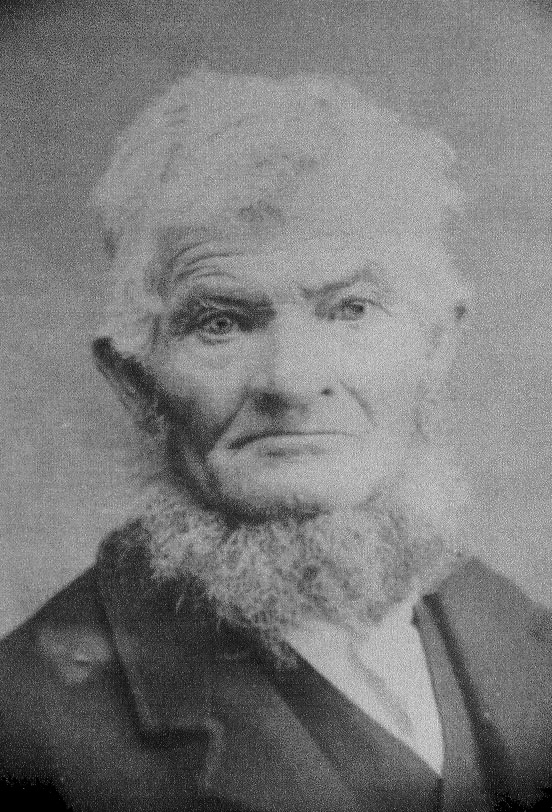
I could not find an image of Edward but here is Azel D. Hayward who also served in Co. B, 72nd Illinois Infantry(Randy Hayward Collection)
During the Civil War, Edward enlisted as a private in Co. B, 72nd Illinois Infantry (the “First Chicago Board of Trade Regiment”) in August 1862. He was promoted to corporal in June 1863 and to sergeant in September 1863.
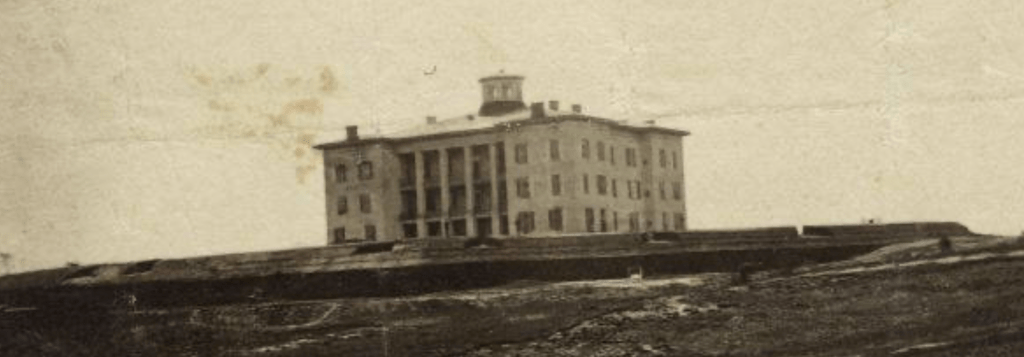
In his letter, Edward writes a paragraph on the Black troops in Natchez in September 1863 and of the construction of a new fortification there on the north side of town. On July 13, 1863, Union troops arrived in Natchez and “established the Union Army headquarters at the Rosalie Mansion. By August of 1863, more U.S. Colored Troops began residing in Natchez. A large number of black men that enlisted were from Natchez or had left plantations in surrounding areas such as Franklin County, Jefferson County, Wilkinson County, etc. During the Fall of 1863, the soldiers began working on the construction of a fortification named for General James Birdseye McPherson. There were over 3,000 colored troop soldiers who served in the six regiments at Fort McPherson. These regiments included the sixth U.S. Colored Heavy Artillery, 58th U.S. Colored Infantry, 70th U.S. Colored Infantry, 71st U.S. Colored Infantry, 63rd U.S. Colored Infantry, and the 64th U.S. Colored Infantry.” [The Story of the Natchez US Colored Troops by Inesha Jackson]
The Union Battlements of Fort McPherson, encompassed the United States Marine Hospital
Transcription
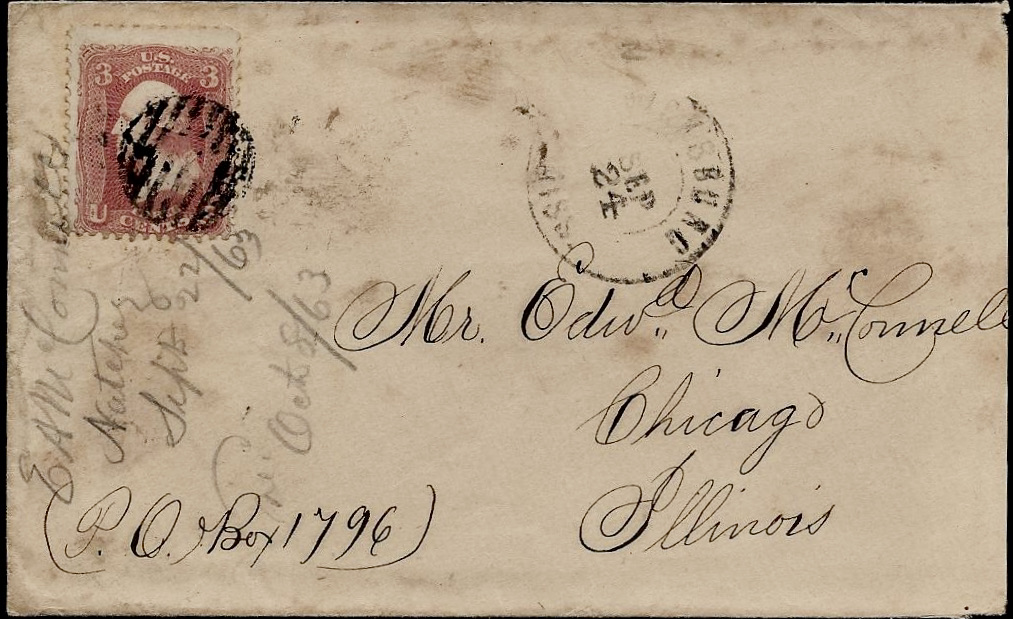
Addressed to Mr. Edward McConnell, Chicago, Illinois
Natchez [Mississippi] September 22, 1863
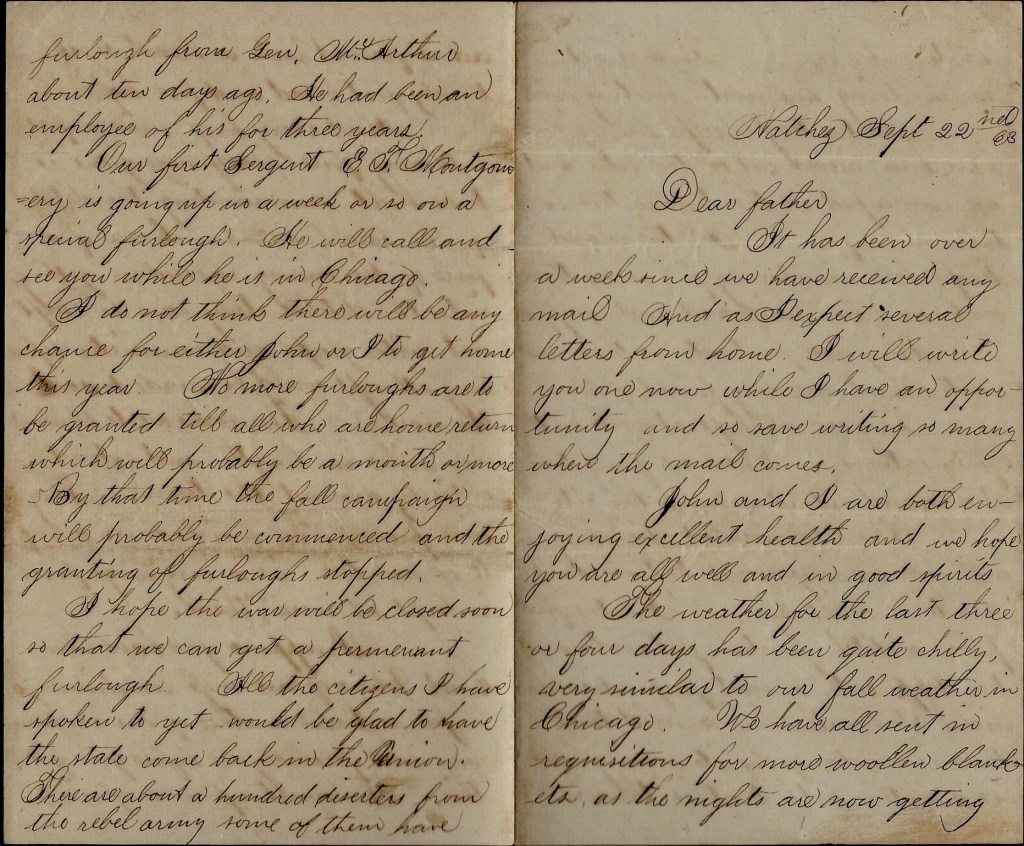
Dear father,
It has been over a week since we have received any mail and as I expect several letters from home, I will write you one now while I have an opportunity and so save writing so many when the mail comes.
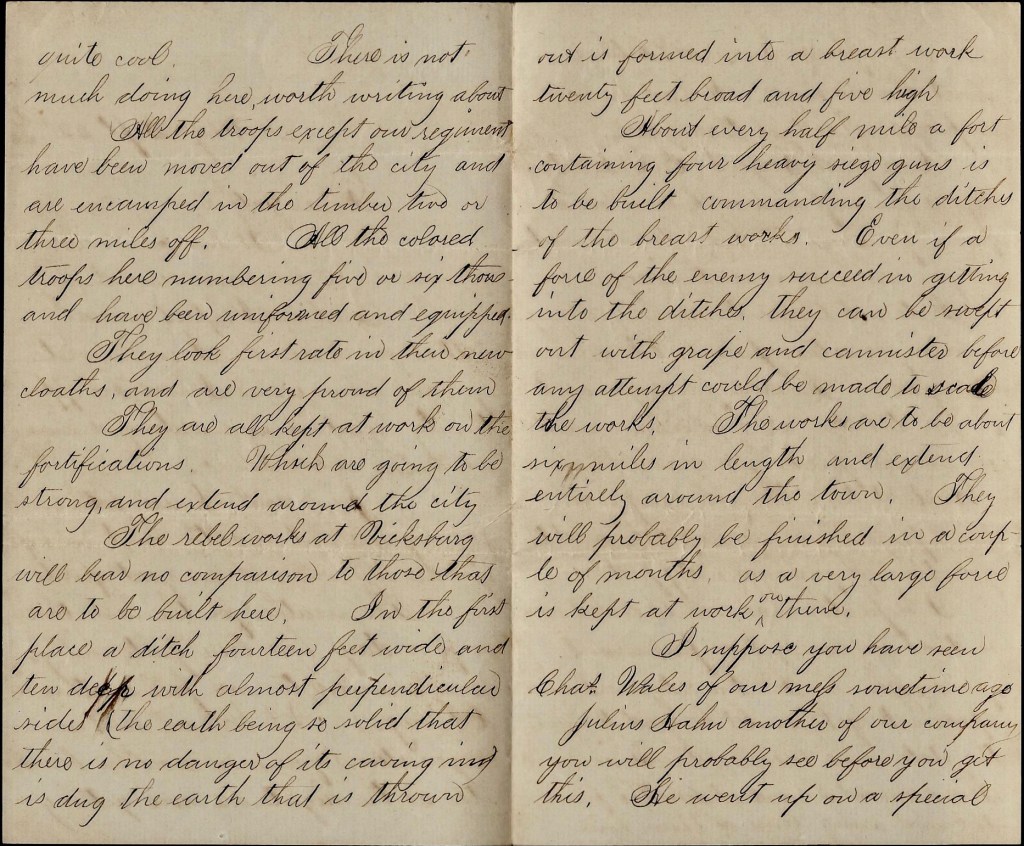
John and I are both enjoying excellent health and we hope you are all well and in good spirits. The weather for the last three or four days has been quite chilly—very similar to our fall weather in Chicago. We have all sent in requisitions for more woolen blankets as the nights are now getting quite cool. There is not much doing here worth writing about.
All the troops except our regiment have been moved out of the city and are encamped in the timber two or three miles off. All the colored troops here numbering five or six thousand have been uniformed and equipped. They look first rate in their new clothes and are very proud of them. They are all kept at work on the fortifications which are going to be strong and extend around the city.
The rebel works at Vicksburg will bear no comparison to those that are to be built here. In the first place a ditch fourteen feet wide and ten feet deep with almost perpendicular sides (the earth being so solid that there is no danger of its caving in) is dug. The earth that is thrown out is formed into a breastwork twenty feet broad and five high. About every half mile a fort containing four heavy siege guns is to be built commanding the ditches of the breastworks. Even if a force of the enemy succeeds in getting into the ditches, they can be swept out with grape and canister before any attempt could be made to scale the works. The works are to be about six miles in length and extend entirely around the town. They will probably be finished in a couple of months as a very large force is kept at work on them.
I suppose you have seen Charles Wales of our mess sometime ago. Julius Hahn another of our company you will probably see before you get this. He went up on a special furlough from Gen. McArthur about ten days ago. He had been an employee of his for three years.
Our First Sergeant E[than] T. Montgomery is going up in a week or so on a special furlough. He will call and see you while he is in Chicago. I do not think there will be any chance for either John or I to get home this year. No more furloughs are to be granted till all who are home return which will probably be a month or more. By that time the fall campaign will probably be commenced and the granting of furloughs stopped.
I hope the war will be closed soon so that we can get a permanent furlough. All the citizens I have spoken to yet would be glad to have the state come back in the Union. There are about a hundred deserters from the rebel army. Some of them have [rest of letter missing].








 Spared & Shared 23