Category Archives: 72nd Ohio Infantry

1861: Unidentified Civilian to Friend Mary

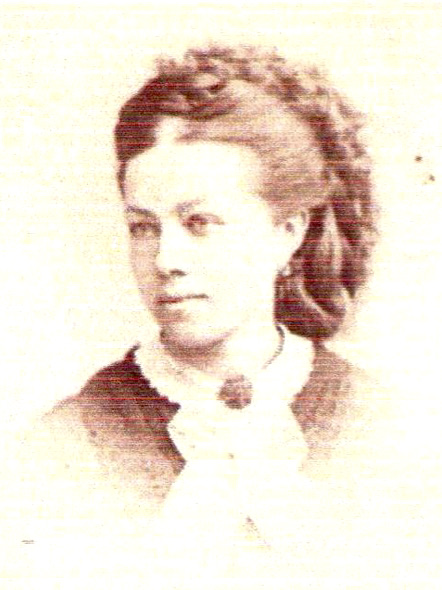
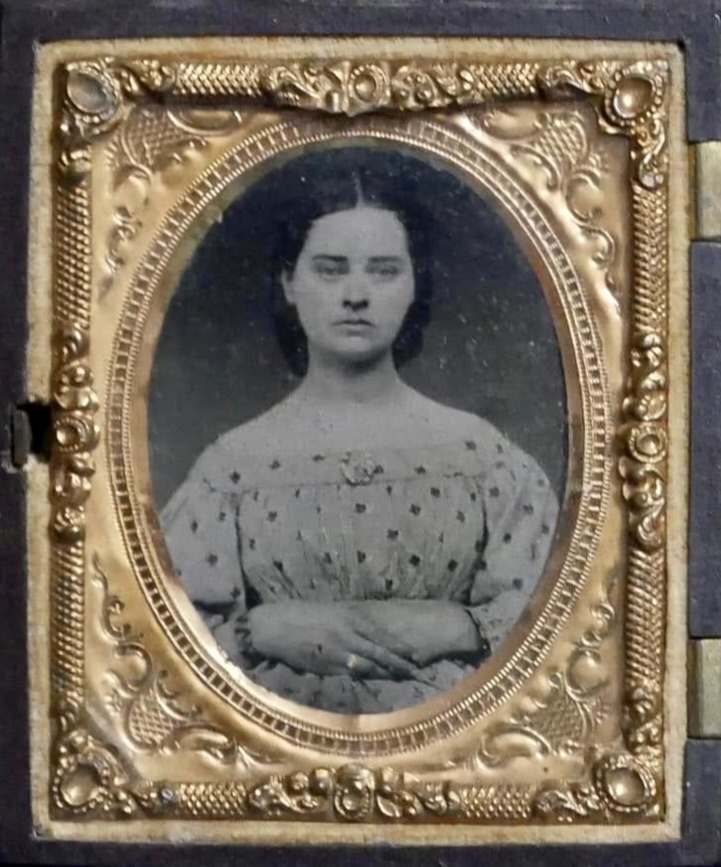
How the author might have looked

Unfortunately this partial and unsigned letter provides us with few clues to the author’s identity. I’m inclined to believe it was a young female between the age of 15 and 20 who lived in Fremont, Sandusky county, Ohio. She writes of receiving a Christmas gift of “a very nice tooth brush and a cake of tooth soap and a comb”—a practical and coveted luxury at the time. She also writes of visiting the camp of the 72nd Ohio Regiment at nearby Camp Chrogan in company with the handsome Capt. Samuel A. J. Snyder. “What didn’t I have a good time!” she wrote her friend Mary.

Transcription

Fremont [Ohio]
December 30th, 1861

Friend Mary,

Your letter was most gladly received and came in time to stop my letter which I was about sending, and which contained something like a scolding. I began to think you weren’t going to write to me any more or something dreadful had happened, but when your good letter came and set my fears at rest, you can imagine how welcomed it was.

I haven’t written to you so long that I hardly now how to converse with you. The first thing I will try to do will be to imagine how the house looked after you and Frank had done up the work. Probably the first thing Frank does to bother Mary is to go at the caller [?] and [ ] them a pail of water and is sent off in a hurry. [ ] straight for the corn crib and begins to shell corn while Mary puts the caller to bed and returns to her work, gets the work done up and commences to write to you know. We were but your humble servant. [ ] is much obliged to you for it, but enough of this nonsense.

I spent my Christmas very pleasant here. Went down town in the morning and called at Mrs. Beans, got an invitation to dinner the next day (which was the day after Christmas). Got home and found Brother and his wife here and spent a pleasant afternoon and evening. The next day had a present of a very nice tooth brush and a cake of tooth soap and a comb. I think I have told you all that I did on Christmas as nearly as I can think.

There is a regiment of soldiers stationed here now which makes the realities of war come closer home than ever. The camp is called Camp Chrogan (72nd [Ohio] Regiment). I went over last week with one of the officers, Captain [Samuel A. J.] Snyder 1 (he is handsome as he can be I tell you). What didn’t I have a good time. It looks so funny to see them was dishes and cook and their tents are so funny. But enough of this.

Who do you think Dillie is going to be married to? If you know, tell in your next letter. I have been interrupted in my pleasant talk with you by a caller from the town Miss Smith. They staid so long that it drove everything out of my head that I was a going to say to you. You spoke about Sis Whiskers staying here in Fremont over night. I don’t believe it for I don’t believe the place could hold him, much more that he would come here without seeing me. It is perfectly shocking. It almost made me cry. Don’t he look as though he had lost something since I came away. I don’t believe his whiskers have grown a bit since he see me. I bet the sight of me made them strike in. If so, please console him as well as you can and give him my prescription, that is some of Mrs. Winslow’s soothing syrup. Now mind you, don’t… [partial letter]

1 Capt. Samuel A. J. Snyder’s name comes up in the history of the 72nd Ohio Regiment in connection with the regiment’s flag and the Battle of Shiloh. To wit: “This flag was presented to the regiment by the mayor of Fremont in January 1862 as the regiment was leaving Camp Croghan to head south to war. It was entrusted to Sergeant Gustavus H. Gessner of Co. H. During the skirmish at Crump’s Landing on April 4, 1862, Gessner received a neck wound and went into the hospital; the flag was left furled in his tent. At the outset of the Battle of Shiloh two days later, Co. H was on picket duty and the company commander Captain Samuel A.J. Snyder (who under arrest for shooting a squirrel in camp and consequently left in camp while Co. H was on picket) noticed that the flag was in Gessner’s tent. Snyder took the flag and placed it in a regimental wagon behind the lines, then offered his services to Col. Buckland, thinking that he had placed the flag in a safe place. After a hard fight of two hours, the 72nd Ohio retreated from their position west of Shiloh Church and in the course of the retreat, the wagon and flag were captured. The flag was quickly discovered and presented to Confederate General Pierre G.T, Beauregard who kept the flag for many years.” See “72nd Ohio Infantry Flag Captured at the Battle of Shiloh”; Dan Masters’ Civil War Chronicles, June 4, 2017.

1863: Jonathan F. Harrington to Lionel E. Harrington

The following letter was written by Jonathan F. Harrington (1835-1916), the son of Ralph Harrington (1802-1863) and Anna Paxton (1809-1884) of Groton township, Erie county, Ohio.

Capt. Jonathan F. Harrington, Co. A, 72nd OVI

His on-line obituary claims that “he grew up in a time when Erie county, Ohio, was still in a pioneer condition. He was reared on the home farm and secured his educational training in some of the early schoolhouses familiarly known only to the oldest residents now living. After getting the advantages offered by the schools of Groton township he also spent one year attending school at Detroit, Michigan.

His vocation since early manhood has been that of farming and soon after getting started in that vocation, he went away to help fight in the battles of the Union. Capt. Harrington enlisted in May 1861 in Co. A, 72nd regiment OVI ad his first duty was in recruiting the company for that regiment, and after getting its quota mustered in he took his place in the ranks as a private soldier. A year later he was made 2nd Lieutenant, and later promoted to 1st Lieutenant and during the last two years of is service to his country was captain of the company. He continued in the war four years until his honorable discharge in September 1865. Capt. Harrington fought in the great battle of Shiloh, participated in the siege of Corinth and also in the campaign ending in the fall of Vicksburg.

On January 1st 1868, he was married to Miss Sarah E. McKesson (1845-1935) who also represents some of the pioneers of Erie county.”

In this letter datelined from the regiment’s encampment 8 miles in the rear of Vicksburg, Mississippi, Capt. Harrington informs his younger brother Lionel E. Harrington (1841-1895) of their location, the health of the regiment, and reacts to the recent gubernatorial election results in the regiment and at home in Ohio in which the “Peace Democrat” Clement Vallandigham lost in a landslide to the pro-Union War Democrat John Brough.

Field Desk used by Capt. Jonathan F. Harrington during the Civil War

[Note: To read Harrington’s account of the Battle of Shiloh, go to: Civil War Talk.]

Transcription

Addressed to L. E. Harrington, Esq., Groton, Erie county, Ohio

Camp in rear of Vicksburg
October 28, 1863

Brother,

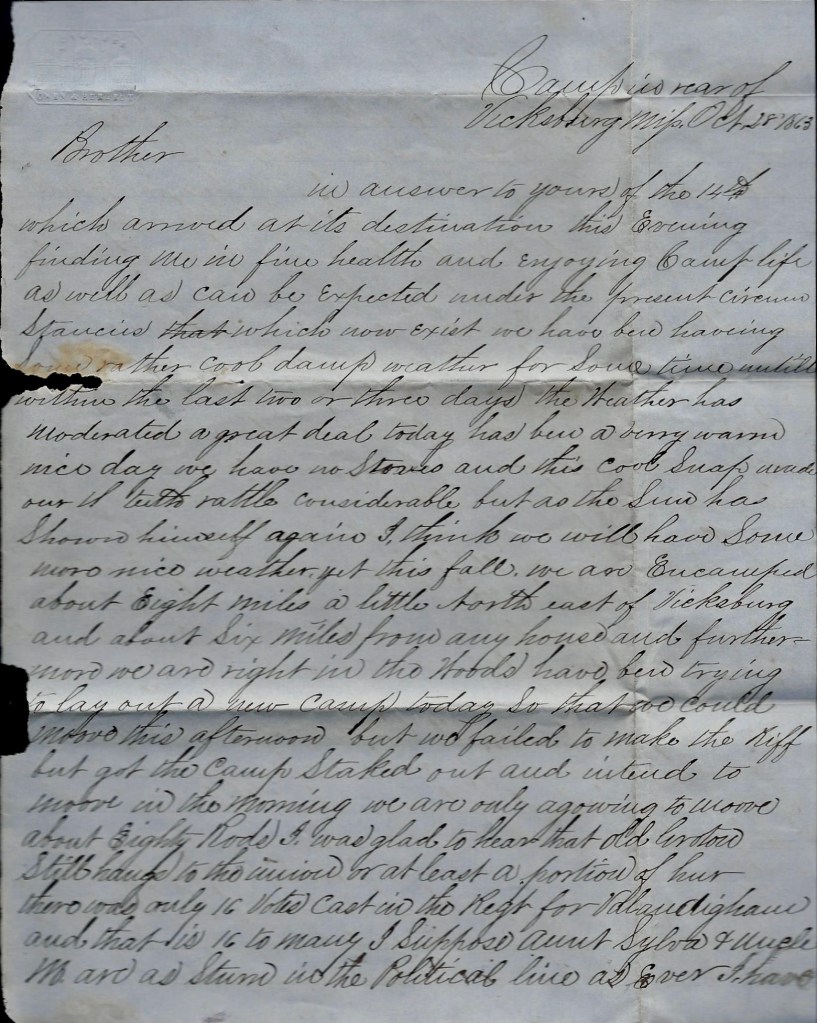
In answer to yours of the 14th which arrived at its destination this evening finding me in fine health and enjoying camp life as well as can be expected under the present circumstances which now exist, we have been having some rather cool damp weather for some time until within the last two or three days. The weather has moderated a great deal. Today has been a very warm day, nice day. We have no stoves and the cool snap made our teeth rattle considerably but as the sun has shown himself again, I think we will have some more nice weather yet this fall.

We are encamped about eight miles a little northeast of Vicksburg and about six miles from any house. And furthermore, we are right in the woods. Have been trying to lay out a new camp today so that we could move this afternoon but we failed to make the riff [?] but got the camp staked out and intend to move in the morning. We are only a going to move about eighty rods [quarter mile].

I was glad to hear that Old Groton still hangs to the Union, or at least a portion of her. There was only 16 votes cast in the regiment for [Clement] Vallandigham and that is 16 too many. I suppose Aunt Sylvia & Uncle M. are as stern in the political line as ever. I have a man in my company that voted for Vallandigham but—well, you know him. It was M. Pilgrim. He done it mostly for spite—nothing more nor less.

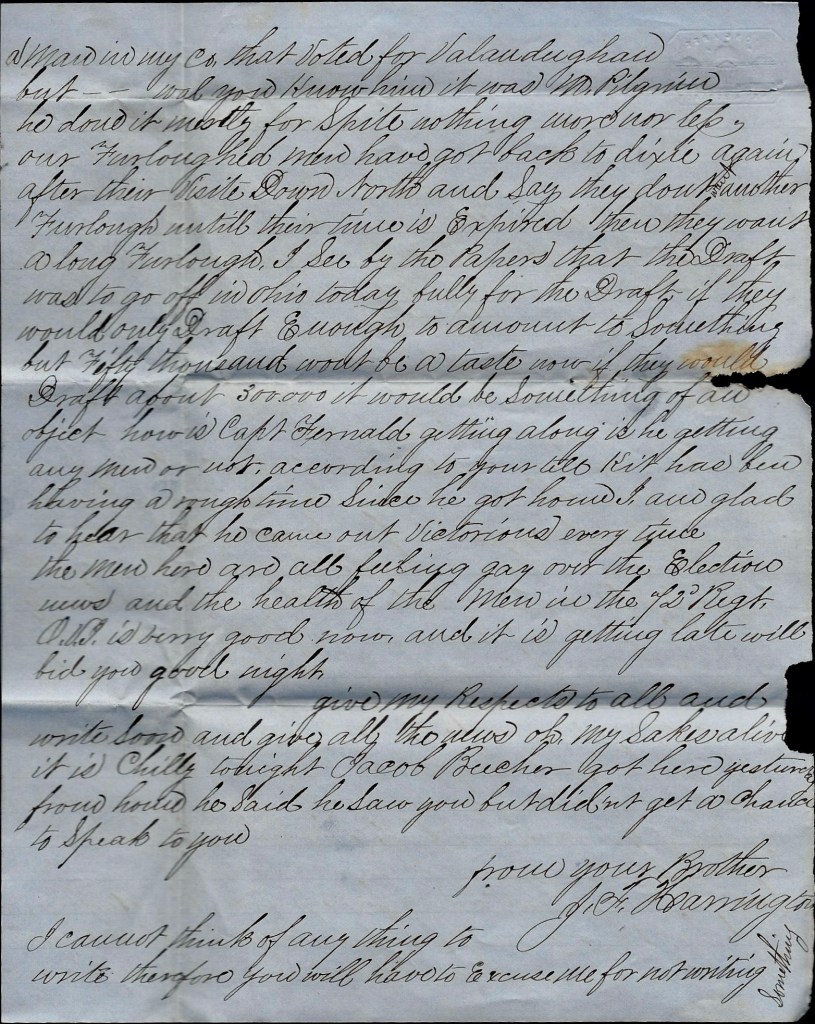
Our furloughed men have got back to Dixie again after their visit down North and say they don’t want another furlough until their time is expired. Then they want a long furlough.

I see by the papers that the draft was to go off in Ohio today. Bully for the draft if they would only draft enough to amount to something, but fifty thousand won’t be a taste. Now if they would draft about 300,000, it would be something of an object. How is Capt. Fernald getting along? Is he getting any men or not? According to your tell, Kit has been having a rough time since he got home. I am glad to hear that he came out victorious every time.

The men here are all feeling gay over the election news and the health of the men in the 72nd Regiment OVI is very good now and it is getting late. Will bid you good night.

Give my respects to all and write soon and give all the news. Oh my sakes alive, it is chilly tonight. Jacob Beecher got here yesterday from home. He said he saw you but didn’t get a chance to speak to you.

From your brother, — J. F. Harrington

I cannot think of anything to write. Therefore, you will have to excuse me for not writing something.

1864: John Birchard Rice to Eliza Ann (Wilson) Rice

Surgeon John Birchard Rice

This letter was written by Surgeon John Birchard Rice (1832-1893), a physician from Fremont, Ohio, who served in the 72nd Ohio Infantry. He was promoted to Brigade Surgeon after the Battle of Shiloh and eventually made Chief Surgeon of a Division in the 15th Army Corps, and Medical Office of the District of Memphis, overseeing 150 surgeons and 15,000 soldiers. He later served in the US Congress (1881-1883).

In this letter, Rice informs his wife of the casualties sustained by members of the 72nd Ohio during the expedition to Tupelo, Mississippi, in July 1864 under the command of Gen. Andrew Jackson Smith. In the Battle of Tupelo (July 14-15), Union forces turned back Confederate forces under Gen. Nathan B. Forrest that were threatening the disruption of Sherman’s supply lines during the Atlanta Campaign.

John B. Rice was the son of Robert Stuart Rice (1805-1875) and Eliza Ann Caldwell (1807-1873) of Fremont, Sandusky county, Ohio. He was married to Sarah Eliza Wilson (1842-1928) in 1861.

Transcription

Memphis, [Tennessee]
July 21, 1864

My Dear Wife,

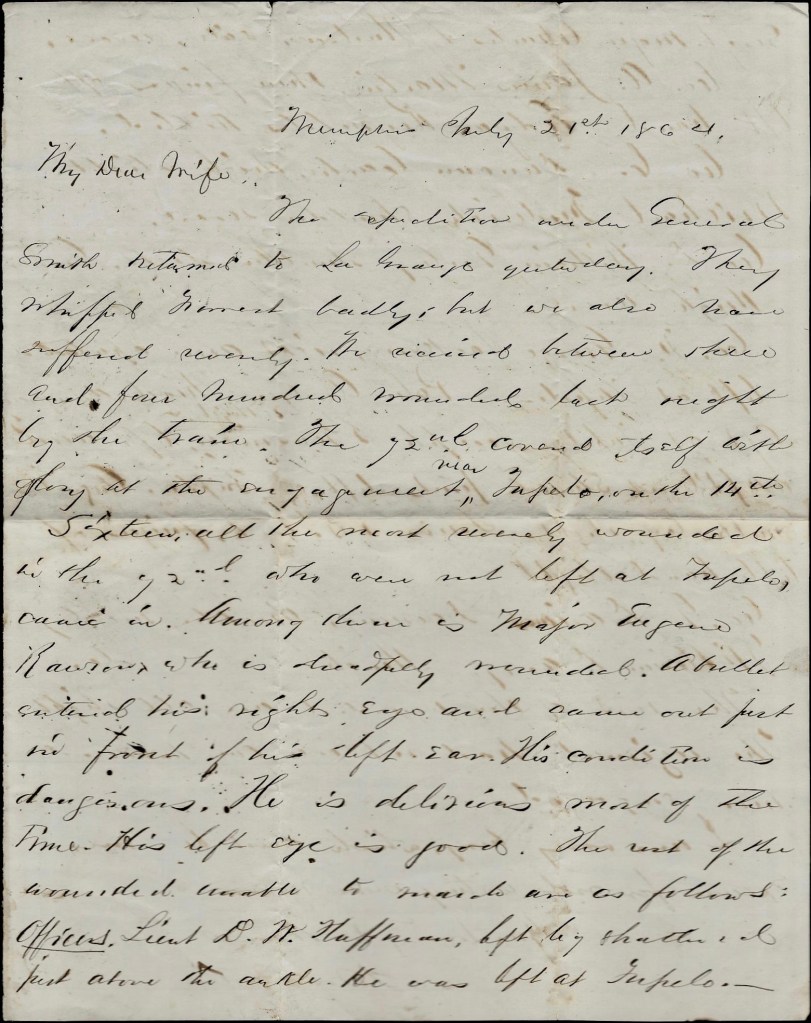
The expedition under General Smith returned to La Grange yesterday. They whipped Forrest badly but we also have suffered severely. We received between three and four hundred wounded last night by the train. The 72nd covered itself with glory at the engagement near Tupelo, on the 14th. Sixteen, all the most severely wounded in the 72nd who were not left at Tupelo, came in. Among them is Major Eugene Rawson who is dreadfully wounded. A bullet entered his right eye and came out just in front of his left ear. His condition is dangerous. He is delirious most of the time. His left eye is good. 1

The rest of the wounded unable to march are as follows: 

Officers:
Lieut. D. W. Huffman [Co. B], left leg shattered just above the ankle. He was left at Tupelo.
Sergt. Major [& Adjutant] Charles L. Hudson, side, severe. 
Co. A, [Pvt.] James Martin, three fingers off left hand. [Pvt.] Edgar Reynolds killed. 
Co. C, [Sgt.] Duncan Carter, thigh, slight. [Pvt.] Michael Frederick, shoulder, severe.
Co. D, [Pvt.] William Gooley, shoulder, slight. Grones, thigh, severe. 
Co. F, [Pvt.] George Jackson, right arm amputated, left at Tupelo. [Pvt.] Peter Andrews, head, dangerous, left at Tupelo. [Pvt.] Joseph Bensinger, in thigh & left arm amputated at shoulder joint—left at Tupelo. [Pvt.] Augustus Smith, leg, slight. [Pvt.] Louis Bowlach, fingers of left hand, slight.
Co. G, [Pvt.] Darius Downing, shoulder, severely. William Davis, thigh, severely.

The rest of the wounded are all slight.  The Regiment had not over one hundred men engaged. I am very busy, which must be my excuse for not writing more now. 

Your loving husband, — John B. Rice


1 Major Eugene A. Rawson died on 22 July 1864 at Memphis from wounds received on 15 July 1864 at Old Town Creek, Mississippi.

1863: Lizzie (Wilson) Rice to John Birchard Rice

Lizzie (Wilson) Rice

This letter was written by Sarah Eliza (Wilson) Rice (1842-1928), the daughter of James William Wilson (1816-1904) and Nancy E. Justice (1821-1904) of Fremont, Sandusky county, Ohio. Sarah—who went by “Lizzie”—was only 19 years old when she married John Birchard Rice (1832-1893), an 1857 graduate of the medical department at the University of Michigan, in December 1861.

During the Civil War, Lizzie’s husband served on the medical staff as assistant surgeon of the Tenth and then as surgeon of the Seventy-second regiments of the Ohio Volunteer Infantry. He was also surgeon in chief of a division in the Fifteenth Army Corps and of the District of Memphis. Following the Battle of Shiloh, Gen. W. T. Sherman went out of of his way to praise Rice in his after action brigade report: “I take the liberty to refer to the important services of Surgeon John B. Rice and the assistant surgeons of the 48th, 70th, and 72nd [Ohio] Regiments. They have labored at the landing among the wounded almost incessantly night and day, taking no sleep for two days and nights.”

In this letter, Lizzie shares home-front information with her husband including the excitement raised between Union loyalists and secession sympathizers who were derisively called “Butternuts” or “Copperheads.” Her youthful exuberance relating social activity and local courtships is on full display as her husband is about to embark on an expedition down the Mississippi from Memphis to Young’s Point, opposite Vicksburg.

More on Surgeon John B. Rice:

Five of John’s Civil War letters are on-line, graciously made available to researchers at the Ohio History Connection where they are housed under the title, John Birchard Rice Civil War Letters. The Auburn University Digital Library also has a letter from Surgeon Rice to his wife dated 24 October 1864 on-line.

For an excellent article mentioning Surgeon Rice, see—“Skinned out for Memphis like Tom O’ Shanter with the devil after him,” General Samuel Sturgis, the 72nd Ohio, and the Guntown Disaster, Dan Masters’ Civil War Chronicles, published 8 June 2019.

Transcription

Home
March 28th 1863

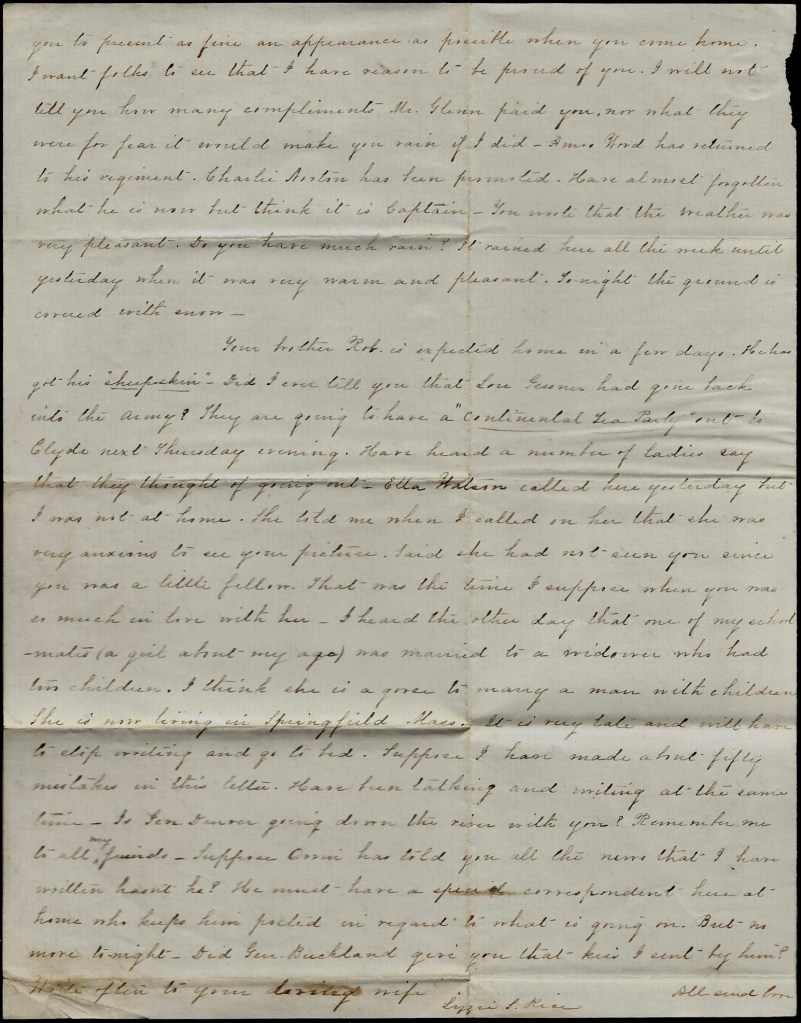
My Own Darling Husband,

I wrote you a long letter day before yesterday, but having nothing in particular to do this evening will write you again. There is nothing going on worth writing about. It is as dull as can be here. Was out to an exhibition last evening which was as good as such exhibitions generally are. Saw Mr. Willard there and he inquired about you as he always does when he sees me.

Surgeon John B. Rice, 72nd OVI

There was a “Union Supper” over at Hocke’s Hotel 1 last evening. The way they come to have it there was this. One evening last week a number of these butternuts about town (Frinefrock 2, [Bruce] Lindsay, and others) went over there to hold one of their meetings. They abused Lincoln and the soldiers and talked “secesh” so strong that Hocke ordered them out of his house. They remonstrated, but he told them to go. They then told him that they would get their horses and go and that it would ruin him. He told the hostler to get their horses ready as soon as he could and let them go. Said there was something in his heart that told him he ought not to let them do so and he would not have it. The Union men were so pleased when they heard it that about one hundred of them went over there last night and got their supper. Do not know whether [Benjamin] Brundage & Owen were there the night they were ordered away or not.

Owen is very much taken with Live [Olivia] Bartlett. 3 Thinks she is perfection. He pays here a great deal of attention and would not be surprised if he cut out Oakley. 4 She would do a great deal better to take him, if he was not a butternut. That is the only thing I know against him. He is smarter than Oak and has a profession while Oak has no trade, profession, or anything else. The most he has ever done towards making a living is teaching school and clerking.

I received yours of the 14th day before yesterday. I cannot tell you how glad I was to hear that you had been promised a “leave of absence” when this expedition was ended. Hope it will not be very long. You had better take good care of your new clothes for I want you to present as fine an appearance as possible when you come home. I want folks to see that I have reason to be proud of you. I will not tell you how many compliments Mr. Glenn paid you, nor what they were for fear it would make you vain if I did. Amos Word has returned to his regiment. Charlie Norton has been promoted. Have almost forgotten what he is now but think it is Captain. You wrote that the weather was very pleasant. Do you have much rain? It rained here all this week until yesterday when it was very warm and pleasant. Tonight the ground is covered with snow.

Your brother Rob is expected home in a few days. He has got his “sheepskin.” Did I ever tell you that Lou Gessner 5 had gone back into the army? They are going to have a “Continental Tea Party” 6 out to Clyde next Thursday evening. Have heard a number of ladies say that they thought of going out. Ella Watson called here yesterday but I was not at home. She told me when I called on her that she was very anxious to see your picture. Said she had not seen you since you was a little fellow. That was the time I suppose when you was so much in love with her. I heard the other day that one of my schoolmates (a girl about my age) was married to a widower who had ten children. I think she is a goose to marry a man with children. She is now living in Springfield, Mass.

It is very late and will have to stop writing and go to bed. Suppose I have made about fifty mistakes in this letter. Have been talking and writing at the same time. Is Gen. [James William] Denver going down the river with you? Remember me to all friends. Suppose Owen has told you all the news that I have written, hasn’t he? He must have a special correspondent here at home who keeps him posted in regard to what is going on. But no more tonight. Did Gen. [Ralph Pomeroy] Buckland give you that kiss I sent by him?

Write often to your darling wife, — Lizzie S. Rice

All send love

Monday, March 30

Did not get this letter in the [Post] Office yesterday and it will not go out until tomorrow morning. I suppose you will get it as soon as if it had gone out this morning. Have no doubt but it will lay in the office at Cairo or perhaps travel around two or three weeks before you get it. Do not forget to write often. Affectionately your wife, — Lizzie


1 Christian F. Hocke, (1820-1863) a native of Germany, operated the hotel in Fremont, Ohio. I note that Christian died on 10 June 1863, just two and a half months after this letter was written. His 17 year-old son who was also named Christian, took over the operation of his father’s hotel and was identified as the proprietor in 1870.

2 Judge Thomas Peter Finefrock (1826-1909) practiced law in Sandusky county. He ws married to Emma Ellen Carter (1835-1910) at Fremont, Ohio. Finefrock was a life-long Democrat who took a very active role in leading the ultra-Democratic Party in an anti-Administration campaign.

3 Olivia Jane Bartlett (1842-1879) was the 21 year-old daughter of Brice J. Bartlett—a lawyer and former mayor in Fremont, Ohio. Olivia married Israel Oakley Totten on 29 March 1864. When he died two years later, she married Capt. John George Nuhfer.

4 Israel “Oakley” Totten (1841-1866) enlisted in August 1861 in Co. F, 49th OVI. He was wounded in the Battle of Stones River and discharged in August 1863. His father, William Oakley Totten, was a shipbuilder in Fremont.

5 Dr. Louis S. J. Gessner was an Asst. Surgeon on the 37th OVI. He later served briefly as the surgeon at Camp Chase, Confederate POW Camp in Columbus, and then was sent to Nashville where he was Chief Surgeon at Hospital No. 11, Army of the Cumberland, 1863-65.

6 A “Continental Tea Party” seems to have been an event designed to inspire patriotism during the war, conjuring up images of the Spirit of ’76. Some newspaper accounts of such events indicate attendees may have worn continental clothing.