The following letter was written by David Hayden Foster (1829-1871) of Beaver Dam, Allen county, Ohio, who enlisted in January 1862 in Co. H, 74th Ohio Volunteer Infantry. He did not serve long. He was discharged for disability as a corporal on 5 November 1862 at Nashville, Tennessee.
David write the letter to his wife, Elizabeth (Emmons) Foster (1826-1902). They were married in Allen county, Ohio, in June 1847 and had at least five children by the time of the Civil War.
Transcription
March 22, 1862
Dear Wife,
It is with pleasure that I sit down to let you know that I am well at this time, hoping these few pencil marks may find you in the same state of health. I have had a good lot of work to do since I came into camp but I stand it all well & nice. Yesterday I superintended the dressing up of the company hospital for the sick. There is five or six that are on the sick list but not dangerous. It is from cold. The doctor says that these fellows [just] want to get rid of duty. This game is played off every day.
I want you to write to me for I have not received one word from home yet. Now I think it time that some of you would write to me. I have written 20 letters and not one answer yet. I wrote G. W. Young a few lines to see about your money that you are to draw. He has not answered me yet. I do not know what course to pursue until he answers my letter. I will most assuredly attend to it as soon as I learn what course to pursue. I want you to do a mother’s part in taking care of my beloved children. That I have no doubt you will do & do it right too.
Dear wife, there is some talk of us moving from here but we do not know when we will move. It may be in ten days & maybe not for twenty. There is all kinds if camp reports going every day but the Captain thinks that we will have to stay here till the war is over.
There was 90 prisoners came into our prison this morning. I have had a chance to talk with the secesh since I came back. Some of them are fine men. Others are mean as get out. Tell my boys to be good to their Mother & do everything they can for her comfort. So no more at preset but remain your husband, — D. H. Foster
The following letter was written by Austin M. McDowell (1815-1892), the husband of Susan Ann Finney (1813-1889) and the Captain of Co. D, 74th Ohio Infantry during the Civil War. Austin was working as a lumber agent in Xenia, Greene county, Ohio, when the war began. He enlisted in October 1861 and resigned his commission in mid-February 1863—just a few weeks after this letter was penned.
From Austin’s letter we learn that he was not with his company in the Battle of Stones River. He was apparently in Xenia, Ohio, on recruiting duty.
Transcription
Xenia, [Ohio] January 3rd 1863
Lieut. Wm. H. Moody Dear Friend,
Not having heard from you for some time, I drop you a line. I am having no success in recruiting. My squad reports to me regularly and we have not yet got a single man. How are you getting along? I think it downright folly to keep us here doing nothing but mot my will but Father Abraham’s be done. You have doubtless read the stirring news from Murfreesboro. It has been a terrible battle and I fear the 74th has suffered great loss. I feel great anxiety for my own noble boys. I hope and believe that they have done their duty. I regret to hear that our Colonel [Granville Moody] is probably wounded. 1 If so, I trust it is slightly and I rejoice to know and am proud to express it that, from accounts, he has won by his valor an imperishable name on that gory field. I am very anxious to hear the final result and particulars of the battle. Dr. Kyle expects to start tonight for Nashville. Rev. Mr. [James] Harper expects to go early next week and likely others will go. Some women think of going. I would like to go but I suppose there is no chance for that. Please write to me soon
Your obedient servant, — Capt. A. M’Dowell
1 Col. Moody led the 74th Ohio into the Battle at Stones River (Dec. 31, 1862- Jan. 2, 1863) near Murfreesboro, Tennessee. A later account noted that “his horse was shot from under him, he took a bullet in his right calf and he narrowly escaped a fatal wound when one or more bullets shattered a revolver he carried in his right breast pocket, more bullets shredded his uniform so much that one man called him the ‘ragged colonel.’”
The following letters were written by William (“Will”) Hickman Harris Moody (1842-1864), the son of Rev. Granville Moody (1812-1887) and Lucretia Elizabeth Harris (1818-1886). When he was 19 years old, William enlisted on 4 January 1862 as a private in Co. H, 74th Ohio Infantry—a regiment commanded by his father. He was immediately elevated to the rank of 2nd Lieutenant. We learn from the letter that William was taken prisoner by some of Gen. John Hunt Morgan’s men in Tennessee in early September 1862. He was paroled but was waiting to be exchanged when this letter was penned on 21 September. Mostly likely William had returned to his regiment in time to participate in the Battle of Stones River three months later. William died of typhoid fever in September 1864 at Marietta, Georgia.
Unlike his son, Granville Moody would have a long and interesting career:
“A later history described him in some detail. ‘He was of Puritan stock, born in Portland, Maine, January 2, 1812…He settled in Muskingum County, Ohio, when eighteen years old, and engaged in mercantile pursuits. While teaching in a Methodist Sabbath school, he was converted…He joined the Ohio Methodist Conference in 1833.
The Methodists had been given a lot for a church on the north side of Town Street between High and 3rd Streets (now a part of the site of John F. Wolfe Columbus Commons) by the Proprietors of Columbus. Other denominations had been given other lots. The Methodists began with a small, one-room church, and built, built and rebuilt as the congregation grew larger. By 1845, there was a brick church of some size on the lot. It was to this church that Granville Moody came as pastor.
“He served it two years, from the fall of 1845 to that of 1847. He had great success and reported a membership of 644 the first year and 600 the second year. Encouraged by this growth, the society felt strong enough to divide. William Neil gave them a lot on the west side of High Street between Gay and Long Streets … on which Wesley Chapel was built. The location was then considered the northern part of the city. A colony of 190 members went out of Town Street” to this new site.
After leaving Columbus in 1847, Granville Moody continued to grow in influence and position in the Methodist Church in Ohio and the Midwest. And then came the Civil War.
At the outbreak of the war, Gov. William Dennison offered Moody command of the 74th Ohio Volunteer Infantry, whose duty soon became guarding several thousand Confederate prisoners at the Camp Chase Confederate Prison Camp five miles west of Columbus. Moody was considered to be a firm, but fair, administrator.
When the rebels later learned that he was leaving, they promised him the same treatment if he were to become a prisoner of the Confederacy. “Should Colonel Moody, at any time become a prisoner of our [Confederate] government, we hereby earnestly request for him the highest consideration and treatment, as a proper acknowledgment of his kindness and care for us.” But some wondered how well he might fight.
The doubters soon found out.
Col. Moody led the 74th Ohio into the Battle at Stones River (Dec. 31, 1862- Jan. 2, 1863) near Murfreesboro, Tennessee. A later account noted that “his horse was shot from under him, he took a bullet in his right calf and he narrowly escaped a fatal wound when one or more bullets shattered a revolver he carried in his right breast pocket, more bullets shredded his uniform so much that one man called him the ‘ragged colonel.'”
As a practicing Methodist minister, Moody continued to preach to his men and others while in uniform in the Union Army. But as one account put it, “the rigors of campaign and camp took a toll on the 50-year-old Moody and prompted his resignation in May, 1863. It was accepted with regret.”
Moody continued to preach and serve as a Methodist minister through the rest of the Civil War and after. The “Fighting Parson” closed a long career of service to church and society with his death in 1887 in Mt. Pleasant, Iowa. He was buried nearby. ” [Source: Ed Lentz, The Columbus Dispatch, 16 April 2023]
[Note: The 1st letter is from the private collection of Greg Herr and was transcribed and published on Spared & Shared by express consent.]
Letter 1
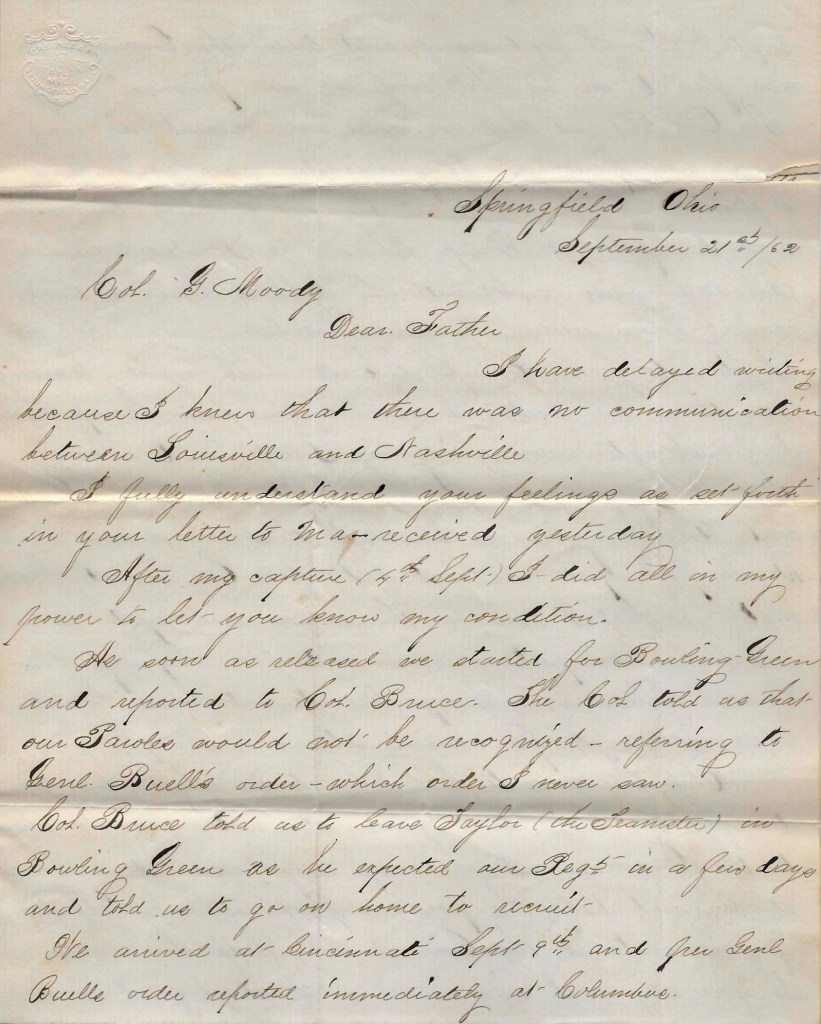
Springfield, Ohio September 21st 1862
Col. G. Moody,
Dear father, I have delayed writing because I knew that there was no communication between Louisville and Nashville. I fully understand your feelings as set forth in your letter to Ma received yesterday.
After my capture (4th September), I did all in my power to let you know my condition. As soon as released, we started for Bowling Green and reported to Col. Bruce. The Colonel told us that our paroles would not be recognized—referring to Gen. Buell’s orders—which order I never saw. Col. Bruce told us to leave Taylor (the teamster) in Bowling Green as he expected our regiment in a few days and told us to go on home to recruit.
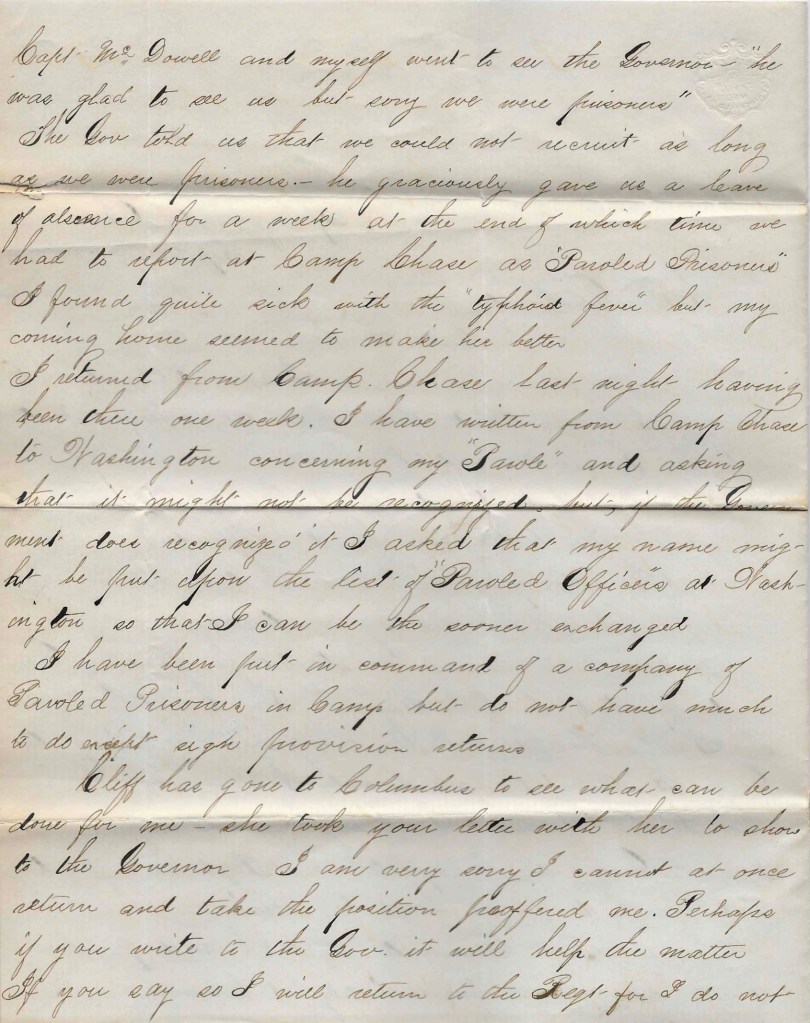
We arrived at Cincinnati September 9th and per Gen. Buell’s order, reported immediately at Columbus. Capt. [Austin] McDowell [of Co. D] and myself went to see the Governor. He was glad to see us but “sorry we were prisoners.” The Gov. told us that we could not recruit as long as we were prisoners. He graciously gave us a leave of absence for a week at the end of which time we had to report at Camp Chase as “paroled prisoners.” I found [Ma] quite sick with the “typhoid fever: but my coming home seemed to make her better.
I returned from Camp Chase last night having been there one week. I have written from Camp Chase to Washington concerning my “parole” and asking that it might not be recognized but, if the government does recognize it, I asked that my name might be put upon the list of “paroled officers” at Washington so that I can be the sooner exchanged. I have been put in command of a company of paroled prisoners in Camp but do not have much to do except sign provision returns.
[Brother] Cliff[ord] has gone to Columbus to see what can be done for me. She took your letter with her to show to the Governor. I am very sorry I cannot at once return and take the position proffered me. Perhaps if you write to the Governor, it will help the matter. If you say so, I will return to the regiment for I do not consider my parole binding, a copy of which I send:
Hartsville, Tennessee September 4th 1862
2nd Lt. ——– captured by our forces under Gen. John H. Morgan is hereby given a parole of thirty days at the end of which he will report to the Provost Marshal at Knoxville, Tennessee (by letter) to be held as a Prisoner of War until exchanged. By order of Gen. John H. Morgan, — J. C. McCann, Lt. Col., commanding Morgan’s Regt.
I did not sign this nor did I swear to anything except secrecy. If this is legal, I am willing to abide by it. If not, I am not.
I miss you so much. I should like to be with you above all things. I like the service and think that I might be able to make my mark. I will give you a synopsis of my trip in my next. Capt. [Austin] McDowell wrote you a few days since. I will say that I have not met with a person who blames us in the least. The rebels treated us very well with the exception of plundering. I hope you can make some arrangements for my speedy return to the regiment. Ma is a great deal better. Was up nearly all day yesterday.
Granville Moody, the “Famous Fighting Methodist Preacher” (Military Images Digital)
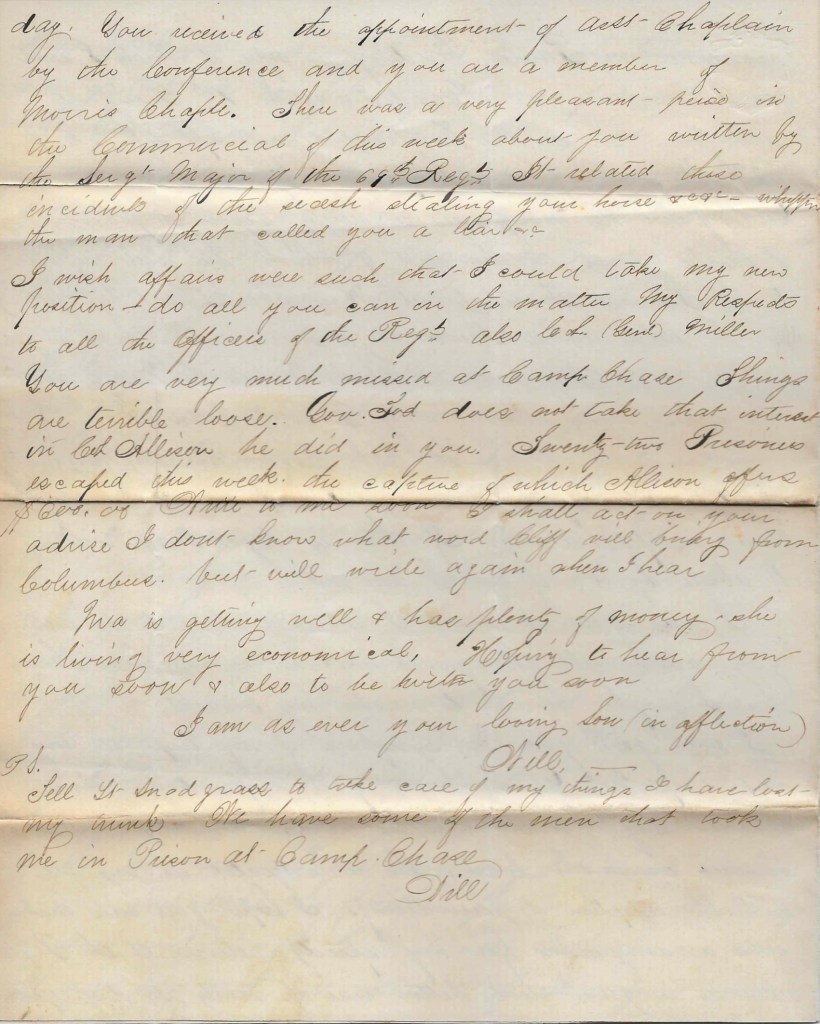
You received the appointment of Asst. Chaplain by the Conference and you are a member of Morris Chapel. There was a very pleasant piece in the [Cincinnati]Commercial of this week about you written by the Sergeant Major of the 69th Regiment. It related those incidents of the secesh stealing your horse &c., whipping the man that called you a liar, &c.
I wish affairs were such that I could take my new position. Do all you can in the matter. My respects to all the officers of the regiment; also Col. (Gen.) Miller. You are very much missed at Camp Chase. Things are terrible loose. Gov. Tod does not take that interest in Col. [Charles W. B.] Allison he did in you. Twenty-two prisoners escaped this week. The capture of which Allison offers $600.
Write to me soon. I shall act on your advice. I don’t know what word Cliff will bring from Columbus but will write again when I hear. Ma is getting well and has plenty of money. She is living very economical. Hoping to hear from you soon & also to be with you soon. I am as ever your loving son (in affection), — Will
P. S. Tell Lt. Snodgrass to take care of my things. I have lost my trunk. We have some of the men that took me in prison at Camp Chase. — Will
Letter 2
Headquarters 3rd Brigade, 2d Division, 14th A. C. Murfreesboro. Tennessee May 25, 1863
Dear Father,
I received the enclosed letter yesterday. I spent the evening with Col. Miller and Lady Munger and Lady Gabbath May 25th. Col. very kind says he has a letter he intends sending you. He sends his compliments to the friends that made him a life member of the Missionary Society, considering it a high compliment. Mrs. Miller wishes your photograph. By all means send it to me also.
There was a drunken row in the 74th yesterday. All of Co. I engaged in the fight. Lt. McGreavy knocked down. Had his clothes almost entirely torn from his person. Maj. Bell went in on his muscle, knocking down several. Col. Miller I think will investigate the matter.
Send me a field glass and write soon to your loving son, — Wm. H. H. Moody. Lt. and Top. Engineer, 3rd Brigade
to Col. G. Moody, Springfield, Ohio
Letter 3
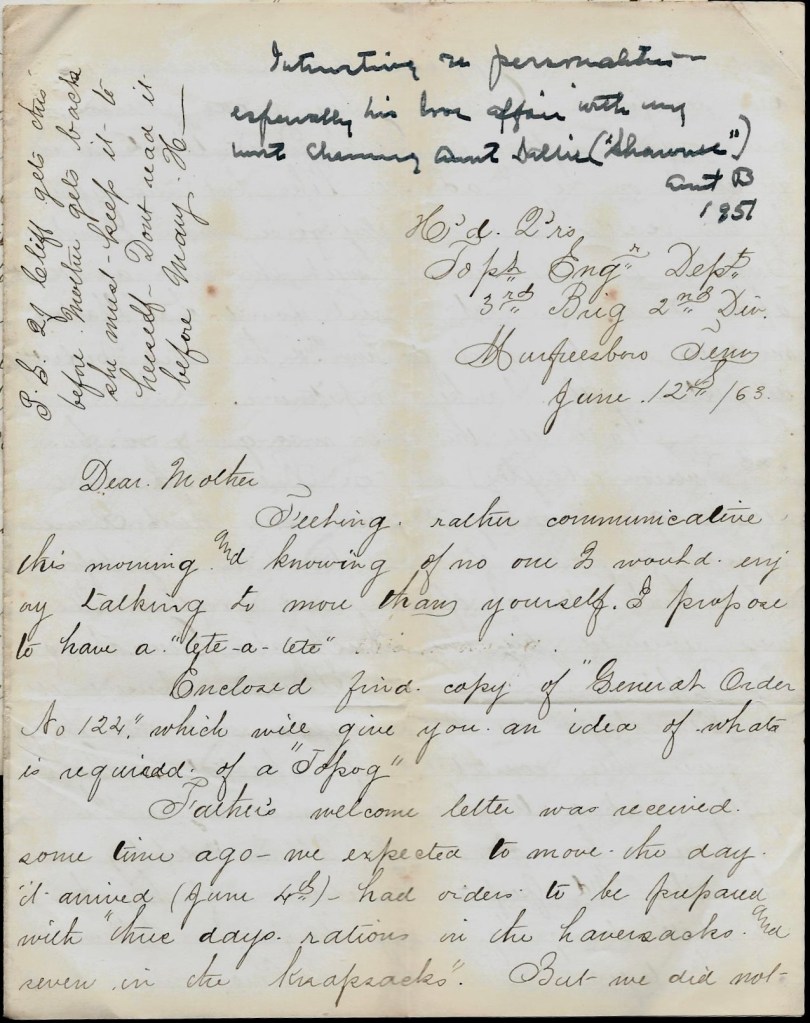
Headquarters Topographical Eng. Department 3rd Brigade, 2nd Division Murfreesboro, Tenn. June 12th 1863
Dear Mother,
Feeling rather communicative this morning and knowing of no one I would enjoy talking to more than yourself, I propose to have a “tete-a-tete.”
Enclosed find copy of “General Order No. 124” which will give you an idea of what is required of a “Topog.”
Father’s welcome letter was received some time ago. We expected to move the day it arrived (June 4th)—had orders to be prepared with “three days rations in the haversacks and seven in th knapsacks.” But we did not move. The “rebs” supposed that Rosecrans had reinforced Grant and they made a “reconnoissance in force”—drove in General Davis’ pickets—made an attack on the Bradyville Pike but were repulsed by the “videttes” and a “Cavalry force” under General Turchin. Simultaneously with this was an attack upon Franklin, but Forrest found that “Yankee mudsills” were too much for him and he retired, perfectly disgusted with Yankee impertinence.
While all this fuss was going on the 2nd Division (Negly) were on Review. I have seen a great many reviews—saw General Rosecrans’ Division (a portion of it “Regulars”) the day before but I think (general opinion) ours excelled. We were reviewed by the “Inspector General” of this Department—Col. Ducat. There was present all the generals in the departments, together with their “staff” and wives—these constituted the spectators. Gen. Negley wished to show how well drilled “his boys” are so he had the 19th Illinois “deploy as skirmishers” and perform the evolutions of the “skirmish drill.” closing by giving the famous “Ellsworth cheer and tiger.” Then the 18th Ohio were ordered to show themselves adept in the “bayonet exercise” closing with the command, “left rear volt—in high tierce—parrie—thrust—guard.” The whole Division was then formed in “double column” and thence “into square.” After deploying, the command “Repare for Review” was given and then commenced “Review” proper. Pa can show you how it is done.
Our Brigade was highly complimented by the Reviewing Officer. But the grand feature of the day was the banquet furnished by Gen. Negley in the evening. Col. Miller and staff were invited of course. The General has caused quite a number of the “flies of his tents” to fly into position in line of battle which formed a canopy for those assembled. The silver band of the 19th Regulars dispensed “Nation at Air,” “Operatic Gems,” while General Rosecrans, Thomas, Sheridan, Garfield, and lesser lights” paid their respects to the richly ladened tables. Mrs. Gen. Negley, Mrs. Quartermaster Taylor, and many other ladies were present adding much to the appearance of affairs. Old Von was there. He took me off to one side and had quite a lengthy talk with me—spoke highly of Pa. Said “by some means a misunderstanding had arisen—that he hoped Pa would find out some time that he was not the enemy Pa supposed him. Said he never wished the Colonelcy of the 74th. All he wanted was a wider sphere in which to work. He has that place now—does not wish a change. Expressed his friendship for me—said I ought to be his Adjutant. Called me “Billie” &c. &c. I suppose you have before this learned the fate of the 74th Ohio.
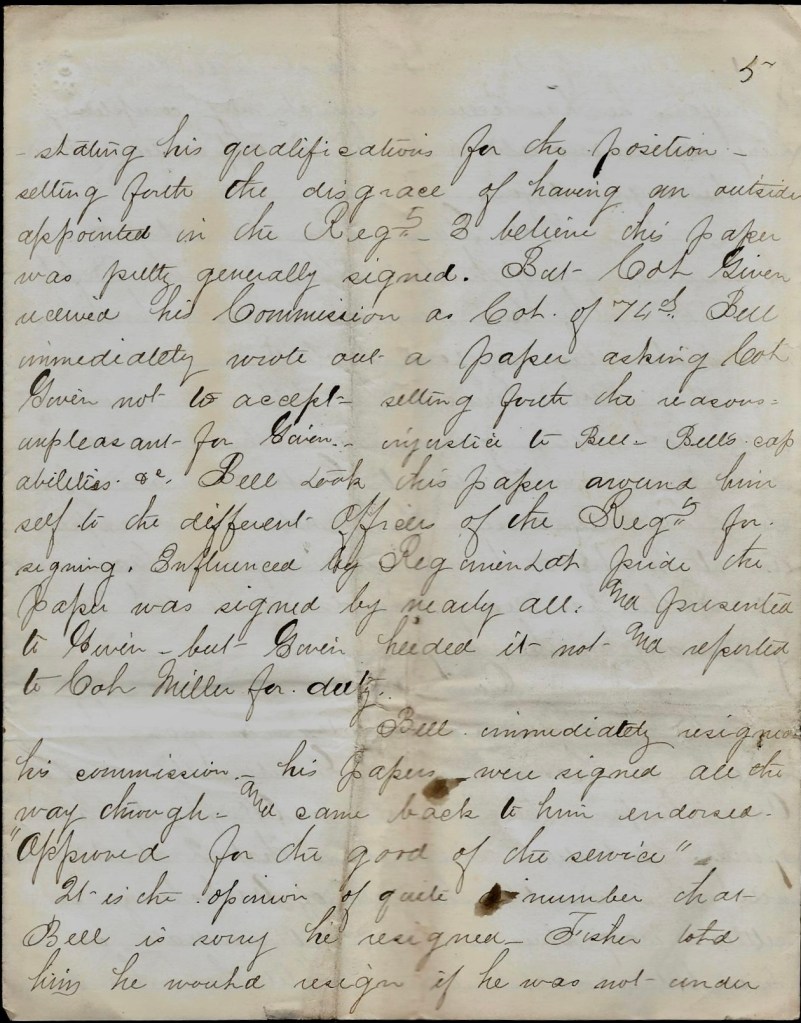
Commissions were forwarded to Von—Bell and Fisher. Von would not accept, therefore the other commissions were “null and void.” Lt. Col. Given of the 18th Ohio—the senior Lt. Col. of this department—had a promise from Gov. Tod that he should be promoted to fill the first vacancy. Col. Given telegraphed to Tod as soon as Von refused the promotion. In the meanwhile, Bell started a petition for him (Bell) to be appointed Colonel of the 74th stating his qualification for the position—setting forth the disgrace of having an outside appointed in the Regiment. I believe this paper was pretty generally signed. But Col. Given received his commission as Colonel of the 74th. Bell immediately wrote out a paper asking Col. Given not to accept, setting forth the reasons—unpleasant for Givens—injustice to Bell—Bell’s capabilities, &c. Bell took this paper around himself to the different officers of the regiment for signing. Influenced by the regiment’s pride, the paper was signed by nearly all and presented to Given—but—Given heeded it not and reported to Col. Miller for duty.
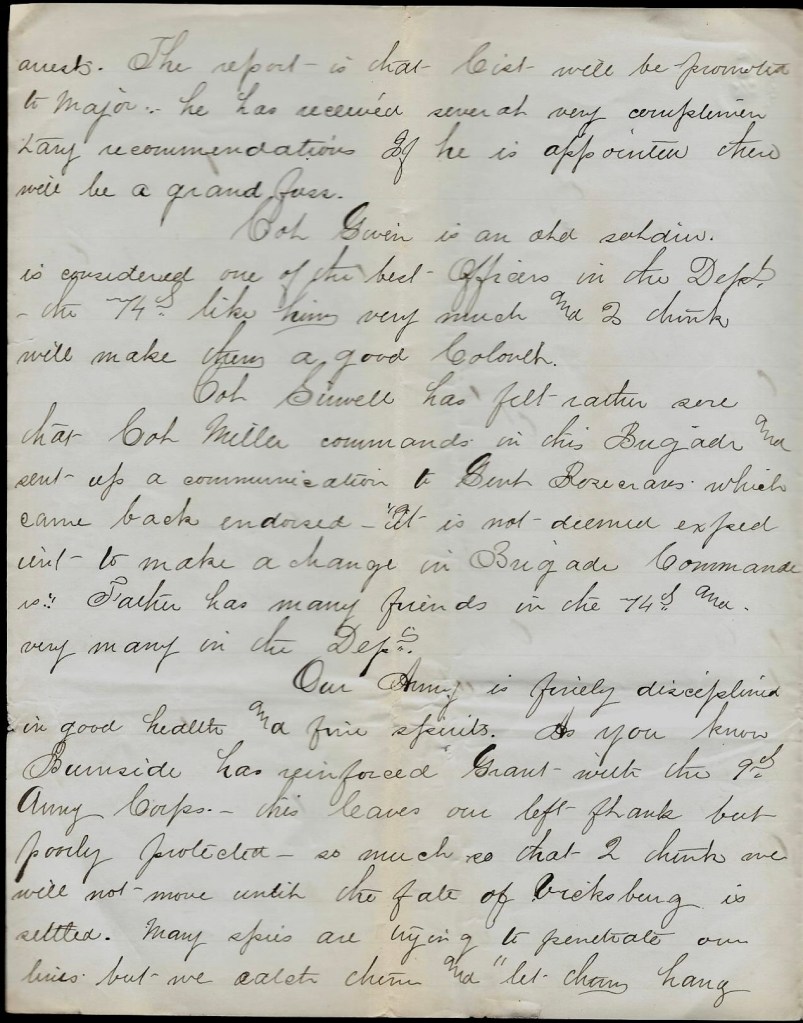
Bell immediately resigned his commission. His papers were signed all the way through and came back to him endorsed, “Approved for the good of the service.” It is the opinion of quite a number that Bell is sorry he resigned. Fisher told him he would resign if he was not under arrest. The report is that Cist will be promoted to Major. He has received several very complimentary recommendations. If he is appointed there will be a grand fuss. Col. Given is an old soldier, is considered one of the best officers in the department—the 74th like him very much and I think will make them a good colonel.
John Franklin Miller
Col. [William] Sirwell [78th Pennsylvania] has felt rather sore that Col. [John Franklin] Miller [29th Indiana] commands in this Brigade and sent up a communication to Gen. Rosecrans which came back endorsed, “It is not deemed expedient to make a change in Brigade Commanders.” Father has many friends in the 74th and very many in the Department.
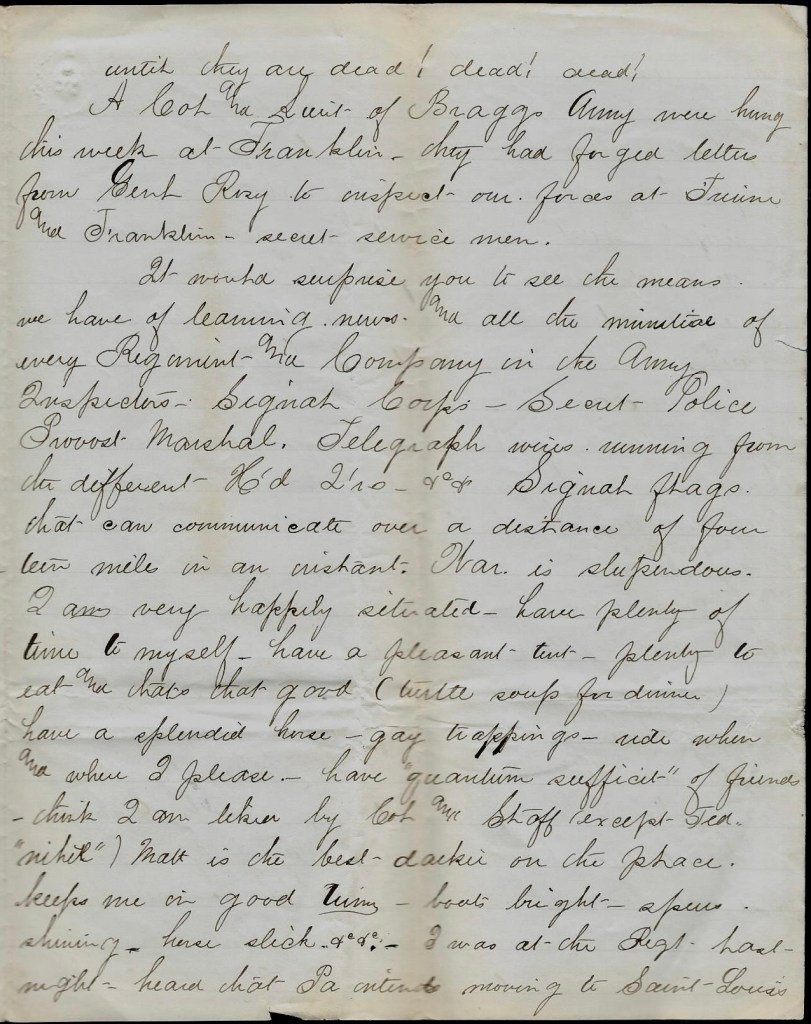
Our Army is finely disciplined, in good health, and fine spirits. As you know, Burnside has reinforced Grant with the 9th Army Corps. This leaves our left flank but poorly protected—so much so that I think we will not move until the fate of Vicksburg is settled. Many spies are trying to penetrate out lines but we catch them and “let them hang until they are dead! dead! dead! A colonel and lieutenant of Bragg’s Army were hung this week at Franklin. They had forged letters from Gen. Rosy to inspect our forces at Triune and Franklin—secret service men.
The Philadelphia Inquirer, 10 June 1863
It would surprise you to see the means we have of learning news and all the minutiae of every regiment and company in the army—inspectors—signal corps—secret police—provost marshal—telegraph wires running from the different headquarters, &c. &c. Signal flags that can communicate over a distance of fourteen miles in an instant. War is stupendous. I am very happy situated—have plenty to eat and that’s that good (turtle soup for dinner)—have a splendid horse—gay trappings—ride when and where I please—have “quantum sufficit” of friends—think I am liked by Col. & staff (except Ted. “nickel”). Matt is the best darkie on the place—keeps me in good trim—boots bright—spurs shining—horse slick, &c. &c.
I was at the regiment last night. Heard that Pa intends moving to Saint Louis, having received the Chaplaincy of that Post. I say go. I also learned (thanks to somebody) that “I am going to resign in September, come home and take to myself a wife.” Just remark to my friends that I am soldiering at present and expect to for some time to come unless health or life should fail. I should like to be home with you over Sunday. I would like some of Grandma’s good dinner.
We had a splendid serenade last week by the “glee club” of the 79th Pennsylvania. One member of which sings the finest “falsetto” I ever heard sing. The staff were invited up to Mrs. Miller’s private rooms and we spent a very pleasant evening.
I am sorry that I can’t hear from sister Lizzie more than I do, nor little Molly. What’s the matter—are they sick? I want you to buy Brother Granville a handsome birthday present (July 2nd or 3rd)—some first rate present and give it to him for me. I will send some money perhaps before long. If not, I have plenty at home.
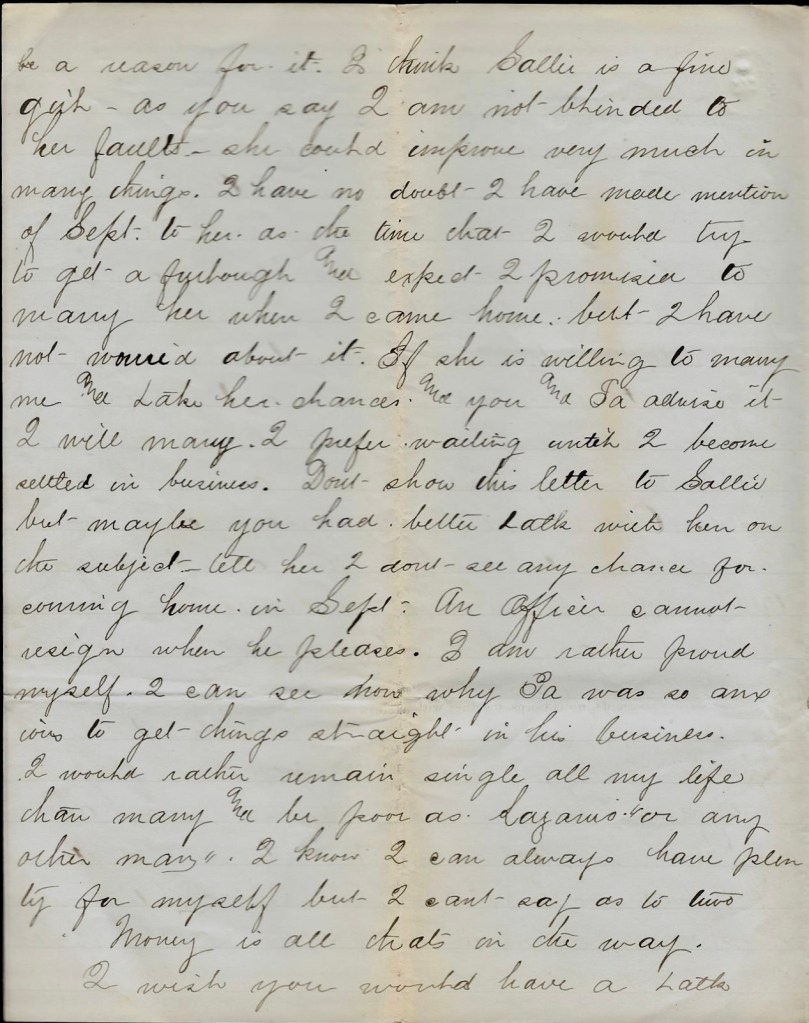
2 p.m. I have just received your letter of June 7th containing wedding cards. “Long may Annie Wave” and I am sure her shadow will never grow less. I am very thankful for the good motherly letter. I must confess I feel rather queer—to tell you the truth, I have never felt sure I was going to marry. I have been perfectly honest with Sallie but I did not know that the day or month was fixed. One thing I am certain of, I won’t marry anybody until I am able to support them. My expenses here are necessarily heavy. Besides, I have not stinted myself in anything. A staff officer can’t save near as much as a line officer—a servant—a cook—table expenses—servant’s rations—clothes—spending money, &c. &c. When I leave the service, I have no business that I can go into immediately. If I was worth $10,000 I wouldn’t care to marry. It is very uncertain—in fact, improbable, that I can get home in September even should there be a reason for it. I think Sallie is a fine girl. As you say, I am not blinded to her faults. She could improve very much in many things. I have no doubt I have made mention of September to her as the time that I would try to get a furlough and expect I promised to marry her when I came home, but I have not worried about it. If she is willing to marry me and take her chances and you and Pa advise it, I will marry. I prefer waiting until I become settled in business. Don’t show this letter to Sallie but maybe you had better talk with her on the subject. Tell her I don’t see any chance for coming home in September. An officer cannot resign when he pleases. I am rather proud myself. I can see now why Pa was so anxious to get things straight in his business. I would rather remain single all my life than marry and be poor as Lazarus “or any other man.” I know I can always have plenty for myself but I can’t say as to two. Money is all that’s in the way. I wish you would have a talk with Sallie. I think I could break her of most of her bad habits. I assure you I have a due appreciation of my name and family. I don’t consider they condescend much.
While I was in Columbus, I met Beckie and Sallie is not the only person I could marry. Keep this to yourself.
This afternoon at 3 o’clock, two men are to be hung for murder. Great crowds of soldiers are passing here “en route” for the execution. This will be the fifth hung in this department within a fortnight: “Sic semper tyrannus.”
I must close as I wish a nap before Brigade Drill. Tell Pa to write. How about a [ ] glass? Give my love to Aunt Jane. I should like to hear from her. Love to Cliff (answer my letter), Lizzie, Mary, Granville, Charley & Grandma. Tell them all how much I love htem. Love to dear Pa (Col.) and believe me your loving son, — Wm. H. H. Moody, Lieut. & Topographical Engineer
This letter came to me for transcription unsigned but we learn from the content that he served in the 74th Ohio Volunteer Infantry (OVI) which was organized at Xenia beginning in October 1861. Seven of the ten regiment’s ten companies were recruited from the vicinity of Xenia. Beyond that, however, I am unable to identify the name of the soldier.
The regiment was ordered to Camp Chase, four miles west of Columbus, Ohio, on 24 February 1862, and were on duty there until 20 April when they were ordered to Nashville, Tennessee, to join Dumont’s Independent Brigade in the Army of the Ohio. While at Camp Chase, their primary duty was to guard the civilian and Confederate prisoners who had begun to arrive there in large numbers following the surrender of Fort Donelson. Granville Moody (see image in banner), the colonel of the 74th OVI and who would later earn the sobriquet “the Fighting Preacher” for his gallantry at Stone River, was placed in charge of Camp Chase at the time of this letter and Major Ballard, also if the 74th, was appointed to supervise the police of the camp.
The letter was written to Mary Anot Halley (1836-1888), the daughter of John and Jessie (Spital) Halley of Markinch, Fifeshire, Scotland. John brought his family to America in 1847. Mary’s mother, however, died in Montreal, Canada, while enroute to Vermont where John Halley settled in Orange county. Mary is believed to have either been a teacher or student at the Xenia Female Seminary in 1862 and a member of the literary society there.
Transcription
Addressed to Miss M. A. Halley, Corresponding Secretary of Aesthetic Society, Xenia, OH “Soldiers Letter, G. Moody, Col., 74th Regt. Camp Chase, OH”
Camp Chase [Columbus, Ohio] March 20th 1862
Members of Aesthetic Society,
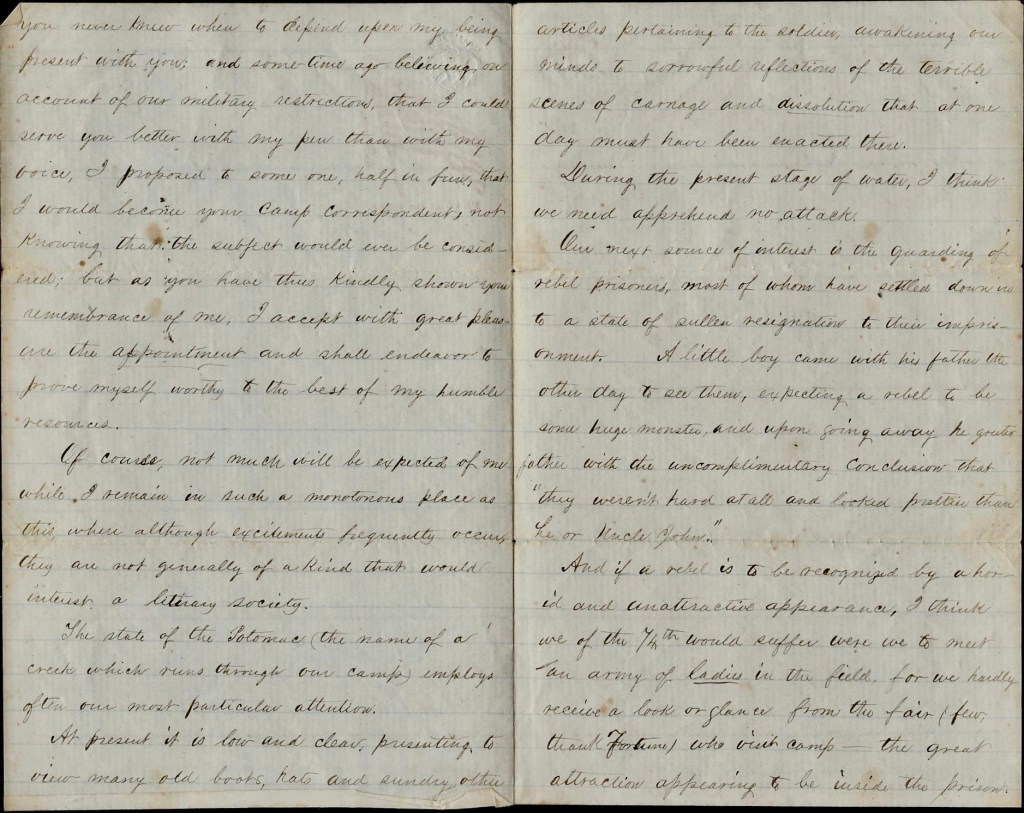
Through your kind Secretary, Miss Halley, I received the information that I had been chosen as your anything but local correspondent. While I feel highly grateful for the honor, I cannot help feeling myself in a great degree unworthy of the compliment, both because I do not feel myself capable of affording you much entertainment, and because I have heretofore proved myself to be such an unprofitable member to the Society.
Ever since my acceptance of a membership with you, I felt that I was a drawback rather than an advantage to you as you never knew when to depend upon my being present with you, and some time ago believing on account of our military restriction that I could serve you better with my pen than with my voice, I proposed to someone, half in fun, that I would become your camp correspondent, not knowing that the subject would ever be considered. But as you have thus kindly shown your remembrance of me, I accept with great pleasure the appointment and shall endeavor to prove myself worthy to the best of my humble resources.
Of course, not much will be expected of me while I remain in such a monotonous place as this, where although excitements frequently occurs, they are not generally of a kind that would interest a literary society.
The state of the Potomac (the name of a creek which runs through our camp) employs often our most particular attention. At present it is low and clear, presenting to view many old boots, hats and sundry other articles to the soldier, awakening our minds to sorrowful reflections of the terrible scenes of carnage and dissolution that at one day must have been enacted there. During the present stage of water, I think we need apprehend no attack.
Our next source of interest is the guarding of rebel prisoners, most of whom have settled down to a state of sullen resignation to their imprisonment. A little boy came with his father the other day to see them expecting a rebel to be some huge monster and upon going away, he greeted father with the uncomplimentary conclusion that “they weren’t hard at all and looked prettier than he or Uncle John.”
And if a rebel is to be recognized by a horrid and unattractive appearance, I think we of the 74th would suffer were we to meet an army of ladies in the field for we hardly received a glance from the fair (few, thank fortune) who visit camp—the great attraction appearing to be inside the prison. I have had conversations with a good many of the rebels who appear to be most able and intelligent men, causing one to wonder why they were ever so intellectually blinded as to take the part they did.
I am glad to hear from recent reports that the Shaker doctrine is not promulgated from the Aesthetic Society. I trust that the occurrence will not take any members from your society. I would advise that hereafter no officers of your society be one that contemplates matrimony for it is the death of any institution to be constantly changing officers. I wish the pair much happiness and hope that they wil not carry their love for your society so far as to introduce lectures *certain ones) and critiques into domestic life.
Wishing your meetings to continue in interest and profit, I close expecting to receive reports of your proceedings, and hoping to entertain you better when opportunities are better. I anticipate the pleasure of being once more with you when the present rebellion is crushed and Columbia once more sings her sweet song of Freedom over the Land.













 Spared & Shared 23