This letter was written by David Dempsey Kreps (1844-1920) who enlisted on 8/18/64 as a private in Co. B, 77th PA Infantry. He was discharged on 6/16/65. He was a Member of GAR Post # 433 (Sergeant John C. Dickey) in Greenville, PA. Kreps died on 11/7/1920 in Indianapolis, IN and is buried there in Crown Hill Cemetery.
David wrote the letter to his brother, Frank A. Kreps who was one of the officers that escaped from Libby by tunneling out of the Confederate Prison in Richmond. He was one that was recaptured as well as the following article in the Richmond Enquirer on 13 February 1864 relates: “Three more of the Yankee officers who recently took the underground route out of the Libby Prison, were recaptured on Thursday, near Fort Clifton, on the Appomattox. It seems that after their escape from the Libby they succeeded in reaching Port Walthall, where they secured a boat and started for Old Point. In going down the James river they mistook their way and turned into the Appomattox. In the darkness they ran the boat upon the obstructions in the river, near the fort, and upset it, when, utterly exhausted and almost frozen to death, they went ashore and surrendered themselves to a party of men belonging to Martin’s Battery. They were conveyed to Petersburg and confined in the provost marshal’s guard house. Their names are Frank M. Kreps, 1st Lieutenant, 77th Pennsylvania; Freeman C. Gay, 2d Lieutenant, 11th Pennsylvania; Henry B. Freeman, 1st Lieutenant, United States Infantry.”
T R A N S C R I P T I O N
Camp near Huntsville, Alabama January 29 [1865]
Dear Brother,
I received your letter some days ago and I put it iff and ought of answered it before this time. But being as it is Sunday and not having much to do, I thought I would answer your letter.
Will Lavern said that Col. [Thomas E.] Rose said that you was to be Capt. of Co. B and that he was going to try to go home to recruit and get you to help him. I don’t know how true it is but that is what Will [ ] heard at headquarters. Lieut. Shroth and Lieut. Johnson and Lieut. [George] Conrad and Lieut. [Silas L.] Vera are all going home.
Lieut. Vera told me to tell you that he had got a letter from you and that he would answer it in a few days. He said he was kept busy making out pay rolls. They got a notice at headquarters a day or so ago that you was mustered out of the service. If you haven’t sent those shirts I sent for, send me a hat with the shirts. The government hats are such poor things that they won’t last no time at all and it cost between 7.8 and 9 dollars for a hat.
Lieut. [Alex T.] Baldwin [of Co. C] is the only one that was killed [at Nashville on 16 December 1864] that I know. There was several others killed and some wounded but I don’t know their names. Acer of our company was wounded but not very bad.
I guess we will be paid off in a few days but don’t know how soon. They are busy making out the pay rolls.
I think you had better stay at home for I think you have done enough. Our family has done enough towards putting down this rebellion. Let some others come that has not soldiered any. We are all well, getting along first rate. We have nothing to do except eat, drink, and drill a little. The grub we get is not quite as good as that we get at home [but they] give me plenty of it. I can live. I have gained just twenty pounds. I weigh 137 pounds and a half. Whenever we are paid off, I want to get my picture taken and send it home.
I must bring my letter to a close. Frank, I would like to see you. Well, I will close hoping to see you in about seven months. Give my love to all the family and friends. Your affectionate brother, — David D. Kreps
The following letter was only signed “Andrew” and addressed to an unnamed brother, but the content reveals that it was written by a member of the 77th Pennsylvania Infantry. This regiment was organized at Pittsburgh on October 15, 1861 and left for Louisville, Kentucky, three days later. They were attached to Negley’s 4th Brigade, McCook’s Command, in General Don C. Buell’s Army of the Ohio. In December, 1861 they transferred to the 5th Brigade, led by Colonel Edward Kirk—events that are mentioned in the following letter. It’s seems probable that Andrew had a brother named Frank who served with him in the same company. The writer had distinctive, beautiful handwriting, which was similar to that of William Andrew Robinson, Captain of Co. E, but he signed his letters, “Will.”
Transcription
Camp Wood, Kentucky Sunday, 15 [December] 1861
Dear Brother,
I wrote to Mother this forenoon and as I had a little more leisure time this afternoon, I thought I would write a few lines to you. Since I wrote you last, we have advanced a little farther towards Ole Buckner. Our regiment was detached from Negley’s Brigade on the 9th and we were ordered to join an Indiana Brigade commanded by Gen. Wood, which were encamped about two miles distant. We remained there until the 11th when we received orders to march (the whole Brigade). All things being ready, we got started about 9 o’clock and arrived to where we now are about sundown which is 14 miles from Nevin and 9 miles from Green river I believe. We were considerably wearied carrying our knapsacks, it being the first long march that we have had.
Our camp is near Bacon Creek. The railroad bridge that crosses it at this place has been burned twice by the Rebels. It has just been rebuilt. It was burned the second time the next night after it was finished which was about ten days ago. There were no Union troops here then. There are now about 10,000 encamped within sight of us.
It is probable that we will march on as far as Green river next week. I suppose we will have to give Ole Buckner a sweep before long. I think the 77th can hoe her row with any of them. We are getting right among the sesau-singers [secessionists] now. Frank went out to get his boots mended the other day and he seen Buckner’s Uncle and he had quite a talk with him. He pretended to be a good Union man of course, but whether he is or not is a question. Buckner owns a farm only 5 or 6 miles from here.
Don’t tell Mother that we are advancing. I did not say anything about it in my letter to her. I seen some of the shabbiest looking houses on our march down here that I ever saw. The natives don’t seem to take any pride in having anything nice around them. The curse of slavery can be seen even here.
I received the Harper’s Weekly you sent me day before yesterday and it was gladly received too, I tell you. You don’t know how glad a soldier is to get letters or papers from home. The sketch of Camp Nevin is not where we were encamped. There were three or four camps included in Camp Nevin. McCook’s Headquarters were about a mile from Negley’s. The weather here for the past week or two has been beautiful—about like September weather at home, no snow. Excuse this short letter. I will write more some future time. My love to all. Your brother, — Andrew
N. B. It agrees with me Bully down here. I weight 155 lbs. in my shirt sleeves.
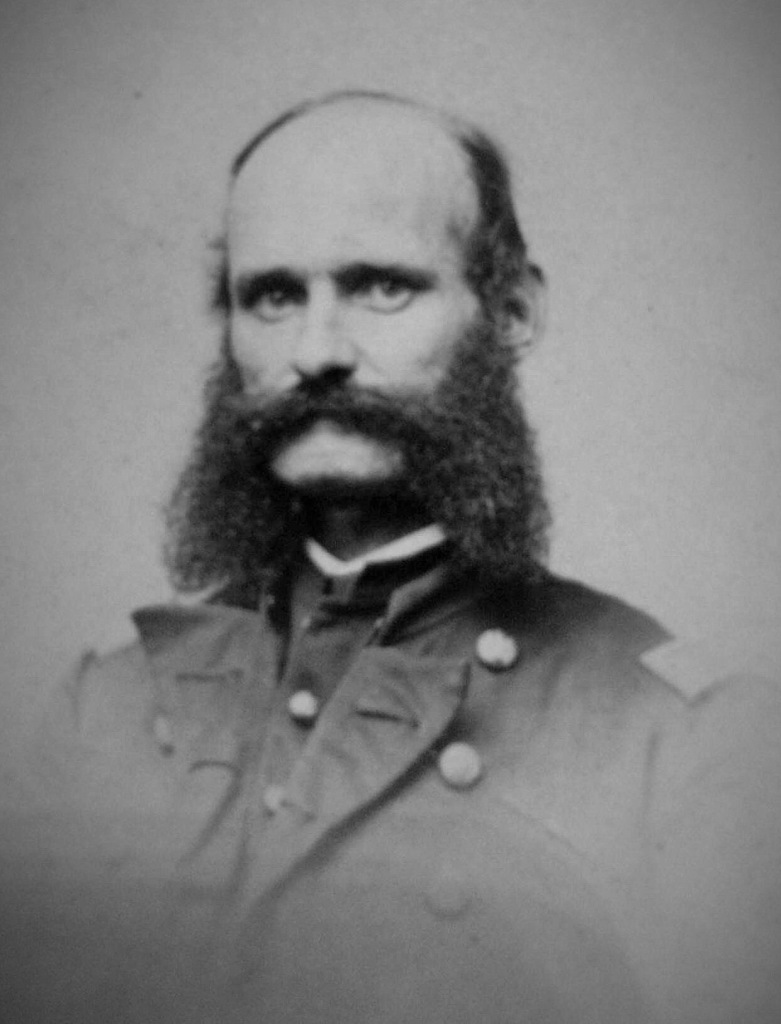
The following letter was penned by William Andrew Robinson (1830-1902) in December 1862 while serving as the Captain of Co. E, 77th Pennsylvania Infantry. He later rose in rank to Lt. Colonel of the regiment. The 77th was formed in September and October 1861 for a three-year service. It participated in several battles including the Battle of Shiloh, the siege of Corinth, the Battle of Stones River, the Battle of Chickamauga, the Atlanta campaign, the Nashville campaign, and the Battle of Nashville. The regiment was later assigned to Texas and finally mustered out in Philadelphia on January 16, 1866.
William A. Robinson was twenty-nine years old when he enlisted. His family was from the Lawrenceville neighborhood of Pittsburgh. He was captured after the Battle of Chickamauga and was a Prisoner of War in Libby Prison in Richmond, Virginia. After his release from Libby Prison, he was recaptured and sent to Georgia. He was mustered out of the Army on January 15, 1866 and returned to Pittsburgh and civilian life on February 1, 1866.
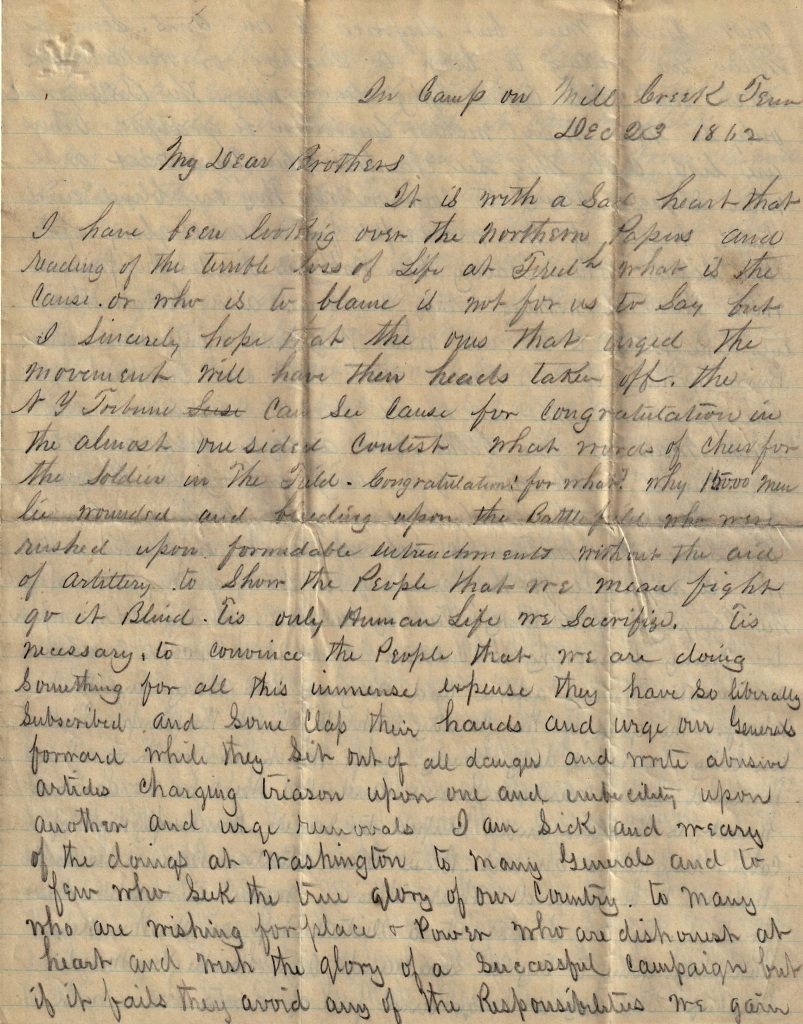
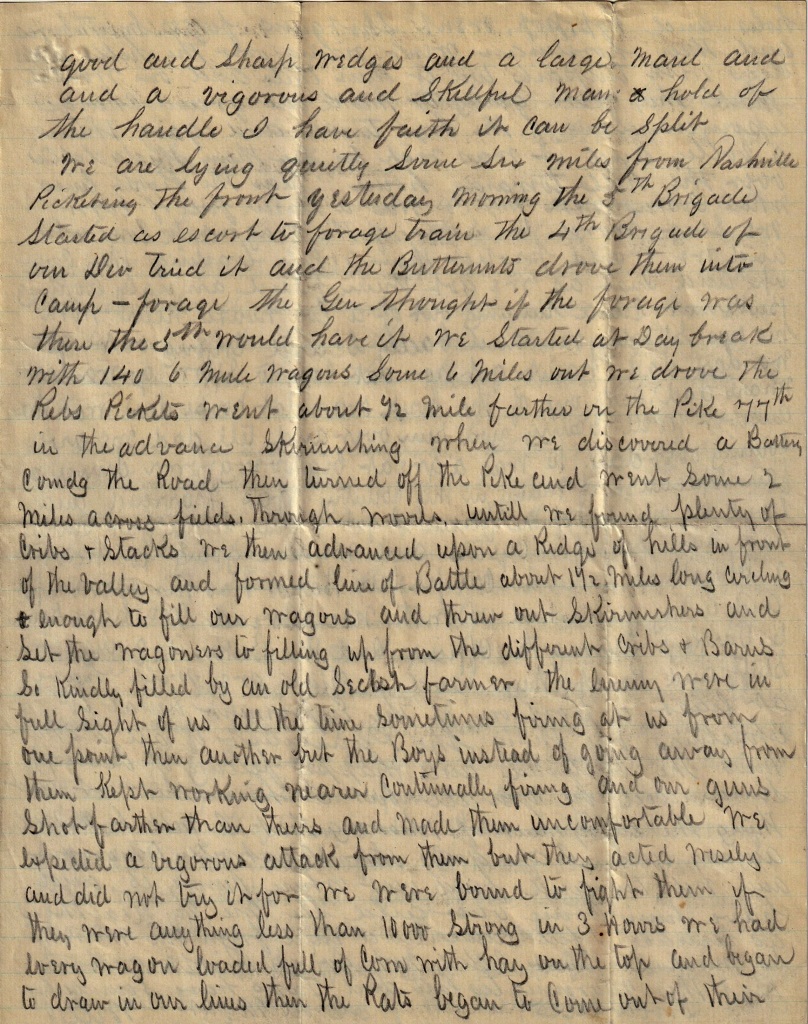
In this letter, William conveys his response to the intelligence received regarding Burnsides’ loss at the Battle of Fredericksburg. He expresses his profound dismay with the generals who appear to prioritize personal glory over the welfare of their country. William writes, “Stars shine upon too many unworthy shoulders and men crowd around Washington offering advice and urging this policy and that, who, for the good of the country, ought to ‘stretch the hemp,'” he wrote. He also expresses his dissatisfaction with the way President Lincoln is prosecuting the war. “Lives are being sacrificed daily—hourly, one of which is worth ten thousand such miserable knaves and Old Abe who no doubt is honest is too slow and stupid to see it.” He then asks, “Are we drifting to a dictatorship or is the Old Rail Splitter going to try a lone hand and handle the maul himself? The log is large and full of knots. But with good and sharp wedges and a large maul and a vigorous and skillful man hold of the handle, I have faith it can be split.” William closes his 4-page letter with a description of a foraging expedition and his plans for a Christmas dinner.
[Note: This letter is from the private collection of Richard Weiner and was transcribed and published on Spared & Shared by express consent.]
Transcription
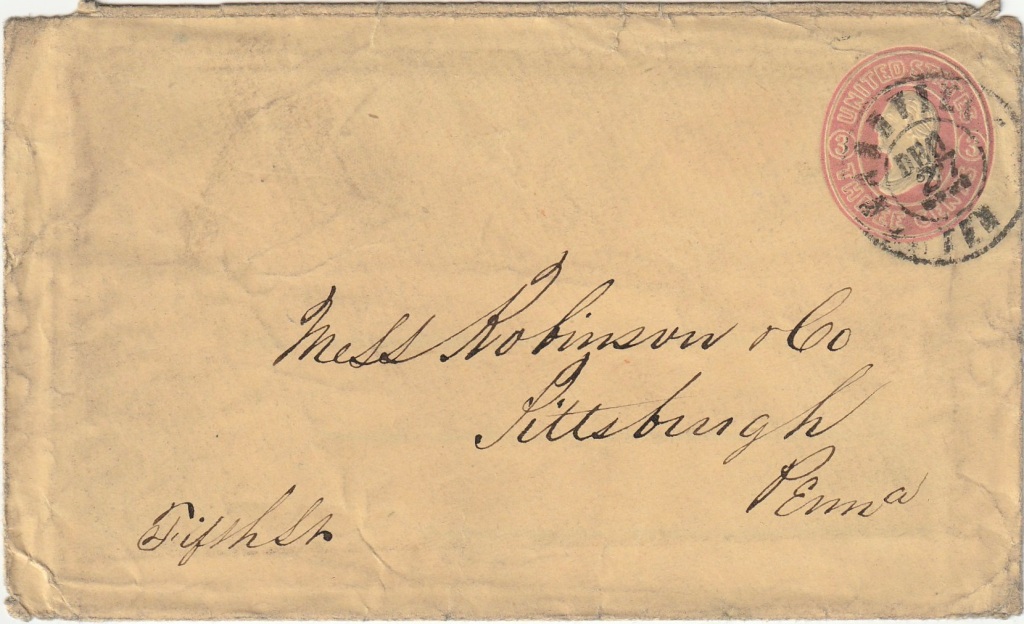
In camp on Mill Creek, Tennessee December 23, 1862
My Dear Brothers,
It is with a sad heart that I have been looking over the Northern papers and reading of the terrible loss of life at Fredericksburg. What is the cause or who is to blame is not for us to say, but I sincerely hope that the ones that urged the movement will have their heads taken off. The New York Tribune can see cause for congratulation in the almost one-sided contest. What words of cheer for the soldier in the field. Congratulations for what? Why 15,000 men lie wounded and bleeding upon the battlefield who were rushed upon formidable entrenchments without the aid of artillery to show the people that we mean fight go it blind. Tis only human life we sacrifice. Tis necessary to convince the people that we are doing something for all the immense expense they have so liberally subscribed and some clap their hands and urge our Generals forward while they sit out of all danger and write abusive articles charging treason upon one and imbecility upon another and urge removals.
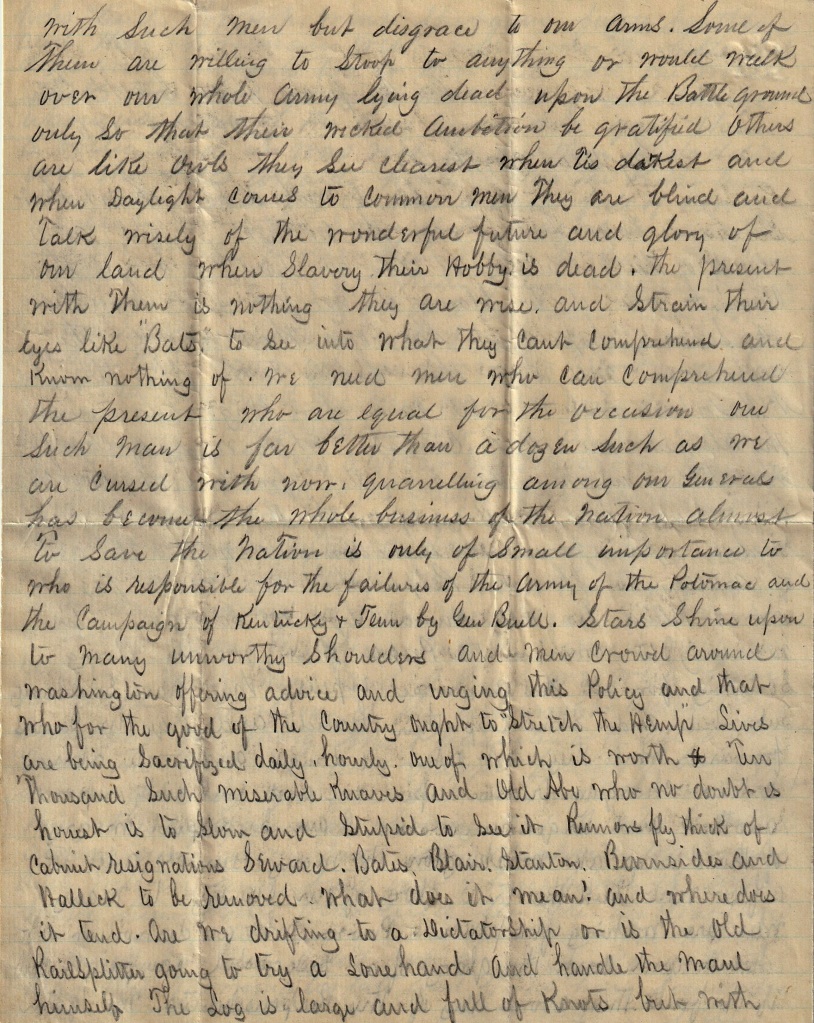
I am sick and weary of the doings at Washington. Too many Generals and too few who seek the true glory of our country. Too many who are wishing for place & power who are dishonest at heart and wish the glory of a successful campaign but if it fails, they avoid any of the responsibilities. We gain with such men but disgrace to our arms. Some of them are willing to stoop to anything or would walk over our whole army lying dead upon the battleground only so that their wicked ambition be gratified. Others are like owls. They see clearest when tis darkest and when daylight comes to common men, they are blind and talk wisely of the wonderful future and glory of our land when slavery—their hobby—is dead. The present with them is nothing. They are wise and strain their eyes like “bats” to see what they can’t comprehend and know nothing of. We need men who can comprehend the present—who are equal for the occasion. One such man is far better than a dozen such as we are cursed with now.
Quarreling among our Generals has become the whole business of the Nation almost. To save the Nation is only of small importance to who is responsible for the failures of the Army of the Potomac and the campaign of Kentucky & Tennessee by Gen. Buell. Stars shine upon too many unworthy shoulders and men crowd around Washington offering advice and urging this policy and that, who, for the good of the country, ought to “stretch the hemp.”
Lives are being sacrificed daily—hourly, one of which is worth ten thousand such miserable knaves and Old Abe who no doubt is honest is too slow and stupid to see it. Rumors fly thick of cabinet resignations—Seward, Bates, Blair, Stanton. Burnsides and Halleck to be removed. What does it mean! and where does it end? Are we drifting to a dictatorship or is the Old Rail Splitter going to try a lone hand and handle the maul himself? The log is large and full of knots. But with good and sharp wedges and a large maul and a vigorous and skillful man hold of the handle, I have faith it can be split.
We are lying quietly some six miles from Nashville, picketing the front. Yesterday morning the 5th Brigade started as escort to forage train the 4th Brigade of our Division, tried it, and the Butternuts drove them into camp—forage. The General thought if the forage was there, the 5th would have it. We started at daybreak with 140 6-mule wagons. Some 6 miles out, we drove the Reb’s pickets, went about half mile further on the Pike, 77th [Pennsylvania Infantry] in the advance skirmishing, when we discovered a battery commanding the road, then turned off the Pike and went some two miles across fields, through woods, until we found plenty of cribs and stacks. We then advanced upon a ridge of hills in front of the valley and formed line of battle about one and a half miles long circling enough to fill our wagons and threw out skirmishers and set the wagoners to filling up from the different cribs and barns so kindly filled by an old Secesh farmer. The enemy were in full sight of us all the time, sometimes firing at us from one point, then another, but the Boys instead of going away from them, kept working nearer, continually firing, and our guns shot farther than theirs and made them uncomfortable.
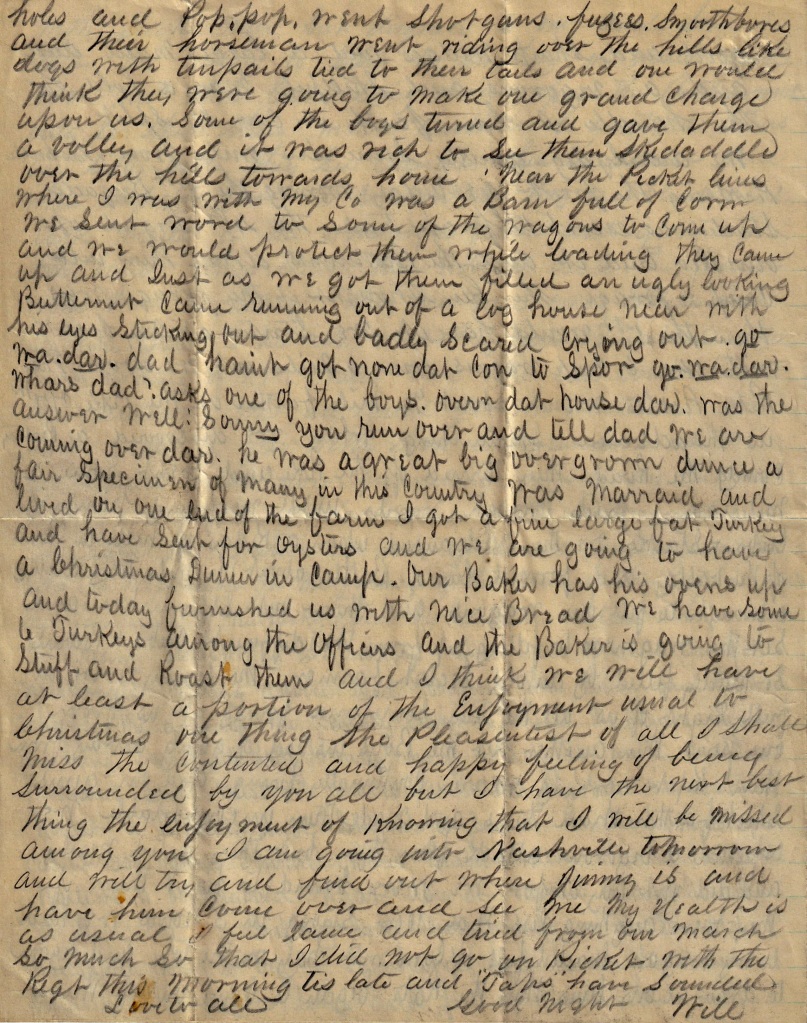
We expected a vigorous attack from them but they acted wisely and did not try it for we were bound to fight them if they were anything less than 10,000 strong. In 3 hours we had every wagon loaded full of corn with hay on the top and began to draw in our lines. Then the rats began to come out of their holes and pop—pop, went shotguns, fuses, smoothbores and their horsemen went riding over the hills like dogs with tin pails tied to their tails and one would think they were going to make one grand charge upon us. Some of the boys turned and gave them a volley and it was rich to see them skedaddle over the hills towards home.
Near the picket lines where I was with my company was a barn full of corn. We sent word to some of the wagons to come up and we would protect them while loading. They came up and just as we got them filled, an ugly-looking Butternut came running out of a log house near with his eyes sticking out and badly scared, crying out, “Go way, dar. Dad hainn’t got none dar corn to spare. Go way dar!” Where’s Dad? asks one of the boys. “Over’n dat house dar,” was the answer. Well, sonny, you run over and tell dad we are coming over dar. He was a great big overgrown dunce—a fair specimen of many in this country. Was married and lived on one end of the farm.
I got a fine, large, fat turkey and have sent for oysters and we are going to have a Christmas dinner in camp. Our baker has his ovens up and today furnished us with nice bread. We have some 6 turkeys among the officers and the baker is going to stuff and roast them and I think we will have at least a portion of the enjoyment usual to Christmas. One thing—the pleasantest of all—I shall miss the contented and happy feeling of being surrounded by you all but I have the next best thing; the enjoyment of knowing that I will be missed among you. I am going into Nashville tomorrow and will try and find out where Jimmy is and have him come over and see me.
My health is as usual. I feel lame and tired from our march, so much so that I did not go on picket with the regiment this morning. Tis late and “Taps” have sounded. Love to all. Good night, — Will



 Spared & Shared 23