Category Archives: 7th Indiana Infantry

1861: Jacob J. Burnett to Mary (Purdy) Burnett

The following letter was written by Jacob J. Burnett (1829-Aft1900) of Co. C, 7th Indiana Infantry. The 7th Indiana was organized at Indianapolis and mustered in on 13 September 1861. It was ordered to Cheat Mountain, West Virginia in September, 1861 and first saw action at Greenbrier on 3-4 October 1861 where Union Gen. Joseph Reynolds advanced from Cheat Mountain with two brigades and attack the Confederate camp at Greenbrier River. After sporadic fighting and an abortive attempt to turn the enemy’s right flank, Reynolds withdrew to Cheat Mountain. In his letter, Burnett describes his company’s efforts to support a Union Battery in that artillery duel. There were less than 100 casualties total in the engagement. The engagement is sometimes referred to as the Battle of Camp Bartow.

According to muster records, Jacob was discharged for disability on 24 March 1863 after one and a half years of service. Jacob wrote the letter to his wife, Mary (Purdy) Burnett (1837-1875).

Four years ago today I transcribed account of the Battle of Camp Bartow by another member of the 7th Indiana Infantry named George Washington Sefton. His account was written in a letter dated 21 October 1861 which reads:

“I suppose you have heard that the 7th Regiment has been in one battle. If you ain’t, I will give you a description of it. The 3rd day of this month we was in a battle at Greenbriar about thirty miles from our camp. We started Wednesday evening. We marched till sundown and stopped for the night and at twelve o’clock we had orders to gather up and march in order to get there in the morning. It rained on us considerable that [night] but we did not care for that. About 9 in the morning we reached their camp. When we was [with]in about three miles of the camp, we double quicked from there to [the] battleground. The firing was kept up for three long hours. Their camp laid in the valley. It extended about 80 rods (~450 yards) in width and about the same in length. Their masked battery was on the side of the mountain. We marched up in the front of them. We undertook to flank them on the left of them under their fire which appeared to me like they might have cut us all to pieces. We was right in front of their cannons. The grapeshot just hailed round. It got so heavy that our old Colonel [Ebenezer Dumont] ordered us to take to the bushes for shelter which we obeyed. We stayed on the side of the side of the mountain for a half an hour. We being not drilled very well, we got scattered right smart but rallied and retreated under the fire without the loss of any man so that is all the particulars at the present.”

Transcription

Camp Reynolds
Saturday, October the 5th [1861]

Dear Mary,

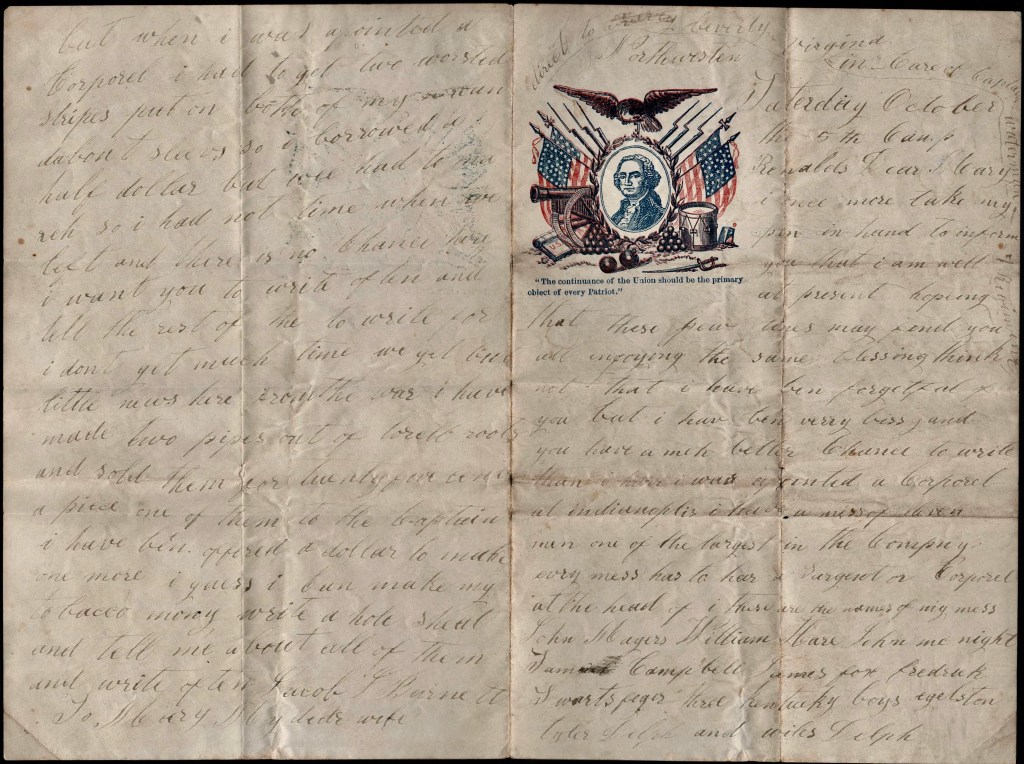
I once more take my pen in hand to inform you that I am well at present, hoping that these few lines may find you all enjoying the same blessing. Think not that I have been forgetful of you but I have been very busy and you have a much better chance to write than I have. I was appointed a corporal at Indianapolis. I have a mess of eleven men—one of the largest in the company. Every mess has to have a sergeant or corporal at the head of it. These are the names of my mess: John Magors, William Hare, John McKnight, Tom Campbell, James Fox, Frederick Schwertzfeger, three Kentucky boys—[Aaron] Eggleston, [Jonas] Tyler Delph and Willis Delph.

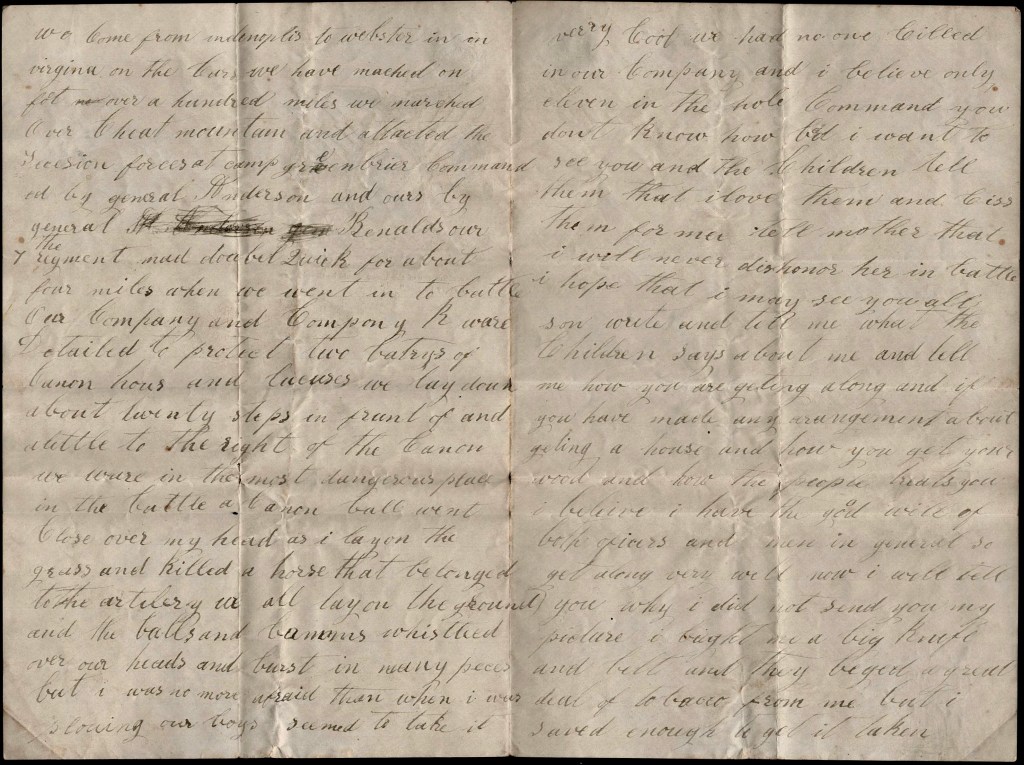
We come from Indianapolis to Webster in Virginia on the cars. We have marched on foot over a hundred miles. We marched over Cheat Mountain and attacked the secession forces at Camp Greenbrier commanded by General Anderson and ours by General [Joseph] Reynolds. Our 7th [Indiana] Regiment made double quick for about four miles when we went into battle. Our company and Co. K were detailed to protect two batteries of cannon—Howe’s and Lucas’ [Loomis’]. We lay down about twenty steps in front of and a little to the right of the cannon. We were in the most dangerous place in the battle. A cannon ball went close over my head as I lay on the grass and killed a horse that belonged to the artillery. We all lay on the ground and the balls and cannons whistled over our heads and burst in many pieces but I was no more afraid than when I was plowing. Our boys seemed to take it very cool. We had no one killed in our company and I believe only eleven in the whole command.

You don’t know how bad I want to see you and the children. Tell them that I love them and kiss them for me. Tell mother that I will never dishonor her in battle. I hope that I may see you all soon. Write and tell me what the children says about me and tell me how you are getting along and if you have made any arrangement about getting a house and how you get your wood and how the people treats you.

I believe I have the good will of both officers and men in general so get along very well. Now I will tell you why I did not send you my picture. I bought me a big knife and belt and they begged a great deal of tobacco from me but I saved enough to get it taken but when I was appointed corporal, I had to get two worsted stripes put on both of my roundabout sleeves so I borrowed a half dollar but we had to march so I had not time when we left and there is no chance here.

I want you to write often and tell the rest of them to write for I don’t get much time. We get but little news here from the war, I have made two pipes out of laurel roots and sold them for twenty-five cents apiece—one of them to the Captain. I have been offered a dollar to make one more. I guess I can make my tobacco money.

Write a whole sheet and tell me about all of them and write often. — Jacob J. Barnett

To Mary, my dear wife.

Direct to Beverly, Northwestern Virginia in care of Captain [Solomon] Waterman, 7th [Indiana] Regiment.
1862: John W. Morgan to Nancy (Larimore) Newham

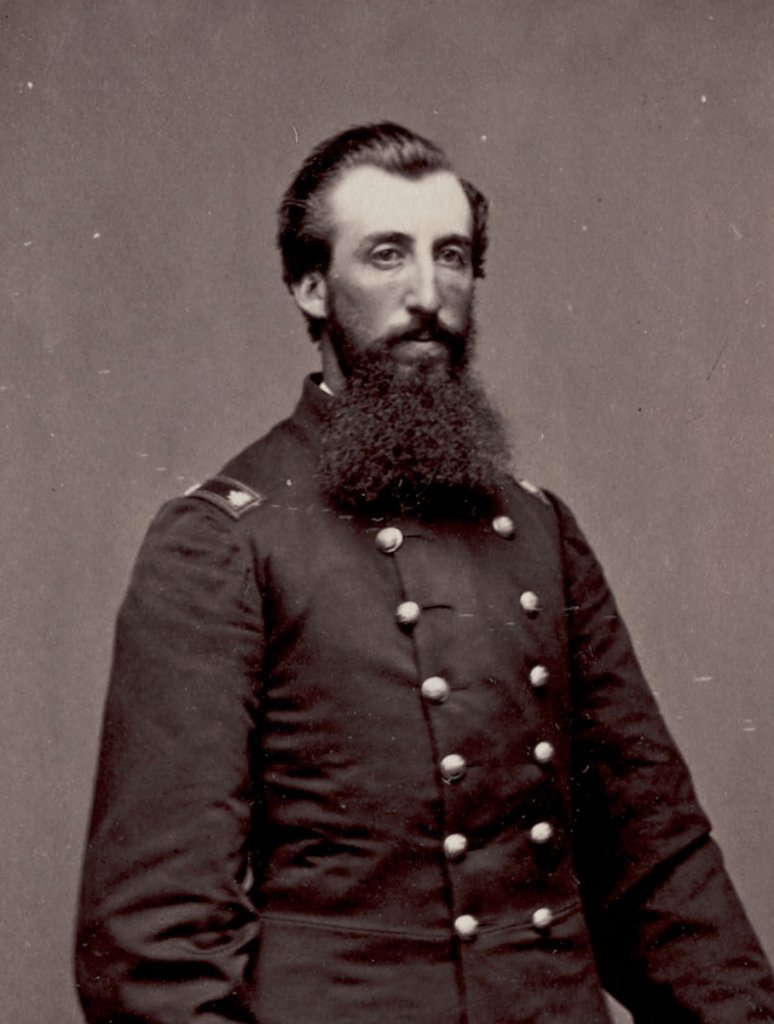
William C. Banta was the captain of Co. B, 7th Indiana at the Battle of Fredericksburg. He later rose to the rank of Lt. Colonel.

The following letter was written by John W. Morgan of Brownsburg, Hendricks county, Indiana. John was 22 years old when he enlisted on 30 August 1861 in Co. B, 7th Indiana Infantry. Sometime prior to the Overland Campaign, John was promoted to corporal. He was taken a prisoner on 5 May 1864 in the opening fighting in the Wilderness. His military records indicates that he died on 22 April 1865 and was buried in the National Cemetery at Hampton, Virginia. POW records suggest that he was held at Andersonville for a time but later transferred elsewhere, not stated.

John wrote the letter to his mother who I believe was Nancy (Larimore) Newham (1813-1891)—married to her second husband, Thomas Newham (1816-1898), about 1849. It was written from the regiment’s encampment near Falmouth just after the Battle of Fredericksburg in which they were present but held in reserve and never called upon to engage with the enemy. The regiment was brigaded with the 76th and 95th New York, and the 56th Pennsylvania in Col. Gavin’s 2nd Brigade of Abner Doubleday’s 1st Division, 1st Corps. Morgan’s letter tells of the nighttime retreat across the Rappahannock and alleges that whiskey was being offered to the men in the event they were called upon to charge the enemy’s breastworks or batteries.

To read letters by other members of the 7th Indiana Infantry transcribed and published on Spared & Shared, see:

Theodore & Mortimer Longwood, Co. C, 7th Indiana (Archive)
John H. Denton, Co. E, 7th Indiana (1 Letter)
George Washington Sefton, Co. E, 7th Indiana (20 Letters)
Phillip Jones Carleton, Co. G, 7th Indiana (1 Letter)

Transcription

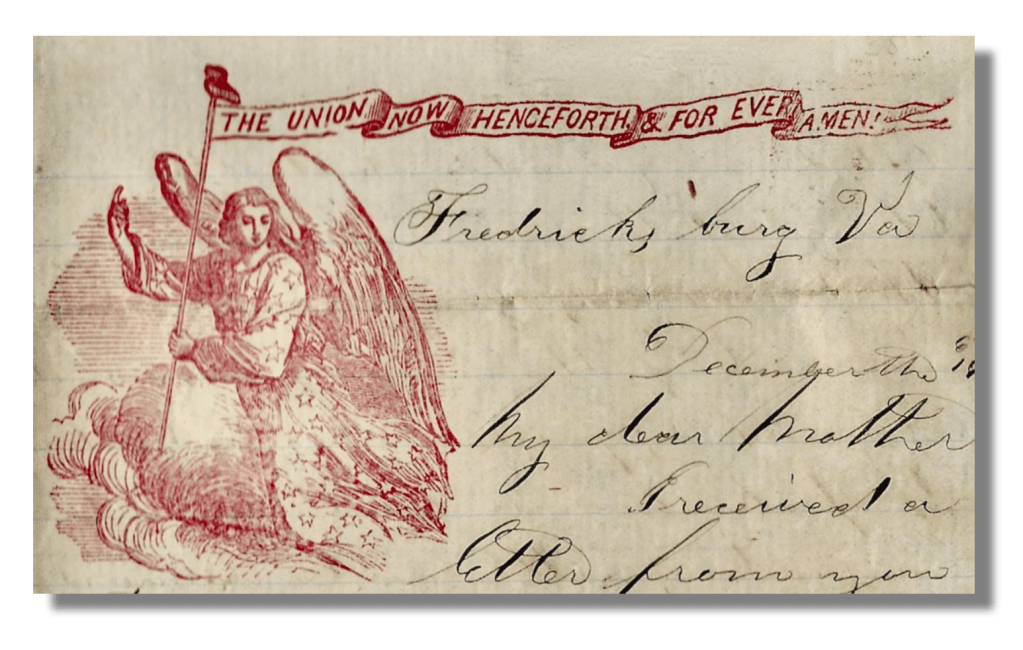
Patriotic Letterhead of Morgan’s stationery. “The Union Now Henceforth & Forever, Amen!”

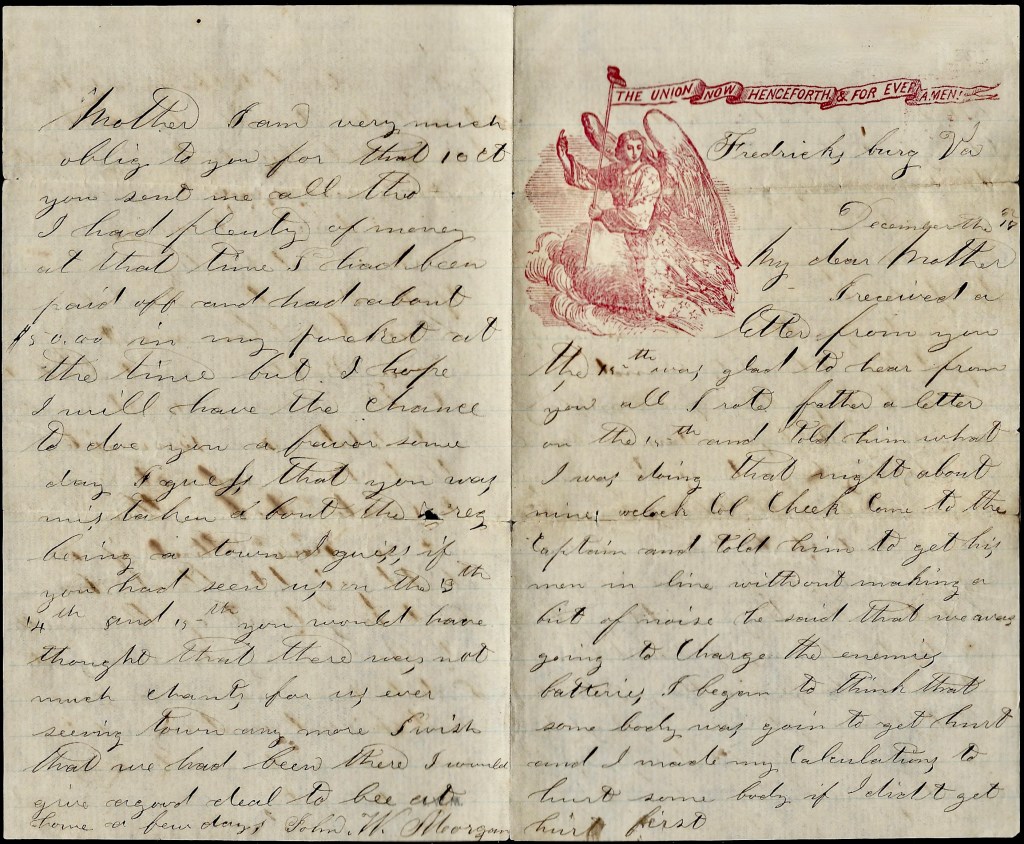
Fredericksburg, Virginia
December the 17th 1862

My dear mother,

I received a letter from you the 15th. Was glad to hear from you all. I wrote father a letter on the 15th and told him what I was doing that night. About nine o’clock, [Lt.] Col. [John F.] Cheek come to the Capt. [William Cyress Banta] and told him to get his men in line without making a bit of noise. He said that we was going to charge the enemy batteries. I began to think that somebody was going to get hurt and I made my calculations to hurt somebody if I didn’t get hurt first.

“He said that we was going to charge the enemies batteries. I began to think that some body was goin’ to get hurt and I made my calculations to hurt some body if I didn’t get hurt first.”

—John W. Morgan, Co. B, 7th Indiana Infantry, 17 Dec. 1862

But I soon found instead of charging the enemy’s batteries that we were going to get on our own side of the [Rappahannock] river as easy and as quick as possible. We wasn’t allowed to speak above our breath not let our canteens rattle. Our cannoneers wrapped their blankets round the wheels to keep them from making noise.

Just before dark a barrel of whiskey came to us to give us before making the charge. I seen the barrel but didn’t know what it was for—only to give because we was so exposed to bad weather. They wouldn’t of got me to drank any if I had knew it was to charge a battery. I think that I have got nerve enough to go anywhere the 7th Indiana Regiment goes and it will go anywhere it is ordered. If it is ordered to charge a battery, it will do it without whiskey. I guess that this beats any retreat that has been made since the war commenced. We went across the river and hardly a man spoke a word.

Gen. McClellan went up in a balloon and looked at the enemy’s breastworks and told Gen. Burnside that he would not undertake to take them and he knew that if he didn’t fight that he had to get out of there without the enemy knowing it. I don’t know how many we had killed and wounded. We have not made any report yet.

Mother, I am very much obliged to you for that 10 cents you sent me although I had plenty of money at that time. I had been paid off and had about $50 in my pocket at the time. But I hope I will have the chance to do you a favor someday. I guess that you was mistaken about the 7th regiment being a town. I guess if you had seen us on the 13th, 14th, and 15th, you would have thought that there was not much chance for us ever seeing town any more. I wish that we had been there. I would give a good deal to be at home a few days. — John W. Morgan

1864: Phillip Jones Carleton to “Cousin Harry”

This letter was written by Phillip Jones Carleton (1842-1887) who enlisted in August 862 as a musician in Co. G, 7th Indiana Infantry. Because he still had time to serve when his regiment mustered out in 1864, he later transferred to Co. C, 20th Indiana Infantry.

Phil was the son of James Farnum Carlton (1805-1857) and Anna Maria Jones (1810-Aft1860) of Bangor, Penobscot, Maine. In 1874, he was married to Emma Shields Nunemacher (1850-1925) in Marion county, Indiana. After the war, Phil worked as a freight agent in an express office in Indianapolis.

In his letter, Phillip inform his cousin that he had cut two buttons from the “coat of a dead reb Lieutenant at the Battle of Gettysburg.” The 7th Indiana came to Gettysburg with 436 men in the ranks but played no active role in the fighting on July 1st, having been detailed to remain behind and guard the corps supply trains. When their relief never showed up, their colonel (Grover) took it upon himself to order his men to the battlefield where they arrived and took a position on the north side of Culp’s Hill, next to the survivors of the Iron Brigade.

Here’s a cdv of 1st Platoon, Co. G, 7th Indiana Infantry (Dale Niesen Collection)

Transcription

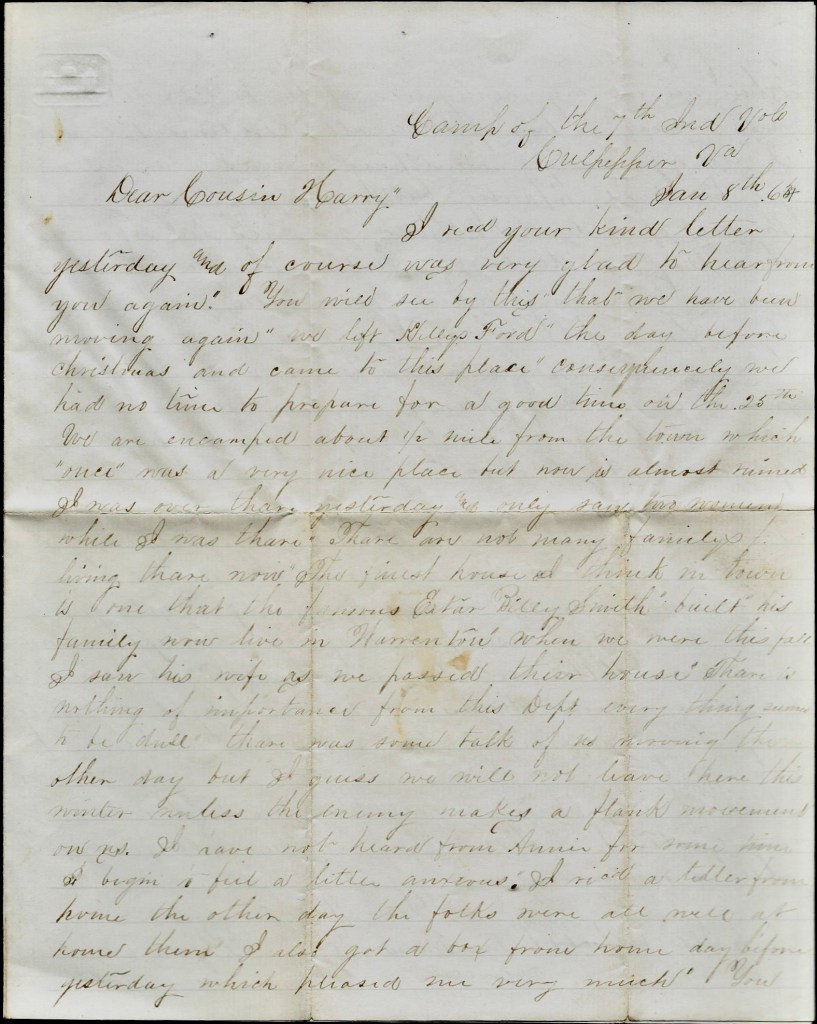
Camp of the 7th Indiana Volunteers
Culpeper, Va.
January 8th 1864

Dear Cousin Harry,

I received your kind letter yesterday and of course was very glad to hear from you again. You will see by this that we have been moving again. We left Kelly’s Ford the day before Christmas and came to this place. Correspondingly we had no time to prepare for a good time on the 25th. We are encamped about half mile from the town which once was a very nice place but now is almost ruined. I was over there yesterday and only saw two women while I was there. There are not many families living there now. The finest house, I think, in town is one that the famous Extar [Extra] Billy Smith built. His family now live in Warrenton. When we were [there] this fall I saw his wife as we passed their house. 1

There is nothing of importance from this Dept. Everything seems to be dull. There was some talk of us moving the other day but I guess we will not leave here this winter unless the enemy makes a flank movement on us. I have not heard from Annie for some time. I begin to feel a little anxious. I received a letter from home the other day. The folks were all well at home then. I also got a box from home day before yesterday which pleased me very much.

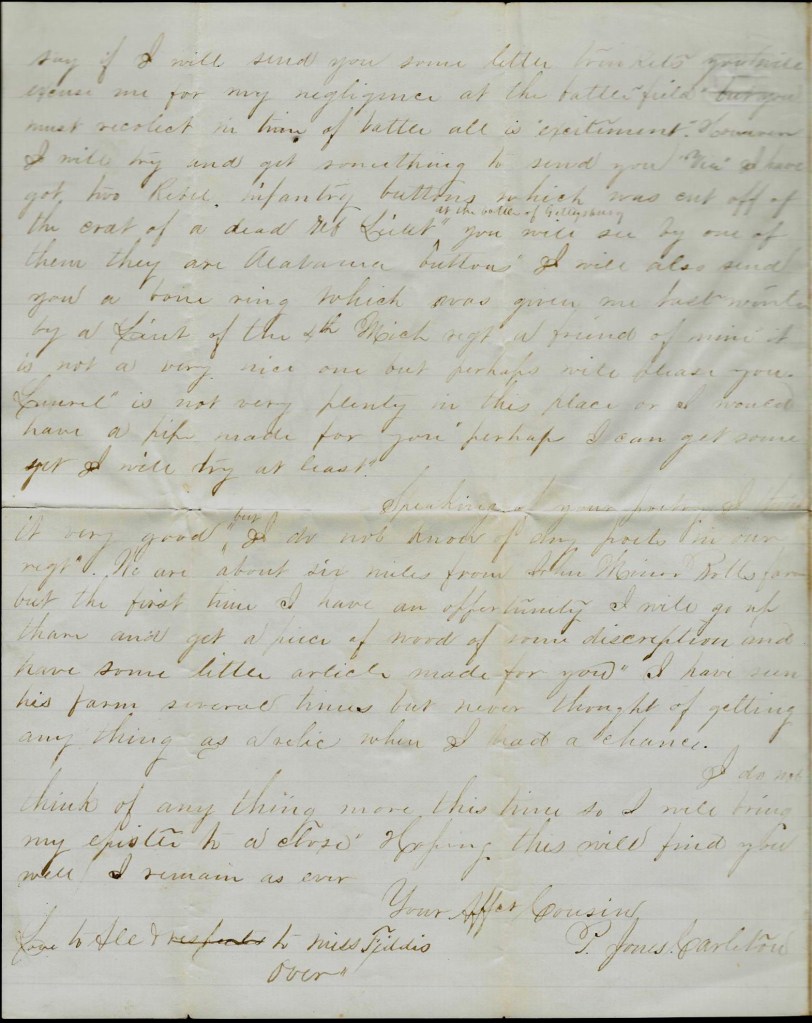
You say if I will send you some little trinkets, you will excuse me for my negligence at the battlefield, but you must recollect in time of battle all is “excitement.” However, I will try and get something to send you—viz: I have got two Rebel infantry buttons which was cut off of the coat of a dead reb Lieutenant at the Battle of Gettysburg. You will see by one of them they are Alabama buttons. I will also send you a bone ring which was given me last winter by a Lieut. of the 4th Michigan Regt.—a friend of mine. It is not a very nice one but perhaps will please you. Laurel [wood] is not very plenty in this place or I would have a pipe made for you. Perhaps I can get some yet. I will try at least.

An Alabama officer’s coat button

Speaking of your poetry, I think it is very good but I do not know of any poets in our regiment. We are about six miles from John Minor Botts farm 2 but the first time I have an opportunity I will go up there and get a piece of wood of some description and have some little article made for you. I have seen his farm several times but never thought of getting anything as a relic when I had a chance.

I do not think of anything more this time so I will bring my epistle to a close. Hoping this will find you well, I remain as ever your affectionate cousin. — P. Jones Carleston

Love to all & to Miss Fiddis

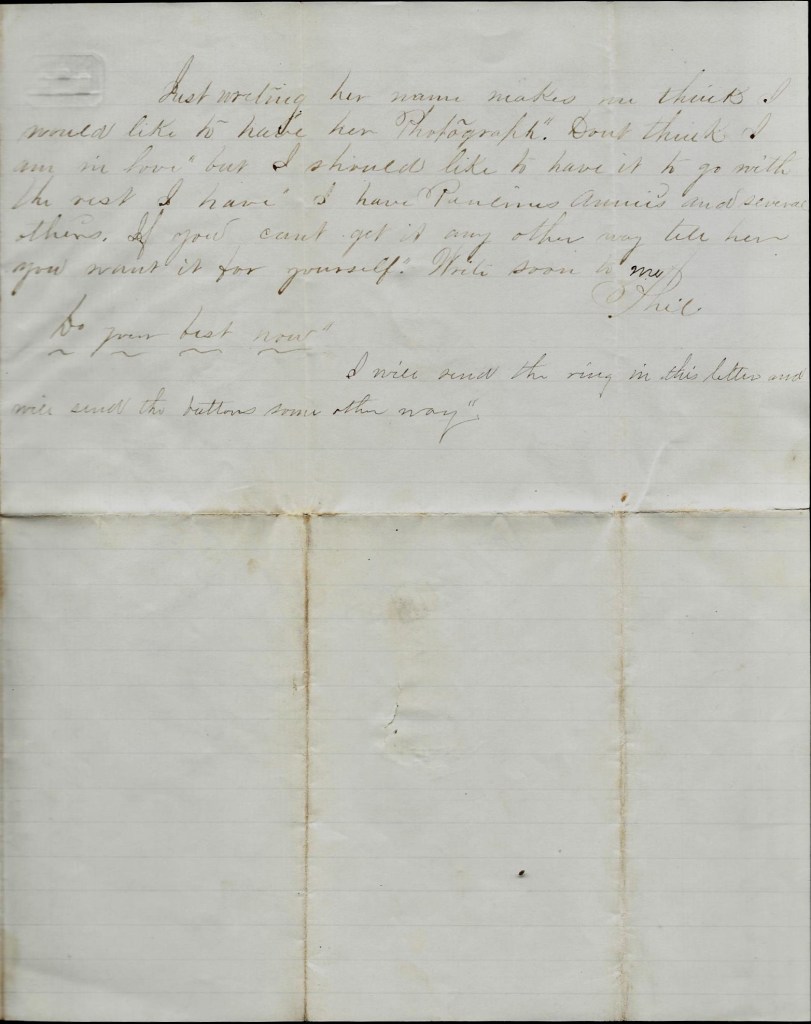
Just writing her name makes me think I would like to have her photograph. Don’t think I am in love but I should like to have it to go with the rest I have. I have Pauline’s, Annie’s and several others. If you can’t get it any other way, tell her you want it for yourself. Write soon to me. — Phil

Do your best now.

I will send the ring in the letter and will send the buttons some other way.

1 Extra Billy Smith was the Governor of Virginia. He also served early in the war as Colonel of thr 49th Virginia Infantry. His home in Culpeper was a classical revival mansion that was demolished about 1930. The post office was built on the location. The property in Warrenton was called “Monterosa.” It was constructed in the 1840s and is still standing today.

2 John Minor Botts was a prominent Virginian who opposed the expansion of slavery and opposed secession. He was jailed on a couple of occasions by the Confederate government. His farm was near Culpeper.

1861: John H. Denton to Martha Cole

With undated letters, envelopes or stationery with patriotic emblems such as this one generally indicate an early-war letter (but not always!).

This letter was written by John H. Denton (1840-1893) of Aurora, Dearborn county, Indiana, who served as a private in Co. E, 7th Indiana Infantry from 20 April 1861 to 2 August 1861. Later he served as the Captain of Co. K, 10th Kentucky Infantry, which was organized in November 1861.

The 7th Indiana Infantry was organized at Indianapolis in mid-April 1861 with Ebenezer Dumont as its colonel. They made their first camp near Grafton, Virginia (now West Virginia) which is where this letter was written in June 1861. As part of Brigadier General Thomas A. Morris’ Indiana Brigade (of Major General George B. McClellan’s Army of West Virginia), the 7th Indiana participated in the Rich Mountain Campaign from July 6 to 17. The regiment saw action at Laurel Hill (July 7), Belington (July 8), the Battle of Corrick’s Ford (July 12–14), and in the pursuit of Brig. Gen. Robert S. Garnett’s forces (July 15–17). The regiment was mustered out of service on August 2, 1861.

John wrote the letter to Martha (“Mattie” or “Mat”) Cole (1844-1933) with whom he married in February 1865.

The Battle of Rich Mountain which the 7th Indiana Infantry participated.

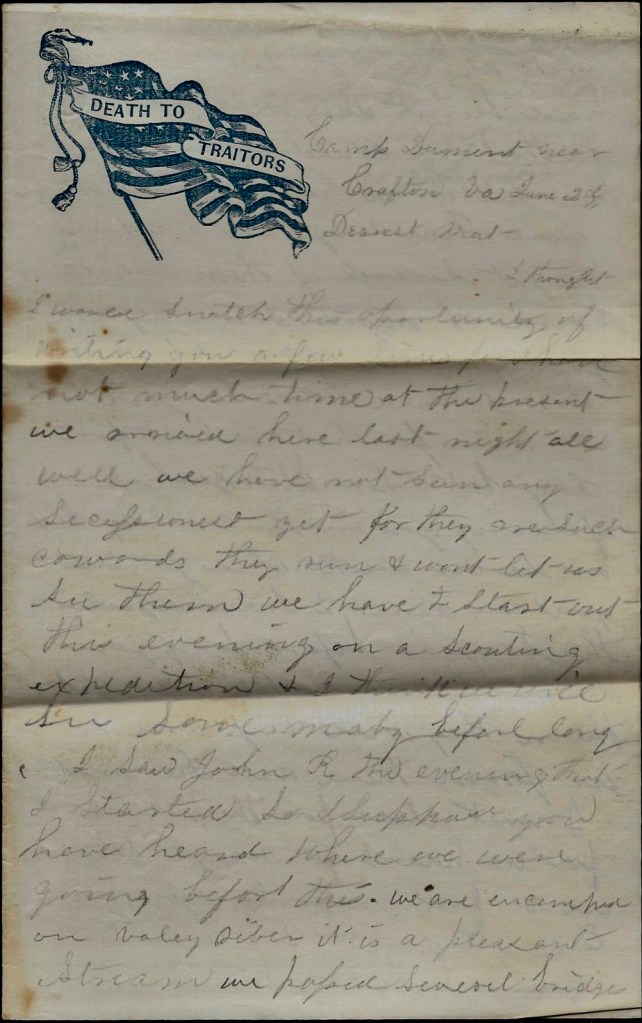
Transcription

Camp Dumont near Grafton, Virginia
June 24, [1861]

Dearest Mat,

I thought I would snatch this opportunity of writing you a few lines for there is not much time at the present. We arrived here last night all well. We have not seen any secessionists yet for they are such cowards they run and won’t let us see them. We have to start out this evening on a scouting expedition & I think we will see some maybe before long.

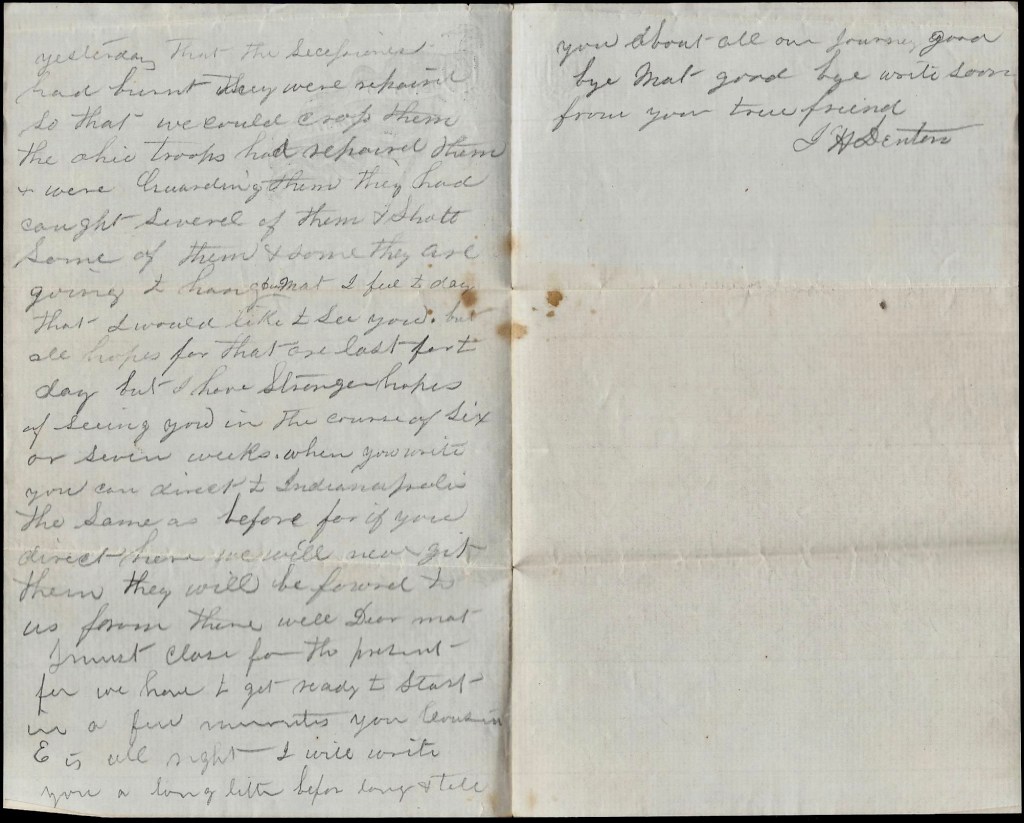
I saw John R. the evening that I started so I suppose you have heard where we were going before this. We are encamped on Valley River. It is a pleasant stream. we passed several bridges yesterday that the secessionists had burnt. They were repaired so that we could cross them. The Ohio troops had repaired them & were guarding them. They had caught several of them & some they are going to hang.

Mat, I feel today that I would like to see you but all hopes for that are lost for today. But I have stronger hopes of seeing you in the course of six or seven weeks. When you write, you can direct to Indianapolis the same as before for if you direct here, we will never get them. They will be forwarded to us from there.

Well dear Mat, I must close for the present for we have to get ready to start in a few minutes. Your cousin E. is all right. I will write you a long letter before long and tell you about all our journey. Goodbye Mat, goodbye.

Write soon. From your true friend, — J. H. Denton