The following letter was written by 24 year-old Rodolphus Payson Tryon (1837-1862), the son of Rodolphus Tryon (1809-1894) and Lavinia Derby (1810-1888) of Alaiedon, Ingham county, Michigan. He was married in August 1859 to Eliza Jane Topping (1840-1876) and the couple had a small child when he enlisted as a private in Co. B, 7th Michigan Infantry on 22 August 1861. He received a gunshot wound to the head in the fighting at Fair Oaks, Virginia, on 31 May 1862 and died at a hospital in New York City on 29 June 1862.
Print of a drawing by J.L. Richardson showing the 7th Regiment of the Michigan Volunteers at Camp Benton, situated near Edwards Ferry. Text underneath the drawing labels buildings, from left to right, as “Hospital Buildings,” “Magazine,” “Guardhouse,” “Quarter Master,” “Head Quarters,” “Officers Mess,” “Band,” and “Bakery.” Text at bottom reads “Entered according to act of Congress in the year 1862 by B.R. Young in the Clerks Office of the District Court of Md.” Text at bottom right reads “Lith. by . Hoen & Co. Baltimore.”
T R A N S C R I P T I O N
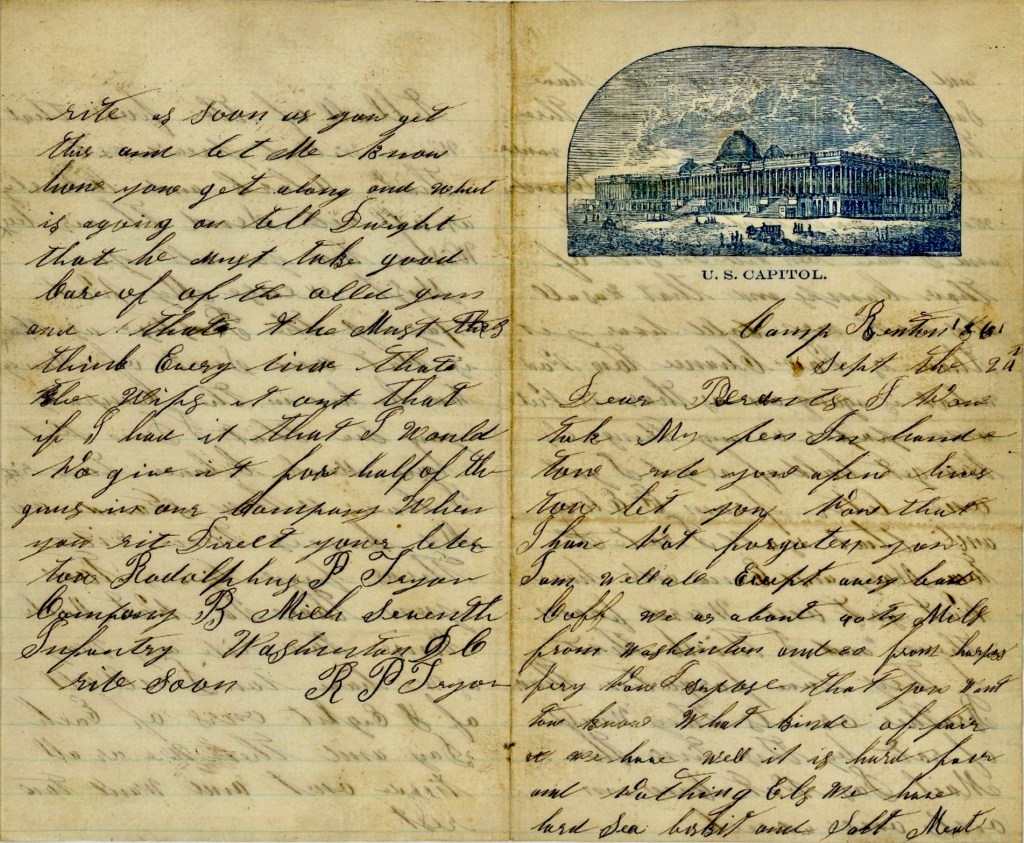
Camp Benton (near Edwards Ferry) September 24th 1861
Dear Parents,
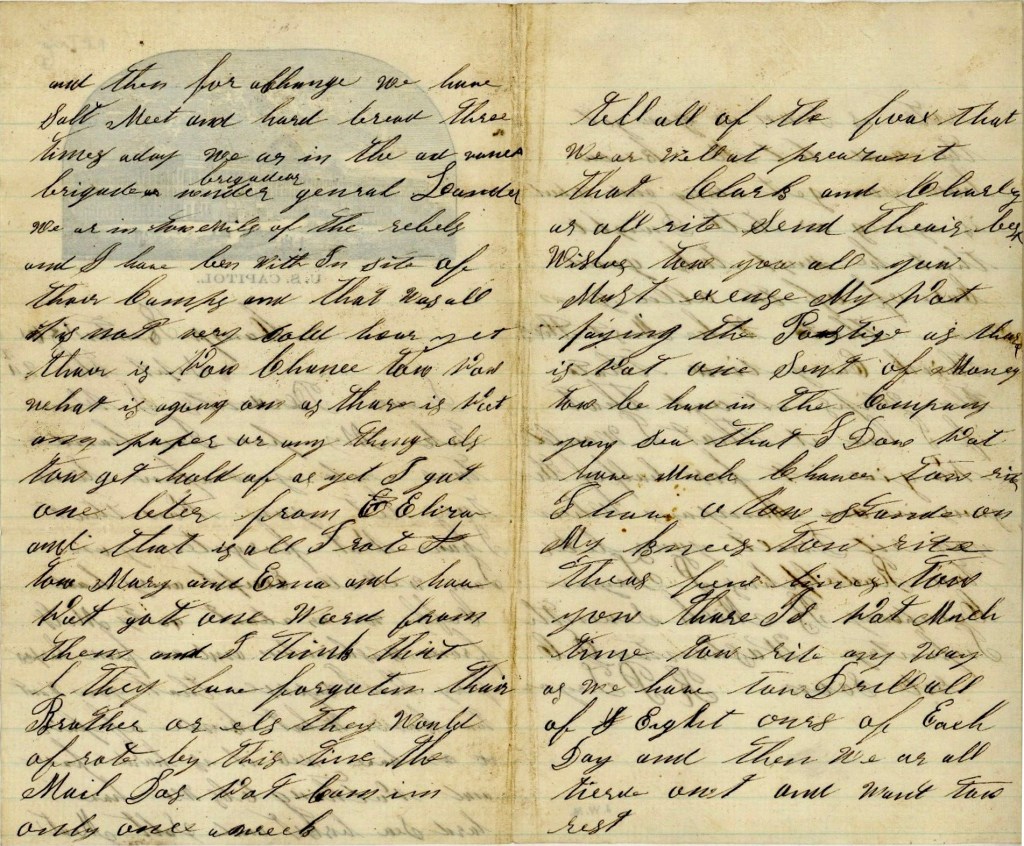
I now take my pen in hand to write you a few lines to let you know that I have not forgotten you. I am well, all except a very bad cough. We are about 90 miles from Washington and 20 from Harpers Ferry. Now I suppose that you want to know what kind of fare we have. Well, it is hard fare and nothing else. We have hard sea biscuit and salt meat and then for a change we have salt meat and hard bread three times a day. We are in the advance brigade under Brigadier General Landers. We are in two miles of the rebels and I have been within sight of their camps and that was all. It is not very cold here yet. There is no chance to know what is going on as there is not any paper or anything else to get hold of as yet.
I got one letter from [my wife] Eliza and that is all. I wrote to Mary and Emma and have not got one word from them and I think that they have forgotten their brother or else they would of wrote by this time. The mail has not come in only once a week. Tell all of the friends that we are well at present, that Clark and Charley are all right and send their best wishes to you all. You must excuse my not paying the postage as there is not one cent of money to be had in the company. You see that I do not have much chance to write. I have to stand on my knees to write these few lines to you. There is not much time to write anyway as we have to drill all of eight hours of each day and then we are all tired out and want to rest.
Write as soon as you get this and let me know how you get along and what is going on. Tell Dwight that he must take good care of the old gun and that he must think every time that he whips it out that if I had it, that I would not give it for half of the guns in our company.
When you write, direct your letter to Rodolphus P. Tryon. Company B, Michigan Seventh Infantry, Washington D. C.
This letter was written by Charles Thompson (1842-1904) of Port Huron, St. Clair county, Michigan, who enlisted at age 19 as a corporal in Co. A, 7th Michigan Infantry. On 1 July 1862 he was commissioned a 2nd Lieutenant and on 6 May 1864 during the battle of the Wilderness, he was wounded and mustered out of the service on 5 October 1864. After the war he resided in Georgia for a time.
Camp Benton, 7th Regt. Michigan Volunteers, Col. J.B. Grosvenor, situated near Edwards Ferry. A. Hoen & Co., lithographer. March 1862.
Transcription
Camp Benton [near Edward’s Ferry on Potomac River] January 14th 1862
Friend Marshal,
Your letter was received some time ago & the only excuse I have for not answering it is “business”—as usual rather poor excuse for me. I will try & not have it occur again. You have likely seen Capt. [Charles J.] Hunt. Do you have all the news. I was out looking at a Secesh battery on the other side of the river—one they have completed & they were at work all of Sunday on the other. You could see them quite plain with a glass from where we were. Their battery is near Ball’s Bluff. I guess it is to command the ferry “Edwards.”
They will have to vacate it before long for there are four 20-pound rifled cannon gone up there. I think there will be an advance movement made before long. Everything is ready for it. The whole army is lying idle except the one in South Carolina. They seem to be doing something. There is some talk of our Division going South but I do not believe it.
You had better enlist & come down with Capt. Hunt. You need not tell “Ettie” and it will be all right. “By the way,” how do you and “Ettie” get along? As well as ever? Now Marshal, take a fool’s advice & leave the girls alone.
There is no news of any importance so I will have to close, Give my respects to all the boys. Ed[mond] Fetchet & Bill Strout send their best respects. Write soon & believe me your friend, — Charlie Thompson
P. S. I am not coming home till the war is over. Ed is not going in February. — C. T.
An image of George Hodges on the 7th Michigan Infantry. (Charles Joyce Collection; now in Dale Niesen Collection)
The identity of the soldier from Co. H, 7th Michigan Infantry who wrote this letter cannot be confirmed but my hunch is that it was penned by Elijah C. Eldred (1835-1921) of Oakland county, Michigan. More research would be required to confirm this.
The 7th Michigan Infantry was organized at Monroe, Michigan, in August 1861 and were sent to the Army of the Potomac in September where they were attached to the 3rd Brigade, 2nd Division, 2nd Corps for the duration of the war. The following letter was written in Maryland when the regiment was posted along the upper Potomac.
The 7th was one of the first regiments to cross the Rappahannock River on Dec. 11th, 1862 while under fire from Confederate sharpshooters hidden in the buildings of Fredericksburg.
Transcription
Headquarters Camp Benton 7th Regt. Michigan, Co. H October 18th 1861
Dear Brother,
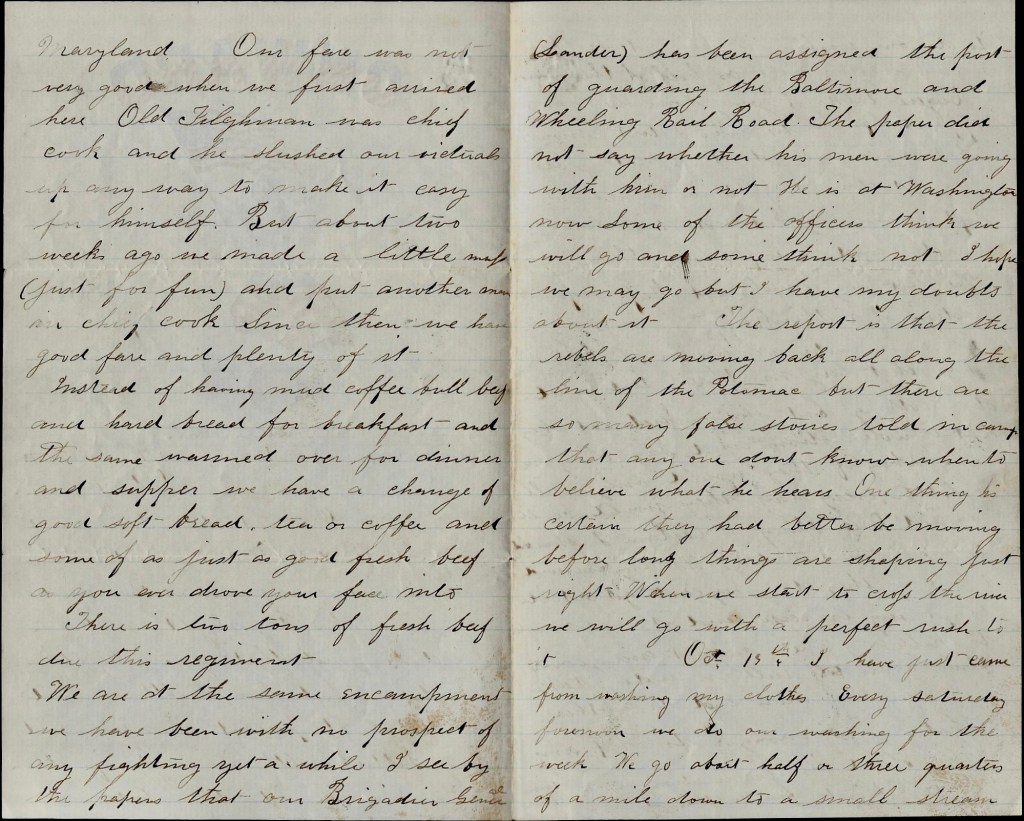
I received your kind letter a short time since and one from Mother and Melvin Tuesday night and am glad to find that your health continues good. My health is good as usual at present. I never had any better health in my life than since I came into the state of Maryland. Our fare was not very good when we first arrived here. Old [James M.] Tilghman was chief cook and he slushed our victuals up any way to make it easy for himself. But about two weeks ago, we made a little mess (just for fun) and put another man in as chief cook. Since then we have good fare and plenty of it.
Instead of having mud coffee, bull beef, and hard bread for breakfast and the same warmed up for dinner and supper, we have a change of good soft bread, tea, or coffee, and some of as just as good fresh beef as you ever drove your face into. There is two tons of fresh beef due this regiment.
We are at the same encampment we have been with no prospect of any fighting yet awhile. I see by the the papers that our Brigadier General (Lander) has been assigned the post of guarding the Baltimore and Wheeling Railroad. The paper did not say whether his men were going with him or not. He is at Washington now. Some of the officers think we will go and some think not. I hope we may go but I have my doubts about it. The report is that the rebels are moving back all along the line of the Potomac but there are so many false stories told in camp that anyone don’t know when to believe what he hears. One thing is certain, they had better be moving before long. Things are shaping just right. When we start to cross the river, we will go with a perfect rush to it.
October 19th. I have just come from washing my clothes. Every Saturday forenoon we do our washing for the week, We go about half or three quarters of a mile down to a small stream to do our washing. I have got so that I can wash as well as half of the women.
Eugene [Clark] talks of going home. He has applied for his discharge. I don’t know whether he will get it or not. He has not done anything since he left Monroe. He did not drill only one day and a half while there. He don’t say much but keeps up a devil of a thinking.
There is quite a number of our boys that lay in their tents and do nothing but sleep and eat. They eat double rations and say they are sick when if they would only drill a little every day, the would be all sound. One thing is certain, I should be sick in two days to lay around the way they do. They can’t get outside to get any exercise and it is enough to kill anyone.We don’t average over two hours drill in a day, take it from one week’s end to another. That is just enough to keep anyone’s blood in circulation.
I will try to finish this at some other time. [unsigned]
I could not find an image of Cyril but here is one of Russell Townsley who served in Co. C, 7th Michigan Infantry (Ancestry.com)
The following letter was written by Cyril H. Tyler (1841-1913) of Co. I, 7th Michigan Infantry. Cyril was the son of Rufus Tyler (1816-1894) and Amy Farnum (1818-18xx) of Waukesha, Michigan. Just days before enlisting, he married Mary Eliza Foote (1839-1924). The location and date of this letter is missing and my hunch is this was the second sheet of a two-sheet letter which may have been sent to his wife. Cyril mentions that a fort was being constructed at the Chain Bridge which I presume was either Fort Marcy or Fort Ethan Allen. Construction on these forts began in late September 1861 so I would date this letter in October 1861 when they were attached to Lander’s Brigade and bivouacked somewhere near or on Meridian Hill outside Washington D. C. Cyril entered the war as a private and was discharged on 22 August 1864 at Petersburg, Virginia, as a sergeant.
The 7th Michigan Infantry left the state in late August and arrived in Washington D. C. on 5 September 1861. They were assigned guard duty along near Edward’s Ferry in October and moved to Muddy Branch on 4 December where they remained until March 1862. They later participated in the Peninsula Campaign, the Battle of Antietam, the Battle of Fredericksburg (being the first regiment to cross the Rappahannock river in pontoon boats under the fire of Confederate sharpshooters), the Battle of Gettysburg (repulsing Pickett’s charge), the Mine Run Campaign, the Overland Campaign, the Siege of Petersburg and Appomattox Campaign.
Transcription
[Camp near Meridian Hill, October 1861]
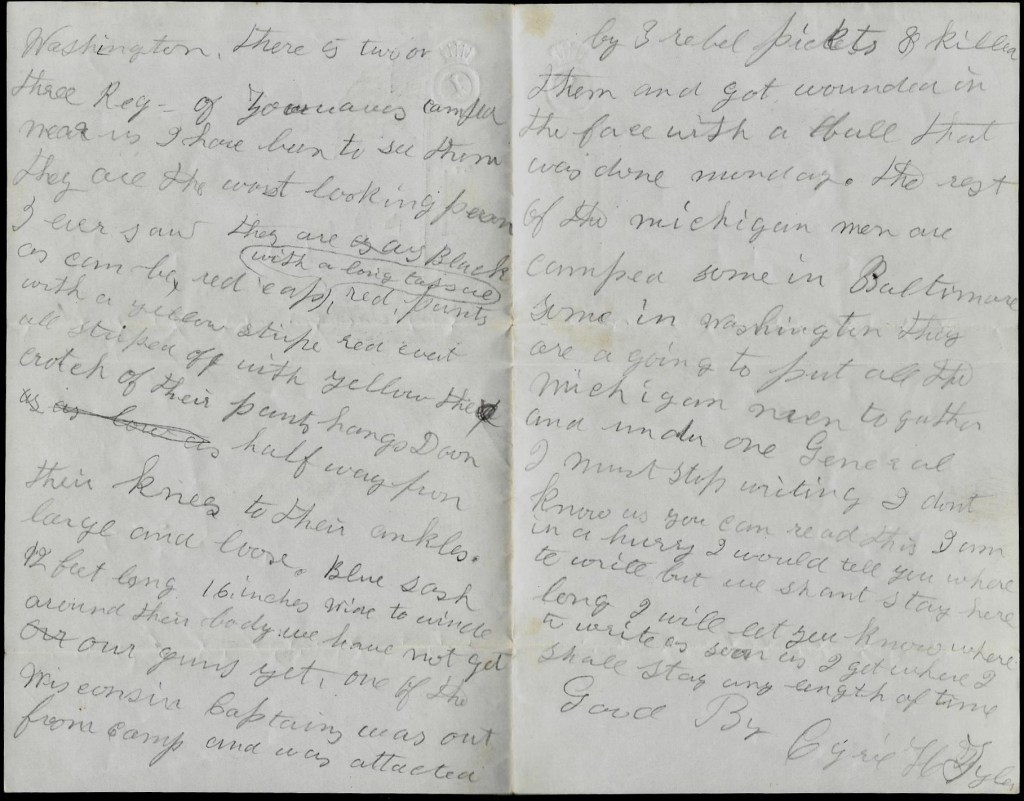
The ground around here is not much of it tilled. It is all overrun by the soldiers. Lots of farms here was owned by disunion men and their property was confiscated. The District of Columbia is half covered with camps. The rebel pickets are within 8 or 9 miles from here. Our men are making a large fort at Chain Bridge. A number of picket guards is killed most every day near Chain Bridge. There is a telegraph line that extends from Washington as far as our lines go—that is about 8 miles around Washington.
Winslow Homer’s painting of Zouaves
There is two or three regiments of Zouaves camped near us. I have been to see them. They are the worst looking persons I ever saw. They are as black as can be, red cap with a long tassel, red pants with a yellow stripe, red vest all striped off with yellow. The crotch of the pants hangs down halfway from their knees to their ankles, large and loose. Blue sash 12 feet long, 16 inches wide to wind around their body. 1
We have not got our guns yet. One of the Wisconsin captains was out from camp and was attacked by three rebel pickets and killed them and got wounded in the face. That was done Monday. The regiment of the Michigan men are camped some in Baltimore and some in Washington. They are a going to put all the Michigan men together and under one general.
I must stop writing. I don’t know as you can read this. I am in a hurry. I would tell you where to write but we shan’t stay here long. I will let you know where to write as soon as I get where I shall stay any length of time.
Goodbye, — Cyril H. Tyler
1 I cannot identify the Zouave unit based upon Henry’s description alone. My assumption is that the “blue sash” he is referring to was the scarf commonly tied around the midsection of the uniform.A Zouave regiment known to be in the vicinity of Meridian Hill at the time was the Anderson Zouaves which was the 62nd New York Infantry.Their uniform was described as baggy red breeches, leggings, gaiters, blue scarf worn around the waist, wiastcoat, short jacket, and red fez with blue silk tassel.
I could not find an image of either Jeheiel or Frederick but here is a tintype of Russell Towsley who served in Co. C, 7th Michigan Infantry wearing his early war uniform (Ancestry.com)
The following letters were written by Aaron “Jehiel” Rayner (1841-1919) of Co. B, 7th Michigan Infantry. The first letter includes a part written by Frederick R. Searl (1843-1874) of the same company.
Jehiel was the son of John Raynor (1804-1879) and Emily Meech (1817-1873) of Mason, Ingham county, Michigan. He enlisted in the 7th Michigan on 22 August 1861 and was discharged at Petersburg, Virginia, on 22 August 1864 after three years service. His 1919 obituary states that Jehiel saw “much active service, being engaged in a number of important battles such as Fair Oaks, Antietam, Gettysburg, and numerous smaller engagements. While in the service he had many close calls, but was never seriously wounded, although his horse was killed under him at Spotsylvania.” [Not sure why an infantryman would have been riding a horse unless he was on a special detail.]
Frederick R. Searl was the son of Elisha Randal Searl (1809-1879) and Martha Hurd (1815-1862) of Mason, Ingham county, Michigan. He enlisted with Jehiel in August 1862 in Co. B, 7th Michigan and was wounded on 31 May 1862 in the Battle of Fair Oaks, Virginia. The would was so severe that his right arm had to be amputated, necessitating his discharge for disability on 18 July 1862. He died twelve years later.
The letters were addressed to Jehiel’s older brother, William Henry Rayner (1836-1905) of Mason, Ingham county, Michigan.
To read another letter written from Camp Benton by Roger Noble of the 7th Michigan Infantry written on 28 October 1861, see Roger Noble Letter-October 28, 1861. MSU Libraries.
Letter 1
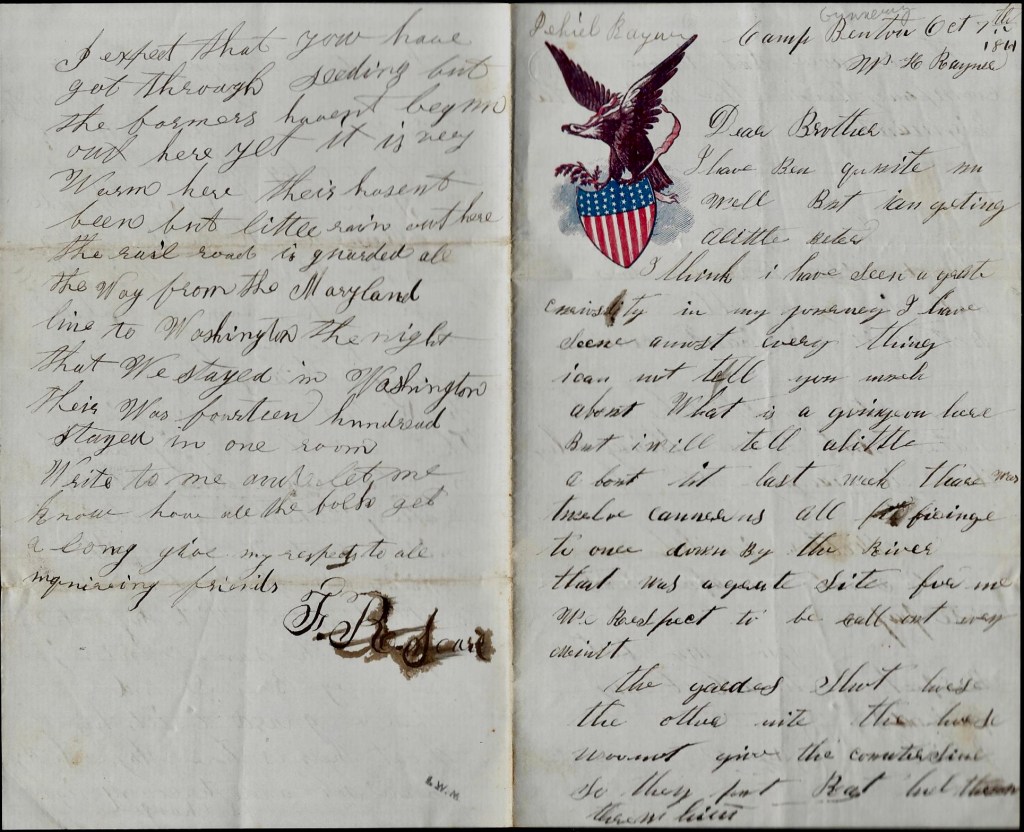
This letter was written from Camp Benton on the Maryland side of the Upper Potomac. The 7th Michigan was brigaded with several Massachusetts regiments known as Lander’s Brigade. It was penned just two weeks prior to the Battle of Ball’s Bluff. Fortuitously, the 7th Michigan did not participate in this federal disaster because it was deemed “unfair to put them into battle with the poor arms they had.” These “poor arms” were converted Belgian flintlocks that were very unreliable and inaccurate. Before the end of the year they were provided with Springfield rifled muskets.
Camp Benton October 7, 1861
Dear Brother,
I have been quite unwell but I am getting a little better. I think I have seen a great curiosity in my journey. I have seen almost everything. I cannot tell you much about what is a going on here but I will tell a little about it. Last week there was twelve cannons all firing at once down by the river. That was a great sight for me. We expect to be called out every minute.
The guards shot twice the other night. The [ ] wouldn’t give the countersign so they shot but [did not get] him. There is more sick in our company than in the rest of the regiment.
Dear brother, I would like to come home and see you all but as it is, I can’t come.
Our water [is] just like crick water. That is one thing why there is so many sick here.
Mother, I wish you would send me a few newspapers. Give my best respects to all of my friends, — Jehiel Rayner
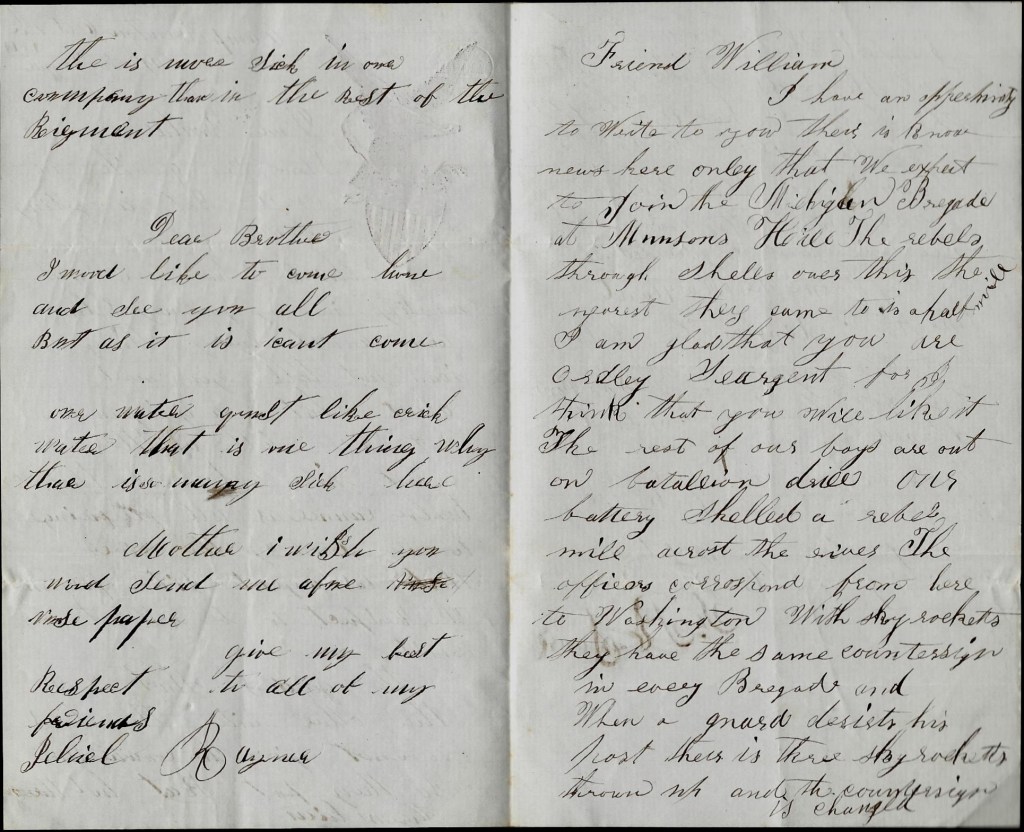
Friend William
I have an opportunity to write to you. There is no news here only that we expect to join the Michigan Brigade at Munson’s Hill. The rebels throw shells over this. The nearest they came to [us] is a half mile. I am glad that you are Orderly Sergeant for I think that you will like it. The rest of our boys are out on Battalion Drill. Our battery shelled a rebel mill across the river. The officers correspond from here to Washington with sky rockets. They have the same countersign in every brigade and when a guard deserts his post, there is three sky rockets thrown up and the countersign is changed.
I expect that you have got through seeding but the farmers haven’t begun out here yet. It is very warm here. There hasn’t been but little rain out here. The railroad is guarded all the way from the Maryland line to Washington. The night that we stayed in Washington there was fourteen hundred stayed in one room.
Write to me and let me know how all the folks get along. Give my respects to all enquiring friends. — F. R. Searl
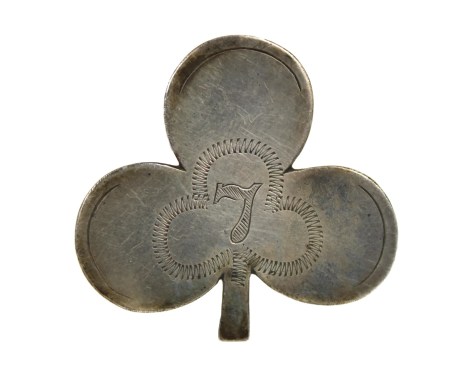
The Corps Badge of the 7th Michigan Infantry from later in the war.
Letter 2
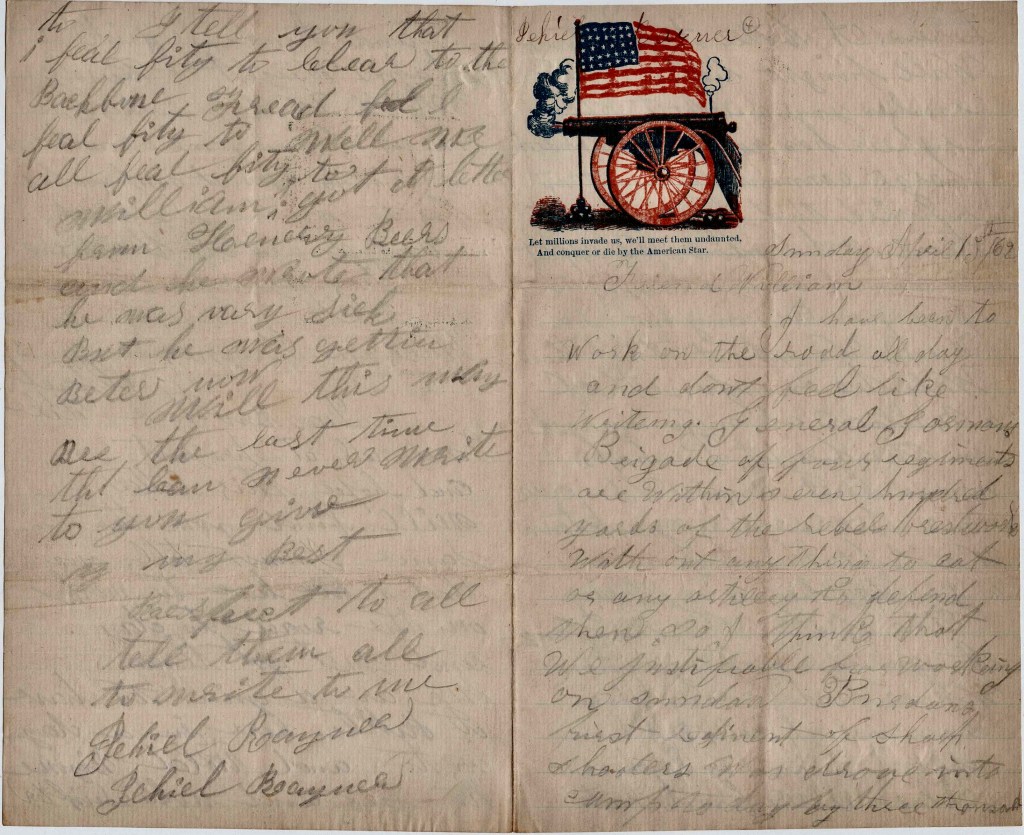
Sunday, April 13th 1862
Friend William.
I have been to work on the road all day and don’t feel like writing. General Gorman’s Brigade of four regiments are within seven hundred yards of the rebels’ breastworks without anything to eat or any artillery to defend them so I think that we [are] justifiable for working on Sunday. Berdan’s First Regiment of Sharpshooters was drove into camp by three thousand rebels. A battle at Yorktown will [be] fought before this reaches you, I expect. The rebels has got five hundred large cannons there. It is reported that Jeff Davis is there & Johns[t]on. We expect to march on Yorktown tomorrow [but] we may not in a week. We expect that there will be one-fourth of a million of men engaged in the fight.
Perhaps you don’t know where we are but we [are] near Yorktown. We left Fortress [Monroe] a week ago day before yesterday. The battle will be fought on the same ground where Lord Cornwallis surrendered in 1776. [should be 1781]
I have seen Charley Rhodes & Alva Welles & Frank Feits & Ambrose Irish & John Wright & Burdy Hill. Write whether you hear from me or not for it is almost impossible for to write. We sleep outdoors all the time. From your friend, — Fred [R. Searl]
To William Rayner
[In a different hand]
April 13th
Dear Brother,
I am well at present and hope this letter will find you the same. I must tell you that I have to work on the road today and just got through. We are a goin’ to have a battle here in a day or two and a big one too….
Well, this may be the last time that I can write to you. Give my best respects to all. Tell them all to write to me. — Jehiel Rayner
Letter 3
Camp near Culpeper [Va.] September 30, 1863
Dear Brother,
I now take the opportunity to write you a few lines to let you know that I am well at present and hope these few lines will find you the same. I must say that I hain’t had a letter from you in some time. I would like to know why you don’t write to me oftener. Now, Will, I wish you would try to write to me once a month if you please.
I can’t think of much to write to you this time but can say that the Rebels are a coming into our lines every day. they come one and two at a time. They was two come over last night and they give is some very important news. I must say that I like to see them come over. Why? Because when one comes over, that is one less to fight.
The report is this morning that they was seven hundred came over last night upon the right. I hope it is so. I guess Old Lee will lose the whole of his army if he don’t look out. Them that come over last night said that they had to keep double pickets on every night so as to keep them from running away. I guess that is so.
Mr. Wm. H. Rayner, I will send you in this letter twenty dollars. I wish you would write as soon as you get it so as to let me know if you get it or not. If you get it, I will send you twenty more right off. We got pay the other day and I have got forty dollars that I want to send home to you. This is all at present. Give my best respects to all. This is from A. J. Rayner
Will, I want you to give H. H. Beers three dollars for me that I owe him. I think that is all that I owe him. You ask him how much I owe him and then pay him and then let me know how much it is and then I will pay. Will, I want you to let me know how much I owe you and then I will send it home to you. You must know what I mean—the money that I borrowed from you. — Jehiel Rayner









 Spared & Shared 23