Category Archives: 7th Pennsylvania Cavalry

1863: Ira Mann Warriner to Albert Osborn

The following letter was written by Ira Mann Warriner (1837-1919) of Co. G, 7th Pennsylvania Cavalry (80th Volunteers). Ira was born in Roxbury, Vermont, the son of Benjamin Howard Warriner (1794-1843). He came to Tioga county, Pennsylvania, with his parents when he was about four years of age and grew to manhood in Delmar. When a young man he went to Wisconsin where he remained two or three years and then returned to Pennsylvania, making the journey most of the way on foot. When the Civil War began, he enlisted in the 7th Pennsylvania Cavalry at Wellsboro on 20 September 1861 and was honorably discharged at Macon, Georgia, in June 1865.

“After the war he returned to Delmar and on March 26 he married Hepsie Elizabeth Carvey, in Wellsboro, and soon after his marriage he went to Addison, N.Y., where he engaged in the jewelry business for a short time and then came to Wellsboro and entered into a partnership with the late Samuel Warriner in the same business. In a year or two he sold out to his partner and moved his family to Liberty, where he resided until 1897, when he came back to Delmar and purchased the lot on which the old log school-house stood where he first attended school, and there built the house in which he had since resided. Mr. Warriner had an interesting collection of old relics of the war; among them, the old carbine which he carried while in the service; his saber; a leather knapsack which he made from leather captured from the Rebels while he was with Gen. Wilson on that memorable exploit known as Wilson’s raid, and many other articles that are interesting. He was fond of telling of his experiences while in the army and had a diary which he kept while in the service. Mr. Warriner was an Odd Fellow for over forty-five years, being a member of Block House Lodge No. 398.”

T R A N S C R I P T I O N
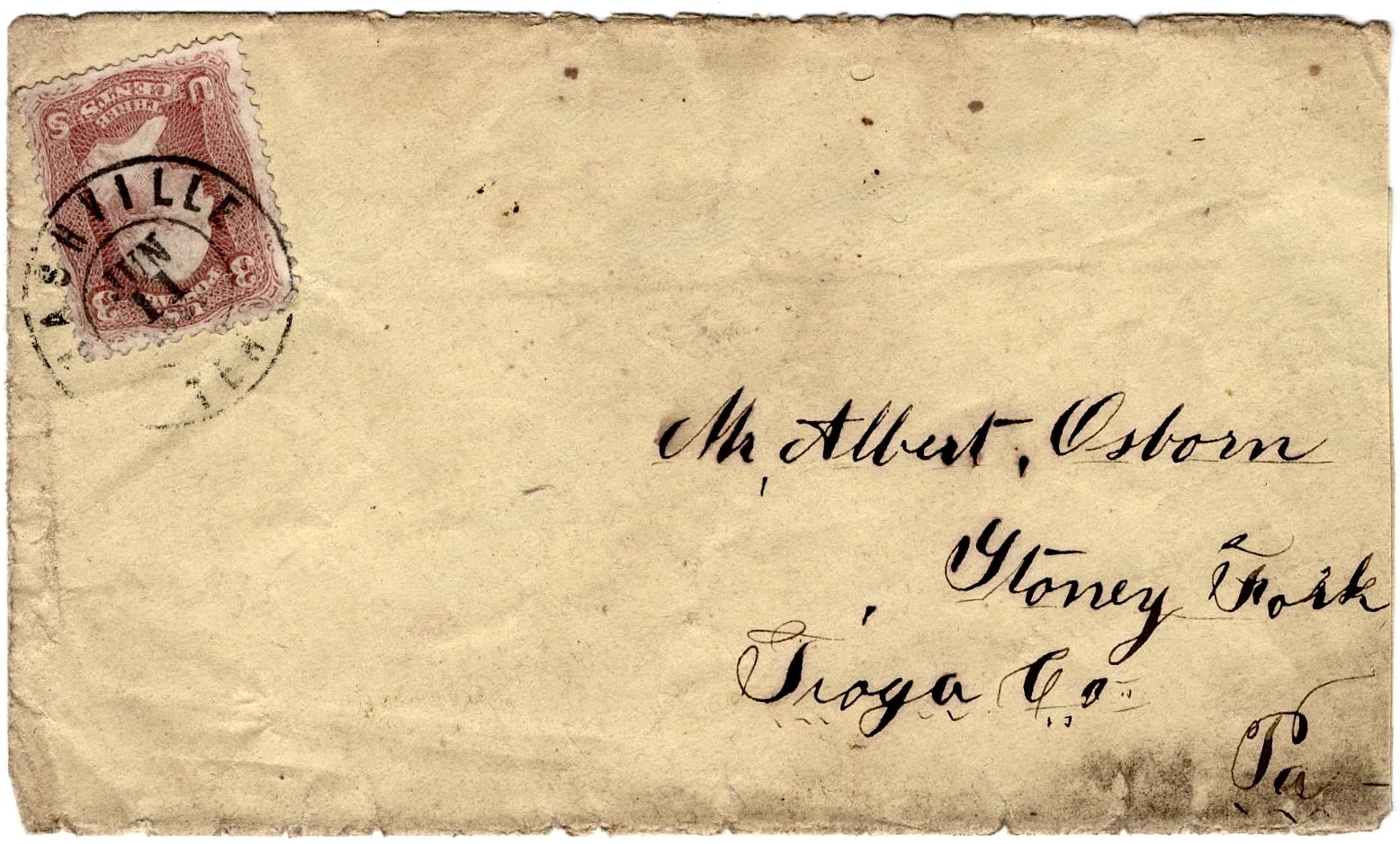
Addressed to Mr. Albert Osborn, Stoney Fork, Tioga county, Pa.

Murfreesboro [Tennessee]
June 8th ’63

Dear Friend,

I am seated to write you a few lines. I am in the Hospital not to wait the long painful workings of my disease but to await for my great toe to grow & unite itself to its parent foot from which I took it the other morning with the hatchet. The bone was cut entirely off but the flesh & hide on one side is left so I think it will grow on again.

Albert, I have a yarn &c but I am afraid I haint got room for it here. You may think it ain’t worth bothering with. The First Stain. Were some of our friends at home to see with how much pleasure a soldier shows his saber with the first stain of blood upon it, it would almost startle them. They would think that their once quiet & tender hearted friends had become barbarous & their hearts hardened against the human race. Do not harbor such ideas, for no sooner does he see his foe fall, than his heart has sympathy for the fellow sufferer & he would do his utmost to comfort him. What gives so much pride is this? The weapon shows for itself that he has had a chance to try his courage & bravery & has come off victorious.

My trusty blade done its first bloody work the other day while I was on picket by striking a death blow to a Grayback. I was on the outpost & in a piece of woods. I had stood all day until near sundown. My horse was standing by a large tree & I, to take things easy, was leaning my back against the tree. I had not sat in this position long before I heard a noise the other side of the tree. I looked as close as I could without moving & could see nor hear nothing so I came to the conclusion that It was more imagination than reality. But I soon changed my mind for I heard it again & so plain that I was satisfied that there was something there that had no business to be, so I moved my horse to where I could see what was up & there, & ascending the tree, was the object of my hatred.

I was startled. Not that I was afraid, but because I had been so heedless as to allow anything to approach so near without seeing it there. One thing that was strange to me was to see him going up the tree & what could be his object? It is a mystery that I will leave for you to solve. In less time than I have been in writing this verse, I had drew my saber & struck the death blow (for I dare not allow him to get out of my reach). The body fell heavily to the ground. A convulsive shake ran through it & life was extinct.

As I looked upon his lifeless form, a shudder passed over me. I could not but think how much he had me in his power had he chose to made the first attack. Instead of writing this mixed up yarn, I would now be beneath the sod. This daring fellow was stout built & a few inches shorter than I am (6 ft), but I now rejoiced over his lifeless form for his snakeship had no more power to climb trees & scare soldiers. I had severed his head from the body at one blow. It was a new idea to me to see a snake climb a tree & one of the size of that for it was a large smooth-barked white oak & he was going straight up without coiling around it. His body was as perpendicular as a plumb line could hang. He was five feet 6 inches long & was of a grayish color. His name I did not ask; perhaps he would not have told it. Thus you see how I first stained my saber.

I told you at the start how I stained my hatchet, & now I will wait until after diner.

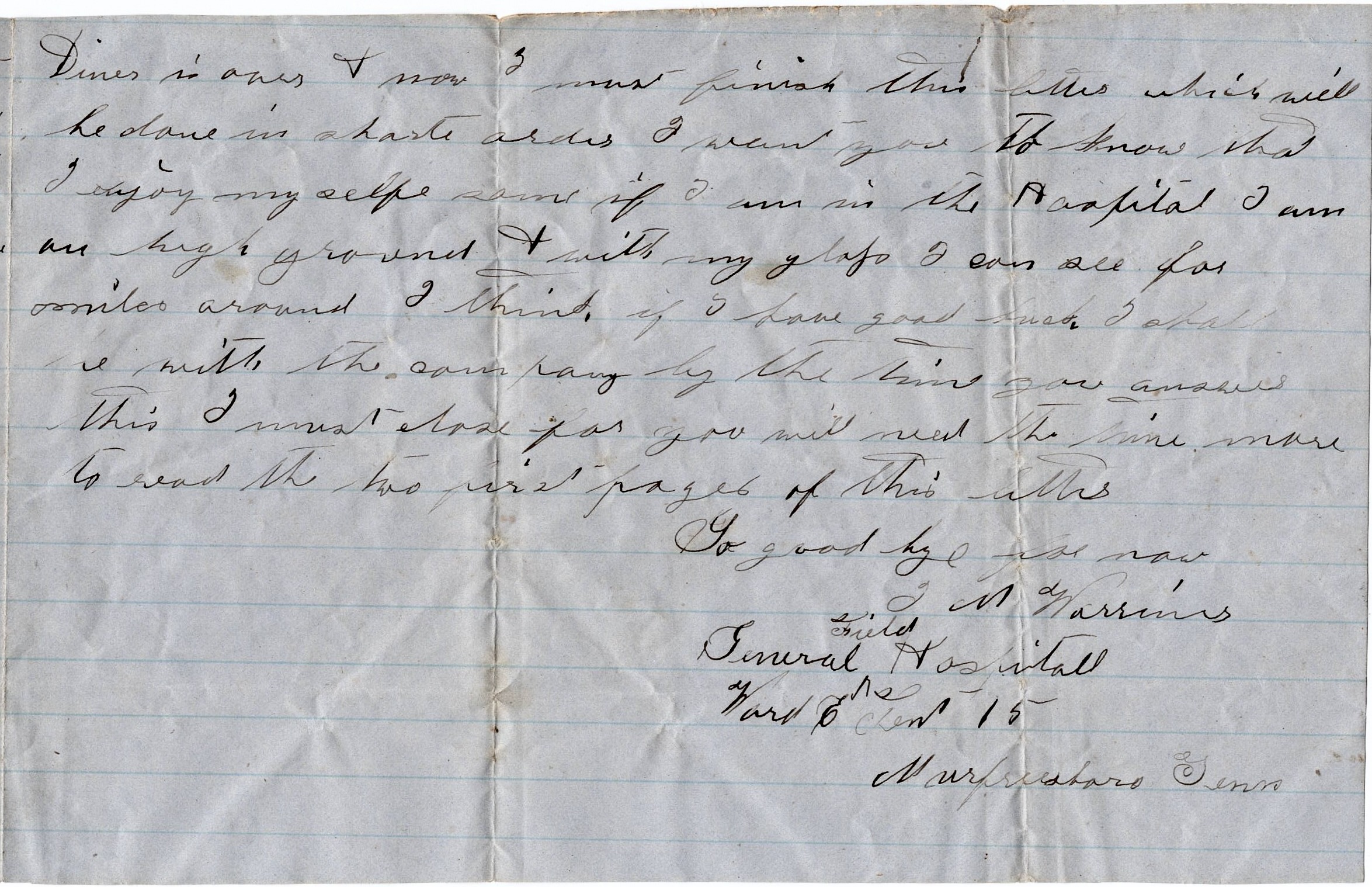
Dinner is over & now I must finish this letter which will be done in a short order. I want you to know that I enjoy myself some [even] if I am in the hospital. I am on high ground & with my glass, I can see for miles around. I think if I have good luck, I shall be with the company by the time you answer this. I must close for you will need the time more to read the two first pages of this letter. So goodbye for now. — I. M. Warriner

General Field Hospital, Ward E, Tent 15, Murfreesboro, Tenn.

1862: Waldo Spear to his Parents

The following letter was written by Waldo Spear (1843-1907), the son of Hiram Spear (1810-1872) and Lucy C. Ripley (1806-1893) of Springfield, Bradford county, Pennsylvania. Waldo enlisted in Co. C, 7th Pennsylvania Cavalry on 1 November 1861. He was taken prisoner at Gallatin on 25 August 1862 and was paroled due to his injuries. Following his release, he was detailed a courier of the 2nd Cavalry Division, Army of the Cumberland. He continued in this capacity until he was discharged in November 1864.

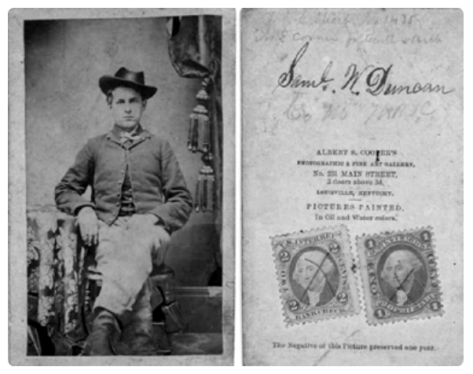
I could not find an image of Waldo but here is one of PVT. Samuel W. Duncan of Co. M, 7th Pennsylvania Cavalry (Photo Sleuth)

Waldo’s letter gives us an account of the Battle of Lebanon—a relatively small affair that took place in and near Lebanon, Tennessee on May 5, 1862. We learn that Waldo was not a witness to the event because he had been detailed to guard the baggage, but he relates how the regiment won the praise of General Ebenezer Dumont led the Union troopers into Lebanon and then pursued Colonel John Hunt Morgan’s Confederate cavalry all the way to the Tennessee river. Dumont’s force consisted of detachments from the 1st Kentucky Cavalry under Colonel Frank Lane Wolford, the 4th Kentucky Cavalry under Colonel Green Clay Smith, and the 7th Pennsylvania Cavalry under Colonel Wynkoop. Morgan’s force was the 2nd Kentucky Cavalry Regiment. Dumont surprised Morgan early on the morning of May 5, 1862. A 15-mile running battle ensued in which the Confederates were forced to retreat. During the fighting Confederate sympathizers in the town fired upon the Union Cavalry. Many of the remaining Confederates barricaded within the buildings surrendered when Dumont threatened to set the town on fire.

See also—1862: Waldo Spear to his Parents & Brothers.

Note: This letter is from the personal collection of Greg Herr and was transcribed and published on Spared & Shared by express consent.

Transcription

Murfreesboro [Tennessee]
May 9th, [1862]

Dear Parents,

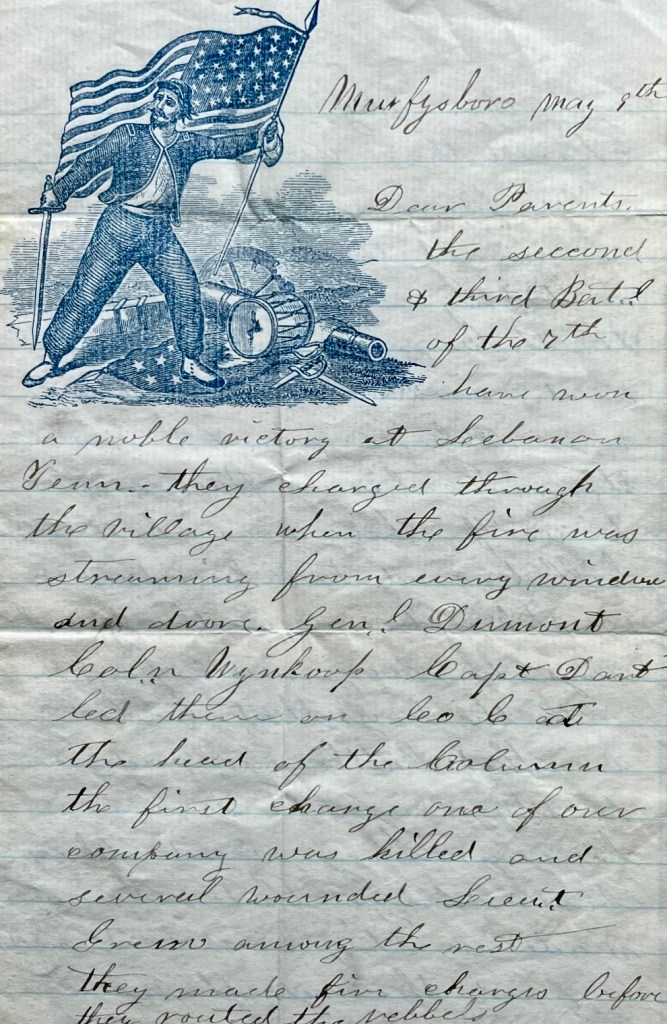
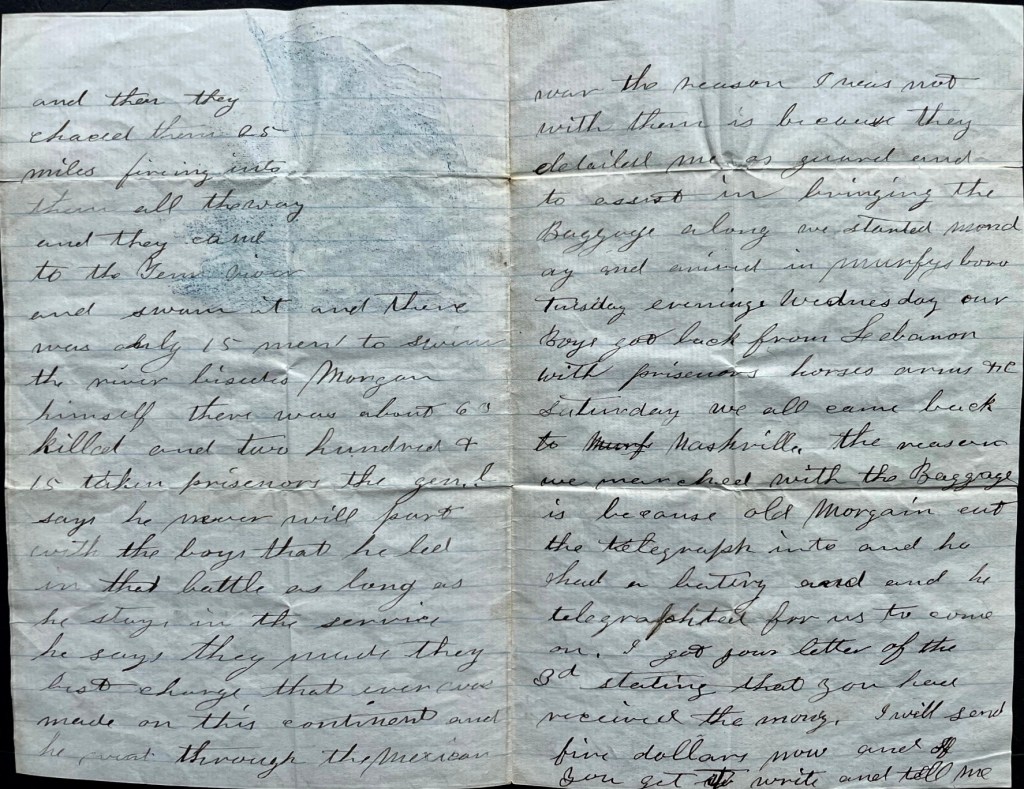
The second and third Battalion of the 7th have won a noble victory at Lebanon, Tennessee. They charged through the village when the fire was streaming from every window and door. Gen. Dumont, Colonel Wynkoop, Capt. Dartt led them on, Company C at the head of the column. The first charge one of our company was killed and several wounded—Lieut. Greir among the rest. They made five charges before they routed the rebels and then they chased them 25 miles, firing into them all the way and they came to the Tennessee River and swam it and there was only 15 men to swim the river besides Morgan himself. There was about 63 killed and two hundred & 15 taken prisoners. The General says he never will part with the boys that he led in that battle as long as he stays in the service. He says they made the best charge that ever was made on this continent and he went through the Mexican War.

The reason I was not with them is because they detailed me as guard and to assist in bringing the baggage along. We started Monday and arrived in Murfreesboro Tuesday evening. Wednesday our Boys got back from Lebanon with prisoners, horses, arms, &c. Saturday we all came back to Nashville. The reason we marched with the baggage is because Old Morgan cut the telegraph in two and he had a battery and he telegraphed for us to come on.

I got a letter of the 3rd stating that you have received the money. I will send five dollars now and if you get it, write and tell me. If I can get a paper, I will send it to you if it has an account of the battle in it. I am enjoying good health and living in hopes that we may see more fighting before the war is closed for I will not die in the battlefield unless I was born to.

This is the most even country I have ever seen. We saw one range of mountains just before we got to Murfreesboro. They must have been 30 miles from us at least. The forest trees are oak, spruce, and some maple. If you get any account of our battle in the papers, I wish you would send it. — Waldo Spear, Co. C, 7th Pennsylvania Vol. [Cavalry]. Camp Worth, Nashville.

1862: Waldo Spear to his Parents & Brothers

The following letter was written by Waldo Spear (1843-1907), the son of Hiram Spear (1810-1872) and Lucy Ripley (1806-1893) of Springfield township, Bradford county, Pennsylvania. Waldo enlisted in Co. C, 7th Pennsylvania Volunteer Cavalry in October 1861 and participated in battles at Lebanon, Murfreesboro, McMinnville, and Gallatin where he was taken prisoner on 25 August 1862. He was paroled because of his injuries and, when exchanged, was detailed as a courier of the 2nd Cavalry Division, Army of the Cumberland, in which capacity he served until 28 December 1864 when he was honorably discharged.

After his discharge, he returned to Pennsylvania for a short time and then moved to Mardin in Tioga county where he farmed for 17 years. In 1883 he purchased a store in East Charleston.

Four hard-riding troopers from Co. F, 7th Pennsylvania Cavalry; from left to right, Richard Fotheringile, John Coughlin, William Smith, and Llewellyn Llewellyn.

Transcription

Camp Parole
September 14, 1862

Dear Parents & Brothers,

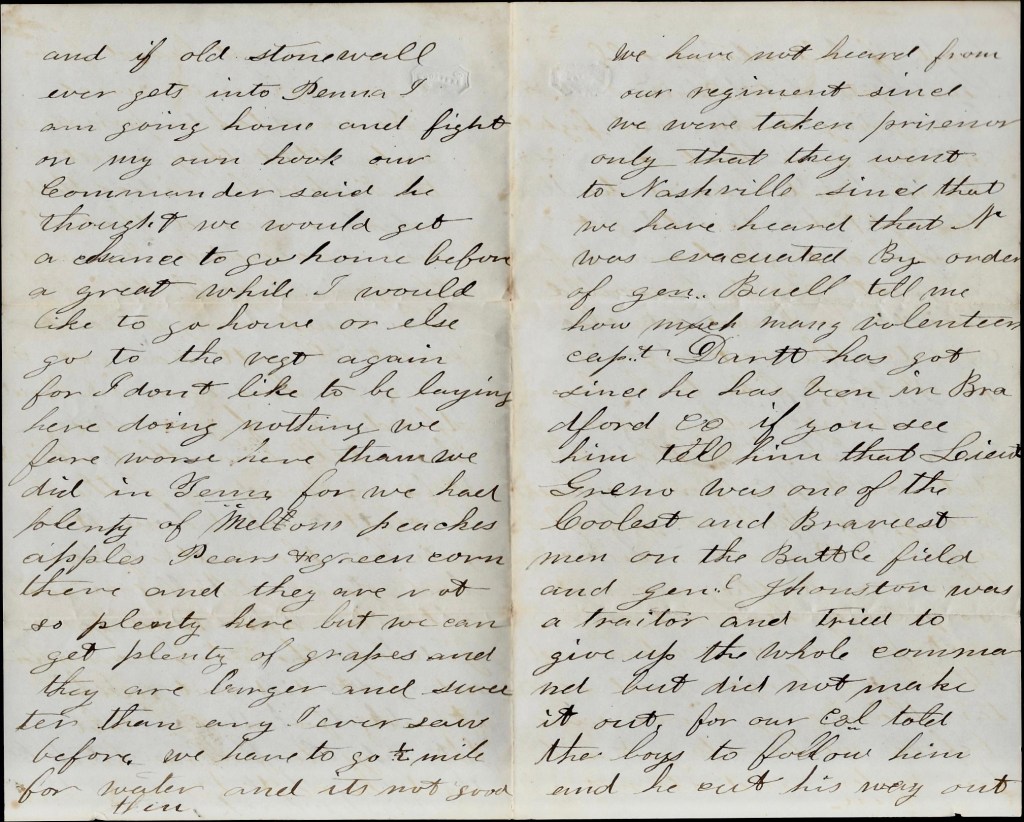
I am looking for an answer to my two letters which I wrote to you as soon as I arrived in Annapolis. I don’t think they have been miscarried for other letters have come from Troy and East Troy. I am very anxious to hear from you and William and all of you. I want to hear how William got home and if he got well. Tell me who is enlisting in Springfield. There must be a good many that I know. Tell Ned that if the rebels get up there, he must take the old shot gun and Bushwhack ’em, and if Old Stonewall ever gets into Pennsylvania, I am going home and fight on my own hook.

Our commander said he thought we would get a chance to go home before a great while. I would like to go home or else go to the regiment again for I don’t like to be laying here doing nothing. We fare worse here than we did in Tennessee for we had plenty of melons, peaches, apples, pears, and green corn there and they are not plenty here. But we can get plenty of grapes and they are longer and sweeter than any I ever saw before. We have to go a half mile for water and it is not good then.

We have not heard from our regiment since we were taken prisoners—only that they went to Nashville. Since that, we have heard that Nashville was evacuated by order of Gen. Buell. Tell me how many volunteers Capt. [Benjamin S.] Dartt has got since he has been in Bradford County. If you see him, tell him that Lieut. [Charles L.] Green was one of the coolest and bravest men on the battlefield and General [Richard Woodhouse] Johnson was a traitor and tried to give up the whole command but did not make it out for our Colonel [George C. Wynkoop] told the boys to follow him and he cut his way out, but not until Gen. Johnson had surrendered. 1

I want you to write soon and tell Marcus Gates that I have written to him twice but have not received an answer yet and I have written to Uncle Dwight once.

Direct your letters to Waldo Speer

Camp Parole, Annapolis, Maryland, Co. C, 7th P. V. Cavalry


1 Waldo’s description of the fight at Gallatin against Morgan’s cavalry in August 1862 rings true. Another member of the regiment wrote of it: “General Johnson, steadily repressing the desire of his subordinate officers to charge vigorously, for his men instead, in line, under fore, after the manner of infantry; in a few minutes ordered a retrograde movement over an open field; dismounted the men, and ordered an advance on foot, each man leading his horse; mounted them again to fall back; divided the command and sent each company to a detached and isolated position, all under fire of the entire rebel force, and held them thus until nearly surrounded, when he drew all together and ordered a retreat. At this stage of the battle I was shot and left on the field, but, from reliable sources, I learn that after retreating about two miles, the command was halted, dismounted, formed in line and held in check until the flanks were turned, when another retreat was ordered in which Lieut. Nicholas A. Wynkoop, son of the Colonel, Battalion Adjutant, and at the time, acting Aide-de-Camp to General Johnson, was killed. Arrived near the Cumberland river, another line was formed, dismounted, the flanks being entirely unguarded, Morgan was enabled to throw forces to the rear to cut off retreat, and pressed heavily on all sides, when General Johnson surrendered. When it became manifest that the General purposed to yield to the enemy, Colonel Wynkoop gathered together such of his command as he could mount, and with Colonel [Robert Kline] of the 3rd Indiana, assuming a bold front, succeeded in cutting his way out and reached Nashville. The loss in the brigade was about 40 killed, and 300 wounded and captured. The weather being warm, many of the wounded died in rebel hands…”

1864: Charles A. Marvin to Mrs. Elizabeth Wise

This letter was written by 35 year-old Charles A. Marvin (1829-1898), the son of Tilly Marvin (1793-1864) and Camilla Clemons (1797-1837) of Tioga county, Pennsylvania. Charles was married to Olive Walker (1832-1913) in 1852 and had at least five children by the time this letter was written in 1864 while serving in Co. L, 7th Pennsylvania Cavalry. Prior to his enlistment in February 1864, Charles was a farmer in Cherry Flats in Tioga county. He mustered out of the regiment on 23 August 1865.

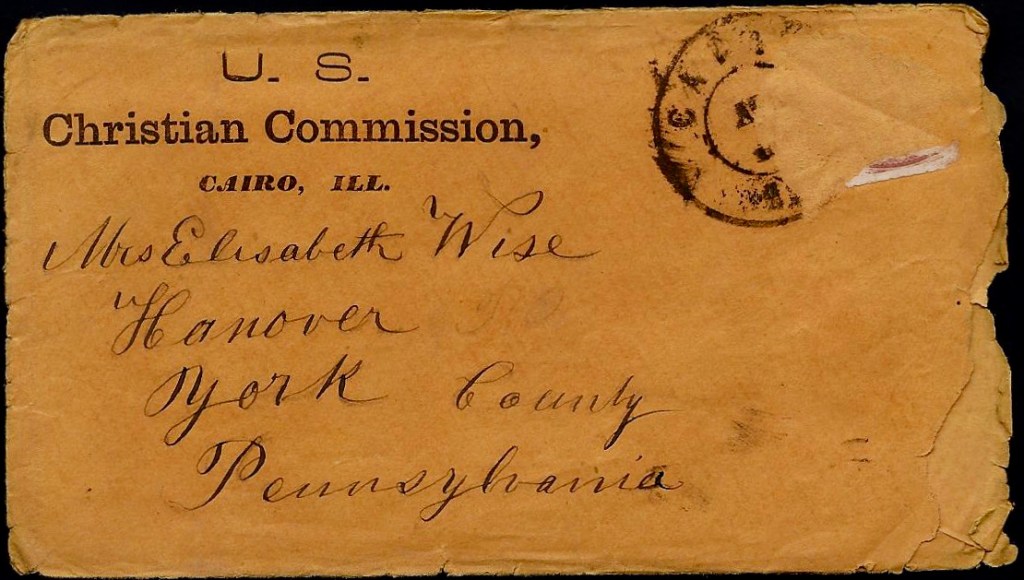
Charles wrote the letter at the request of an apparently illiterate comrade in the regiment to his wife, Mrs. Elizabeth (Snyder) Wise (1832-1880) of Hanover, York county, Pennsylvania. I discovered through census records that 18 year-old Elizabeth was living in 1860 with 20 year-old Michael Wise (Weise) in the household of his parents, Frederick and Catherine Wise of Hanover, Pennsylvania, in the 1850 and 1860 census. I also discovered that Michael had enlisted in April 1861 as a private in Co. G, 16th Pennsylvania Volunteers and that he died on 20 August 1861 from an acute attack of gastroenteritis. In filing for a widow’s pension, Elizabeth submitted a certificate of marriage by the justice of the peace dated 6 August 1860 that informs us the couple were finally married after at least a decade of living together when she filed a charge of “Fornication and Bastardy” again Michael claiming he was the father of their yet unborn child. Dragged into court, Michael agreed to marry Elizabeth which resulted in the marriage certificate. Elizabeth gave birth to the child on 3 November 1860, two and a half months after the marriage, and named him Charles James Wise.

For Michael’ service, Elizabeth began receiving a widow’s pension in the amount of $8 per month beginning on 20 August 1861 and an additional $2 per month for her son Charlie until he reached maturity on his birthday in 1877. In October 1864, we learn from pension records that Elizabeth resided in Littlestown, Adams county, Pennsylvania.

So who was the “husband” who “often speaks of you and his children” that Charles Marvin referred to in his letter? Could it be that Elizabeth had taken up living with another man out of wedlock? Under the terms of her pension, she would have had to forfeit her monthly allotment if she remarried and so she may, perhaps, have wanted to avoid marriage and to change her name. It should be noted that Elizabeth was also illiterate as she could only make her mark in pension papers so apparently the mystery soldier “husband” and Mrs. Wise could only carry on their correspondence through the courtesy of others.

Transcription

Columbus, Tennessee
April 27, 1864

Mrs. Elizabeth Wise,

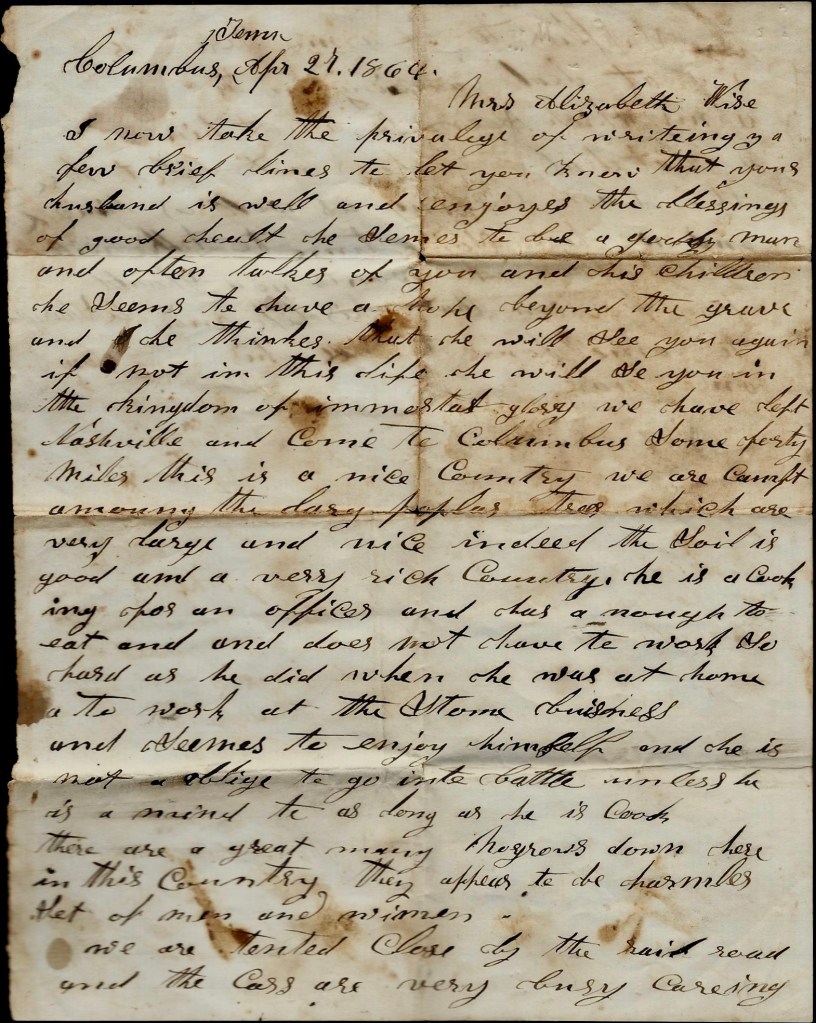
I now take the privilege of writing you a few brief lines to let you know that your husband is well and enjoys the blessings of good health. He seems to be a Godly man and often talks of you and his children. He seems to have a hope beyond the grave and he thinks that he will see you again, if not in this life, he will see you in the Kingdom of Immortal Glory.

We have left Nashville and come to Columbus some forty miles. This is a nice country. We are camped among the lazy poplar trees which are very large and nice indeed. The soil is good and a very rich country. He is a cooking for an officer and has enough to eat and does not have to work so hard as he did when he was at home at work at the stone business and seems to enjoy himself, and he is not obliged to go onto battle unless he is a mind to as long as he is cook.

There is a great many negroes down here in this country. They appear to be [a] harmless set of men and women.

We are tented close by the railroad and the cars are very busy carrying supplies to the army. There is a great deal of cursing in the army which seems to affect him a great deal. He does not like to hear it. I am cooking as well as himself and we have some time to talk with each other. He wants you should pray for him that his life may be spared to come home to see his family once more. He wants you to send him some postage stamps for they are hard to get here. You can send him one or two in each letter. He says that he received a letter from Charley Burns and he said that if I would write him, I should receive a speedy answer. I wrote him a letter but he thinks it was not directed right.

We are under marching orders and expect to move again right away. — Charles A. Marvin