Category Archives: 81st New York Infantry

1862: Charles D. Wilson to his Family

These letters were written by Charles D. Wilson (1846-1916), the son of Robert Wilson and Sarah Ward of Constantia, Oswego county, New York. Charles volunteered to serve in Co. K. , 81st New York Infantry. Charles claimed to have been born in 1843 when he enlisted in December 1861 but census records reveal that he was actually born in 1846 so he was probably only 15 or 16. He reenlisted as a veteran in 1864 and was wounded before Petersburg on 15 August 1864 and mustered out of the service on account of his wounds on 8 September 1865.

In 1880, Charles was a laborer in Oil City, Venango county, Pennsylvania, where he resided with his wife Libby Ryan (1855-1936). He later relocated to Jamestown, Chautauqua county, New York, where he died in 1916.

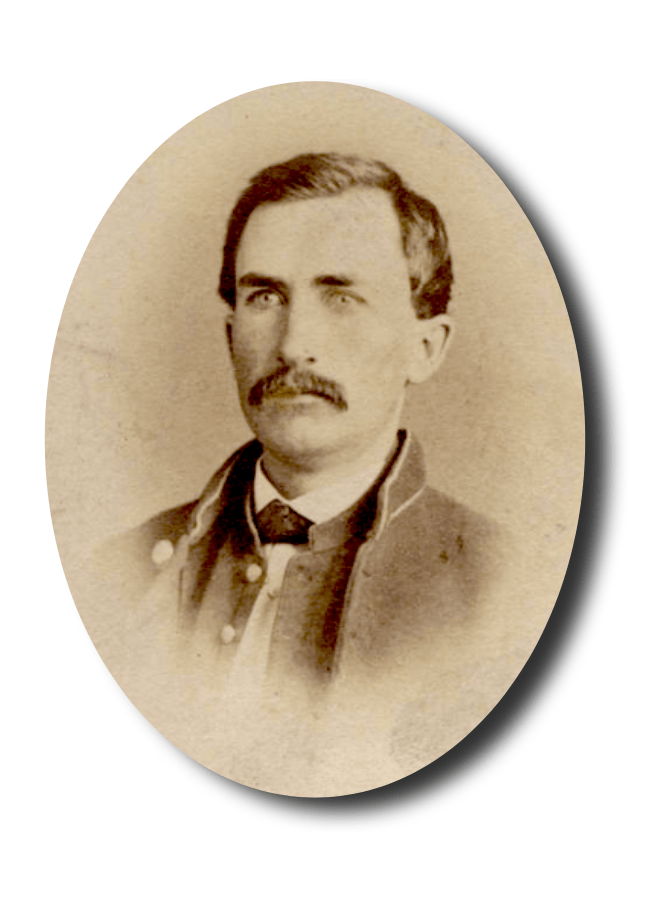
I couldn’t find an image of Charles but here is one of Pvt. Edward Fallen wearing the uniform of the 81st New York Infantry. Ed served in Co. C. (Al & Claudia Niemiec Collection)

Letter 1

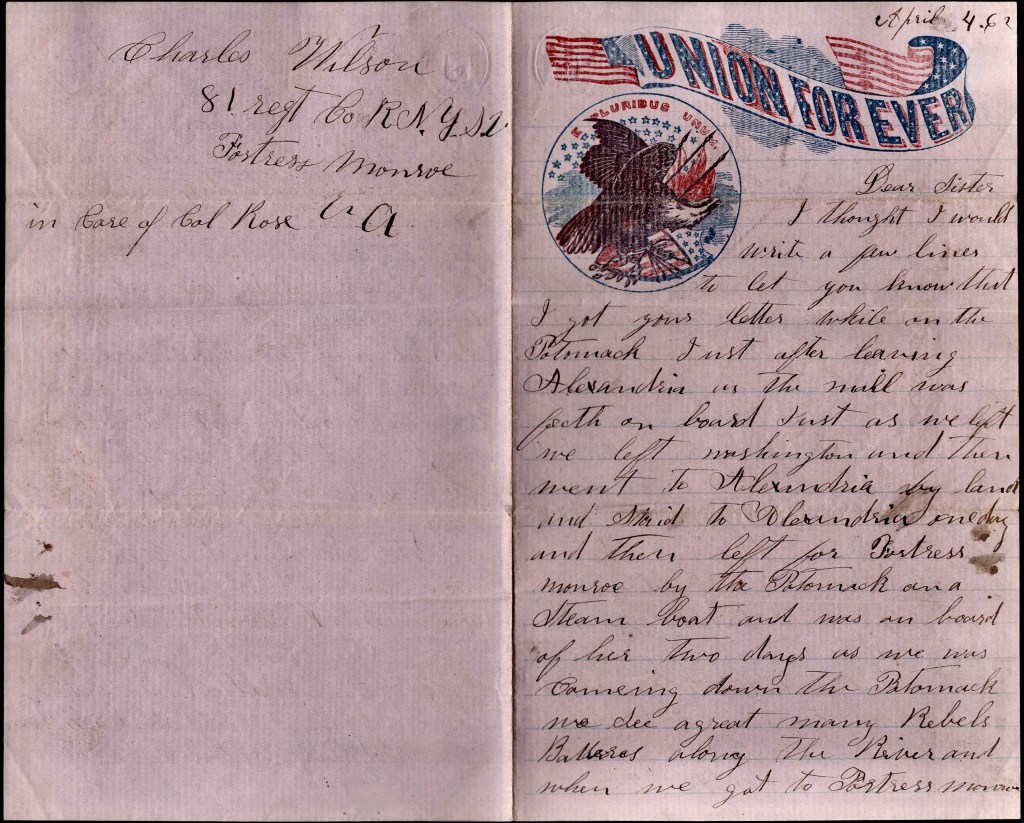
April 4, 1862

Dear Sister,

I thought I would write a few lines to let you know that I got your letter while on the Potomac just after leaving Alexandria, or the mail was put on board just as we left. We left Washington and then went to Alexandria by land and stayed to Alexandria one day and then left for Fortress Monroe by the Potomac and steamboat and was on board of her two days. As we was coming down the Potomac, we seen a great many Rebel batteries along the river and when we got to Fortress Monroe, it was a grand sight. The fort covers one hundred acres of ground. It is of solid stone and some thirty feet from the top down to the water. It is straight up and down and all around the fort is a ditch like the canal and the water is very deep so that it is impossible for to get in or out except in one place where there is a drawbridge. We are about 11 miles from the fort right among the Rebels. We are the advance regiment. The Rebels are not two miles from us. Our pickets saw them last night. It is my turn to go on picket tomorrow and then we have our guns loaded all the time, ready for an attack any time. We are close to the James river where the Rebel ship Merrimack is now. Yesterday we heard their guns all day. She had a fight with one of our ships.

It is nice and warm down here. The grass has started and the trees are all green. It is a very wild country. It is all woods but in little spots. They are all secesh here. Every house has a secesh in it. So I must close now for it is supper time. You must write soon. From your brother as ever, — Charles Wilson

Direct as follows: Charles Wilson, 81st Regt. Co. K, N. Y. S. Infantry, Fortress Monroe, Va., in care of Col. Rose.

Letter 2

Headquarters, Co. K, 81st [New York] Regiment
[At Harrison’s Landing on the James River]
August 2, 1862

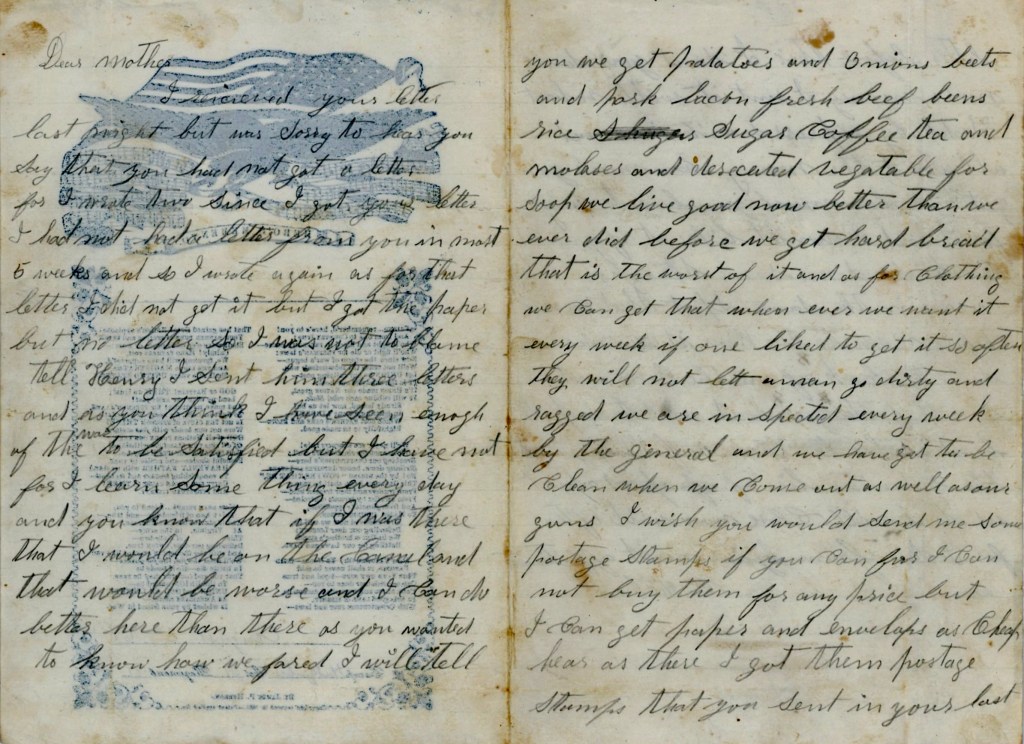
Dear Mother,

I received your letter last night but was sorry to hear you say that you had not got a letter for I wrote two since I got your letter. I had not had a letter from you in most 5 weeks and so I wrote again. As for that letter, I had not got it but I got the paper but no letter so I was not to blame. Tell Henry I sent him three letters and as you think I have seen enough of the war to be satisfied but I have not for I learn some things every day and you know that if I was there that I would be on the canal and that that would be worse and I can do better here than there.

As you wanted to know how we fared, I will tell you. We get potatoes and onions, beets and pork bacon, fresh beef, beans, rice, sugar, coffee, tea, and molasses and desecrated vegetable for soup. We live good now—better than we ever did before. We get hard bread—that is the worst of it. And as for clothing, we can get that whenever we want it. Every week if one liked to get it. So often they will not let a man go dirty and ragged. We are inspected every week by the general and we have got to be clean when we come out, as well as our guns.

I wish you would send me some postage stamps if you can for I cannot buy them for any price but I can get paper and envelopes as cheap here as there. I got them postage stamps that you sent in your last letter before this. I sent you some more money. I sent it with Robert Todd by Express. So write soon and all about the money. How much you get and how much you have to pay for it and I would like it if you could sed me some stamps.

We are in the same spot that we was before—close to the river. It is a nice scene to look off on the river and see all of the gunboats and transports lie at anchor. The river is full of gunboats. The Monitor lies off opposite us. So I will close now. Write often for I do. From your most affectionate son, — C. Wilson
1864: William Bredow to a Friend

The following brief letter was written by 35 year-old 1st Sergeant William Bredow of Waterville, Oneida county, New York, who enlisted in Co. E, 81st New York Infantry to serve three years. He was promoted from private to corporal in February 1862, to sergeant in July 1862, and to 1st Sergeant in January 1864 when he re-enlisted as a veteran. In February 1865 he was commissioned a 1st Lieutenant and he mustered out as the Captain of Co. H in August 1865.

I believe that William Bredow was born in Germany in 1836 and came to the United States in 1843 when he was seven years old.

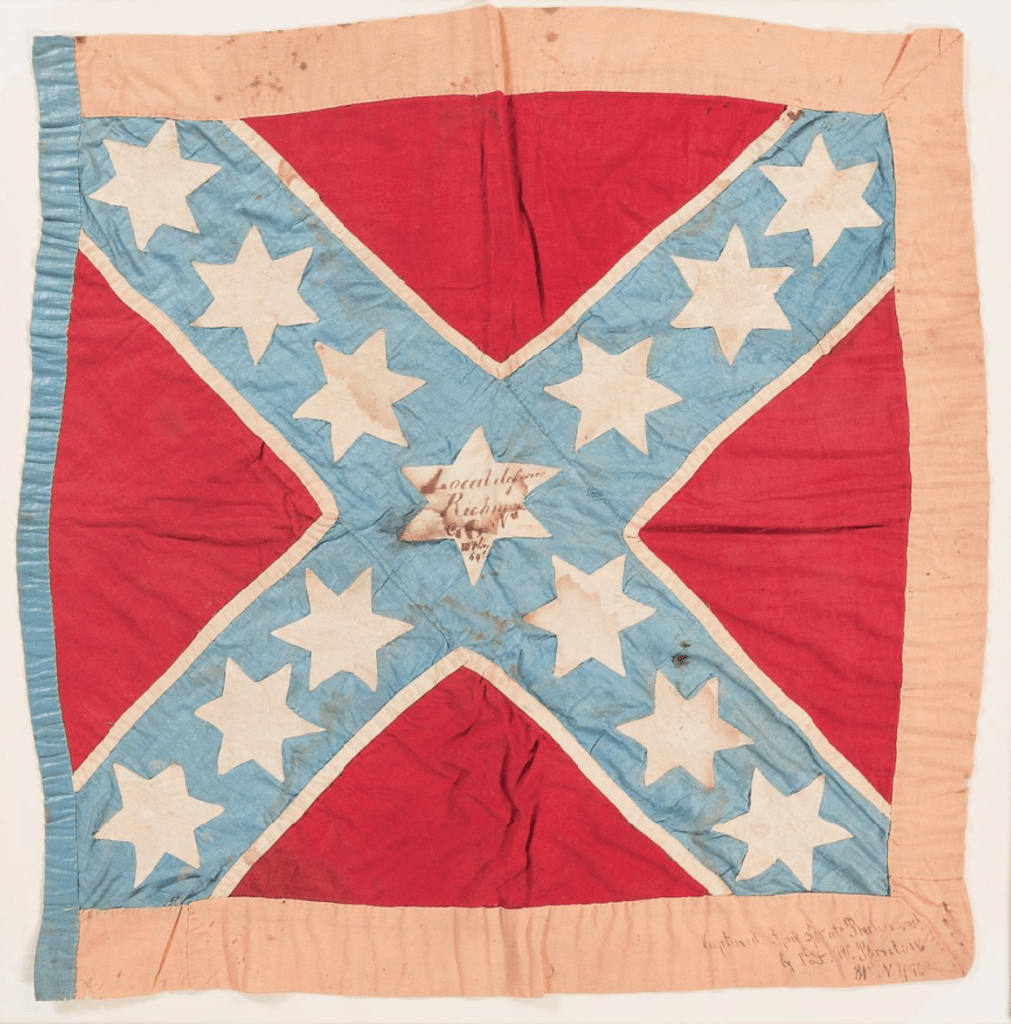
A small Confederate battle flag (24 inches by 25 inches) marked “Local defence/Richmond/Co. G/10th Va/10th May 1864″ and marked, Captured April 3rd 65 at Richmond by 1st Lt. W. Bredow, 81st NY Vols.” sold at auction recently for $55,000.

Note: This letter is from the personal collection of Greg Herr and was made available for transcription and publication on Spared & Shared by express consent.

Transcription

In front of Petersburg, Virginia
near Bermuda Hundred
September 16th 1864

Friend Tailiur!

I received your letter dated the 14th this month and am very much surprised to learn that you got no letter from me. I wrote one the next day as your brother-in-law Mr. Day in Hampton. The other I wrote the 11th this month. In the latter I answered you all the questions about payroll and so on and told you the news about our regiment. I hope you got both letters by this time. Your trunk is left by Captain [Lewis B.] Porter 1 in the storehouse in Norfolk.

I hope your leg will get well pretty soon and will not trouble you much. Everything is quiet here since you left. No excitement at all except this morning a couple boys were shot on picket by fooling with their guns. [John] Daily 2 out of Company B was brought in this morning about 5 o’clock shot through his buttocks, and now about half hour ago, [Francis P.] Graves 3 of Company I shot by Thomas McDonald 4 through the bowels.

Lieutenant [Maurice P.] Tidd joined the regiment yesterday. The boys sent their love to you. Hoping you got my letter by this time. I remain your friend, — W. Bredow


1 Lewis B. Porter was 30 years old when he enlisted on 5 September 1861 at Oswego to serve three years in Co. D, 81st New York Infantry. He was promoted to 1st Sergeant in August 1862, commissioned a 2nd Lt. in November 1862, and made Captain of Co. K in June 1864. He was wounded in action at Chaffin’s Farm, Va. two weeks after this letter was written and died of his wounds on 15 November 1864 at Fort Monroe, Va.

2 John Daly [or Dailey] was 36 years old when he enlisted at Oswego as a private in Co. B. in the fall of 1861. He was wounded “while on picket near Bermuda Hundred” and mustered out on 25 May 1865.

3 Francis (“Frank”) P. Graves of Rome, New York, was 19 when he enlisted in August 1862 to serve in Co. I with his brothers. He was wounded in action on 23 June 1864 at Cold Harbor but was standing duty on picket at Bermuda Hundred when he was “accidentally killed.”

4 Thomas McDonald was 18 when he enlisted on 14 December 1861 at Rome, New York to serve in Co. I. He was wounded in action at Cold Harbor on 3 June 1864 but survived the war.

1862: Samuel Durant to his Daughter

The following letters were written by a semi-literate English emigrant named Samual Durant (1819-1862) who enlisted at Fulton, Oswego county, New York, on 13 September 1861 as a private in Co. C, 81st New York Infantry. He was transferred to Co. G on 6 February 1862. He died of chronic diarrhea on 20 September 1862 at Philadelphia. He’s buried in the National Cemetery at Philadelphia, Section B, Site 406.

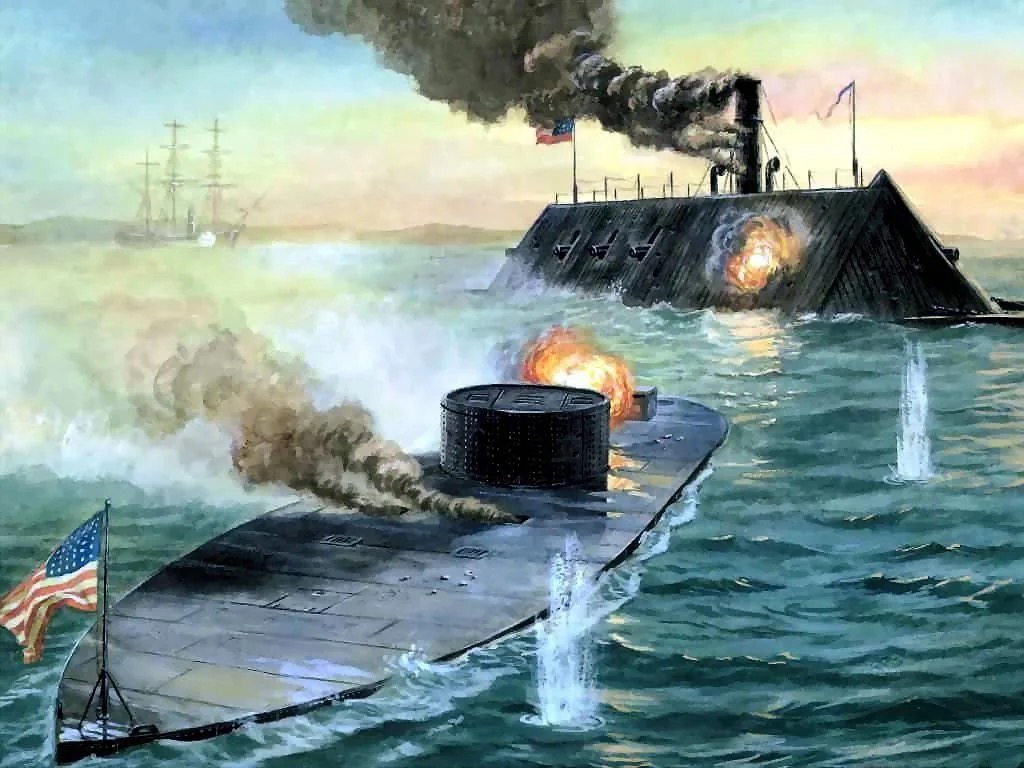
On the 21st of February the regiment was ordered to New York City, and then proceeded on the 5th of March to Washington, D. C. There the men remained in camp twenty days, and on the 28th of March, marched to Alexandria Va., where they embarked for Fortress Monroe, arriving on the 1st of April—just three weeks after the famous battle between the ironclads that captured the imagination of the public. Samuel’s description of the USS Monitor is classic: “She looks like a mud turtle with a barrel on his back. I can’t see nothing but her hump stick up out of the water. She is wicked. They are all afraid of her…”

From their landing at Newport News until May 31st the regiment was on the march or in camp, acting as reserve at the battle of Williamsburg Va., and reaching Seven Pines on the 28th, where they remained until the bloody engagement of the 31st was fought. In this battle the 81st was assigned to the left of Casey’s Division, unsupported in an open field. The regiment here underwent its baptism of fire and stood the ordeal heroically.

To read letters by other members of the 81st New York Infantry that I’ve transcribed and published on Spared & Shared, see: Horace Benjamin Ensworth, Co. B, 81st New York (1 Letter); Horace Benjamin Ensworth, Co. B, 81st New York (4 Letters); Marshall S. Moses, Co. E, 81st New York (1 Letter); Franklin Darius Sizer, Co. I, 81st New York (1 Letter); and
Dexter Samson, Co. K, 81st New York (1 Letter).

Letter 1

Headquarters, Camp Dutton
81st Regiment, Company G, NYV.
April 14, 1862

Dear daughter,

I take [this] opportunity to write to you. [I] take it from Albany. We march in the night to New York by railway in the morning & daylight. Laid there two days, then went on to Staten Island. Laid there 8 days, then [at] 4 o’clock in the afternoon, took a boat 25 miles and then took railway to the Delaware river, crossed that and a steamer to Philadelphia and a loyal place that was too. [The] saloon was a Cooper’s Shop. It was so large that we had a 11 hundred men all eat at one long table and we had everything the good. All regiments [that] pass through [Philadelphia] is fed by the corporation and all took pleasant good talk to boys.

Away we go for Baltimore and a fine country it was too, houses and other buildings painted white. The grass by the side of the road was on fire more than a 100 times. We come to a place called Mule City by ingen [?] I should think. They said there was 14 hundred mules and such—a sight you never saw, Great homely wagons, 6 mules make a team, one line on the leader and a saddle on the pull mull. The man sits this [ ] and [ ] is all I can make out. I tell you, he looked like a monkey on a hand organ. I wish you uncle James Harmon was here to see them. I tell you, we would have a laugh about it. I saw a team run away across the corn stubble. The wagon went bump, bump, bump. The boys all a laughing.

I have been down to the river and saw the Cumberland lay there sunk by the Merrimack. She is a iron-cladded rebel steamer. We have got the Monitor up there and she looks like a mud turtle with a barrel on his back. I can’t see nothing but her hump stick up out of the water. She is wicked. They are all afraid of her and [ ] battery that go by steam and [ ] chisels. And then we have got the Vanderbilt. If they attack us now they will smell powder. They keep playing round. I saw where they had two cut one [ ] off, killed two men and never touched them—the air knocked them dead. We had 11,000 men in one Division. I tell you, that made a show, and there was five thousand at that camp [which] is called Newport News.

All round us the fences are all burnt. I saw a wheat stubble and stacks of wheat knocked down, corn stubble and stalks and stacks of corn stalks but this is the pleasantest country I ever saw in my life. It is a good country for grain and potatoes. We [ ] cows nor hogs. We have two darkies follow us from [ ]. We keep them along with us. They cut wood, carry water. They are smart. We have tents now. The boys [ ] then about 3 miles and [ ]. I got up at light and take a black brand [?], named it Fort Spencer, Harpers ferry brew. Put on the Orderly….

Please send me particulars about your trade and where you [ ]. Excuse my writing and spelling. I must close my letter. Give my love to all my friends. I remain yours, — Samuel Durant


Letter 2

May 11th 1862

Dear daughter,

I take the pleasure to write to you to let you know I got back to my regiment last Saturday. I was very tired. The fever was leaving Robert on Saturday morning. I left him about 5 o’clock. I got to the regiment at 3 o’clock. The cannons was roaring all night. I didn’t sleep at all. The balloon went up in the night. They han’t got no light in camp so early.

The Sunday morning we started for the forts [at Yorktown], they had all left. As we were going along, I heard a report like a cannon. I thought [maybe] they was not gone, but when I got a little farther, I saw a man laying there badly wounded. There was one killed and 7 badly wounded. They had buried bomb shells in the road and all along where they thought we would go. As soon as you touch one of them, off they go. I say, “G. Van Pattan, what’s the matter?” [He said,” “see them shells buried, mind you [don’t] step on them. We had to be very careful.

Well, we traveled all day through forts and rifle pits until night and then laid down until 3 o’clock and then went back 8 miles in the rain. It rained all day and about all night. I was wet to my skin and my coat was so wet that I could barely carry it. I had to go in the dar, to a tree, chop some wood to be warm. There was firing all day just ahead of us. In the morning we marched round to get on the east side of them but they was just one day too fast. They had to fight like the devil to win. They did fight too, I tell you.

McClellan was up in the balloon. He see the Louisiana tigers come out of the woods put down the balloon. Our army is whipped. When he got there they had [ ] them all to pieces. The officer gave up his sword and said you have whipped the best regiment in the Confederate army. It is a very large field, I should think 1,000 acres. I should think and a 100 acres of wheat and corn. I don’t know but their five forts, ditches round 15 feet deep they got in there. Our boys got on one shoulder and the gun in the other hand and away they run, throwed the rails across the ditch [and] over they went [ ] them out. They took some prisoners but how many I don’t know. I saw 150 wounded rebels in one barn & shed. The doctors cutting off legs and arms, some screaming all night. That was on Wednesday night. I couldn’t sleep.

Next morning I got up and went off to south and west of the field. I come to a [ ] and then I come to a horse shot down, three or four in a mud hole with the harnesses on. They was the muddiest lot of horses and men I ever saw in my life. I saw the Michigan 5th, I think it was, all shot to pieces and bayonet[ed]. They was too fast. Had their knapsacks on all in the rain and mud. They was all muddy. 1

I just now read your letter. I felt glad to hear from you. I heard from Robert just before. He is better. I wish we get our pay so he could have some to get some things. I left all I could spared with Ed and I tell you that we are to march on the road to Richmond. They are not far ahead of us. Our boys are dragging [?] out all the time. We can’t get half enough to eat. The teams can’t get along with it. I would rather have seen wheat. I have seen the last 500 dollars but I have seen hard times. I received a letter from E. Carrier. He has received 35 dollars. From S. Durant

1 “The next major battle that the Fifth Michigan took part in was the battle of Williamsburg. The Union general wanted to attack the center of the Confederate line, which was heavily fortified by Fort Magruder. This proved to be too much for them and they were forced to turn back. This gave the Confederates a clear advantage and they decided to do a countercharge. The Confederates were able to capture a Union battery and fire upon the retreating Union soldiers. This is where the “Fighting Fifth” first earned its nickname. Once the Fifth saw what was happening, they fired upon the Confederates at the Union battery, then charged them. This shocked the rebels, resulting in them fleeing the battery. After which the Fifth started taking fire and many casualties from Confederates. To overcome this, another charge was called for, and the Fifth ended up in the rebel trenches, taking prisoners and displacing the Confederates. If it was not for their valor, the outcome of the battle would have been very different. It is reported that after the second charge they held their position for six or seven waves of attacks, incurring up to fifty percent casualties. This is the reason why the Fighting Fifth is such a notable regiment. Within their first battle, they showed gallantry and guts to overtake the Confederates with not only one, but two charges against the odds. Not only did they prove themselves at Williamsburg, but they did so too during other battles as well.”  [See The 5th Michigan Volunteer Infantry Regiment during the Civil War.]

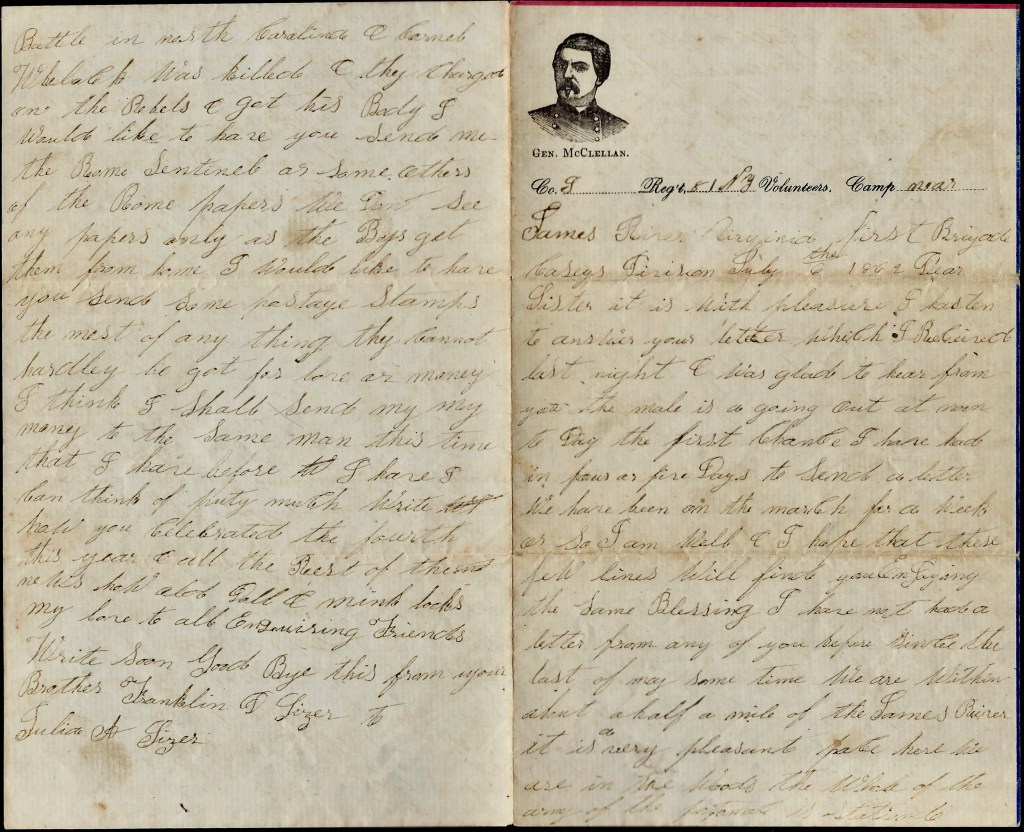
1862: Franklin Darius Sizer to Julia A. Sizer

Franklin D. Sizer, Co. I, 81st NYV

The following letter was written by Franklin Darius Sizer (1840-1862), the son of Luther Sizer (1798-1877) and Perlina Barnum (1802-1873) of Western, Oneida county, New York. Frank enlisted on 12 October 1861 to serve in Co. I, 81st New York Infantry. He died of disease on 29 December 1862 at Yorktown, Virginia.

He wrote the letter to his younger sister, Julia Ann Sizer (1842-1926).

Transcription

Co. I, 81st New York Volunteers
Camp near James River, Virginia
July 6th 1862

Dear Sister,

It is with pleasure I hasten to answer your letter which I received last night. I was glad to hear from you. The mail is a going out at noon today, the first chance I have had in four or five days to send a letter. We have been on the march for a week or so. I am well & I hope that these few lines will find you enjoying the same blessing. I have not had a letter from any of you before since the last of May some time.

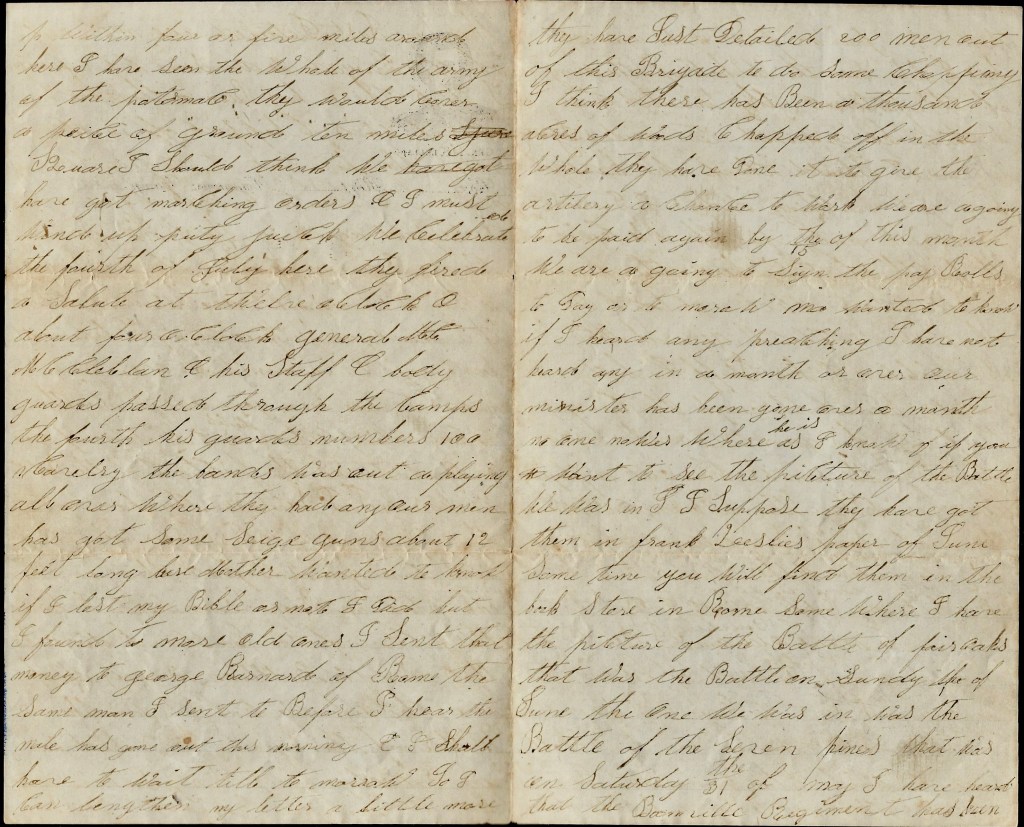
We are within about a half a mile of the James River. It is a very pleasant place here. We are in the woods. The whole of the Army of the Potomac is stationed within four or five miles around here. I have seen the whole of the Army of the Potomac. They would cover a parcel of ground ten miles square, I should think. We have got marching orders & I must wind up pretty quick.

We celebrated the 4th of July here. They fired a salute at twelve o’clock and about four o’clock. General McClellan and his staff & bodyguards passed through the camps on the 4th. His guards numbers 100 cavalry. The bands was out a playing all over where they had any. Our men has got siege guns about 12 feet long here.

Mother wanted to know if I lost my bible or not. I did but I found two more old ones. I sent that money to George Barnard of Rome—the same man I sent to before. I hear the mail has gone out this morning & I shall have to wait till tomorrow so I can lengthen my letter a little more.

They have just detailed 200 men out of this brigade to so some chopping. I think there has been a thousand acres of woods chopped off in the whole. They have done it to give the artillery a chance to work.

We are a going to be paid again by the 15th of this month. We are a going to sign the pay rolls today or tomorrow. Ma wanted to know if I heard any preaching. I have not heard any in a month or over a month. No one knows where he is as I know of.

If you want to see the picture of the battle we was in, I suppose they have got them in Frank Leslie’s paper of June some time. You will find them in the book store in Rome somewhere. I have the picture of the Battle of Fair Oaks. That was the battle on Sunday of June the 1st. We was in the battle of the Seven Pines. That was on Saturday, 31st of May. I have heard that the Boonville Regiment [Third Oneida] has been battle in North Carolina & Colonel [Charles] Wheelock was killed & they charged on the rebels and got his body.

I would like to have you send me the Rome Sentinel or some others of the Rome papers. We don’t see any papers—only as the boys get them from home. I would like to have you send some postage stamps the most of anything. They cannot hardly be got for love or money. I think I shall send my money to the same man this time that I have before. I have [written all] I can think of pretty much. Write how you celebrated the 4th this year & all the rest of the news, how Old Doll & Mink looks. My love to all enquiring friends. Write soon. Goodbye. This from your brother, — Franklin D. Sizer

To Julia A. Sizer

1863-65: Horace Benjamin Ensworth Letters

I could not find an image of Horace in uniform but here is one of Dorance Ferris who served in Co. K, 81st New York Infantry (Photo Sleuth)

These four letters were written by Horace B. Ensworth (1842-Aft1870) who enlisted at the age of 21 at Oswego to serve three years in Co. B, 81st New York Infantry in late September 1861. He reenlisted in January 1864 and mustered out as a veteran on 31 August 1865 at Fortress Monroe.

In his enlistment records, Horace was described as standing 5 feet 5 inches tall, with gray eyes, and brown hair. He entered the service as a private and mustered out as a sergeant.

Horace was the son of Backus Ensworth (1812-1882) and his first wife, Hannah, who died in 1856. The Ensworth family were farmers in Mexico, Oswego county, New York.

See also—1862: Horace Benjamin Ensworth to Backus Ensworth published on Spared & Shared 22 on 2 May 2022.


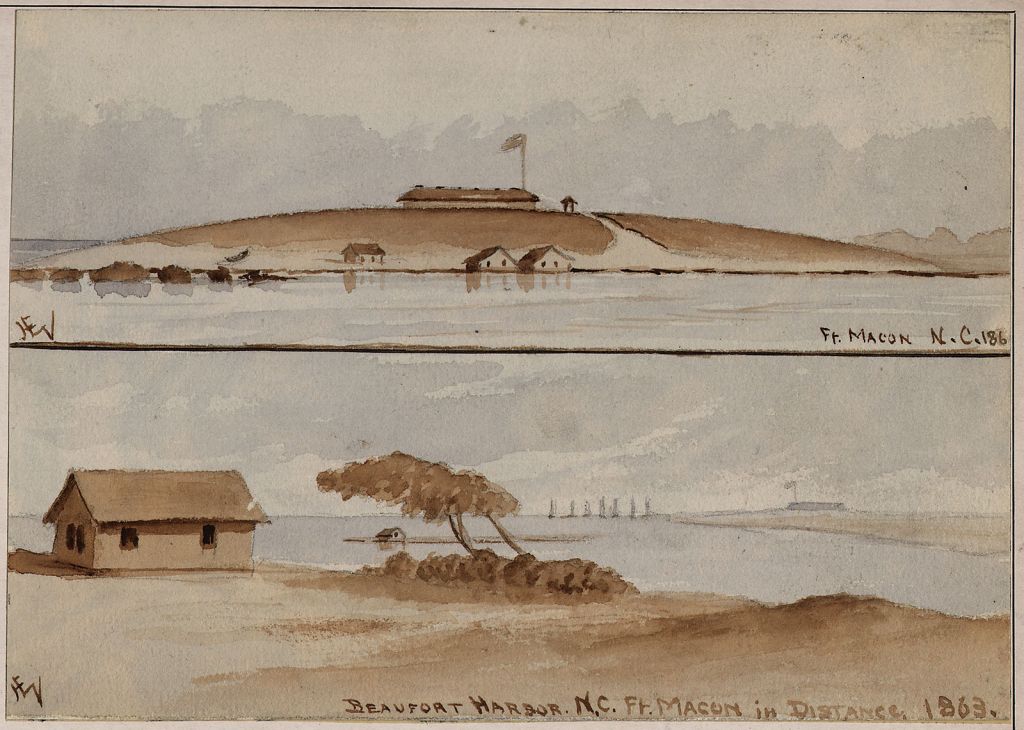
Fort Macon in Beaufort Harbor, North Carolina, 1863

Letter 1

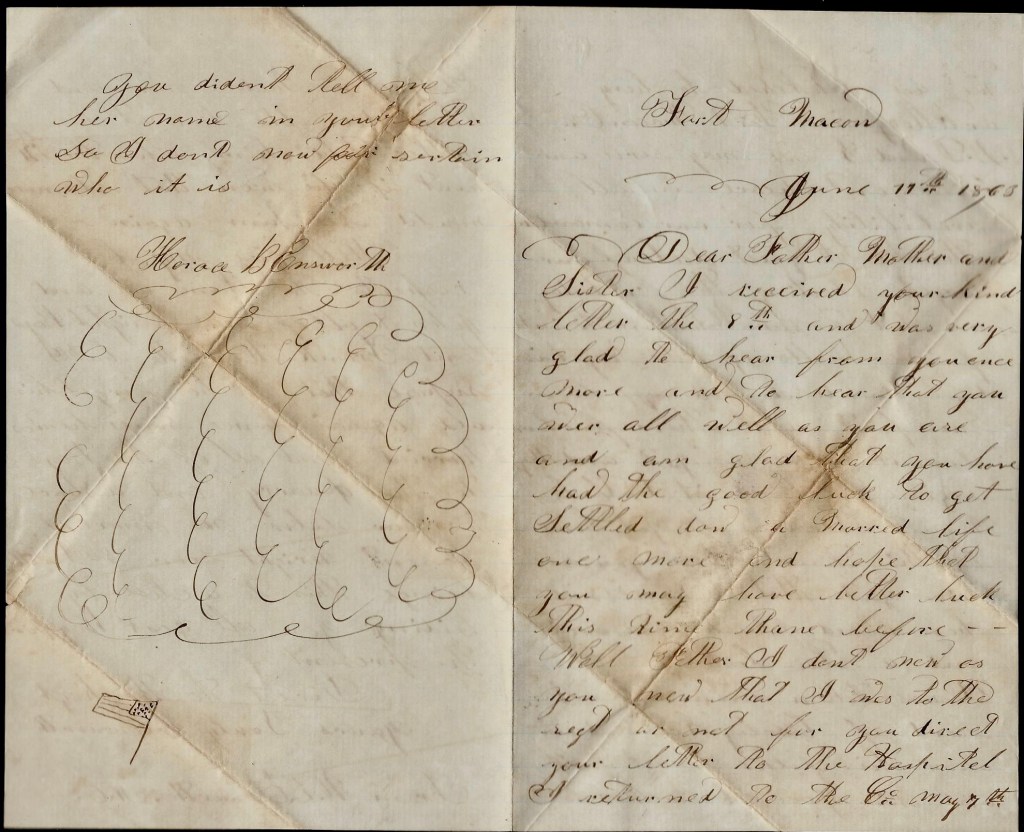
Fort Macon
June 11, 1863

Dear Father, Mother and Sister,

I received your kind letter the 8th and was very glad to hear from you once more and to hear that you were all well as you are and am glad that you have had the good luck to get settled down to a married life once more and hope that you may have better luck this time than before.

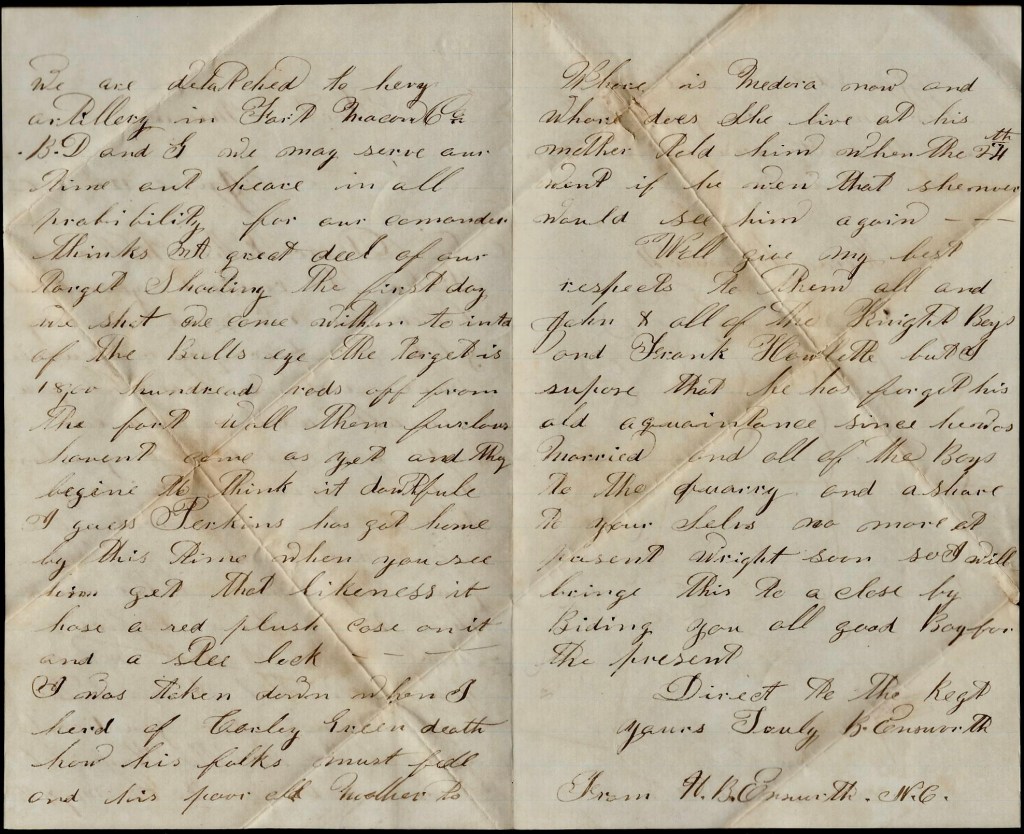
Well Father, I don’t know as you know that I was to the regiment or not for you directed your letter to the hospital. I returned to the company May 7th. We are detached to heavy artillery in Fort Macon—companies B. D, and G. We may serve our time and leave in all probability for our commander thinks a great deal of our target shooting. The first day we shot we came within two inches of the bulls eye. The target is 1800 rods off from the fort.

Well them furloughs haven’t come as yet and they begin to think it doubtful. I guess Perkins has got home by this time. When you see him, get that likeness. It has a red lush case on it and a steel lock.

I was taken down when I heard of Charley Green’s death. How his folks must feel and his poor old Mother too. Where is Medera now and where does she live at? His mother told him when the 24th went if he went that she never would see him again.

Well, give my best respects to them all and John and all of the Knight boys and Frank Howlette—but I suppose that he has forgot his old acquaintance since he was married—and all of the boys to the quarry, and a share to yourselves. No more at present. Write soon. So I will bring this to a close by bidding you all goodbye for the present.

Direct to the regiment. Yours truly, — B. Ensworth

From H. B. Ensworth, W. C.

You didn’t tell me her name in your letter so I don’t know for certain who it is.


Letter 2

Fort Macon
Beaufort, North Carolina
August 24, 1863

Dear Father

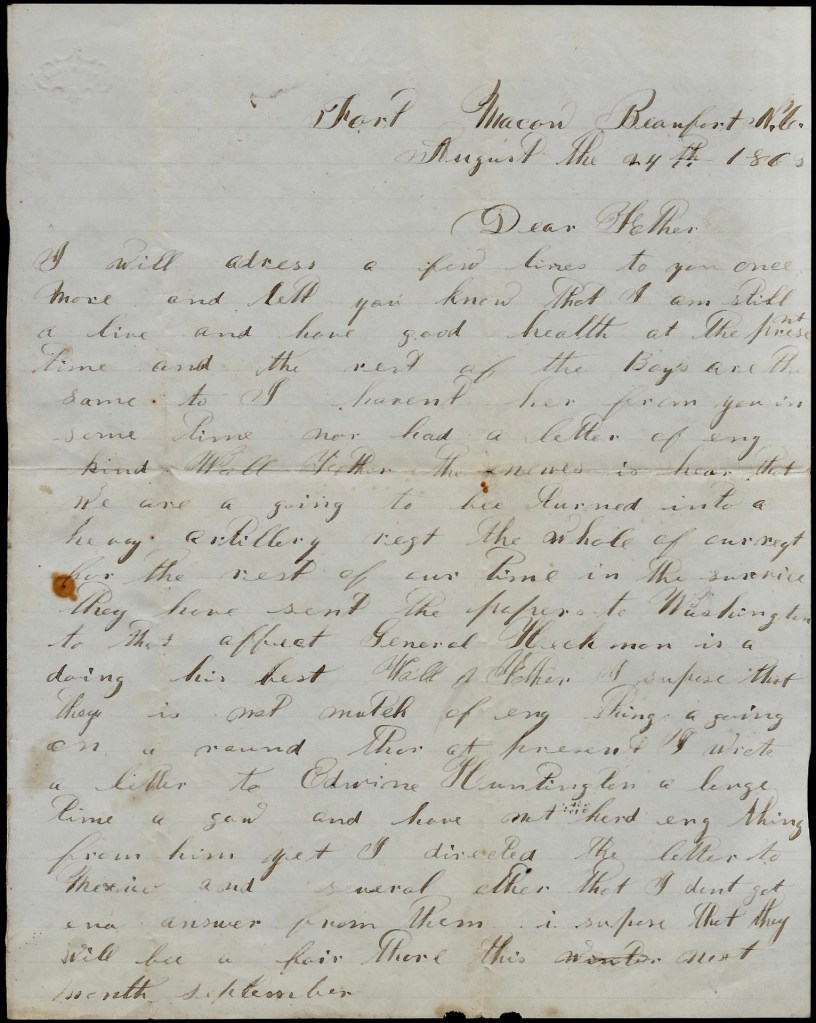
I will address a few lines to you once more and tell you now that I am still alive and have good health at the present time and the rest of the boys are the same to. I haven’t heard from you in some time nor had a letter of any kind.

Well, Father, the news is here that we are a going to be turned into a heavy artillery regiment—the whole of our regiment for the rest of our time in the service. They have sent the papers to Washington to that effect. General Heckman is a doing his best.

Well, Father, I suppose that there is not much of anything on around there at present. I wrote a letter to Edwin Huntington a long time ago and have not heard anything form him yet. I directed the letter to Mexico and several others that I don’t get any answer from them. I suppose that they will be a fair there this next month September.

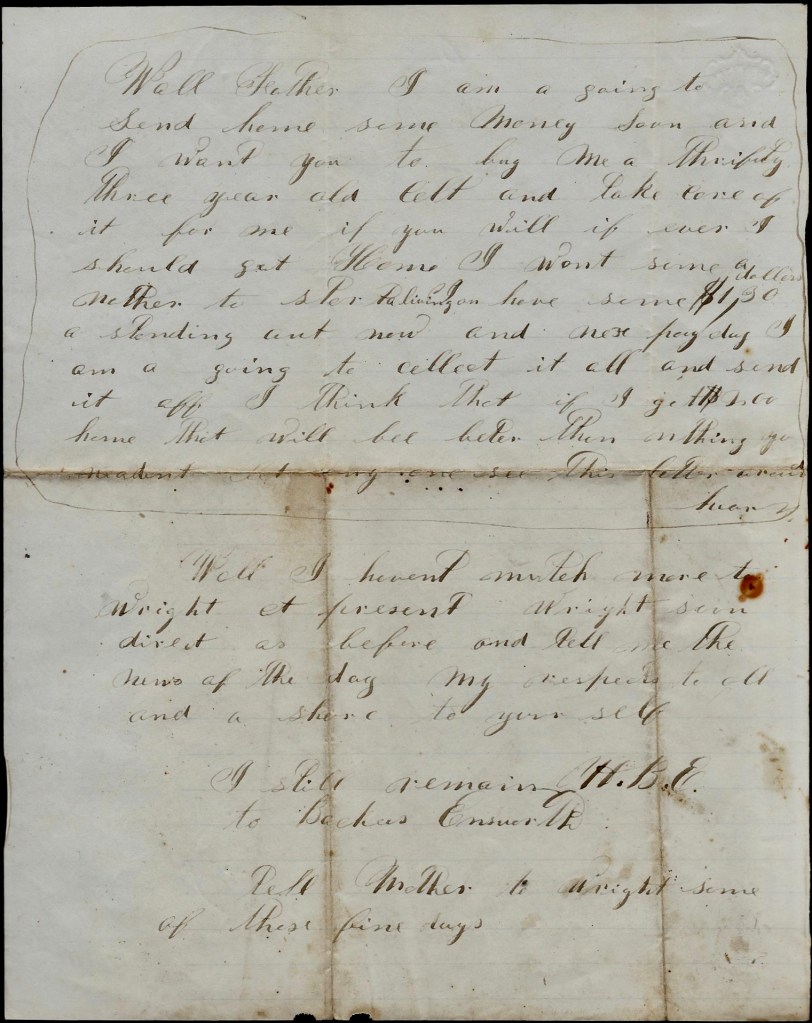
Well, Father, I am a going to send home money soon and I want you to buy me a thrifty three-year old colt and take care of it for me if you will. If ever I should get home, I want some another to start a living. Have some $130 dollars a lending out now and more payday. I am a going to collect it all and send it off. I think that if I get $200 home, that will be better than nothing. You hadn’t let anyone see this letter around here.

Well I haven’t much more to write at present. Write soon. Direct as before and tell me the news of the day. My respects to all and a share to yourself. I still remain H. B. E.

To mother to write some of these fine days.


Letter 3

Camp 81st Regt. N. Y. State Volunteers
March 4th 1865

Friend F. D. Myers,

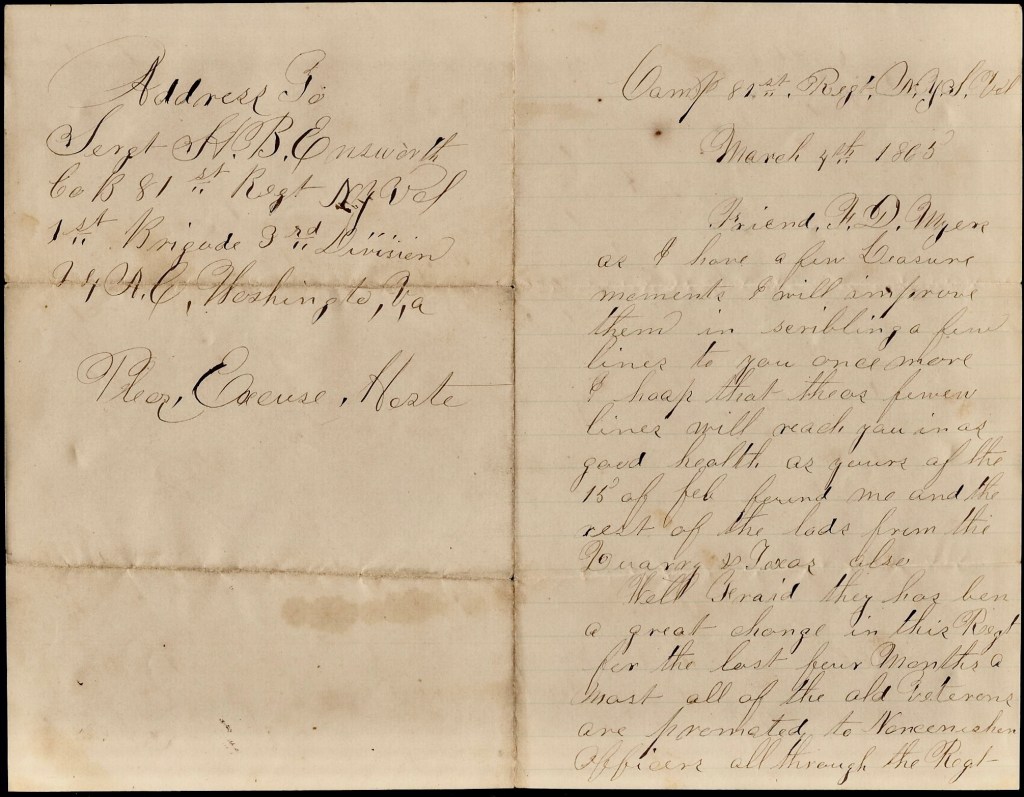
As I have a few leisure moments, I will improve them in scribbling a few lines to you once more. I hope that these few lines will reach you in as good health as yours of the 15th of February found me and the rest of the lads from the Quarry & Texas also.

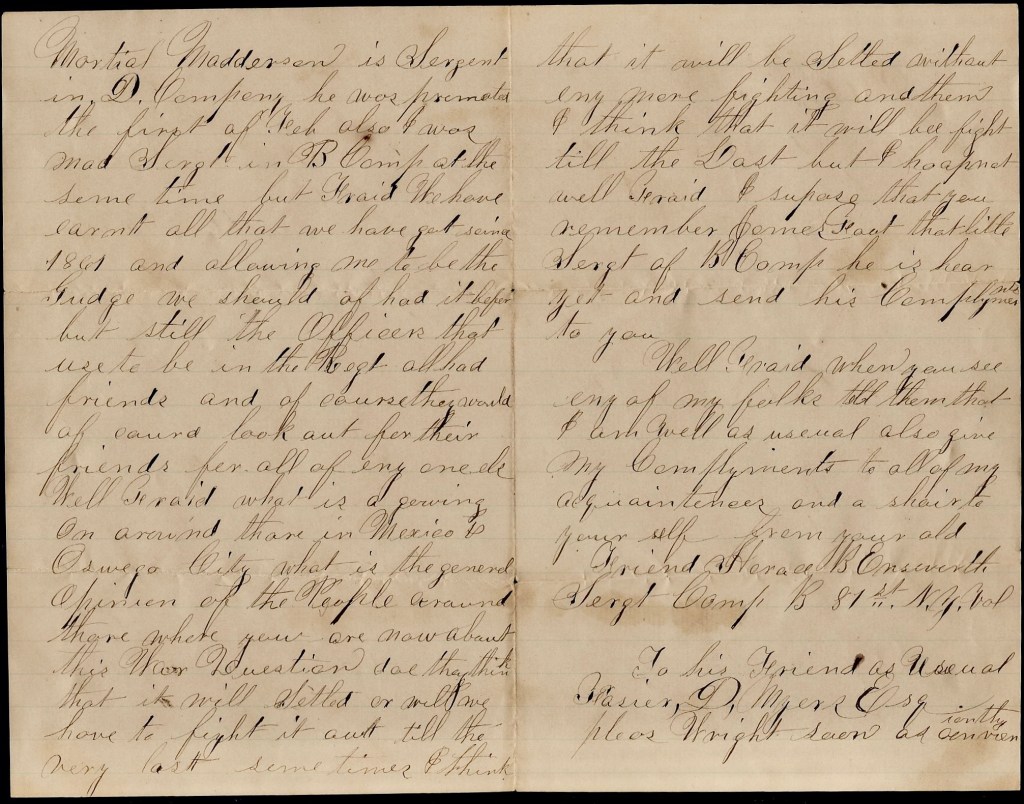
Well, Fraid, there has been a great change in this regiment for the last four months. Almost all of the old veterans are promoted to non-commissioned officers all through the regiment. Marshall Mattison is sergeant in D Company. He was promoted the first of February. Also I was made sergeant in B. Company at the same time but Fraid, we have earned all that we have got since 1861 and allowing me to be the judge, we should of had it before. But still the officers that use to be in the regiment all had friends and of course they would look out for their friends before all of anyone else.

Well, Fraid, what is a going on around there in Mexico and Oswego City? What is the general opinion of the people around there? Where are you now about this war question? Do they think that it will be settled or will we have to fight it out till the very last? Sometimes I think that it will be settled without anymore fighting and then I think that it will be fight till the last. But I hope not.

Well Fraid, I suppose that you remember James Gant, that little sergeant of B Co.? He is here yet and sends his compliments to you.

Well, Fraid, when you see any of my folks, tell them that I am well as usial. Also give my compliments to all of my acquaintances and a share to yourself. From your old friend, — Horace B. Ensworth, Sergt. Company B, 81st N. Y. Vol.

To his friends as usual. Frasier D. Myers, Esq. Please write soon as convenient.

Address to:

Sergt. H. B. Ensworth
Co. B, 81st Regt. N. Y. S. Col.
1st Brigade, 3rd Division, 24th A. C.
Washington D. C.


Letter 4

Headquarters 81st N. Y. Regt.
Williamsburg, Va.
May 30th 1865

Dear Father,

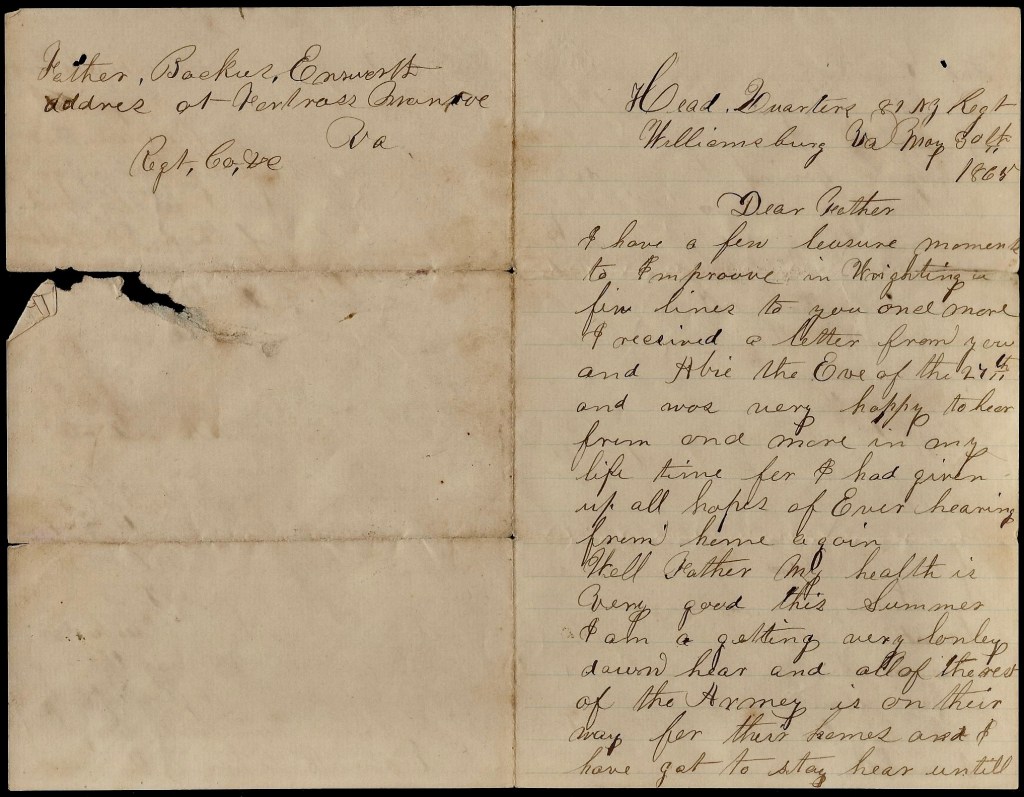
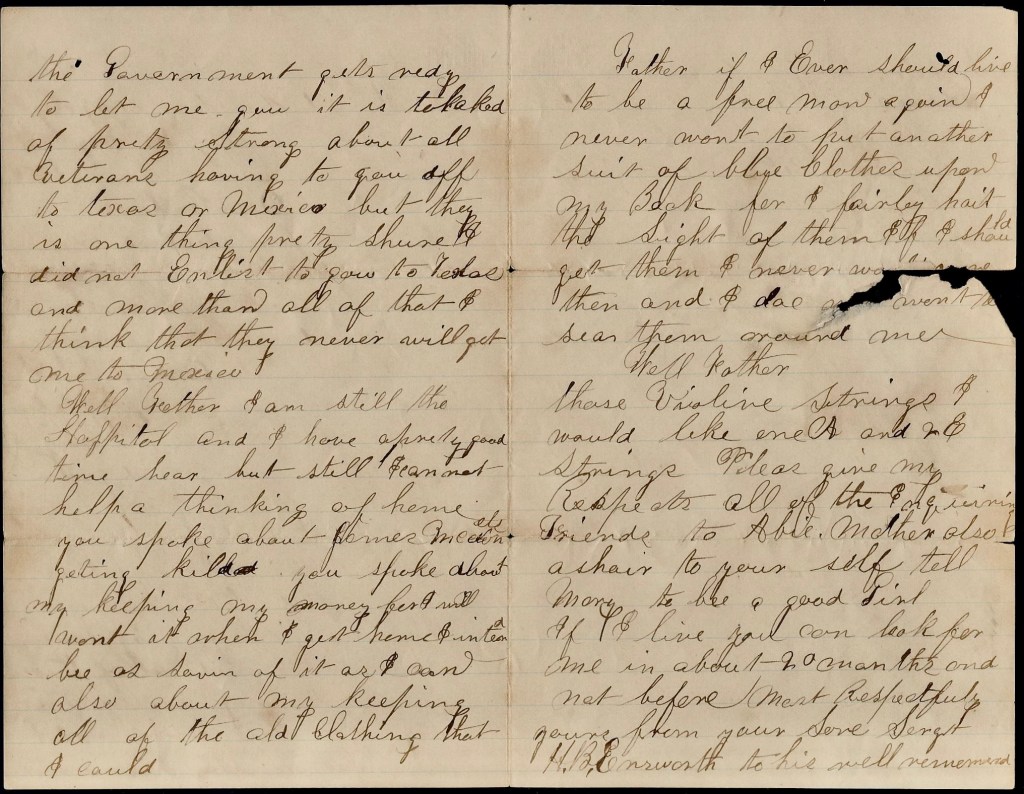
I have a few leisure moments to improve in writing a few lines to you once more. I received a letter from you and Abbie the eve of the 27th and was very happy to hear from you once more in my life time for I had given up all hopes of ever hearing from home again.

Well, Father, my health is very good this summer. I am a getting very lonely down here and all of the rest of the army is on their way home and I have got to stay here until the government gets ready to let me go. It is talked of pretty strong about all veterans having to go off to Texas or Mexico but there is one thing pretty sure, I did not enlist to go to Texas and more than all of that, I think that they never will get me to Mexico.

Well, Father, I am still in the hospital and I have a pretty good time here but still I cannot help a thinking of home. You spoke about James Mc____ getting killed. You spoke about my keeping my money for I will want it when I get home. I intend to be as saving of it as I can. Also, about my keeping all of the old clothing that I could.

Father, if I ever should live to be a free man again, I never want to put on another suit of blue clothes upon my back for I fairly hate the sight of them. If I should get them, I never would wear them and I do not want them to see them around me.

Well Father, those violin strings I would like one.

Please give my respects to all of he enquiring friends, to Abbie, to Mother, also a share to yourself. Tell Mary to be a good girl. If I live you can look for me in about 20 months and not before.

Most respectfully yours. From your son, — Sergt. H. B. Ensworth

To his well remembered Father, Backus Ensworth.

Address at Fortress Monroe, Va.