Category Archives: 85th New York Infantry

1862: William Merwin Smith to William Van Nostrand

Surgeon William M. Smith, 85th New York (M. Brady)

This letter was written by Dr. William Merwin Smith, Surgeon of the 85th New York Infantry, relaying to a friend at home in western NY his experiences and his analysis of the Battle of Fair Oaks on May 31 where the 85th took heavy losses. Born in Patterson, NJ, the son of a physician, Smith was already a twice widowed general practitioner living in Elmira, New York with his two young children when he enlisted as surgeon on 10/29/61. Smith remained with the 85th until 17 June 1863 when he resigned.

Fair Oaks represented the first significant battle experience for the 85th. As he describes in his letter (and consistent with what appears elsewhere), the 85th (at the time part of Casey’s Division) heroically held off a much larger Confederate force until they were forced to retreat, in the process losing most of their camp possessions, along with 34 killed or wounded. A substantial portion of the letter deals with Smith’s frustration and anger with top leadership, particularly McClellan, who he despised (for reasons similar to those expressed by other Union soldiers at the time).
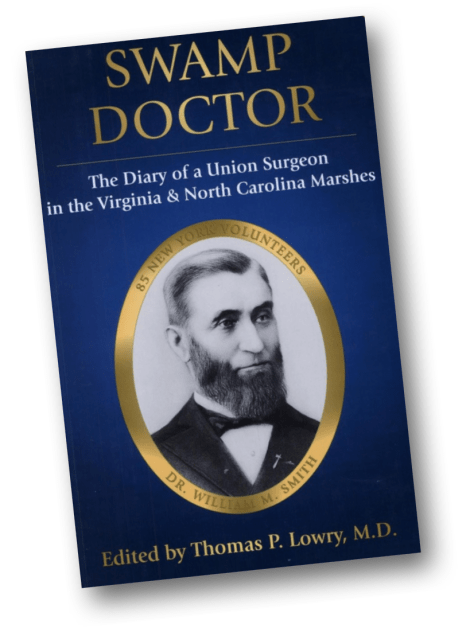
Dr. Smith’s annotated diary, actually his second diary—the first being lost at Fair Oaks, was published in 2001 by Dr. Thomas P. Lowry (Stackpole Books). This highly detailed and very thoughtful diary begins in the aftermath of Fair Oaks (several days after the present letter was written). This letter, the only one cited in the book, is included within Appendix A, because of its contextual importance to the diary’s early content (as far as I know, the letter has so far never been posted on the web).

[Note: This letter was provided to me from a private collection (RW) for transcription and publication on Spared & Shared by express consent.]

T R A N S C R I P T I O N

Camp near Long Bridge, Virginia
June 11th 1862

My dear sir,

Your favor of the 20th ult., came to hand in due time. Since that time you know we have had a terrible collision with the rebels. Much has been said of Casey’s Division by the jealousy of generals chiefly, & correspondents who are the hangeron’s of these generals & who were not on the battle ground of Casey’s Division, nor indeed dare be, with one exception—Bulkley of the Herald, & he gives a very different story to the public. It is sufficient for imported men to know what they will know despite misrepresentation, that the battle commenced between 12 and 1 p.m. and that the less than six thousand men of Casey’s command held a force, never estimated less that forty thousand men, until nearly four o’clock p.m.; certainly three hours & without a regiment to reinforce & sustain them, although Couches line of battle was less than 200 rods behind us, sustaining a loss in killed and wounded of fully one fourth the number with which they went into battle.

I remained under fire in the immediate vicinity of the ranks, dressing the wounded until the overwhelming force of the enemy had out flanked right and left our line of battle and wounded men were struck a second time while being dressed and several horses had been shot down near the orderly who was holding my own. Consequently I know the tenacity & bravery with which most of the regiments of this Division fought. The 103rd Pennsylvania broke early in the action 7 rushed pell mell on Couch’s line. They did not receive or give a single volley. Their conduct gave character to the whole. The 85th [New York] in particular fought until enveloped by the columns of the enemy. The character of the remarks by the Press and McClellan’s first telegram has greatly discouraged the brave men in this and other regiments composing this Division. No Division has suffered half as much since they landed at Fortress Monroe from neglect & exposure as this. They landed with 13,000 men. Today cannot bring into line 5,000 effective men. If ever a truthful history of the campaign shall be written, a dark responsibility and disgraceful neglect will be laid at the door of some of the managers.

My health is very poor. I have worked myself threadbare in trying to keep my Department shipshape amid all the disadvantages of my want of means, help, &c. And now, after struggling with my ailment through the dank swamps, pestiferous malaria, weary marches, long days and nights of labor with the sick and wounded, my health does not improve within a few days, I shall return for a short time to see if the free bracing air of my native hills will not restore me to myself.

McClellan waits for reinforcements. Unless the gunboats achieve a signal and unexpected success, the battle of Richmond yet remains to be fought. Give my regards to friends. Yours truly, — W. M. Smith

[to] Mr. W. Van Nostrand

1861: Edgar Walton Irish to his Cousin Lottie

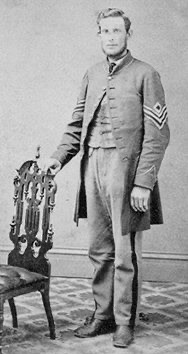
The following letter was written by Edgar W. Irish (1838-1897), the son of George Irish (1810-1888) and Maria Edgerton Potter (1810-1844) of Little Genesse, Allegany county, New York. Edgar enlisted in Co. C, 85th New York Infantry with his younger brother George Hadwin Irish in September 1861. Edgar was made a corporal upon mustering into the regiment and was promoted to sergeant in April 1862. His beautiful penmanship no doubt earned him the rank of 1st Sergt. in August 1862—his highest rank.

1st Sergt. Edgar Walton Irish of Co. C, 85th New York Infantry

In April 1864, while garrisoning the forts at Plymouth, North Carolina, both Edgar and his brother George were taken prisoner with approximately 500 others when the town was surrendered. He and George were sent to Andersonville Prison, George. A source on Find-A-Grave claims that Edgar’s fine penmanship and bookkeeping skills earned him a job at the prison that enabled him to be kept separately and fed better than his fellow prisoners. All the while, however, he worried about his younger brother and after months of pleading, he was finally allowed to search for George but found that he was too late; George had passed away the day before of starvation and dysentery. Edgar was determined that the truth would be known about Andersonville, and seek revenge for his brother George. He found records and concealed them on himself when he was released from prison. Later this evidence was used at the trial of Capt. Wirz. Along with George 310 Soldiers from the 85th died as prisoners of war, the most men of any unit in the Northern Army. George Hadwin Irish is buried at Andersonville National Cemetary, Sumter County, Georgia, USA Site#4587, Findagrave Memorial#28873296.

There is a cenotaph in Edgar’s name at the West Genessee Cemetery that has the following inscription carved into the base: “He made, preserved and supplied the evidence that made possible the execution of Capt. Henry Wirz. The keeper of Anderson Prison.”

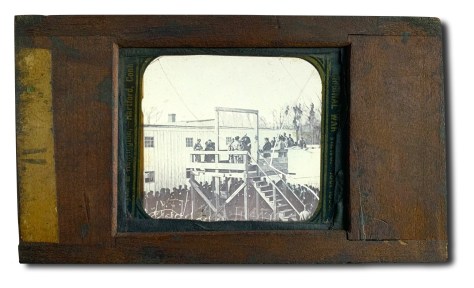
A lantern slide of the Wirz Execution in Washington D. C. (W. Griffing Collection)

Transcription

Camp Shephard
Washington D. C.
December 12th 1861

Dear Cousin Lottie,

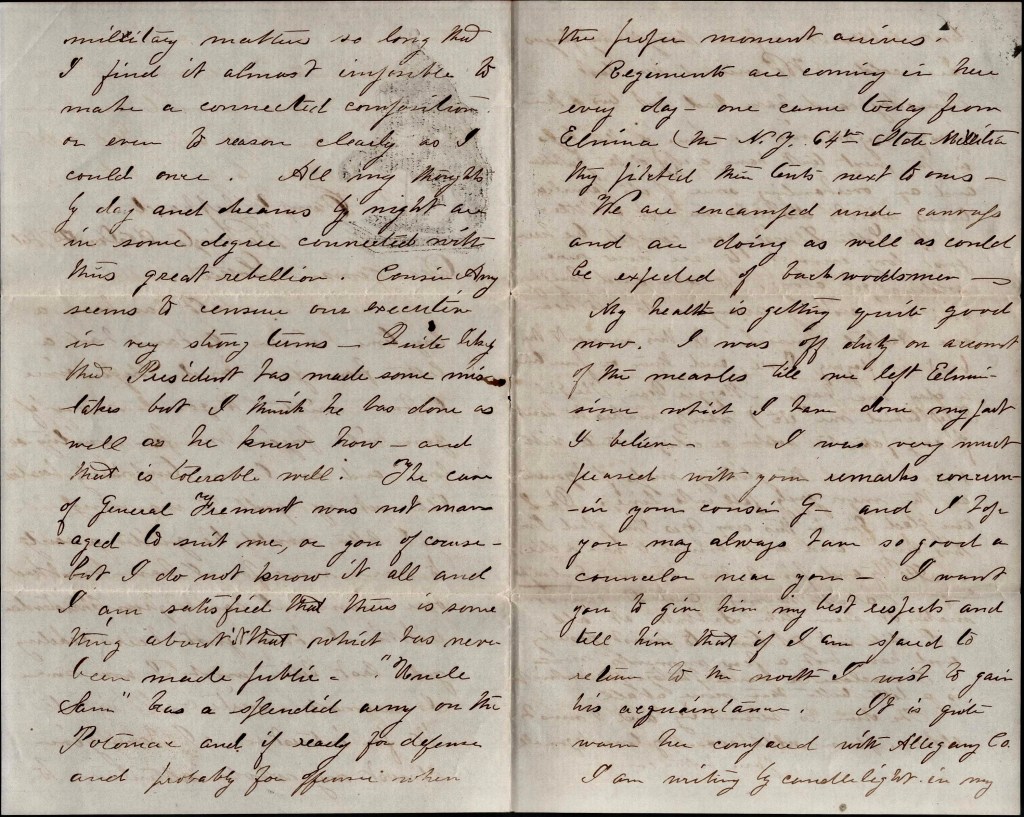
It has been a long time since I have had a letter from you and longer since I have written to you. Now if you will forgive me for waiting so long and as I am temporarily located, I’ll set my quill to running. A letter would be quite a rarity to me now for I have not had one since I came from Christendom. Lottie, I have just been reading your last letter and I am sure I cannot write one to match it for interest. I have give almost my whole attention to military matters so long that I find it almost impossible to make a connected composition or even to reason clearly as I could once. All my thoughts by day and dreams by night are in some degree connected with this great rebellion.

Cousin Amy seems to censure our [Chief] Executive in very strong terms. Quite likely the President has made some mistakes but I think he has done as well as he knew how—and that is tolerable well. The case of General Fremont was not managed to suit me, or you of course, but I do not know it all and I am satisfied that there is something about it that which has never been made public. 1

“Uncle Sam” has a splendid army on the Potomac and if ready for defense and probably for offense when the proper moment arrives. Regiments are coming in here every day. One came today from Elmira (the N. Y. 64th State Militia). They pitched their tents next to ours. We are encamped under canvas and are doing as well as could be expected of backwoodsmen.

My health is getting quite good now. I was off duty on account of the measles till we left Elmira, since which I have done my part, I believe. I was very much pleased with your remarks concerning your cousin G. and I hope you may always have so good a counselor near you. I want you to give him my best respects and tell him that if I am spared to return to the North, I wish to gain his acquaintance.

It is quite warm here compared with Allegany Co. I am writing by candlelight in my tent without a fire though my fingers are cold. We arrived here last Thursday and have had but two or three frosty nights since. Some of the boys in the next tent have a copy of the Jubilee and an overhauling some of its familiar tunes which disturb me not a little.

Oh Lottie, I wish you could be here just long enough to see how our soldiers get along, to see and laugh over our cooking arrangements, to hear our martial music (at this moment the band is playing Dixie, and three or four times a day we have “Maggie Dear,” “The Girl I left behind me,” etc.) which makes the heart of every patriotic soldier or citizen thrill with joy, to see the glittering mass of bayonets as the men gaily fall into line. Oh, I am glad I’m in this army. Yes, I’m glad I’m [in] this army,” and we’re bound to win or die.

I’ll try and finish this tomorrow, Good night.

Sabbath morning, and I cannot make it seem like Sabbath at all. I did not get time to finish yesterday and have but a few moments now. I enclosed a card photograph which is a little better than none at all. The drum is sounding and I must close. Please write soon. My love to you all. Your brother cousin, — Edgar W.


1 In August 1861, General John Fremont imposed martial law in the state of Missouri and declared all rebel owned slaves to be free. Lincoln, fearing the loss of a loyal border state, rescinded Fremont’s order and relieved the General of his command.

1861: Unidentified to Friend “Ed”

The following partial letter is unsigned and though I can’t be certain of his identify, I suspect he was a member of the 85th New York Infantry, possibly from Rushford, Allegany county, New York. The 85th New York was known to be camped at Fort Warren in December 1861 and Charley Merrill of the 64th New York Infantry (mentioned in the letter) was from Rushford so he would have been known locally to the correspondents.

Transcription

Camp Warren [Meridian Hill]
Washington D. C.
December 21, 1861

Dear Friend Ed,

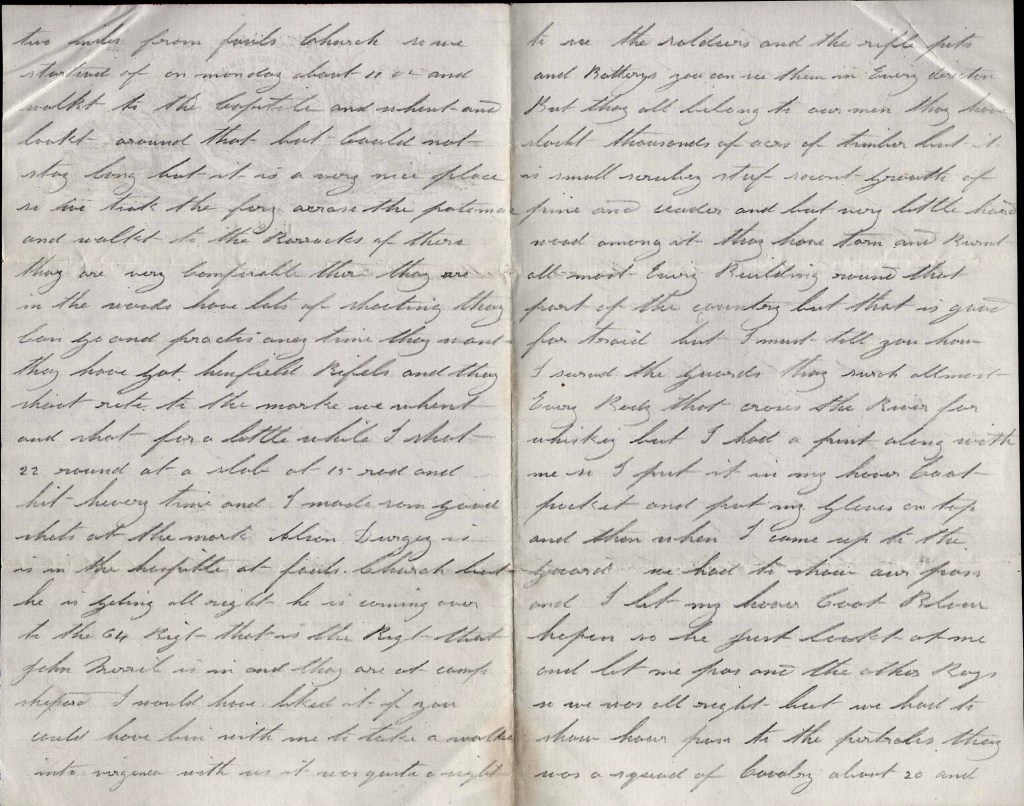
I am happy to say that I received your letter last night and was very glad to hear that you are quite well and I hope that you had a good time with the girls but I am sorry to say that I don’t have much chance to have any fun with the girls here for I can’t get out. I had a pass last Monday for two days but Hank Merrill was out here with Otis Kingsbury and he had to go back on Sunday but I got them to stay till Monday and then I went back with them. They are about 12 miles from Washington at Upton’s Hill, two miles from Fall’s Church so we started off on Monday about 10 o’clock and walked to the Capitol and went and looked around that but could not stay kone but it is a very nice place. So we took the ferry across the Potomac and walked to the barracks up there. They are very comfortable there. They are in the woods, have lots of shooting. They can go and practice any time they want. They have got Enfield Rifles and shoot right to the mark. We went out and shot for a little while. I shot 22 rounds at a slab of 15 rods and hit every time and I made some good shots at the mark.

Alson Durgey is in the hospital at Fall’s Church but he is getting all right. He is coming over to the 64th Regiment—that is the regiment that John Merrill is in and they are at Camp Shephard. I would have liked it if you could have been with us. It was quite a sight to see the soldiers and the rifle pits and batteries. You can see them in every direction but they all belong to our men. They have slashed thousands of acres of timber land. It is small scrubby stuff recent growth of pine and cedar and but very little hard wood among it. They have torn [down]and burnt almost every building round that part of the country but that is good for trade but I must tell you how I served the guards. They search almost every rock that crosses the river for whiskey but I had a pint along with me so I put it in my overcoat pocket and put my gloves on top and then when I came up to the guard, we had to show our pass and I left my overcoat blouse open so he just looked at me and let me pass and the other boys so we was all right. But we had to show our pass to the patrols. There was a squad of cavalry about 20 and they have to stop people and see their pass.

A soldier can’t go about Washington without a pass and so you see that we have not got much chance to run around but after we got by them, we met a regiment of cavalry that was returning from a foraging party. They have been out to Fairfax Court House and had found one man there and he was drunk and very easy and they took him out and shot him but they brought mack 27 baggage wagons full of corn and hay and some cattle but my pass was dated from the 16th to the 17th but I wanted to stay longer so I turned the 7 into a 9 and that made it the 19th so I had a good stay and the guards could not tell the difference and Captain did not say anything so I had it all right.

Now Ed, about Zib Wheeler, I don’t think that it will pay to see him for I have not got any chance to go to town to do anything so you can tell him to kiss your ass for me. [rest of letter missing]

1862: William Henry Stebbins to Edwin Thomas Scott

The saga of the 85th New York Infantry

The following letters were written by William Henry Stebbins (1839-1864) of Wirt, Allegany county, New York. William enlisted in August 1861 as a private in Co. C, 85th New York Infantry. He was taken a prisoner on 20 April 1864 at Plymouth, North Carolina and died of dysentery as a POW at Andersonville on 18 June 1864.

William was the son of John Stebbins (1807-1855) and Electa A. Clark (1813-1880). He wrote the letters to his sister Celora M. (Stebbins) Scott (1845-1915) and her husband, Edwin Thomas Scott (b. 1837). After marrying Celora in the summer of 1862, Edwin enlisted as a private in Co. E, 12th New York Cavalry. He was later transferred to Co. C and survived the war, mustering out at Raleigh in July 1865.

Letter 1

[Camp on James River, Va.]
Sunday, July 6th 1862

Dear Brother Ed,

I received your letter June 19th and I was sick and could not answer it before. I have been sick three weeks but I am getting better. I did not know of your marriage till I received your letter. I did not think when I was at home last fall I should have the privilege of calling you brother. There is lots of marriages since I have been a soldier. I think I shall have to fetch home with me a wench. There is lots of black devils here and I hate the sight of them. Little did I think that any girl would be a fool enough to have George Ferris, the poor miserable devil.

I suppose you have heard about the Union troops before Richmond falling back near the James river. Our regiment is camped near Harrison’s bar on the James river. It seems as if we would never get Richmond. I am getting tired of waiting. There was lots of reinforcements came in last week and I hope Richmond will be ours pretty soon. We have got a new general in General Casey’s place. It is General Peck. He has command of the Division. I shall have to close. Write soon.

Very truly yours, — William H. Stebbins

William H. Stebbins
Co. C, 85th Regt. N. Y. Vols
General Peck’s Division
2nd Brigade, Washington D. C.


Letter 2

Camp Suffolk, Va.
November 26th 1862

E. T. Scott, Esq.,

Dear brother—Your letter was duly received and I was very glad to hear that you was well. You wrote that you had enlisted in the cavalry. I am glad that you done so for you will have it easier than infantry on a march. I have wished a great many times that I belonged to cavalry when I was on a march. A horse is a darn nice thing when a man is pretty tired and has got a good ways to march. When you get into the field, you must write and let me know how you like the soldier’s life. It is pretty hard sometimes and sometimes pretty easy. But a soldier has got to stand to the rack—hay or no hay. It won’t do for a man to get home sick. If he does, he will darn soon get under the sod.

I was sorry to hear that Seymour was elected. I don’t think he is the man for Governor. What do you think of McClellan being removed? He was too slow to suit me. I hope Burnside won’t give the rebs a chance to sleep nights. I hope he will make them hunt their holes and after he get them in, I hope he will make them smell powder. I believe this war could have been stopped six month ago just as well as to have it where it is now. I don’t see any more signs of it being ended in six months than I did six months ago. I will close for this time and I hope to hear from you soon.

Respectfully yours, — W. H. Stebbins


Letter 3

Plymouth, North Carolina
September 20th 1863

Dear Sister Lola,

Your kind letter of the 10th came to hand yesterday. I was very glad to hear from you and hear that you were well. It is very cool today. It has been very rainy weather the past week. Everything around here remains all quiet.

I received a letter from Albert Spoon last week. He wrote that Uncle Samuel and Aunt Lydia Carter and Electa Miner had been there a visiting. Ed Knapp and his wife run away from Glendale, Ed was drafted. I suppose he thought it would be cheaper to run away than to leave his pretty Sarah.

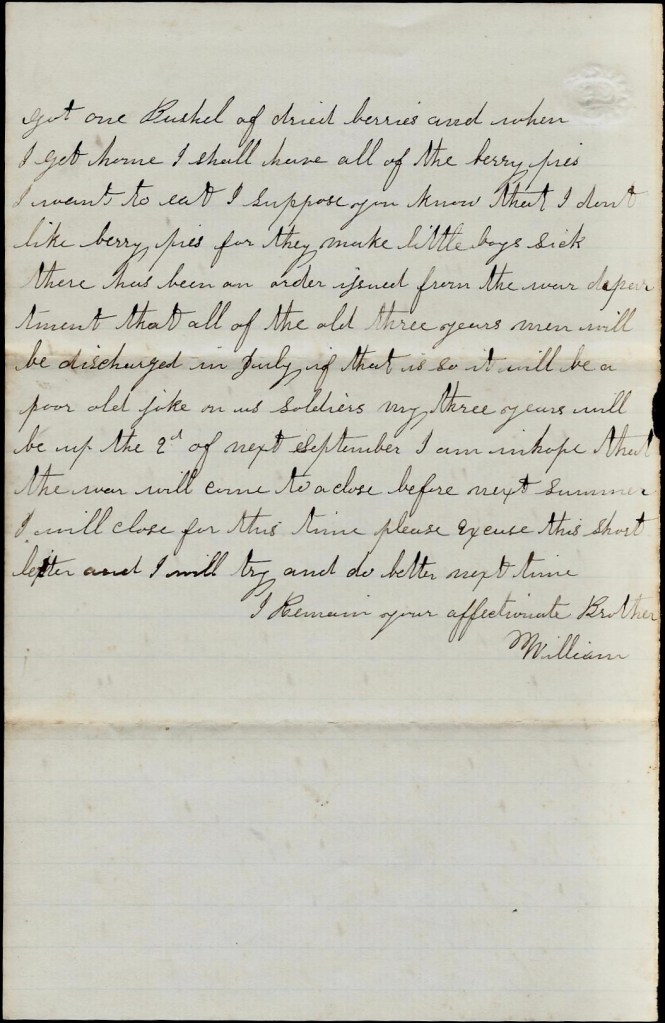
Last Sunday I received a letter from Ed. He did not write anything about his company going to Newbern. There was a company of the 12th New York Cavalry here last week/ They started for Newbern. Albert Root has got back. He has been home on a furlough. He says it is very lonesome at Richburgh and Bolivar. Mother wrote me that she had got one bushel of dried berries and when I get home I shall have all of the berry pies I want to eat. I suppose you know that I don’t like berry pies for they make little boys sick.

There has been an order issued from the War Department that all of the old three years men will be discharged in July. If that is so, it will be a poor old joke on us soldiers. My three years will be up the 2nd of September. I am in hope that the war will come to a close before next summer.

I will close for this time. Please excuse this short letter and I will try and do better next time. I remain your affectionate brother, — William


Letter 4

War Neck [North Carolina]
Sunday, February 21, 1864

Dear sister,

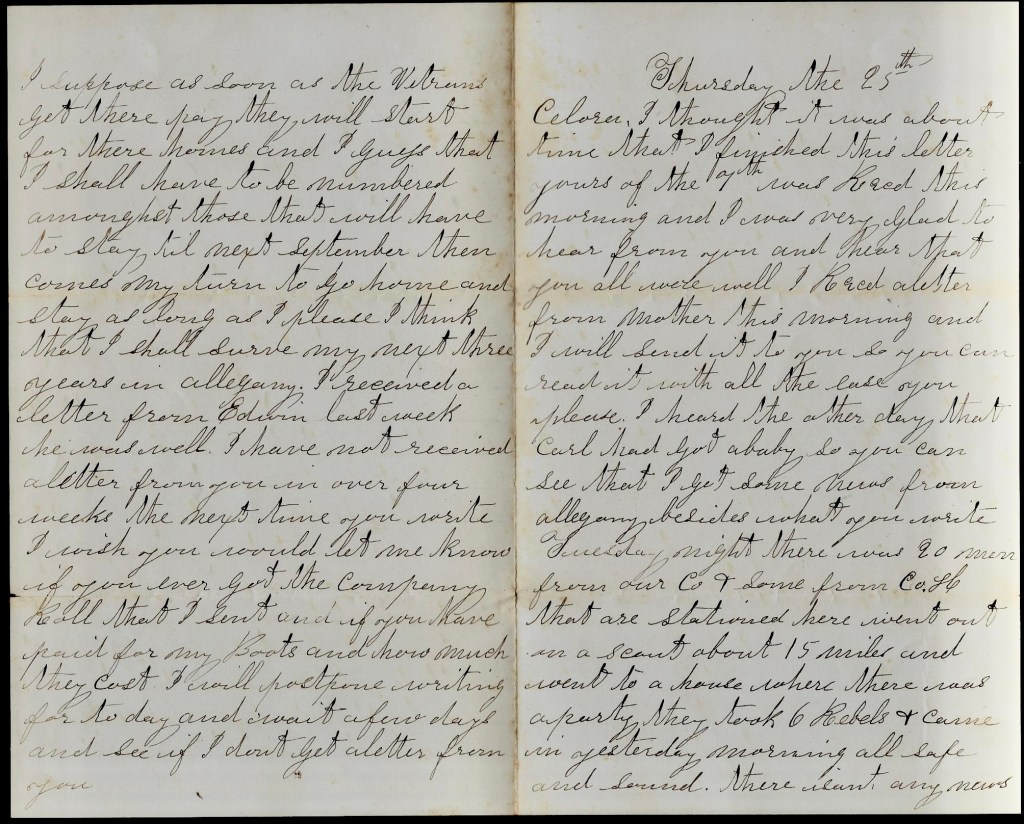
I thought I would devote a few leisure moments in writing to you this pleasant day. It has been very cold for the past few days. The other morning when I got up, I found the ground all covered with a very pretty white carpet. The snow was about one inch deep and it was very cold. It made me think of Old Allegany county. Everything remains all quiet here. There has not any Veterans from here gone home yet nor I don’t see any prospect of their going very soon. The Paymaster has been expected here for the past two weeks but he has not made his appearance yet. I suppose as long as the Veterans get their pay, they will start for their home and I guess that I shall have to be numbered amongst those that will have to stay till next September. Then comes my turn to go home and stay as long as I please. I think that I shall serve my next three years in Allegany.

I received a letter from Edwin last week. He was well. I have not received a letter from you in over four weeks. The next time you write, I wish you let me know if you ever got the Company Roll that I sent and if you have paid for my boots and how much they cost. I will postpone writing for today and wait a few days and see if I don’t get a letter from you.

Thursday the 25th. Celora, I thought it was about time that I finished this letter. Yours of the 7th was received this morning and I was very glad to hear from you and hear that you all were well. I received a letter from Mother this morning and I will send it to you so you can read it with all the ease you please.

I heard the other day that Carl had got a baby so you can see that I get some news from Allegany besides what you write. Tuesday night there was 20 men from our company & some from Co. H that are stationed here went out on a scout about 15 miles and went to a house where there was a party. They took six rebels and came in yesterday morning all safe and sound. There isn’t any news here. Everything remains all quiet. The weather is warm and pleasant. I will close for this time. Please write often. From your brother, — William H. S.


Letter 5

Plymouth [North Carolina]
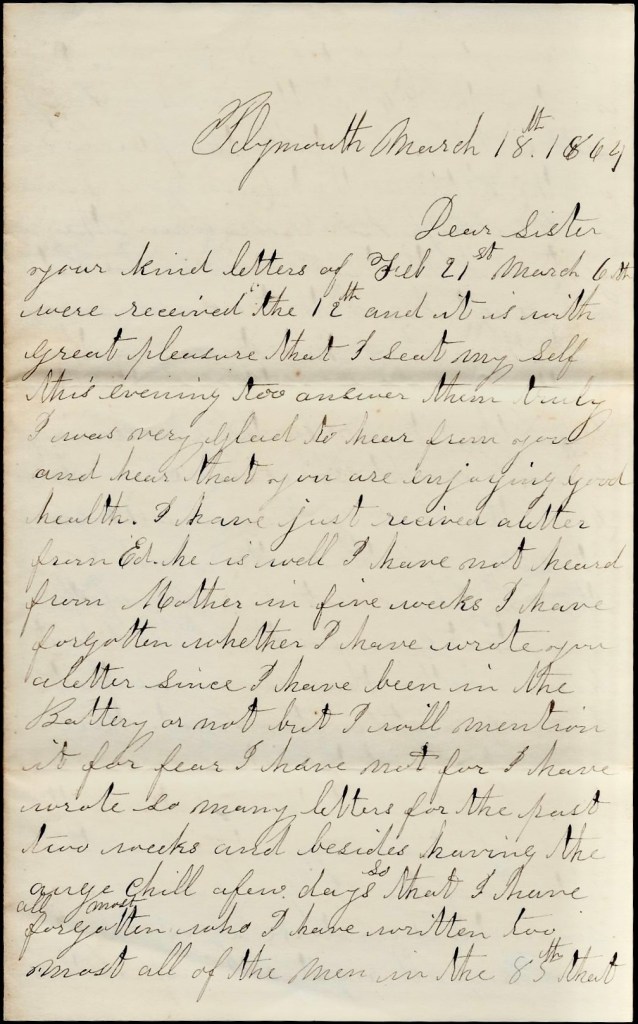
March 18th 1864

Dear Sister,

Your kind letters of February 21st, March 6th, were received the 12th and it is with great pleasure that I seat myself this evening to answer them. Truly I was glad to hear from you and hear that you are enjoying good health. I have just received a letter from Ed. He is well. I have not heard from Mother in five weeks. I have forgotten whether I have wrote you a letter since I have been in the Battery or not but I will mention it for fear I have not for I have wrote so many letters for the past two weeks and besides having the ague chill a few days so that I have almost forgotten who I have written to.

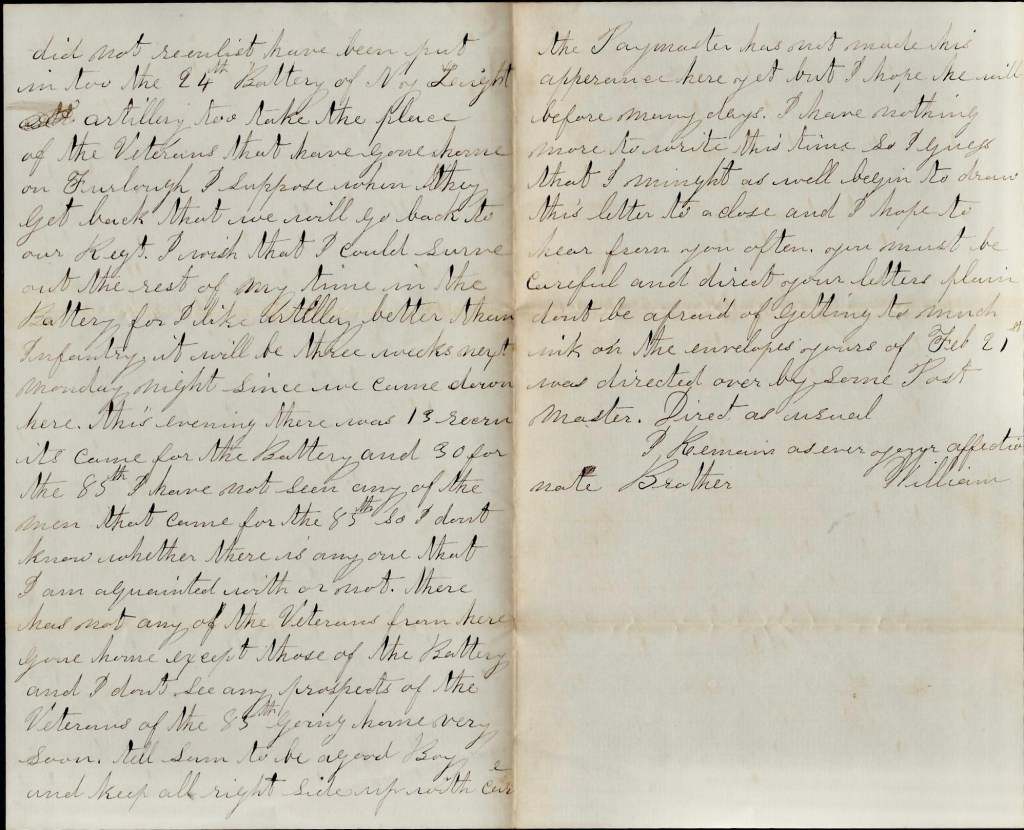
Most all of the men in the 85th that did not reenlist have been put into the 24th Battery of the New York Light Artillery to take the place of the Veterans that have gone home on furlough. I suppose when they get back that we will go back to our regiment. I wish that I could serve out the rest of my time in the battery for I like artillery better than infantry. It will be three weeks next Monday night since we came down here. This evening there was 13 recruits came for the battery and 30 for the 85th. I have not seem any of the men that came for the 85th so I don’t know whether there is anyone that I am acquainted with or not. There has not any of the Veterans from here gone home except those of the battery and I don’t see any prospects of the Veterans of the 85th going home very soon.

Tell Sam to be a good boy and keep all right side up with care. The Paymaster has not made his appearance here yet but I hope he will before many days. I have nothing more to write this time so I guess that I might as well begin to draw this letter to a close and I hope to hear from you often. You must be careful and direct your letters plain. Don’t be afraid of getting too much ink on the envelopes. Yours of February 21st was directed over by some postmaster. Direct as usual.

I remain as ever your affectionate brother, — William