Category Archives: 85th Pennsylvania Infantry

1862: Adam McGill to William H. Crago

The following letter was written by Adam McGill (1837-1919), the son of Charles and Mary (Bidenger) McGill of Carmichaels, Greene county, Pennsylvania. Adam was working as a cooper, a trade he learned from his father, when he mustered into Co. G, 85th Pennsylvania Volunteer Infantry on 15 October 1861 as a musician (fifer) at Harrisburg, Pennsylvania. He served three years and mustered out on 22 November 1864 at Pittsburgh.

The profound regret Adam expresses regarding his regiment’s performance in the Battle of Seven Pines permeates his letter. This marked their initial encounter with the harsh realities of combat, and they found themselves unexpectedly vulnerable to the rebel assault, which forced them to shamefully skedaddle. McClellan placed the blame on Casey’s Division, resulting in their exclusion from the Army of the Potomac for the duration of the war. It would take another two years before the regiment could restore its honor in the Richmond-Petersburg Campaign.

[Note: This letter is from the collection of Keith Fleckner and was offered for transcription and publication on Spared & Shared by express consent.]

T R A N S C R I P T I O N
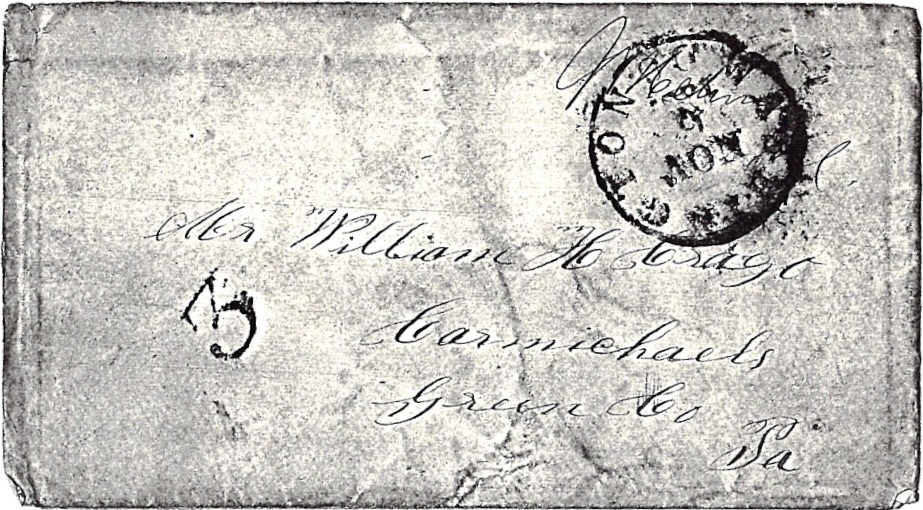
Addressed to William H. Crago, Carmichaels, Green county, Pennsylvania

[Following the Battle of Seven Pines]
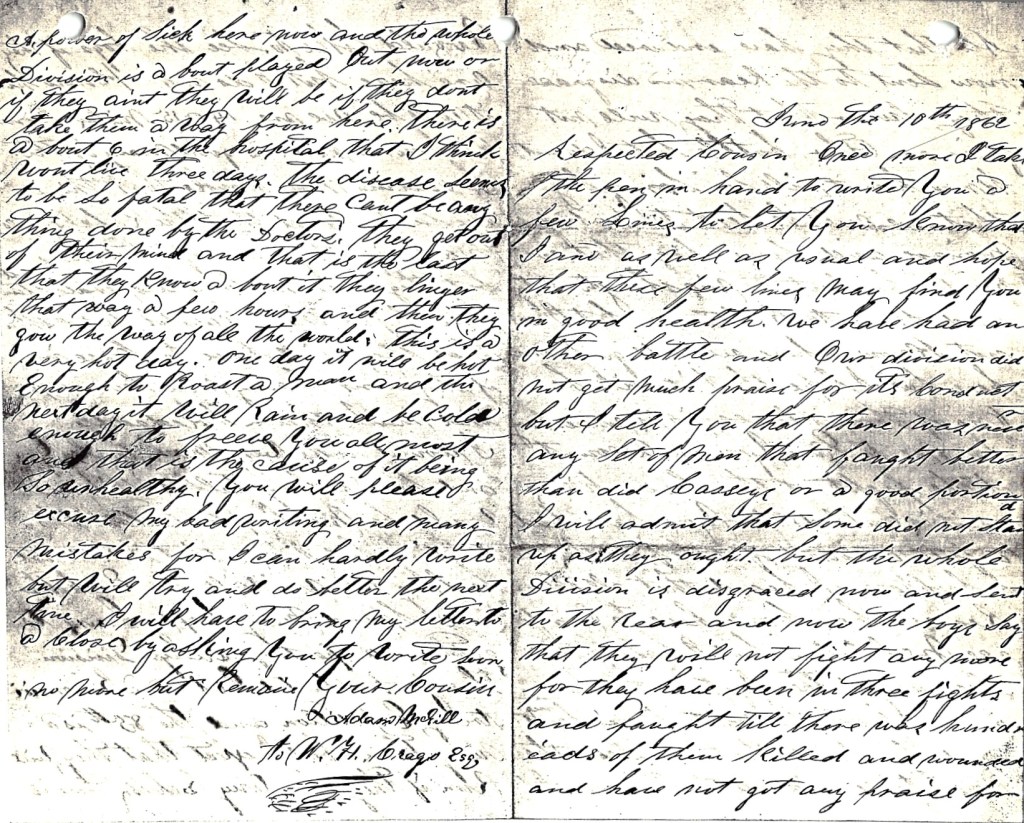
June the 10th, 1862

Respected Cousin,

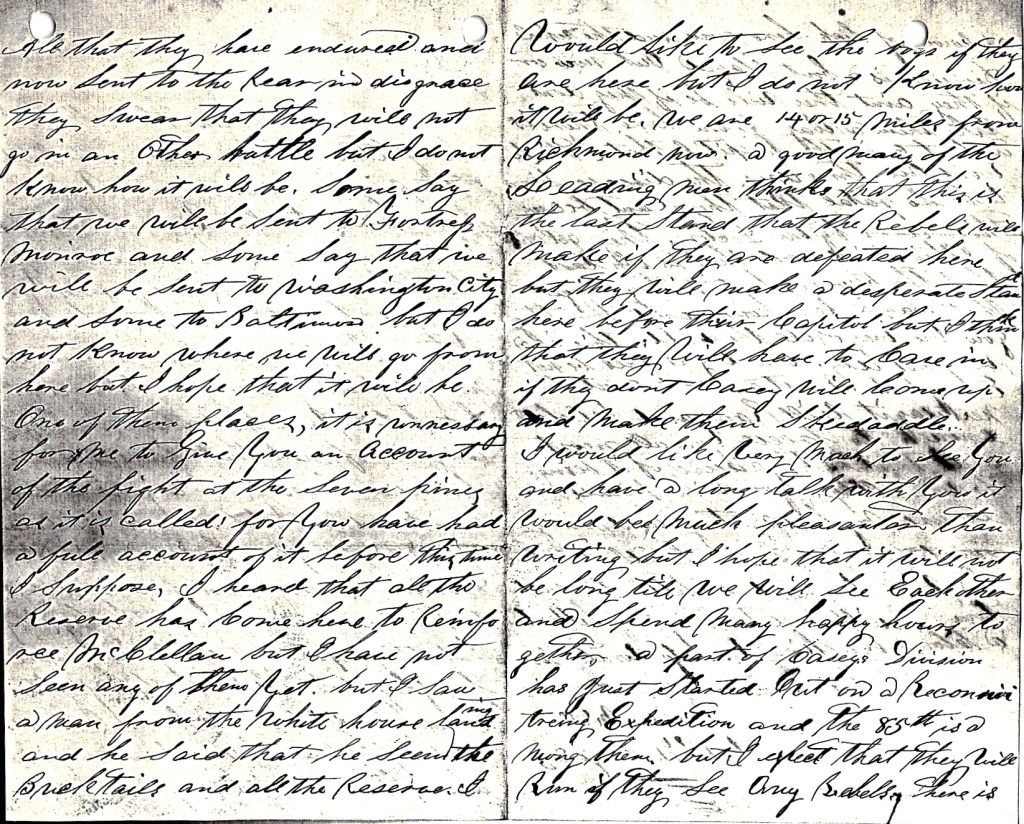
Once more I take the pen in hand to write you a few lines to let you know that I am well as usual and hope that these few lines may find you in good health. We have had an other battle and our division did not get much praise for its conduct, but I tell you that there was never any set of men that fought better than did [Silas] Casey’s—or a good portion.I will admit that some did not stand up as they ought, but the whole Division is disgraced now and sent to the rear. And now the boys say that they will not fight any more for they have been in three fights and fought till there was hundreds of them killed and wounded and have not got any praise for all that they have endured, and now sent to the rear in disgrace. They swear that they will not go in another battle, but I do not know how it will be.

Some say that we will be sent to Fortress Monroe and some say that we will be sent to Washington City and some to Baltimore. But I do not know where we will go from here. But I hope that it will be one of them places.

It is [not] necessary for me to give you an account of the fight at the Seven Pines as it is called,  for you have had a full account of it before this time I suppose. I heard that all the [Pennsylvania] Reserves has come here to reinforce McClellan but I have not seen any of them yet. But I saw a man from the White House Landing and he said that he seen the Bucktails and all the Reserves. I would like to see the boys if they are here, but I do not know how it will be. We are 14 or 15 miles from Richmond now. A good many of the leading men thinks that this is the last stand that the Rebels will make if they are defeated here. But they will make a desperate stand here before their Capitol. But I think that they will have to cave in if they don’t. Casey will come up and make them skeddadle.

I would like very much to see you and have a long talk with you. It would be much pleasanter than writing, but I hope that it will not be long till we will see each other and spend many happy hours together.

A part of Casey’s Division has just started out on a reconnoitering expedition and the 85th is among them. But I expect that they will run if they see any Rebels. There is a power of sick here now and the whole Division is about played out now or if they ain’t, they will be if they don’t take them away from here. There is about 6 in the hospital that I think won’t live three days. The disease seems to be so fatal that there can’t be anything done by the doctors. They get out of their mind and that is the last that they know about it. They linger that way a few hours and then they go the way of all the world.

This is a very hot day. One day it will be hot enough to roast a man and the next day it will rain and be cold enough to freeze you almost and that is the cause of it being so unhealthy. You will please excuse my bad writing and many mistakes for I can hardly write but will try and do better the next time. I will have to bring my letter to a close by asking you to write soon. No more but remain your cousin, — Adam McGill.

to W. H. Crago, Esq.
1862: John Finegan to Dorcas A. Sprowls

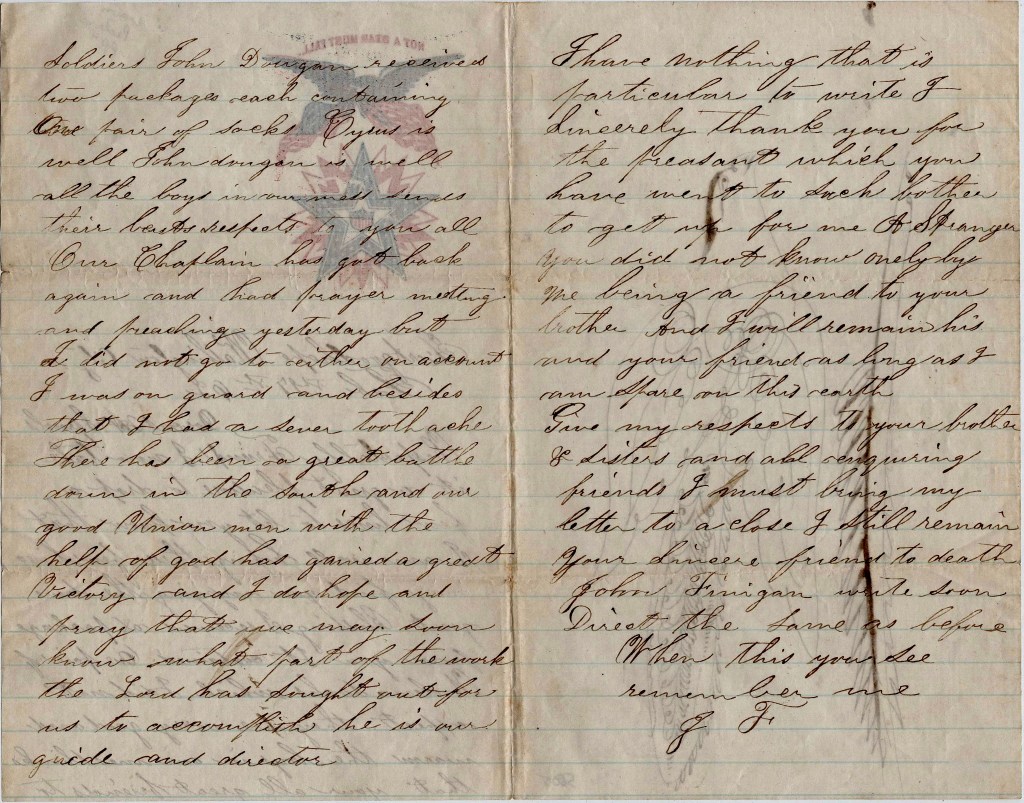
The following letter was written by Pvt. John Finegan of Co. E, 85th Pennsylvania. It was written from Fort Good Hope, described by one member of the regiment who wrote an anonymous letter on 20 February 1862 to the Monongahela Valley Republican, as one “the largest and most important [forts near Washington D. C.]…Our regiment has charge of many of those fortifications; sixty men under command of Lieutenant are each day detailed for guarding there, the furthest from camp being distant about five miles. Our camp is rather pleasantly situated and our men have generally fared well. Six deaths have occurred among them since we left home nearly three months ago; there are only sixteen cases in the hospital at present.”

“The 85th Pennsylvania was formed in late 1861 in Uniontown, PA.  The men hailed from the southwestern corner of the state.  After building forts on the east side of Washington, D.C. for several months, they found themselves in the aforementioned Casey’s Division, headed for the Virginia, Peninsula.  The 85th PA was in the rear at Yorktown, and only just came up as the fighting was ending at Williamsburg.  They saw their first real combat at the Battle of Seven Pines and it was a devastating blow.  Author Dan Clendaniel offers up a compelling defense of the men and Casey’s larger organization.  They were also involved in the Seven Days and the retreat to Harrison’s landing.  Here their war took a hard left turn when compared to most of the regiments involved in the Peninsula Campaign.  As has been said, McClellan scapegoated Casey’s Division, and they were removed from the AotP and sent to North Carolina for the remainder of 1862, where they were involved in the Kingston Expedition.  They moved to the Charleston area and participated in the Siege of Charleston on Morris Island for most of 1863.  Here the Pennsylvanians were held in readiness to assault Fort Wagner not once but twice, though ultimately they were not sent in after the initial assaults failed. In December 1863, they were then moved to Hilton Head, SC and stayed there until April 1864…

“The 85th Pennsylvania was part of the 10th Corps, Army of the James during these campaigns until mustering out in November 1864. Although not a part of the Army of the Potomac, which they had left in August 1862, they fought alongside that famous unit in these final battles against the Army of Northern Virginia.  The 85th Pennsylvania was at Port Walthal Junction and in the Battle of Ware Bottom Church during the Bermuda Hundred Campaign.  They saw major action at Second Deep Bottom, Chaffin’s Farm, and Darbytown Road during the Richmond-Petersburg Campaign. Members of the regiment whose time had not yet expired when the organization’s veterans mustered out went on to serve at Fort Gregg and in the Appomattox Campaign.” [Source: 85th PA: Such Hard and Severe Service by Dan Clendaniel]

John Finegan (or Finnegan) was a resident of Washington, Washington county, Pennsylvania, when he enlisted on 12 November 1861. He wrote the letter to Dorcas A. Sprowls (1841-1910), the daughter of William Sprowls (1794-1868) and Dorcas Towne (1797-1870) of Washington, PA. Dorcas never married. 

T R A N S C R I P T I O N

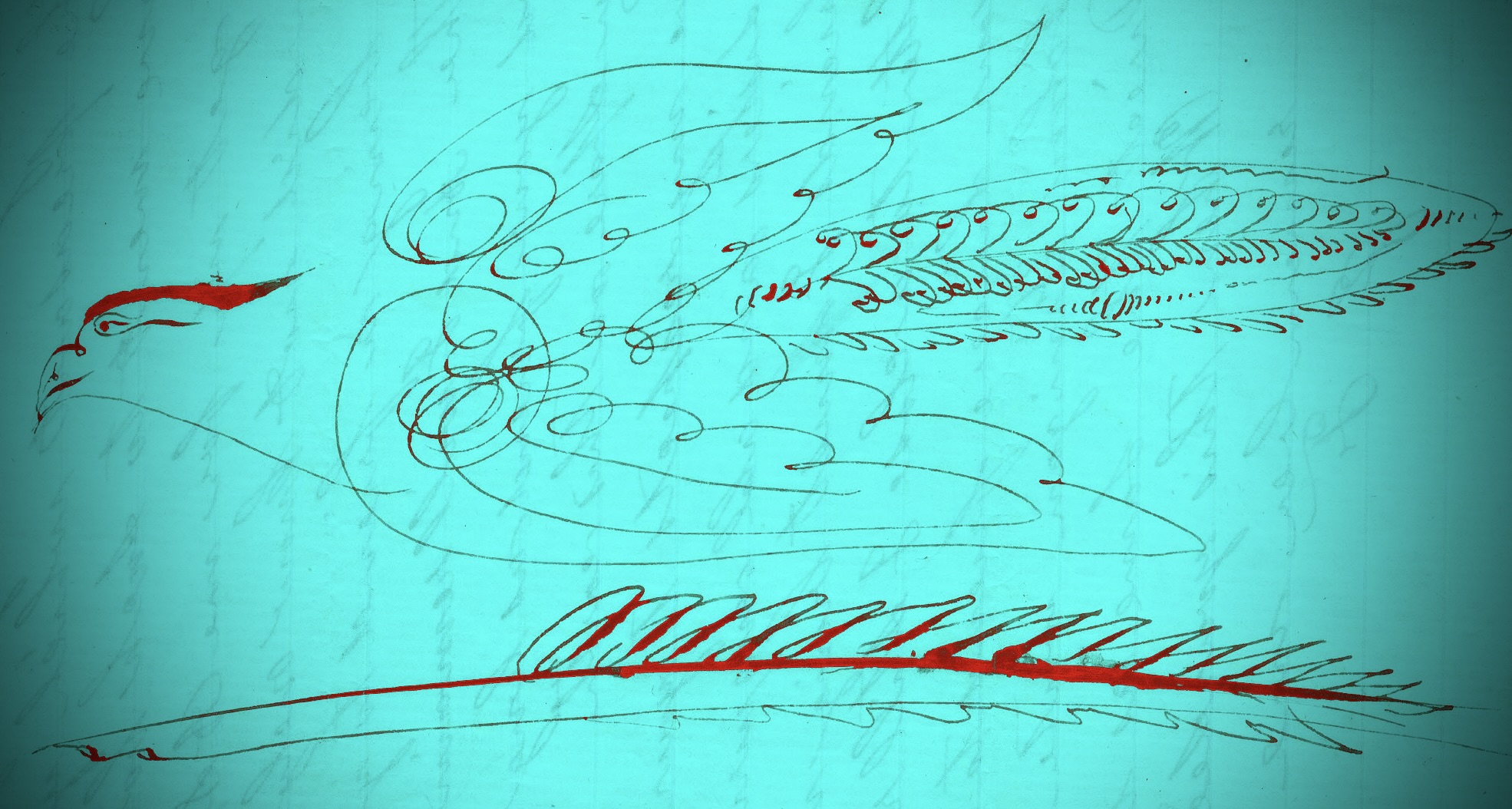
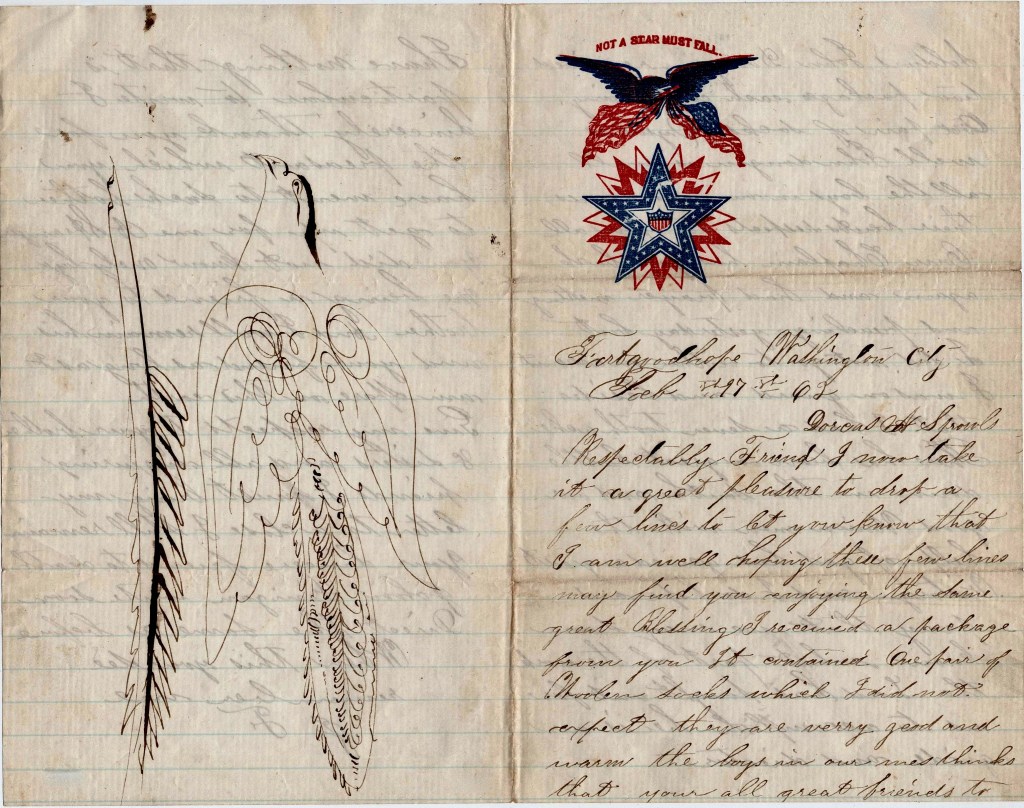
John’s artwork

Fort Good Hope
Washington City
February 17th 1862

Dorcas A. Sprowls, respected friend,

I not take it a great pleasure to drop a few lines to let you know that I am well, hoping these few lines may find you enjoying the same great blessing. I received a package from you. It contained one pair of woolen sicks which I did not expect. They are very good and warm. The boys in our mess thinks that you’re all great friends to soldiers. John Dougan [Dugan] received two packages each containing on pair of socks. Cyrus is well. John Dougan is well. All the boys in our mess sends their best respects to all.

Our chaplain [John N. Pierce] has got back again and had prayer meeting and preaching yesterday but I did not go to either on account I was on guard. And besides that, I had a severe toothache.

There has been a great battle down in the South and our good Union men with the help of God has gained a great victory and I do hope and pray that we may soon know what part of the work the Lord has sought out for us to accomplish. He is our guide and director.

I have nothing that is particular to write. I sincerely thank you for the present which you have went to such bother to get up for me—a stranger you did not know—only by me being a friend to your brother. And I will remain his and your friend as long as I am spared on this earth.

Give my respects to your brother and sisters and all enquiring friends. I must bring my letter to a close. I still remain your sincere friend to derath. — John Finigan

Write soon. Direct the same as before. When this you see, remember me, — J. F.

1862: William Bearl to Peter Bearl

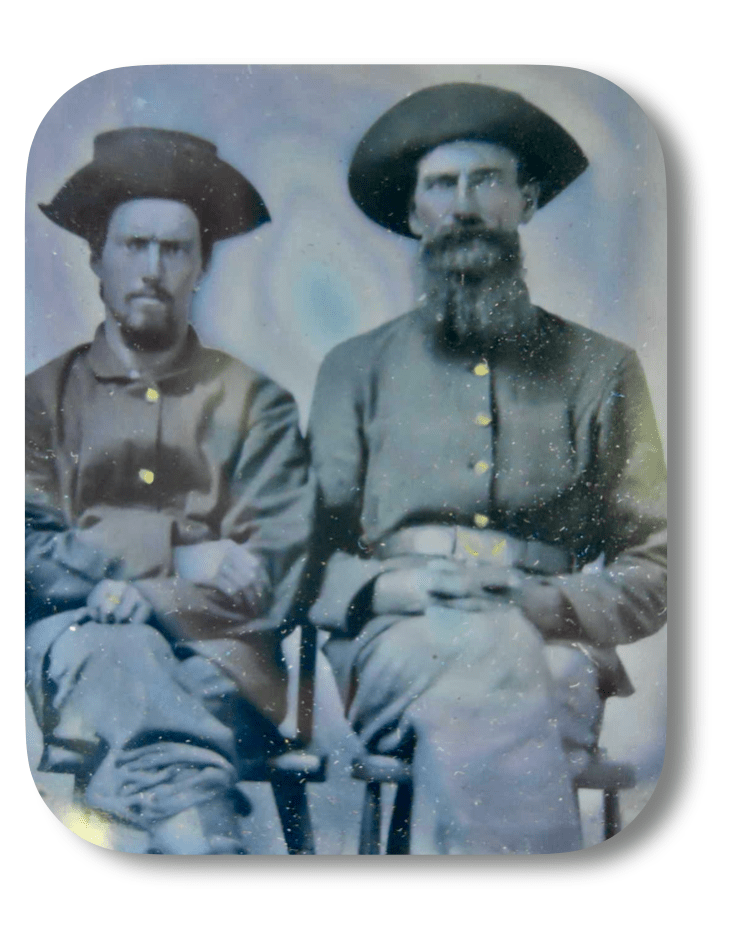
The following letter was written by William Bearl (1829-1913), a native of Germany, who was living in Somerset county, Pennsylvania, when he enlisted on 12 November 1861 to serve three years in Co. H, 85th Pennsylvania Infantry. He mustered out with the company on 22 November 1864.

William’s death certificate gives his parents names as Henry Bearl and Mary Knopschnider

Sam and Ben Marshall who both served in the 85th Pennsylvania Infantry

Letter 1

Fort Good [Hope] 1
Near Washington City
February 13, 1862

Brother Peter Bearl,

I must give a few lines to you for you don’t write to me now. I will tell you now that I am well at this time and I hope these few lines may find you in the same state of health. And Now I will let you know that we had not much snow [but] a good deal of rain and the mud was shoe mouth deep and it is hard to get along. We don’t drill now [but] we stand guard. I get on guard about two times a week. One time at the camp and one time on vidette. There is no fun but we have plenty to eat and we have good clothes and [a] good bed. We split timber in two and then we lay on the soft side of it and so we sleep bully. I have plenty of money but we have to win every cent of it.

Now I would like to know how times are there. I would write a good deal more if I could write better. Now I want you to excuse my bad writing. I am afraid that you can’t read it and so I will stop it. But I will commence again for I don’t write enough. I will learn to write by it for I have plenty paper but a pen. If this letter comes to hand, then write soon. It is warm today. I was too much in a hurry. I was cooking. I am cook for the mess. But the next time I will write better.

Direct your letter to Washington City, D. C., Fort Good Hope, 85th Regiment Pa. Volunteers, in care of Captain [James B.] Treadwell, near Washington.

William Bearl to Peter Bearl

1 An anonymous letter from a soldier in the 85th PA appeared in the Monongahela Valley Republican on 20 February 1862. He wrote, “There are several forts on the heights of which ours is prominent. Fort Good Hope is, we believe, one of the largest and most important, being nearly completed. Our regiment has charge of many of these fortifications; sixty men under command of Lieutenant are each day detailed for guarding there, the furthest from camp being distant five miles. Our camp is rather pleasantly situated and our men have generally fared well. Six deaths have occurred among them since we left home nearly three months ago; three are only sixteen cases in the hospital at present.”