Category Archives: 8th Maine Infantry

1861: Richard Fletcher Taft to Ephraim Wales Taft

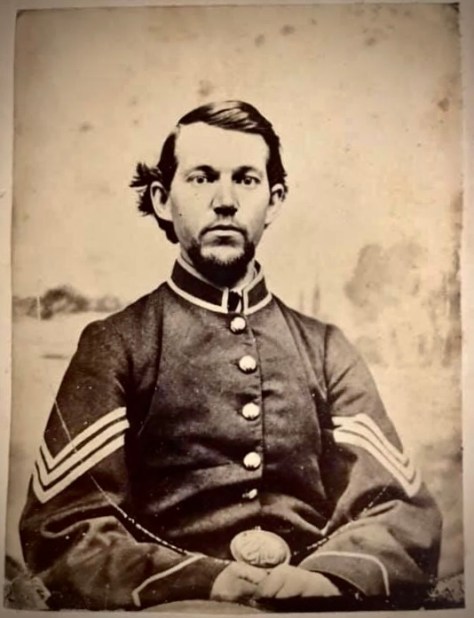
I could not find an image of Fletcher in uniform but here is one of Sgt. James Henry Hobbs of Co. H, 8th Maine Infantry. (Andrew Garton Collection)

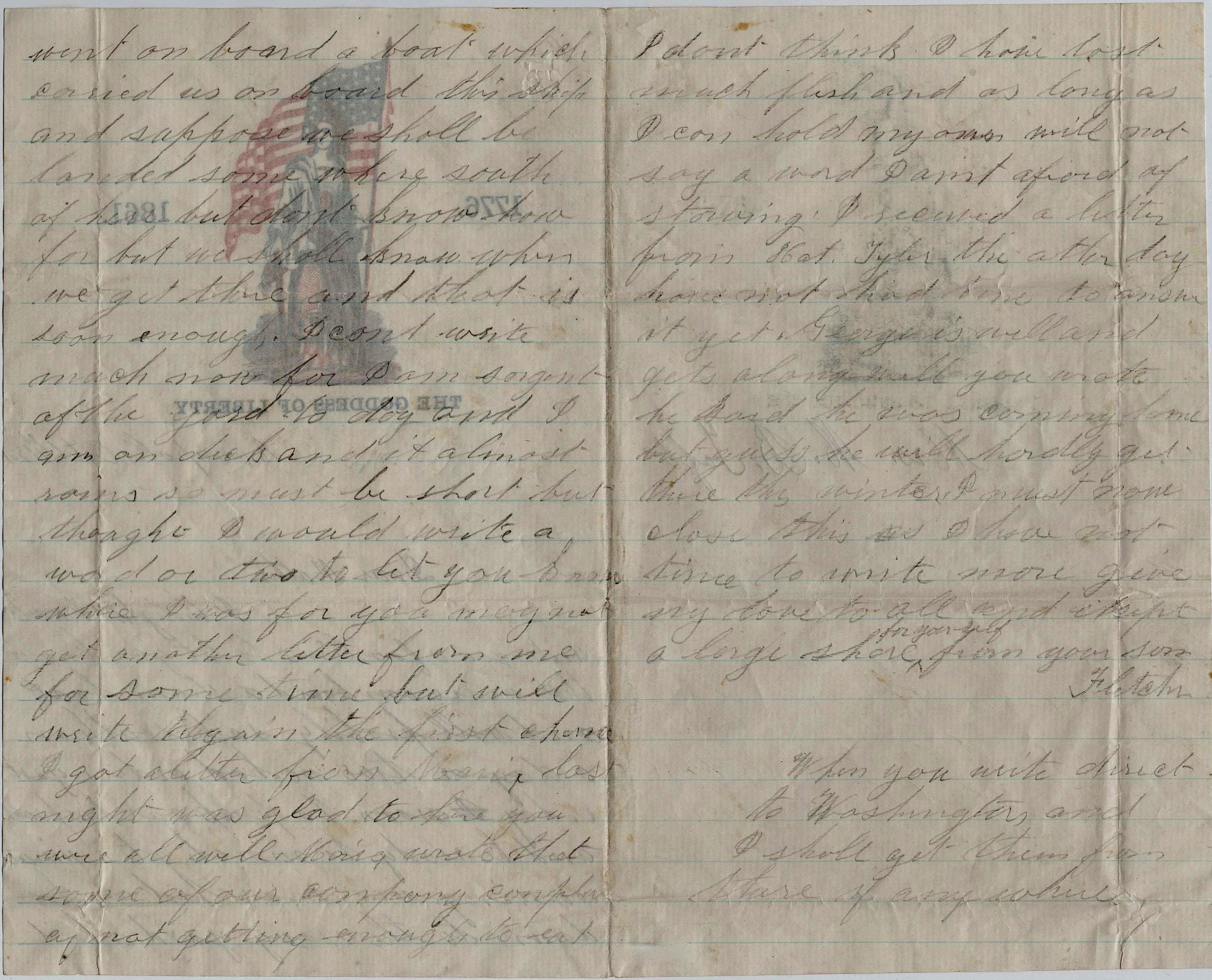
The following letter was written by Sgt. Richard “Fletcher” Taft (1840-1862) while serving in Co. G, 8th Maine Infantry. Fletcher enlisted at Gouldsboro, Hancock county, Maine, on 7 September 1861 and penned this letter shortly after boarding the steamboat Daniel Webster that would take the regiment from Annapolis to “somewhere south of here but don’t know how far but we shall know when we get there and that is soon enough.” Though he did not yet know it, the regiment was to take part in the Port Royal Expedition. Regrettably, it would be his last ocean transport. He died of typhoid fever on Daufuskie Island on 30 March 1862. He lies buried in a soldier’s grave at the Beaufort National Cemetery, marker 1605.

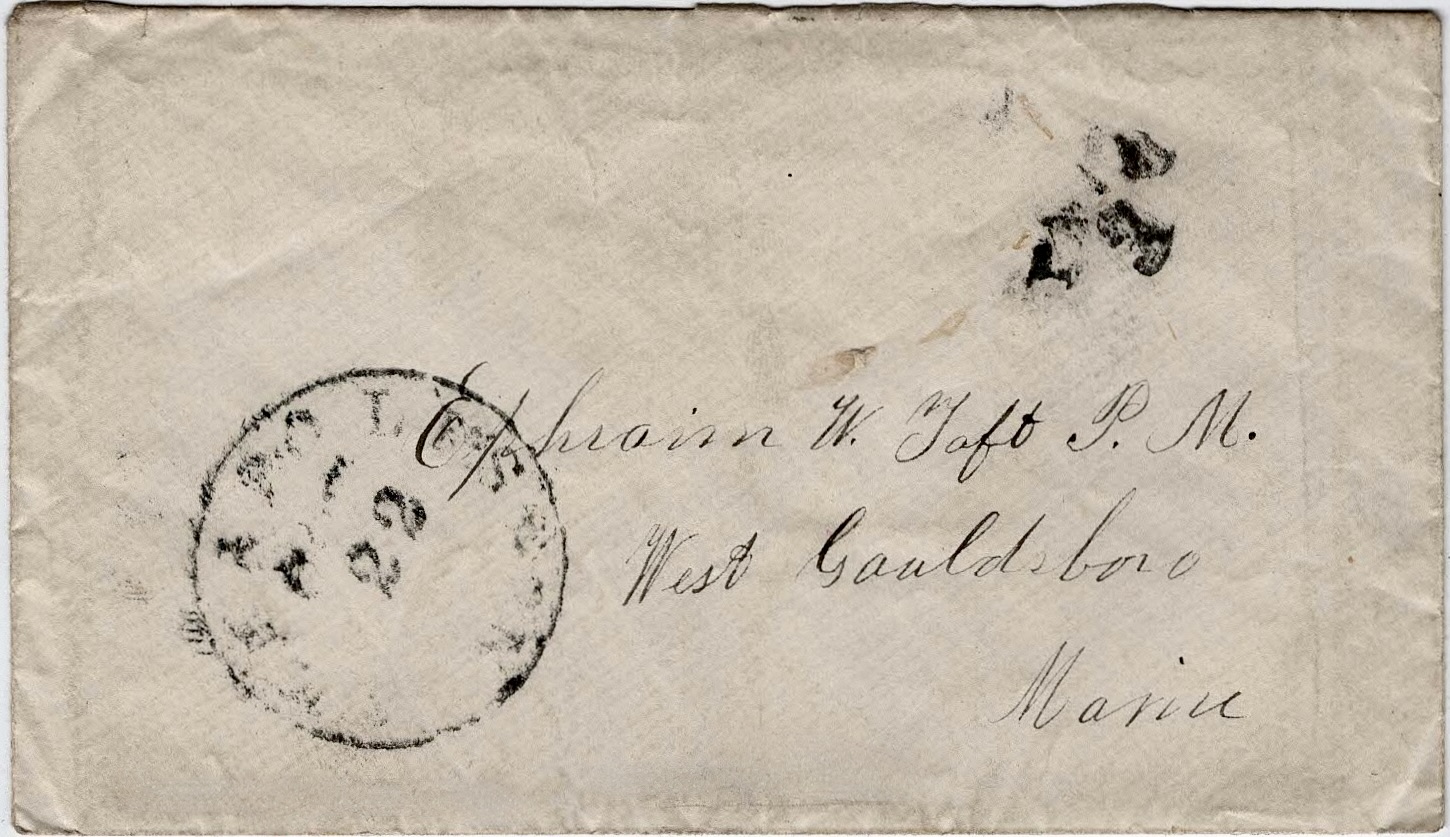
Fletcher wrote this letter to his parents, Ephraim Wales Taft (1795-1873) and Maria B. Cobb (1813-1885).

For Spared & Shared followers interested in reading more great letters by members of the 8th Maine Infantry, check out those written by Augustus Alonzo Hoit who served as an officer in the same company as Fletcher and was also from Gouldsboro. See: The Smoke of my Rifle transcribed and published by Spared & Shared in 2015.

T R A N S C R I P T I O N
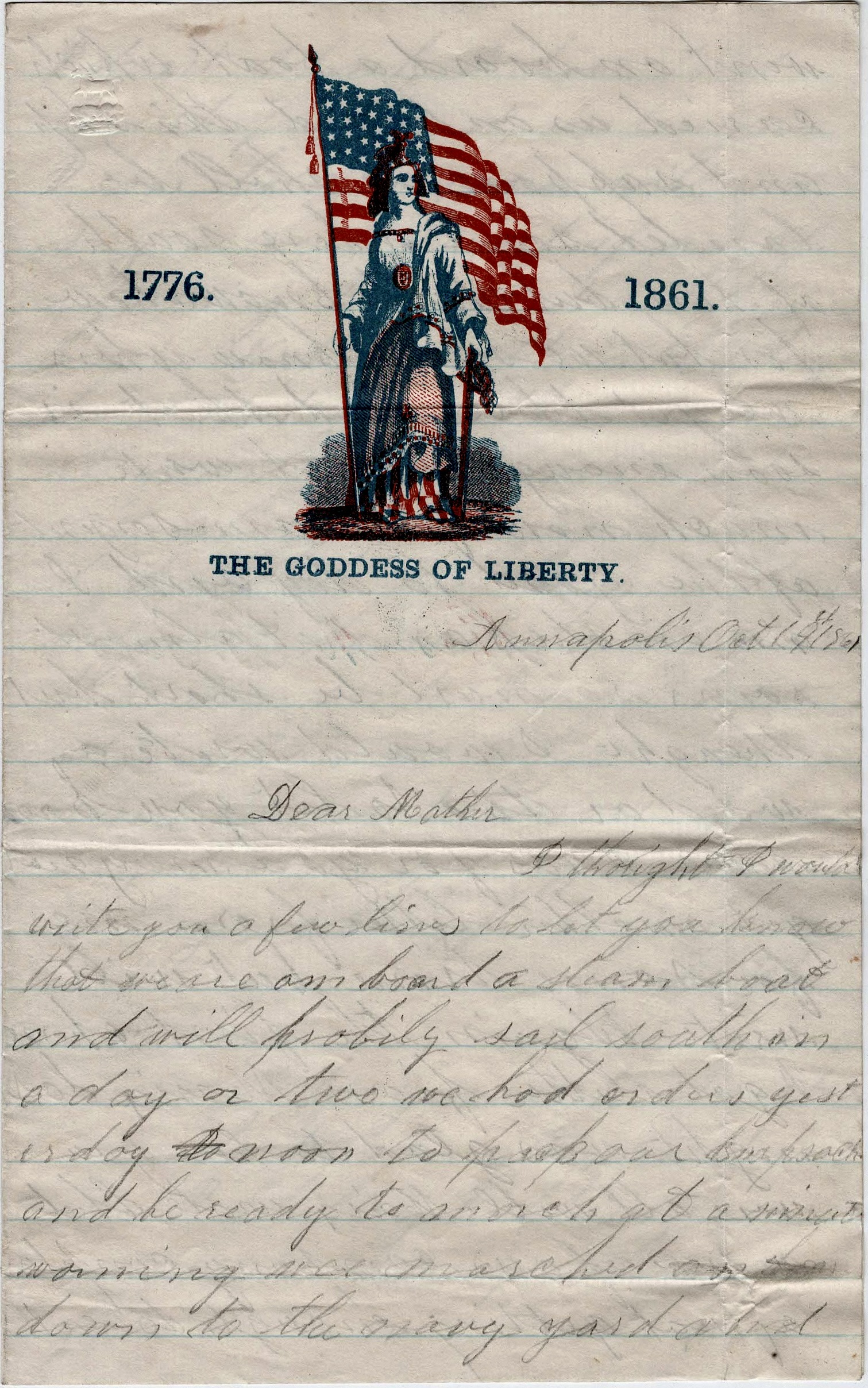
Annapolis [Maryland]
October 19th 1861

Dear Mother,

I thought I would write you a few lines to let you know that we are on board a steamboat and will probably sail south in a day or two. We had orders yesterday noon to pack our knapsacks and be ready to march at a minute’s warning. We marched on down to the Navy Yard and went on board a boat which carried us on board this ship and suppose we shall be landed somewhere south of here but don’t know how far but we shall know when we get there and that is soon enough. I can’t write much now for I am Sergeant of the Guard today and I am on deck and it almost rains so must be short but thought I would write a word or two to let you know where I was for you may not get another letter from me for some time but will write again the first chance.

I got a letter from Maria last night. Was glad to hear you were all well. Maria wrote that some of our company complain of not getting enough to eat. I don’t think I have lost much flesh and as long as I can hold my own, will not say a word. I ain’t afraid of starving. I received a letter from Nat Tyler the other day [but] have not had time to answer it yet. George is well and gets along well. You wrote he said he was coming home but guess he will hardly get there this winter.

I must now close this as I have not time to write more. Give love to all and keep a large share for yourself. From your son, — Fletcher

When you write, direct to Washington and I shall get them from there if anywhere.
1862: Daniel Patch to Friend in Maine

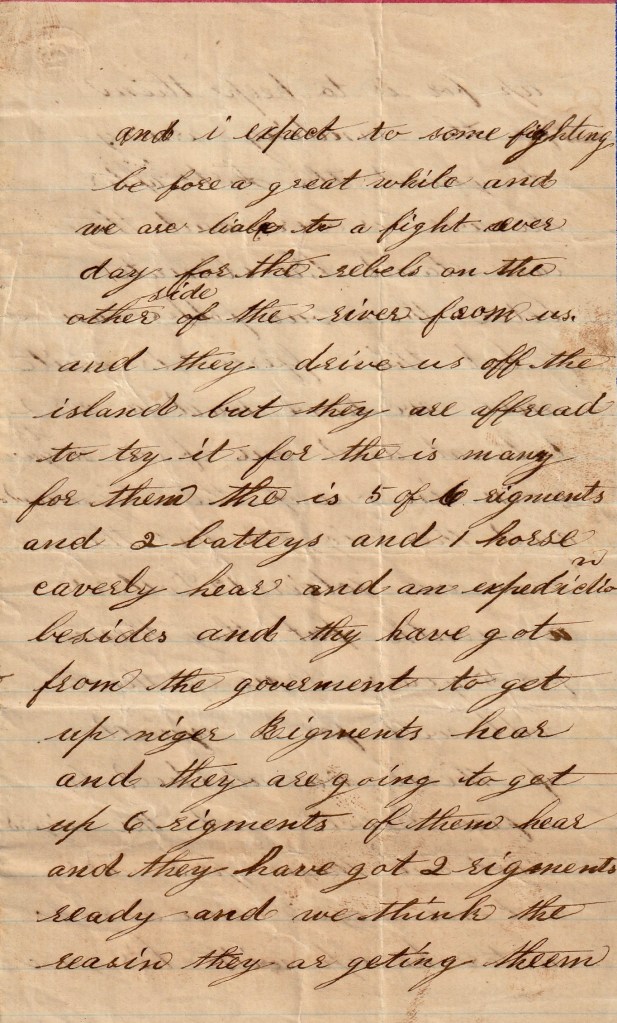
The following partial letter was written by Daniel Patch (1841-1862) of Co H, 8th Maine Infantry to an unnamed friend regarding his observations, expectations, and reactions about contemporary events in his life as a soldier. Notable is his rendering of a story about an African American soldier who “came across” his old master on the battlefield—a poignant and distinctly unusual event: “he up with his gun sys he to his mastar i have took of my hat to you Hundreds of times and now i want you to take yourn of to me if you don’t i blow your dam brains out and he did take it off.”

I could not find an image of Daniel but here is Sgt. James Henry Hobbs who also served in Co. H, 8th Maine Infantry.
(Andrew Garton Collection)

Although the first part of Patch’s letter is missing and its precise date and location are unknown, circumstantial evidence points to the time and place being the Fall of 1862 in the coastal southern region of South Carolina (most likely Hilton Head or the surrounding area). Elements of what eventually became the 1st SC Volunteer Infantry, Colored, were first organized in the Department of the South by Gen. David Hunter at Hilton Head in May of 1862 (and without official approval from Washington) by recruiting freed male slaves from the Hilton Head area, where Patch’s Regiment was present for at least some of the time. This was a period of frequent small skirmishes between Union and Confederate forces in the area and the 1st S. C. were known to have soldiers involved in some of these, so that it would not be surprising for a black soldier to come in contact with his ex-master (as either a Confederate soldier or sympathizer). It would also be quite possible for Patch to know about the event described in the letter since both the 8th Maine and 1st S. C. were located near each other, and, for that matter, as Patch himself mentions, multiple 8th Maine soldiers had already transferred to black units as officers. Finally, Patch is known to have died of typhoid on 11 December 1862 in a Port Royal Hospital so the letter would have to have been written prior to that time. Disease was particularly a problem for troops stationed in Southern coastal areas, with 11.6% of the 8th Maine soldiers, including Patch, dying of illness.

Although the striking confrontation described in the letter between the black soldier and his ex-master may be apocryphal, other references to such an occurrence exist, although none found by me are clearly tied to the letter’s description. In any event, the confrontation was striking enough to Pvt. Patch to include it in his letter home.

Daniel was the son of George Washington Patch (1809-1896) and Elizabeth Call (1816-1902) of York Village, Yorm county, Maine.

[Note: This letter is from the personal collection of Richard Weiner and was transcribed and published on Spared and Shared by express consent. Likewise, the research and description of the contents was provided by Richard.]

Transcription

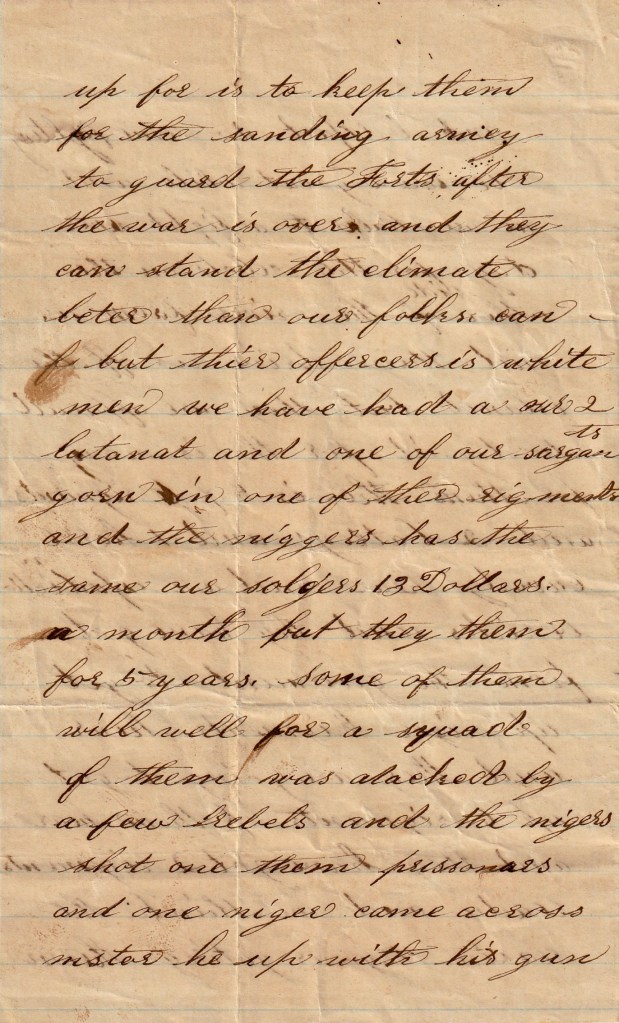
…and I expect to [see] some fighting before a great while and we are liable to fight everyday for the rebels on the other side of the river from us and they drive us off the island but they are afraid to try it for there is [too] many for them. There is 5 or 6 regiments and two batteries and one horse cavalry here and an expedition besides and they have got [authorization] from the government to get up nigger regiments here and they are going to get up 6 regiments of them here. And they have got two regiments [al]ready and we think the reason they are getting them up for is to keep them for the standing army to guard the forts after the war is over and they can stand the climate better than our folks can. But their officers is white men. We have had our 2nd Lieutenant and one of our sergeants go in one of their regiments and the niggers has the same [pay as] our soldiers—13 dollars a month—but they [have] them for five years.

Some of them will [fight] well for a squad of them was attacked by a few rebels and the niggers shot one of them prisoners and one nigger came across [his former] master. He up with his gun, says he to his master, I have took off my hat to you hundreds of times and now I want you to take yourn off to me. If you don’t, I’ll blow your damn brains out. And he did take it off and the nigger took him prisoner and brought him to Hilton Head and they put him in prison.

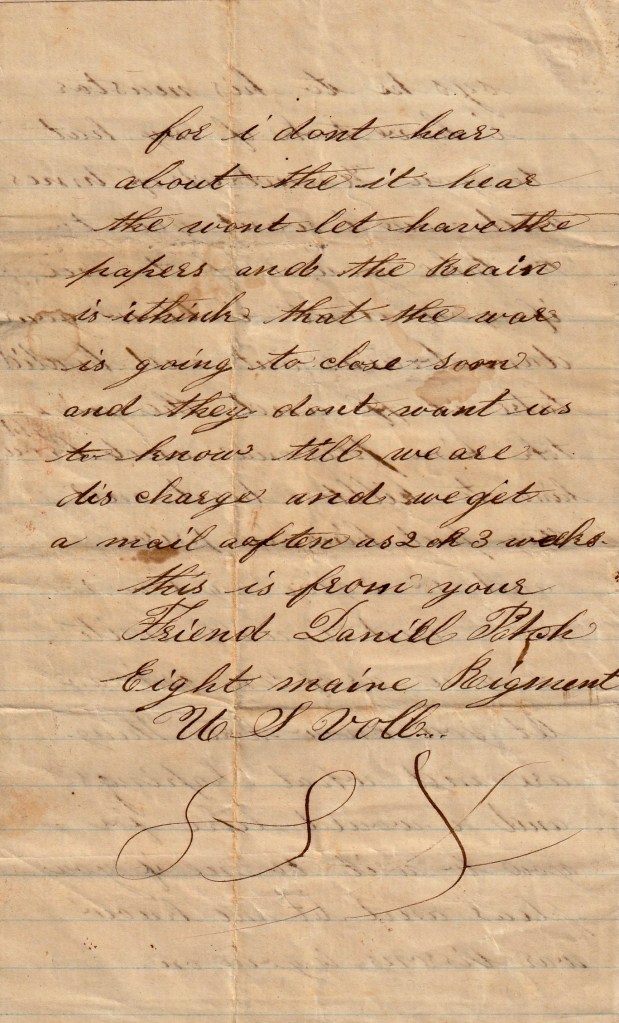
And so I give my love to you all and I will write to you as often as I can [and] let you know how things are and what happens. And I would like for you to write to me if you please and let me know [about the war] besides [what] is going on for I don’t hear about it here. They won’t let [us] have the papers and the reason is I think that the war is going to close soon and they don’t want us to know till we are discharged. And we get a mail as often as 2 or 3 weeks.

This is from your friend — Daniel Patch, 8th Main Regiment, US Vols.