
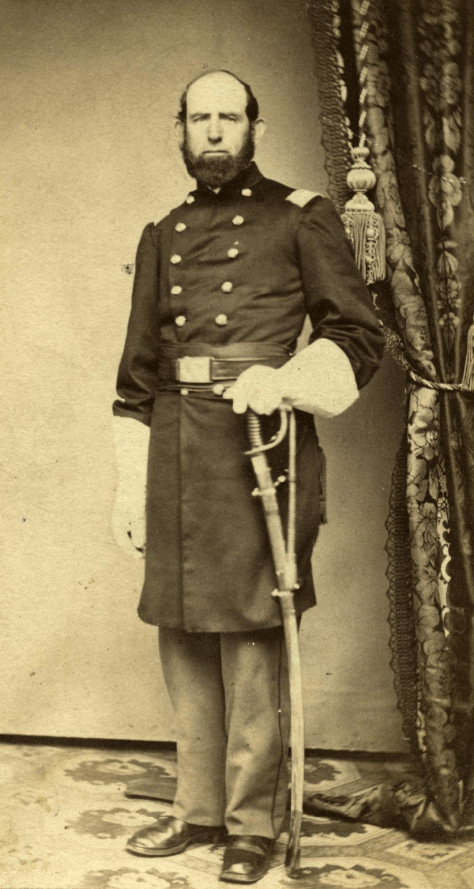
I can’t be certain of the author of this partial and therefore unsigned letter but it was written by the officer who led a detachment of the 8th Michigan Cavalry posted at Carrollsville, Wayne county, Tennessee in August 1865 and my hunch is that it was Lt. Col. William L. Buck. I say so because he writes with a familiarity to his Colonel that would have been uncharacteristic of any junior officer unless they happened to be related to him. The Colonel of the regiment was Elisha Mix and he was headquartered in Pulaski, Tennessee, at that time.
The letter addresses the current state of affairs and the sentiments of the populace in the designated areas of Wayne, Hardin, and Hickman counties, which he was tasked to patrol. It covers a range of critical issues, responding to various inquiries posed by his Colonel in prior correspondence concerning civil unrest, the armament status of the citizens, and the legitimacy of such authority. He articulates his perspective on the social practices of southern women who resorted to the use of snuff and whiskey, highlighting the ramifications these habits had on child-rearing, and concludes with a detailed account of his needs for provisions from the quartermaster in Paducah.
[Note: This letter is from the collection of Dale Niesen and was made available for transcription and publication on Spared & Shared by express consent.]
T R A N S C R I P T I O N
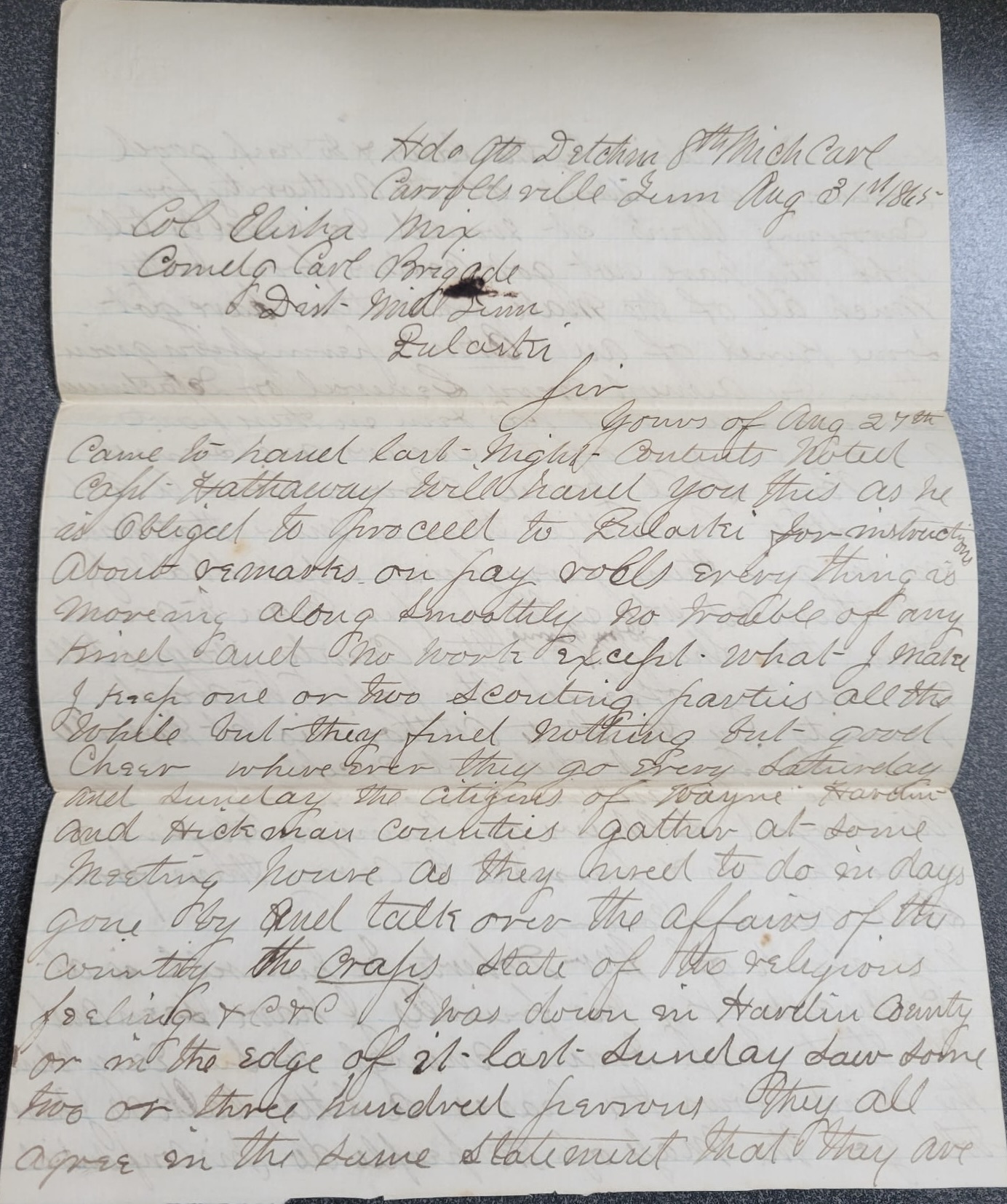
Headquarters Detachment, 8th Michigan Cavalry
Carrollsville, Tennessee 1
August 31st 1865
Col. Elisha Mix
Commanding Cavalry Brigade
District Middle Tennessee
Pulaski
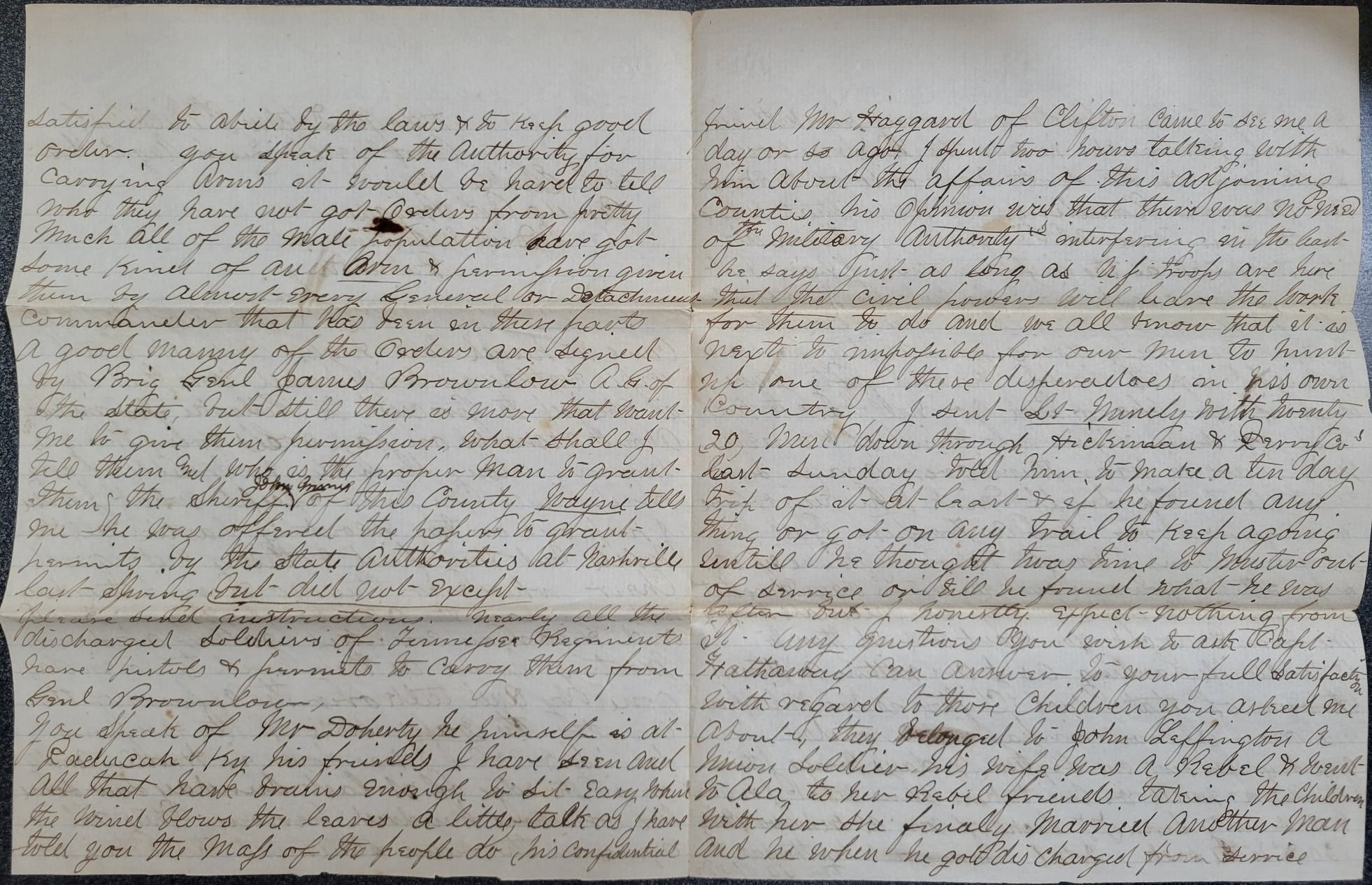
Sir, yours of August 27th came to hand last night, contents noted. Capt. [Albert] Hathaway 2 will hand you this as he is obliged to proceed to Pulaski for instructions about remarks on pay rolls. Everything is moving along smoothly—no trouble of any kind and no work except what I make. I keep one or two scoting parties all the while but they find nothing but good cheer wherever they go. Every Saturday and Sunday the citizens of Wayne, Hardin and Hickman counties gather at some Meeting House as they used to do in days gone by and talk over the affairs of the country, the crops, state of the religious feeling, &c. &c. I was down in Hardin county or in the edge of it last Sunday [and] saw some two or three hundred persons. They all agree in the same statement—that they are satisfied to abide by the laws & to keep good order.
You speak of the authority for carrying arms. It would be hard to tell who they have not got orders from. Pretty much all of the male population have got some kind of an arm & permission given them by almost every General or Detachment Commander that has been in these parts. A good many of the Orders are signed by Brig. Genl. James Brownlow, A[cting] G[overnor] of the state. The sheriff, John Grimes, of this county (Wayne), tell me he was offered the papers to grant permits by the State Authorities at Nashville last spring but did not except [accept]. Please send instructions. Nearly all the discharged soldiers of Tennessee regiments have pistols & permits to carry them from Genl. Brownlow.
You speak of Mr. Doherty. He himself is at Paducah, Kentucky. His friends I have seen and all that have brains enough to sit easy where the wind blows the leaves a little, talk as I have told you the mass of the people do. His confidential friend, Mr. Haggard of Clifton, came to see me a day or so ago. I spent two hours talking with him about the affairs of these adjoining counties. His opinion was that there was no need of the military authority interfering in the least. He says just as long as U. S. troops are here, that the civil powers will leave the work for them to do and we all know that it is next to impossible for our men to hunt up one of these desperadoes in his own country. I sent Lt. [George] Nunally with twenty men down through Hickman & Derry counties last Sunday [and] told him to make a ten-day trip of it at least & if he found anything or got on any trail, to keep going until he thought twas time to muster out of service or till he found what he was after. But I honestly expect nothing from it. Any questions you wish to ask, Capt. Hathaway can answer to your full satisfaction.
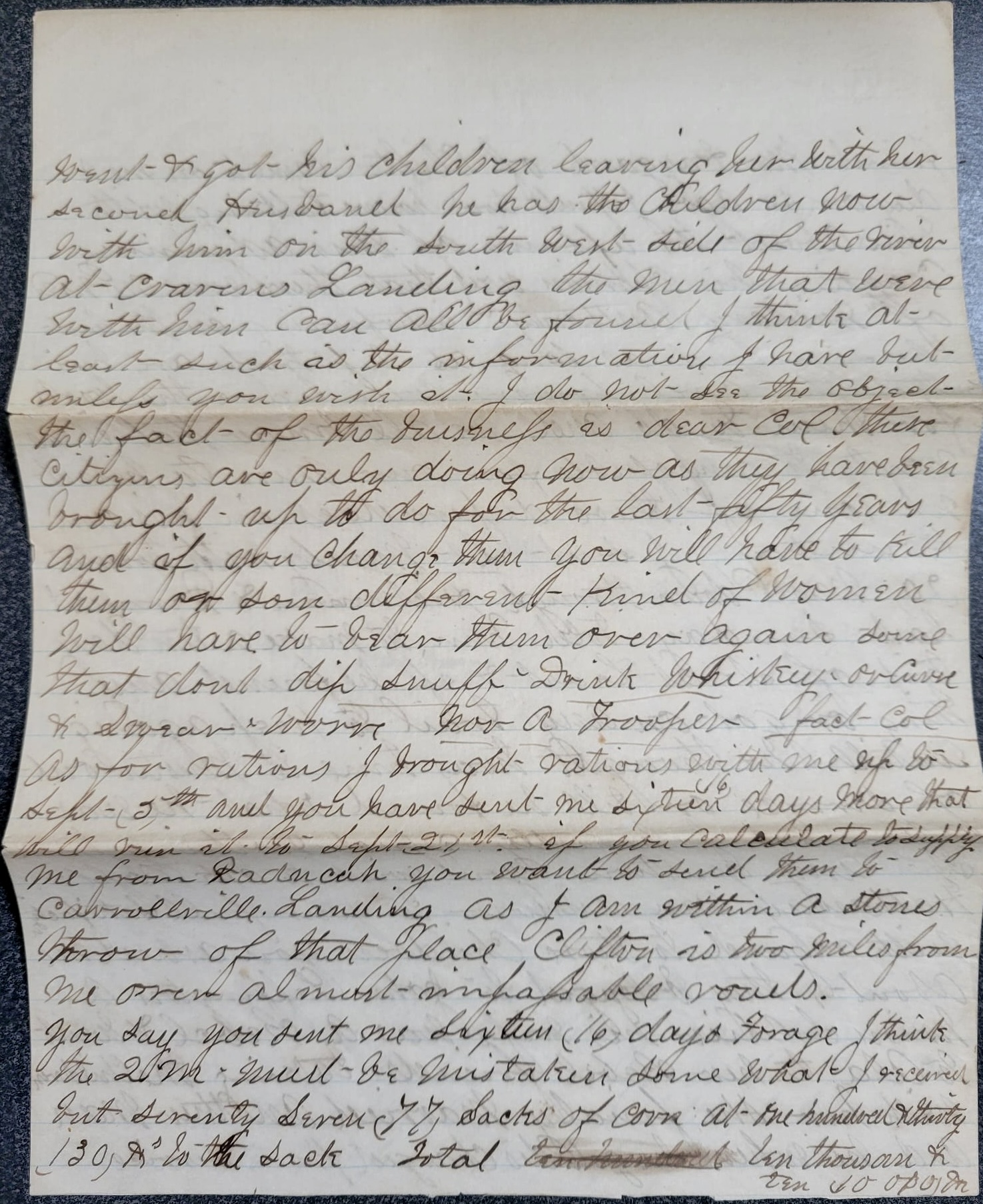
With regard to those children you asked me about, they belonged to John Laffington—a Union soldier. His wife was a Rebel & went to Alabama to her Rebel friends, taking the children with her. She finally married another man and he, when he got discharged from service, went & got his children, leaving her with her second husband. He has the children now with him on the southwest side of the river at Craven’s Landing [near Savannah in Hardin county]. The men that were with him can all be found I think, at least such as the information I have. But unless you wish it, I do not see the object. The fact of the business is, dear Colonel, these citizens are only doing now as they have been brought up to do for the last fifty years and if you change them, you will have to kill them or some different kind of woman will have to bear them over again—some that don’t dip snuff drink whiskey or curse and swear worse than a trooper. [It’s a] fact, Colonel.
As for rations I brought rations with me up to September 5th and you have sent me sixteen days more. That will run it to September 21st. If you calculate to supply me from Paducah, you want to send them to Carrollsville Landing as I am within a stone’s throw of that place. Clifton is two miles from me over almost impassable roads. You say you sent me 16 days forage. I think the quartermaster must be mistaken somewhat. I received but 77 sacks of corn at 130 [ ‘s] to the sack. Total, 10,010 [ ]…[remainder of letter missing]
1 Carrollsville was a small town located in Wayne County, Tennessee, situated on the Tennessee River about a mile below Clifton. It no longer exists but during the Civil War, it was a recognized community within a region noted for its divided loyalties, with the northern part of Wayne County generally favoring the Confederacy, while the southern part remained strongly Unionist. In August 1865, the 8th Michigan Cavalry, which by now included members of the 11th Michigan Cavalry, was stationed in Tennessee performing scouting and patrol duties. While the regiment was heavily involved around Pulaski, TN, until September 21, 1865, they were actively patrolling, which likely included detachments stationed at various points in the region (such as near Carrollsville or other parts of Middle/West Tennessee) to suppress guerrilla operations.
2 Albert L. Hathaway. He was in Company K, 8th Michigan Cavalry (1863-1864) as sergeant, sergeant major, first lieutenant. He was taken prisoner on Stoneman’s raid, Aug. 3, 1864, and exchanged Sept. 27. He was commissioned captain of Company I Dec. 27, 1864, and mustered out at Nashville, Tenn. Sept. 22, 1865. He then went to Harbor Springs, Mich., to live.
 Spared & Shared 23