Category Archives: 8th New Hampshire Infantry

1863: Henry N. Chapman to Sarah (Newman) Chapman

I could not find an image of Henry but here is one of Lt. George B. Johnson who also served in the 8th New Hampshire Infantry (Dave Moran Collection)

The following letter was written by Henry Newman Chapman (1843-1917), the son of Jeremiah Chapman (1817-1854) and Sarah Newman (1810-1894) of Washington, Sullivan county, New Hampshire. Henry was born in Sanbornton, Belknap county, New Hampshire. He was a painter by profession.

Henry was 18 years old when he enlisted on 14 September 1861 as a private in Co. A, 8th New Hampshire Infantry. He was wounded on 27 May 1863 at Port Hudson and after recuperating in Baton Rouge, we learn that he was placed on duty as a hospital steward in the Theatre Hospital. He re-enlisted in 1864 and mustered out in January 1865.

I have not been able to find any information about the Theatre Hospital in Baton Rouge except for notices of certain Union soldiers dying there. Presumably the theatre stopped productions for a time in Baton Rouge due to the Union occupation and was converted into a hospital.

Transcription
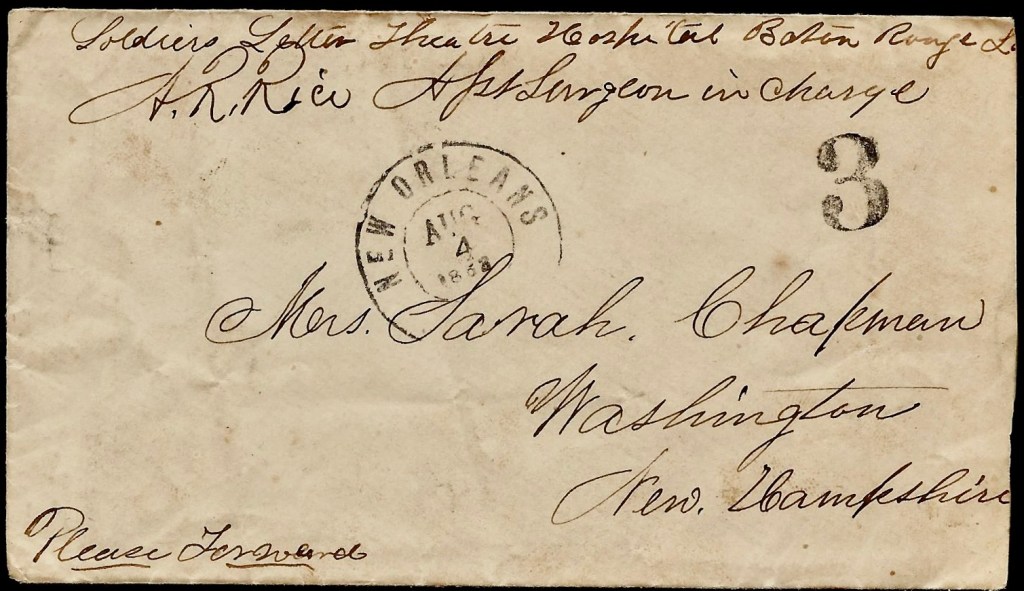
Mrs. Sarah Chapman, Washington, New Hampshire

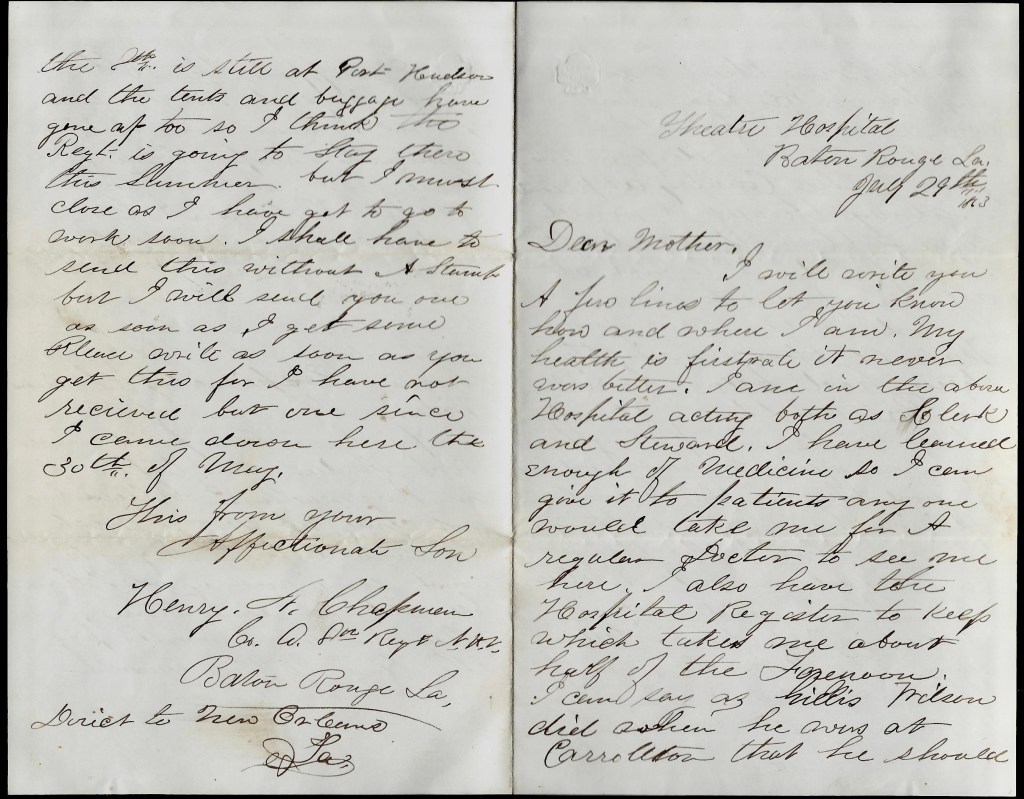
Theatre Hospital
Baton Rouge
July 29th, 1863

Dear Mother,

I will write you a few lines to let you know how and where I am. My health is first rate. It never was better. I am in the above hospital acting both as clerk and Steward. I have learned enough of medicine so I can give it to patients. Anyone would take me for a regular doctor to see me here. I also have the hospital registrar to keep which takes me about half of the forenoon.

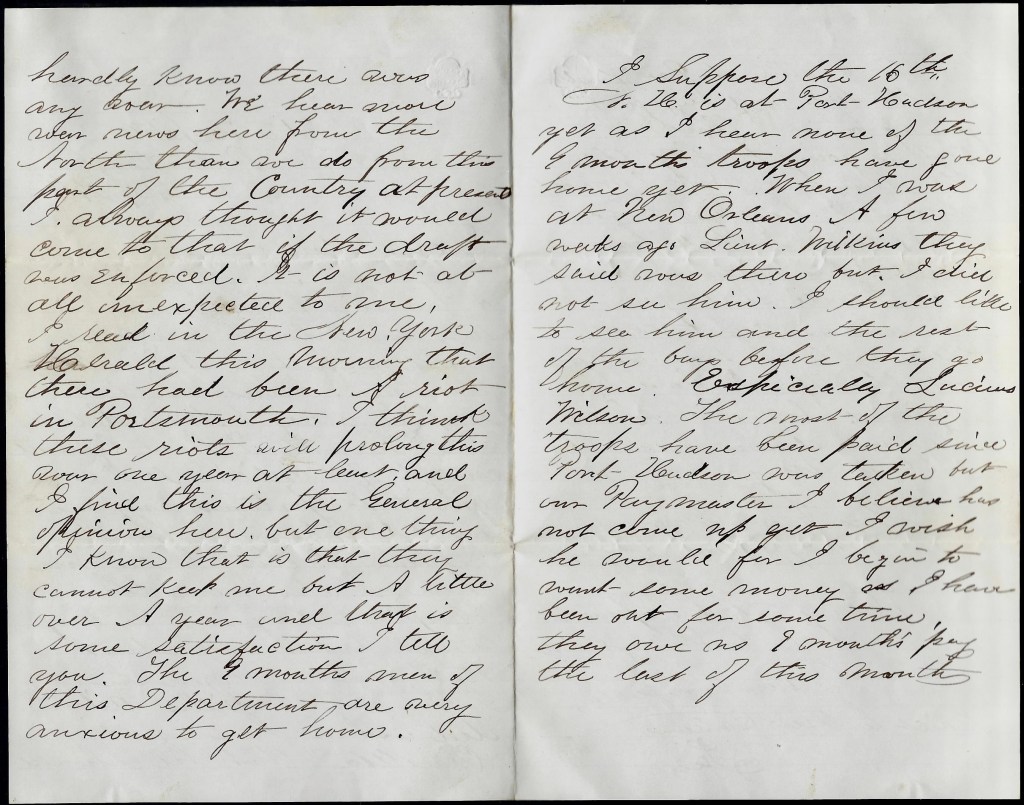
I can say as Hillis Wilson died when he was at Carrollton that we should hardly know there was any war. We hear more war news here from the North than we do from this part of the country at present. I always thought it would come to that if the draft was enforced. It is not at all unexpected to me. I read in the New York Herald this morning that there had been a riot in Portsmouth. I think these riots will prolong this war one year at least, and I find this is the general opinion here. But one thing I know—that is that they cannot keep me but a little over a year and that is some satisfaction, I tell you. The 9-month’s men of this Department are very anxious to get home.

I suppose the 16th New Hampshire is at Port Hudson yet as I hear none of the 9-month’s troops have gone home yet. When I was at New Orleans a few weeks ago, Lieut. Wilkins they said was there but I did not see him. I should like to see him and the rest of the boys before they go home—especially Lucius Wilson.

The most of the troops have been paid since Port Hudson was taken but our Paymaster I believe has not come up yet. I wish he would for I begin to want some money as I have been out for some time. They owe us 9-month’s pay the last of this month. The 8th is still at Port Hudson and the tents and baggage have gone up too so I think the regiment is going to stay there this summer.

But I must close as I have got to go to work soon. I shall have to send this without a stamp but I will send you one as soon as I get some. Please write as soon as you get this for I have not received but one since I came down here the 30th of May.

This from your affectionate son, — Henry N. Chapman, Co. A, 8th Regt. N. V. V., Baton Rouge, La.

Direct to New Orleans, La.
1862: Samuel G. Shackford to Alfred Bunker

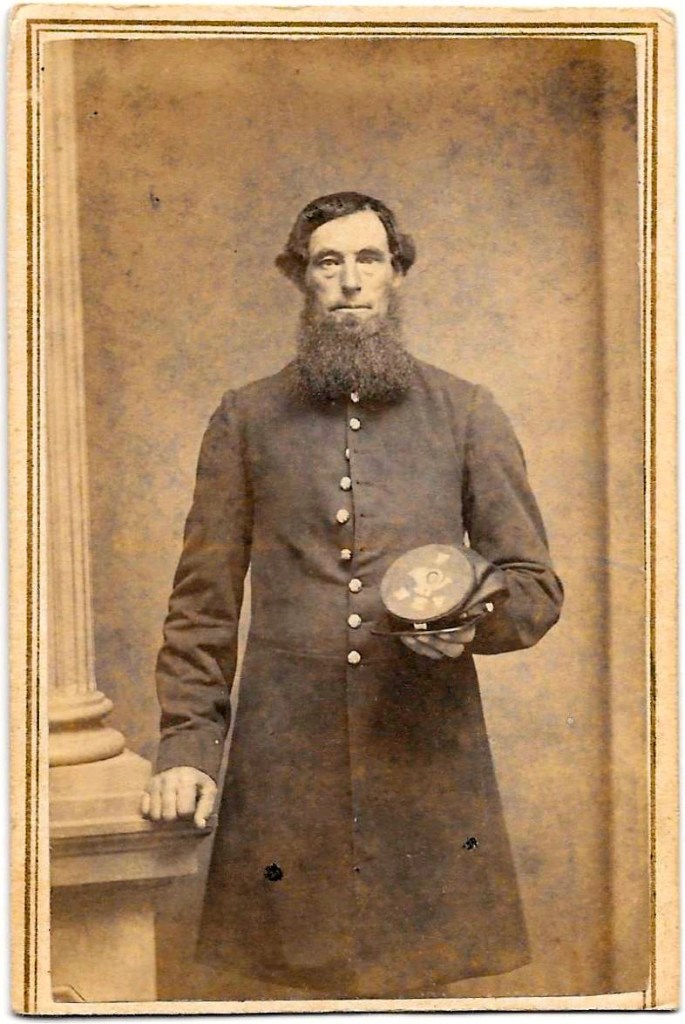
I could not find an image of Samuel but here’s an unidentified New Hampshire soldier who appears to be about Samuel’s age. (Dave Morin Collection)

This letter was written by 41 year-old shoemaker and innkeeper Samuel Garland Shackford (1821-1885) of Barnstead who enlisted on 30 November 1861 in Co. G, 8th New Hampshire Infantry. Samuel remained with the regiment until 18 January 1865 when he mustered out.

Samuel’s parents were Josiah Ring Shackford (1796-1874) and Mary Garland (1796-1867) of Barnstead, Belknap county, New Hampshire. Samuel’s first wife, Margaret Bean Foss (1816-1859) died in July 1859 leaving him with four young children, ages 2 to 13 who were cared for by the Thomas Muzzey Huse family while he was in the service. He did not marry again until after the Civil War, taking Esta L. Higgins as his second wife in 1872.

The Notre Dame Rare Books and Special Collection includes a collection of twenty-two letters which Samuel wrote to the Huse family while they cared for his children during the war. 

The letter was addressed to Alfred Bunker (b. 1811), a farmer in Belknap county, New Hampshire.

Camp Parapet, 8 miles above New Orleans

Transcription

Carrollton, Louisiana
Camp Parapet
Hospital, 8th N. H. Vol.
September 11, 1862

Dearest Friend,

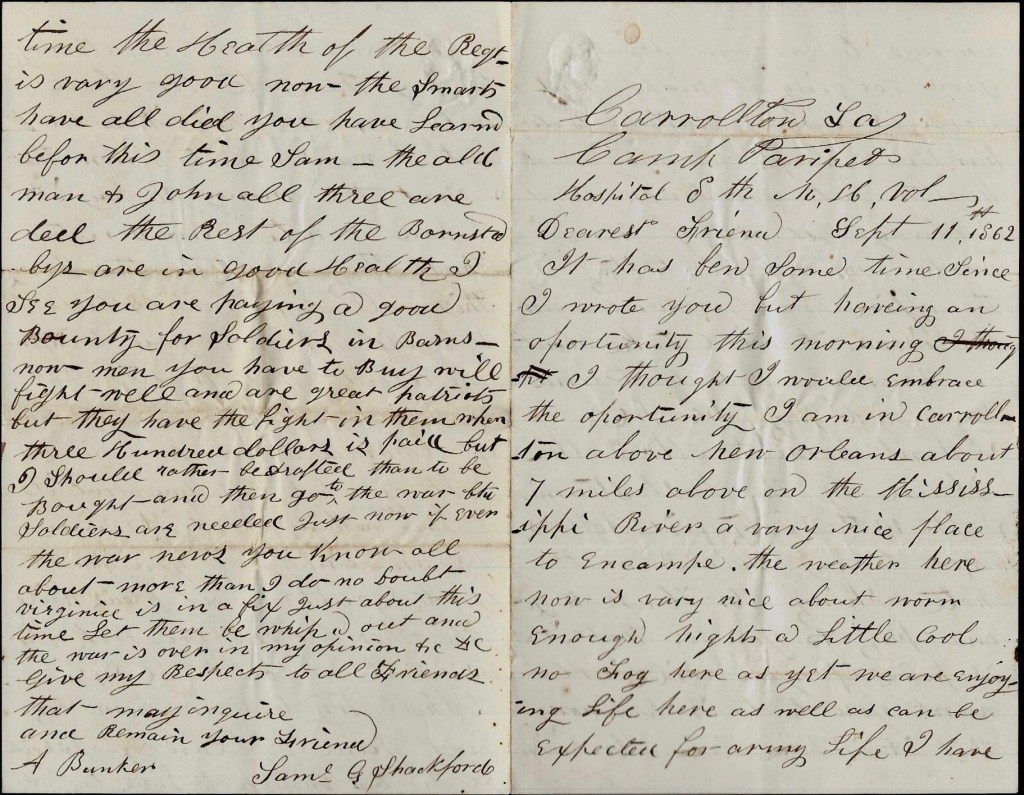
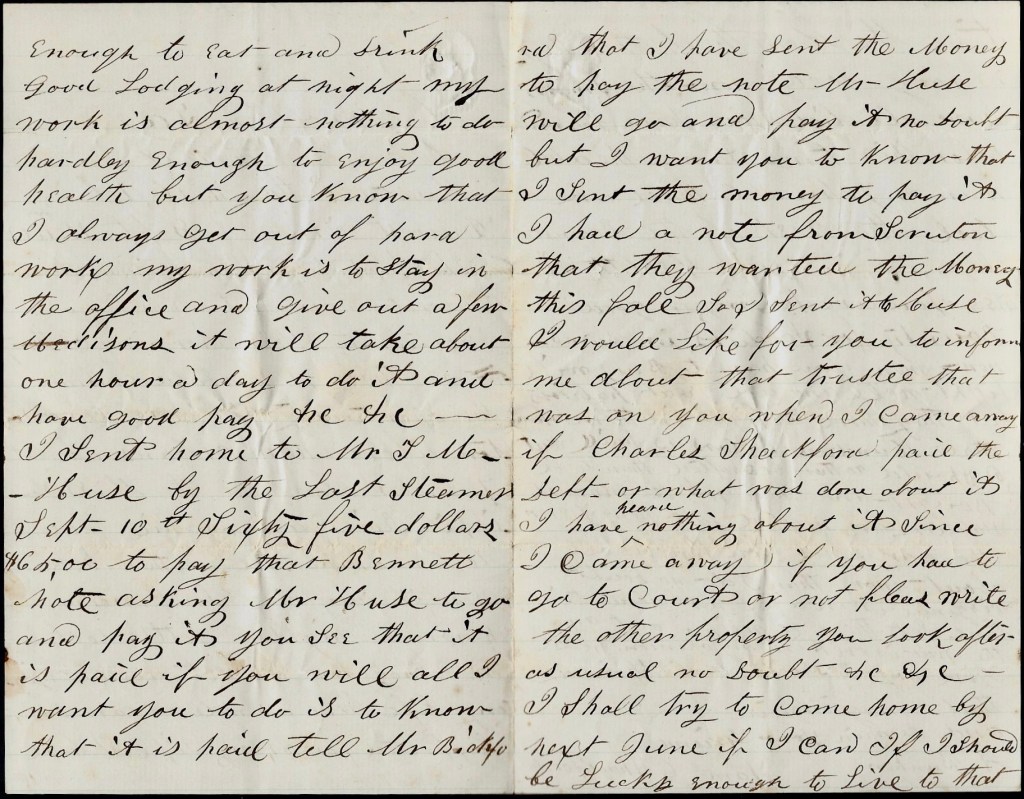
It has been some time since I wrote you but having an opportunity this morning, I thought I would embrace the opportunity. I am i nCarrollton above New Orleans about seven miles on the Mississippi River—a very nice place to encamp. The weather here now is very nice—about warm enough, night a little cool. No fog here as yet. We are enjoying life here as well as can be expected for army life. I have enough to eat and drink, good lodging at night. My work is almost nothing to do—hardly enough to enjoy good health but you know that I always get out of hard work.

My work is to stay in the office and give out a few medicines. It will take about an hour a day to do it and have good pay &c. &c.

I sent home to Mr. T[homas] M. Huse by the last steamer, September 10th, sixty-five dollars ($65) to pay that Bennett note asking Mr. Huse to go and pay it. YOu see that it is paid, if you will. All I want you to do is to know that it is paid. Tell Mr. Bickford that I have sent the money to pay the note. Mr. Huse will go and pay it no doubt but I want you to know that I sent the money to pay it.

I had a note from Scruton that they wanted the money this fall so I sent it to Huse. I would like for you to inform me about that trustee that was on you when I came away. If Charles Shackford paid the debt, or what was done about it. I have heard nothing about it since I came away. If you had to go to court or not, please write. The other property you look after as usual no doubt, &c. &c.

I shall try to come home by next June if I can—if I should be lucky enough to live to that time.

The health of the regiment is very good now. The Smarts have have all died. You have learned before this time Sam—the old man to John—all three are dead. The rest of the Barnstead boys are in good health.

I see you are paying a good bounty for soldiers in Barnstead now. Men you have to buy will fight and are great patriots but they have the fight in them when three hundred dollars is paid but I should rather be drafted than to be bought and then go to the war. But soldiers are needed just now if ever.

The war news you know all about—more than I do no doubt. Virginia is in a fix just about this time. Let them be whipped out and the war is over in my opinion, &c. &c. Give my respects to all friends that may inquire and remain your friend, — Samuel G. Shackford

A. Bunker