
The following letters were written by John M. Britton who enlisted as a private for three years in Co. H, 8th New Jersey Infantry on 5 September 1861 and later transferred to Co. C. He reenlisted on 25 December 1863 (carried under the name Briton). The variations in spelling make it difficult to track down John’s family but I believe he was the son of Henry Britton (1807-1877) and his wife Mary (b. 1813) who were residents of Carpentersville, Warren county, New Jersey. In the 1850 US Census, this family was enumerated in Franklin township, Warren county, N. J. as the Henry and Mary Brittain family and their children at that time were Elizabeth (“Libby”), age 15 (1834-1904); John, age 12; Mercey, age 8 (1842-1911); and David J., age 5.
Little else could be learned about John except that he survived the war and married Catharine Lobb (b. 1843), the daughter of Jacob Lobb and Susan Morehouse of Rahway, New Jersey.
Letter 1

Camp Jersey [Meridian Hill]
October 21, [1861]
Monday morning, seven o’clock
I have just had my breakfast, tin cup of coffee, a piece of pork, and bread. That was my meal. All of the boys have their pipes and are smoking away. I would rather write than to smoke so I will write first and then smoke. We had a prayer meeting in the Colonel’s tent last evening. It was filled full. It lasted only one hour.
It is quite cool this morning. The soldiers are drawing on their overcoats. The wild pigeons are flying thick.
Half past eight. I have just come off drill. We were drilling double quick—that is what we call a Bull Run Retreat. We run and keep step. It is fun. Perhaps we will need it one of these days but we will never retreat unless we receive orders from our officer to do so. We are ready to go in the battlefield as soon as called on. Our armies are driving the rebels back. They have cleared them pretty well out of Virginia. We know all about the war. The papers come in our camp every morning so we know everything that is going on.
We are thirty-nine miles from Bulls Run and four miles from Chain Bridge. Last Friday the rebels had to retreat. We could hear the cannons roar very plainly. They fired very fast. We seen a secession balloon go up last Friday [18 October 1861] but it did not stay up very long and just after it came down, the firing commenced. I suppose he seen something he did not like.
We are going to have a brass band in our regiment. We have got nothing but drums now and I am getting tired hearing them. We have twenty all together and such a racket as they make I never heard. You can’t hear anybody speak unless they yelp their best.
They are building barracks in Washington to accommodate 60 thousand soldiers this winter. I believe we are to go to South Carolina or else take up our quarters in Washington. My wish is that we will get in Washington. We have a great deal of rain here. It appears to rain very easy. You must not look for me home before next spring and perhaps not then.
I am glad Junkin got the carriage. You must all make good use of it. I think by the time I get home I will have enough money to pay for it. I would like to come home and see you all very much. Obediah Evans started home yesterday. He went to get more recruits. He was the only one from our company. There was a lieutenant from one of the other companies with him. He lives at Pattenburg. Obediah is a sergeant in our company. Daniel Cowl said I should tell you he was well and liked it first rate. I guess I will stop writing.. No more. Your affectionate brother, — John Britton, Meridian Hill
Dear sister Mercy, I do not know as I have anything to write to you—only I want you and Junkin to enjoy yourselves the best you can. I would like to be home and take you out riding. Junkin, I want you to break the colt in single so when I come home, I can ride behind her. I don’t know when I will get home to stay but if I live, I will get home in the spring to see you. No more from your brother, — John B.


Letter 2
Camp Jersey
November 13, [1861]
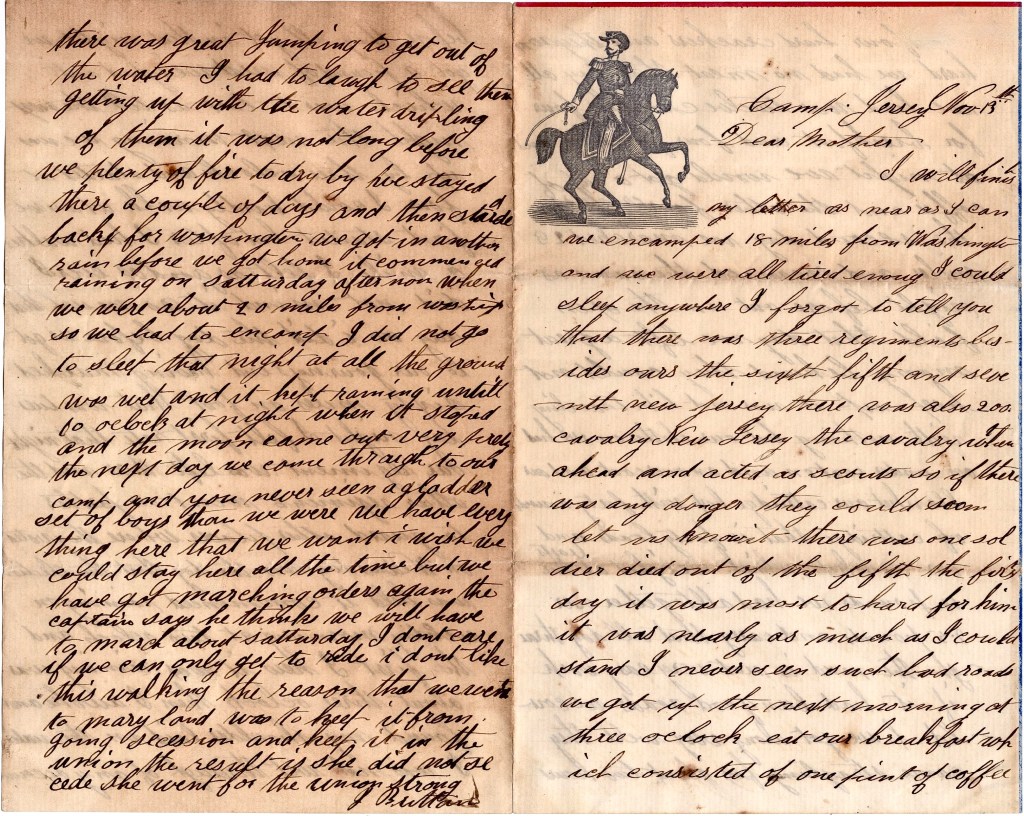
Dear mother,
I will finish my letter as near as I can. We encamped 18 miles from Washington and we were all tired enough. I could sleep anywhere. I forgot to tell you that there was three regiments besides ours—the Sixth, Fifth and Seventh New Jersey. There was also 200 cavalry [from] New Jersey. The cavalry went ahead and acted as scouts so if there was any danger they could soon let us know it. There was one soldier died out of the Fifth the first day. It was most too hard for him. It was nearly as much as I could stand. I never seen such bad roads.
We got up the next morning at 3 o’clock, eat our breakfast which consisted of one pint of coffee and four hard crackers and they were hard. We had no meat that day. All we had was twelve crackers—four for breakfast and four for dinner, and at night we would get a cup of coffee and the other four crackers. The 2nd day we marched 23 miles and encamped the same as night before, out in the open field. That day we left a great many behind. They could not keep up. It was not like traveling with nothing but our clothes on. We had an under coat and an overcoat and our blankets, our cartridge box with forty rounds of cartridges—that is, forty loads, and our muskets which weighed at the least ten pounds. We had altogether over 25 pounds and carry all that day through the mud is not very easy work. If it had been good roads, we could have got along very well. They came straggling for about two hours before they all got in that night. We got a pound of meat weighed out which was to last us till the next night.
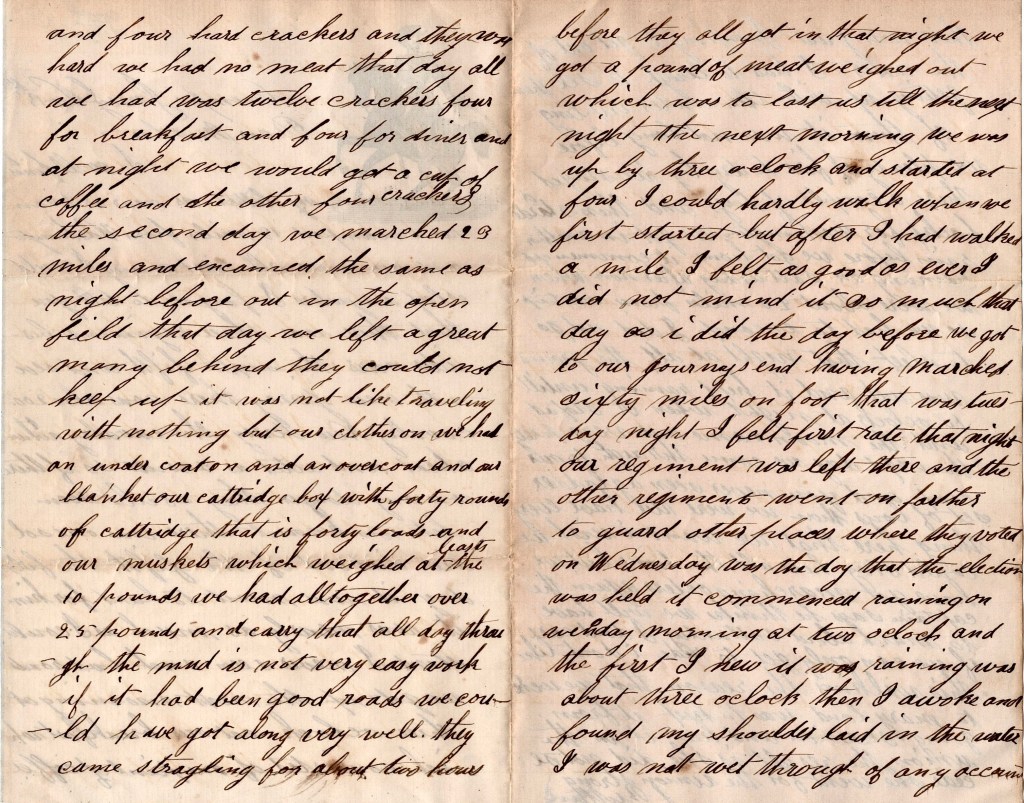
The next morning we was up by three o’clock and started at four. I could hardly walk when we first started but after I had walked a mile, I felt as good as ever. I did not mind it as much that day as I did the day before. We got to our journey’s end having marched sixty miles on foot. That was Tuesday night. I felt first rate that night. Our regiment was left there and the other regiments went on farther to guard other places where they voted.
On Wednesday was the day that the election was held. It commenced raining on Wednesday morning at two o’clock and the first I knew it was raining was about three o’clock when I awoke and found my shoulder laid in the water. I was not wet through of any account [but] there was great jumping to get out of the water. I had to laugh to see them getting up with the water dripping off them. It was not long before we [had] plenty of fire to dry by. We stayed there a couple of days and then started back for Washington. We got in another rain before we got home. It commenced raining on Saturday afternoon when we were about 20 miles from Washington so we had to encamp. I did not go to sleep that night at all. The ground was set and it kept raining until 10 o’clock at night when it stopped and the moon came out very pretty.
The next day we came through to our camp and you never seen a gladder set of boys that we were. We have everything here that we want. I wish we could stay here all the time but we have got marching orders again. The Captain says he thinks we will have to march about Saturday. I don’t care if we can only get to ride. I don’t like this walking. The reason that we went to Maryland was to keep it from going secession and keep it in the Union. The result is she did not secede. She went for the Union strong. — J. Britton
Letter 3
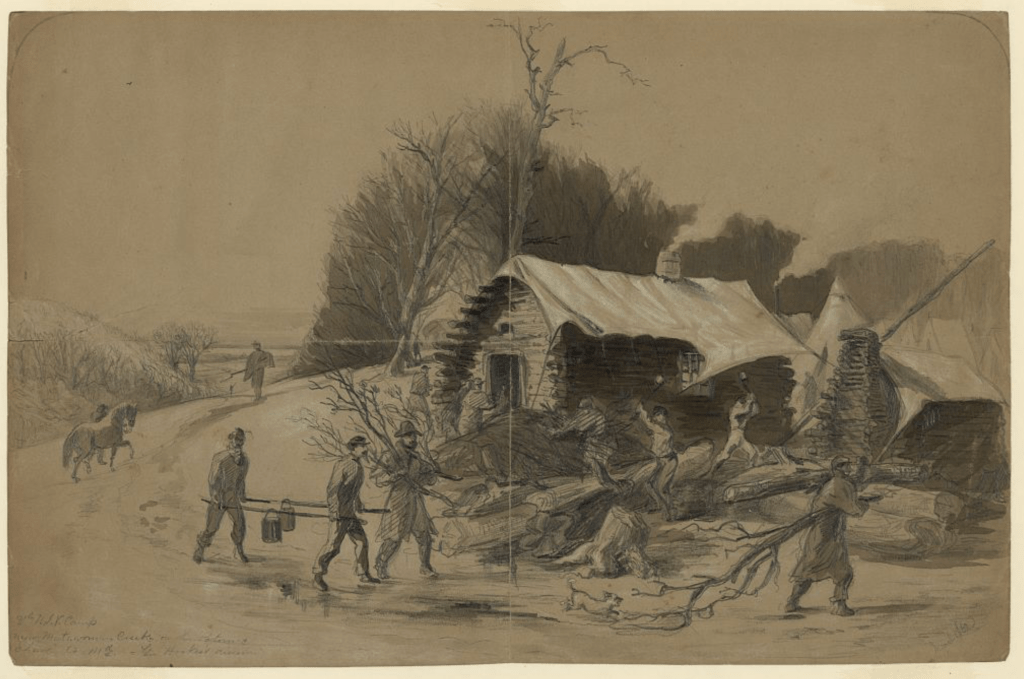
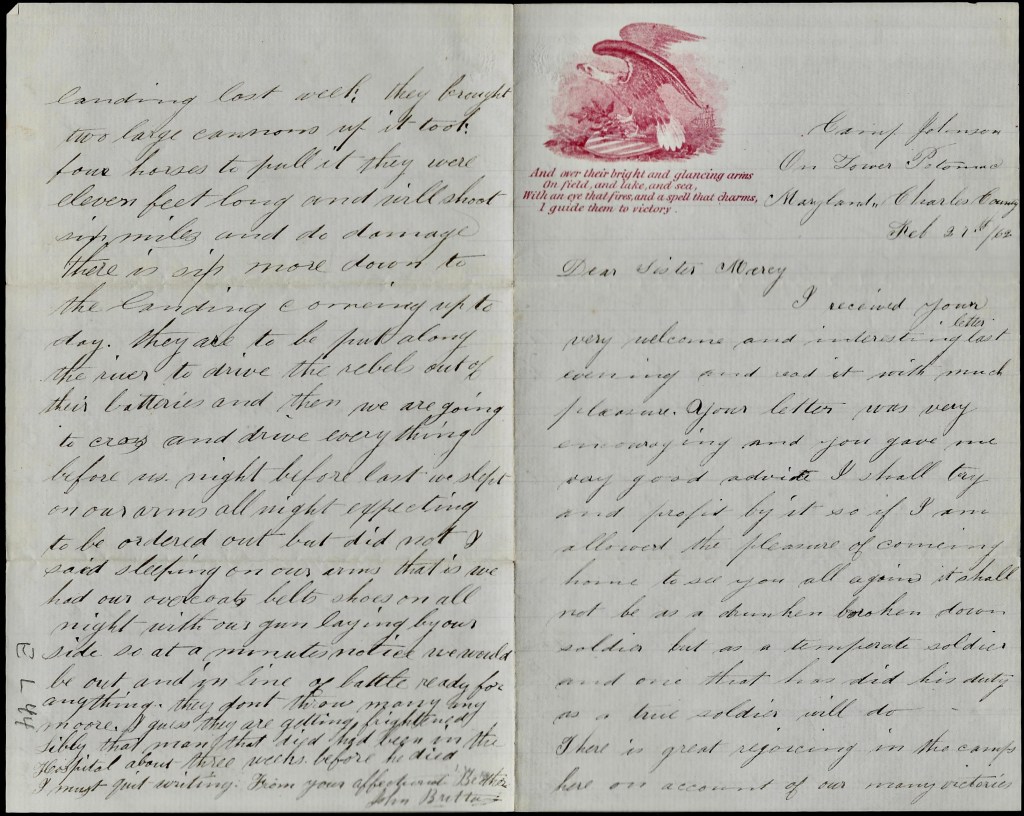
John wrote this letter in late February 1862 from Camp Johnson (named after their Colonel Adolphus Johnson). This camp was located near Budd’s Ferry on the lower Potomac. They spent most of the winter at this location. Their first major engagement wasn’t until 5 May 1862 at the Battle of Williamsburg.
Camp Johnson
On Lower Potomac
Charles county, Maryland
February 27th 1862
Dear Sister Mercy,
I received your very welcome and interesting letter last evening and read it with much pleasure. Your letter was very encouraging and you gave me some good advice. I shall try and profit by it so if I am allowed the pleasure of coming home to see you all again, it shall not be as a drunken, broken down soldier, but as a temperate soldier and one that has did his duty as a true soldier will do.
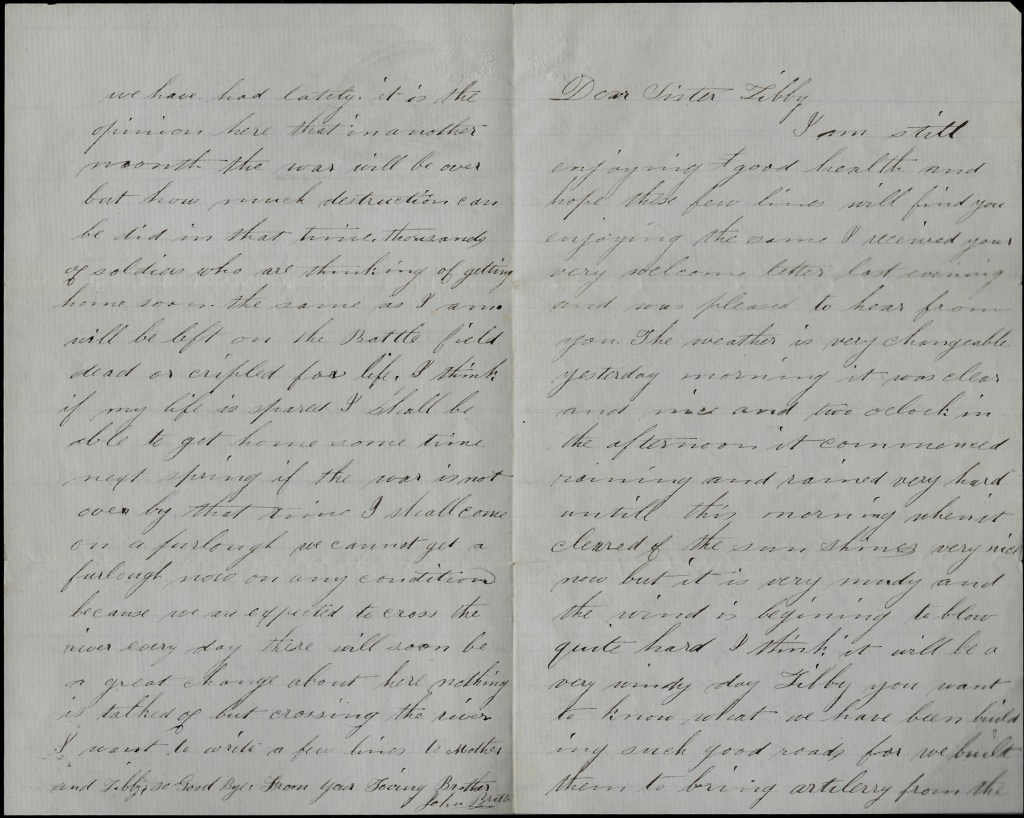
There is great rejoicing in the camp here on account of our many victories we have had lately. It is the opinion here than in another month, the war will be over. But how much destruction can be did in that time, thousands of soldiers who are thinking of getting home soon the same as I am will be left on the battlefield, dead or crippled for life. I think if my life is spared, I shall be able to get home some time next spring. If the war is not over by that time, I shall come on a furlough. We cannot get a furlough now on any condition because we are expected to cross the [Potomac] river every day. There will soon be a great change about here. Nothing is talked of but crossing the river.
I want to write a few lines to Mother and Libby so goodbye from your loving brother, — John Britton
Dear Sister Libby,
I am still enjoying good health and hope these few lines will find you enjoying the same. I received your very welcome letter last evening and was pleased to hear from you. The weather is very changeable. Yesterday morning it was clear and nice and two o’clock in the afternoon it commenced raining and rained very hard until this morning when it cleared off. The sun shines very nice now but it is very muddy and the wind is beginning to blow quite hard. I think it will be a very windy day.
Libby, you want to know what we have been building such good roads for. We built them to bring artillery from the landing last week. They brought two large cannons up. It took four horses to pull it. they were eleven feet long and will shoot six miles and do damage. There is six more down to the landing coming up today. They are to be put along the river to drive the rebels out of their batteries and then we are going to cross and drive everything before us.
Night before last we slept on our arms al night expecting to be ordered out but did not. I said sleeping on our arms—that is, we had our overcoats, belts, shoes on all night with our gun laying by our side so at a moment’s notice we would be out and in line of battle ready for anything. They don’t throw many any more. I guess they are getting frightened. Libby, that man that died had been in the hospital about three weeks before he died.
I must quit writing. From your affectionate brother, – John Britton
 Spared & Shared 23