Category Archives: 93rd Ohio Infantry

1864: Abraham Eikenberry to Sallie Ann Young

This letter was written by Abraham (“Abram”) Eikenberry (1842-1897), the son of Isaac Eikenberry (1804-1887) and Dally Neff (1804-1887) of Gratis, Preble county, Ohio. Abraham wrote the letter while serving in Co. H, 93rd Ohio Volunteer Infantry along with his brothers, Reuben Eikenberry (1837-1922) and Joseph Eikenberry (1847-1921). According to the 1890 Veteran’s Schedule, Abram suffered two gunshot wounds during the war. Abraham wrote this letter to Sallie Ann Young )1843-1924) but he did not marry her. After the war, in November 1866, he married Maria E. Furrey (1844-1917). Sallie, on the other hand, married Joseph Furrey (1839-1925)—Maria’s brother—so Abram and Sallie eventually became in-law siblings.
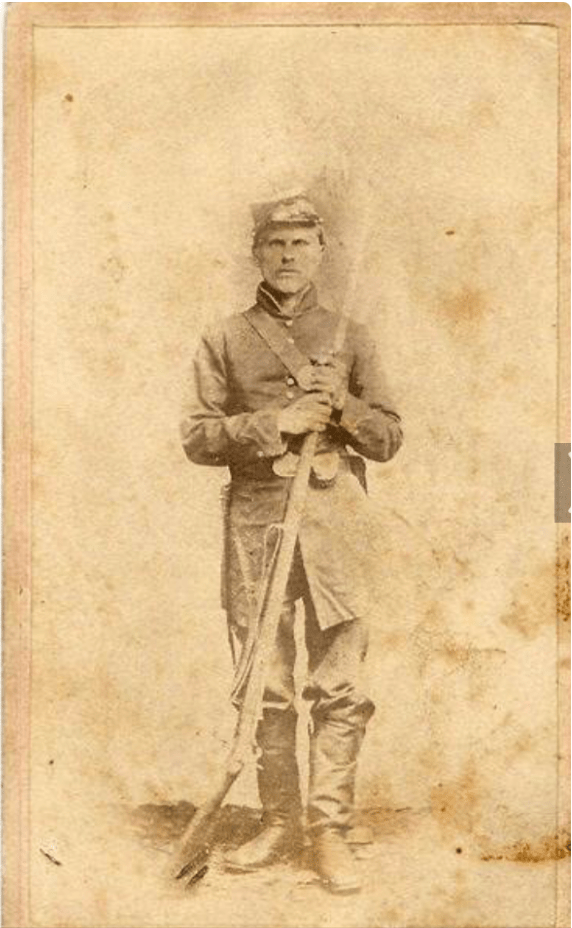
I could not find an image of Abram but here is Pvt. John Gotlieb Weckel of Co. A, 93rd OVI (Collection of Nancy Weckel)

The 93rd Ohio Infantry was organized in the fall of 1862 and was ordered to Kentucky and afterwards to Nashville. It participated in the battle of Stone River with severe loss, and also in the battle of Chickamauga, where it charged a Rebel battery and captured all the guns. During the engagement on Saturday the Regiment lost 124 officers and men. On Sunday it expended one hundred rounds of ammunition per man, killing 300 Rebels in its front. In November the Regiment assaulted Mission Ridge and afterwards moved to East Tennessee. In May, 1864, it joined the Atlanta campaign, fighting at Buzzard’s Roost, Resaca, Dallas, Kenesaw and Atlanta. After the fall of Atlanta it joined General Thomas’ army in Tennessee and engaged the enemy at Nashville. It followed in the pursuit of Hood to the Tennessee River, then went into camp at Huntsville. In March, 1865, the Regiment marched into East Tennessee, then to Ashville, N.C., then returned to Nashville, where it was mustered out June 8, 1865.

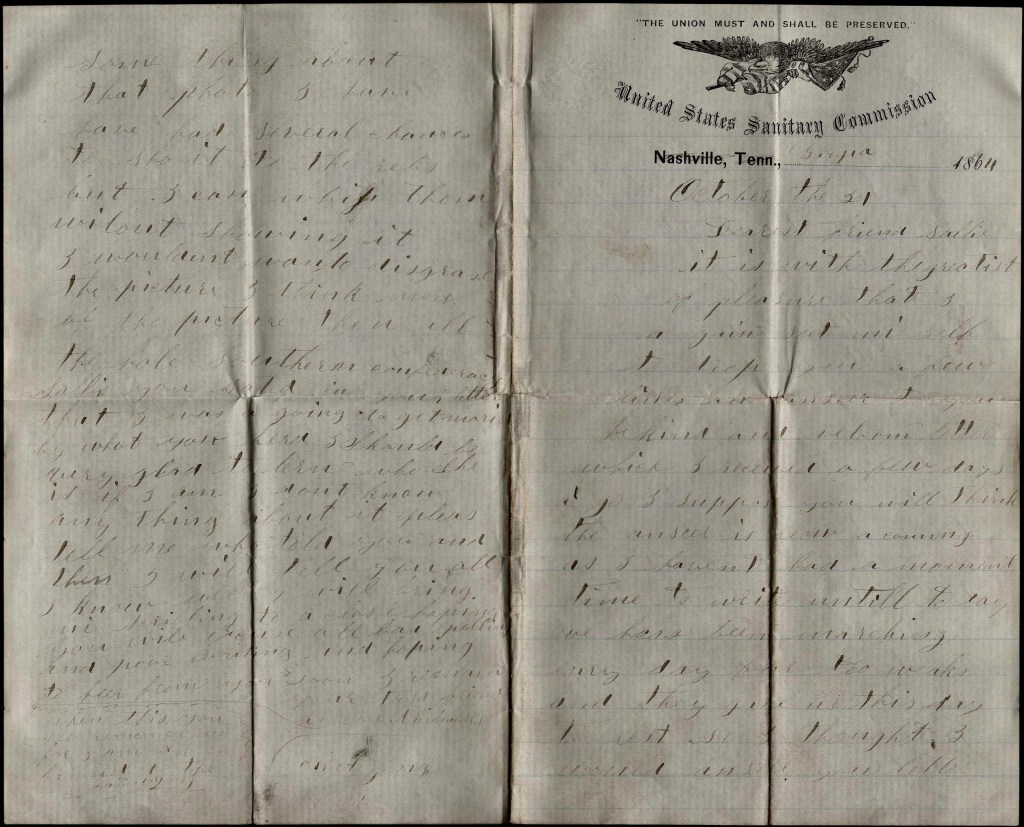
Transcription

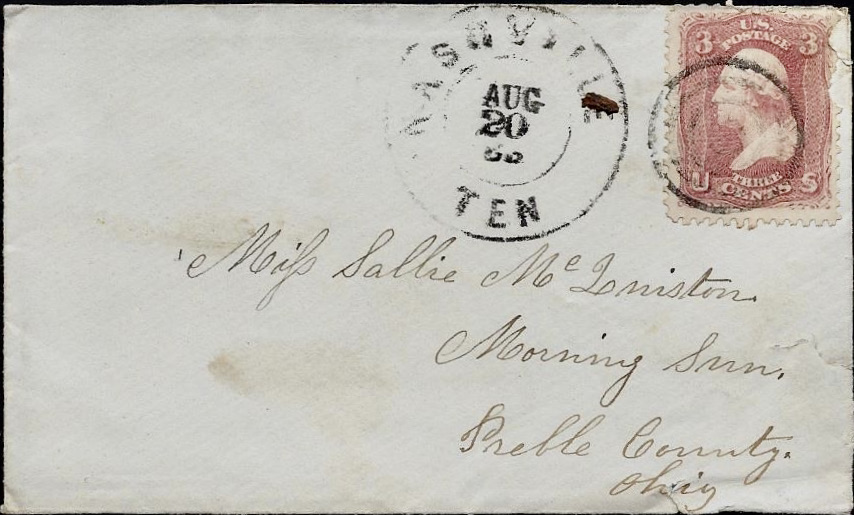
Addressed to Miss Sallie A. Young, Camden, Preble county, Ohio

[Somewhere in] Georgia
October 21, 1864

Dearest friend Sallie,

It is with the greatest of pleasure that I again seat myself to drop you a few lines in answer to your kind and welcome letter which I received a few days ago. I suppose you will think the answer is slow a coming as I haven’t had a moment’s time to write until today. We have been marching every day for two weeks and they give us this day to rest so I thought I would answer your letter.

“I can’t help but pity the innocent for they can’t help what the guilty does, let me tell you. The Union people has to suffer in this country. The rebs has no mercy on them.”

–Abram Eikenberry, Co. H, 94rd OVI, 21 October 1864

Sallie, I will tell you that I saw one of the most pitifullest things I ever saw since I’ve been in the army. I stopped at a house yesterday as I passed along and saw an old lady and three little children. One of the little children was crying and I asked it what was the matter. It said they had nothing to eat. The old lady said the rebs has taken everything they had to eat. All the flour they had was taken. I give them half of what I had and several of the boys divided with her. The little children eat just like if they haven’t had anything for a week. I can’t help but pity the innocent for they can’t help what the guilty does, let me tell you. The Union people has to suffer in this country. The rebs has no mercy on them.

While we was at Atlanta, the rebs got between us and Chattanooga and destroyed 25 miles of the railroad, It stopped our communication. We fell back and fought over the same ground where they got whipped bad once before and this last time they lost six hundred dead on the field besides the wounded, It is no trouble for us to whip them, We can whip three to one and have done it more than once.

Something about that photo. I have had several chances to show it to the rebs but I can whip them without showing it. I wouldn’t want to disgrace the picture. I think more of the picture than all the whole Southern Confederacy.

Sallie, you stated in your letter that I was a going to get married by what you heard. I should be very glad to learn who she is if I am. I don’t know anything about it. Please tell me who told you and then I will tell you all I know.

Well, I will bring my scribbling to a close hoping you will excuse all bad spelling and poor writing and hoping to hear from you soon. I remain your true friend as ever, –A. Eikenberry

When this you see, remember me.
1863: Roger Hannaford to his Niece

The following letter was written by Roger Hannaford (1804-1882), a native of Devon, England, who emigrated to the United Stated on 1844, settling in Hamilton, Butler county, Ohio. Roger and his wife, Mary Northcott (1810-1852) were married in Devon, England, and had at least nine children before her death in 1852, her last born being Robert (“Bob”) Hamlyn Hannaford (1843-1870) who was a year old when the family sailed to the United States. In 1880 he moved to Marion, Kansas, which is where he died. In the 1860 US Census, Roger was enumerated as a widower farmer in St. Clair, Butler county, Ohio.

In Roger’s letter to his niece he refers to a letter received from his son Edwin (“Win”) Augustus Hannaford (1841-1915), a quartermaster sergeant in the 6th Ohio Infantry. It was written shortly after the Battle of Chickamauga that took place on 19-20 September 1863 and conveys the sad intelligence that the youngest of Roger’s sons, “Bob”—a private in Co. C, 93rd Ohio Infantry—was wounded in the battle and taken prisoner by the Confederates. The details of Bob’s captivity are not known but others in the 93rd who were captured at Chickamauga were taken to the Confederate prison at Danville, Virginia (see 1863: Isaac W. Newton to Sallie McQuiston). We know that he survived the war, however, and was discharged from his regiment on 3 November 1864. He married Mary Judith Coppage (1842-1915) and had one son before he died in 1870 of consumption (tuberculosis).

Ebenezer Hannaford (1840-1905)

Roger had another son who served with Win as a Corporal in the 6th Ohio Infantry. His name was Ebenezer Hannaford (1840-1905). After Ebenezer was mustered out of the regiment in 1864, he received a commission as Adjutant Lieutenant with the 197th Ohio Volunteer Infantry in April of 1865. He wrote several articles of his unit’s course during the war and had a couple of them published in Harper’s Magazine in 1863 and 1864. He published a few books after the war about his time in the service including: “The Story of a Regiment, Campaigns and Associations of the 6th Ohio Regiment (1868)” and the “Last Survivor (1904).” He died at his residence in Springfield, Ohio in 1905.

[Note: This letter was made available for transcription and publication on Spared & Shared by Kathy Nicholson by express consent. Kathy is the great- great granddaughter of Roger Hannaford.]

Transcription

Hamilton [Ohio]
October 5th 1863

My dear Lu,

Yours to your aunt Sarah has been received (that is to say your note). Herewith I send Maggie’s and Willie and Tykes’ photographs. I think they are good—especially Willie’s and Mary Lizzie’s. Your Grandmother received a note from Julia a day or two since (Saturday).

Robert Hamlyn Hannaford, Find-A-Grave

We received a letter from Win dated Chattanooga, 21st September. He was safe but poor Bob was wounded in the leg, and what is worse, is a prisoner, if alive. He was wounded on the 19th (Saturday). Poor dear boy. I fear I shall never see him more. Edwin tells me that his comrades offered to help him off the field. His reply was, “Join your company and never mind me.” He little expected a repulse but such was the case so that that part of the battlefield where he was lying was soon in possession of the rebels. No one knows his fate.

I can write no more. All well and all unite in kind love. Your affectionate Uncle, — Roger Hannaford

1863: Isaac W. Newton to Sallie McQuiston

I could not find an image of Isaac but here is a CDV of Pvt. John G. Weckel of Co. A, 93rd Ohio Infantry

This letter was written by Isaac W. Newton (1841-1863), the son of Asa Newton (1812-1880) and Lydia Cook (1812-1908) of Camden, Preble county, Ohio.

21 year-old Isaac enlisted on 9 August 1862 to serve three years in Co. G, 93rd Ohio Volunteer Infantry (OVI). The regiment was organized at Dayton, Ohio, and sent to Lexington, Kentucky, just in time to join the Union retreat back to Louisville due to the advance of Gen. Bragg’s army. The regiment remained at Lexington for a time and then marched to Frankfort, Kentucky. After manning the fortifications there for a few weeks, they were sent to Tennessee in time to participate in the Battle of Stones River where they were in the thickest of the fight.

Newton remained with his regiment until he was taken prisoner during the Battle of Chickamauga in September 1863. He died a couple of months later while a POW at Danville Prison. He is buried in the Danville National Cemetery in Plot E, grave 747.

Transcription

Addressed to Miss Sallie McQuiston, Morning Sun, Preble county, Ohio

Tullahoma, Tennessee
August 15, 1863

Friend Sallie,

I received your kind and welcomed letter of the 4th [on] the 13th and was glad to hear the news. Since my last letter to you I have moved my position somewhat. On the 4th, I resolved to go to my regiment. I got transportation and by 8 o’clock a.m. the next morning, I was aboard the cars going to Nashville. By 6:30 p.m. we arrived there to this place. We had a very pleasant trip. The next morning by 3 a.m. we were hurried up to get ready to go on.

We were marched down to the cars. Soon we moved off and had proceeded about 10 miles on the way when the train which we were on stalled as it was turning a curve. There was another train coming up in the rear and it did not see us in time to stop. It run into us demolishing five or six cars killing three guards that were guarding the train and wounding a number of others. There was several that was on the car that I was on jumped off and got seriously injured. For my part I thought it was as safe to remain on the car as to jump off.

After considerable delay we started on the way. Our trip lay through the Stone River battleground and the awful carnage is still visible. By dusk in the evening, I got to my company, found the boys with the exception of two or three getting along finely. Smith Hamilton was in the hospital at Tullahoma and was very low. Since then he has been sent to Nashville. At present John Whiteside is down here trying to get him home. I don’t know how he will succeed in the undertaking.

We have a good camp with plenty of water. Our duty is very light. I think we will move on before long. There is talk of us going down to Stevenson but this is only a rumor. Well as it is about time for taps for lights to be blown out, I will close promising to write more in the future. So no more but as ever remain your friend. Yours truly, — Isaac Newton

P. S. Direct your letter to Co. G, 93rd Ohio, Tullahoma, Tennessee. No more. — I. Newton