

Thomas Hannah, Jr. (1835-1865) was born 11 February 1835 in or near Montreal, Quebec, Canada. He was the first child of Thomas and Jane Hannah. There were 3 brothers and 1 sister. Thomas emigrated from Canada to Massillion, Ohio when he was quite young. He married Elizabeth Marshall in 1855 and shortly after their marriage moved to Belvidere, Illinois to join the Hannah family, who now resided there. The Hannah’s were farmers. In 1862, Thomas became a naturalized U. S. citizen. Thomas and Elizabeth’s first child died in infancy. Their second son Jesse was born in 1860, followed in 1862 by Thomas. This same year, Thomas joined the army for three years and was mustered out in 1865. From 26 January 1863 to 30 July 1864, he served as Ward Master at Adams Hospital in Memphis. He was wounded at Spanish Fort in 1865 and died October 22, 1865.
Thomas wrote these letters to 32 year-old Margaret Meseroll (1833-1934), a native of New Brunswick, Canada, with whom he became acquainted while working at the Adams Hospital in Memphis. “Maggie” served for two years and six months at Adams General Hospital No. 2 and Gayoso Hospital, Memphis, Tennessee, as a regular ‘Commissioned nurse,” hired by Mary Livermore under the auspices of the US Sanitary Commission. In her later years, Maggie recalled with horror the treatment of maimed soldiers carried into the hospital from the Sultana steamboat disaster. Maggie was married in 1866 to Sanford E. Hayes. She died in 1934 at the age of 101.
Thomas’ letters from Memphis were transcribed by his great, great grandson, Michael Bryan Fiske, and have been posted here: Civil War Letters from Memphis.
Letter 1
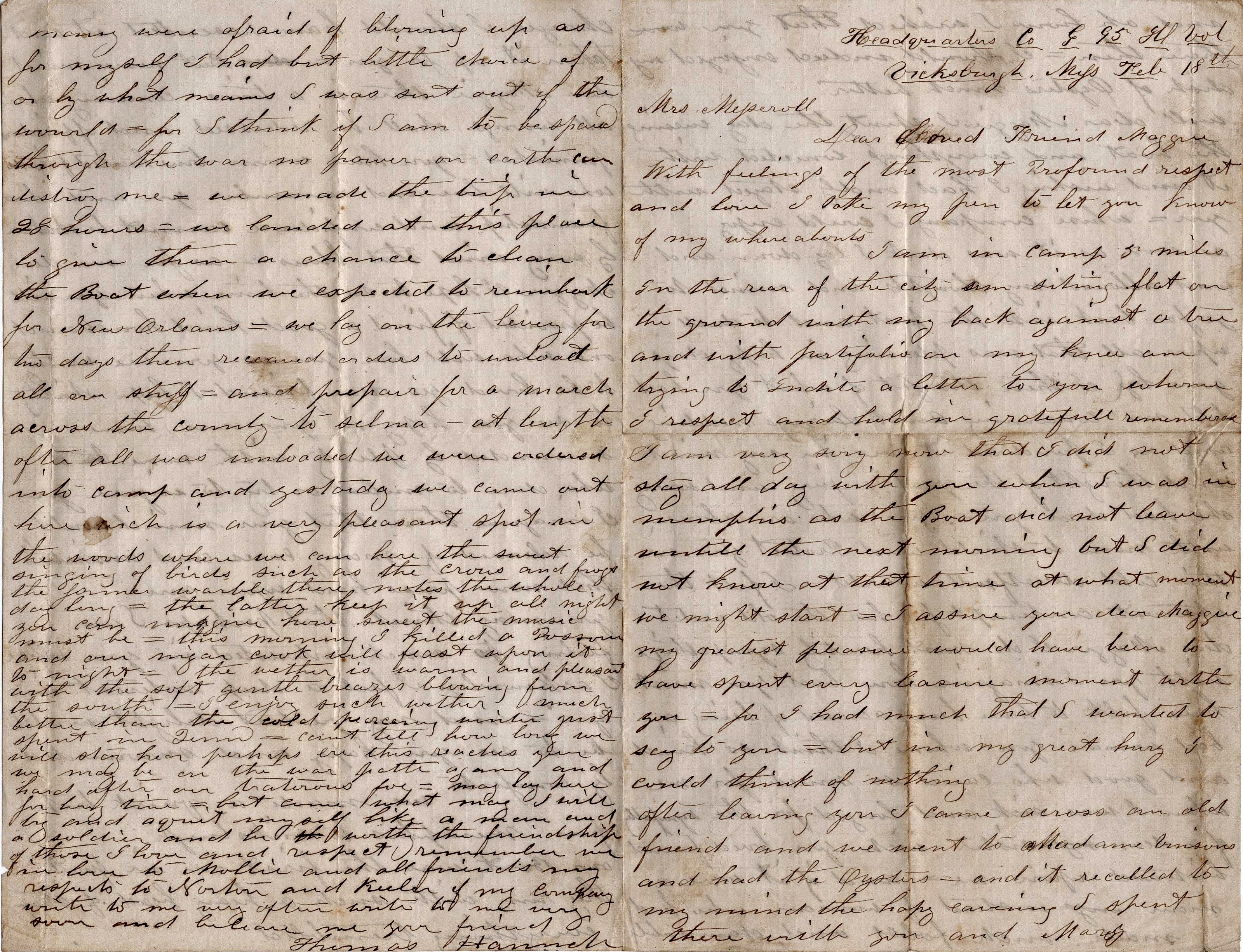
Headquarters Co. G, 95th Illinois Vols.
Vicksburg, Mississippi
February 18th [1865]
Mrs. Messerall,
Dear loved friend Maggie. With feelings of the most profound respect and love I take my pen to let you know of my whereabouts. I am in camp 5 miles in the rear of the city. Am sitting flat on the ground with my back against a tree and with portfolio on my knee. Am trying to write a letter to you whom I respect and hold in grateful remembrance. I am very sorry now that I did not stay all day with you when I was in Memphis as the boat did not leave until the next morning but I did not know at that time at what moment we might start. I assure you, dear Maggie, my greatest pleasure would have been have spent every leisure moment with you for I had much that I wanted to say to you. But in my great hurry, I could think of nothing.
After leaving you, I came across an old friend and we went to Madame Vinson’s and had the oysters, and it recalled to my mind the happy evening I spent there with you and Mary. And oh! how I wished that you were there then. I should indeed enjoyed my dish of oysters much better.
Well, dear Maggie, I spent the day cursing the boat and everything connected with it and wishing I had only stayed with you whose company I could enjoy. As soon as it was dark, I lay down and allowed my thoughts and mind to go far back into the past and to dwell upon all that was pleasing in happy days gone by (I then thought of what you had told me concerning Aunt Lizzey’s wedding and as I pondered it over in my mind and thought of the great injury and wrong she had drove you—you who are alone with none to shield and protect you in this cold, deceitful world—I felt the utmost contempt for her, the old wretch. Dear Maggie, I do most heartily sympathize with you. I imagine how bad you must have felt to have been accused of being a bad woman—you whom I think so kind and good who cared so much for me when I was sick and longed for the sympathy of a dear sister which you, loved friend, bestowed upon me. And if it were a man instead of woman who had made such false and damnable charges, I should have resented it and taken it up for you.
But never mind, dear Maggie. There is a time coming when all wrongs shall be redressed and offenders punished. You have warm, true-hearted friends who will live and remember you and whose friendship and confidence cannot be shaken by every wind that blows. As for me, dear Maggie, I hope to see the time when you will be provided of, find a good, kind husband—one who will love you as you are worthy to be loved. Yes, dear friend, I hope shortly to see you happy in your own home surrounded by plenty with none who dare to molest or try to injure you. I imagine then that your mind would be relieved of many cares and anxieties that now press hard upon you.
You may think that perhaps I am feeling too much interested in your welfare. I acknowledge I feel a deep interest in you and my greatest delight would be to see you happy and surrounded by comforts.
We made a quick trip from Memphis to Vicksburg. Our boat was the first one in port. They run with such a heavy head of steam [that] everything trembled. Many were afraid of blowing up. As for myself, I had but little choice of or by what means I was sent out of the world for I think if I am to be spared through the war, no power on earth can destroy me. We made the trip in 28 hours. We landed at this place to give them a chance to clean the boat when we expected to reembark for New Orleans. We lay on the levy for two days, then received orders to unload all our stuff and prepare for a march across the country to Selma. At length, all was unloaded. We were ordered into camp and yesterday we came out here which is a very pleasant spot in the woods where we can hear the sweet singing of birds such as the crows and frogs. The former warble their notes the whole day long. the latter keep it up all night. You can imagine how sweet the music must be.
This morning I killed a possum and our nigger cook will feast upon it tonight. The weather is warm and pleasant with the soft gentle breezes blowing from the south. I enjoy such weather, much better than the cold piercing winter just spent in Tennessee. Can’t tell how long we will stay here. Perhaps ere this reaches you, we may be on the war path again and hard after our traitorous foe. May lay here for a long time. But come what may, I will try and acquit myself like a man and a soldier and be worthy the friendship of those I love and respect. Remember me in love and respect. Remember me in love to Mollie and all friends, My respects to Norton and Keeler of my company. Write to me very often. Write to me very soon and believe me your friend, — Thomas Hannah

Letter 2
Camped in the Mud in a Sinking Condition
Near New Orleans, Louisiana
My loved friend,
As Amost Norton is writing to the hospital [Adams Hospital, Memphis], I embrace the opportunity with pleasure to send a few lines along to you, my dear friend. I wrote to you from Vicksburg giving you all the particulars up to that time.
We landed at this place the 22nd. It has rained ever since and no prospect of it stopping yet. We are camped on a low, flat plowed field that is now deluged with water. You have heard of the Louisiana low lands? Well here we are sitting in the mud with alligators, lizards, turtles, and other reptiles crawling around while the frogs are singing all round even in our beds and I am expecting every moment to see some monster of the deep poke up his head to pull me under.
This morning Norton and myself and three others thought we would lay in our beds as it was raining. We lay there till the water came in around us two inches deep. We then turned out in the storm. I looked around for some high spot to fly to for refuge but could see nothing but water. We then started for the woods, cut brush and trees to lay upon and keep us up. Norton asked me what you would think could you see us. I told him you would feel worse than we did ourselves. I know you would, dear Maggie. I am glad our friends cannot realize what we have to endure.
We do not expect to remain here long but expect soon to be out on the ocean sailing—the sooner the better. I was in hopes we would be paid at Vicksburg but am disappointed once more.
I have nothing more but mud to write about. I will bring my letter to a close by wishing to be remembered in love to Mollie and my friends at the Adams [Hospital]. Tell them to simply address their letters to the company and regiment for we are changing round so much we don’t know half the time to what army we belong. Tell Keeler of my company to hurry back to the regiment for I miss the rations he supplied me with when here. Hoping soon to hear from you, I hasten to subscribe myself your friends, — Thomas Hannah
to Miss Margaritte Meseroll, Gayoso Hospital, Memphis, Tenn.


 Spared & Shared 23