
The following letter was written by Benjamin Linton (1841-1903), the son Hezekiah Linton (1789-1858) and Elizabeth Hibbard Davis (1805-1886) of West Fallowfield, Chester county, Pennsylvania. Benjamin was working as a school teacher in Cochranville, Pennsylvania, where, at age 20, he enlisted in Co. B, 97th Pennsylvania Infantry. He reenlisted as a veteran at Fernandina, Florida on Mar. 15, 1864, to date Jan 1, 1864 and was wounded in the left hip during the action at Petersburg Mine (Battle of the Crater) on July 30, 1864. He was absent at muster out on account of wounds while in the U. S. Hospital at Hampton, Virginia, and was discharged at the hospital to date August 28, 1865.
He was working as a clerk in Philadelphia when he died of Brights disease in 1903. His widow was Rebecca (Roberts) Linton (1842-1933).
To read other letters by member of the 97th Pennsylvania Infantry, see: John L. Hosmer, F&S, 97th Pennsylvania (1 Letter)
Harvey Kauffman, Co. C, 97th Pennsylvania (1 Letter)
Isaac Smedley, Co. C, 97th Pennsylvania (1 Letter)
T R A N S C R I P T I O N
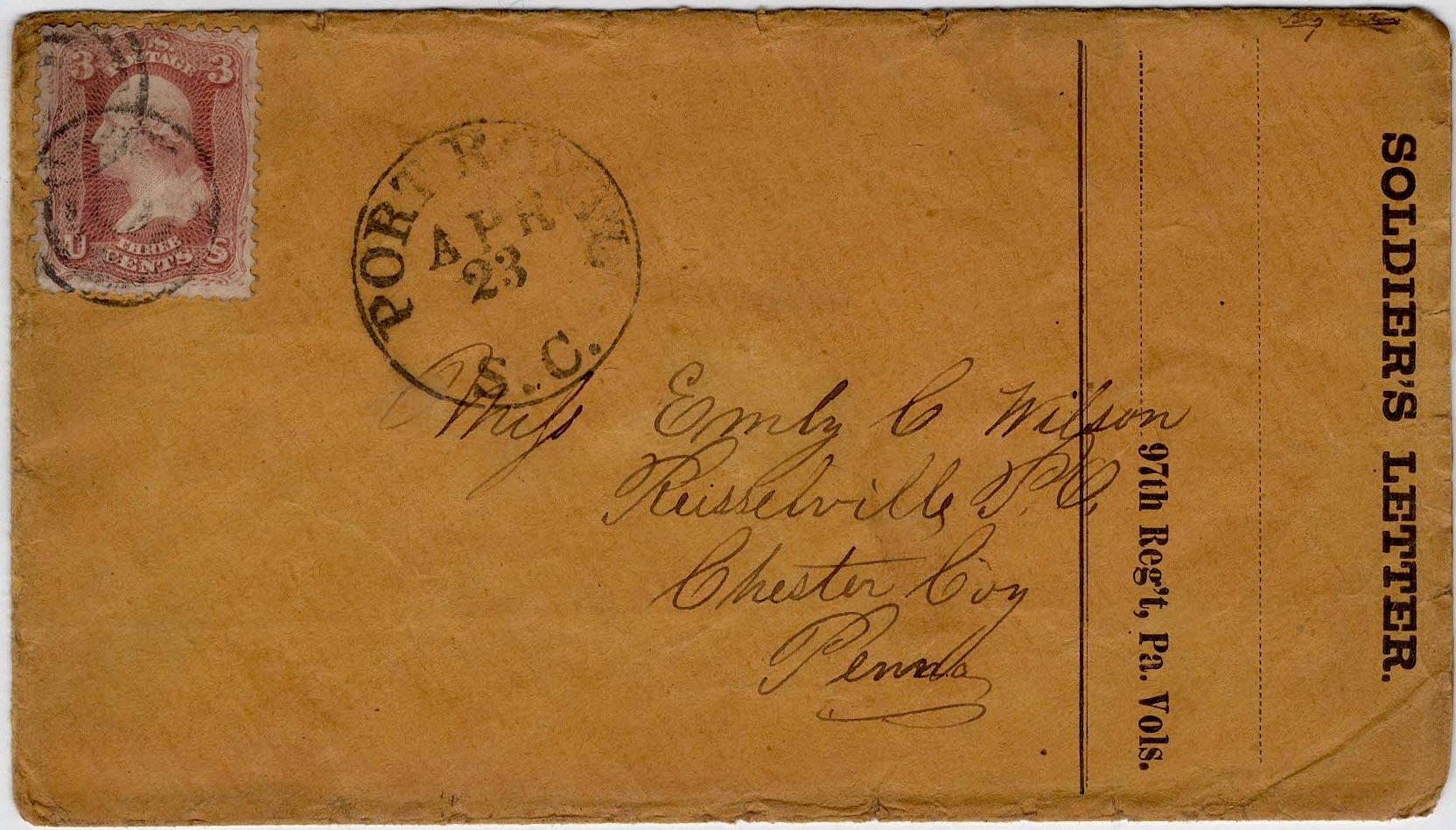
Jacksonville, Florida
April 7th 1862
Friend Emily,
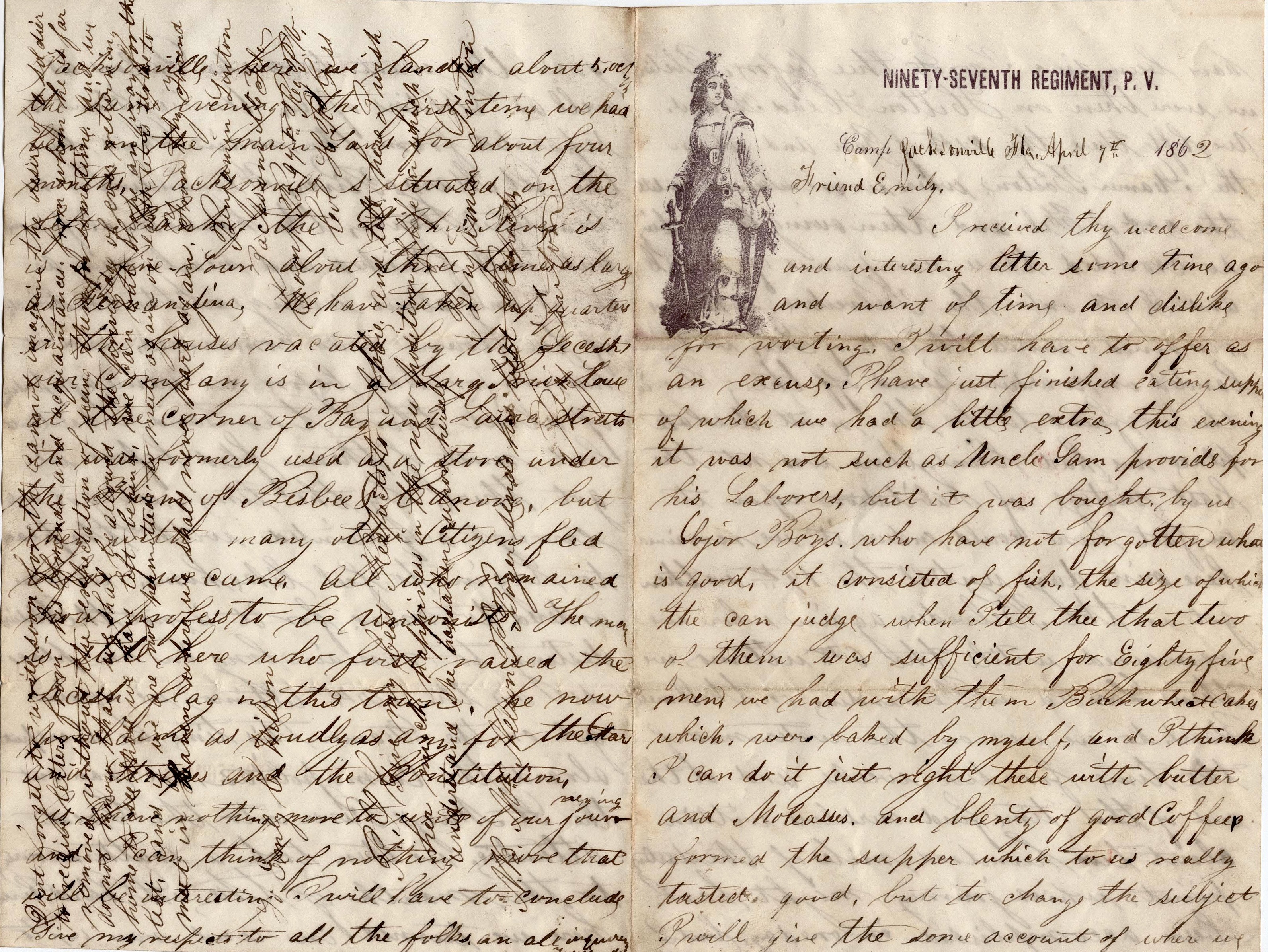
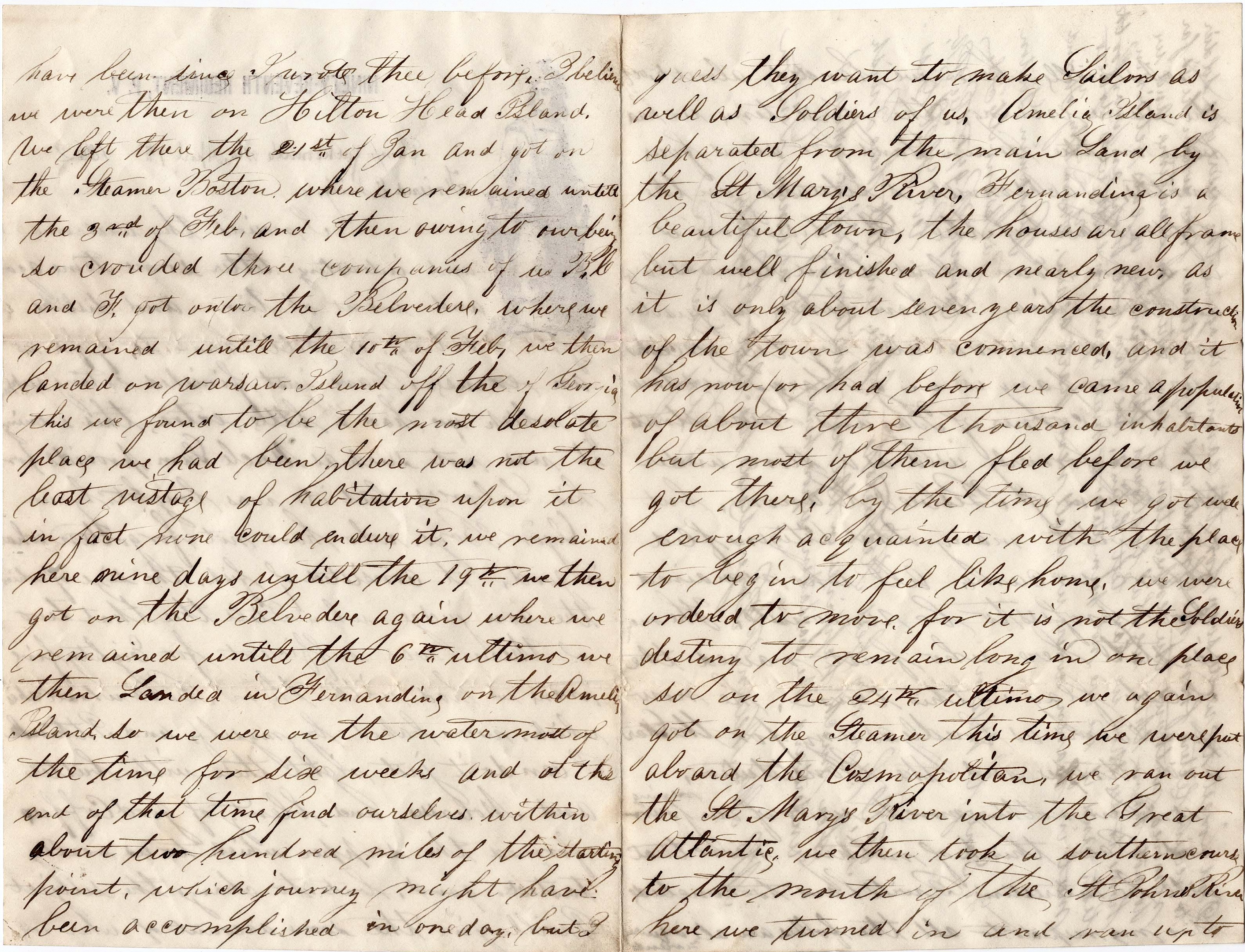
I received thy welcome and interesting letter some time ago and want of time and dislike for writing I will have to offer as an excuse. I have just finished eating supper of which we had a little extra this evening. It was not such as Uncle Sam provides for his labors, but it was bought by us Soger Boys who have not forgotten what is good. It consisted of fish the size of which thee can judge when I tell thee that two of them was sufficient for 85 men. We had with them buckwheat cakes which were baked by myself and I think I can do it just right. These with butter and molasses and plenty of good coffee formed the supper which to us really tasted good. But to change the subject I will give the same account of where we have been since I wrote before.
I believe we were then on Hilton Head Island. We left there the 21st of January and got on the Steamer Boston where we remained until the 3rd of February, and then owing to our being so crowded, three companies of us, B, C, &F, got onto the Belvedere where we remained until the 10th of February. We then landed on Warsaw Island off the Georgia [coast]. This we found to be the most desolate place we had been. There was not the least vestige of habitation upon it. In fact, none could endure it. We remained here nine days until the 19th. We then got on the Belvedere again where we remained until the 6th ultimo. We then landed in Fernandina on the Amelia Island, so we were on the water most of the time for six weeks and at the end of that time find ourselves within aboyut two hundred miles of the starting point, which journey might have been accomplished in one day. But I guess they want to make sailors as well as soldiers of us.
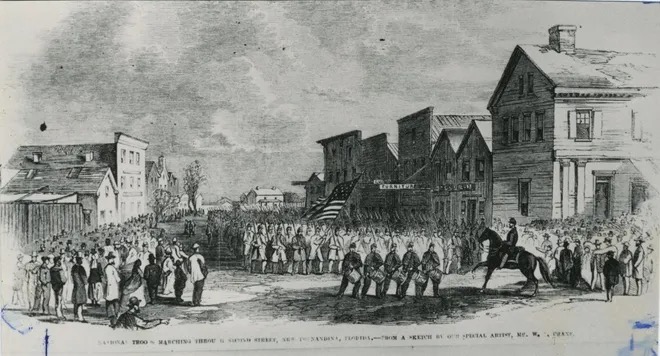
Amelia Island is separated from the mainland by the St. Mary’s River. Fermandina is a beautiful town. The houses are all frame but well finished and nearly new, as it is only about seven years [since] the construction of the town commenced and it has now (or had before we came) a population of about three thousand inhabitants. But most of them fled before we got there. By the time we got well enough acquainted with the place to begin to feel like home, we were ordered to move for it is not the soldier’s destiny to remain long in one place. So on the 24th ultimo, we again got on the Steamer. This time we were put aboard the Cosmopolitan. We ran out the St. Mary’s River into the great Atlantic. We then took a southern course to the mouth of the St. John’s River. Here we turned in and ran up to Jacksonville. Her we landed about 5 o’clock the same evening—the first time we had been on the mainland for about four months.
Jacksonville is situated on the left bank of the St. John’s River. It is a fine town—about three times as large as Fernandina. We have taken up quarters in the houses vacated by the Secesh. Our company is in a large brick house at the corner of Bay and Laura Streets. It was formerly used as a store under the firm of Bisbee & Canove, but they with many other citizens fled before we came. All who remained now profess to be Unionists. The man is still here who first raised the Secesh flag in this town. He now proclaims as loudly as any for the Stars & Stripes and the Constitution. As I have nothing more to write of our journeying and I can think of nothing more that will be interesting, I will have to conclude. Give my respects to all the folks and all inquiring friends.
Don’t forget to write soon for thee cannot imagine the desire of a soldier to receive letters from his friends and acquaintances from whom he is so far ermoved without the expectation of seeing them for some time. And we do not know that we shall be allowed the privilege of ever returning home to see those we have left behind. We can but hope and pray for the best. And if we are not permitted to meet again on earth, let us meet in heaven where we shall never part again. From your friend, — Benjamin Linton
Camp 97th Reg. P. V. Col. H[enry] R. Guss
P. S. Give my best respects to Abbie and tell her I wish her much happiness in the new position of life in which I understand she has taken upon herself. — Benjamin Linton
N. B. Mr. Nelson Boyer sends his best respects.




 Spared & Shared 23