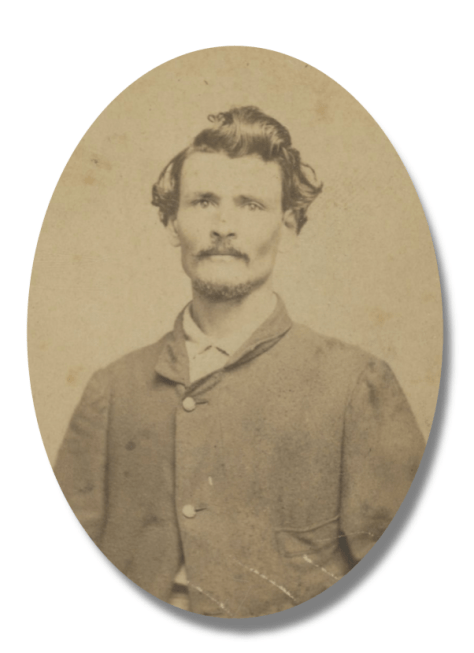
I could not find an image of Calvin but here is one of William G. Sallee of Co. H, 9th Iowa Infantry (Iowa CW Images)
This letter was written by Calvin McGowan (1838-Aft1880) who enlisted as a private in Co. B, 9th Iowa Infantry on 12 August 1861. He mustered out of the regiment 3 years later on 24 September 1864 at East Point, Georgia.
Calvin was the offspring of English emigrants Archibald McGowan (1790-1858) and Hannah Weimer, who settled in Muddy Creek in Butler County, Pennsylvania, where Calvin was raised. According to the 1860 US Census, Calvin was residing in Fairview, Jones County, Iowa, where he was listed within the household of William McGowan, likely an elder sibling who had established his own family. In that same year, he was appointed postmaster of Fairview. Following the conclusion of the war, Calvin returned to Fairview, where he took up the profession of a mercantile agent.
T R A N S C R I P T I O N
White County, Arkansas Camp near [Little] Red River May 25, 1862
Dear Cousin,
With pleasure I again sit down to write you a few lines to let you know that I am well at present and hope these few lines may find you and all the rest she named. It has been some time since I have heard from you but I think it is on account of our mail not coming regular. I hope you will continue writing to me while the war lasts. Nothing gives me more comfort than to hear from you and the boys that enlisted around Old Muddy Creek [Pennsylvania]. I am a thinking that they will have something to do before long at Richmond, Va. if the papers tells the truth.
We are on our way to Little Rock about fifteen thousand in all of us. We are sixty miles from Little Rock at present. We would of been about there now but it has been raining for the past week and the Little] Red River is so high we can’t get across. We have been laying in camp one mile from the river for four days waiting on the river to fall. It is about one hundred and fifty yards wide and twenty feet deep. There is about one thousand rebels four miles on the other side of the river commanded by Coleman. We had a small fight with them. There was none of our men engaged in it. [see Skirmish at Little Red River (May 17, 1862)]
Only one part of one regiment under [Franz] Sigel’s command. Sigel’s Division [Army of the Southwest] was at the river some five or six days before the rest of the troops came up. The river was not high at that time [and] part of one of his regiments went across the river. They had built a bridge across to go a foraging when they was attacked by the enemy about one thousand strong. We had thirty-one men killed and the number wounded I can’t tell you. The bridge they built has since went away and we can’t cross till the water gets lower. The rebels say they will kill more of us before we get to Little Rock than they did at Pea Ridge. We will give them a chance in a few days once we cross this river.
We started on this march the sixth of April. We have marched three hundred and forty miles. When we started, we was about twelve miles from Pea Ridge. I must tell you we have come through a God forsaken country. I seen but few places that was fit for a white man to live. If all the southern states is like Missouri and Arkansas, I want to see no more of them for in seeing, you can behold nothing.
I must close this subject. I must say, the weather is very warm at present. Apples and peaches is about one third the size. When you receive this letter, write soon. Let me know all the news about the boys that left their women to fight for their country. Let me know what is going on about home and what has taken place. Give my love to one and all. Be sure and write. Yours truly, — Calvin McGowen
The following letter was written by Calvin McGowan (1836-1892), the son of Archibald McGowan (1790-1858) and Hannah Tebay (1799-1870) of Fairview, Jones county, Iowa. According to regimental records, Calvin mustered into Co. B, 9th Iowa Infantry as a private on 27 September 1861 and mustered out three years later on 24 September 1864 when his term expired.
John Willard Niles was a sergeant in Co. B, 9th Iowa Infantry and was promoted to Lieutenant in 1863 and Captain in 1865. (Image from eBay)
“The last company was mustered September 24, 1861, and, two days later, the regiment, with an aggregate strength of 977 officers and enlisted men, was embarked on steamboats at Dubuque and transported to St. Louis, and, upon its arrival there, marched to Benton Barracks, where it received it first supply of arms, clothing and camp equipage. Here it remained until October 11th, receiving such instruction in military drill as could be given in so short a period of time. It was then ordered to proceed to Franklin, Mo., at which Place regimental headquarters were maintained, while companies were detached to different points for the purpose of guarding the railroad from Franklin toward Rolla, Mo. During the three months in which the regiment remained upon this duty, it suffered greatly from exposure to the inclement winter weather, and, like all new regiments, was subjected to much sickness on account of such exposure. On the last day of the year 1861, the official returns showed a death loss of 17, and 7 discharged on account of disability, total 24; but on the same date it had gained 38 by additional enlistment, and 4 by transfers making a net gain of 18, and an aggregate of 995. Of this number however many were on the sick list, and the hardships which the regiment was called upon to endure, during the active winter campaign which followed, still further reduced its fighting strength, and when it first went into battle it numbered but little more than half the aggregate above stated. January 21, 1862 the regiment was again consolidated, the companies on detached duty having been relieved, and was conveyed by rail to Rolla, Mo., and from there begins its first real campaign against the enemy. Marching to Lebanon, Mo., it joined the Army of the Southwest commanded by General Curtis. Colonel Vandever was placed in command of the brigade to which his regiment was attached, leaving Lieut. Col. Frank J. Herron in command of the regiment.
Upon the approach of the Union forces, the rebel General Price evacuated Springfield, which he had occupied during the winter, and began his retreat towards the Ozark Mountains. Then began that remarkable march of general Curtis’ army in pursuit of the enemy. The regiment started from Springfield on the 14th of February and, in less than one month, had marched over difficult roads, and much of the time through storms of alternating rain and snow, a distance of two hundred and fifty miles. Arriving at Cross Hollows, Ark., a detachment of three hundred of the regiment was sent upon an expedition to Huntsville, forty miles distant, with the purpose of surprising and capturing a detachment of the enemy stationed there as a guard for commissary stores; but, upon reaching Huntsville, they found the place abandoned, and learned that the rebel army under General Van Dorn was marching to the attack of General Curtis’ army, which had fallen back from Cross Hollows and taken up a new position at Pea Ridge. Realizing the danger of being cut off and captured by a superior force, the detachment of the Ninth Iowa at once started to rejoin the command and, after a continuous march of sixteen hours, covering a distance of forty-two miles, it reached the regiment at 8 P. M., March 6th. With only a few hours of rest after this exhausting march, these men went into the memorable battle of Pea Ridge at 10 A. M., March 7, 1862.”
Transcription
Camp Scott, Missouri January 14th 1862
Dear Cousin,
Your kind letter of the 4th of this month has come to hand. I was glad to hear from you and sorry too. It was about seven o’clock in the evening when I received your letter. We was all sitting around a good fire and singing some old familiar songs when I read over your letter. I was surprised to hear of so many deaths among my old relations, but we must all die sooner or later. We must all come to that end. I hope us all will be willing to go when that day comes for to meet that solemn hour.
I have not much to write at this time. Price still roams through this county seeking whom he may devour but I think we will soon devour him. Jim Lane has got a job of cleaning Price out. He is going to start in a few days on pursuit of Price. There is two Iowa regiments going with him. We may be one of them and we may not. I hope we will. There is thirty thousand going with him. They have to be picked regiments.
There was a fight a few days ago on Silver Creek not far from this place—a complete victory for the Union men. When our men come up on them, they were in line of battle. Our men was all cavalry men. They rode right up and broke their line and put them all to flight. There was four hundred of our men and eleven hundred rebels. We killed thirty and wounded about forty. We lost three men and thirty wounded. That is a true account of the Battle of Silver Creek [see Battle of Roan’s Tan Yard, 8 January 1862] We took sixty horses and a great many wagons and two wagon loads of powder. The Union men burnt the wagons and kept the powder.
There was ten thousand cavalry started from Rolla a few days ago. They started the course of Springfield. We have not heard from them since they left. Price has possession of Springfield—at least he had a few days ago. Since I have commenced this letter, we have got further news. We leave this place tomorrow morning at seven o’clock. That is the orders now. I can’t tell you where we will go yet. That is not known yet. I did not know this when I commenced this letter. The orders may be countermanded before morning. I hope it will not. Our regiment is well fitted out for service. We have twelve cannons. Some of them is 18-pounders. I hope they will say something before long and do something. I would like to hear them howl and [the] rebels too.
We had news a few days ago that the big fleet had started from St. Louis last week to Columbus, Kentucky. I will say in conclusion that our company has not lost a man yet but our regiment has lost thirty since we left Dubuque, all by disease. We have got the best regiment in the State of Missouri and our company is the best company in the regiment—Co. B. I think we will see fun in a few days. That is the opinion of the officers this night. The sooner the better. We have got the best of guns. They will shoot nine hundred yards.
I must close for this evening. You must excuse this letter for there was 18 men in the same shanty where I was trying to write and it is impossible for any man to write. This leaves me hearty and in good spirits. I hope it will find you all the same. Give my love to all enquiring friends. I hope to see you all someday. Be sure and write as soon as you get this letter. Yours truly, — Calvin McGowan
Address Pacific City, Missouri, 9th Regiment Iowa Infantry, Co. B. in care of Capt. ]Don A.] Carpenter
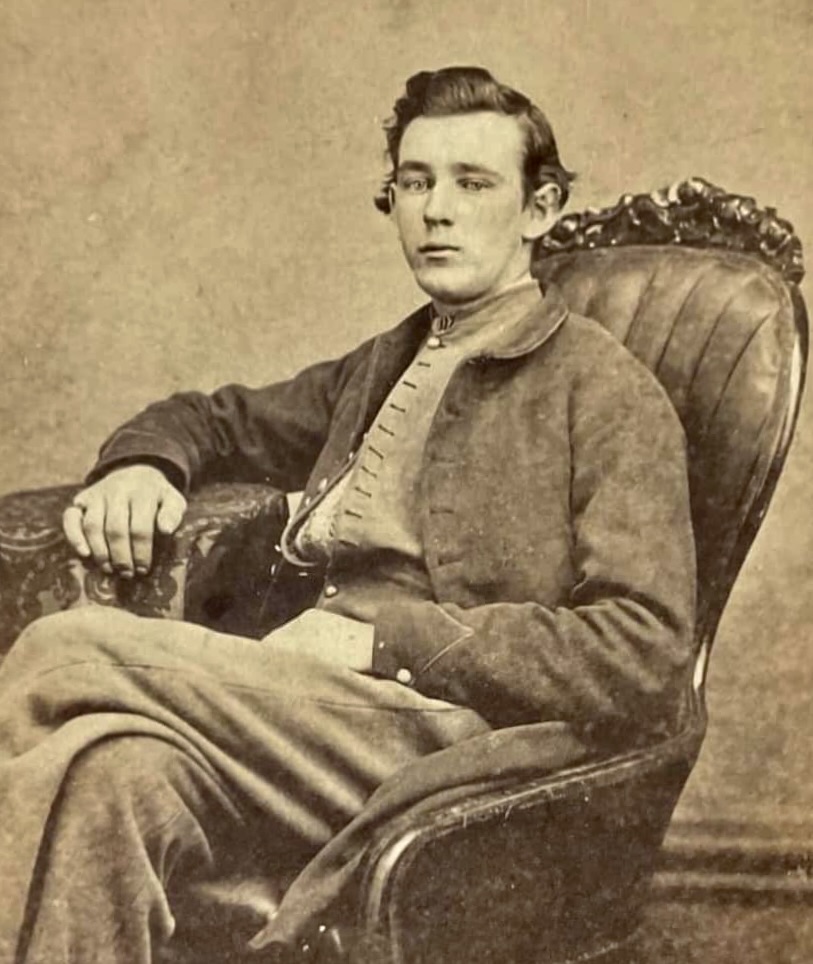
I could not find an image of James but here is one of Jerome H. Sessions who also served in Co. K, 9th Iowa Infantry. (Collection of Al & Claudia Niemiec)
The following letter was written by Pvt. James Knox Polk McCoy (1845-1862) of Tipton, Cedar county, Iowa, who enlisted on 14 September 1861 in Co. K, 9th Iowa Infantry and was killed on 7 March 1862 at the Battle of Pea Ridge, Arkansas. Although the muster records indicate that he was 18 years old at the time of enlistment, he was not. He was born in August 1845 so he would have only been 16 when he enlisted and when he died.
James was the son of George William McCoy (1814-1881) and Harriet Sarah Nye (1822-1906). He wrote the letter to his older sister, Laura Lavinia (McCoy) Willard (1841-1915). Laura was only 16 when she married James G. Willard, 13 years her senior, in 1857.
[Note: This letter is from the private collection of Mike Huston and was transcribe and published on Spared & Shared by express consent.]
“Thin Blue Line, Battle of Pea Ridge,” by Daniel Hoffbauer. The painting depicts the 9th Iowa in action north of Elkhorn Tavern, with Lt. Col. Francis Jay Herron on his horse. They suffered 35% casualties, the most of any Union regiment in the battle. Herron was wounded, caprured and received the Medal of Honor for his actions.
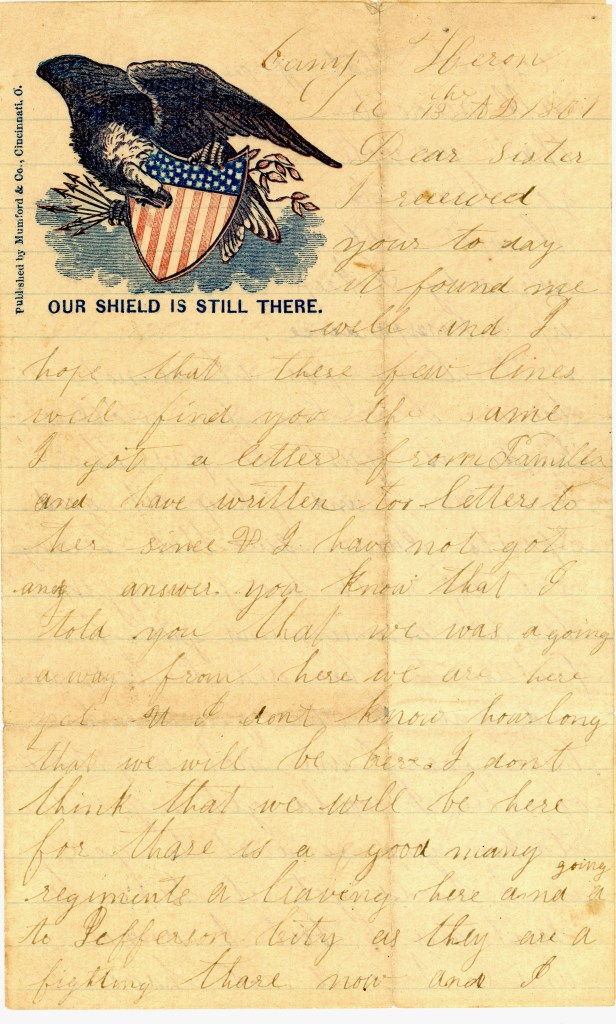
Transcription
Camp Herron December 13th 1861
Dear Sister,
I received yours today. It found me well and I hope that these few lines will find you the same. I got a letter from Pamela and have written two letters to her since I have not got any answer, You know that I told you that we was a going away from here. We are here yet. I don’t know how long that we will be here for there is a good many regiments a leaving here and a going to Jefferson county as they are a fighting there now and I expect that from all accounts that we will go there too.
I will tell you why I keep up a correspondence with Karen [?] for it not because I love her at all. I do it just to pass the time away and to keep up good spirits. I am sure that he may sit up with her from June to all eternity and give his picture to her and his body, soul and all, to her for what I care for I am not any beau of hers. I would get my picture taken and send it to you if I could get it taken to suit me but I cannot so I will not have it taken at all.
I am glad to hear that the money I sent has got home safe. I would like to see you all and I hope that the time will come when I may see you. Dear sister, I have no more to write at present. You needn’t say anything about what I have said and I trust that you won’t.
It is very warm down here now. Your affectionate brother, — J. K. P. McCoy
to Laura L. Willard
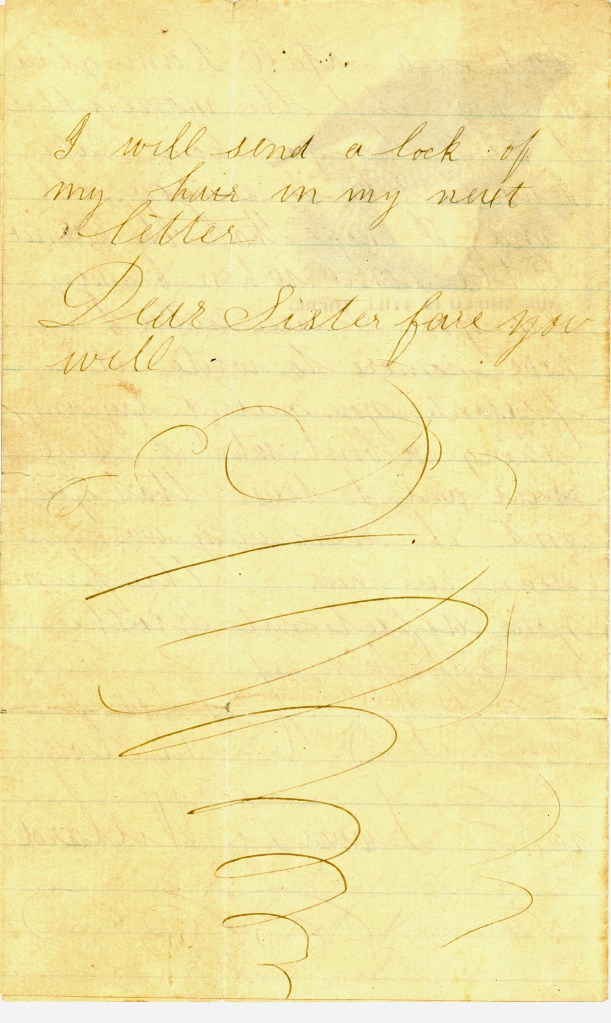
I will send a lock of my hair in my next letter. Dear sister, fare you well.
The following letter was written by Theodore Norton Hyde, the son of Ambrose Hyde (1814-1899) and Eunice Ann Lewis (1819-1900) of Quasqueton, Buchanan county, Iowa. The couple were married in 1841 and made their way west to Iowa by 1853. Theodore enlisted with Co. C, 9th Iowa Infantry on 25 September 1861 and served with his regiment until he was killed in the fighting on Missionary Ridge on 25 November 1863.
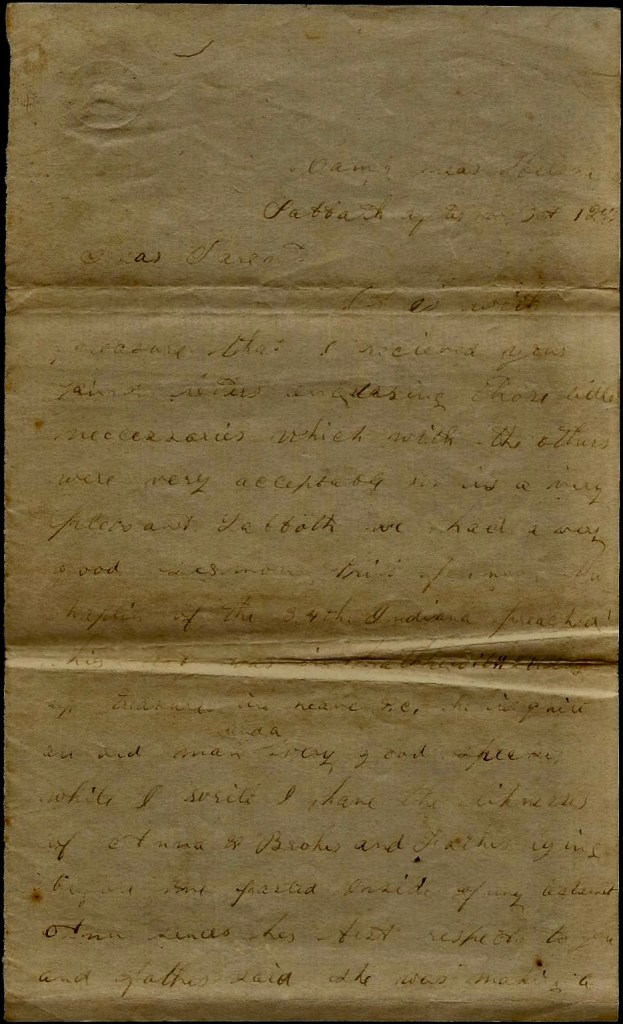
Camp near Helena Sabbath afternoon, October 12th, 1862
Dear Parents,
It is with pleasure that I received your kind letters enclosing those little necessaries which with the others were very acceptable. It is a very pleasant Sabbath. We had a very good sermon this afternoon. The Chaplain of the 34th Indiana preached. His text was [illegible due to fold] …up treasure in heaven, &c. He is quite an old man and a very good speaker. While I write, I have the likeness of Anna and Brother and Father lying before me pasted inside of my [ ]. Ann sends her best respects to you and father. Said she was making a present for Franky.
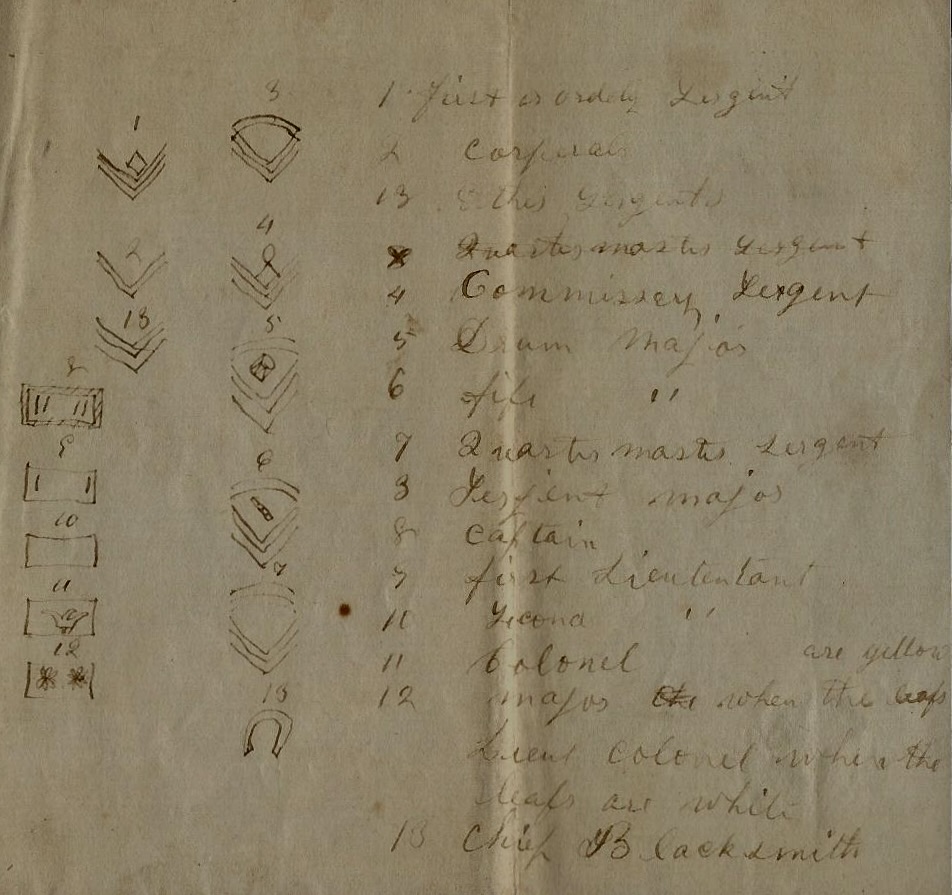
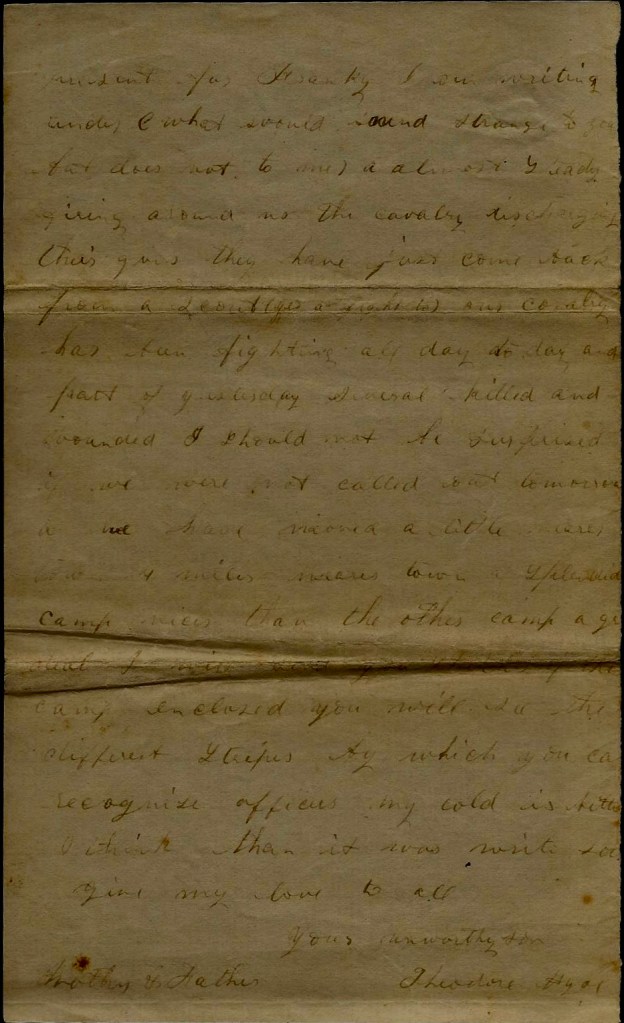
I am writing under (what would sound strange to you but does not to me) an almost steady firing around us. The cavalry discharging their guns. They have just come back from a scout (yes, a fight too). Our cavalry has been fighting all day today and part of yesterday. Several killed and wounded. I should not be surprised if we were not called out tomorrow as we have moved a little nearer town—4 miles nearer town. A splendid camp, nicer than the other camp a great deal. I will send you a sketch of the camp. Enclosed you will see the different stripes by which you can recognize officers. My cold is better, I think, than it was. Write soon. Give my love to all.
This incredible letter was written by 2nd Lt. John Hawthorn (1817-1882) of Fayette county, Iowa, who enlisted on 5 September 1861 as a sergeant in Co. F, 9th Iowa Infantry. He was promoted to 1st Sergeant on 11 March 1862, and finally to 2nd Lieutenant on 6 February 1863. He survived the war and mustered out on 31 December 1864 after making the march to Savannah, Georgia—a proud veteran of the Bloody 9th whose record of service was arguably unmatched by that of any other regiment in the state.
I could not find an image of John Hawthorn but here is one of John W. Niles who served with him in the 9th Iowa, first as a sergeant and then as captain of Co. B. (Photo Sleuth)
John was married to Hannah White (1825-1880) in Wiscassett, Maine, on 9 May 1848. In the 1850 US Census, he was enumerated as a farmer in Bloomingdale, Dupage county, Illinois. In 1860, John & Hannah had relocated to Westfield township, Fayette county, Iowa. In 1870, John and Hannah were living in Lodi (Maple Park), Kane county, Illinois, where he was employed as agent for the gas works. They were enumerated in the household of his father-in-law, Solomon White (1801-1879), a local merchant.
Hannah died in 1880 and John died in 1882; both are buried in Springfield Cemetery, Garnet, Kansas. Her grave marker bears the name, “Hawthorne” though the name has been found in records as Hawthorn, Hathorn, and Hawthorne.
Transcription
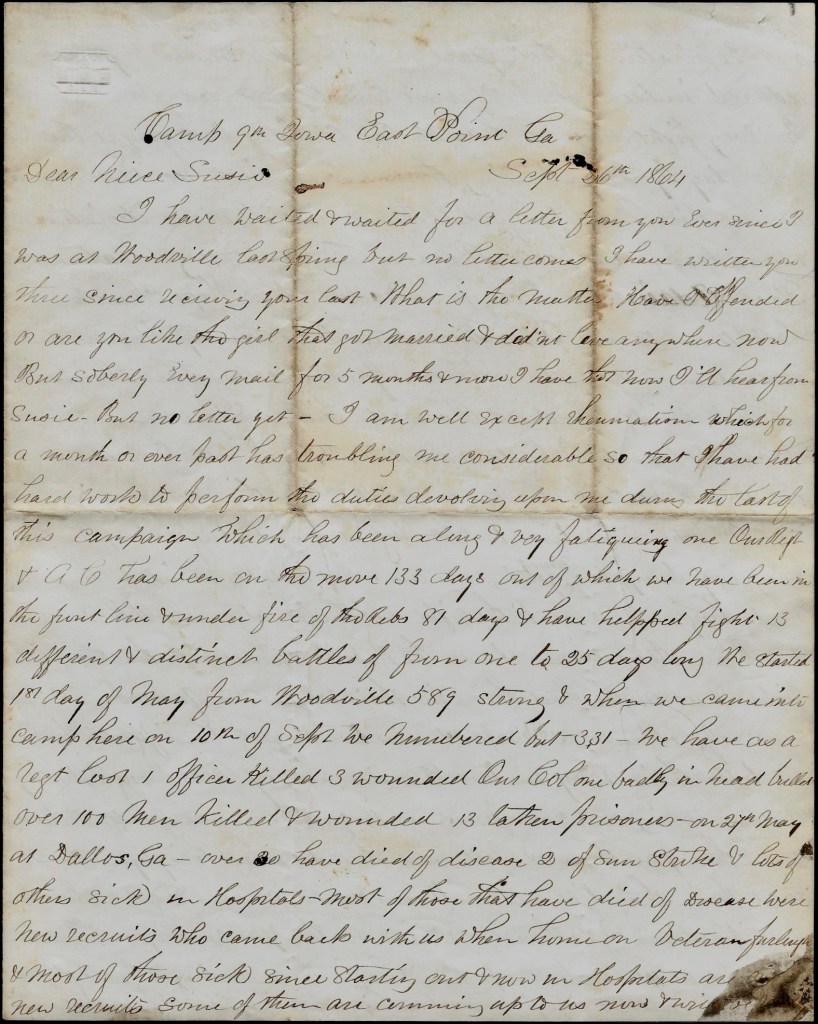
Camp 9th Iowa East Point, Georgia September 26th 1864
Dear Niece Susie,
I have waited & waited for a letter from you ever since I was at Woodville [Alabama] last spring but no letter comes. I have written you three since receiving your last. What is the matter? Have I offended or are you like the girl that got married & didn’t live anywhere now? But soberly, every mail for five months & now I have thought now I’ll hear from Susie—but no letter yet.
I am well except rheumatism which for a month or over past has [been] troubling me considerable so that I have had hard work to perform the duties devolving upon me during the last of this campaign which has been a long and fatiguing one. Our regiment & Army Corps has been on the move 133 days out of which we have been in the front line & under fire of the Rebs 81 days and have helped fight 13 different and distinct battles from one to 25 days long.
We started the first of May from Woodville 589 strong and when we came into camp here on 10th of September, we numbered but 331. We have as a regiment lost 1 officer killed, 3 wounded—our Colonel [being] one, badly [wounded] in head [by a] bullet; over 100 men killed and wounded, 13 taken prisoners on 27th May at Dallas, Georgia. Over 30 have died of disease—2 of sun stroke, and lots of others sick in hospitals. Most of those that have died of disease were new recruits who came back with us when home on Veteran’s furlough & most of those sick since starting out & now in hospitals are all new recruits. Some of them are coming up to us now & will be ready for the fall campaign. Yesterday, 112 non-veterans mustered out—expiration of three years on 23rd—so now we are very much reduced indeed. But what we have left are good grit.
An unidentified member of Co. E, 9th Iowa Infantry—a regiment much reduced after the Atlanta Campaign but those left were of “good grit.” (Dale Niesen Collection)
In every fight, siege, &c. have we—the [9th]—come off best, fought the Rebs day by day, driving them inch by inch as it were from Tunnel Hill near Ringgold, through all their various deviations & wanderings to Dalton, Resaca, Calhoun Ferry, Allatoona Pass, Adairsville, Kingston, Dallas, New Hope Church, Lost Mountain, Pine Mountain, Big Shanty, Kennesaw Mountain, Marietta, Nick-A-Jack Creek, Chattahoochie River at RR Bridge, and at Roswell. Then at Stone Mountain, Decatur & towards Atlanta on east 20, 21, 22 Peach Orchard & Creek, on west and north by Hooker on 20 & 21st too, then at Eutaw Church on 28th July from which time to 26th August we fought, dug, and sharpshot with [the Rebels] every day, every day almost getting someone in [our] regiment killed or wounded.
Then we made the flank move to the right, cut the Montgomery Railroad near Fairburn, then on 30th drove the Rebs 6 miles with three sharp little fights & at night had them in their works near Jonesboro 22 miles south of Atlanta 31st & September 1st were two days of hard fighting but we broke their army in two, 8 miles above Jonesboro near Rough & Ready Station, taking over 2,000 prisoners, 14 guns, and on the eve of September 1st, drove them through Jonesboro. [On the] 2nd, [we] followed them to near Lovejoy Station & held them there till all our teams could collect & get within the fortifications of Atlanta when on the 7th we began to fall back slowly & on the 10th, we brought up here and have been resting & fortifying &c. as best we could & enjoying ourselves hugely on hard tack and bacon. No fresh beef.
We have given the Rebs several good killings & they say that one more good large killing, or two small ones, would be all they could stand. Sheridan in the Shenandoah Valley is doing glorious work too. Old Farragut has acted well his part. Grant has fought some heavy and bloody battles though not with that success we had hoped for but we do not despair for him. He will hoe his row out yet, we believe, and compel Lee to cut bait or fish.
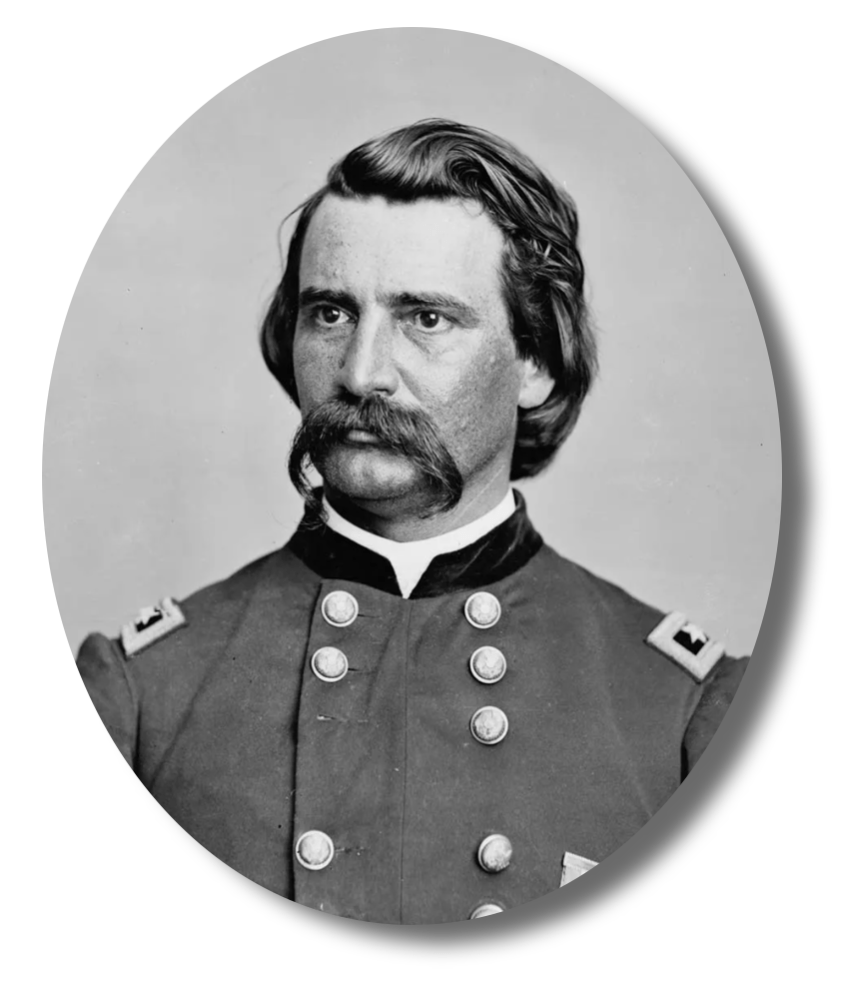
Gen. John “Black Jack” Logan, “Hold your fire till they come up snug & then kill them all, damn them!”
We got a report last night that Grant had had a blood fight & taken Petersburg but we hardly credit it as Grant was, the last we heard of him, looking after matters about Harpers Ferry. But we hope he may have [taken] Petersburg though we hope the loss as reported on our side may not be true of 30,000 killed, wounded, & missing & that Grant himself was mortally wounded. That would be an awful blow to the army. We would in that case fear you would be for taking our general away from us. We could illy afford to lose Grant, but to lose Sherman would cut us up bad, though we have a Thomas, a Howard, & then our Gen. John A. Logan who is a trump & loves to tread on secesh snakes of all varieties & says the best way to end the rebellion is to kill every Reb—North or South— we can get at as on the 28th July when the Rebs were charging our lines, charge after charge, & riding along our lines he [Logan] said, “They come, hold your fire till they get up snug & then kill them all, damn them! Kill every mother’s son of them! That’s the way to end the rebellion & take you home.
Now Sis, you have our moves &c. in a nut shell & soon we hope to crack the secesh shell & if extermination or the acknowledgement of their independence alone will secure peace, we hope to enrich their soil with their carcasses as at Decatur & Eutaw Church where we buried ourselves in front of our own Army Corps over 2400. In front of the 55th Illinois they buried 209 in two trenches—98 and 111. In our front we buried 97—one colonel, one major, 6 captains, and 11 lieutenants. They seemed determined on death or whipping us as Hood told them the 15th Army Corps was never whipped & it remained for them to do it or all was lost. But the 15th Army Corps still remains unwhipped & long may it remain.
We are having fine weather. All is cheerful and bright. Everything is being done that can be to put the army in fighting trim for a speedy campaign & vigorous one. The Rebs are playing hob with our hard tack line. Night before last they entered Marietta, tore up track, burned lots of supplies &c. carrying off report says quite a lot of our sick boys in hospital there & some few guards. They have been doing that kind of business for some time & this morning one division of our Corps & one battery have gone out there to attend to their cases.
I expect by & by to go home. Business calls for me loudly & I feel that I must go and I shall resign if I cannot get a furlough or leave of absence. So when you write me again, direct to Fayette, Fayette county, Iowa. I would I could go East this fall & see you all & father and mother J. but I will have to content myself with matters at home for awhile. Write me a long letter & tell me if you have been down to see the Dresden folks & how you are all going for President. I see you did nobly for Governor. May the whole Union follow your lead & put Lincoln & Johnson in the Chairs of State, that Rebels may howl & gnash their teeth for the tightening of Union measures & the downfall of their arrogant pride that “Lincoln should never rule over them, &c.”
Where is John &c. now all your good friends in your neighborhood. My love & regards to all who inquire after me so deal it as will suit best saving a good share of the first for yourself & tell Uncle G & Aunt I never got any letter from them yet & I would be right glad of a letter from your Aunt Elizabeth & will answer. Love to Aunt Baily & girls. Where is Uncle B. now? Are the Richmond folks & Aunt Polly? Do you go and see her often? I got a letter from Han & Sallie on inst. date, were well and very urgent for me to come now and stay there this winter and then I might come back but I feel that I am getting [too] old to sleep in mud and wet and cold, though I have stood it for over three years now & have not seen a day for the whole time but what I could do my duty though I have several times been somewhat under the weather.
Now dear Susie, if you wish to keep up correspondence all right & I’ll try to act my part & when I get home, I’ll get help now and then, but if other engagements take up your time & cannot afford your Old Uncle a little time to keep youth bright & life cheerful, all right. So do your best for self & I’ll try & live as long as I can see anybody & when we go under, may Jordan be crossed safely & by and by all meet where there is fullness of joy & pleasures forever more. And now goodbye. Ever be true to yourself, your country, and your God. Your uncle, — John










 Spared & Shared 23