The following letter was written by Eli Clemens Williams (1841-1921), the son of Aaron Williams (1800-1883) and Alcia L. Lane of Hiram, Oxford county, Maine. Muster roll records indicate that Eli enlisted in the 9th Maine Infantry as early as 17 July 1863 but this letter suggests that he did not get assigned to his company until he arrived in South Carolina several months later. He remained in the regiment until 13 July 1865 when he was mustered out of the service.
Eli’s letter provides us with a good description of the scenes and activity in Charleston Harbor in March 1864, including the rebels’ use of a 300-pounder gun called “The Bull of the Woods.”
T R A N S C R I P T I O N
Addressed to Mr. Simeon P. Lane, Brownfield, Maine
Morris Island [South Carolina] March 20, 1864
Dear Cousin,
I will take my pen in hand to remind you that I have not forgotten you and to let you [know] how I like soldiering. If I could have my heath, I should like it quite well now I am here but I do not admire the job of moving much. When we left Portland, we stopped four days on Long Island and there we almost froze and when we left we had a bad storm. we sailed 3 days and the captain told us that if he was back to Long Island again, he could get to Fortress Monroe as quick as from where he was. One day we blew 100 miles and only gained one mile ahead. Our little boat rocked very bad. The bunks all broke down and the water came in the gangway. Sometimes it would take a man off the stairs and duck him good. We was all seasick and our cabin was as neat as father’s pig pen. We got here in 9 days, 115 of us, and only lost one man. He was crazy and jumped overboard by night.
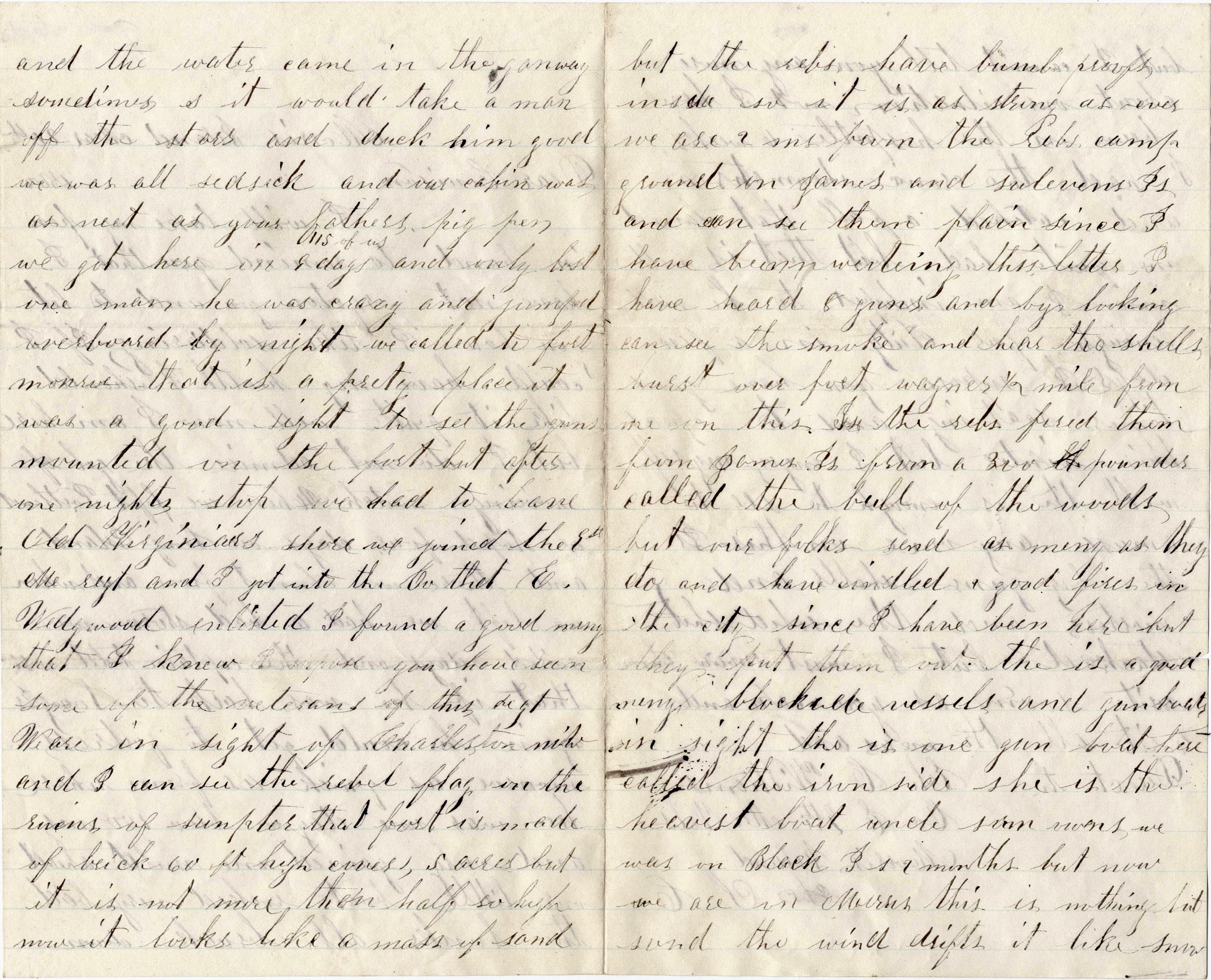
We called to Fort Monroe. That is a pretty place. It was a good sight to see the guns mounted on the fort but after one night’s stop, we had to leave Old Virginia’s shore. We joined the 9th Maine Regiment and I got into the company that E. Wedgwood enlisted. I found a good many that I knew. I suppose you have seen some of the veterans of this regiment. We are in sight of Charleston now and I can see the rebel flag on the ruins of Sumter. That fort is made of brick 60 feet high, covers 5 acres, but it is not more than half so high now. It looks like a mass of sand, but the rebs have bomb proofs inside so it is as strong as ever.
We are two miles from the rebs campground on James and Sullivan’s Island and can see them plain. Since I have been writing this letter, I have heard 8 guns and by looking, can see the smoke and hear the shells burst over Fort Wagner half mile from me on this island. The rebs fired them from James Island from a 300 pounder called the “Bull of the Woods” but our folks send as many as they do and have kindled a good [many] fires in the city since I have been here but they put them out. There is a good many blockade vessels and gunboats in sight. There is one gunboat here called the Ironside. She is the heaviest boat Uncle Sam owns. We was on Black Island two months but now we are on Morris Island. This is nothing but sand. The wind drifts it like snow but I cannot tell you anymore about our situation now.
I have been in the hospital six weeks. I had the chronic rheumatism and catched a fall that lamed me quite bad, but that is well now. I am in hopes to be well enough for duty in a few days. I suppose you have good times skating and to speces [?] this winter but I enjoy myself well. There is enough to see to amuse anyone in this place. The big guns, shells, and mortars and the solid shot stacked. But I must now close. Write soon as you can and write all the news and direct to Eli C. Williams, Co. E, 9th Maine Vols., Morris Island, S. C.
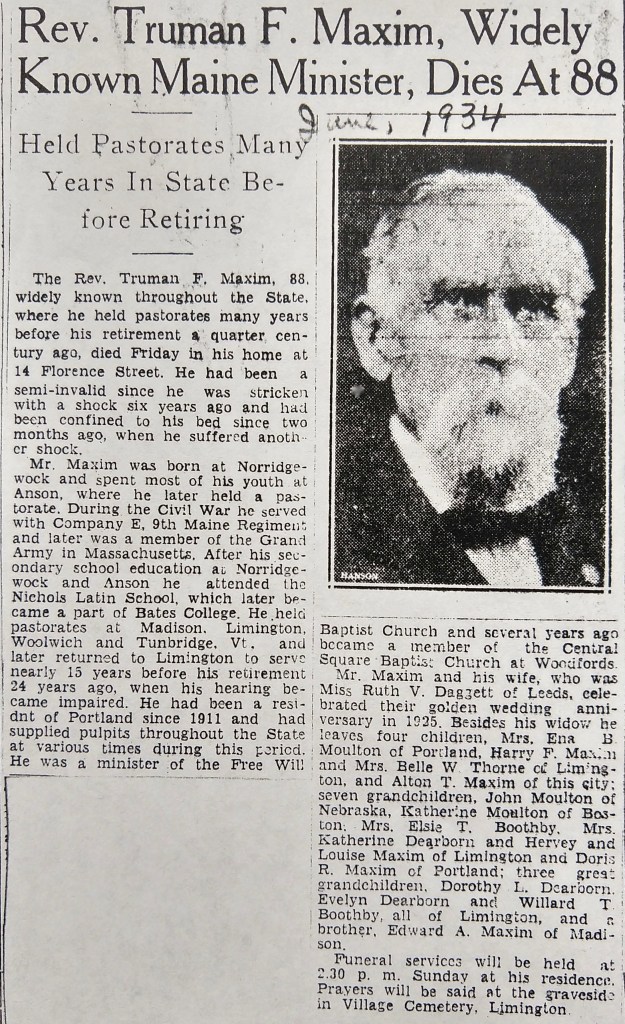
The following letter was written by Truman Francis Maxim (1845-1934), the son of Jesse Maxim and Louisa Pease (1810-1892) of South Norridgewock, Somerset county, Maine. Truman enlisted on 3 October 1864 as a private in Co. E, 9th Maine Infantry, enrolling himself as a substitute. He remained with the regiment until 13 July 1865 when he was mustered out, ten days after writing this letter.
Upon his return to Somerset County, he took up employment as both a blacksmith and a farmer for several years before ultimately becoming a Baptist minister. It is hoped that his perspective on race shifted toward a more positive stance as he adopted the teachings of Christianity. Truman’s description of the 4th of July celebration in 1865 was brief and racially biased: “It was celebrated mostly by the Negroes. The streets were blacker than a thunder cloud.” A more comprehensive description of the celebration can be found in an article based on a story in the NY Times of 14 July 1865. See “Eyewitness Account of the Joyous First 4th of July Celebration in Raleigh NC since Fort Sumter: A Contrast in Black and White.”
T R A N S C R I P T I O N
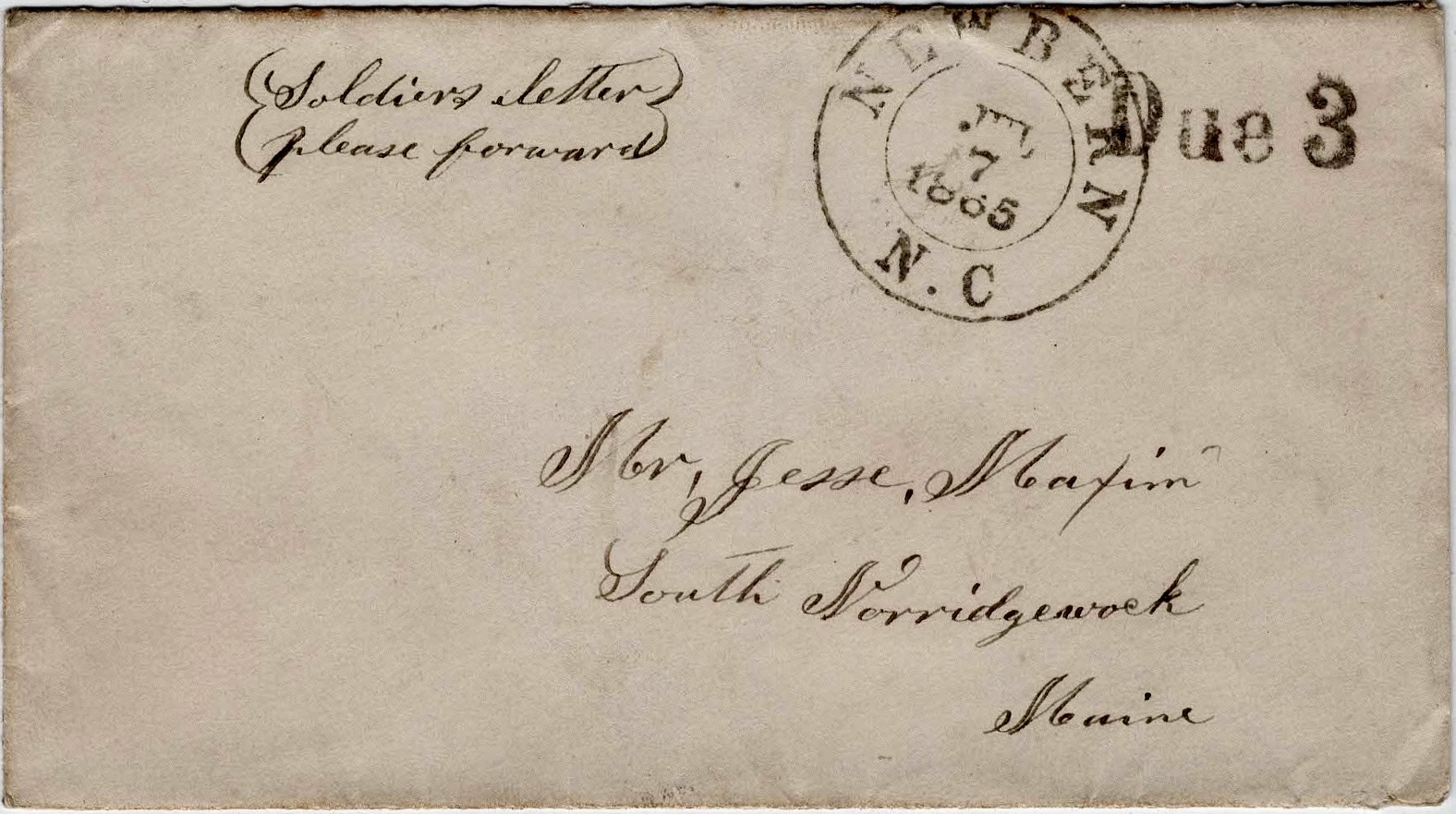
Addressed to Mr. Jesse Maxim, South Norridgewock, Maine
Raleigh, North Carolina Monday, July 3rd 1865
Dear Parents and Friends
I have just received your kind letter under date of June 25th and was glad to hear from you again and to know that you are all well. I got a letter from Leander today. He was well. The men whose time of service expired before October 1st started for home yesterday. It took near one half of the regiment. It is the talk that there is another order on the way to discharge all men whose term of service expires before the 1st of January next. If so, it will take me. But if they are as long about it as they were about discharging those other men, I shan’t get home much before my year is out for there is only three months more from today. I expect it will be the longest three months for most all of the boys that I was acquainted with have gone home.
Now, about Harrison’s picture, if you can have it painted perfectly, I should for my choice rather have it than to have the monument as long as his remains are not there. Would not you rather have his picture to look at every day if you want to that to have his name carved out in marble a way yonder in the grave yard and when you look at it can neither see his features and then think here is his name but oh, he is not here. No, I should rather have his face to view and then think, thou once wast [here] but have passed away.
I am glad to hear that Sophronia has gone forward in Baptism. I have written to her two times and have ot heard from her yet. I don’t know whether she neglects to write or don’t get my letters. Where does George keep himself and what is he doing? I have not had a letter from him since May 15th. I should write to him if I had some stamps. If you can send me some, I should be glad to have them as I have but three and Leander sent me two of them in his letter that I got today. I should think that Syrena had brought her pigs to a June market but perhaps I am no judge.
I am glad there is a Sabbath School started in neighborhood and hope it will do some good. I don’t think of much more to write. I suppose you will want to know how the Fourth of July is spent here so I will not send this until day after tomorrow.
Wednesday morning, July 5th
I will tell you about the 4th of July. It was celebrated mostly by the Negroes. The streets were blacker than a thunder cloud. They had just such a time as you might suppose that Negroes would get up with the exceptions of a little fire works just to please the negroes. I don’t know but what you will think I am coming down on the negroes pretty hard but I can’t help that. You know that I am one of these kind that speaks just what I think and when a General will issue and order not to allow an enlisted man in town without a pass signed by Brigade commander, I think it is time to talk. And if that is not enough, it is time to shoot. How circumstances will change in one year. One year ago yesterday I was home. This year I was in Raleigh and on patrol, acting sergeant of the day [even though] I am nothing but a private.
It is reported that the order to discharge all men whose term of service expires before the 1st of January has got to regimental headquarters. I don’t want you to make any calculation on my getting home before my time is out nor do I want you to worry about me but write often and I will do the same. I must close so goodbye at present. This from your son, — T. F. Maxim
I shall hve to send this without a stamp as I have but three and have two other letters to write and want to keep one on hand.
The following letter was written by Sgt. Isaiah Cushman (1825-1917) of Co. F, 9th Maine Infantry. He enlisted on 21 September 1861 and mustered out of the service on 27 August 1863.
Isaiah was the son of Levi Cushman (1778-1868) and Betsy Thompson (1787-1851). He was married to Barbara B. Erskine (1837-1922) in 1863 and resided in Abington, Plymouth county, Maine. Isaiah worked in the shoe manufacturing industry in Abington. During the Civil War, Abington was a major boot production center. More than half of the boots issued to Union soldiers during the war were made in Abington.
Letter 1
Hilton Head Port Royal Entrance, S. C. December 2, 1861
Dear Brother,
I received your letter this morning and hasten to write you. What shall I write you—I hardly know what. Mary is dead. Can it be? Shall we not behold that smiling face again on Earth? I can feel to weep with you that weep and to sympathize with you in the loss of a dear friend. What would you do now in your affliction if you did not believe she was with the Savior?
One of our number is taken from the Church of Christ. What is our duty now as professors of the followers of the meek and lowly Jesus. Oh! if I could live faithful and always be found at my post of duty. You have met with a great loss, but you do not mourn as those that lose friends that have no hope. You feel as though in a few short years at the most you will meet her in that world of bliss and glory.
You write let us be waiting to follow. Yes, that is it, dear brother. Live so as to meet our friends in Heaven. Oh what a happy thought. And I feel the need of the presence of my Savior here away from my earthly friends. But I believe that I hold communion with my God. We have some prayer meetings in our tents. We have no chaplain. It is a disgrace to the Pine Tree State. But we can meet our Savior at all times and in all places. The poor as well as the rich can partake of the waters of life freely.
My dear brother, I wish I could write you a good letter but I cannot. I could not if I had a good opportunity. We have to be called so often that I am confused so you will excuse me. Tell Charles W. that I will attempt to answer his kind letter in a few days. Give my love to your Mother Roberts and all of my friends in Abington. I wrote you in my last about some things. You will not feel like getting them now although I should like to have them. But I can do without them. Write often and I will try and do the same.
From your affectionate brother, — Isaiah Cushman
Letter 2
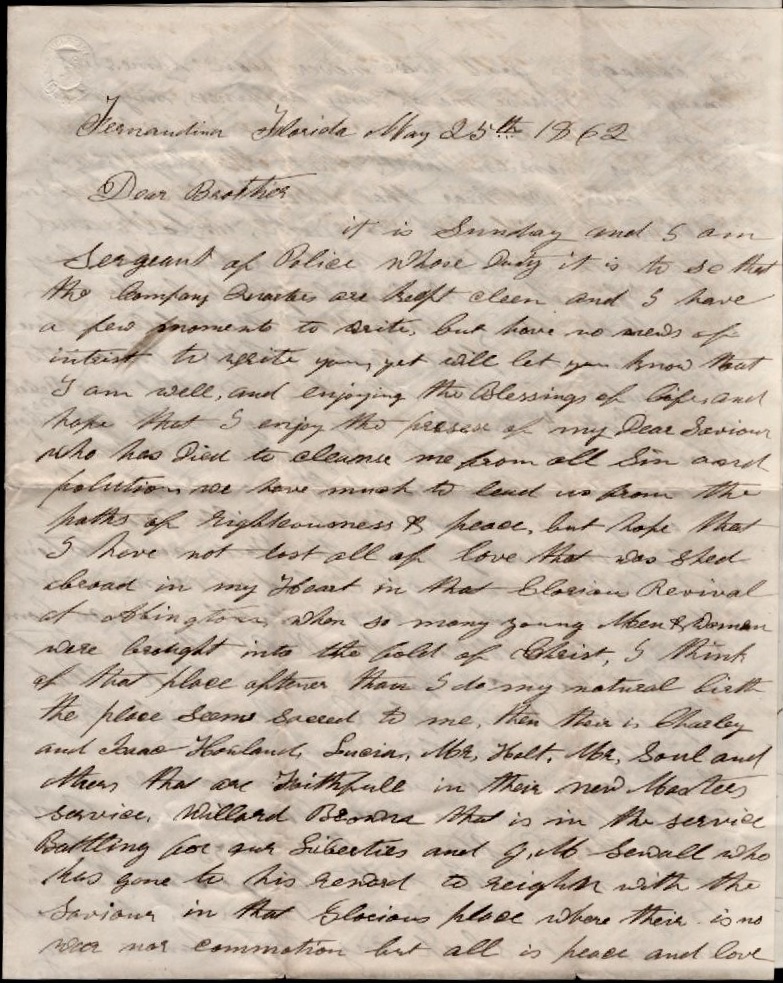
Fernandina, Florida May 25th 1862
Dear Brother,
It is Sunday and I am Sergeant of Police whose duty it is to see that the company quarters are kept clean and I have a few moments to write, but have no news of interest to write you, yet will let you know that I am well and enjoying the blessing of life and hope that I enjoy the presence of my Dear Savior who has died to cleanse me from all sin and pollution. We have much to lead us from the paths of righteousness & peace, but hope that I have not lost all of love that was shed abroad in my heart in that Glorious Revival of Abington when so many young men and when were brought into the folk of Christ. I think of that place oftener than I do my natural birth. The place seems sacred to me. Then there is Charley and Howland, Lucia, Mr. Holt, Mr. Soul, and others that are faithful in their new Master’s service. Willard Brown that is in the service battling for our liberties and G. M. Sewall who has gone to his reward with the Savior in that Glorious place where there is no war nor commotion but all is peace and love.
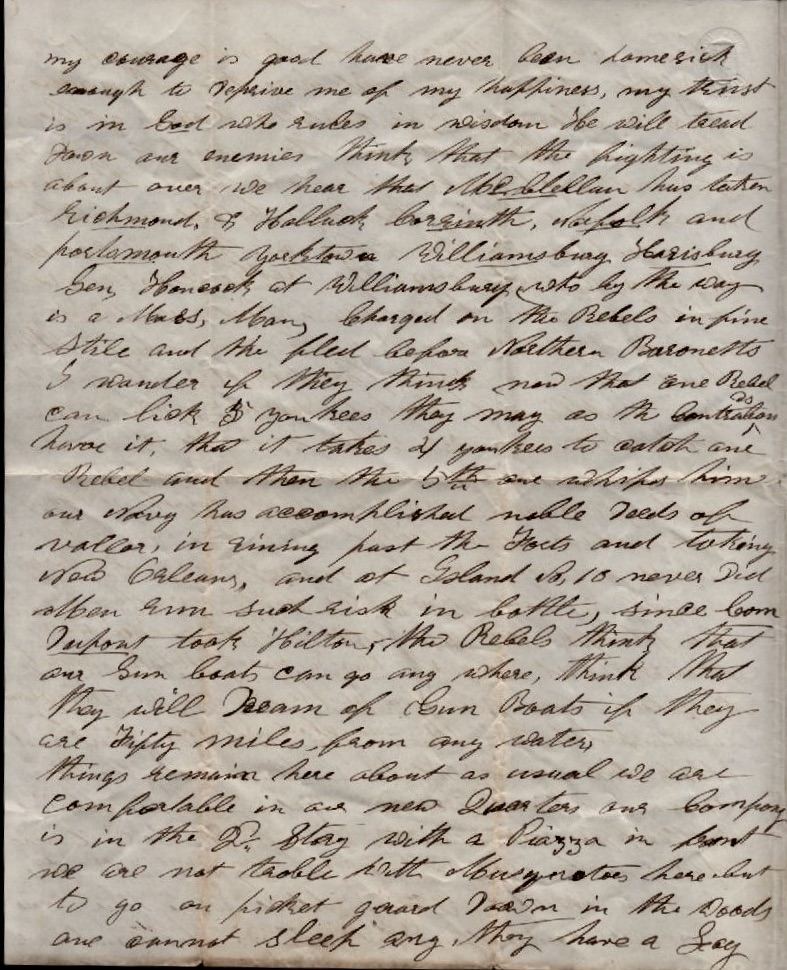
My courage is good. Have never been homesick enough to deprive me of my happiness. My trust is i nGod who rules in wisdom. He will tread down our enemies. Think that the fighting is about over. We hear that McClellan has taken Richmond & Halleck Corinth, Norfolk and Portsmouth, Yorktown, Williamsburg, Harrisburg. Gen. Hancock at Williamsburg (who by the way is a Massachusetts man) charged on the rebels in fine style and they fled before the northern bayonets. I wonder if they think now that one rebel can lick five Yankees. They may as the contralions [?] have it, that it takes 4 Yankees to catch one Rebel and then the fifth one whips him. Our Navy has accomplished noble deeds of valor in going past the forts and taking New Orleans, and at Island No. 10. Never did men run such risk in battle. Since Commodore Dupont took Hilton, the Rebels think that our gunboats can go anywhere. Think that they will dream of gunboats if he they are fifty miles from any water.
Things remain here about as usual. We are comfortable in our new quarters. Our company is in the [ ]. Stay with a piazza in front. We are not troubled with mosquitoes here but to go on picket guard down in the woods, we cannot sleep any. They have a log house built there. Last Sunday night I stopped there and I could hear the mosquitoes buzz as plain as you could a swarm of bees. There were thousands of them and a plenty of snakes. It will not do to tell the women much about them. The Boys killed one Blake [?] one and a coach whip as they are called. He was 6 feet long. The rattlesnakes are thick. Our captain was Officer of the Day a few days since and as he was going down the railroad to visit the pickets, he heard one rattle and looked down by his side and there was one within 8 inches of his leg and all curled up read to strike. The captain jumped across the track and then got a club and killed him. He was between three and four feet long. It was a small one, but large enough to have struck the captain above the hip. He got off lucky. Sgt. Bonney saw one about 8 feet long. It was a coach whip and very large for us Northern people to see running about.
It is reported that the ironclad steamer Monitor and five or six other ironclad boats and wooden gunboats, about 40 in all, are at Hilton Head bound, all think, for Charleston to raise the Stars & Stripes over Fort Sumter. The will do it if they undertake it. We shall expect to hear in ten days that Charleston is in the Union. Rebellion is about played out we think.
I have sent you $20 at a time in two letters. Wish you would write whether you have received it, and if you please, pay my dies at the Good Templars and also my part of the expenses for I have a good interest in that Order. Should have made arrangements to have my bills paid but forgot it in mu anxiety to put down rebellion. I received a letter from Barbone that last mail and also one the mail before the last. She writes that her health was poor and that she gets almost discouraged at times. She thinks it is living so near the salt water. I received a very good letter from Esq, Wormell the last mail. Porborie sent me the Abington Standard which contained the letter from the Orderly Sergeant of Co, E, 23rd Mass. Regt., at New Orleans to John’s widow and also the resolution passed by the company in regard to the death of brother Sewall. Am happy to get the Standard. Have not received a paper for some time from anyone. Think that Benjamin Brown has sent me some that I have never got. You must write to e often. Keep up good courage and trust in God who will. never leave nor forsake you. Pray for me. Direct to Hilton Head, Co. F, 9th Maine Regt., Hunter’s Division, S. C. Affectionately yours, — Isaiah Cushman
Letter 3
Fernandina, Florida August 18th 1862
Dear Brother,
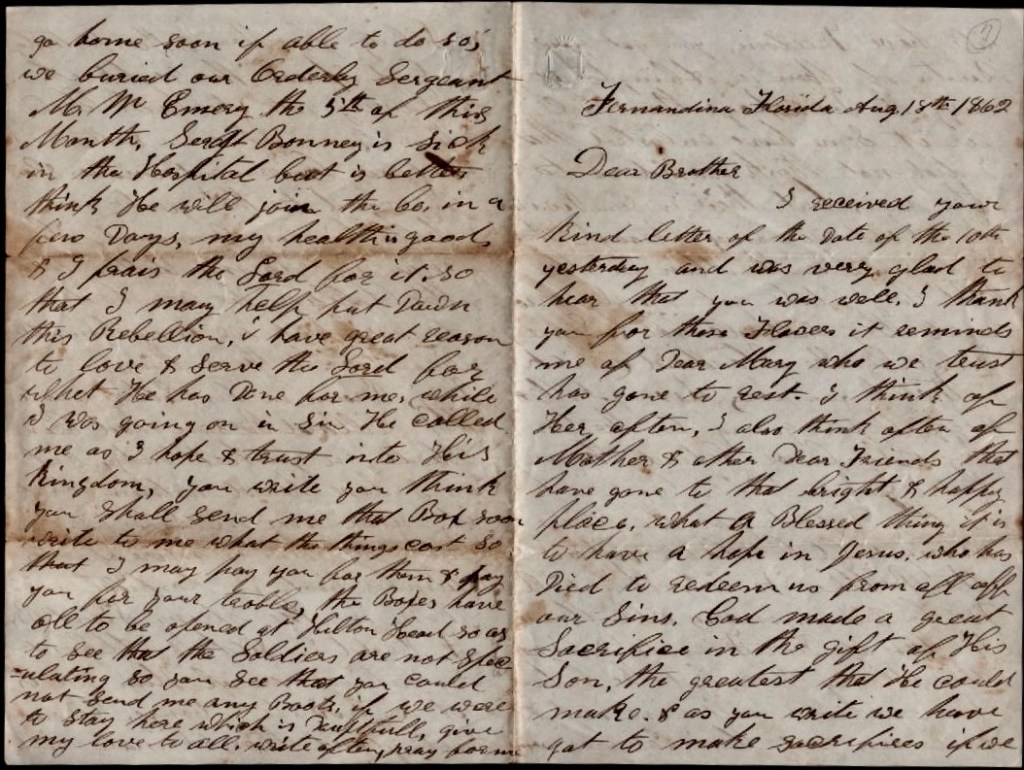
I received your kind letter of the date of the 10th yesterday and was very glad to hear that you was well. I thank you for those flowers. It reminds me of Dear Mary who we trust has gone to rest. I think of her often. I also think often of Mother and other dear friends that have gone to that bright and happy place. What a blessed thing it is to have a hope in Jesus who has died to redeem us from all of our sins. God made a great sacrifice in the gift of His son, the greatest that He could make, And as you write, we have got to make sacrifices if we will have freedom.
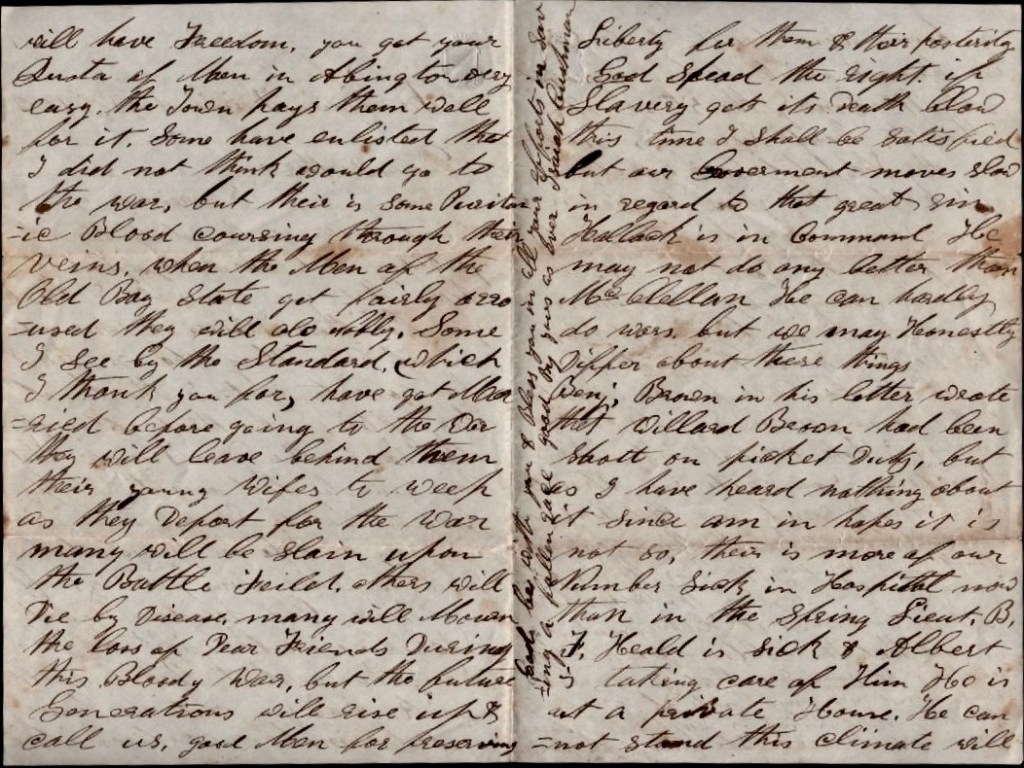
You get your quota of them in Abington very easy. The town pays them well for it. Some have enlisted that I did not think would go to the war, but there is some patriotic blood coursing through the veins when the men of the Old Bay State get fairly aroused. They will all nobly. Some I see by the Standard—which I thank you for—have got married before going to the war. They will leave behind them their young wives to weep as they depart for the war. Many will be slain upon the battlefield, others will die by disease, many will mourn the loss of dear friends during this bloody war, but the future generations will rise up and call us good men for preserving liberty for them and their posterity. God speed the right. If slavery gets its death blow this time, I shall be satisfied. But our government moves slow in regard to that great sin. Halleck is in command. He may not do any better than McClellan. He can hardly do worse, but we may honestly differ about these things.
Benjamin Brown in his letter wrote that Willard Beason had been shot on picket duty, but as I have heard nothing about it since, am in hopes it is not so. There is more of our number sick in hospital now than in the spring and Albert is taking care of him. He is at a private house. He cannot stand the climate [and] will go home soon if able to do so. We buried our Orderly Sergeant M. W. Emery the 5th of this month. Sergt. Bonney is sick in the hospital but is better. Think he will join the company in a few days. My health is good & I praise the Lord for it so that I may help put down this rebellion. I have great reason to love & serve the Lord for what he has done for me. While I was going on in sin, He called me as I hope & trust into His Kingdom.
You write you think you shall send me that box soon. Write to me what the things cost so that I may pay you for them & pay you for your trouble. The boxes have all to be opened at Hilton Head so as to see that the soldiers are not speculating so you see that you could not send me any boots if we were to stay here which is doubtful. Give my love to all. Write often. Pray for me. God be with you and bless you in all your efforts in saving a fallen [ ]. Goodbye, Yours as ever, — Isaiah Cushman
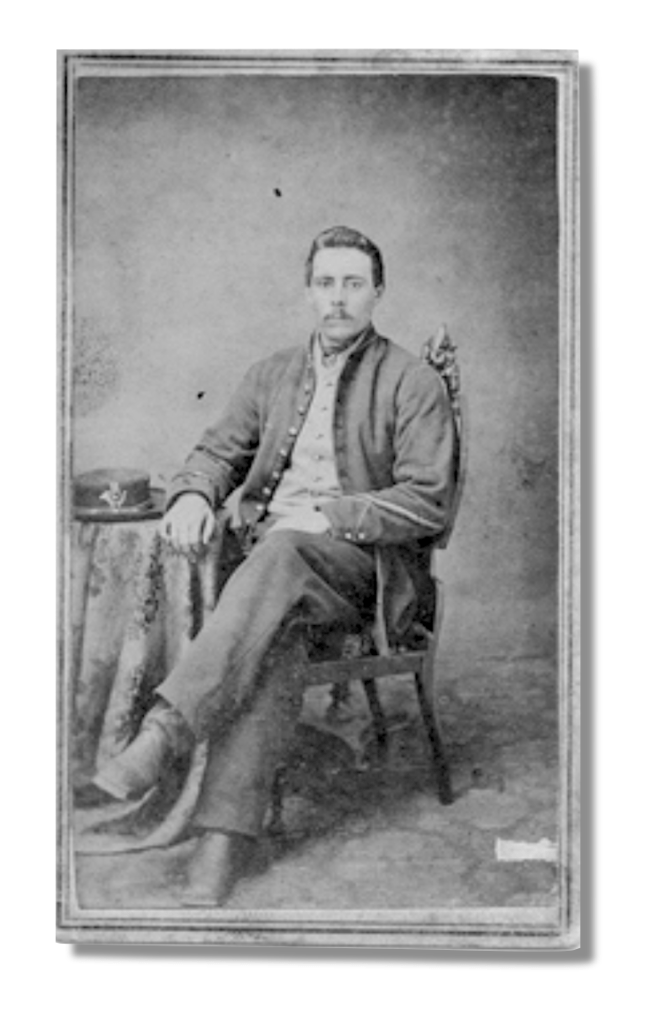
I could not find an image of Gilson but here is a cdv of Samuel A. Bagley who served in Co. H, 9th Maine Infantry (Photo Sleuth)
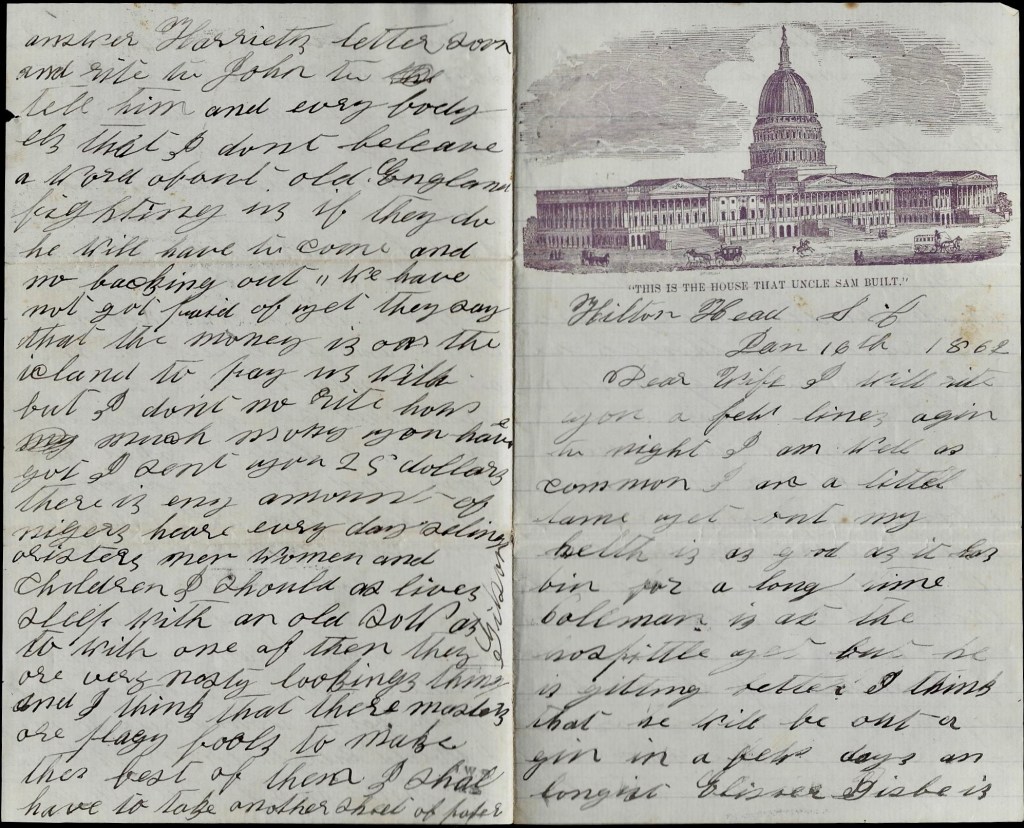
This letter was written by Gilson Mendall (1837-1887), the son of Sylvanus Mendall (1807-1872) and Mary Soule (1805-1874) of Canton, Oxford county, Maine. Gilson was married in March 1860 to Elmira Foye. According to enlistment records, Gilson entered Co. F, 9th Maine Infantry as a private in mid-September 1861 and was mustered out as a corporal after three years and 10 months service in July 1865.
The 9th Maine Infantry was organized at Augusta and mustered in September 22, 1861. It proceeded to Washington and briefly served in the Washington Defenses before joining the expedition to Port Royal, SC, attached to the Department of the South. The 9th Maine participated in a number of minor combined operations resulting in the capture of Forts Walker and Beauregard and later occupied Fernandina, Florida. The regiment then shifted to operations at Charleston arriving at Hilton Head in January 1863, assigned to the 10th Corps.
Transcription
Hilton Head, South Carolina January 16th 1862
Dear Wife,
I will write you a few lines again tonight. I am well as common. I am a little lame yet but my health is as good as it has been for a long time. Coleman is at the hospital yet but he is getting better. I think that he will be out again in a few days at longest. Elisha Bisbee is dead. He died last Monday night. I think they said that it was the typhoid fever that he died with. He was not sick but a few days. I can imagine how his mother will feel. He died very easy—the same as though he was going to sleep. 1
It is very rainy and cold tonight. It seems like October. It rains about half of the time now. The niggers say that it will for about a month. There is a lot of them on the island—a number of hundreds of them.
The report is that we are a going to move soon and I hope we shall for I thought they should be doing something to close this thing up (they won’t let me go into battle for I am lame). They want that I should cook and I think that seeing I have cooked so long that I shall keep. [I also] help on the mail some and we expect it in a few minutes so I will wait and see if I get any letters. I hope I shall. The last that I got from you was dated December 29th. I want you should number your letters on the lower corner. Begin at 1, then 2, 3, 4 and so on. I will do the same. I am expecting a letter from Father. I wish your folks would write to me. I would write to them if I could get time and I will try to answer Harriet’s letter soon and write to John to tell him and everybody else that I don’t believe a word about Old England fighting us. If they do, he will have to come and no backing out.
We have not got paid off yet. They say that the money is on the island to pay us with but I don’t know. Write how much money you have got. I sent you 25 dollars. There is any amount of niggers here every day selling oysters—men, women and children. I should as leave sleep with an old sow as to one of them. They are very nasty looking things and I think that their masters are plagey fools to make the best of them. I shall have to take another sheet of paper. — Gilson
1 Elisha Bisbee of Canton, Maine, was 18 years old when he enlisted as a corporal in Co. F, 9th Maine Infantry. He died on 14 January 1862.










 Spared & Shared 23