
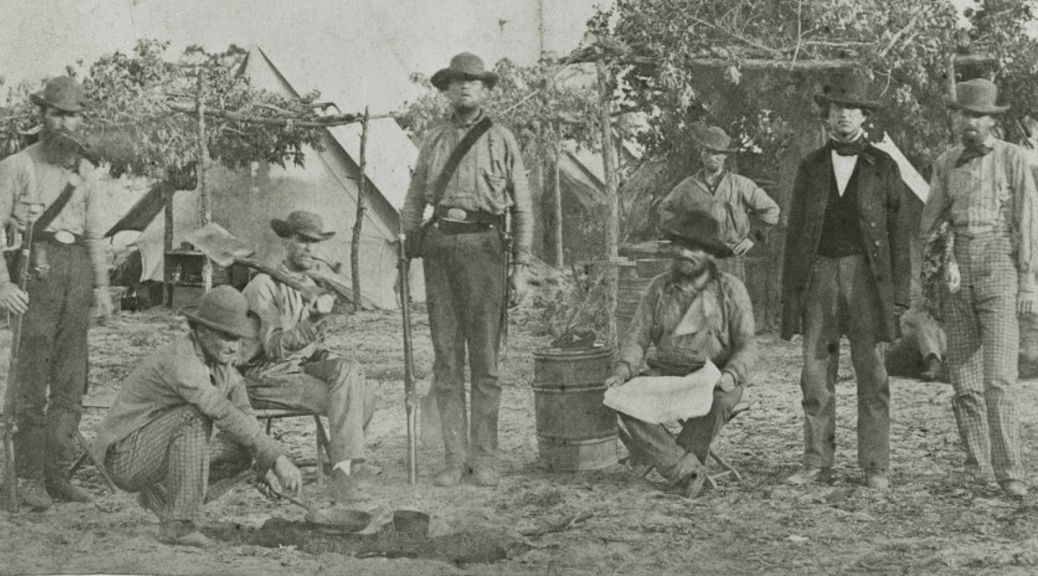
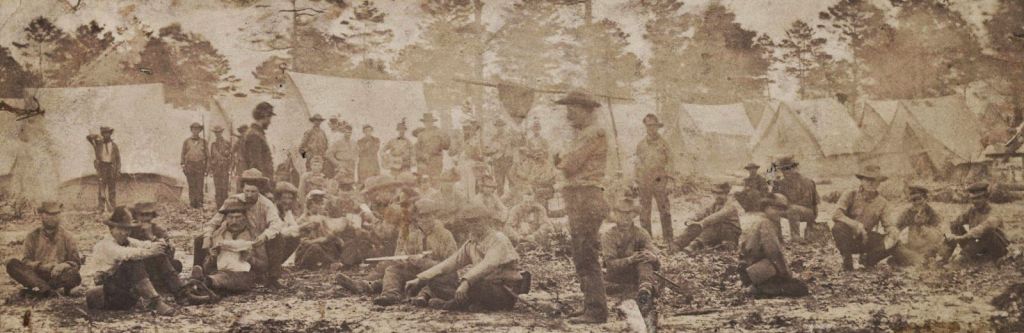
The following letters were written by Mississippi born and bred, Mary Ellen (Barton) Clark (1833-1888)—the wife of William Spencer Clark (1826-1878) of Holly Springs, Marshall county, Mississippi. Mary’s husband was a native of Vermont and attended Amherst College. In 1850, he was enumerated among the students attending Amherst. Ten years later, in 1860, he was enumerated in Holly Springs where he lived with his wife and three children Rosa (age 4), Eudora or “Dora” (age 2), and Rodger B. (6 months). Also residing in the same household were Peyton Johnson, Frank Ross, Hugh C. Barton, and N. B. Dean (teenagers and presumably students at the boys school where William taught). From the letter we learn that William initially served with the Home Guards, a company of the 9th Mississippi. He later joined Co. B, 35th Mississippi Infantry. He survived the war, returned to Holly Springs to teach school, but died of Yellow Fever in 1878.
In 1860, William Clark was the owner of six slaves ranging in age from 45 to 8. I suspect their given names are mentioned in the portion of the letter dated May 7th.

Letter 1
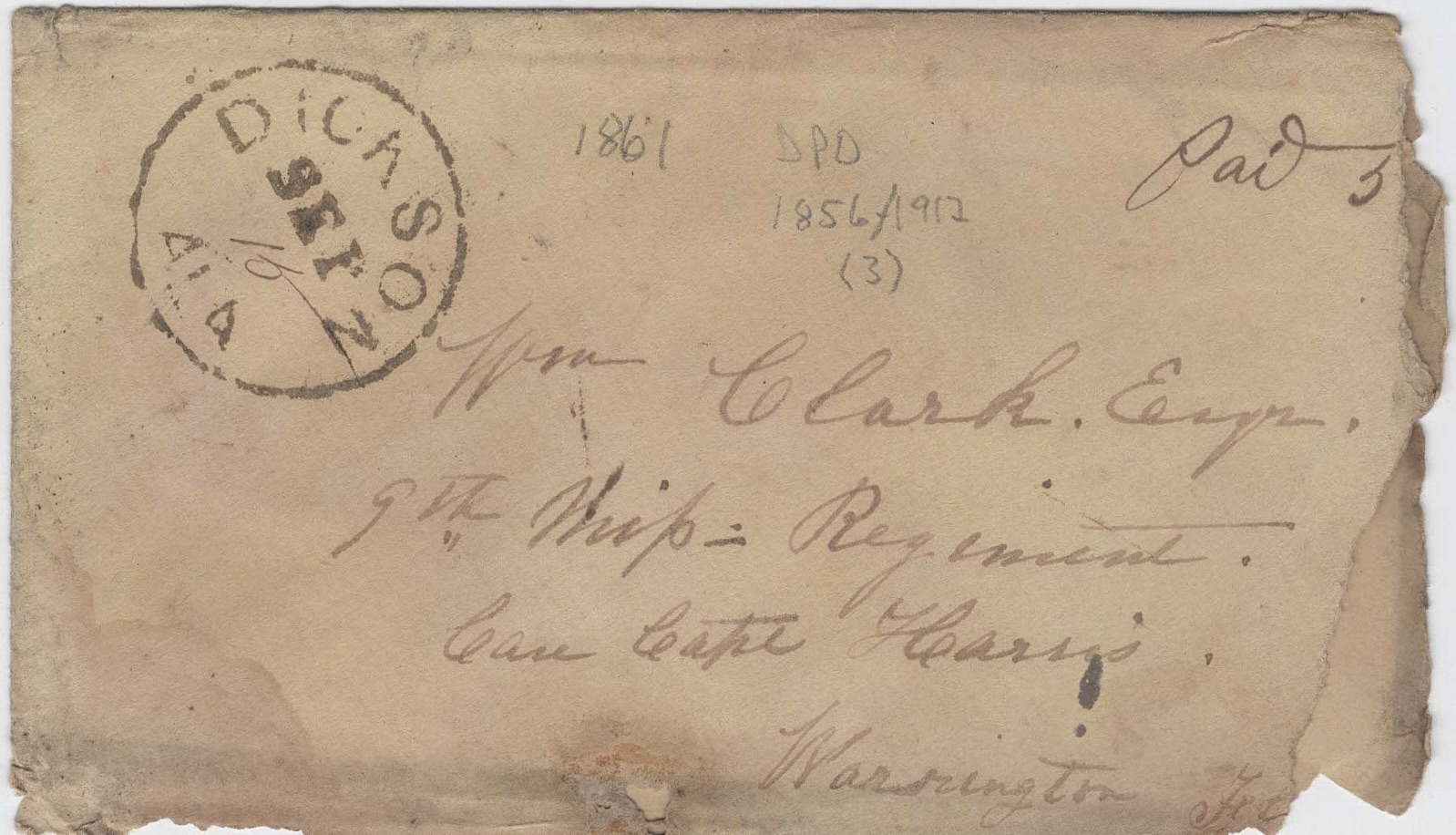
Holly Springs, Mississippi
May 6th 1861
My own dear husband,
Although it is bed time, I feel that I cannot retire until I have written to you. It is certainly a very great pleasure to me to hold communion with you by letter if I cannot in reality. Mrs. Finley & Mit just left. They have been sitting with me since supper, and I always feel lonelier at bed time than anytime. I believe I have written daily for four days now and been complaining of not receiving letters. It seems strange but I feel certain you do write.
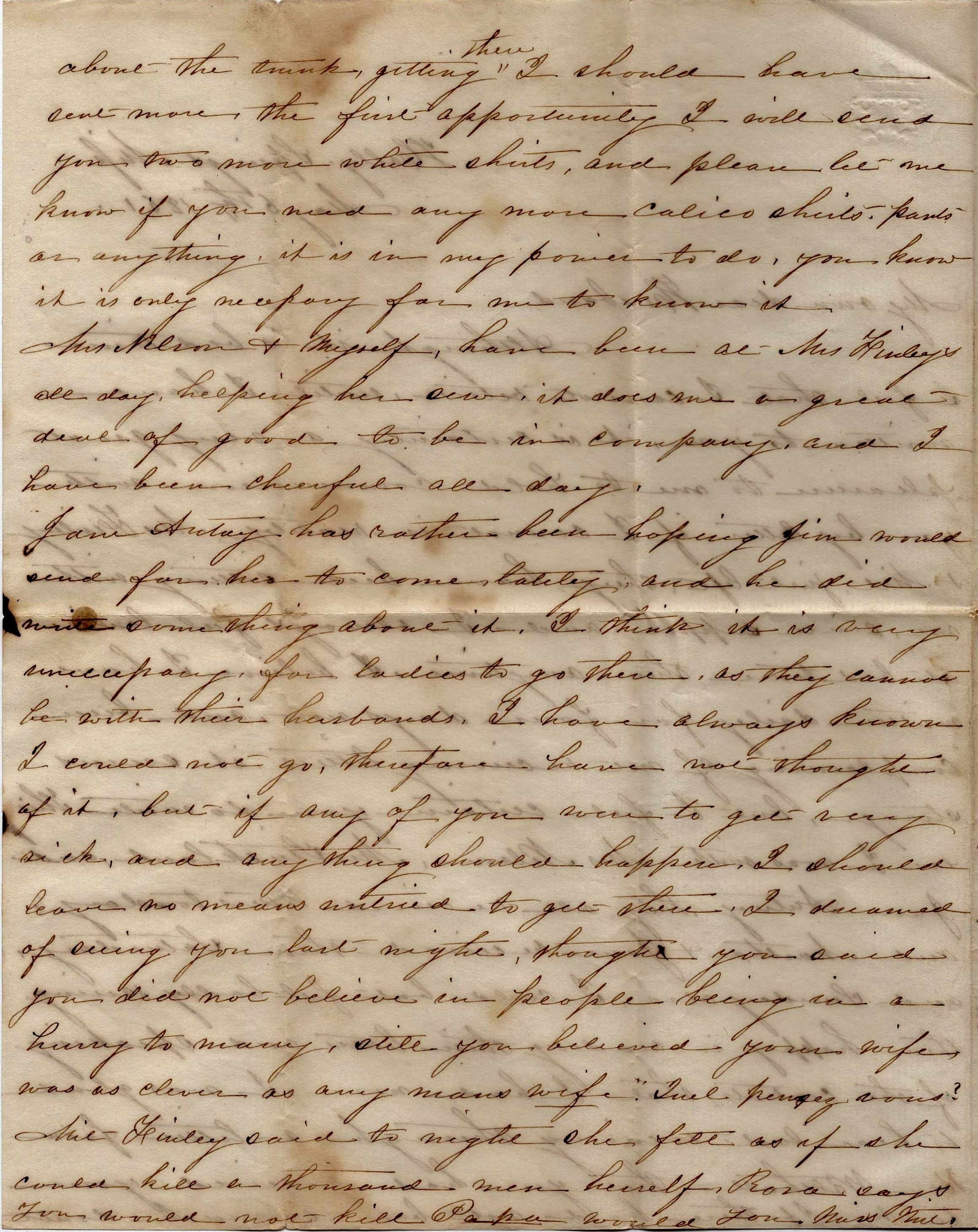
This eve I was with Mrs. Nelson, Mrs. Strickland 1, and Jane Autry. They all received letters today and Martha & Jane received them Saturday and Sunday also. I could but feel badly (seeing them happy in reading their letters and speaking of the contents) that I had none. I was glad to hear last evening through a letter from Ben Walthall that you had received your trunk. If there had not been so much doubt about the trunk getting there, I should have sent more. The first opportunity, I will send you two more white shirts, and please let me know if you need any more calico shirts, pants, or anything, if it is in my poewr to do. You know it is only necessary for me to know it.
Mrs. Nelson & myself have been at Mrs. Finley’s all day helping her sew. It does me a great deal of good to be in company and I have been cheerful all day.
Jane Autry 2 has rather been hoping Jim would send for her to come lately, and he did write something about it. I think it is very unnecessary for ladies to go there, as they cannot be with their husbands. I have always known I could not go, therefore have not thought of it. But if any of you were to get very sick, and anything should happen, I should leave no means untried to get there. I dreamed of seeing you last night. Thought you said you did not believe in people being in a hurry to marry. Still you believed your wife was as clever as any man’s wife. Tuel pensey vous? [Don’t you think so?]
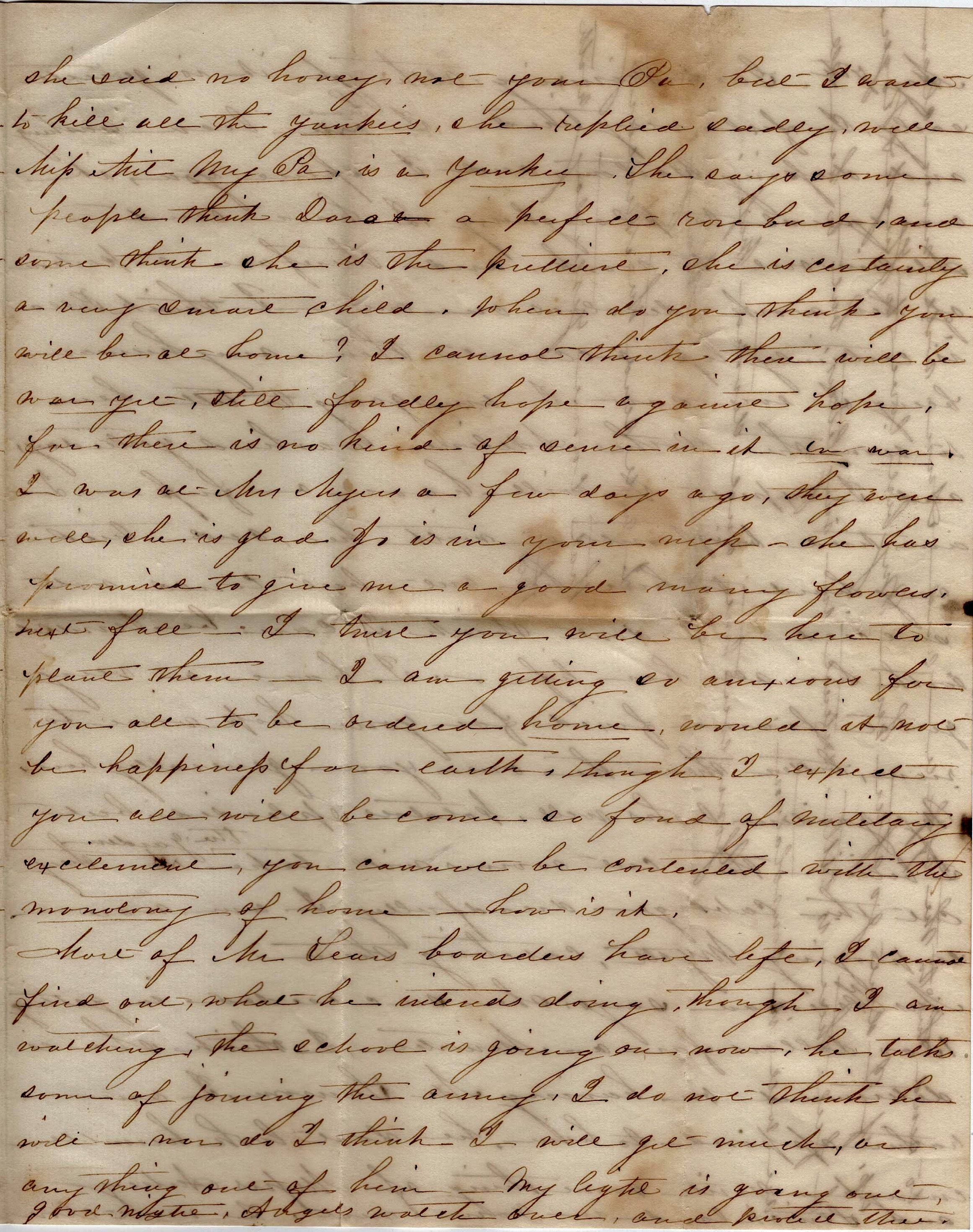
Mit Finley said tonight she felt as if she could kill a thousand men herself. Rosa says you would not kill Papa, would you, Miss Mit? She said, “No honey, not your Pa, but I want to kill all the Yankees.” She replied sadly, “Well, Miss Mit, my Pa is a Yankee.” She says some people think Dora a perfect rosebud and some think she is the prettiest. She is certainly a very smart child.
When do you think you will be at home? I cannot think there will be war yet. Still fondly hope against hope for there is no kind of sense in it in war.
I was at Mrs. Myers a few days ago, They were well. She is glad Jo is in your mess. She has promised to give me a good many flowers next fall. I trust you will be here to plant hem. I am getting so anxious for you all to be ordered home. Would it not be happiness for earth, though I expect you all will become so fond of military excitement you cannot be contented with the monotony of home. How is it?
Most of Mr. Sear’s boarders have left. I cannot find out what he intends doing though I am watching. The school is going on now. He talks some of joining the army. I do not think he will—nor do I think I will get much, or anything out of him. 3
My light is going out. Good night. Angels watch over and protect thee.
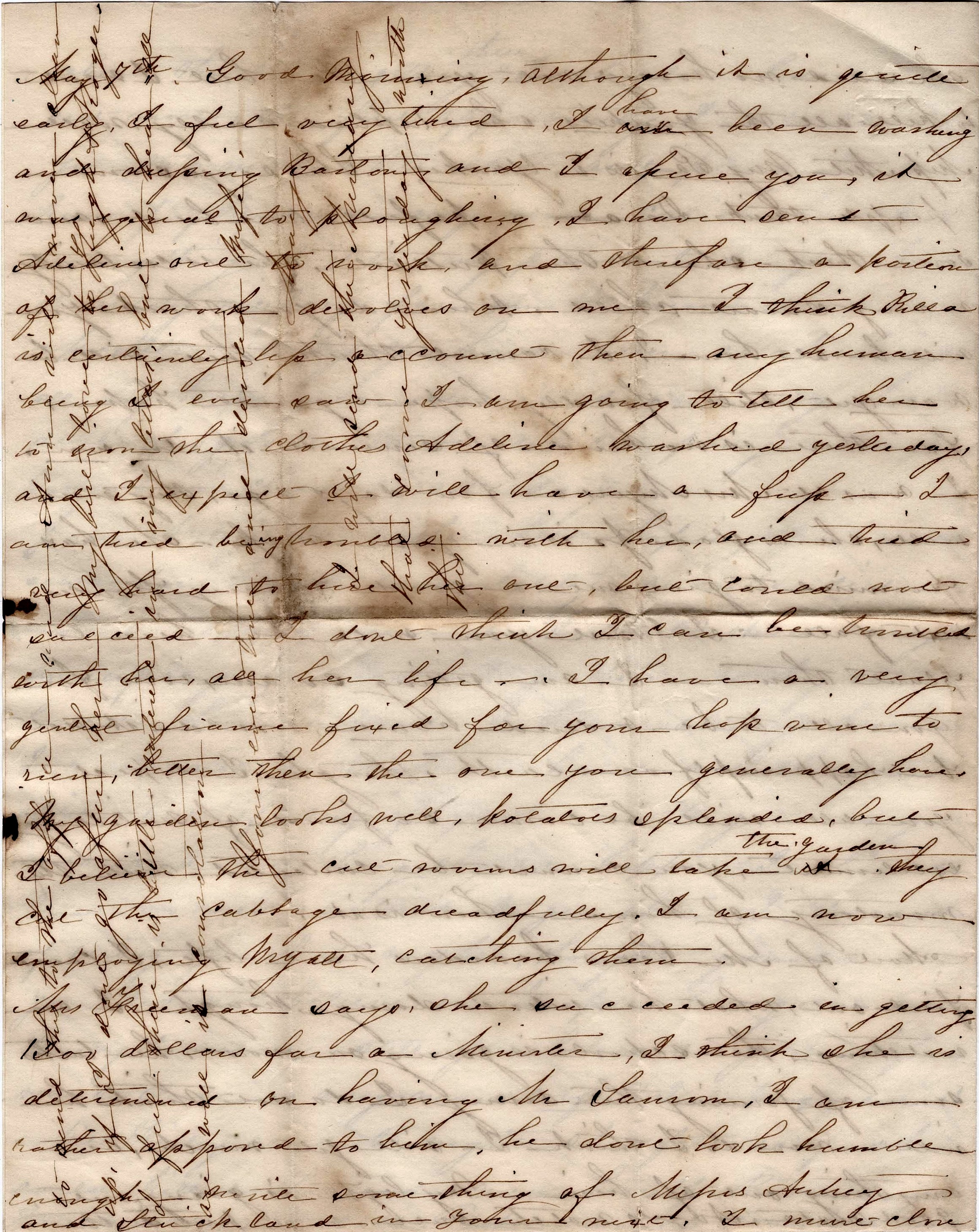
May 7th. Good morning. Although it is quite early, I feel very tired. I have been washing and dressing Barton and I assure you, it was equal to ploughing. I have sent Adeline out to work and therefore a portion of her work devolves upon me. I think Rilla is certainly less account than any human being I ever saw. I am going to tell her to iron the clothes. Adeline washed yesterday and I expect I will have a fuss. I am tired being troubled with her and tried very hard to hire her out but could not succeed. I don’t think I can be troubled with her all her life. I have a very genteel frame fixed for your hop vine to run. Better than the one you generally have. My garden looks well—potatoes splendid. But I believe the cut worms will take the garden. They cut the cabbage dreadfully. I a now employing Wyatt catching them.
Mrs. Freeman says she succeeded in getting 1200 dollars for a Minister. I think she is determined on having Mr. Lawson. I am rather opposed to him. He don’t look humble enough. Write something of Messers. Autrey and Strickland in your next. I must close to send this to the office and Ann will never clean up if I don’t go after her. My best love to Hugh & Roger. I feel there is little interest in my letters but to hear all are well is consolation. Your ever true and devoted wife, — Mary
I will send the Mercury that came yesterday with this.

1 Martha Mildred (Thompson) Strickland (1835-1863) was married to William Matthew (“Buck”) Strickland (1823-1908) of Holly Springs, Mississippi. In the second letter, the death of their youngest daughter Madie Strickland (1857-1861) is described. Buck Strickland was a plantation owner and lawyer. He was the 1st Sergeant of Co. D, 9th Mississippi Infantry. A friend of Jeff Davis, he parlayed his connection into a position on the staff of Gen. Bragg and other prominent generals. He was a Major at war’s end. His wife was a native of Spartanburg, South Carolina.
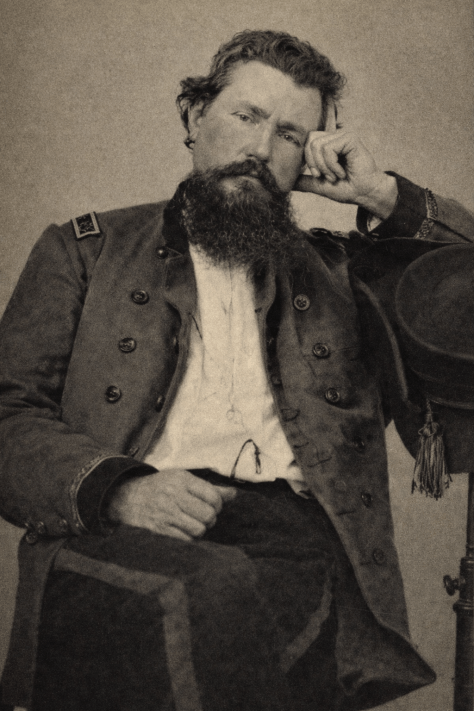
2 Jane [Valliant] Autry (1835-1912) was married to James Lockhart Autry (1830-1862). James’ father was one of the approximately 187 heroes of the Alamo, killed in March of 1836. He was educated at St. Thomas Hall in Holly Springs where E.C. Walthall, James R. Chalmers, and Christopher H. (Kit) Mott were among his schoolmates. When war came he enlisted in the Home Guards, a company of the 9th Mississippi, where he was made a Lt. After a year’s service, he was made military governor of Vicksburg. In May of 1862, Admiral Farragut demanded the surrender of Vicksburg, to which Autry replied, “Mississippians do not know how to surrender and do not care to learn.” Lt. Col. Autry transferred to the 27th Mississippi Infantry later in 1862. While cheering his men forward in the Battle of Murfreesboro he was struck in the head with a minie ball and killed. After his death on Dec. 31, 1862, his body was returned to Holly Springs and interred in Hillcrest Cemetery with this epitaph: “He died for his country.”
3 Claudius Wistar Sears (1817-1891) was born in Massachusetts and was a graduate of the Military Academy at West Point in 1841—a classmate of John Reynolds and Don Carlos Buell. After a year in the 8th US Infantry fighting Seminoles in Florida, Sears resigned his commission and began teaching school. In 1844 he taught mathematics at St. Thomas’s Hall—a military school in Holly Springs. In 1859 he became the president of the school and commandant of cadets. When many of the students left the school in 1861, so did Sears, accepting a commission as captain of Co. G, 17th Mississippi Infantry on June 1861. He eventually became Colonel of the 46th Mississippi. He was taken prisoner in the surrender at Vicksburg but in March 1864 became a Brigade General. He led the Brigade through the Atlanta and Tennessee campaigns, losing a leg at the Battle of Nashville on 15 December 1864. After the war, he taught mathematics at the University of Mississippi.

Some time ago I was asked to transcribe the 1864 Diary of Brig. Gen. Sears that described his daily activities between 27 November and 25 December 1864. His entry describing the wound he received at the Battle of Nashville reads as follows: “15th [December]—At daylight received report from my skirmish line that the enemy was appearing in force. Immediately took position in [ ] just north of pike. Was shelled during the day hotly with only one man slightly wounded. Just before sunset the enemy made a charge upon our extreme left, just to my left, and broke our line. We immediately fell back—not in good order. Found my horse just to the rear, very uneasy, in charge of an orderly. Mounted and he soon became quiet. Found my command and was marching by the flank quickly to the rear through a corn stubble. It was getting dark. Felt something strike my foot. Looked down [and] saw my leg swinging helpless. The ball (solid) had ricoched, passed through my poor, dear old horse, and crushed my left leg. As they took me from the horse, he rolled over to the right dead. Thus closed Bill’s long and eventful career in the army since Vicksburg. Was taken to Mr. Ewing’s place on the Franklin Pike where Surgeon [P. J.] McCormick [46th Mississippi] amputated my leg just below the knee. Was immediately placed in and ambulance and we started for the rear. In my long military service, [this was] my first wound of any magnitude. ” To read the diary, go to: https://sparedcreative21.art.blog/2020/04/11/1864-diary-of-brig-gen-claudius-wistar-sears/

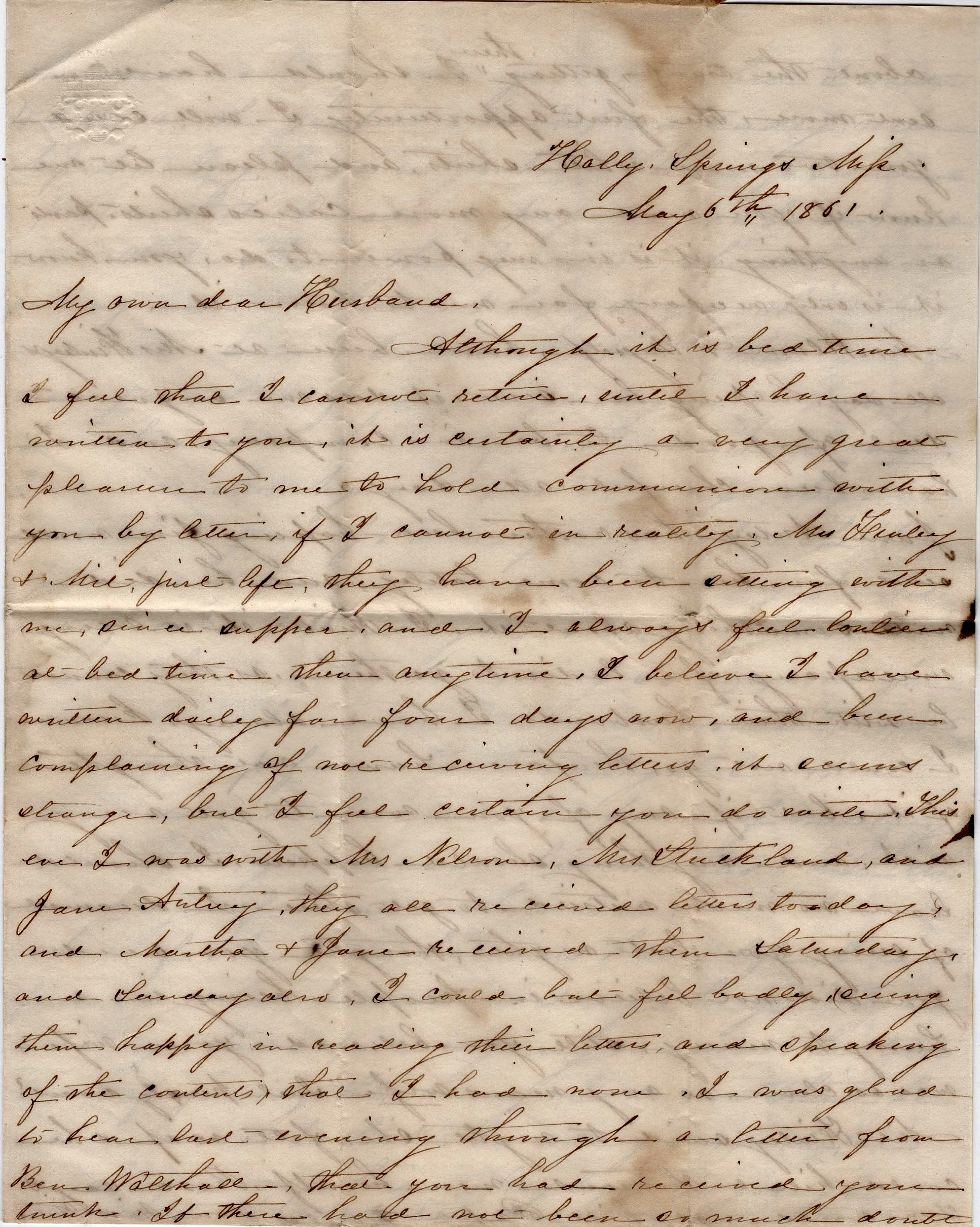
Letter 2

Jackson, Alabama
July 4th 1861
My own dearest husband,
Three days have passed now since I have received a letter from you but I am not going to complain for you are a very good correspondent. I look forward to tomorrow for a letter without fail. I do wish I could get hold of a good pen. I can scarcely continue to manage this, or write intelligibly with it.
Today is the anxiously looked for 4th [of July] and may it be still more memorable by being the day on which our second independence is declared by the North. I do trust Lincoln’s inaugural may have peace in it. I was in great distress and anxiety of mind Tuesday as I heard you were fighting at Pickens. But now I know it was a false alarm. I trust such alarms will cease some time. I think it cruel to start them. For the last day or two the papers indicate such a decided and rapid change of mind at the North that I now have great hopes of peace. Indeed, I am almost sure of it. Yancey writes t oDavis that his negotiations with England reach his most sanguine expectations. Without a doubt I look for peace by September as I suppose it will occupy time to make the necessary peace treaties. Am I not rather sanguine? But such is only my opinion in which I am pretty much alone. I look for peace so certain by September that I have almost concluded to remain here until then. I do not feel as if I could yet return home with any comfort or composure. I know I am better contented here than I would be there. At any rate, I shall remain here one month if not two months longer.
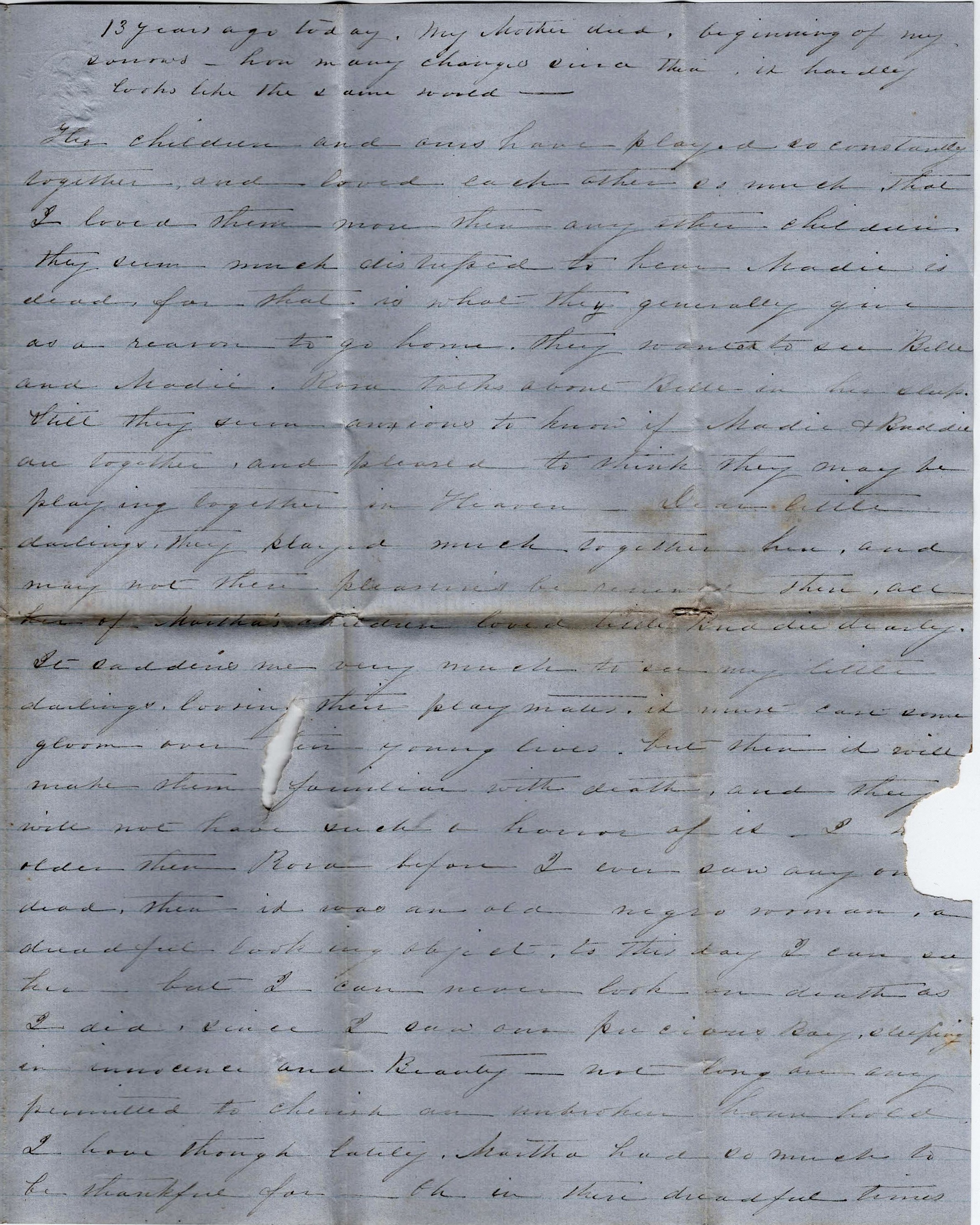
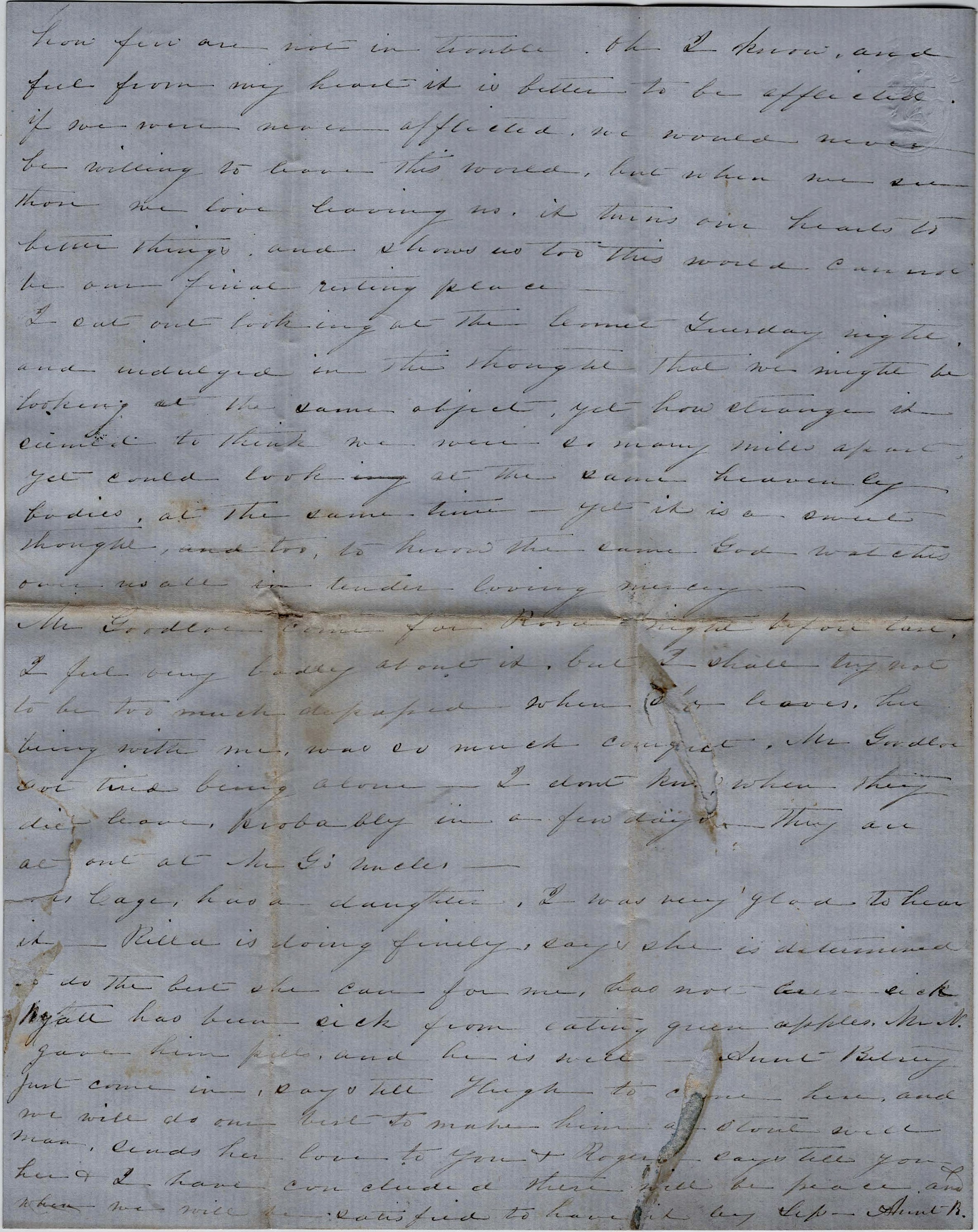
I received a letter from Mrs. Nelson yesterday telling the sad news of little Madie Strickland’s death. She had diphtheria, was sick six days. Mr. Strickland got there Sunday and Madie died Monday 2 o’clock. She was buried Tuesday at 10 o’clock. He was obliged to leave same day. Mrs. Nelson said Martha was composed. Said she knew how poor Mary Clark felt and wanted to see me. But no, she did not know how I felt, for she was not alone in the dark hour of her deep anguish, nor not alone did she stand by the grave, and see her child laid forever from her sight. Poor Martha, she has my heartfelt sympathy. 13 years ago today, my Mother died, beginning of my sorows. How many changes since then. It hardly looks like the same world.
Her children and ours have played so constantly together and loved each other so much that I loved them more han any other children. They seem much distressed to hear Madie is dead for that is what they generally give as a reason to go home. They wanted to see Belle and Madie. Rosa talks about Belle in her sleep. Still they seem anxious to know if Madie and Buddie are together, and pleased to think they may be playing together in Heaven. Dear little darlings, they played much together here and may not [illegible]. It saddens me very much to see my little darlings losing their playmates. It must cast some gloom over their young lives. But then it will make them familiar with death, and they will nit have such a horror of it. I was older than Rosa before I ever saw anyone dead. Then it was an old negro woman—a dreadful looking object. To this day I can see her. But I can never look on death as I did since I saw our precious boy sleeping in innocence and beauty. Not long are any permitted to cherish an unbroken household, I have thought lately. Martha had so much to be thankful for. Oh, in these dreadful times, how few are not in trouble.
Oh, I know and feel from my heart it is better to be afflicted. If we were never afflicted, we would never be willing to leave this world. But when we see those we love leaving us, it turns our hearts to better things and shows us too this world cannot be out final resting place.
I sat out looking at the Comet Tuesday night and indulged in the thought that we might be looking at the same object. Yet how strange it seemed, to think we were so many miles apart yet could look at the same heavenly bodies at the same time. Yet it is a sweet thought too to know the same God watches over us all in tender loving mercy…
[unsigned]




 Spared & Shared 23