
I can’t confirm his identity but this letter may have been written by David Seig Beare (1820-1898), a native of Virginia, who was employed as a silver smith in Corinth, Tishomingo county, Mississippi, at the time of the 1860 US Census. He had a ten year old daughter named Edmonia—a name that is mentioned in the letter.
The author reveals his ongoing recovery from an illness while in Mobile, a place that does not serve as his residence. In his letter, he admits that his “financial matters” have been rendered stagnant by the banks. Additionally, he expresses profound frustration regarding the reports of the invading Union army in Virginia.
T R A N S C R I P T I O N
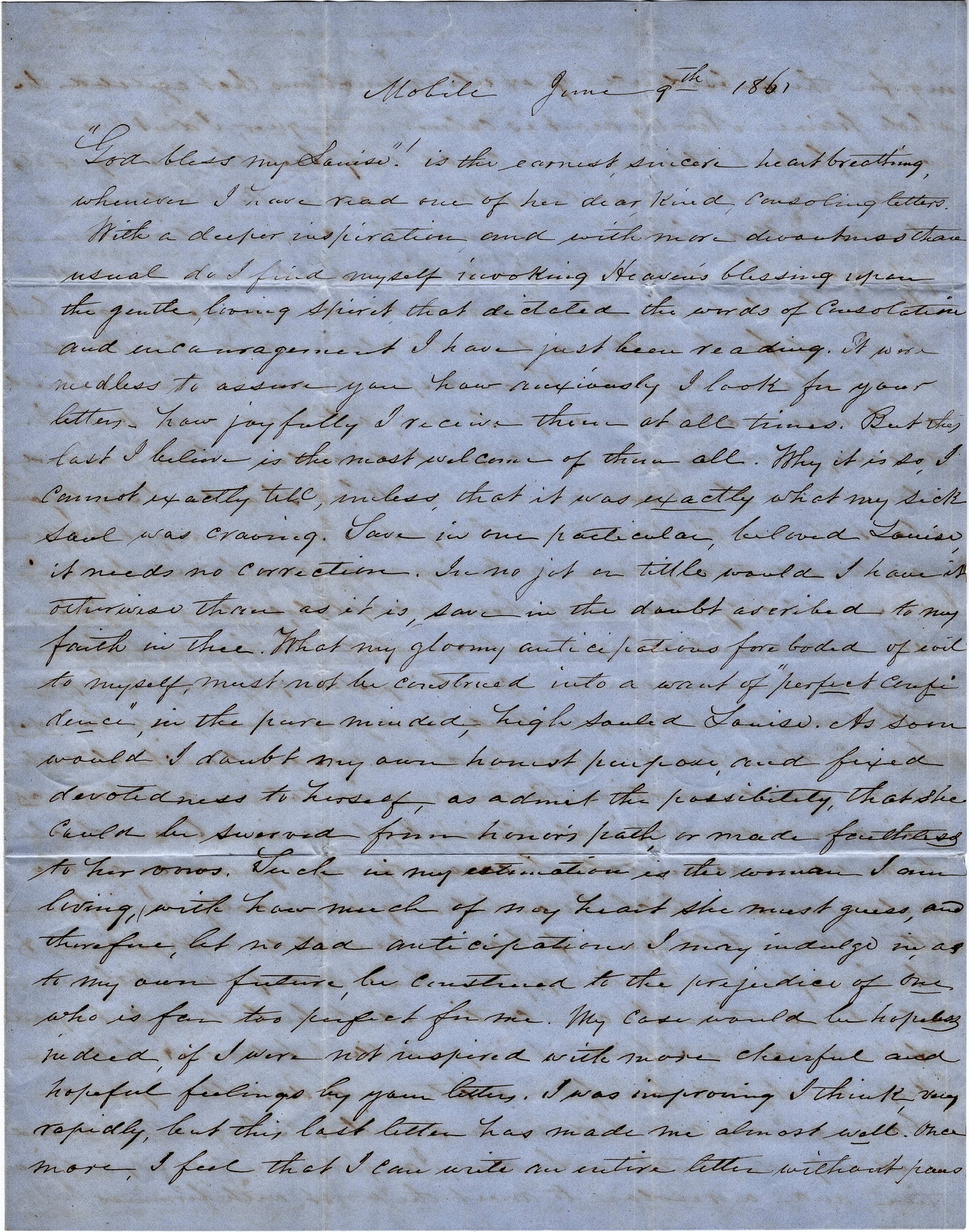
Mobile [Alabama]
June 9th 1861
“God bless my Louise!” is the earnest, sincere, heart breathing, whenever I have read one of her dear, kind, consoling letters. With a deeper inspiration and with more devoutness than usual do I find myself invoking Heaven’s blessing upon the gentle living spirit that dictated the words of consolation and encouragement I have just been reading. It were needless to assure you how anxiously I look for your letters—how joyfully I receive them at all times. But this last, I believe, is the most welcome of them all. Why is it so? I cannot exactly tell unless that it was exactly what my sick soul was craving. Love is one particular, beloved Louise, it needs no correction. In no job or title would I have it otherwise than as it is, save in the doubt ascribed to my faith in thee. What my gloomy anticipations foreboded of evil to myself, must not be construed into a want of “perfect confidence” in the pure minded, high-souled Louise. As soon would I doubt my own honest purpose, and fixed devotedness to herself as admit the possibility that she could be swerved from honor’s path, or made faultless to her [ ]. Such in my estimation is the woman I am loving, with how much of my heart she must guess, and therefore, let no sad anticipation I may indulge in as to my future, be construed to the prejudice of one who is far too perfect for me.
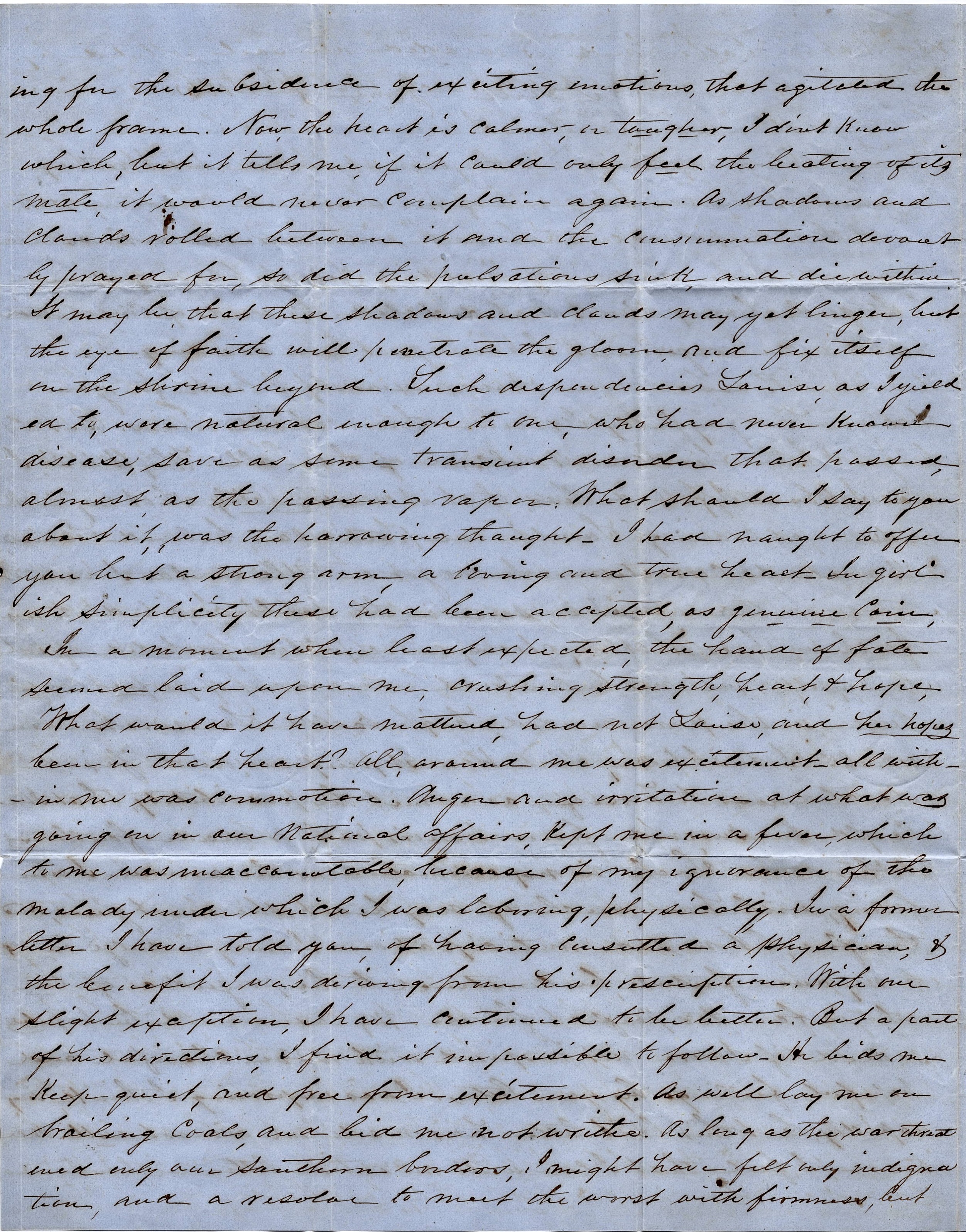
My case would be hopeless indeed if I were not inspired with more cheerful and hopeful feelings by your letters. I was improving, I think, very rapidly but this last letter has made me almost well. Once more I feel that I can write with an entire letter without pausing for the subsidence of existing emotions, that agitated the whole frame. Now the heart is calmer, or tougher—I don’t know which, but it tells me if it could only feel the beating of its mate, it would never complain again. As shadows and clouds rolled between it and the consummation devoutly prayed for, so did the pulsations sink and the die within. It may be that these shadows and clouds may yet linger, but the eye of faith will penetrate the gloom and fix itself on the shrine beyond. Such despondencies, Louise, as I yielded to were natural enough to one who had never known disease, save as some transient disorder that passed almost as the passing vapor. What should I say to you about it was the harrowing thought. I had naught to offer you but a strong arm, a loving and true heart. In girlish simplicity these had been accepted as genuine coin.
In a moment when least expected, the hand of fate seemed laid upon me, crushing strength, heart, and hope. What would it have mattered had not Louise and her hopes been in that heart? All around me was excitement. All within me was commotion. Anger and irritation at what was going in our National affairs kept me in a fever which to me was unaccountable because of my ignorance of the malady under which I was laboring physically.
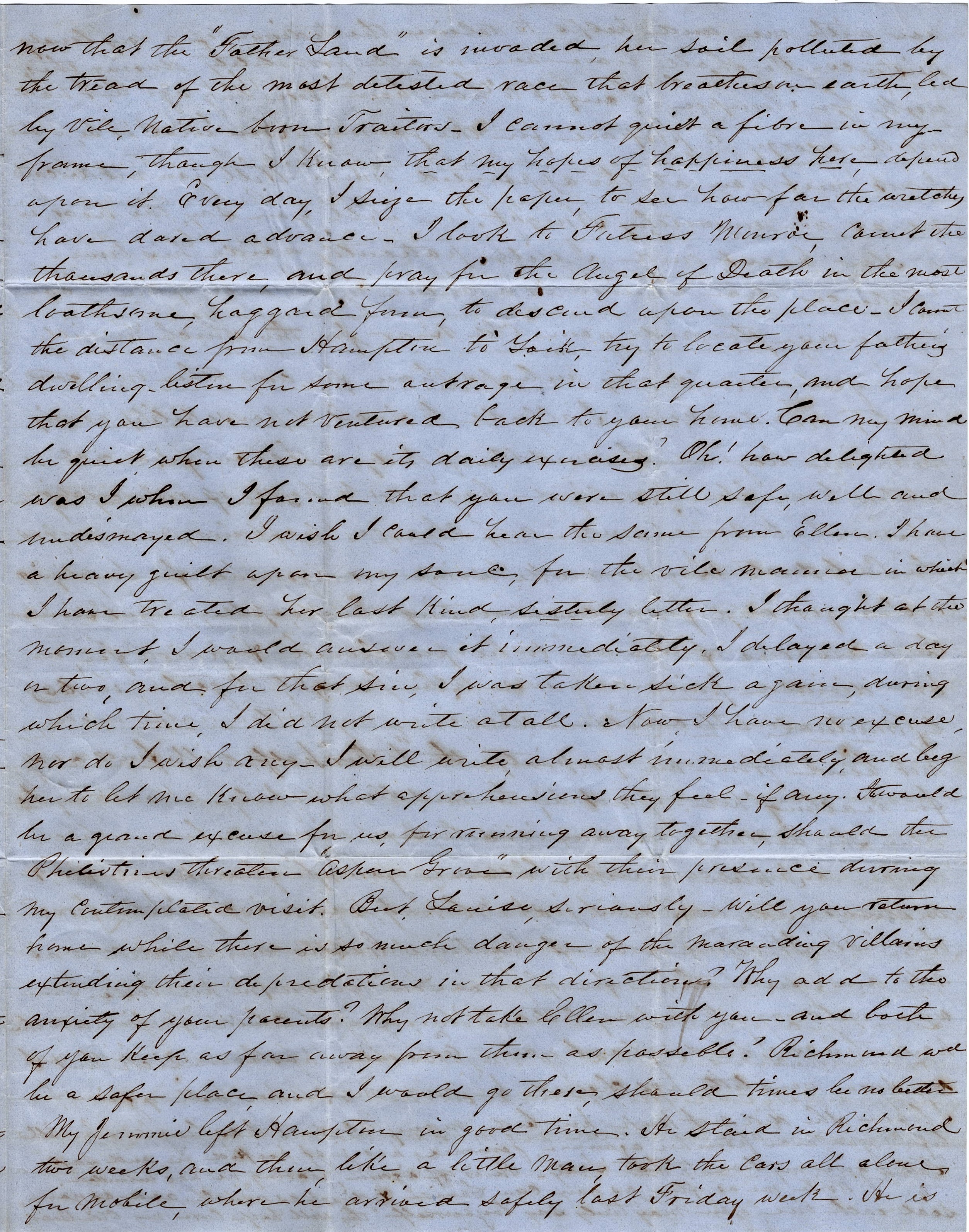
In a former letter I have told you of having consulted a physician and the benefit I was deriving from his prescription. With one slight exception, I have continued to be better. But a part of his directions, I find it impossible to follow. He bids me keep quiet, and free from excitement. [Might] as well lay me on broiling coals and bid me not writhe. As long as the war threatened only our Southern borders, I might have felt only indignation, and a resolve to meet the worst with firmness, but now that the “Father Land” is invaded, her soil polluted by the tread of the most detested race that breathes on earth, led by vile, native born traitors. I cannot quiet a fibre in my frame, though I know that my hopes of happiness here depend upon it. Every day I seize the paper to see how far the wretches have dared advance. I look to Fortress Monroe—count the thousands there, and pray for the Angel of Death in the most loathsome, haggard form to descend upon the place. I count the distance from Hampton to York, try to locate your father’s dwelling, listen for some outrage in that quarter, and hope that you have not ventured back to your home. Can my mind be quiet when these are its daily exercises? Oh! how delighted was I when I found that you were still safe, well and undismayed.
I wish I could hear the same from Ellen. I have a heavy guilt upon my soul for the vile manner in which I have treated her last kind, sisterly letter. I thought at the moment I would answer it immediately. I delayed a day or two and for that sin, I was taken sick again, during which time I did not write at all. Now I have no excuse, nor do I wish any. I will write almost immediately and beg her to let me know what apprehensions they feel—if any. It would be a grand excuse for us, for running away together, should the Philistines threaten “As___ Grave” with their presence during my contemplated visit. But Louise, seriously, will you return home while there is so much danger of the marauding villains extending their depredations in that direction? Why add to the anxiety of your parents? Why not take Ellen with you and both of you keep as far away from them as possible? Richmond would be a safer place and I would go there, should times be no better.
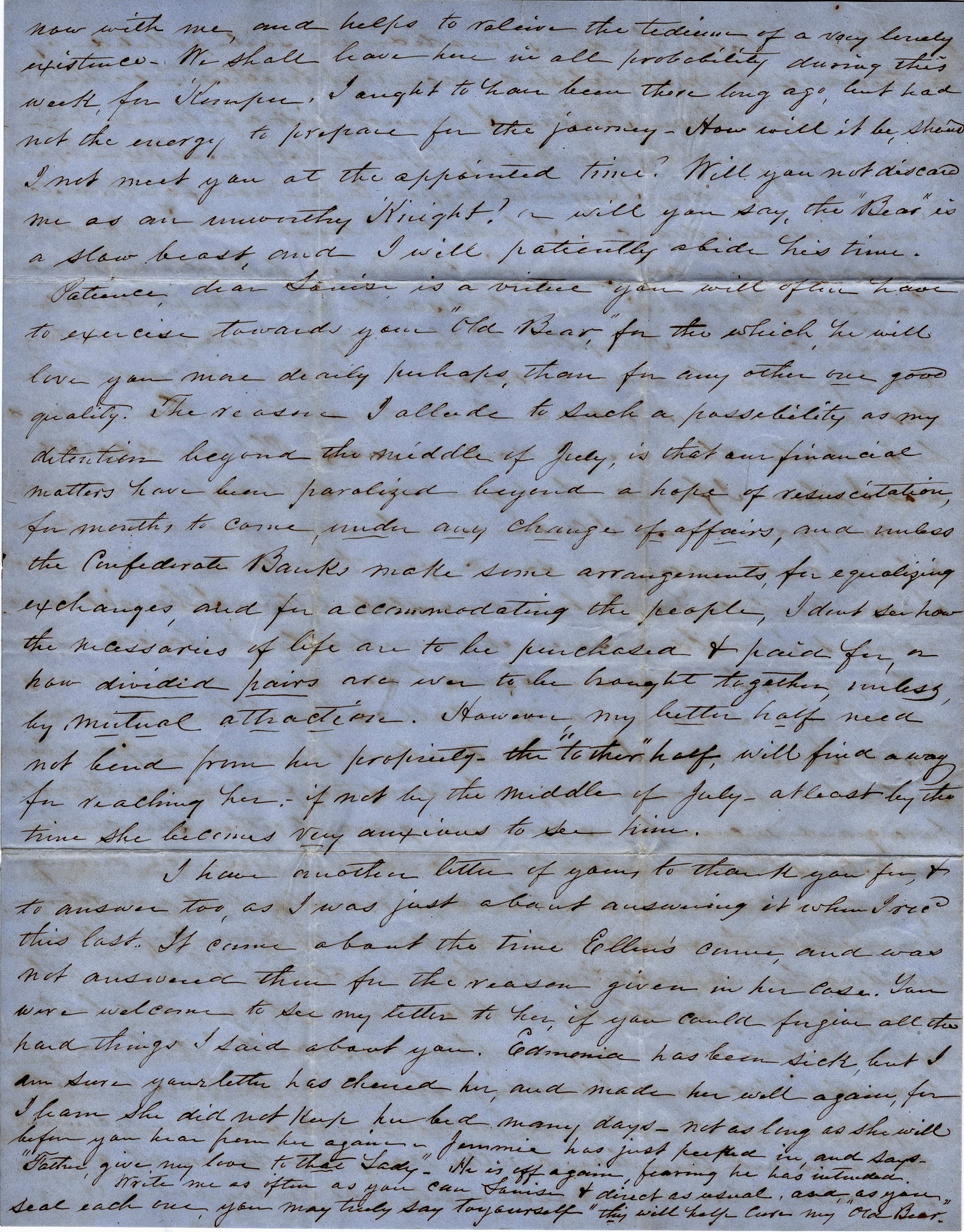
My Jemmie left Hampton in good time. He stayed in Richmond two weeks and then like a little man, took the cars all alone for Mobile where he arrived safely last Friday week. He is now with me and helps to relieve tension tedium of a very lonely existence. We shall leave here in all probability during this week for Kemper. I ought to have been there long ago, but had not the energy to prepare for the journey. How will it be. Should I not meet you at the appointed time? Will you not discard me as an unworthy knight? Will you say, the “Bear” is a slow beast, and I will patiently abide his time.
Patience, dear Louise, is a virtue you will often have to exercise towards your “Old Bear,” for the which he will love you more dearly perhaps than an other one good quality. The reason I allude to such a possibility as my detention beyond the middle of July is that our financial matters have been paralyzed beyond a hope of resuscitation for months to come, under my change of affairs, and unless the Confederate banks make some arrangements for equalizing exchanges, and for accommodating the people, I don’t see how the necessaries of life are to be purchased & paid form or how divided pairs are ever to be brought together unless by mutual attraction.
However, my better half need not bend from her propriety—the “t’other” half will find a way of reaching her, if not by the middle of July, at least by the time she becomes very anxious to see him.
I have another letter of yours to thank you for and to answer too, as I was just about answering it when I received this last. It came about the time Ellen’s came and was not answered then for the reason given in her case. You were welcome to see my letter to her, if you could forgive all the hard things I said about you. Edmonia has been sick but I am sure your letter has cheered her and made her well again, for I learn she did not keep her bed many days—not as long as she will before you hear from her again. Jemmie has just peeked in and says, “Father, give my love to that lady.” He is off again, fearing he has offended.
Write me as often as you can, Louise, and direct as usual, and as you seal each one, you may truly say to yourself, “This will cure my “Old Bear.”

 Spared & Shared 23