Category Archives: American Revolution

1779: William Vernon, Jr. to William Vernon, Sr.

The following 1779 letter may appear to be a simple letter from a “dutiful and affectionate” son to his father, but it is actually a significant historical document that may have provided the first indication that the Revolutionary War in America might yet result in American Independence. The letter was penned by William Vernon, Jr. in Bordeaux, France, to his father (and namesake) William Vernon, Sr. in Boston, where the elder Vernon was functioning, by appointment of the Continental Congress, as president of the Continental Naval Board (precursor the Dept. of the Navy). The letter conveys the all important intelligence that Spain had joined France in a war against Great Britain which ensured that the British would have to spread their resources even thinner than before. Though Spain could not be persuaded to encourage the Americans in their quest to free themselves from the imperial control of their motherland, the alliance with France in a war against Great Britain effectively and indirectly endorsed the revolt.

Vernon, Jr, who graduated from what is now Princeton University in 1776, was sent by his father to France in 1778 (travelling with John Adams). He served for a time as an assistant there to Benjamin Franklin (with whom he continued a relationship thereafter). Vernon, Jr. stayed in France after the Revolutionary war ended until 1795 when he reluctantly returned to Newport upon his father’s threat to disown him if he did not. When passing through Bordeau on his way to Spain to negotiate matters of commerce in 1780, John Adams visited William Vernon, Jr. where he found him “in perfect health” and “that he had pursued his studies to such a purpose as to speak French very well.” [Letter from John Adams to William Vernon, 16 March 1780]

Interestingly, Vernon, Sr, both before and after the Revolutionary War was notorious in his playing a major role in the importation of African slaves into the U. S. and West Indies as part of the Triangular Trade. It is estimated that he and his brother Samuel owned as many as eight slave trafficking vessels and in the course of over 60 years, the Vernons financed well over forty slave voyages to the coast of West Africa.

The William Vernon Family Residence in Newport, Rhode Island

[Note: This letter is from the private collection of Richard Weiner and was transcribed and published on Spared & Shared by express consent.]

Transcription

Bordeaux, [France]
July 12, 1779

Honored Sir,

The enclosed packet was intended by the Buckskin, Capt. [Aquila] Johns,1 who very unexpectedly left it upon my hands since which several events of consequence have taken place.

The Spanish Plenipotentiary at the Court of Britain gave in a Manifesto signifying his master’s displeasure at the proceedings of the British Ministry & his orders to withdraw. The 20th of June, Lord Grantham 2 withdrew from the Spanish Court & the 21st, war was declared against Great Britain. Two fleets have arrived at Brest from the West Indies consisting of upwards of 20 sail each under the convoy of three frigates. The British fleet consisting of 33 sail of the line under the command of Admiral [Thomas] Hardy has returned to port after remaining a few days in the Channel.

I have the pleasure to inform you that Mr. Bon.’d had obtained admittance for me into the House of Messrs. Freyer & Frerer; I shall enter the counting house next week. I have shipped by the General Mercer 3 a cap containing articles to the amount of 9.4.10 [ ] addressed to Mr. Hews. The captain attending and crying at every moment in my ear forces me to conclude this abruptly.

Your very dutiful and affectionate son, — W. Vernon, Jun.

1 The 200-ton Maryland Privateer Ship Buckskin was commissioned on 9 January 1779 under Commander Aquila Johns of Baltimore, Maryland. Serving aboard the Buckskin as officers were First Mate or Lieutenant John Slemaker of Baltimore, Second Lieutenant George Duck, of Baltimore, and Third Lieutenant Ambrose Bartlett, probably from Baltimore. She was listed as having a battery of twenty-eight guns and a crew of 100 men. Her owners are listed as Samuel and Robert Purviance and John Crockett and others of Baltimore. Her $10000 bond was signed by Johns and John Davidson of Annapolis, Maryland.

Buckskin prepared to sail for Bordeaux, France in early 1779. About fifteen sail of merchant vessels collected to sail with the Buckskin acting as an escort. About early February 1779 the “convoy” sailed. Buckskin proceeded on her way, but ten of the others were captured. During her passage she captured a British privateer with a crew of sixty men. Johns paroled the sixty men and forwarded the parole to Benjamin Franklin, hoping it could be used in a prisoner exchange. Buckskin arrived in Bordeaux about the beginning of March 1779. A letter from an American merchant in Bordeaux, William MacCreery, to Benjamin Franklin, one of the American Commissioners in France, sought to obtain an exception to the French tariffs on exporting salt. MacCreery noted the Buckskin twenty-two 9-pounders, had a good crew, and “she Sails remarkably fast, having been constructed for Cruizing.” He also solicited the transportation of any American government goods going to Baltimore. Franklin replied on 18 March, stating that he would investigate the matter, but also pointing out that it was improper to request favors for private parties at a time when French financial aid was so frequently requested by the American government.

In April 1779 the Buckskin was still at Bordeaux, loading a cargo for Baltimore. MacCreery, on 17 April 1779, informed Franklin that he was going to sail to Baltimore in the Buckskin, and offered to take any dispatches that the American Commissioners in France wished to send to America. Buckskin sailed from Bordeaux on 21 June 1779, bound for Baltimore. She safely arrived in Baltimore and began preparing for another voyage to Bordeaux. In late December 1779 Buckskin lay in the Patuxent River, preparing to sail. She had taken on a cargo of tobacco and was again bound for Bordeaux. On 26 December one Thomas Ridout, embarked aboard the ship. He was going to France and was entrusted with certain dispatches for Franklin. A winter freeze set in and the Buckskin was held in the river for nearly two months, finally sailing about the end of February 1780. She arrived in Bordeaux on 3 April 1780.

Buckskin (or Buckskin Hero) was on her return voyage to Baltimore, when, on 9 November 1780, she was captured by HM Frigate Iris (Captain George Dawson), off Cape Henry, Virginia. She had a cargo of dry goods, clothing, liquors and general merchandise aboard. Buckskin’s crew was stated to be 128 men, and her battery to be twenty-eight guns. She was variously listed as 400 tons and 600 tons. Other sources indicate she had thirty-six guns in her battery. Buckskin was tried and condemned in the New York Vice Admiralty court in 1780-1781. She was listed as an American merchant vessel with a “cong,” a French pass, in these papers. On 27 January 1781, the Maryland Council approved a proposal to exchange Johns, then on parole at New York. [See Buckskin, Frigate]

2 Lord Grantham was the British Minister to Spain from 1771 to 1779.

3 General Hugh Mercer was killed while leading American troops at the Battle of Princeton on 3 January 1777. A privateer named the General Mercer was launched the following year out of Massachusetts. The vessel was captured in 1780.

1808: William Dalrymple to his Parents

How William Dalrymple might have looked

This historically significant letter was written by 27 year-old William Dalrymple (1781-1811), the eldest son of James Dalrymple (1758-1847) and Azubah Parmenter (1764-1850) of Framingham, Middlesex county, Massachusetts. According to family history, William moved to Montreal, Quebec, Canada in 1809 and visited distant parts of Quebec, dying during one of those trips. William’s father was a drummer in Capt. Jonathan W. Edes’ 4th Company, Col. Thomas Craft’s Artillery Regiment in the Revolutionary War. He served from 1 August 1776 to 1 November 1776, 3 months.

William’s letter to his parents describes his 5-day passage from Boston to New York City aboard the sloop Ten Sisters on what appears to have been a business venture. His landing in New York City just happened to coincide with the “Grand Procession to the Tomb of the Martyr’s” on the morning following his arrival. The “Martyrs” were the roughly 11-12,000 American patriot prisoners who died during the American Revolution onboard the British Prison Ship Jersey (and other lesser vessels) that was anchored in Wallabout Bay on the East River. William shares some of his observations from the procession that day that began in Manhattan, crossed the East River to Brooklyn (by boats), and then proceeded to Wallabout Bay.

Transcription

Addressed to Mr. James Dalrymple. Framingham, near Boston [Mass.]
Postmarked New York [City]

New York [City, New York]
May 26, 1808

Dear Parents,

The Sloop Ten Sisters plied the New England coast carrying freight or passengers

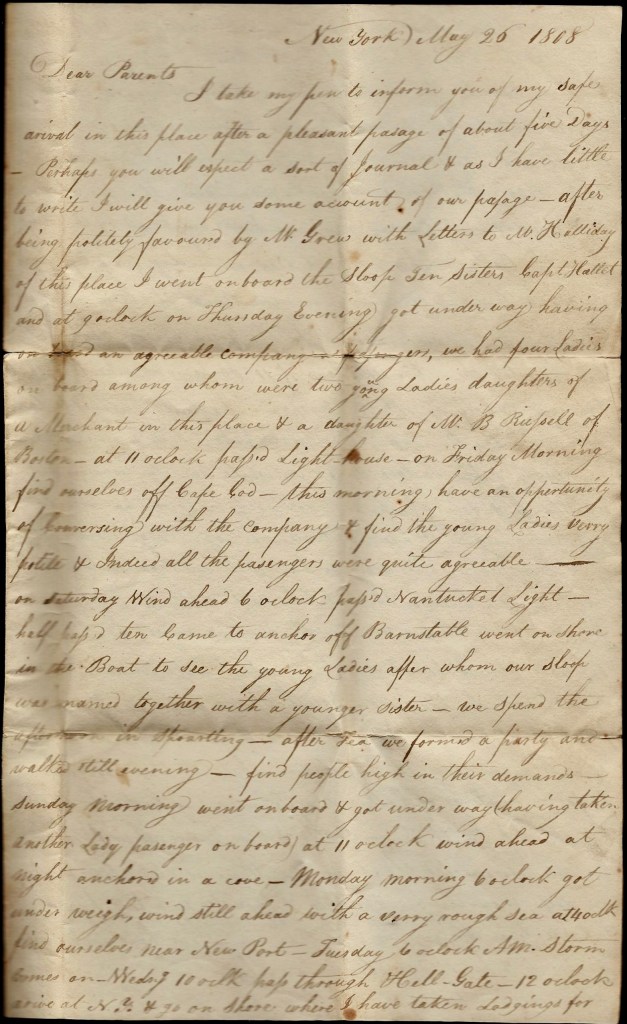
I take my pen to inform you of my safe arrival in this place after a pleasant passage of about five days. Perhaps you will expect a sort of journal & as I have little to write, I will give you some account of our passage. After being politely favored by Mr. Grew with letters [of introduction] to Mr. Holliday 1 of this place, I went on board the sloop Ten Sisters, Capt. [Benjamin] Hallet, and at 9 o’clock on Thursday evening, got under way having on board an agreeable company of passengers. We had four ladies on board, among whom were two young ladies—daughters of a merchant in this place, and a daughter of Mr. B. Russell of Boston. At 11, o’clock, passed lighthouse. On Friday morning, find ourselves off Cape Cod. This morning have an opportunity of conversing with the company & find the ladies very polite & indeed all the passengers were quite agreeable.

On Saturday, wind ahead. 6 o’clock passed Nantucket Light. Half past ten came to anchor off Barnstable. Went on shore in the boat to see the young ladies after whom our sloop was named together with a younger sister. We spend the afternoon in sporting. After tea we formed a party and walked till evening. Find people high in their demands. Sunday morning went on board & got under way (having taken another lady passenger on board). At 11 o’clock, wind ahead. At night, anchored in a cove.

Monday morning 6 o’clock got under weigh. Wind still ahead with a very rough sea. At 4 o’clock find ourselves near Newport. Tuesday, 6 o’clock a.m., storm comes on. Wednesday 10 o’clock pass through Hell Gate. 2 12 o’clock arrive at New York [City] and go on shore where I have taken lodgings for a few days but expect no business. 4 o’clock called on Mr. Holliday whom I found very polite. Having taken a glass of wine and passed an hour at his house, he promised me his good offices in forwarding my views in this place & politely offers me letters to his friends in Philadelphia & Baltimore. I now retire to my lodgings after having received an invitation to dine at 2 o’clock on Thursday.

An idyllic scene of Hell Gate, about 1820. From an engraving by John Hill of a painting by Joshua Shaw. The view is from Ward’s Island looking south across Hell Gate. The blockhouse is apparently the one at Mill Rock. Note the tidal movement of the water, depicted in striations in the foreground. (Image courtesy of NYPL.)

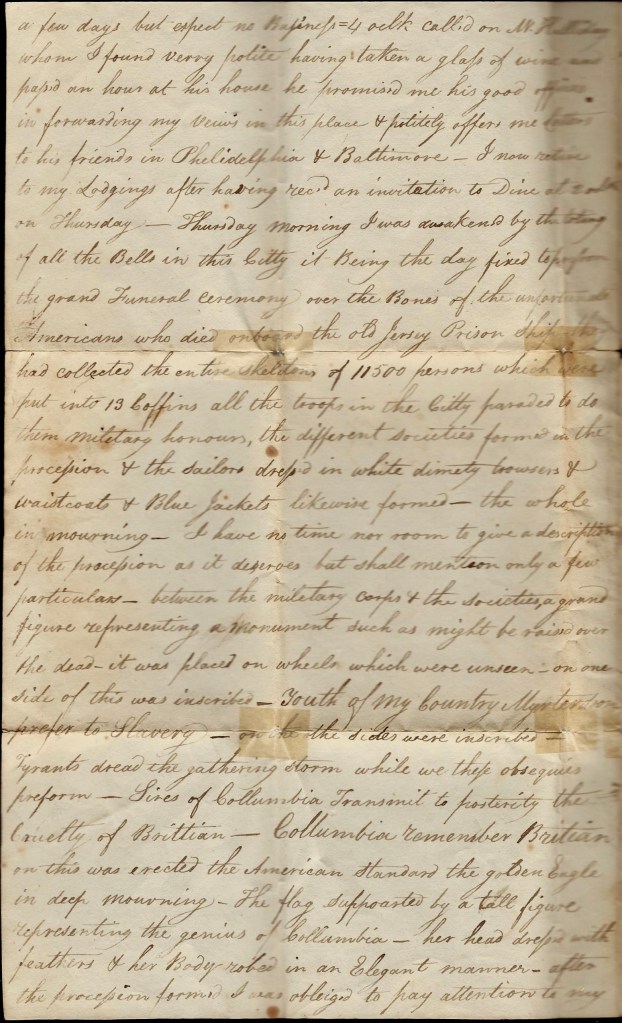
Thursday morning I was awakened by the tolling of all the bells in this city, it being the day fixed to perform the grand funeral ceremony over the bones of the unfortunate Americans who died on board the old Jersey Prison Ship. 3 They had collected the entire skeletons of 11,500 persons which were put into 13 coffins. All the troops in the city paraded to do them military honors. The different societies formed in the procession & the sailors dressed in white dimety trousers & waistcoats & blue jackets likewise formed—the whole in mourning. I have no time nor room to give a description of the procession as it deserves but shall mention only a few particulars.

The Prison Ship Jersey anchored in Wallabout Bay in the East River

Between the military corps and the societies [was] a grand figure representing a monument such as might be raised over the dead. It was placed on wheels which were unseen. On one side of this was inscribed, “Youth of my Country, Martyrdom prefer to Slavery.” On the other sides were inscribed, “Tyrants dread the gathering storm while we these obsequies perform—Sires of Columbia, transmit to posterity the cruelty of Britain—Columbia remember Britain.” On this was erected the American standard, the golden Eagle in deep mourning. The flag [was] supported by a tall figure representing he genius of Columbia—her head dressed with feathers & her body robed in an elegant manner.

After the procession formed, I was obliged to pay attention to my engagement and found Mr. Holliday, Mr. Frears, &c., who were very free in conversation. This made time pass agreeably as it drew my attention from the gloomy prospects of poverty which too often renders me unhappy. We now walk in the park to take a view of the Transparent representation of the British evacuating New York. Over the city hovered the Goddess of Liberty—the Genius of History, Fame, &c.

I now retire to my lodgings to write this, where poverty again disturbs me, as I pay 6 dollars for my board, beside what wine spirit, &c. I make use of. I cannot tell where you may direct your letters as in all probability I shall leave New York in a few days. Philadelphia will be my next resting place after which I shall proceed to Baltimore. I shall now close this by subscribing myself your dutiful son, — William Dalrymple


1 I could find only two men named Holliday in the New York City Directory in 1809. These were Thomas Holliday, grocer, 48 Henry Street; and William Holliday, 25 Mulberry (no occupation given).

2 Hell Gate was a narrow, dangerous tidal straight in the East River near New York City that required the full attention of mariners.

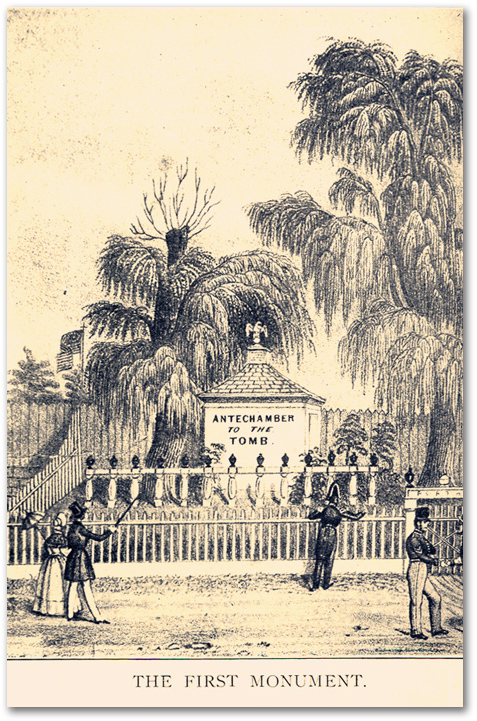
The first monument to the American Patriots who died aboard the Prison Ship Jersey in the American Revolution

3 During the American Revolution, the British resorted to confining American prisoners in the hold of old ships, the most famous of which was the HMS Jersey—an old converted 64-gun man-of-war that was stripped of all its fittings except for the flagstaff and anchored in Wallabout Bay in the East River. “Conditions on board were despicable. Meager rations of maggoty bread and rotted meat left the prisoners sick, weak and emaciated.” There were no toilets. By 1780, prisoners were dying aboard the Jersey at a rate of roughly ten each day, their bodies either buried in shallow graves on the shoreline or simply thrown overboard. More than 1,000 men were kept aboard the Jersey at one time. Even after the British surrender at Yorktown in late 1781, prisoners were kept aboard the Jersey and other ships until the war formally ended in 1783. Only 1,400 Americans survived captivity onboard the Jersey. At least 11,000 men and boys died—more Americans than in all the Revolutionary Battles combined. In the years that followed, the skeletons—whole or partial—that were collected from the bay or from the shoreline were gathered by citizens until 1808 when a crypt was constructed for their burial. One hundred years later, in 1908, a more proper monument was erected on the hilltop overlooking the bay. Today, almost no ones visit the spot to honor these patriots. I may have to make the journey there before I die. One of my ancestors, Capt. Peter Griffing (1742-1781), who led a company of volunteers at New Haven and fell prisoner to the British when they burned the city in July 1779, was placed on board the Jersey where he died in 1781. Peter’s brother, Capt. Moses Griffing (1745-1804), the captain of a merchant vessel, was likewise taken prisoner at sea and placed aboard the Jersey, but survived the ordeal when his wife called at the camp of Washington who gave her an English captain prisoner to exchange for her husband.