This letter was written by Samuel W. Hill (1840-1864), a native of Pennsylvania, who was residing in Waynesburg, Carroll county, Ohio, working as a “Laborer” at the time of the 1860 US Census. He was enumerated in the household of Henry Rider (1822-1869), a farmer with a wife and two children. Henry’s wife’s maiden name was Elizabeth Maple (b. 1820). It’s possible the Rider’s were relatives.
In August 1862, when Samuel was 22, he enlisted as a private Co. F, 126th Ohio Infantry. He was taken prisoner at the Bloody Angle (or Muleshoe) on 12 May 1864 near Spotsylvania Court House and was transported to the prison at Sumter, Georgia, where he languished and died of scorbutus. He was one of 57 prisoners who died at Andersonville on 22 September 1864. His remains are in Grave 9538 at the National Cemetery there.
[This letter is from the private collection of Greg Herr and was made available for transcription and publication on Spared & Shared by express consent.]
T R A N S C R I P T I O N
Addressed to Mrs. E. M. Hill. North Orwell, Bradford county, Pennsylvania; this envelope does not go with the letter but has US & CSA postage on it.
Camp Sumptor May the 26th 1864
Dear Mother this afternoon I find myself in Georgia a prisonor of war and wel as usual though some tiard riding so far at one. I was taken the 12 of this month in the big fight that comenced on the 3d and was not over when I was taken I came out all rite this from your sone S. W. Hill to to EM Hill Bory no trouble about me.
The 1864 captivity of Andrew Clark McCoy, 9th Minnesota Infantry, at Andersonville.
Andrew Clark McCoy (1842-1913) was born in Crete, Will County, Illinois, on December 26, 1842, and with his father’s family settled upon a farm in Salem township, Olmstead County, Minnesota in 1856. He received his education in the district school and later at Hamline University which was then located at Red Wing. While there, he enlisted in 1862 in the 9th Minnesota Infantry—a regiment that had the misfortune of earning the sobriquet, the “hard luck” regiment. This regiment was trained and used as companies on the frontier in its first year of service, scattered at various posts in Minnesota and later Missouri. In September 1863 the Ninth received a short furlough, and in October the companies departed Minnesota in groups for Missouri. Here, as part of the Department of the Missouri, the regiment spent the next seven months guarding railroads from near St. Louis westward to the Kansas state line. In May 1864 the Ninth concentrated at St. Louis. At dress parade on the evening of May 26 the entire regiment came together with all ten companies present for the first time in the Ninth’s history.
Andrew Clark McCoy, Co. F, 9th Minnesota Infantry (courtesy of Ryan Martin)
From St. Louis the Ninth Minnesota moved to Memphis, where they joined an expedition led by General Samuel Sturgis. They were tasked with protecting Union railroad supply lines from Confederate raiders while Sherman’s army campaigned toward Atlanta. On June 10 1864, Sturgis’s force clashed with Confederate General Nathan Bedford Forrest in the Battle of Brice’s Crossroads (Guntown), Mississippi. Sturgis’ units joined the battle piecemeal and were defeated by Forrest. Throughout the night and into the next morning Forrest pursued the federals for more than twenty miles. The Southerners captured many cannon and wagons, as well as some 1600 prisoners. 235 men from the Ninth Minnesota were sent to prison camps.”
The following speech was written sometime after the war by McCoy chronicling his experience at Andersonville, the notorious Confederate prison located in Sumter, Georgia, where he was held in captivity for about six months in 1864. Following is exchange from prison, McCoy returned to his regiment and served until August 1865. Following his discharge, he returned to Olmstead county where he became a prominent farmer and leading citizen, serving as a town supervisor, as county commissioner, and as a member of the school board. He took an active part in Grand Army affairs and my hunch is that this speech may have been prepared for one such meeting. A copy of the speech was made available to the Rochester Public Library in 1908. How much earlier it was written is unknown. I have published it here because I could not find any evidence that it had ever been published. My thanks to Ryan Martin for sharing the speech.
T R A N S C R I P T I O N
“I was a member of Company F, 9th Reg, Infantry, Minnesota. I was captured at Ripley, Mississippi on the 11th day of June 1864, the very day after the Guntown disaster. Was conveyed through Selma, Demopolis, Montgomery, and Macon to Andersonville. Andersonville is about 60 miles south of Macon and ½ mile east of Anderson, a little railroad station. The prison was simply a stockade built of logs cut 18 feet long hewn flat set in the ground 4 feet and stood 14 feet above it, the enclosure contained 13 acres, 20 feet inside of the stockade were stakes about 2 feet long driven in the ground 12 feet apart. Narrow strips of boards were nailed on tops of the stakes and this was the “dead line.” There were 33 perches around the stockade in each of which stood one guard. The prison was first occupied by federal soldiers held as prisoners of was on March 12, 1864. They were from Bell Island and Libby prisons. This prison was used about one year.” — Account written by A. C. McCoy.
A SPEECH MADE BY A. C. McCOY ABOUT PERSONAL EXPERIENCES AS A CAPTURED UNION SOLDIER HELD AS A PRISONER OF WAR BY THE ARMY OF THE CONFEDERACY
On the 19 day of June 1864 between sundown and dark, 700 of us Guntown victims stood in line in front of the South gate at Andersonville prison—and were counted off into squads of 90 men each. Three of these squads or 270 men made a detachment. The squads were numbered from one to three. The detachments were numbered in order from one side to the other of the Stockade. At the conclusion of the counting the large plank gate opened, and after passing into a sort of ante yard the prison gate proper was opened and we were ordered to go inside. While the counting was going on, Capt. Wirtz and other officers and men mounted apparently ready for any emergency.
Oh! What a sight met our eyes as we entered the prison and the terrible stench that greeted our nostrils—men half naked—complexion colored by sun and pitch pine, smoke-haggard countenances, flesh shriveled and drawn tight to the bone, eye sunken and glassy—it was difficult to believe that they belonged to the same race of beings as ourselves. The great question which presented itself to us at that time was where we could find a place to stand or sit down, to say nothing about unoccupied ground to lie down on at this end of the prison. Every inch of space seemed to be taken, but after a while we separated and found places to lie down in the narrow spaces left for the men to walk in. Our sleep was not one of rest for body or mind—and to add to our discomfiture, we were trampled on by men going back and forth from the creek and slough and the terrible tongue lashing we received for being in their way.
We got through the night without any broken bones or serious scars however, but morning found us possessed with an awful gnawing for something to eat; it being 48 hours since we had tasted food. About 8 o’clock we reported in the drive way near the South gate, according to orders received the night before, where a rebel sergeant met us and escorted us north over the creek and slough to a point northeast of the north gate where our detachment from the “dead line” and on the Second street East from it. These streets were about 3 feet wide and usually ran from the north end to the slough, there being no cross walks excepting the wide driveway at the north gate which was left for and used by the mule team and wagon that brought in our rations. This gate was only used for this purpose.
Sketch of Andersonville Prison by Barbara McCoy
Here we remained without any shelter of any kind until the stockade was enlarged by an addition of 5 acres on the north end which when completed the north wall of the old enclosure was left standing excepting here and there two of the timbers were taken out to give access between the old enclosure and the new one. Eight of us managed to get out one of those pine timbers by considerable digging with the tools nature had given us—our fingers took it to where we had dug a hole about 16 inches deep and wide enough to permit eight of us to lie down spoon fashion, and by the use of an old hatchet we got out six stakes and material in shape and strong enough to hold up 8 inches of dirt above this hole when completed. This afforded a good shelter from the hot rays of the sun by day and dew at night—but in hard rainstorms the roof would wash off and we were obliged to pull out and stand and take it. The hole filled up with water and mud—but usually in a few hours the water soaked into the ground—the soil being a mixture of clay and sand. After the storm had passed over, we re-covered the roof. In July and August we had quite a number of hard rainstorms which was a Godsend for those confined there as it washed away many tons of filth and cleansed the enclosure generally.
Through nearly midway between the North and South gate east and west was a soft slough or quagmire. Through the center of this ran a small creek of water running from west to east. The ground sloped on either side toward this slough. On this creek above the stockade was the cook house and above that was located the camp of the guards. The wash from this camp and the refuse from the cook house entered the creek before it reached the stockade. All the water we used came from this creek. The slough was used for the offal of the prison or dumping place for all who could get there.
In order to get as good water as possible the whole camp were obliged to get it on the west side within a few feet of the “dead line.” It was here that so many of the boys were shot and killed by the guards. At this place there was always a crowd, especially so in the forenoon, of 500 persons or more, each waiting his turn at the water and in the jam and crowding some one or more would reach too far up the stream and under the “dead line.” The guards who seemed to be always alert as to the Yanks violating prison rules without using any discretion or reason whatsoever would fire from their perches on either side of the stream right into the crowd nearest the “dead line.” The offer held out furlough to any and every guard who shot a federal prisoner for crossing the “dead line.” The guards made no bones in telling us so.
In the hands of the water brigade you could see all kinds of ingenious contrivances imaginable for carrying water, some with shoes, old boot tops, bags made from rubber blankets. I saw small buckets made from material got inside of staves with hoops, spliced the ends of which were riveted together with zinc nails taken from the heel of an old boot or shoe. Our outfit for cooking usually consisted of one or more half canteen, a tin cup and a case knife which someone of the mess brought into the enclosure or was lucky enough to find strolling from its rightful owner. We were furnished absolutely nothing inside the prison, aside rations. Lucky was the man who when captured was suffered to retain his haversack and his individual kit of field cooking utensils. Nearly all who were captured by Forrest’s men were robbed of their money, watches, pocket knives, hats and the whole private cooking outfit that was of any consequence. When our rations were issued to us uncooked, each one cooked his own, the dishes being too small for more. The outfit heretofore mentioned was the common property of the mess and in the use of which each took his turn. Arches were constructed of clay for cup and half canteen to sit on underneath of which was a fire made from a few splints of pitch pine.
Wood was a scarce article inside of the stockade and it was necessary for us to economize in its use—while not more than 80 rods from where we were we could see hundreds of cords standing in the tree. Every morning at 8 o’clock a rebel sergeant came inside, called us in line 2 deep to answer our names as he called them and as we answered he would check us off on his book—and from these checks the number of rations were issued or each check on his book represented a ration for that day. There was a sergeant for each detachment. One man of our number was appointed by the rebel sergeant to draw rations for the detachment of 270 men. Then there was a man chosen from each of the squads to draw its share of 270 rations. The detachment sergeant would divide the amount he received into three equal parts and one of those parts represented one man’s ration for a day of 24 hours. In the course of the forenoon the wagon containing our rations was driven in. For a time our ration was corn bread with a couple ounces of raw beef and at other times in lieu of corn bread would be corn meal. At other times it would be corn meal mush with no meat or salt. When mush was issued to us, it came in steaming hot and was measured out to the detachment sergeant from the wagon with a common shovel. The corn meal in whatever way it was dished up to us—whether cooked or raw—was coarsely ground and unbolted. No salt was used in the cooked food or issued to us except on two occasions and the allowance then was so small that it was of little value. Sometimes our ration would be a pint of half cooked peas or red beans which were full of black bugs. Our digestive organs could do nothing with them. On one occasion we received each a tablespoonful of vinegar and on two occasions the same quantity of sour molasses. A ration of corn bread was a piece about the size of my hand, of raw meal 1 pint, of mush 3/4 of a quart. The mush we could not keep as it would sour inside of two hours. We ate it up right away. Most of the corn bread was hardly baked through. The meat when we got any was given with one or the other named ration. The last two months no meat was issued. The raw meal we wet up with water and cooked it on the ever handy half canteen. The beef we stewed in the same dish. Our corn bread ration we tried to make last as long as possible for us to restrain our knawing stomachs. When other kinds of cooked foods were issued, we were obliged to eat it up right away to keep it from spoiling.
You understand that we were destitute of any utensils for receiving or keeping of the rations and the men who drew the food for detachments and squads had only a blanket or rubber pouch to carry the stuff from the wagon to the place of division. In my own case, I tore out the sleeve lining from my blouse to hold the rations of my mess. We had been there less than a month when our boys commenced to die of dysentery and bowel troubles caused by the quality of food received, from exposure and impure water. Nearly all were reduced to walking skeletons. The prison was a breeder of disease. The slough a bed of squirming maggots, and air impregnated with foul odors from the cesspool—and for some distance back from it the air was filled with flies bred there. The death rate was greater among those who were unfortunate enough to be located on its borders. Many died later of starvation and of that loathsome disease, scurvy, and gangrene and of other diseases bred by the scanty allowance and unwholesome nature of food received, and the want of proper sanitary regulations. The pangs of hunger were at times terrible to endure. At night would dream of home and its surroundings, of being about ready to sit up at a table spread with the most palatable layout imaginable, only to wake up and hear the groans of the sick and dying all around us, the guards cry the number of their posts and the hour of night ending with “all is well,” and then realize our dreadful situation—that we were in the hands of men who were not possessed with such a thing as pity, mercy, reason or manly consideration. Our stomachs many times would not retain the food and at other times the sight of it would sicken us. Many times in my own case while standing in the ranks for roll call, I became dizzy from weakness and could not see an object 20 rods in front of me and had to sit down to keep from falling. But this feeling wore off as the day advanced and would be able to take considerable exercise and feel quite well considering.
Our time at first was spent in studying our surroundings, playing games with devices of our own manufacture, talking, relating our boyhood experiences, &c. But the uppermost thought always to be considered was the opinion of each one as to the length of time he thought our stay would be there. This opinion was asked for many times a day—anxious to know of home, of the outside world and what our armies were doing. The want of suitable and sufficient food turned our minds in that direction, would tell of the good meals we had helped to stow away, of what they consisted and how cooked. Would even remember of the crusts of bread we had seen floating round in our folk’s swill barrel and think what a feast we would have if we could get at it. Would wonder if General Stoneman or someone else would not come down on the guards and relieve us—and a thousand and one thought of like nature suggested by one and another. Little did we think or dream that we lived under the following order which if carried out meant certain death to all of us:
Headquarters Military Prison, Andersonville, Ga. July 27, 1864
The officers on duty and in charge of the battery of the Florida Artillery at the time will, upon receiving notice that the enemy has approached within seven miles of this post, open upon the Stockade with grapeshot, without reference to the situation beyond these lines of defense.
John H. Winder, Brigadier-General Commanding
[Original clipped from newspaper taken from the Confederacy records]
Our daily routine was about this—1st, in line for roll call—2nd, draw rations—3rd, cook and eat same—4th, if any of our friends were sick to help or carry them over to the south gate and there wait with them their turn to be taken before the doctor—5th, if any of our number had died during the last 24 hours to carry him out through the south gate and leave his body there to be picked by the burial party and while out there to pick up some wood and bring back with us—6th, would skirmish for vermin, first take the shirt and then the pants and go over each article carefully—usually twice a day—and if there were any in our mess who were unable to look over their own clothes someone would do it for him. These little demons increased in number and size most rapidly and throve the best of anything I ever saw or heard of in all of God’s creation. I know they sapped the life’s blood from many a poor fellow’s veins. As a matter of fact, all those who had been confined there any length of time were reduced in flesh and strength and had but little blood left in their body. The ground was alive with the vermin. It was no unusual thing to have the outside of our clothes covered in the morning so thick that we could scrape off these pests with a knife or rather a stick with the edges sharpened. We had no chance to wash our clothes and they were worn until they literally dropped off us, which were replaced by stripping the dead who were taken out nearly naked. Usually a shirt or a part of a blouse was left on them. The dead were laid out with hands crossed below the breast, wrists tied together as was also the feet. The name, regiment, and state to which he belonged was written on a piece of paper and fastened to the breast of the garment left on him.
The sick were often compelled to wait 3 or 4 hours in the hot sun before their turn came to see doctors. Many died there while waiting. It became useless to go to the gate for medical aid from the fact that the doctors had no medicine to give excepting the steepings of weeds and herbs said to have medicinal properties. The hospital on the outside was always full and it was generally known that to go there in nearly every case was but so many steps nearer the trench. Many times when our young Johnnie came inside to call the roll, he would report to us the death of this and that one of our detachment who had left for the hospital but the day before. During the months of July and August there was about 35,000 persons confined in the stockade and the average daily death rate for those two months was 200. The number of inmates was kept up by new arrivals from Grant’s and Sherman’s armies. From these arrivals we learned what our armies were doing. The Johnnies only let us know of federal reverses. During the long time confined there I never saw a newspaper of any kind.
When the new arrivals came inside, the boys in their eagerness to gain news would gather and stand around them in great immense crowds which the rebels in their fear, or otherwise, construed to be a gathering to plan an outbreak. So one day some of the guards came inside and stuck stakes with white stripes of cloth fastened to them through the center of the stockade north and south and orders were given that if we congregated on the west side of this line of stakes—that is, on the side next to the gates—they would open on us with shell and canister. They did one afternoon by firing two guns. One shot went clear over the stockade. The other struck between the dead line and the wall of the north end.
During the last week in September, they took the first trainload of men out. It was supposed for exchange—in fact, they told us it was. But after the second trainload was taken out, all such hopes were dispelled. Our show began to look blue and no wonder that some became discouraged and gave up and in their delirium crossed the “dead line” that the guards might put an end to their miserable existence. It looked as if our only show to escape from death was by taking the Oath of Allegiance and enter the Confederate service. This inducement was constantly held out to us. They called for men to go out on parole to make shoes and for men who were acquainted with machinery who could run and keep the same in repair, offered great inducements to such, but few expressed a desire to go and those who did were reasoned with by their fellows and most cases were persuaded to remain inside. Those who did go outside on parole did it thinking their show for escape would be better and with the intentions to do so at the first opportunity offered. A fixed determination generally prevailed that no one, let come what may, would do anything to aid or help the rebels—or in short, “Death before Dishonor.”
Some of their modes of punishments aside from cutting off rations were: They tied men up by their thumbs to limbs of trees so high that their toes would just touch the ground and kept them there in that position from 8 to 10 hours at a time, or until the victim fainted. One day out by the south gate, I saw men laying on their backs with the hot southern sun beating down on them, their feet fastened to stocks, arms stretched out full length, their wrists tied to stakes driven in the ground in such a position that it was impossible for them to shift their position in any way. One of our boys who had helped to carry a dead person out borrowed an ax of a negro to cut up some limbs of a tree to carry inside, he concealed the ax in such a way as to elude detection of the two guards at the gate and brought it inside and when the ax was missed they compelled the negro with a guard to go inside and pick out the man who had the ax, which he did, and he was taken out with the negro and they were both ordered to bare their backs. The negro’s hands were tied to a short post and a rawhide whip of 3 strands was given to the white man and he was ordered to give the negro 30 hard lashes. He remonstrated but was told he must do so, or he would received a double dose. After he had whipped the negro, they changed positions from active to receptive—vice versa. There were kept on the outside of the stockade at the southeast corner in a covered shed, a dozen bloodhounds in charge of their master. They were kept and used to capture escaped prisoners and paroled men who attempted to run away. Quite a number of tunnels were dug from the inside under the stockade well and those who escaped through them were scented by the hounds, and run down or treed in a few hours after their escape had been discovered (of course these escapes were made at night). The poor runaways were obliged to climb a tree in order to keep the hounds from tearing them to pieces before their mounted master came up to call them off.
Three weeks before I was paroled for exchange, I was removed to Savannah, Ga. I was there one week at the end of which was taken to Milan or Camp Lawton—both prisons were stockades. The enclosures were constructed of the same material and in the same way as Andersonville. At Savannah the dead lines were lit up at night by lamps but we were crowded in there to almost suffocation. Rations were better, however, both in quantity and quantity. At Milan the stockade enclosed 60 acres and there were not over 8,000 of us there. The prison was new and had not been occupied more than a week before our arrival. The treetops of timbers cut for the enclosure were mostly there so wood was plenty. We needed it badly for it was getting to be pretty cold and frosty at night. Quite a stream of water ran through the stockade and no slough. By the use of this stream and some fixing up which was done before it was occupied made it more healthy and in accordance with true sanitary rules. Was there two weeks when on one afternoon in the first week of December 1864, a rebel sergeant and surgeon came in and called for all the sick to fall in line. The boys were a little slow about it, had been fooled so many times that they thought there was some game in it, but I said to my mess, “I’m going to see what’s in it anyway.” I had no more idea I would pass or that it meant exchange than I have of owning this hall. I took a place in line and when the surgeon came to me, he looked me squarely in the eye and said gruffly, ‘What’s the trouble with you?” I answered, “Bone scurvy.” He pinched my right arm midway between the shoulder and elbow joint, turned to the sergeant and said, “Put his name down.” As fast as our names were written down, we were separated from the rest and were formed in a separate line and as soon as there was a train load of us, we were marched to a vacant corner of the stockade where we stayed that night under a special guard. The next morning we went through the gate en route to the station 3/4 of a mile away, walked along the road between the files of guards. It took me ½ day to walk that distance and I did my best!
We boarded a flat car and rode all night in an awful cold rainstorm. Arriving at Savannah in the morning, we found men with tables and blank paroles for us to sign. While waiting my turn I noticed that there were some dead bodies carried from the cars, this was no unusual occurrence in the transporting of men from the rebel prisons. After all the men had signed their paroles we were marched to the river past Fort McCallister and to our fleet of transports. Steamed alongside on the them, a gangplank was laid down between the two boats a Federal stood on one edge, a Butternut on the other of the plank, and counted us as we passed from one boat to the other. It was not long before we were treated to “Yankee food,” after which we washed and scrubbed ourselves, hair and beard trimmed, after which we donned decent clothing. In a few days we were examined and those who were thought to be able to stand the trip were put on board an ocean steamer for Annapolis, Maryland. The others were left on hospital boats we passed. And after three days passage, arrived at Annapolis and had the joyous satisfaction of planting our feet once more in “God’s country, and standing beneath “Old Glory ‘Free’.”
There were 184 of the 9th Minnesota volunteers in Andersonville. 128 died there; 56 came out alive. Of my Co. F, 19 were captured; 13 died in prison. Only 6 came out alive.
Two privates who served with McCoy in Co. F, 9th Minnesota Infantry. Both were from Crete, Illinois, but served in the Minnesota regiment. At left is John H. Dodge who survived the war. At right is Edwin Horace Adams who died of starvation in the Florence Stockade on February 19, 1865 two days before prisoners were exchanged. His cenotaph in Crete has an unreadable epitaph except for the last few words “…that awful Florence Hell.” Both images were taken in the same studio; Dodge wears his sack coat and Adams wears his dress coat. [Images courtesy of Ryan Martin]
No artistry conveys the miserable conditions of Andersonville than this actual photograph. (LOC)
The following letter was written by Edgar W. Irish (1838-1897), the son of George Irish (1810-1888) and Maria Edgerton Potter (1810-1844) of Little Genesse, Allegany county, New York. Edgar enlisted in Co. C, 85th New York Infantry with his younger brother George Hadwin Irish in September 1861. Edgar was made a corporal upon mustering into the regiment and was promoted to sergeant in April 1862. His beautiful penmanship no doubt earned him the rank of 1st Sergt. in August 1862—his highest rank.
1st Sergt. Edgar Walton Irish of Co. C, 85th New York Infantry
In April 1864, while garrisoning the forts at Plymouth, North Carolina, both Edgar and his brother George were taken prisoner with approximately 500 others when the town was surrendered. He and George were sent to Andersonville Prison, George. A source on Find-A-Grave claims that Edgar’s fine penmanship and bookkeeping skills earned him a job at the prison that enabled him to be kept separately and fed better than his fellow prisoners. All the while, however, he worried about his younger brother and after months of pleading, he was finally allowed to search for George but found that he was too late; George had passed away the day before of starvation and dysentery. Edgar was determined that the truth would be known about Andersonville, and seek revenge for his brother George. He found records and concealed them on himself when he was released from prison. Later this evidence was used at the trial of Capt. Wirz. Along with George 310 Soldiers from the 85th died as prisoners of war, the most men of any unit in the Northern Army. George Hadwin Irish is buried at Andersonville National Cemetary, Sumter County, Georgia, USA Site#4587, Findagrave Memorial#28873296.
There is a cenotaph in Edgar’s name at the West Genessee Cemetery that has the following inscription carved into the base: “He made, preserved and supplied the evidence that made possible the execution of Capt. Henry Wirz. The keeper of Anderson Prison.”
A lantern slide of the Wirz Execution in Washington D. C. (W. Griffing Collection)
Transcription
Camp Shephard Washington D. C. December 12th 1861
Dear Cousin Lottie,
It has been a long time since I have had a letter from you and longer since I have written to you. Now if you will forgive me for waiting so long and as I am temporarily located, I’ll set my quill to running. A letter would be quite a rarity to me now for I have not had one since I came from Christendom. Lottie, I have just been reading your last letter and I am sure I cannot write one to match it for interest. I have give almost my whole attention to military matters so long that I find it almost impossible to make a connected composition or even to reason clearly as I could once. All my thoughts by day and dreams by night are in some degree connected with this great rebellion.
Cousin Amy seems to censure our [Chief] Executive in very strong terms. Quite likely the President has made some mistakes but I think he has done as well as he knew how—and that is tolerable well. The case of General Fremont was not managed to suit me, or you of course, but I do not know it all and I am satisfied that there is something about it that which has never been made public. 1
“Uncle Sam” has a splendid army on the Potomac and if ready for defense and probably for offense when the proper moment arrives. Regiments are coming in here every day. One came today from Elmira (the N. Y. 64th State Militia). They pitched their tents next to ours. We are encamped under canvas and are doing as well as could be expected of backwoodsmen.
My health is getting quite good now. I was off duty on account of the measles till we left Elmira, since which I have done my part, I believe. I was very much pleased with your remarks concerning your cousin G. and I hope you may always have so good a counselor near you. I want you to give him my best respects and tell him that if I am spared to return to the North, I wish to gain his acquaintance.
It is quite warm here compared with Allegany Co. I am writing by candlelight in my tent without a fire though my fingers are cold. We arrived here last Thursday and have had but two or three frosty nights since. Some of the boys in the next tent have a copy of the Jubilee and an overhauling some of its familiar tunes which disturb me not a little.
Oh Lottie, I wish you could be here just long enough to see how our soldiers get along, to see and laugh over our cooking arrangements, to hear our martial music (at this moment the band is playing Dixie, and three or four times a day we have “Maggie Dear,” “The Girl I left behind me,” etc.) which makes the heart of every patriotic soldier or citizen thrill with joy, to see the glittering mass of bayonets as the men gaily fall into line. Oh, I am glad I’m in this army. Yes, I’m glad I’m [in] this army,” and we’re bound to win or die.
I’ll try and finish this tomorrow, Good night.
Sabbath morning, and I cannot make it seem like Sabbath at all. I did not get time to finish yesterday and have but a few moments now. I enclosed a card photograph which is a little better than none at all. The drum is sounding and I must close. Please write soon. My love to you all. Your brother cousin, — Edgar W.
1 In August 1861, General John Fremont imposed martial law in the state of Missouri and declared all rebel owned slaves to be free. Lincoln, fearing the loss of a loyal border state, rescinded Fremont’s order and relieved the General of his command.
I could not find an image of George, but here is one of John Irby (1840-1871) who served with him in Co. C, 3rd Indiana Cavalry. He suffered an injury to his left hand from a canister shot at Brandy Station, Virginia, on 4 August 1864. This photograph taken shortly after that. (Eldon Irby Collection)
These letters were written by George Washington Martin (1843-1864), the son of John Martin (1792-1861) and Frances (“Fanny”) Horton (1818-1899) of Craig township, Switzerland county, Indiana.
George enlisted on 22 August 1861 as a private in Co. C, 3rd Indiana Cavalry. According to his pension record, George was taken prisoner while on a scout 29 January 1864 near James City, Virginia. He was initially confined at Richmond and then sent to Andersonville, Georgia, on 4 March 1864. He was admitted to the hospital at Andersonville on 29 May and died two days later on 31 May 1864.
In the affidavits filed by acquaintances of the Martin family, Ostrum Bowright, a neighbor and comrade of George’s in the 3rd Indiana Cavalry, attested under oath that George’s father, John Martin, was poor, was an inebriate, and finally became insane and died at the poor house in the fall of 1861, leaving his family no property whatsoever ever and apparently a lot of debt. Fanny lived, according to Ostrum, in a run down 4-room shack that she rented from Jonathan Fromand on the outskirts of Mount Sterling.
In George’s letters, there are frequent reference to his younger brother, Edward M. Martin (1843-1926). Ed enlisted as a private in Co. H, 6th Indiana Infantry. He mustered into the regiment in September 1861 and mustered out in September 1864. He survived the war, married Ella Corns (1852-1915) and settled in Vevay, Indiana. Another brother, Joseph H. Martin (1845-1911) later served in Co. H, 10th Indiana Cavalry.
[Note: These letters were found in the Pension Records in Washington D. C. and made available to me for transcription and publication of Spared & Shared by Bradley Quinlin of Suwanee, Georgia. It’s rather unusual to find this many letters in the pension files.]
Letter 1
August 6th 1861
My dear Mother and sisters,
I received your letter this morning and was glad to hear from you. I was glad to hear that you was well and I hope those few lines will find you in the same health when you get this letter…This has been three letters that I have wrote to you and only got one. I think you ought to write me a letter every week. I want you to send me my brass pen holder and a good pen in your next letter for I can’t get one when I want it to write you a letter when I want to. Now be sure to send it to me if you please and write to me how you all are and how you are doing at home.
Pvt. William H. Sheets served with George in Co. C, 3rd Indiana Cavalry. (Daniel N. Thompson Collection)
I am Police of the Guard today. I feel pretty big to day. I am well and hearty. I weigh 185 pounds and I feel like fighting. You needn’t feel bad about me for t’other night when I was laying down, I said to myself, if I ever got home, I wanted to dream of you and I dreamed that I come home and you all was so glad to see me and Mother, you know that my dreams always come to pass. You know that I always believe in dreams.
When you get this letter, write when you got it.
We get plenty to eat here now but no whiskey to drink. We are all out of money here now but we expect to get some next week and when I get some, I will send it home to you all as soon as I get it. We are all well here except a few and they ain’t very well. Thomas Smelly is getting about well.
Here is my best respects to you all at present time and I hope those few lines will find you all in the same health. Here is a few lines to Miss Corit. We heard that Mary was very sick and he wanted them to write how they all were and write soon. Ossie [Ostrum Bowright] is well and hearty and full of fun. Tell them as soon as you get it. — G. W. Martin
Letter 2
September 26th 1861
My dear Sister and Mother,
I take my pen in hand to let you know that I am well at the present time and I hope these few lines will find you in the same health. I received your first letter on the 19th of September. Was glad to hear from you all and I received your last letter on the 15th and I was glad to hear that you was getting along so well at this time. Tell Andy he must not cry when you call my name. Tell him to be a soldier and not cry about me for when I get some money, I will send him a present and I will send you all a present.
My best friend is P[aul] Clark here but all are good to me. There is no sickness here now nor hain’t been. We are a brave set of boys. We care for nothing. We are the boys that fear no noise when we are far from home.
“We hain’t got our arms yet but we can kill a regiment of Rebels with clubs. We are men here. I can kill six secession men and not half try.”
— George W. Martin, Co. C, 3rd Indiana Cavalry, 26 September 1861
You may sell my scythe and cradle to Cotton Bonty [Bonta?] but he aught to give you three dollars and a half for it. Mother, you are just as [ ] to me as Mary Ann, but you know id she didn’t get my ring, she would cry all the time about it. We don’t know when we will be paid. You know just as much about it as we do. I thought I would have some money by this time but we will have some soon. Tell all of my friends to be good to you all while I am fighting for their country. They say here that if they don’t arm us here pretty soon, they will send us home and arm us and send us to Kentucky. We hain’t got our arms yet but we can kill a regiment of Rebels with clubs. We are men here. I can kill six secession men and not half try. We heard that Kentucky had took Vevay.
If I have anything at home, sell it if it will do you any good. Tell Cuney and Dosh to save all the fodder they can for the cow this winter. Oh dear Mother, and brother and sisters, I am a great ways from you now. Don’t you grieve about me for I am a coming back to Old Indiana again. They can’t kill me. You all know that, and if Joseph can’t get him no coat, make him one out of mine. I would just like to see you all just as well as you would me. When I get some money, I will send you my money.
Dear sister, tell Miss Dow [?] that Thomas Smelly has got so that he can walk and he has changed his looks so that you would not know him. But he is getting better every day. Tell Doll [Dewell C.] McMackin to write me and Thomas Smelly a letter and tell Ike Freeman to write me a letter.
Letter 3
October 6th 1861
My dear friends,
I take my pen in hand to let you know that I am well at present time and I hope these few lines will find you in the same health. I made a mistake in my letter. I dated it in the wrong month and I wrote this. I thought I would right another to you. We are well here at present time. I am well and hearty adn weigh 185 pounds and I see the pleasure of my life here and plenty of fun in our old camp ground.
Dear mother and sister, I wrote this letter today because it was Sunday. I wrote you a letter on Saturday. That is the one I made the mistake on. Then I wrote this one. You must send me my brass pen holder and a good pen.
A soldier’s life is a dreary one. I would like to see you all very well and you would like to see me I expect at home once more. Don’t grieve about me Mother for I am coming back home when war is over. They can’t kill me, you know that. And you must do the best you can till I get some money. I expect to get some next week and if I do, I will send it to you and I will send you all a present. Here is my letter to you all at home.
Dear mother and sisters and brothers, you must think of me but not cry. Here is my love to all in Mt. Sterling and I want all of them to write and be good to you and I will not forget them.. Be sure to tell them to write me a letter and sign all their names. Here is the paper I have got and you must send me some to write to you for I don’t get more here that is fit to write on now. When you get this letter, you must write when you got it. I write to you twice a week. You must write how you are doing and how you are getting along at home.
I am dirty and sassy as a hog. And write to me if you got that letter that I wrote to you when I told you might sell my scythe and cradle to Cotton Bonty. You must write whether you got it or not.
I am your dear son, Mother, far from home in a secession country and I want you to write to me where Edward is if you can. And write soon. I received your letter this 5th of October and was glad to hear from you all. I can’t get paper enough to write to you. — G. W. Martin
Letter 4
[Letter from George’s brother]
October 17, 1861
[Dear] George Washington Martin,
I take the opportunity of writing you a few lines to let you know that we are all well at present time and when you receive these lines, I hope they will find you in the same health. And when you get it—the letter—you must not let it hurt your feelings what I write, for dear brother, you know that I would not lie to you and I want you to believe what this letter tells you.
We saved over half of your fodder at John Nash [Mosher?] and he come over here and dared Mother or me or anybody else to come inside of the fence. He said you give him your corn and we should not have it. He told Mother and me if we come in the field again, that he would shoot us and George, if we don’t get it—your corn—to live on, what do you think we will live on. And he came over here in the house and abused Mother to all you ever heard in your life, and it has grieved Mother almost to death because you let him have your corn and would not let us have it and you ought to know what a good boy Joseph is and when he went over to save the rest of your fodder, John Nash run him off and threatened to take his wagon whip and whip him all the way home if he went in the field again. And now George, we want you to send us word who is to have your corn—us or Mr. John Nash?
And we received your letter the 15th of October and you named Mother’s name so many times in your letter that she cried all day after we got the letter. She says you are her one dear son and she says that she will always remember you and we would give our right hand to see you come home once more to let people know who they are a running over. And now, dear brother, we want you and Paul Clark to write Harvey Bonty and Mr. Brown an order to have your corn gathered in their care for us. Mr. Bonty told us to write to you for an order for the corn in his care and he would gather it and haul it home for us. If you and Paul Clark would send him an order on the field which John Nash rented from Nathan Waldron and you bought it from John Nash and we have got a very long well ever since you have been gone and everybody has been good to us—all but old Parker and John Nash.
And dear brother, there is a long farewell for Mother to you for she thinks that she will never see you anymore for she thinks you are gone forever more to stay. She hain’t got anything to do now but grieve about her two boys in the army for when we lay down at night on our good, warm beds, our thoughts is on you and Edward in the army for you both have to take your beds on the ground in strange lands—where? we know not. And dear brother, don’t never forget your God that rules the Heaven and Earth. And now, dear brother, if you get sick while you are there, you must pray to our blessed God to spare you to come back home once more and your best friend here, Doll [Dewell C.] McMackin, he was here yesterday and told me to send you and Thomas Smelly [ ]. Write him a letter and send him both of your respects. And George, when we could not get any wood, Doll [Dewell] hauled us a load of wood and he said that we should not suffer for wood this week. And George, you may write back on the same paper and you must write to me when you get it. — your brother
Bladensburg, Maryland October 28, 1861
Friend Martin, as your kind letter has just come to hand and George is unwell and desires me to write something concerning his corn at John Marsh’s, he says that John in the first was to find the team and feed and he was to do the work and have one third and then him and Ed and Joseph bought John’s third for ten dollars and paid him six dollars in money and four dollars in work and John was to find the team. Together their two-thirds and would done one third. This he says he can prove by Mr. Waldon and you and Marian. He says to tell Mr. Banta and Brown to tent that for him and he will pay them for it. Yours respectfully, —Paul Clark. (for George Martin)
I would say not to be uneasy about George for he is not dangerous.
Letter 5
Washington D. C. October 20, 1861
My dear Mother,
I take my pen in hand to let you know that I am well today and I hope those few lines will find you in the same health. My dear Mother, I ain’t very well at the present time but I hope these few lines will find you all well today. It is Sunday and I thought I would write you a good letter. You sent me word I must write you a good letter and dear Mother, I thought I would write one to you today. I received your letter on Saturday the 19th day of October and was glad to hear from you all. I have a bad cold and don’t feel much like writing today but I like camp life very well and I see plenty of fun here but has got no money yet.
Dear Mother, I was glad to hear where Edward was and I want you to write to him and tell him to write to me how he likes to be a soldier and how he likes his company and then you get an answer from him and write it to me, And dear Mother, you must write how the children is and tell them to send me some word about them in the next letter you send to me. I would like to see little Darly very well and all of you but I could not leave Washington and come home at all. There is nothing here but soldiers and music and I never will leave here as long as they can beat a drum and play a fife. Mother, you know I like to hear music.
This paper was sent to us from Vevay and I thought I would write to you all. Now Mother and Mary Ann, I want you to write as soon as you get this letter and tell all in Mt. Sterling to send me their best respects…I hope you will not forget to write to me….— George W. Martin
Letter 6
[Approximately 1 November 1861]
Dear Mother,
I received your letter the 23rd day of October in the evening and was glad to hear from you all but, dear Mother, I am sorry to hear that you was used so bad at home. Now dear Mother, if I had thought that you would of been served so mean, I never would left you in my life at home to be run over by such a mean son-of-a-bitch John Nash. Mother, it hurt my feelings to read your letter and to think how you was used. I always was so glad to get a letter from you till now. You wrote so nice to me and how well you was a getting along.
Dear Mother, you must not think I never will come home again for I am a coming back when this war is over with plenty of money. Dear Mother, I have dreamed of you and the children every night for a week and thought that there was something the matter. They told me that you should not be run over if I left home but I imagine they don’t care now. Dear Mother, when you get this letter, take it to Mr. Brown and tell him to see about my corn and get it for you and I will pay him for it as soon as I get some money and I will be much obliged to him.
Mother, write as soon as you get this and tell me how you are getting along. — George W. Martin
Letter 7
November 25, 1861
Dear Mother,
I received your letter this morning and I was glad to hear from you and hear that you was well and was doing well at the present time. Dear Mother, I was glad to hear from Edward. I would like to see him but I can’t and I would like to see you all. You wanted to know how many letters I had received from you. I have got ten letters from you since I left Madison [Indiana] and when you get this letter, write to me how many you have got from me since I left Madison. Mother, you wanted me to get my miniature [photograph] for you but I can’t get any place to get it taken. But when I get where they taken them, I will get mine and send it to you.
Dear Mother and brothers and sisters, here is my best respects to you.
Dear Mother, I have sent you twenty dollars by Express and when you get it you must be saving with it and buy good clothes for the children and for you and Mary Ann. And if you ain’t got enough, write to me and I will send you some more. I wrote a letter last week to you. When I got my pay and I wrote this one, I received your letter this morning that had three stamps on it and I thought I would answer it….
Letter 8
December 1, 1861
Dear Mother,
I received your letter this evening on Sunday and I was glad to hear from you and hear that you all was well and hearty. This is three letters that I have wrote to you and I have got two. And you say that you don’t get any from me. I write once a week to you and you say you don’t get any letters from me. Dear Mother, we have got paid off and I have sent you 35 dollars to buy your winter cloth. I was glad to hear from Ed. I shall write to him soon.
Dear Mother, I have been sick for some time. When you get htis letter, don’t write till I do again for you say you don’t get any letters from me. Dear Mother, I am well and hearty now. I ain’t got anything to write to you. I have got to wash and clean my things to go on fress parade and I ain’t got time to write any more.
We are all well but a few and they have got bad colds. Sickness is pretty bad here now. I hope that when you get this letter it will find you all well and hearty. Mother, just let that 230 cent [?] alone till I write again. Mother, I want you to write to me if you got that corn at John Mash and write too if it was good and where you put it. And write to me if you have got it gathered or not. And write how you all are i nMt. Sterling. And tell them all to write to me. And Mary Ann, you must write to me how all the children is. I will have to close my letter now.
Dear Mother, here is my love to you in this letter and all the children. — George W. Martin
To his beloved Mother, fifteen hundred miles from home.
Letter 9
December 10, 1861
Dear Mother,
I received your letter last night on the 9th of December. I was glad to hear from you and hear that you was getting along so well at home. I received your letter and Ike [Snow’s?] letter and the paper, two sheets, and three stamps and I was glad to get them. Dear Mother, I am well and hearty now. I have got well and I see a heap of fun in the company. You want me to come home but I wouldn’t leave my company and come home for no price at all.
We are in sight of the Rebels. We can hear the cannon balls whizz when they fire and see the bomb shells burst. Our gunboats went down yesterday and fired on the Rebels and routed them and burnt three fine houses—our men did. And we expect a big fight in a few days now and I hope that we will for we all want to whip the black sons-of-bitches so bad that we don’t know what to do. We are all hankerin’ for a fight.
We have plenty to eat and plenty to wear. We have fresh beef every other day and hog most every day and good coffee and rice and beans and potatoes and sugar and molasses. Don’t you think we can stand it on that grub? We was out on a scout a few days ago and took five mules from the Rebels and has got a team out of them to haul our things and we are right in the Rebel’s country now.
I write Ed a letter t’other day and I hope when I get an answer from him he will be well and hearty. Mary Ann, I want you to write to me if you got the corn over to John Mash or not. And write too if you have got enough to do you this winter. And write to me how you get your milling done and write to me who hauls your wood and how you pay for it. And write how the children is and Joseph and Andy. You must write to me in the next letter how you are. Mary Ann, you wanted to know when I settled with Mr. Froman. I paid him the rent up to the first day of August. You hunt my papers and you will see when we settled on. Then you will know all about it. Mother, I sent you 20 dollars by Dan Glade. When you get it, you must write to me and be sure to do it.
Dear Mother, you don’t know what a soldier your son George is. I can whip Jeff Davis or any other old woman.
Letter 10
January 25, 1862
Dear Mother,
I received your kind letter today and I was glad to hear from you and hear that you all were well and hearty at this time. This is three letters I have wrote to you this week and I have got one today. You said you wanted me to tell you the story about the old sow. Well, don’t you know the old sow that father bought from old Billy Mitchell when we lived in Point [?] Run—that is the sow? Don’t you know when I was eating a piece of her, I got a piece of her in my teeth and I said, “God damn the old sow. I wish she was in old Mitchell and he was in Ireland.” I meant Maryland and said Ireland. That is the joke.
You said you wanted me to write you the news. Well there is none here. It is a dry place here. The mud is three feet deep here and still raining. We see a good time here. We have plenty to eat and wear and don’t do anything adn we have plenty of horse feed. Our horses all is fat now.
Well, you said you wanted to know how I built my house. Well, I cut the log and put them on my back and built my house and I built my chimbley [chimney] with rocks and sticks and mud and covered it with my tent and it is just as good a house as anybody’s house, I can build a big fire in it and sweat.
Well, you wanted to know who stayed in it with me. James Pollison and Charles Johnson—that young man that went with Bordman and me a squirrel hunting when we killed three [ ] three owl. I have got three men in my house—the best men in the company with me. I have got paid off and sent you 25 dollars by Mr. Danglade. When you get it, you should spend it for something to eat and ear. You said I must write to Ed on that paper. Well, Mother, I have wrote to Ed two or three times but go no answer. I won’t write to him till I get an answer from him. Here is my love to you all. From G. W. Martin
Letter 11
Camp at Budd’s Ferry, Maryland February 11th 1862
It is with great pleasure that I take my pen in hand to let you know that I received your letter that you sent by. Mr. Clark. I was glad to hear from you once more. That is the first letter I have got from you for three weeks and I was so glad to get a letter from you that I didn’t know what to do. I think you have forgot me or you would write more than you do. I have wrote six letters to you and only got one letter from you—[the one] Clark fetched me. You must write to me more than you do…
Well, dear Mother, I got the can of peaches that you sent to me by Clark and I was glad to get them. I ain’t eat them yet. When I write again, I will tell you how I liked them. Mother, I got a letter from Edward yesterday and he said he was well and hearty. I am well and hearty today and see plenty of fun. Mr. Wilcox is here now and he looks better than he ever did….It has been raining for two months here.
Mother, when you get this letter, you must write to me, I can’t think of any [more] to write till I get a letter from you. I want you to write how all of hte children is in your next letter and write me a good letter. No more at present but still remain yours, — G. W. Martin
Letter 12
May 21, 1862
Dear Mother,
I take the time to let you know that I am well at this present time and hope these few lines will find you all well and enjoying the same good health.
Well, Mother, we have got paid and Captain Lemon is coming home on a furlough and I will send you fifty dollars by him to you and when you get it, you must buy some things to eat and wear and do the best you can until I come home. I think we will be home before long. Well, I got a letter from Ed since he has been in the fight and he was well and is doing well. Well, we have got back to washing right in the city and I see the best time in the world. Well, Mother, you wanted to know where [ ] Reed was. He is here with us and he is the best friend I have got. He is well and hearty and he has got the best name of any of us. Tell Mrs. Reed that he is all right.
Well, Mother, I have wrote all I know this time. I will close. Write as soon as you get this and write and tell me how you are getting along at home and write [more] often than you do. From G. W. M.
To his dear Mother
Letter 13
May 25, 1862
Dear Mother,
I sit down to let you know that I am well at the present time and hope these few lines will find you in the same good health. Well, dear Mother, I have sent you thirty dollars by Capt. Lemon and I thought I would send more but I bought me a fine watch. I thought I ought to buy me something for I think I ought to have something to make me look like a man, don’t youy? Well, Mother, I have wrote this much, I will write something else. When you get the money, you must buy something to eat and wear and do the best you can with it and when you get this you must write and tell me if you got it.
Well, Mother, I would [have] sent more but I thought I would buy me something to wear and to look like somebody. And it won’t be long till we are paid off again and then I will send you some more. Well, I have wrote all I know this time. Write as soon as you get this and tell me how you are getting along at home. Abraham Plew is coming home and will tell you all about me. And Mother, I want you to send me two shirts by Capt. Lemon and I don’t want you to send me white shirts. Send me some checked ones and I will thank be thankful to you to get them. From G. W. M.
To his dear Mother at home.
Letter 14
May 31st, 1862
Dear Mother,
I take my pencil in hand to let you know that I am well and hearty. Well, I will tell you where we are now. We are in Virginia out ion the Rebel’s country, and they are all around us and we look every night for them to come on us. But we are all right for them and we expect to have a big fight tomorrow and we expect to go it into them like lions.
Well, Mother, I ain’t got much to write this time. I thought I would write and tell you where we was so you would bot be uneasy about me. Write as soon as you get this and when I write again, I will have something to write. And tell O[ssie] Bowright to write and tell me if he got home and if he gave you the money I sent to you. Write as soon as you get this. From G. W. M. to his Mother
Letter 15
June 5th 1862
Dear Mother,
I take the time to let you know that I am well at present and hope these few lines will find you in the same good health. I received your letter this morning and was glad to hear that you was well and hearty. Well, Mother, I will tell you where we have been. We left Washington and went into Virginia and we have traveled all over the mountains. We have been all through Virginia and now we are on the railroad at [ ] about 25 miles from Harper’s Ferry and we seen good times here.
Well, Mother, I have wrote all I know. I will close. When you get this, write and tell me if [you got the] 35 dollars that I sent to you. I would send $5 but I bought me something to wear and to look like somebody and I only sent you 35 dollars and you must not think hard of it for me not sending you more.
Well, I will close. write as soon as you get this. from G. W. M. to his dear Ma in Mt. Sterling. Goodbye till I hear from you.
Letter 16
June 28th 1862
Dear Sister,
I take the present opportunity to let you know that your dear brother, G. W. M., is well and hearty this morning and I hope these few lines will find you in the same good health.
Well, dear sister, I can’t much to write this time. I thought I would write this to you and I want you to do just what this says. When I send you some money again when Father’s old debts come, I don’t want you to pay them anymore. I wanted you to pay S.S. S. Cofield for he is all of gentleman. I think that is in Mt. Sterling. I owed him about three dollars and 90 cents I think. When you get this letter, give my best respects to Mr. Cofield and when I send you money again, I want to spend it for you and the children. Everybody that Father owed said that you paid Symes. That rotten rascal knowed you would pay them. Now if anybody else come for debts, tell them that you have quit being banker for everybody.
Dear sister, I am out here soldiering for your living and now when you get any money from me, you buy something to eat and wear for you and Mother and the children and tell the next rascal that comes to you for debts that you ain’t around. Dear sister, it hurt my feelings to hear that you had to pay every little debt that I owed and father’s too. If you ever see Walter Lock, tell him that I think he just went and stole that money as to make you pay it. When I read it, it made me so mad I could just [have] bit steel. Dear sister, don’t think hard of this. Write soon as you get this and tell me how you all are. From your dear brother, — G. W. M.
To Mary Ann
June 28, 1862
Dear Mother,
I take this time to let you know that I received your letter last night and was glad to hear from you all once more. That was the first letter I have got from you for one month and you don’t know how glad I was to hear from you all at home. Your letter found me well and hearty and enjoying myself very well and I have been all of the time. Well, dear Mother, you said you wanted to know where we was. We are in Virginia at the Junction. We have been all over Virginia. We have been over the Rappahannock River three times and have been to Harper’s Ferry once and have been to Front Royal and now we don’t know where we will go next and we have had the best time in the world. We ain’t been in a fight yet nor I don’t think we will for some time yet. We was called out in a line of battle one night and we thought that we was going to have some fun, but the rebels didn’t come and you never seen anybody so keen for a fight as the Bloody Third Indiana Cavalry was. We just think we can clean Virginia out if they will let us into them. It is given up that Capt. Lemon has the best company in the regiment. We are all brave and hearty men and don’t care for nothing. If we get hungry, we just go in a house and get something to eat. And if one of our horses gives out, we will go in someone’s stables and get the finest horse that we can find and then we are all right again.
Well, Mother, I have wrote all I know this time. I think when you get this letter, write and tell me how you all are at home. I think this war will be over before long and then I will come home. Don’t be uneasy about me for I am all right on the goose. And if you get a letter from Ed, write and tell me how he is. From your dear son, — G. W. Martin
To his dear Mother. Goodbye till I hear from you.
Letter 17
July 23, 1862
Dear Mother,
I received your letter today and I was so glad to hear from you once more. This is the first letter I have received from you for one month. I thought that you had forgot me. Your letter found me in good health and in fine spirits and enjoying myself better than I ever did in my life.
We are in Virginia yet and I expect we will stay here for some time yet—at least I think we will. Well, Mother, you wanted to know what Paul Clark come home for. Well, I don’t know. Mother, I sent you five dollars by Paul Clark when he left and you never sent me word whether he give it to you or not and when you write to me, write and tell me if he give it to you. Well, dear Mother, I got a letter from Edward t’other day and he was well and hearty. And he said the fighting was played out where he was and he said when [ ] he thought they would go to Richmond. Well, I think the fighting is about played out myself.
Well, dear Mother, when you get this letter, you must write and tell me how you all are getting along at home and tell Joseph to tell me how he is doing at home by himself. And tell Old Andy to tell me how he is and tell Darly to tell me how he is and tell all of the children to tell me how they are and you must do the best you can until I come home….— George W. Martin
Washington City, D. C. in care of Capt. Lemon, 3rd Indiana Cavalry, Co. C.
Letter 18
August 8, 1862
Dear Mother,
I received your letter last night and was glad to hear from you all. your letter found me in good health and in fine spirits.
Well. dear Mother, I will tell you what we have been doing for two weeks. We have been scouting around in Virginia for two weeks and we have been in two pretty hard fights. We was in a fight day before yesterday off and on all day. We got one man killed and several took prisoner but we held out until we shipped them out and they took three of our teams in the fight.
Well, Mother, I have told you all I know about the fight. I will tell you what I have sent to you. I have sent you forty dollars and here is an order to get the money. You take this order and go to Vevay and give it to Mr. Brimstrong and you will get the money and when you get it, you must write and tell me if you got it.
And Mother, I was glad to hear from Ed. I will write to him as soon as I can and if I hear from him before you do, I will write and tell you how he is. Well, dear Mother, I have wrote all I know this time. I will bring my letter to a close. Write as soon as you get this and tell me how you all are at home. So no more at present but still remain your dear son, — G. W. Martin
Letter 19
[Sharpsburg, Maryland] October 4, 1862
Dear Mother,
I take my pen in hand to let you know that I am well at the present time and hope these few lines will find you all in the same good health ad enjoying yourselves as well as ever.
It has been a long time since I heard from you and I thought I would write you a letter today as I have nothing to do and it is a fine day. We had a nice drill this morning and a bully time last night and cut up the Devil. We charges on the Major’s tent and tore it down. We are in camp now and we are going to rest for thirty days and by that time I think we will be all right.
We have had a very hard time all summer and fall. Had no rest until now. We are in Maryland at a town called Sharpsburg about ten miles from Harpers Ferry. We have got all the rebels out of Maryland and run them to Virginia again. But now I think the rebels is about played out here and I hope everywhere else. I wish this cursed rebellion was scratch [?] for I a getting tired of it.
Well, I have wrote all I know about the war. I will write something else. When you get this letter, I want you to write me a good letter and tell me all of the news that you have at home and if you hear from Edward. You must write ad tell me how he is and Mother, we ain’t got paid off yet but will be next month and then I will send you some money and you must do the best you can until I get paid off. Write as soon as you get this. From G. W. Martin
To his dear Mother at home in Mount Sterling
Letter 20
[Falmouth, Virginia] November 24th 1862
Dear Mother,
I sit down to write you a few lines to let you know that I received your letter last night and I was so glad to hear from you and this is four letters I have received from you and I had no chance to write you until now for we have been going for one month day and night until now and we have stopped for one day or two. Your letter found me in good health and in fine spirits for a soldier and when you get this, I hope it will find you all in the same good health.
Well, dear Mother, I will tell you what we have been doing for some time. We fought the Rebels out of Maryland into Virginia and fought them from Sharpsburg to Fredericksburg in Virginia and that is about 50 miles. We fought them fifteen days right straight along and we had it up and under with them. Sometimes we would run them and sometimes they would run us but we never lost a man. We only got one wounded but we just slayed the Rebels. We killed and wounded I don’t know how many.
Pvt. William T. Holmes of Co. A 3rd Indiana Cavalry.
And now we are in camp in sight of them. They are on one side of the [Rappahannock] river and we are on the other side. We are waiting for them to fire on us and then we are going to cross the river and run them to Richmond. The talk is here now that we will go to Richmond or to Texas and we don’t know which place we will go yet. Gen. Burnside’s whole army is here and he says he will go to Richmond or lose every man he has got with him and it is a going to be a very hard time on us this winter for it is very cold here now and it is getting colder every day.
Well, Mother, I have wrote all I know about the war. I will write something else. We ain’t got paid off yet and we don’t know when we will be paid off but when we get paid, I will send you some money for I expect, dear Mother, you need some money now. And tell my friend P. Clark to let you have things and when I send you some money, you must pay him. And if you hear from Ed, you must write and tell me how he is for I ain’t heard from him for four months and I would like to hear from him.
Well, dear Mother, I have wrote all I know. I will bring my letter to a close. Write soon as you get this. From your dear son, — G. W. Martin
to his dear Mother
Letter 21
On picket on the Rappahannock River February 5, 1863
Dear Mother,
I received your letter last night and I was glad to hear from you and to hear that you all was well and hearty at present. Your letter found me in good health and in fine spirits for a soldier.
Well, Mother, I have got some good news to tell you this time. We got paid off yesterday and I am going to send you fifty dollars and dear Mother, I wish I could send you some more but I had to pay for my clothes this time and some more that I owed and I sent you all that I could. Cpt. Lemon is coming home and I am going to send it by him to you and when you get it, I want you to spend it for something to eat and to wear. And Mother, Charley Johnson is coming home with the captain and I want you to send me some shirts by C. Johnson. I told him to fetch them to me and if Ralph Cotton has got them boots done, tell him to send them to me by C. Johnson. And Mother, I would send you something but I am on picket and I can’t leave to get anything to send to you.
C. Johnson will tell you all about me. Well, dear Mother, I have wrote all I know this time. When you get this letter, I want you to send me some postage stamps. Send me twenty. That will cost 63 cents and when you get this, tell P. Clark that I received his letter and I can’t get anything to answer it. I can’t get no stamps, nor paper to write. Tell P. Clark to send me some stamps and then I will write him a good letter. We can’t get them for the money and you must send me some and then I will write to you until you get tired of it.
Well, Mother, I have wrote all I know. Write as soon as you get this. And when I get paper and stamps, I will write to Edward and if you hear from him, write and tell me how he is. From G. W. Martin
Goodbye until I hear from you.
Letter 22
On picket at Port Conway, Virginia February 9, 1863
Dear Mother,
I sit down to let you know that I am well at present and I hope this letter will find you in good health and in fine spirits at home when it comes to hand. Well, dear Mother, I wrote a letter t’other day and I thought I would write you another today, being I could do nothing else. Well, dear Mother, we have got paid off and I am going to send you fifty dollars by Capt. Lemon and when you get it I want you to get something to eat and to wear. And dear Mother, you must do the best you can until I come home. And Mother, I want you to send me twenty stamps in your next letter for I can’t get none here. And tell P. Clark to send me some stamps. Tell Paul that there is no stamps in Virginia and tell Paul if he will send me some stamps that I will be under obligation to him. And tell him to tell me who that gal is that thinks so much of me.
Mother, you must pay Paul what you owe him and then you can get things from him again. And when Capt. Lemon comes back, I want you to send me some shirts and if Ralph Cotts has got them boots done, tell him to send them to me by Capt. Lemon and that will be all right. Well, dear Mother, I have wrote all I know this time. write as soon as you get this letter and tell me the news and tell me how you all are. From G. W. Martin
Letter 23
On picket at Port Conway, [Virginia] February 14, 1863
Dear Sister,
I take mt pen in [hand] to let you know that I am well at present and enjoying myself very well for a soldier and I hope when you get this, it will find you enjoying yourself as well as I am.
Dear sister, I received your letter this morning and was glad to hear from you all and hear that you was doing so well. I have not much to write you this time. You wanted to know if I had heard from Edward. Well, I have not heard from him yet and I wrote to him two letters and got no answer yet and if you hear from him, write and tell me where he is and if I hear from him, I will write and tell you how he is.
Dear sister, if you know anything about Borden Wilcox, write and tell me for I would like to hear from him and if you know where he is, write and tell me…. Send me some stamps for I can get any here and I had to send a letter without a stamp on it and I send you this letter and mother one in this envelope… From G. W. Martin
Letter 24
Camp 15 miles from the Knowledge of God March 2, 1863
Dear Mother,
I received your letter today and it was read with great pleasure. Your letter found me in good health and in fine spirits for a soldier. I have wrote you four letters and this is the first one I have received from you and I was glad to get a letter from you and I got a letter from Edward this morning and he was well and hearty.
Well, Mother, I have not much to write this time. I will tell you what a hard march we had t’other day after Old Stewart’s Cavalry. They came over the river and took some of our pickets and we was called out at three o’clock in the morning to catch him and it was raining and the snow was about one foot deep and we was gone two days and nights and it rained all of the time we was gone and we didn’t see a rebel while we was gone and we had all of our hard march for nothing. And the roads was belly deep to our horses all of the way there and back. And now we are are in camp and all of the boys in good health and in fine spirits.
Well Mother, I have wrote all I know. I will write something else. Mother, Charles Johnson is coming home on a furlough and I want you to send me some shirts by him to me and be sure and do it. And Mother, I have got fifty dollars to send you the first chance I get. I would a sent it by Johnson but the Captain had it and he was not here and the first chance I get I will send it to you… Tell Josepg I would like to get a letter from him and when you get this, tell Mr. Cotton to send me a pair of boots by Johnson and when I get there, I will send him the money for them…
Well, dear Mother, I will close this short letter. Write as soon as you get it. From G. W. Martin to Mother and children at home
Letter 25
Camp near Stafford Court House in Virginia April 18, 1863
Dear Mother,
I received your kind and welcome [letter] this evening and it was read with great pleasure and I was so glad to hear from you for this is the only letter I have got from you for 10 days and I was glad to hear that you all was well. Your letter found me in good health and enjoying myself. We have been on picket for ten days and we had everything that we wanted. We had chickens, eggs, and cornbread and ham, and everything that we wanted. We had a fine time and now we are back in our old camp and we will see a good time, I think.
Well, Mother, we are going to leave this place in the morning and cross the Rappahannock River and go it right into the rebels and I think the hair will slip for there is a big force over the river of them. All of the army here is going. I think we will see Richmond this summer if we have the good luck to live and I hope we will. This summer is the time to whip them out or we never will in this world. I am willing to risk my life with them once more and don’t think there is a man in the Army of the Potomac but what is ready to fight for their country at any time.
Well, Mother, I have wrote all I know this time. It may be some ime before I hear from you again but write often and tell me how you all are at home. We was going to be paid this week but now I don’t know when we will be paid. Tell Paul C. to let you have what you want and when I get paid, I will send him the money.
But it is getting late and I am sleepy and I will have to close. Write as soon as you get this and tell me all of the news. From G. W. Martin
to dear Mother and children at home in Mt. Sterling
Letter 26
Camp near Rappahannock Station in old Virginia August 19, 1863
Dear Mother,
I received your kind and interesting letter today and was glad to hear from you. Your letter found me in good health and in fine spirits for the times here. Well, dear Mother, I have nothing to write that would interest you. You say that Edward is well and hearty. Well I am glad to hear that for I thought he was dead for I have not got a letter from him for three months and I had just give him up. And you say you want me to send you some money to buy you a stove. Well, I will send you some money to buy you a stove before the cold weather sets in and we are going to be paid in a few days and I will send you some money to buyt your winter clothes ad it won’t be long until I will be at home and then I will know what to do. I wish this war was over so I could come home and stay with you all of the time.
Well, dear Mother, I have wrote all I know. I will close. Write soon and tell me all of the news. From — G. W. Martin
To dear Mother at home. Goodbye until I hear from you.
Letter 27
[Editor’s note: The following letter was written by Ed Kelso at the request of George Martin. George’s muster rolls indicate he was ill in December 1863 and he may have not been up to writing but didn’t want his mother to worry about him. Edward Kelso later died in Andersonville Prison as well.]
Camp 3rd Indiana Cavalry Culpeper C. H., Va. December 21st 1863
Dear Mother,
I received a letter from you on the 19th inst. and was truly glad to hear from you. In answer I hardly know what to write. No news here of any interest. Our regiment are putting up “log shanties” for the winter. Our only duty is picket and camp guard. We are four days on picket and 8 days in camp. In this way we expect to pass the winter. The rebs are picketing on the south side of the Rapidan River and only six hundred yards from our picket line.
The health of the regiment is good. I sent you $20 by Abe Plew. He started home day before yesterday. It is very cold here now and getting colder. Was paid off day before Abe Plew started home. I can’t think of anything more to write just now. My health continues good and I hope these lines ,ay find you the same. Remember me to all enquiring friends. Please write again soon and give me the news generally. Ed Kelso (the writer) send his compliments and best respects to all. No more. Your affectionate son, &c. — George
To Mrs. Frances Martin
Letter 28
Camp near Culpeper, Va. January 18, 1863 [should be 1864]
Dear Mother,
I sit down to let you know that I am well and hearty and hope these few lines will find you enjoying the same good health. It has been a long time since I heard from you and that I thought it was would write and see what is the reason you don’t write to me. Two letters is all I have got from you this winter and I would like to know the reason you don’t write to me more than you do. Dear Mother, you have no idea how glad I am to get a letter from any of the family. I have been from home two long years and a half in this tarnation rebellion and it is not settled yet and if our men don’t turn out this spring and help us, we are gone forever and ever. I have been in the service long enough to have my eyes opened and before I will see the Rebels gain their independence and see all of the niggers freed, I will see the last drop of my blood fall from my body. I am a true Union man and will die in the cause before I will suffer to see those things come to pass.
Dear Mother, I dreamed of being at home last night and we all had a gay time. I think it won’t be long until I will come home and Mother, you must not think hard of this letter for every word in it is so and when you get it, I want you to write and tell me how Joseph is and if you hear from Edward. Write and tell me how he is getting along and tell me what is the reason they don’t write to me. And write and tell me how Andy and William is for I dreamed of them last night and I believe they saw something the matter with you all or you would write more than you do. Well, dear Mother, I have wrote all I know. I will close by saying you must write as soon as you get this. From your son, — George W. Martin
I could not find an image of Willard but here is one of Quartermaster Sergeant Erastus Holmes of the 5th Indiana Cavalry who also spent months in Andersonville Prison (John Sickle’s Collection)
These letters (some partial and unsigned) were written by Pvt. Willard J. Smith (1835-1868) of Co. I, 5th Indiana Cavalry. Willard enlisted in the regiment on 9 August 1862 and he mustered out of the regiment on 23 June 1865.
Willard wrote the letters to younger brother James Hall Smith (1839-1909), the son of John W. Smith (1808-1877) and Electa A. Jackson (1810-1864) of Boone township, Porter county, Indiana.
From Willard’s letter of May 22, 1865, we learn that he spent the winter of 1864/65 in Andersonville Prison with a number of other members of the 5th Indiana Cavalry—several of whom died there. Willard himself was reported to have died at Andersonville on August 15, 1864, but inconsistently also reports him to have been mustered out of the regiment on 15 June 1865. Most of the 5th Indiana Cavalry regiment was captured during Stoneman’s Raid at Sunshine Church, Hillsboro, between July 30-31, 1864.
Though Willard survived the ordeal of Andersonville Prison, his health must have been irreparably broken as he died on 14 October 1868 at the age of 33. His gravestone in Fleming Cemetery does not even recognize his military service, let alone his confinement at Andersonville.
Letter 1
November the 23, 1862
Well Jim, this is Sunday morning & I hain’t anything to do only to write to you. The first thing I have to tell you is that I am well & hope that these few lines will find you all the same. We are going to have an election this afternoon to elect another captain. Our captain [Ephraim N. Banks] has been promoted to regimental surgeon. He is going to the 54th [Indiana] Regiment. He will leave us tonight. I have to have him leave the worst way because he is the right kind of a man. We are going to put Dock Macon [John T. McKean] in his place and the orderly in [Arthur M.] Buell’s place. I think Mr. Buell will be shoved clear out of the company. I hope so at any rate. ¹
Tell John that I got his letter just about five minutes ago. John wrote that there was 600 and 40 bushels of corn off that big field. I think that turned out pretty well. John wrote that he saw Joe Frenchman and Frank Farmer go by there. They will have to march around two or three weeks with “deserter” pinned on their backs. I should like to go home first rate but not bad enough to run away to get there. There is one company that 30 took French furlough and went home. There was 5 left out of our company last night.
I don’t know anything about when we will have to leave here. Well, I can’t think of anything more to write this time. Be [good] and write all the news, old Jim. I want you to write & not wait for John to do it all.
Tell Wat ² to write and if you see Uncle Henry, just tell him to answer that letter that I wrote to him. No more this time.
From Willard Smith
to James Smith
Tell Uncle Wat’s folks that high is well.
¹ Arthur M. Buell resigned his 1st Lieutenant’s commission on 1 December 1862. Apparently he was roundly disliked by the men. He was replaced by Edgar L. Morse of Lowell, Indiana, and eventually became captain.
² Waterman J. Smith (1832-1901) was Willard’s older brother. “Wat” served in Co. D, 23rd Indiana Infantry.
Letter 2
December the 18, 1862
Started from camp Carington to go south. Went to Lawrenceburg on the Ohio River the first night, stayed there all night. The next night we encamped about 9 miles from Lawrenceburg on the Ohio River. Went through a little town called Aurora. The next day went to Rising Sun. Encamped about two [miles] north of that place.
January 4, 1863, we are camped two miles west of Rising Sun. This camp is called Camp Williams. It is warm & rainy weather. I saw one plowing yesterday. We started from Rising Sun February the 24, 1863 & went down to Louisville. Went on the steamer Princess. Encamped about two miles from Louisville on the Lexington turnpike.
Left Louisville March the 4, 1863 to go to Glasgow. Glasgow is 100 & 20 miles from Louisville. Stayed one night in Mumfordsville. Camped about a mile south of Glasgow. This camp is called Camp Boyle. It is the nicest place that we have camped yet.
March 25, 1863, I went out on a scout. Went to a little town 18 miles from camp called Edmington & from there to Tompkinsville 25 miles distant. Tompkinsville is the County Seat of Monroe County.
Went out on a scout. Started April the 19, 1863. Started Friday about noon. Travelled all the afternoon and all night & got to the Cumberland about 4 o’clock & shelled the town of Celina, drove the rebels out & set the town on fire. There was part of our regiment & some of the 14th Illinois Cavalry & some of the 14 Illinois Infantry [and] the 5th Illinois Battery. We had about 1200 men. Old Hamilton and Johnson had 2,000. They all run. Celina is about 50 miles from camp.
Well, John, this a small sketch that I had set down in my book. John, we have just got orders to have 3 days rations cooked & to be ready to march at a moment’s warning. I haven’t any idea at all where we are going to and don’t care where I go. I have stayed here long enough.
I sent 26 dollars to Father. The Chaplain [Amos D. Cunningham] of our regiment put the money in the express office at Indianapolis. I want you to write whether it comes through all right or not. If some of you don’t write, I won’t write anymore. I hain’t had only 2 letters in pretty near 2 months—one from you and one from Jim. Wat don’t pretend to write at all. It makes a fellow feel a little rantankerous to see all the rest of the boys getting letters and not get any myself.
I am well and thick as a bear. Weigh 178 and enough for anything. I want you to write as soon as you get this. Write all about everything and everybody. There is a good many of the boys sick. John Huffman and George Mckinsey just came to camp this morning from the hospital. I saw 2 niggers & a nigger wench sold at public auction. The wench went for 155 dollars & 10 cents. One of the niggers went for 300 hundred and the other for 400 dollars. They said before this war broke out they would have fetched $1500 dollars.
Letter 3
February 18, 1863
Well Jim, I got a letter from you last night & one from Tom. I was glad to hear from you both. You must be having a good time this winter. I should like to be to home awhile to go to some of your meetings and spelling schools, but I am here & shall have to stay for the next two years and a half, I expect. But I live in hopes that there is a better time a coming. I am sorry to hear that Father and Mother are so much under the weather. Tell Mother that she mustn’t fret about me for I will come around all right in the course of time if the Lord is willing.
Well Jim, I was on picket guard last night for the first time. They sent out some of the boys yesterday & fetched in a couple of soldiers that have been laying around Rising Sun for the last month. They pretended to be back on furlough. The Provost Marshal came down from Indianapolis & had them fetched in to camp & last night one of them got away. They had about a dozen of us stationed all along the bank of the river but he gave us all the slip and got over into Kentucky. His folks live in Kentucky. They sent the other to Indiana this morning.
It has been nice warm weather for the last 3 or 4 days. Some of the folks are plowing. It is raining today so that I don’t have to drill. When it is good weather, we have to drill twice a day.
Letter 4
Camp Chase, Ohio May the 22, 1865
Mr. John,
It has been over a year since I have took a pen to try to write. I thought I wouldn’t write at all but I wanted to hear from home so bad that I couldn’t wait any longer, so I thought I would write. I don’t know whether they will discharge me here or give me a furlough. I may not have to stay here more than a week and I may have to stay three months. This military is rather uncertain business.
I landed here Saturday the 20th and who should I find but Jim Marsh and Frank Parmer. You can’t think how much good it done me to them and to hear from home. They say you all thought I had done up the spout. But thank the Lord, I am in the land of the living and able to eat my rations yet.
I was paroled and got through to our lines the 28th of April. Come into our lines at Jacksonville, Florida. That was the happiest day of my life. I staid in Andersonville, Georgia, last winter. Was sent to Jacksonville, to Annapolis, Maryland, and there I drew 9 months ration money—the hardest earned money that ever I got in my life. I drew 67 dollars and a half, the first money that I have had in a year. Jim Marsh says that [my brothers] Wat 1 and Jim have both enlisted and gone soldiering. I hope they may never have the misfortune to fall into the rebels hands. If they ever do, I hope they will fare better than I did.
Well John, it has been so long since I wrote that I can’t write. Write as soon as you get this and write all about everybody and everything. Write what regiment they belong to and how Uncle Henry’s folks get along and all about it.
From Willard Smith
to Brother John & all the rest of the folks.
1Waterman J. Smith (1832-1901) was Willard’s older brother. “Wat” served in Co. D, 23rd Indiana Infantry.
The following letter was penned by Sarah Abigail (“Abbie”) Jenness (1843-1916), the daughter of Joseph Jenness (1813-1886) and Elizabeth J. Hawkins (1813-1903) of Wolfeboro, Carroll county, New Hampshire. In the 1860 US Census, Sarah was enumerated in her parents’ farmhouse and employed as a 16-year-old school teacher. What emotions stirred within her as she witnessed the boys of her generation enlisting to preserve the Union? Did she surrender her heart to a soldier who never returned from the war? Did tears fall as Wolfeboro revealed the Civil War Monument in 1914, just two years before she met her tragic end in a fire that engulfed her entire home on the Cotton Valley road in Wolfeboro?
Sarah defied societal norms by never getting married. Surprisingly, despite her remarkable achievements, there are no online obituaries for her. She was one of “nine young ladies” in the graduating class of the 1864 Abbott Female Academy in Andover, New Hampshire. Unbelievably, she resided at 431 Shawmut Avenue in Boston in the 1890s, earning a living as a physician! It’s fascinating to note that Sarah graduated from the Boston Medical College in 1889 at the age of 45. She dedicated herself to practicing medicine in Boston, providing care for the underprivileged for a couple of decades before eventually returning to Wolfeboro.
The following letter sheds light on another fascinating aspect of Sarah’s extraordinary life. It reveals that Sarah was residing in Savannah in March 1867, and a search through Ancestry.com records uncovers her role as one of seven teachers in the city, funded by the Freedmen’s Bureau—undoubtedly instructing former slaves. At the time this particular Bureau record was created in 1867, 458 females were enrolled in the school which had a total of 604 students. For more information, visit: https://www.wjcl.com/article/black-history-profile-beach-institute/46826174
We are also informed in the letter that Sarah had a recent opportunity to visit the Andersonville Prison site in Sumter county, Georgia. During her visit, she took the time to honor the memory of the soldiers who lost their lives while detained there, some of whom were acquaintances. Among them was John Walter Cotton Avery (1835-1864) of Co. G, 1st Massachusetts Heavy Artillery, laid to rest in Grave 4065. He was the son of Walter Avery (1796-1874) and Sally Cotton (1795-1869), neighbors from Wolfeboro, who tragically lost their two youngest sons in the war. In addition to John, they also mourned the loss of Leonidas J. Avery (1839-1863) of Co. B, 16th New Hampshire Infantry, who succumbed to illness at Port Hudson in July 1863.
The following letter is from the personal collection of Greg Herr and was transcribed, researched and published on Spared & Shared by express consent.
Andersonville Prison Graves, circa 1867
Transcription
Eufaula, Alabama 29th March 1867
Mrs. Walter Avery Wolf[e]boro, N. H.
Dear Friend,
A few days since I passed through the western part of Georgia, and among other places, I spent one day at Andersonville—that place the name of which casts such a gloom over many northern households. Among the graves of those whom I knew, I found that of your son John. A neat white head board marks the spot on which is painted in black letters, “John W. Avery, Co. G, 1st Artillery. Died July 27th 1864.”
I enclose a few violets which may be prized by you when you know that I found them growing near his grave. Do not think that yours is the only mother’s heart made desolate by knowing that her dear ones sleep far away. I found there over thirteen thousand graves representing as many saddened homes. Over 500 graves bear simply the inscription “unknown” and the friends of such probably are, and always will be ignorant of the resting place of those for whom they mourn.
I passed over the whole ground, saw the stockade in which they were confined, &c. One cannot look over those places without feeling that the cruelty practiced upon our prisoners there was but the legitimate result, caused by the unrighteous system of human slavery—a system which fostered and strengthened all the cruelty of the Southern people. Thank God the blood of our martyred soldiers was not shed without removing that curse from our land.
Should you wish to know any particulars in regard to the place or surroundings, I shall be glad to answer any questions you may ask. I shall return to Savannah in a few days and perhaps may visit Andersonville again in May. Do not hesitate to ask any questions you would like answered in regard to the place or surroundings.
Very truly, — S. A. Jenness, Savannah, Ga. P. O. Box 483
P. S. I omitted to mention the No. of John’s grave which is 4065. — S. A. J.
Andersonville National Cemetery, 1865, Harper’s Illustrated Magazine (LOC)
The following letter was written by David Gardner (b. 1842) who enlisted on 8 April 1863 at New York City to serve three years in Co. I, 5th New York Cavalry. He was taken prisoner on 17 June 1864 at Ely’s Ford on the Rapidan river in Virginia and taken to Andersonville. Unlike most of his fellow prisoners, David survived the confinement and was paroled in January 1865.
I could not find an image of David Gardner but here is an ambrotype of a cavalryman from the collection of my friend, Megan Kemble, who thinks he was in either the 5th or 6th New York Cavalry.
The letter is addressed to “Dear Sir” and my assumption is that it was sent to James Emslie, the father of William H. Emslie (1842-1864) who enlisted on 12 August 1861 at the age of 18 in Co. G, 2nd New York Cavalry. William was captured at Ellis Ford on 17 January 1864 and died of chronic diarrhea at Andersonville Prison on 25 June 1864. William’s parents were James and Jane (Weston) Emslie of Cornwall, Orange county, New York. We learn from the letter that David and William were tent mates at Andersonville. William was buried at Andersonville.
Also mentioned in the letter are two other names. The first is Henry J. Brewer (1841-1864) who served with William in Co. G, 2nd New York Cavalry. Henry was taken prisoner on 22 August 1863 at U. S. Ford on the Rappahannock River in Virginia and was also sent to Andersonville. He died there on 31 October 1864. This letter informs us that he was suffering from scurvy.
The other soldier mentioned was Frank Wood (1842-1864) who served in Co. I, 5th New York Cavalry with David Gardner. He was taken prisoner on 1 March 1864 near Richmond and died at Andersonville Prison on 19 July 1864.
A burial trench outside Andersonville Prison
Transcription
Winchester, Virginia February 10th 1865
Dear Sir,
I received a letter from you last night requesting me to let you know any particulars about your son, Wm. Emslie. He tented with me at Andersonville. He got the chronic diarrhea. I took him to the hospital and I heard in a few days after that he was dead. Frank Wood died of the same disease shortly after. The last I saw of Henry J. Brewer was at Andersonville and he was alive then. He had the scurvy very bad—had to walk with a cane. I did not see him at parole camp so I can’t say any further for him. I am sorry I did not see them friends of yours in New York. If I had, I could have told them all about it.
Wm. Emslie was taken sick soon after he was captured and was sick all the time until he died at Andersonville. He was so weak when we carried him to the hospital that he could not stand up without help. Frank Wood was the same. He told me before he died that he knew he could not live and gave up all hopes of ever getting well again. I have no more to say at present.
I could not find a war-time image of Levi but here is one of Ben Pratt, Co. F, 64th New York Infantry
The following letter was written by Levi Leverett Carr (1842-1900) of Randolph, Cattaraugus county, New York. The letter is not datelined but it was undoubtedly written not long after he was released from Andersonville Prison. Levi enlisted at the age of 19 in Co. B, 64th New York Infantry—the “First Cattaraugus Regiment.” According to family tradition, “In company with H. D. Litchfield of Randolph he was taken prisoner in front of Petersburg on 17 June 1864, and together they spent 10 months and 20 days in the loathsome prison pen at Andersonvllle; when the northern men were turned loose in April, 1865, Mr. Carr carried his comrade out upon his back.”
During its service the regiment lost by death, killed in action, 10 officers, 109 enlisted men; of wounds received in action, 3 officers, 50 enlisted men; of disease and other causes, 5 officers, 124 enlisted men; total, 18 officers, 283 enlisted men; aggregate, 301; of whom 1 officer and 31 enlisted men died in the hands of the enemy.
Transcription
Addressed to Miss Livonia Carr, Randolph, Cattaraugus county, New York [Envelope may be from earlier correspondence]
[April 1865?] Livonia,
If I don’t gain weight soon, I shall soon sleep in my grave. But the grave has no sting to me. You don’t know how I suffer and I never shall live through another such a time. But Livonia, it seems to me that I have been hurled into the well and through the world and I shall be chased out but I do have that trust in God [that] I shall be at rest.
My mother has worried herself almost to death to think I am sick. I had a spell the other morning that I was numb and cold, my hands to my elbows, and my feet to my knees cold and numb and crooked. You don’t know how mother was so frail. I am so tired. You can excuse my short letter for I have got to go to bed. Write all about the folks. — Levi
Many folks has been here everyday for a week till today. — E. J. Monroe
This letter was written by John B. Freeman (1840-1868), the son of Job Tarleton Freeman (1810-1891) and Eveline Barnes (1820-1896) of Roxanna, Eaton county, Michigan. Prior to their relocation to Michigan, the Freeman’s lived in Allen township, Hancock county, Ohio, where they were enumerated in 1850. John probably wrote the letter to his sister Mary Kay (Freeman) Goit who was married to William Goit, had an young son named LaQuinnis (b. 1862), and still resided in Ohio where she must have known many of the soldiers who volunteered in the 21st Ohio Infantry who were also former friends of John’s.
I could not find an image of John but here is one of Henry Fox who served in Co. C, 13th Michigan Infantry. (Osman Collection in Photo Sleuth)
John enlisted in Co. H, 13th Michigan Infantry which mustered into service for three years in January 1862. The regiment performed well in many engagements in the western theatre. One of the prominent battles in which the 13th served was the battle of Chickamauga where they were under the command of Col. J. B. Culver, and where they helped to hold the rebels in check from early in the morning until 12 noon. When the thermometer stood at 90 degrees, the regiment charged upon the enemy in a most spectacular movement. In this engagement 107 officers and men were lost, either killed, wounded or missing. 217 took part in the engagement. Such a loss tells how the 13th Michigan sustained its part in this historic engagement far more eloquently than words can describe.
In his remarkable letter, John chronicles his time in captivity from the time of his being wounded and taken prisoner at Chickamauga until he was released at the end of the war, including time spent at Richmond, Danville, and Andersonville, and two escape attempts. And though he claims that he was as “tough and hearty” as ever following his release, he died three years later at the age of 28.
Dear Brother and Sister, nephew, and all enquiring friends,
I enjoy the opportunity of once more being in God’s country and having the privilege to write what I like. I am again at Father’s as tough and hearty as ever. If anything, my health is better. I was a prisoner a long time—from the twentieth of September ’63 until the twenty-eighth of April ’65. I was wounded and captured at the Battle of Chickamauga. I was wounded in the left shoulder and back so that I could not get away or they would not have got me. I was then taken to Richmond and remained there until the 12th of December, then went to Danville, Virginia, and remained there until the fourteenth of April except a little while when I ran away. I got out of prison and was 14 days and very near to our lines.
We arrived at Andersonville on the 20th of April where I remained until I again ran away, was caught, and brought back and put in the prison. I run away from the hospital where I had been for 7 months. I then remained with the other prisoners until we came to our lines and a hard-looking set we was of course for we had wore the same old clothing for near two years—dirty, ragged, and lousy with naught to shelter us from the sun or storm—not even a blanket—nothing but the sand to lay on. It was not hard atall, was it? The second time I run away I was caught by their hounds.
Prisoners at Andersonville
All the 21st Ohio boys that were in prison were with me and many of them died. I will give you the names of a few that I know died. George Brets [Co. G], George McMurray [Co.G], Henry Copus [Co. G], and a young fellow by the name of Davis. I was not acquainted with him. Charles Tonoe was there. I think he got through. And James Copus’s boy, little Joe Copus [Co. G]—he left the hospital last fall. I told him when he left that if he got through, he should let you know about me as I was working in the hospital at that time and had something to do with the sick and dead. They died very fast. I have saw them carry out as high as 172 dead bodies in a day that died in 24 hours. Through July, August, and September, there was not a day passed but there was 152 died.
I must stop. I will send you a couple of songs that I helped to compose in prison. So saying I remain your affectionate brother, — J. B. Freeman
A squad from the 21st Ohio Infantry with their Colt Revolving Rifles (David K. Parks Military Antiques posted on CW Faces)
These two letters were written by Samuel J. Marshall (1844-1864), the orphaned son of James Marshall (1816-1860) and Martha Jane Wartenbe (1825-1850) of Milford township, Defiance county, Ohio.
Samuel enlisted in Co. E, 21st Ohio Volunteer Infantry (OVI) when the company was formed in Defiance county in September 1861 and was with them until September 1863 when he was taken prisoner at the Battle of Chickamauga and died of dysentery ten months later, 26 July 1864, at Andersonville Prison in Sumter county, Georgia. He was a corporal at the time of his death, having been promoted in February 1863.
It’s worth noting that Samuel was only one of 96 prisoners who died at Andersonville on that date. At the time, the prison population was 31,693.
Samuel wrote the letters to his hometown friend Addis E. Smith who served in the 38th OVI and died of disease in April 1862 at Bardstown, Kentucky.
More more letters by members of the 21st OVI transcibed & published on Spared & Shared, see: David Harness Randall, Co. D, 21st Ohio (1 Letter) Levi M. Bronson, Co. E, 21st Ohio (1 Letter) Joseph H. Hornback, Co. K, 21st Ohio (1 Letter)
It is with the greatest pleasure that I sit down this fine Christmas morning to let you know that I received your letter yesterday that was dated the 19h and I was very glad to hear from you all. I am well at present.
After we left you, we went to Lexington where we stayed a couple of days and then we marched from there to Hazel Green where we stayed a couple of weeks. We had such bad water there that about half of the regiment took sick so we left there and marched to Prestonsburg and stayed there a couple of nights and then we was ordered to Piketon and there we had a battle with the ornery cusses.
But when our artillerymen throwed some of them old bomb shells amongst them, it made them run like the devil. There was about seven hundred of the rebels and about four thousand of us and in crossing the river there was six horses drowned and the cannon went to the bottom. But they got the cannon and harness out again and then we marched down the Big Sandy about forty miles and then we took the steamboat and run down to the mouth of Big Sandy and then we took the boat there and run down the Ohio River and arrived at Cincinnati again—distance one hundred and fifty miles. And there we was ordered to get on to another boat and go to Louisville, Kentucky—one hundred and fifty miles further down the river—and there we camped two weeks.
And then we was ordered to march to Elizabethtown—distance forty miles further towards Green river. We stayed there one week and was paid off there and then we left there and went about twenty miles further down the railroad to this camp. We are now within eight miles of Green river. The Rebels burnt the railroad bridge at Green river and they are repairing it as fast as possible. They think they will finish it in a couple of weeks and then we calculate to try Old Buckner a crack.
But i don’t expect that the 21st will ever get to see much of the fun for there is about sixty thousand Union troops ahead of us. But there is no telling. They [may] be fixed so that they may stand us a pretty good brush after all. But they have got to be whipped out—there is no mistake in that.
No more at present but excuse bad writing and bad spelling. Write as soon as possible. I send my best respects to you all and I hope I shall see you all again. From your friend, — Samuel J. Marshall
Direct your letters to Kentucky, 21st Regiment, OV[I], USA in care of Capt. J[ames] P. Arrants, Co. E
Letter 2
Bacon Creek, Kentucky January 1, 1862
Friend Addis,
I take a seat to inform you that I received your letter this evening of the 19th. I was very glad to ear from you all. I am as well as usual and have had a very Happy New Years. But I don’t expect to have as fine a sleigh ride or as good times tonight as we had together last New Years night as we had the privilege to cross the guard line backwards and forwards just as we pleased.
We went up the creek about a mile and went through a tunnel that was about sixty rods [330 yards] long. It was worth going to see, I can tell you. If I was to home tonight, I can tell you I would have better times than I expect to have tonight. But I am very well satisfied where I am.
The new bridge across the St. Joseph river is finished and the widow boy has had a bussing bee since the bridge was finished and all of the boys and girls in the neighborhood was there and they had a big time of it. But just wait, if we ever get home safe, won’t we have a jolly old time of it, though I think we will.
General Buell was here inspecting the different regiments. He was also down to Green river inspecting the regiments down there. I heard that we was to remain where we are for sixty days but I don’t [know] whether we will or not. But I think that we will move about the same time you do. But won’t we give Old Buckner the devil though I think we will.
We have very nice weather here at present. I send my best respects to you and all the boys that I am acquainted with. Write soon and oblige.

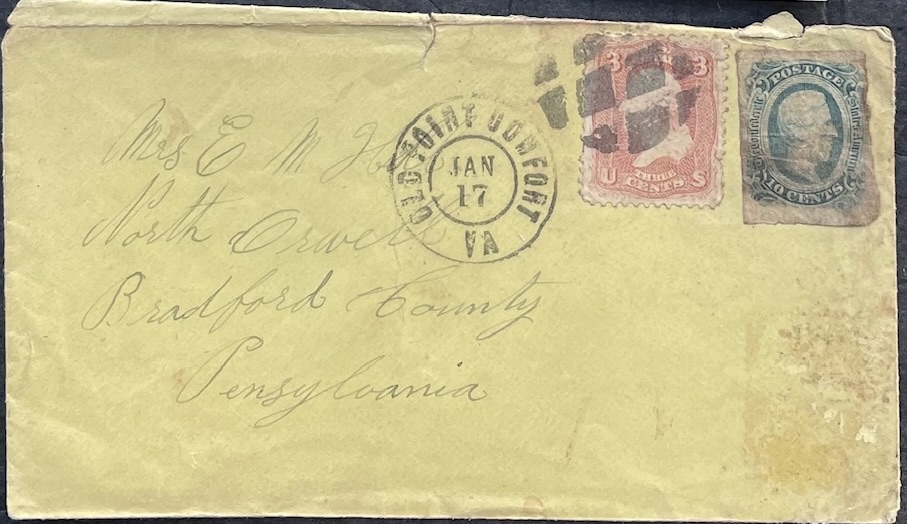
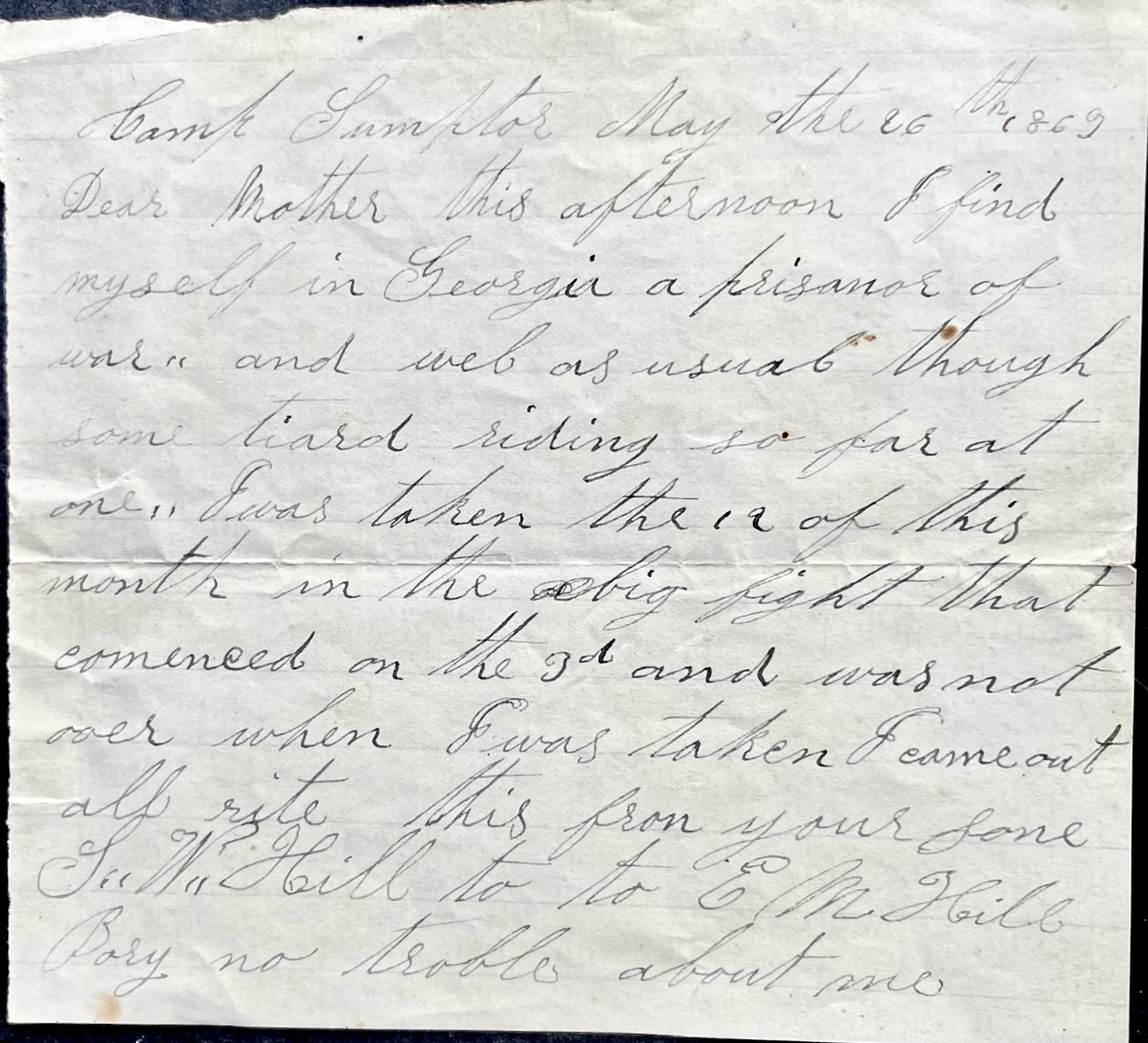
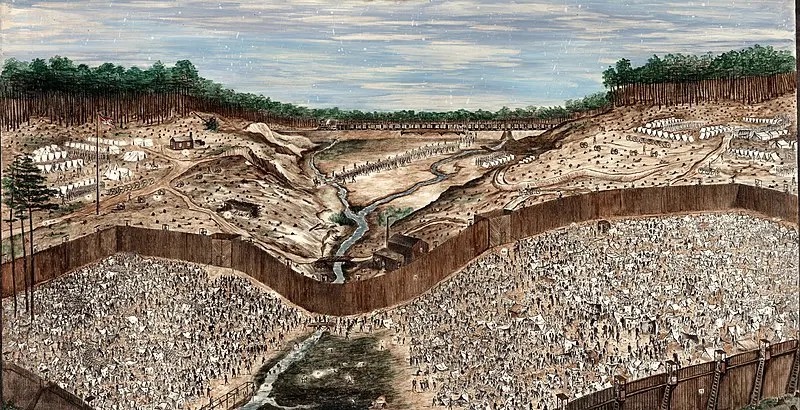

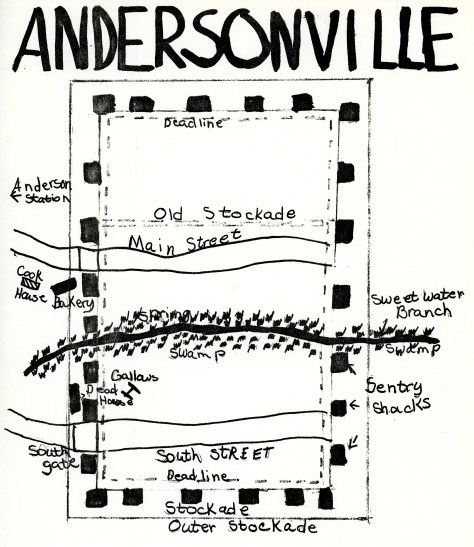
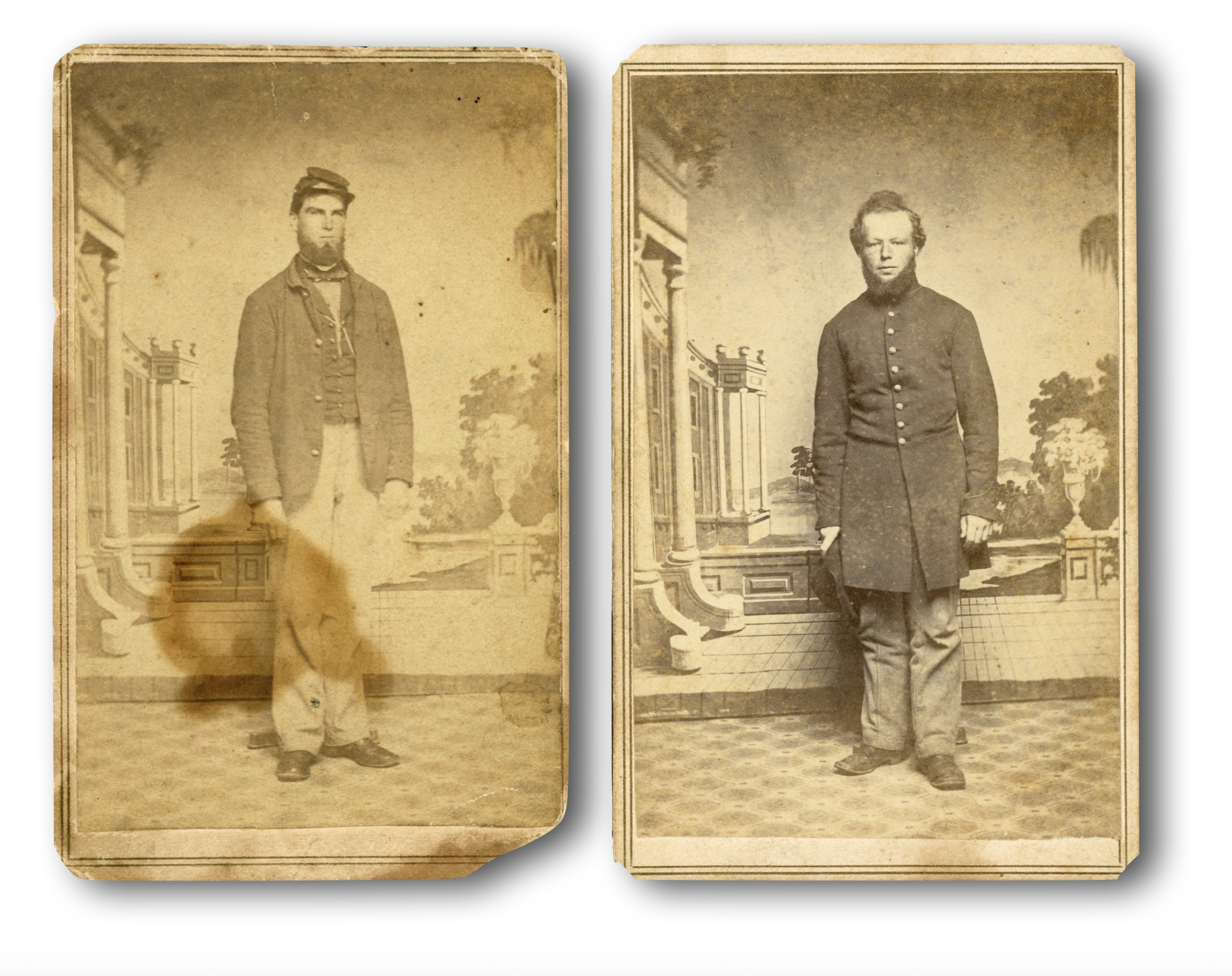

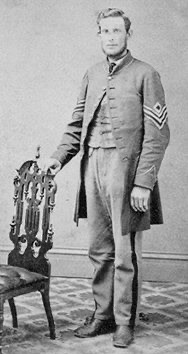
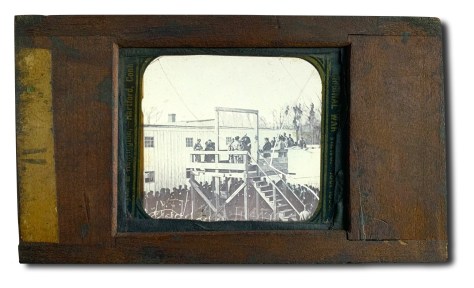

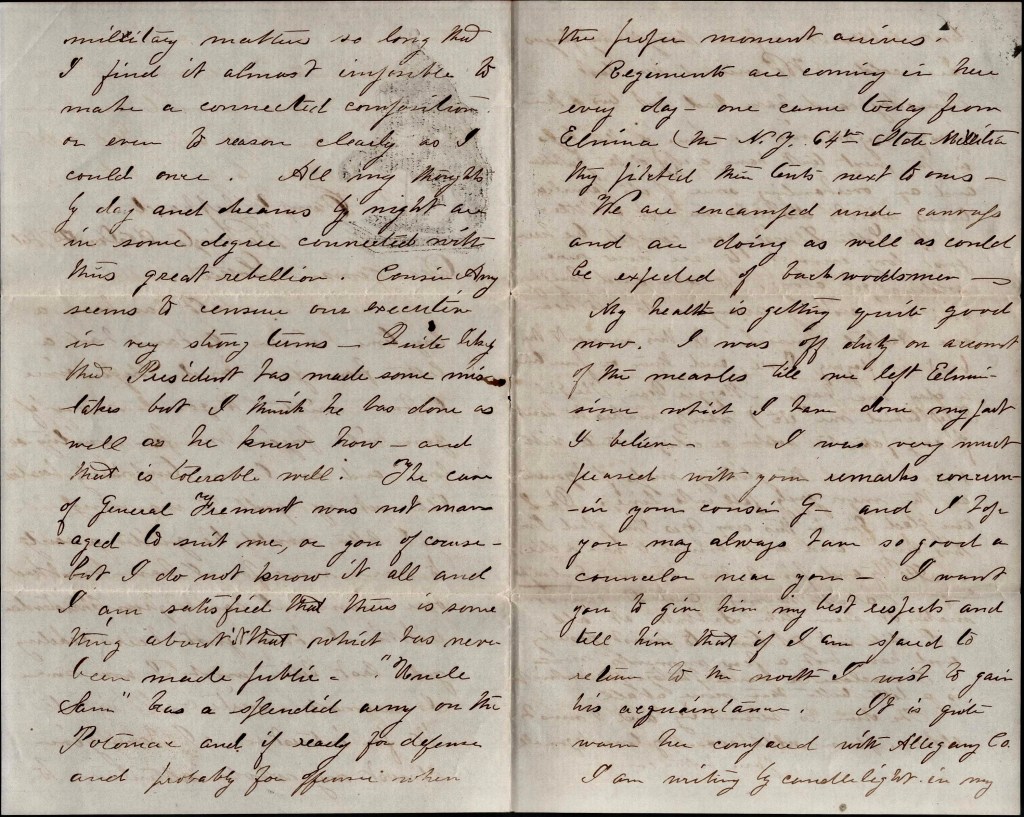


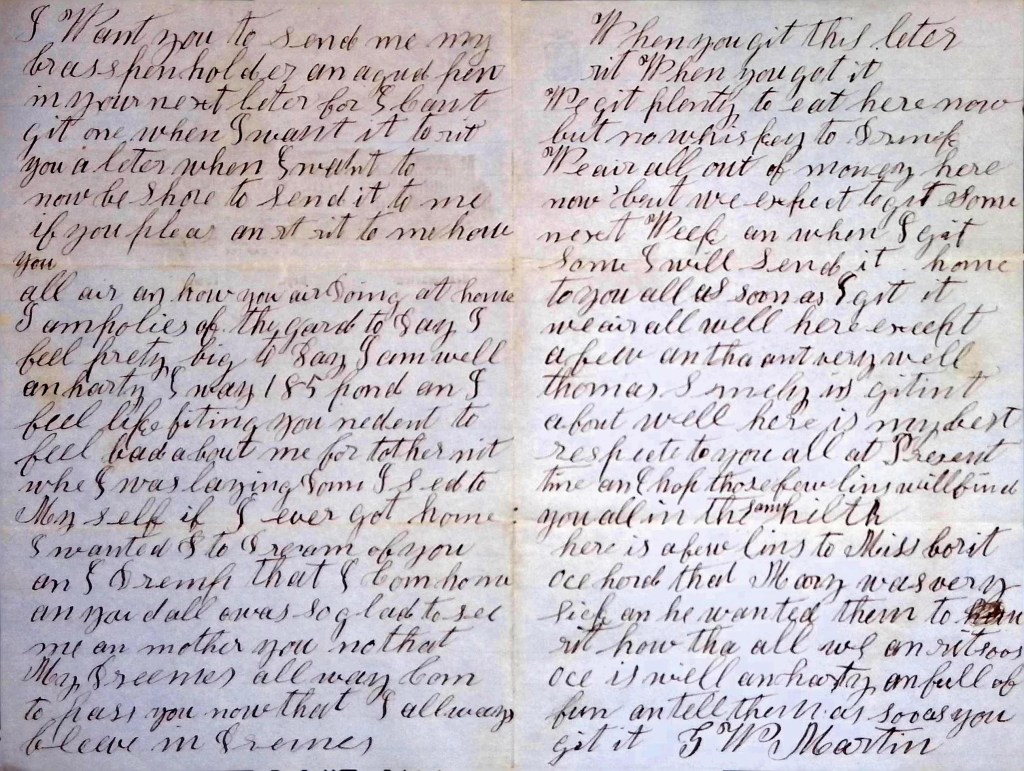
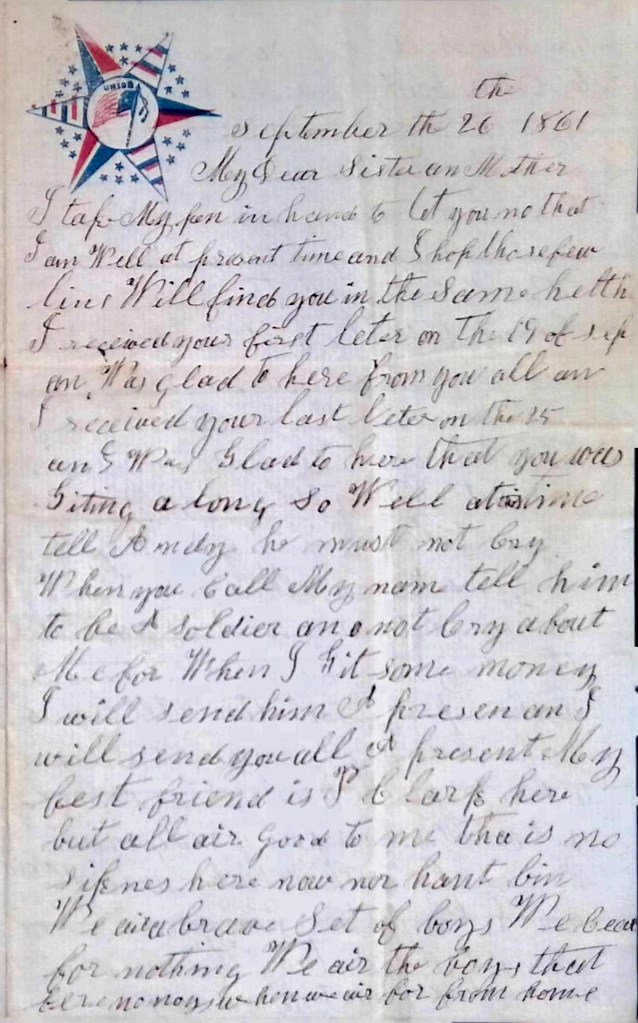


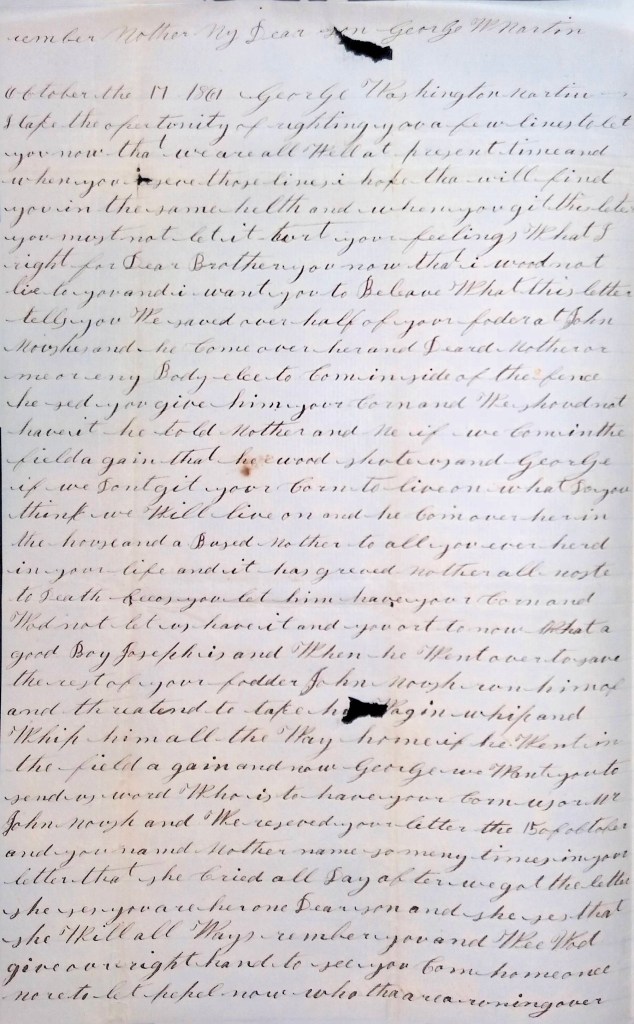


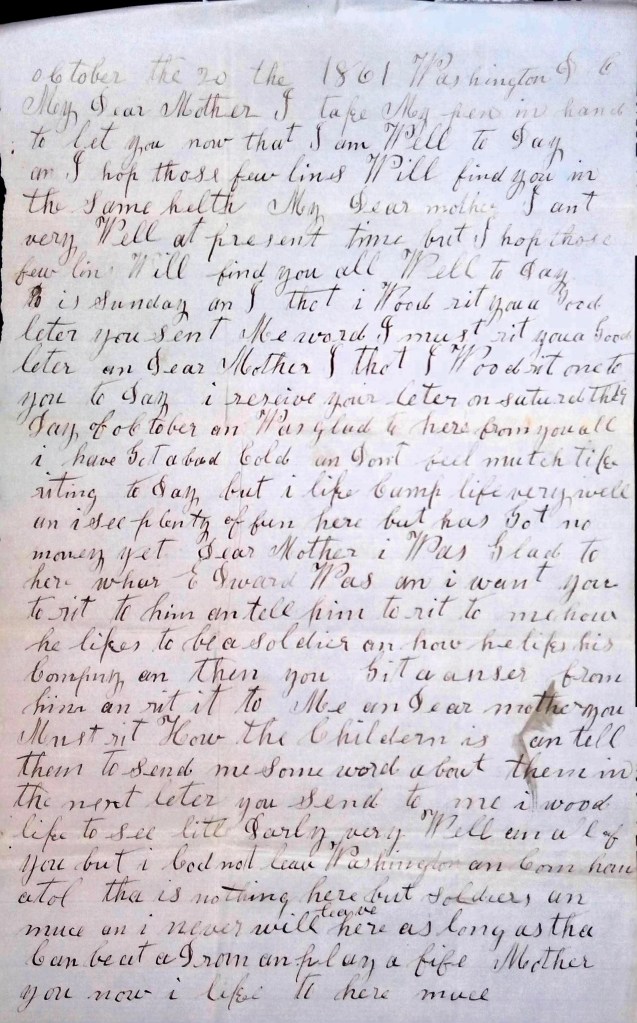
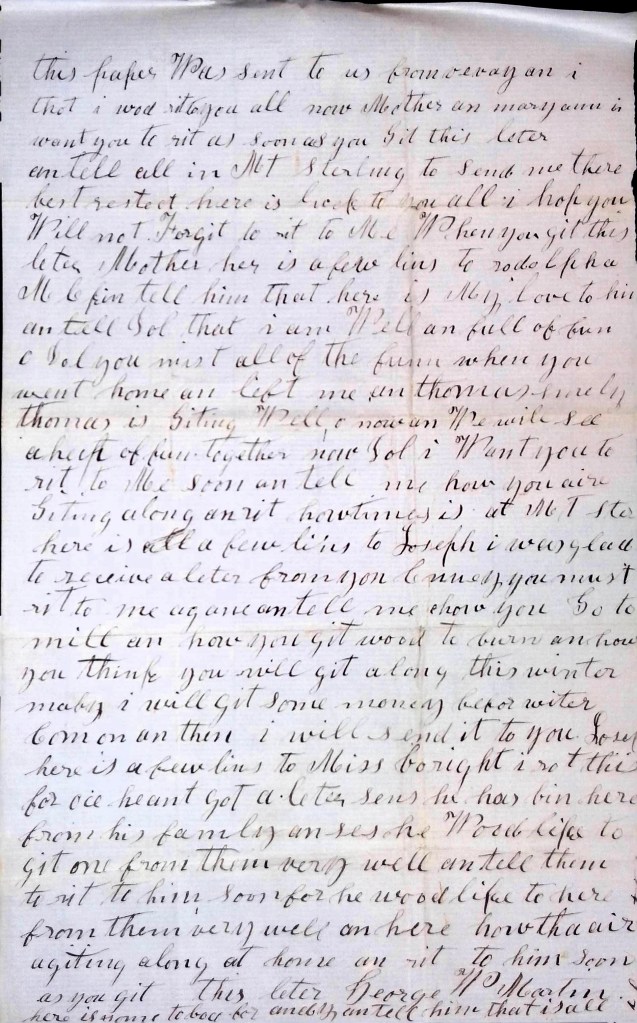

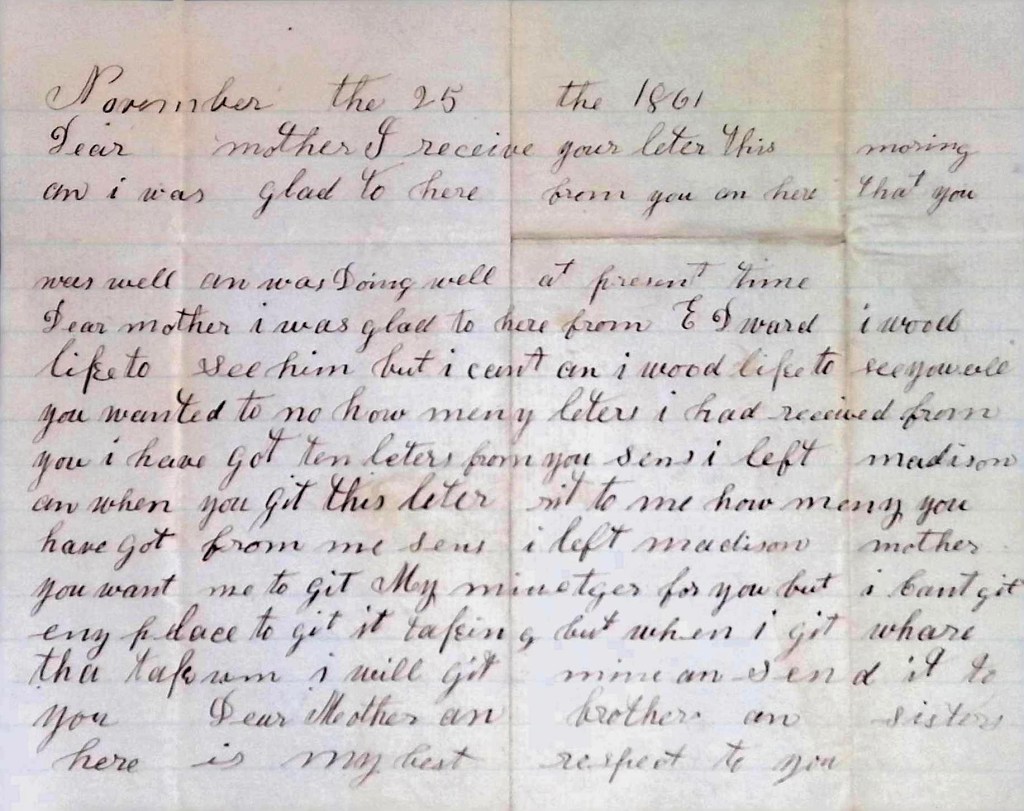


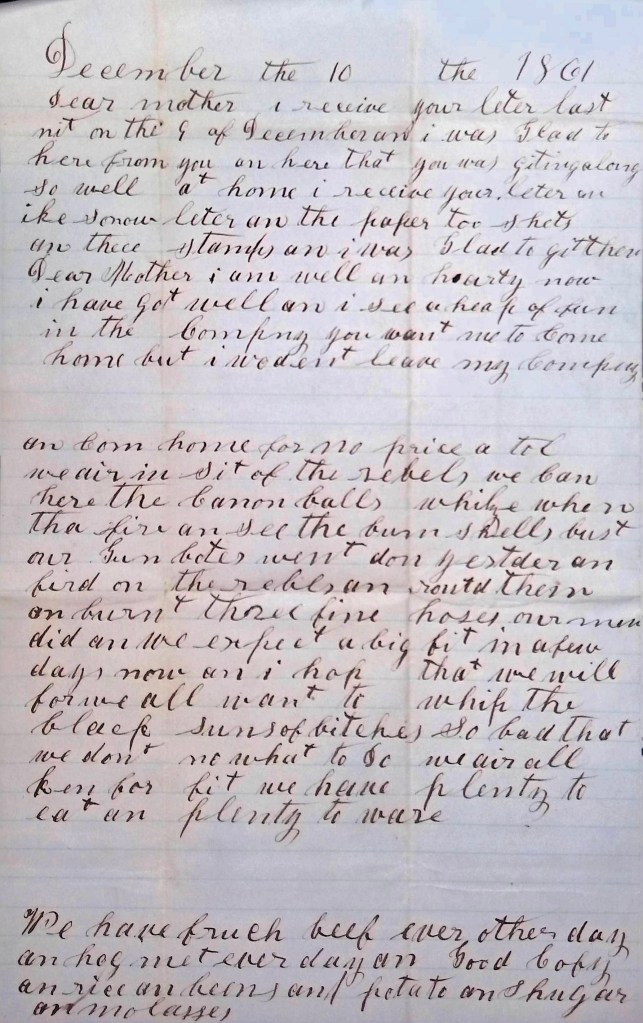

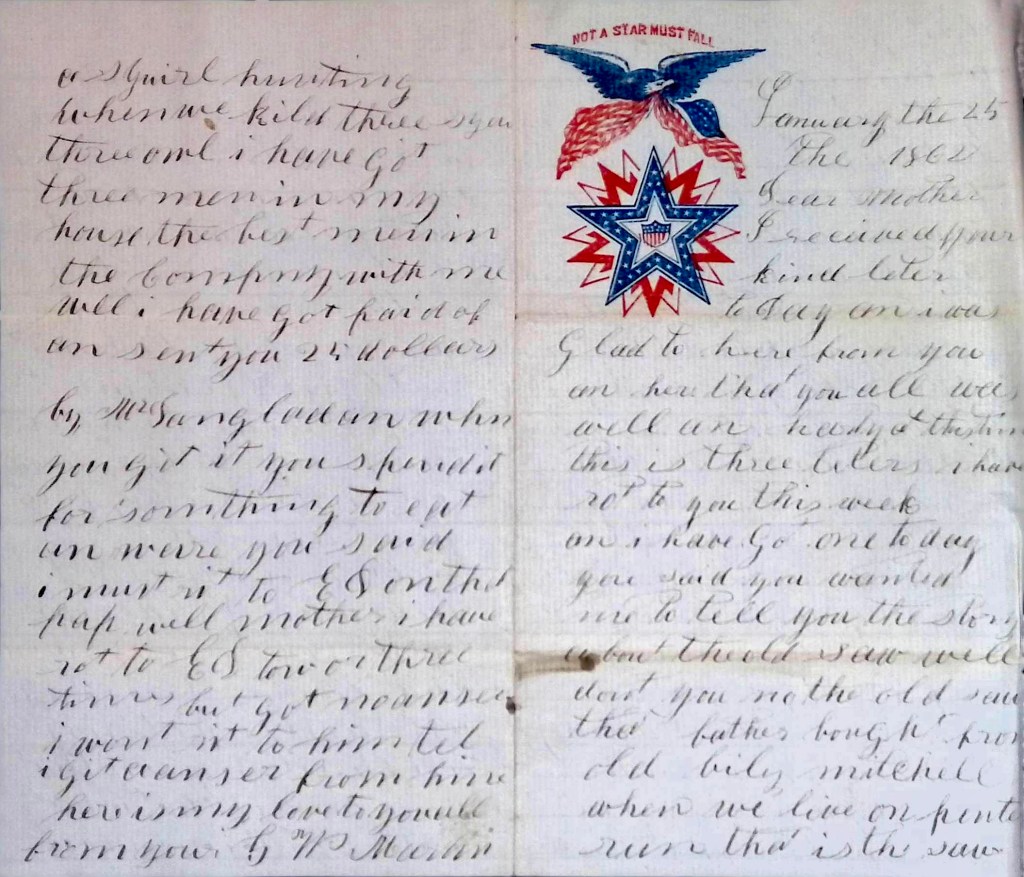


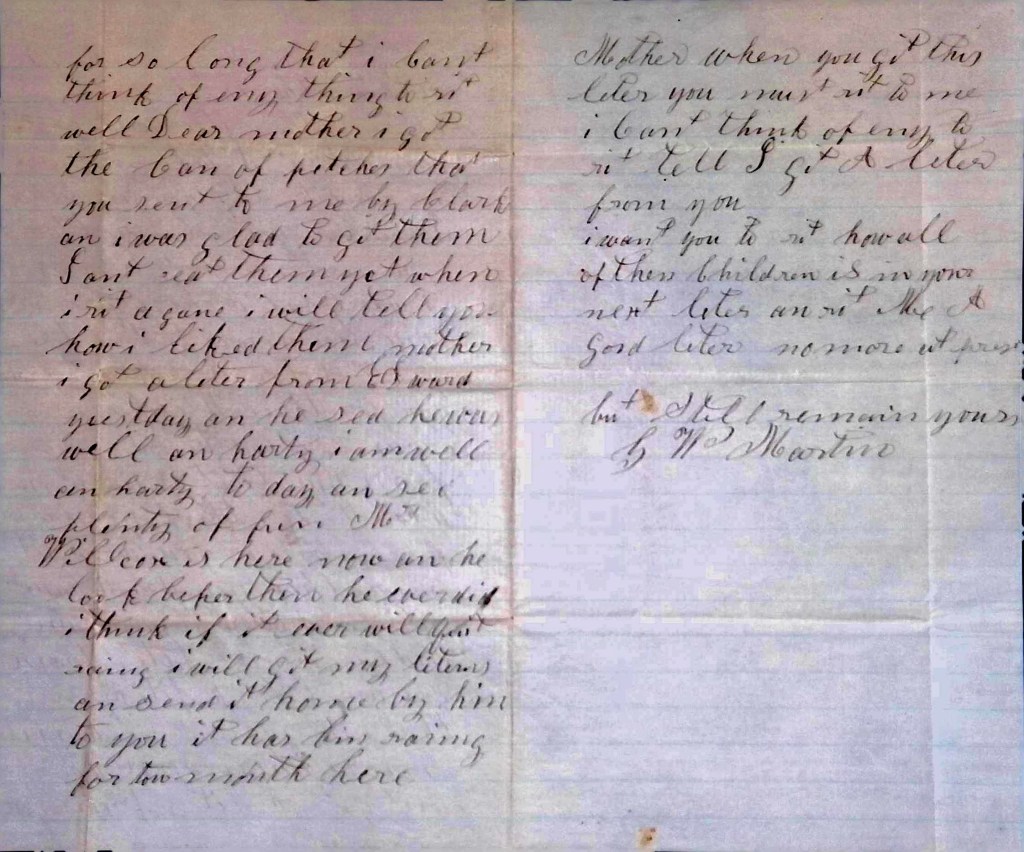

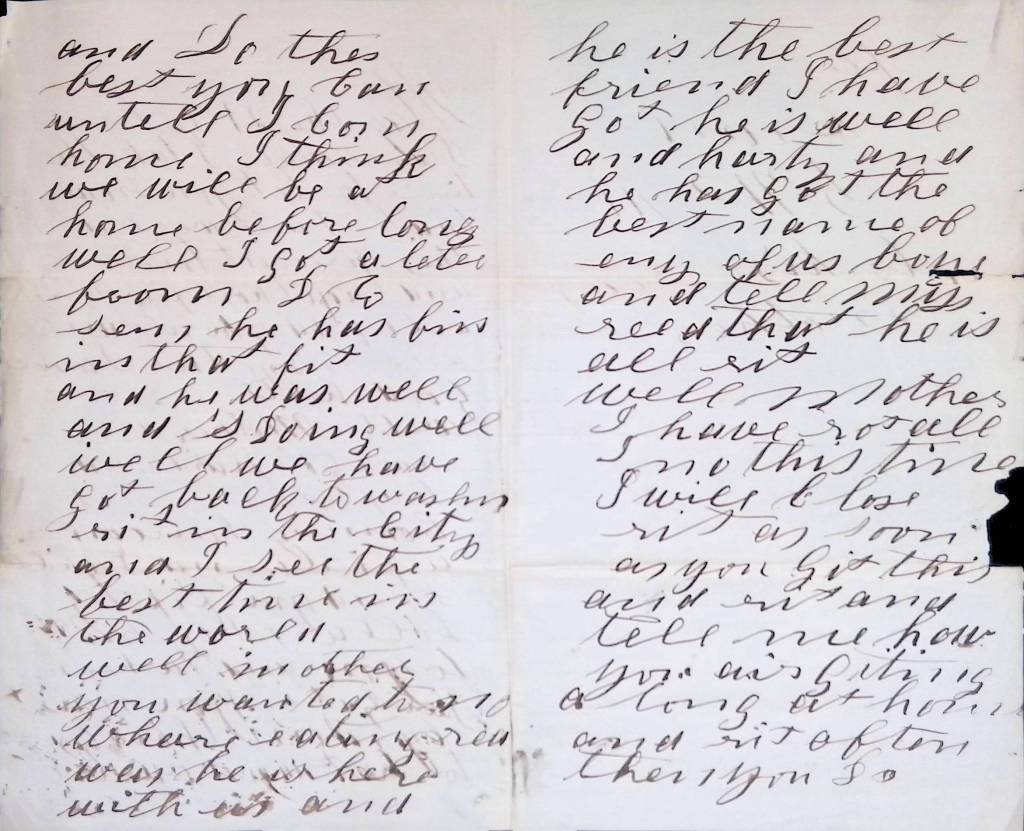
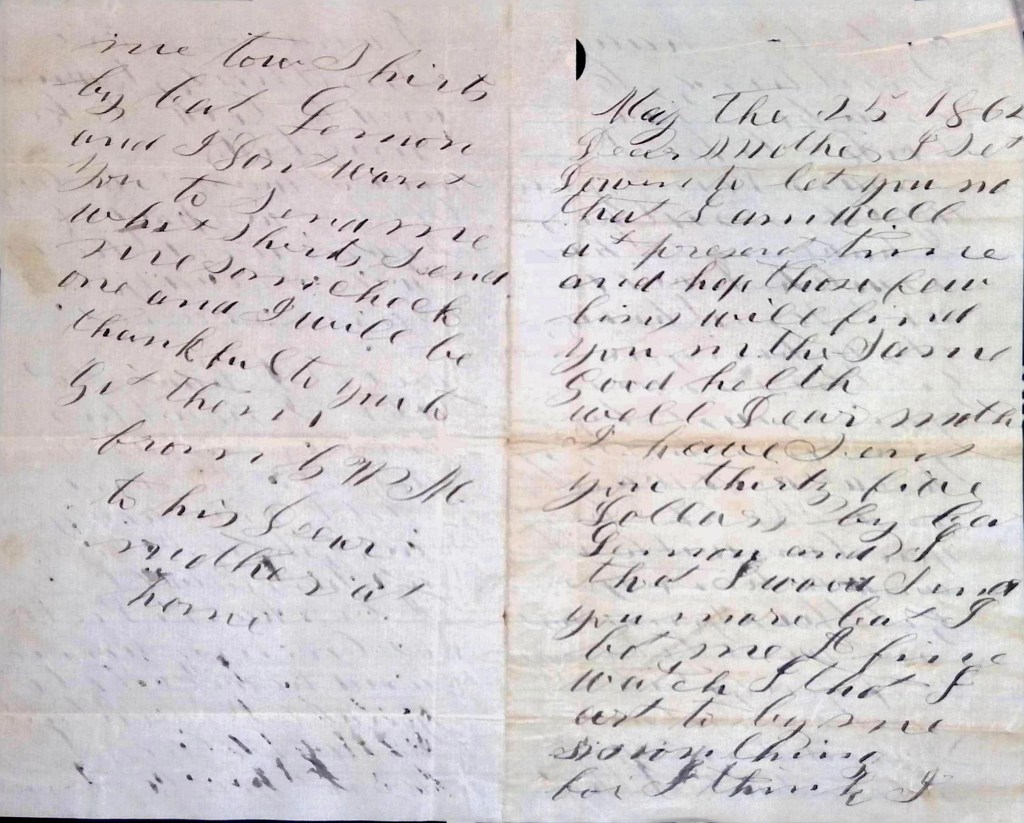


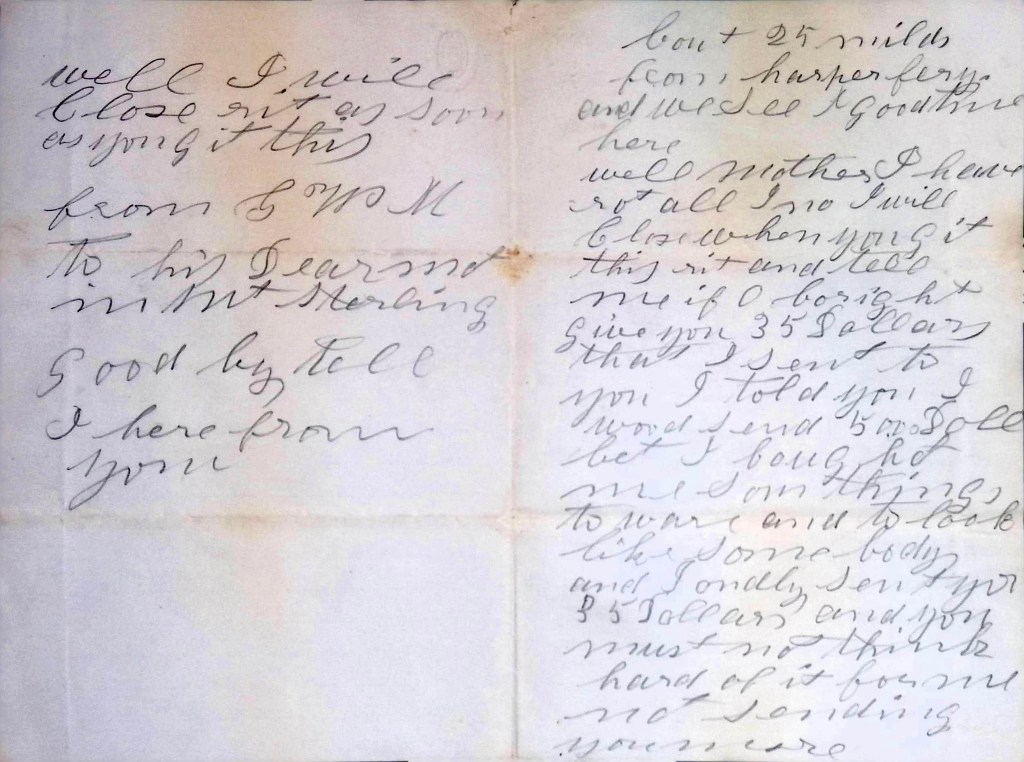
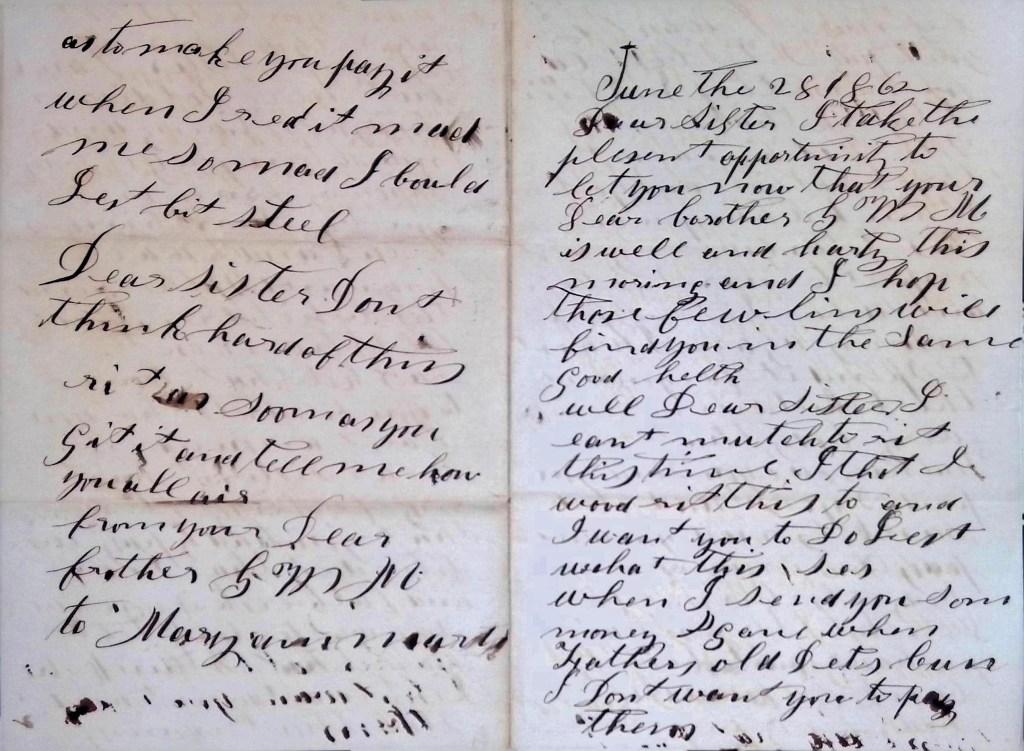


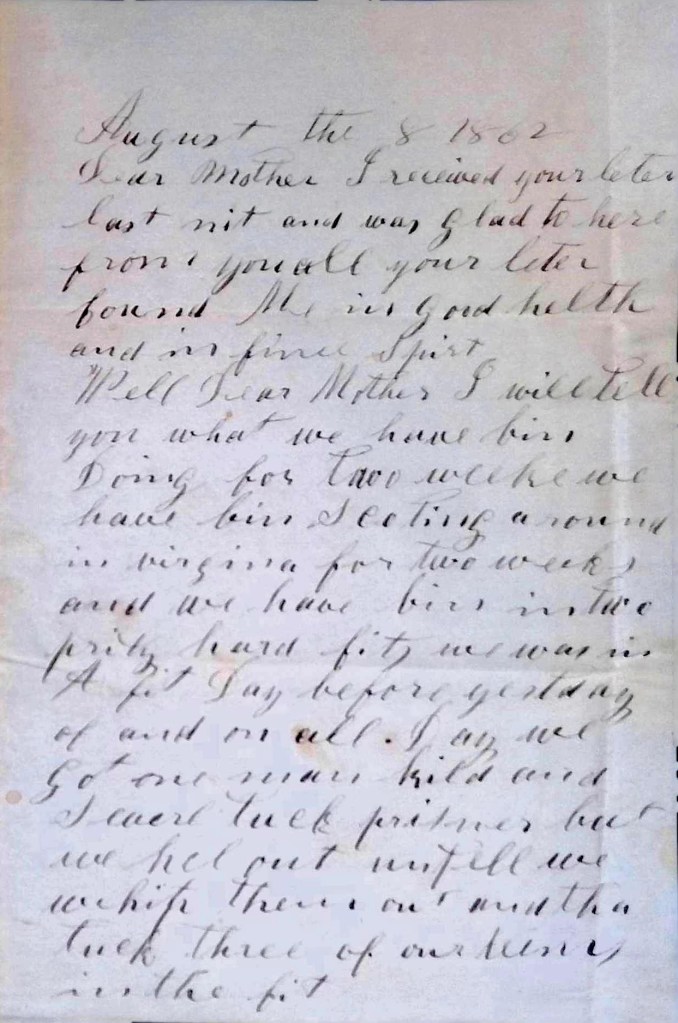
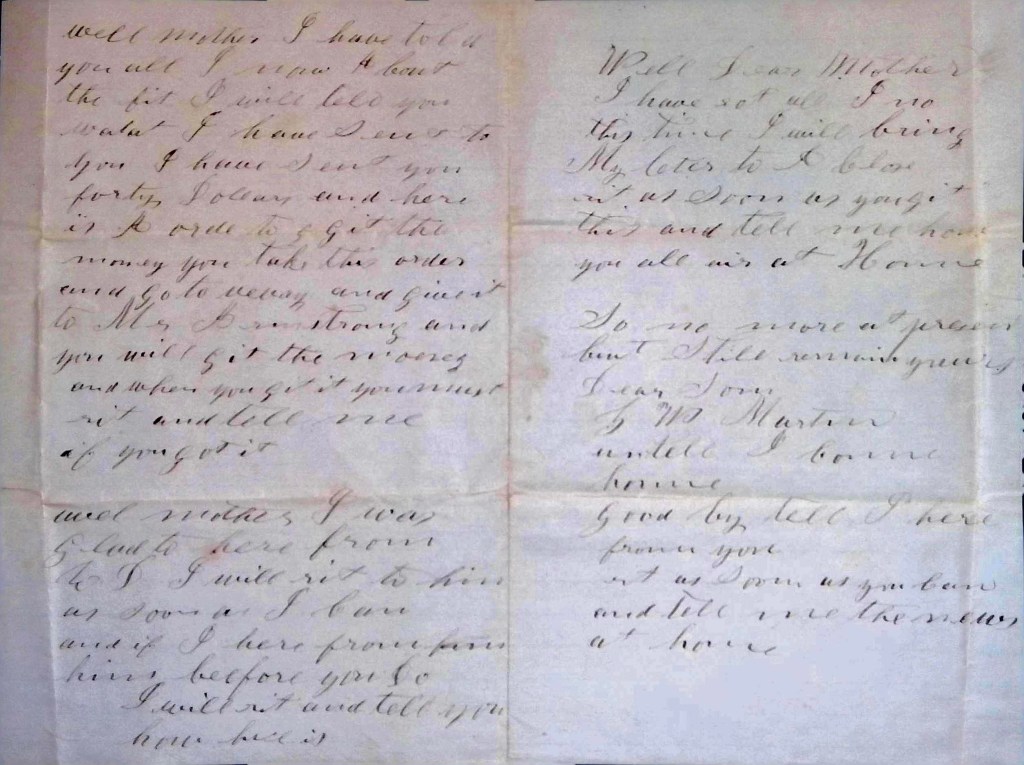


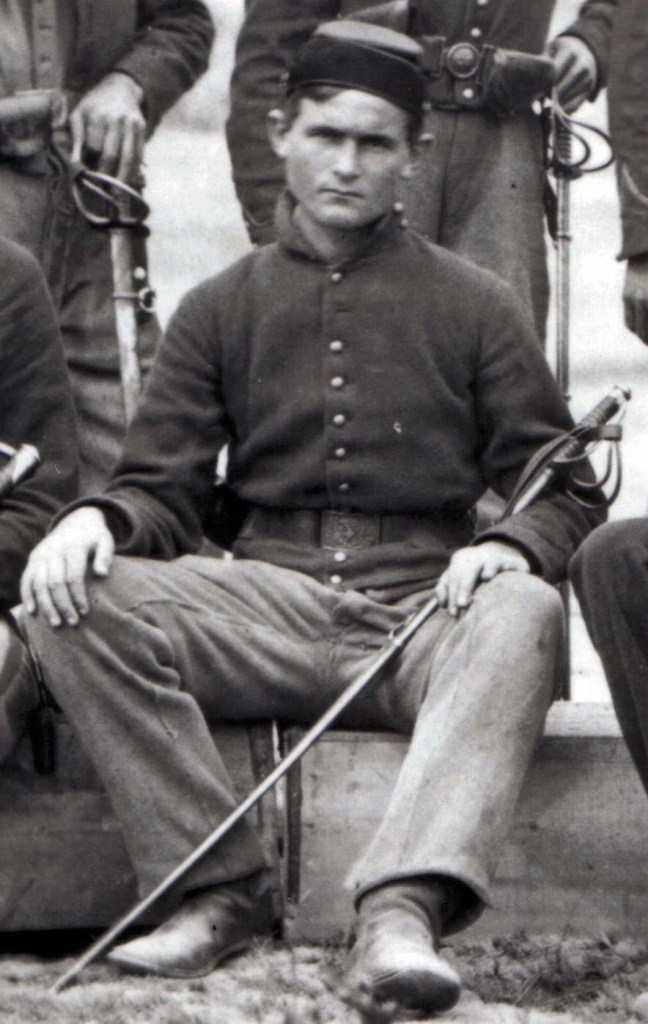


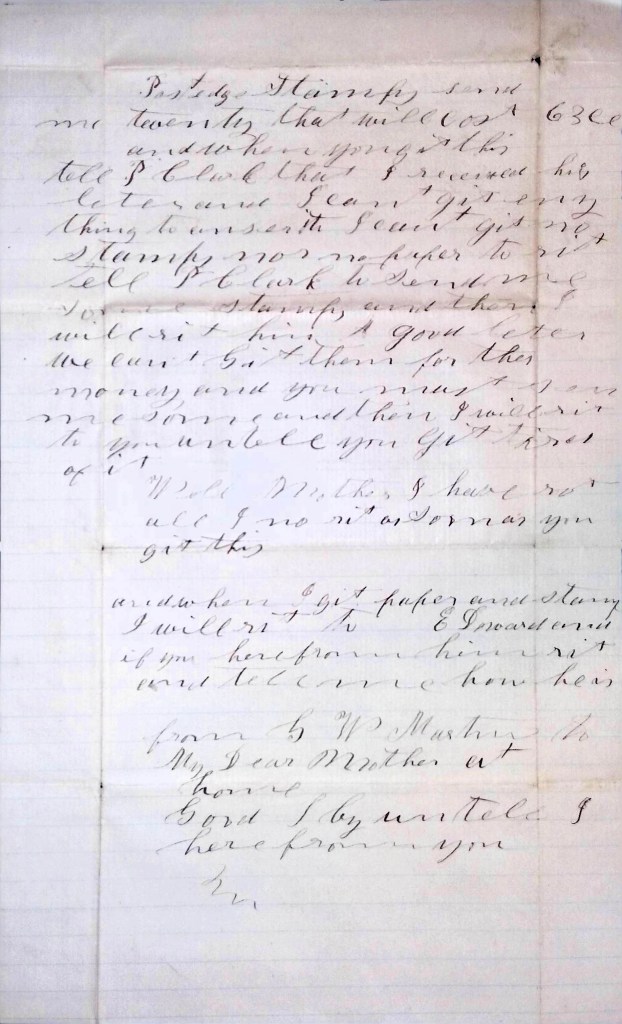
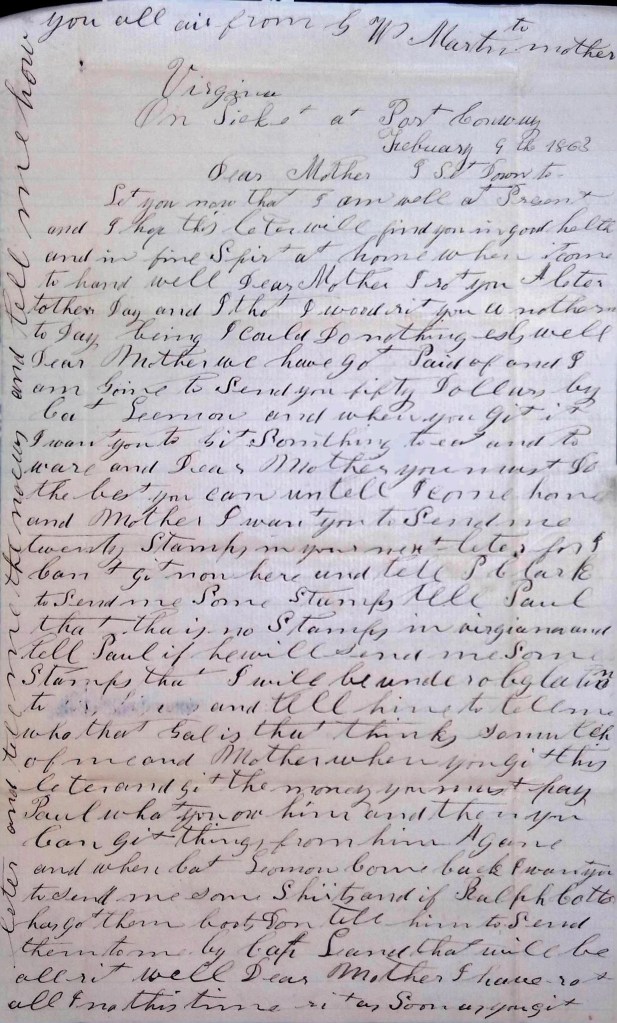

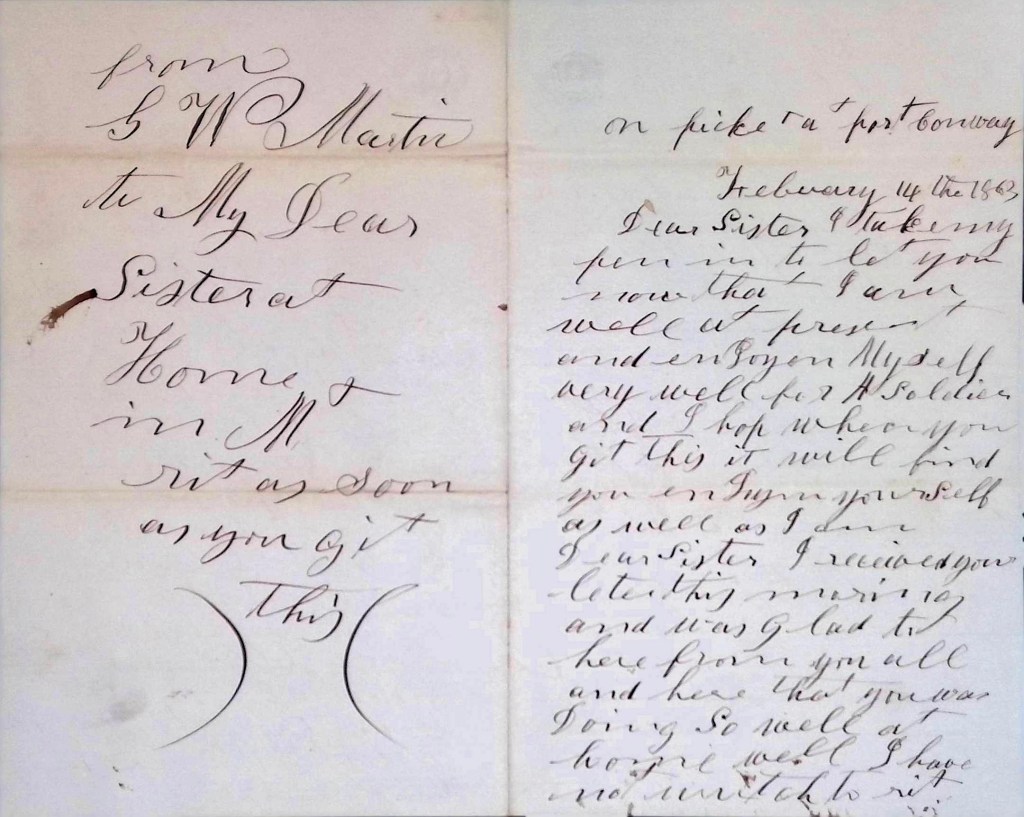


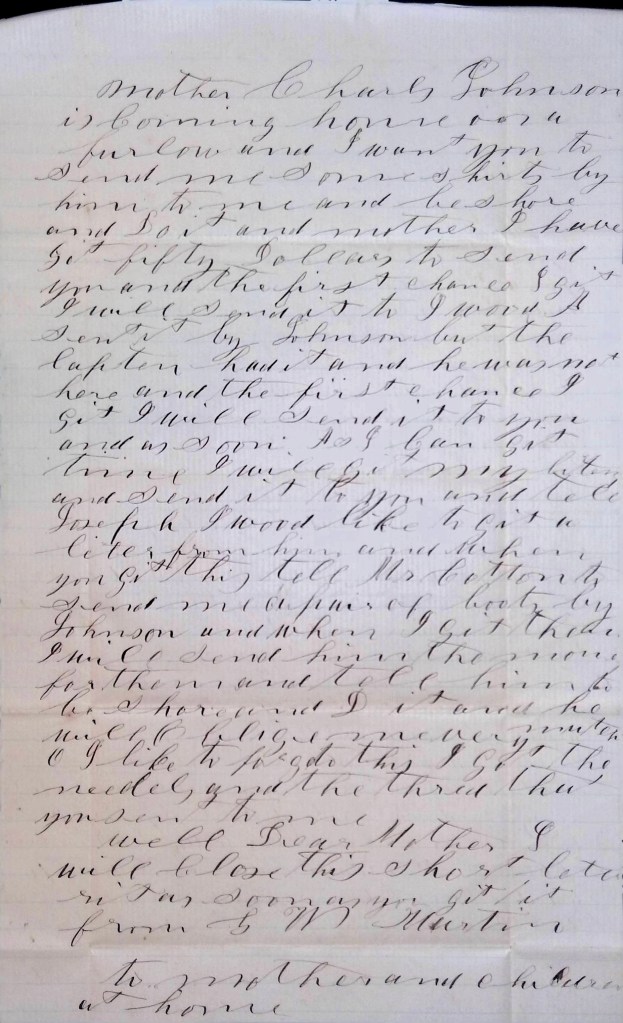
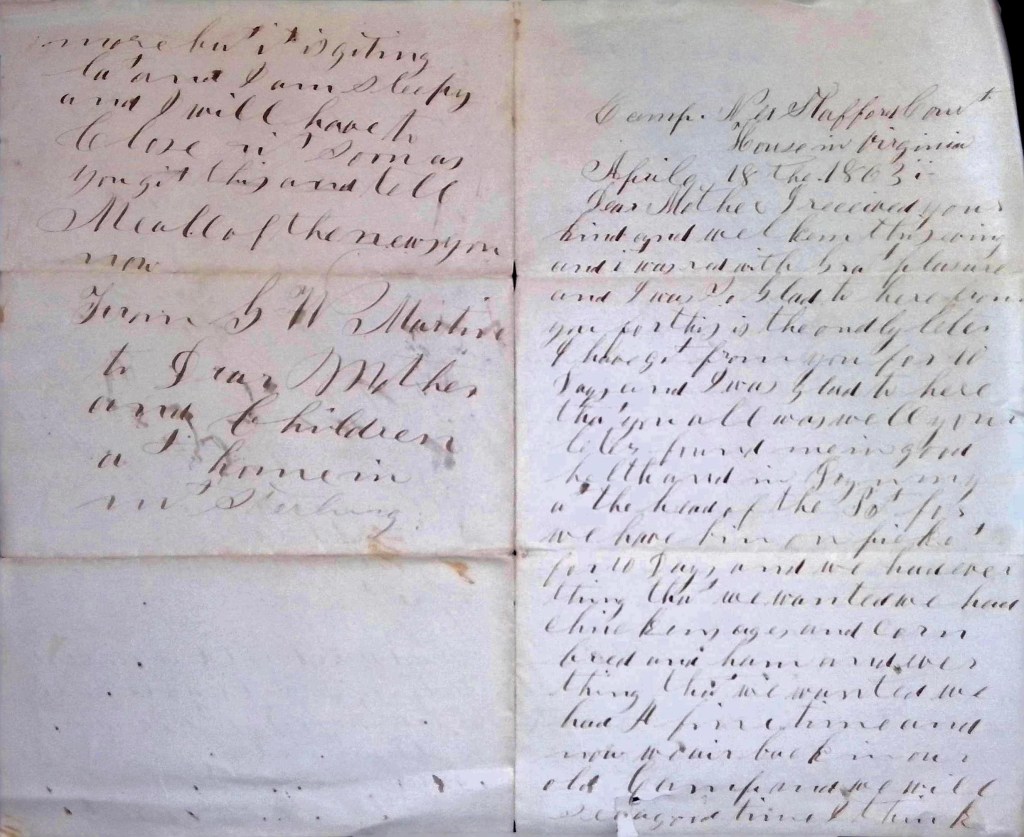
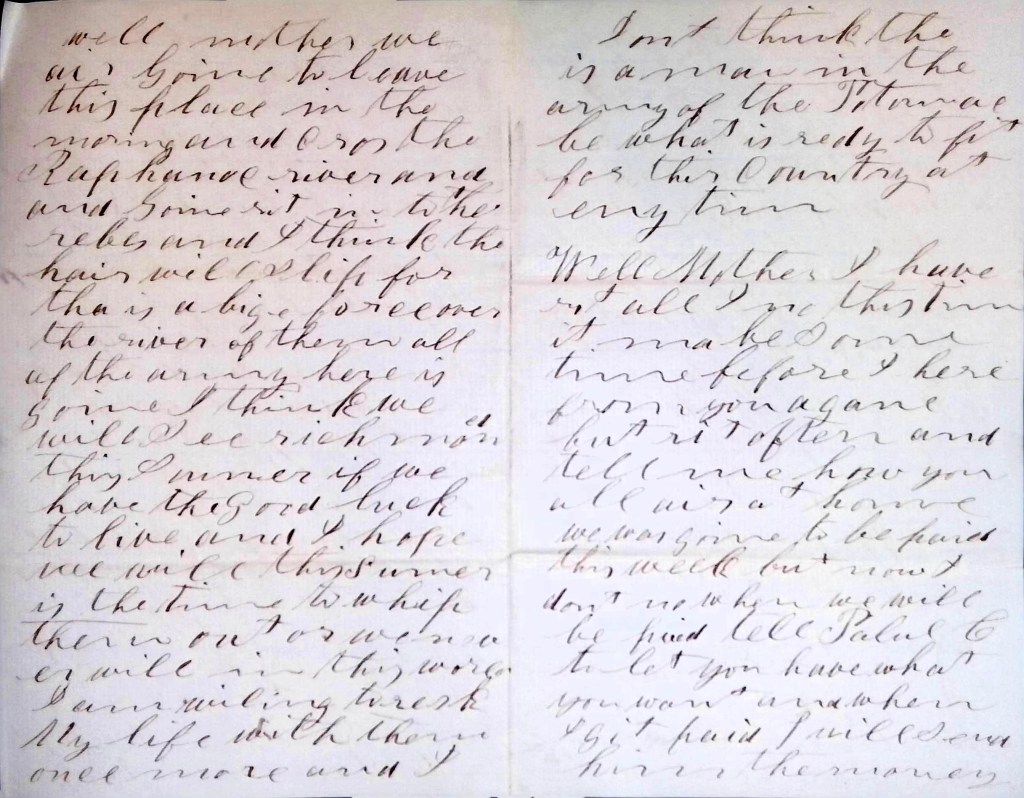
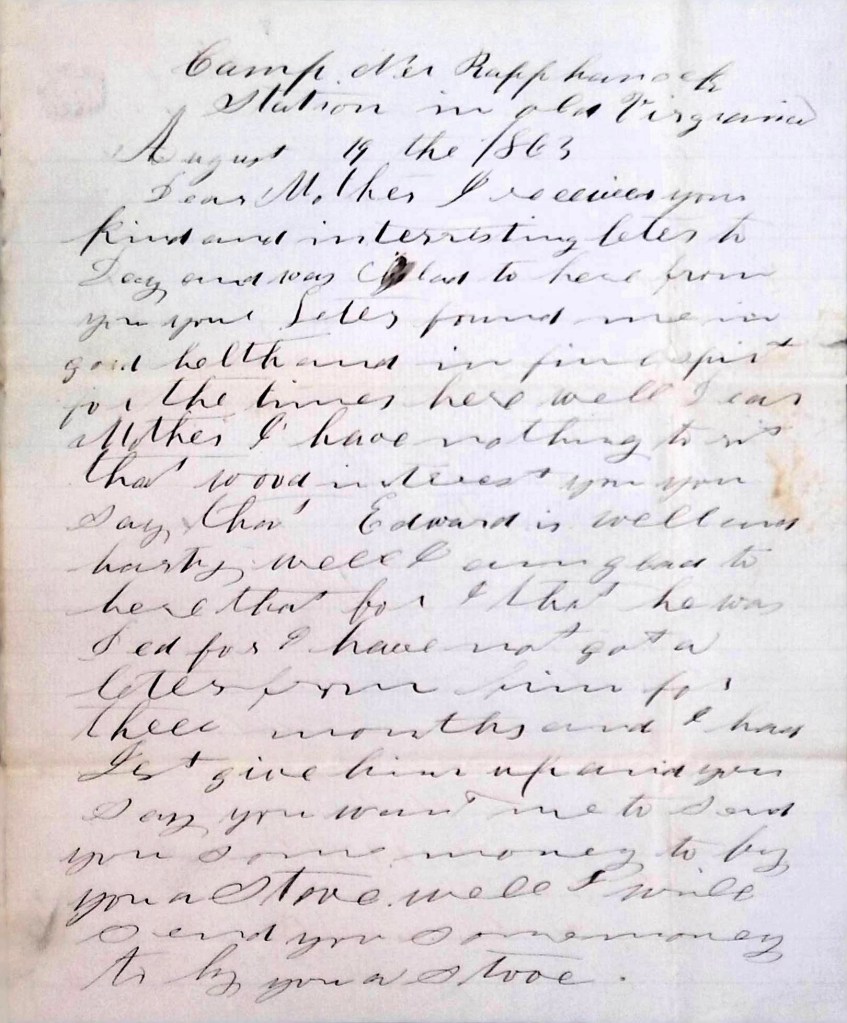
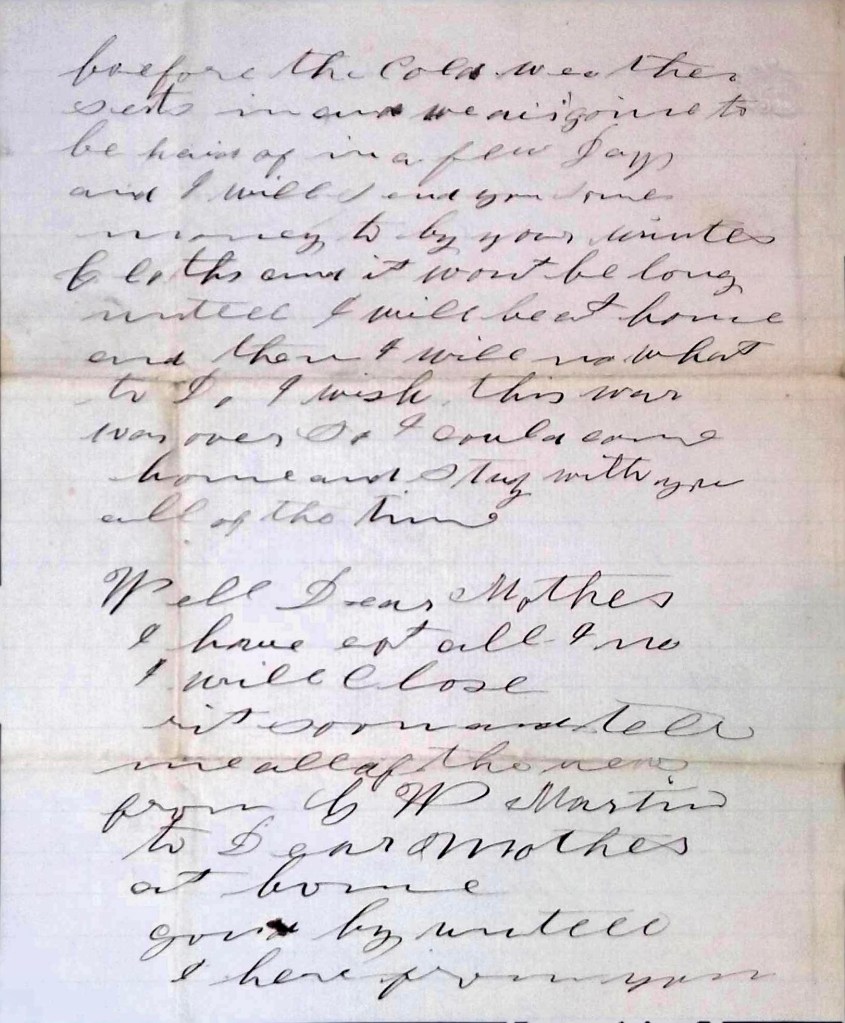
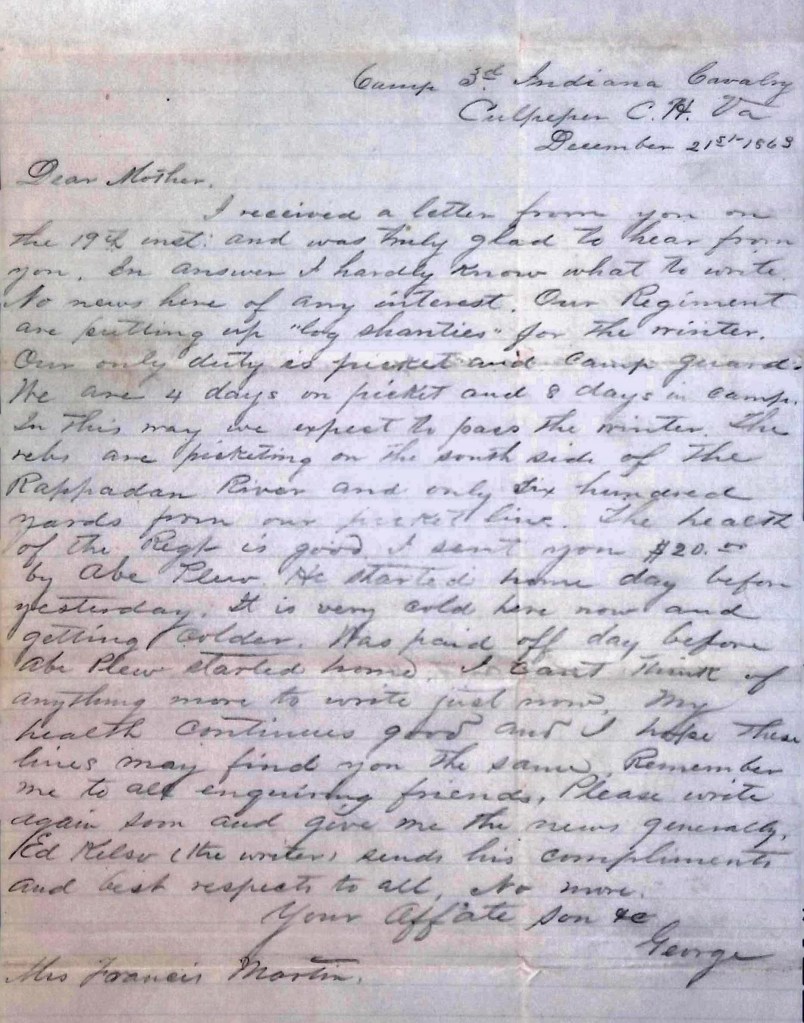

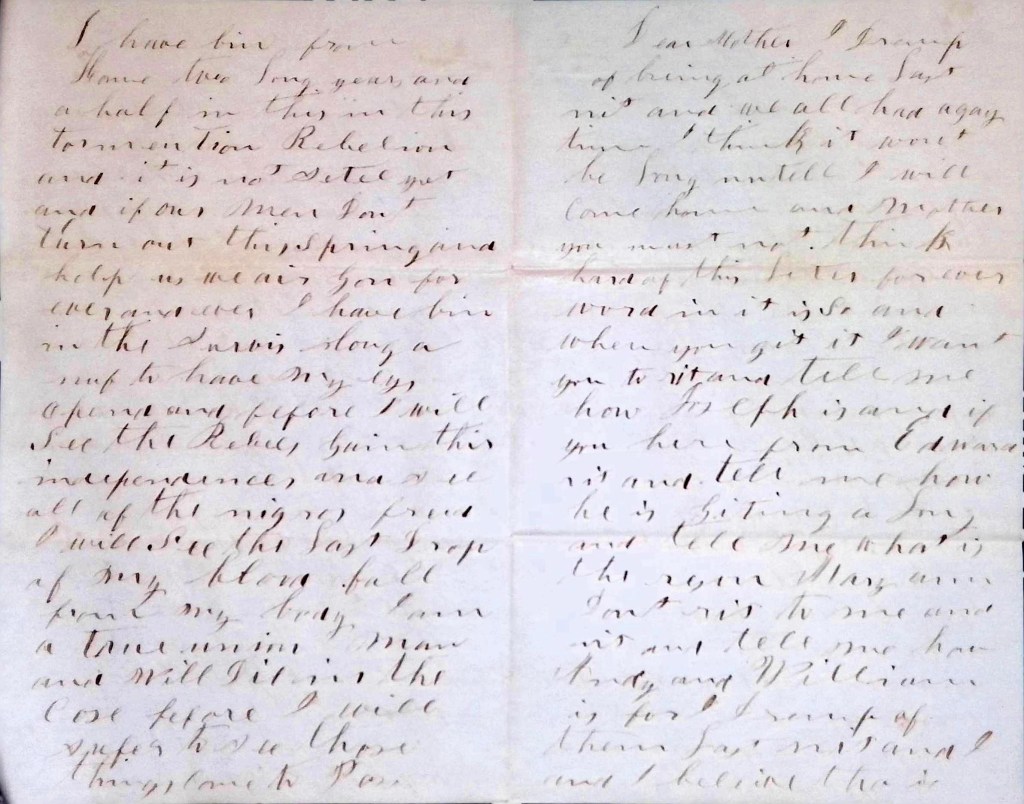
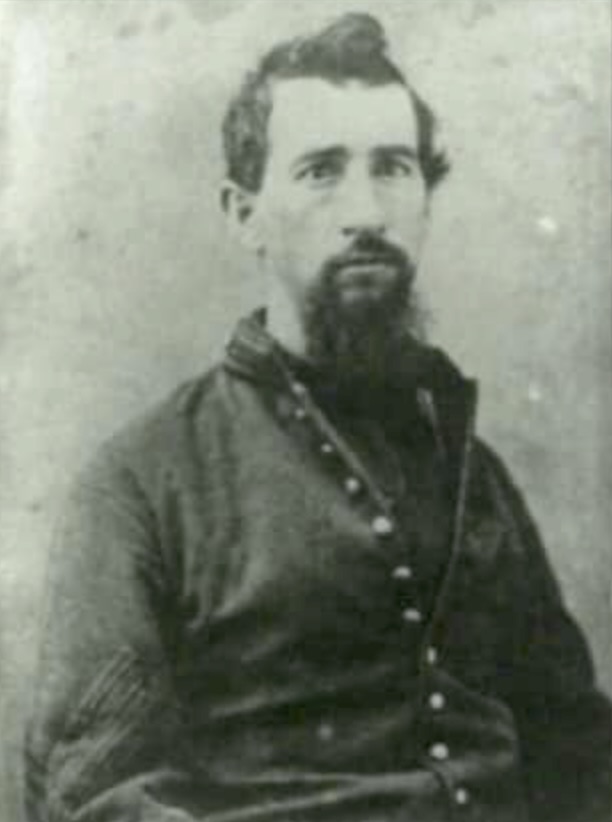

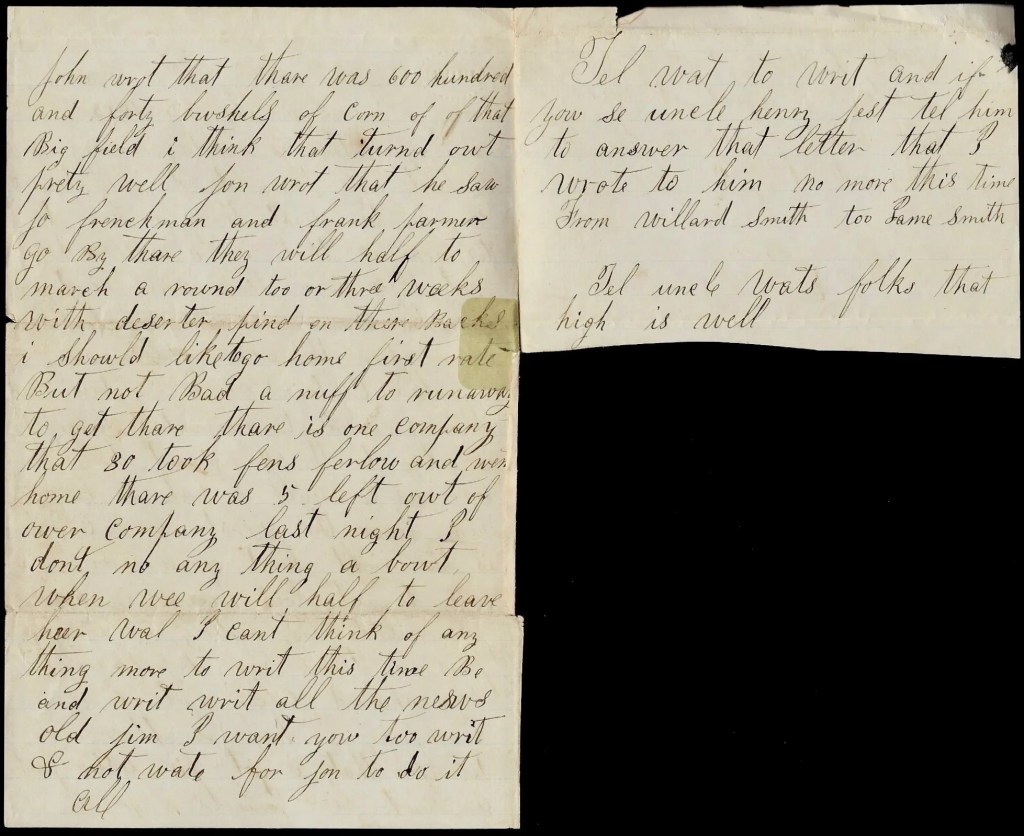
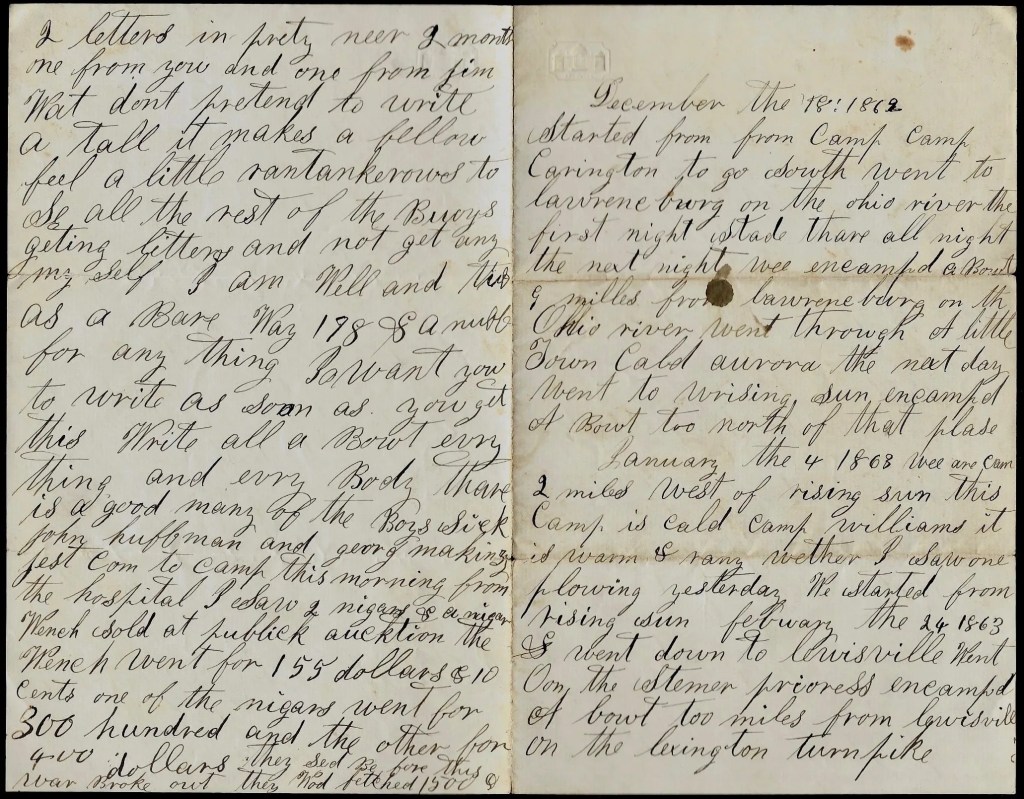
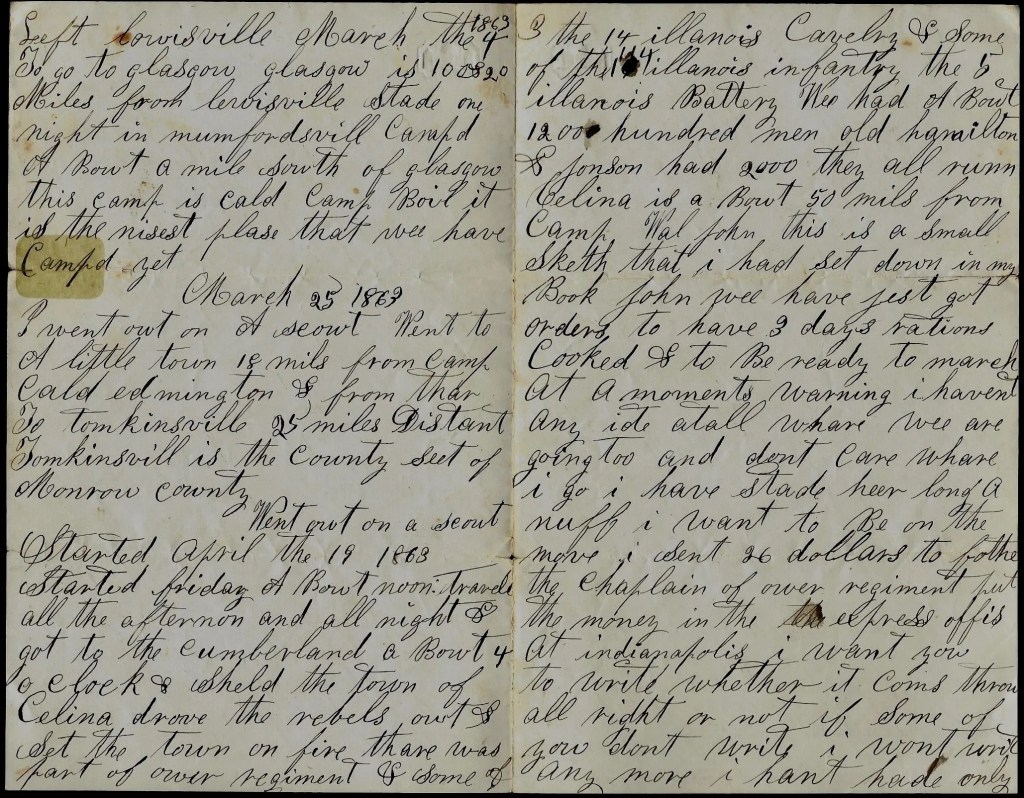
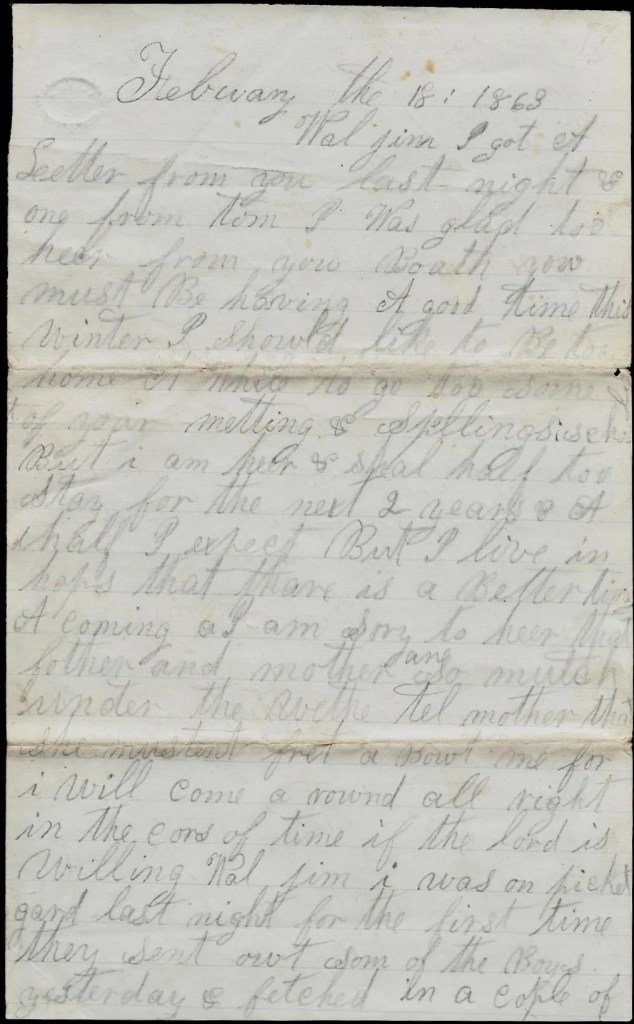
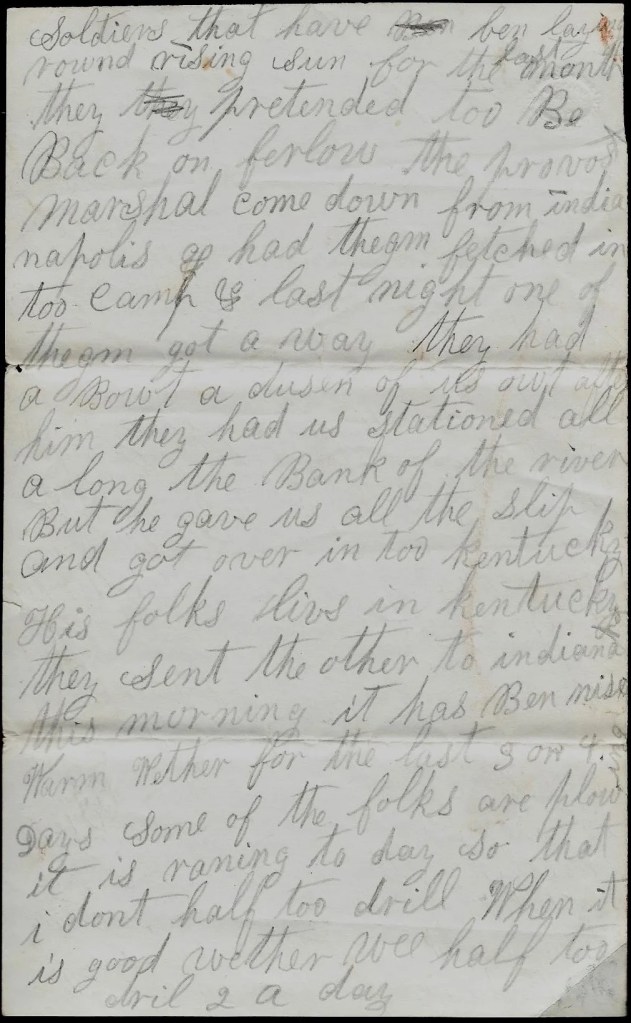


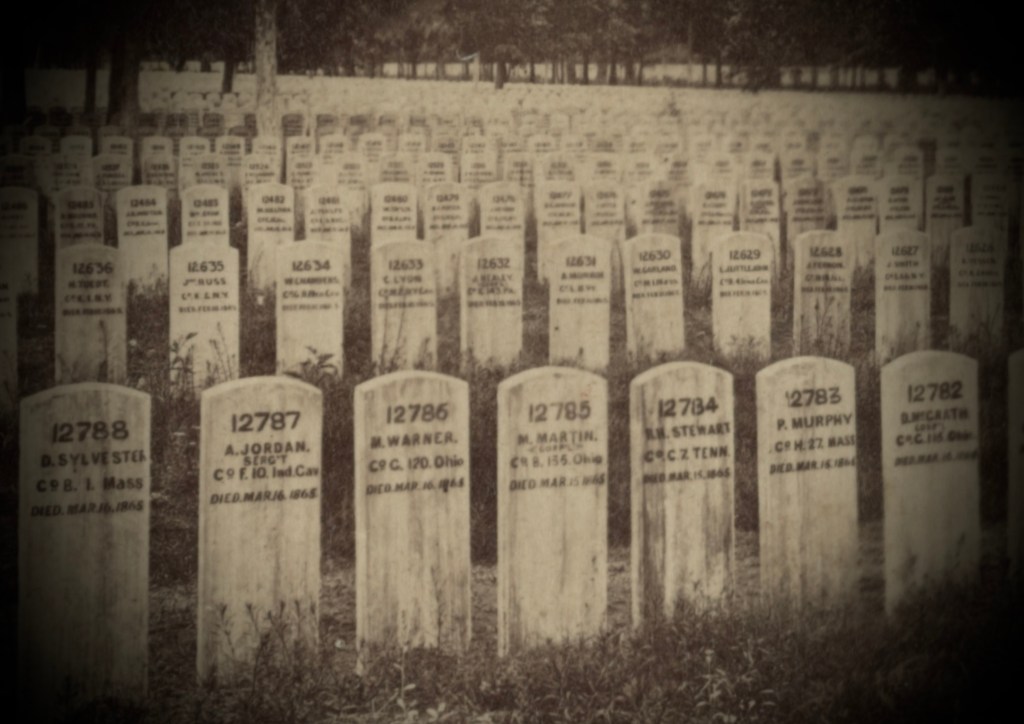
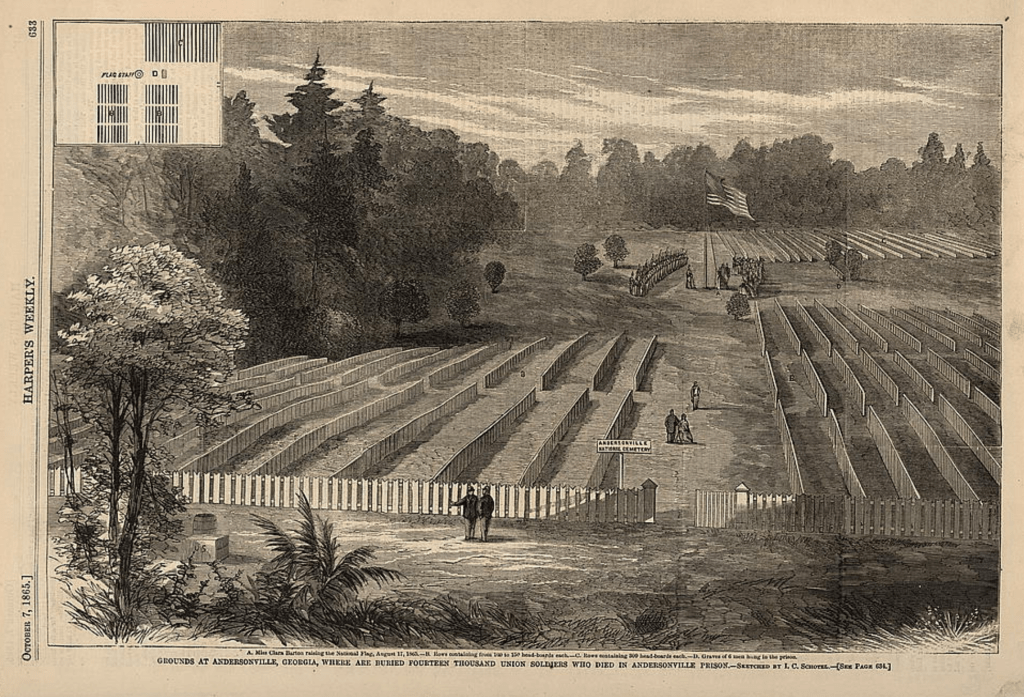
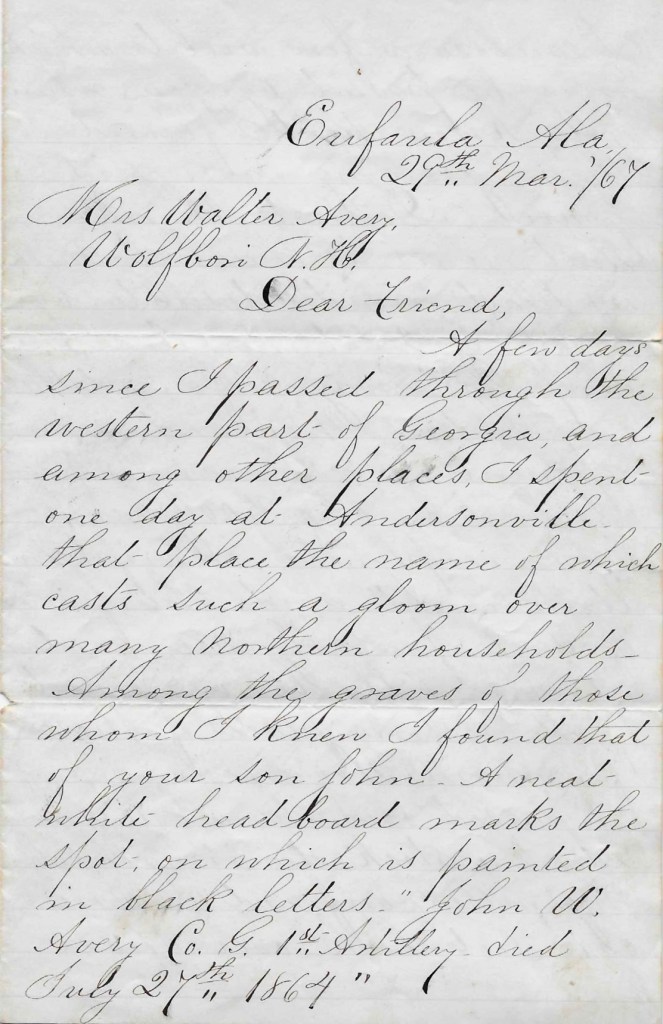

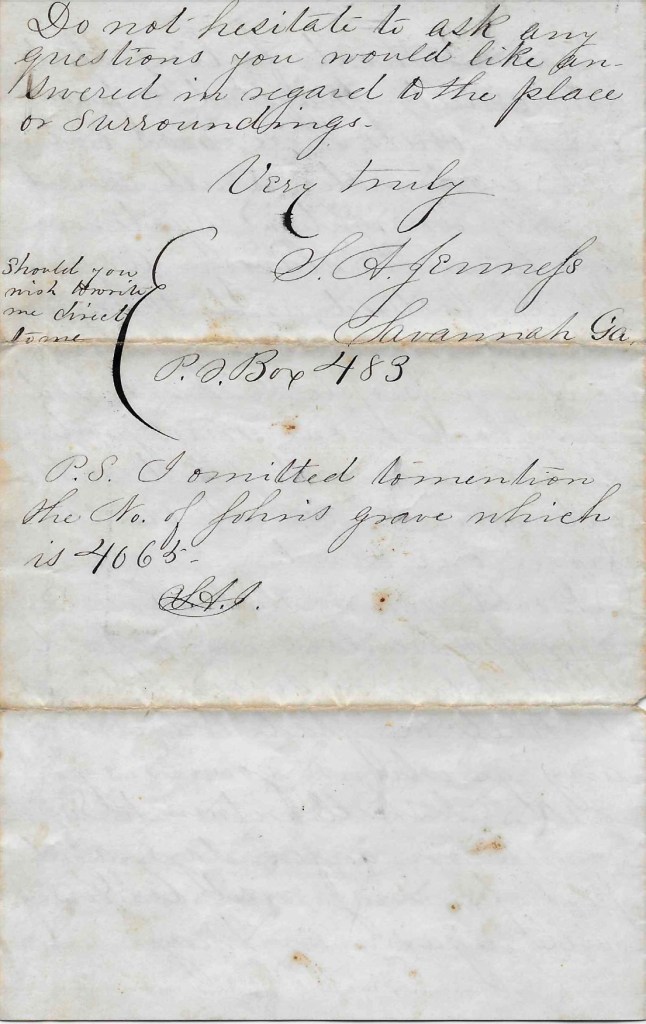




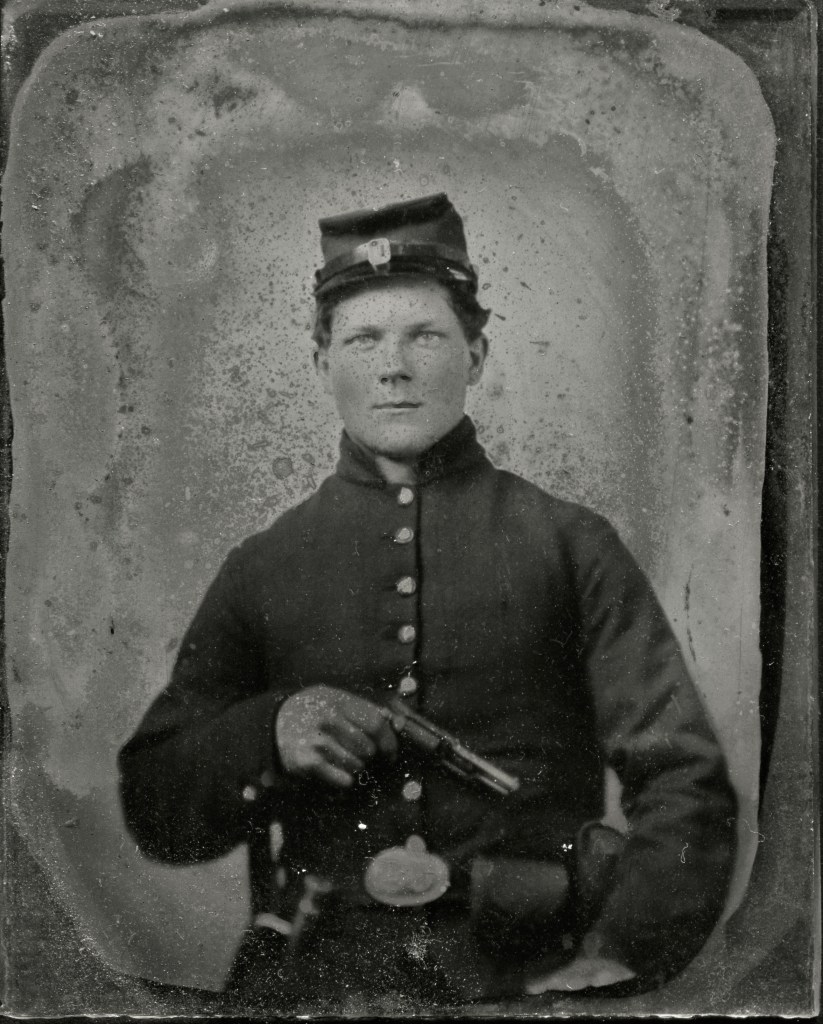
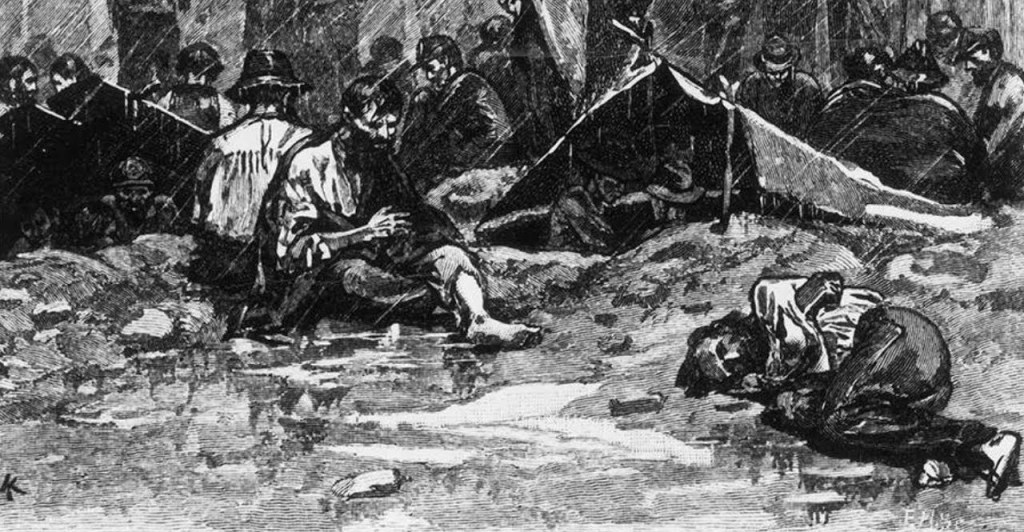
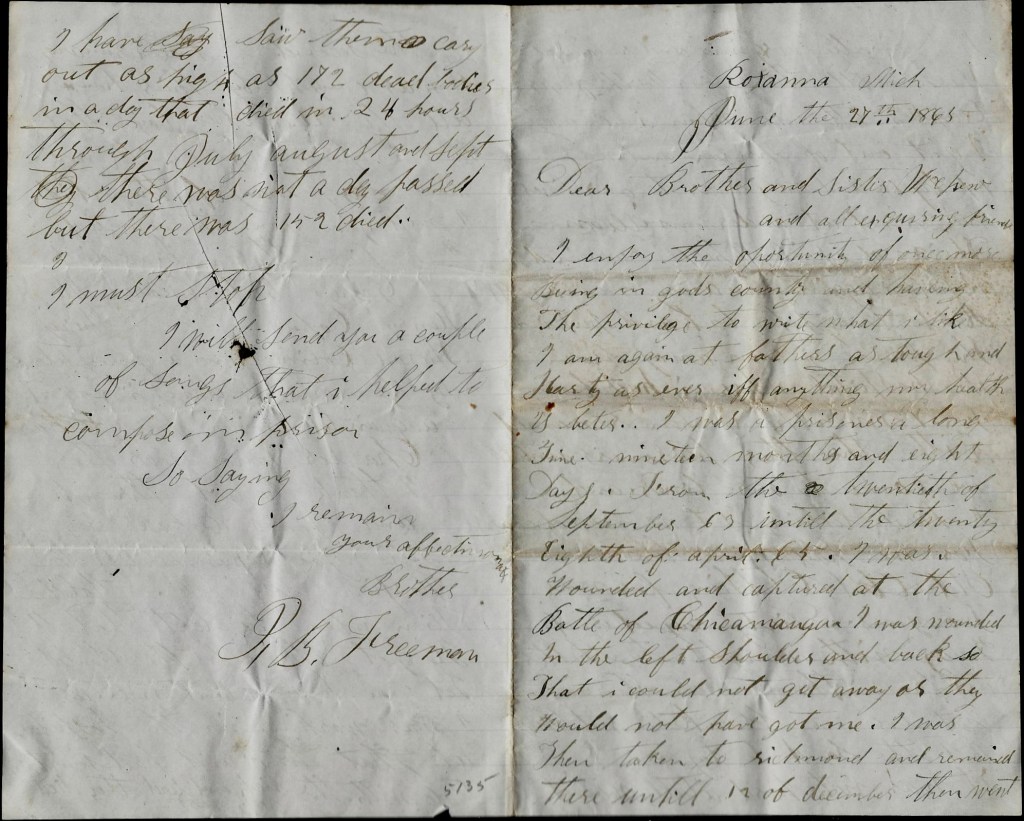


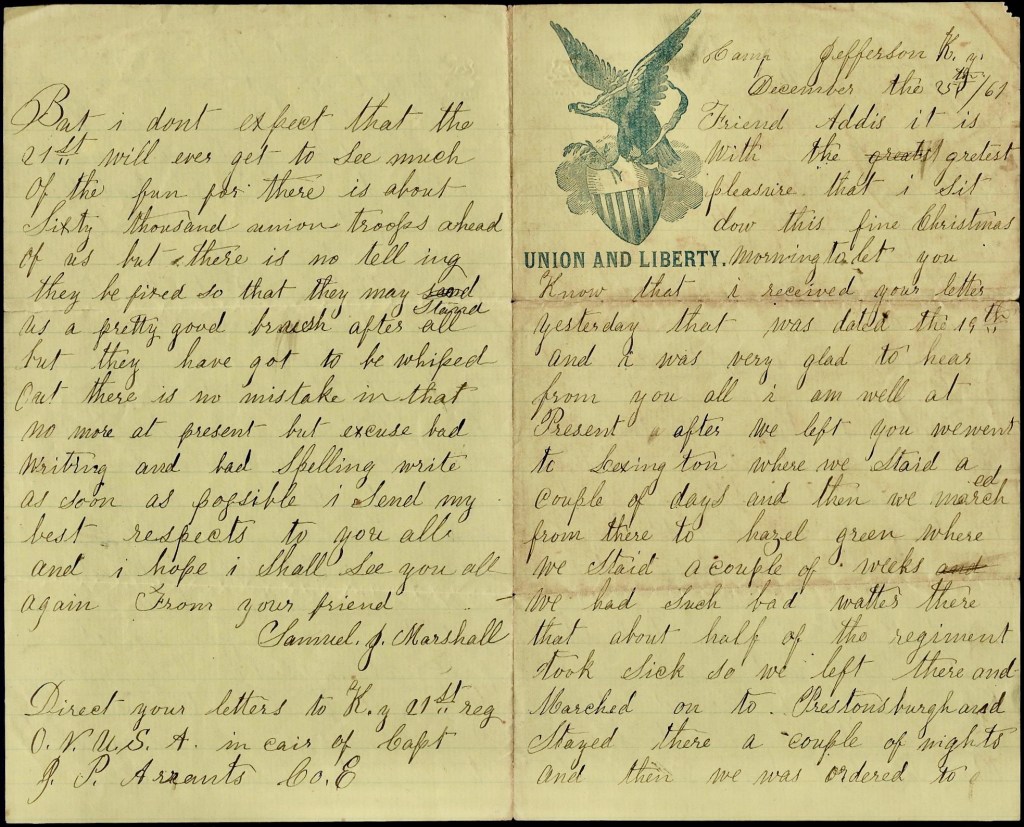


 Spared & Shared 23