Category Archives: Antebellum Alabama

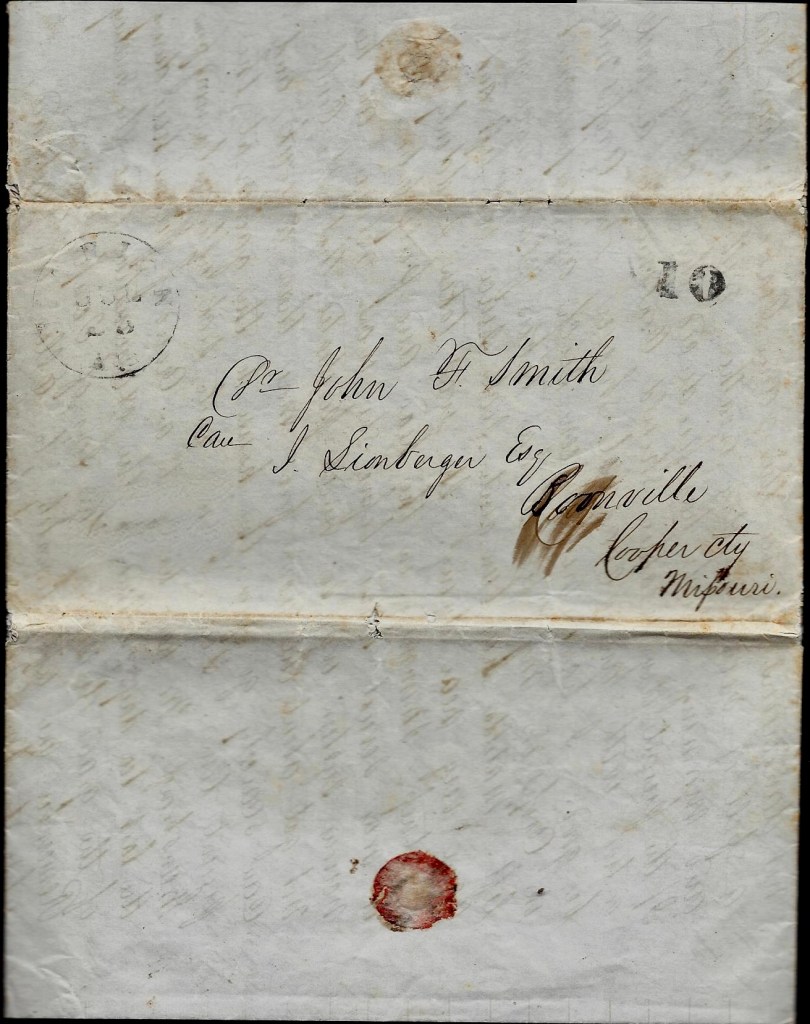
1834: John S. Sankey to Abijah Catlin

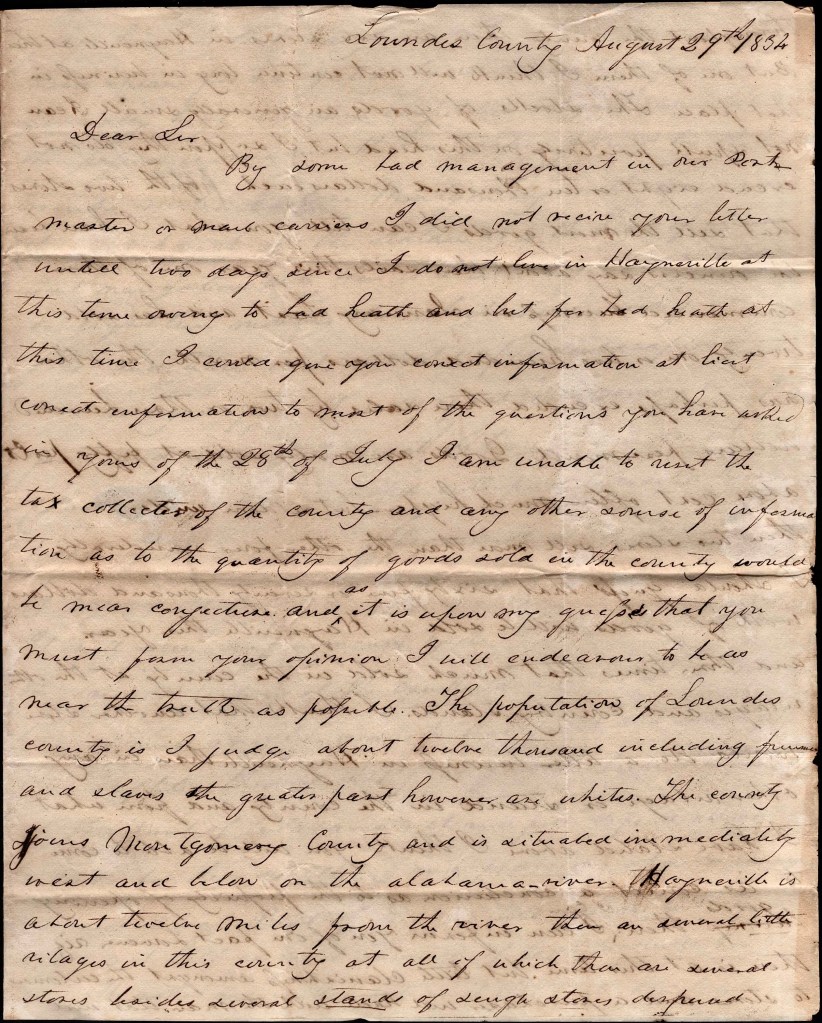
The following letter was written by John S. Sankey (Unk-1837), the son of John Thompson Sankey (1745-1819) and Ann Linton Thompson Daniel (1746-1810). He was married in Lowndes county to Patience Stephens on 27 December 1832. He was appointed Justice of the Peace in 1835 but he died on 10 May 1837 in Montgomery county, Alabama.

The letter describes the commercial business prospects for central Alabama in the mid 1830’s in response to an enquiry. Why Abijah Catlin, a prominent Litchfield, Connecticut, lawyer would have been enquiring remains a mystery.

Transcription

Lowndes County [Alabama]
August 29th, 1834

Dear Sir,

By some bad management in our post master or mail carriers, I did not receive your letter until two days since. I do not live in Hayneville at this time owing to bad health and but for bad health at this time, I could give you correct information—at least correct information to most of the questions you have asked in yours of the 28th of July. I am unable to visit the tax collector of the county, and any other source of information as to the quantity of goods sold in the county would be mere conjecture. And as it is upon my guess that you must form your opinion, I will endeavor to be as near the truth as possible.

The population of Lowndes County is, I judge, about twelve thousand including freemen and slaves. The greater part, however, are whites. The county joins Montgomery County and is situated immediately west and below on the Alabama River. Hayneville is about twelve miles from the river. There are several little villages in the county at all of which there are several stores besides several stands of single stores, dispersed throughout the county. There are six stores in Hayneville at this time, but one of them I think will not continue long in business in that place. The stocks of goods are generally small. I cannot speak positively on this head, but I suppose they do not exceed eight or ten thousand dollars each. Of the two stores that sell the most goods, I can tell you what I have heard the owners say about their sales this year. One of them commenced business in January last and has sold twenty-one or two hundred dollars per month. The other has perhaps exceeded these sales by two or three hundred dollars per month. Goods are mostly sold at fifty per cent above cost, often much higher, but seldom under. These two stores sell more than the other four individually. I should guess that sixty-five or seventy thousand dollars worth of goods will be sold in Hayneville this year, and three times that much sold in the county at the villages and country stands. I think that another store would do a better business in Hayneville than in any other village or stand in the county, and from what I have stated above, I think you will be able to come to as correct a conclusion as to the propriety of opening goods there. I can inform you of one fact, however,—viz, there is at this time but little clanishness amongst the customers to stores, and a purchaser will trade with the men that will give him the best bargain.

The Alabama river is a noble stream for navigation by steamers, but fruit is generally high. Sometimes competition brings it down until the passion is over and the combination formed by the owners. Montgomery on the Coosa river (the west branch of the Alabama) is the head of steamboat navigation and there is a little town about twelve or eighteen months old which is increasing in size and trade with almost unprecedented rapidity and many suppose it will equal Montgomery in a few years and surpass it much in time. I was once at that place and judge if proper enterprise is exerted by the people of the village for several years particularly by having good roads on the east side of the Coosa River, it will secure an immense trade to their little town. Much the largest portions of the Creek Lands (about which there has been so much row) lies nearer to that point and must get their supplies through that place from Mobile. The people of this part of Alabama, rich and poor, depend almost entirely for their clothing and provisions upon the merchants compared to that part of Georgia that you are best acquainted with. There is not half so much consumed of some products here as there. The northern and southern portions have little dealings.

The produce of the northern part of the state is carried down the Tennessee River then to New Orleans by the Mississippi. I am sorry that my situation is such at this time that I cannot give you a more exact statement in answer to several questions which might have been done if I was able to ride ten or fifteen miles. You must, however, excuse me as this is the best I can do at this time. I must stop as my paper is nearly out. I should like to hear what you conclude and when you design locating. If you should settle in another place than Hayneville, inform us.

Yours, — John S. Sankey
1844: Austin Train Wing Blair to Edwin Hugh Blair

The following letter was written by Austin Train Wing Blair (1820-1847), the son of William Blair, Sr. (1765-1842) and Sally Train (1772-1864) of Williamstown, Berkshire county, Massachusetts. He wrote the letter to his older brother, Edwin Hugh Blair (1806-1878) who took over the family farm, became melancholic in his old age and committed suicide in 1878.

A notice placed in the Mobile Register & Journal in 1844 informs us that “Blair & Co.” purchased the well known drug establishment of Mr. George F. Marlow located at the southeast corner of Dauphin and Water Streets in Mobile. According to Austin’s headstone, he died of yellow fever in Mobile on 20 October 1847 when he was 28 years old.

Transcription

Addressed to Mr. Edwin Blair, Williamstown, Berkshire county, Massachusetts

Mobile, [Alabama]
October 22, 1844

Dear Brother,

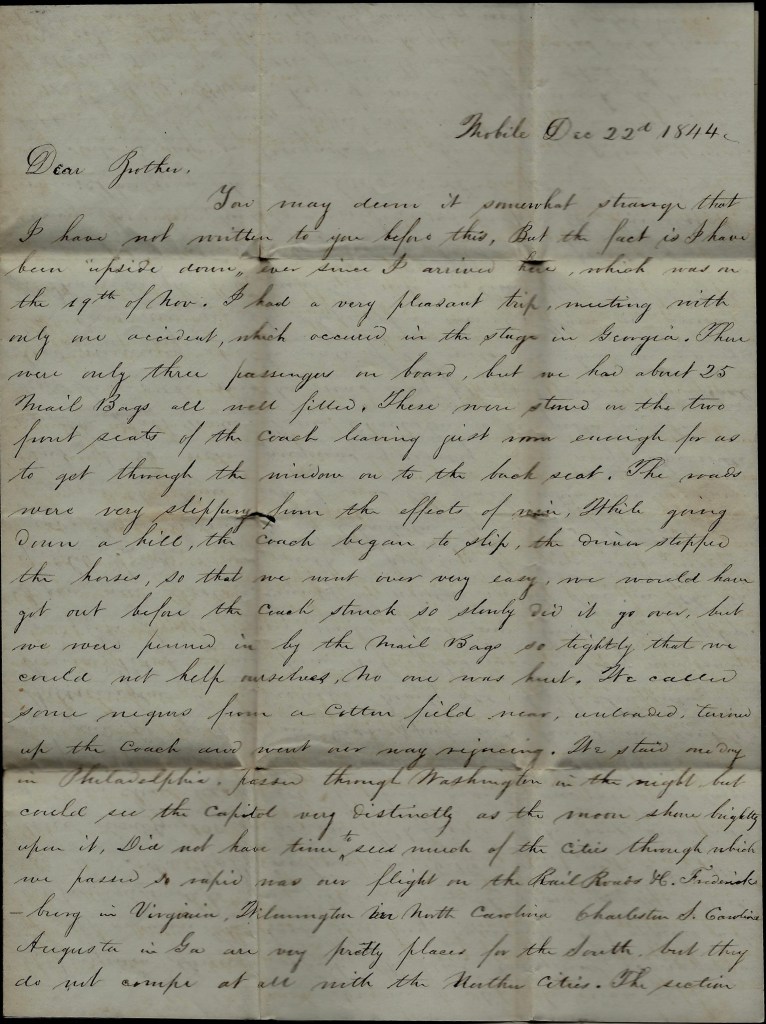
You may deem it somewhat strange that I have not written to you before this, but the fact is I have been “upside down” ever since I arrived here, which was on the 19th of November. I had a pleasant trip, meeting with only one accident which occurred in the stage in Georgia. There were only three passengers on board but we had about 25 mail bags all well filled. These were stowed on the two front seats of the coach, leaving just enough for us to get through the window onto the back seat. The roads were very slippery from the effects of the rain. While going down a hill, the coach began to sli, the driver stopped the horses, so that we went over very easy. We would have got out before the coach struck so slowly did it go over, but we were penned in by the mail bags so tightly that we could not help ourselves. No one was hurt. We called some negroes from a cotton field near, unloaded, turned up the coach, and went on our way rejoicing.

We staid one day in Philadelphia, passed through Washington in the night but could see the Capitol very distinctly as the moon shone brightly upon t. Did not have time to see much of the cities through which we passed so rapid was our flight on the rail roads &c. Fredericksburg in Virginia, Wilmington in North Carolina, Charleston, S. Carolina, Augusta in Georgia are very pretty places for the South but they do not compare at all with the northern cities. The section of Virginia through which the rail road runs is very barren in appearance. The land lies very handsomely but appears on the surface just like your fields when the snow goes off—black and dead.

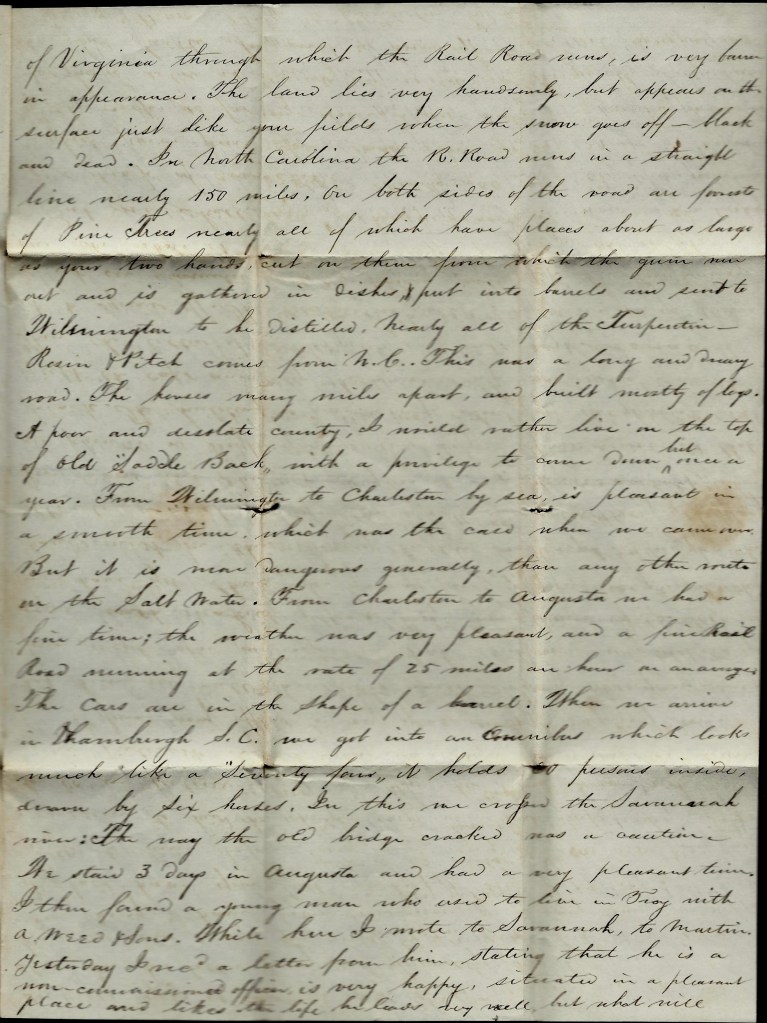
In North Carolina the rail road runs in a straight line nearly 150 miles. On both sides of the road are forests of Pine trees nearly all of which have places about as large as your two hands cut on the from which the gum runs out and is gathered in dishes, put into barrels, and sent to Wilmington to be distilled. Nearly all of the turpentine, resin and pitch comes from North Carolina. This was a long and dreary road. The houses many miles apart and built mostly lof logs. A poor and desolate country. I would rather live on the top of old “Saddle Back” with a privilege to come down but once a year.

From Wilmington to Charleston by sea is pleasant in a smooth time, which was the case when we came over. But it is more dangerous generally than any other route on the salt water. From Charleston to Augusta we had a fine time; the weather was very pleasant and a fine rail road running at the rate of 25 miles an hour on an average. The cars are in the shape of a barrel. When we arrived in Hamburg, South Carolina, we got into an omnibus which looks much like a “Seventy four.” It holds 60 persons inside drawn by six horses. In this we crossed the Savannah river. The way the old bridge cracked was a caution.

A South Carolina Railroad Car (patented in 1841)

We staid 3 days in Augusta and had a very pleasant time. I then found a young man who used to live in Troy with a Weed & Sons. While here, I wrote to Savannah to Martin Yesterday I received a letter from him stating that he is non-commissioned officer, is very happy, situated in a pleasant place, and likes the life he leads very well, but what will surprise you is that he was to be married on the 8th of December. In his letter he says, “Before this reaches you I shall be a married man. You will be surprised but it is no sudden thing. I have been considering on a long time and I hope I shall have your best wishes for my happiness. I shall write to him before long and congratulate him on the occasion to his household, and find out what he intends to do in future—that is, after his term expires. I feel some interest in the boy and hope he may do well.

I found my affairs in very good shape here, though business has been very dull during the summer. It rained just four weeks after our arrival which threw me back some time with making repairs but I worked night and days and have got things in good shape now. The store is the handsomest on the outside of any store in the city and attracts a great deal of attention. Tis two stories high with iron doors and shutters, all opening on the outside. These are painted a bright green on the panels and trimmed with black. The building is pained the color of peach blossom except the caps and sills of the doors & windows which are white. Then the letters of the sign are 3 feet long. One can read it 6 squares off. The [ ] made of tin is 6 feet high and 3 feet in diameter painted blue, with gold bands around. On the whole, it is the handsomest building I ever saw.

But we shall have a hard season for business. There is a heap of competition & cotton is very low. The very highest price paid this season was 7 cents but nearly all of the crop so far has brought but 5 cents on an average. Some has been sold as low as 3 cents—a fair article too. We have had but little business yet and shall not do much before February & March. But enough to pay all expenses which is better than many have done.

The gardeners are now putting in a fresh lot of seed. We received yesterday upwards of 11,000 paper of garden seeds which we sell at $8 per hundred or 10 cents a single paper. I wish you were here to spend the winter with me. Write to me soon and let me know how you get on with your matters. Remember me to all the folks and give my love to our family & believe me your affectionate brother, — A. T. W. Blair

The weather is very pleasant now though we have two or three days cold enough to make a fire quite comfortable. Indeed, it has been colder than any weather we had last winter but notwithstanding this, there has been green corn, snap beans, radishes, and in fact, all kinds of vegetables in market grown this season.

1859: Allen Hall Statement

This statement by Allen Hall (1815-1864), a neighbor, may have been submitted in support of a challenge to the Last Will & Testament of Elam Smith (1788-1859) of Greene County, Alabama. According to the Will that he executed in August 1858, Elam declared that he, having heretofore provided for his older children, intended to give the whole of his estate to his current wife and her children—Elam Smith and Franklin Smith. He also gave $1,000 to his daughter Sally Smith, the wife of Charles Stephens. All the rest of his estate—lands, negroes, stock, money and effects—were left to his wife, Mary (Harris) Smith and the aforementioned son. My hunch is that Elam’s daughter, Sally, and her husband, John Stephens, challenged the Will following his death in 1859.

Elam Smith was born in North Carolina in 1788. His first wife’s name was Cynthia Green (1786-1850). His second wife’s name was Mary Harris. Their sons, Elam Smith and Franklin Smith were born in 1851 and 1853, respectively.

Allen Hall was a farmer in Greene county, Alabama. He was a native of Tennessee. I have no other details on his death except that he was killed in action at the Battle of Mobile o 10 September 1864.

[Note: This document is from the personal collection of Greg Herr and was transcribed and published on Spared & Shared by express consent.]

Transcription

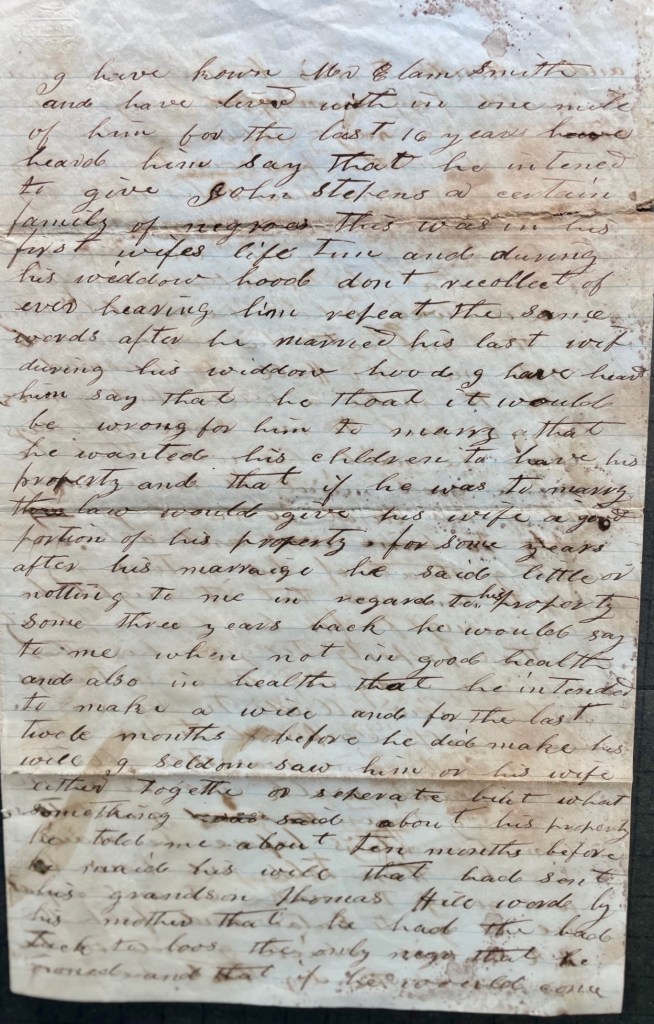
I have known Mr. Elam Smith and have lived within one mile of him for the last 16 years. Have heard him say that he intended to give John Stephens a certain family of negroes. This was in his first wife’s lifetime and during his widowhood. Don’t recollect of ever hearing him repeat the same words after he married his last wife. During his widowhood, I have heard him say that he thought it would be wrong for him to marry—that he wanted his children to have his property and that if he was to marry, the law would give his wife a good portion of his property.

For some years years after his marriage, he said little or nothing to me in regard to his property. Some three years back he would say to me when not in good health and also in health that he intended to make a will and for the last twelve months before he did make his will, I seldom saw him or his wife either together or separate but what something was said about his property.

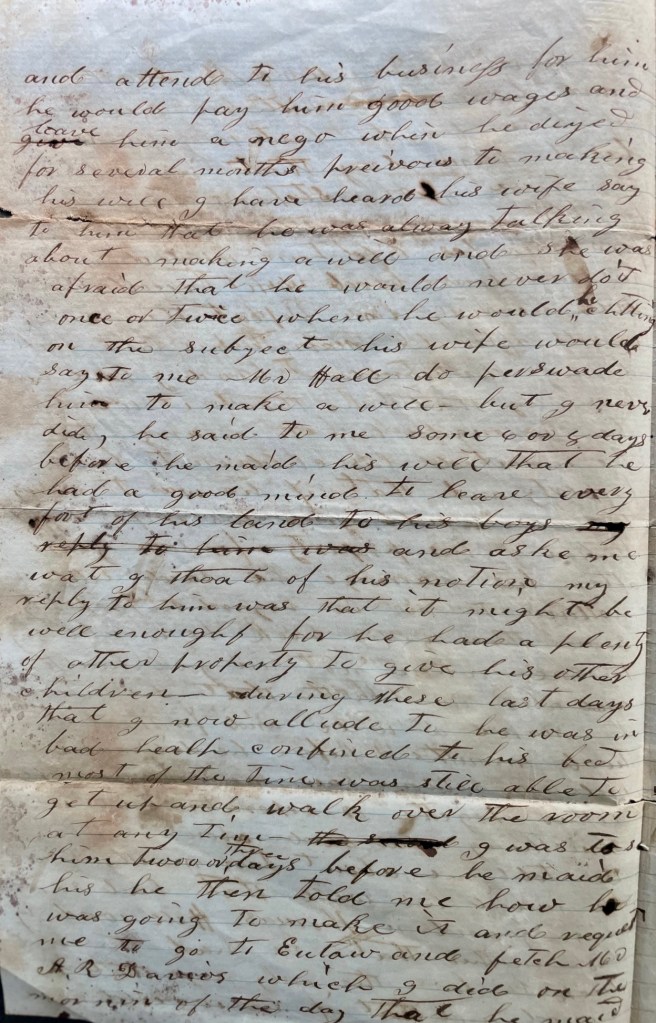
He told me about ten months before he made his will that he had sent his grandson Thomas Hill word by his mother that he had the bad luck to lose his only negro that he owned and that if he would come and attend to his business for him, he would pay him good wages and leave him a negro when he died. For several months previous to making his will, I have heard his wife say to him that he was always talking about making a will and she was afraid that he would never do it. Once or twice when he would be chatting on the subject, his wife would say to me, “Mr. Hall, do persuade him to make a will,” but I never did. He said to me some 6 or 8 days before he made his will that he had a good mind to leave every foot of his land to his boys and asked me what I thought of his notion. My reply to him was that it might be well enough for he had a plenty of other property to give his other children.

During these last days that I now allude to, he was in bad health, confined to his bed most of the time, was still able to get up and walk over the room at any time. I was to see him two or three days before he made his will. He then told me how he was going to make it and requested me to go to Eutaw and fetch Mr. A[ttoway Reeder] Davis which I did on the morning of the day that he made his will.

I went to see him early and told him that I knew his other children—that they were poor, and that I felt sorry for them and hoped he would think of them and their posterity. His reply was that his older children were of no account—that they were waiting for him to die to get his property and that they would miss it. I then turned to his wife and said to her that his daughters used to plow and hoe [that land] and that there were persons that knew it now living. Her reply was that his property was his own and that he had the right to dispose of it as he pleased.

Mr. Smith also said to my wife about three months after making of his will that his grown son John Stephens had professed religion and was rejoiced at it and said that he could never be satisfied without giving him something more. November 12, 1859

— Allen Hall

1850: Thomas Larmuth to William Hunter

This letter was written by 23 year-old English native Thomas Larmuth (1826-1866) who seems to have been paying for his sight-seeing excursion of the United States by performing various jobs in which he could apply his skill as an engineer. In this particular letter he wrote to his former acquaintance, William Hunter (b. 1818), an English-born millhand at the Hamilton Corporation, a cotton textile mill in Lowell, Massachusetts.

How Thomas might have looked in 1850

Gleaning any kind of information about Thomas from US census records proved impossible due to his mobility but I fortunately stumbled on his identity from an article published on the internet pertaining to Leopold Larmuth (b. 1855), an ear surgeon who grew up in Manchester, England. It seems Leopold’s grandfather was named Thomas Larmuth (1797-1873) and he lived in Salford, Manchester, where he was the proprietor of his own machine manufacturing firm (eventually the Tobleben Iron Works). This Thomas Larmuth had three sons who acquired the skills of their father—James Williams (1821-1902), Thomas (1826-1866), and Matthew Henry (1831-1908). James and Matthew continued to work for their father producing boilers, steam cranes, rock drills, and many kinds of machines using in manufacturing.

Thomas Larmuth, however, decided to see America before settling down in Cheetham, Lancashire, England, to work at the family trade designing and manufacturing machinery. In the 1851 UK census, he was still living with his parents but in 1853 he married Rachel Adelaide Taylor (1831-1911) and by 1861 had moved his growing family to Frodsham in Cheshire. After the 1861 UK Census, Thomas disappears from public records and his family speculates that he returned to America where he worked in the Confederacy as an engineer. A member of the family claims to have found a death notice stating that he drowned in the Mississippi river on 17 January 1866. His wife, who made a living as a pianist, was left to raise their five children back in England.

From the Manchester Courier, Saturday, 5 May 1866. Courtesy of the The British Library Board and supplied by Gwyneth Wilkie, author of the article about Leopold Larmuth.

Transcription

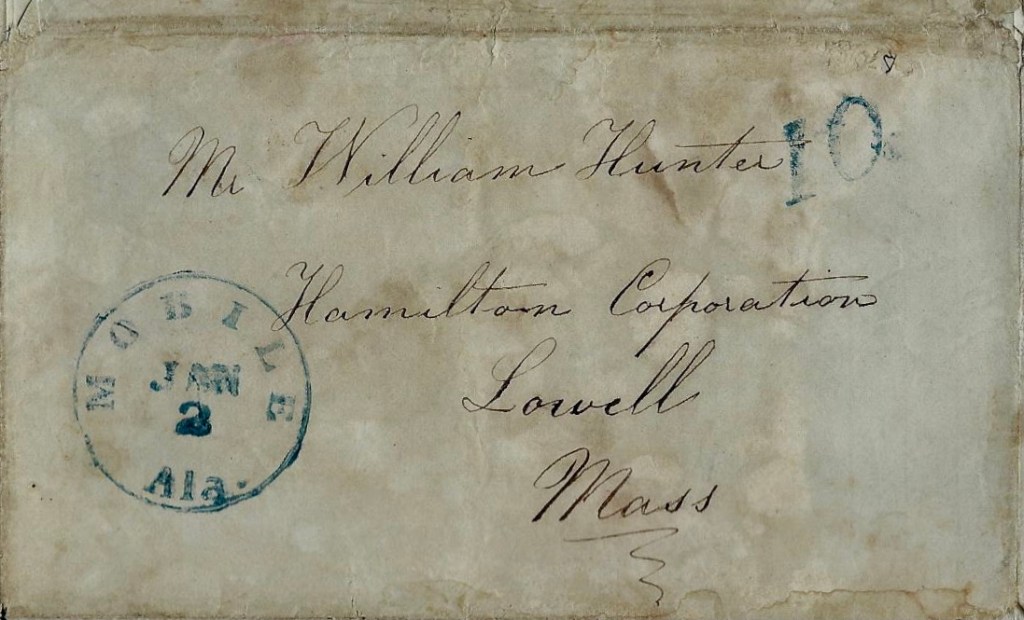
Addressed to Mr. William Hunter, Hamilton Corporation, Lowell, Mass.
Postmarked Mobile, Alabama, January 2, 1850

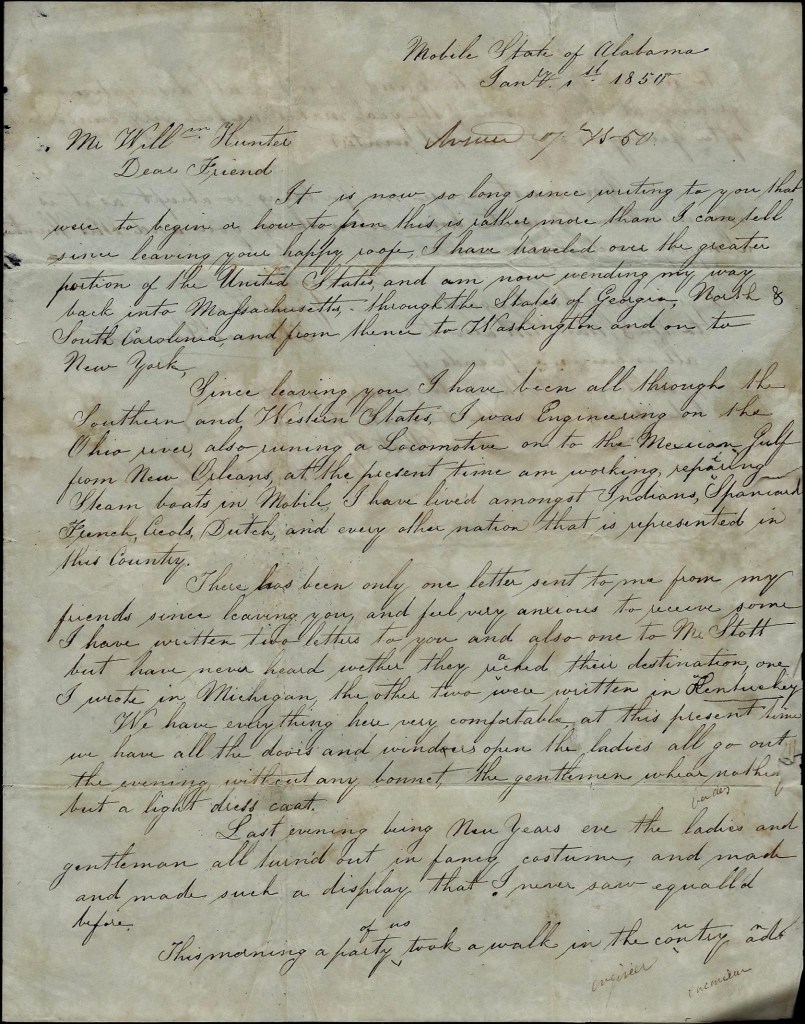
Mobile, State of Alabama
January 1st 1850

Mr. William Hunter, dear friend,

It is now so long since writing to you that where to begin or how to pen this is rather more than I can tell. Since leaving your happy roof, I have traveled over the greater portion of the United States and am now wending my way back into Massachusetts through the states of Georgia, North and South Carolina, and from thence to Washington and on to New York.

Since leaving you I have been all through the southern and western states. I was engineering on the Ohio river, also running a locomotive on to the Mexican Gulf from New Orleans, at the present time am working repairing steamboats in Mobile. I have lived amongst Indians, Spaniards, French, Creoles, Dutch, and every other nation that is represented in this country.

There has been only one letter sent to me from my friends since leaving you and I feel very anxious to receive some. I have written two letters to you and also one to Mr. Stott but have never heard whether they reached their destination. One I wrote in Michigan; the other two were written in Kentucky.

We have everything here very comfortable at this present time. We have all the doors and windows open, the ladies all go out in the evening without any bonnet, the gentlemen wear nothing but a light dress coat. Last evening being New Year’s eve, the ladies and gentlemen all turned out in fancy costume and made such a display that I never saw equal before. 1 This morning a party of us took a walk in the country out to see the orange trees and flowers of all descriptions growing at this season of the year. Makes one feel very comfortable after feeling one of your cold winters.

You must excuse me for being so abrupt as it is my intention to write home so wishing you and Mrs. Hunter a happy and prosperous New Year, I remain yours truly, — Thomas Larmuth

P.S. Give my kind regards to Mr & Mrs Stott. Also to all enquiring friends. If you have anything to communicate, be kind enough to write to me. Post Office Mobile, Alabama

1 Thomas was probably referring to the callithumpians who caused a large commotion in the streets. Often they were masked or costumed revelers making noise for an official occasion.

1836: Thomas P. Nodine to William Nodine

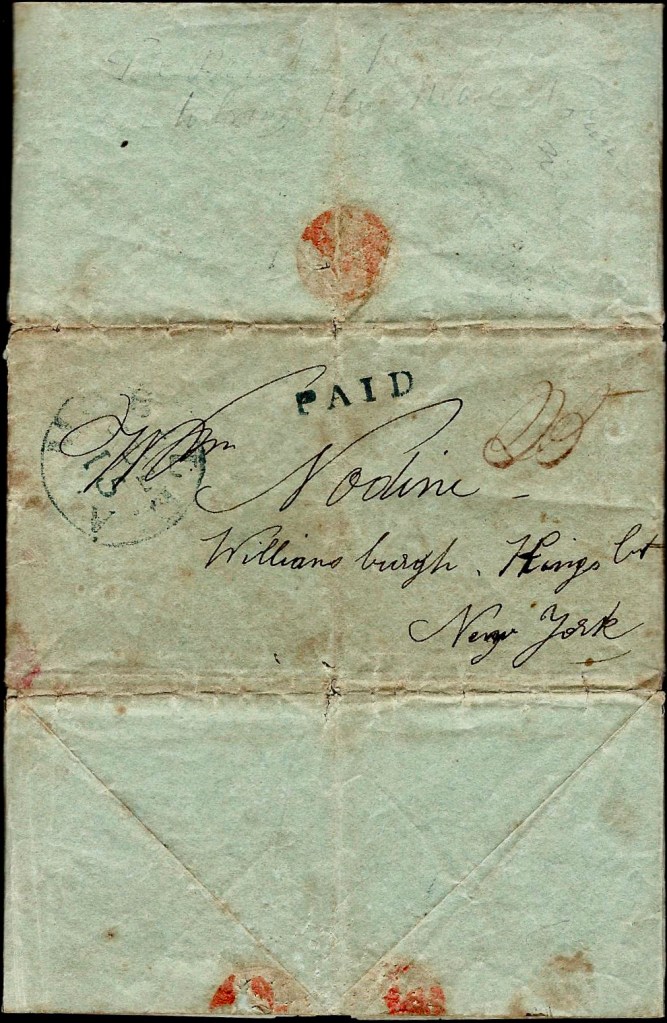
This letter was written by Thomas P. Nodine. He may be the same blacksmith born in New York in 1824 that relocated to Connecticut prior to the Civil War and enlisted in Co. B, 28th Connecticut Infantry under the name Nodyne. I could not verify this or his parentage given the absence of information in early census records. William wrote the letter to his brother William Nodine (1804-18xx) who worked as a cartman, later as a blacksmith, in Williamsburgh, Kings county, New York. William was married to Catherine K. Richardson in the 1820’s and had at least two children by the time his letter was written in 1836.

It’s difficult to discern from Thomas’s letter what he was doing in Mobile, Alabama, in 1836 besides hunting reptiles which I assume was only a pastime and not the “excellent job” he claimed having. In any event, it’s easy to understand the fascination that visitors from the northeastern states experienced when they first encountered an alligator. Thomas may have been employed by a merchant in the trade between New York and Mobile which was well established by this time.

An 1835 Woodcut of Mobile, Alabama

Transcription

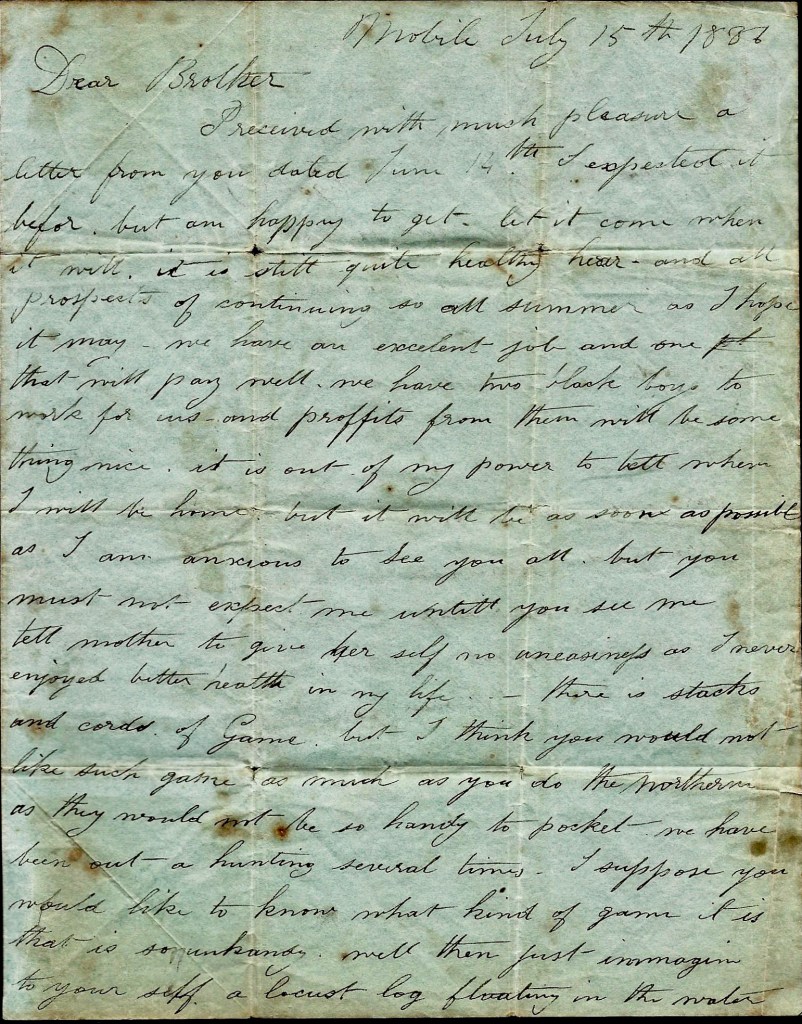
Mobile [Alabama]
July 15th 1836

Dear Brother,

I received with much pleasure a letter from you daed June 14th. I expected it before but am happy to get it. Let it come when it will. It is still quite healthy here and all prospects of continuing so all summer as I hope it may. We have an excellent job and one that will pay well. We have two black boys to work for us and profits from them will be something nice. It is out of my power to bet when I will be home but it will be as soon as possible as I am anxious to see you all. But you must not expect me until you see me. Tell Mother to give herself no uneasiness as I never enjoyed better health in my life.

There is stacks and cords of game but I think you would not like such game as much as you do the northern as they would not be so handy to pocket. We have been out a hunting several times. I suppose you would like to know what kind of game it is that is so handy. Well them, just imagine yourself a locust log floating in the water about fourteen feet long with a mouth one half the length of the body with four short, crokked legs with nails about 4 inches long and then you wil know exactly what our game is (Aligator).

When I come home, I will be very glad of an introduction to that Miss E. Lambert you talk about so much in your letters. I don’t know who she can be. I am well acquainted with a young lady and a particular friend of mine by the name of Lizzy Lambert but it cannot be the same. But whoever she is, give her and all her family my love. The same to Miss Crawford. Remember me to all inquiring friend.

My love to Mother and Father and sisters. My best respects to your wife. I remain your affectionate brother, — Thomas C. Nodine

1850: Lewis Conner Tutt, Sr. to John F. Smith

This letter was written by Lewis Conner Tutt, Sr. (1817-18xx), the son of Richard Johnson Tutt (1772-1840) and Mildred Conner (1776-1837) of Culpeper, Virginia. Lewis was married in February 1844 to Matilda Josephine Jones (b. 1826) and together they raised half a dozen children or more—of whom was Lewis (Jr.) who served as a sergeant in Roddy’s Escort, Alabama Cavalry.

From his post war “Amnesty & Pardon” papers we learn that Lewis was “by profession a merchant and since immigrating to [Alabama, was always] engaged in merchandizing and farming.” He claimed to have “never sought or held political office nor in any manner a public man but devoted all his time and energies to his business.” He went on to describe the hardship he now faced having had “the larger portion of his estate swept away by the emancipation of slaves (he had owned 14) and other losses sustained in consequence of the war.” He made it clear that he had supported the Constitutional Union Party and therefore voted for Bell & Everett in 1860 hoping to avoid the “calamities which have befallen our country.” He pointed out that he never was in the Confederate army or service, and only offered aid to ease the helpless and suffering families in his county. Furthermore, he had already begun to hire freedmen “at liberal compensation—those he formerly held as slaves.”

Lewis wrote this letter to his brother-in-law, Dr. John F. Smith who married his sister, Mary “Ellen” Tutt (b. 1813) on 12 October 1841 in Rappahannock, Virginia.

Judson Female Institute, Marion, Alabama

Transcription

Marion, [Perry county, Alabama]
July 26, 1850

Dr. John F. Smith,
Dear Sir,

You will no doubt think it strange that I have not written to you before this, but after your expressing so much doubt in regard to the time you should leave Pontotoc in Mississippi and your promise to write to me from Memphis, I concluded to wait until I heard from you before I wrote. I received your first letter after leaving Pontotoc about a week since from St. Louis and your last from Boonville day before yesterday. I did not know until I heard from you at St. Louis whether or not you had left Pontotoc, or if you had, what route you had taken—whether by land all the way, or by Memphis. I am sorry now that I did not write for I expect you have been anxious to hear from this place. For the same reason that I did not write, I thought it best not to ship your trunk until I heard from you which I did as soon as I received your letter from St. Louis.

I was very much pleased to learn that notwithstanding your hard and fatiguing trip that you had all arrived safely with the exception of your sickness. I felt very uneasy all the time until I heard from you all and from your symptoms in St. Louis, was not much surprised to learn that you were sick after getting to Boonville. I am very glad to learn that you are improving and hope your health will be entirely restored.

The horse you left in Greensboro died the day after you left. The tavern keeper wrote me he could do nothing with him and could find no one who could. I am satisfied from all I can learn that his disease was not the glanders. Brazelton appeared to be very much astonished—declared he knew that he knew of nothing that was the matter with him and said that he was willing to do anything that it was right and proper that he should do to give you satisfaction. I thought I would not press the matter on him as the note was not due until I heard from you. I think you done well to sell your horse in Memphis, taking everything into consideration.

Your affairs stand pretty much as they did when you left—everything being entirely easy. I shall collect a little money from the Judson [Female Instutute], I think, during the examination which takes place next week. The Howard [College] and the [Marion Female] Seminary examinations are both over. We have had very dull times here since you left and some of the hottest weather I think I ever felt. A part of the time we have had a great deal of rain but for the last week it has been dry.

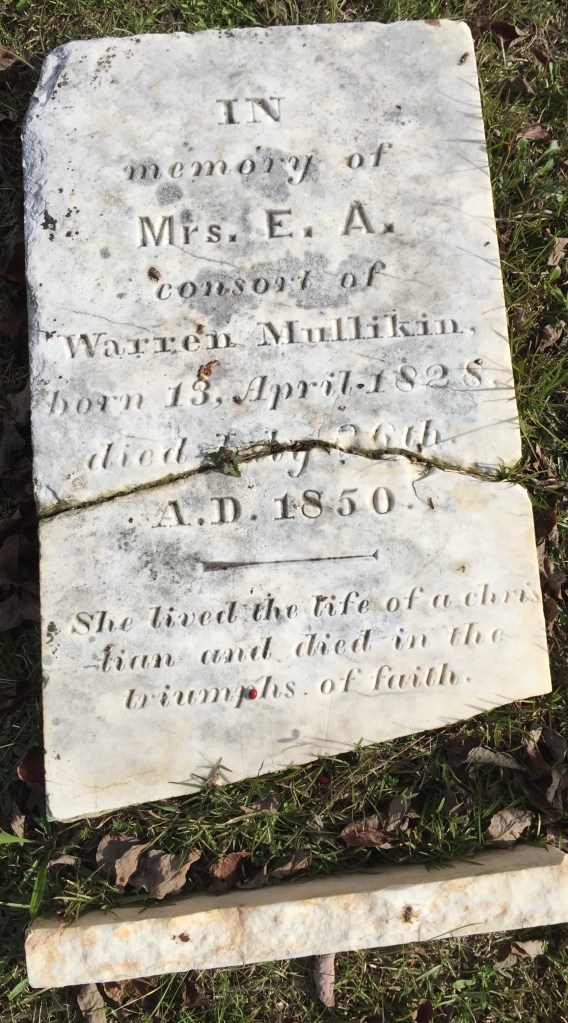
Toppled & shattered headstone of Elizabeth, consort of Warren Mullikin. He married her sister less than two years later (you could say he “got a mulligan?)

We have at this time a considerable amount of sickness—typhus and billious fever. My girl Elvira has had a very hard spell and is just recovering. Warren Mullikin’s wife 1 was buried today. She died after about three or four days illness. A Miss Johnson, granddaughter of Mrs. Rutledge, died a few days since. Miss Neal is not expected to live and there have been several deaths amongst the negroes. Dr. [Samuel] Johns, James [Anderson] Howze, and Mr. [Hector] McLane are all sick at this time, but I suppose not dangerous. Since the rains ceased, we have had a spell of very hot, dry weather with cool nights and mornings which has produced the sickness.

If the present dry weather should continue for a week or two, with an occasional shower, our crops will be good. I have never seen such an improvement in crops in my life as has taken place since you left.

Matilda has been sick since you left and came very near dying. She was taken suddenly with faintness, swimming in her head and palpitations. It was several hours before she was relieved and her nervous system was so much prostrated that she could not get about the room for more than a week, and can scarcely go from the house to the garden at the present time. Lewis I found quite sick after returning from Greensboro. We have had quite a crowd of persons here during the last ten days attending the examinations and the meeting of the Grand Division of the Sons of Temperance.

Remember me affectionately to Ellen and Edward. Also to Mr. Turner and family and relatives generally. Matilda desires to be kindly remembered to Ellen & yourself, and requests particularly that sister Ellen should write to her. You need not feel any uneasiness about any of your matters here for there is not the least occasion for it. I will write you again in three or four days. Write me as often as you can.

Yours, — L. C. Tutt

Say to sister Ellen that I will write to her in a few days and that she must not wait for my letter to write. Tell her to write and give me all the news in Missouri.

1 Warren Mullkin (1821-1860), a collector in Perry county, was married to Elizabeth A. Patterson (1828-1850). She died on 26 July 1850. “She lived the life of a christian and died in the triumphs of faith” according to her gravestone, which lies broken on the ground in the Marion Cemetery. The couple had been married less than four years.