
Less than a year following Arkansas Statehood, 22 year-old John Covington Burch (1815-1875) penned the following letter from the new state capitol to his sister America Glovinia Emeline Burch (1813-1893) in Washington City, District of Columbia. Covington and his older sister were the oldest of several children born to Col. Samuel Birche (1787-1846) and Susannah Maria Wilson (1790-1873).
Samuel Burch was a government clerk in Washington City who also served in the militia during the War of 1812. A story posted by a descendant in Ancestry.com claims that when the British army were marching on Washington, Samuel attempted to be excused from his duties as a soldier to stay in the city and do what he could to rescue House documents to prevent them from destruction. He was finally relieved of his duties so that he could accomplish the task but by the time he arrived back in the city, nearly all of the wagons and carts had been taken up for hauling valuables away by the citizens. He was finally able to secure one ox and cart and remove some few things but much was lost that might have been saved had he been relieved sooner.
From this letter we learn that Covington entertained the idea of relocating to the frontier state of Arkansas, beyond the Mississippi. I can’t find any evidence that he ever moved there, but if he did, he did not remain long for he eventually accepted an appointment to serve as the Journal Clerk of the U. S. Senate—a position he held until June 1850 when he was dismissed and replaced by a Democrat from Indiana. There is also evidence in the newspapers that, like his father, Covington worked as a “General Agent” at Washington to assist veterans in securing their claims for pensions or land claims.
Having secured land in Arkansas, it seems that Covington intended to return to Arkansas by January 1, 1838. He apparently took a slave with him to Arkansas when he traveled there in 1837 and left him there to be hired out with Col. Lockart in Little Rock until he returned.
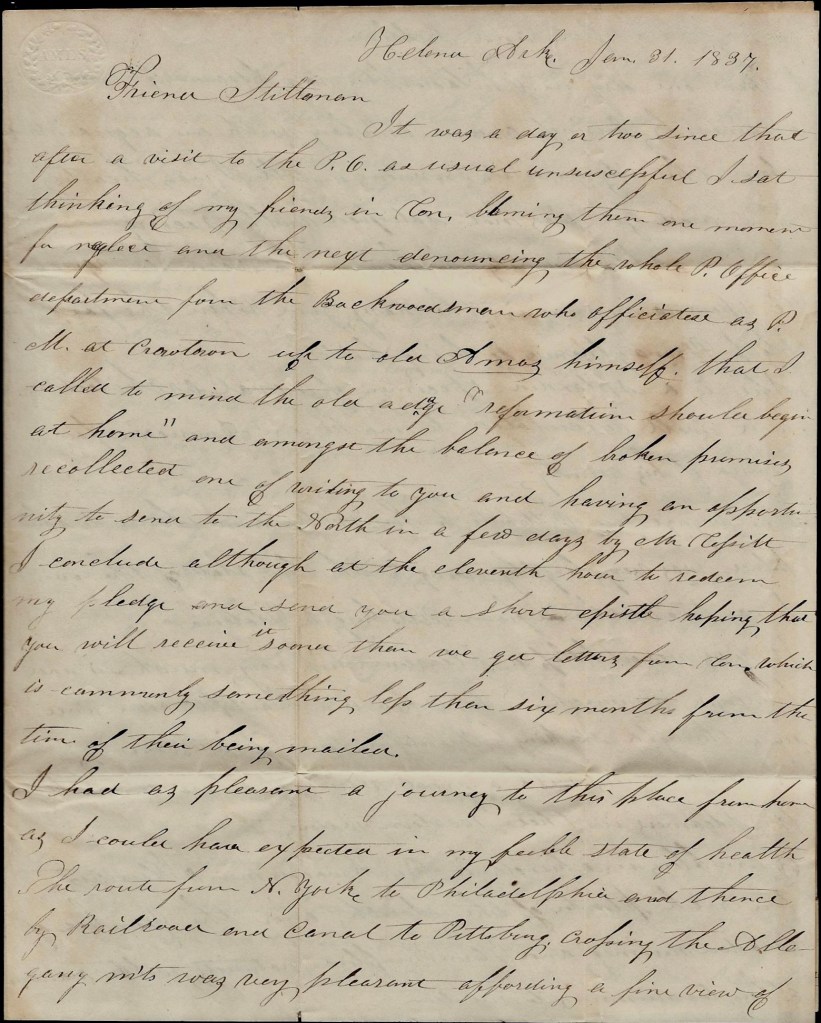
Transcription

Little Rock, Arkansas
April 27th 1837
My dear sister,
Having an idle moment to spare, I know not how I can better employ it than by scribing a few lines to you, and the other “dead ones” at home.
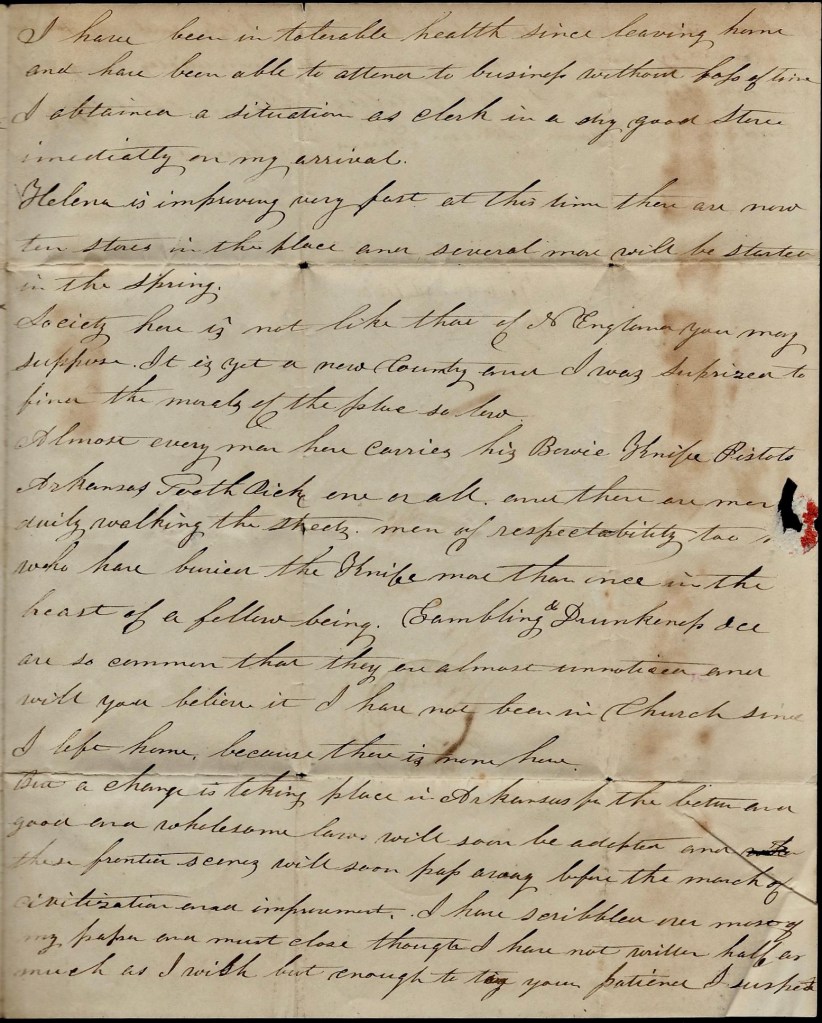
I have just returned to the Rock from a visit to a Mr. Bradley’s—a young gentleman living on the Arkansas [River] about twenty miles from the Rock, who came out to Arkansas last fall and settled. He is a friend of mine. I went to Mr. Bradley’s for the purpose to look at land, and, Oh such a time as I had of it, through cane brakes and swamps, swimming bayous, wading creeks, and as Major Peay says: so forth & so forth & so forth. I think it probable that I will purchase of Mr. Bradley as he has made me an excellent offer.
Tell father that I have redeemed Uncle Artis’ land. 1 Tell him though not to tell Uncle Artis of it until I come home. I believe that both of the tracts are good.
I have become acquainted with pretty much all the big people of Arkansas such as Gov. [James Sevier] Conway, 2 Judge [Charles Anthony] Caldwell, 3 &c. &c. &c.
I intend to leave tomorrow for the Wachita [Quachita] country and shall be absent about twelve days and after my return to this place, shall turn my steps homewards.
I have hired John to Col. [William S.] Lockart, 4 one of Judge Caldwell’s son-in-laws, for six dollars per month, from now until January. He gave me his note for the amount due 1st January.
Give my best love to Father, Mother, brothers, relatives and friends one and all. Also to the servants and receive for yourself the renewed assurances of affection and esteem. From your brother, — Covington
P. S. Excuse mistakes as I write in a hurry.
1 Uncle Artis was likely John Artis Willson (1776-1841), brother of Covington’s mother. He was a resident of Washington City in the 1830 census. He was a lawyer and a US Marshal of the District during the Jefferson and Monroe Administrations. He is believed to have fathered several children with Maria Ford, his slave.
2 James Sevier Conway (1798-1855) served as the 1st Governor of Arkansas from 1836 to 1840. Conway was born in Tennessee and migrated to Arkansas Territory in 1820, purchasing a large cotton plantation in Lafayette county.
3 Col. Charles Anthony Caldwell, or Judge Caldwell, (1785-1844) was a native of Virginia but came to Kentucky with his parents as a child and was married in Fayette county to Ann Nancy Venable (1788-1813). After her death, he married Sarah Anderson (1799-1837). He appears to have relocated to Arkansas Territory about 1830 and served as a state representative from Saline county prior to his appointment as Judge.
4 Col. William S. Lockart (1810-1850) was married to Georgia Anderson Caldwell on 23 August 1836 in Saline county, Arkansas. For Lockart, it was his second marriage; his first wife, Nancy M. Kellum died in 1831. Lockart was born in South Carolina but lived in Alabama for a time before coming to Arkansas in the mid 1830s.






 Spared & Shared 23