
This partial and therefore unsigned letter was written by Alexander Wilson McClure (1808-1863) of Boston, Massachusetts. He graduated from Amherst in 1827 and at Andover Theological Seminary in 1830, and after preaching at Malden, Massachusetts, two years, he was ordained there in 1832. He subsequently was stationed at St. Augustine, Florida, where he labored successfully among the soldiers that were on duty there. In 1846 he returned to Boston, and soon after began the publication of the “Christian Observatory,” which he edited more than three years. He also assisted Dr. Parsons Cooke in conducting the “Puritan Recorders” In 1855 he became secretary of the American and Foreign Christian union, and labored for some time abroad. In 1859 he was disabled by illness. Mr. McClure was a prolific writer for the religious press, and published, among other works, a tract called the “Life-Boat,” which had a wide circulation; another entitled Four Lectures on Ultra. Universalism”; “A Series of Letters upon the Bible in the Public Schools,” written in controversy with a Roman Catholic priest in Jersey City; two volumes of the “Lives of the Chief Fathers of New England,” in the series published by the Massachusetts Sunday School Society : and “Translators Reviewed,” giving a biographical sketch of each translator concerned in King James’s version (New York, 1853). This has been adopted by the board of publication of the Reformed Dutch church.” [Source: Appleton’s Cyclopedia of American Biography]
[Note: This letter was transcribed by Lily Cutler; proofread and researched by Griff.]
Transcription
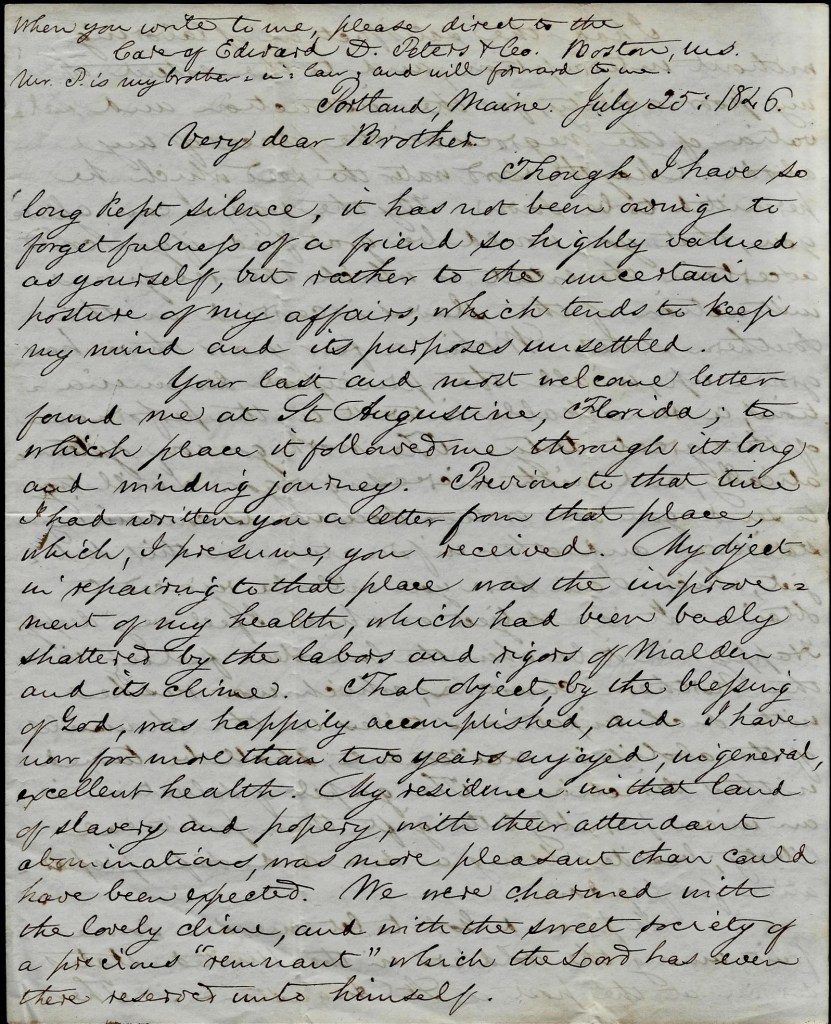
Portland, Maine
July 25, 1846
Dear Brother,
Though I have so long kept silence, it has not been owing to forgetfulness of a friend so highly valued as yourself, but rather to the uncertain posture of my affairs, which tends to keep my mind and its purposes unsettled.
Your last and most welcome letter found me at St. Augustine, Florida; to which place it followed me through its long and winding journey. Previous to that time I had written you a letter from that place, which, I presume, you received. My object in repairing to that place was the improvement of my health, which had been badly shattered by the labors and rigors of Malden and its clime. That object, by the blessing of God, was happily accomplished, and I have now for more than two years enjoyed, in general, excellent health. My residence in that land of slavery and popery, with their attendant abominations, was more pleasant than could have been expected. We were charmed with the lovely clime, and with the sweet society of a precious “remnant,” which the Lord has even there reserved unto himself.
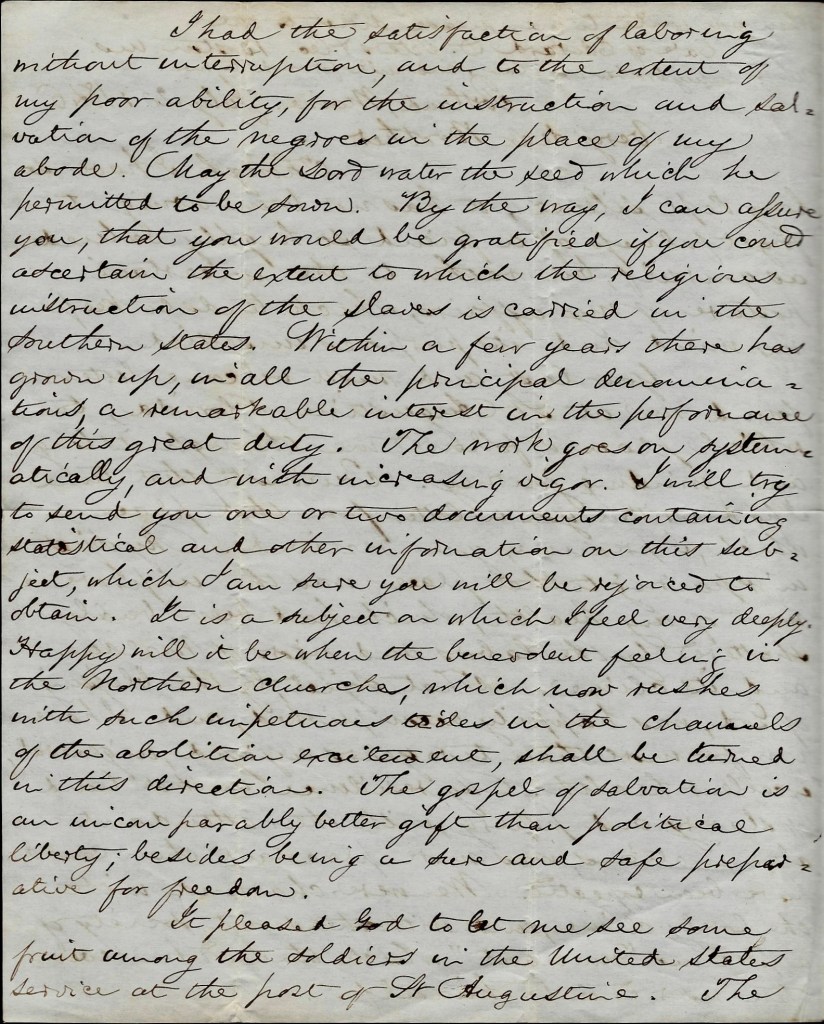
I had the satisfaction of laboring without interruption, and to the extent of my poor ability, for the instruction and salvation of the negroes in the place of my abode. May the Lord water the seed which he permitted to be sown. By the way, I can assure you, that you would be gratified if you could ascertain the extent to which the religious instruction of the slaves is carried in the Southern States. Within a few years there has grown up, in all the principal denominations, a remarkable interest in the performance of this great duty. The work goes on systematically, and with increasing vigor. I will try to send you one or two documents containing statistical and other information on this subject, which I am sure you will be rejoiced to obtain. It is a subject on which I feel very deeply. Happy will it be when the benevolent feeling in the Northern churches, which now rushes with such impetuous tides in the channels of the abolition excitement, shall be turned in this direction. The gospel of salvation is an incomparably better gift than political liberty; besides being a sure and safe preparative for freedom.
It pleased God to let me see some fruit among the soldiers in the United States service at the post of St. Augustine. The Temperance reform when once, with difficulty, it was introduced into the garrison, wrought wonders. There was almost a complete transformation among the men, as to their appearance and behavior. Some of them we received into the church, who were a great consolation to us. Soon after I left Florida, that regiment—the 8th U. S. Infantry—was sent to Mexico to fight President Polk’s iniquitous battles. Some of my praying soldiers were killed in the fights of Palo Alto and Palma de Resaca, where their regiment suffered the most of any. I hope they were prepared: but when I suffer myself to think of the atrocity of the orders under which they were thus exposed to a bloody death, I find it hard to keep from “speaking evil of the ruler of my people,” and “blaspheming the king.” I can only keep down the fire of indignation by that eternal mountain—the sovereignty of God in the affairs of men.
While we were in Florida, God consoled us for the departure of our first born, the bright and endearing Thomas who left us at Malden, by the birth of a lovely little daughter, who is now above three years old. Our other children, Mary, who is eleven years, and Willie, who is seven, are well, and are promising children in most respects.
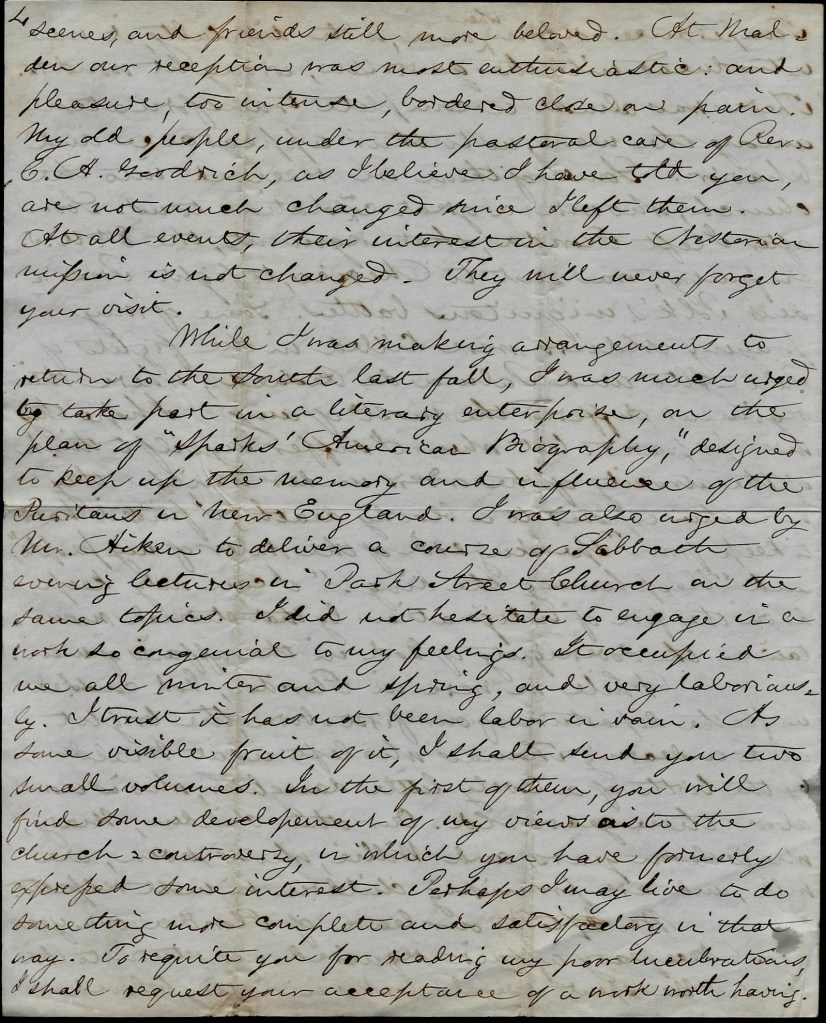
We took our leave of Florida one year ago. Necessary affairs required our return to the North. We spent several weeks in visiting beloved scenes, and friends still more beloved. At Malden our reception was most enthusiastic: and pleasure, too intense, bordered close on pain. My old people, under the pastoral care of Rev. C. A. Goodrich, as I believe I have told you, are not much changed since I left them. At all events, their interest in the Nestorian mission is not changed. They will never forget your visit.
While I was making arrangements to return to the South last fall, I was much urged to take part in a literary enterprise, on the plan of “Sparks’ American Biography,” designed to keep up the memory and influence of the Puritans in New England. I was also urged by Mr. Aiken to deliver a course of Sabbath evening lectures in Park Street Church on the same topics. I did not hesitate to engage in a work so congenial to my feelings. It occupied me all winter and spring, and very laboriously. I trust it has not been labor in vain. As some visible fruit of it, I shall send you two small volumes. In the first of them, you will find some development of my views as to the church controversy, in which you have formerly expressed some interest. Perhaps I may live to do something more complete and satisfactory in that way. To requite you for reading my poor incubrations, I shall request your acceptance of a work worth having….
[rest of letter missing]
When you write to me, please direct to the care of Edward D[yer] Peters & Co. Boston.
Mr. P is my brother in law, and will forward to me.

 Spared & Shared 23