
This letter was written by John Fulkerson Tyler (1838-1911), the son of Henry C. Tyler (1807-1850) and Jane E. Fulkerson (1813-1850) of Jonesville, Lee county, Virginia. When his parents died in 1850 within days of each other, 12 year-old Tyler went to live with his Uncle Fulkerson in the same county. After graduating from the Virginia Military Institute (VMI) in 1859, Tyler relocated to Lexington, Missouri, where he studied law.
When the Civil War began in 1861, Tyler enlisted as a private in the 14th Missouri Infantry but, due to his prior military training, he was rapidly promoted to Major of his regiment and appointed as the aide-de-camp to Brig. Gen. John McAllister Schofield, a West Pointer who commanded the Missouri State Militia and was state adjutant general. When he was only twenty-five years old, Missouri Governor Hamilton R. Gamble selected Tyler to be Lieutenant-Colonel of the First Regiment Infantry, Missouri State Militia, with date of rank in mid-June 1862.
“For most of the next year, Tyler was on detached service away from the regiment. One assignment in August 1862 was to take command of the gunboat John Warner on the Missouri River. His orders were to ‘seize or destroy all ferry boats, skiffs, rafts or other means of crossing the river, which are in position to be used by the rebels.’ In October he was assigned as commanding officer of the post at Pilot Knob on the Southwest Branch, Pacific Railroad, in charge of about 85 officers and fifteen hundred men, and he had other assignments. On 18 March 1863, he was promoted to colonel of his regiment, replacing Col. John B. Gray.” [VMI Alumni Review]
From the time of his promotion to Colonel until the end of the war, however, things did not go well for Tyler. He was plagued with criticisms of his performance and threatened with a court martial which was finally ordered in January 1865. He did not return to Lexington, Missouri, after the war but settled in St. Joseph instead where he practiced law and traded in real estate.
Tyler wrote the letter to his cousin Samuel Vance Fulkerson (1822-1862). According to the book, History of Southwest Virginia 1746-1786 and Washington County 1777-1870 by Lewis Preston Summers, Samuel was born on his father’s farm in the southern part of Washington County, Virginia, but he was principally raised in Grainger county, Tennessee. He enlisted as a private in Colonel McClelland’s regiment during the Mexican war, and served throughout the war. He studied law and began a law practice in Estillville, in 1846. He was elected to the Constitutional Convention of 1850, and then elected judge in 1856. He served as judge until the spring of 1861, when he was elected and commissioned colonel of the 37th Virginia Regiment of Infantry, and commanded that regiment until June 27, 1862, when he was mortally wounded while leading the 3rd Brigade in a charge against a strong Northern position on the Chickahominy. He died the following day, and was interred in the Sinking Spring Cemetery, Abingdon, Virginia. Of his death, Stonewall Jackson wrote, “Col. S. V. Fulkerson was an officer of distinguished worth. I deeply felt his death. He rendered valuable service to his country, and had he lived, would probably have been recommended by me before this time for a brigadier generalcy. So far as my knowledge extends, he enjoyed the confidence of his regiment and all who knew him. I am, Sir, your obdt. servt, T. J. Jackson”
The letter is particularly interesting because the third paragraph refers to what has come to be called, “The Morgan Walker Raid.” It was this raid that took place on 10 December 1860 that marked the turning point in William Clarke Quantrill’s life when he chose to side with the pro-slavery forces in Missouri rather than remain with his anti-slavery friends in Kansas Territory. The following article by Ted W. Stillwell summarizes the incident:
“William Quantrill, being from Kansas, was an abolitionist prior to becoming the leader of “The Bushwhackers” of Jackson County, Missouri. December 10,1860 was the turning point in his politics. On this date he joined five young Quaker abolitionists from Lawrence on a slave-stealing raid into Jackson County, Missouri, where they planned to “steal” the slaves of Morgan Walker, who lived near Blue Springs. The 1900 acre Walker farm was located where Pink Hill Park is today just west of Highway 7.
It was daylight when they arrived in the neighborhood. Quantrill left his boys hidden in the bush while he rode on into the Walker farm to survey the situation. At this point he became a turncoat and sold out his “friends.” He informed Morgan Walker’s son, young Andrew, what was about to take place, and that they should be prepared. Quantrill returned to his troop to await nightfall to begin the raid.
The Walkers rounded up a few neighbors to assist them and setup an ambush as the abolitionists came riding in that evening. One Quaker was killed on the spot, two were wounded and ran for cover and two more escaped back to Lawrence, Quantrill hung back out of harms way during the ambush. The neighbors tracked down the two wounded men and shot them on the spot.“

The presentation sword of Lt. Col. John F. Tyler sold recently for $2,400.
[This letter is from the personal collection of my friend Rob Morgan and has been published on Spared & Shared by express consent.]
Transcription

Napoleon City [Missouri]
December 23rd 1860
Dear Cousin,
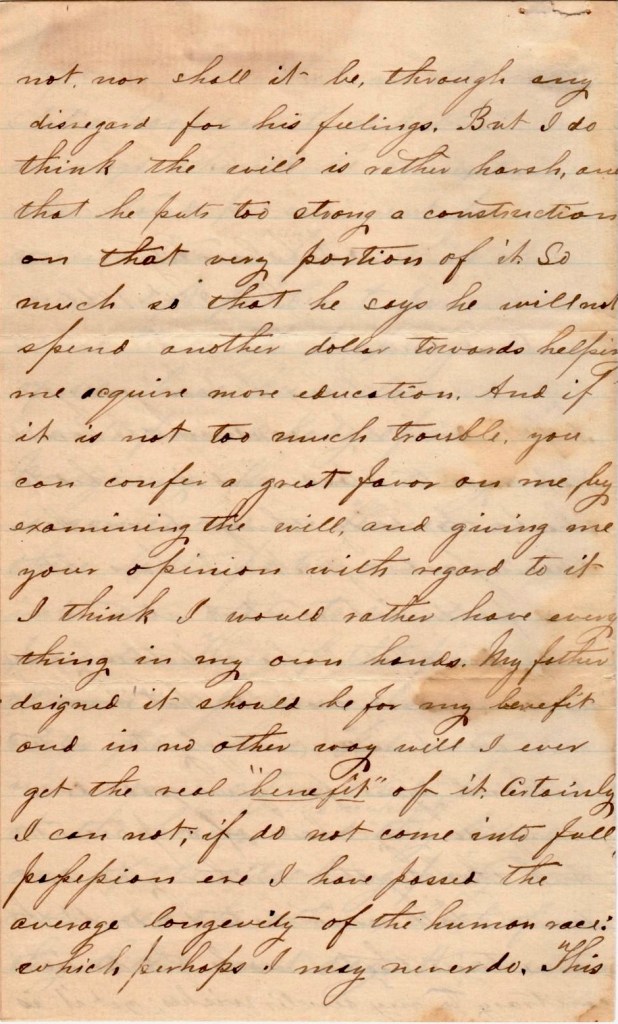
When I was younger I felt like the sands in the hour glass ran too slow, and I wished to shake the tardy thing to make them faster go. Now I have let this feeble but constant stream run on, and I have listlessly gazed until I am warned that I must act ere it everlastingly too late. I thank you for your good advice as regards my choice of a pursuit. And this together with my own desire shall cause me to decide. At the same time that I make this decision contrary to my Uncle’s wishes; yet it is not, nor shall it be, through any disregard for his feelings. But I do think the will is rather harsh, and that he puts too strong a construction on that very portion of it—so much so that he says he will not spend another dollar towards helping me acquire more education. And if it is not too much trouble, you can confer a great favor on me by examining the will and giving me your opinion with regard to it. I think I would rather have everything in my own hands. My father designed it should be for my benefit and in no other way will I ever get the real “benefit” of it. Certainly I can not; if do not come into full possession ere I have passed the average longevity of the human race, which perhaps I may never do. This is the only restriction in the will from which I at present wish to be relieved, and by this being removed whatever beside I wish removed is immediately done also.
What are you going to do in Virginia when South Carolina shall have seceded? Will Old Virginia go too? God grant that she may not. May she, as she has ever done, in times of trouble furnish from her own prolific womb, some compromising genius who may induce even the Palmetto State to retrace her steps and take more solemnly her vow in the sight of heaven and at the alter of our country to support the Constitution and the Union, thus making us more truly one people engaged in the grand work of disseminating the great principles of freedom among the human family.
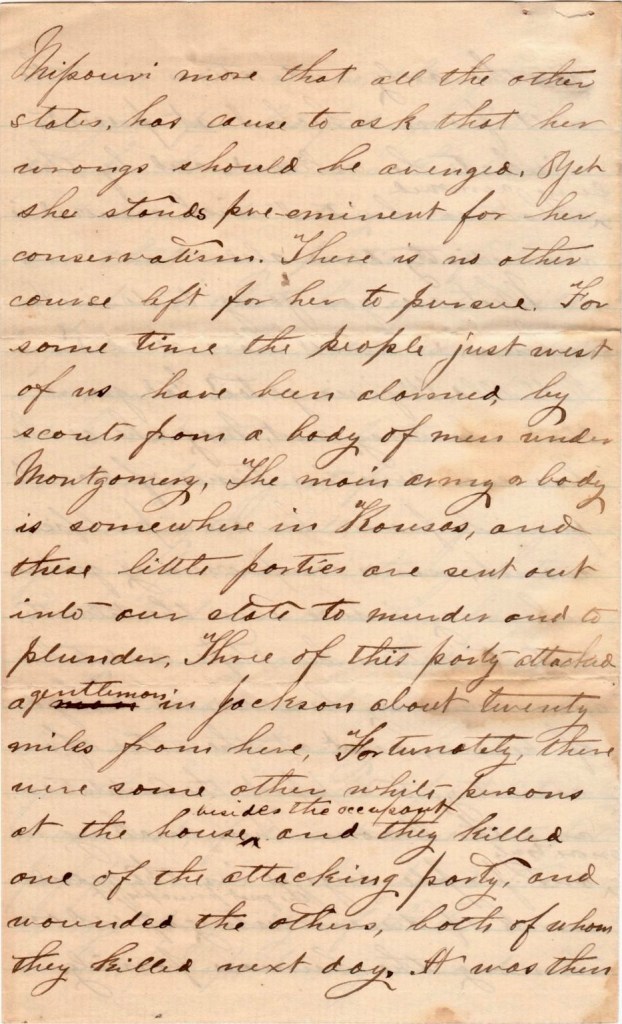
Missouri more than all the other states has cause to ask that her wrongs should be avenged. Yet she stands preeminent for her conservatism. There is no other cause left for her to pursue. For some time, the people just west of us have been alarmed by scouts from a body of men under [James] Montgomery. The main army or body is somewhere in Kansas and these little parties are sent out into our state to murder and to plunder. Three of this party attacked a gentleman in Jackson about twenty miles from here. Fortunately there were some other white persons at the house besides the occupant and they killed one of the attacking party and wounded the others, both of whom they killed next day. It was then rumored that “Mont” had come to this place for vengeance. We immediately made up a company to go and drive him back or take him right there. We went within two or three miles of where the main army was said to be encamped when messengers told us that the report was a mistake. Then of course we could but return in peace.

Notwithstanding all this trouble, Missouri is still for the Union. But whenever the constitutional rights of the South are trampled upon by Federal officers or with the sanctions of Federal Authorities, then will her voice be heard for redress. And if civil war should follow her just demands, then will her sons be found flocking to the standard of southern rights under which, if need be, they will,
“Strike for their altars & their fires,
For the green graves of their sires,
For God & their native land.” 1
If our rights are touched, I know what course you will pursue. I remember well when you told my mother and me farewell, and started by yourself from Jonesville for Mexico. The others mustered around & Old Dr. Stubblefield made speeches considerably for show, [yet] they remained at home and you went to do the work it required. The case is now different. The battle has not begun.
Do Virginians believe a state has the right to secede when she thinks proper? Has the President a right to force a state [back into the Union] when she does secede? And will Virginia uphold Lincoln if he administers the laws with equal justice to all parties?
I went to Lexington [Mo.] a few days ago to see cousin Ellen. She enjoyed her trip very much and speaks very highly of you all of which I was very proud. I had given her a glowing description of you all before and am glad she found you as I had said. I did not have time to hear much from her but am going again soon when I shall endeavor to hear all about her trip. All our relations are well and doing well. Give my love to Aunt & Cousin Kate. Tell cousin Kate I am looking for a letter from her every mail. If I do not get one soon, I will not look any longer.
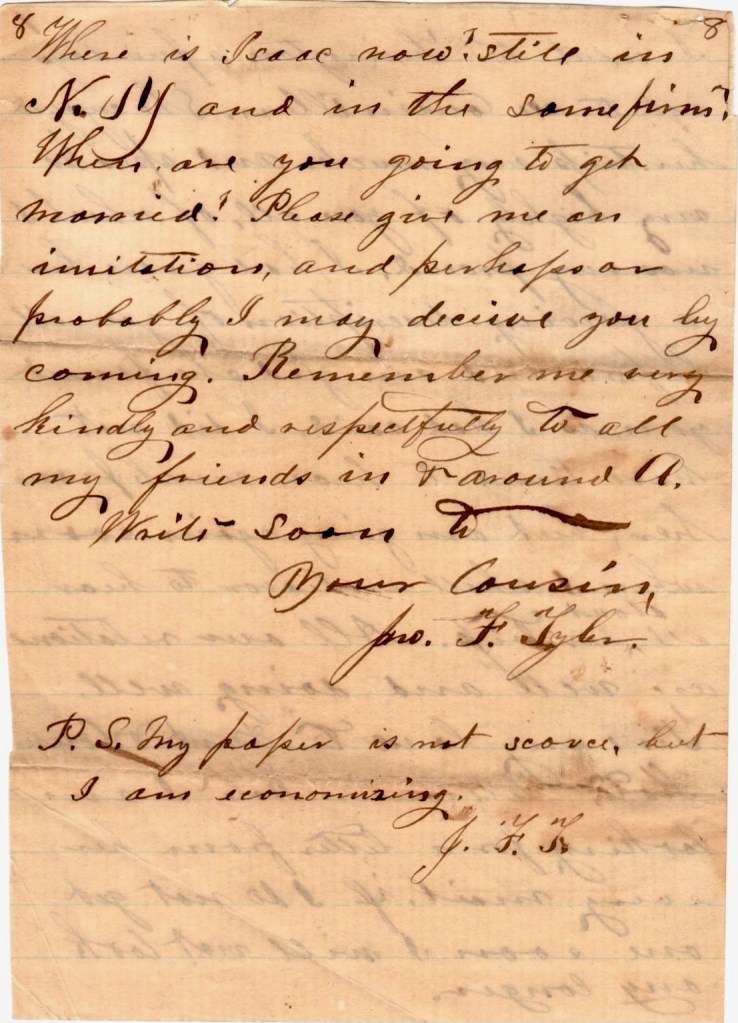
Where is Isaac now? Still in N. Y. and in the same firm? When are you going to get married? Please give me an invitation and perhaps or probably I may deceive you by coming. Remember me very kindly and respectfully to all my friends in and around A[bingdon]. Write soon to your cousin, — Jno. F. Taylor
P. S. My paper is not scarce but I am economizing. — J. F. T.
1 These lines are from a poem authored by Fitz-Greene Halleck entitled, “Marco Bozzaris” (a Greek chieftain).







 Spared & Shared 23