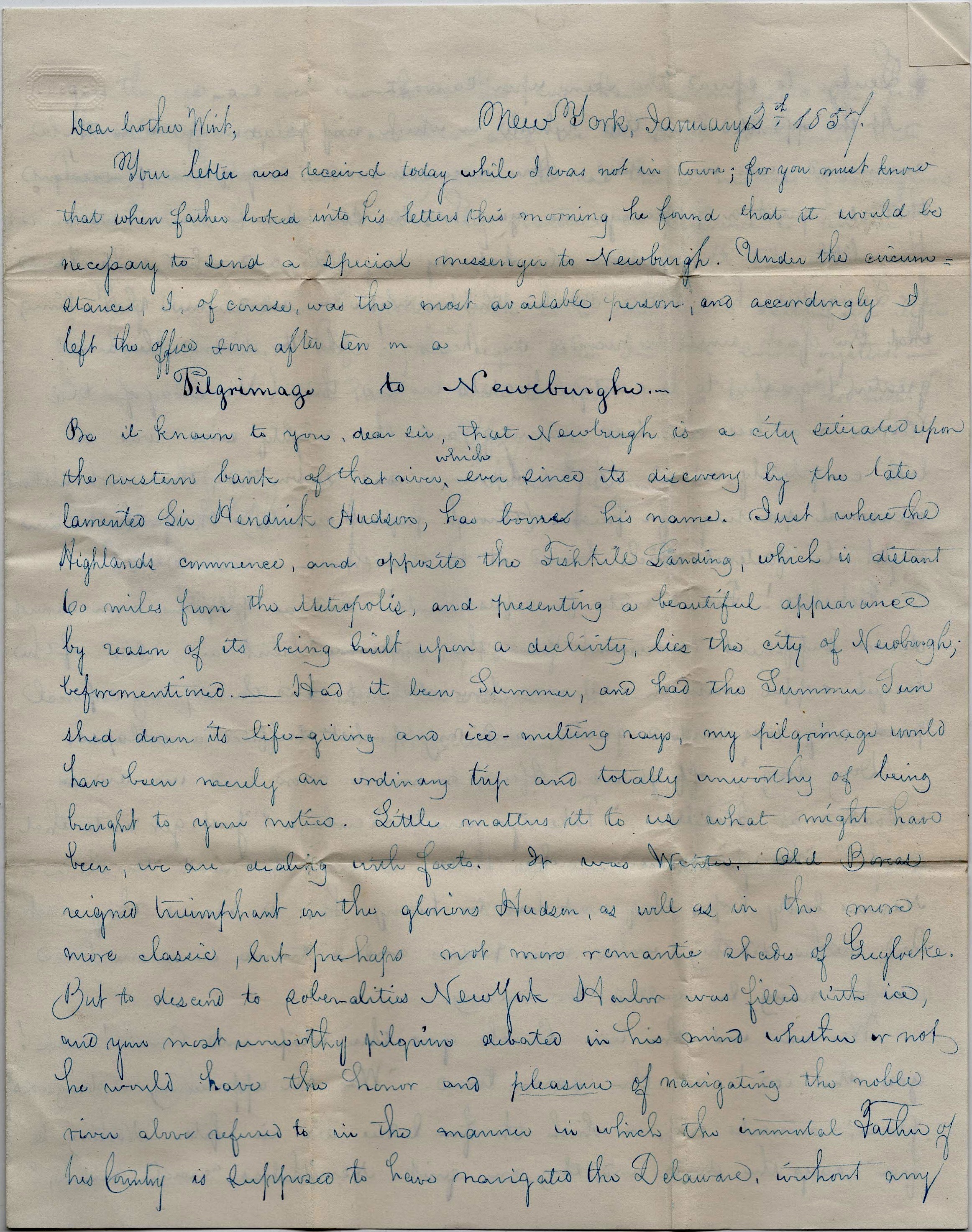
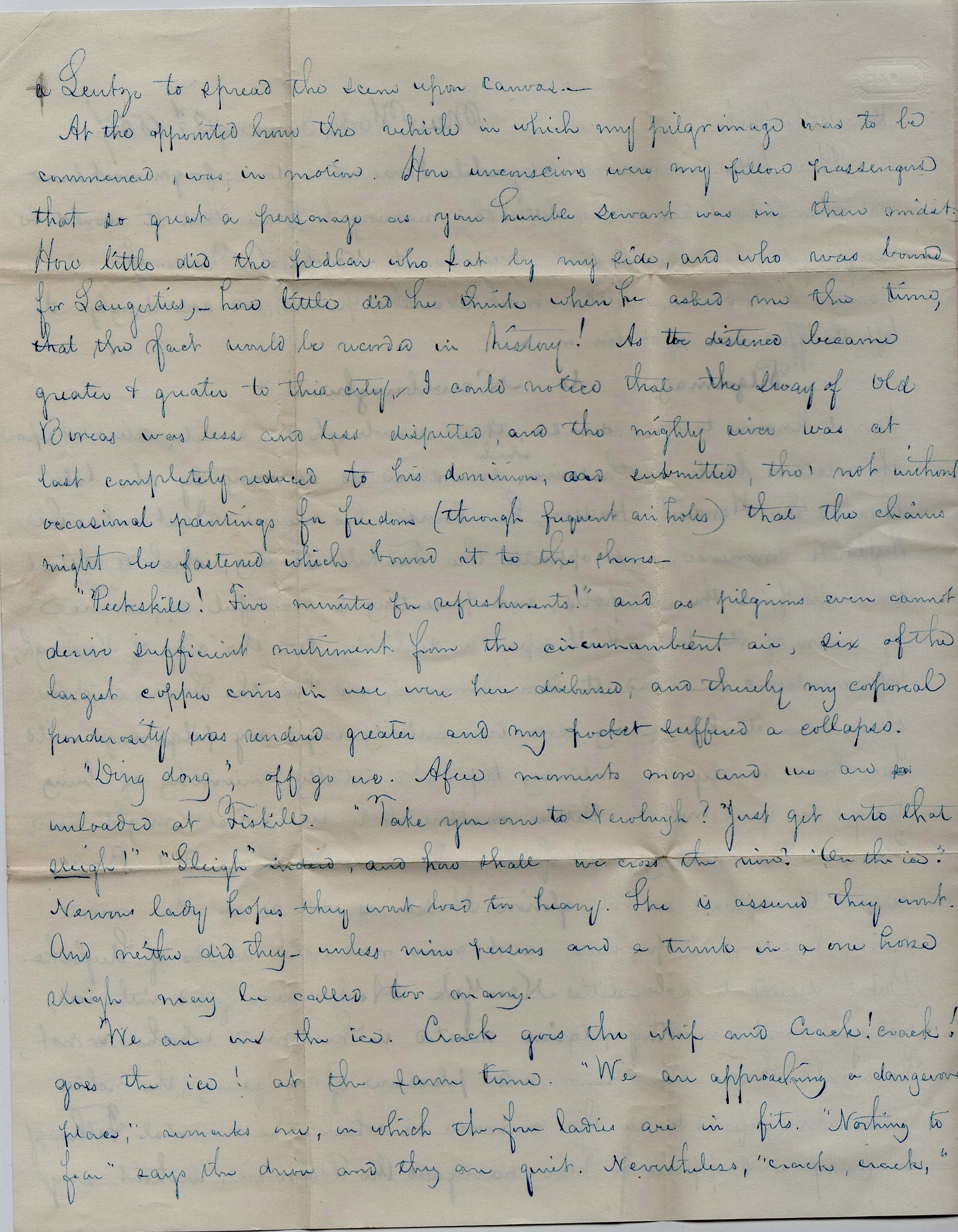
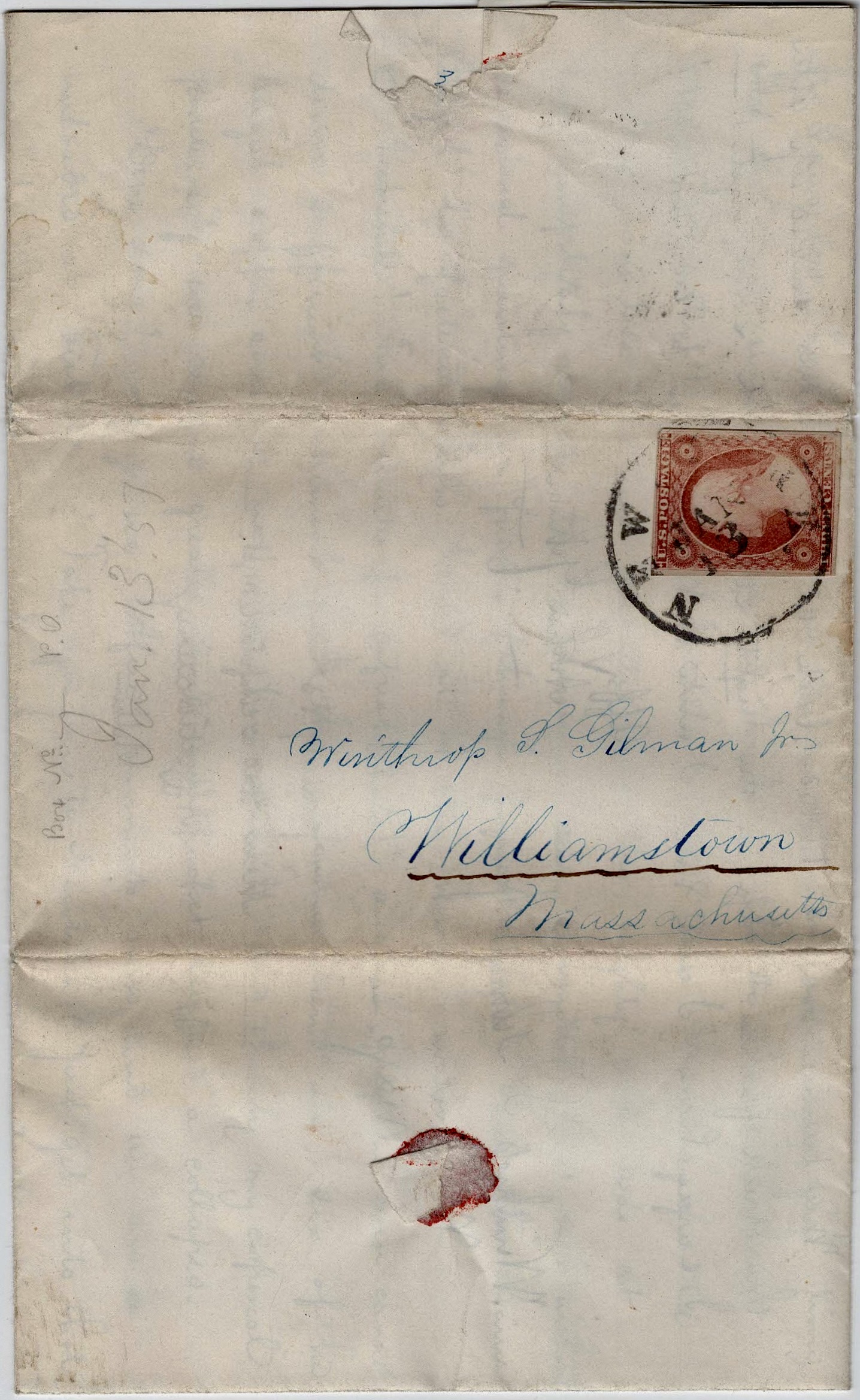
The following letter was written in January 1857 by Arthur Gilman (1837-1909), the son of Winthrop Sargent Gilman, Sr. (1808-1884) and Abia Swift Lippincott (1817-1902). He wrote the letter to his younger brother Winthrop (“Wint”) Sargent Gilman, Jr. (1839-1923) attending Williams College in Massachusetts.
Arthur’s father was a businessman who had a wholesale business in Alton, Illinois, and St. Louis, Missouri, before settling in New York City as an agent of the St. Louis firm in 1848. In 1860 he opened a banking house known as Gilman, Son, & Co. Arthur worked for his father in the bank for a while and then devoted his life to the education of women through the Harvard courses (the “Society for the Collegiate Instruction of Women”). In 1886, he established a school for girls which he called the Cambridge School but it was more generally known by his name.
Arthur’s letter recounts a day-long journey from New York City to Newburgh, a distance of 60 miles up the Hudson River on a frigid day in January 1857. He embarked on a river steamer to Fishkill Landing and subsequently traversed the ice on a heavily laden sleigh, a choice he later deemed unwise.
T R A N S C R I P T I O N
New York [City] January 12, 1857
Dear Brother Wint,
Your letter was received today while I was not in town, for you must know that when father looked into his letters this morning, he found that it would be necessary to send a special messenger to Newburgh. Under the circumstances, I, of course, was the most available person and accordingly I left the office soon after ten on a…
Pilgrimage to Newburgh.
Be it known to you, dear sir, that Newburgh is a city situated upon the western bank of that river which ever since its discovery by the late lamented Sir Hendrick Hudson has borne his name. Just where the Highlands commence and opposite the Fishkill Landing, which is distant 60 miles from the Metropolis, and presenting a beautiful appearance by reason of its being built upon a declivity, lies the City of Newburgh, before mentioned.
Had it been summer and had the summer sun shed down its life-giving and ice-melting rays, my pilgrimage would have been merely an ordinary trip and totally unworthy of being brought to your notice. Little matters it to us what might have been; we are dealing with facts. It was winter. Old Boreas reigned triumphant on the glorious Hudson as will as in the more classic, put perhaps not more romantic shades of Greylocke.
But to descend to soberalities, New York harbor was filled with ice and your most unworthy pilgrim debated in his mind whether or not he would have the honor and pleasure of navigating the noble river above referred to in the manner in which the immortal Father of his Country is supposed to have navigated the Delaware, without any [Emanuel] Leutze to spread the scene upon canvas.
At the appointed hour the vehicle in which my pilgrimage was to be commenced was in motion. How unconscious were my fellow passengers that so great a personage as your humble servant was in their midst. How little did the pedlar who sat by my side and who was bound for Saugerties,—how little did he think when he asked me the time that the fact would be recorded in history! As the distance became greater and greater to this city, I could notice that the sway of Old Boreas was less and less disputed and the mighty river was at last completely reduced to his dominion and submitted, tho’ not without occassional pantings for freedom (through frequent air holes) that the chains might be fastened which bound it to the shore.
“Peekskill! Five minutes for refreshments!” and as pilgrims even cannot derive sufficient nutriment from the circumambient air, six of the largest copper coins in use were here disbursed and thereby my corporeal ponderosity was rendered greater and my pocket suffered a collapse.
“Ding dong,” off go us. A few moments more and we are unloaded at Fishkill. “Take you over to Newburgh? Just get into that sleigh!” Sleigh indeed, and “how shall we cross the river?” “On the ice.” Nervous lady hopes they won’t load too heavy. She is assured they won’t. And neither did they, unless nine persons and a trunk in a one horse sleigh may be called too many.
We are on the ice. Crack goes the whip and crack! crack! goes the ice! at the same time. “We are approaching a dangerous place,” remarks one on which the four ladies are in fits. “Nothing to fear,” says the driver and they are quiet. Nevertheless, “crack, crack” goes the ice and we are there. Yes, we have accomplished the feat. A mile of ice is in our rear and we are safe! I hurried onto terra firma determined on my return to use those means of conveyance with which I was endowed by nature in preference to another sleigh ride.
My business over, I trotted back [over the ice] with my arms doubled up after the Greek fashion. Safe on the right side, I took some oysters! I came home. I am here. I write to Whit. I go to bed. Good night!
Affectionately, — Arthur Gilman
P. S. January 13th. Alice had a comfortable night. Affectionately, — Arthur.
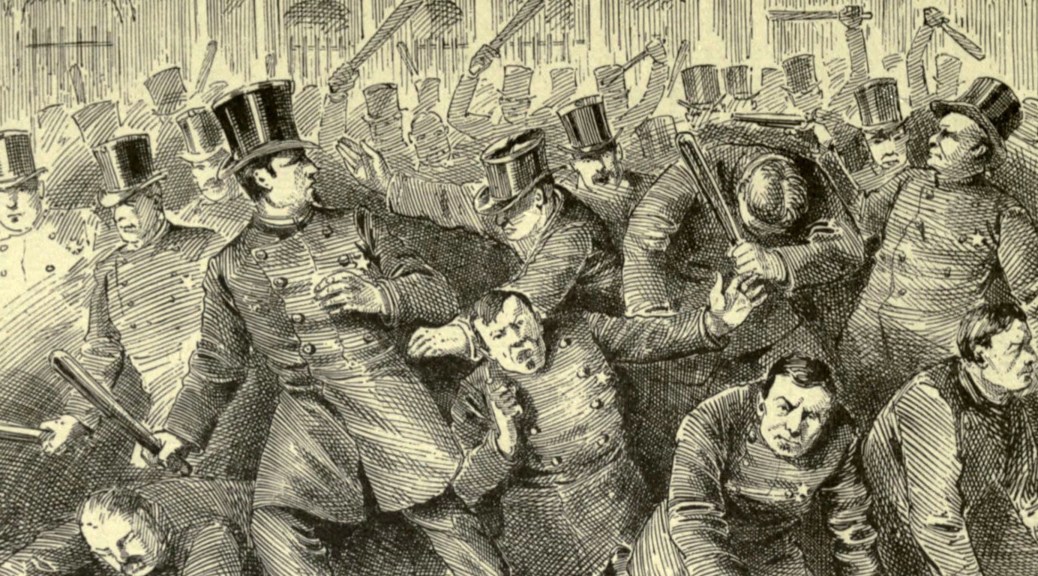
The author of this letter, J. E. Fisher, has not been further identified due to his common name but the content of the letter is interesting for it mentions the 1857 Police Riot in New York City. This incident was described in a recent article entitled. “In 1857, NYC Police Didn’t Keep the Peace—They Caused a Riot” by Joseph A. Williams. In it he informs us that “two rival police forces were operating at the same time in New York City…. The unusual situation was the outcome of a corrupt mayor and opposing political parties heading the state and city governments and would eventually erupt in a bloody, all-out police brawl.
“The tensions took root in a city seeped in corruption. The administration of Democratic Mayor Fernando Wood was regularly accused of graft, electioneering, demagoguery and bribery. Despite the mayor’s sleaziness, he had a solid base of support from New York City’s immigrant lower classes, particularly the Irish, who felt that the mayor protected them from a patronizing, anti-immigrant elite class. Mayor Wood’s deliberate failure to enforce temperance laws which would have restricted drinking saloons, made him a hero among the underclass. To help maintain his grip on the city, Wood misused New York’s police as a cudgel to guarantee election results and his power. Many of the police, meanwhile, took part in the graft and bribery common of the era.
“However, the recently formed Republican Party, coming into control of the New York State government, strategized a means to break the mayor’s and the Democratic Party’s control over the city. In April 1857, the State Legislature passed a law which disbanded New York’s Municipal Police, ostensibly for corruption and to enforce liquor laws, and replaced it with a State-controlled Metropolitan Police force that encompassed the area of Manhattan, then independent Brooklyn, Staten Island, and Westchester County. Wood claimed the new police was illegal since it violated the principle of home rule, and sued. A decision would not be made for months.
“In the meantime, Wood’s Municipal force and the State’s Metropolitans were operating in the same city at the same time. At the various station houses throughout the city, roll calls were taken and individual policemen were to announce their support— either to Wood or to the State. Fifteen police captains remained loyal to Wood, and only about 300 of the 1,100 rank-and-file police joined the new police. Each side dismissed those police who were not loyal and filled the vacancies by appointing new officers. With the stage set for conflict, the two forces often competed with each other.”
To read the details of the conflict that erupted on the morning of June 16th, I’ll refer you to the rest of Williams’ article. See: …”They Caused a Riot.”
T R A N S C R I P T I O N
New York [City] June 18th 1857
Mother,
I received your letter in due season and was very glad to hear from you. The weather has been quite stormy for several weeks raining nearly half of the time.
We are having quite an exciting time here now in regard to the new police & street commissioner [Daniel Conover] appointed by the Governor [John King] Tuesday. The police had quite a fight yesterday. The Major [Fernando Wood], Sheriff [James C. Willett] & several others were arrested. The Governor arrived last night. The Military are kept in readiness to be called out at any moment.
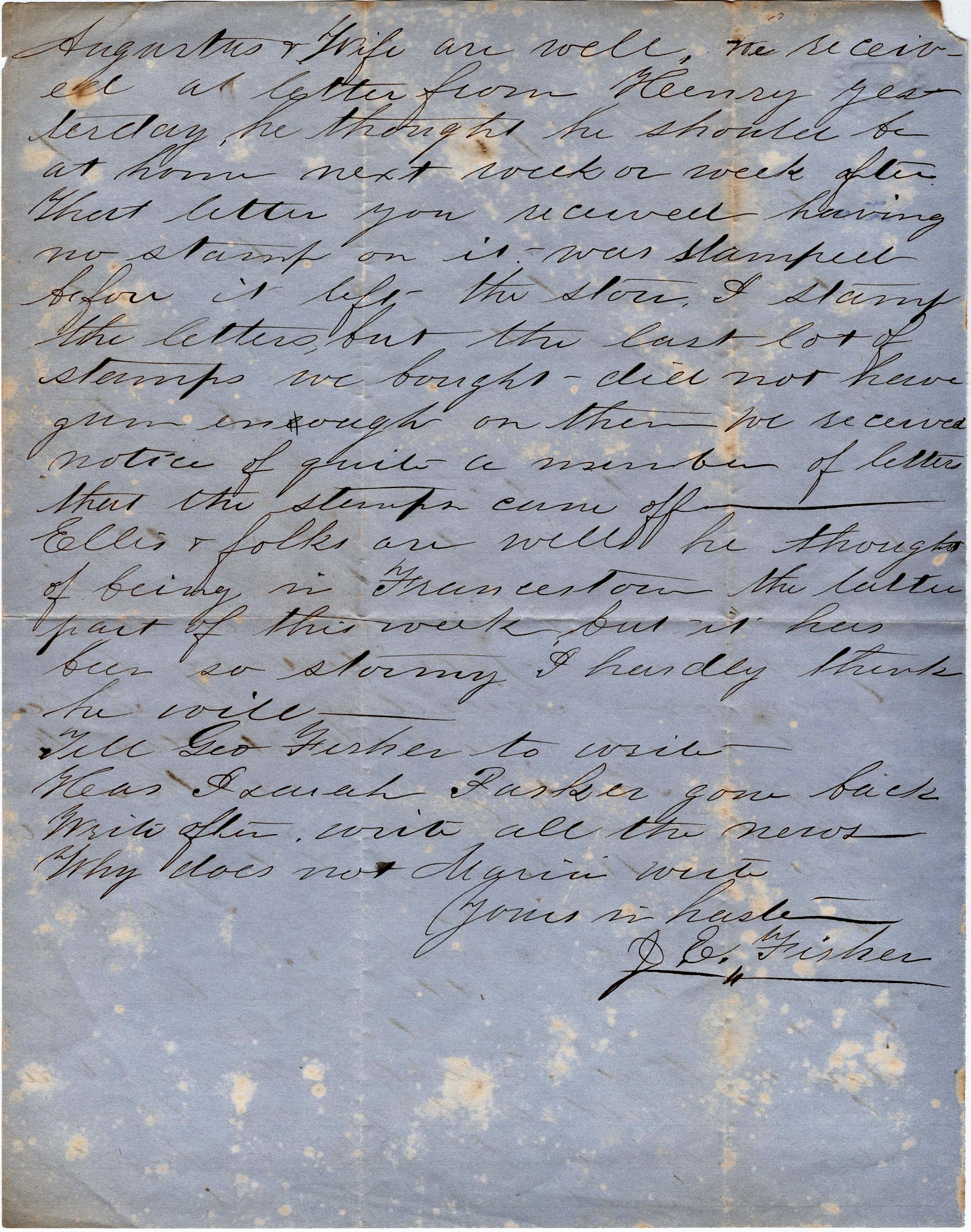
I received a letter from Harvey Goodrich a few days ago. He wrote that Bradford’s boy was dead. What do they say about it? I should think Mr. Sawyer’s folks would feel bad about it. Augustus & wife are well. We received a letter from Henry yesterday. He thought he should be at home next week or week after. That letter you received having no stamp on it was stamped before it left the store. I stamp the letters, but the last lot of stamps we bought did not have gum enough on them. We received notice of quite a number of letters that the stamps came off.
Ellis & folks are well. He thought of being in Francestown the latter part of this week but it has been so stormy I hardly think he will. Tell George Fisher to write. Has Isaiah Parker gone back? Write often. Write all the news. Why does not Maria write? Yours in haste. — J. E. Fisher
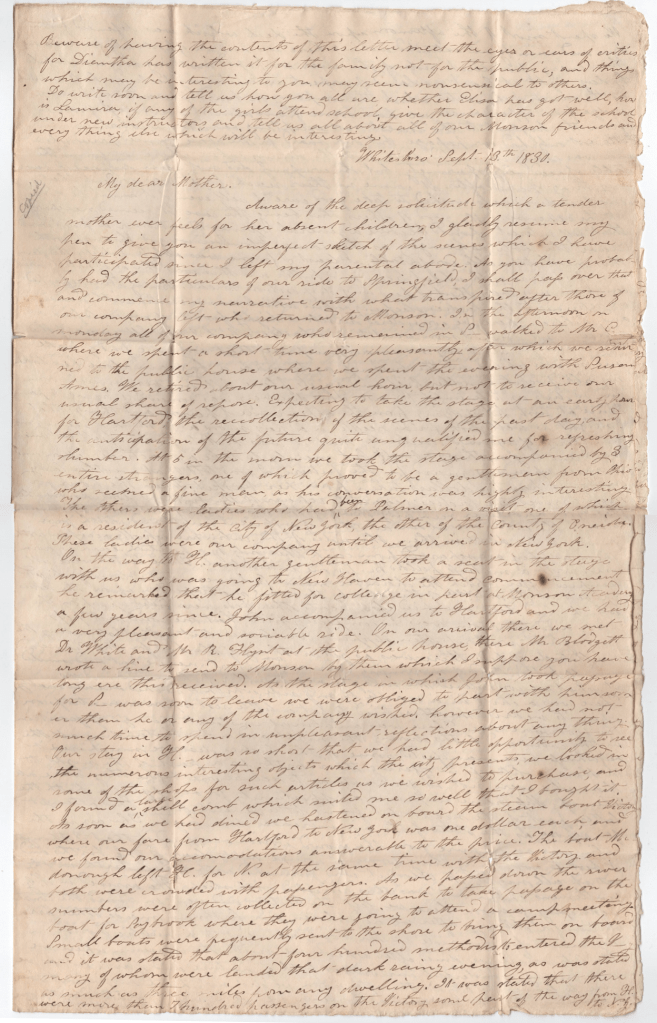
Diantha (Keep) Blodgett (1807-1884) was 22 years old and just two weeks married when she wrote this letter to her mother, Alice (Goodall) Keep, wife of Simeon Keep of Monson, Massachusetts. Her new husband, Harvey Blodgett (1802-1850), was an 1829 graduate of Amherst College and we learn he was employed teaching school at Whitesboro. He may have been teaching at the Oneida Institute which was a short-lived Presbyterian school in that village, and the first to accept both Black and White students in the United States. His first appointment to the ministry in the Presbytery was at Euclid (East Cleveland, OH) in 1837. After a few years he left the ministry and returned to teaching at Newton Falls, Ohio, and later at Jackson, Illinois, where he died of typhoid fever in 1850. The couple had several children, one of who was James Harvey Blodgett (1832-1916) who was Captain of Co. E, 75th Illinois Infantry during the Civil War.
Diantha’s letter gives us a glimpse of what travel was like in 1830 in New England. Her journey from her birthplace in Monson, Massachusetts, to her new home in Whitesboro, New York, takes us on two stage rides, two steamboats, and two boats on the Erie Canal—a journey she claimed was 450 miles.
T R A N S C R I P T I O N
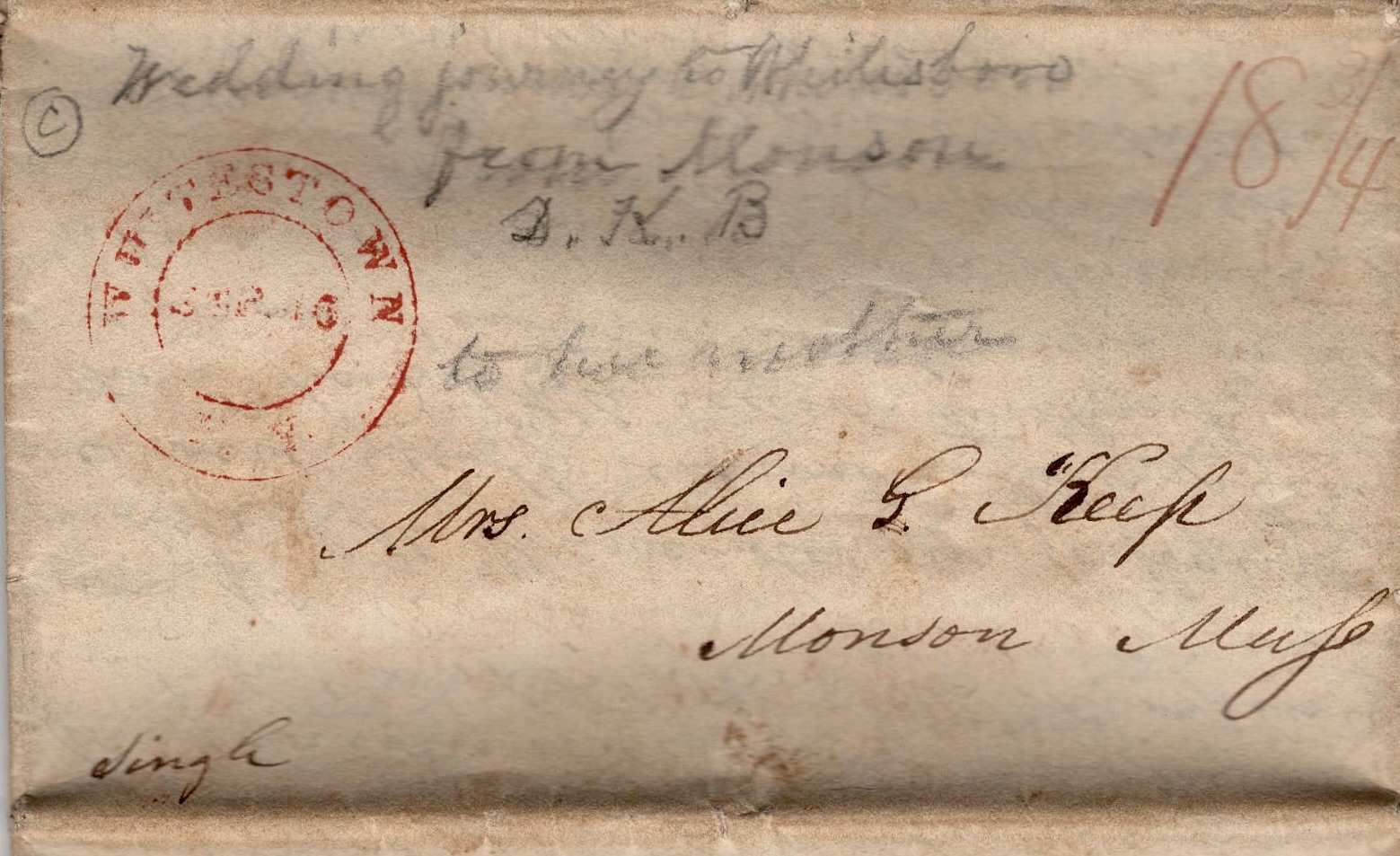
Addressed to Mrs. Alice G. Keep, Monson, Massachusetts
Whitesboro [New York] September 13th 1830
My dear mother,
Aware of the deep solicitude which a tender mother ever feels for her absent children, I gladly resume my pen to give you an imperfect sketch of the scenes which I have participated since I left my parental abode. As you have probably had the particulars of our ride to Springfield, I shall pass over that and commence my narrative with what transpired after those of our company left who returned to Monson.
In the afternoon on Monday all of our company who remained in P___ walked to Mr. C where we spent a short time very pleasantly after which we scurried to the public house where we spent the evening with Parson Ames. We retired about the usual hour but not to receive our usual share of repose. Expecting to take the stage at an early hour for Hartford the recollection of the scenes of the past day and the anticipation of the future quite unqualified me for refreshing slumber. At 5 in the morn we took the stage accompanied by three entire strangers, one of which proved to be a gentleman from Ohio who seemed a fine man as his conversation was highly interesting. The others were ladies who had been to Palmer on a visit, one of which is a resident of the City of New York, the other of the county of Oneida. These ladies were our company until we arrived in New York.
On the way to Hartford, another gentleman took a seat in the stage with us who was going to New Haven to attend commencement. He remarked that he fitted for college in part at Monson Academy a few years since. John accompanied us to Hartford and we had had a very pleasant and sociable ride. On our arrival there, we met Dr. White and Mr. R. Flynt at the public house. There Mr. Blodgett wrote a line to send to Monson by them which I suppose you have long ere this received. As the stage in which John took passage for P___ was soon to leave, we were obliged to part with him sooner than he or any of the company wished. However, we had not much time to spend in unpleasant reflections about anything.
Our stay in Hartford was so short that we had little opportunity to see the numerous interesting objects which the city presents. We looked in some of the shops for such articles as we wished to purchase, and I found a large shell comb which smited me so well that I bought it. As soon as we had dined, we hastened on board the steamboat Victory where our fare from Hartford to New York was one dollar each and we found our accommodations answerable to the price. The boat McDonough left Hartford for New York at the same time with the Victory and both were crowded with passengers. As we passed down the river, numbers were often collected on the bank to take passage on the boat for Saybrook where they were going to attend a camp meeting. Small boats were frequently sent to the shore to bring them on board and it was stated that about four hundred Methodists entered the Victory, many of whom were landed that dark, rainy evening as was stated as much as three miles from any dwelling. It was stated that there were more than 7 hundred passengers on the Victory, some part of the way from Hartford to New York.
We spent most of the afternoon upon the deck which was defended from sun and rain by an extended awning. Here we had an opportunity for viewing the scenery upon each side of the river. We passed nothing very wonderful by daylight, at least no land prospect interested my feelings half as much as the variety of character which the company on board presented, If I may judge from appearances, we had some from almost every class of society, from the highest to the lowest, not excepting variety in color.
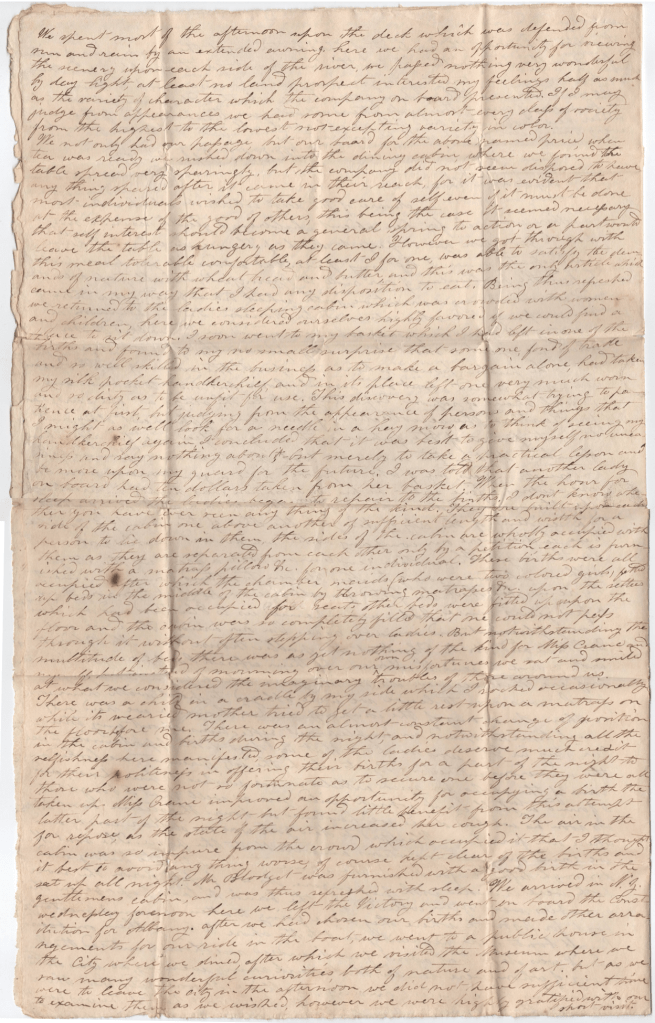
We not only had our passage but our board for the above named price. When tea was ready, we rushed down into the dining room where we found the table spread very sparingly, but the company did not seem disposed to have anything spared after it came in their reach, for it was evident that most individuals wished to take good care of self even if it must be done at the expense of the good of others. This being the case, it seemed necessary that self interest should become a general spring to action or a part would leave the table as hungry as they came. However, we got through with this meal tolerable comfortable, at least for one was able to satisfy the demands of nature with weather bread and butter, and this was the only article which came in my way that I had any disposition to eat. Being this refreshed, we returned to the ladies sleeping cabin which was crowded with women and children. Here we considered ourselves highly favored if we could find a place to sit down. I soon went to my basket which I had left in one of the berths and found to my no small surprise that someone fond of trade and so well skilled in the business as to make a bargain alone had taken my silk pocket handkerchief and it its place left one very much worn and so dirty as to be unfit for use. This discovery was somewhat trying to patience at first, but judging from the appearance of persons and things that I might as well look for a needle in a hay mow as to think of seeing my handkerchief again. I concluded that it was best to give myself no uneasiness and say nothing about it, but merely to take a practical lesson and be more upon my guard for the future. I was told that another lady on board had ten dollars taken from her basket.
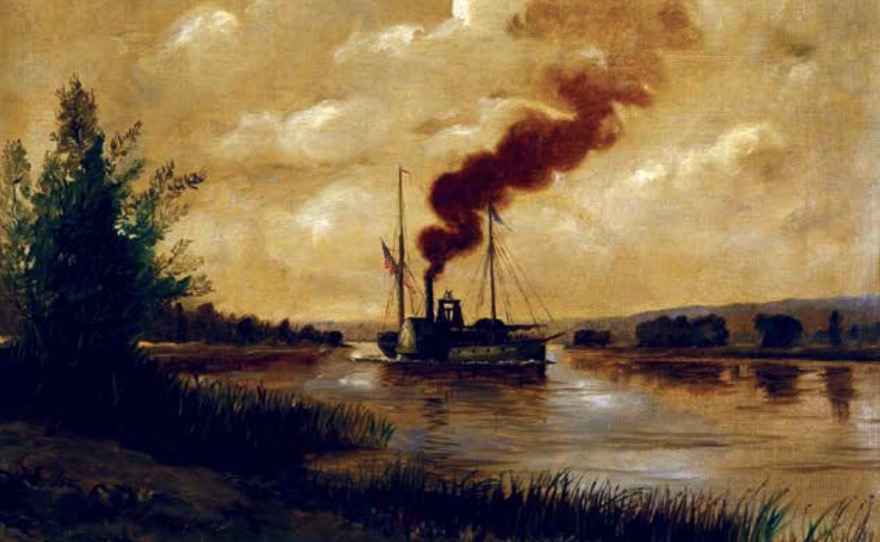
Steam boating on the Connecticut River in 1830.
When the hour for sleep arrived, the ladies began to repair to the berths. I don’t know whether you have ever seen anything of the kind. They are built upon each side of the cabin, one above another of sufficient length and width for a person to lie down on them. The sides of the cabin are wholly occupied with them as they are separated from each other only by a petition [partition?]. Each is furnished with a mattress, pillow, &c. for one individual. These berths were all occupied after which the chamber maids (who were two colored girls) fitted up beds in the middle of the cabin by throwing mattresses &c. upon the settees which had been occupied for seats. These beds were fitted up upon the floor and the cabin was so completely filled that we could not pass through it without often stepping over ladies. But notwithstanding the multitude of beds, there was as yet nothing of the kind for Miss Crane and myself. But instead of mourning over our own misfortune, we sat and smiled at what we considered the imaginary troubles of those around us.
There was a child in a cradle by my side which I rocked occasionally while its wearied mother tried to get a little rest upon a mattress on the floor before me. There was an almost constant change of position in the cabin and berths during the night, and notwithstanding all the selfishness here manifested, some of the ladies deserve much credit for their politeness in offering their berths for a part of the night to those who were not so fortunate as to secure one before they were all taken up. Miss Crane improved an opportunity for occupying a berth the latter part of the night but found little benefit from this attempt for repose as the state of the air increased her cough. The air in the cabin was so impure from the crowd which occupied it that I thought it best to avoid anything worse, of course kept clear of the berths and sat up all night. Mr. Blodgett was furnished with a good berth in the gentleman’s cabin and was thus refreshed with sleep.
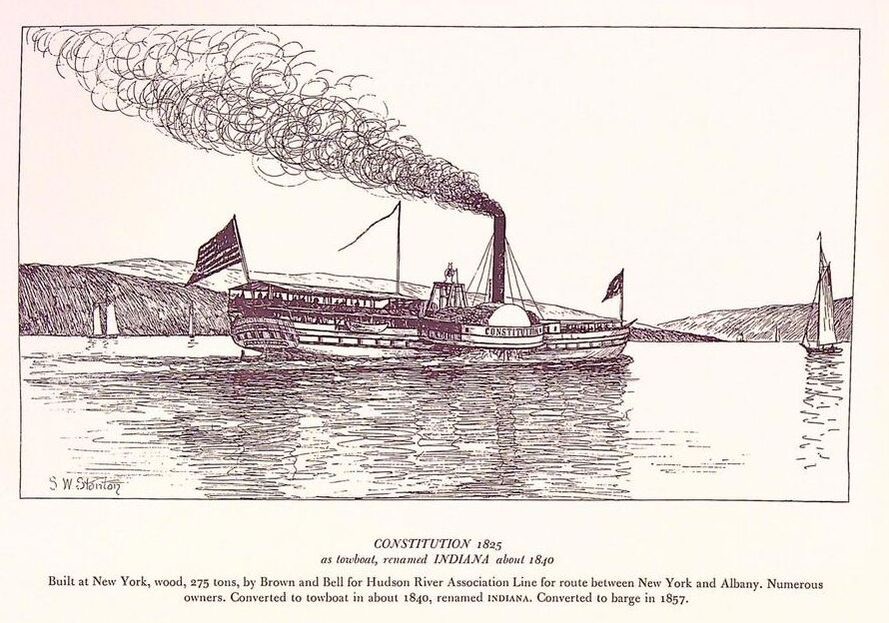
We arrived in New York [City] Wednesday forenoon. Here we left the Victory and went on board the Constitution for Albany. After we had chosen our berths and made pther arrangements for our ride in the boat, we went to a public house in the City where we dined, after which we visited the [Peale’s New York] Museum where we saw many wonderful curiosities, both of nature and of art. But as we were to leave the city in the afternoon, we did not have sufficient time to examine them as we wished. However, we were highly gratified with our short visit. We called at some of the shops in New York in one of which I purchased a white Moreno shawl about the size of Miss Crane’s but much cheaper. In another a half mourning fancy handkerchief.
After this we found ourselves pleasantly situated compared with what we were in the Victory. The boat [Constitution] itself was pleasanter, was less crowded with passengers, and furnished with a better chamber maid. Here we paid for meals exclusive of way bills and had things in decent order. I was furnished with a good berth and succeeded in getting some sleep, but the mode of sleeping was so novel to me that I did not get near my usual share of repose. We arrived in Albany Thursday morning. Here we made no stay but took the stage immediately after leaving the boat which carried us to Schenectady. A minister with his wife and daughter from New Jersey took seats in the stage with us and accompanied us to Utica where the daughter anticipated spending considerable time at school. By this time Miss Crane and myself suffered much from a loss of sleep and fatigue both in our feelings and looks. From the first of our experiencing these evils we thought it not best to make any delay with the hope of being relieved from them but rather to pursue our journey as expeditiously as possible.
We arrived in Schenectady a little past noon. Here we left the stage and took a canal boat. Here our situation was in some respects pleasanter than on board the steam boats as there was no clatter of machinery and much less motion of the boat. We had good company tables, well furnished, and in general everything was calculated to render the situation of passengers agreeable as fair as they themselves were in a right state to enjoy a ride. We had some pleasant views of the Mohawk and of neighboring natural scenery. At length, night came on and we again sought repose in berths and to my agreeable surprise, I slept more than I had any preceding night since I commenced the journey.
A humorous sketch of passengers scrambling to avoid hitting their heads on a bridge over the Erie Canal.Source: Bottoming Out, Vol 1, No 3-4, July 1957.
In the morning the passengers arose early to avail themselves of a view of an interesting place called the Little Falls. By keeping a good look out at the bridges, we could stay up on deck with frequent low stooping. Here we had a much better opportunity of seeing the surrounding country than from the cabin windows. While the above named minister and wife were in this situation, the boat approached a bridge which they discovered and for which they stooped as they suppose sufficiently low to avoid a blow from it, but to her surprise the bridge took her Navarino [bonnet with a large crown] from her head and folded it tolerably closely, throwing so much dirt between the folds as to nearly ruin the bonnet. After it was restored to its former perch, the lady perceived no personal injury but seemed rather to lament the loss of her bonnet. Her husband seemed disposed to take a different view of the subject. Never mind for the bonnet, says he, we all need to learn to stoop low for we have frequent occasion for this exercise in the various concerns of life.
We arrived in Utica a little before noon. We spent but a short time in this place, took passage on a packet boat bound for Rochester which stopped and landed us safe in Whitesboro on Friday p.m. Thus ended our fatiguing though pleasant journey of 450 miles and we were gladly received into a pleasant family in a pleasant village though I had little reason to think it a pleasant village from what I saw of it as I entered, as the road by which we came from the canal seemed like a lane leading to a distant part of a farm or something of the kind, and the buildings which we passed were of a very inferior order.
On seating myself in my new habitation, I was ready to enquirer, where us that famous Whitesboro of which I have heard so much. However, I concluded that it was best to say nothing about present appearances but to wait until I had been favored with a better opportunity for seeing the village before I questioned the truth of former reports. And indeed, I was so glad to find a resting place after such a tour that I did not feel much disposed to find fault with its location even if it did not answer my expectations. Our things came without any material injury except my ban box which was pretty thoroughly jammed and the lid badly broken without its contents being injured. Since our arrival, agreeable to the wishes of the family, we have purchased one dozen chairs, one pair of glass lamps, some curtains for our chamber, and we’ll be purchasing a looking glass when we find one whose size, price and quality suits us. We purchased the above named articles at Utica. Mr. Blodgett paid one dollar 25 cents a piece for the chairs. They are very pretty, cane bottomed chairs and considered very cheap indeed for the quality.
Mr. Blodgett and myself went to Utica this afternoon.m. in a private carriage. During this ride I had a better opportunity to see our village than I had before enjoyed. It is indeed a very pleasant place. I have seen some Whitesboro people. Several have called to see their new inhabitant and I am much pleased with them from so short an acquaintance. And now, going to Whitesboro to live is no longer an anticipation but a reality. Yes, I am actually here, far from the friends of my childhood and upper years and I can assure my dear mother that the reality is far pleasanter than the anticipation.
We were so much affected by the motion of the boats that after we came on land and had seated ourselves in the house, we seemed to ourselves as though we were still riding upon the water. We suffered so much from this imaginary motion of the water and the fatigue of the journey that we found ourselves ill prepared for any business the next day after we arrived. We now have less of such unnatural feelings and trust we shall soon be wholly freed from them. We think that when Miss Crane has recovered from her fatigue, she will find that her journey has benefitted her health. Her society, by the way, was a favor for which I feel that I cannot be sufficiently grateful. From what I have learned of journeying during this tour, I think that I should have more fortitude to commence out without any female acquaintance to accompany me than before.
Since I left Monson, I have though much of the inmates of the parental abode and wished that they might have an opportunity to see the different parts of the country and numerous other objects upon which I have had an opportunity to cast a momentary gaze. Should our lives be spared, I trust that the period is not far distant when some of your number will visit this region. I hope that I have not given so dark a coloring to the journey as to discourage others from attempting it. Let me assure you that with equal prosperity on the way to what we have enjoyed, you will find that the greatest difficulties respecting such a journey are those which lie in the way of commencing it. I have written this letter all under the same date but have been writing it at different times. It is now Thursday. Mr. Blodgett commenced his school this morn under flattering prospects for the term. Miss Crane sends love to the whole family. Please to accept the same from Mr. Blodgett and myself, and remember us affectionately to all others who feel sufficiently interested in our welfare to enquire after us. Do not let us be disappointed by expecting a letter from Monson soon, but be sure and have some of the family write without delay, — Diantha H. Blodgett
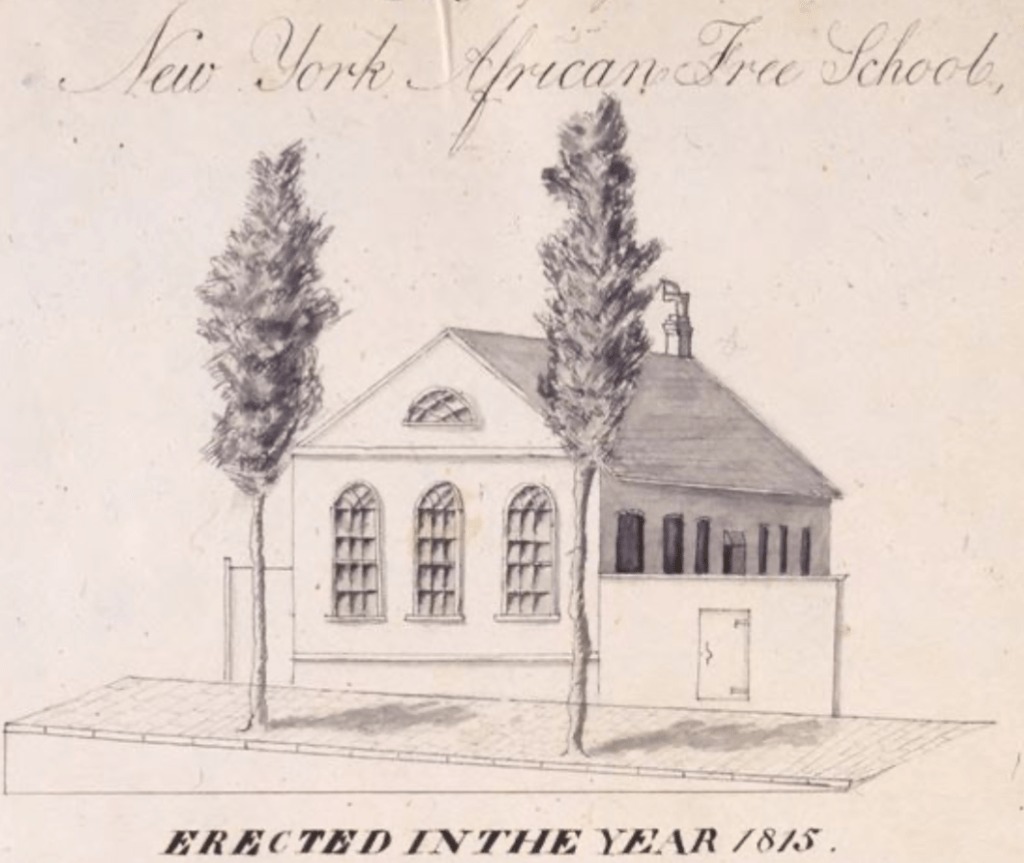
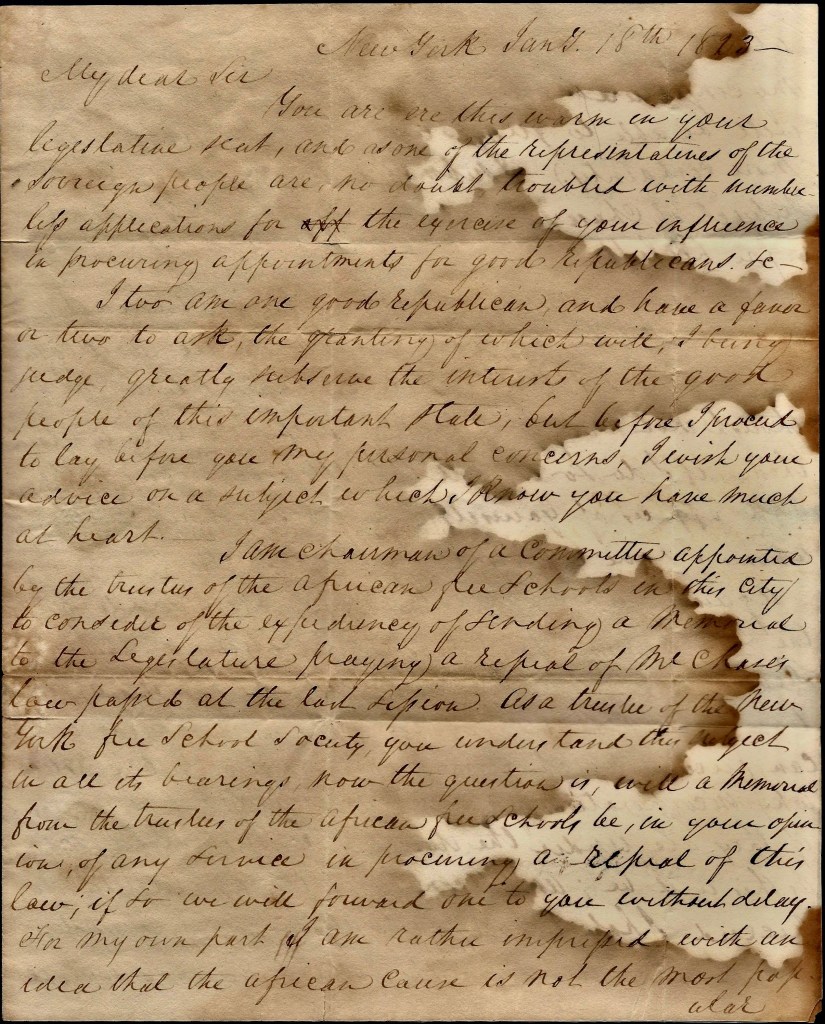
This letter was written by Hiram Ketchum, a lawyer, public servant, and a Trustee of the African Free School of New York City. He wrote the letter to Gideon Lee (1778-1841), a recently elected member of the New York State Assembly who shared some common interests with Ketchum. Lee later served as the mayor of New York City and was elected to the US Congress as a Jackson Democrat.
Hiram’s letter was penned in 1823–four years before slavery was fully and finally abolished in New York State. The impending abolishment of slavery caused tremendous social upheaval among the citizens of New York, particularly in New York City which was awash is social change, creating much anxiety among those who feared losing a grip on their power. In his letter, Hiram, calls attention to a bill passed in the previous session of the State Legislature called “Chase’s Law” which must have adversely affected the funding for the African Free School in New York City. The African Free School was founded by members of the New York Manumission Society, including Alexander Hamilton and John Jay, in 1787. The first school was established in 1794. In 1813 a state law provided that the African Free School would receive both city and county school funds. By 1820 the enrollment approached 700 students in multiple schools and they were gaining a reputation for success. Under the leadership of Charles C. Andrews, the institution grew significantly. Andrews believed passionately that his black students were just as bright as whites, if not even smarter. In 1834 the Free Schools were transferred to the control of the New York State Public School Society, the major local conduit for state funds. In reality, the schools had already ceased to be philanthropic institutions and had become public schools.
It is a matter of curiosity that when Gen. Marquis de La Fayette visited the United States in September 1824, one of his stops was to the African Free School on Mulberry Street in NYC, and it was Hiram Ketchum who gave the general a synopsis of the history of the school and proudly displayed examples of the black student’s work.
Transcription
New York [City] January 18th 1823
My Dear Sir,
You are ere this warm in your legislative seat, and as one of the representatives of the sovereign people are no doubt troubled with numberless afflictions for the exercise of your influence in procuring appointments for good republicans, &c.
I too am one good republican and have a favor to ask, the granting of which will, I being judge, greatly subserve the interests of the good people of this important state. But before I proceed to lay before you my personal concerns, I wish your advice on a subject which I know you have much at heart.
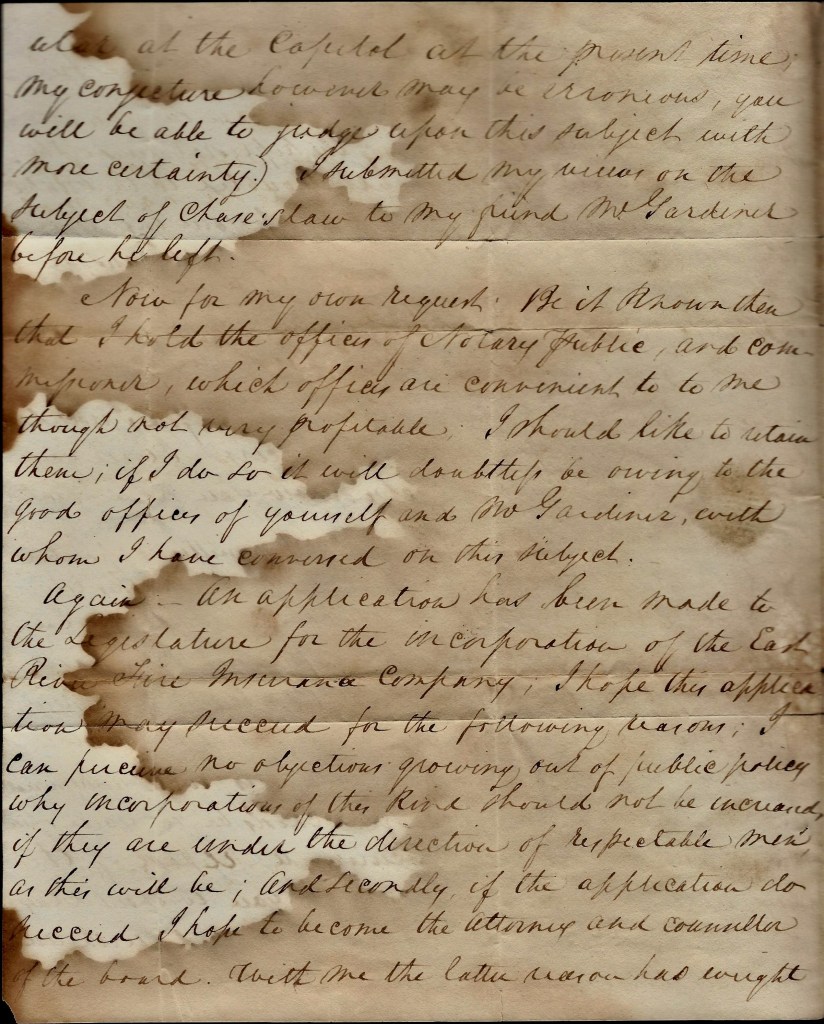
I am chairman of a committee appointed by the trustees of the African Free Schools in this city to consider of the expediency of sending a memorial to the Legislature praying a repeal of Mr. Chase’s law passed at the last session. As a trustee of the New York Free School Society, you understand this subject in all its bearings. Now the question is, will a Memorial from the trustees of the African Free Schools be, in your opinion, of any service in procuring a repeal of this law; if som we will forward one to you without delay. For my own part, I am rather impressed with an idea that the African cause is not the most popular at the Capitol at the present time. My conjecture, however, may be erroneous. You will be able to judge upon this subject with more certainty. I submitted my views on the subject of Chase’s law to my friend Mr. Gardiner before he left.
Now for my own request. Be it known then that I hold the offices of Notary Public, and Commissioner, which offices are convenient to me though not very profitable. I should like to retain them; if I do so, it will doubtless be owing to the good offices of yourself and Mr. Gardiner, with whom I have conversed on the subject.
Again, an application has been made to the Legislature for the incorporation of the East River Fire Insurance Company. I hope this application may succeed for the following reasons. I can perceive no objections growing out of public policy why incorporations of this kind should not be increased if they are under the direction of respectable men as this will be; and secondly, if the application does succeed, I hope to become the attorney and counsellor of the board. With me the latter reason has weight though it is not one in which the public feel much interest.
I have been threatening ever since you left to take a walk to Art Street 1 to see how matters are conducted in your absence, but have not yet executed my purpose; it will not be long, however, before I shall.
There is no domestic intelligence of interest here. The ladies of our acquaintance are, I believe, all well. By the bye, have you made acquaintance with a certain long, tall but good and agreeable girl who inhabits the basement story of the house where you lodge? If you have, please remember me to her. When I was at Albany last summer, I found it quite pleasant to spend some time in her company. as you well know, where ere I am, I cannot “let the gals alone.”
Please remember me to your colleague, Mr. Gardiner. Very sincerely, — Hiram Ketchum
[to] Gideon Lee, Esqr.
1 Art Street is now 8th Street in Manhattan. Gideon Lee’s leather store was located 20 Ferry Street, His home on Art Street.
The following letter was written by a young man named L. Russell to his friend, Daniel H. Whitney (1820-1904) of Seneca Castle, Ontario, New York. Daniel was the son of William E. Whitney (1770-1872) of Maine and Elizabeth Howard (1799-1900) of Geneseo, Livingston county, New York.
Transcription
Geneseo Saturday, December 20th 1841
Friend,
According to promise and the weather being stormy, I have nothing to do and can as well as not, spend my idle hours in writing to you. Lord whistles the wind around the old mansion. The snow is cutting all the fantastics that imagination can picture. A dense cloud obscures the heavens from which the snow is incessantly falling which, however, finds no rest on the earth for Boreas pipes loud and long and appear to be moving the snow about from place to place by the job. And to speak the truth, he is doing wonders around your father’s house and out buildings. In one place the snow is piled up not unlike a sugar loaf. In another may be seen the hull of a ship turned bottom side up with the figurehead Garha and moulded in the finest possible manner. But I am notable to give a full account of the tenth part of the wonderful, twisting and windings of this boisterous old Boreas for when he has nearly finished a piece of work, he destroys to build another.
I feel uncommon dull today although I am sitting by a fine blazing fire in the east chamber. But I suppose it is owing to the dreariness of the weather or to love—maybe both; but I need not be dull if the sighings of the wind has anything enlivening in its tuneful notes.
But to my promise—my journey. You know that I left your father’s for Pennsylvania on the 18th of October. But I shall say nothing of the five first days save that they were anything but agreeable and shall commence with the sixth, Saturday, October 23rd. I left the village of Bolivar at six in the morning in a snowstorm and walked to Smith Settlement over the gloomy hemlock hills to the village of Millgrove where I came to the Allegheny River, which is about eighty yards wide at this place and not motion enough in the water for me to perceive it running. Here I took dinner and concluded to stay until the snowstorm was over. I had no sooner finished my meal than looking out I found the storm had in measure abated. At the west, the clear blue was visible. I directly started on my journey for the village of Smethport, the distance being twenty miles and not a public house on the whole route.
Millgrove is in the extreme bend of the river and on the line between the state line of New York and Pennsylvania. My route lay up the stream which was an outcast by south course and the soil of a sandy loam for a mile or two. Corn grows well on this soil by what little I see though there but little attention paid to cultivating the lands in this section of country. Lumber is the all absorbing business of this part of the world save now and then hunting, drinking, and lawing. After leaving Millgrove I found a tolerable good road for a mile or two. the clouds having just passed over the sun shone out bright and clear. The snow on the mountains mixed with the evergreen pines and hemlock gave the scene a half melancholy, half cheerful appearance, whilst the reflections of the sun on the surface of the Allegheny [river] made its crystal waters as they meander through the valley cast many a pleasing reflection on the sides of the mountains.
But these few sunshiny minutes were of but short duration. I had not walked over three or four miles before I perceived at my right hand a dense black cloud arise above the western mountains which soon obscured the sky and blasted all my hopes of having better weather or roads the remaining part of my journey. The vivid flashes of lightning that darted through the clouds whilst the tremendous thunder that rolled along the valley of the Allegheny and its tributaries doubly echoing amongst the cliffs of the mountains. These with a heavy shower of rain incessantly falling added to the badness of the road which after leaving Millgrove a few miles are of about red clay and the mud was about half boot deep, put me out of all patience and I damned the road and cursed my own folly. Ten miles above Millgrove I crossed the river and had to walk a mile on, up and down hill in the same clay soil. These short hills are made by small brooks and rivulets putting into the river. There is a junction of the river a mile above where I crossed it and I followed up the west branch which is called Potato Creek. The turnpike here runs nearly on a south course. I was sometimes in sight of the stream over the points of high lands where the road was barely wide enough for two wagons to pass with a majestic mountain on one side and deep precipice on the other and sometimes three or four miles between houses.
The road over these hills was much better to walk upon than the road on the level valley. I tried my speed this afternoon and endeavored to reach the village of Smethport but fell short five miles when night overtook me. I stopped at the house of an old farmer by the name of Sartwelland put up for the night, tired and weary and angry with myself for having attempted a journey over this mountainous [terrain] at this advanced and inclement season of the year. The rain having poured down incessantly the whole afternoon, I was drenched to the skin with my feet wet and sore, having walked thirty-five miles. I dried my clothes and went to bed at an early hour when sleep soon overtook me. But it was neither sound nor undisturbed for I went through all the toils of the past day and was sunk in the mud to the depth of forty feet where I remain until I awoke the next morning.
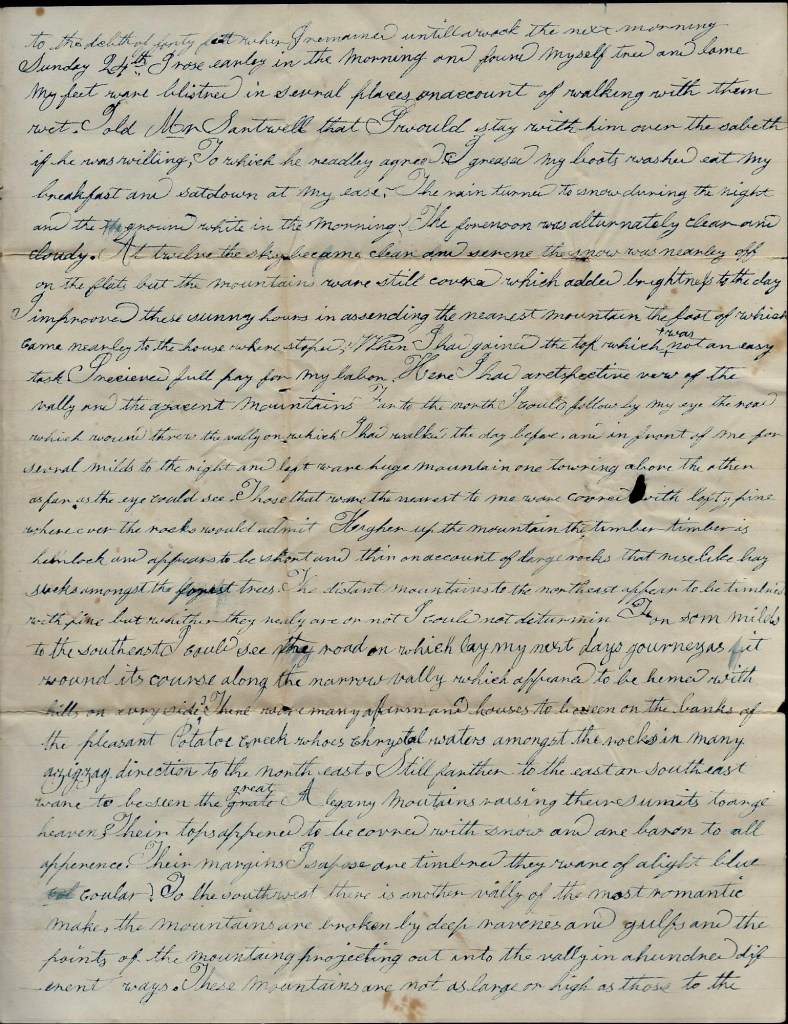
Sunday, 24th. I arose early in the morning and found myself tired and lame. My feet were blistered in several places on account of walking with them wet. Told Mr. Sartwell that I would stay with him over the Sabbath if he was willing to which he readily agreed. I greased my boots, washed, eat my breakfast, and sat down at my ease. The rain turned to snow during the night and the ground white in the morning. The forenoon was alternately clear and cloudy. At twelve the sky became clear and serene. The snow was nearly off on the flats but the mountain was still covered which added brightness to the day.
I improved these sunny hours in ascending the nearest mountain by foot of which came nearly to the house where it stopped. When I had gained the top which was not an easy task, I received full pay for my labor. Here I had a retrospective view of the valley and the adjacent mountains. Far to the north, I could follow by my eyes the road which wound through the valley on which I had walked the day before, and in front of me for several miles to the right and left were huge mountains, one towering above the other as far as the eye could see. Those that were the nearest to me were covered with lofty pines wherever the rocks would admit. Higher up the mountain the timber is hemlock and appears to be short and thin on account of large rocks that were like hay stacks amongst the forest trees. The distant mountains to the northeast appear to be timbered with pine but whether they nearly are or not, I could not determine. For some miles to the southeast I could see the road on which lay my next days journey as it wound its course along the narrow valley which appeared to be hemmed with hills on every side. There were many a farm and houses to be seen on the banks of the pleasant Potato Creek whose crystal waters amongst the rocks in many a zigzagging direction to the northeast. Still farther to the east or southeast were to be seen the great Allegheny Mountains raising their summits to angel heavens. Their tops appeared to be covered with snow and are barren to all appearances. Their margins I suppose are timbered. They were of a light blue color. To the southwest there is another valley of the most romantic make. The mountains are broken by deep ravines and gulfs and the pits of the mountains projecting out into the valley in a hundred different ways. These mountains are not as large or high as those to the west or north, which are nothing in comparison to the mountains to the east and southeast. But they are so broken and rocky that they make a more wild and romantic scene.
At two p.m., the weather became cloudy and I descended the mountain in a snowstorm and did not lack for an appetite at supper. More of the mountains in my next. — L. Russell
Your folks are all well and send their love to you. Hickliah, Sidney, Clarissa, and William are at the donation party tonight at the Rev. Mr. Shaw’s. I am tending the Old Mill. There is a plenty of water at present. Mr. Witney, if you have leisure, I would like you to write and inform me what branches you are studying and of your progress or what progress you make. The clock has just struck nine and I must close. Your sincere though illiterate friend.
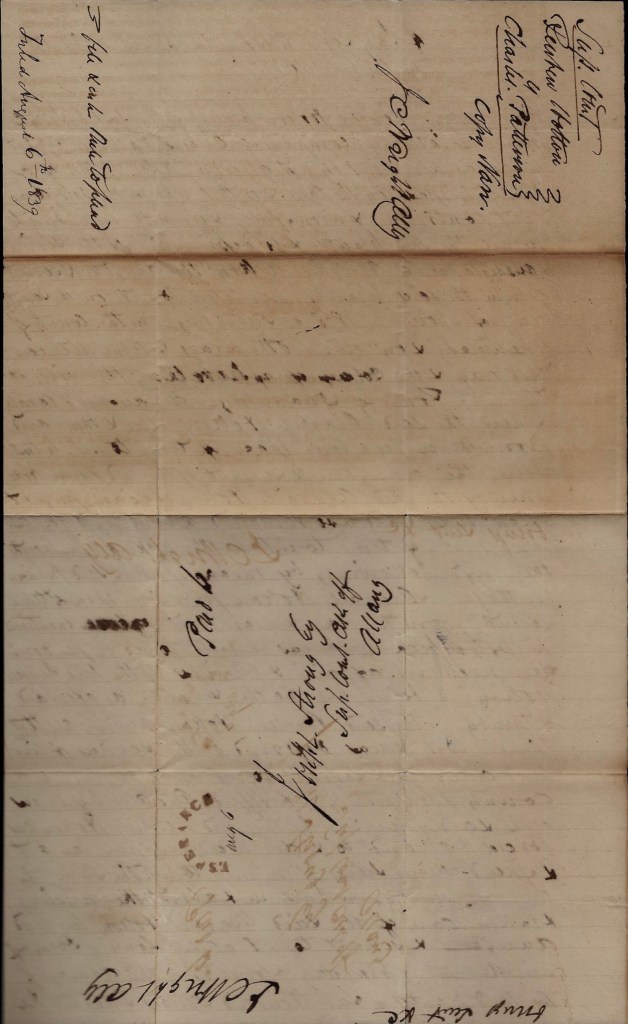
In the following 1839 lawsuit, the plaintiff Reuben Holton, brought suit against the defendant, Charles Patterson, for having made his unwed daughter Abigail pregnant, thus depriving him of the services of his daughter—and servant. Yes, under New York law, and apparently the English courts before, a parent was entitled to their child’s services, and compensatory damages were often awarded for the loss of services of the person seduced. Evidence that the defendant offered to marry the child seduced was not to be taken into consideration in mitigation of the damages. A defendant’s only recourse in fighting the suit would be to show that that the child was not seduced but was unchaste and promiscuous in her intercourse with men. [New York Law of Damages]
Transcription
Superior Court of July Term of the 6th Day of August 1839 Schenectady county
Reuben Holton, Plaintiff, in the suit by John C. Wright, his Attorney, complains of Charles Patterson, defendant, by declaration & not by [ ] according to the statute of a plea of trespass on the case. For that whereas the said defendant contriving & wrongfully & [un___] intending to injure the said plaintiff & to deprive him of the service & assistance of Abigail Holton, the daughter & servant of him, the said plaintiff heretofore to wit, on the seventh day of November 1838 at Duanesburg in the County of Schenectady & on divers other days & times between that day and this…debauched and carnally knew the said Abigail Holton there and then and from thence for a long space of time to wit, hitherto being the daughter and servant of the said Reuben Holton, where the said Abigail Holton became pregnant & sick with child & so remained & continued for a long space of time, to wit, for the space of nine months.,,from the day & year mentioned hitherto became & was unable to do or perform the necessary affairs & business of the said Reuben Holton, so being her father & master as aforesaid, & thereby hem the said Reuben Holton during all that time lost and was deprived of the services of his said daughter & servant [and was] forced and obliged to and did unnecessarily pay, lay out, and spend divers sums of money…one hundred dollars in and about the nursing & taking care of the said Abigail Holton…To the damage of the said plaintiff of two thousand dollars…
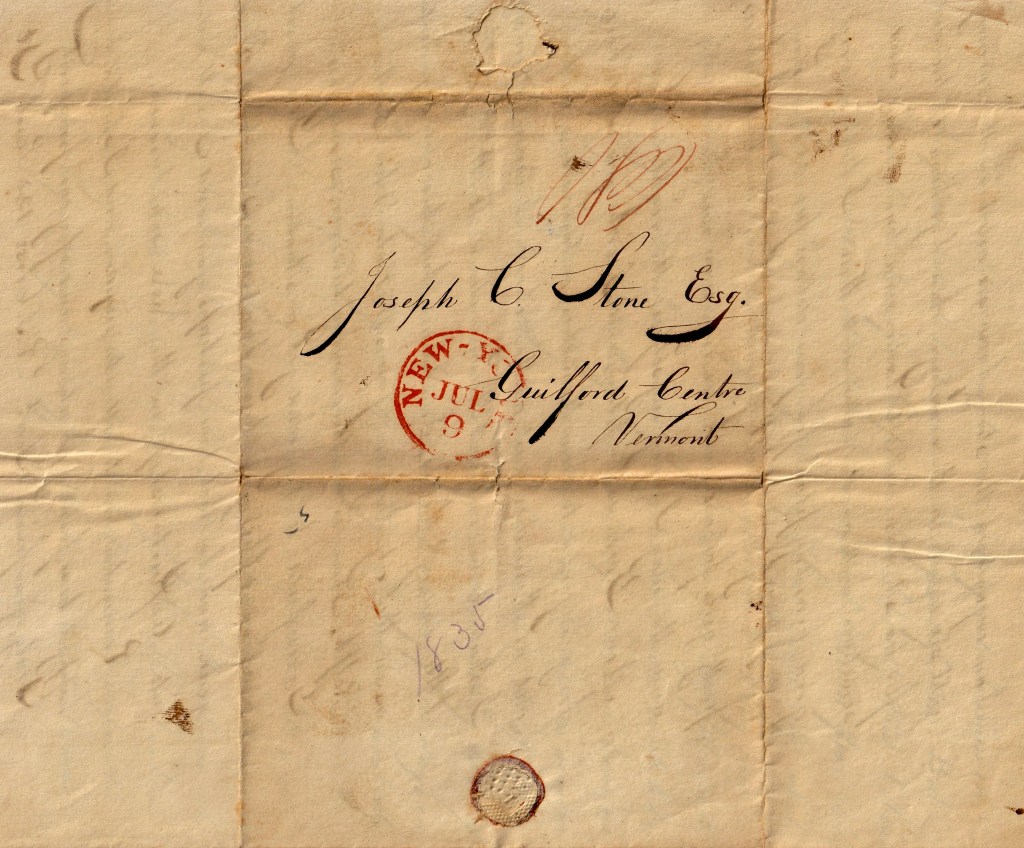
This is a wonderful handwritten letter, written on 8 July 1835, by 17 year-old Robert Thomas Corss (1818-1879), who had recently moved to New York to seek his fortune. He wrote the letter to Joseph C. Stone, an acquaintance who lived in Guilford Centre, Vermont. This articulate and tongue-in-cheek letter is of a philsophical nature, regarding how NYC is a place where young, hardworking people can become successful: ” New York is the place…for young men to ruin themselves or to make something out of themselves, just as they choose…” Corss also relates the ongong riots on the (politics, abolition, etc) which raged at the time. He also details what life was like for a young man at the time; long work hours—but still time to have fun. The address leaf has the applicable red postal mark of New York City.
Robert was the son of John and Lucy (Lee) Corss of Leyden, Franklin county, Massachusetts. By the late 1850’s, Robert was working as a broker on Wall Street—a position held until he died single in 1879.
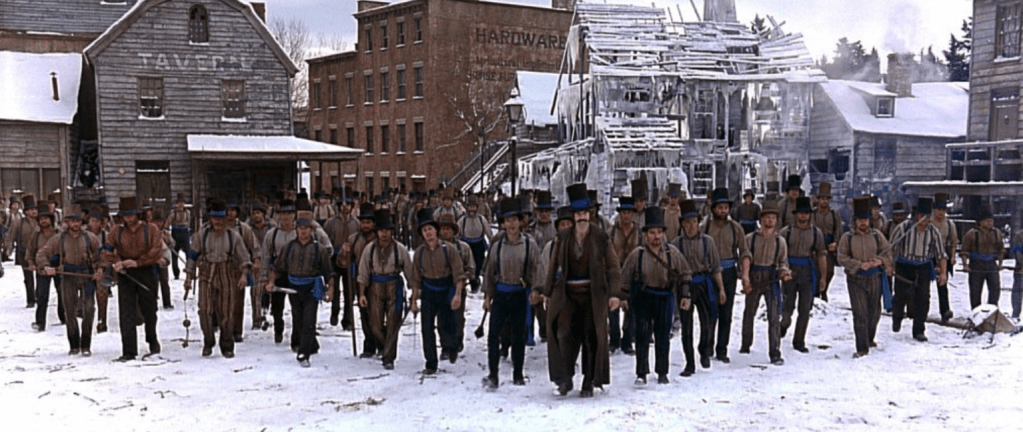
Robert’s letter mentions the riots in New York City that were getting to be commonplace. “There has been so many riots in this place that it is almost impossible for a public day to pass off without some disturbance,” he wrote. The year previous to this letter saw a huge antiabolitionist riot (the Tappan Riot) that lasted nearly a week until it was put down by military force. At times the rioters controlled whole sections of the city while they attacked the homes, businesses, and churches of abolitionist leaders and ransacked Black neighborhoods. But the growing number of Irish immigrants flowing into the city loomed as an even greater threat. By 1835, it was estimated that over 30,000 Irish emigrants were arriving in New York City annually. The conflict between the newly arrived Irish “foreigners” and the so called “native” Americans—those born in the United States—was keenest on the lower east side of Manhattan in the Bowery (Five Points), but fighting occasionally spilled over into other parts of the city.
Scene from “Gangs of New York” (Movie)
[Note: This letter is from the personal collection of Richard Weiner and was transcribed and published on Spared & Shared by express consent.]
Transcription
New York [City] July 8, 1835
Joseph C. Stone, Esq., Dear sir,
I received a paper from you July 3rd and am happy to hear that you have found business; and to you mind I hope. I have had several letters from Leyden recently, and some of them bring very interesting intelligence in regard to the young people, their present and future prospects, &c. I understand they are as usual, very serious, and meeting with more changes everyday in their temporal, as well as spiritual affairs.
There is one happy result in the experience which they profess to go through; as soon as they are brought to see the error of their ways, they become so attached to one another that an offer of the heart & hand is indispensable. And with these two changes secure their happiness in this world, and the world to come. What lovely times! In fact, some of them hardly live to see the error of their ways before they become so deeply impressed with their situation that an offer from the most respectable citizen would not be respected.
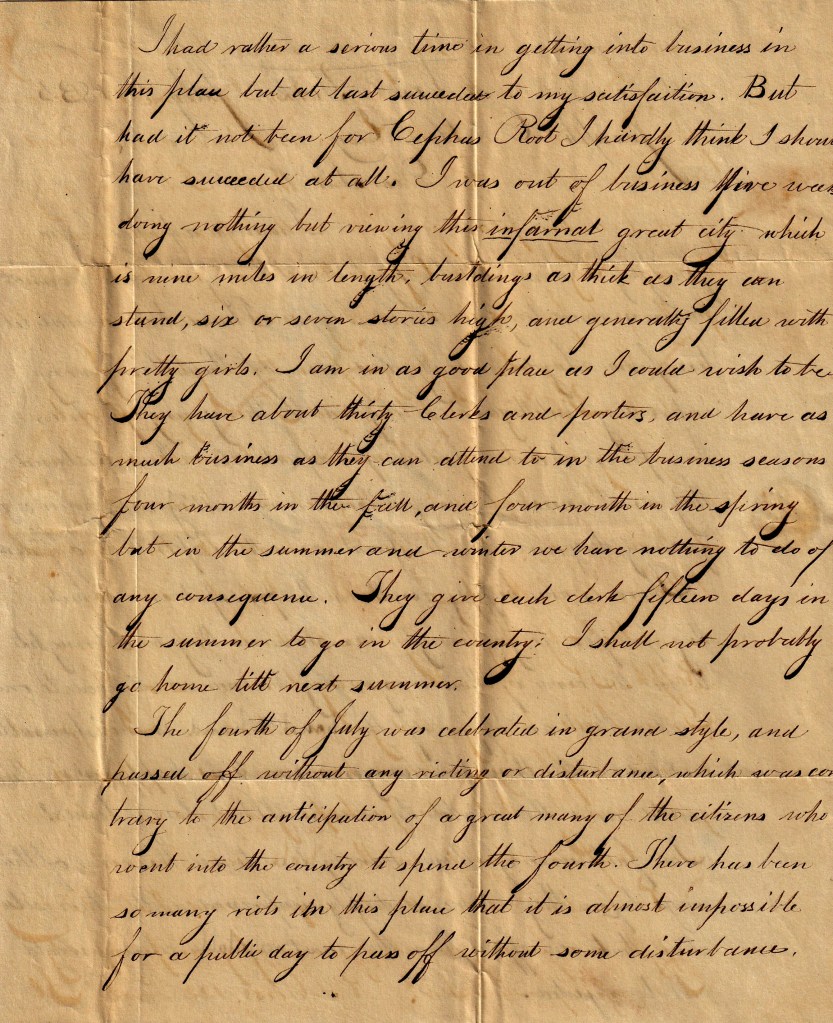
I had rather a serious time in getting into business in this place but at last succeeded to my satisfaction. But had it not been for Cephus Root, I hardly think I should have succeeded at all. I was out of business five weeks doing nothing but viewing the infernal great city which is nine miles in length, buildings as thick as they can stand, six or seven stories high, and generally filled with pretty girls. I am in as good place as I could wish to be. There have about thirty clerks and porters and have as much business as they can attend to in the business seasons four months in the fall and four months in the spring, but the summer and winter, we have nothing to do of any consequence. They give each clerk fifteen days in the summer to go in the country. I shall not probably go home till next summer.
The Fourth of July was celebrated in grand style, and passed off without any rioting or disturbance, which was contrary to the anticipation of a great many if the citizens who went into the country to spend the Fourth. There has been so many riots in this place that it is almost impossible for a public day to pass off without some disturbance.
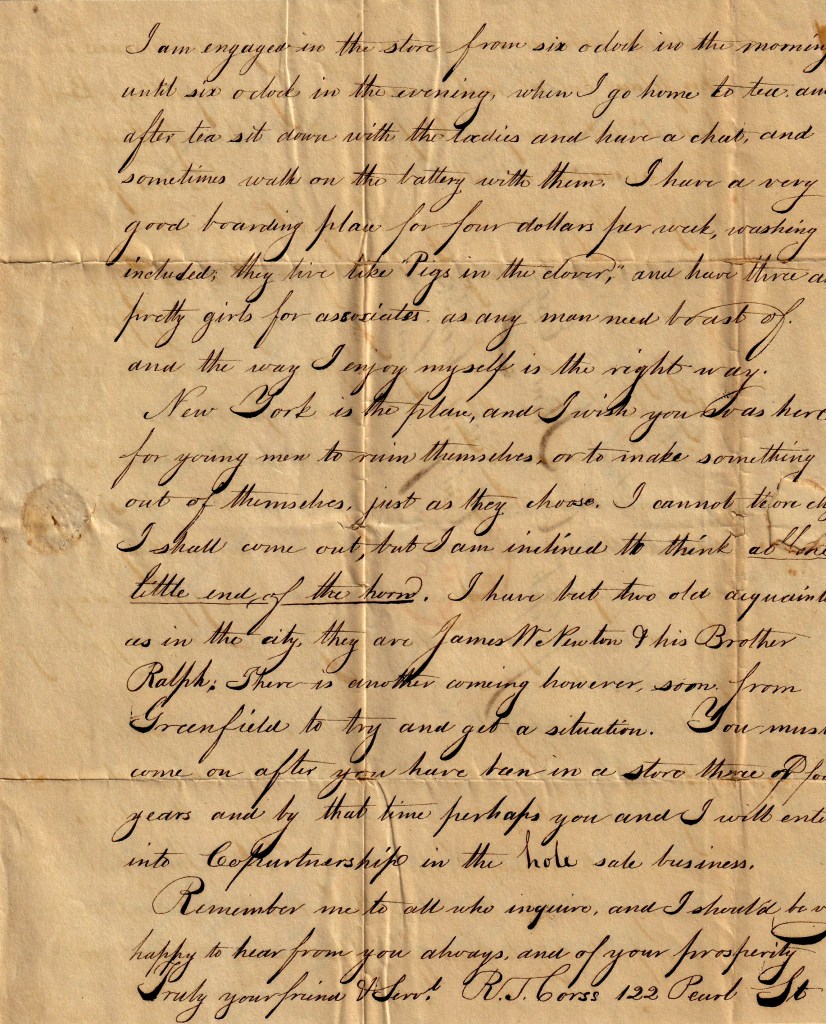
I am engaged in the store from six o’clock in the morning until six o’clock in the evening, when I go home to tea, and after tea, sit down with the ladies and have a chat, and sometimes walk on the battery with them. I have a very good boarding place for four dollars per week, washing included. They live like “pigs in the clover” and have three pretty girls for associates as any man need boast of, and the way I enjoy myself is the right way.
New York is the place, and I wish you was here for young men to ruin themselves, or to make something out of themselves, just as they choose. I cannot [say how] I shall come out, but I am inclined to think at the little end of the horn. I have but two old acquaintances in the city. They are James W. Newton and his brother Ralph. There is another coming, however, soon from Greenfield to try and get a situation. You must come on after you have been in a store three or four years and by that time perhaps you and I will enter into copartnership in the wholesale business.
Remember me to all who enquire and I should be happy to hear from you always and of your prosperity.
Truly your friend & servant, — R. T. Corss, 122 Pearl Street
This letter was written by Calvin Waldo Marsh (1825-1873), the son of Henry Marsh (1797-1852) and Sarah Whitney (1796-1883) of Berkshire county, Massachusetts. Calvin’s father, Henry, died of cholera at LaSalle, Illinois in 1852 when he was 55 years old. Calvin graduated from Williams College in 1844) and later worked as a commission merchant in St. Louis, Missouri, and served as a Union officer in the Civil War.
Transcription
Addressed to Mrs. Henry Marsh, Sandusky City, Ohio
Buffalo [New York] August 29, 1847
Dear Mother,
I take a few moments this evening to write you a few lines although it is Sabbath evening. I was quite disappointed when I arrived here not to find Father. But next morning I received a letter from him dated Pittsfield, August 25th, being last Thursday. He writes me he should be in Albany tomorrow and next day to attend to his wool and that he should be here on Thursday of this week so you will not expect him till the very last of this week. He will undoubtedly write you from here when he will be at home.
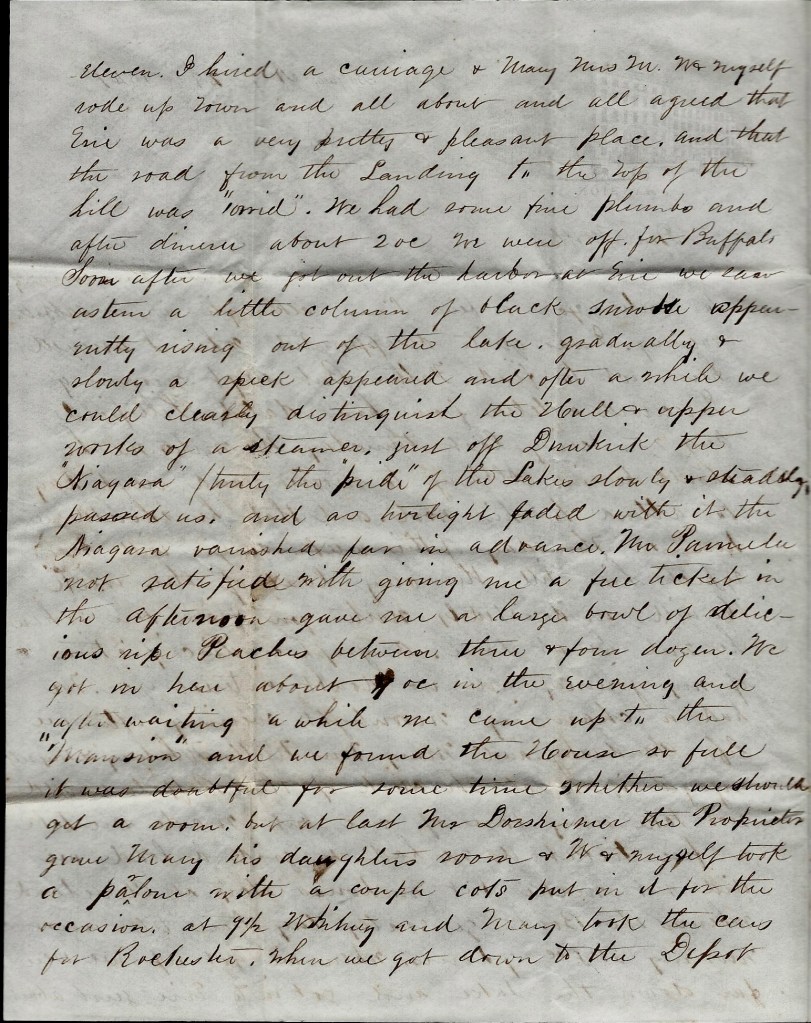
A graphic description of my journey will no doubt interest you. We had a charming moonlight evening after we left Sandusky and Mary, Mrs. Mills, Whitney & myself enjoyed it much. The clerk of the Buffalo would not take any fare of me but made me take a fare ticket as we had so good a load, we did not make but an hour’s stay at Cleveland whereas the boats generally lay there till next morning at 8 o’clock, 7 hours. When we got up we were far down the Lake and got into Erie [Pennsylvania] just about eleven. I hired a carriage & Mary, Mrs. Mills, Whitney & myself rode up town and all about and all agreed that Erie was a very pretty & pleasant place and that the road from the Landing to the top of the hill was “‘orrid”) We had some fine plums and after dinner about 2 o’clock we were off for Buffalo.
The Sidewheel Steamer Niagara (ca. 1847)
Soon after we got out of the harbor at Erie, we saw asteern a little column of black smoke apparently rising out of the lake. Gradually & slowly a speck appeared and after awhile we could clearly distinguish the hull and upper works of a steamer, just off Dunkirk—the “Niagara“—truly the “pride” of the Lakes, slowly & steadily passed us, and as twilight faded with it, the Niagara vanished far in advance. Mr. Parmelee, not satisfied with giving me a free ticket, in the afternoon gave me a large bowl of delicious peaches—between three & four dozen.
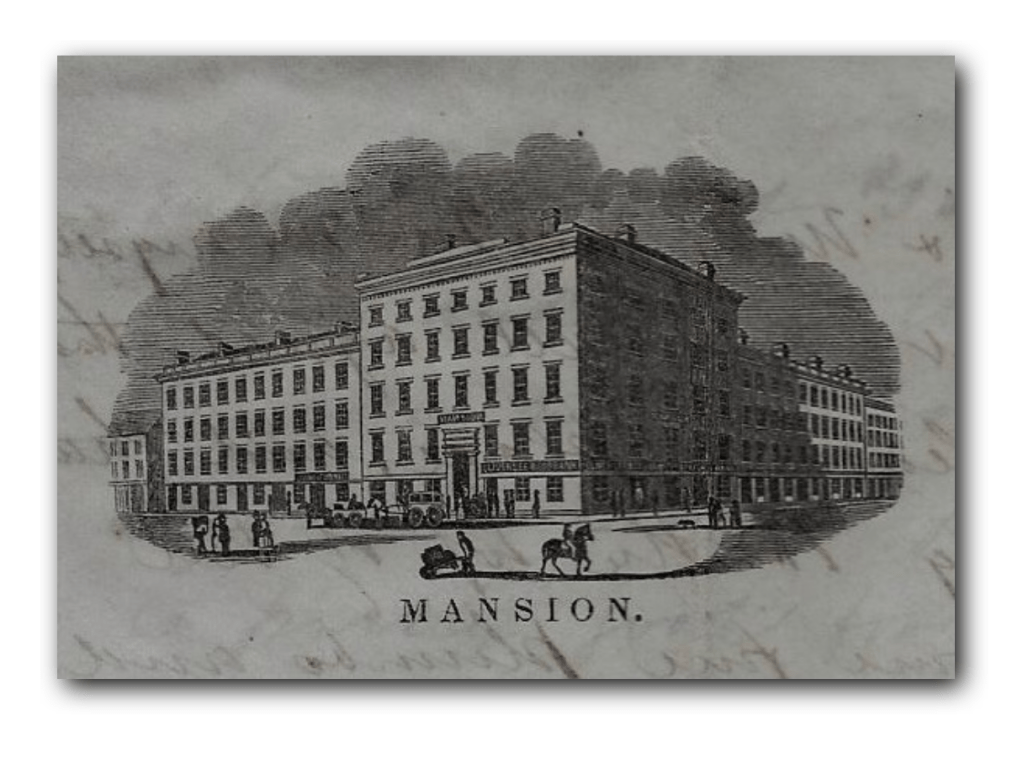
We got in here about 7 o’clock in the evening and after waiting awhile we came up to the “Mansion” 1 and we found the House so full it was doubtful for some time whether we should get a room but at last Mr. [Philip] Dorsheimer, the proprietor, gave Mary his daughter’s room & Whitney and myself took a parlor with a couple of cots put in it for the occasion. At 9:30 Whitney and Mary took the cars for Rochester. When we got down to the depot, found some St. Louis gentlemen who told him that Judge Carr & Dabney were in the depot somewhere. We looked all around but could not find him. Just as the cars started, Whitney found that he had walked out on the track a little ways to see the cars pass. As the cars passed, Whitney put his head out of the window and the Judge recognized him and bowed. After the cars left, I walked out and introduced myself to him at Whitney’s request. He gave me a very cordial reception and said that he was going to the [Niagara] Falls in the afternoon train and urged me when I told him I had thought of going down to accompany him and Dabney.
Tourists in top hats standing on the American side of the Niagara Falls, early 1850s (LOC)
After dinner I wrote a letter to Father, one to Henry, and one to one of our captains. I just finished my business in time to run to the cars at 4:30. We reached the Falls about 6 o’clock and we went down to the cataract. Judge Carr at first sight was very much disappointed in the falls. Next morning we went down the bank in the cars which take down and bring up passengers by water power at an angle of about 45 degrees. 2 Went across the small boat and visited the battleground of Lundy’s Lane, Table Rock, British Museum, Camera Obscura, &c. 3 I stopped at the cataract & Judge Carr insisted upon paying everything except my bill at the hotel and what trinkets I bought which I did not give him an opportunity to do. He went on in the cars & is going by way of Montreal and Boston to enter Dabney at Yale College.
I went to Mr. Ware’s house and saw Aunt and the rest of the family. Aunt is not as broken down by her age as I expected and looked perfectly natural. Her health is pretty good for her age as she is now over eighty. She seemed glad to see me & thought I had altered very much. She desired her love to be sent and all of the rest of the family. Charles gave me a very pretty cane. I saw Moses Miller & Chester White of Racine the first evening I got here. They left Racine last Monday in the Niagara and said Harry was well and Mr. Canfield’s family also.
Last evening after the cars came in, who should come in but Mr. John Boalt & I soon made”wacks” for the Ladies Drawing room. Miss “Pill” & “Nan” appeared very glad to see me and after they got some tea, we had a very pleasant chat. “Pill” had a bad headache and retired about 9:30. I ate breakfast with them this morning and soon after they took a cab and went down to the house of some of their cousins. They got up Tuesday morning and I shall send a small package by them which I wish you would open & ask Clara to deliver the one to Kate & Martha. With much love to [all]. From your affectionate son, — Waldo
Kind regards to all enquiring friends.
The Mansion on the corner of Main & Exchange Streets in Buffalo, New York
1 The Mansion House was built on land purchase by Philip Dorsheimer sometime after the British burned buffalo in 1813. The location was formerly the site of the Crow’s Tavern. Philip built his five story structure and then added another floor which was styled a modern hotel in 1829. It stood on the sire for over 100 years. It was torn down in 1932 to make way for building utilized by the New York Central Railroad.
2 An 1847 visitor to Niagara Falls wrote of this conveyance to the base of the falls in an article published in the New York Commercial Advertiser on 4 August. Among the most recent improvements he observed at the falls, he stated, was “the stairs and inclined plane on the American side, constructed [in 1845 and operated by water power] by the Messrs Porter, the proprietors of the land adjacent to the falls. They afford an easy ascent and descent to the ferry across the river, where thousands annually cross and recross within full view of the mighty cataract, but still there seemed something wanting to enable visitors to obtain a closer view of the falls from below, and this want has been supplied by the construction of a steam boat appropriately called the Maid of the Mist, which now safely conveys passengers from the lower landing on the American side to the very verge of the falls themselves—passing the American falls and nearly approaching the Horse shoe falls, where three-fourths of the waters of the Niagara plunge over a precipice of about 160 feet. This steamboat excursion, which occupies about forty minutes, has become very popular, and will no doubt well repay the enterprising proprietors. The Maid of the Mist is commanded by Captain H. Filkins, whose obliging manners have made himself and boat deservedly popular.”
3 It has been said that “tackiness is a cherished tradition at Niagara Falls.” Tourist attractions have abounded at the falls saince at least the mid 1920s. An 1847 visitor reported: “Now the neighborhood of the great wonder is overrun with every species of abominable fungus—the growth of rank bad taste, with equal luxuriance on the English and American sides—Chinese pagoda, menagerie, camera obscura, museum, watchtower, wooden monument, tea-gardens and old curiosity shops.” The “Camera Obscura was “Robinson’s Canadian Pagoda which was built in 1847. It stood 70 feet talland had three observations platforms for viewing the Horseshoe Falls. It was torn down in 1860.

















 Spared & Shared 23