
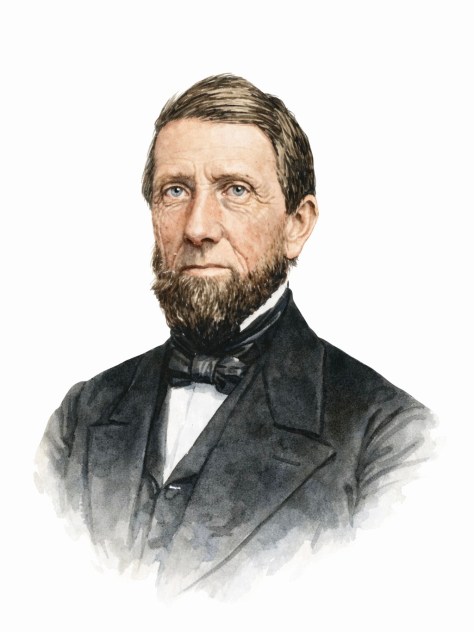
The following letter was written by Ralph Ashley (1797-1852) to his eldest son, Rollin Mallory Asley (1827-1911). Father and son were partners in a general store in Port Republic, New Jersey under the name “R. and R. T. Ashley” until 1833, when the partnership was discontinued and Ralph carried on the business alone until about 1848. Ralph also ventured into ship building, the marketing of wood and charcoal to New York City. Ralph Ashley was married to Sarah Blackman (1803-1879) in 1826.
The nature of Ralph’s trip to the coastal port of Edenton, North Carolina, is not stated explicitly but seems to have been connected with the salvage or selling of a vessel and/or cargo, and perhaps a reconnoissance trip to look for timber to purchase and sell to the New York City market. Ralph’s impression of slavery is consistent with the views of most Northern businessmen who visited the Antebellum South.
T R A N S C R I P T I O N
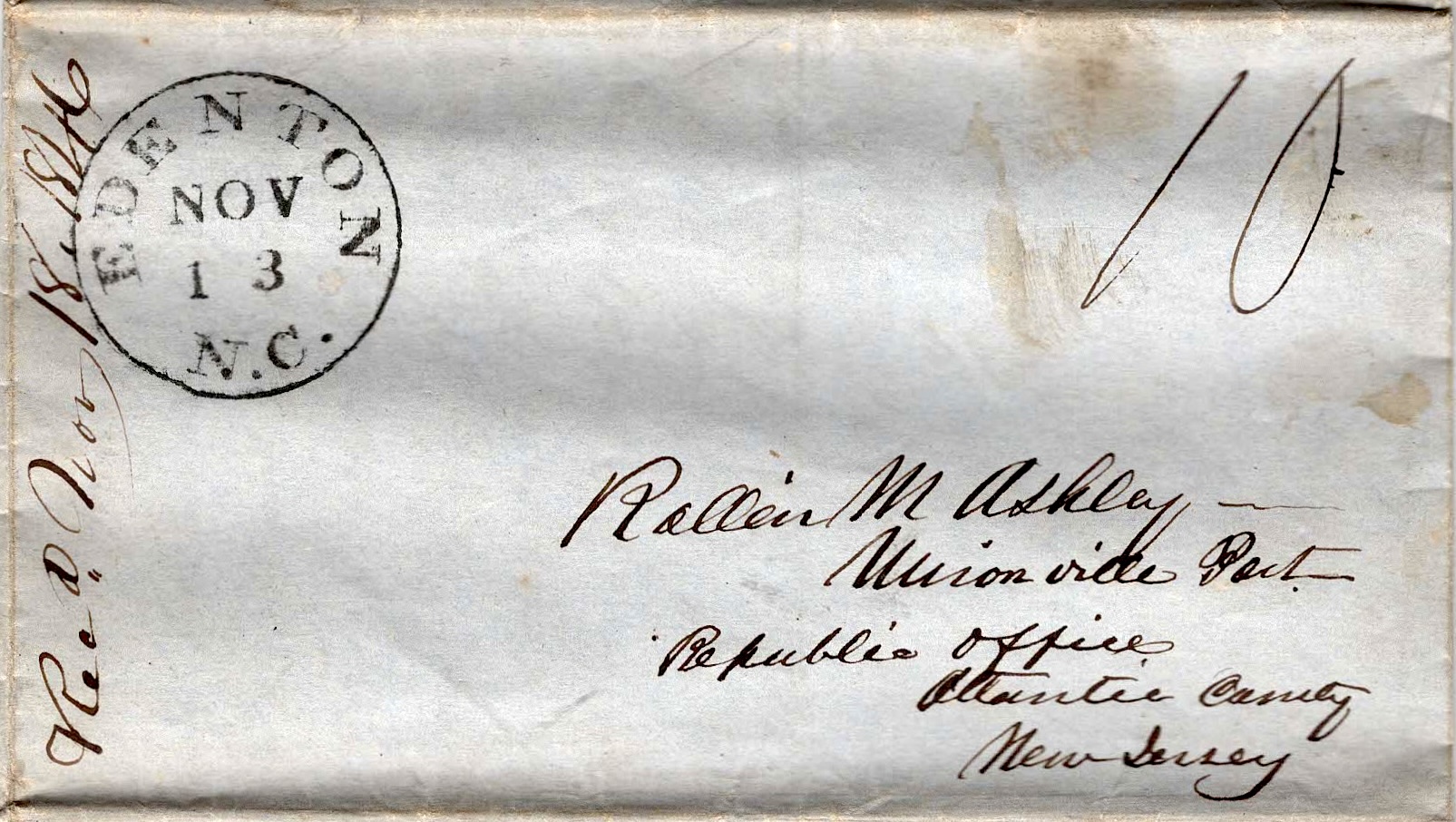
Edenton, North Carolina
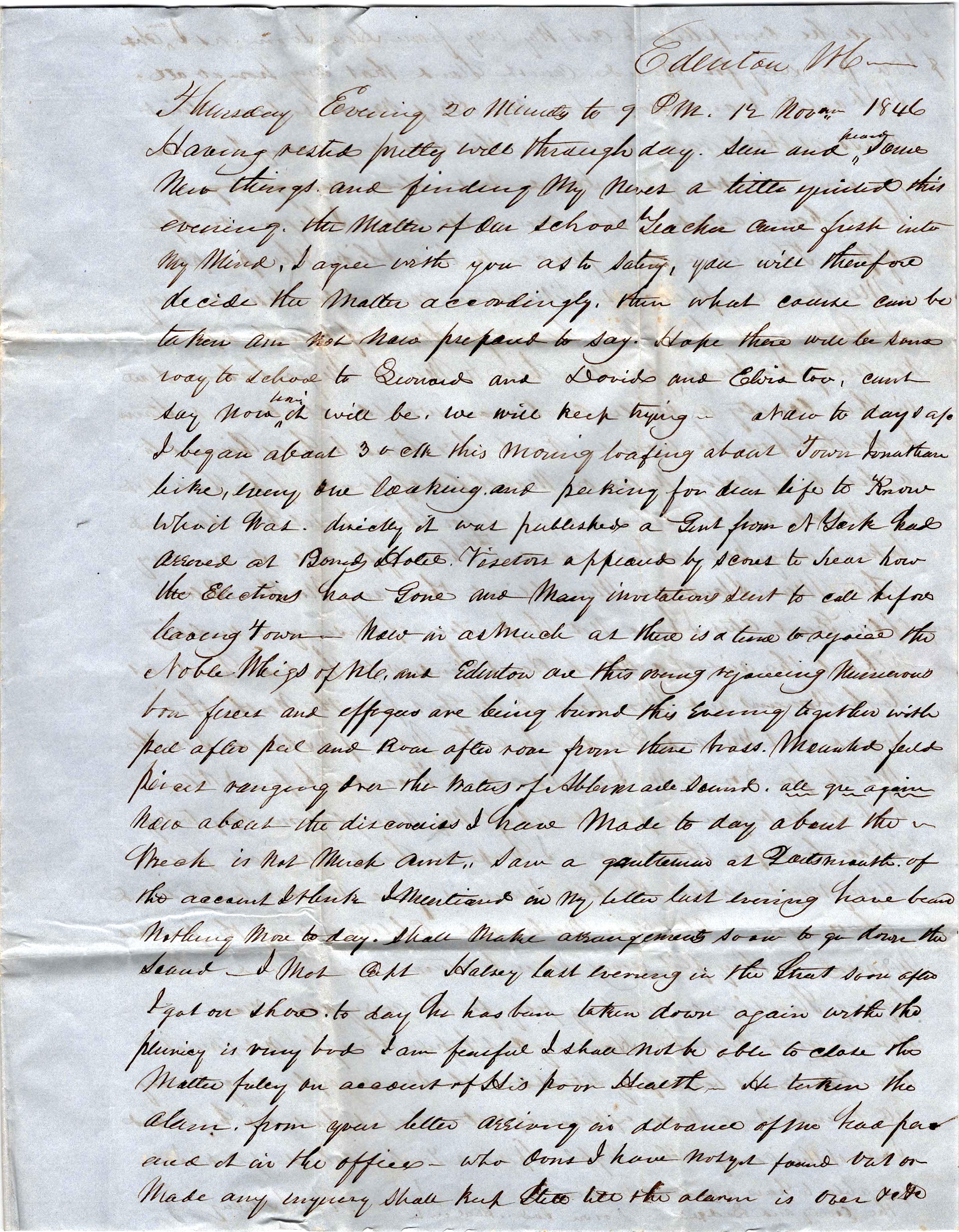
Thursday evening, 20 minutes to 9 p.m., 12 November 1846
Having rested pretty well through day, saw and heard some new things and finding my nerves a little quieted this evening, the matter of our school teacher came fresh into my mind. I agree with you as to salary. You will therefore decide the matter accordingly. Then what course can be taken, am not prepared to say. Hope there will be some way to school to Leonard and David and Eliza too. 1 Can’t say now how it will be. We will keep trying.
Now today as I began about 3 o’clock this morning loafing about town, Jonathan-like, everyone looking and peeking for dear life to know who I was, directly it was published a Gent from York had arrived at Bond’s Hotel. Visitors appeared by scores to hear how the elections had gone and many invitations sent to call before leaving town. Now inasmuch as there is a time to rejoice the Noble Whigs of North Carolina and Edenton, on this evening together with peel after peel, and roar after roar from the brass-mounted field pieces ranging over the waters of Albemarle Sound, all qu again.
Now, about the discoveries I have made today about — the wreck is not much [ ]. Saw a gentleman at Portsmouth of the account I think I mentioned in my letter last evening. Have been nothing more today. Shall make arrangements soon to go down the Sound. I met Capt. Halsey last evening in the street soon after I got on shore today. He was taken down again with the pleurisy [and] is very bad. I am fearful I shall not be able to close the matter fully on account of his poor health. He taken the Alum. From your letter arriving in advance of me had [ ] and it in the office. Who [ ] I have noted found out on. Many any enquiry. Shall keep still till the alarm is over, &c.
I shall be compelled to cut my way from here soon as I am charged $1.50 per day for board. [ ] stand that any [ ]. I should want 4000 for my half week before Christmas at that rate. Do not see that I shall get away from here for some weeks yet. Have been asleep a bit. Cannot tell where I began or left off.
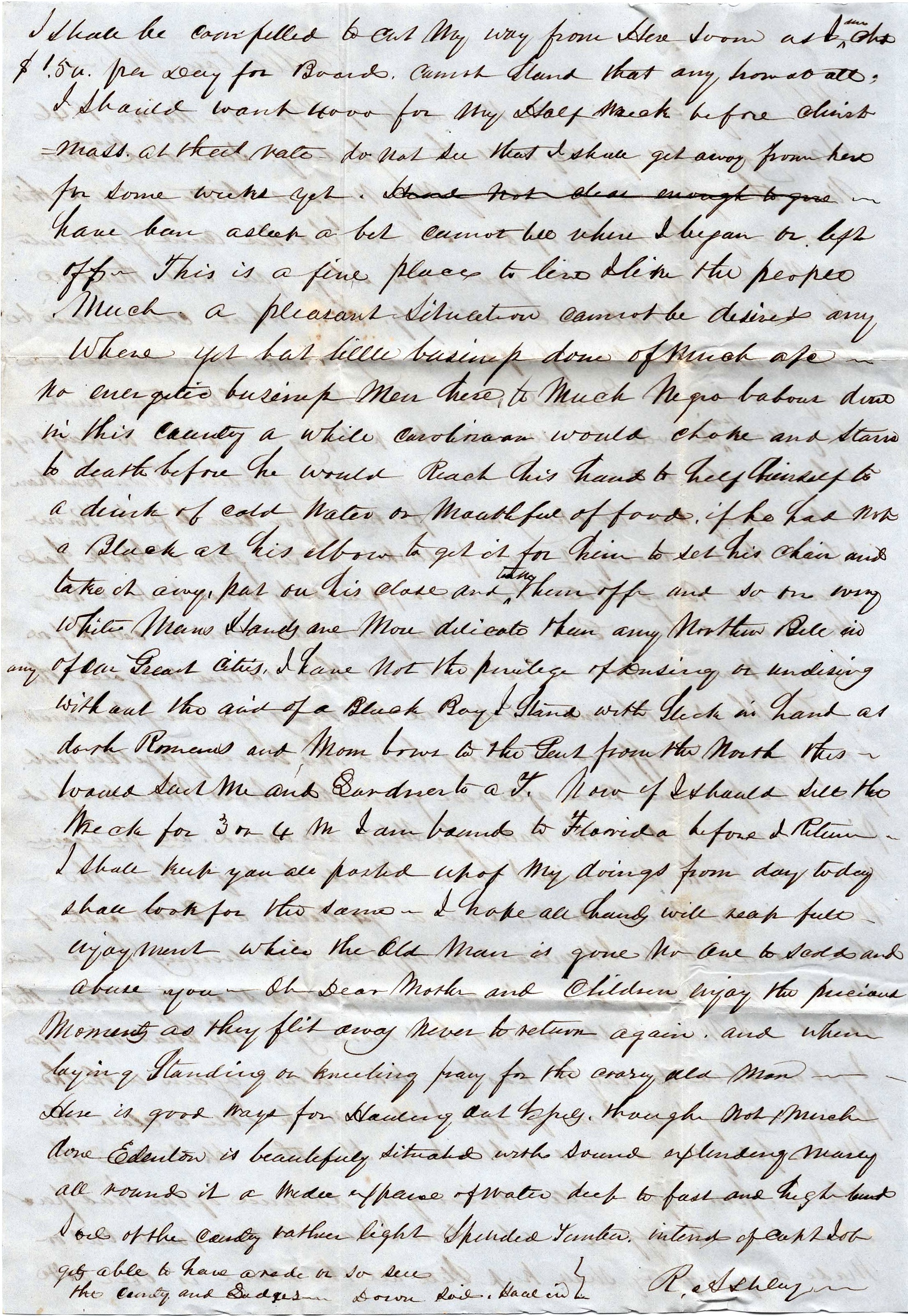
This is a fine place to live. I like the people much. A [more] pleasant situation cannot be desired anywhere yet but little business done of much account. [There are] no energetic business men here. Too much Negro labor done in this country. A white Carolinian would choke and starve to death before he would reach his hand to help himself to a drink of cold water or a mouthful of food if he had not a Black at his elbow to get it for him, to set the chair and take it away, put on his clothes and take them off, and so on. Every white man’s hands are more delicate than any Northern belle in any of the great cities. I have not the privilege of dressing or undressing without the aid of a Black boy. I stand with stick in hand as dark Romans and Mom bows to the Gent from the North. This would suit me and Gardner to a T.
Now if I should sell the wreck for 3 or 4 M, I am bound to Florida before I return. I shall keep you all posted up of my doings from day to day. Shall look for the same. I hope all hands will reap full enjoyment while the Old Man is gone. No one to scold and abuse you. Oh dear Mother and children, enjoy the precious moments as they flit away, never to return again. And when laying, standing, or kneeling, pray for the crazy old man. Here is good ways for hauling out vessels, though not much done. Edenton is beautifully situated with Sound extending marly all round it. A wide expanse of water, deep too, and high coast. Soil of the country rather light. Splendid timber. Intend if Capt. Job gets able to have a ride to see he country and ledges. — R. Ashley
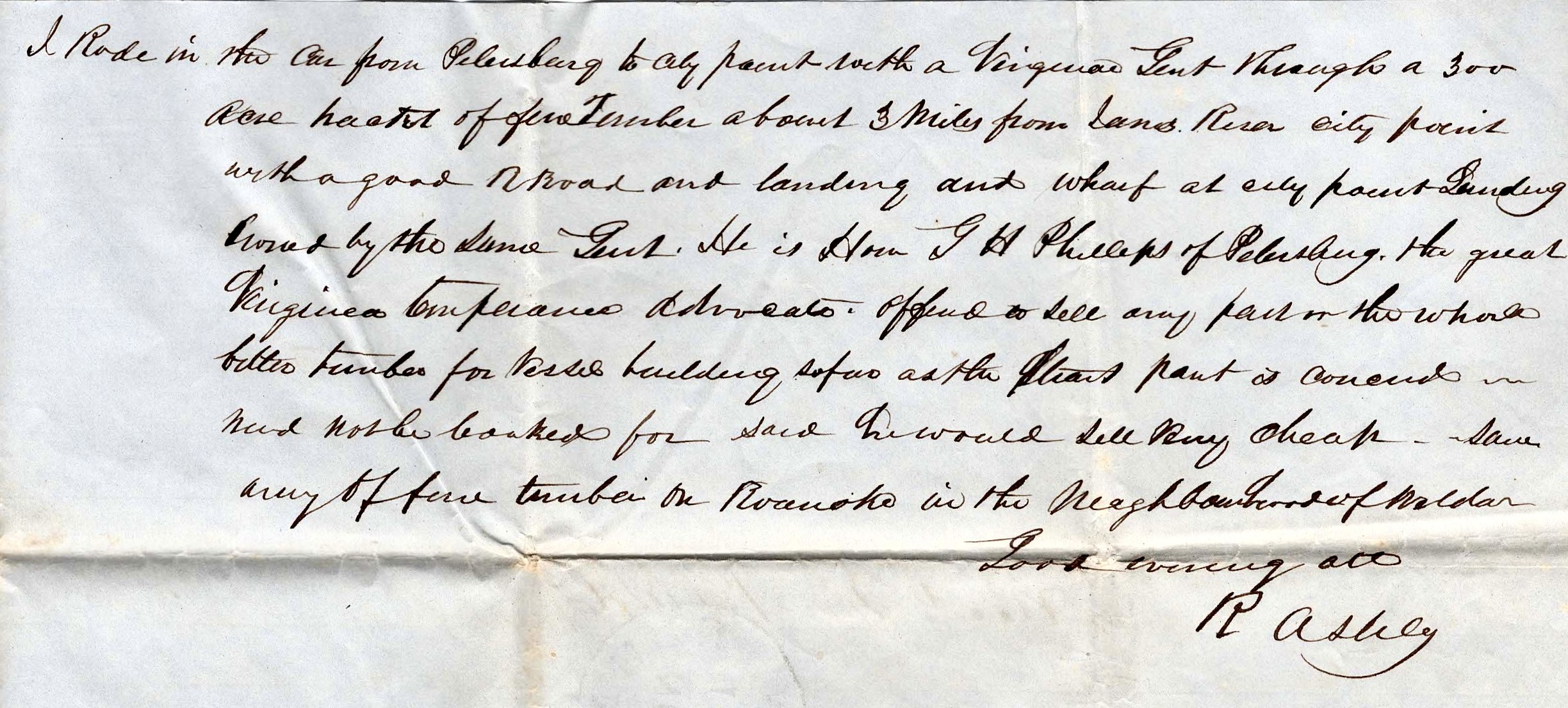
I rode in the car from Petersburg to City Point with a Virginia Gent through a 300-acre [ ] of fine timber about 3 miles from James River. City Point with a good railroad and landing and wharf at City Point Landing owned by the same Gent. He is Hon. G. H. Phillips of Petersburg—the great Virginia temperance advocate. Offered to sell any part or the whole. Better timber for vessel building so far as the strait part is concerned. Need [ ] [ ] for said he would sell buy cheap. Saw [ ] of fine timber on Roanoke in the neighborhood of [ ].
Good evening all, — R. Ashley
1 Ralph’s youngest children were Ann Eliza Ashley (b. 1835), Leonard (b. 1837), and David (b. 1840).







 Spared & Shared 23