Category Archives: Antebellum Texas

1849: Joseph Hatch LaMotte to Ellen (Chambers) LaMotte

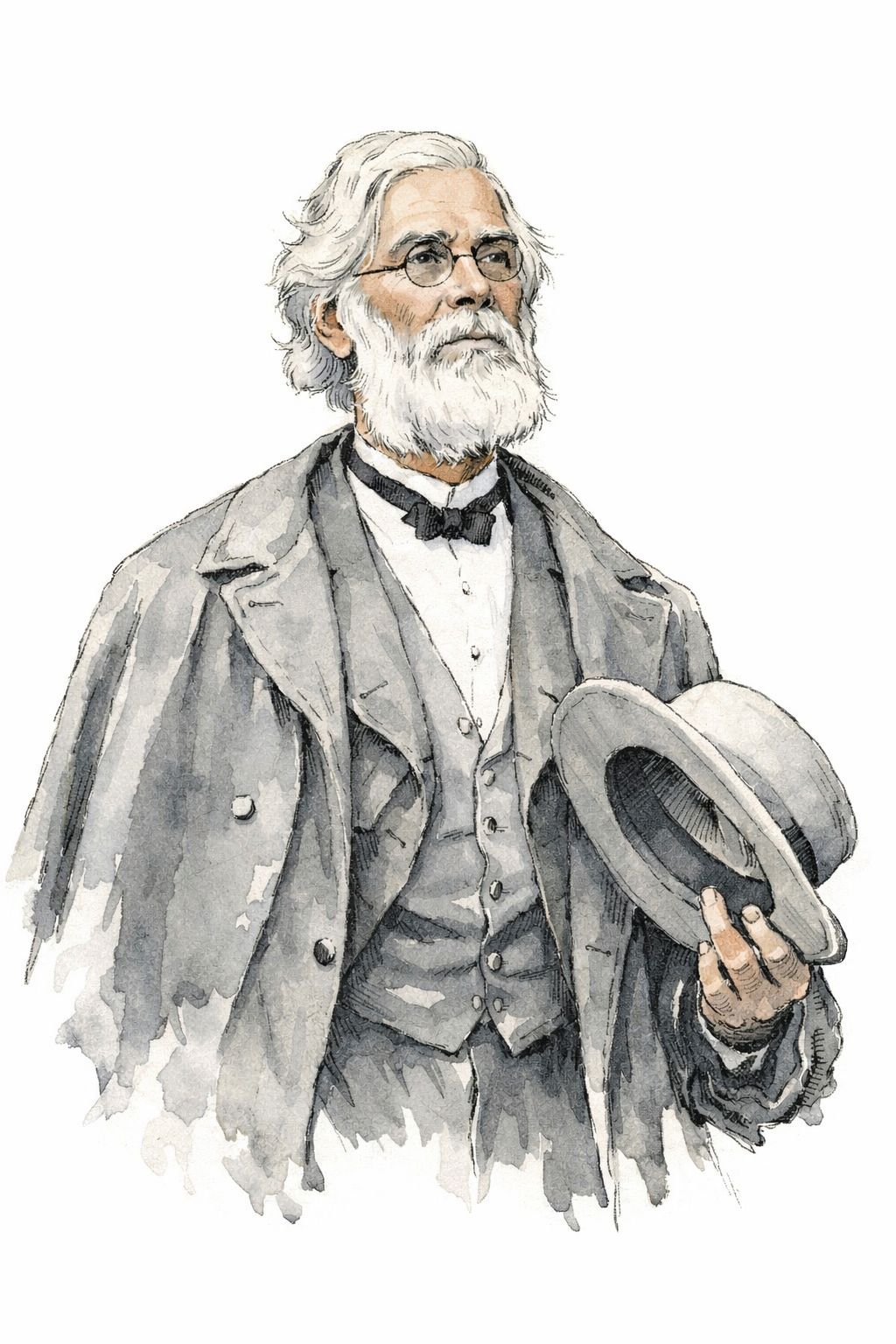
I could not find any image of LaMotte but here is a pen & watercolor of Co. James Duncan (1811-1849) in his military uniform of the period. He was also a graduate of West Point and roughly the same age as LaMotte.

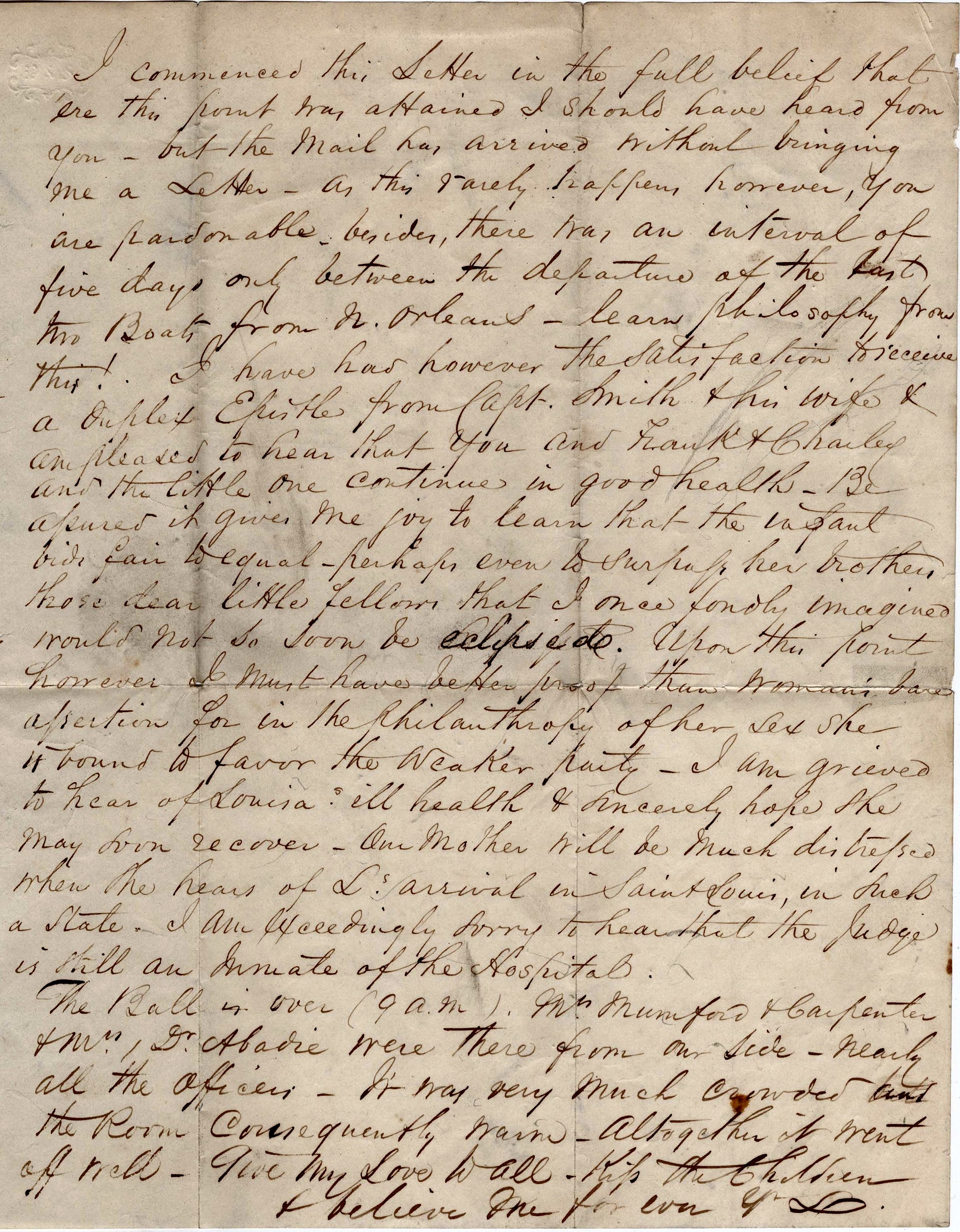
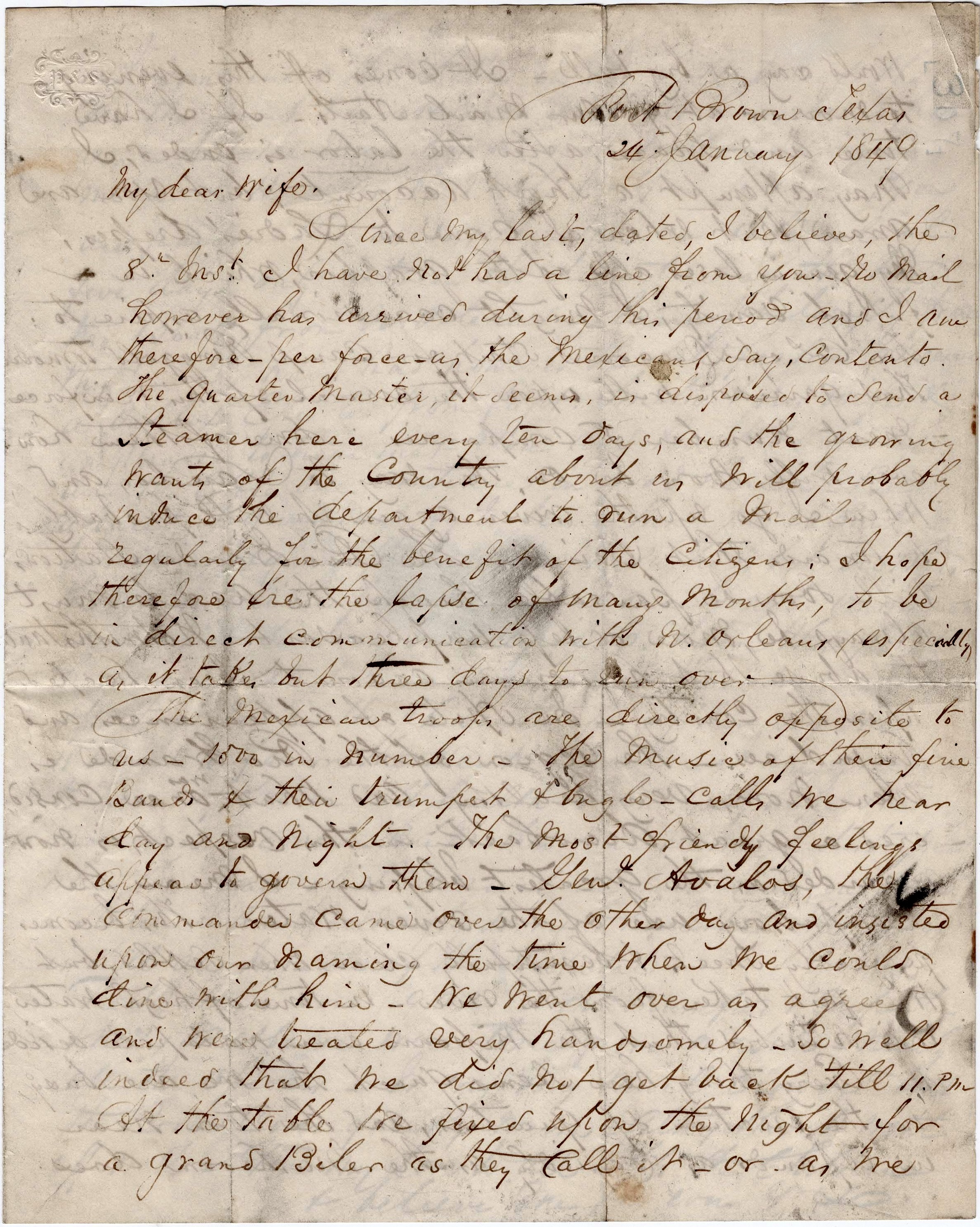
I can safely attribute the following letter to Major Joseph Hatch LaMotte (1807-1888), an 1827 graduate of the US Military Academy, Mexican War Veteran and career infantry officer. Joseph was married to Ellen M. Chambers (1818-1911) in May 1842 and his two oldest children, Francis Xavier LaMotte (1843-1868) and Charles Chambers LaMotte (1846-1896) are mentioned in this letter. An infant and unnamed daughter is also mentioned. She was Catherine Mullanphy LaMotte (1848-1852); she died in 1852 and was buried in St. Louis. A sister, Louisa, is also mentioned which would have been Louisa LaMotte (1826-1897).

Joseph’s presence at Fort Brown is confirmed by an article published in the New York Herald on 4 December 1848 stating that “The following officers are attached to the First Regiment of Infantry, five companies of which arrived at Fort Brown on the 21st inst.—Col. H. Wilson, Major J. H. LaMotte, Capt. R. S. Granger, Capt. F. S. Mumford…”

Joseph filled various frontier posts, rising to the rank of captain in the War with Mexico. He was severely wounded at the Battle of Monterey in September 1846 for which he was recognized for gallant and meritorious conduct, and was later reassigned as the acting Inspector General of Brig. General Kearny’s Division at Mexico City. After a brief stint at East Pascagoula, Mississippi, he was transferred to frontier duty in Texas. He retired to his farm near St. Louis in the 1850s where he died at the age of 81. His Italianate style home, called “Wildwood,” built in 1857 in Ferguson, still stands.

Fort Brown, originally called Fort Texas, was begun in April 1846 by Zachary Taylor. It was built near Brownsville on the Rio Grande river to establish the river as the southern boundary of Texas—the boundary between the United States and Mexico being the principal matter of dispute between the two countries. The earthen fort had a perimeter of 800 yards, with six bastions, and walls that were 9 feet high and a parapet 15 feet wide. It was surrounded by a ditch 15 feet deep and 20 wide. It was when the fort was being outfitted that a Mexican force intercepted the supply train and triggered the Mexican War. In 1848, after the war ended, the US garrison constructed quarters for officers and enlisted men at a permanent site a quarter mile north of the fort. The post was abandoned by US troops in 1861 though it was used for various purposes well into the 20th Century.
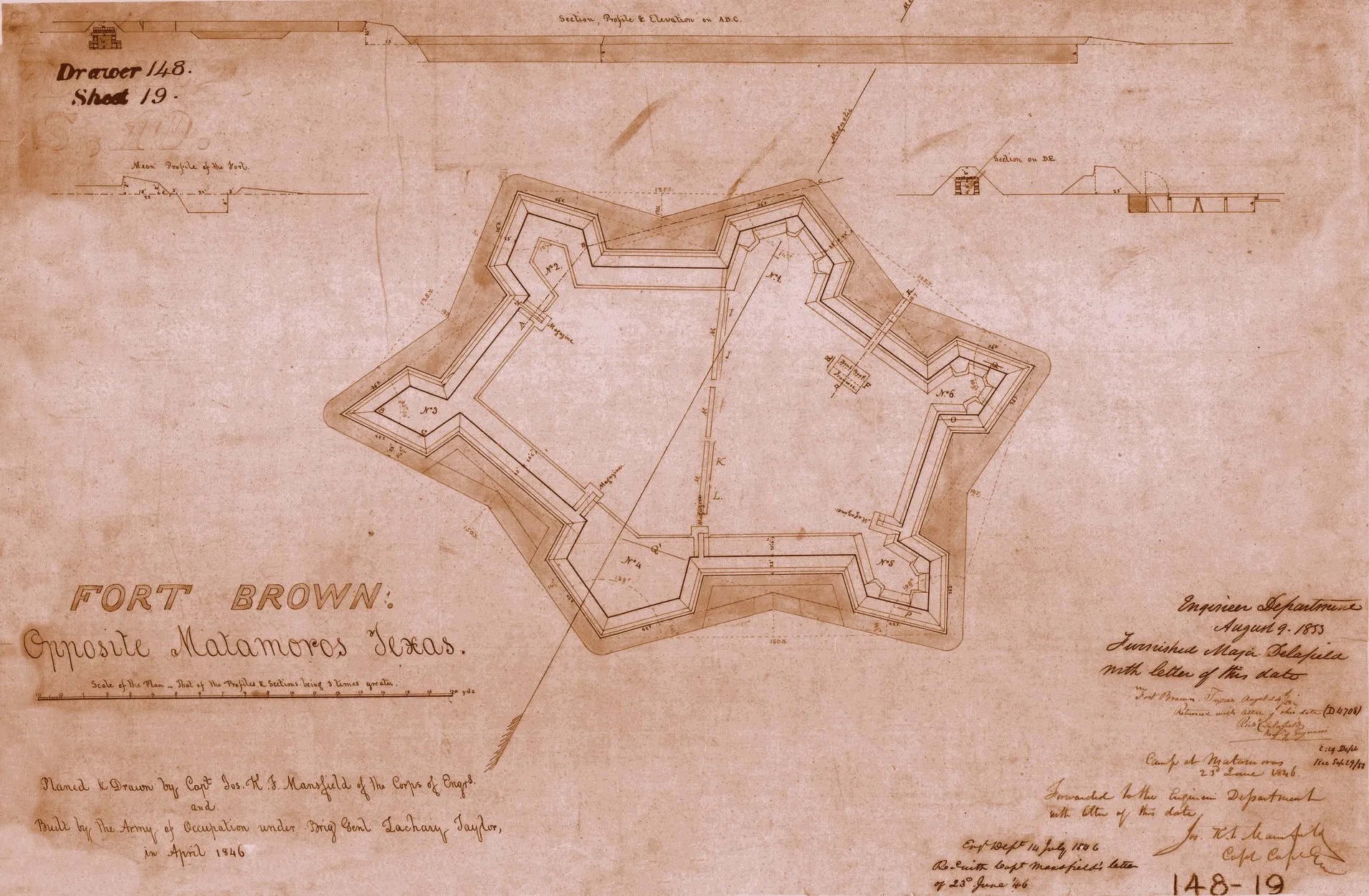
Diagram of Fort Brown

T R A N S C R I P T I O N

Fort Brown, Texas
24 January 1849

My dear wife,

Since my last dated, I believe, the 8th inst., I have not had a line from you. No mail, however, has arrived during this period and I am therefore—per force—as the Mexicans say, contento. The Quartermaster [Major. W. W. Chapman] it seems is disposed to send a steamer here every ten days and the growing wants of the country about us will probably induce the department to run a mail regularly for the benefit of the citizens. I hope therefore ere the lapse of many months, to be in direct communication with New Orleans (especially) as it takes but three days to run over.

The Mexican troops are directly opposite to us—1,000 in number. The music of their fine bands & the trumpet & bugle calls we hear day and night. The most friendly feelings appear to govern them. Gen. [Francisco] Ávalos, the commander, came over the other day and insisted upon our naming the time when we could dine with him. we went over as agreed and were treated very handsomely—so well indeed that we did not get back till 11 p.m. At the table we fixed upon the night for a Grand Biler [Ballare] as they call it, or as we would say—a Big Ball. It comes off this evening. Tomorrow at 9 our mail starts. If I have time and space after the labor is ended, I may attempt a short account. But you are aware that when I come to Ladie’s dresses, my genius loses all of the graphic, which in a fit of vanity, I might occasionally aspire to.

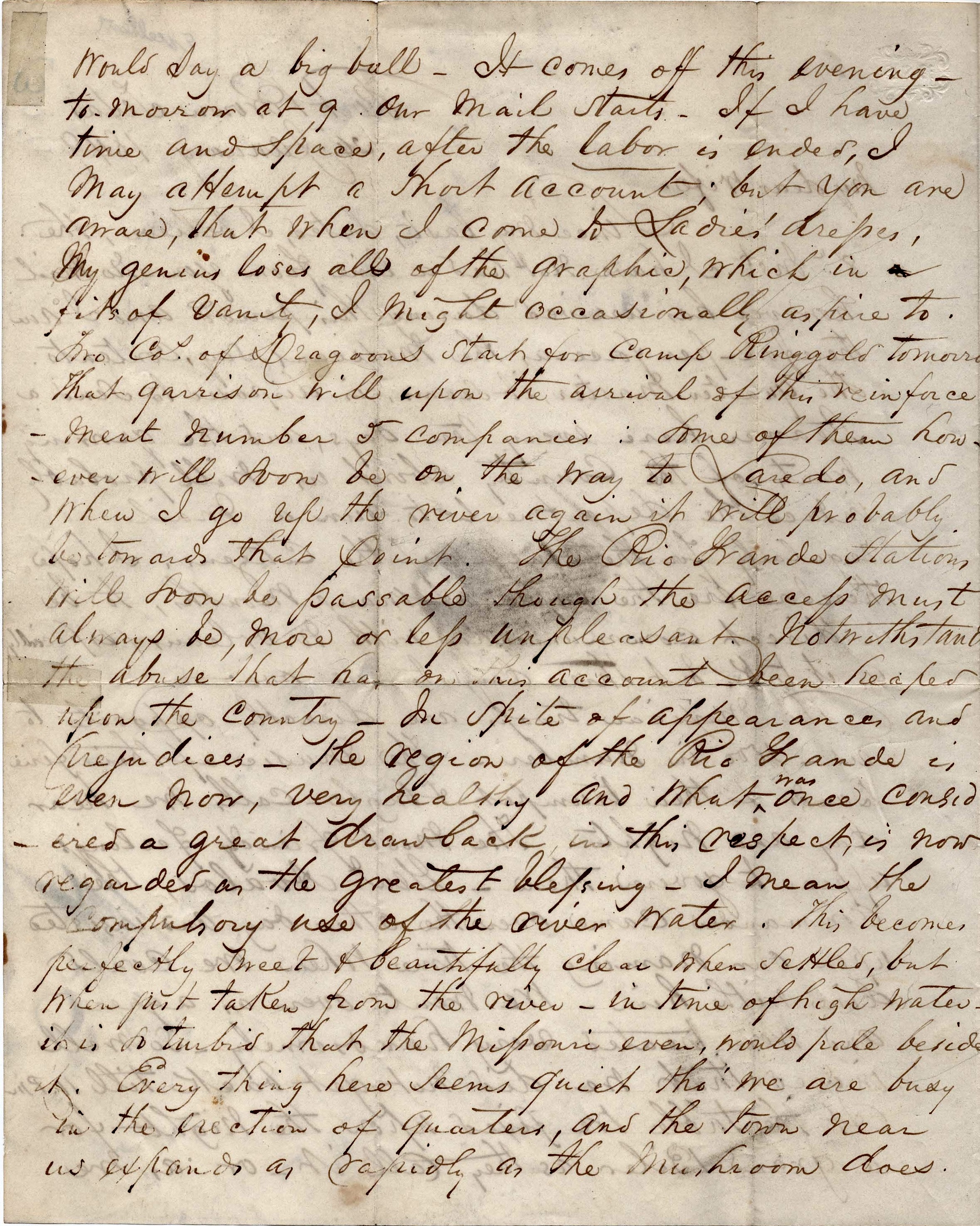
Two companies of Dragoons start for Camp Ringgold 1 tomorrow. That garrison will upon the arrival of this reinforcement number 5 companies. Some of them, however, will soon be on the way to Laredo and when I go up the river again, it will probably be towards that point. The Rio Grande Station will soon be passable though the access must always be more or less unpleasant. Notwithstanding the abuse that has on this account been heaped upon the country—in spite of appearance and prejudices—the region of the Rio Grande is even now very healthy and what was once considered a great drawback in this respect is now regarded as the greatest blessing. I mean the compulsory use of the river water. This becomes perfectly sweet and beautifully clear when settled, but when just taken from the river in time of high water, is is so turbid that the Missouri even would pale beside it.

Everything here seems quiet though we are busy in the erection of quarters and the town near us [Brownsville, TX] expands as rapidly as the mushroom does.

I commenced this letter in the full belief that ere this point was attained, I should have heard from you, but the mail has arrived without bringing me a letter. As this rarely happens, however, you are pardonable. Besides, there was an interval of five days only between the departure of the last two boats from New Orleans. Learn philosophy from this!

I have had, however, the satisfaction to receive a duplex epistle from Capt. Smith & his wife, & am pleased to hear that you and Frank & Charley and the little one continue in good health. Be assured it gives me joy to learn that the infant bids fair to equal, perhaps even to surpass, her brothers—those dear little fellows that I once fondly imagined would not so soon be eclipsed. Upon this point, however, I must have better proof than woman’s base assertion for in the philanthropy of her sex, she is bound to favor the weaker party. I am grieved to hear of Louisa’s ill health & sincerely hope she may soon recover. Our Mother will be much distressed when she hears of Louisa’s arrival in Saint Louis in such a state. I am exceedingly sorry to hear that the Judge is still an inmate of the Hospital.

The Ball is over (9 a.m.). Mr. [Capt. Ferdinand S.] Mumford & [1st Lt. Stephen D.] Carpenter & Mrs. & Dr. [Eugéne Hilarian] Abadie were there from our side—nearly all the officers. It was very much crowded and the room consequently warm. Altogether it went off well. Give my love to all. Kiss the children & believe me forever yours, — L.


1 Camp Ringgold was located upriver from Brownsville and barracks were eventually built on a high bank of the Rio Grande within a half mile of Rio Grand City. Camp Crawford was established in March 1849 just outside the old Mexican village of Laredo, 120 miles further upriver. A fort was eventually built there called Fort McIntosh.
1852: William Barrett Blair to George Gibson

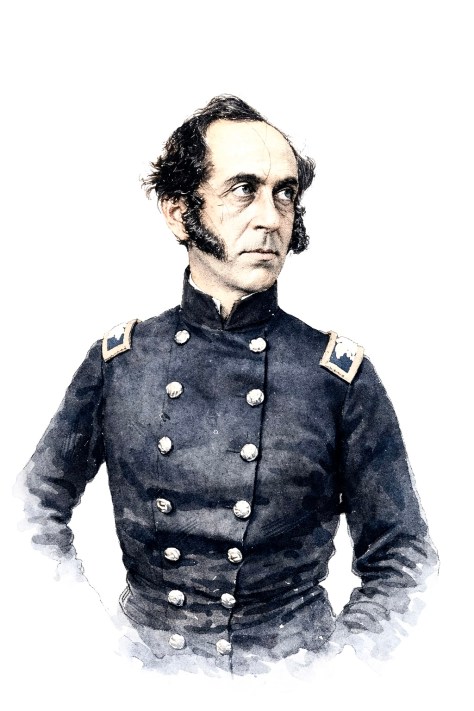
A post Civil War image of William B. Blair

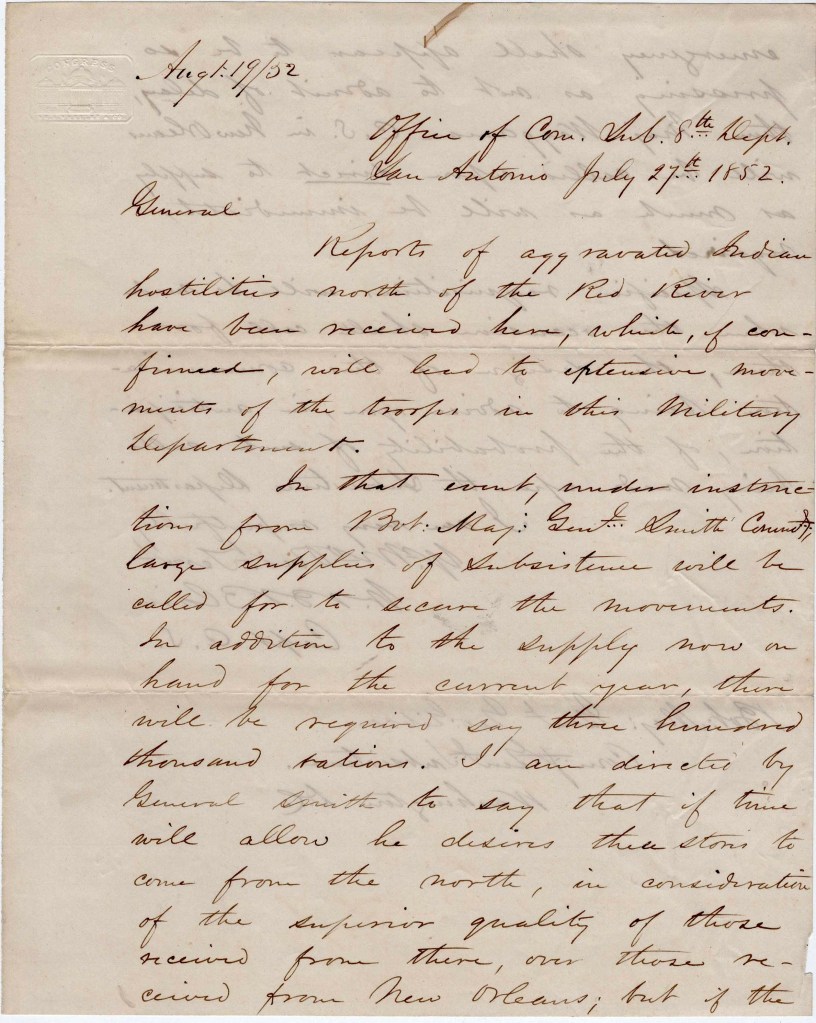
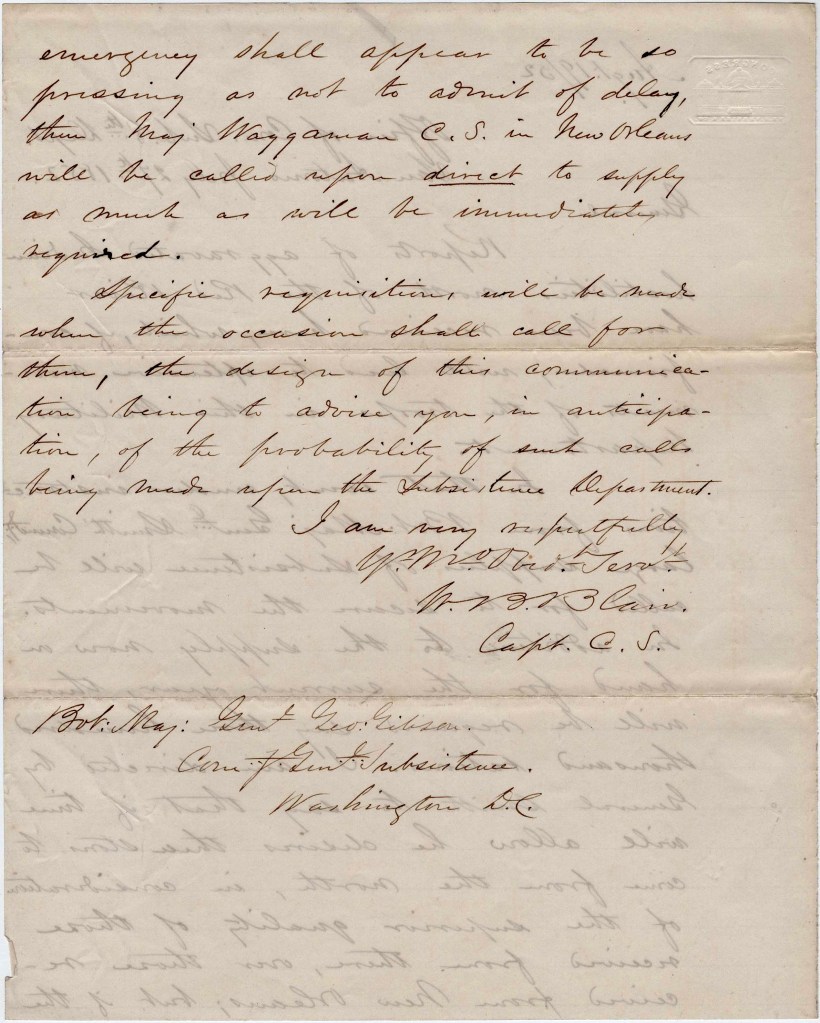
The following letter 1852 was written from San Antonio, Texas, during a period of heightened conflict north of the Red River. It was penned by Captain William Barrett Blair (1818-1883) to Commissary General George Gibson, reporting “aggravated Indian hostilities” which, if confirmed, will require “extensive movements of the troops in this Military Department.” Acting under the direction of Brevet Major General Persifor Frazer Smith, Blair anticipates the need for “say three hundred thousand rations” beyond the current stock on hand. Blair notes a preference for supplies obtained from northern depots “in consideration of the superior quality of those received from there, over those received from New Orleans,” but authorizes immediate procurement through Maj. Henry Waggaman in New Orleans if the situation proves too urgent to allow delay. Blair closes by advising the Subsistence Department that formal requisitions will follow as the situation develops.

The 1850s Red River–Cross Timbers corridor remained one of the most volatile regions in the Southwest, with Comanche, Kiowa, and allied groups resisting U. S. encroachment and the Army maintaining a chain of scattered posts from San Antonio northward.

William Barrett Blair graduated from the US Military Academy in 1838 and after an early assignment to the Northern Frontier, returned to the Academy as a professor of Mathematics until the War with Mexico. In that conflict, he served in the Ordnance and Commissary Departments. He afterward took an assignment in Texas on the staff of the Commissary Subsistence Department unto the Civil War broke out at which time he resigned his commission and joined his native State of Virginia in rebellion against the United States. At the time of his death in 1883, he was on the faculty at VMI in Lexington, Va. 

T R A N S C R I P T I O N

Office of Commissary Subsistence, 8th Deptartment
San Antonio, [Texas]
July 27th 1852

General,

Reports of aggravated Indian hostilities north of the Red River have been received here, which, if confirmed, will lead to extensive movements of the troops in this Military Department.

In that event, under instructions from Bvt. Maj. Genl. [Persifor F.] Smith, Commanding, large supplies of subsistence will be called for to secure the movements. In addition to the supply now on hand for the current year, there will be required say three hundred thousand rations. I am directed by General Smith to say that if time will allow, he desires these stores to come from the north, in consideration of the superior quality of those received from there, over those received from New Orleans; but if the emergency shall appear to be so pressing as not to admit of delay, then Maj. [Henry] Waggaman, C. S. in New Orleans will be called upon direct to supply as much as will be immediately required.

Specific requisitions will be made when the occasion shall call for them, the design of this communication being to advise you, in anticipation, of the probability of such calls being made upon the Subsistence Department.

I am very respectfully, your most obedient servant, W. B. Blair, Capt. C. S.

[to] Bvt. Maj. Genl. Geo. Gibson, Com. Genl. Subsistence, Washington D. C.

1838-39: Alexander Hamilton Phillips to his Family

A Map of the Republic of Texas published in 1837

These letters were written by Alexander Hamilton Phillips (1804-1880), a native of Montgomery county, New York, who graduated from Union College in 1826, studied law until 1830, and then taught in the Lawrenceville, New Jersey, prep school for boys. He came to Texas in 1837, was admitted to the Texas Bar the following year and practiced law in Houston and Galveston. From 1839 to 1841 he was in partnership with Milford Phillips Norton. After both men visited Refugio County in the interests of a client, Phillips settled in Lamar, where he married Susan B. MacRae. He represented Refugio County in the Eighth Congress of the Republic of Texas, in 1843–44. He moved to Victoria and served the district after annexation as a senator in the first three state legislatures, 1846–50. From 1852 to 1861 Phillips practiced law in partnership with John McClanahan. The 1860 census listed him as owning $35,000 in real and personal property, including seven slaves. After the Civil War he served as a delegate to the Constitutional Convention of 1866. He was an incorporator of the Central Transit Company Railroad, chartered in November 1866 and intended to connect Texas with the Pacific coast but never built. He formed a partnership with Samuel A. Neville in 1868 and in 1870 joined the firm of Samuel C. Lackey and future Texas Supreme Court chief justice John William Stayton; the firm was renamed Phillips, Lackey, and Stayton. In the 1870s Phillips was senior member of the Victoria bar, whose members claimed that “his was a name to conjure by.” Phillips was an elder of the Presbyterian church at Victoria for thirty years and was one of the founders and incorporators of Aranama College. He died in Victoria on June 24, 1880. 

Two sons, Alexander H. Phillips, Jr., and William Phillips, both served the Confederacy as officers in the Sixth Texas Infantry. Alexander served as major of that unit until his death in Montgomery, Alabama, on June 4, 1863. William was captured at Arkansas Post in 1863 and taken to the notorious Camp Chase, Ohio, where he died. [Source Handbook of Texas]

Letter 1

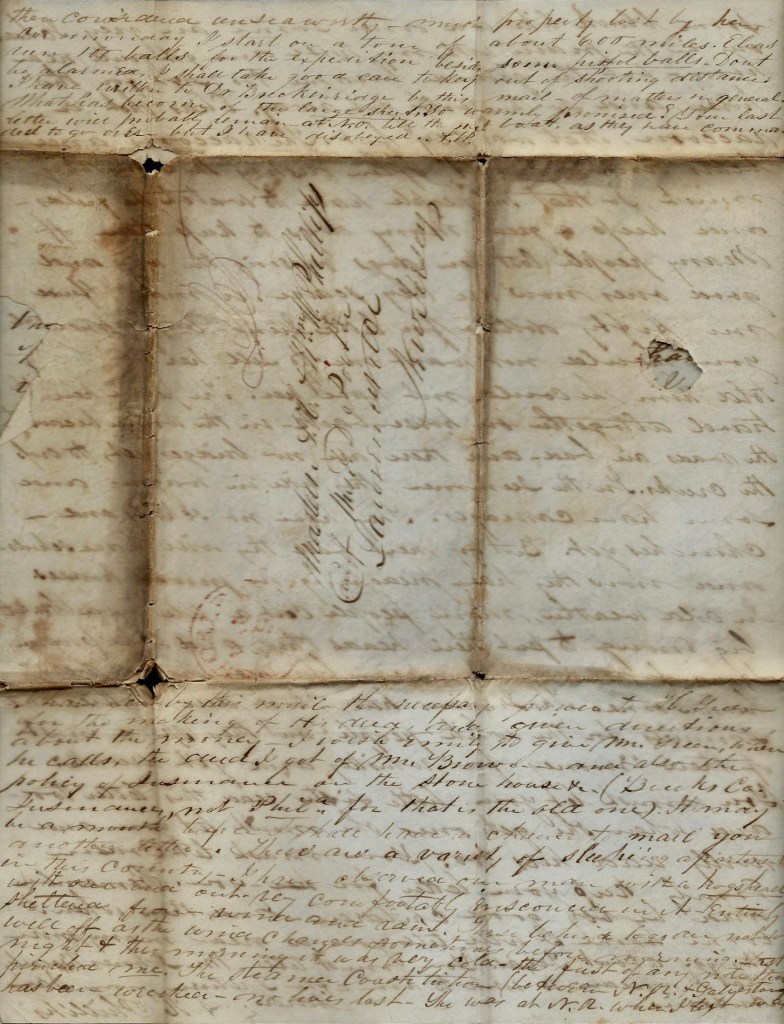
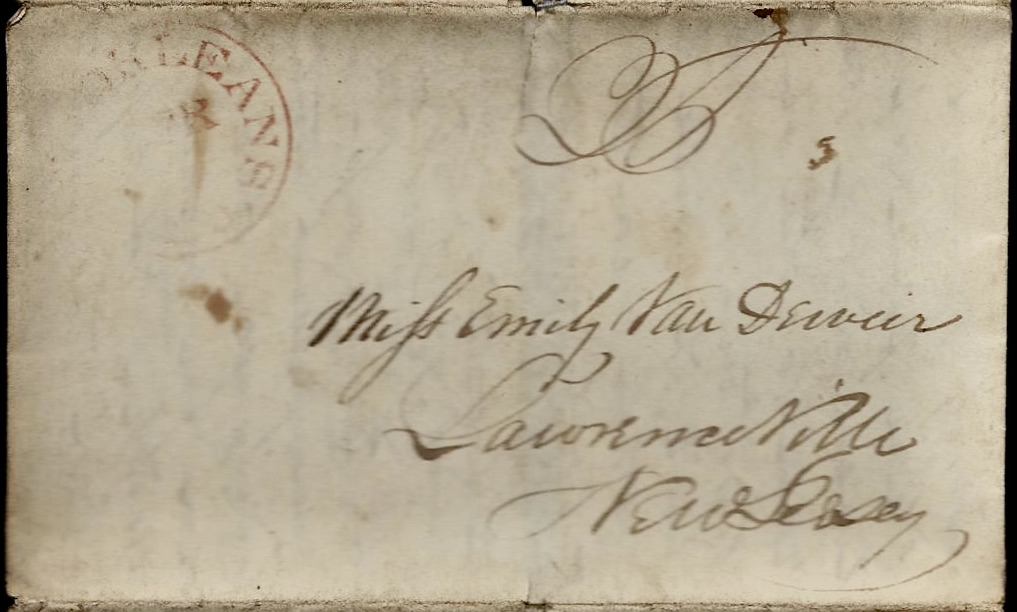
Addressed to Master A. H. & Wm W. Phillips, Lawrenceville, New Jersey

[The Republic of Texas]
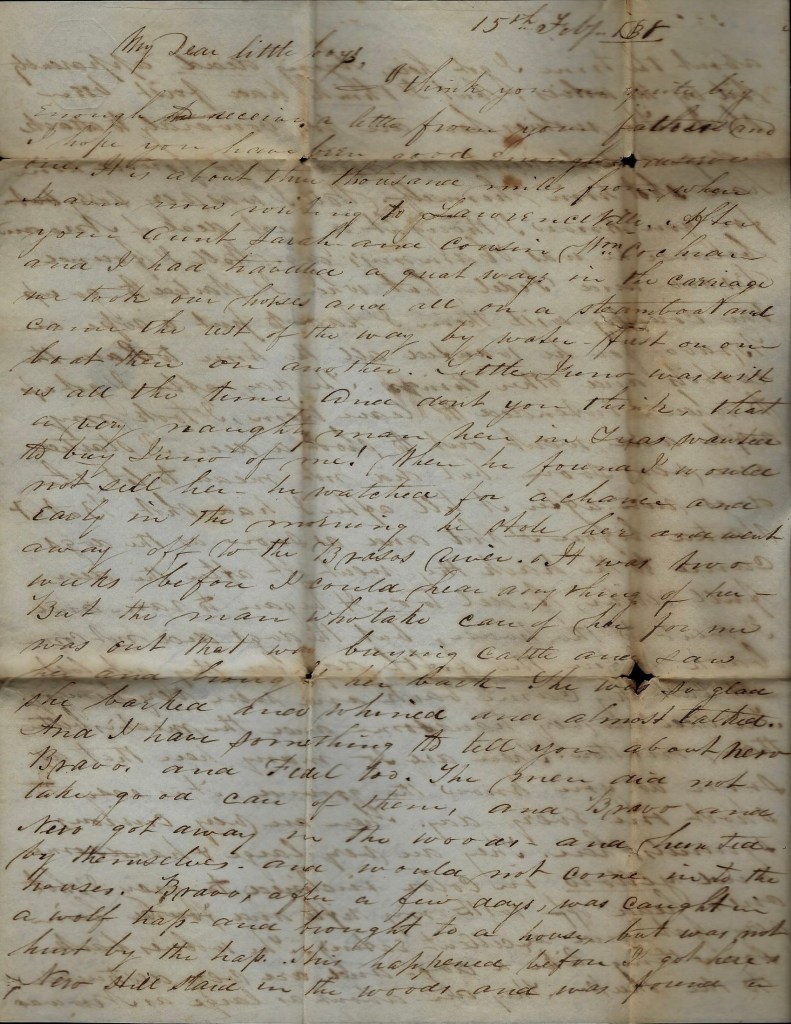
15th February 1838

My dear little boys,

I think you are quite big enough to receive a letter from your father. It is about three thousand miles from where I am now writing to Lawrenceville. After your Aunt Sarah and cousin William Cochran and I had traveled a great ways in the carriage, we took our horses and all on a steamboat and came the rest of the way by water, first on one boat, then on another. Little Juno was with us all the time and don’t you think that a very naughty man here in Texas wanted to buy Juno of me! When he found I would not sell her, he watched for a chance and early in the morning he stole here and went away off to the Brazos River. It was two weeks before I could hear anything of her. But the man who take care of her for me was out that way buying cattle and saw her and brought her back. She was so glad she barked and whined and almost talked.

And I have something to tell you about Nero, Bravo, and Fidel too. The men did not take good care of them and Bravo and Nero got away in the woods and hunted by themselves and would not come into the houses. Bravo, after a few days, was caught in a wolf trap and brought to a house but was not hurt by the trap. This happened before I got here. And Nero still stayed in the woods and was found in about the time I got here, lying dead, apparently bit by the wolves. But I think had just been short. The wolves here are too coward to attack a dog and I think the man who found him had shot him himself. Well, I was very sorry for you know I thought a great deal of Nero and because he was Hammy’s dog. Well, I found Bravo and Fidel but when I started to go up the country with them, I had to put a rope on Bravo for he wanted all the time to chase the rabbits and other things.

The day after I got up to where I intended to leave them, I took my rifle and went out to shhot a deer. I started one very soon but did not mean to let the dogs run after it till after I had shot. But they started before I shot and as soon as the dogs came to the track, they went off after the deer full drive—Fidel too.

It began to rain and I went to the house but the dogs did not come back before the fifth day for they got lost. At last they came back and were very hungry. The deer are very handsome and the meat is better than mutton. There are so many here that as soon as you know the grounds, it is easy to shoot one every day. There are very curious squirrels here. They are very large & handsome and yellow in color, inclined to grey. I shot one’s head off with my rifle and found him very fat and excellent eating. The wolves bark something like a dog and are very destructive to the sheep. They are about as large as Nero was. Some black like Don and some are grey. I chased one in the prairie with my horse and got quite near him but the ground became too soft for the horse, and so the wolf got away.

Elias shot a raccoon that was very fat. The raccoons and bears and squirrels often destroy the corn very much so that the people have to watch the fields and keep a great many dogs to keep them off. Many people lost their dogs during the War [of Texas Independence] and good ones now are very scarce. A man offered me fifty dollars for Little Juno but I knew you would not want me to sell her. I told him he could not have her.

The people here travel altogether on horseback in the winter because the roads are bad and there are no bridges yet to cross the creeks, In the summer, they ride in wagons and some have carriages. They have no schools and churches yet but by next fall they will have schools. And now they have preaching in private houses. In cold weather, many people cut a hole in a blanket big enough to put their heads through and so keep warm. Some of them are Mexican blankets and are very handsome. The Indians here shoot deer, turkeys, and squirrels for the white people but they spend most of their money for whiskey and get drunk.

You might let your little sister read this letter too and when she gets one, she must let you and Willy read hers too. You must let Cousin Emily keep your letter for you. Remember and be very good children and then when I come home, I will tell you a great many more things about Texas. You must tell Mr. Johnes Boerly that I mean to write to him after I return from San Antonio.

Adieu, — A. H. Phillips

I have sent by this mail the necessary payment to H. Green for the making of his deed and given directions about the money….There are a variety of sleeping apartments in this country. I have observed one man with a hogstand sheltered from winter and rain. Those behind logs are not so well off as the wind changes sometimes before morning. This morning it was very cold—the first of any note that pinched me.

The steamer Constitution (between N. O. and Galveston) has been wrecked. No lives lost She was at N. O. when I left was then considered unseaworthy. Much property lost by her.

On Monday I start on a tour of about 600 miles. Elias run 100 balls for the expedition beside some pistol balls. Don’t be alarmed. I shall take good care to keep out of shooting distance. I have written to Dr. Breckinridge by this mail of matters in general. What has become of the large sheet so warmly promised? Your last letter will probably remain at N. O. till the next boat as they have commanded to go over but I have been disobeyed. — A. H. P.


Letter 2

Addressed to Miss Emily Van Dervier, Lawrenceville, New Jersey

Bexar [Republic of Texas]
March 8, 1839

My Dear Emily,

Before I left Houston two months ago, I wrote to Cochran to detain your letters at New Orleans till I apprised him of my return to Houston. This accounts for my not having heard from you in a long time as well as for your not receiving letters from me lately with as much regularity as usual. At this place, the population is mostly Mexican. I have been much amused here in learning the manners and customs of the people. I have devoted all my leisure hours to the Spanish grammar and have advanced so far in the acquisition of the language that I can understand the run of their conversation generally and can so far speak it as to make myself understood with regard to anything I wish to communicate. Some few of them understand a little English or American as they universally call our language. The Spanish is the easiest language I ever undertook to learn. The greatest difficulty is the pronunciation though when you hear it hourly this may be mastered in a very short time. The vowels have one invariable sound, whatever their position with regard to other letters. The consonants are altogether different in pronunciation from any and vary according to their position. The vowels are sounded differently from ours but having always the same sound are easily mastered.

I will not occupy my paper in details about the people. This will answer us when we have nothing else to talk of during the summer.

I have about completed the several objects of my coming here and have some idea of leaving for Houston in the course of two weeks. I have two surveys to make before I can go. As the excitement of speculation begins to wear off by the completion of my business, I begin to feel the first movings of the excitement so natural and unavoidable to one who has so long been absent and is about making preparations to meet all that is dear to him on earth/ I don’t know yet how soon I shall be able to leave for the States but we have limited ourselves to the 1st of May—if circumstances will permit.

Swett writes me that our notes are not paid punctually but that business is very good. I don’t wish to start home with less than four thousand dollars, This will be of but little account of the loan obtained by Texas does not help to enhance the values of Texas money. If it does not, I shall not sacrifice it at the value it has had in the States during the winter. I am satisfied that the time is not far distant when there will be more silver & gold in circulation in Texas for the population it contains, than in any other country. Here are the mines and these have only to be opened and worked to enrich the country and to furnish a source of currency.

An expedition is now getting up against the Indians and as soon as they are thoroughly whipped, capital will be inverted to develop the resources of these tremendous mountains. The Mexicans were at one time exclusively engaged in these operations as is clear from report not only but from actual remains of their labor. Our plan, we have located on, still had a ladder in it. Another has been worked to an extent which it would take our men a whole year to effect the work. Copper & Coal mines are also so abundant & Lead, that they are not considered worth locating.

If we leave the first of May, we shall probably be at Philadelphia about the 3rd week to rig up. You would be amused to see our present style of living. Sometimes we live well and at others we have parched corn for bread & meat, and corn coffee for drink. It depends on where we are. For the last two months I have twice undressed and went to bed. we sleep in our blankets. I have, however, had all along clean under clothes and shirts, but my stockings sometimes are rather sorry, showing more toe than is altogether “agabable” as the Mexicans say. Make me a few shirts with ruffles.

Kiss the children for me. There is a little boy here (American father & Mexican mother) whom looks so much like Hammy that the first time I saw him, I followed him about the streets for an hour. I could not leave him. Adieu “Señorita” — A. H. P.