Category Archives: Armory Hospital

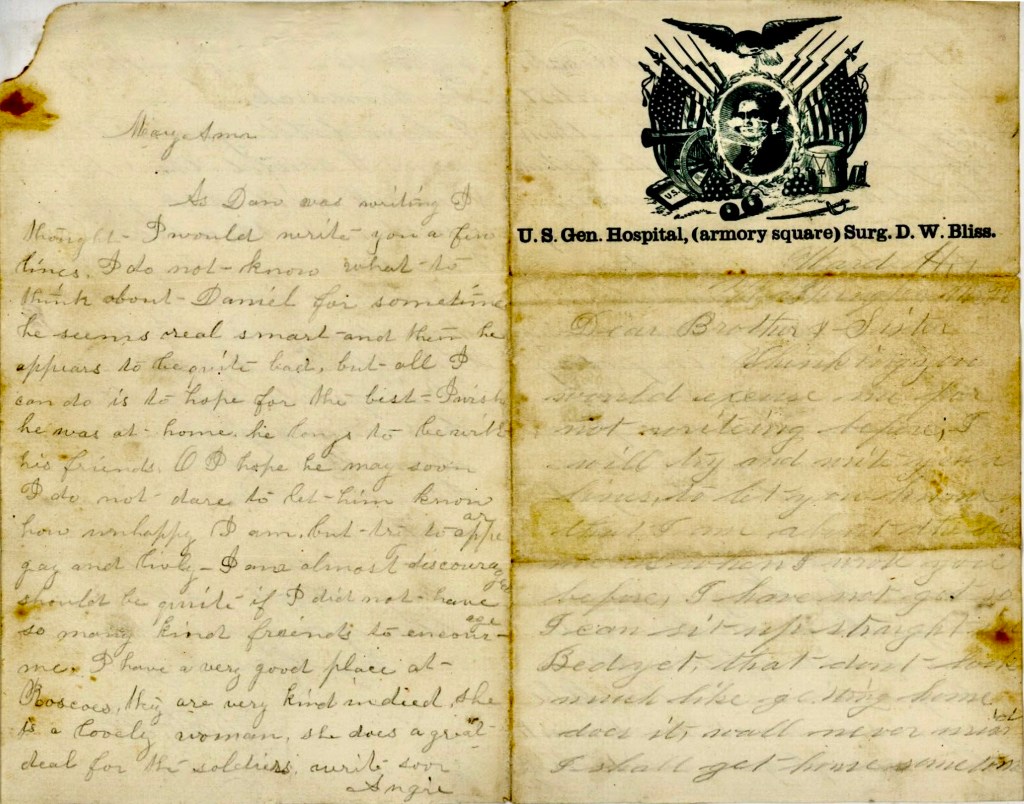
1863: Daniel Franklin Houghton to Mary Ann (Houghton) Greene

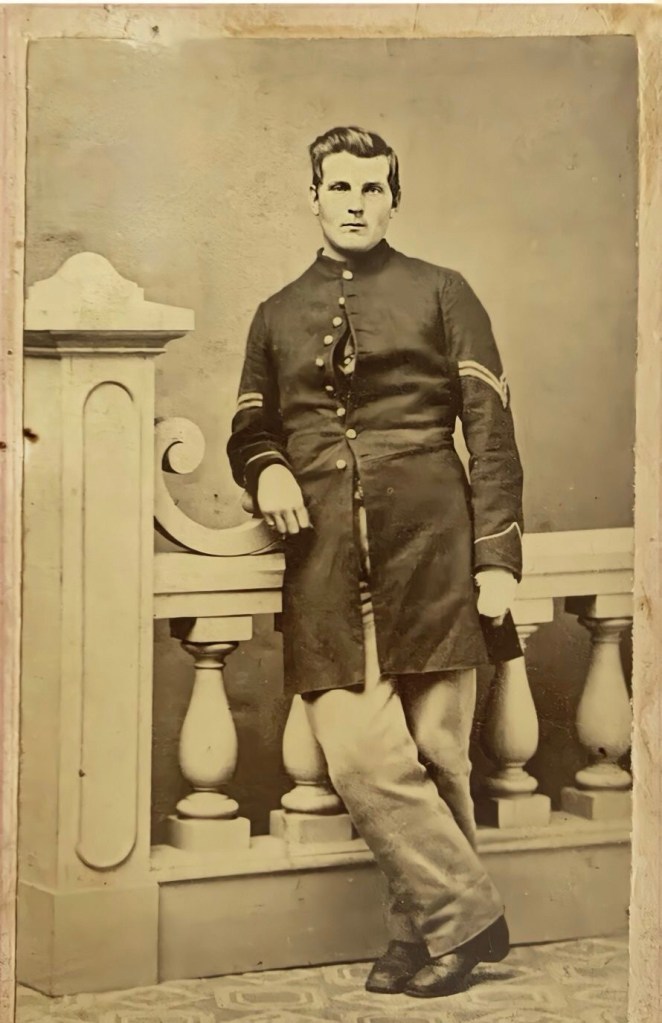
I could not find an image of Daniel but here is Corporal Alonzo Smith of Co. G, 16th Maine Infantry. He was wounded at Fredericksburg too. (Taj Patel Collection)

The following letter was written by Daniel F. Houghton (1841-1889), the son of Abel Houghton (1796-1890) and Elizabeth Parlin (1803-1881) of Weld, Maine. Daniel enlisted when he was 21 years old as a corporal in Co. E, 16th Maine Infantry on 14 August 1862. Daniel was severely wounded during the Battle of Fredericksburg on 13 December 1862 and to save his life, his left leg was amputated. He was discharged for disability on 15 May 1863. A history of the regiment reveals that during the Battle of Fredericksburg, its first engagement with the enemy, the 16th Maine, “unskilled and untrained though we were, to us belongs the credit of bull-dog fighting, until 54 percent of our number were killed or wounded.”

Adding a note at the end of Daniel’s letter was “Angie” whom I believe was Mary Angelia Leavitt (1841-1896), Daniel’s fiancé. The couple were married on 3 May 1866 in Weld, Maine, and they had at least eight children born between 1867 and 1883.

The letter was addressed to Daniel’s older sister, Mary Ann (Houghton) Greene (1828-1906) who married William K. Greene (1821-1889) in 1862.

For a great short video, see “Redemption of the Blanket Brigade: 16th Maine at Fredericksburg.”

Transcription
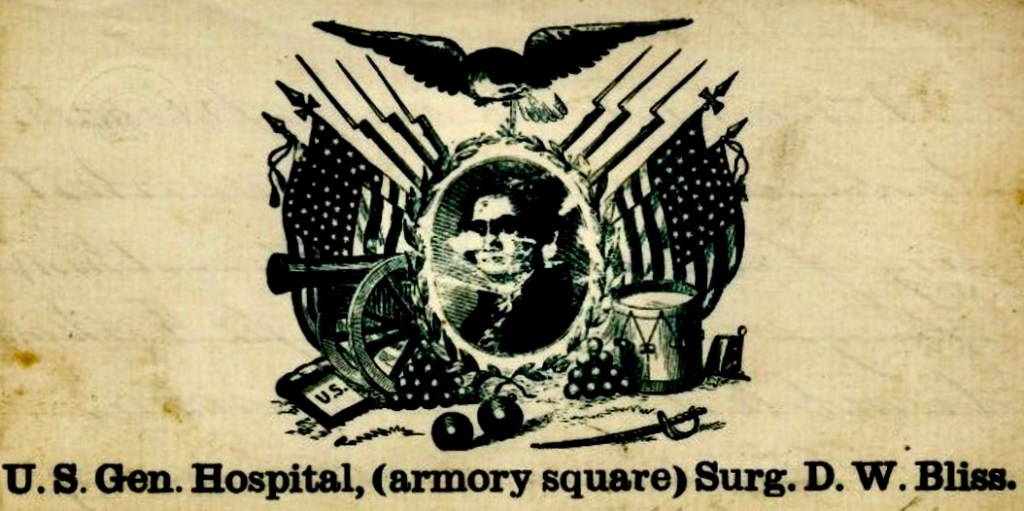
Rare patriotic letterhead labeled US General Hospital (armory square) Surg. D. W. Bliss

U.S. Gen. Hospital (armory square)
Ward H, Washington
[April 1863]

Dear Brother & Sister,

Thinking you would excuse me for not writing before, I will try and write you a [few] lines to let you know that I am about the same as when I wrote you before. I have not got so I can sit up straight in bed yet. That don’t look much like getting home, does it? Well never mind. I shall get home sometime. It would be very pleasant to be sent home and amongst my friends. I often think of you all & I hope I shall be able to see you soon.

There is but a very few here now that was here when I came here. There is new ones coming in here almost every day, We have some Union citizens here now from Virginia. They were taken prisoners & so exchanged.

Roscoe’s folks are all well. Mr. Cory is smart [ ] boy. He is in here with me quite often. Angie is well but she says she won’t write until some of you write to her. I guess she is getting to be homesick. I have told you all the news I could think of & now I will ask you a few questions & then close.

1—Is sleighing all gone there?
2—How does your leg hold out?
3—How does your stock look this spring? I presume it is quite high there? Has Minnie gone home yet? How does all your folks do? There I guess that will do.

Please write soon. May God watch over & bless you & your family. My love to you all, — D. F. Houghton

Mary Ann, as Dan was writing, I thought I would write you a few lines. I do not know what to think about Daniel for sometimes he seems real smart and then he appears to be quite bad, but all I can do is to hope for the best. I wish he was at home. He longs to be with his friends. Oh, I hope he may soon. I do not dare to let him know how unhappy I am, but try to appear gay and lively. I am almost discouraged. Should be quite if I did not have so many kind friends to encourage me. I have a very good place at Roscoe’s. They are very kind indeed. She is a lovely woman. She does a great deal for the soldiers. Write soon, — Angie

The Angel Watchers—July 1863

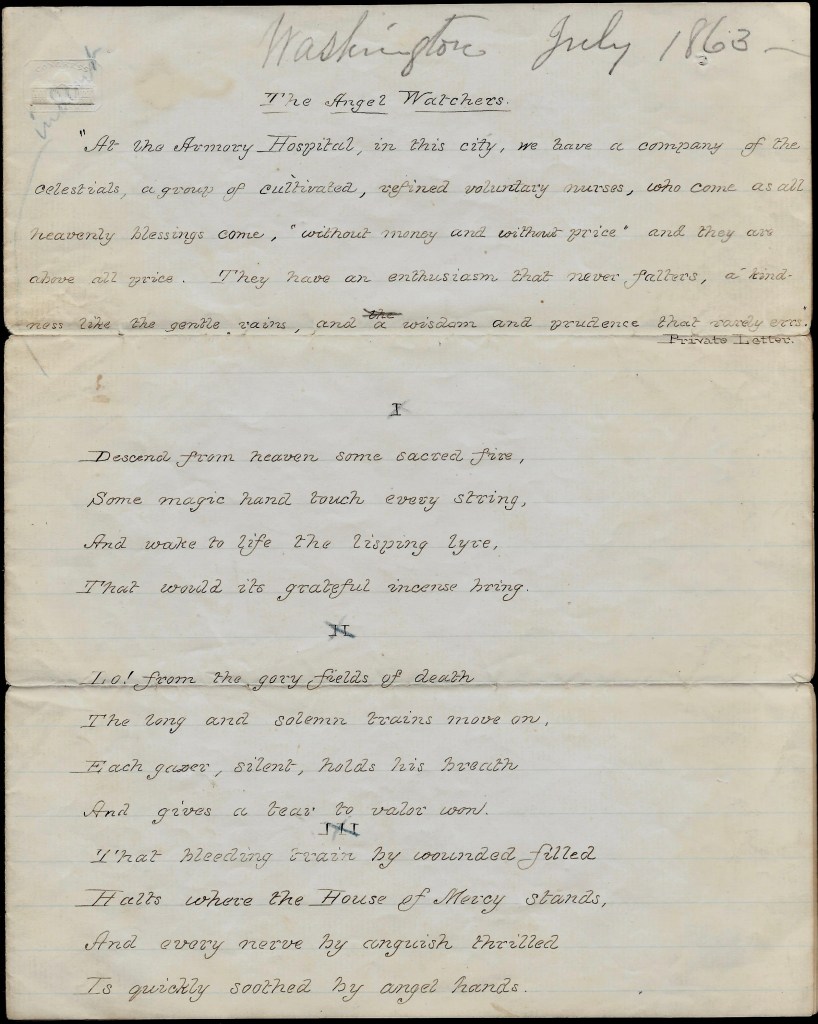
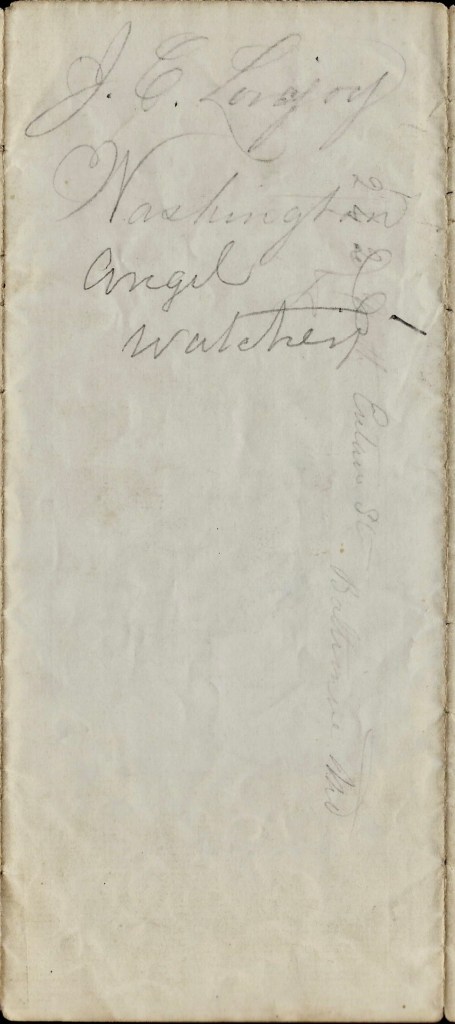
The poem titled “The Angel Watchers” comes from a private collection and is a precious piece of history. It was penned presumably in July of 1863, as indicated at the top of the page. On one of the pages, the name “J. C. Lovejoy” is inscribed, sparking curiosity about the author’s identity. Months after I posted this poem on Spared & Shared, I received a solid clue (see comments) from Eric Pominville who suggested the poem was written by Joseph Cammett Lovejoy (1805-1871), the older brother of Congressman Owen Lovejoy. According to Eric, who has been researching Armory Square General Hospital, he reports that Amanda Akin Stearns (1909) memoir, The Lady Nurse of Ward E, Mr. Lovejoy was a frequent visitor at Armory Square and was well known to the hospital staff. Writing under the date May 14, 1863: “A gallant old gentleman in Congress (brother of Owen Lovejoy, the noted Abolitionist) was introduced to us by Mrs. [Henrietta Crosby] Ingersoll. He says, “We can take care of the soldiers, and he will take care of us,” so he comes quite often to accompany us in a walk after supper through the Capitol grounds. He writes verses, and is a friend of Mrs. Sen. [Henry Smith] Lane. Tomorrow for diversion, he is to take a party of us to another hospital, where they have theatrical entertainments.” Akin, The Lady Nurse of Ward E, (1909), p. 27-28.

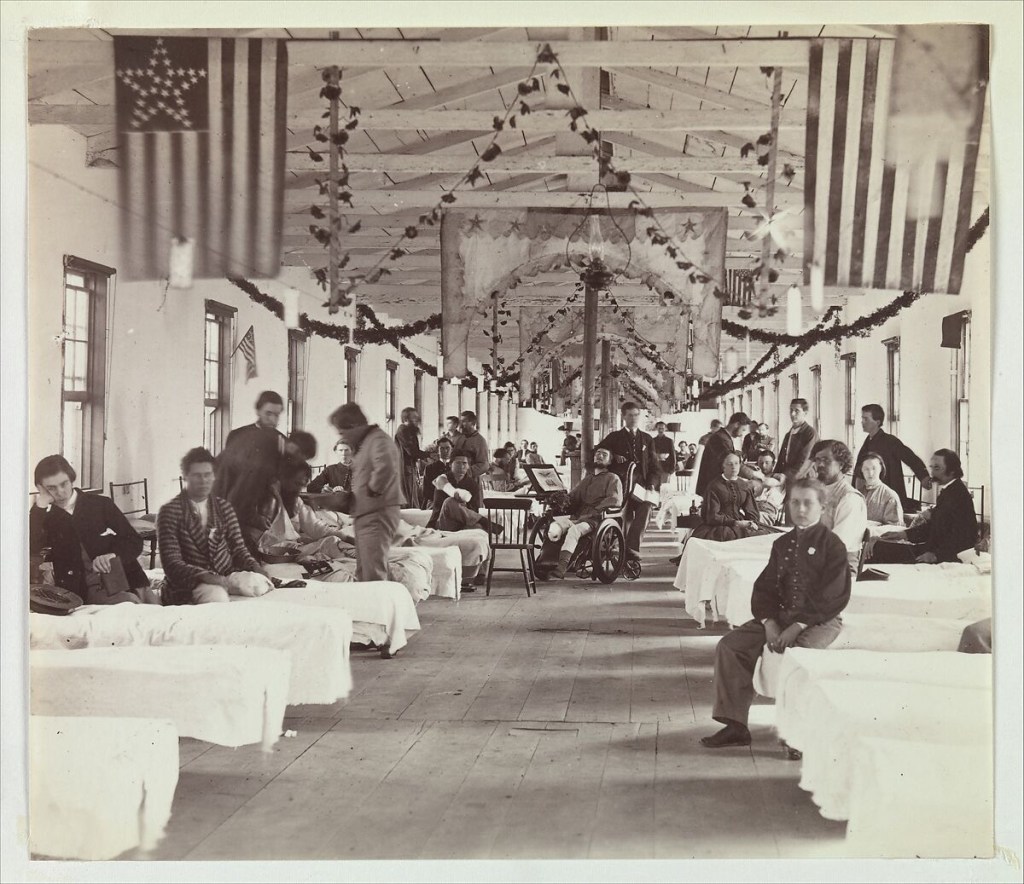
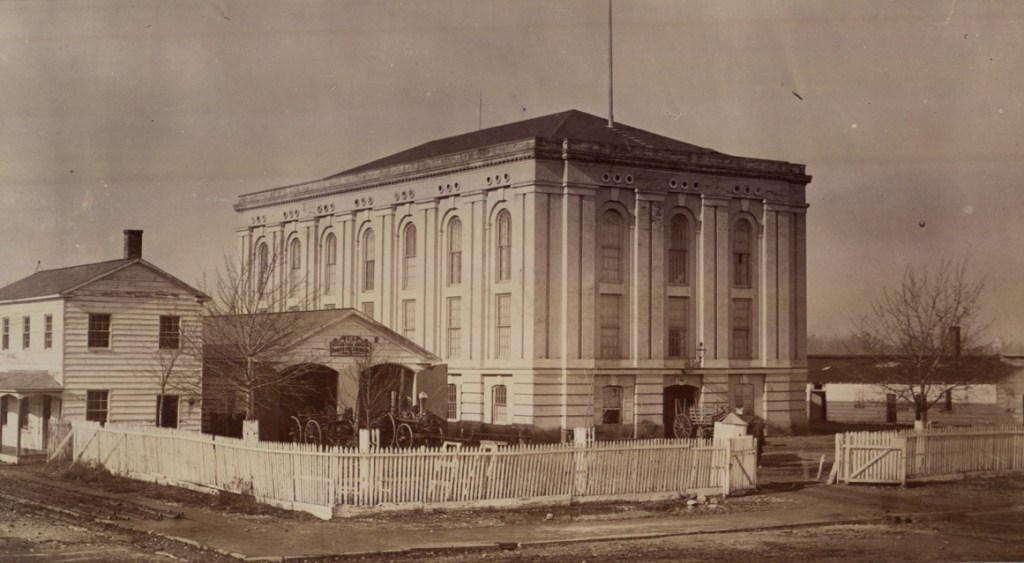
I have searched the internet extensively to look for evidence that this poem was published at some time but could not find it. That search included newspapers and “Google Books,” etc. The Armory Hospital was established in 1862. It was constructed on land adjacent to the Smithsonian Institution, approximately where the National Air and Space Museum is today. There was an anniversary celebration at the hospital in August 1863. Perhaps that is when this photograph was taken and was the occasion for the poem.

Armory Hospital in the District of Columbia

The Angel Watchers

At the Armory Hospital, in this city, we have a company of the celestials, a group of cultivated, refined voluntary nurses, who come as all heavenly blessings come, “without money and without price” and they are above all price. They have an enthusiasm that never falters, a kindness like the gentle rains, and a wisdom and prudence that rarely errs. Private Letter.

Descend from heaven some sacred fire,
some magic hand touch every string,
And wake to life the lisping lyre,
That would its grateful incense bring.

Lo! from the gory fields of death
The long and solemn trains move on,
Each gazer, silent, holds his breath
And gives a tear to valor won.

That bleeding train by wounded filled
Halts where the House of Mercy stands,
And ever nerve by anguish thrilled
Is quickly soothed by angel hands.

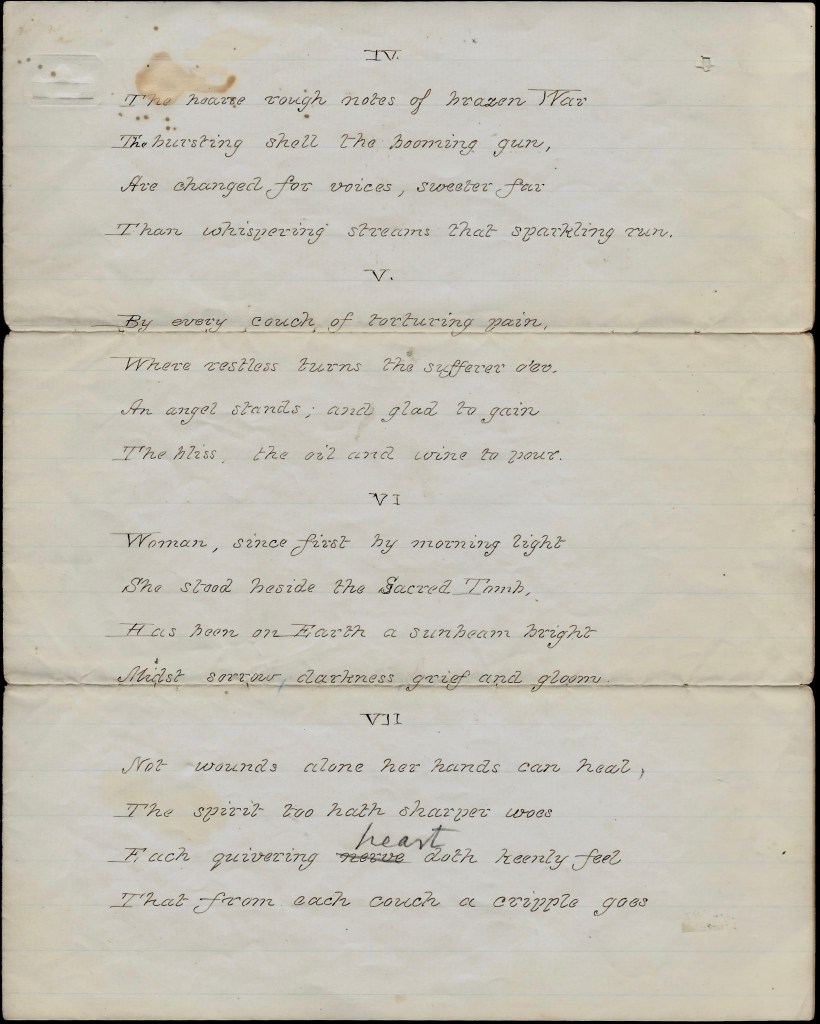
The hoarse rough notes of brazen war
The bursting shell the booming gun,
Are changed for voices, sweeter far
Than whispering streams that sparkling run.

By every couch of torturing pain,
Where restless turns the sufferer o’er,
An angel stands, and glad to gain
The bliss, the oil and wine to pour.

Woman, since first by morning light
She stood beside the Sacred Tomb,
Has born on Earth a sunbeam bright
Midst sorrow, darkness, grief and gloom.

Not wounds alone her hands can heal,
The spirit too hath sharper woes
Each quivering heart doth keenly feel
That from each couch a cripple goes.

Nancy Maria Hill, one of the nurses that worked at Armory Square Hospital (LOC)

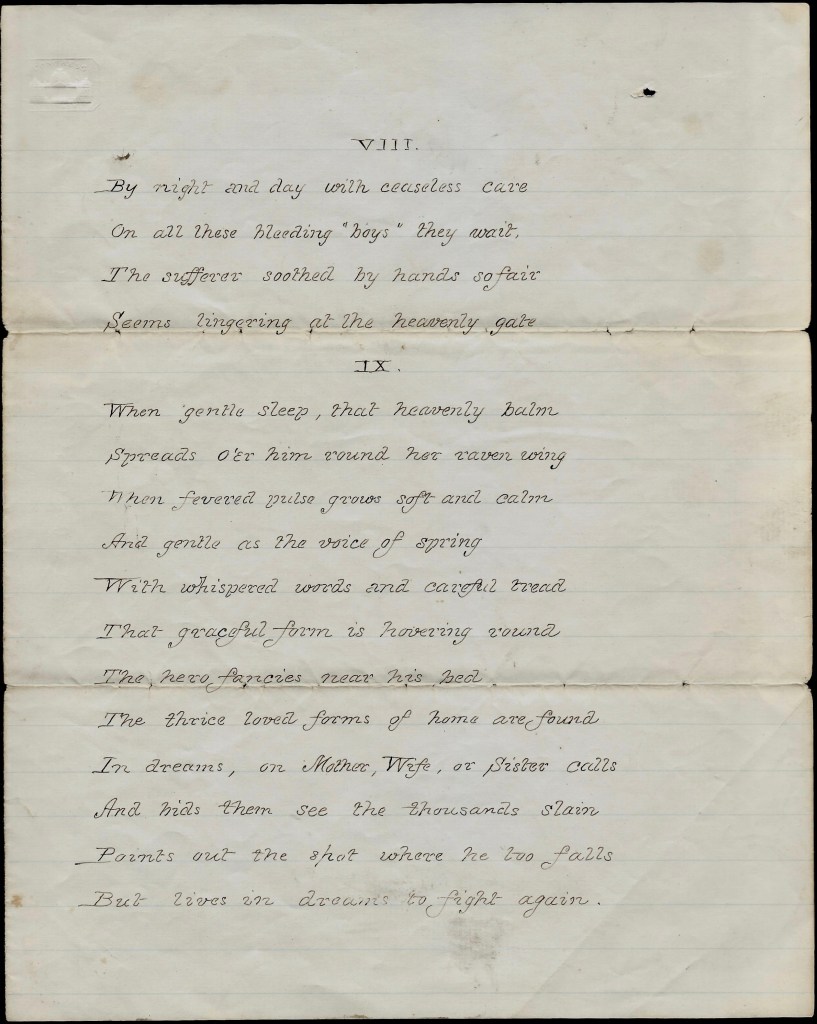
By night and day with ceaseless care
On all these bleeding “boys” they wait,
The sufferer soothed by hands so fair
Seems lingering at the heavenly gate.

When gentle sleep, that heavenly balm
Spreads o’er him round her raven wing
When fevered pulse grows soft and calm
And gentle as the voice of spring

With whispered words and careful tread
That graceful form is hovering round
The hero facies near his bed
The thrice loved forms of home are found

In dreams, on Mother, Wife, and Sister calls
And bids them see the thousands slain
Points out the spot where he too falls.
But lives in dreams to fight again.

Exterior of Armory Square Hospital during the Civil War,