An unidentified member of the 104th OVI taken in Nashville (Jason Lynn Pate Collection)
The following letter was written by James Peden (1828-1896) of Co. F, 104th Ohio Volunteer Infantry (OVI). He was the oldest son of William Peden and Elizabeth Richards of Wellsville, Columbiana, Ohio. Serving with him in the same company were his younger brothers, Hezekiah Peden (1831-1881) and William Peden (1841-18xx). James was married to Christina McIntosh (1808-1896).
James enlisted in Co. F, 104th OVI on 12 August 1862 and mustered out of the regiment on 17 June 1865 at Greensboro, North Carolina. “Co. F was recruited from Wellsville, and the towns adjacent, up and down the Ohio river, and along the line of the C & P Railroad with the disadvantage of having within its ranks an undue proportion of “toughs” and “dead beats.” Still Co. F always held its own with any other company in the regiment for efficiency and readiness for duty.
Harvey, the mascot of the 104th OVI
Co. F also rejoiced in the ownership of two dogs which became the pets of the regiment. “Old Harvey” had been in service before; was wounded in Virginia and again at Resaca. He was an aristocrat and wore a brass collar with the legend, “I am Lieutenant D. M. Steam’s dog; whose dog are you?” After Lieutenant Williamson’s death, “the blue pup” became a “child of the regiment.” By his antics, especially his tricks with fire, the boys were often thrown into convulsions of laughter. Unluckily, he tumbled off the train on which the regiment were going from Cincinnati to Washington.”
James’ letter speaks of the fighting by the regiment at Tunnel Hill and at Resaca. The 104th Ohio sustained a total of 183 fatalities (including those killed, mortally wounded, and died of disease) throughout its service, with Resaca being one of its earlier, significant battles in the 1864 campaign.
T R A N S C R I P T I O N
[In the Altoona Mountains] June 8, 1864
Miss Jenette McIntish in haste.
I will pen a few lines to let you know that I am well, hoping you & yours to be the same. Well, Janet, we are fighting a little every day. We have drove the Rebs about 80 miles into Georgia, We had a hard fight at Tunnell Hill & still harder at Resaca. We lost a good many men but not as many as the Johnny Rebs. We charged on their breastworks. The contest lasted about 30 minutes & the two armies was very close together during that time, varying from 10 to 40 feet apart. I shall not say anything about the field after the fight was over.
Now, at this instant, we are in the Altoona Mountains following after the scared Johnnies. They are retreating towards Atlanta, Georgia—a distance from this point of 30 miles. It is supposed they will make a stand 15 miles from here called the Lost Mountain but I think it will be of no use to them for we must or will whip them. I would say to you that the Armies of Sherman & Thomas & Hooker have grown desperate & will wipe rebellion out afor they get a chance so to do. Officers & privates generally think we will be in Atlanta on or before the 4th of July, 1864.
Now I will close by wishing you a long and happy life. Give my respects to your father and mother and mother’s sister [?]. Keep a bucket full for yourself.
[James] Peden to Jenette McIntosh
Now Jenette, this letter, I want everyone that may read this to consider that I wrote it to him or her as the case may be.
To Mrs. Crisy James Peden, I am thankful to you for your likeness which you sent me accompanied with a kind & acceptable letter, hoping the time will soon be that I may see the original. Pictures the [ ] of all my [illegible].
There was two killed out of Co. F, 104th OVI. Their names was Van Tyne & [blank] & there was four slightly wounded. Hick [Hezekiah Peden] got a letter this morning from William. He is still at [ ]ville & was better of his illness. Tell father that his sons Heck & James are in the field & is alright as yet and their cry with all true men is down with the traitors wherever they may be.
Write soon. Direct to Chattanooga, Tennessee. First Brigade, 3rd Division, 23rd Army Corps. Co. F, 104th Regiment O. V.
The following note was penned entirely in his own hand by Major General John Newton (1823-1895) in the closing days of the Atlanta Campaign. At the time, Newton commanded the 2nd Division, IV Army Corps in Maj. Gen. George H. Thomas’s command. Newton enjoyed the confidence of Sherman and was respected for having successfully commanded the 1st Army Corps after Reynolds was killed at Gettysburg. A few weeks earlier he was credited with helping to win the critical battle of Peachtree Creek. A highly competent engineer, Newton was cautious but not so that he risked his career in late December 1862 by meeting with President Lincoln to voice his lack of confidence in Burnside as the commander of the Army of the Potomac.
Newton composed the note to Lt. Col. Joseph Scott Fullerton (1835-1897), who held the position of Aide-de-Camp and Chief of Staff for Thomas’s IV Army Corps. The note was intended to inform Maj. Gen. Thomas of observed troop and artillery movements in the area and to inquire, essentially, whether they were allies or adversaries. Schofield’s maneuvers seemed to be unknown to Newton, who was in the process of preparing to disrupt the Macon & Western Railroad to the south of Atlanta, becoming involved in the Battle of Jonesborough from August 31 to September 1, 1864.
[Note: This letter is from the collection of Jim Doncaster who made it available for transcription and publication on Spared & Shared by express consent.]
T R A N S C R I P T I O N
Headquarters 2nd Division, 4th Army Corps In the Field, August 30, 1864 8 o’clock p.m.
Colonel,
I have the honor to report that Lt. Col. [Porter] Olson, 36th Illinois [Infantry], of my Division reports that he saw a column of troops moving into position north-east of [John A.] Mann’s House at about sundown this evening. 1
Col. Opdycke from his position about 600 yards in advance of the works heard the movement of artillery. The Maj. General Commanding can judge whether this was Gen. Schofield’s troops or not. I incline to think it was not. I am sir, very respectfully your obedient servant, — John Newton, Brig. General Commanding
Lt. Col. J. S. Fullerton, AAG & Chief of staff, 4th A. C.
1 The John A, Mann farmhouse is mentioned in several official dispatches in describing the movements of the 4th Army Corps from Red Oak to the Macon Railroad at Rough & Ready on 30 August 1864. See Marker: The Mann House.
The following letters were written by William Washington Downing (1827-1908), the son of Timothy Downing (1801-1887) and Rachel Davis (1803-1883) of Pike county, Ohio. William was 34 years old when he enlisted in Co. D, 33rd Ohio Volunteer Infantry (OVI) in August 1861. Given his maturity, he quickly rose in rank to 1st Sergeant of the company and served in that capacity until August 1864 when he was promoted to 1st Lieutenant of Co. E. He mustered out as a veteran of the regiment and as Captain of Co. E, serving a total of nearly four years. After returning from the war, William relocated to Benton county, Missouri, where he farmed and lived out his days.
The flag of the 33rd Regiment Ohio Veteran Volunteers
William’s younger brother, Henry Clay Downing (1844-1862), also served in Co. D with him early in the war but died of disease in August 1862. All of the letters below were written to his younger sister, Sena (Downing) Lightle (1834-1910) whose husband Peter Lightle had also served with William in the same company but was killed during the Battle of Perryville in October 1862.
William was twice married. His first wife was Mary Howard (1827-1854). His second wife was Rachel Hooper (1833-1907). A son by his first marriage, Arlington (“Arly”) Leslie Downing (1848-1929) also served in 33rd Ohio with William. He was recruited in and joined Co. D in February 1864 when he was but 16 years old.
William possessed a noteworthy and engaging style of writing that stood out among soldiers. His expressions were often humorous and unusual. And of all the thousands of Civil War letters I have transcribed, his are the first to document the use of camouflage by Union skirmishers (see letter of June 9, 1864 before Atlanta).
William’s letters are the property of Natalie Stocks who graciously made them available to Spared & Shared for transcription and publication. Sena (Downing) Lightle was her g-g-g grandmother. She inherited the letters of William, his brother Henry, and their brother in law, Peter Lightle, all of the 33rd OH Infantry Regiment, Co. D.
Letter 1
Crow Creek, Alabama August 1863
Dear Sister,
I pen you a few lines this afternoon. My health is very good at present and I hope and trust this may find yourself and little ones well. I am glad that notwithstanding the prevalence of much sickness around you that it has not yet entered our own doors and I trust a kind Providence that it may not. In what respect you favor the eel [?] you speak of is more than I can say, but as it regards the scolding you got from me, it certainly was not as tormenting in its effects as taking the hide off. It was not so intended. At least its effects were very gratifying—it brought you and Rachel both out. I give her a little [scolding] also and at last I heard another tune that pleased me better than Morgan. As to an apology, you need never to have mentioned it because I have got to be one of the best natured individuals in the world.
I am much pleased to hear that the weather god has at last concluded to do like the ladies always does on Crooked Creek—follow the fashions a short space and has given you plenty of rain. I am sorry that the prospect for corn on the old place is so poor. But as plenty of rain has now come, if the fall is favorable as common, no danger but what corn sufficient will be raised to make all the meat that may be required and as bread more than sufficient for another year is already secured. The dwellers around the old point have every reason to congratulate themselves and as the prospect is favorable yet for plenty of turnips and although potatoes may be few in a hill and small at that, yet there may be some cabbage, some plump hens, some parsnips, some beans, some blackberries, some apples, some dried roasting ears [and] all these together—although little of each—will make a pretty large sum. I want you and Rachel to see to it that you help father take care of all and each of these things. If you do, although thousands throughout the country during the dark and stormy days of the coming winter, will suffer the gnawings of hunger, yet our own little ones can revel in abundance. As long as there is anything on the old place to eat, it is my desire that yourself and little ones shall have part of it.
I will write to Henry Soerbach and request him to pay you immediately the money he owed Peter. It is not less than 6 dollars and it may be 8. Ben Lewis says Henry will know as they talked about it often while at the hospital together. Ben has forgot the amount. I guess you will have to lose what Peter’s mess owed him for the calf. Talk with them about it. They all know that they owed him but it is so messed up among hands, none seems to know just how it is. Some says they have paid theirs to some of the rest to pay over. They say they didn’t and the up shot of the matter is I don’t think they intend to pay it at all.
Dear sister, since you asked my advice as to what would be the best for you to do with the money you will get from the government this fall, I will just say that I intend to pay Crist what we owe him and keep the place ourselves. So you can just content yourself where you are. We intend to pay him the greater portion of the debt towards new year, and if you feel so disposed to let us have a part of your money to help save the old place, we will pay it back to you if not well and good. Content yourself and remain where you are anyhow. For safe keeping as soon as you get your money, if you don’t want to use it right away, take it to Emmitt’s. Take a certificate of deposit for it. If he will allow you interest on it until you want to use it, so much the better. If not, leave it anyhow. It will be the safest there. I have wrote you a long letter so l will close by requesting you to write often. I ever remain your true friend and brother, — William
P. S. Don’t read this letter once and then burn it, but ponder well what is written.
Letter 2
Chattanooga, Tennessee December 30, 1863
Dear sister,
In answer to your kind favor of the 20th, I pen you a few lines tonight. I had begun to think that all my friends in Pike county except Rachel had forsaken me. But night before last, I was undeceived. The letters just poured in. I sat for about two hours and read letters and felt as clever as ever Aunt Sallie did in a Methodist lovefeast. You tried to excuse yourself by saying the reason you didn’t write was that there was nothing to write about. I accept no such excuses for there was something to write about. You were all alive and well, were you not? You could have wrote and told me that certainly. And I assure you, nothing could be written that would interest me so much as that. Just let me know that are all are well at home and I can get along very well. Of course I like to hear all of the news, but I want you to make this the last time that, like Macabre, you wait for something to turn up before you write. 1
My health is only tolerable good. A spell of the headache has been bothering me for the last several days, but is better tonight. And to make htings more disagreeable, I have had muster rolls to make out, the monthly return of the company, and a great deal of other writing besides, so that I am about played out in that line. So you will have to excuse all deficiencies in this letter—both of manner and matter.
I hope this may find yourself and little ones well and hearty. Tell Allie to hold on. I will be at home in the summer and will learn him how to husk corn and pull flax and thrash soup beans too. Tell Eva that Uncle Will says she must be a good girl and learn her book and learn how to work so when mother is busy, she can get dinner, wash the dishes, and do up the work like a woman. She must learn how to knit and sew and do all kinds of work—and that she must hurry or Toey will beat her.
There is nothing whatever going on here except a little work being done finishing up the forts and the building of a bridge across the river. The cars don’t yet run nearer than 14 miles of here and the time when they will come nearer, I think, is still distant.
From the tone of your letter, you seem to think that the house I live in would not be just the thing for wet and stormy weather, seeing it is constructed out of material so frail. But I assure you that it is not only comfortable in dry weather, but is not to be grinned at even when it rains and storms either. It is not covered with coffee sacks but a first rate quality of dog tents. One side only is weather boarded with coffee sacks. They don’t keep the cold out very well, it’s true, but then they are better than nothing. But as an off set to this, I have a most charming fireplace. And the crowd around it not being large—consisting of but one individual about my size, I can make a good fire when the weather is cold, and like the Indian, sit close to it. As to the house taking fire and burning up some night while I sleep, there is not much danger from the fact that the chimney runs up to the top of the house and I never yet knew a spark to set a dorg tent afire. Id there any Sparks flying about on Crooked Creek these days or is there not?
What pity the Pike county [Peace] nuts can’t inveigle a lot of poor Devil’s into the Army in their place and let their worships remain at home. They may screw and squirm as much as they please, but their time is coming certain as the 7 year itch, and that never fails once in a lifetime nor never will.
There will be an effort made in a few days to induce the 33rd [Ohio] to go in as veterans but don’t think it will be successful. Ben Lewis made application for a furlough the other day. His papers came back this morning vetoed. The Waverly boys are all well. In fact, nearly everybody here is well. This has been a warm, sunny day but looks now as though the rain would pour before morning.
Well, for fear you will get as tired reading this as I am writing it, I guess I had better stop right here. Write often all the news—especially about the Sparks. Ever your true friend and brother, — William
1 The character Mr. Micawber from Charles Dickens’s novel David Copperfield was famous for his eternal optimism and his personal maxim of “something will turn up.”
Letter 3
Chattanooga, Tennessee January 17, 1864
Dear sister,
In answer to your kind favor of the 1st and 3rd of January, I pen you a few lines this afternoon. My health is very good and I trust when this comes to hand, it may find yourself and little ones well. From all accounts, there certainly never was such a storm ever witnessed in this country as that that begun on New Year’s eve. And it seemed to be a pretty general thing everywhere. It stormed here at the same time nearly if not quite as hard as it did there. But I reckon was not quite as cold. But the citizens say it never was any colder here in the memory of the oldest inhabitants. It is not so cold here now but is yet somewhat winterish.
There is nothing of interest to speak of going on in this region just now except the reenlisted regiments getting ready to go home [on Veteran’s furlough of 30 days]. The 33rd [Ohio] I suppose will get off one day this week.
You advised me not to reenlist. I had come to that conclusion a while back not to do so, but I studied into the matter and felt satisfied in my own mind that another summer would end the war, and as the old enlistment would hold me until fall anyway, I changed my notion and concluded to go in. As Uncle Sam felt good enough to make me a present of four hundred adn two dollars and thirty days furlough, I thought it nothing more than right to accept both. When I get home, we will argue the point.
You finished your letter on the morning of the 4th by the observation that the snow was 4 or 5 inches deep and very cold. Query—which was cold—the snow or the weather? By the way, did the Sparks fly about during the windy weather or is there nothing on the creek anymore that produce a Spark.
Tell Eva and Allie that I will not write them any letters now but I will beat home some of these days to chat with them. The boys are all well. Nothing more. I remain your affectionate brother, — William
Letter 4
Camp in Woods, Georgia 11 miles from Marietta June 9, 1864
Dear sister,
As I have gopt my washing hung out and a leisure moment to spare, I will inprove it by writing a line or two to you to try and straighten your face for as you have wrote several letters to me and had no answer to any of them, I expect you have an awful pout on by this time which I am sorry for but can’t help—unless this makes it all right. My health has been none of the best for a couple of weeks but I am still able for duty. I trust when this reaches it, it may find you all at home enjoying good health and spirits.
After another two weeks fighting among these infernal broken, brushy, scraggly mean hills that belong to a man—I expect fully as mean—by the name of Bradford, the Johnnies concluded the locality was becoming very unhealthy and incontinently left it during the prevalence of a heavy rain the other night and are now sneaking around among the thickets somewhere between here and Atlanta. The rumor is [they are] preparing to dispute our passage of the Chattahoochee [river] this side of that place where it is said Johnston intends to make his last stand, and, if beaten, calculates to surrender his entire army for to retreat further would be useless. This is what rumor says. I hope the jade may tell the truth for once.
You can form some idea of the battlefields of Resaca and this place when I tell you that the thicket in the fallen timber above Moot’s town is not as dense as it is where the two last fights took place although the hills there are a little higher. I leave you to guess what a nice time our fellows had hunting the Johnnies in such a place, who like a pack of wolves were hid behind every tree, log, or stone, and the brush so thick that you could not see a man until nearly on top of him. And wherever the ground was favorable, they had breastworks of logs and earthworks thrown up, and in making our approaches our men several times unwittingly run against them and suffered heavy loss in consequence. This is the way the 23rd [Army Corps] was cut up so badly. The officer in charge of the Brigade, like a fool, run them into it and he might just as well have run them into Hell five at once.
Hazen’s Brigade of our Corps was served exactly the same and suffered accordingly. Here in these two foolish enterprises hundreds of men were killed and wounded and neither of them added one iota towards the defeat of the Rebels. It is a nice job driving the scoundrels out of these places as well as a work of time, but our fellows goes at it like working by the month.
The skirmishers before they start in, breaks a lot of twigs with the leaves on and sticks them all over the front of their persons, being very careful to stick a large bunch in the hat band in front. The idea is to look as much like a bush as possible to fool the Johnnies, each being fixed up in green. They start in walking as though on eggs [but] in a very short time the guns begin to crack and bullets whistle. The Johnnies hang to their thickets to the last moment. But the Yankees, like Old Virginia, never tires and they have to get out of it at last, fast as their legs can carry them. People at home may think that the good work goes on very slow in this direction, if any such there be. They know nothing about what the difficulties are. When you read this, you will have some idea of them. But thank Heaven, we are gaining ground and the further we advance south, the more open the country becomes. And as these difficulties lessen, the more telling will be our blows on the Rebel armies and I think by the time we reach Atlanta and Montgomery, those armies will be about used up and dispersed. And then the end approaches, for just as soon as this and Lee’s army, or either of them, is dispersed, the Confederacy is gone beyond the hope of recovery by Davis, the Devil, or any other man. Mark that, and I am satisfied that four months is ample time in which to accomplish the good work. And if the hard fighting is not over within that time, I miss my guess—that’s all.
Arly is well and lively as a cricket. He sends his love and word to Lily [and says] that he will not write until we get into camp but when that will be, she knows as well as he. The rest of our boys are well except James Hirn. He is complaining.
The weather is showery and very hot but the health of the troops generally is very good. There is more apples, peaches, black band huckleberries here than you ever heard tell of, and all nearly ripe. The people here lives just as the first settlers in Ohio used to. Every family has a set of hand cards for wool and cotton, a spinning wheel, reel and loom. They raise and manufacture near about everything they eat and wear. It is the happiest life people can live and I long for the time to come when I can enjoy the blessing of such a life myself for I assure you, that the din and confusion of the crowded camp as well as the crash and roar of battle begins to worry me—and I feel as though I wanted to be more to myself, or where I will not be disturbed by any noise more harsh than that heard on and around a well regulated farm. Such as are made by domestic fowls and animals or the voices of those I love.
Happy life—how I long for your return once more. How keenly and with what relish can I enjoy your blessings in time to come. Dear sister, I expect I have wrote all and more than will interest you, so I think we had better close for this time by requesting you not to get in the pouts any oftener than once a week if you don’t get any letters from me for I assure you that materials and opportunities for writing letters here are of the most limited character. And if you don’t get letters from me, don’t make it an excuse for not writing on your part. I ever remain your true friend and brother, — William
Letter 5
Camp in Sight of Atlanta, Georgia July 14, 1864
In answer to your kind favor of 26 June that came to hand over a week ago, I write you a line this afternoon. My health is tolerable. Arly is well and hearty. I hope that this will find yourself and little ones well. The lack of something on which to write is the reason I haven’t answered your letter before but Rachel sent us a lot of paper and envelopes so that I can no longer plead that as an excuse. I am glad that something has put an end to your pouting and straightened your face once more. Sorry that the only means that can accomplish that desirable end is likely to do a great deal of damage to the growing crops in Ohio. I do hope that during the continuance of the hot and sultry weather that the process of sweltering and sweating may so work on your constitution that you many at the first good rain that falls like other folks be enabled to rejoice at the prospect of plenty to eat, and not fall away again into your old habit of pouting while everybody else are in good humor.
Joking aside, if the heat at home has been anything like as great as it has here, I pity you and you have the heartfelt thanks of the soldiers for the sympathy you express for us, for this is truly an awful place. This is hardly any cleared land in this whole region of country. It is one everlasting jungle of black jack scrub pines, green briars, thorns and all other kinds of bushes that ever was thought of, and a great many that never was thought of, I believe, all growing in one eternal jumble, and so thick almost everywhere that a bird can’t fly through. Add to all this the face of the earth which contains nary level foot so far as I have yet been in the delectable state of Georgia. But it’s broken up into holes, knolls, three cornered ridges, little knobs, ravines, and gullies—the sides so steep while chasing the Johnnies the first thing we know, sometimes we are at the bottom of them and have to look straight up to see out. It seems as though long ago some internal convulsion of the earth tossed this country from someplace down below, and it don’t seem to have to got used to the change yet. But everything seems out of place and out of shape. Even the stones don’t seem to have yet become accustomed [to] the situation for in the place of occupying a horizontal position like rocks in a civilized country, they stand on end on the corners, the edges, and every imaginable way.
You can form some faint idea from this the difficulties this army has to encounter aside from Johnston’s army on the advance on Atlanta. Our progress thus far has been at times slow, but has been all the time onward until the present time. We have them drove across the Chattahoochee [river] and into the last ditch between the yank and the town. This river is about as wide as the Scioto [river] but deeper. Nearly all of our army except the 14th and 20th [Army] Corps and some cavalry are on the Atlanta side and are now beginning to crowd the Johnnies’ works pretty heavy. Day before yesterday, our Calvary attacked the Rebels cavalry on Cedar Mountain, seven miles east of Atlanta. The extreme right of their lines defeated and drove them off and still holds the mountain. This gives us a position that will eventually force the evacuation of the town or coop the Rebs up in their works which I do not think they will permit as long as there is a chance for them to get away.
Our corps is still encamped on the heights a mile and a half from the river in full view of the steeples and a few houses in Atlanta which as the bird flies is 2 miles, but by the railroad, 8 miles. I think by the 15th of August we will be in town, and by the 1st of September, Grant will have Richmond. This is my private opinion, publicly expressed. From accounts, the Johnnies are stirring them up tolerably lively in Maryland. It will not amount to much in my opinion. It is a raid to obtain supplies more than with the expectation of diverting Grant from his great purpose of capturing the Rebel Capitol. The prospects of the Rebels are now desperate and they know that unless they can gain some important advantage, and that soon, they are ruined forever. They are satisfied and so am I that this is the last year of the war and if they cannot defeat our armies this summer and fall, they never can do it. Hence their reckless dashes and efforts to destroy the yanks. I am satisfied the result will be alright and six months from this time will see the end.
It seems that Saint Val [Clement Vallandigham] did not create as much excitement on his advent into Ohio as might have been expected. The fact is the old sinner, like his chum John Morgan, is just about played out. So much so in fact that neither of them when stirred up will make a stink. For the life of me, I can’t conceive why the lovers of Val should get sick over anything that McClellan could say because there is as little similarity between them as there is between day and night. McClellan is just as upright, honest, and patriotic as they are sneaking, traitorous, and contemptible. Since it is out of the question for the general to be their man for President, yet one consolation remains to them. There is yet balm in Gilead. Frémont still lives and as the abolition butternuts have already taken him to their immaculate bosoms and roll him as a sweet morsel under their tongues, take my word for it, that the Val-ites will do the same, and the postponement of the Chicago [Democratic] Convention is more than presumptive evidence of this fact and that long before the Presidential election, they will be cheek by jowl with the sneaking abolitionists that they have heretofore cursed so much as the cause of the war and all that.
Some may hardly believe this, but I will bet anyone six bits that the peace nuts will hold no convention to nominate a candidate for this election at all, but will all turn a back summer set over the fence and their coats at the same time, and go their death on the pathfinder.
A word or two from the other side and we are done. The Union Convention at Baltimore seen fit in their great wisdom—or more likely the want of it—-to nominate old Abe for another term. He is a bitter pill, you may well believe, for me to take. But as a rational being, of two evils I am bound to take the least and vote for him in preference to Frémont. The nomination for Vice President suits me better. Andy Johnson, I believe, to be one of the best men in the country. He is honest, capable, and better than all, attends to his own business which is more than can be said of Uncle Abe. This will do on politics for a while I think.
The weather here is awful hot. All we have done for a week is cook and eat and try to keep cool. Our pup tents are literally hid in brush sheds over them and brush set up around them. A storm last night mixed matters somewhat and tumbled over the main house. But everything is now in order and time wags as usual. I believe I have wrote all I can think of this time [that] will be likely to interest you, and perhaps more. So I will close by requesting you to write whenever convenient. Ever your true friend and brother. — William
P. S. I received a letter from Malinda the other day. I had no paper, and had to write an answer on a page she had not filled. I trust she will not think hard. It was the best I could do, and also one from father. I had to scribble an answer on a blank side of a leaf.
Letter 6
Goldsboro, North Carolina March 27, 1865
Dear Sena,
I received a couple of letters from you yesterday and you complain that I don’t answer your letters. I have this to say on the subject. If you was in my place, you would I think write as little as I do, if not less. It was nearly two months that we had no communication whatever with God’s country. This I think will be sufficient to explain to you the reason you have had no letters. It is not because I am out of humor with you al all, but simply for the want of an opportunity to write.
We are now in camp but I am so busy making out my returns that I can’t write much so you must be satisfied with short letters for a while at least. I suppose from the tone of your letters that you are having gay times this winter with your turkey roasts and mighty societies and such. We are having gay times down here too but not just in your style. While speaking of parties, I wish to know what kind of party that your preacher and Iowa Kerns had. Who is Iowa Kerns? It seems your preacher is a gay chap, flogging the ladies in this day and age of the world. If he can’t contain himself but must fight, I would advise that a committee of old maids enquire into his case and if as deperate as his actions indicate, theyshould ship the fat gentleman down here and let him fight the Rebels. But if that should not suit him—which is very likely—he could have full swing at the wenches which I conceive would be much more Christian like than whaling the white women in Pike county—because he could not only preach to them but he could at te same time gratify his fighting propensities by thrashing them occasionally as they are used to it and would not mind it much.
We drew a lot of clothing today and our ragamuffins are much improved in looks, you may well believe. We are now drawing full rations. The railroad is completed to town and steamboats come up within 20 or 30 miles and wagons bring the stores from there. As one railroad is insufficient to supply the army that is now here, if Lee does not leave Richmond soon, he will hear such a hullabaloo in his rear as he never heard before in his life.
The mail has been pouring in by the bushel. Yesterday and today I have got more than 30 letters, a nice coat vest, socks, and shirts, and a nice cake of butter. You ought to have seen me wade into it. It come just as my cook took a warm corn pone out of the oven. Oh but it was good.
Maj. Hinson says the young lady didn’t ask for a man to guard her bull. He says someone is likely to be slandered but he hasn’t come to a conclusion yet whether it will be him or the bull. This is all this time. Write often all the gossip going on in the neighborhood. No more but I am ever your affectionate brother, — William
More biographical information on William W. Downing supplied by family descendants.
The following diary was kept by Cyrenius Whetstone (1839-1922) of New Baltimore, Stark county, Ohio. He enlisted in Battery A, 1st Ohio Light Artillery (“Goodspeed’s Battery”) on 25 September 1861 and served until 31 July 1865. He was married to Charlotte (“Lottie”) Scovel in 1879. He was the son of Solomon Whetstone (1810-1873) and Catherine D. Stickler (1808-1860). A pension record gives his date and place of death as 26 June 1922 at Rock Falls, Illinois.
A brief biographical sketch appears in a history of the battery which reads: “Cyrenius Whetstone enlisted with the Battery at its organization and served with it in all the marches through Kentucky and Tennessee. At the Battle of Stones River, after his gun squad had lost its gun, he used a musket in the day’s battle with the 42nd Illinois Volunteer Infantry. He also participated in the battles of Liberty Gap and Chickamauga, and in the whole of the campaign to and from Atlanta during 1864; was promoted to Corporal on the 13th of September, 1864. Discharged at Cleveland, Ohio, on July 31st 1865.”
Battery A was mustered into national service for three-years at Camp Chase, Columbus, Ohio, in September 1861. They were immediately moved to Gallipolis, Ohio and assigned to Brigadier General Cox and on 22 October 1861 ordered to report to General A.M. McCook, at Camp Nevin, Kentucky. By 1862 the unit had moved to Green River; Louisville; Nashville; Pittsburgh Landing; and the advance on Corinth. Still assigned to McCook they marched to Florence, Alabama; Battle Creek; Jasper; Decard Station; Winchester; Tullahoma; Shelbyville; and Nashville. With General Buell, they marched into Kentucky and fought at Dog Walk and Bowling Green, Kentucky. They also fought with General Rosecrans at Stones River.
In 1863 Battery A was combined with the 20th OIB and Simonson’s Indiana Battery to constitute an artillery brigade in the Army of the Cumberland’s Second Division. The brigade accompanied McCook at Tullahoma; Liberty; Hoovers Gap and over Sand Mountain. They fought with gallantry in the battle of Chickamauga, and for defense of Chattanooga. On October 18th, 1863, Battery A reported to General Speer, at Sale Creek. They advanced through East Tennessee to relive Burnside at Knoxville, and had daily engagements with confederate cavalry until the middle of January 1864.
The unit mustered out at the beginning of 1864, but by February, after a 30 day furlough, most of the men rejoined the unit in Cincinnati, Ohio. Battery A first returned to Nashville, and then on to Catoosa Springs, where they joined the Second Division, Fourth Army Corps, with General Sherman. After joining Sherman’s Army, the unit moved on to Gallatin, Tennessee. Towards the end of the war Battery A was sent to New Orleans with Stanley’s Division, and remained there until they were finally mustered out of national service on July 31, 1865. By the end of the war, the battery had lost 15 men killed in action and 33 to disease. A free book on the History of Goodspeed’s Battery can be found online written by Henry M. Davidson.
This diary spans the year 1864 with the rendezvous of the Battery at Cincinnati until after the Battle of Nashville in mid December 1864.
For those interested in reading letters transcribed by Spared & Shared written by members of the 1st Ohio Light Artillery, among its various Batteries, see:
This diary is the property of Evan Iannone and was made available for transcription and publication on Spared & Shared by express consent.
Identified as Battery A, 1st Ohio Light Artillery, by Larry Strayer in the book, Chickamauga by Time-Life Books. The original albumen photograph is said to have been taken by the Nashville firm of A.S. Morse.
T R A N S C R I P T I O N
Friday, January 1, 1864—Lay in camp at Buffalo Creek, Tennessee.
Wednesday, January 13, 1864—Left Buffalo Creek, Marched about fourteen miles and camped for the night.
Wednesday, January 20, 1864—Arrived at Camp Nelson at nine o’clock a.m. Went to General Hospital to see [brother] Allen [104th OVI]. Stayed with him till the Battery came up. Boarded with the convalescents.
Thursday, January 21, 1864—Allen went to Frankfort. I remained at Camp Nelson till noon. Then started for Nicholasville and remained at the above named place during the night.
Friday, January 22, 1864—Took the cars at Nicholasville for Covington, Kentucky. Arrived at Covington at 11 o’clock in the night. Rendezvoused at the barracks.
Saturday, 23, 1864—Arrived at Cincinnati about ten o’clock a.m. Rendezvoused at Sixth Street Bazaar. Boarded at the Soldiers’ Home.
Monday, February 1, 1864—Took the cars at Cincinnati for Cleveland at 6 a.m. Arrived at Cleveland at 4 p.m. Took supper at the Depot and lodging at the New England Hotel.
Friday, February 5, 1864—Received a furlough at Camp Cleveland to continue 30 days.
Saturday, February 6, 1864—Left Cleveland at 8 a.m. Arrived at Ravenna at ten a.m. Went to the Town Hall where there was an address delivered by Judge Day. Then took dinner at the Taylor House. Started for Randolph at 7 p.m. Stayed with William Ch___ the 7th.
Sunday, February 7, 1864—Arrived at R, M. Hamilton’s at 11 a.m. Took dinner with them. Arrived at Balty [New Baltimore, Stark county, OH] at 4 p.m. Stopped at A. Hamilton’s
Monday, March 7, 1864—Left New Baltimore about noon. Went to R. M. Hamilton’s. Mate & I went to Davis’s, then to W. Hutchen’s, then back to Davis’s again. At 4 p.m., Genl. & I started for Atwater Station. Arrived at Cleveland at 10 p.m. Stayed at the New England Hotel.
Tuesday, March 8, 1864—Went to Camp Cleveland at 8 a.m. Went back to the New England Hotel and stayed that. Genl. and I went to 65, told some lies, then went to the Algier House, took supper, then went with Jim Kendrick and had an oyster supper.
Wednesday, March 9, 1864—Went to Picture Gallery. Had an Ambrotype taken. Then went to Camp. Drew clothing. Went to New England Hotel. Stayed all night. Wrote a letter to A. Hamilton. Sent him physiognomy of those taken.
Thursday, March 10, 1864—Left Cleveland at 9 a.m. Arrived Cincinnati at 8 p.m. Bivouacked in the Depot for the night.
Friday, March 11, 1864—Left Cincinnati at 9 a.m. Arrived Louisville 12 p.m. On the Ohio and Mississippi Railroad. Arrived at Seymour about noon. Stay in the depot till twelve o’clock that night. Had a prayer meeting. The Boys had a big time bumming it around town.
Saturday, March 12, 1864—Arrived at Louisville 12 a.m. Rendezvoused on the corner of Main and 1st Streets. Went to a Picture Gallery and sat for one dozen photographs. Went to see the 19th Ohio Vol. Vet. Infantry. Visited Jink Davis. He went to my quarters with me & he and I played [illegible].
Sunday, March 13, 1864—Left Louisville at 3 p.m. Went to Picture Gallery and received half dozen photographs.
Monday, March 14, 1864—Arrived at Nashville at 6 a.m. Went out to camp and pitched tents. Wrote a letter to Harriet Whetstone & sent her a photograph.
Tuesday, March 15, 1864—Lay in camp at Nashville. Wrote a letter to Allen. We had quite a snow storm. Had a big time initiating the new recruits.
Wednesday, March 16, 1864—Battery C left for the front. Battery A occupied their quarters. I went to Nashville, got shaved, then went and visited Jink Davis. Took dinner with him. Played a game of Seven-Up and beat our opponents 4 out of 7.
Thursday, March 17, 1864—Wrote a letter to Lidia Hollabough. Sent her a photograph. Swept the park. Jink Davis & Perry Woods are here. There were a number of promotions made among the corporals and sergeants. Enjoyed a dance this evening in the Park.
Friday, March 18, 1864—Drilled foot drill at 9 a.m. After drill I went to Nashville. Went to the Post Office. Then to a hardware store. Purchased a frying pan. Paid $1 for it. Returned to camp and wrote a letter to photographers at Louisville, Ky.
Tuesday, April 26, 1864—Received orders to prepare to march to the front. Drew ten days rations & cooked them. Drew dog tents and clothing.
Wednesday, April 27, 1864—Left Camp Brough at 7 a.m. Arrived at Lavergne about three p.m. and camped for the night. Had a big time pitching our new dog tents.
Thursday, April 28, 1864—Left Lavergne at 8 a.m. Had a devil of a rain storm last night and pump tent blew down & had a gay time. Had potatoes, meat, coffee and bread for breakfast. Arrived at Murfreesboro at 12 M. Camped near Camp Sill at Stone River.
Friday, April 29, 1864—Arrived at Shelbyville about 2 p.m. Pitched tents on the bank of Duck River. Went in bathing. Had a big time swimming horses. Marched 22 miles.
Saturday, April 30, 1864—Left Shelbyville at 7 a.m. Had quite a rain storm. Got lost in the wilderness & had a devil of a time. Marched about 22 miles. Arrived at Tullahoma at 2 p.m. WEnt to the Depit. Pitched tents near our old camping ground. Had some of Mate;s tea for supper.
Sunday, May 1, 1864—Left Tullahoma at 7 a.m. Crossed Elk River. Passed through Decherd about noon. Arrived at Cowan Station about ten o’clock p.m. and camped for the night. Marched 20 miles.
Monday, May 2, 1864—Left Cowan Station at 7 a.m., crossed the Cumberland Mountains. Arrived at the Blue Springs at two p.m. and camped for the night. Marched about 20 miles.
Tuesday, May 3, 1864—Left Blue Springs in Sweden’s Cove about 7 a.m. Stopped to rest at our old camping ground. Visited the grave of Walton Phelps. Arrived at Bridgeport about two p.m. & camped for the night. The 7th OVI left for the front just before our arrival. Drew a large supply of Sanitary stores.
Wednesday, May 4, 1864—Left Bridgeport this morning. Crossed the Tennessee River on the railroad bridge. Marched through the narrows 18 miles. Camped for the night 10 miles from Chattanooga in Wahatchie Valley.
Thursday, May 5, 1864—Arrived at Chattanooga about noon. Camped for the night on our old camping ground. Drew a 12-pound Battery. Went to the river to water horses. Wrote two letters—one to Emeline & one to A. Hamilton.
THE ATLANTA CAMPAIGN
Friday, May 6, 1864—Left Chattanooga at 7 a.m. on road to join our Division. Passed over the Chickamauga Battlefield. Saw bones of our dead soldiers bleaching in the sun. Came by the way of Gordon’s Mill. Arrived at Ringgold & joined our Division sometime after dark. Marched about 25 miles.
Saturday, May 7, 1864—Was on guard last night. Had reveille at 2 a.m. and at four. We left for the front at six. Took a position in line of battle. Took a 2nd position near Tunnel Hill. Our Brigade advanced & battery halted. Here we saw General Willich & his Brigade. All fighting done today on the right by Hooker.
Sunday, May 8, 1864—Stayed in camp near Tunnel Hill all day and the preceding night. Had considerable skirmishing. Our forces occupied Tunnel Hill. Wrote a letter to Lide but did not send it out.
Monday, May 9, 1864—Left camp near Tunnel Hill at 6 o’clock and moved to the left about 1.5 miles Parked the Battery in a corn field near an old log house. Lay idle all day. Had heavy skirmishing on Face Rock [Rocky Face] Ridge. John Shook and I went to top of ridge. Saw the 42nd Illinois Boys.
Tuesday, May 10, 1864—Encamped last night near the ridge and on the left of the line. Had constant but light skirmishing all day. Commenced raining about noon and continued to rain all the latter part of the day. Battery M, 1st Ohio Battery went out & threw a few shell on the right of our Division.
Wednesday, May 11, 1864—Remain in our same position. Skirmishing still continues but light. Rained like the Devil last night. Went upon the ridge this morning. Nothing new. Saw two Rebel engines coming into Dalton [illegible].
Thursday, May 12, 1864—Had reveille at two o’clock & moved at four. Marched about 7.5 miles to the left and relieved the 23rd Army Corps. They moved to the right wing. Kept falling back during the day. Skirmishing continued as usually light. Threw up barricades at last position.
Friday, May 13, 1864—Had reveille at two. Marched at four a.m. Arrived at Dalton about ten and found it evacuated. Rested an hour. Had a gay time ransacking the town. Marched 8 miles from town and camped for the night. Cavalry had quite a skirmish in the evening.
Saturday, May 14, 1864—Had reveille at 3 a.m. Left camp about 6 a.m. Took position in line of battle about eight. Changed position several times. The fighting commenced fifteen minutes before one p.m. The Battery was not engaged. Fighting heavy on the left.
Sunday, May 15, 1864—Took position in fortifications at 3 p.m. Done some digging. Skirmishing quite brisk. Battery commenced firing. Fired 12 rounds. Vack [Victor B.?] Stanford badly wounded by premature discharge. Darius Roe, W[ilson] Davidson, A[uston] D. Bishop, & J. Van Ornum wounded by premature discharge.
[Editor’s note: Victor B. Stanford was wounded in the Battle of Resaca and died on 4 June 1864 at Chattanooga. Regrettably, it appears that his wounds were due to a premature discharge of their own guns—not enemy fire. The other four men listed appear to have been wounded in the same manner though not mortally.]
Monday, May 16, 1864—Had reveille at 3 o’clock & marched at 6 a.m. Found the Rebs had absconded. Arrived at Coosa River about noon. Rested about two hours. Crossed the river and after marching a while, halted. Skirmishing continues. Resaca evacuated.
Tuesday, May 17, 1864—Left camp near Calhoun about daylight. Skirmished through the town. Advanced about two miles when skirmishing commenced quite brisk. Battery halted and came into position. Camped for the night four miles from Calhoun.
Wednesday, May 18, 1864—Left camp about 8 a.m.. Advanced very cautiously. The Rebs falling back but were very stubborn. Had quite a fight in the evening. Camped for the night about a mile from town called Deerville.
Thursday, May 19, 1864—Left Camp about 7 a.m. Arrived at Deerville about 9 & halted till noon. The [illegible]/ Skirmishing in front today. Camped for the night about [ ] miles from Deerville.
Friday, May 20, 1864—Left camp at early dawn. Arrived at Kingston at 11 a.m. and halted for dinner. Advanced at 12 M & after marching two miles found the enemy in line of battle. Drove them till dark, then camped for the night.
Saturday, May 21, 1864—Moved back from the front about a mile & camped for a day or two’s rest. Perry Woods was here today. Went with him to the 19th OVI. Jink Davis came with me when I returned to my quarters. In the evening went to the 42nd Illinois.
Sunday, May 22, 1864—Lay in camp. Done my washing & played poker during the remainder of the day. In the evening Clint Allen & I went to see some Rebel prisoners and had quite a conversation with them.
Monday, May 23, 1864—We still remain in camp. [Gen.] Thomas’s Headquarters which were located near us moved this morning. Left camp about noon. Arrived at the river and crossed about 9 o’clock. Marched about 11 miles. Went into camp at midnight.
Tuesday, May 24, 1864—Left camp at 7 a.m. Marched through the pine regions about ten miles. Camped in a narrow valley. Was detailed to cut a road through the woods. Rained like the very Devil. Were five miles in the rear of our Division.
Wednesday, May 25, 1864—Left camp about 8 a.m. Had to double teams to ascend the ridge. The country traveled over today is very hilly & is but very thinly settled. The timber is principally pine. Water rather scarce. Heavy fighting in front of Dallas. Commenced at 5.
Thursday, May 26, 1864—Camped in a wheat field last night. Had a rain storm. Remained in camp till about 6 p.m., then started to join our Division which was then at the front, a distance of about five miles. Arrived at front about 8 p.m. Went in line. No. 1 & 2 went on picket.
Friday, May 27, 1864—Cannonading opened quite brisk about six a.m. Moved a mile to the left. Remained there till [ ]. The Rebs shelled us like the Devil. Moved to the right a mile, took position in front earthworks. Worked till 2 a.m. last night.
Saturday, May 28, 1864—Got up at about 3 a.m. At 11 a.m., the Rebs made a demonstration in our front. Came over their fortifications. We gave them double charge of canister which sent them back flying.
Sunday, May 29, 1864—Worked last night till two a.m. The Rebs commenced heavy firing along the whole line which was returned. Our Battery fired about six rounds to each gun. The firing continued a half hour when the Rebs dried up.
Monday, May 30, 1864—But very little artillery firing today. Musketry is kept up brisk now from behind fortifications. Was on guard last night. The enemy made quite a noise chopping. Could hear them talking very distinct. Was called to my post about 2 a.m.
Tuesday, May 31, 1864—Was called up at early dawn. Considerable cannonading on the left. James Robinson was wounded today in the left leg. Had it amputated. Received a letter from Helen R. today.
[Editors Note: James T. Robinson died on June 25, 1864, at Chattanooga, Term., of wounds received in action at Dalton, Ga.]
Wednesday, June 1, 1864—Was called to our post once last night. Wrote a letter to Em C. today. Nothing worthy of note occurred during the latter part of the day.
Thursday, June 2, 1864—Still remain in fortifications. Skirmishing continues as usual. Had pretty hard fighting on the left today. Had quite a rain storm in the afternoon.
Friday, June 3, 1864—Remain in fortifications. Firing continues as usual. The right section moved somewhere to the left last night. Wrote a letter to Helen R. Commenced raining about noon & continued raining all day and night.
Saturday, June 4, 1864—Moved our piece into the place that No. 1 occupied. Was on guard. Pickets run in last night. Were all called to our posts. Ed[ward] Cain was wounded this morning. [illegible]
Sunday, June 5, 1864—Were relieved last night by one of Genl. Osterhaus’ Bsatteries. When arrived at the caissons, it was a.m. Found the Rebel works in front of Dallas evacuated this morning. Pulled out of Park about noon. Moved a little to the right and went to fortifying.
Monday, June 6, 1864—Moved out of fortifications this morning and followed the retreating Rebels. Marched about 8 miles and went into camp at 5 p.m. This camp was about 3 miles from Altoona Station pass.
Tuesday, June 7, 1864—Remained in camp today. Done my washing today & changed clothes. Hiram Swartz paid us a visit today. Wrote a letter today. In the evening went to the 42nd Illinois [illegible].
Wednesday, June 8, 1864—Remained in camp. Wrote a letter to Samantha Chain. Perry Woods came to see us today. Commenced raining at 1 p.m. Went to see Davis Boys in the evening. Saw D. Reichard. He is looking well.
Thursday, June 9, 1864—Still remain in camp. Several of our boys who have been prisoners returned today and brought us the sad intelligence that Vack Stanford died on the 5th. Jink Davis was here today and also some of the 42nd Illinois Boys.
Friday, June 10, 1864—Left camp at 8 a.m. Marched very slow & cautiously. Passed Hooker’s Corps. Arrived at the front in the evening. There was but very little firing done today. Marched about three miles.
Saturday, June 11, 1864—Camped at an old house last night. Rained like the very devil. Marched at about 9 a.m. Advanced very cautiously. Went into park near the lines in the evening. Marched about two miles but very little firing today.
Sunday, June 12, 1864—Still continues to rain. Gen. Woods’ Division passed from our left toward the right. Wrote a letter to Ben Switzer. Heard but very little firing today. Rained all day without ceasing.
Monday, June 13, 1864—Ceased raining about 2 p.m. Went out to the lines today. Called at Harker’s Headquarters for mail. Did not get any. Skirmishing continues but light.
Tuesday, June 14, 1864—Cannonading heavy this morning. Was on guard last night. It is reported that McPherson captured a thousand prisoners on the left yesterday. [ ] up at noon. Heavy skirmishing at 5 p.m. Moved a mile to the left front and camped for the night. Reb Gen. Polk killed.
Wednesday, June 15, 1864—Marched at noon. After going a mile, the Battery came into position and on our way to this place I came across Myron. Skirmishing heavy today. The 42nd [Illinois] was engaged. Myron was with the regiment. Came to our gun and stayed all night with me.
Thursday, June 16, 1864—Moved our gun to the front and throwing good works. All the pieces but Nos. 2 & 3 done some firing. In the evening, the Battery moved three hundred yards to the front & took position in [illegible].
Friday, June 17, 1864—Was on guard last night. Our skirmishers advanced at early dawn & found the Rebel works evacuated. Battery moved at 8 a.m. Heavy skirmishing & cannonading commenced at noon. At 5 p.m. the Battery came to position at an old house a little [ ] Brigade. Fired 20 rounds to a gun.
Saturday, June 18, 1864—Moved three hundred yards to the front. Found the enemy again in force & fortified. Battery remained here all day. Rained like the Devil. Battery fired 470 rounds. [Archibald A.] McMasters was hurt by a primer which he supposed had failed. Stepped in & pulled it out just as the [illegible] is changed.
[Editor’s note: Muster rolls indicate that Archibald A. McMasters “was wounded June 18, 1864, in battle of Kennesaw Mountain, Ga.”]
Sunday, June 19th, 1864—Moved at 8 a.m. The Rebs having again evacuated [illegible].
Monday, June 20, 1864—[see Battle of Kennesaw Mountain] Remained in position at the cotton gin till in the afternoon when our battery & Spencer’s Battery [H] moved to the front & took a position in front of the hill. Commenced firing at 4 p.m. Had a hot time with some Rebel batteries. Dock [Levi] Griswold was wounded in wrist by a shell.
Tuesday, June 21, 1864—The 14th Corps relieved our Corps last night. Battery moved back to the cotton gin this morning. Moved to the right, our Corps having relieved the 20th Corps Hookers. Our Corps advanced the line half a mile. Our Battery took a position with Wood’s Division by an old house near the 19th OVVI.
Wednesday, June 22, 1864—Were on the front line all day. Changed position several times. Our piece fired 5 shots [illegible]. Hooker [?] advanced the line with some hard fighting but [?] the enemy [illegible].
Thursday, June 23, 1864—Moved a half mile to the right and took a position in open field by an old chimney. Battery fired 72 rounds of solid [shot]. Stanley’s men drove the Rebs out of their picket pits & held the pits.
Friday, June 24, 1864—We threw up works for our guns last night. [James] Courtney died this morning [of wounds in field hospital near Kennesaw Mountain]. Captain [Wilbur F.] Goodspeed relieved Captain [Charles] Aleshire as Chief of Artillery of our Division, Very quiet along the lines all day.
Saturday, June 25, 1864—Heavy cannonading on the line this morning. [Samuel M.] McDowell’s Battery moved into the line of works in front of us in night. The Battery drew clothing. I received a letter [illegible].
Sunday, June 26, 1864—Were called to our posts with orders to be reeady to commence firing. Commenced firing at 9 a.m. Fired 12 rounds. Our Division & Stanley’s Division charged the Rebel works &some of [them] succeeded in taking the works but were compelled to fall back. Heard today Gen’l. [Charles G.] Harker was killed. [Daniel] McCook wounded.
Monday, June 27, 1864—Strengthened our works with sand bags last night. Visited the 42nd [Illinois Boys] today. Was very quiet today along the whole line.
Tuesday, June 28, 1864—[no entry]
Wednesday, June 29, 1864—Turned our Nos. 3 & 5 pieces and drew two from McDowell’s Battery. Our men are out between the lines with a [Flag of] Truce burying the dead. The boys are exchanging papers with the enemy and also trading coffee for tobacco.
Thursday, June 30, 1864—Last night the enemy made a demonstration in front of our Division. Musketry was very heavy [while it] lasted. Twenty-four of our pieces [ ] to the rear & Battery M filled their places. Wrote letter to Eliza.
Friday, July 1, 1864—Had another [ ] last night. Lasted 15 minutes. John Shook and I went to the 19th OVI. At 5 p.m. the Battery fired 30 rounds at the Rebel works [illegible].
Saturday, July 2, 1864—Were called to our posts at four. Commenced firing at 6 a.m Fired ten rounds. In the evening our Division moved a mile and a half to the left to relieve one Division of the 14th Army Corps. The Battery relieved Battery I of our regiment.
Sunday, July 3, 1864—Got up this morning & found the enemy had evacuated their position in front of Kennesaw Mountain. Moved at 6 a.m. Arrived at Marietta about noon. Passed to the right of the town. Marched 9 miles.
Monday, July 4, 1864—Camped in a field by the railroad. Was on guard last night. Reveille at 4 o’clock. Lieutenant [Henry C.] Grant’s Section & Battery M moved to the front. Found the enemy again fortified. Remained by the Battery. Moved out. Camp by an old house in a [ ] orchard.
Tuesday, July 5, 1864—Moved at 6 a.m. The Rebs had good works which they left very hastily. Skirmishing continued at 4 p.m. We arrived at the Chattahoochee River [and found] the enemy have again taken up a very strong position on the south side of the river. I went on the hill where Atlanta could be seen.
Wednesday, July 6, 1864—Last night we took position on a ridge near the river. The Pioneers built works for the Battery this morning. We strengthened our works. Gen. Thomas & a number of Corps generals were here. The Battery was ordered to fire at Reb picket pits. Fired two rounds.
Thursday, July 7, 1864—Wrote a letter to Sue Whetstone. At 6 p.m., Battery fired 18 rounds. At 8, all the artillery in the Corps had orders to fire, our Battery giving the signal. Battery fired 72 rounds. This firing was done to attract the attention of the Rebs while Schofield laid a pontoon [bridge] across the river. Was a [success?].
Friday, July 8, 1864—Rebel pontoon bridge was moved last night. Is very quiet along the lines today. The Johnny Rebs & Yanks went in battling with each other. Built a bowery over our gun today.
Saturday, July 9, 1864—At 7 a.m, our Division started on an expedition up the river to a town by the name of Roswell, distance 16 miles. Arrived there at 5 p.m. The infantry crossed the river. Several men died from sun stroke. The heat was intense.
Sunday, Jul 10, 1864—Battery is lying in Roswell. Heavy cannonading on the right of us. Is supposed to be Schofield. Two Divisions of the 16th Army Corps came in today, crossed the river, and relieved our Division. Received a letter from Allen.
Monday, July 11, 1864—Lay in camp at Roswell. John Shook and I went after blackberries. Had blackberry dumplings, stewed berries, apple sauce & biscuit for dinner. Done my washing, then went to town after soap. Visited nearly all the houses & also the ruins of the factories.
Tuesday, July 12, 1864—The Division marched from Roswell at 8 a.m. Went back to our former camp at the railroad. Had a gay time smashing our furniture. Camped near the pontoon bridge.
Wednesday, July 13, 1864—Left camp at 8 a.m., crossed the river on pontoon [bridge] at 9 a.m. After marching 2.5 miles, parked the Battery. Right and Left sections went to the front and took position. John Shook and I went after berries. Wrote letter to Ell. Worked on fortifications till ten p.m.
Thursday, July 14, 1864—Lay in camp. Part of the 23rd Army Corps passed by this morning. Is very quiet at the front today. Received a letter from Robb Crockett. Am on guard tonight. Had quite a rain storm. Jink Davis paid us a visit this evening.
Friday, July 15, 1864—Battery still remains in camp. Jink Davis and I were to the 104th OVI. Took dinner with Captain Andrew J. Southworth [of Co. B]. Had a game of Seven Up with the Boys. Wrote a letter to Robb Crockett.
From the History of the 104th Ohio Volunteer Infantry, page 56.
Saturday, July 16, 1864—In camp. Wrote a letter to Elvira G. Went to the 42nd [Illinois] and found [illegible]. Our Division made a reconnaissance. Found the enemy. All quiet at the front.
Sunday, July 17, 1864—Remained in camp today. Done my washing. Wrote a letter to Hal and received one from Em. Went to see Myron this evening. He was detailed to the Division Ambulance Corps.
Monday, July 18, 1864—Had reveille at 3 o’clock. Marched at 5 Had slight skirmishing. Marched 7 miles. Are now within 5 miles of Atlanta. Have formed a line of battle. Battery is in position at an old house. Received a letter from [ ].
Tuesday, July 19, 1864—All is quiet this morning. Our forces are fortifying. There are apparently [ ] Rebels near. Heavy cannonading commenced about noon & continued throughout the day. In the evening we advanced two miles to Battle Creek [illegible].
Wednesday, July 20, 1864—In position at Peach Tree Creek. All is quiet this morning. At 10 a.m., our forces advanced & drove the Rebs from their skirmish pits. At 3 p.m., the Battery crossed Peach Tree Creek [and] took a position in line of battle. At 4 p.m., the Rebs charged us & were repulsed with terrible slaughter. Battery fired 74 rounds.
Robert Jenkins’ book, published in 2021, explores this battle in detail.
[Editor’s Note: “When Sherman began his final push toward Atlanta, he divided his forces, sending Thomas’s Army of the Cumberland directly toward the city and ordering Schofield’s Army of the Ohio and McPherson’s Army of the Tennessee around Atlanta to the east. Hood viewed this as an opportunity to strike a blow for the Confederacy. In order to approach Atlanta, Thomas’s army had to cross Peachtree Creek in several places. Johnston had been aware of that while still in command and had devised a plan to attack Thomas’s soldiers at the time of the crossing. When the crossing took place on July 20, Hood implemented Johnston’s plan. Unfortunately for the Southerners, Thomas’s army had already crossed the creek when the attack began at about 4:00 p.m., instead of the planned time of 1 p.m. The assault initially showed some promise, but the Federals were able to hold their ground, eventually punishing the Rebels with high casualties. The Battle of Peachtree Creek cost the Confederacy nearly 5,000 men killed, wounded, and captured or missing, compared to about 1,700 for the Union.” Source: Ohio Civil War]
Thursday, July 21, 1864—Very quiet on the lines today. Our forces are burying the Rebel dead. The Rebel General [Clement Hoffman] Stevens [of Georgia Brigade] was killed. Fortified last night. Remained in our works today.
Friday, July 22, 1864—Advanced at 8 a.m. After marching 1.5 miles, again encountered the enemy. Battery came into position and fired 74 rounds. The Rebs done splendid artillery firing. At 5 p.m., the enemy charged McPherson & was repulsed with great loss. Hear Gen. McPherson was killed.
Saturday, July 23, 1864—Worked on fortifications last night and this morning. The Johnnies keep up a continual artillery firing & also considerable musketry. Gen. [William T.] Sherman & also Gen. [Lovell] Rousseau passed us today.
Sunday, July 24, 1864—Remained in works today. The Johnnies keep up a continuous firing from their batteries but do very little damage. Wrote a letter to Em___.
Monday, July 25, 1864—Rebs done considerable cannonading last night. Could hear them fighting on the Right Wing at 12 o’clock last night. Built a line of works in front. Cannoneers built embrasures. Moved into the works at 4 p.m.
Tuesday, July 26, 1864—Built a bowery over our gun this morning. Allen was here last night. He and I went to see Myron. Allen went back to him command this morning. Our section moved to the left at five p.m. and took a position to guard a ravine.
Wednesday, July 27, 1864—Built a fort for our gun this morning. Wrote a letter to Bobb Crockett. Gen. McPherson’s forces are moving to the right. A brisk firing is kept up to attract the Johnnies’ attention in our front.
Thursday, July 28, 1864—Wrote a letter to Em today. A continual musketry firing & also cannonading is kept up in our front to attract the Johnnies’ attention while the flank is moving round.
Friday, July 29, 1864—Made an addition to our fort today. Is quiet in our front today. Heavy firing was heard on the right. Lasted for about an hour. The fighting was done by the 15th Corps. The Rebs were repulsed with heavy loss. Wrote a letter to Henry.
Saturday, July 30, 1864—Still remain in our fort. Is very quiet in our lines but heavy skirmishing in the 20th Corps which drove the Johnnies from their skirmish pits.
Sunday, July 31, 1864—Hitched up and prepared for inspection at 9 a.m. The inspecting officer failed to come. At 5 p.m., we were relieved by Battery M, 1st O. L. A. Battery moved to the rear and parked near Corps Headquarters & pitched tents.
Monday, August 1, 1864—Made preparations to build boweries over our tents. The 23rd Corps is moving to the right. Our Corps is building a line of works one half mile in the rear of our present lines. Have orders to cease work—that we are going to move further to the rear. Climb a tree and took a peep at the City [of Atlanta].
Tuesday, August 2, 1864—Moved to the rear a mile and a half and went into camp. Policed the Park. Then write a letter to Corp. Roe. The 23rd Army Corps moved by our camp this morning. Myron was to the Battery this evening. The 32nd Indiana non vets started home today.
Wednesday, August 3, 1864—Was on guard last night & today. Built a bowery over my tent this morning. Went to see Myron. Came back, policed the Park, then took a shave. Is very quiet on the lines today. The skirmish line advanced but had to fall back again.
Thursday, August 4, 1864—Policed the Park this morning. The Boys went out foraging today. In the afternoon, I took a stroll along the lines. Visited Jink [Jenkins] Davis. Returned to camp and had some green corn and apple sauce for supper.
Friday, August 5, 1864—Joseph Ulm and I done our washing this morning. Heavy cannonading on the right. Received a letter from A. Hamilton and also one from A. Whetstone.
Saturday, August 6, 1864—Took our carriages to the creek today and washed them. Prepare for inspection [illegible].
Sunday, August 7, 1864—Was on guard last night and today. Had quite a rain storm last night. Did not have an inspection today. Received a letter from E. G. with photo enclosed.
Monday, August 8, 1864—Took a walk today along the lines. Went to the right as far as the 16th Army Corps. Witnessed the shelling of the City by our long ranged batteries. Joseph Ulm and I were to the Corps Hospital.
Tuesday, August 9, 1864—Commenced building a stable for our horses today. Had quite a rain storm. There was considerable cannonading along the lines. Rebs do not reply with their artillery.
Wednesday, August 10, 1864—Finished our barn today. Is raining again. Cannonading heavy along the whole line. Wrote a letter to E. G. Was on guard last night. Rained all night.
Thursday, August 11, 1864—Was out foraging today. Was very warm. Came near getting sun struck. Had green corn for supper.
Friday, August 12, 1864—Heavy cannonading on the right. Is very quit in our front. The long ranged batteries [fire] a gun every five minutes. Was ill and in bed all day.
Saturday, August 13, 1864—Very quiet in the lines. Reported good news from Mobile. The boys are oiling their harnesses today. Jet [Justin] Rogers & I went after beef shanks this evening.
Sunday, August 14, 1864—Joseph Ulm and I are detailed to boil out some Neats’ Foot Oil today. Had an inspection at 9 a.m. I and Joe were not present.
Monday, August 15, 1864—Was on guard last night. Today heavy musketry on the right at 3 o’clock last night. The usual quiet prevailed on the lines today.
Tuesday, August 16, 1864—Wrote a letter to Helen R. today. Had a General Inspection at 2 p.m. Received the sad intelligence through the papers that Allen [S.] Whetstone was among the missing of the 4th Kentucky Mounted Infantry.
[Editor’s note: Allen S. Whetstone (1837-1909) Served in the 104th Ohio Infantry (U.S.A.) as private from August 11, 1862 to April 9, 1864. Served in the 4th Kentucky Mounted Infantry (U.S.A.) as first lieutenant from April 16, 1864 to December 9, 1864.]
Wednesday, August 17, 1864—Considerable firing on the lines today. Wrote a letter to Harriet today. Made a feint along the lines in our Corps tonight. Our Battery moved about two miles to [ ], made considerable noise, then returned to camp. Arrived in camp at 12 midnight.
Thursday, August 18, 1864—Heavy cannonading by the Johnnies this morning. Went up to the front this afternoon. Seen nothing of importance. Drew five days rations last night.
Friday, August 19, 1864—Was on guard last night and today. Terrific artillery firing at 4 o’clock this morning. Was done mostly by our batteries. It is reported in camp today that Kilpatrick has cut the Macon Railroad. Had a rain storm this evening.
Saturday, August 20, 1864—Is very quiet along the lines today. Jenk Davis paid us a visit this afternoon. Received a letter from Sue Whetstone & also one from Em with photo enclosed. Had a rain storm today.
Sunday, August 21, 1864—Went out foraging this morning—like Hell I did. Rained nearly all day. Wrote a letter to Em Whetstone. B. Maxwell and George Bissett were here on a visit.
Monday, August 22, 1864—Went out foraging this morning. Received a letter from Corp. Roe and also one from Samantha Chain. Replied to Alex’s letter.
Tuesday, August 23, 1864—All quiet in the lines this morning. Was to the 19th OVVI on a visit today. Played a big game of Seven Up.
Wednesday, August 24, 1864—Marched at 1 p.m. Moved about three miles to the right. Occupied the works which the 11th Army Corps had abandoned. Camped for the night just in rear of the line.
Thursday, August 25, 1864—Had reveille at early dawn. The 2nd & 3rd Divisions passed the 1st Division which was guarding the rear. The Battery was left with the 1st Division. Pulled out of the works about 10 a.m. The Johnnies threw a few shell this morning. Marched about 6 miles. Camped close to Battery M, 1st Ohio.
Friday, August 26, 1864—Left camp at 8 a.m. Marched about four miles. The infantry threw up a line of works after relieving the cavalry. Went into camp about 4 p.m. Parked on a hill in a grove. There was some slight skirmishing today.
Saturday, August 27, 1864—Moved at 10 a.m. The whole 14th Corps train passed us. Didn’t march over a mile during the day. Built a bridge over a small creek in the afternoon. Started to join our Corps at 8 p.m. Marched 4 miles. Arrived at camp at 12 o’clock. Had a big time going through a swamp.
August 28 through September 1, 1864 [No entries]
Friday, September 2, 1864—Our Corps struck the Macon Railroad this morning & was engaged in destroying it all day. At 4 p.m. the 14th Army Corps attacked the Johnnies in front of Jonesboro and gave them a sound thrashing. Captured 1600 of them and 16 pieces of artillery. The Battery camped for the night on the left of the RR near the battlefield.
Major Gen. Thomas John Wood, 4th Cavalry US Army, suffered a leg wound in the Battle of Lovejoy’s Station.
Saturday, September 3, 1864—The Johnnies evacuated Atlanta last night. The 20th Army Corps occupied the city this morning. Our Corps advanced at 9 a.m. After marching five miles, found the Johnnies again in line of battle. At 5 p.m., Gen. Wood’s [cavalry] charged the Rebs [at Lovejoy’s Station] and were repulsed. Col. [Charles F.] Manderson and Gen. [Thomas John] Wood were wounded.
Sunday, September 4, 1864–Battery lay at cotton gin all day. No important news from the front. Had a rain storm. No. 5 & 6 went out on the lines & done some firing.
Monday, September 5, 1864—Lay at cotton gin. Wrote a letter to Matt Chain. In the evening the Army abandoned its position in front of Lovejoy Station and fall back 7 miles toward Atlanta. Battery went into camp at 12 o’clock. Parked in a field near the railroad.
Tuesday, September 6, 1864—Moved this morning at 8 a.m. After marching about 1.5 miles, pitched tents with orders to remain during the night. Marched with the Artillery Brigade today.
Wednesday, September 7, 1864—Had reveille at 2 o’clock this morning. Marched at 4. After marching 6 miles, went into camp within 7 miles of Atlanta. Joseph Ulm, Jacob Fifer, and I went out after forage.
Thursday, September 8, 1864—Arrived at Atlanta about two p.m. Went into camp on the Decatur Railroad a mile east of the City on the battlefield where McPherson fell.
September 9, 1864 through October 2, 1864 [No entries]
Monday, October 3, 1864—Camp at Atlanta. Had reveille at 2 o’clock. Left camp at early dawn to start for Johnnie Hood who had gone to our rear. Crossed the pontoon bridge at Vining Station. Camped within 5 miles of Marietta. Marched 13 miles.
Tuesday, October 4, 1864—Had reveille at early dawn. Marched at noon. Passed through Marietta about 4 p.m. Went into camp at Kennesaw Mountain. Marched 6 miles today. Battle at Altoona Pass. Rebel loss 600.
Wednesday, October 5, 1864—In camp at Kennesaw Mountain. Marched at 5 p.m. After marching 5 miles, went into camp about a mile from Pine Mountain & near the old house from which we fired on the 17th of June when in position with Willich’s Brigade.
Thursday, October 6, 1864—Lay in camp today. Nothing worthy of note occurred. Rain quite hard all day. Was on guard last night & today.
Friday, October 7, 1864—Changed camp at 9 a.m. After marching a mile, we joined our Corps and went into camp near Pine Mountain. Heard some cannonading on the left this evening. The Johnniesattacked the 15th ARmy Corps and were repulsed.
Saturday, October 8, 1864—In camp near Pine Mountain. Lay close to Willich’s Brigade. Was in my tent all day reading a novel. Moved at 3 p.m. Marched 8 miles. Went into camp in an open field near Acworth. Was 10 p.m. when we pulled into Park.
Sunday, October 9, 1864—Changed camp this morning at 10 a.m. Move about a mile. Our camp located near the railroad & close to Acworth. Had an order read to us at Roll Call concerning the fight at Altoona.
Monday, October 10, 1864—In camp at Acworth. Went out grazing horses. Returned to camp and marched at 3 p.m. Passed through Altoona at dusk. Arrived at Cartersville at 10 p.m. and camped for the night. Marched 9 miles.
Tuesday, October 11, 1864—Had reveille at 4 o’clock. Marched at early dawn. Passed through Cartersville. Arrived at Kingston at 2 p.m. and halted for dinner and held an election. Camped for the night in a woods a mile from Kingston. Received mail this evening.
Wednesday, October 12, 1864—Had reveille at early dawn. Marched at 9 a.m. Heard some cannonading on the left today. Marched about 22 miles and camped within three miles of Rome, Georgia.
Thursday, October 13, 1864—In camp three miles from Rome. The Boys are all out after forage. Heard some cannonading on the right of Rome. Battery moved at 4 p.m. After marching 15 miles, went into camp at one o’clock. Camped in the woods on a high hill 9 miles from Calhoun, Georgia. Skirmish at Resaca this morning.
Friday, October 14, 1864—Marched at 8 a.m. Passed through Calhoun about 10 a.m. and arrived at Resaca at noon. Camped for the night two miles north of town. A Negro Regiment captured at Dalton today.
Hubbard Pryor show at the time of his enlistment (left) and after donning the uniform of the 44th USCT.
[Editor’s Note: The Negro regiment captured at Dalton, Georgia, was the 44th USCT consisting of about 600 Black soldiers and 150 white officers, who were guarding the railroad when they were surprised by General John Bell Hood’s forces. While white officers were quickly paroled, the Black soldiers faced re-enslavement or harsh conditions as prisoners, highlighting the brutal racial disparity in treatment during the Civil War, with one soldier, Hubbard Pryor, surviving to tell his story.]
Saturday, October 15, 1864—Left camp near Resaca at 8 a.m. Marched six miles toward Dalton, then halted. The infantry marched over Rocky Face Ridge at dusk. We went back to Resaca with the wagon train. Battery took a position in Reb works and camped for the night.
Sunday, October 16, 1864—Left camp at 7 a.m. on route for Snake Creek Gap. Halted for dinner at the entrance of the Gap. Passed the Gap two miles & camped for the night at White Church.
Monday, October 17, 1864—Lay in camp at the White Church. Visited the 104th OVI. Received orders to forage off of the country for our subsistence.
Tuesday, October 18, 1864—Left camp at the White Church at 8 a.m. Passed through Dug Gap. Marched 16 miles and camped in a hill in an open field.
Wednesday, October 19, 1864—Lay in camp till the 14th Army Corps passed us. J. Shook and myself went out foraging. Killed a pig. Battery moved at 12 noon. Marched 15 miles. Camped at Summerville, Alabama.
Thursday, October 20, 1864—Left camp at Summerville at 7 a.m. Marched 20 miles. Camped at Gaylesville, Alabama. Passed through some excellent country today.
Friday, October 21, 1864—In camp near Gaylesville. Received mail this morning. Got a letter from Myron and one from Mate Hamilton. Changed camp in the evening. Moved half a mile.
Saturday, October 22, 1864—Was on guard last night and today. Write a letter to Myron today.
October 23, 1864 through November 26, 1864 [No entries]
Sunday, November 27, 1864—Lay in ditch at Columbia, Tennessee. Rained all day. In the evening, Battery moved 1.5 miles to the left. Found the pontoon bridge broken down. Remained in the woods that night.
Monday, November 28, 1864—Moved back to our works again. In the evening forded Duck River. Went into camp two miles from the crossing. Saw Battery I.
Tuesday, November 29, 1864—Battle fought at Spring Hill. The battery participated. Hazen J. Corlis killed. Fred Fairchilds wounded slightly in foot.
[Editor’s Note: Whetstone records very little of this action though the role played by the Battery was significant. Gen. Stanley later admitted that, “The Union forces were only saved from irretrievable loss by the stubborn resistance which Battery A made with well directed volleys of shell and canister, and its concentration of fire under the direction of Capt. Goodspeed.” Source: History of Battery A by Henry M. Davidson, page 132.]
Wednesday, November 30, 1864—Battle of Franklin. Battery fired but a few rounds. Captain Scovill slightly wounded [in the breast by a musket ball].
Thursday, December 1, 1864—Arrived at Nashville. Lay in camp near Fort Negley. Saw Milt Whetstone this eve.
Friday, December 2, 1864—Moved a mile to the right. Took a position in the line on the Charlotte Pike.
December 2, 1864 through December 13, 1864 [No entries]
Wednesday, December 14, 1864—Was relieved from the 4th Army Corps. Battery E, 1st Michigan taking our place.
Thursday, December 15, 1864—Battle at Nashville fought.
The following letter was written by James B. Dutch (1839-19xx) who enlisted as a recruit in Battery B, 1st Illinois Light Artillery (“Taylor’s Battery”) in Chicago in early August 1862 as a private. He was promoted to sergeant and then was selected a Lieutenant in the new Battery A after they consolidated with Battery B. The new consolidated Battery A and Battery H saw hard fighting before Atlanta and several member of Battery H were taken prisoner on 22 August 1864. They included John Thomas, John Frazier, William Scupham, William Heartt, Lewis Lake, Edward Ferry. Charles G. Siller, John F. Stranberg, Thomas Wilcox, A. C. Hall. F. Sweeney. William W. Cowlin, S. P. Coe. and Lieutenant Smyth. The Batteries were posted upon a high ridge on either side of a railroad cut that day and the enemy was able to approach the battery without notice due to the heavy smoke from skirmishing, attacking from both front and rear. Fortunately most of the members of the Battery were soon exchanged as mentioned in this letter.
Prior to his enlistment, James was a captain of a tug boat in Chicago harbor. After the war, he began business on the Board of Trade in Chicago.
[Note: This letter is from the private collection of Nick Kaup and was made available for transcription and publication on Spared & Shared by express consent.]
T R A N S C R I P T I O N
East Point, Georgia September 25th 1864
Friend James,
Your kind letter of was received some time since but I have delayed the reply for the reason that I was daily expecting the arrival of our commissions and the permanent organization of the battery. The commissions have arrived. Lt. Smyth, Capt. Ed Wilcox, Sr. 1st, Harry Roberts, Jr. 1st, E. Colby, Sr. 2nd and myself as Jr. 2nd. We have all been mustered in except Smyth, who has not been exchanged yet, though his name was amongst those sent in for special exchange and agreed upon by Generals Sherman and Hood but for some reason or other, he has not been exchanged though we are expecting him every day. The boys captured on the 22nd have been exchanged and returned to the battery with the exception of Cowlan, Hatt and Sweenie for the old “H” boys and Davis, Chain and Grainge of the detailed men. Their appearance is proof enough of the hardship and suffering they have endured. But it is the same oft repeated story of barbarism and inhumanity. My only surprise is that they have lived through it.
Coe, Thomas, and Frazer have been discharged and have gone home feeling as happy as kings. By the way, you remember it was always a mystery to us how Coe happened to be taken. It was about the first question I asked him. He said when he arrived (with the limber of canister) at or near the foot of the hill, he halted the limber, dismounted, tied his horse and waited a moment or two expecting that we would send for the ammunition. But as no one came for it, he concluded that he was not seen and that he had better take up a couple of rounds and inform them of the arrival of ammunition. Opening the chest, he took out two cartridges and started for the guns and did not discover that the rebs had possession until he had arrived almost up to them when he turned and attempted to make his escape. But when he arrived where his horse was, he found a reb who with gun pointed, demanded his surrender, which he was obliged to do or be shot. He therefore surrendered and was marched to the rear.
Though they have suffered much and are still suffering from the effects of their treatment, still they do not regret their experience as it is something that [they] can be proud of. But, I assure you, they are not anxious for another occasion for pride.
With my kind regards to you, Chappel, and Bancroft, I remain very truly yours, — James B. Dutch
The following manuscript was written by Reuben C. Norton of Co. G, 44th Illinois Infantry. It’s not dated but I think it was probably penned at the end of the Atlanta campaign or in the winter of 1864-65. This manuscript is from the personal collection of Allen Cebula and was made available for transcription and publication on Spared & Shared by express consent.
A Partial History of the Part Acted by Co. G in the Campaign commencing May 4th and ending September 8th 1864.
Lt. Reuben C. Norton, Co. G, 44th Illinois Infantry (1862)
Broke camp at Cleveland, Tennessee and marched a distance of 23 miles and joined the Brigade which had marched the day previous. Laid in this camp until the 7th when we marched about two miles and formed line of battle. Heavy skirmishing in front but no general engagement. Went into camp for the night near Tunnel Hill. 8th, moved to the left and formed line to support 3rd Brigade of our Division who threw out a heavy line of skirmishers and advanced up the slope of Rocky Face Ridge. They met with considerable opposition but gallantly carried the ridge losing 3 men killed and 13 wounded. 9th, 3rd Brigade charged the Rebel works on the ridge. Our regiment was ordered to support the charging party but before the lines could be formed 9owing to the roughness of the ground), the charge was repulsed with heavy loss to our side. The project was then abandoned and we fell back to our old position. Remained in this position until the 11th when the Regiment went on the skirmish line. Considerable firing during the day and a greater portion of the night. 12th, during the night the Rebs evacuated their position on the ridge and fell back into their works at Resaca. 13th, marched through Dalton and took our position before Resaca. Laid on our arms all night.
14th, Ball opened in earnest. Our regiment went in about noon, fired 200 rounds to the man when we were relieved by the 36th Illinois. Fell back under the brow of a hill out of range and again filled our cartridge boxes. At night went on picket line. Some firing but no damage done. Threw up light works. Rebs opened early on the morning of the 15th. Were under fire until 10 o’clock when we were relieved by the 40th Indiana of the 2nd Brigade. Fell back and rested for the night. Rebs evacuated during the night. Fell back across the river. Regiment lost in the engagement 26 men, Co. G lost mortally wounded Thomas Willie, Almond Gifford, and T. F. Collins, slightly wounded. 16th, Rebs in full retreat. Our Division close on their rear. Heavy skirmishing during the day ending in the occupation of Calhoun by our forces.
17th, Our Brigade in advance, skirmishing commenced early and continued light until about noon when the enemy having secured a strong position seemed determined to check our advance. This they succeeded in doing until the 44th Illinois was put forward on the line. The Boys were in good spirits and went forward on the double quick, routing the Johnnies without firing a shot. We continued the pursuit until we were close on the enemy’s train. Here we found Hardee’s whole Corps together with a Division of the Rebel Cavalry formed in three lines of battle. This gave us a momentary check but we soon formed and charged, gaining an advantageous position which we held until support came—a space of three hours. Many of the Boys had expended their last round of ammunition but had too much pride to fall back. This engagement lasted from noon till dark. The Regiment lost 36 in killed and wounded. Co. G lost in killed Corp. Henry Fisher, mortally wounded 1st Sergt. Ezra Sawyer, Private Josepg Cummings. Wounded severely Private Thomas J. Abbott. This affair was called the Battle of Adairville.
We had but little skirmishing until the 26th when we went on the line to relieve the 20th Army Corps before Dallas. The Brigade formed to charge the enemy’s works but for some reason the charge was not made. Formed our lines and threw up works. 27th, at 6 o’clock, went on the skirmish line. About 2 o’clock the Rebs made a charge onour front but were repulsed. Heavy firing was kept up on both sides until dark. Regiment fired 20,000 rounds of ammunition. This engagement lasted until the 5th of June. Regiment lost 47 in killed and wounded. Co. G lost none severely wounded, Homer Dale and William Miner were slightly wounded. On the 22nd of June, the Battle of Gulpe Farm was fought. Our Regiment was in support of the skirmishers. The Rebels were driven 4 miles out of 4 light lines of works and heavy works. Our Regiment lost none in this engagement.
We were engaged in several skirmishes in quick succession—some of them quite severe but lost no men. On the 27th of June, our Brigade formed a line as support to the 2nd and 3rd Brigades of our Division for the purpose of charging the Rebel works in outr immediate front. The column moved forward at about 8 o’clock in the morning meeting with a warmer reception than was expected. Gen. Wagner who with his Brigade was somewhat in advance of the line ordered a halt of his command. Gen.. Kimball, commanding our Brigade, thinking by a dashing move to carry the works, ordered us to charge over the 2nd Brigade. We went forward on the double quick fixing bayonets as we ran but met with a storm of grape and ball which no body of men could withstand. Consequently we were obliged to fall back. The 44th Was thrown out as skirmishers to cover the retreat of the Brigade which was conducted in splendid style. Scarcely a man straggling. The Regiment remained in front until our wounded were removed inside of our lines. The removal was effected under a flag of truce. A member of Co. G was the bearer of the flag. The Regiment lost in this engagement 43 men in killed and wounded. Co. G lost mortally wounded George Knapp and George Young. James Ownby was badly wounded in the left leg. O. C. Rogers slightly in the abdomen.
The Rebel works at this point were impregnable. Obstructions were thrown out which a person could not surmount in five minutes if there was no force to impede his progress. Numbers were shot down while attempting to remove them. One line was a peculiar form. It consisted of logs with holes bored through the center at right angles. Stakes were driven through the holes and made sharp at the ends so that roll them as you might, they still presented a row of bristling points, very difficult to overcome.
On the 29th, the Regiment went on the picket line when arrangements were made whereby firing on the advance line was stopped unless an advance was made. The practice was looked upon by both parties as little short of murder. Under the new order of things, quite a friendly feeling sprange up between the two armies. Exchange of Yankee coffee and Rebel tobacco became frequent. Exchange of newspapers was also carried on to some extent until it came under the notice of the Commanding Officers when a stop was put to all intercourse whatever.
July 2nd, moved to the left and relieved the 1st Division of our Corps. During the night the enemy evacuated their position and the next morning we occupied the City of Marietta. This is a place of some 10,000 inhabitants regularly laid out and withal a very pretty town. 3rd and 4th, a severe skirmish took place which resulted in a loss to the Johnnies of their rifle pits and first line of works, after losing which they made a hasty retreat across the Chattahoochee river, withdrawing their rear guard and making no show of resistance. From this date to the 20th there was but little skirmishing but more marching and counter marching. On the evening of the 19th of July, our Divsion moved across the Peach Tree Creek and relieved our 3rd Division who had been fighting the Johnnies all day. Here we laid on our arms all night. On the morning of the 20th, after throwing out 8 regiments as skirmishers, our Brigade advanced on the enemy, they falling back rapidly, thereby hoping to draw us in a trap. Well we entered the trap just as was desired of us but we Yanks have a way of springing traps of their construction and turning it to our own advantage which we did in this case as the sequel will show.
We advanced until we had gained a good position, formed our lines and commenced throwing up barricades. Our works were but half completed when the Johnnies came for us (charged) in columns 5 lines deep, but they were met with such stubborn resistance that they were forced back. Seven times did they charge but each time meeting the same bold, undaunted front [and] were driven back the last time in the wildest disorder. Better fighting has not been done on the campaign than was done that day by the old Pea Ridge Brigade. We were laying behind barricades which afforded little or no protection and seven times hurled back the fierce assaults of Hardee’s veteran troops. In this action, Sergt. N. Rundle, Private Arlo Merchant, William Miner, William Hart, and Homer Dale were wounded, none severely. The company together with the regiment participated in the skirmishes before Atlanta. Also in Gen. Sherman’s great raid around Atlanta. — Rube Norton, Co. G, 44th Illinois Vet. Vol. Infantry
List of Battles of the Campaign with the killed and wounded of Co. G [Table]
The following letters were written by John L. Phelps (1840-1914), the son of Richard J. Phelps (1817-18xx) and Catherine Camp (1819-1852). They were all written during the American Civil War when John served in Co. D, 85th Illinois Infantry. At the time of his enlistment in August 1862, John was described as a 5′ 10″ tall, grey-eyed, dark-haired farmer from Mason county, Illinois. He served through the end of the war, mustering out on 5 June 1865 at Washington D. C.
He was married on 12 February 1869 to Isabella Sloss (1851-1894) in Nebraska and lived out his days farming in Nora, Nuckolls county, Nebraska.
The letters are from the collection of Doc Krausz who made them available for transcription and publication on Spared & Shared by express consent.
Images of soldiers in the 85th Illinois shared on Civil War Faces:
John Bascum Talbott, Co. AJames W. Jimerson, Co. KSamuel Dunawain, Co. B
Letter 1
[Editor’s note: This letter was datelined from Brentwood, Tennessee, where the regiment was garrisoned from early April until the 1st of June 1863. While at Brentwood, in early May, the regiment received four months pay. The health of the regiment generally improved there as well.]
Addressed to Mrs. Sarah C. Phelps, Snicarte, Mason county, Illinois
Camp Brentwood May 10, 1863
Dear Father,
Yours of the 3rd was received the 9th. I was very glad to hear from home. I was anxious to hear from the money that I sent. I am well at present, hoping this may find you all well. I had heard of the death of Uncle Mead. You had a hard time bringing him home. I know more about the disease of camp cafe that you could tell me. I seen more while I was in the hospital than I ever want to see again. I hope that I never shall have to spend another six weeks in a hospital. If I should take sick, I would want to go to the hospital as soon as possible.
I received sister’s letter the 3rd. From the way you write, I don’t know whether you get all my letters or not. She spoke about Cyrus getting one that was [written] while we was on picket. I wrote one to Aunt Sarah about the 6th of April. Also I wrote one to Elizabeth the 16th and another the 26th. I write so many that I can’t hardly recollect the date of all of them all. I would like to know whether you get them all. The last one I wrote I sent my minature but you have got it before this time.
Colonel [Robert S.] Moore arrived here last Sunday. He looks well though he is still a little lame. All the boys I believe likes the Colonel very well. I like him very well. He has things about as he pleases. Colonel Dan McCook of the 52nd Ohio is acting Brigaduer General. THey say he only outranks Col. Moore three days—that is, his commission is only three days the oldest. The other day when out on drill, McCook spoke about having Brigade drill. Moore told him he didn’t know anything about his Brigade drill. We have to stand picket once a week, camp guard once a week. We have Battalion drill about every other day and company drill occasionally. We have worked on the fort two days and another day we went to work but it rained so we did not do anything. If you want to see shirking, that is the place to see it. They know it is all the same—work or play. The fort is about finished. They call it Fort Granger.
You spoke about my sending too much money home. I expect to have some sent to me along as I need it. I thought it was not worthwhile to keep it here for I would spend it and not get any good of it—not that I was afraid of gambling it away. I have seen more gambling since we got our pay than I ever seen before. They play what they call chuck-a-luck without dice. They bet as much on such spots. I have never bet a cent but there are many that are church members that have. There is one fellow in our company that has sent over $100 home that he has made and another $50. I believe I will mention a few things that I have got so you will see how my money has went or at least part of it. Sent $62 home. Paid three dollars for pictures. One hat $2.75. For portfolio, paper, stamps, and envelopes $3.75. Ink and pens 25 cents. And then there are many other little things to spend money for such as raisons, figs, oranges, lemons, &c. You can get just half as many cakes for the same money that we used to get at home.
Our corn turned out as well or better than I expected. A soldier’s money does him the least good of any person living. He can spend it and hardly see what he has got. It comes easy and goes easy. I have just received a letter from James A. He is well but has had very bad luck. He expressed $75 home the 8th of April [but] the train was captured between Louisville and Nashville so the money is lost. That is bad certain.
We hear a good deal about the Copperheads in the North. A southern sympathizer is worse than an armed rebel. I don’t know what I would do if I was there and hear anyone holler for Jeff. They are the kind we are hunting for.
When you have time, make some calculations about what it is going to cost to get my part of the wheat and corn into market so that I may have some idea what is coming to me. I could write more but it is not worthwhile at present. — John L. Phelps
D. B. is at the hospital yet. He don’t get much better. If you want to write, direct to General Hospital No. 23, Nashville, TN.
[Editor’s Note: The following slip of paper is undated but was most likely written early in John’s service when he was in Tennessee. There was a very large Union meeting held in Franklin on 23 August 1863 and my hunch is that it was written at that time.]
…How much do you think the white shorts are worth. The checked ones are worth about $1.75. I lost my towel coming out here. It was one of them you sent to me at Peoria. I heard some very good speaking in Franklin the 22nd. Parson Brownlow spoke. I did not hear him. I heard Gov. [Andrew] Johnson of Tennessee and Judge Bryant and another fellow from East Tennessee. They made good speeches in favor of the Union. They said the worst proclamation that had ever been issued was the first fire on Fort Sumter. Their speeches was interesting to all who heard them I think—at least among the soldiers.
I heard a Negro preach last Sunday. His text was 11th Chapter, 36th Verse of John. He was somewhat awkward in his language but he done better than some white men.
Letter 2
[Editor’s Note: This letter was datelined in early February 1864 from McAfee’s Church where they built winter quarters in late November 1863. The camp was located in a dense pine forest at the northern limits of the battlefield of Chickamauga and some six miles from Chattanooga. They remained in camp at McAfee’s Church until the launch of the Atlanta Campaign.]
Camp McAfey’s Church February 7, 1864
Dear Father,
I seat myself this pleasant Sabbath morning to write you a short letter. I received yours January the 18th about the 26th. Also the gloves you sent me. The gloves are very good ones. The only fault I found with them, the left one is a size smaller than the right. If you had wrote on them gloves the postage would have only been 4 cents. James H. only lost 4. Also a pair of socks 4 cents. If you write what is in the package, it will come cheaper.
I received a letter from Eliza wrote the 24th. It come to hand the 4th.
I know of nothing worth writing but I know you are always glad to hear from me so I will try and write something. I was in Chattanooga a few days ago to see James A. He is going home, I believe, in a few days. He is about to reenlist and get their bounty. James A. is Orderly Sergeant. The boys all like James. I would like it very well to get to go home but I don’t know as I want to reenlist very bad. I don’t think the war will last three years longer but I am not certain but what them that reenlist will have to serve their three years out. I think that another year will bring it to a close. The Rebs are deserting every chance they get.
I don’t know how long we will stay here. We may have to go out to guard another bridge in a few weeks. This is the nicest camp we have ever been in. We had General Inspection the other day. Our regiment passed inspection the best of any regiment in the division. We had the nicest quarters of any in the division. We have nice pine trees in our quarters which makes it look a great deal better. I have heard some talk that they are going to have it tried over. I don’t know as there is anything of it. The company in our regiment that passed inspection the best missed picket when their time come and the one that passed the poorest had to do the others picketing. Co. F was the best. Co. H was the poorest. We did not have a very fair chance as we just came off of picket that morning.
I will answer Elizabeth’s letter in a few days if nothing happens. I am always glad to hear from you. — John L. Phelps
Letter 3
Camp near Acworth Station, Ga. June 3, 1864
Dear Aunt Sarah.
Yours of the 17th and Father’s of the 26th was received last evening and one from Eliza date the 20th. So you see I had a fine time reading letters. I am well and enjoying myself very well. We camped here the 6th—the longest we have laid at any one time since the 7th of last month without being in a line of battle or where we could hear firing. Since we stopped here, everything has been quiet. Our regiment has not been in any engagement although we have been in front a good part of the time. When we took Rome, we lost a good many men for what the fight lasted. There has been but very little hard fighting done for the amount of ground we have gained. There was pretty hard fighting done at Resaca one afternoon. We know very little about what is going on—only what we see.
The Rebs are said to be falling back across the Chattahoochee River. I think they will try to make a stand there but if there is any way to get around, I think Sherman will flank them. That is his way of fighting. I don’t believe he wants to lose a man more than he can help. We advance and then build fortifications. Last Saturday night we worked until after midnight building fortifications. I think we will move forward in the morning. I expect we will have one hard fight before we get to Atlanta.
The soldiers are all in good spirits about getting to go home. Some thinnk they will get to eat their Christmas dinner at home. I heard Colonel Dillworth say that he thought it could not last long the way things was going. He seemed to be in good spirits. He said when we got home, he expected he would have to come down to Bath every few days to get us out of some trouble.
We have had some very warm days down here. It is warmer here than it was at Nashville. There is some pieces of corn around here that looks well & some little wheat that is ripe enough to shell out. But the army is feeding it to their teams. I guess they don’t like that we take the fences wherever we stop—if there is any.
I have not seen James A. They are about 3 miles from here. Two of the boys out of Co. F, 51st [Illinois] was here today. I answered E. C.’s letter last evening. The mail was going out yesterday evening & I wrote it in a great hurry. We have not been getting our mail regularly. I don’t know when we will have a chance to send letters—perhaps in two or three days. I directed Elizabeth’s letter to Bath. I don’t know which place she will get it the soonest.
I got my hat last evening. I like it very well. J. H. W. got one mailed at Snicarte. The postage was 4 cents which mine was 16 cents. I don’t think they should make that difference in the two places. Please send me some thread. Nothing more. Yours truly, — John L. Phelps
Letter 4
Camp in the field, Ga. June 20, 1864
Dear Father,
Yours of the 5th came to hand on the 17th. I will write you a short letter this morning as I have nothing to do. It has been but a short time since I wrote & I have nothing new or interesting to write—only that I am as well as common.
We have not been in any engagement yet. Our lines still keep advancing slowly. We advanced about two miles yesterday. Our right and left are getting pretty well around. The report is that our right—Hooker is at the river—it is thought that he is trying to get in between the Rebs and the river & burn the bridge. Skirmishing is going on in front of us this morning. The Rebs are on the high ridge or mountain. I think we will soon flank them out of that. The left of our regiment was on the skirmishers the other day and the 22nd Indiana was on the day before. They both had a very good time. They made a compromise or a bargain with one another that neither side would shoot unless they went to advance on them.
The Major [of the] the Rebs and the Capt. [of our] our boys met one another halfway. Then a squad would come out from the Rebs side and then from our side until there was about a hundred out. The boys told me that they shook hands with them. That is the way they done while the 22nd was on & the left of our regiment was not advancing. They did not have any fighting at all. There was a great many deserters coming in & I believe one thrd of their army would desert if they had a chance.
We are right along the railroad. The cars run right up to our lines. I seen one engine yesterday about half a quarter off. I believe it come up with the ammunition. You ought to hear the Yankees cheer when they hear the train come up. It is a great deal more encouraging now than it was last fall. We have the railroad up & we can get plenty of rations & last fall we was on half rations & did not know how long we would get that much.
We have heard that Grant has got his whole army across the James River. Also has Fort Darling. This is very poor writing. The paper has been wet & I have no table or desk to write on. I got the stamps you sent me at Gordon’s Mills. Half dollars worth. Nothing more. — John L. Phelps
It rains nearly every day. One of the boys saw James A. yesterday.
Letter 5
Camp 9 miles from Atlanta July 8, 1864
Dear Father,
I improve the present opportunity of writing you another letter. Yours of the 24th come to hand a few days since. I am well as could be expected. We are laying about 9 miles from Atlanta & about 1.5 miles from the river. We have been laying here 3 days. Everything is quiet along the lines this morning. There was very heavy cannonading on our right and left last night. We have not heard what the result was. We are on the skirmish line. the left of our regiment is on the line. We are laying in the reserve. The skirmishers kept up considerable firing last night. We thought once they was coming on to us. There is only now and then a shot fired. I don’t know whether the Rebs have much force on this side of the river or not. I don’t believe there is a very large force on this side. We can see the steeples in Atlanta from a small hill.
The weather is very warm. It is too warm to do anything. If a person get wounded, it goes very hard with them. I would be very glad if we could get to rest until it gets cooler. We lost about 500 men in our brigade on the 27th of June. Our left is on the river. The 4th Corps is on the river. We have had tolerable good water to drink the most of the time considering how long we have been moving.
I received the suspenders you sent me. I was very glad to get them as I was needing them. Expect you are pretty busy plowing or harvesting. If there is any to do. I hope before another harvest, I will be at home. We will have one year from the 27th of August. I don’t think we will have to serve our time out. I believe we will follow this army here right up until the thing is over with.
I know of nothing worth writing as I have not had any news for some time. I know that you are always glad to hear from me or I would not write as often as I do. This has been one of the longest campaigns we have ever been on. We have been on the move ever since the 3rd of May laying around. We have not been marching all the time but we have never stopped but a few days at a time. It is tiresome to be on the move so long or laying off nights with our accoutrements on.
It has been a very poor country that we have passed through. I have not seen but very little corn that was waist high. I guess that has all been cut to feed on. There is very little in the country and there is nothing left where the army goes.
Let me know if you get that money from Turner. Please send me some needles. Nothing more. — John L. Phelps
This is very poor writing. The ink is poor. When we get stopped some place, I will try and take more pains with my writing than I do now. I am too careless.
Letter 6
[Before Atlanta] Georgia August 4, 1864
Dear father,
Yours of the 22nd was received a few days since. I am in good health at present. I feel better than I have for some time. I hope this may find you all well. Everything is quiet along our lines today as fast as we can hear except the sound of the cannon occasionally. We are at the same place we was when I wrote to Cyrus. We are not on the front line now. The lines have been advanced so we are not in front.
We had orders to be ready to march at daylight this morning but we have not moved yet. But I am afraid we will move. I have heard two bugles.
August 6th. You will see from the above that I had to stop writing. We had to move out and advance the line on the right & then we had to go on picket that night. We built some skirmish pits. We lay in them until morning. At daylight we had to advance about half a mile farther. I believe there was no one hurt. Cos. K and I took about 25 prisoners. We was relived last evening. We are in the second line of works. There is as much danger here as there is in the front line. The bullets fly over from the skirmishers with a shell occasionally but not hurting anyone today that I have heard of. I think from the way our lines run that we are trying to out flank the Rebs and get on to the railroad running to Montgomery, one branch. The other, I believe, runs to Charleston.
I remember well two years ago today, two years ago yesterday I put my name down and was sworn in. I think the war will be over before this time next year but if not, those that are left of us will begin to think about getting home. But one year is a long time to look ahead and in front at that. A ball is liable to hit a person at any time for they are continually flying over when we are in front. All we can do is to do our duty and to be as careful as we can and leave the rest with God. I believe that He has something to do with saving our lives in the hour of danger.
I seen Albert Campbell the other day. He looks just like he used to when he worked on the farm. I know of nothing more worth writing & I will close and get behind our works for the Rebs keep throwing shells over here. Samuel Young is Capt. T. F. Patterson’s second lieutenant. I remain your son until death. Hoping that we may meet on earth again. Nothing more at present. — John L. Phelps
Letter 7
[Before Atlanta, Georgia] August 15, 1864
Dear Father,
I improve the present opportunity of writing to you again. You will see by the papers that we are still knocking at the door of Atlanta. We are on the extreme right of the army some 8 miles perhaps from the city. We was once within 5 miles of town. I suppose our left is closer than that. The army appears to be laying still at present although there is almost a constant firing kept up between our pickets and those of the enemy and some places they fire out of the rifle pits. We have been laying here 4 days. We are not on the front line—that is, our regiment is not. We have been having a very easy time for a few days but it is very uncertain how long it will continue.
I was out about 3 miles the other day to get some corn & about half a mile outside of the cavalry pickets. That was running some risk. Some of the boys was out the next day and the Rebs got after them—some two or three wounded and I am not certain but one killed. If I live till next spring, I want you to have a piece of late corn planted. If I m not at home by that time, I can have some when I get home. I like corn very well but I don’t like to run so much risk to get it.
What do the people seem to think about the war? Do they think it will end very soon? I don’t suppose there will be any drafting in Illinois, will they? I don’t think that the war will last long after this call is filled. I believe we will keep right after them until it is wound up. I think if those men called for was here now, we could use them to a good advantage.
Do you think Illinois will give Abraham Lincoln a majority. It would if the soldiers was allowed to vote but it appears to be the general opinion that Illinois soldiers will not get to vote. I think we are just as capable of putting in the right kind of man as those at home are. I was struck the other night while I was asleep with a spent ball or one that had hit a tree and glanced. It only broke the skin a little on the point of my shoulder. It made it pretty sore for a while.
Write soon. — John L. Phelps
Letter 8
Goldsboro, North Carolina March 30, 1865
Dear Father,
I have received 3 letters from you since we arrived here. We got here the 24th of March. I wrote one letter to Elizabeth. I thought I would wait a few days before writing to you.
We had a long muddy trip of it making two months and four days from the time we left Savannah until we got here. There was a great deal of rain making it very muddy. We had to corduroy nearly all the way. It is the worst country I ever seen. A wagon was most sure to get down if it got off the main road. We passed through some of the poorest country I ever seen. We passed through a strip of about 40 miles after we crossed the Pee Dee River that there was scarcely anyone living—only a few little houses along where persons lived that worked the pine timber to get the turpentine and rosin.
There are a great many people that are bound to suffer through North Carolina. There is nothing at all left for them to live on. You see the army had to depend on living off of the country mostly and when we come into a poor country, it took everything to make a mouthful you might say.
Our regiment was in two fights—one of the 16th, the other on the 19th. We was very lucky in getting out of it. We was detailed with the train at Fayetteville on the Cape Fear river & was with the train until we got through. I tell you, we was lucky in missing it. I have never heard what the loss on either side [was] but from all accounts the Rebels lost a great many the most men.
We crossed a good many fine rivers on our trip. We crossed two branches of the Broad River, Catawba, Pee Dee, Cape Fear & Neuse. We have the best line of communication we have ever had. We have railroad from Wilmington through and river to Kinston 30 miles from here and then they haul with the wagons from there to here, making two lines all the way. We have more rations that we ever had before. Old Billy [Sherman] told the boys he would give us a rest here and we should have the best the North could afford. We have plenty of pork, beans, codfish, sugar, coffee, & crackers.
I just received a letter from E. C. speaking of the election. I say there is nothing fair in levying a tax on all alike. Some men have done a great deal for the war and some have not done a thing. Nobody had to make up a bounty for me to come and I wish you did not have to pay anything for anyone else to come.
Every soldier puts full confidence in Sherman as our leader. Everyone likes him and is willing to obey him. I would rather be under Sherman than any other general that I know of Grant may be as good. He has had a harder place than Sherman has but Sherman in my man. — John L. Phelps
Letter 9
Washington D. C. May 28, 1863
Dear father,
Yours of May the 14th come to hand the 25th. We are camped about three miles north of Washington. The Grand Review of Sherman’s ARmy come off in Washington on the 24th. It was a bidg day in the city. The streets was crowded with people on both sides. The papers estimate the crowd from 60 to 70,000.
Washington is a pretty large place. I was through part of the city yesterday. I was in the Capitol. It is the largest and finest building I ever seen. You have no idea how big it is until you go through it. It is all solid marble, even the floors. The house is lit up with gas in the daytime.
I was in the Patent Office. It is a very large building. It is built of marble. You can see everything there that ever was invented that there is a patent on by looking long enough. I seen Gen. Washington’s camp chest, his tent and tent poles, his dishes that was presented to Martha Washington by Thomas Jefferson in 1781, his buckskin pants that he wore.
We had a long, tiresome march from Raleigh to Washington but I think I am very well paid for the hard marching if I could not have seen the [Rebel] Capitol without it. We marched from near Raleigh to Richmond in 7 days. We left Richmond then and camped near Washington the 19th. The Long Bridge across the Potomac is quite a sight. It is said to be one mile and a quarter long.
I don’t know whether we will get paid here or not. There is some talk of our being mustered out here but I don’t think we will. I can’t tell you anything certain about when we will start for Illinois. We may start in a week and it may be two or three. I think I will be at home by the 20th of June. This letter is very poorly wrote but perhaps you can read it. If you can, that is all that is required. We always have to write in a board or something of the kind.
These letters were written by Truman (“True”) W. Williams (1839-1897) who grew up in Watertown, New York, the son of Asa and Louisa Keelar Williams. He was a self-taught illustrator and one of his earliest published works appeared in Harpers Weekly (April 1862) depicting rebel prisoners at Camp Douglas near Chicago (see below). In mid-December 1863, he enlisted in Co. E, 15th Illinois Infantry at Chicago. When he enlisted, he was described as standing 5′ 8″ tall, with hazel eyes, and dark hair. He was with the regiment until the spring of 1864 when he was attached to the topographical engineers. After mustering out of the service in October 1865, he pursued his career in illustrations and was best known for illustrating books for Mark Twain. [see Biographical Sketch]
In one of the letters presented here, Truman gives us a sketch of the method used by Sherman’s army to bend the rails of the tracks torn up during his Meridian Expedition in the early spring of 1864. His sketch would have been made by direct observation. See Sherman’s Neckties.
Letter 1
Headquarters 15th Illinois Vols. Camp near Vicksburg February 1st 1864
My very dear mother,
I have at last arrived safely and in first rate health and sprits at my destination. I have not had an opportunity or I should have written on the way, Mrs. Ward informed me that she had a letter from Rhoda for me. I have not yet received it.
Of all countries in the world, give me “the Sunny South.” While you are freezing to death at the North, we are having as fine weather here as I ever saw in June. We are encamped in a pleasant piece of wood. The men and officers are lounging about in their shirt sleeves, a full brass band is playing a few rods off, and everything is gay enough. When this cruel war is over the South will catch me sure.
I have very little work to do—only a little writing now and then. If all departments were like this, the anxious mothers at the North should give themselves very little trouble about their boy’s dissipating. A man can’t get a drink here for love or money. If a person is detected selling anything that will intoxicate even down to lager beer, he is fined five hundred dollars and his whole stock confiscated and turned over to the hospital for medicinal purposes. Some of the boys in our brigade have not had a dose for a year and a half.
We are living very well at present. Not as well as I did when in America to be sure, but still well enough. We have sweet potatoes, fresh beef, good bread fresh every day, medium butter, dried beef, ham, apple sauce, cheese, tea, and coffee, &c. &c. Of course the privates don’t fare quite as well but I take my grub with Col. Rogers. I am writing about a dozen letters today. I have some Chicago affairs to see to so you must let me off easy.
Tell Will, Rhoda, and all that I shall be happy to hear from them often. I wil write as often as I can. I don’t know but we shall move soon. I will write today to have my letters forwarded from Springfield. I suppose some of you have written me there.
There is a very large force concentrating now at Vicksburg. We have a number of New York Regiments here and the Northerners ,ay soon hear of the fall of Mobile. About 30 transports have arrived with troops in the last week from Memphis, Cairo and Cincinnati.
Don’t give yourself any uneasiness on my account as I shall be a good boy and do everything for the best. I have good friends here. How is Flora? Give her and the rest my love and believe me your affectionate son, — True
Direct to Truman W. Williams, Care of Col. Rogers, 15th Illinois Vols. Infantry, 2nd Brigade, 4th Division, 17th Army Corps, Vicksburg, Mississippi
Letter 2
Headquarters 15th Ill. Vols. Infantry Hebron, eight miles east of Vicksburg March 7, 1864
My very dear mother,
I received a dozen letters this evening and among them one from you. Our regiment was with the great Sherman [Meridian] Expedition of which no doubt you have heard a great deal, and as our communication has been cut off, it was the first mail we have received for a month or more. I was overjoyed to hear from you and will here solemnly promise to write you in future as often as possible. I know I have neglected you sadly and can only beg pardon promising better conduct at the same time. Mother I do not wish you to think it a want of affection on my part I have put off writing from day to day. I scarce know why. I have just received Rhoda first letter. Tell her I will write to her immediately.
We have had a gay time in the Confederacy for the past month. We left camp and crossed the Big Black River February 3rd and for over a month did not hear one word from America. The rebs had to dust. We marched in all about 450 or 500 miles, ruining their railroads, burning a dozen towns, destroying their plantations and kicking up the deuce generally. We nabbed a few hundred prisoners and frightened as many more to death. A person can have no idea of war until they have participated a little. You will see by looking at the map of Mississippi the route we took. We went from Vicksburg to Jackson, from thence passing directly east through Brandon, Hillsborough, Morton, Decatur, to Meridian where the forces separated, our Army Corps going south to Enterprise and from thence to Quitman, all of which towns we laid in ashes with the exception of Jackson which was nearly destroyed by our forces last summer.
We returned by the way of Canton where we destroyed 25 railroad locomotives. You would be surprised to see how much railroad an army can destroy in a day. Our gang of men tear up the rails, another gang pile up the ties across which the rails are laid and the fire is applied—thus [sketch]
Sketch of method used by Sherman’s army to bend the track rails by heating them over a fire.
When the railrs become red hot in the center, the weight of the ends is too much for the center and consequently they drop to the ground when they again become cold. They can never be straightened. A regiment can spoil ten miles a day and an ARmy Corps make short work of two hundred.
Tell Rhoda I will write her tomorrow and answer the questions she was so particular about. At present I am not doing much of anything. I am waiting for an officer of the Engineers Corps to return from the North with whom Col. Rogers is anxious I should remain. I can’t tell for a few days what my future will be. Should I got into the Engineers Corps, I hope to do first rate. I will keep you advised of my proceedings.
You ask me who the lady in my photograph is. Well she is one of the best friends I ever had and whose friendship I esteem next to the love of the folks at home. She writes me long letters full of good advice, keeps me well supplied with good books, the latest papers, and when opportunity offers, seds me many little things which a soldier needs. She is just more than a “Florence Nightingale” for me.
Tell Will that I will write him and give him a little idea of our tramp soon. Now mother, I don’t wish you to worry about me in the least. I am better off here than in a City for a while. If you wish me to have the blues continually and live like a dog, have Rhoda write some more of her cool letters telling me of your anxiety and my faults. They are pleasant to read. I like really to wait a month or two for a letter and get one as snappish as her first. My health was never better than at present. I shall be vaccinated in a day or two as soon as the surgeon gets some”stuff.” Your affectionate son, — True
Letter 3
Vicksburg, Mississippi April 16th 1864
My very dear mother,
I drop you a line to assure you of my continued good health and safety. I have not yet had time to write a letter of any length to Rhoda but shall soon.
We expect to go as far north as Cairo in a few days. I hope we shall. The weather is delightful—as warm as June in New York. We are encamped at Vicksburg which was formerly a fine little city but the bombardment of last summer about used it up.
Tell all Copperheads at the North that this war is the most stupendous swindle that was ever perpetrated and tell all of my friends to let it alone without they get a soft thing. Will write again soon. Your affectionate son, Tru W. Williams
Letter 4
Headquarters 4th Division 17th Army Corps In the field near Atlanta, Ga. July 14, 1864
Dear Sister Rhoda,
I am writing letters this afternoon and will do the best I can for you. I wrote Mother a letter day before yesterday I think. It is almost impossible to get a chance to write a line here at present. Until a day or two since, we have been continually upon the move and have seen some sport, I can tell you. At present we are lying very near (within half a mile) of the Chattahoochee River. The Confederate skirmishers are upon one side and the Yanks on the other. From the Signal Station on a high hill half a mile to the rear of our headquarters, we can plainly see the City of Atlanta. Mighty nice town it is too. Old Sherman has his eye on it.
Well, I am having as easy times as I could wish. Not much of anything to do. Health never was better. I should have been sick this summer if I had not roughed it doe a season. The weather here is splendid to be sure. It is rather warmer in Georgia than New York but there we have a fresh breeze continually and the showers are frequent enough to keep us comfortable while the evenings are decidedly cool and before morning a person finds two blankets none to few for comfort. I have never seen a night that was not cold enough for an overcoat before morning.
We expect to march again tomorrow or next day. Our line is about fifteen miles long. We will move round to do some flanking, I think. This is the first day for nearly a month that things have been quiet in our front. I can hear heavy guns upon the right and left both today, seven or eight miles away. The whole army is about to make some movement which only Old Sherman himself can comprehend. He is a perfect old brick. He comes around to the headquarters occasionally and goes out upon the lines with the General commanding our Division. Gen. Hooker is around sometimes too with his “critter company” as the Confederate ladies call his cavalry.
We are all in hopes to be in Atlanta soon where I expect this campaign will terminate. I have some affairs to attend to at the North and think I shall go to Chicago and to make Uncle Joe a visit as soon as we wind things up in this section. We hear bad news from Grant. It beats the devil that those Potomac boys can’t get along. They have only one decent Corps to fight and that is Hancock’s, which is composed entirely of western men. We hear this morning that the Confederates are in Pennsylvania and Maryland 30,000 strong. Well, if they stay at home portion of community can’t clear them out of that, I hope they will stay for a while. I wonder where the “Union League” is? I am in hopes this “creole war” [cruel war] will soon be over. When it is, I shall either get married and settle right square down for the rest of my days or else I shall go to California. If I had been smart, I would have been married and have had a home before this.
I should have sent some money as you suggested but when I left Chicago, I had to use all I could raise to liquidate some debts I had contracted in fitting up an office &c. I left the town without owing a cent if I wasn’t much ahead and I suppose the time will come someday when I shall be even with this world all around. It is just utter foolishness in you to talk of my being sick &c. What is I should be? You could do nothing. Mother must not worry herself about me. If it were not for her, I would take some bigger chances than I am now taking. For my own part, I would not give a snap whether I live through the war or not. It is for her sake alone that I strive to keep from harm. The South agrees with me first rate. I would much rather live in Georgia than any other state I ever saw. The weather is warm here—decidedly warm—but then it’s even. It don’t run hot one day and cold the next.
I hope Miss Flora is well. I tell you, sis, that Flora is about the only daughter I ever saw who amounted to anything and I want you to bring her up in the way she should go. When she gets old enough, tell her about her uncle. Keep his fearful enough example constantly before her eyes.
Give mother, Will, and all friends my love, regards, respects, &c. Tell them to write me. I will write you a letter of some length from Atlanta. I must close this and attend to some business. You should see the nigger I have. I have named him “Individual.” I have to knock him down two or three times a day. He has been used to it all his life and can’t live without it now. I have a mighy fine little horse to ride but if we don’t travel faster that we have been going lately, I shall turn him over. Forage gets awful scarce where there are 40 or 50,000 horses to feed. They soon eat a country out. I can get along without one easily. I have all the baggage carried I wish on a march. All I have to do is to take care of myself.
I don’t know whether I shall remain with the Engineer Officer or with the Inspector General of this Division. The latter is the easiest place. You can direct to T. W. Williams, Headquarters, 4th Division, 17th Army Corps, Marietta, Georgia. Care Capt. Gilman
I could not find an image of Winfield but here is one of David Mount who also joined as a recruit in Co. I, 13th Iowa Regiment (Iowa CW Images)
The following letters were found in the pension file of Winfield Pulaski Romick (1848-1865) who served during the American Civil War as a private in Co. I, 13th Iowa Infantry, and also as a private in the 7th Iowa Cavalry. He received a “slight scratch” on the left arm during the charge of his regiment on 21 July 1864 in the prelude to the Battle of Atlanta but survived that wound only to die of chronic dysentery in August 1865.
Winfield was the son of Israel Romick (1818-1903) and Hannah Arney (1820-1895). He was born in Mad River, Champaign county, Ohio, in February 1848 but came with his parents to Davis county, Iowa prior to the Civil War. He enlisted as a recruit in the 13th Iowa on 1 April 1864 when he was 16 years old.
[Note: These letters were found by Phillip Whiteman at the National Archives and made available for transcription and publication on Spared & Shared by request.]
Letter 1
Camp McClellan Davenport, Iowa April 21, 1864
Well parents, I take this opportunity to let you know how I am getting along. I am well and hearty as I ever was. We took the cars at Stumptown 1 about [ ] and reached Keokuk at 2.40 p.m. We then took the cars for Fort Madison at 5 o’clock and reached that place at 7 o’clock. On the 13th we took deck passage aboard the steamer Jennie Whipple at 8.40 and landed here at 4.30 p.m. of the 20th. I was examined, passed muster, and drawed my clothes today. As to my age, I have not been asked how old I was since I left for they don’t ask a fellow here how old he is when he looks like he is 18.
We met the regiment as we come up the Mississippi but did not know it at the time or we should have turned back. The boys that came up with us started down this morning at 7 o’clock by way of the Illinois Railroad. We will stay here probably a week or ten days. I can’t tell anything about it for I know no more thah you do. We are just waiting orders and ready to leave at any minute. Our squad of recruits all passed but Jim Goddard. He is rejected but I don’t know whether he will go home or not. He talks of trying to get in as drummer or fifer. I don’t know whether he will succeed or not. We are all well and hearty and I believe we will make a Bully set of soldiers.
As we came up, the boat landed at Burlington to take in some freight and we received an invitation to attend a supper which was made there for the soldiers and the captain of the boat said we were the most civil set of soldiers that ever rode on his boat and he would wait on us an hour and insisted that we should go and we went up and took supper. They had a very good supper prepared and as we were hungry, we made a bright display of our eating qualifications and had the pleasure of shaking with Rev. Michael See after which Harvey Garrett returned our thanks for their hospitality and gave them three hearty cheers and left.
We signed the pay roll today and will probably draw our pay soon but I can’t tell. I hope it will not be long for I want to get to the regiment as soon as possible. I could stay here all summer if I wanted to but I would rather be with the regiment. I guess I will send my clothes to Stumptown by express if Jim [Goddard] does not go home. But I will direct to Troy and they will send you a letter to let you know when they come. There are a good many soldiers here for different regiments and there are not many larger or stouter soldiers here than myself and there are a great many younger ones. Jim [Goddard] was not large or stout enough was the reason he was rejected. You need not write to me until you hear from me again for likely I will leave here before you get this. You see I am in a hurry so no more but remain your son, — Winfield
1 River Junction, often referred to as “Stumpy” or “Stumptown” is just down the road from Lone Tree, Iowa, 12 miles south of Iowa ity and 26 miles west of Muscatine, in Fremont Twp. Fremont Twp is in the southeastern tip of Johnson County.
Letter 2
Camp McClellan Davenport, Iowa April 24th 1864
Well I guess I will try to write you a short letter again to let you know how I am getting along by this time. We drew our bounty yesterday and I only drew $25. I guess I will not get the 300 dollar bounty but it can’t be helped now. I expressed $15 home. I should have sent home more but I bought some of my clothes instead of drawing and I will get money for what I did not draw after a while. I thought it would be a great deal cheaper to buy than to draw. I am very sorry that I did not get the $300 bounty but I did not enlist for money so I will just…
…important to write so I will quit for the present. Yours &c. — Winfield.
P. S. Direct to Co. I, 13th Iowa Infantry, Cairo, Illinois.
Letter 3
Pulaski, Tennessee May 20th 1864
Dear Parents,
I embrace the present opportunity of writing you a few lines to let you know that I have received your letter and was very glad to hear from you and to hear that you were well at the time of writing. I would have written soon if I could for I am afraid you have been uneasy about me but I did not get your letter until the day before we started from Clifton and as I was on guard that day and had to fix up for our march, I had no time to write. But you need not be uneasy about me for times will sometimes come when I cannot write every week. But I will always do the best I can.
We have been marching four days now and have stopped here to rest a day and then we are going on to Huntsville. They say our regiment is only 28 miles from here. The rebels are in front of them and they can go no farther until we get there and whip out the rebels. But that will not be hard to do for we have got a pretty strong force along with us and they are not more than 8,000 or 10,000 of the rebels and we have got more than that here, besides what are there. They have stopped at Athens.
Well, I have stood the march as well as anybody in the company and think I can go through pretty easy. We have come about 60 miles. The second night I got pretty tired as I was on rear guard and did not get into camp until about 10 o’clock at night. The next night we did not get in until 3 o’clock in the morning. But I feel first rate and you need not be uneasy about me being discontented or anything else. And when I get through with our march, I will tell you more about it.
As i have not time to write much, I will bring my letter to a close. Write soon and often for you can’t imagine the good it does a soldier to hear from home. So no more at present but remain yours truly, — Winfield
Letter 4
Camp near Huntsville, Alabama May 24, 1864
Dear Parents,
I will again try to write you a few lines to let you know how I am getting along at present. We reached here yesterday about 10 o’clock after traveling 19 miles. We found the regiment here and was all glad to find the boys and all of them well.
We have marched about 120 miles since we left Clifton [Tennessee] and was on the road 8 days, laying over one. I have stood the march first rate as well as anybody in the regiment and as I had not then been detailed as fifer, I had a gun and cartridge to carry through. I think soldiering is not very hard work; still we marched pretty hard some days.
We have orders to march again to start tomorrow morning for Rome, Georgia, being about 150 miles from here, and I feel like I can march pretty well now as we have had one days rest.
I forgot to tell you in my last where to direct. Direct to Co. I, 13th Iowa via Nashville, Tennessee, and your letters the same way. You need not be uneasy about me if you do not hear from me again for two or three weeks for very likely I will not have a chance to write again until we get through our march. But I will write as soon as I can. I would like very well to hear from home again for I have had but one letter since I left. And tell John Wallace and Jim to write to me and I will write to them as soon as I can. I am most out of postage stamps and cannot get any here but it may be that I can get them when we stop again.
Well, I guess I will have to stop for this time and fix up for inspection. Write soon and give me all the news and when I get time, I will not write such short letters. But you must remember that we are sometimes hurried so that I have not much time to write but you need not stop on that account for I will always do my best. But I must quit or I will not be ready for inspection. So no more at present but remain yours truly. — Winfield
Letter 5
At Decatur, Ala., May 27, 1864, the 13th Iowa regiment, with the rest of the Crocker Brigade, was attached to the Fourth Division of the 17th Army Corps. General Crocker, who had commanded the division, was compelled on account of poor health to relinquish his command, and was succeeded by Gen. W. Q. Gresham. The regiment now moved forward with this command to Rome, Ga., arriving there June 6th, and thence by way of Kingston and Allatoona to Ackworth, where on June 8th the Seventeenth Army Corps took its place in line with the Army of the Tennessee, commanded by Gen. James B. McPherson, and became a part of the great army commanded by Maj. Gen. W. T. Sherman, consisting of the armies of the Tennessee, the Ohio and the Cumberland. One of the greatest campaigns In the history of warfare had now begun and, through it all, the Thirteenth Iowa was destined to bear a conspicuous and honorable part.
Camp near Aqua [Acworth], Georgia June the 8th 1864
Dear Parents,
I take the present opportunity to write you a few lines to let you know that I am well and getting along fine. As I told you in my last that it was very likely that I would not have a chance to write again soon, I hope you have not been uneasy about me. Since I wrote my last letter, we have been marching all the time with the exception of two days and one of them I wrote to John Wallace and the other I had no chance of sending out mail. I received your letter at Rome bearing date of the 8th of last month which is the second letter I have had from home since I left but I am looking for another the first mail.
Well we finally got as far as we can go until we route the rebels out of here. We have had some pretty hard marching since we left Clifton [Tennessee], having marched about 300 or 350 miles and we are all very glad to stop awhile and rest. Still I have stood the marching fine and am getting fat on it. I think it has done me good to march.
Well, I suppose you heard of the fighting that has been going on here and probably know more about it than I do. I don’t know how long we will be in taking this place. Very likely we will have no more fighting to do here for we heard this morning that Hooker had out flanked Johnston on the left and they were both running to see which can get to Atlanta first. I don’t know how they are making by this time. Johnston held a pretty good position here in the mountains and one that will be hard to take unless Hooker does succeed in drawing him away and if he does that, they are about played out for we have about 150,000 men here now and if we can get them out of these mountains, we will more than make them get.
I think if Grant succeeds in taking Richmond, we will get to go home pretty soon for they are about gone up down this way. Tell Mr. Pierson’s girls (and the old woman to boot) that I think it would have been just as easy to send their respects on a little piece of paper as to send it second handed, but I am much obliged to “em for their spects.” Tell little Mag I am taking as good care of myself as I know how and tell her that I think if she will take good care of herself, I think she will get to be a pretty good-sized girl after while.
You wanted to know what I done about a blanket after I had mine stolen. I had to go and draw another one. As to that letter, there was no harm in opening it. We heard in Decatur that the 7th Iowa Cavalry had gone through there that morning but I guess it must have been a mistake or Bill would have known something about [it]. Well, I have not time to write any more at present. Excuse my short letter and poor writing for I have nothing to writ on and just have to sit down on the ground and after marching so long as we have been marching, a person will naturally get nervous. But enough in the way of apologies. So no more at present but remain your son, — Winfield
Letter 6
Camp 13th Iowa June 16th 1864
Dear Parents,
I again seat myself to drop you a few lines to let you know how we are getting along down here in Dixie. The boys are all getting along tolerable well. I am doing pretty well at present. I had a little sick spell a few days ago and the oyster had me to go to the Convalescent Camp just to get out of the rain for it has been raining very hard here for the last few days but I only stayed there one day and came back to the regiment.
I received your kind letter day before yesterday bearing date of the 28th of last month and was glad to learn that you were still getting along well at home. I have received the two Guards that sent me and was glad to get them for they are the next things to a letter from home. You seem to think that I am not stout enough to stand a hundred miles march but since we started on our march, I have marched about 375 miles and a pretty stout yet and feel like I could stand another just as big if it was necessary but I guess we will have no marching to do for some time as there is something else for us to do now that we have found some Rebs.
Well Mother, I am sorry to hear that you have been afflicted with a boil but you know we must all have afflictions some time and you know too that it is good for us to be afflicted sometimes for it learns us to be contented adn how to appreciate the blessings of good health. You said you had a good time visiting with an old friend of yours. I guess I don’t know anything about the woman—at least I have no recollection of ever hearing of her. I would like first rate to have been at your [Methodist] Quarterly Meeting for I have not been to meeting since we left Clifton and that has been a good [while] but I will tell you the reason for fear you conclude that I don’t want to go to meeting. Since we left Clifton, we have been marching all the time until we have been in this fight and we have no time for meeting now for we have to build forts and dig rifle pits at night and fight in the day time and you know that keeps us pretty busy.
On the 7th we had got to the front of the army and stayed there until this morning of the 9th. The we advanced about 10 miles and camped about one and a half miles from the Rebel breastworks. On the morning of the 11th we marched out and attacked them commencing with very heavy cannon. Since that we have been laying around in front of the enemy watching them get behind trees and shoot at us. But there has been none of our regiment killed unless it has been done since I commenced my letter. We have driven them from a good many of their fortifications & rifle pits and are now in some of them. We have captured four or five pieces of their artillery and a good many prisoners and there are a great many of their men deserting. There was about sixty of them came over to us one evening and said that their whole regiment would be over that night and that the whole brigade would come over as soon as they could get away. But I guess they are watching them so that they can’t get away. I think we will rout them out of here in a couple of days. We are in the rifle pits now and some of the boys are shooting over at them. We are getting along pretty well I think so far and we are in a hurry to get them out of here.
I forgot to say anything about that piece of carpet. I guess it will not be worthwhile to send it but you can lay a little piece up in some dry corner and save it till I get home. I guess I will be at home before long and I can see it there for I don’t think that this thing can last much longer—at least I am living in hopes that we will capture the most of this army and then if Grant takes Richmond, they will be about played out.
Well, I believe I have nothing more of importance to write so I will bring my letter to a close. You wanted to know whether I heard from the Little Rock boys. I don’t hear from them often. So no more at present but remain your son, – W. Romick
Letter 7
Camp 13th Iowa June 21st 1864
Dear Parents,
I will try and write you a few lines again this evening to let you know how we are getting along by this time. I am well and hearty as I ever was. The Troy boys are not in very good health at present. Bep [?] and John Evans and Dolph Miller and Harvey Garret are akk complaining considerable and have been for some two or three days but I guess there is nothing serious the matter with them, and Jim Allen has had two or three chills but is getting well now.
Well I have had no letter from home for a good while—not since I wrote my other letter—but I guess as you will not write to me, I will write every time I get a chance just for spite. I think if I write about three or four times a week and about two sheets at once, you will get tired and write to me to tell me to quit a while and give you time to get your breath. Whenever you get tired, just let me know.
Well I suppose you know that we have been fighting here for sometime. If you don’t, I do. We have been here fighting for the last 11 days and I don’t know when we will get through. We are driving the rebels considerable but they may fight for some time yet as they still hold possession of the mountains. On the night of the 18th, they evacuated their first line of entrenchments and retreated I guess about two miles and the next day we advanced about the same distance. We hear a good many good news here but I will not write anything more than I can see for there is no dependence to be put in anything we hear. There has been heavy cannonading all along our lines for the last two days and considerable musketry but we have been a pretty lucky regiment so far, not losing morethan one or two men since we have been here.
Well I must go and fix up our shebang for I am getting wet for it has been raining for the last month.
Well it is tomorrow morning now and I will try and finish my letter which I commenced last evening. There is nothing going on here this morning except some pretty brisk cannonading and some rattling of musketry but I have got used to that so that I don’t notice it much—only when we are ordered in line of battle as quickly as possible. We expected an attack last night and was ordered to sleep with our shoes and everything on and our cartridge boxes and guns under our heads but the rebs did not disturb our night’s rest. But such orders as that have become so common that we can sleep as well under such orders as with out them.
I think the rebs are going back some this morning and I expect we will have to advance but I don’t know for the brush are so thick here on these mountains that we can’t see more than a rod.
Well, I can’t think of much to write as I have not got a letter from home to answer for some time and i don’t think I can write one of those large letters this time that I was trying to write last evening. I have ben looking for the Guard every mail for some time but still I am living in hopes of getting one today and if I am disappointed, I shall look for one tomorrow. Oh yes, I have forgot to say anything in any of my letters about this other Romick in our company. He is not my cousin as we supposed and I don’t know whether he is any connection of mine or not. His grandfather’s name, I think, was Thomas. He said he would write to his father about it but I don’t know whether he has done it yet or not.
Well, I believe I have nothing more to write at present so I will quit until tomorrow (or some other day). I don’t think this letter will interest you very much but I don’t care for I am writing for spite anyhow and if you want to throw out a little spite, just write a great big letter. So no more at present but remain your son, — W. Romick
Letter 8
Camp 13th Iowa June 28th 1864
Dear Parents,
I will again try this morning to write you a few lines to let you know that I am yet alive, well and hearty. On the night of the 24th, I received your letters bearing the dates respectively of the 3rd, 10th, & 15th, being the first I have received from you for some time. You rightly comprehend my feeling when you think it gives me such great satisfaction to know that I am still remembered at home for there is no one that loves to hear from home and friends than I do. And I think I am equally as anxious to hear from you as you are to hear from me. It is true I was getting discouraged when I wrote my last letter (as you will undoubtedly noticed from my manner of writing) but you can’t imagine what encouragement them three letters give me and I now feel in better spirits for writing than I had before done for some time.
The postage stamps I received and was very thankful to get them as I [was] just about out. You will probably wonder at me sending for stamps so long before I was out as I have stamped all the letters since that time but you will remember that I was at Huntsville when I wrote for them and at that time I had but two left and as there could be none got at that place, I thought I had better send for some. But as we came through on our march, I found a day book and in it 15 stamps so I have had a good supply since.
Well, I suppose you would like to hear some news from here but from the long and protracted fighting that has taken place, I shall not attempt to give you the details, and when we get through with the present campaign (if I am spared to get through which I hope and trust I will) probably I will try to give a detail account of the long and hard fought battle (or rather siege which it has so far been more like than anything else I could compare it to). Although we have had some hard fighting here, it is very likely we will have some more as hard before the rebels are entirely defeated.
The news are very good this morning, it being reported that our extreme left commanded by Gen. [Mortimer] Leggett and the extreme right under Gen. [John] Schofield have come together enclosing Johnston in a complete circle and cutting off all their supplies. I hope we may be enabled to make their whole force surrender here which [if] done, will probably end our campaign on reaching Atlanta. But they may mass their forces and make one desperate charge to break our lines. If they do this, it is likely they will charge on this part of the line as our line is very weak here and no doubt if they come in any force, they will be successful in breaking through although they have moved most of their force to the right.
Well, I guess as I have no more at present to write about matters and things down here, I will try and answer your three letters in one as I have not got time to write three today. You want to know whether i have been to meeting since I left home. I have but have had no opportunity of attending meeting since I left Clifton. You also wanted to know in the same whether I have a duplicate for them clothes, I have none but I think you will get them in course of time. I received your Japonica which was the first flower I have seen since we came on this mountain and such things remind me of home. You want to know whether I am trying to live right since I came in the army. To this I answer I have been trying to live near right as I can & I fel that if I should fall in the army that I shall only exchange this world for a better one. Hoping to hear from you soon, I remain your son, — Winfield
Letter 9
Camp 13th Iowa July 6th 1864
Dear Parents,
I will try to write you a few lines this morning to let you know that I am still alive, well and hearty. I would have written sooner but I have not had time. I received a letter from Jane the 2nd. She was at Bloomfield when written.
On the night of the 2nd, just after going to bed (or laying down rather), we were ordered to move immediately. We got up and started toward the right, marched all night, stopped about daylight to feed the horses and started again at 6 o’clock. Marched until 1:15 p.m. when we arrived on the extreme right. Sent out five companies of our regiment to skirmish while the other five were held back as a reserve. We then advanced, drove the rebs back about two miles when it began to get night and we were ordered to fall back to where we first attacked the enemy. We stacked arms about 11 o’clock and lay down to rest from the fatigue of the previous night and day.
On the 4th, we got up about daylight and got breakfast when I concluded I would have a good dinner to celebrate the 4th as I was always accustomed to do so I went out and gathered a mess of blackberries which I cooked and them together with my hard tack and bacon furnished me a splendid dinner such as a soldier only knows how to relish. After we had eat dinner, we were ordered to advance, We advanced about three miles, driving the enemy before us when it again began to get night and we fell back about half a mile & camped. Yesterday we again advanced at 7 o’clock a.m. about four miles having some very hard fighting to do all along the road and driving the rebs behind their works on the Chattahoochee River where they now hold very strong works. But we will drive them out after a while. We are now in sight of Atlanta and I think we will be in it before long.
In reading my letter you might naturally suppose that we just marched along the road as ew always do on a march but it is not the case. We had to march in line if battle through the thickest kind of brush all the way and each of us thought we done well if we got through without a wound from the brush. But I got through pretty lucky, only I tore my haversack and came near losing all my grub.
Well I have not much time to write today. I just thought I would write a short letter to let you know that I was alive and well. You needn’t be uneasy if you don’t hear from me again for some time for while the rebs are retreating and we follow up, we have no time to write. Please write soon and give me the news in general. Tell me how you spent the 4th of July. I got two Guards last week, both the same date. I suppose one from the office and one from home. If you have ordered it, you need not send anymore from home. Hoping to hear from you soon and often, I remain your obedient son, — Winfield
Letter 10
Camp 13th Iowa July 9th 1864
Dear Parents,
I received your letter of the 22nd last night and was glad to learn that you were well at the time of writing. You say you have not heard from me for three weeks. It seems very strange to me for I have written every week, only when we were marching and I could not. And since we have been been fighting here, I have written at least two every week because I thought you might be uneasy about me so that you will have to lay the blame all to the mail not being carried through regular.
Since I wrote my last, there has nothing occurred of importance any more than we are still fighting and I guess the Rebs are still retreating toward Pine Bluffs which is about 15 miles from here. Day before yesterday the Rebs thought they would trty our strength here and commenced shelling us and as we were right between them and our own cannon, the shells flew pretty thick over our regiment, especially our company which was just falling in to go on picket. There were a good many shells bursted over and around us but there was none of us hurt expecting John Evans. A piece of she hit him on the foot but did not go through his boot, only bruising it. Still he is reported on the list of wounded. We have had five men wounded in our company, about 40 or 50 in the regiment, and I suppose between 150 and 200 in the brigade. This I think to be a very low estimate for both the 15th and 16th Iowa have sustained heavier loss than ours and some companies in our regiment have lost more than we have.
Well, I believe I have nothing more to write as it is not very pleasant writing in the sun to write very long letters when I write so often. I fogot to tell you that I am not fifer yet as we have had no time to make a detail since I have been with the regiment and I don’t care much for I can stand the service first rate as a private and I wanted to carry a gun through one battle and I will be detailed as soon as this campaign is ended.
I guess you can read this and if you want me to write any better, you will have to send me a pen as I have none and can’t get any here—only such a one as I can borrow—and soldiers don’t keep good pens to lend so no more at present but remain your obedient son, — W. Romick
Sunday, July 10th, 1864
Well, I did not get to send my letter off yesterday. I will try and write a little more. I had not told you how we were situated here before and I will have to explain a little. You know that before we moved we occupied the extreme right but since we moved, we have been on the extreme left. We come up and formed line in front and about five hundred yards from the Rebel lines where they were very strongly fortified having a fort containing 16 embrasures bearing on our brigade alone so you may know that our loss has been pretty heavy.
This fort is the strongest I have ever seen. The walls, I suppose, are about 15 feet thick of solid earth. About 25 yards in front of this there are stakes about 3 feet high drove into the ground and sharpened leaning over toward our lines. In front of this there are trees fell so that the tops were pointing toward us. The brush were trimmed off the limbs and these were also sharpened so that it would have been almost impossible to have taken it by storm. When we came up in front of these, Brig. Gen. [William] Hall, commanding our brigade, came along and told [us] in half an hour he wanted to hear us give one of our Iowa yells and never stop until we had planted our flag on the Rebel works. But the Colonels and Major Gen. [Walter Q.] Gresham commanding our division saw the foolishness of such a move and the Colonels refused to lead us forward. 1
We then halted for the night, worked all that night throwing up breastworks and commenced shelling them and continued thus until last night when the rebs evacuated and fell back across the Chattahoochee where they have another line of works and fortifications and we are now in the works they held last night and about half a mile from where the rebs are now in considerable force. Good day to you.
1 The line of forts constructed by the Confederates with their backs to the Chattahoochee River was known as the “River Line” and it incorporated a series of diamond shaped forts called a shoupade. They were placed anywhere from 60 to 175 yards apart depending on the terrain and were connected by earthworks that intersected the Shoupade roughly in the center. The angled section in front of the line from two adjoining Shoupades, allowed for a crossfire on an advancing enemy. Each Shoupade could hold 80 soldiers shoulder to shoulder. They were also constructed to withstand an extended artillery barrage. The Confederates occupied this line until the night of July the 9th, when the retreated across the river. The following map shows the position of Sherman’s Army confronting Johnston’s army on the River Line with its back on the Chattahoochee River. Gresham’s Division and Hall’s Brigade can be seen on the extreme Union right (in the orange circle), flanked by the 3rd Ohio Battery.
Letter 11
4th Division Hospital near Atlanta, Georgia July 24th 1864
Dear Parents,
I will now try to write a few lines to let you know that I am still alive & doing well as I could expect. I suppose you have already heard of my being wounded. I received a slight scratch on the 21st in the charge which the Iowa Brigade made on that memorable day. About 8 o’clock we were ordered into line behind the works which we had thrown up the night before. We were then ordered to advance and springing over our breastworks, we charged down a hill on double quick through a heavy volley of musketry, grape & canister. Our regiment ran on down to the hollow and lay down After laying there about 20 minutes, they found the enemy too strong for us and ordered us to fall back behind our works. We got back behind our works just 30 minutes after leaving them, losing 10 men out of our company in killed & wounded, and 126 out of our regiment. The 15th Iowa also suffered a severe loss. The 11th & 16th being in our rear for a support. I was wounded in the left arm just before we were ordered to halt but did not leave the field until the regiment fell back. Till [Tilman H. Elrod] then helped me back to the hospital which was about 3 miles from the lines.
On the morning of the 22nd, through some carelessness on the part of our officers, the Rebs outflanked us on the left (our Army Corps was on the left) & were but a very short distance from our hospital when the 16th Army Corps moving to the left came upon them & held them in check while we moved our hospital back farther to the rear. Our Brigade (or rather our Corps) again became heavily engaged as the Rebs were on all sides of them and determined on victory. Our regiment fought them in front awhile, then jumped over their works, about faced, and began to fight them in the rear. Then they would face to the right and fight them on the flank, repulsing them in every direction.
After the Rebs had made seven unsuccessful charges & our Brigade first advancing then retreating, then marching on double quick by the flank, they retired from the field in disorder leaving it almost covered with the dead and wounded & our troops occupying the same ground they did in the morning, and although our loss as well as theirs is very heavy, we claim another glorious victory. Our Corps is literally cut all to pieces. The 3rd—or Iowa Brigade—have not enough men to [make] one regiment. Our regiment now numbers but 250 men all told, 130 of which are able for duty.
The Rebel prisoners say that their officers made them a speech the night before and told them that the 17th Corps was the “Flower of the West” & they wanted them to cut it all to pieces & although they did cut it to pieces, they paid for it dearly. It is reported that one division of our Corps buried 1500 Rebels today just in the front of the one division & the prisoners say their men will not fight us in the open field again. There is only one of the Troy boys killed. Henry Thompson died in a hand to hand fight with a rebel after being shot twice with a revolver—one entering his head. He fell dead [and] the last words he was known to say was he would surrender to no rebel. 1
I am thankful to tell you that I am but slightly wounded & will be well, I think, in a few weeks, or months at most. In answer to your letter, [John] Elrod is still Chaplain. I guess I get all your letters but they come very irregular. I sometimes get 4 and 5 at one time. This is the third I have got from you since I have written but had no time to write. Tell Sarah I received her letter this evening & will answer it is a day or two as soon as I get time & paper.
Jim Allen says for you to tell or send word to his folks that he is all right but I will tell you a little more. He was struck in the ankle by a ball or piece of shell and it is considerable swelled although it did not break the hide and he will be all right in a few days, I think. You needn’t be uneasy about me for I will be all right in a short time as there are no broken bones. I will bring my hurried lines to a close hoping to hear from you again soon. I subscribe myself, — Winfield
P. S. I will send you a list of the killed and wounded in Co. I.
George McLaughlin, Captain, in the arm David Hudson, 1st Lieut., in the leg Joseph [G.] Berstler, Orderly Sergeant, in the head Adolphus [M.] Miller, 2nd Sergeant, in the foot Robert [N.] Brown, 4th Sergeant, jaw broke John [E.] Johnson, 2nd Corporal [eye]
Four of the Co. I, 13th Iowa Veterans who were wounded in the Battle of Atlanta, July 21-22, 1864 (Iowa Civil War Images)
1 Kentucky born William Henry Thompson (1843-1864) was from Troy, Davis county, Iowa. He left his widowed mother to join the 13th Iowa in 1861 and then reenlisted in 1864. His remains are in the Marietta National Cemetery in Georgia (Grave 5731).Were there an epitaph, it might read, “I will surrender to no rebel.”
Letter 12
U. S. General Hospital, Marietta, Georgia August 4, 1864
Dear Parents
It is with pleasure that I seat myself to write to you a short letter in answer to yours which I received some days since. In fact, I have received two since I have written on the account of having no paper nor no money to get any with as we have not drawn any since I left Davenport.
My wound is doing well & in all other respects, I am in good health. It is true I am not so stout & fleshy as I was when I came in the hospital for my wound, though slight, has weakened me some. But I am as hearty as I ever was in my life.
I like this place just tolerable well. We are pretty well cared for since we have been here.
I heard from the Regiment yesterday. Co. I numbers 13 privates for duty, 4 corporals, 2 sergeants, & one 2nd Lieutenant. When we started on this campaign, we numbered in all 60 men so that you see just two-thirds of our company are disabled (with the exception of 2 teamsters) 10 of which are killed. But I think this is more than an average loss of the regiment. The men are getting sick very fast now as they have very hard times at the regiment. They work all night throwing up breastworks and the next night go and picket and in the day time sharp shooting all day. But I am getting along fine and am perfectly contented with my posish [position].
Your letter brought me the glad news that Atlanta was taken but I can’t “see it.” I suppose it was Gen. Hood that took it but I don’t think he intends to keep it very long or at least Sherman don’t think so. They received orders at the regiment night before last to send all men back here that were not able for a hard chase. It is supposed that Hood is going to take his army to Richmond and Sherman wants to go along.
Well, I believe I have no more to write at present. I will write again when I get paper or money. Our Orderly gave me this sheet and envelope this morning but you needn’t send me any money for I think we will draw soon. I received them pens but had no ink as my ink stand is at the company. Well, I will quit for this time. — Winfield
Letter 13
Hospital Marietta, Georgia August 4th 1864
Dear Parents,
Itis with great pleasure that I seat myself this afternoon to drop you a few lines to let you know that I am still alive and getting along well. My wound is doing fine & I think if there is no preventing Providence, I will be able to go back to my regiment [in] 3 or 4 weeks. I would have written sooner but I could get no paper & this sheet is all I have got now & I don’t know how I can get anymore.
Well, we have got a good place to stay since we came to Marietta. We are staying in some houses that were built for boarding houses for the Military Institute in this place. Since I have been in the hospital, the regiment has had some very hard fighting to do so that I may have been lucky to be wounded when I was, but of course I would rather be with the regiment now that any other place.
The Marietta Military College trained officers before the war. Once General Sherman arrived, it became a hospital and barracks occupied by Union forces. (Image: Library of Congress)
Well, the Rebs are getting one of the worst whippings here that they ever got anywhere & I think if our armies continue successful during this campaign, we will all be permitted to return home in the course of a year or two. But as long as this war lasts, I don’t want to go home—not until my time is out anyhow.
I believe I have no news to give you, only that our company has been pretty lucky since the 22nd, only being one man, Stephen Wirtz of our company was killed on the 27th. The wounded of our company are doing well. The weather is very good for the wounded as it has been quite cool for the last two weeks. I have been out blackberrying several times since I have been in the hospital. There is plenty of berries down here and you can imagine there are plenty to pick them.
Tell John Wallace I received his welcome letter last night and will answer it as soon as I can get another sheet of paper and envelope. I received one letter from you since I wrote my last which was dated May the 8th & as you just directed it to the 13th Infantry, leaving the Iowa out, it went to the 13th Illinois instead of the 13th Iowa, so you must be careful how you direct your letters after this.
Well, I guess as I have nothing more of importance to write, I will quit for the present. Hoping to hear from you soon, I remain your obedient son, — Winfield
Letter 14
17th Army Corps Hospital, Marietta, Ga. August 29th 1864
Dear Parents,
I again seat myself this morning to drop you a few lines to let you know that I am still getting along well. My wound is healing very fast & is almost well. Since I wrote my last letter, Till [Tilman] Elrod has come here wounded in the chin & shoulder but as it is only a flesh wound, I don’t think it will hurt him much. He is getting along fine & I think will be able for duty or a furlough before long. I guess I could get a furlough if I wanted it but I don’t want one so you needn’t look for me home for some time yet—if not longer. I think it would cost too much to go home for a 30 day furlough.
I have received two letters from home since I wrote my last. You wanted to know whether I ever seen Robert Pierson. He is about a quarter of a mile from this hospital in charge of a squad of convalescents so that I can see him whenever I want to. I have been to see him four or five times since I have been here & he has been up to the hospital several times. You spoke of Villa growling because I did not tell her goodbye. I have no doubt she has been grieving at a grand rate for the last five months. You know she showed her sympathy last spring.
I have received all the stamps you have sent & everything else but I have not had a letter from home nor no other place for some time though I am looking for one every mail. I have heard that our regiment has had another hard fight [and] came out with only 40 men but I don’t know whether it is true or not.
As I have no more at present to write, I will close by asking you to write soon. Yours with respect, — W
Letter 15
Camp Army of the Tennessee Octiber 17th 1864
Dear Parents.
In haste I seat myself to drop you a few lines to let you know that I am still alive and enjoying good health but probably you would like to know first thing why I have not written for so long a time. Indeed, I have been afraid that you would be uneasy about me & I have no doubt but you have been.
On the first of this month while in camp near Atlanta we received orders to get ready to move in 30 minutes with three days rations in our haversacks. We moved out about six miles and camped for the night. Next day we moved on about two miles where we found some Rebs and after skirmishing with them awhile, we fell back and camped where we did the night before & next day marched back into camp near Atlanta. That evening we received orders to move again in the morning in the direction of Huntsville, Alabama. Gen. Hood having got in our rear had torn up the railroad from Big Shanty to Ackworth, a distance of 10 or 15 miles. So you see the mail could not go through for some time. We marched back to Atlanta & camped.
Next day after camping in that place, our division went out on a two days scout in the direction of Powder Springs, camping there that night and going back to Marietta the next day. We then marched up to Big Shanty and laid over there a day. We then came on up to Kingston where we got mail. I got 4 letters & two papers. We had no more than read the news from home until we were ordered to move in the direction of Rome. We moved out about 7 miles and went into camp at 1 o’clock that night. Next day we marched back to Adairsville & took the cars for Resaca, reaching that place about daylight next morning. We there found that the railroad was burned from there to Dalton, a distance of 14 miles. We laid in Resaca one day and then moved again. That was day before yesterday. THat day we found two brigades of rebels at the mouth of Snake Creek Gap. After skirmishing with them about an hour, we routed them and marched on through the Gap, camping at the north end of it.
Yesterday we skirmished with them again and drove them, marching about 7 miles & camping here last night. Today they said there would be a chance of sending out mail so I thought I would improve the opportunity although I don’t know what minute we will be ordered to move. So you must excuse me for writing in such a hurry. Latest reports say we are ordered to Stevenson, Alabama & from there to Tennessee. Also that Hood has left the railroad and is moving south but I have no more room for news. Suffice it to say this is equally as hard a campaign as the last for we are doing more than half of our marching in the night. Tell the young folks I received their package and will answer it as soon as I can/ My last letters were dated September 29th & October 1st. Orders to move. Yours truly, — Winfield
Letter 16
Camp near Galesville, Alabama October 22, 1864
Dear Parents,
As we have stopped to rest a day or two, I will again try to write you a few lines. I am still well and getting along fine. We have been marching ever since I wrote the last letter. I do not know the object of this campaign but as Sherman is along with us, I guess we will come out all right after a while. I have heard that it was to open up a new line of communication but I don’t know whether it is true or not. Our non veterans & officers are to be mustered out today. You better believe they are a joyful set of fellows. Chaplain Elrod says he is going to take supper with you before long & he is going to eat some for me too. Well our rations have been pretty short for the last week or two as we had to make the last three days rations last five days. But we foraged some & now have on hand a good supply of sweet potatoes and fresh pork.
Well we received the news last night of some—–well, I don’t know what to call them trying to resist the draft in Iowa. Copperheads is too good a name for a set of beings (I won’t call them men) that are guilty of such an act as that & I know of no mode of punishment sufficiently severe to inflict upon such persons. But it is of no use for me to try to describe my feelings toward such a set of law breaking peace advocates. But let them look out for the non vets or they might yet get hurt for no one knows better how to hate them than a soldier.
Well, it is pretty cool down here now adn my hands are so numb I can hardly write. But I guess you can read it if you will take time. Well Mother, I guess I will have to ask you to knit me a pair of gloves as it is getting cold weather & we can’t get anything here. I am ashamed to ask for anything as I have not sent you any money yet but I guess we will get pay some time & there will be more of it when it does come. But I don’t want you to send me any money as I told you before for it might get lost.
Well, I don’t know how long we will stay here. I guess we will rest two or three days & we have just now got the news that we are going to Memphis, Tennessee. WE got mail last night but I did not get any. I am going over to see Robert Pierson today to take a letter to him that was directed to our company. I don’t know who wrote it. I will close for the present. I remain as ever your son, — W
Letter 17
Marietta, Georgia November 7, 1864
As we have again stopped & have a chance of writing, I will try to write you a few lines this morning to let you know that I am still well & hearty. We are now camped in Marietta. Came here yesterday. Have been marching ever since we left Galesville, Alabama. I don’t know how long we will stay here. Our orders are to stay several days & there is some talk of us staying here all winter. But I don’t think we will nor in fact I don’t want to for if we have this rebellion to put down by marching and fighting, we may as well be at it & rush the thing through. But I am willing to go according to orders. It may be that we have done enough this year.
Well, you wrote about the guerrillas making a raid up in Davis County but I guess they did not do much damage. I heard that Pap & Brown tied their horses out in the brush. I think you needed me up there to stand picket for you or to ride your horses after them Johnnies. which would have been more prudent. But I guess you got along very well without my assistance & we had a campaign of our own down here in Georgia & Alabama though it may be not so long as yours was for we only marched about 300 miles and skirmished a little with the rebs.
There is some talk of our army going down to Savannah this winter & you see we will have another little campaign of about 300 miles.
Well, it is now tomoroe & we have just come off of Battalion drill & as times are getting pretty busy, I wil have to close to write the balance of my letter the next time. No more at present but remain your affectionate son, — Winfield
Letter 18
Savannah, Georgia Christmas, December 25th 1864
Dear Parents,
I will try to write you a few lines this evening though I haven’t any[thing] to write that will interest you—only that I am still well & getting along as well as I could expect. The Troy boys are all well excepting Dolph Miller. His head is not quite well yet from a hurt that he received in one of our skirmishes, though it does not hurt him much. We have not had any hard fighting since I last wrote to you but our regiment has been in some pretty hot places—places where the shot & shell fell thick and fast around us. But an all-wise Providence saw fit to protect & save us from the enemy’s deadly missiles & we are now enjoying ourselves safe in the beautiful City of Savannah. And although we have not the accommodations that I am accustomed to on this holiday, we have enjoyed ourselves first rate.
For our Christmas dinner we had a piece of roasted beef, some beans, and that other standard of life, “hard tack.” And we are indeed thankful that we have that much & I hope & trust that we will be permitted to spend the next Christmas at home surrounded with friends, peace and happiness though I would not have you infer from this that I am tired of soldiering for I can say today that I am glad I enlisted when I did & when this war is over, if my life is spared, I a can go home feeling that I have done my duty to my country.
Well, Till has got back to the company. He got here (to the company) day before yesterday but we were all disappointed as he lost his knapsack on the road & all that the people sent to the Troy boys. When I get some money to send home, I want to send for some more as you can send it by mail & it will be a great deal cheaper than to buy it down here. I have got all the letters that you have numbered (that is) three of them.
I would like for you to send me a little thread if you please—some of your own making if you have any that is colored. I believe I have nothing more to write at present & must go to getting dinner. So I will quit. I remain as ever your son, — Winfield
Letter 19
Camp of the 13th Iowa Near Beaufort, South Carolina January 8, 1865
Dear Parents,
With pleasure I take this opportunity to write you a short letter to let you know where I am and how I am getting along. I suppose you have heard before this that I was sick & probably thought I was pretty sick that I could not write but I am well again and as hearty as ever. I was pretty sick the last two or three days we stayed in Savannah but as soon as we got to moving around, I got well. I guess it was only a little spell of the Dumb Ague or something of the kind.
On the 6th, we left Savannah & marched about 6 miles to a place on the river. Stayed there all night and day. We embarked on a ship and sailed to this place, landing here about 5 o’clock that night so you see we have had a ride on the big frog pond. But as the sea was very calm that day, we was not troubled much with seasickness. We have a tolerable good place to camp here only we have to carry wood a little too far, but we get rations enough to make up for that. Yesterday we drawed onions, potatoes, picked beef and some light bread. And besides that there is thousands of bushels of oysters laying right out here not more than 200 yards from camp and we have plenty of them you know. I suppose you recollect the time the time that you fixed up some oysters for John Wallace & I. But I have learned a trick or two since that. I can take them out of the shell & eat them alive and a kicking now & if you will come down & take dinner with us I will give you some oyster soup.
Well, perhaps you would like to know what we are going to do out here in South Carolina & I would too but I guess we are preparing for a campaign against Charleston or some other place though I think we will stay here a week or two before we do anything.
Well it is raining and blowing here and I expect I will have to stop writing as my paper is getting wet. Tell Pap I would like to hear from him too once in a while. But no more at present. I remain as ever your son, — W
I wrote a letter to Flora on New Year’s Day.
Letter 20
Camp near Pocotaligo, South Carolina January 18, 1865
Dear Parents,
As I have delayed writing longer than usual I will try to write you a few lines this morning although I have had no word from home for a long time & this is the reason why I have not written sooner for I thought there must be something wrong with the mail line & there was no use of writing.
The next day after I wrote to you last we moved out about five miles from town & camped two days when we received orders to move again. We had not gone more than about 8 miles when we run into the rebels but as the 3rd Division of our Corps was in the advance, our Division did not become engaged but stopped and formed line of battle and rested on our arms until the other Division got them started. And then we moved on keeping the Johnnies going on the “double quick” until they got behind their works at Pocotaligo. They thought they would give us a little fight but they soon found they were not sharp enough for the 17th Corps. As it was then getting dark. we advanced up to within about 150 yards of their line of works when we halted & give them till morning to study on the subject of giving us battle. When morning came, we found that “Johnnies” were not to be seen nor heard of. They had done just as we expected, evacuated & fell back about two miles across a stream called Saltcather River which place they said they must hold at all hazards. But when night again came on, they had left leaving us in full possession of the railroad from Pocotaligo to Savannah & they have now found out that they don’t understand “flanking.”
Our regiment is left out here to picket a cross road so that we have considerable picket duty to do but as long as there is no rebels about, picketing does not amount to much. It has been raining ever since yesterday noon making it very muddy & disagreeable & I don’t know how much longer it is going to rain. I can’t tell you how long we will stay here but I don’t think we will move again until we get ready for another expedition & then I don’t know where we will go though I think we will first strike for Branchville. And if Grant don’t succeed in taking Richmond pretty soon, I expect we will go and help take that. I don’t believe ait would take Sherman long to flank Lee out of there or capture his army one.
Well, I guess I have written enough for the present so I will close by again asking you to write soon. I remain as ever your son, — Winfield
Letter 21
Goldsboro, North Carolina March 27, 1865
Dear Parents,
With pleasure I now hasten to drop you a few lines to let you know that my life has been spared thorough another long and toilsome march & I am still in good health, this last being indeed one of the longest marches made since the commencement of the present war and a great deal the hardest owing to the season of the year. But when I look back at what Sherman’s Grand Army has accomplished on this campaign, I can but be glad that we are rushing things so fast for without this energy, we cannot expect to suppress this fast declining rebellion.
As I have told you that this was the hardest march made since the war, I will tell you some of the hardships to which we have been exposed though I do not want you to think tht I am complaining of anything that we had to go through. The worst trouble we had was wading and crossing swamps as it is a very rainy season of the year down here. The creeks and streams are all very high, being swollen out of their banks for sometimes a half a mile or more & these—as we could not bridge them—we were obliged to wade, one of which in particular I had to swim for a short distance and the water being so cold and we having such loads to carry, you must know that it is very dangerous. But it will do you no good to know of this so I will change the subject though I must tell you that this exposure has not hurt me in the least.
We have had no fighting to amount to much until we got pretty near through to this place & then we had a pretty smart fight though we had considerable skirmishing all along the road and our brigade did not have very hard fight even here as the most of the rebel force were in front of the Left Wing of our army. Our brigade only lost about 40 or 50 men. I suppose it is not necessary to give you an account of the route we came on as you will see that before this reaches you though I must tell you that our regiment was the first to plant its colors in the City of Columbia.
We received the long wished for mail today. I received 5 letters, three from you and one from Sarah & one from Flora, She said they were then living near Fremont so I will not know where to direct to her again but perhaps I will find out after awhile. Tell Maggie & the old folks that wrote in your letter that I am much obliged to them and will remember them when I get more time. I will be very busy for a day or two at washing and fixing up our camp as we are a going to lay over for awhile & when I get fixed up, I will answer all my letters. Also tell Mr. West that I will try to fulfill my promise as soon as possible but it is supper time and I will have to close for the present. My respects to all enquiring friends. I remain as ever your son, — Winfield
The following letter was written by 1Lt. Andrew Gillespie Henderson of Co. F, 31st Iowa Infantry of Maquoketa, Jackson county, Iowa. Andrew was appointed First Lieutenant shortly after he mustered into the regiment on 13 October 1862. He was wounded on 22 May 1863 at Vicksburg, Mississippi. He resigned 22 September 1864 at East Point, Georgia, after participating in the Atlanta Campaign.
I could not find an image of Andrew in uniform but here is one of Capt. Adam Gebert of Co. F, 31st Iowa Infantry (Iowa Civil War Images)
A biographical sketch for Andrew informs us that he was “a native of Franklin County, Pennsylvania, was born January 4, 1823; When 11 years of age his parents came to Illinois and located at Pekin, Tazewell County, Illinois, where he began to learn the printer’s trade; in 1838 he went to Springfield, Illinois, where he finished learning his trade and lived until the spring of 1843; then went to Ogle County, Illinois, and began publishing the Rock River Register; he afterwards sold out his interest and moved to Galena, Illinois; in January of 1846, he engaged in the mercantile business in Wisconsin. He married Miss Sarah Ann Barrow, a native of Madison County, Illinois, on October 6, 1846. In 1849 he started for California by boat to seek his fortune in the gold fields. He returned in March of 1851 and moved to Maquoketa, Iowa. In 1853 he moved to Dubuque, Iowa, and bought a one-half interest in the Dubuque Tribune.” Mr. P. Moriarty, who in the mid 1850s a State Printer, determined, sometime in the latter part of 1855, to start a Republican paper in Maquoketa, the Republican party being then almost unknown in many parts of the West. Accordingly, January 1, 1856, Mr. A. G, Henderson, as agent for Mr. Moriarty, went to Chicago to purchase material for printing the Maquoketa Weekly Excelsior. It proved necessary to send to Philadelphia for the type, and the same becoming “snowed in” in Michigan on the way west; the first copy of the paper was not issued until March 1856. The growth of the paper was very rapid, and, on the 1st of the following August, it printed 54 quires, or 1,296 copies. A. G. Henderson was foreman, compositor and writer in. the office until the fall of 1859.”
T R A N S C R I P T I O N
Addressed to Mrs. A. G. Henderson, Maquoketa, Jackson county, Iowa
Co. F, 31st Regt., Iowa Volunteer Infantry Camp near Kingston, Georgia May 19, 1864
My Dear Wife and Children,
For the first time during the month I find a chance to send you a letter. We started from Woodville, Alabama, on the morning of the 1st of May & as I had been Officer of the Guard the night before, I knew nothing of our orders to start until after 11 o’clock on the last night of April, so that I had no time to write to you.
My health is first rate, but my lame leg troubles me in marching. We had a 3 days battle at Resaca—a strongly fortified town a short distance below Dalton. Our regiment lost ten in killed and wounded, Lt. Col. Jenkins among the latter. A piece of a shell struck him on the arm and he is now back at the hospital.
Last Sunday I had 36 men out skirmishing and got one of the poor fellows killed. He was within 30 feet of me when he was killed. He belonged to Co. E of Jones’ Company. He was a German named Jacob Rider.
We are driving the Rebs right along before us, and I do not believe they will make any stand before reaching Atlanta. We are some 50 miles from Atlanta, pushing Johns[t]on all the time. Our [15th] Army Corps has stopped here, and the balance of the Army are pushing on. It is likely we will follow in a day or so. We have over 100,000 men in our Army and more coming every day.
When I started from Woodville I was very anxious to hear from you, as my last advises left my little Jimmy sick; consequently I left Woodville with a heavy heart. When I got to Chattanooga, I received a letter from you informing me that my little Jimmy had completely recovered. We were lying at the foot of Lookout Mountain when I got the letter. There was 50,000 men surrounding me. The dust was intolerable. I was dirty, tired, foot-sore and lame, but after reading your letter, when the bugles and fife and drum sounded “Onward,” I started with a light and happy heart for Dixie.
Last Sunday after I came from skirmishing—when Rider was killed—I got two letters from home. One [was] dated the 1st and the other the 6th of May. You can’t conceive how much good it done me.
I send this letter by Capt. Thomspon of Bellevue. The Government don’t allow any letters to go North by mail and it is only by smuggling that we can get a letter through at present. We get all letters from home, however. I have not had a clean shirt on since we left Woodville. Our trunks are back on the road some place. Perhaps we may get them at some future period. The Army has no tents—we sleep out in the open air. All the bed clothing I have along is my overcoat and a rubber blanket. The days are very warm and dusty, and the nights quite cool. Everything looks as though the Rebellion would get badly scorched this summer. God grant it may be so, for I want to get home to my dear ones again. Write as often as you can and don’t be uneasy because you don’t hear from me. We had to leave Allen Wood back at Dalton sick. I hope he will be with us again. There has been no Paymaster around yet and Government is now owing me some $500. I have had to borrow some $15 and I have enough to do me till some time next month. I find no trouble in borrowing.
God bless you my dear ones. Your affectionate husband and father, — A. G. Henderson

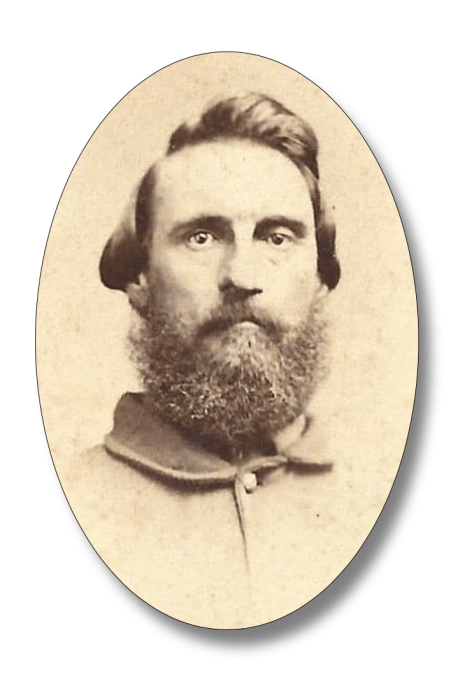
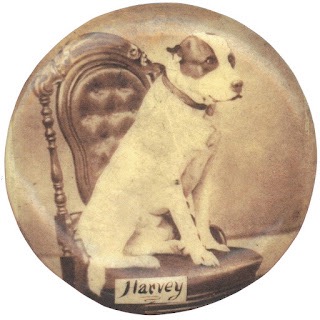
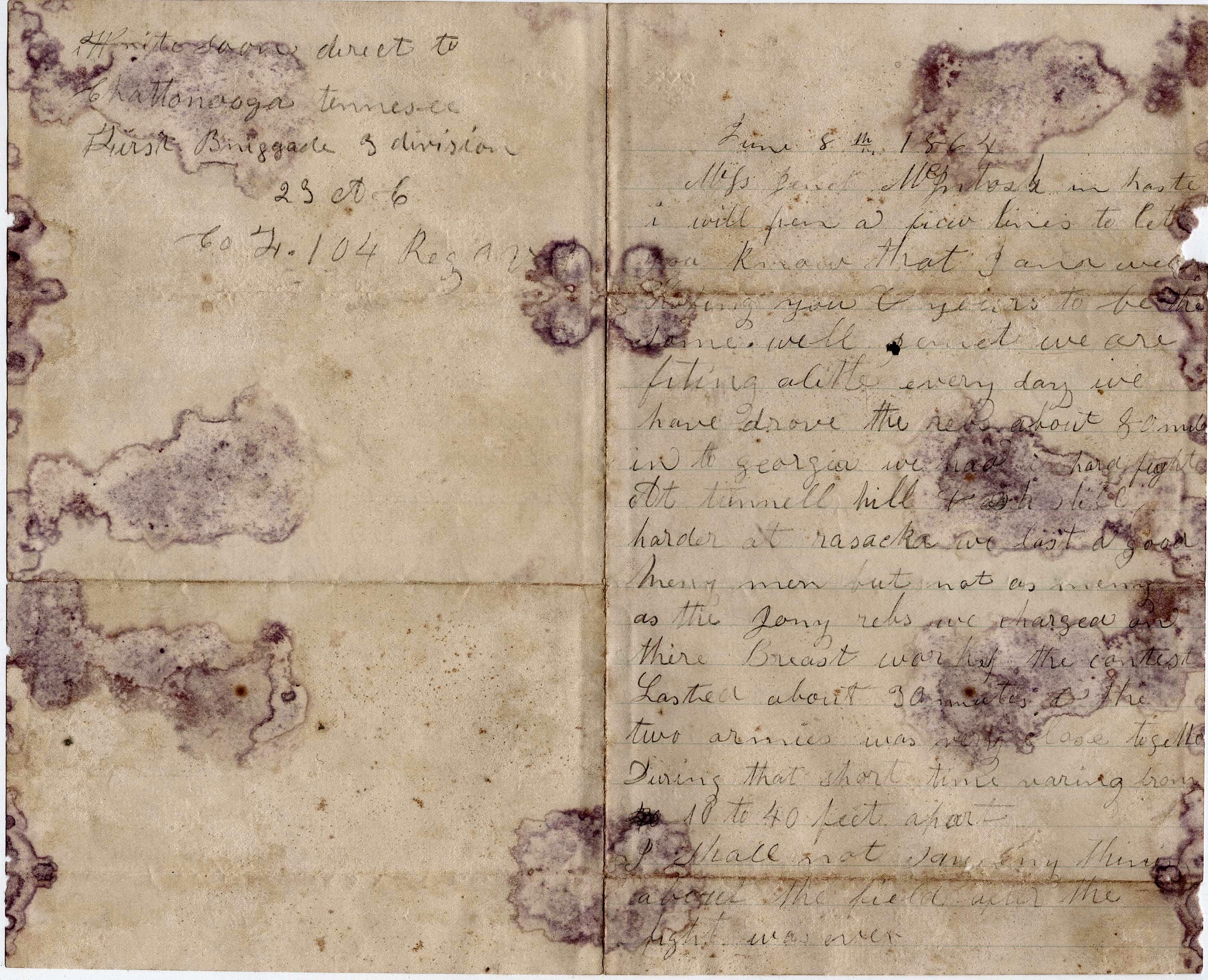
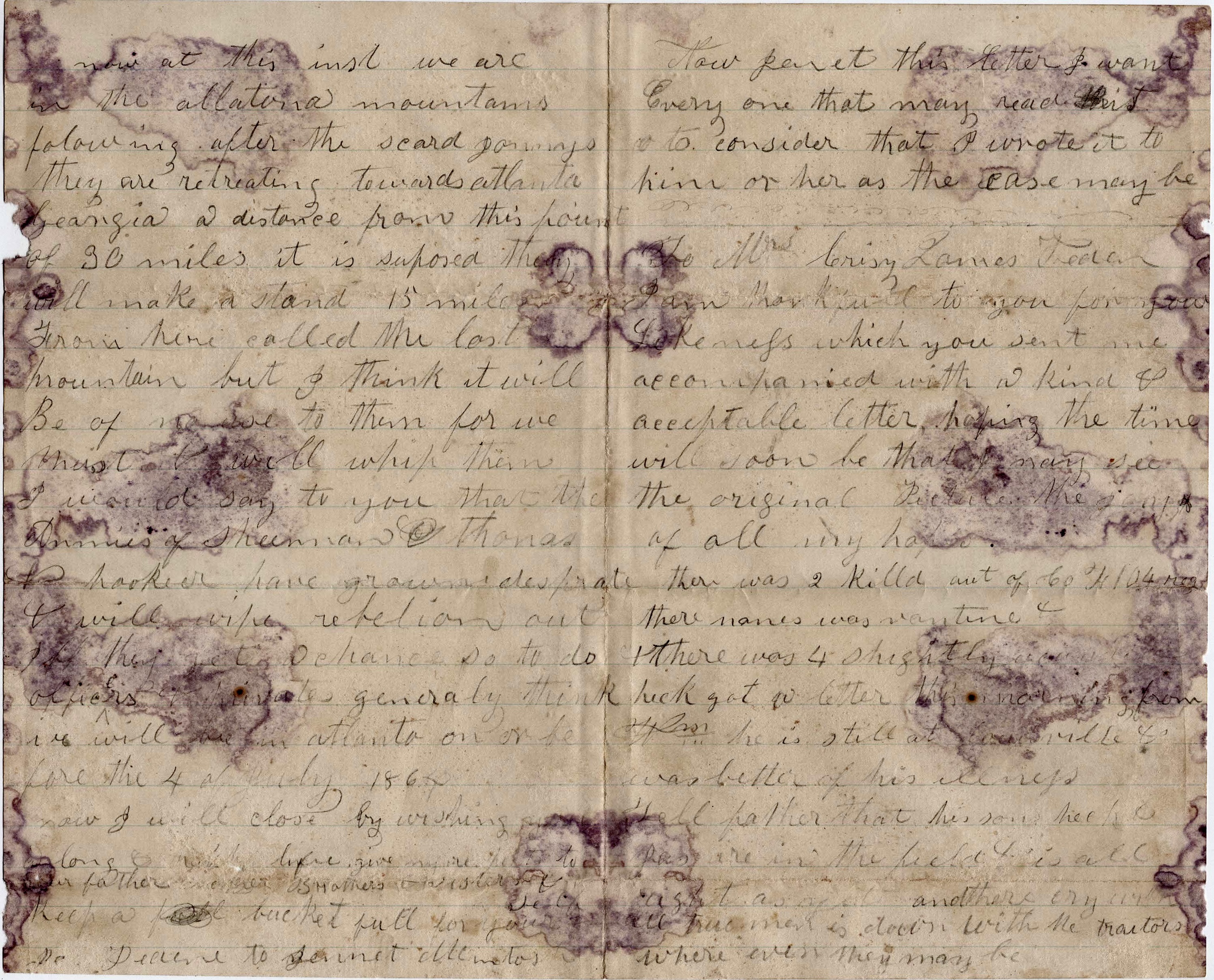
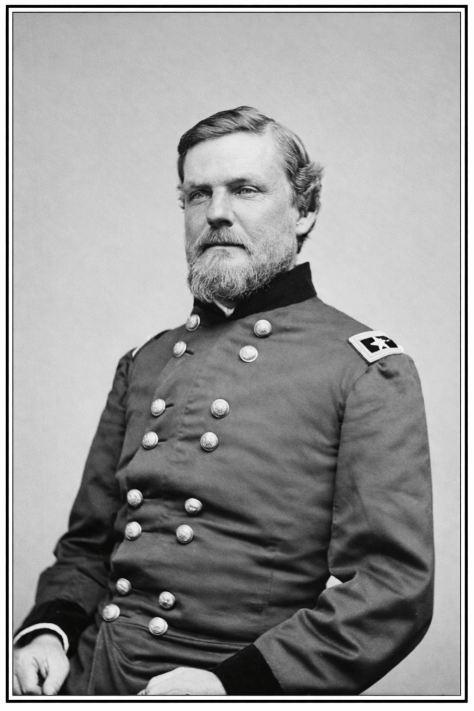
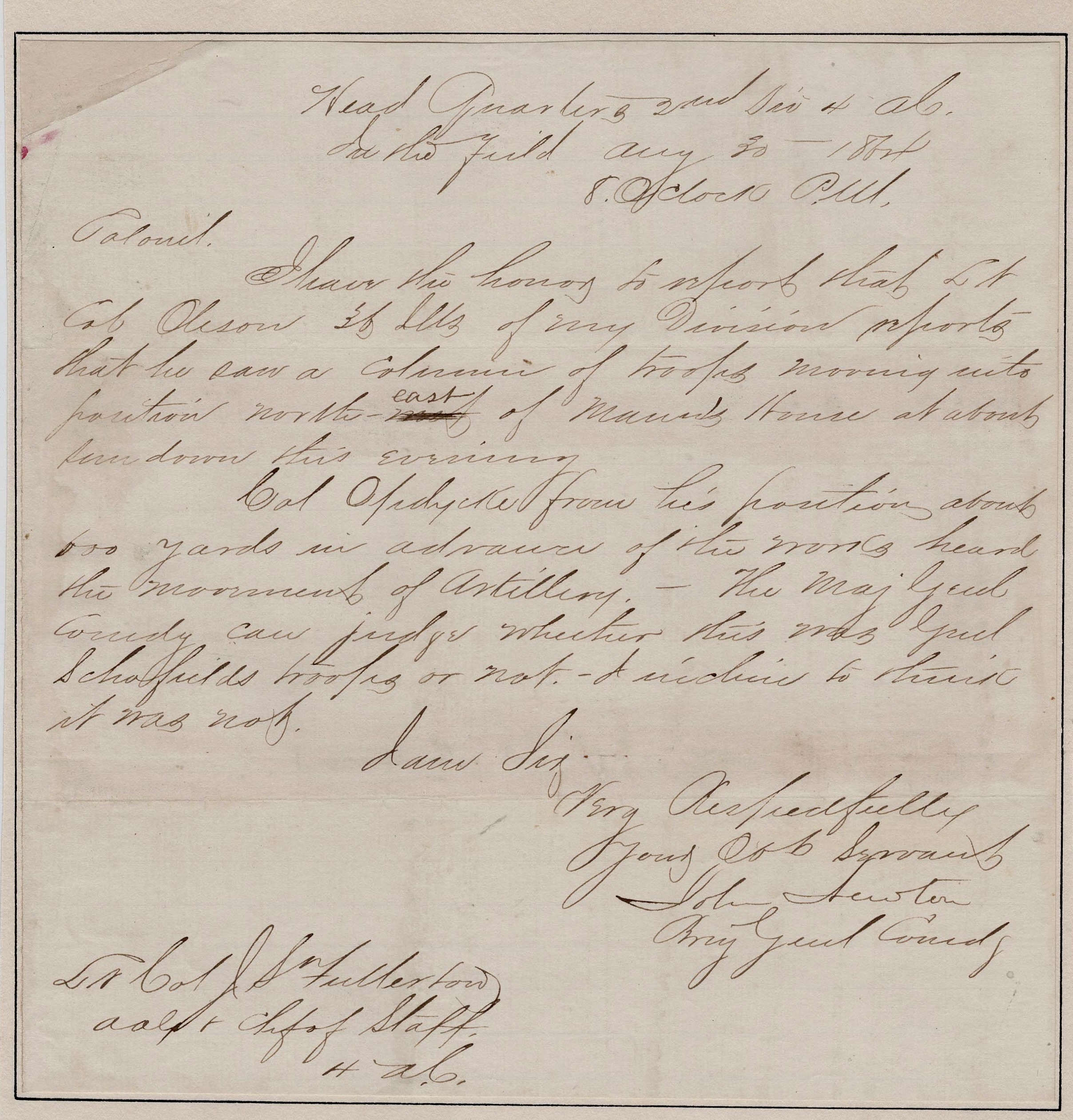
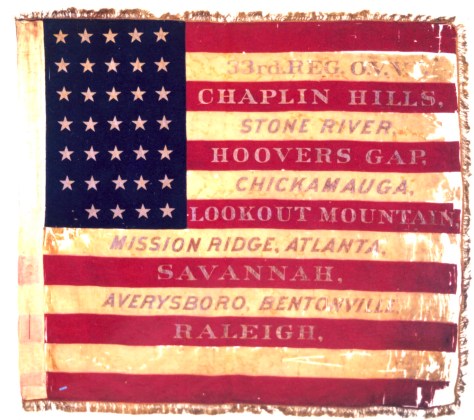
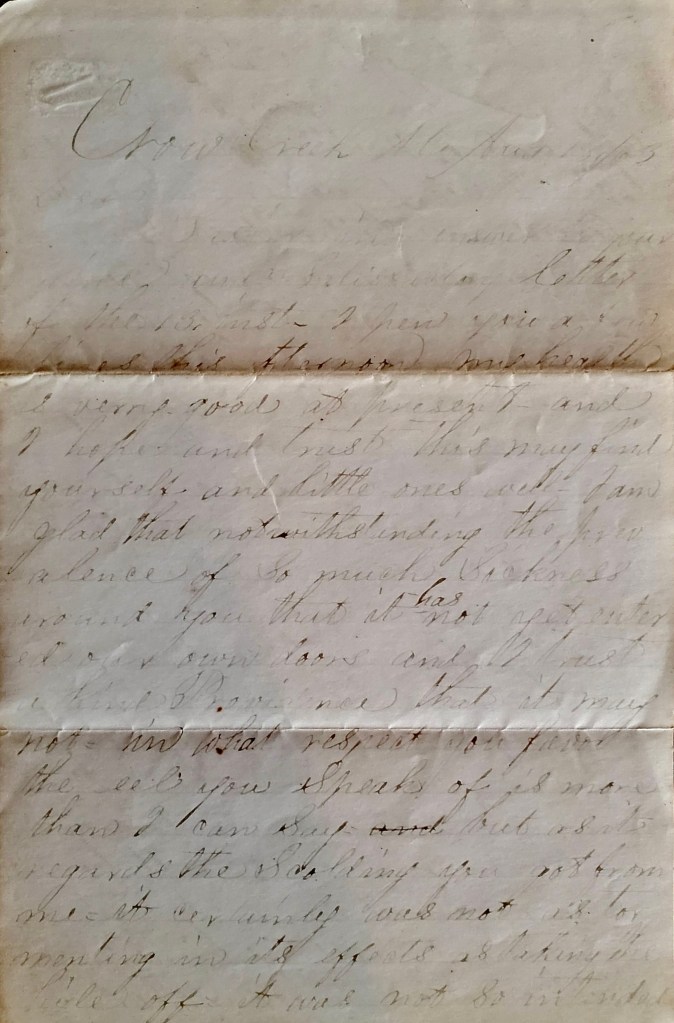
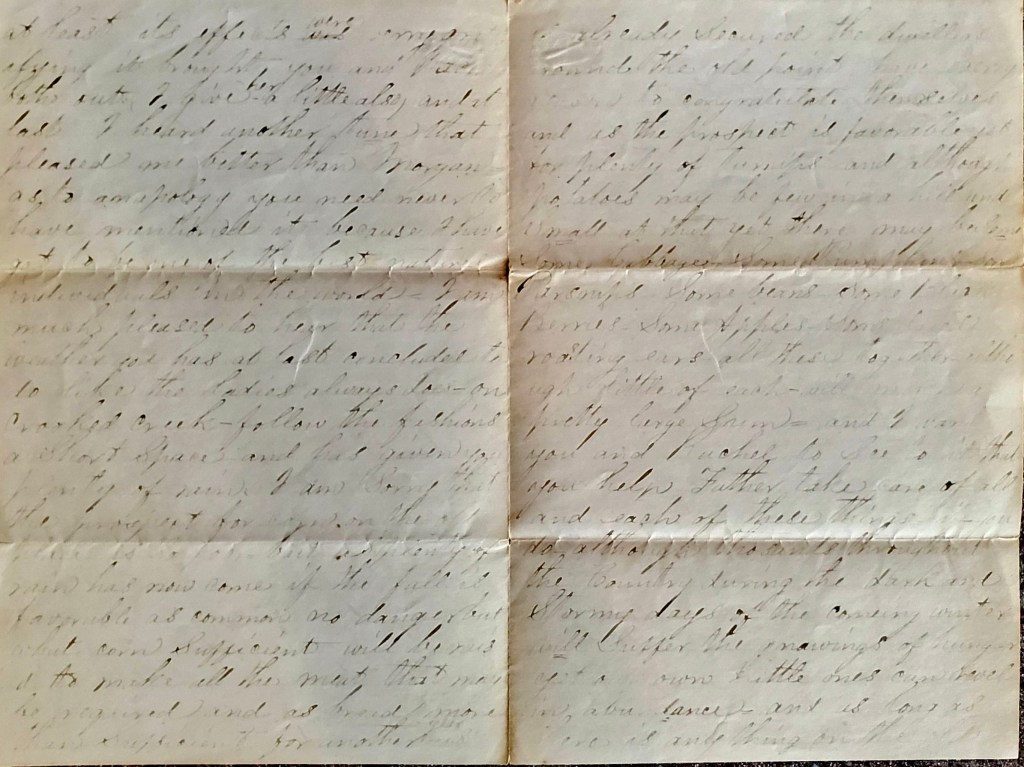

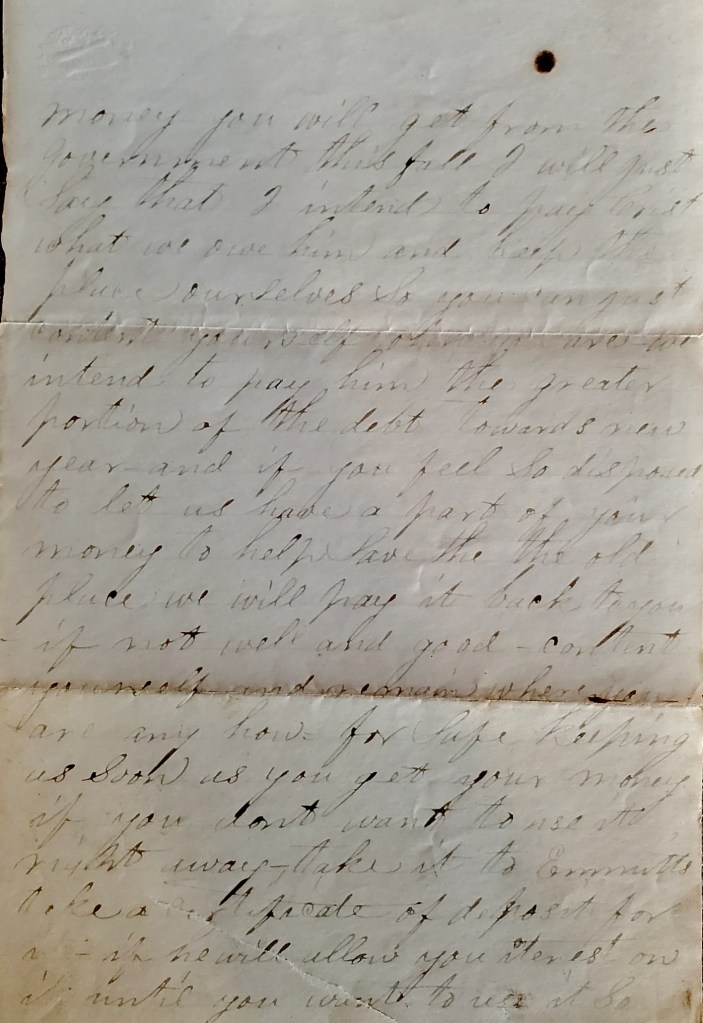
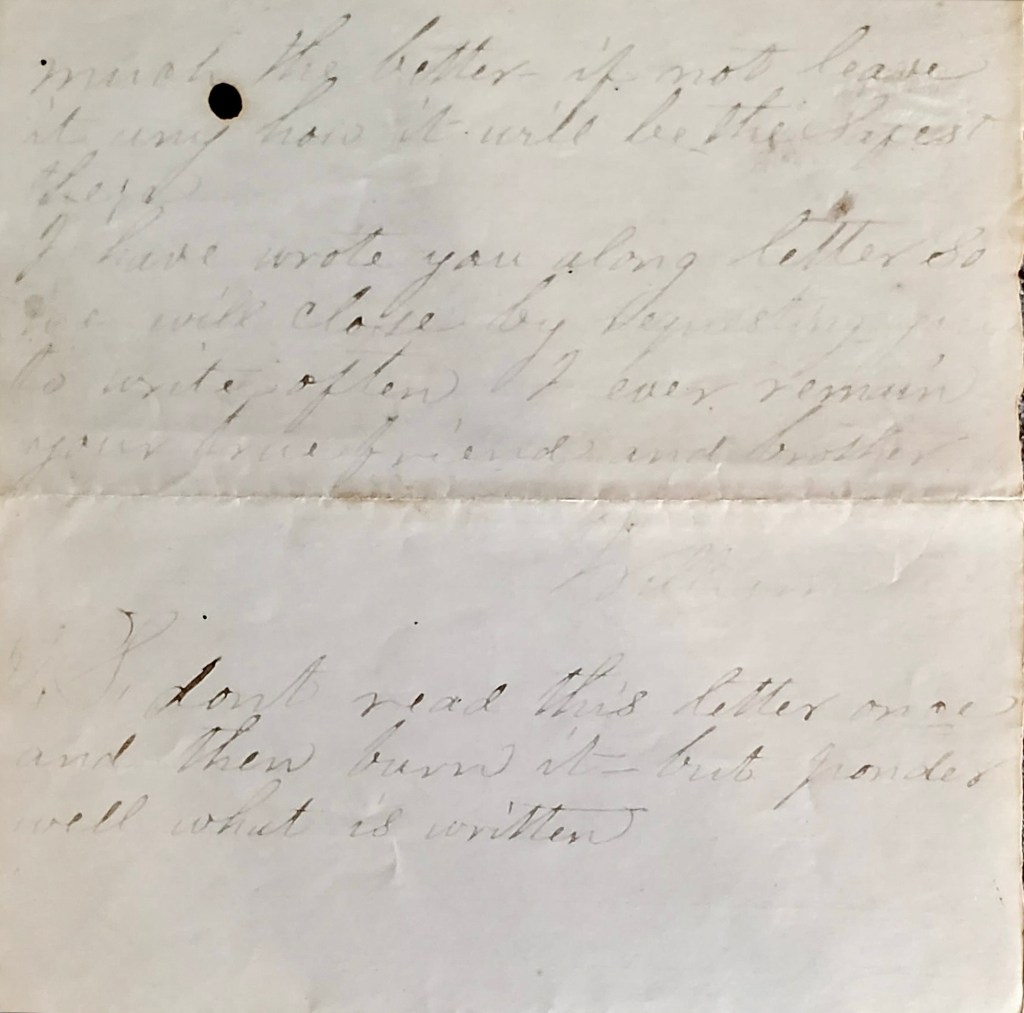


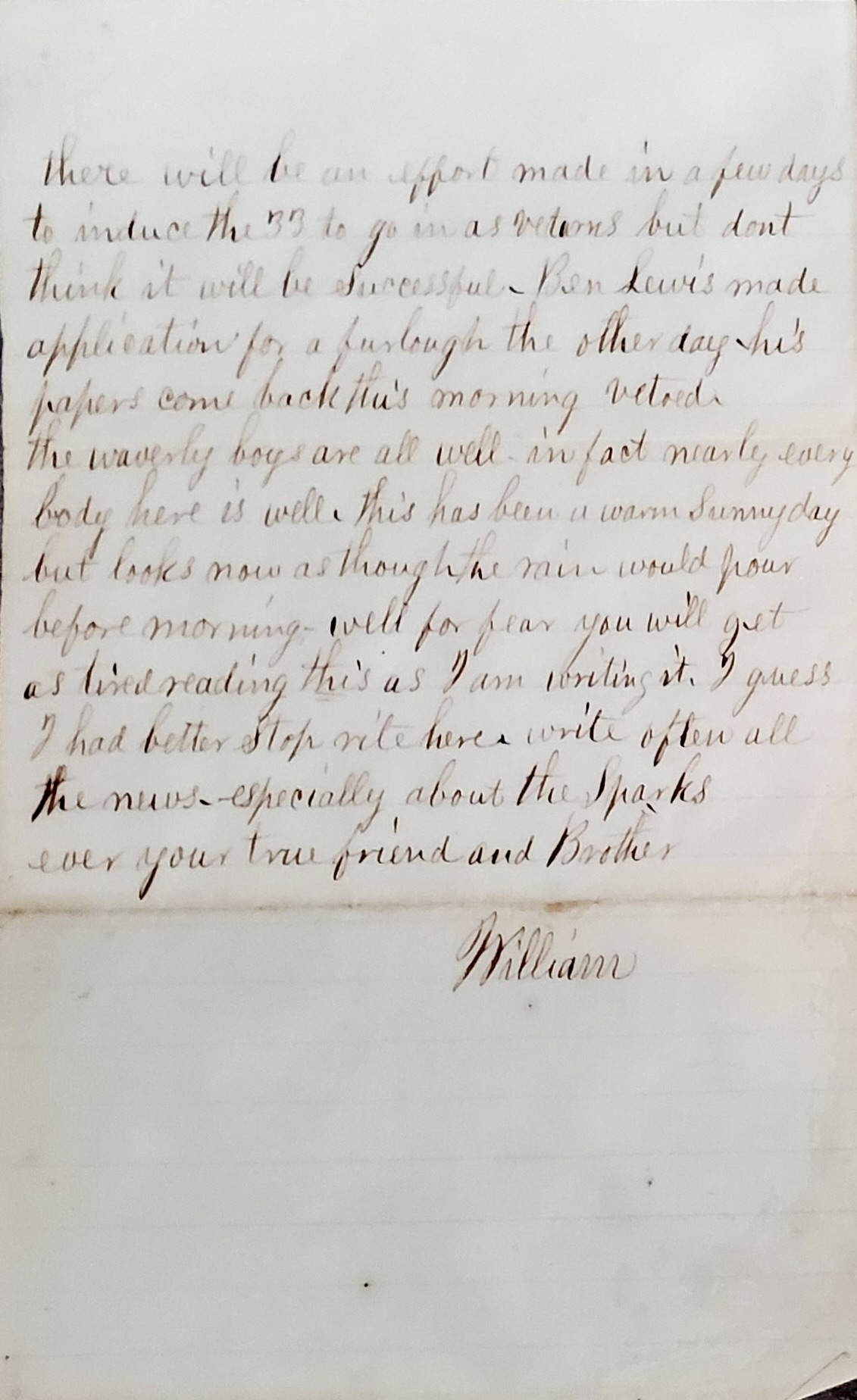

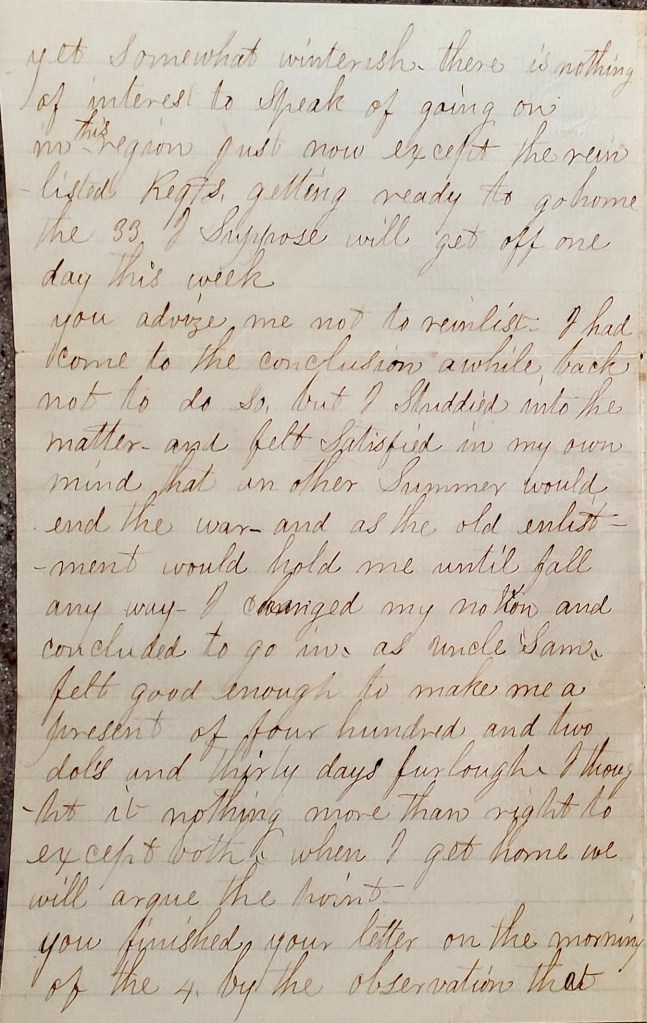

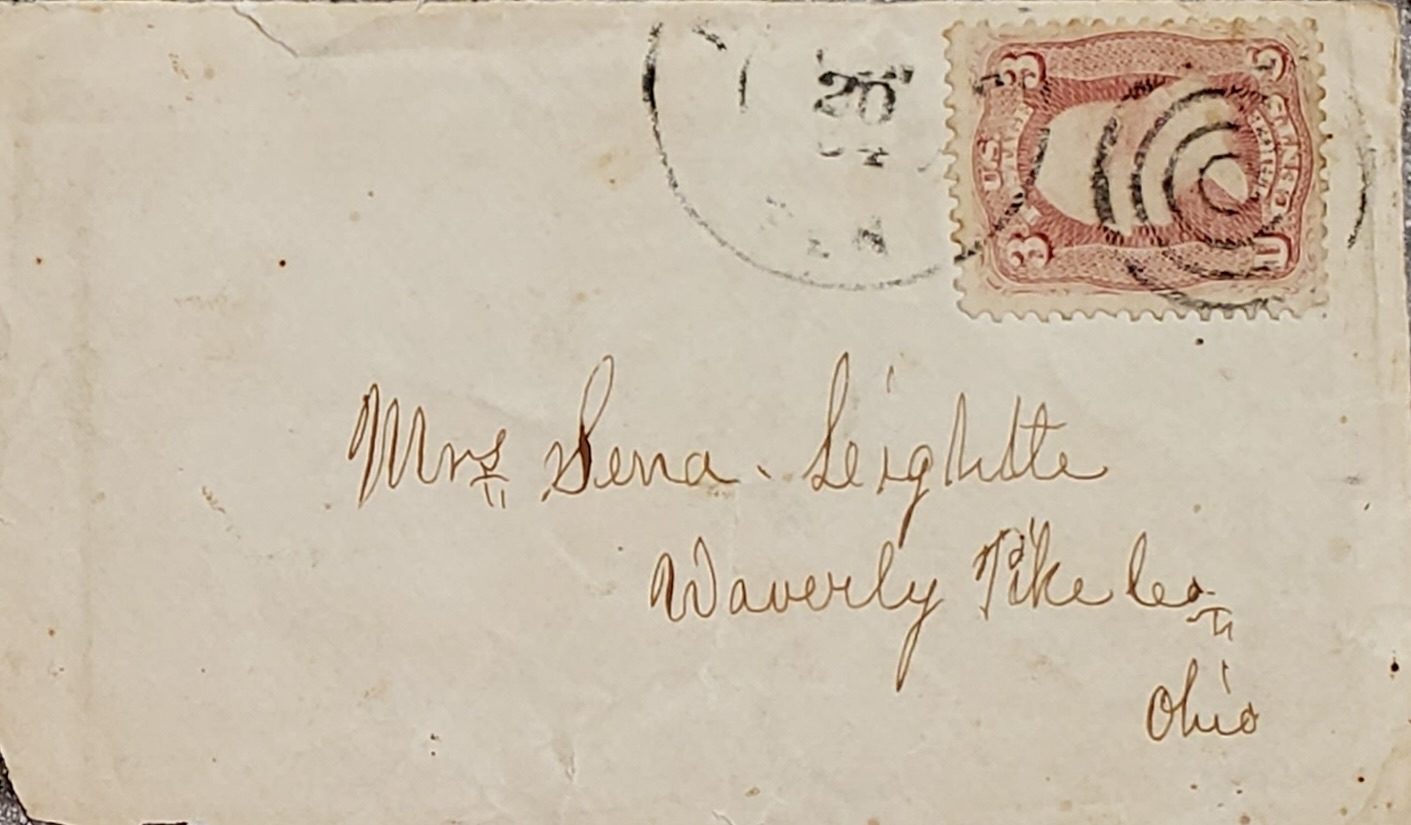
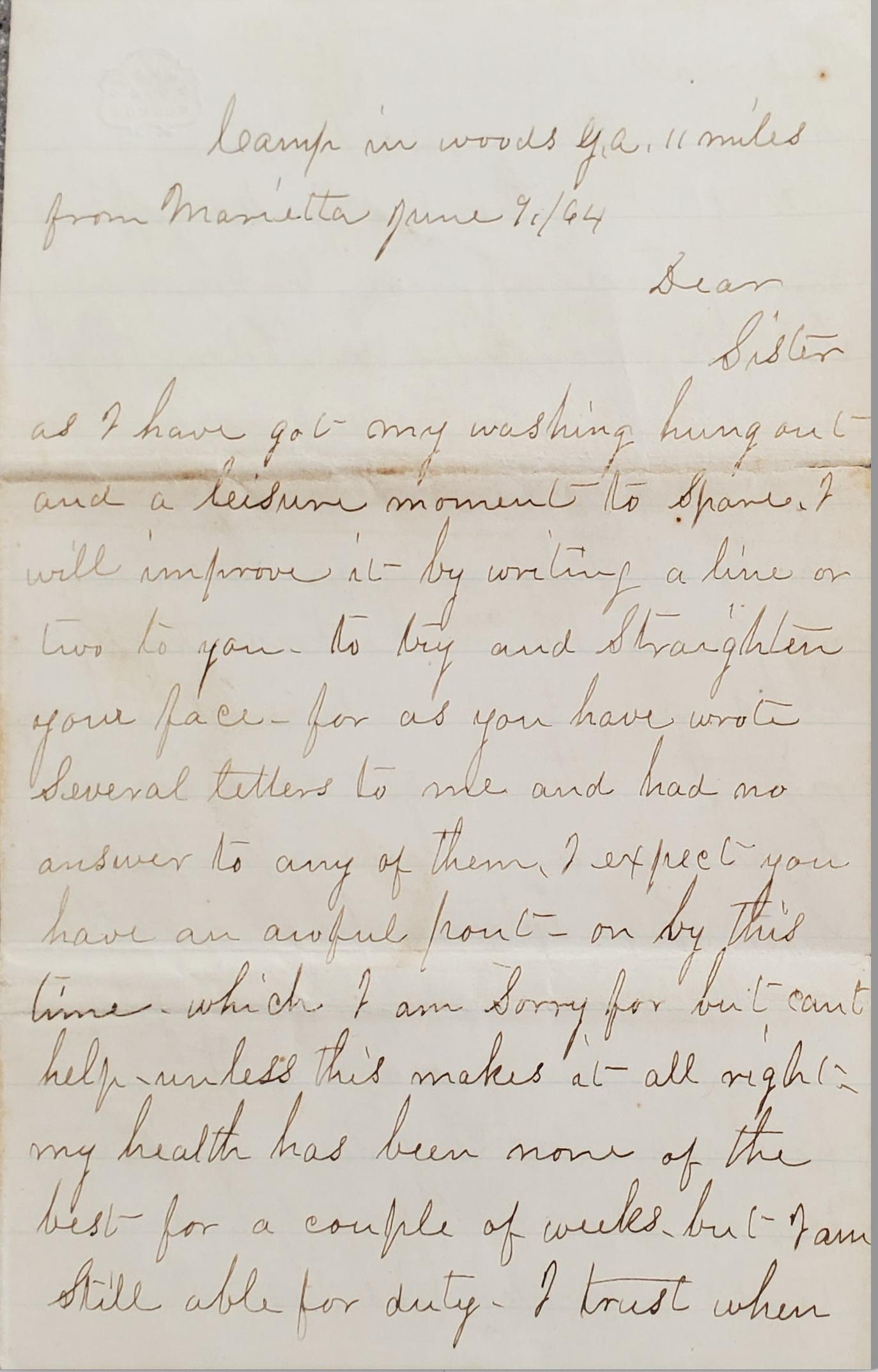
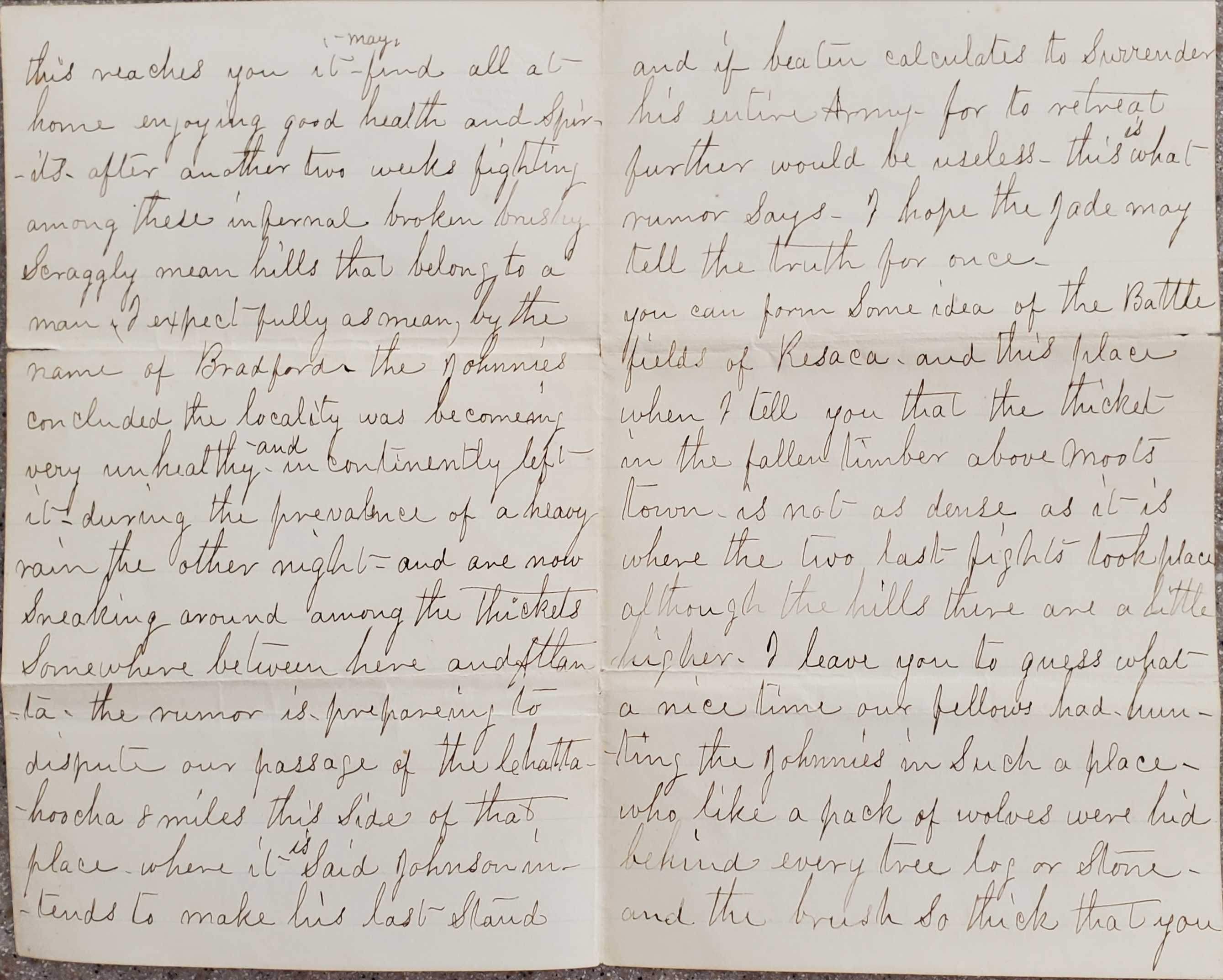
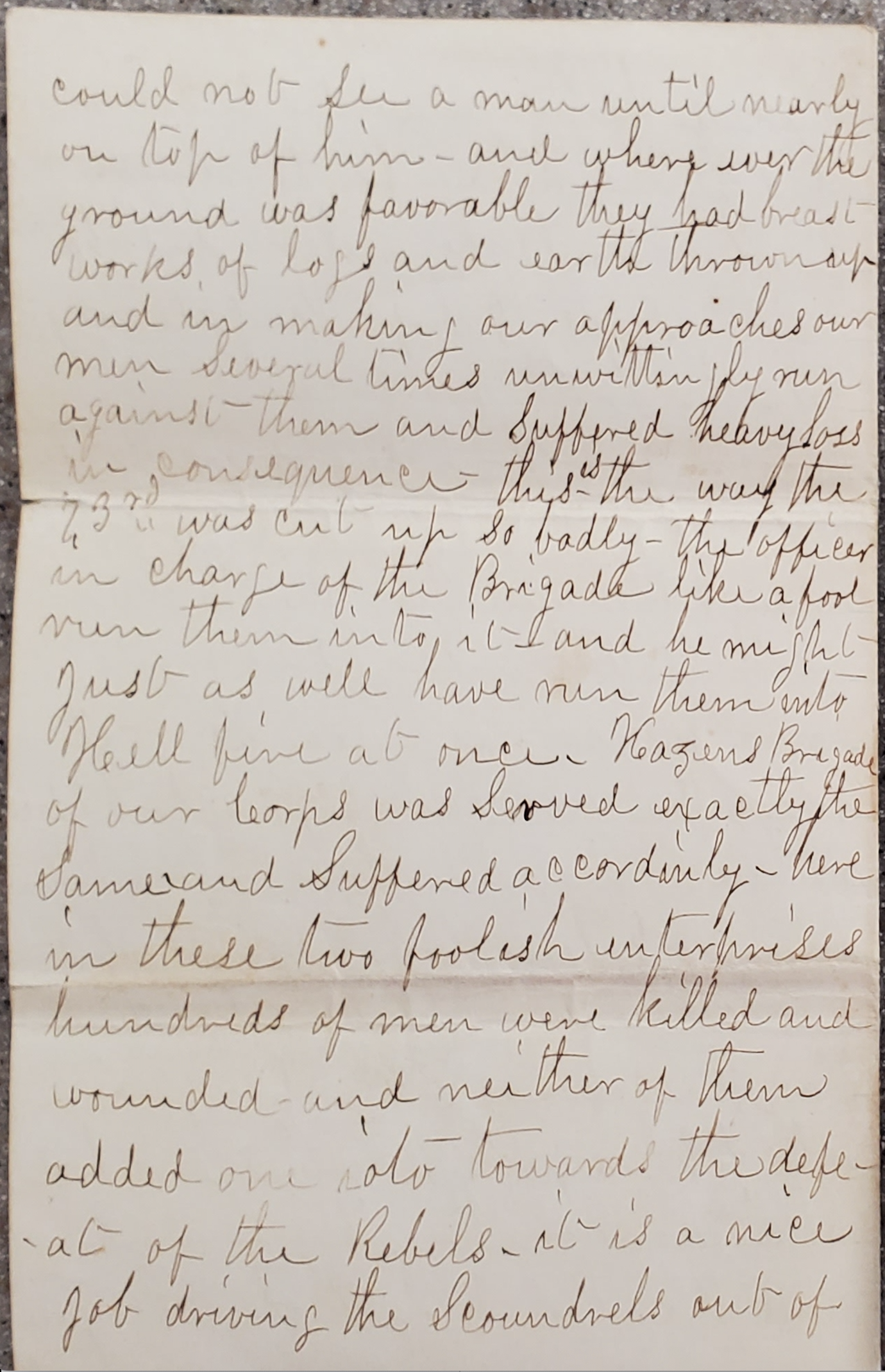
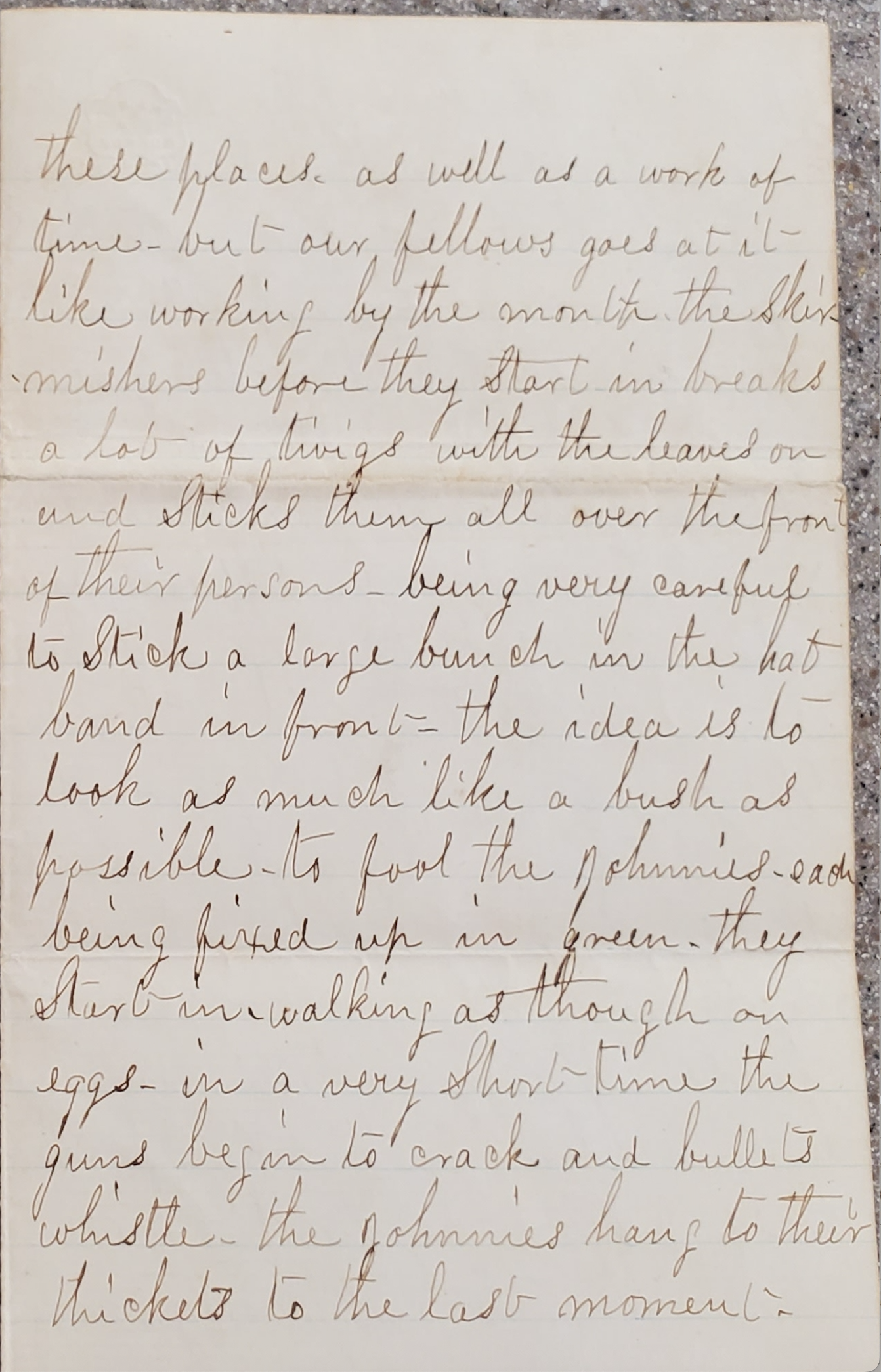

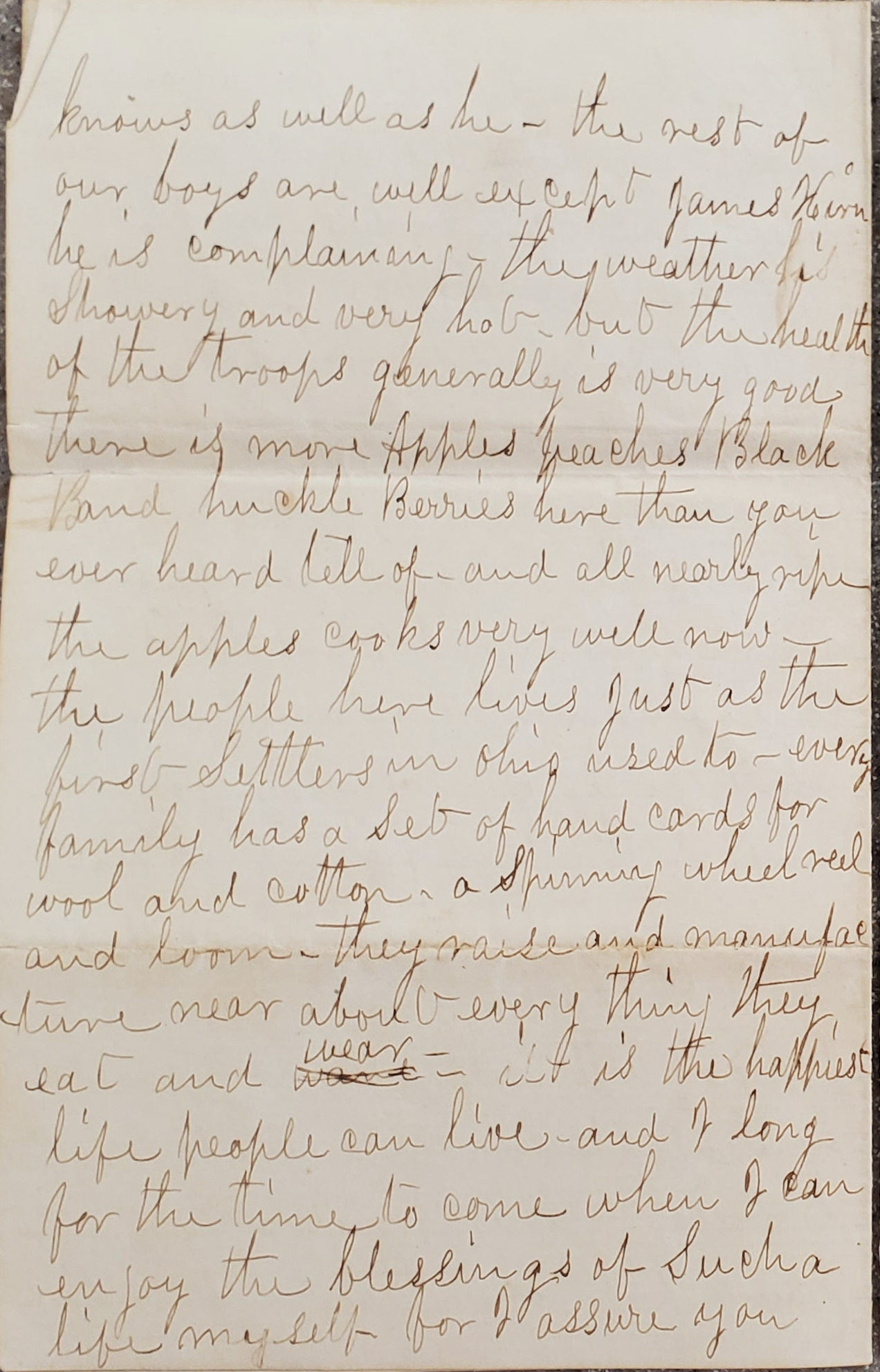
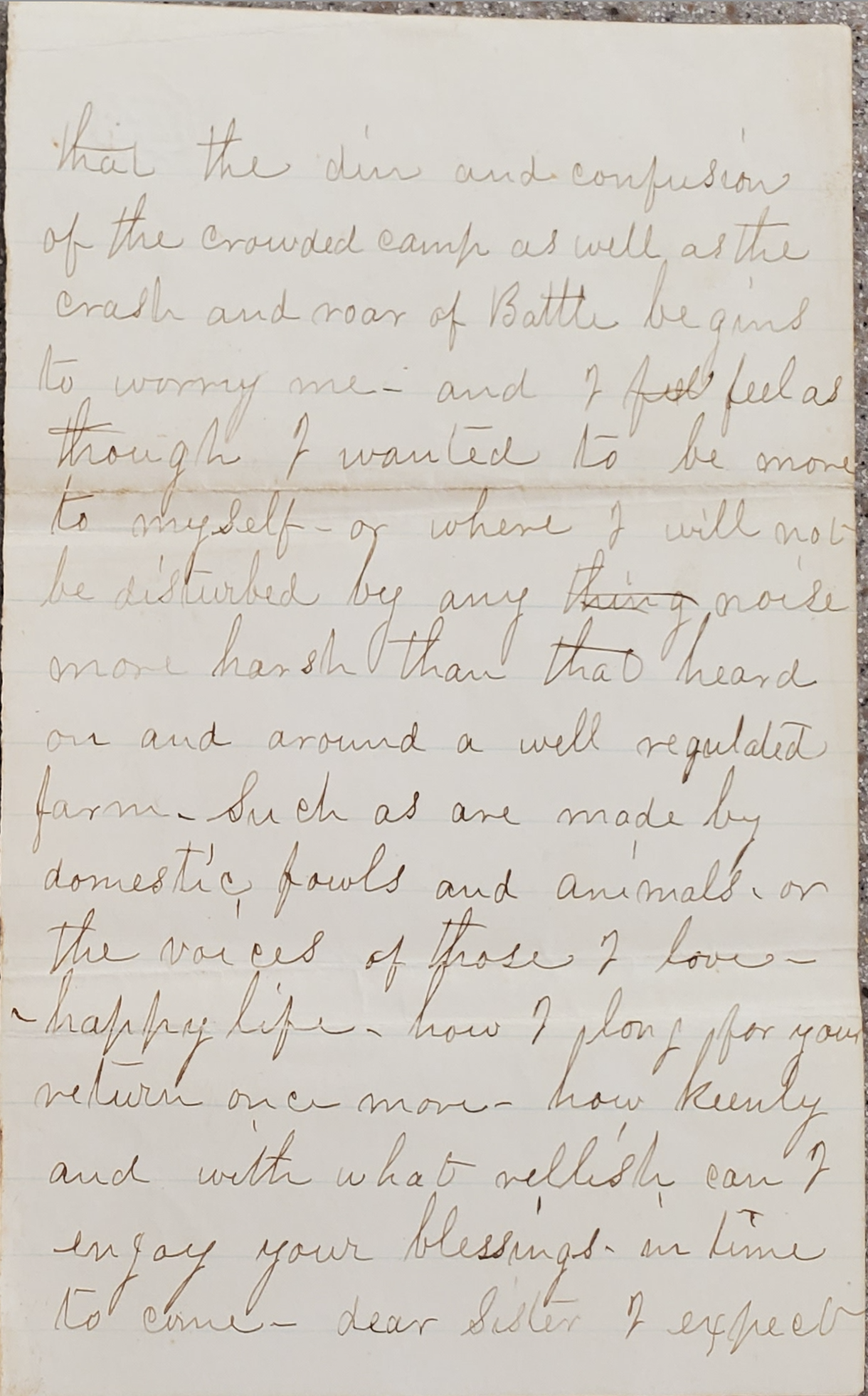


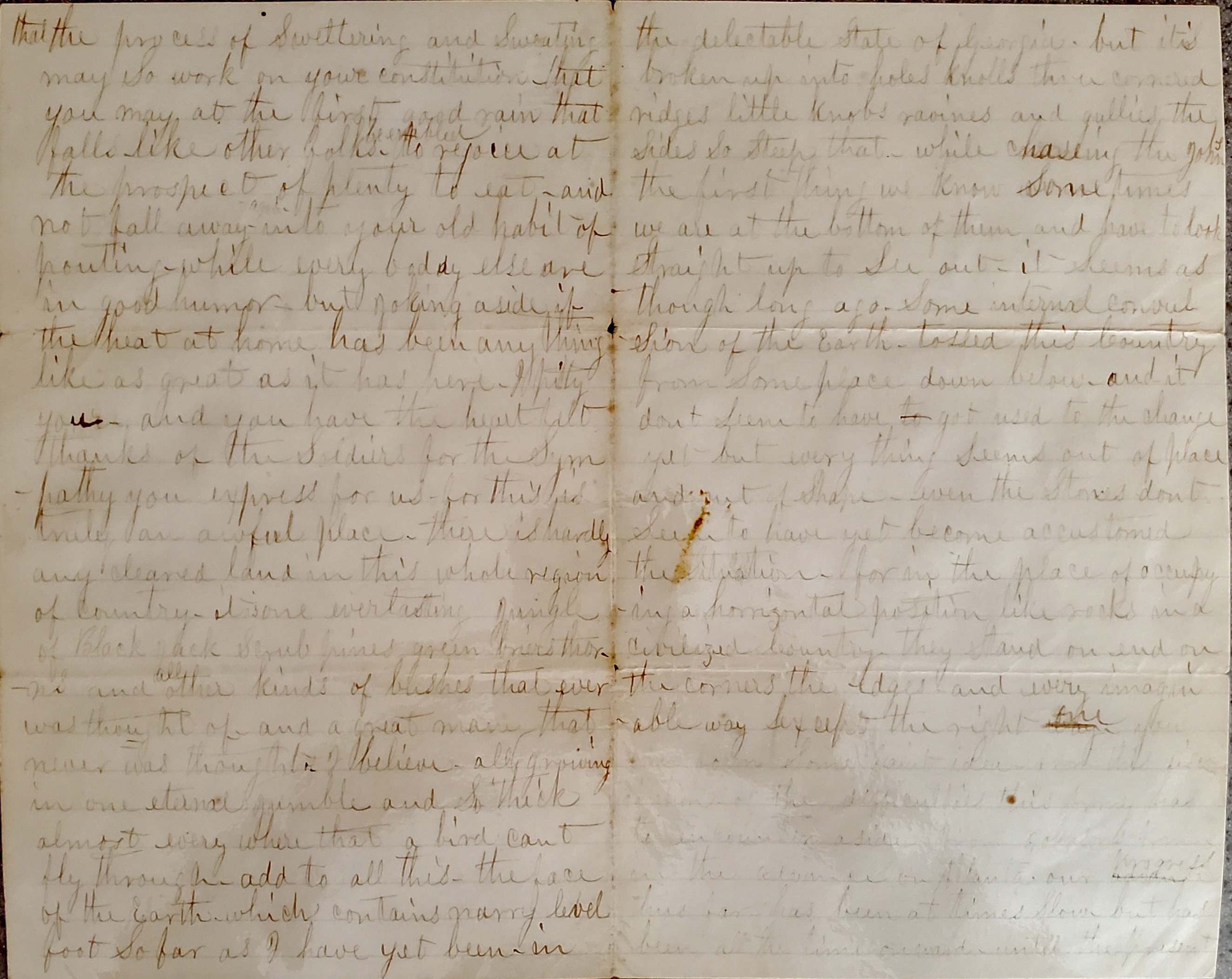

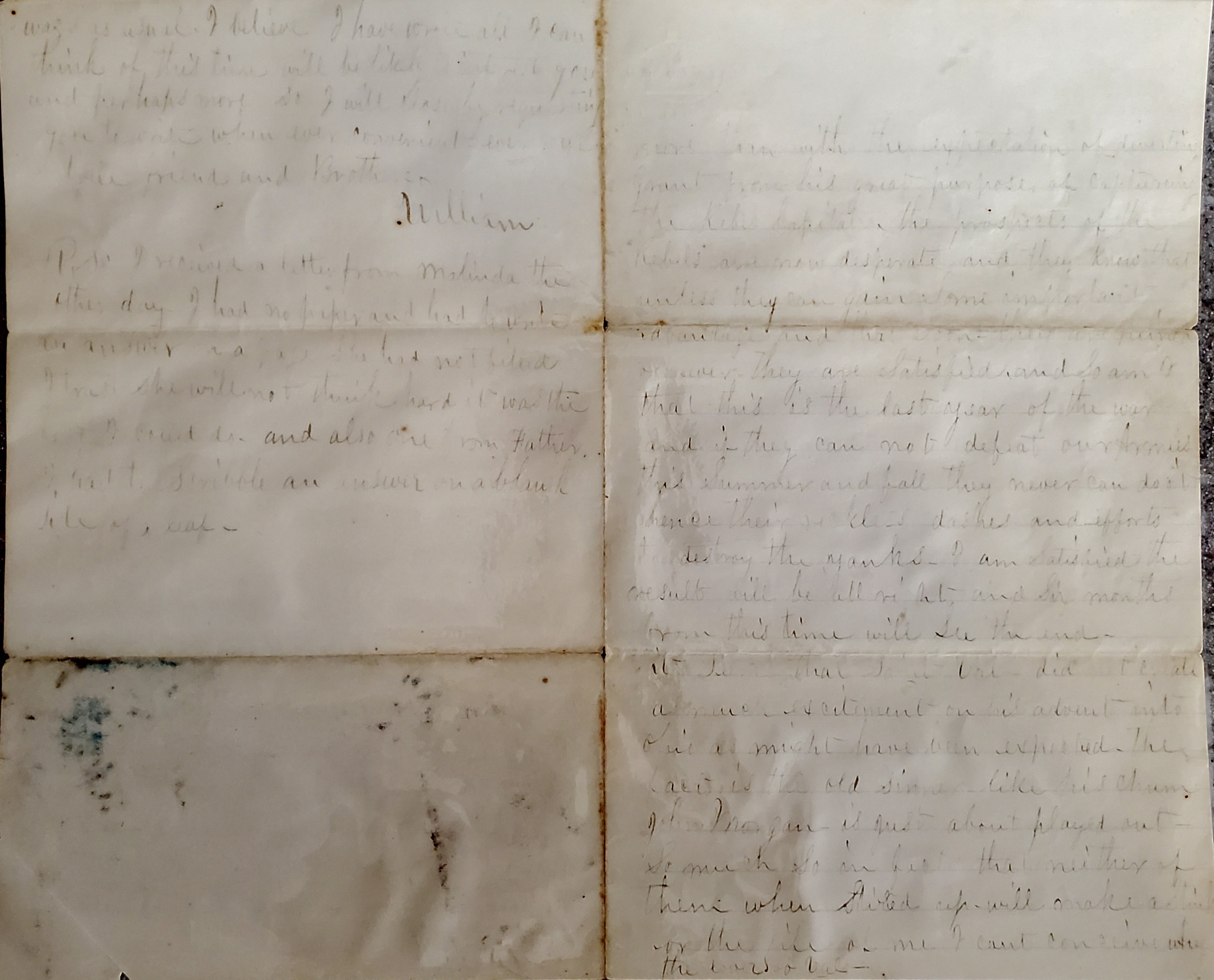
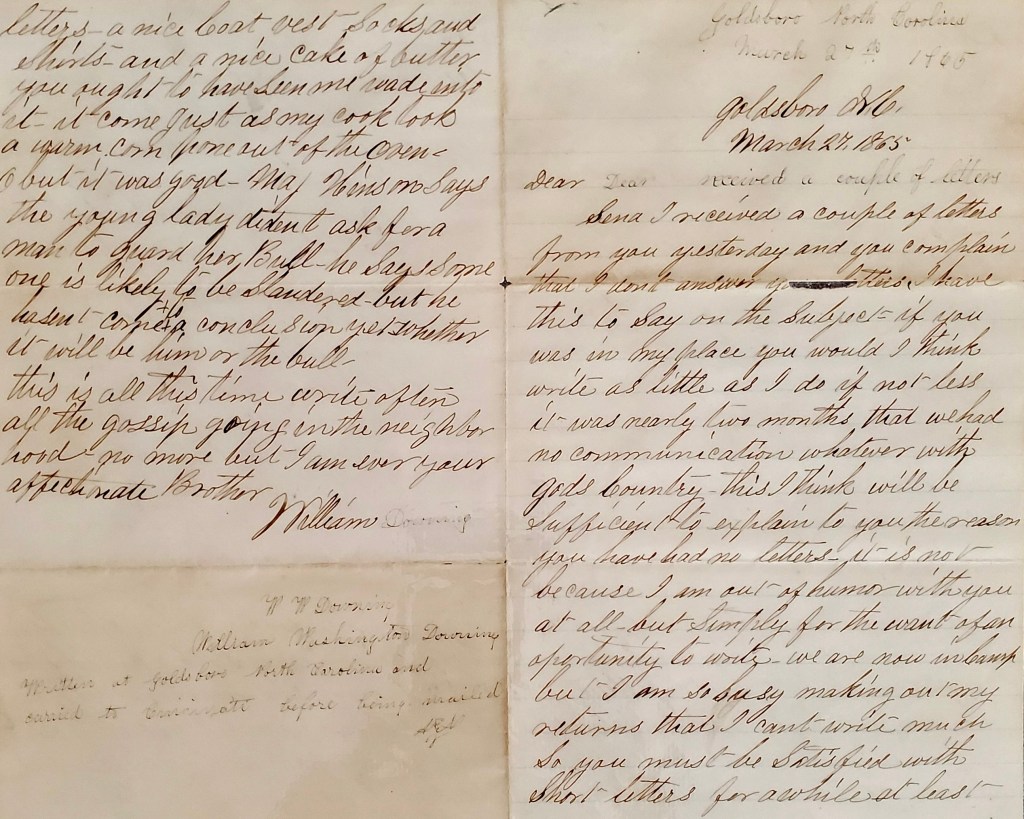
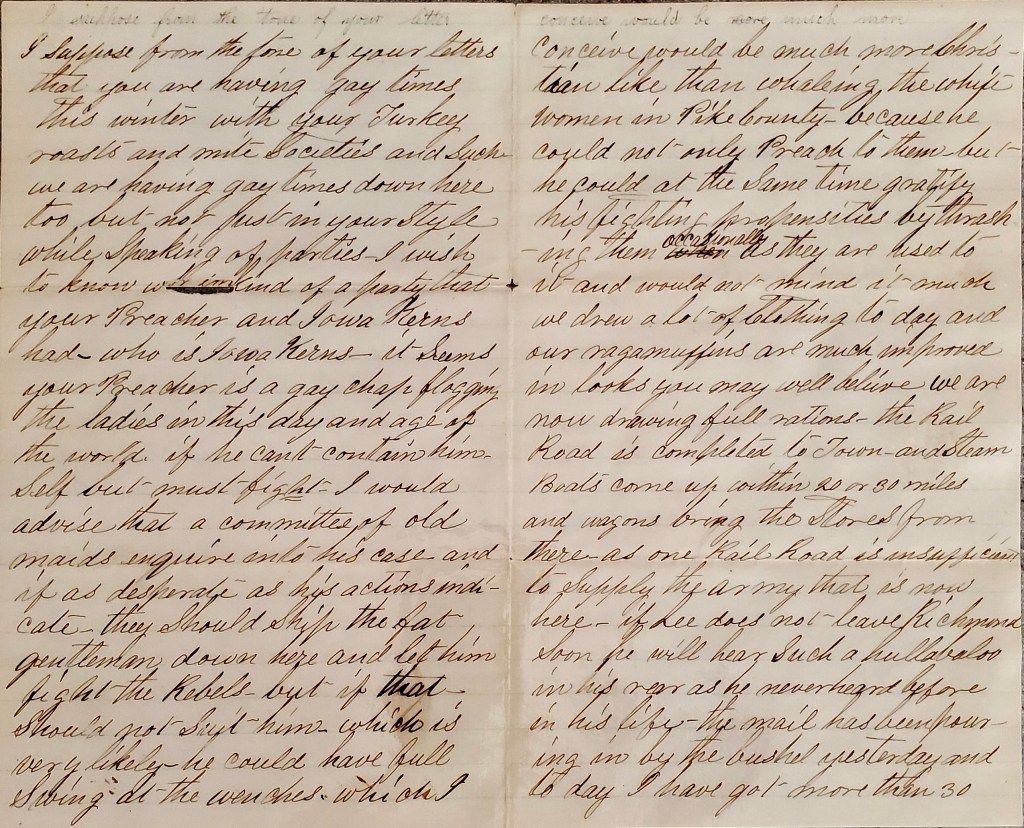

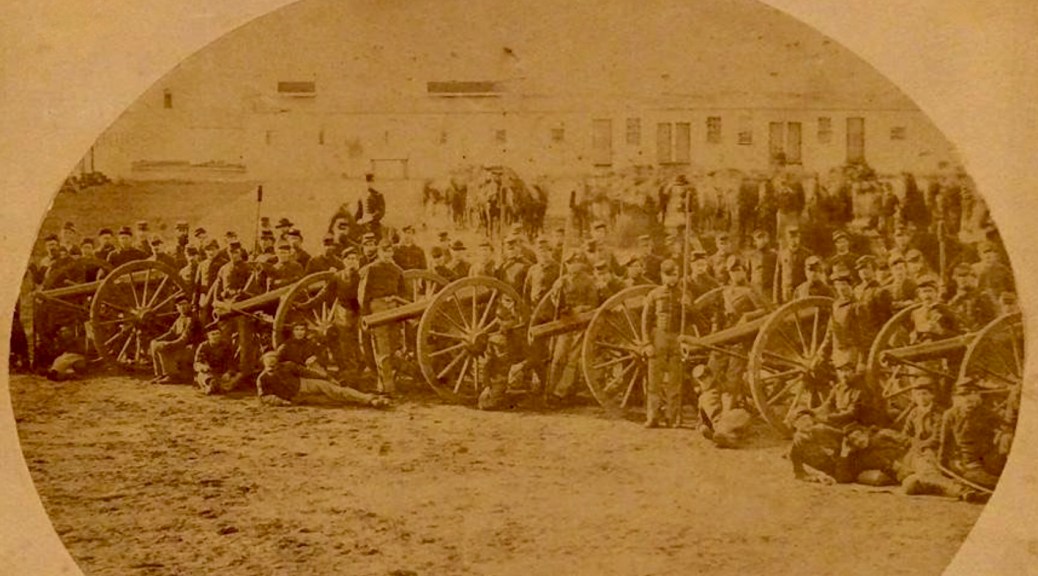


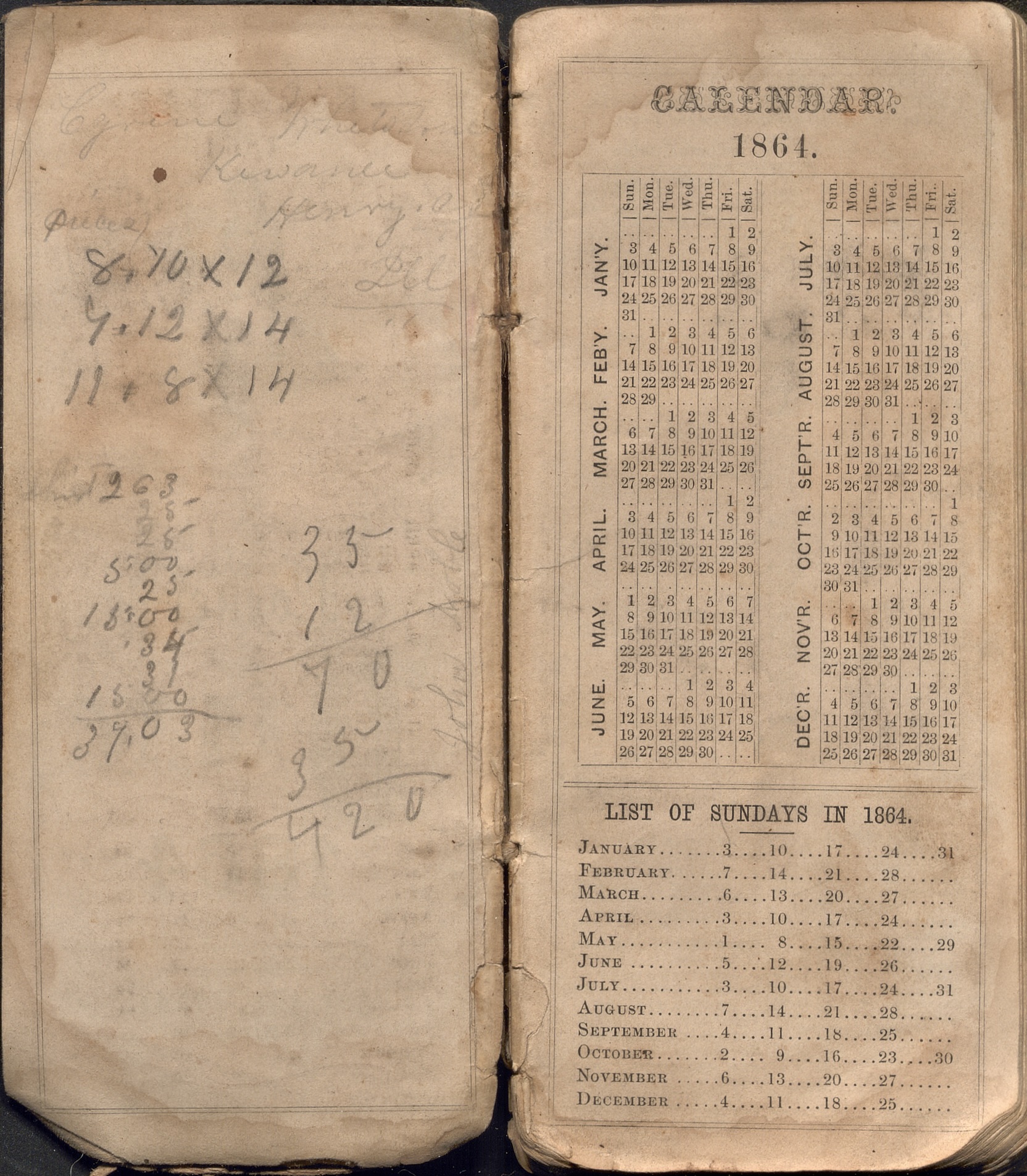
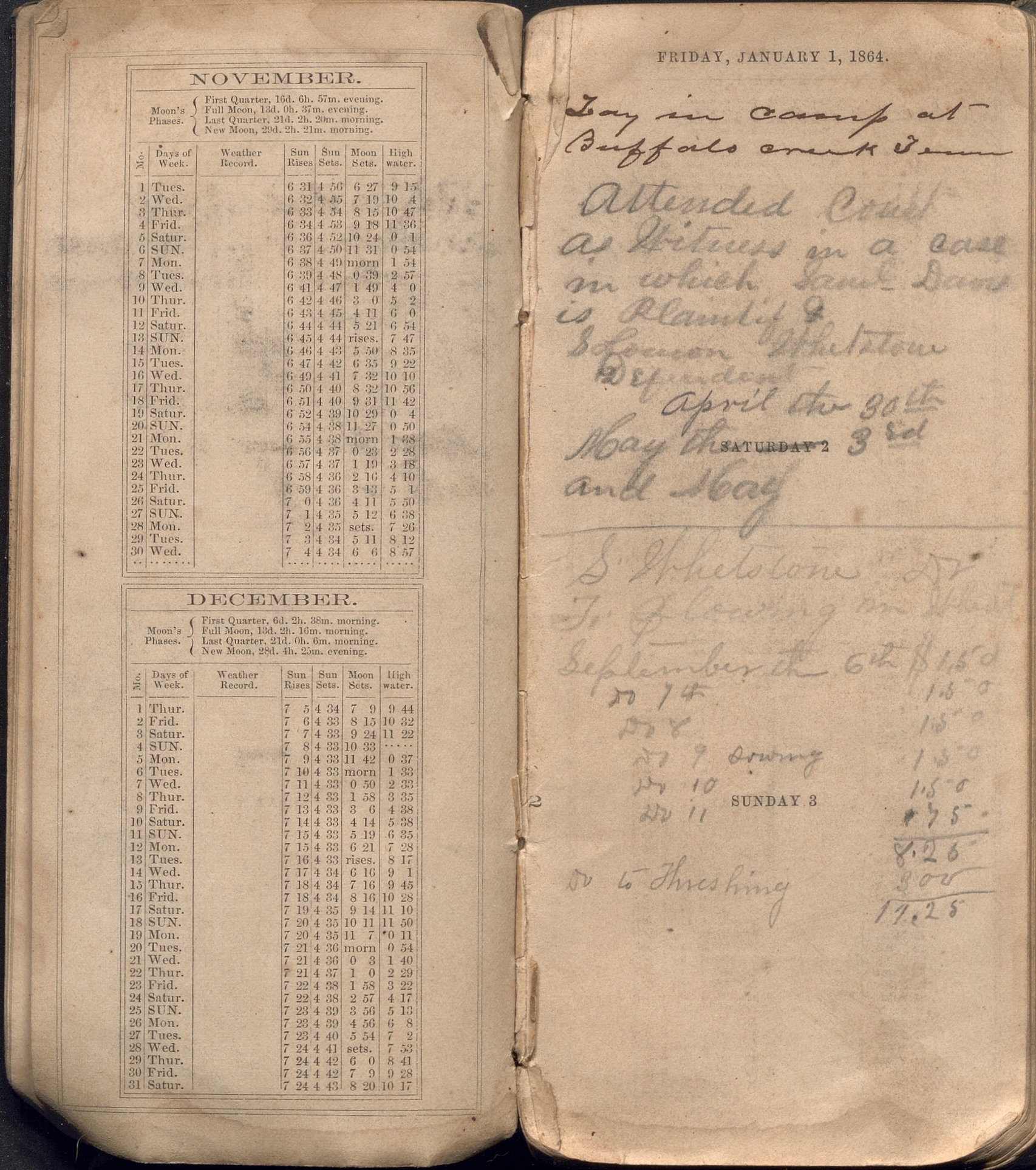
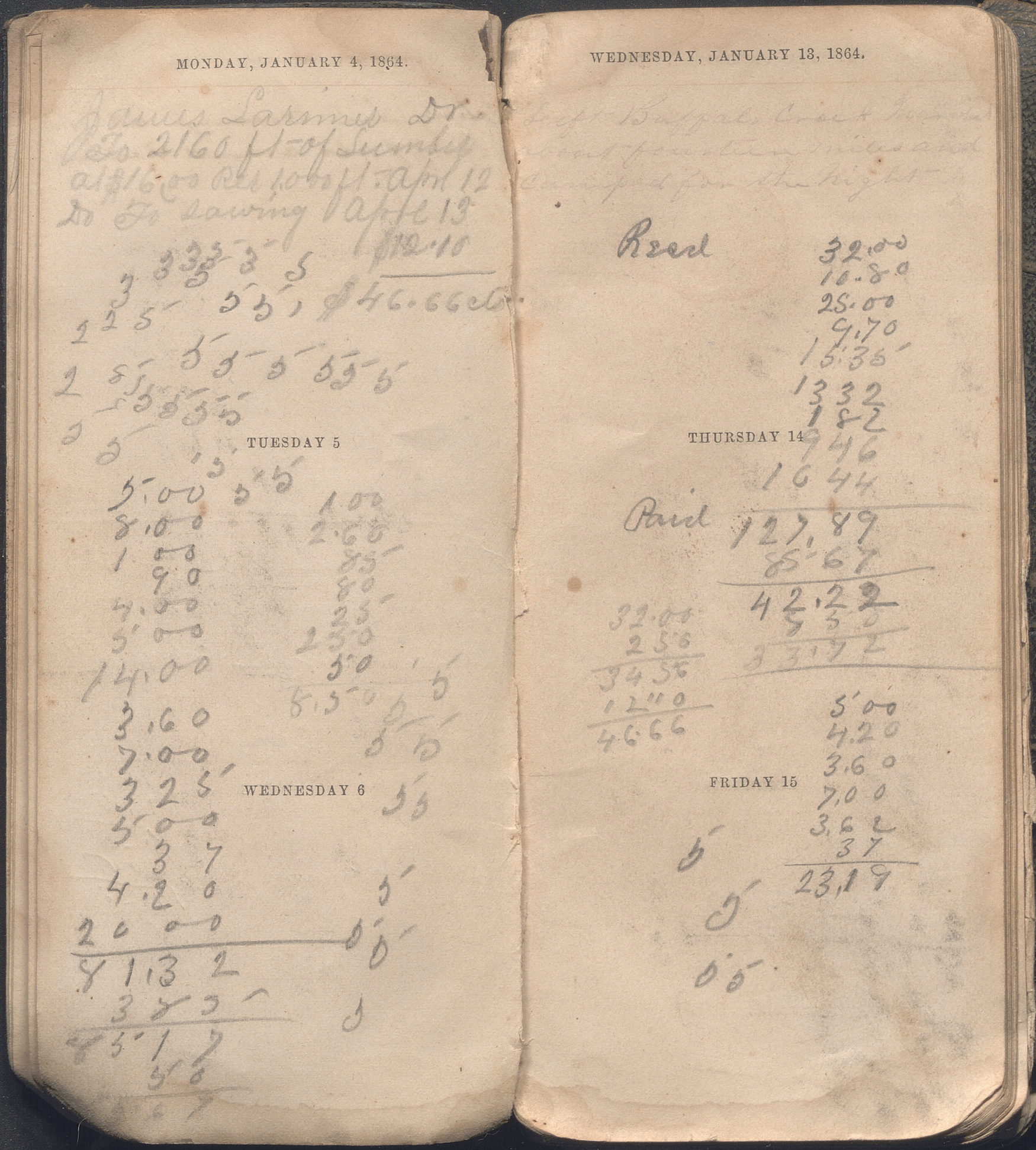
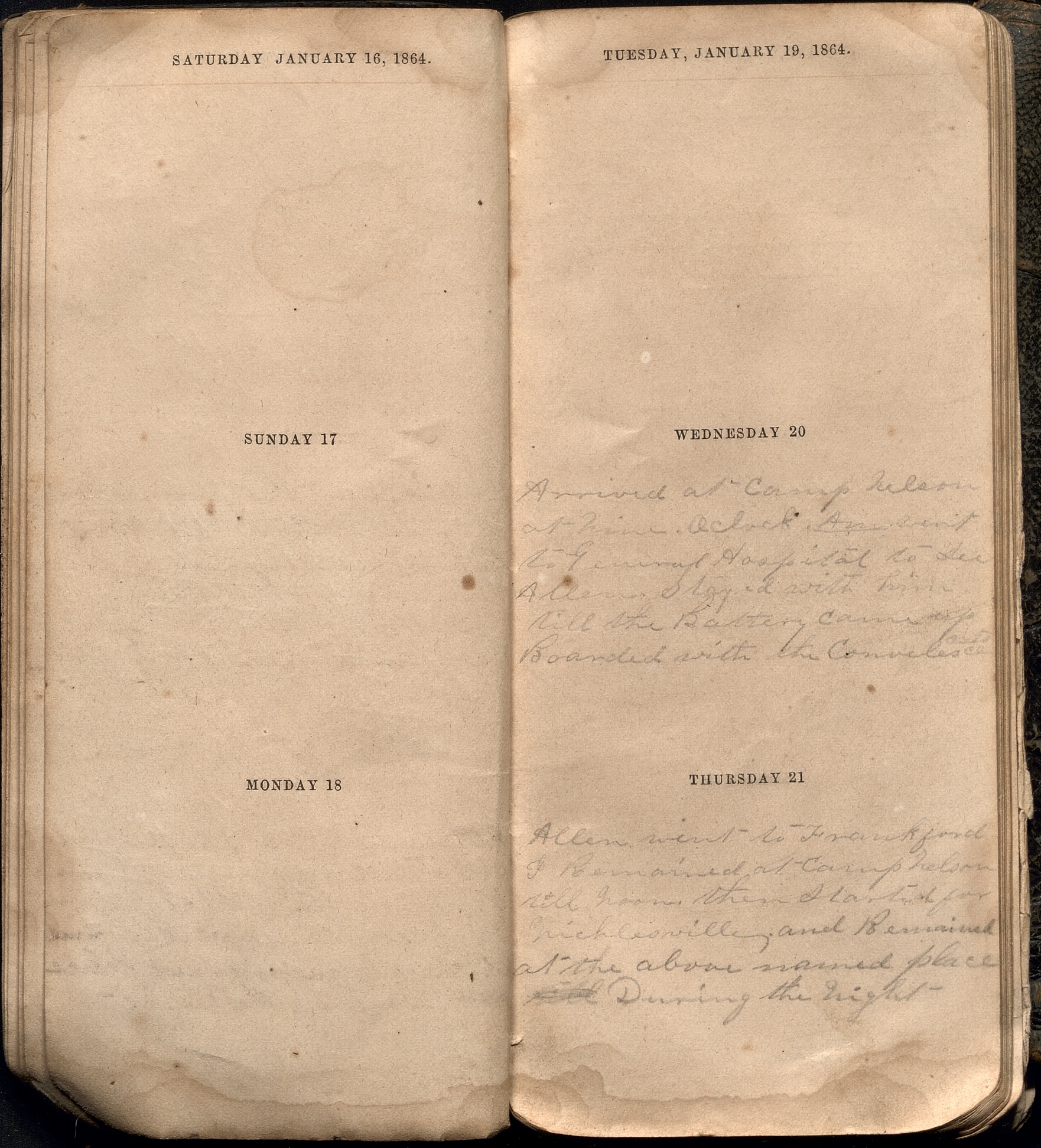
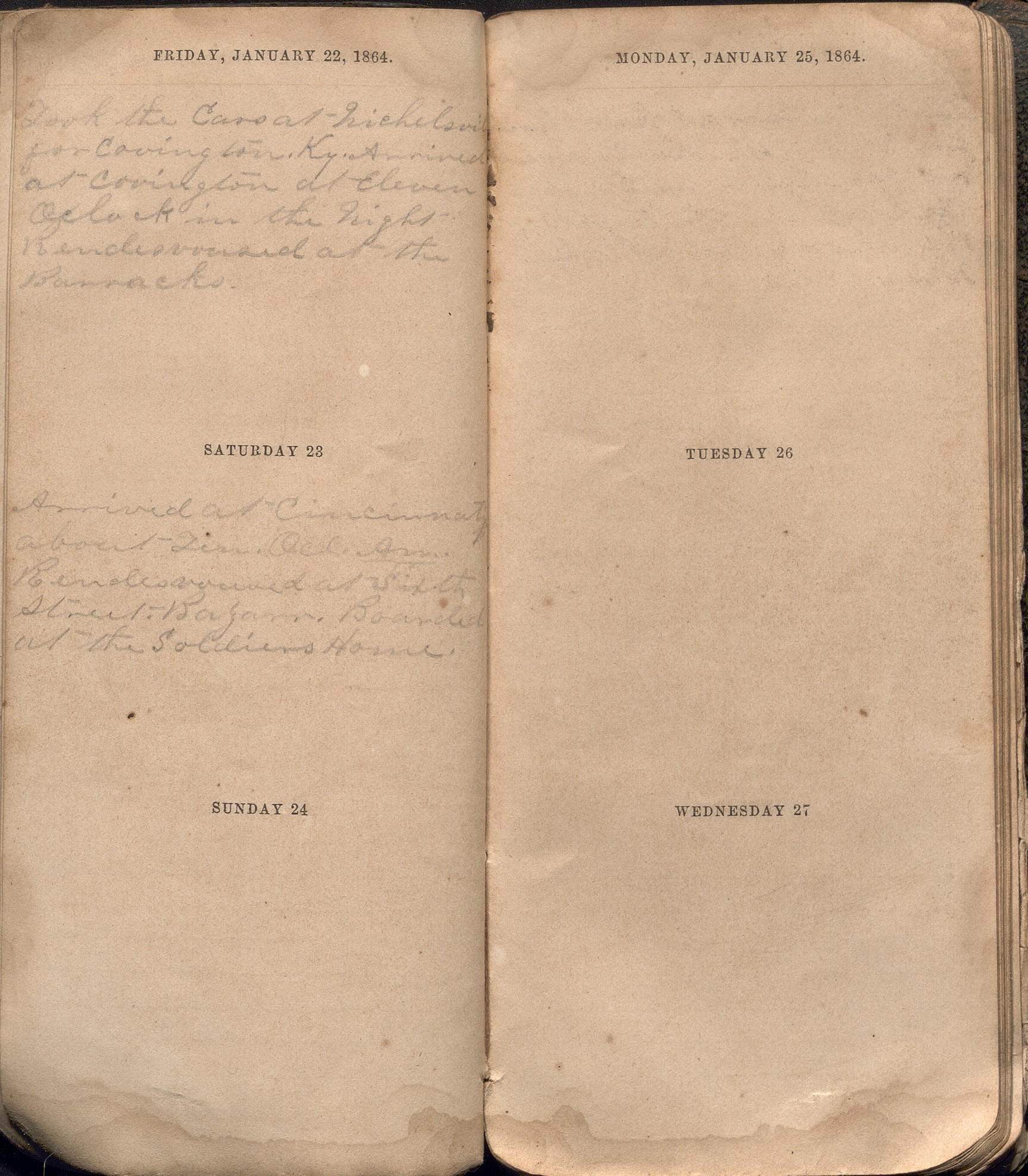

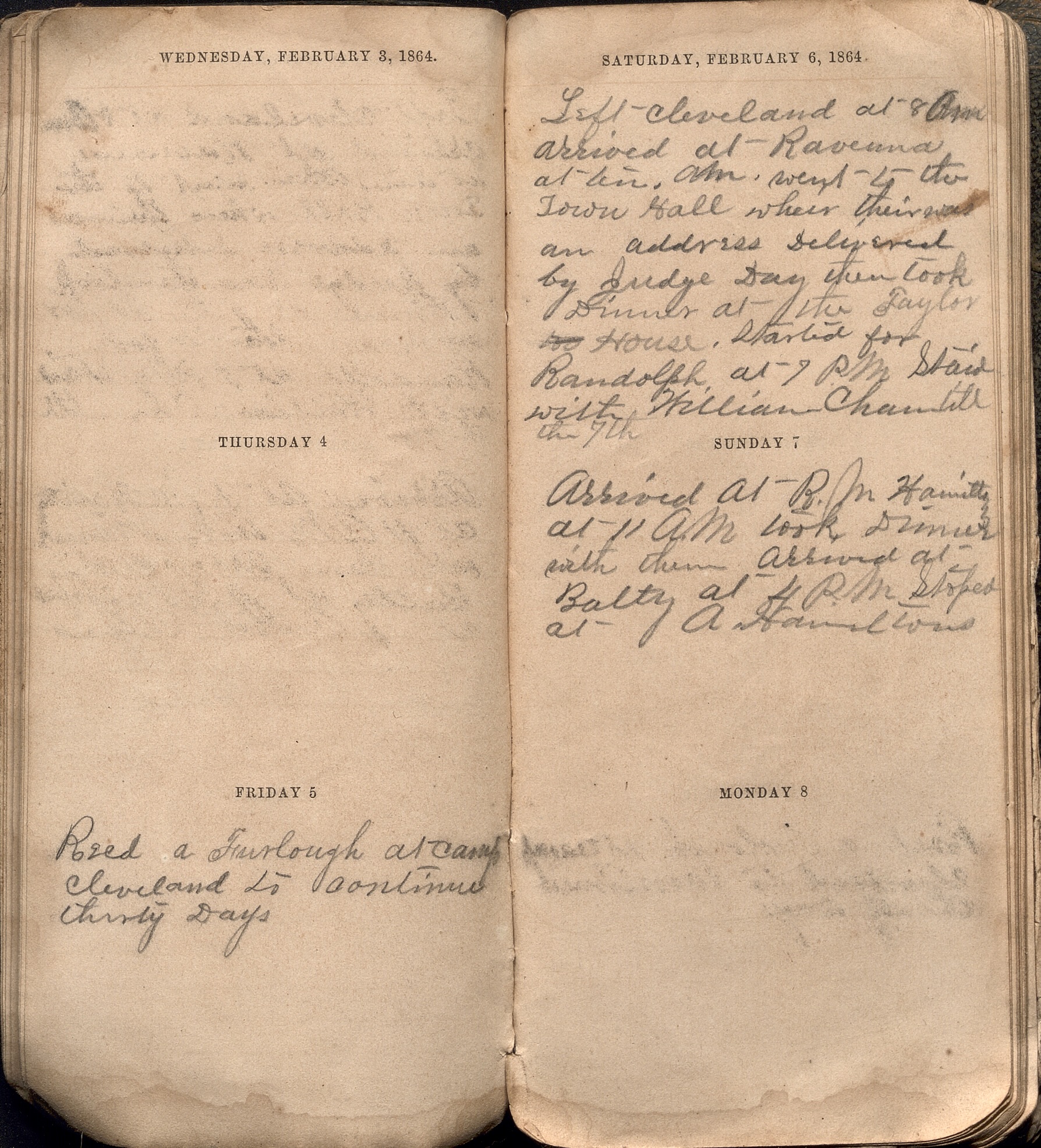
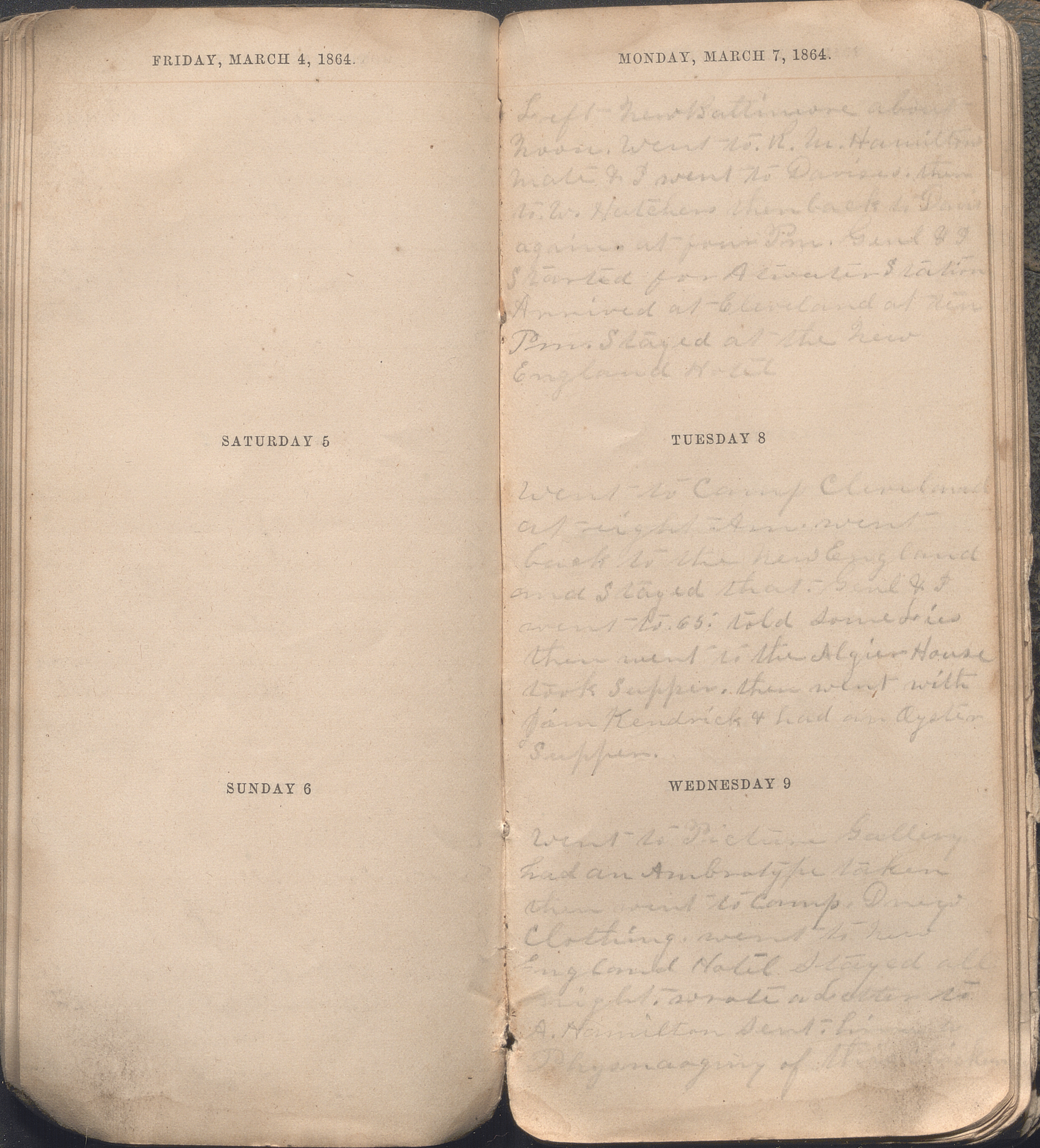
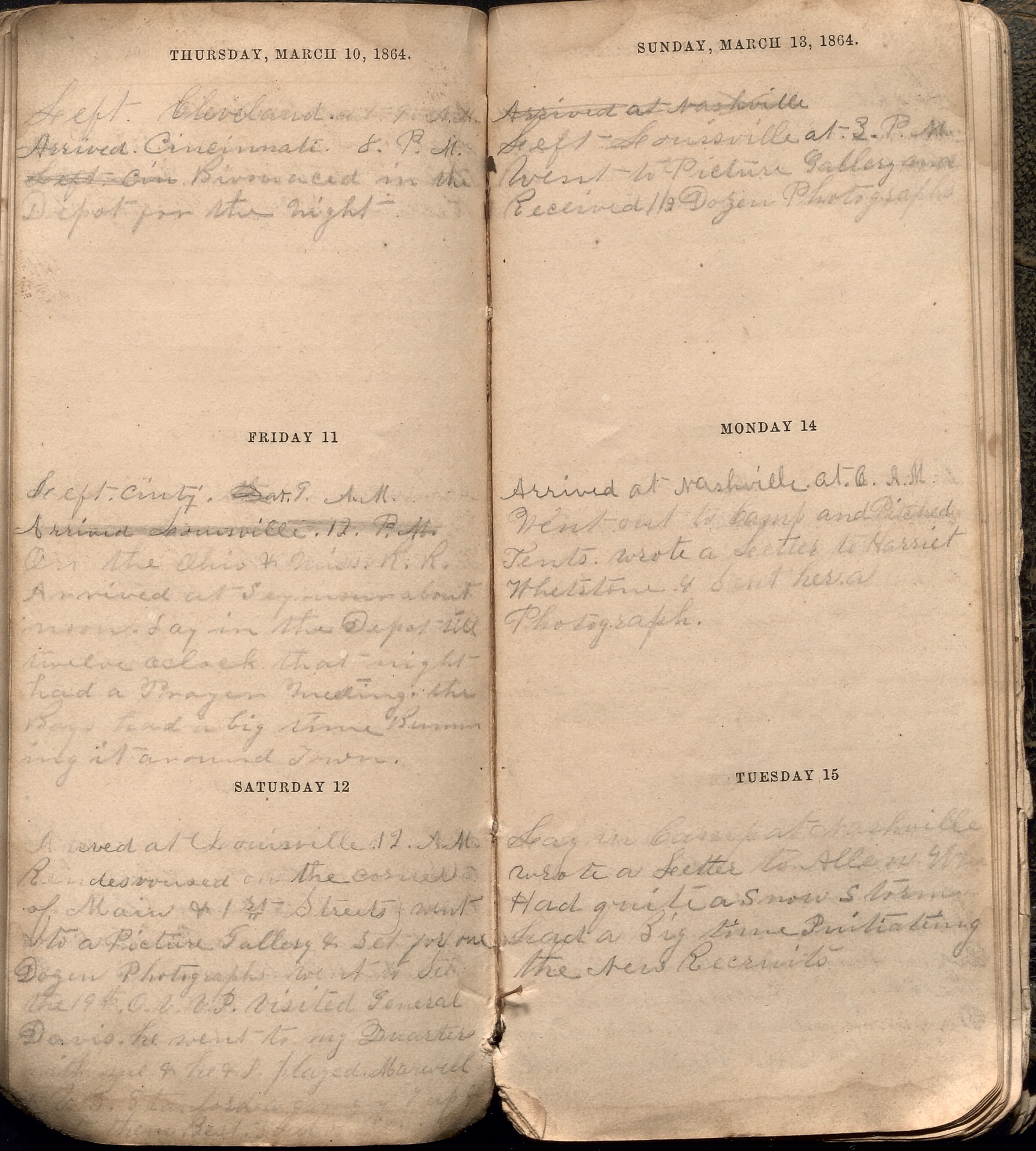
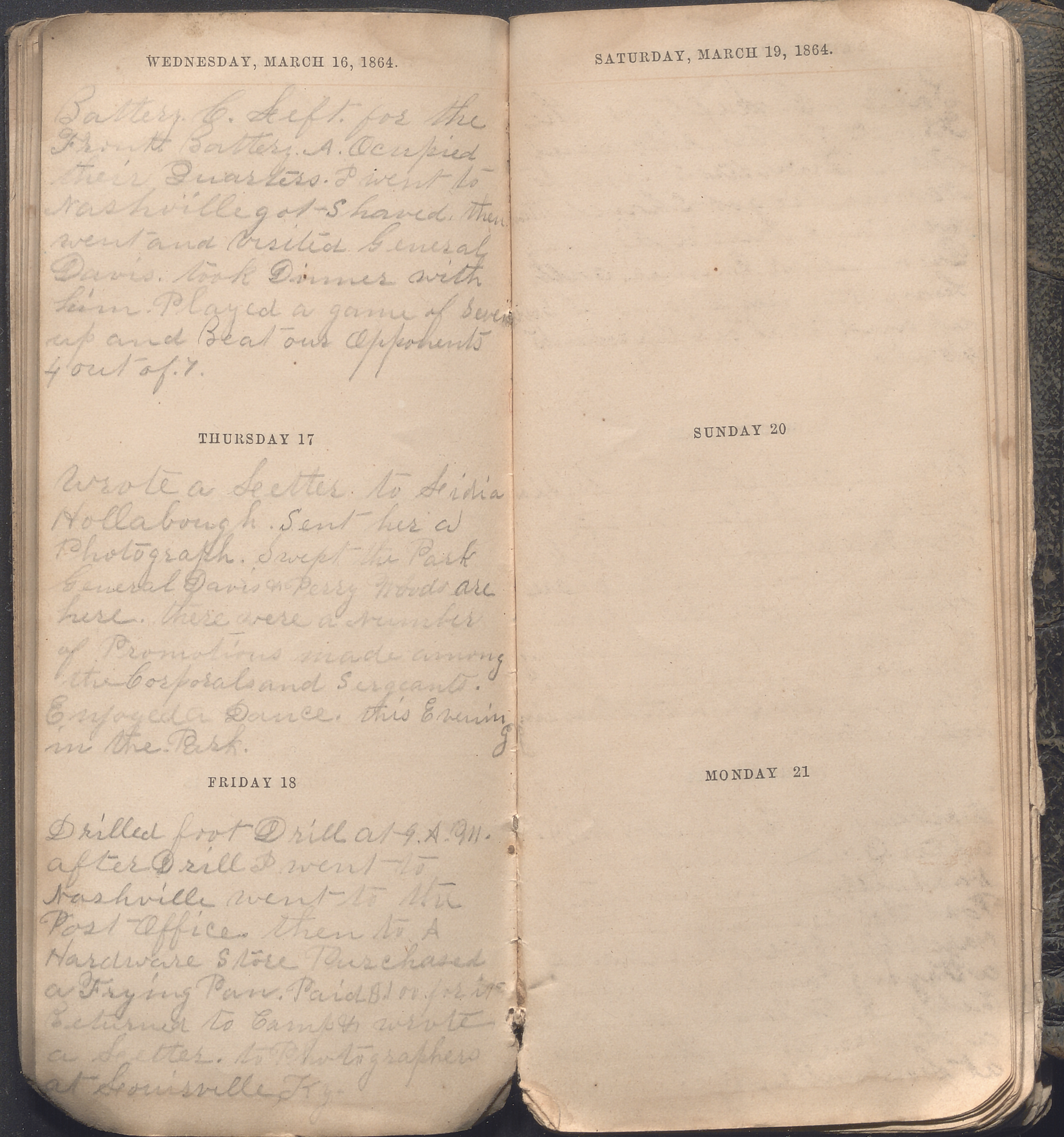
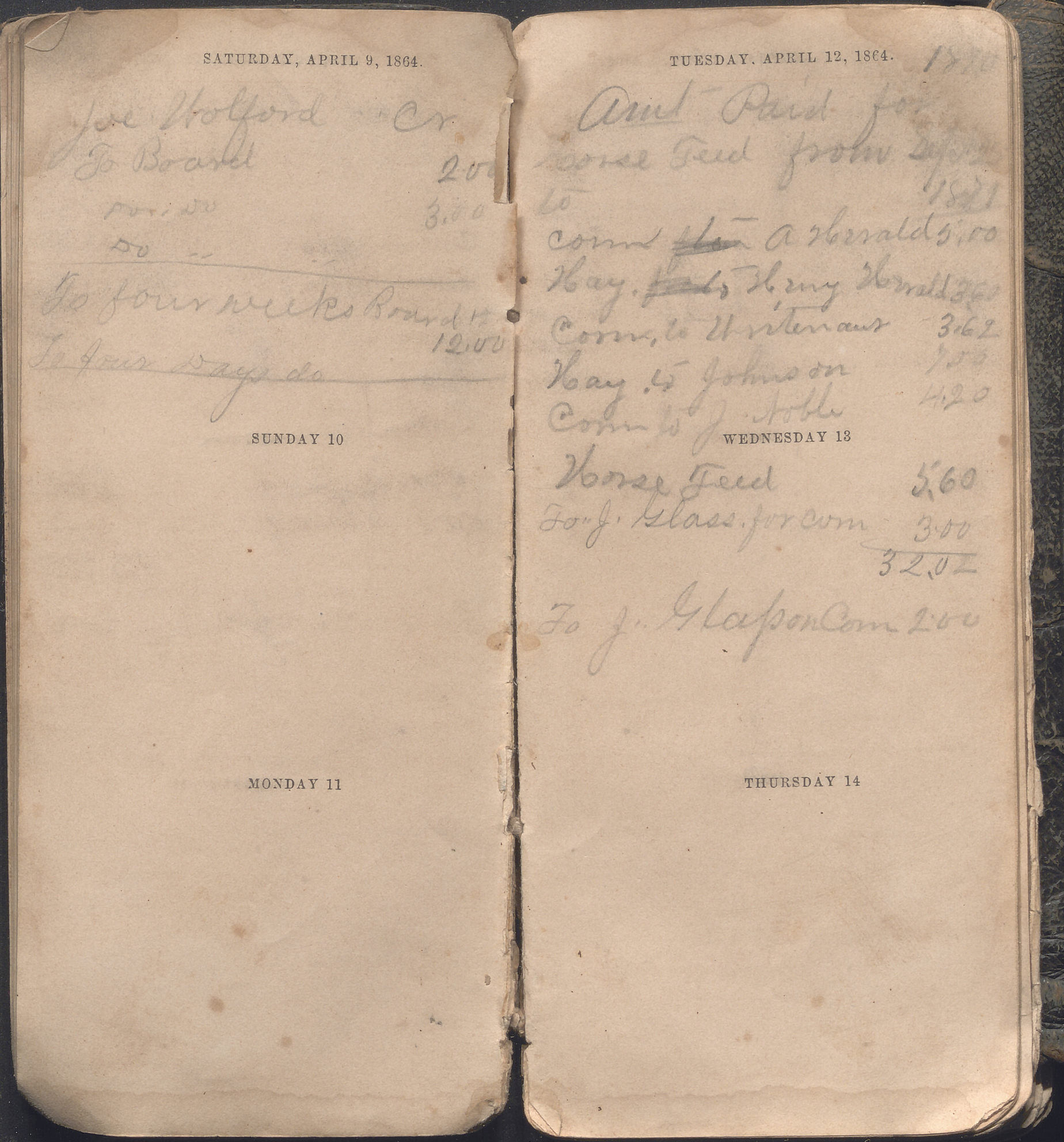
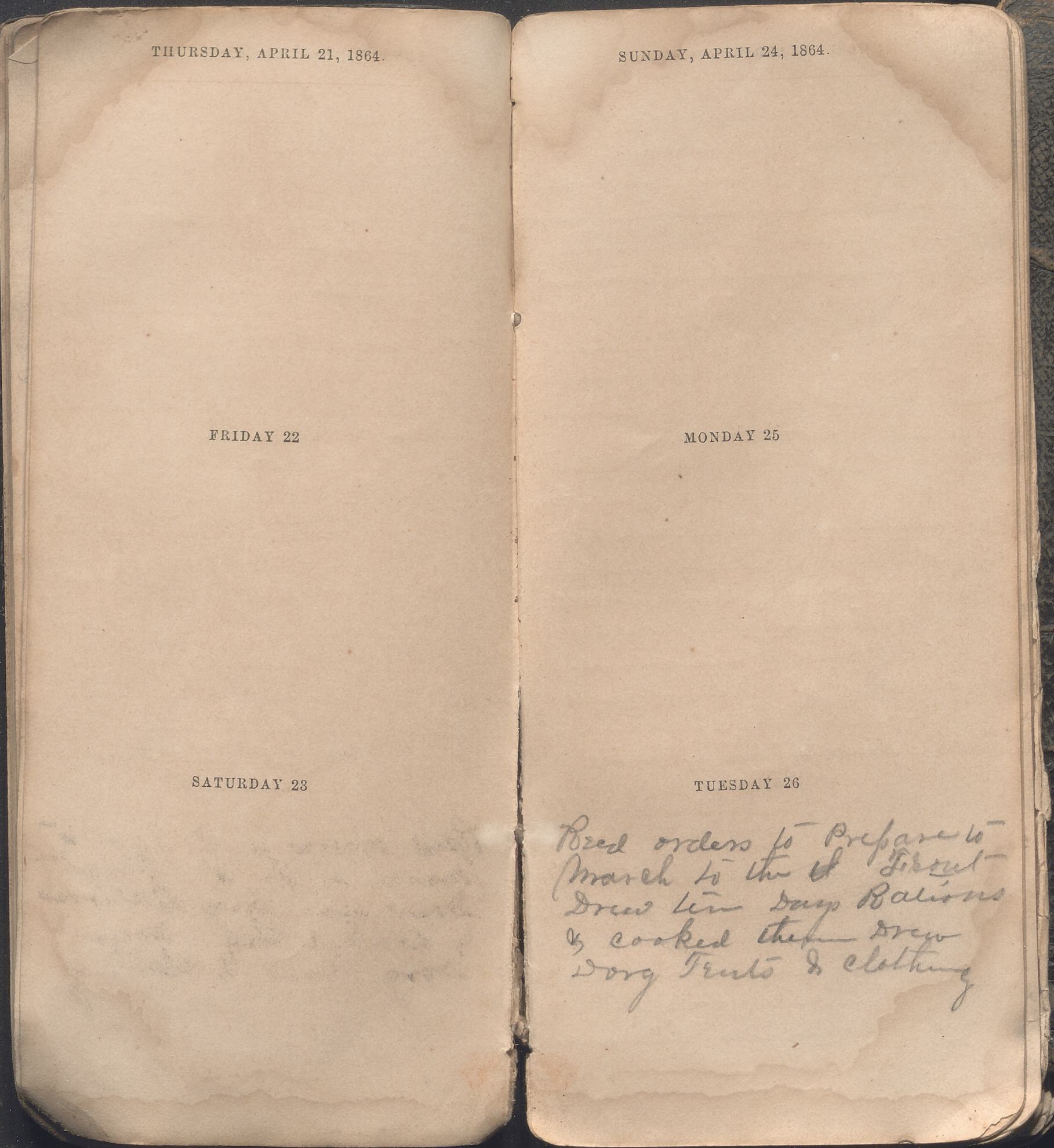
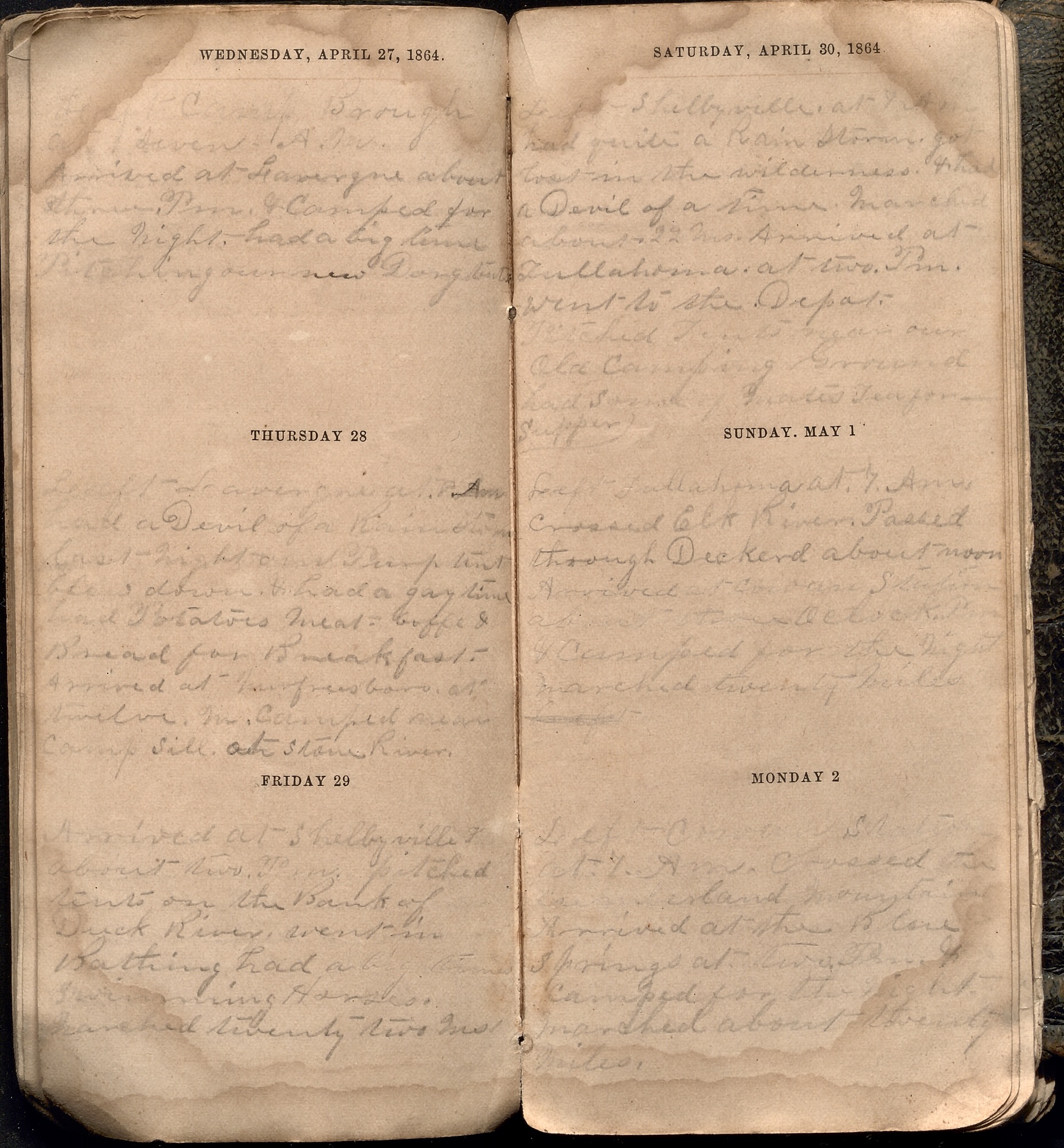
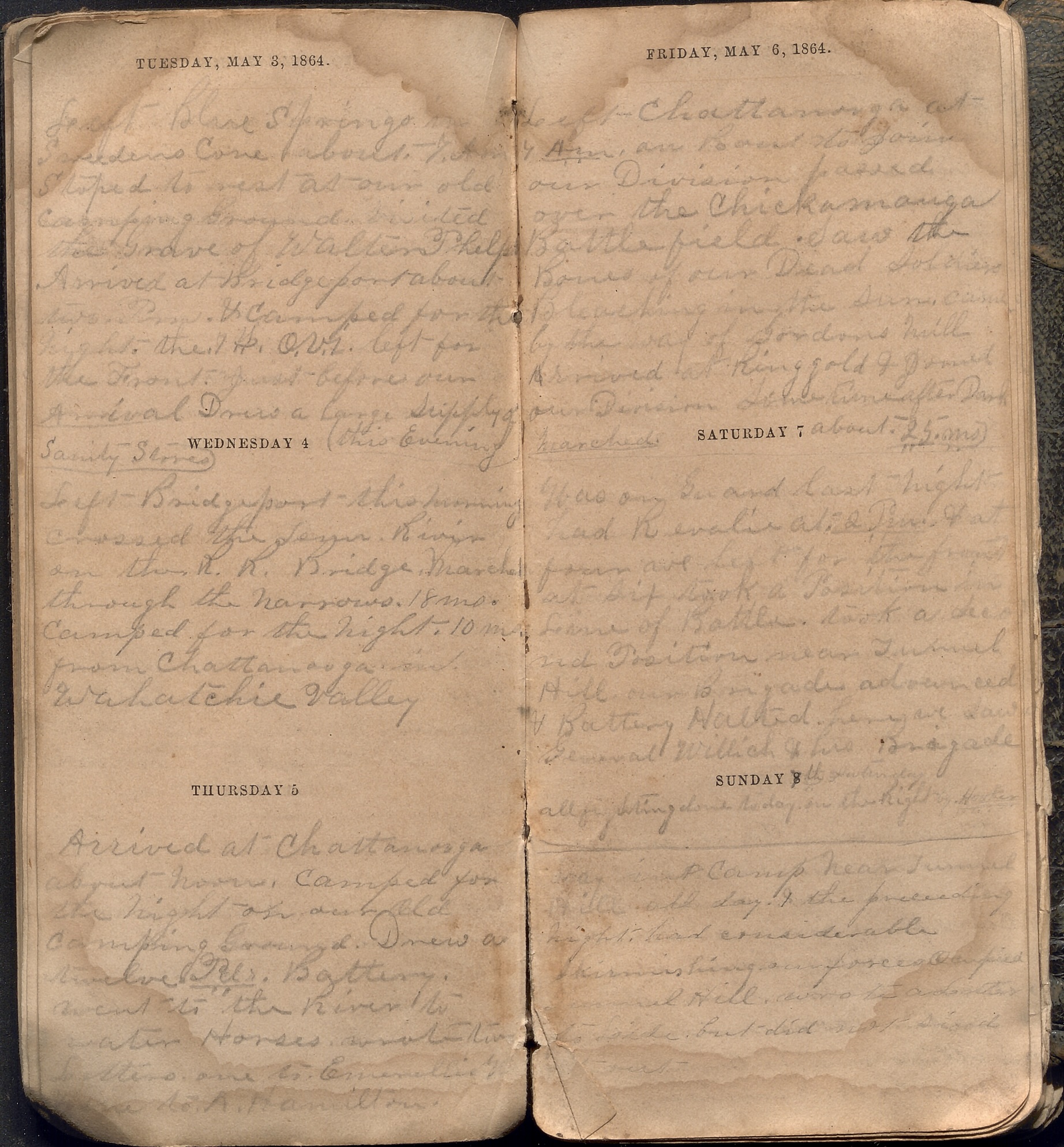
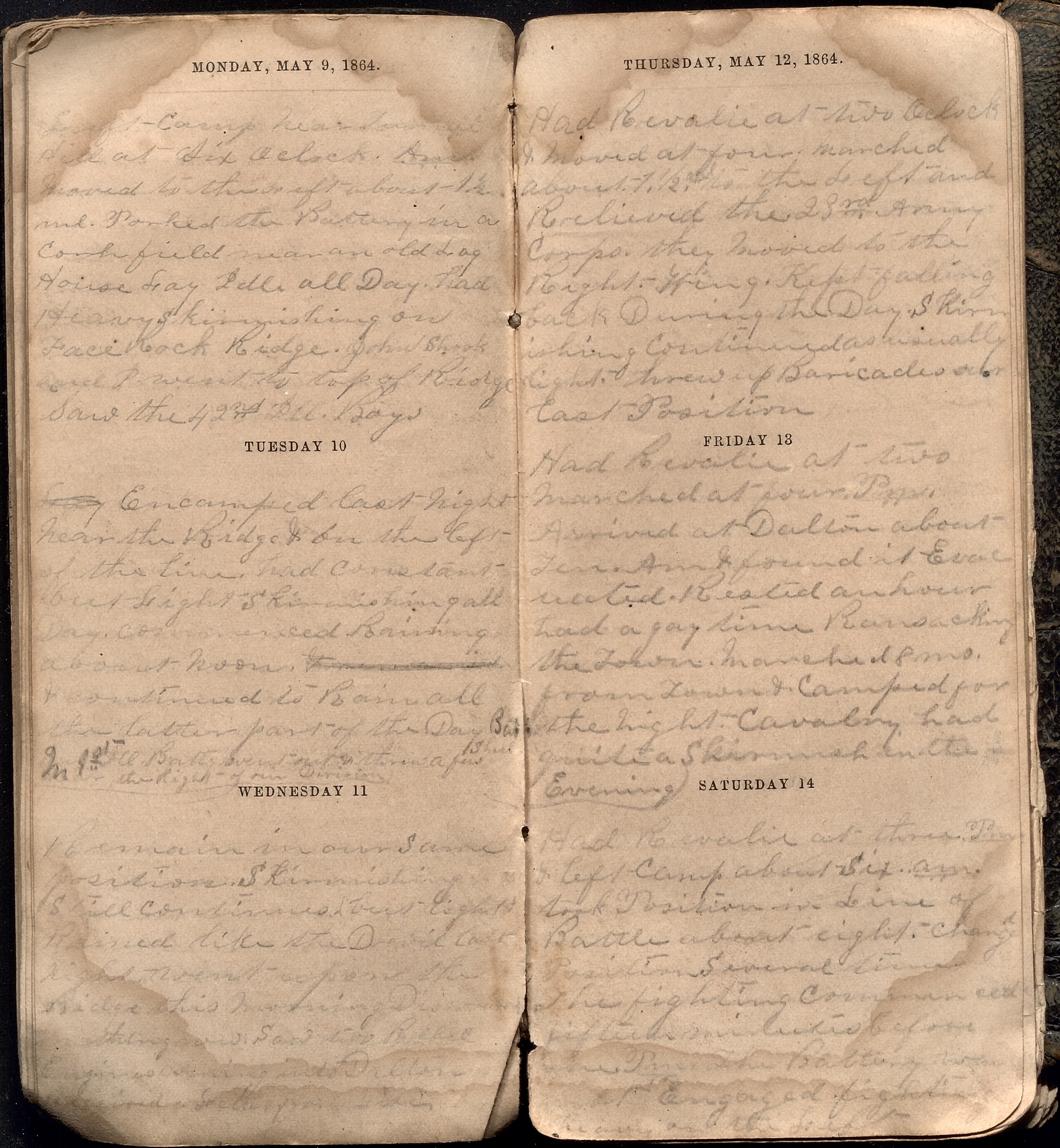
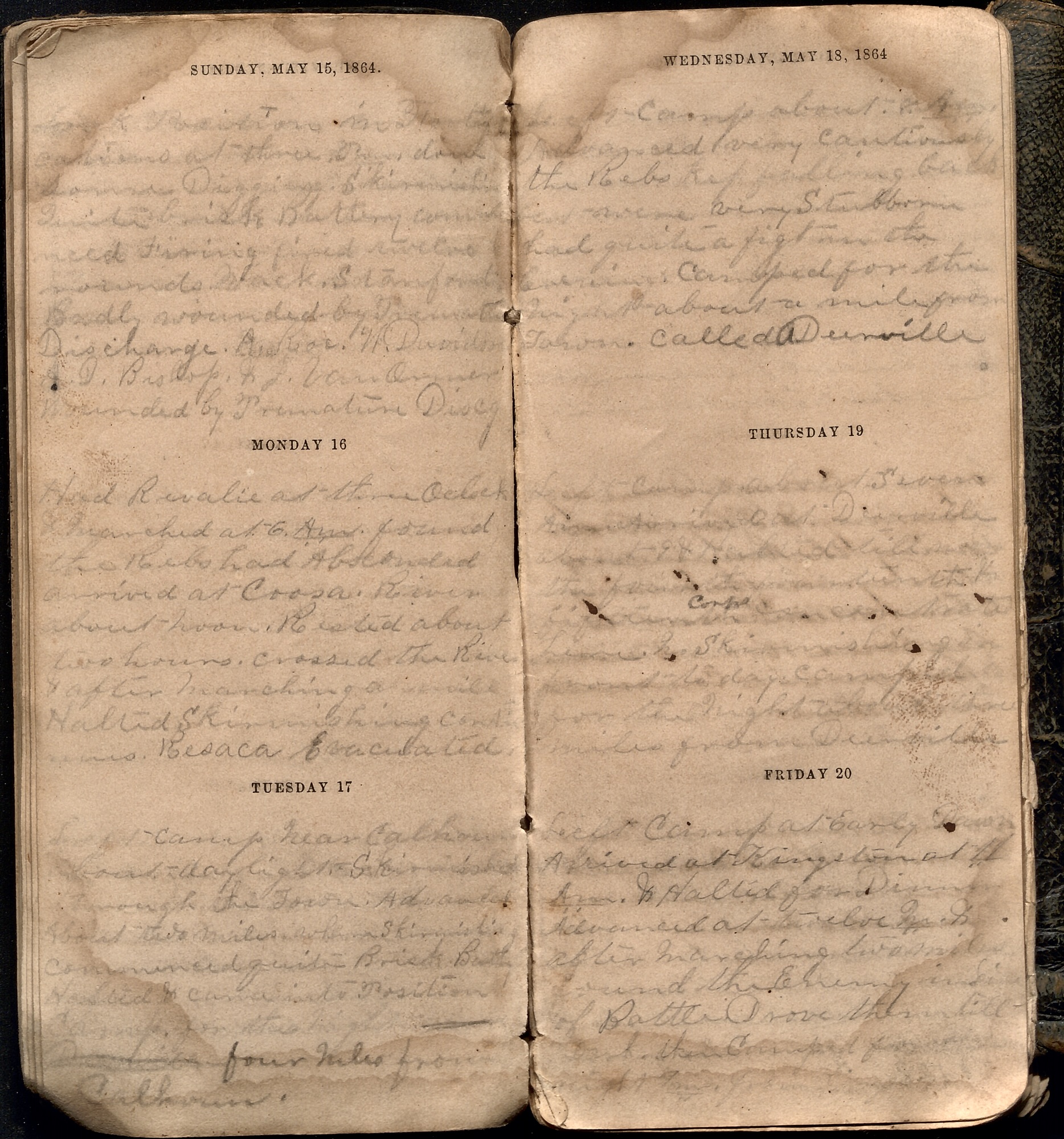

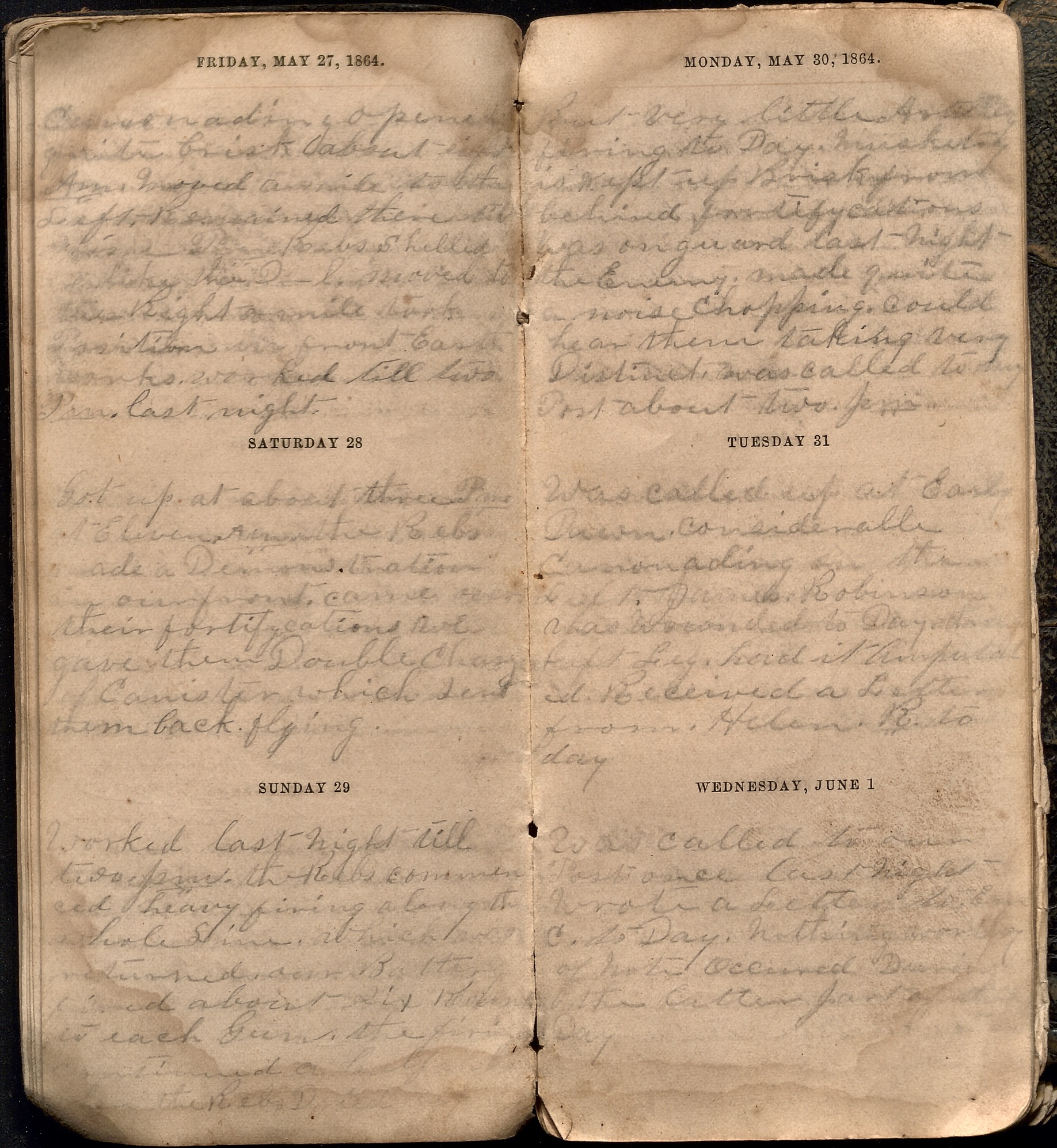
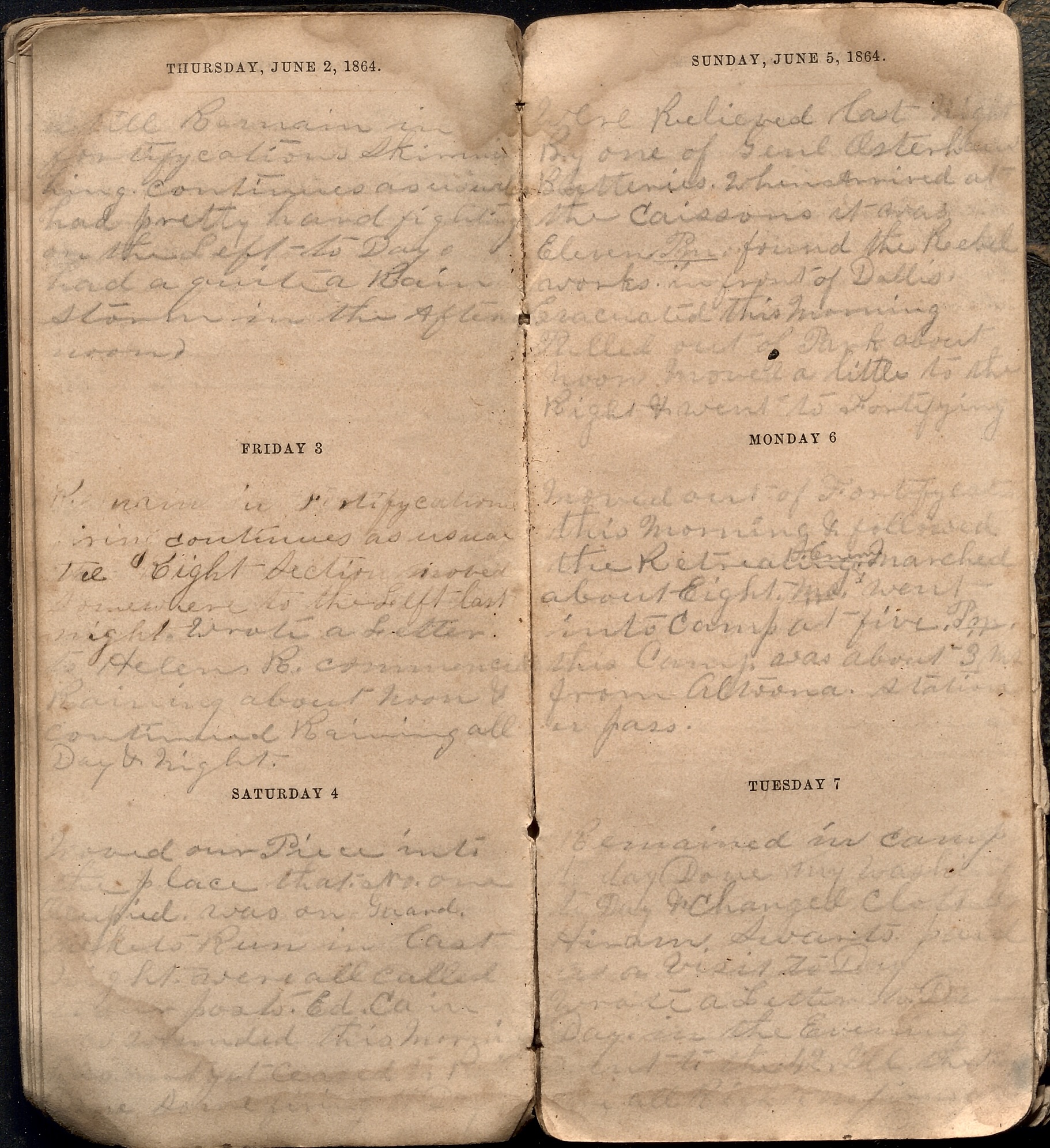
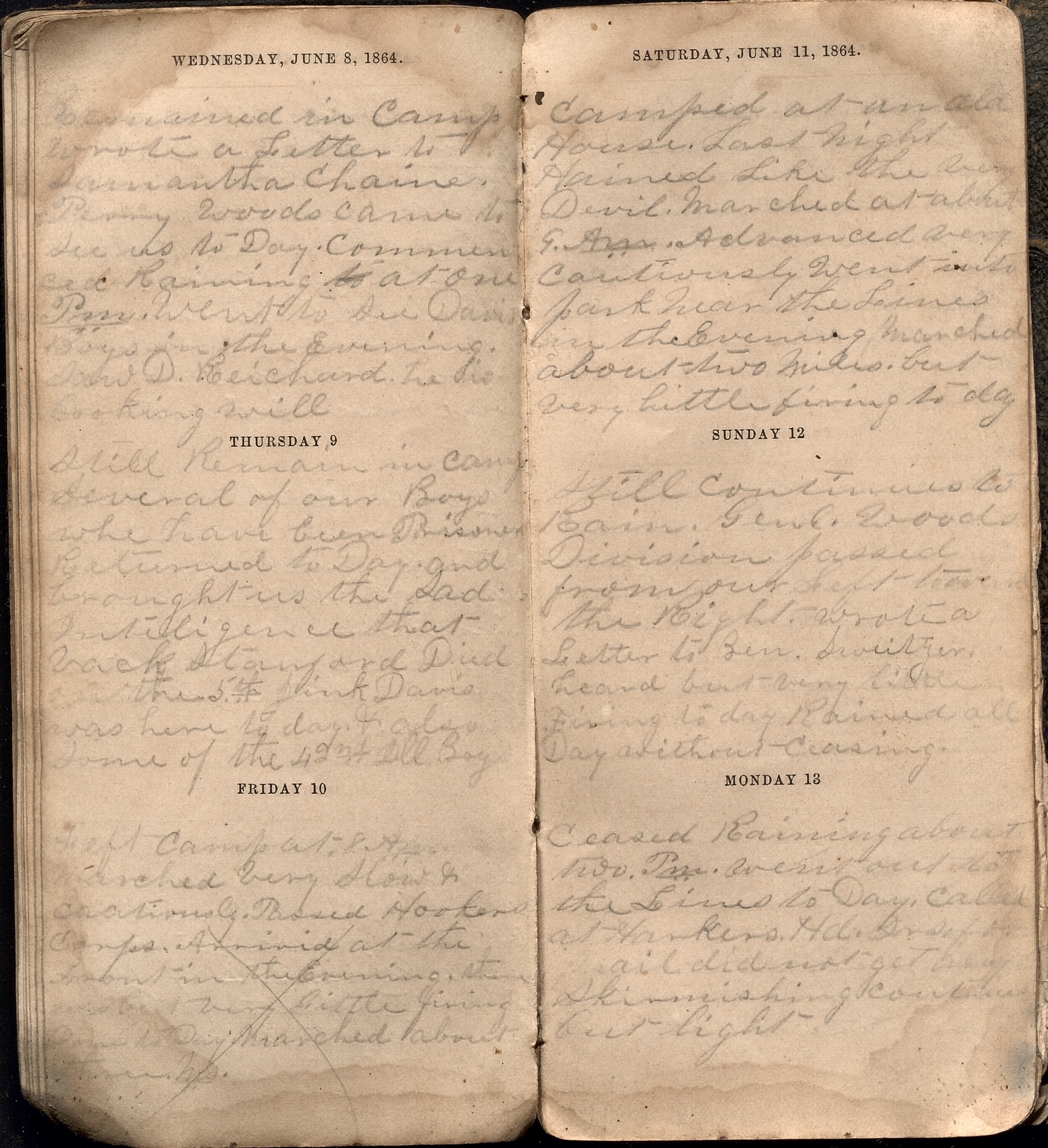

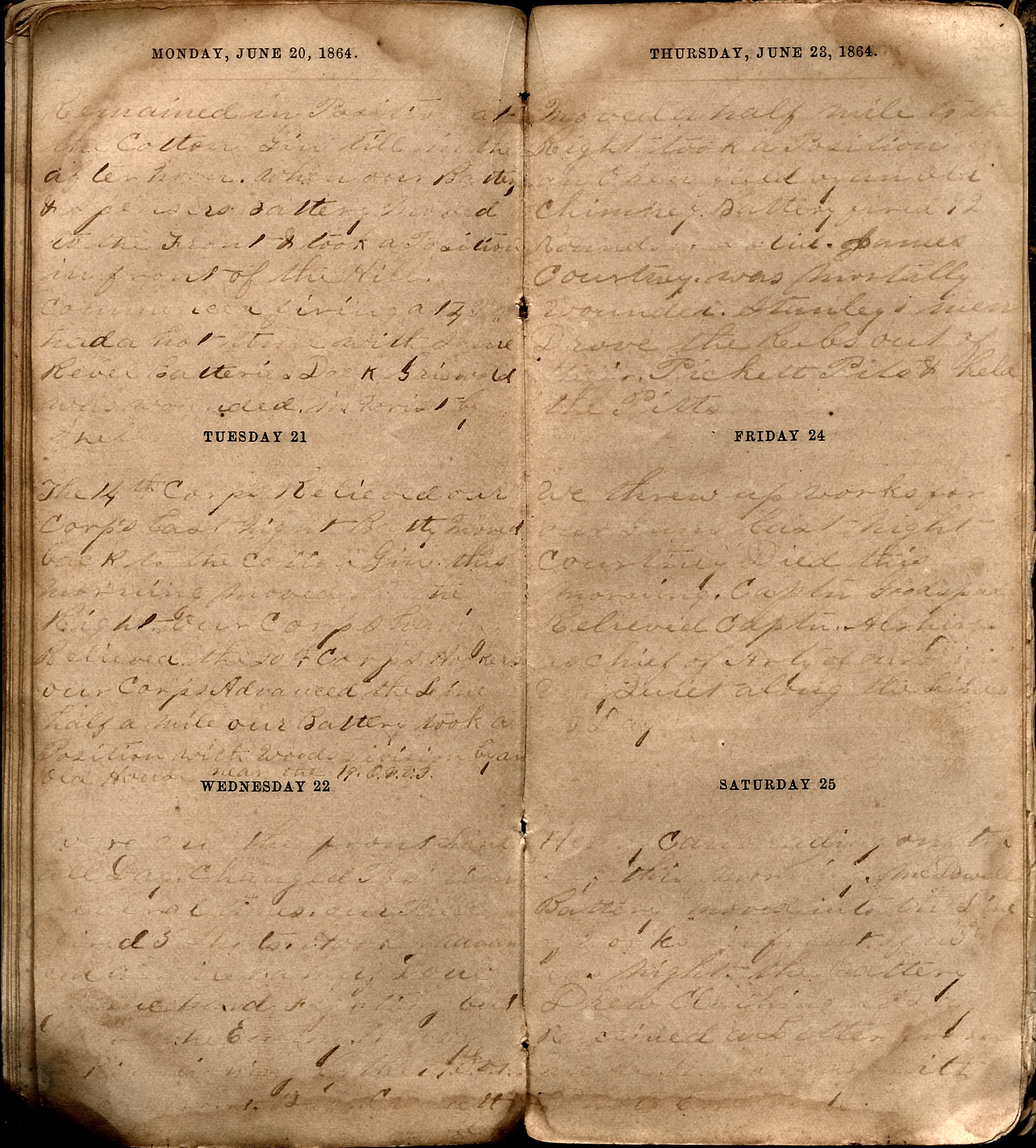
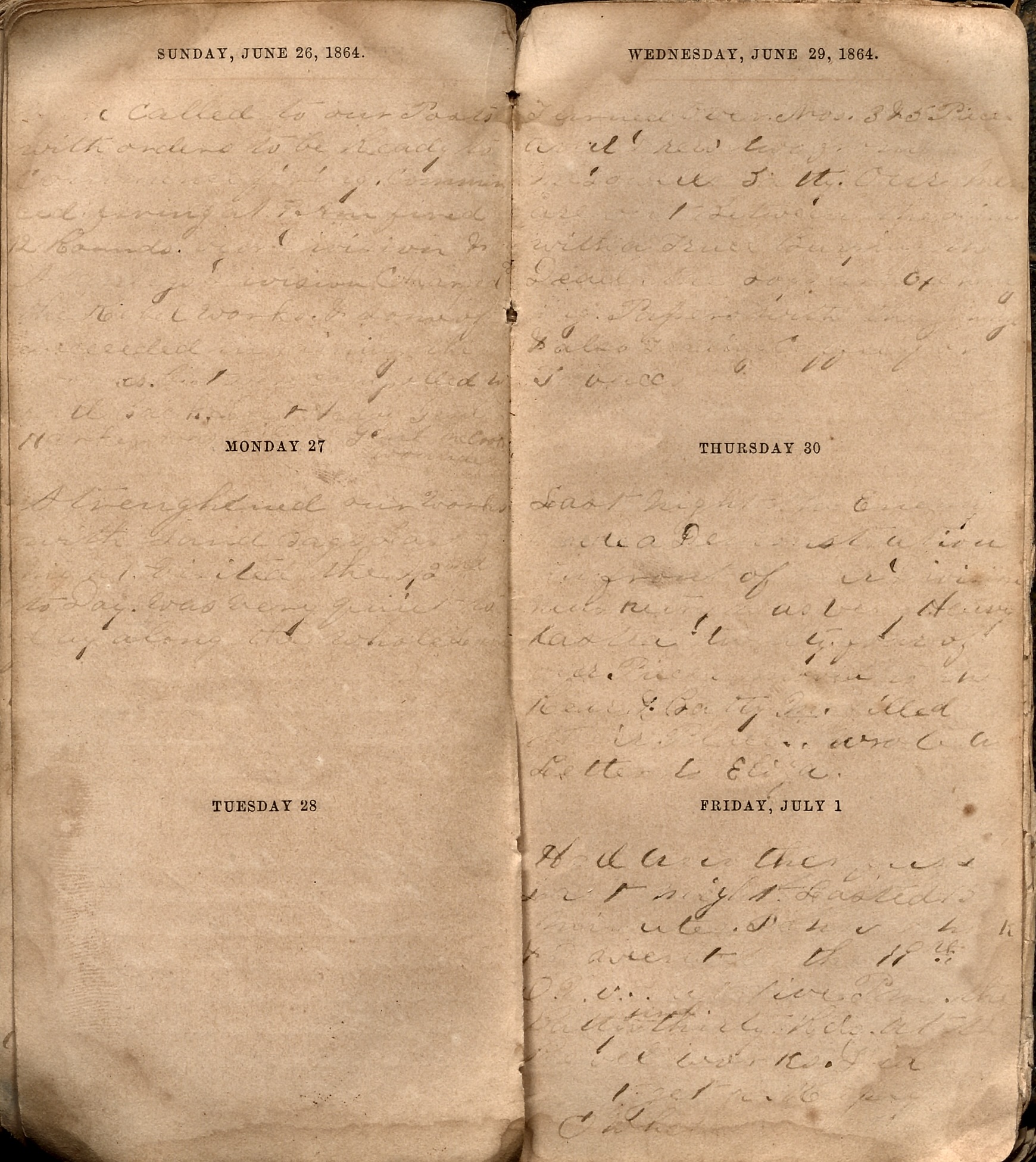
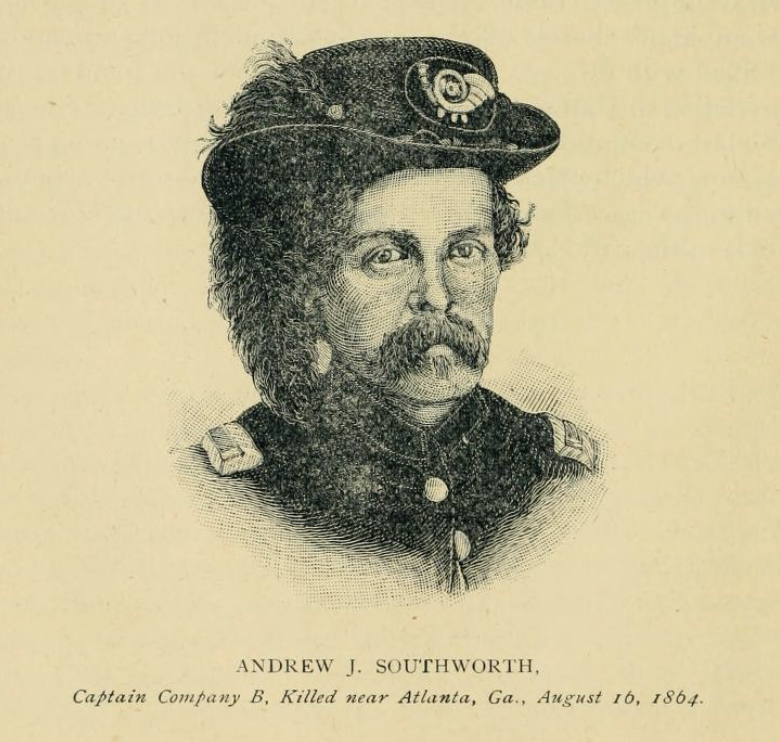
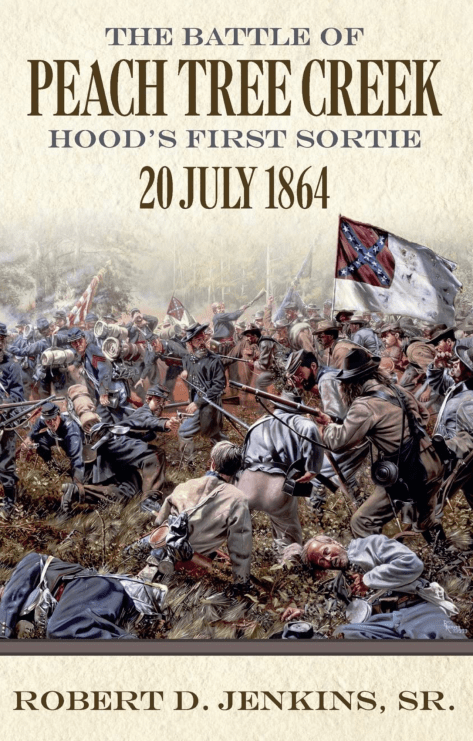

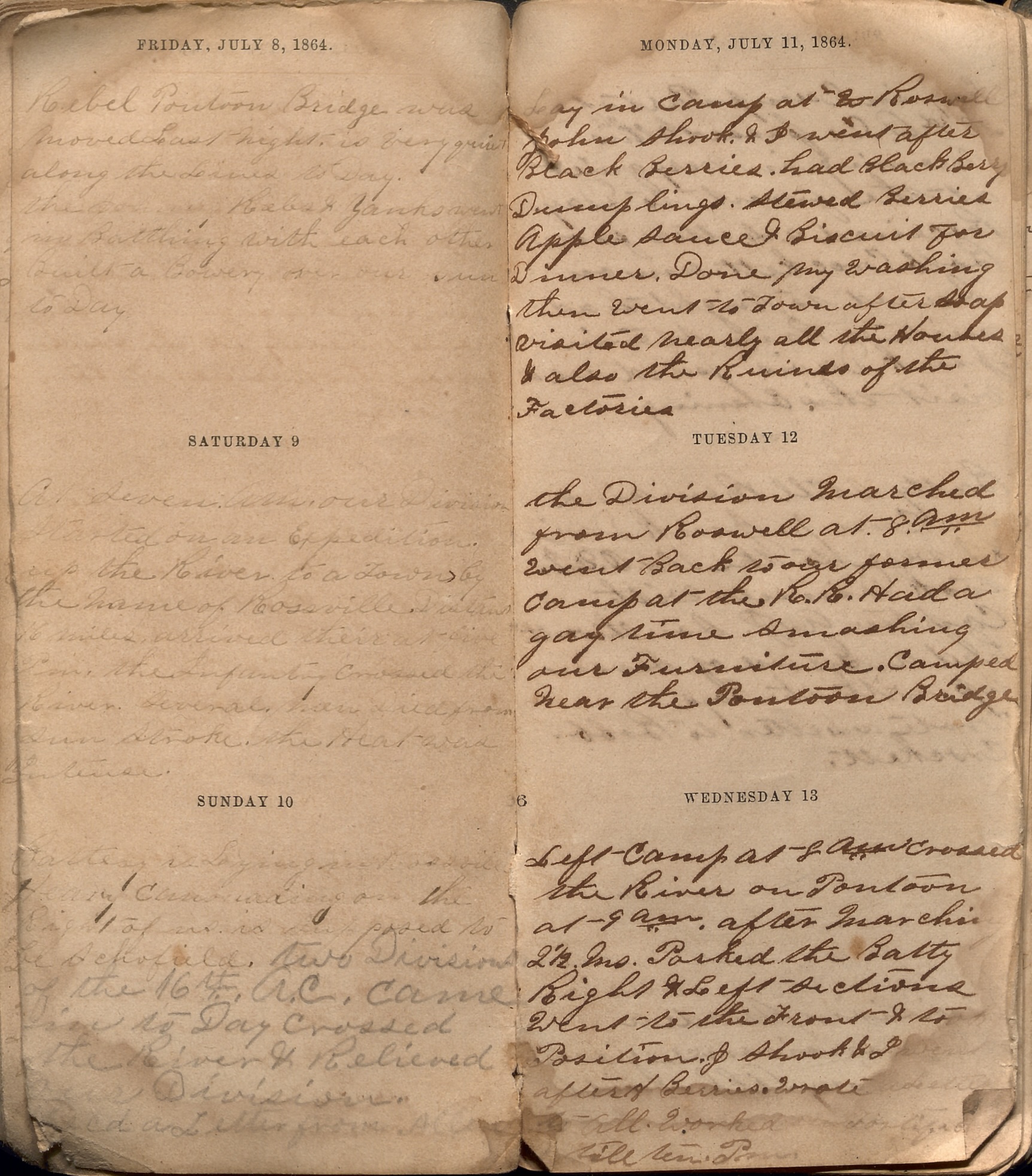
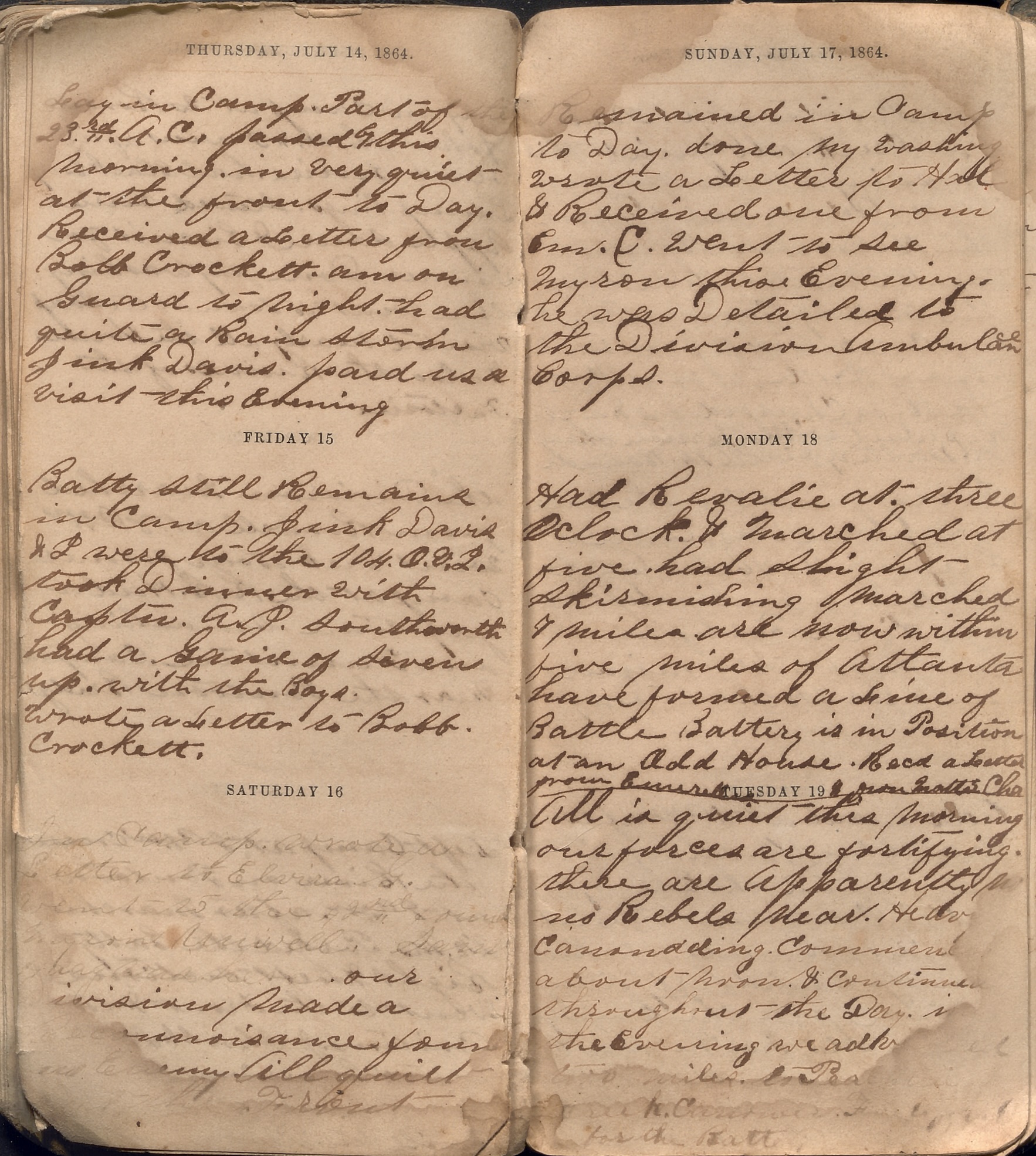
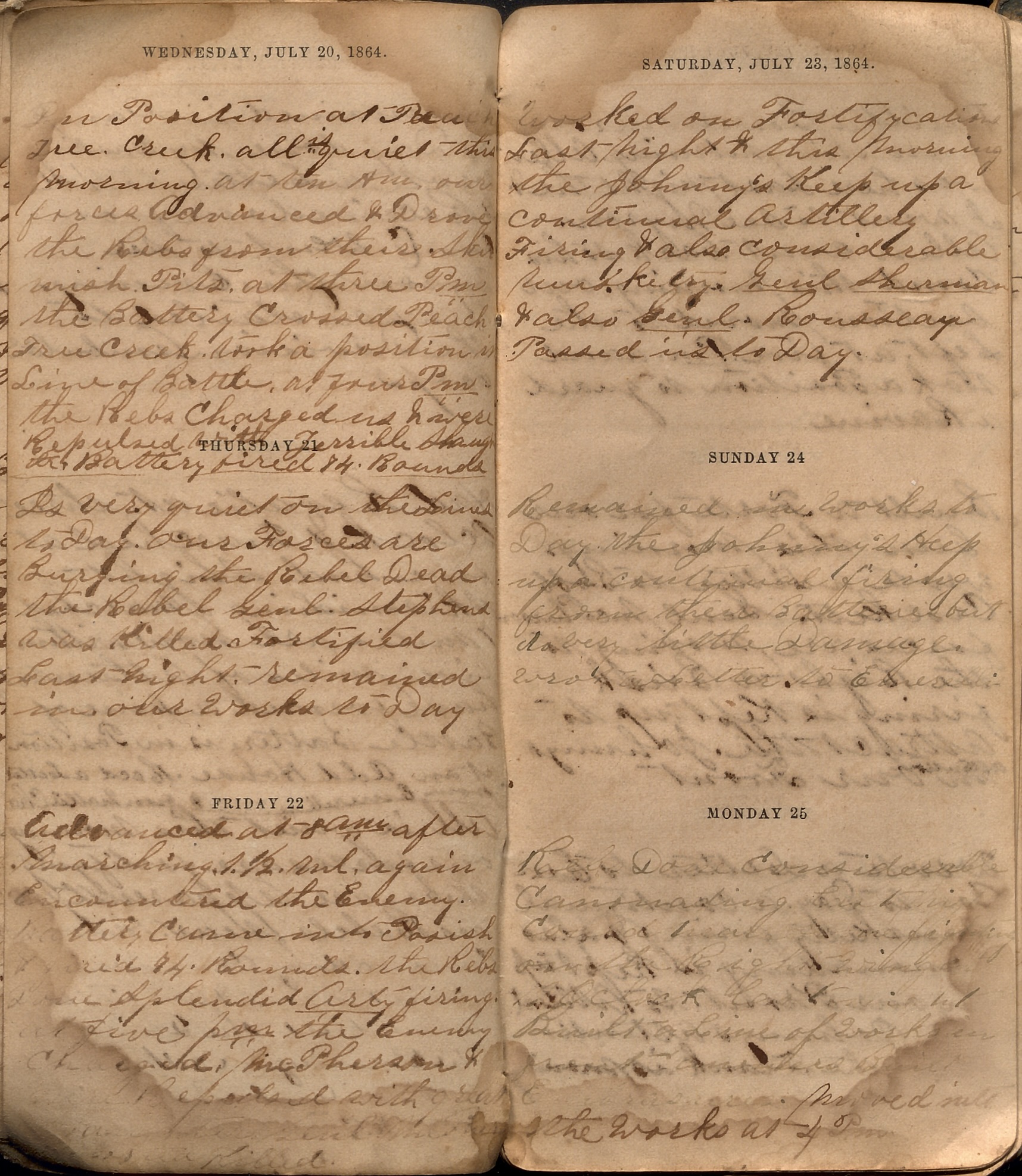
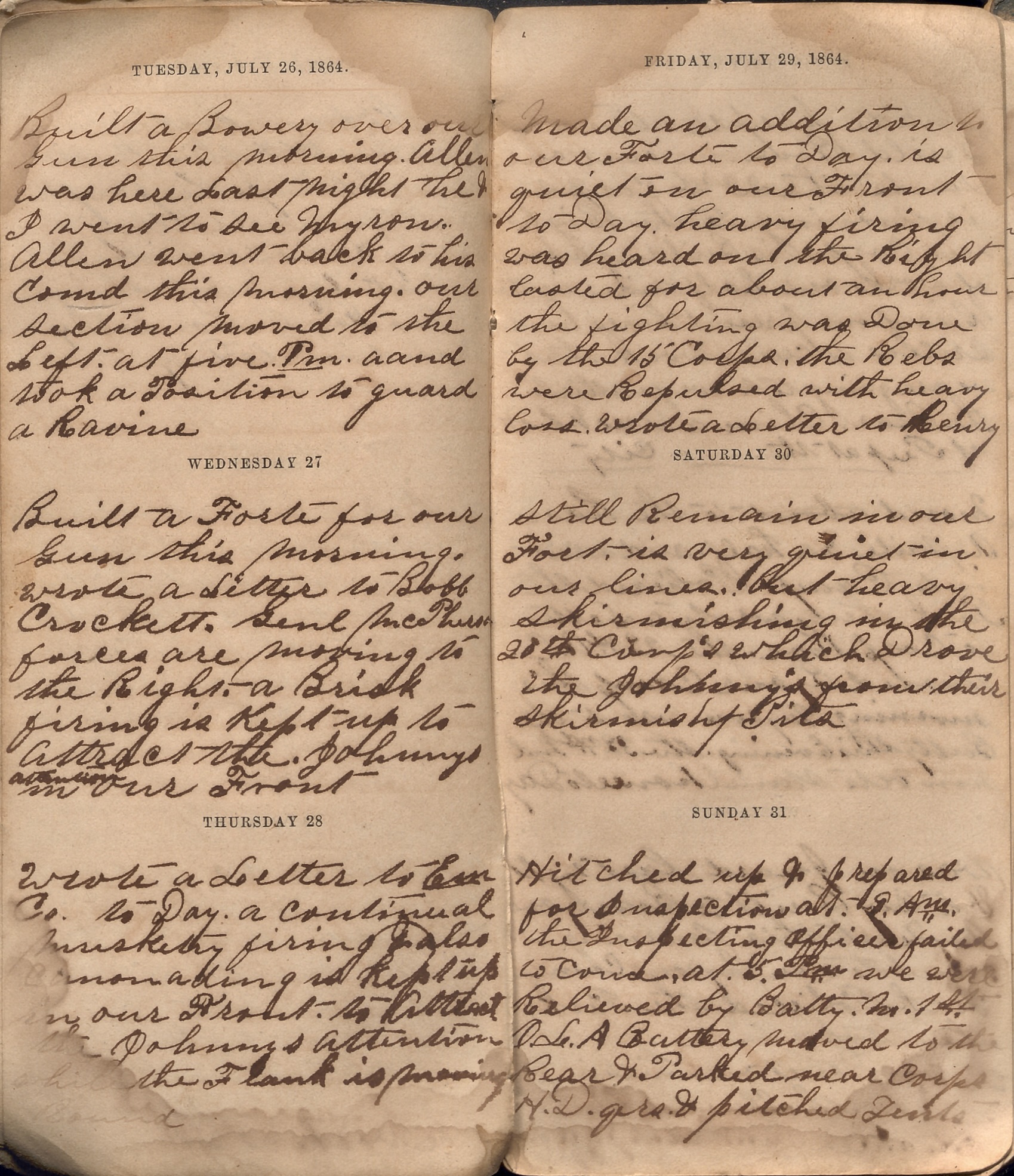

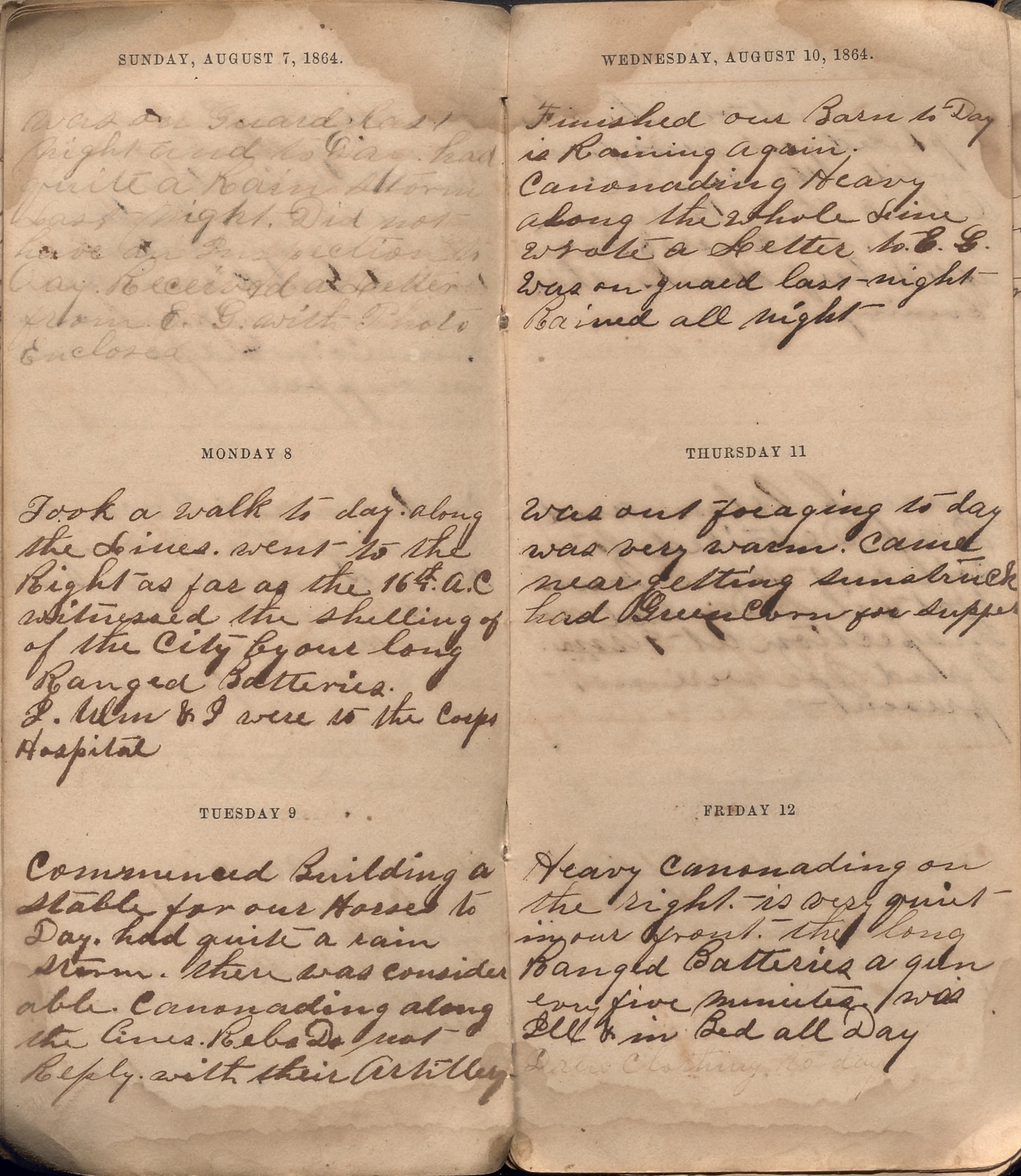
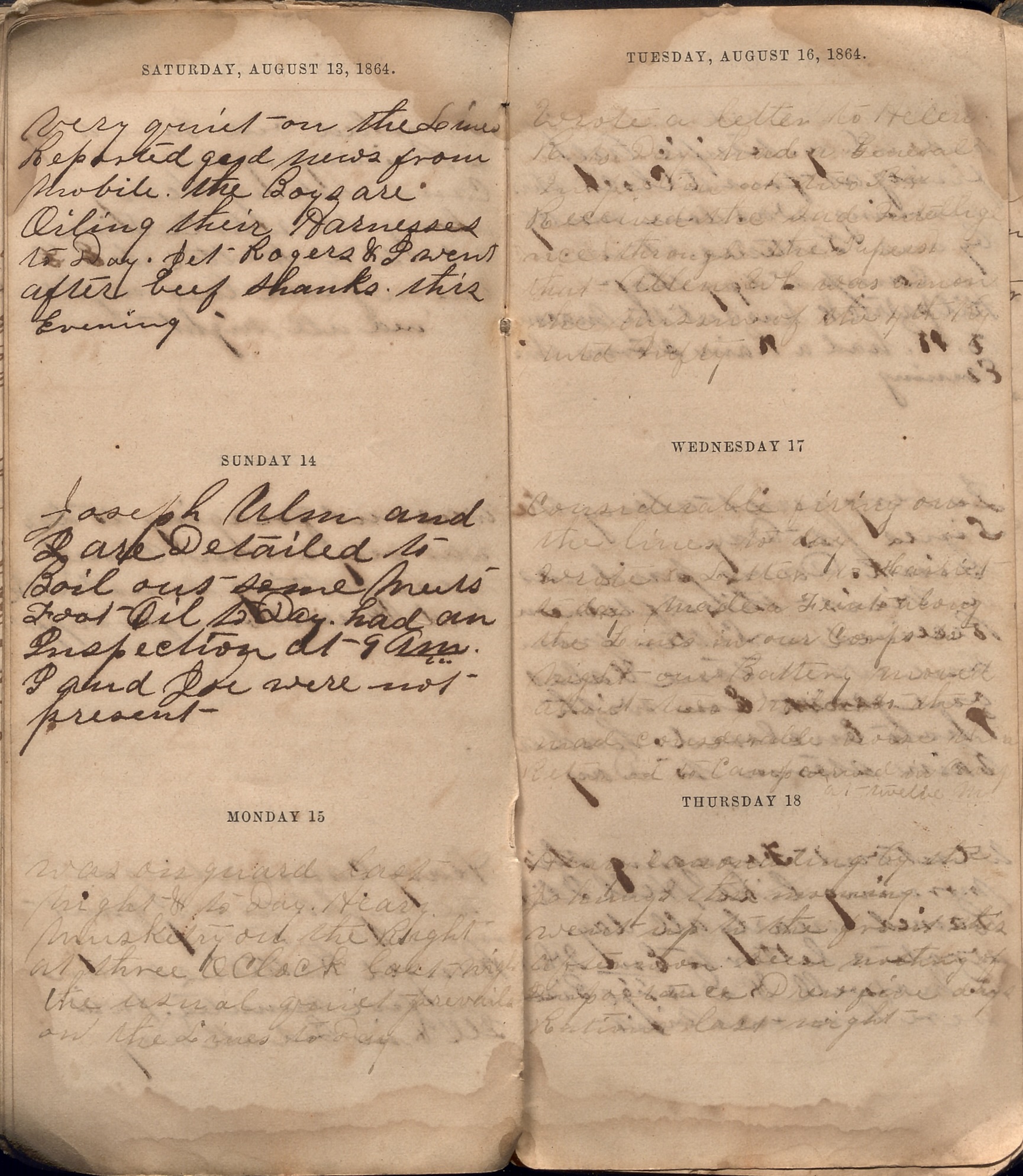
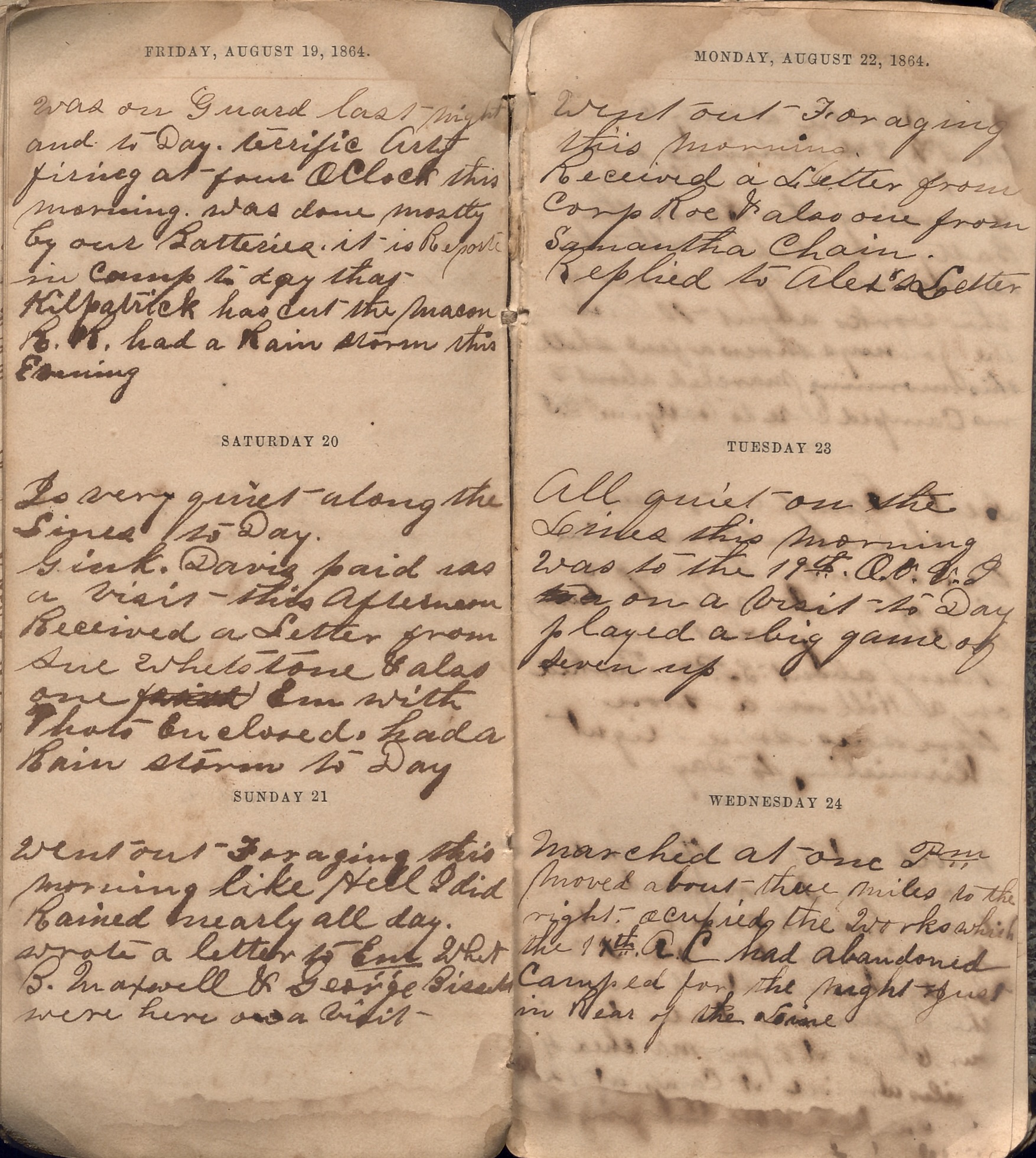
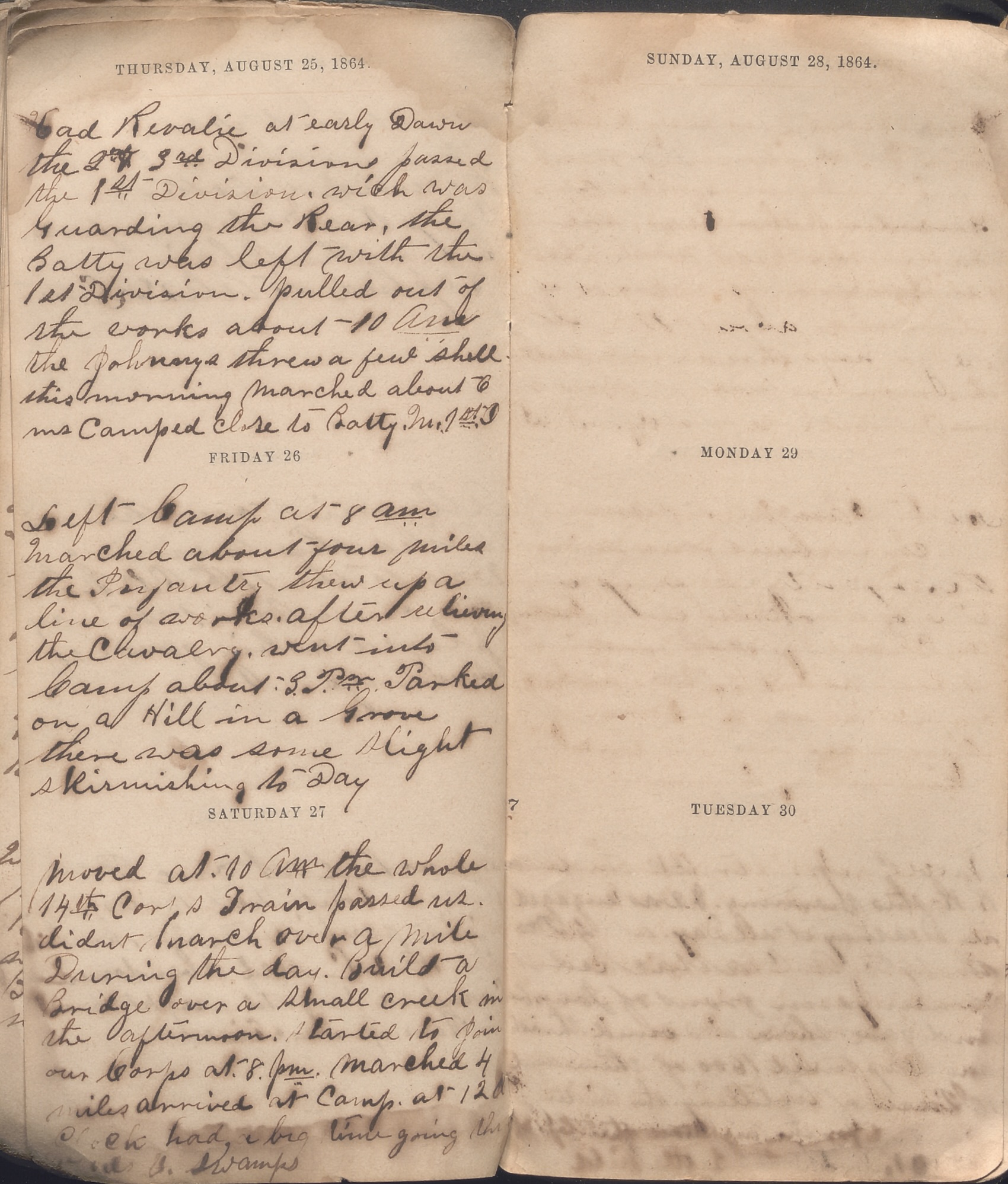
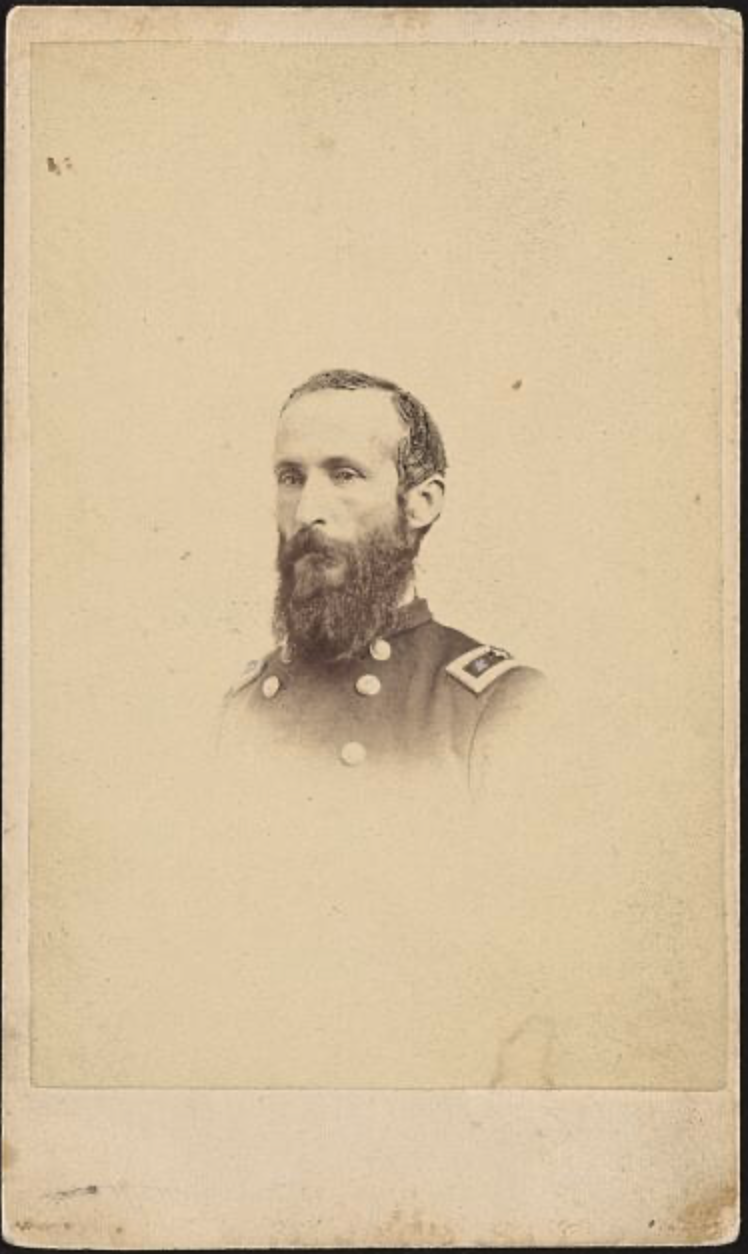
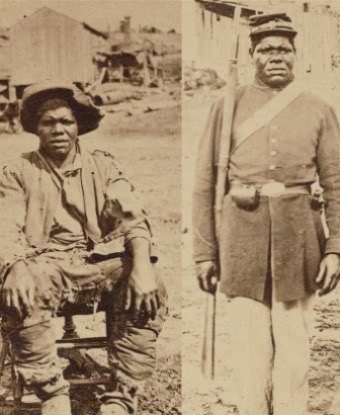
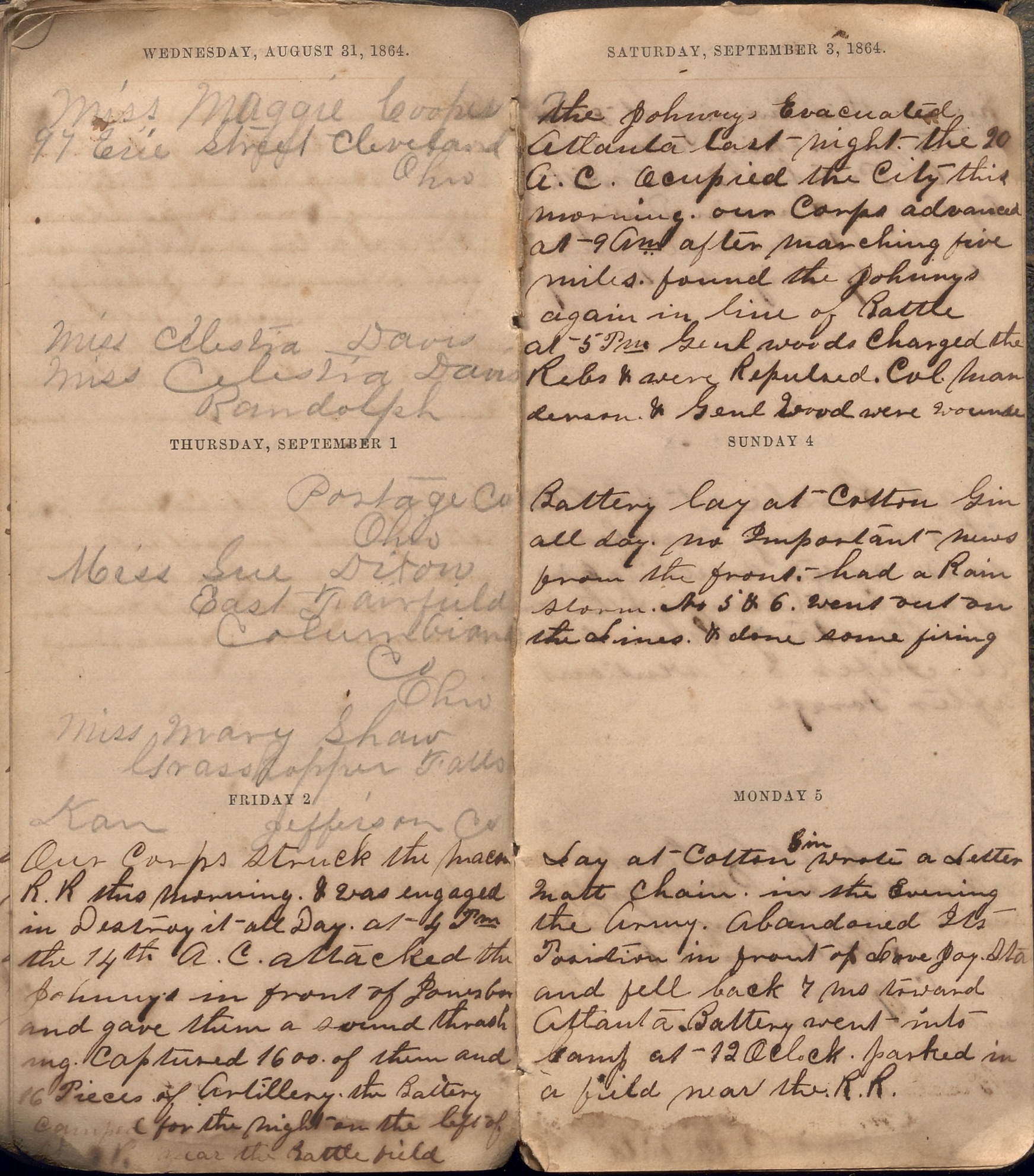
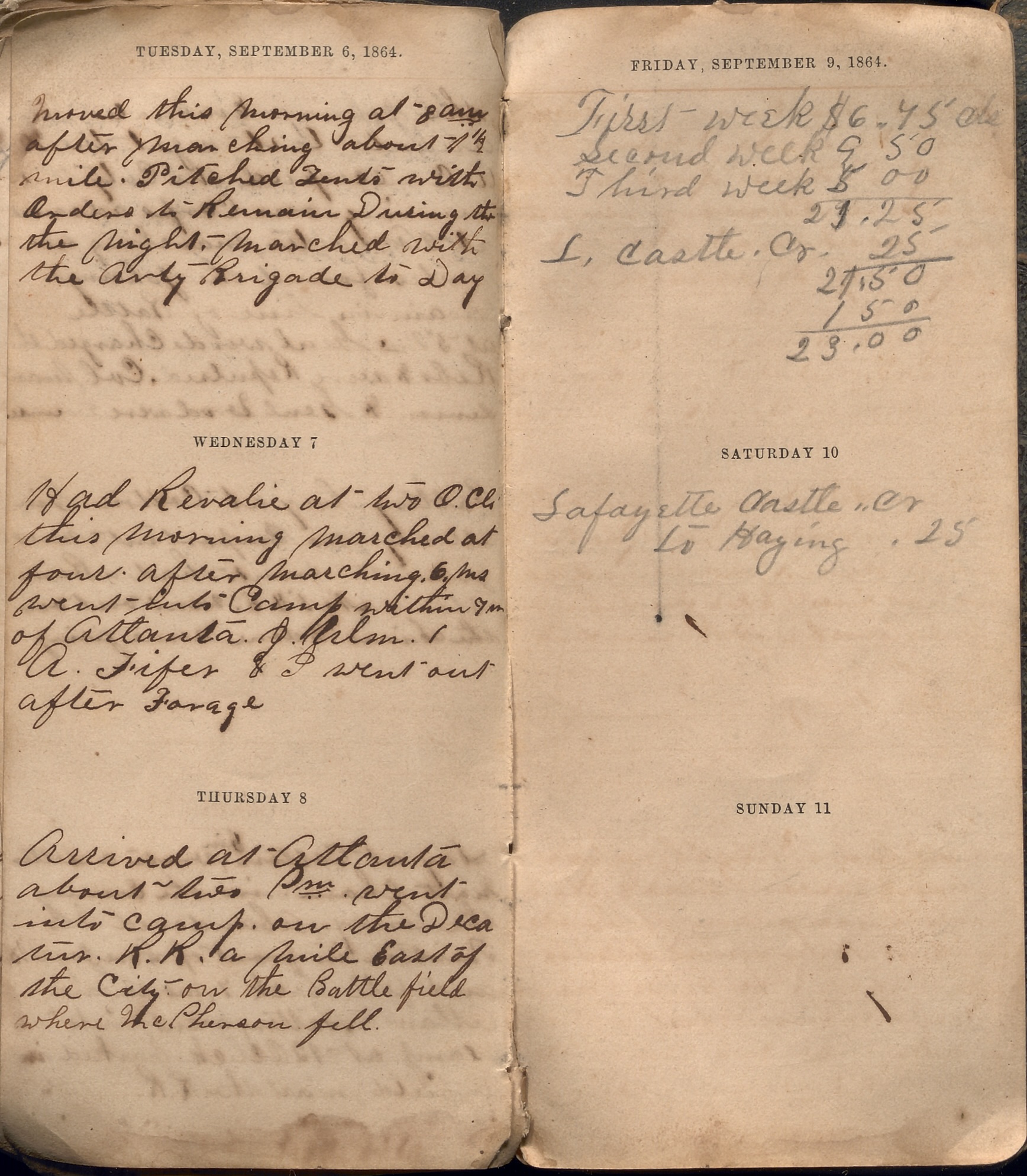
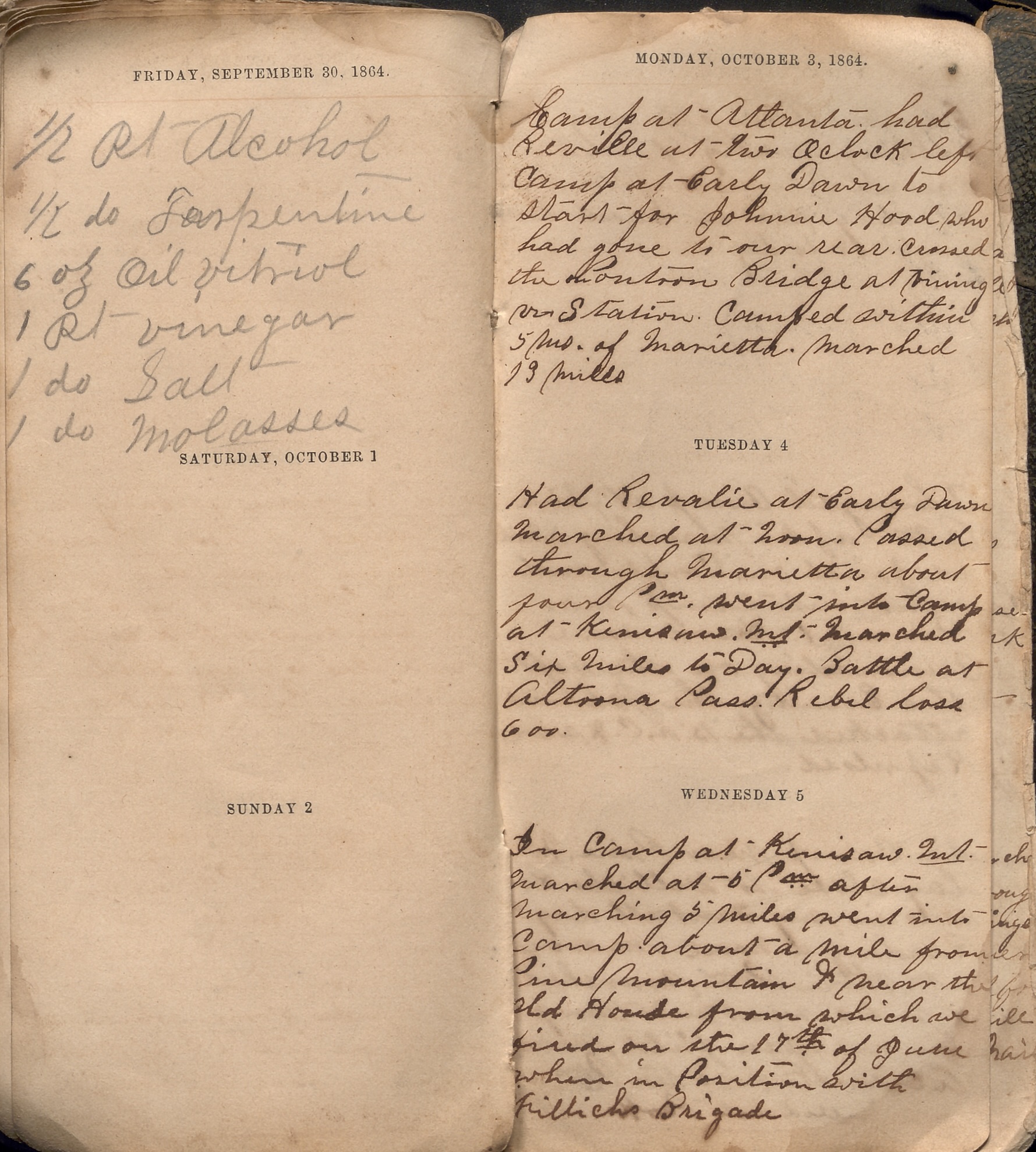

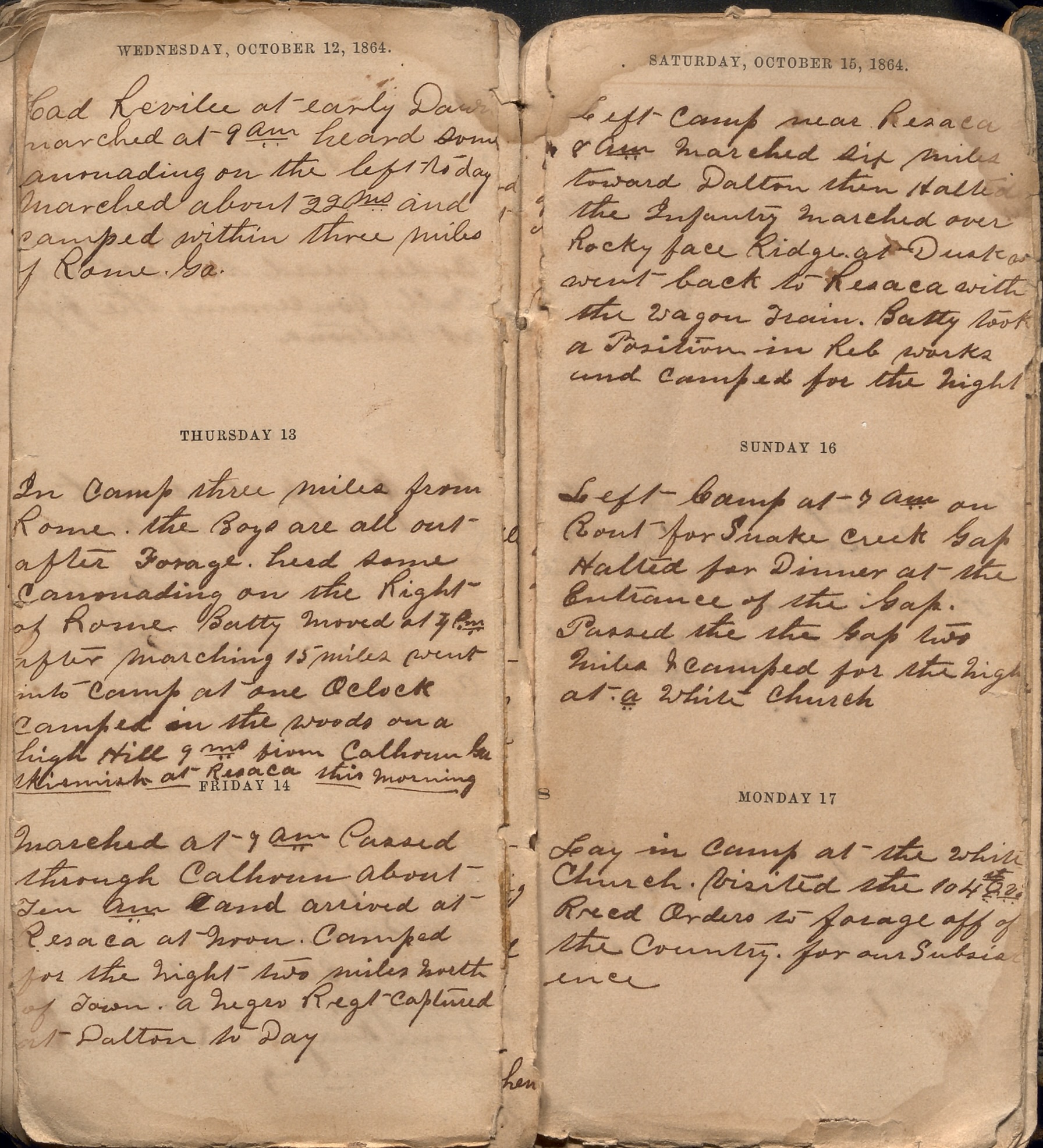
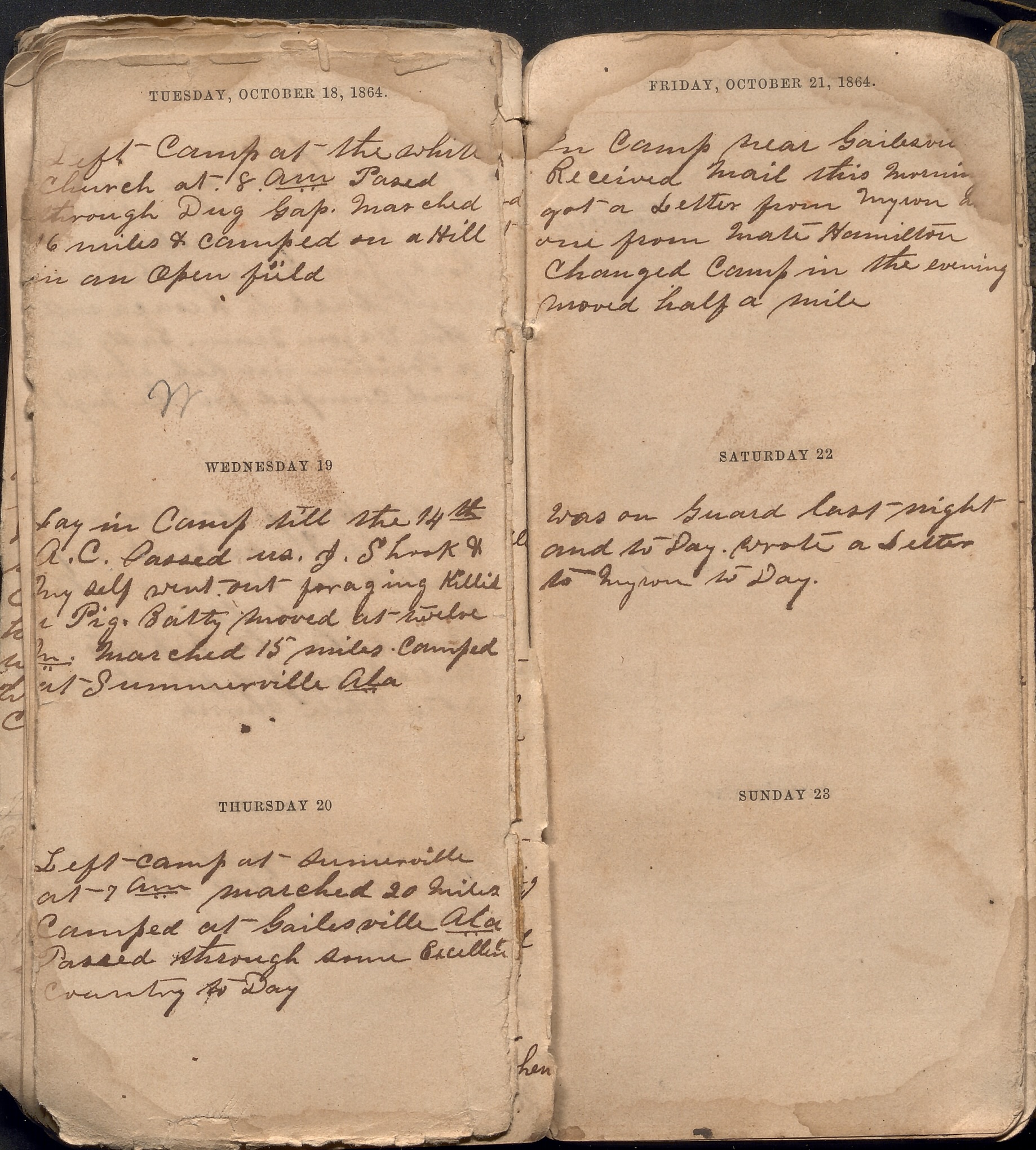
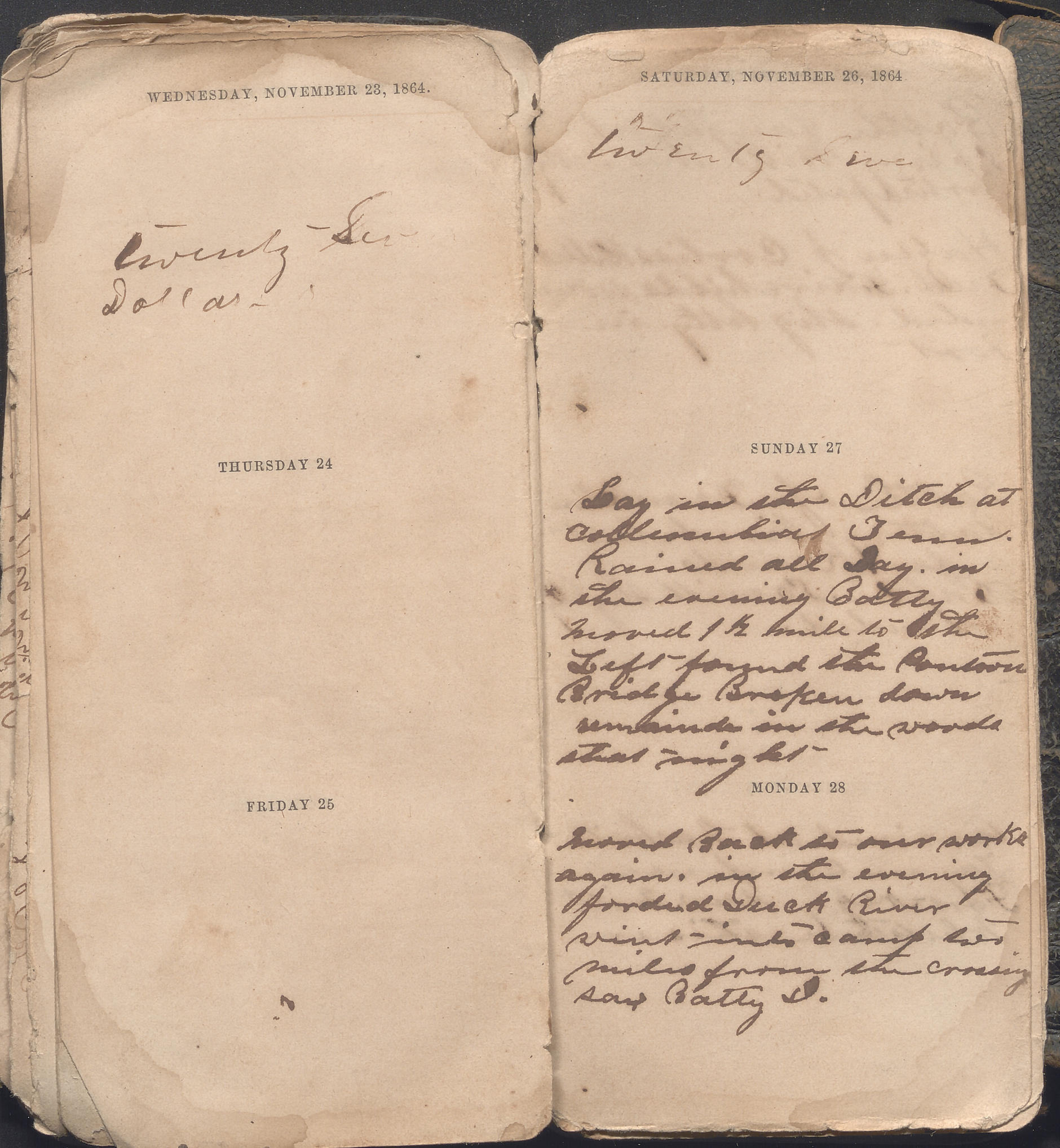

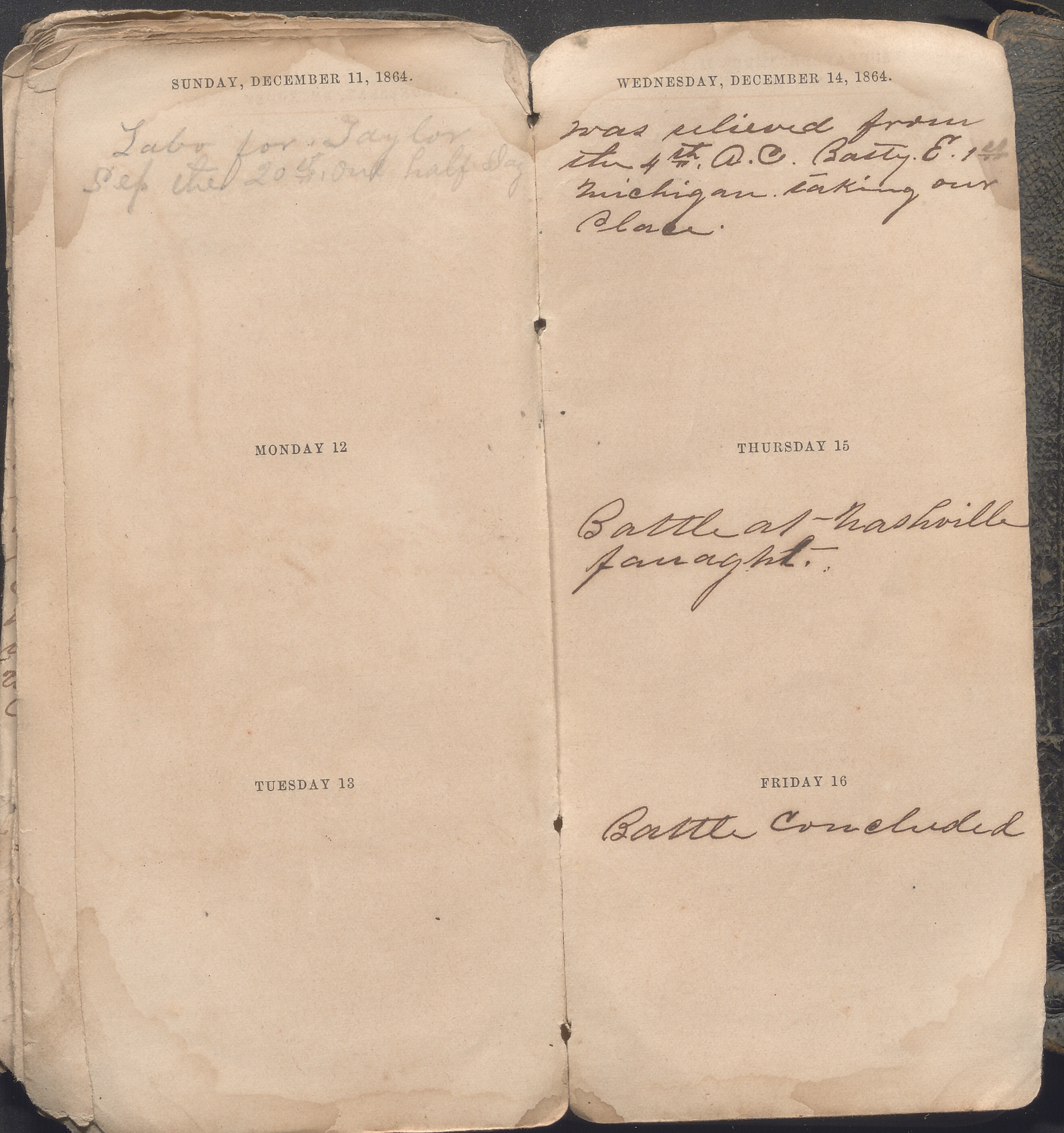
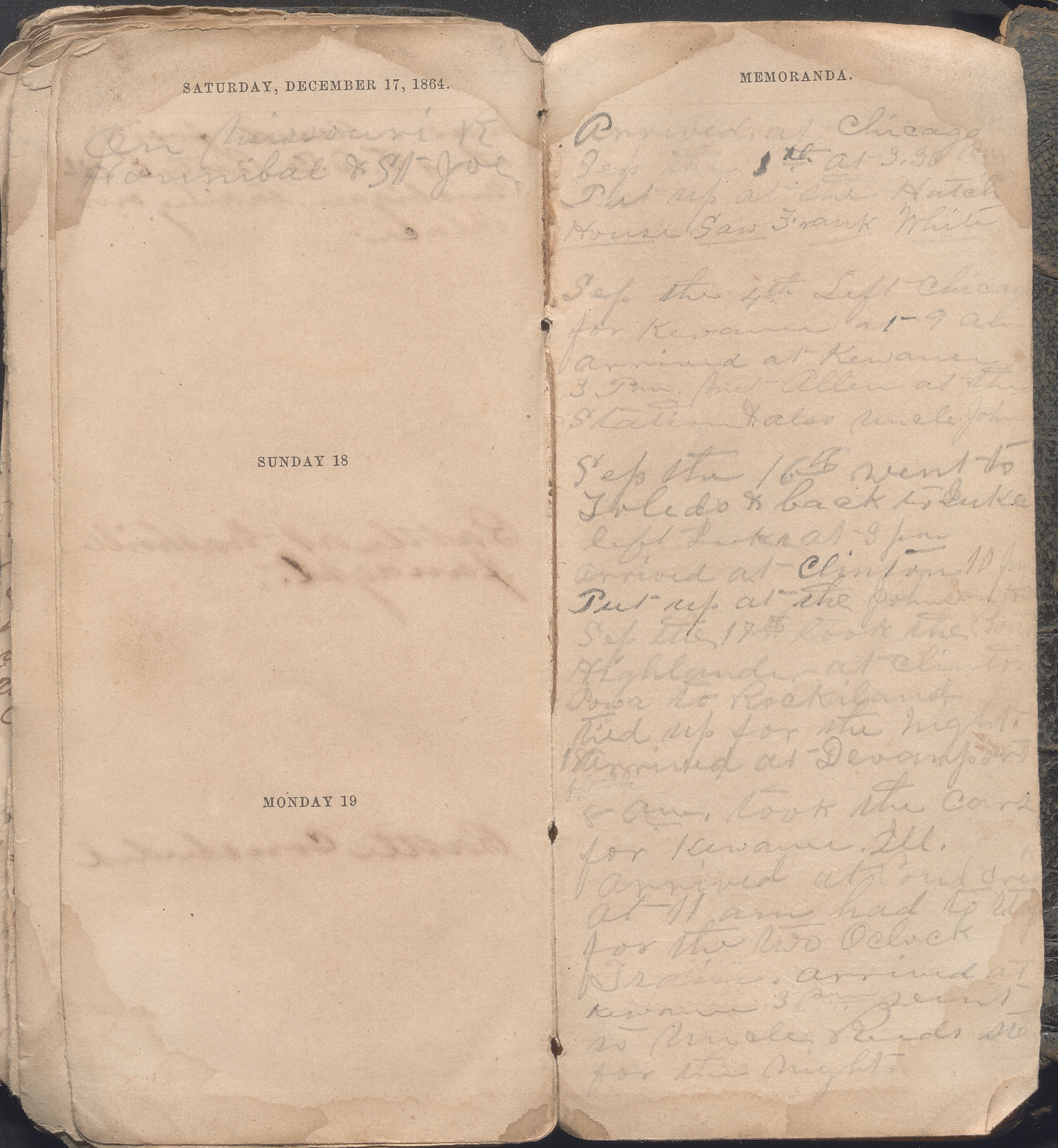
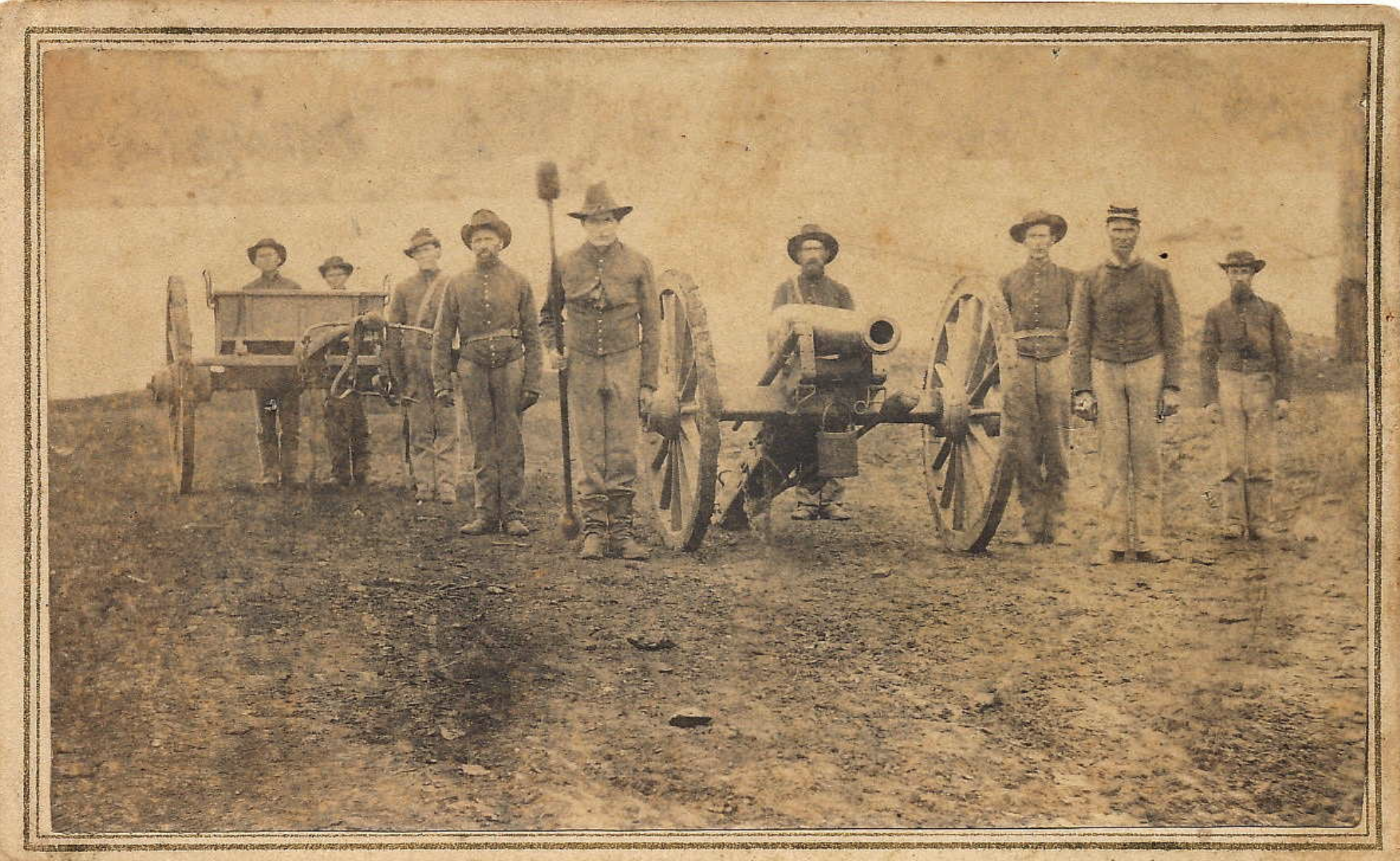

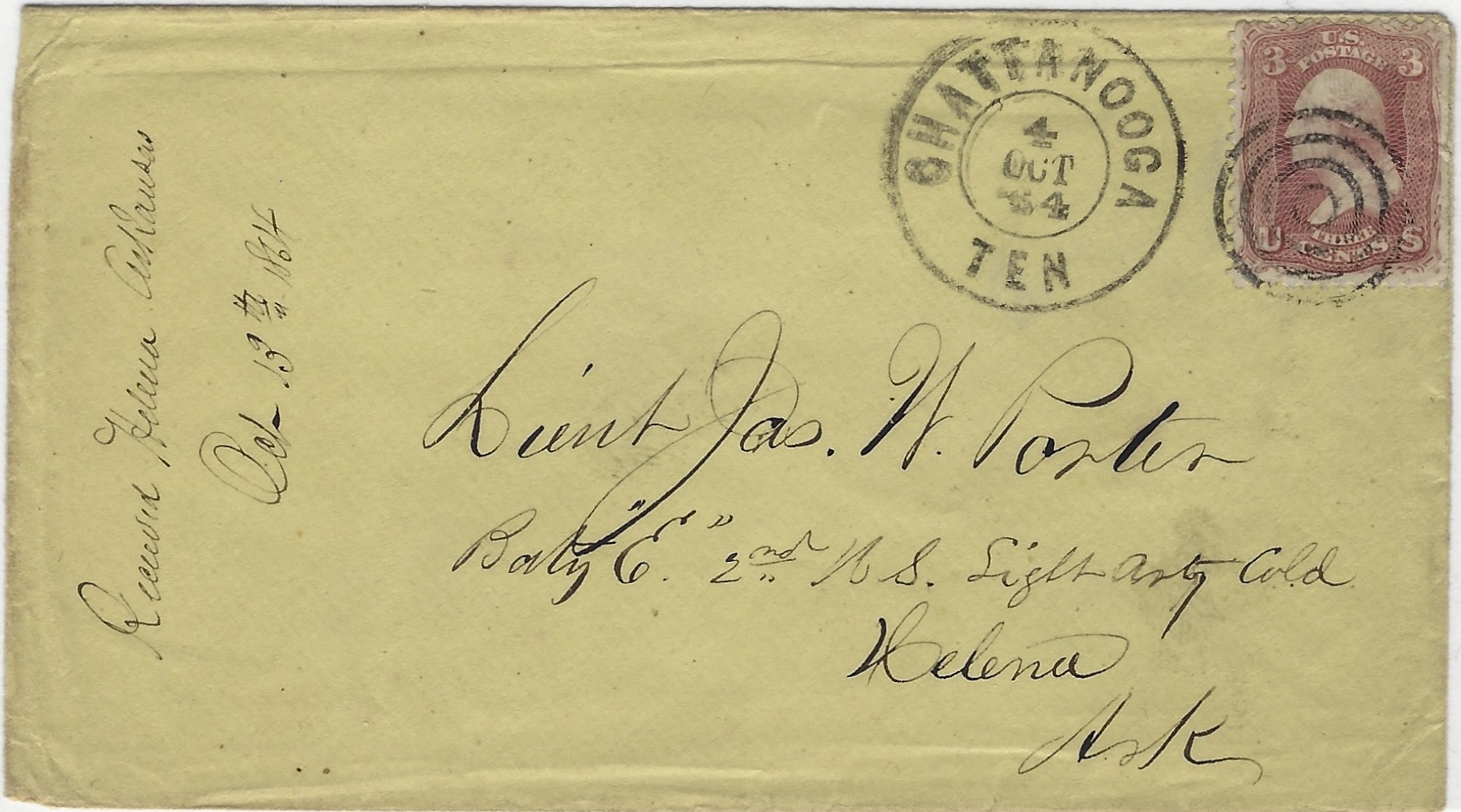





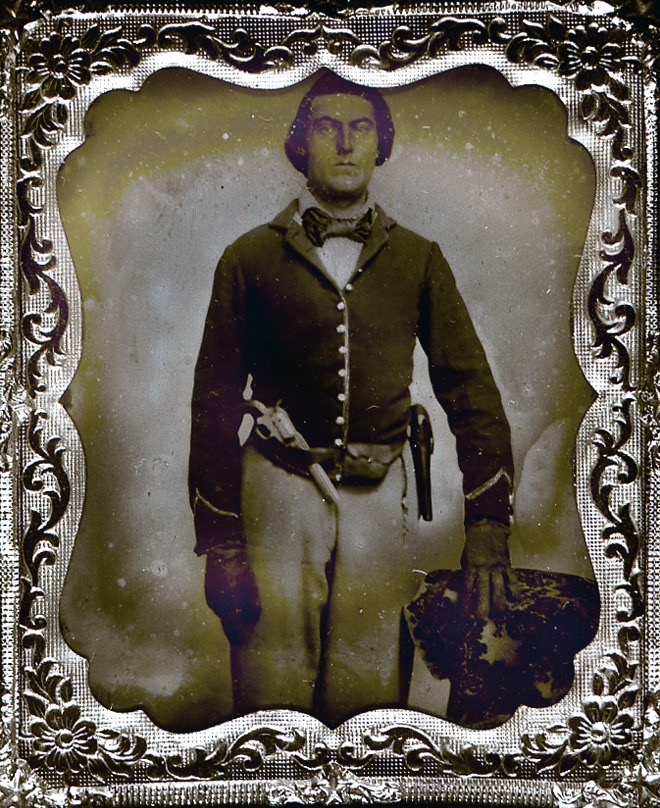
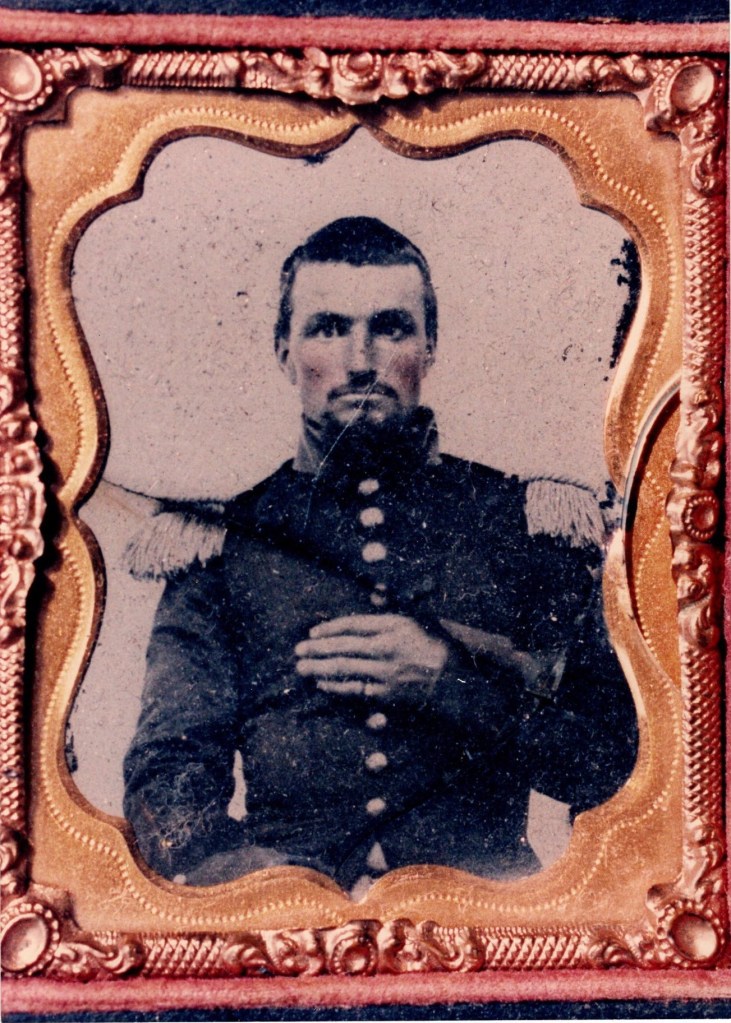



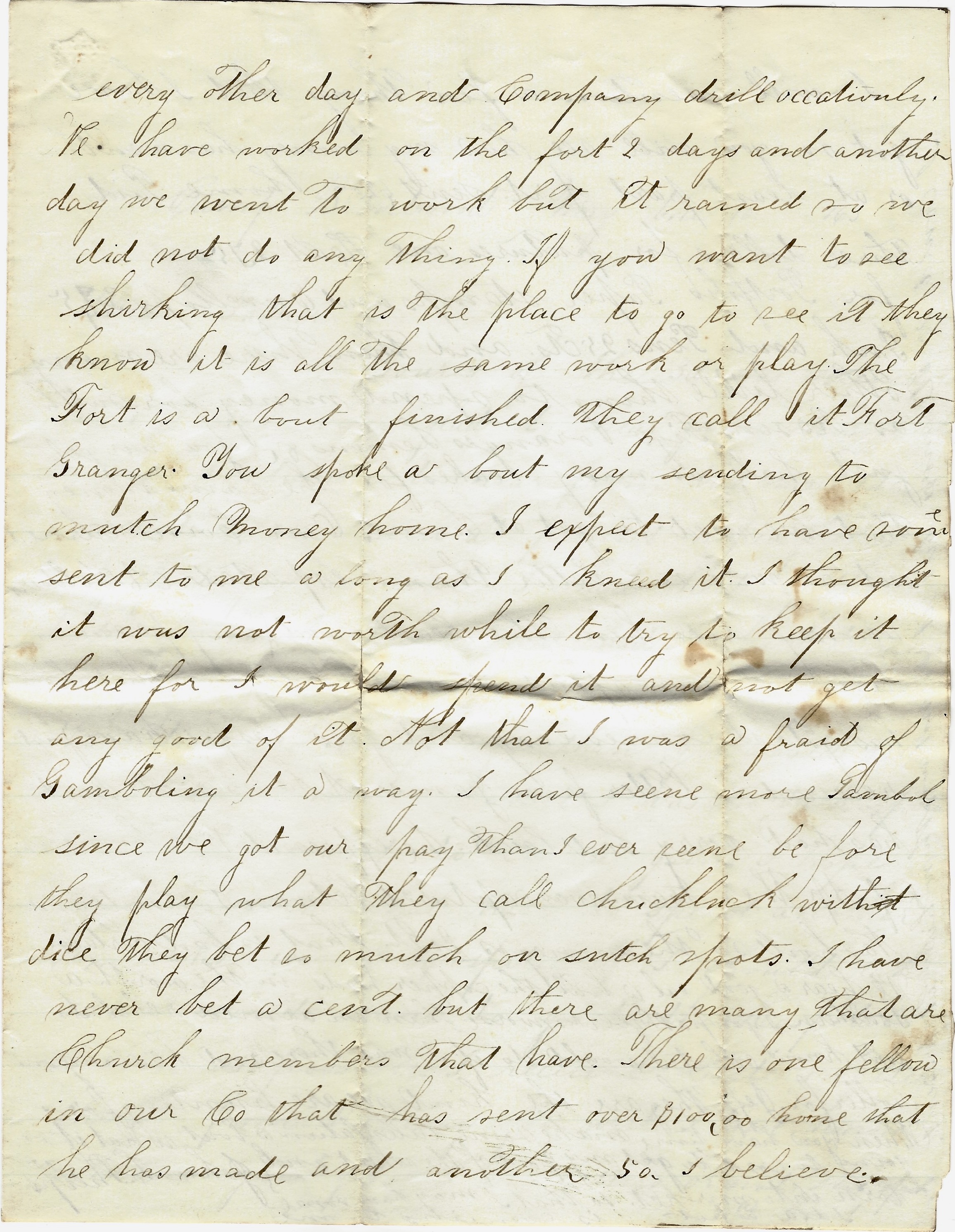

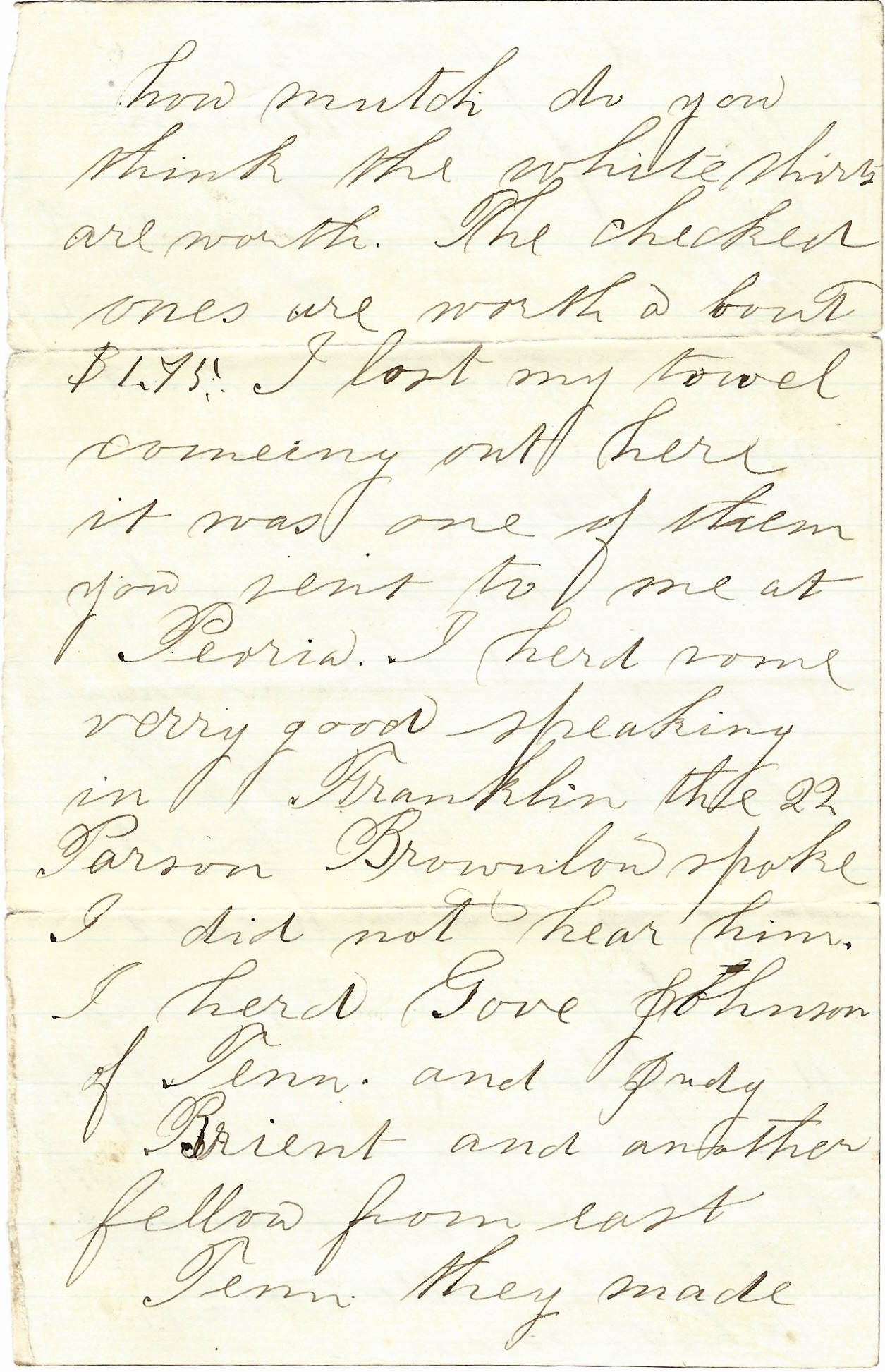


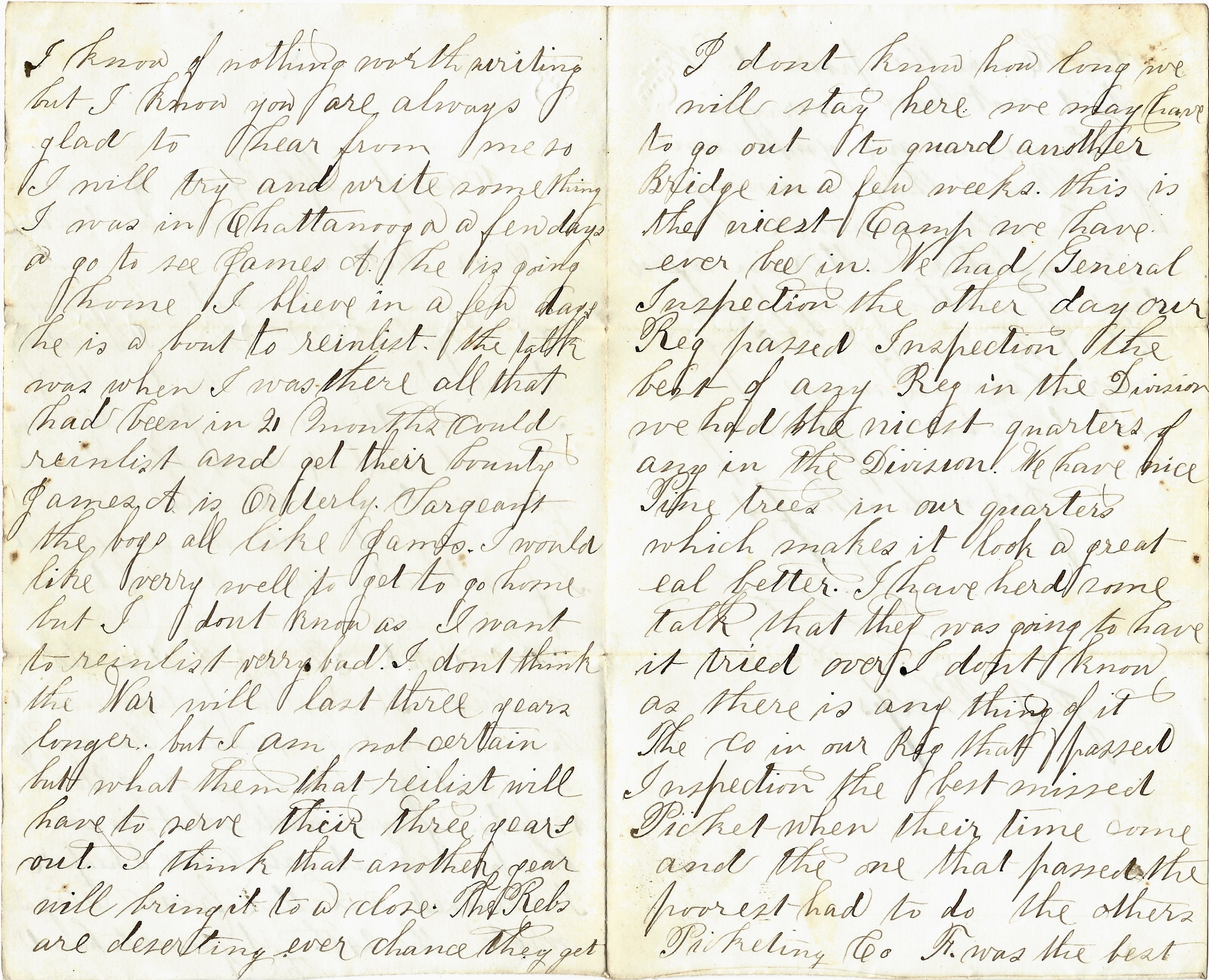


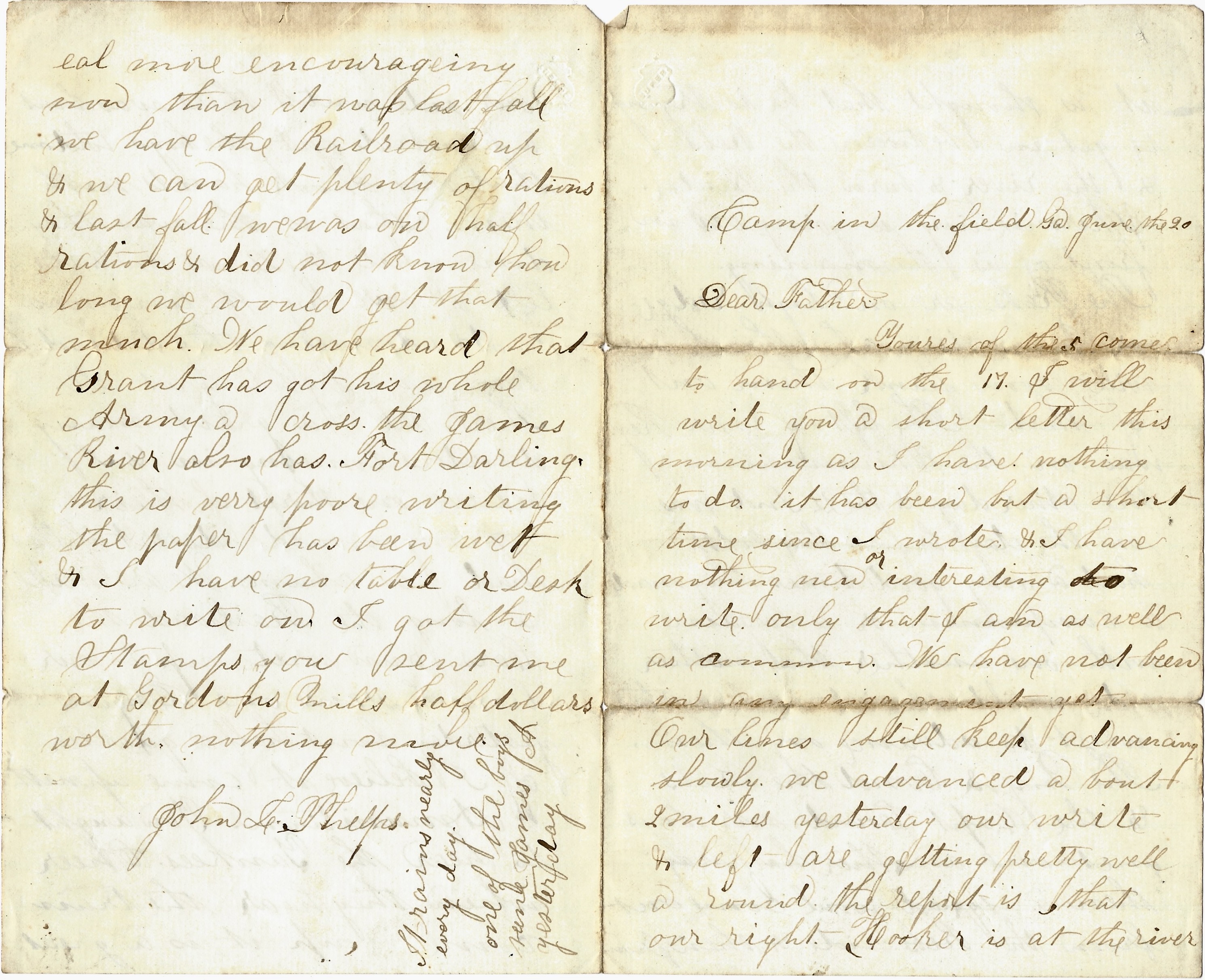


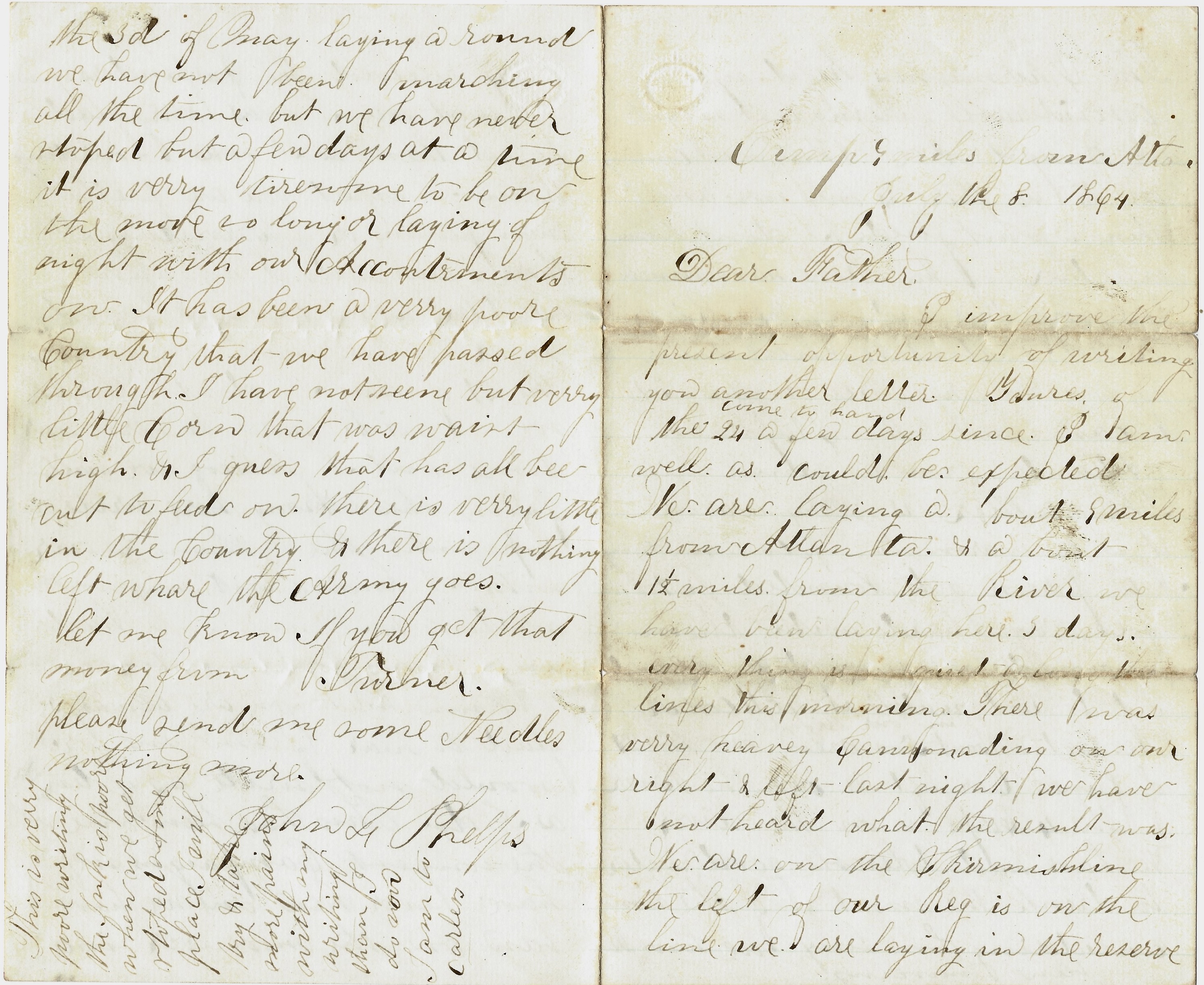
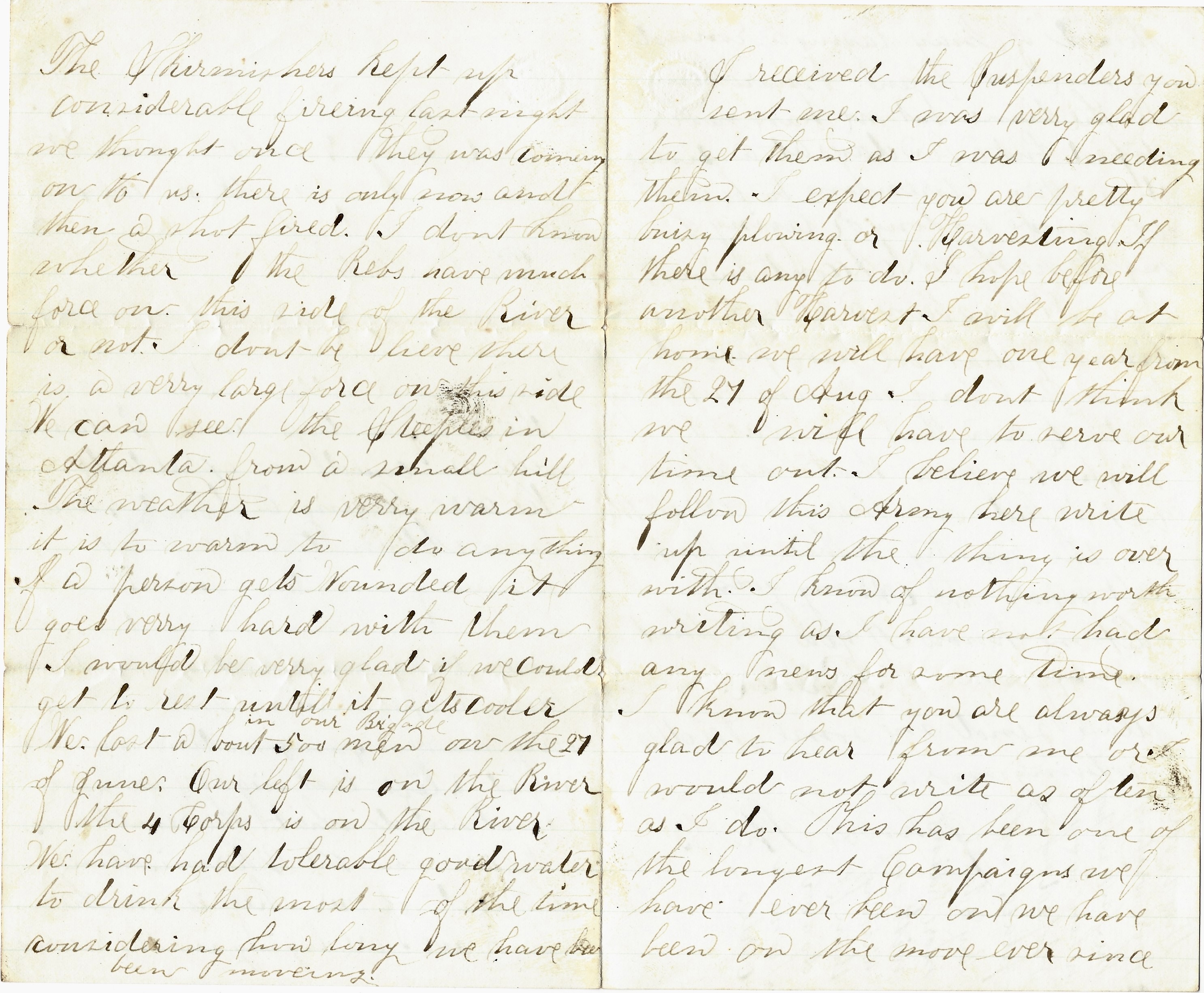

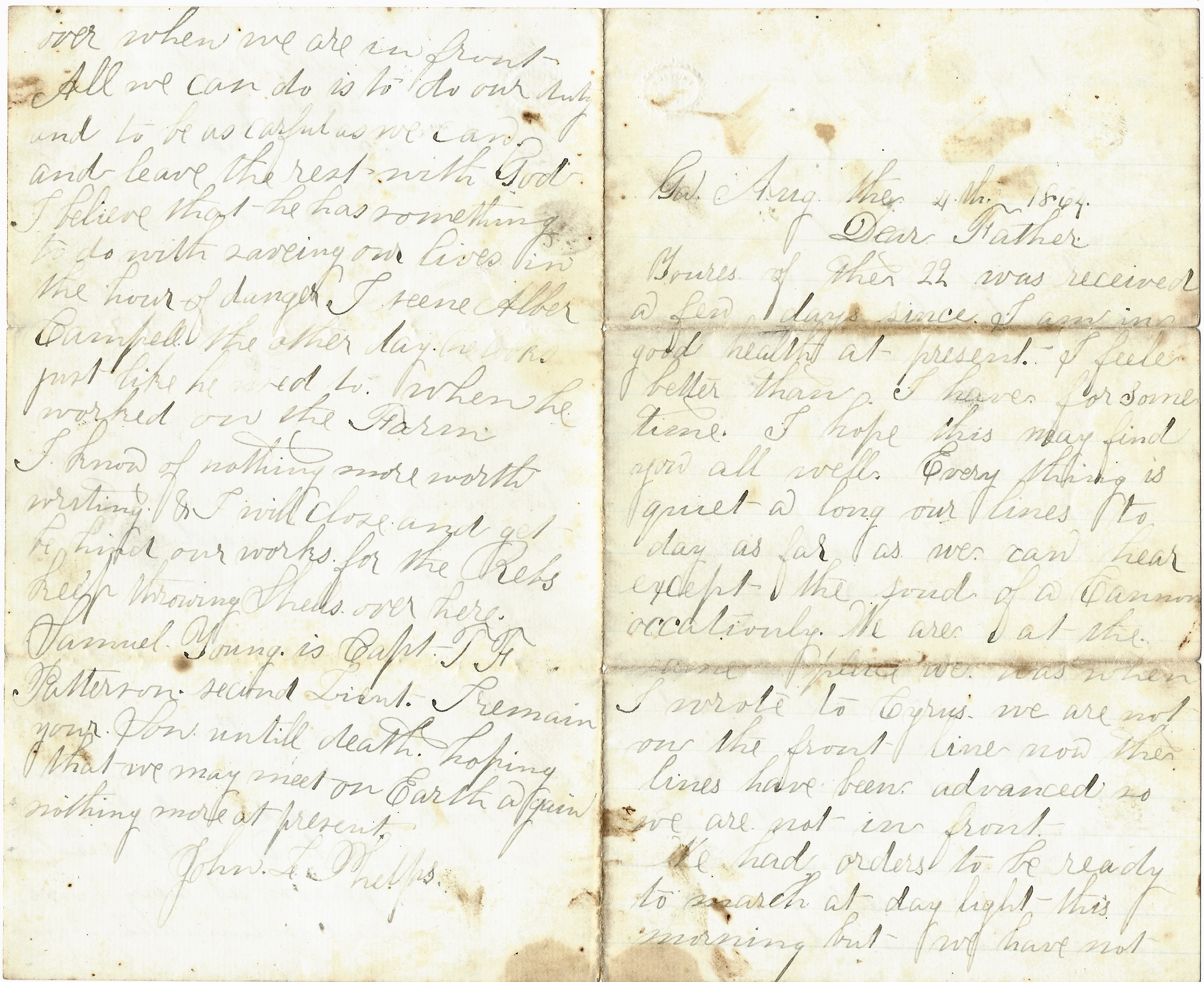

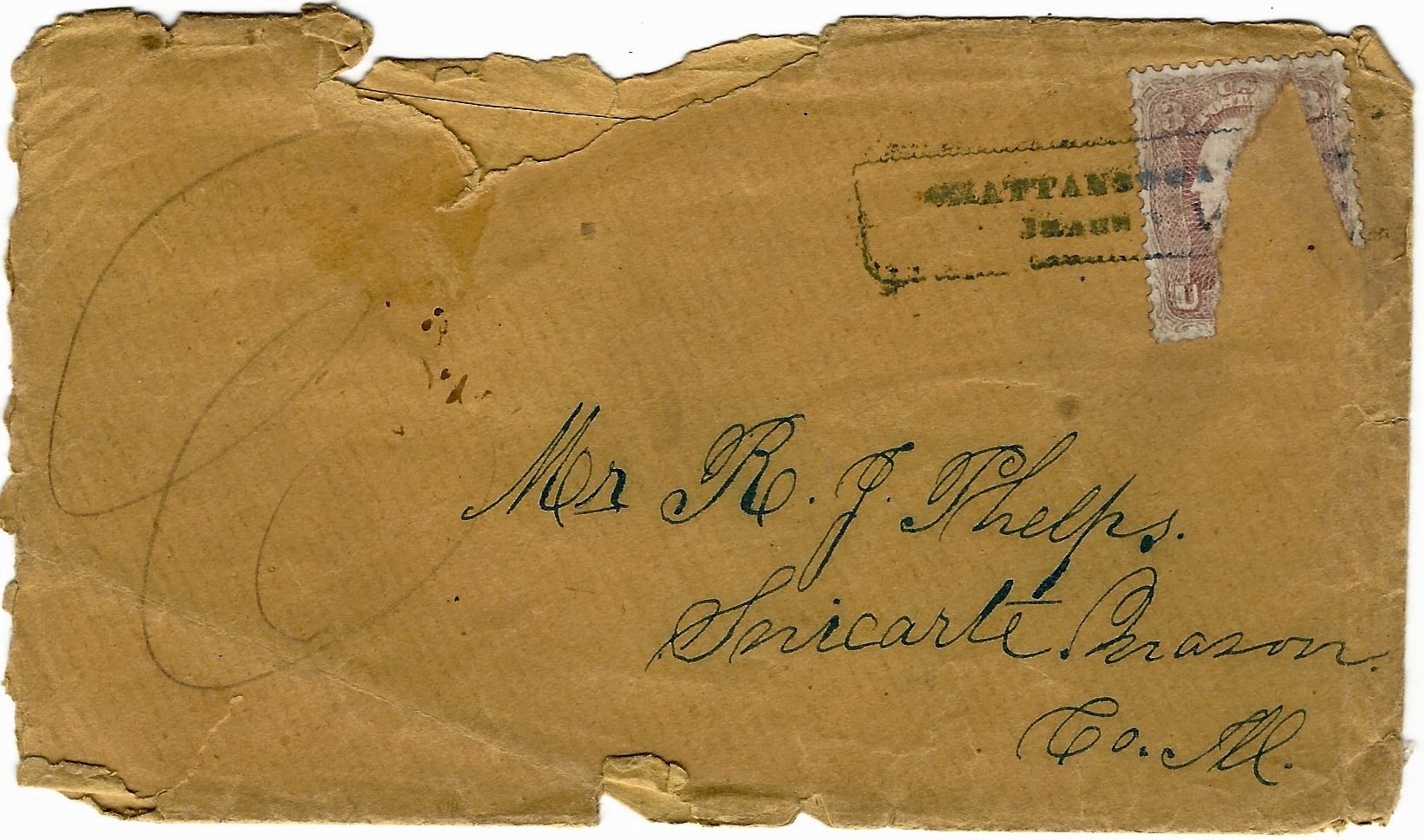
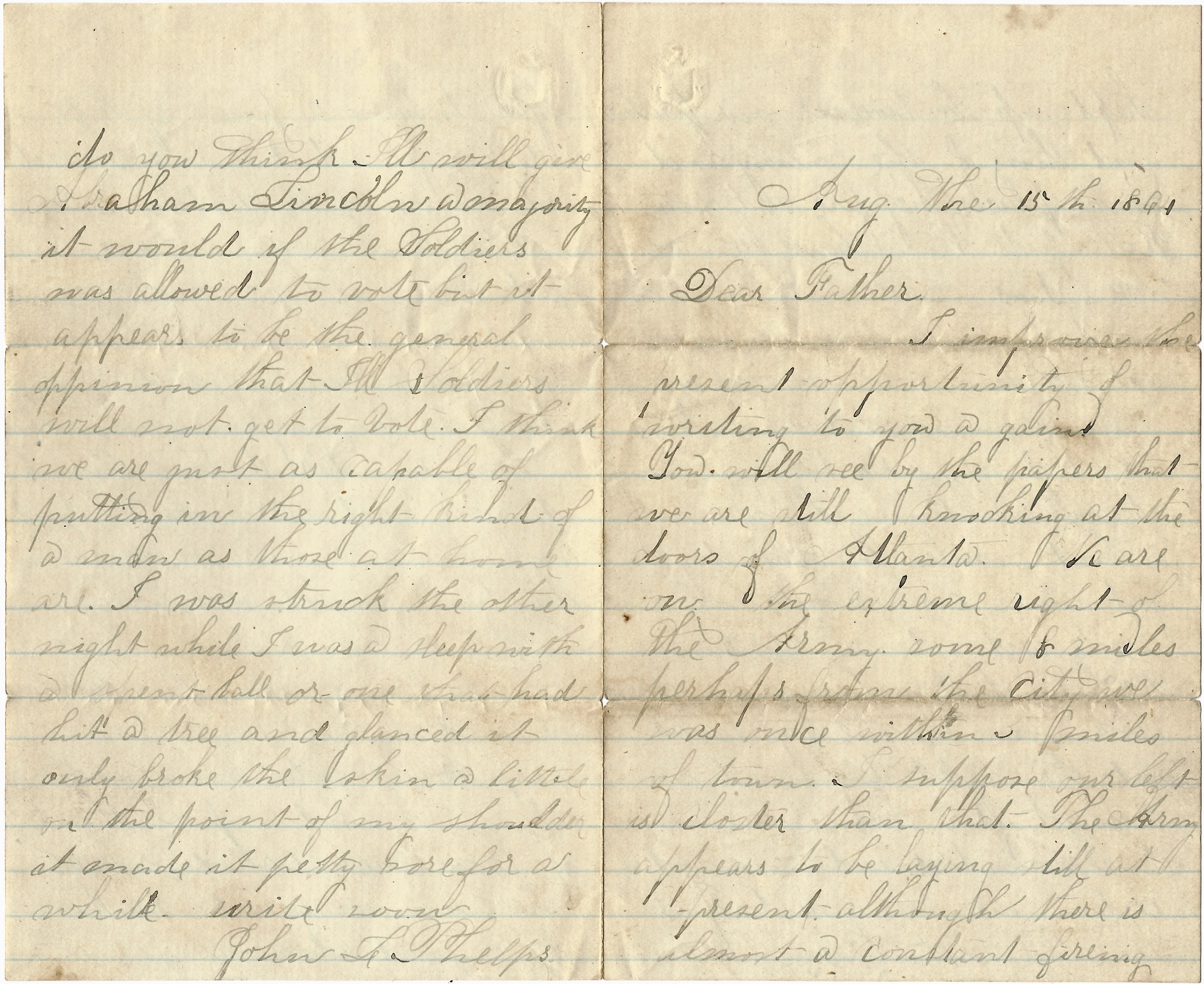
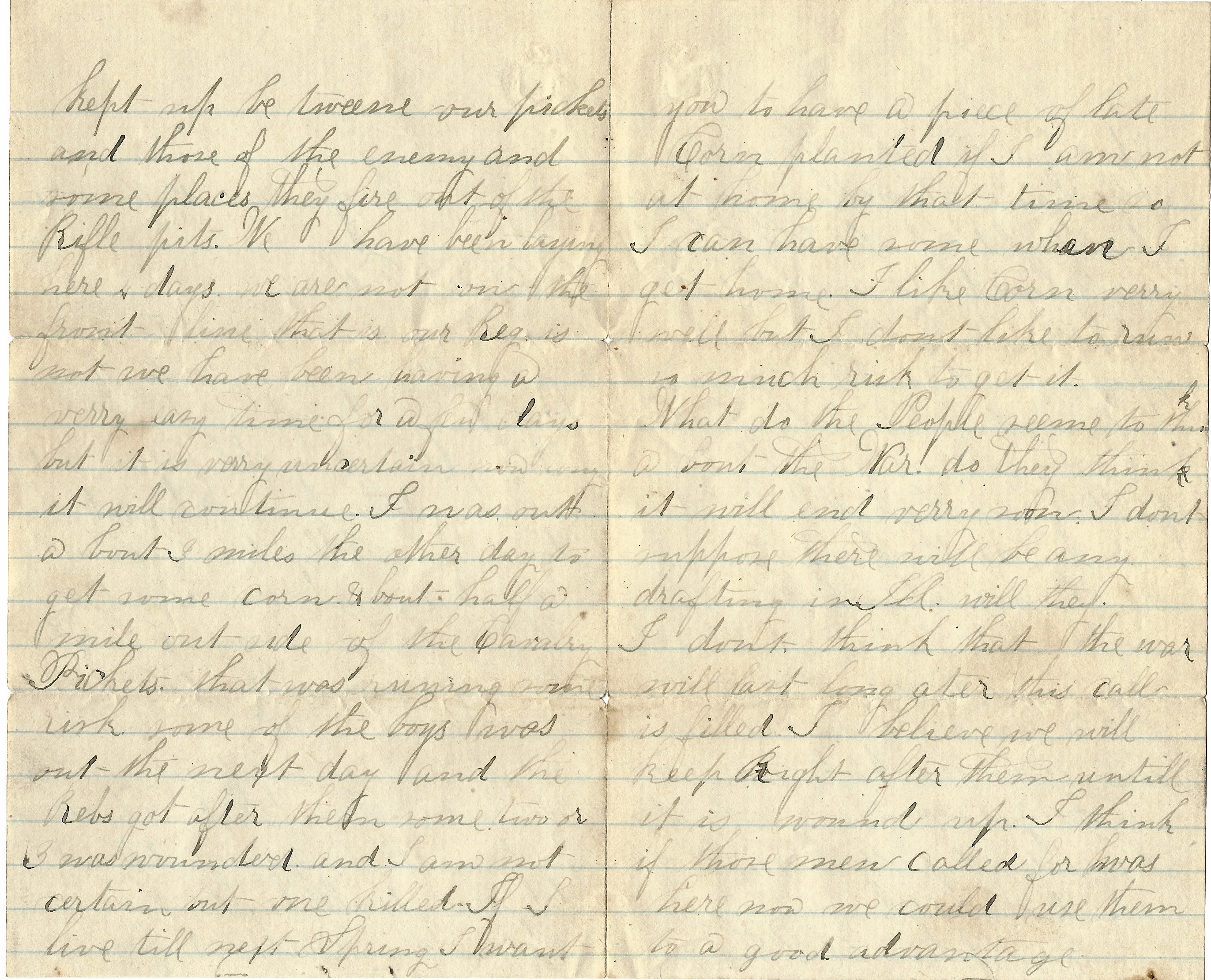


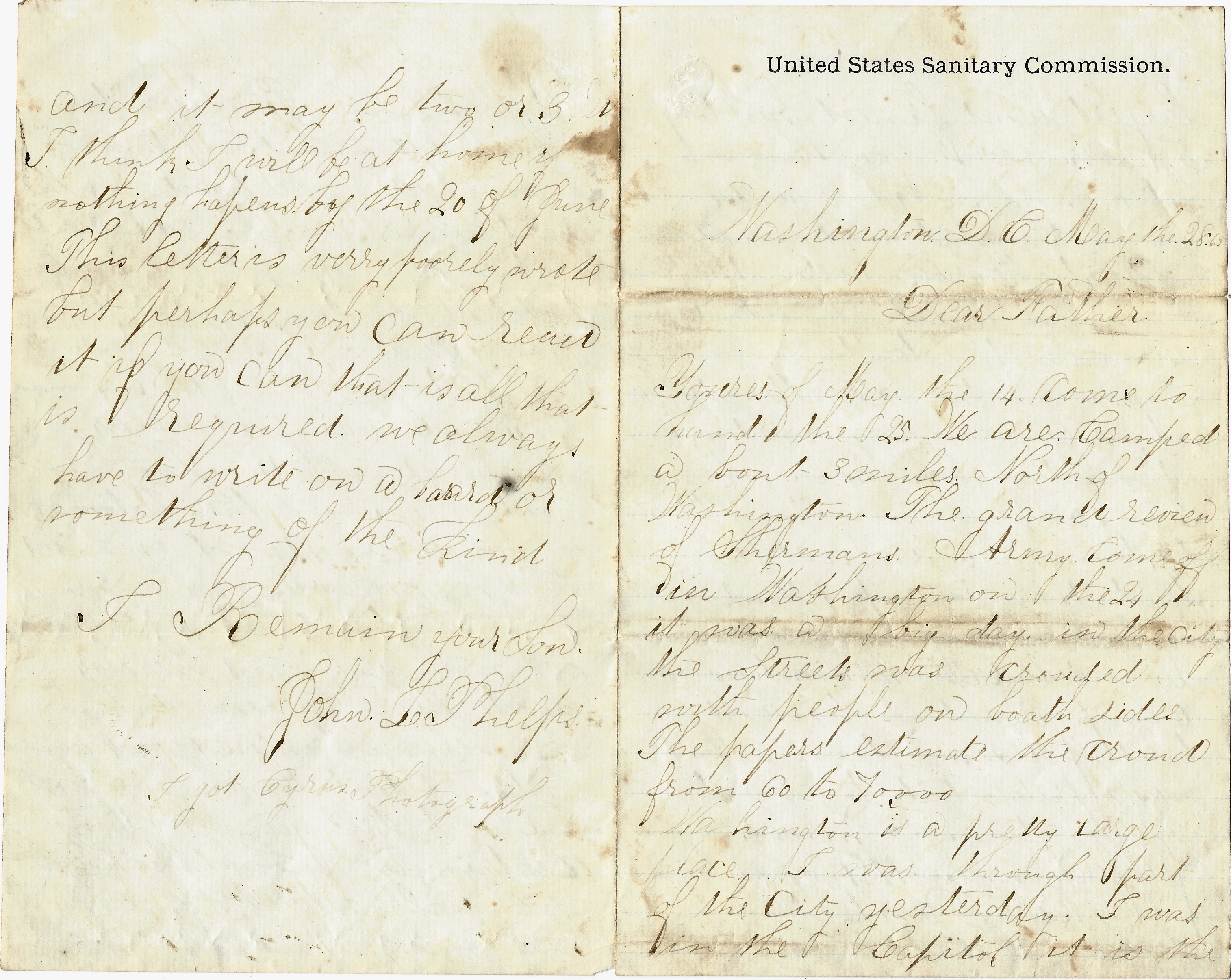

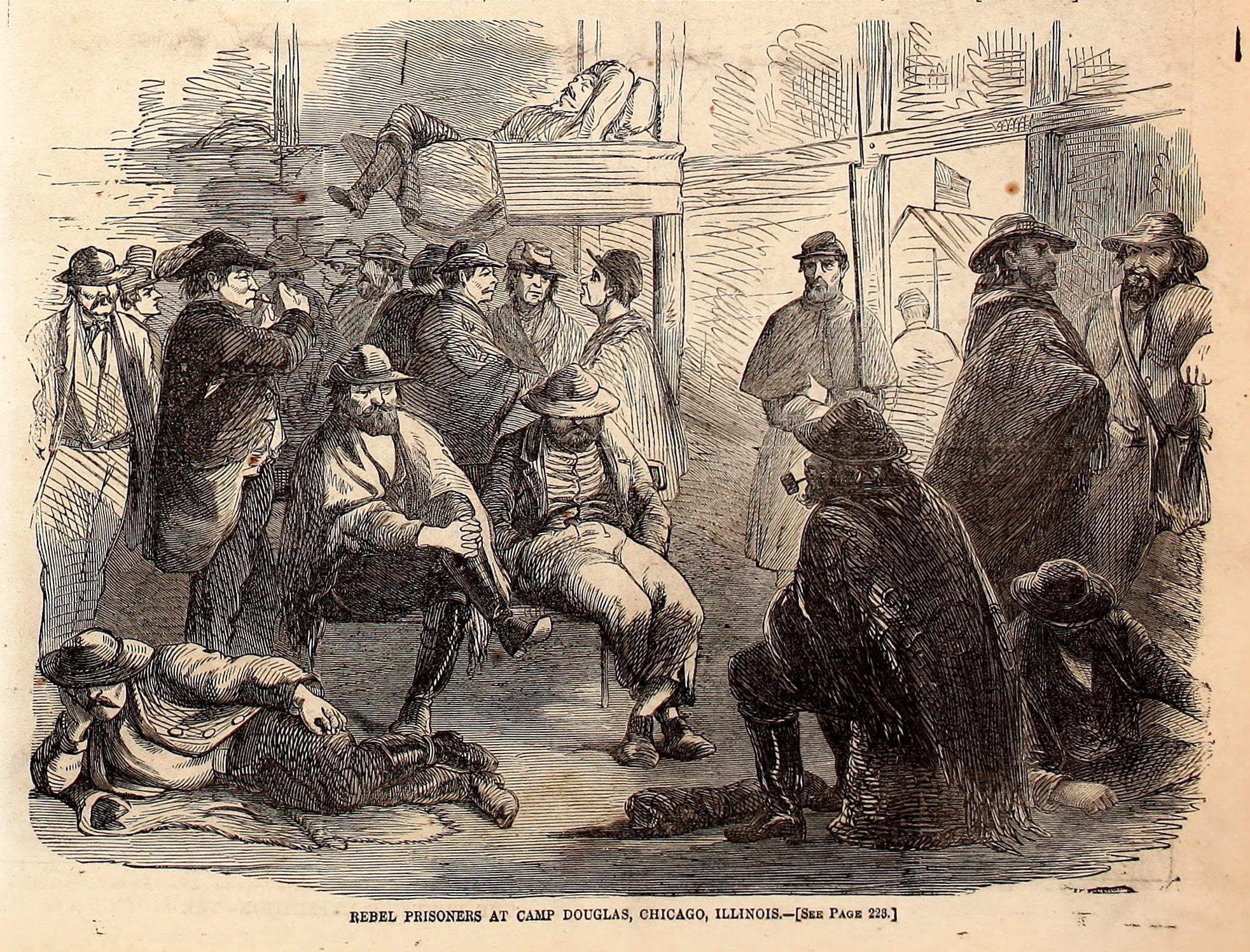


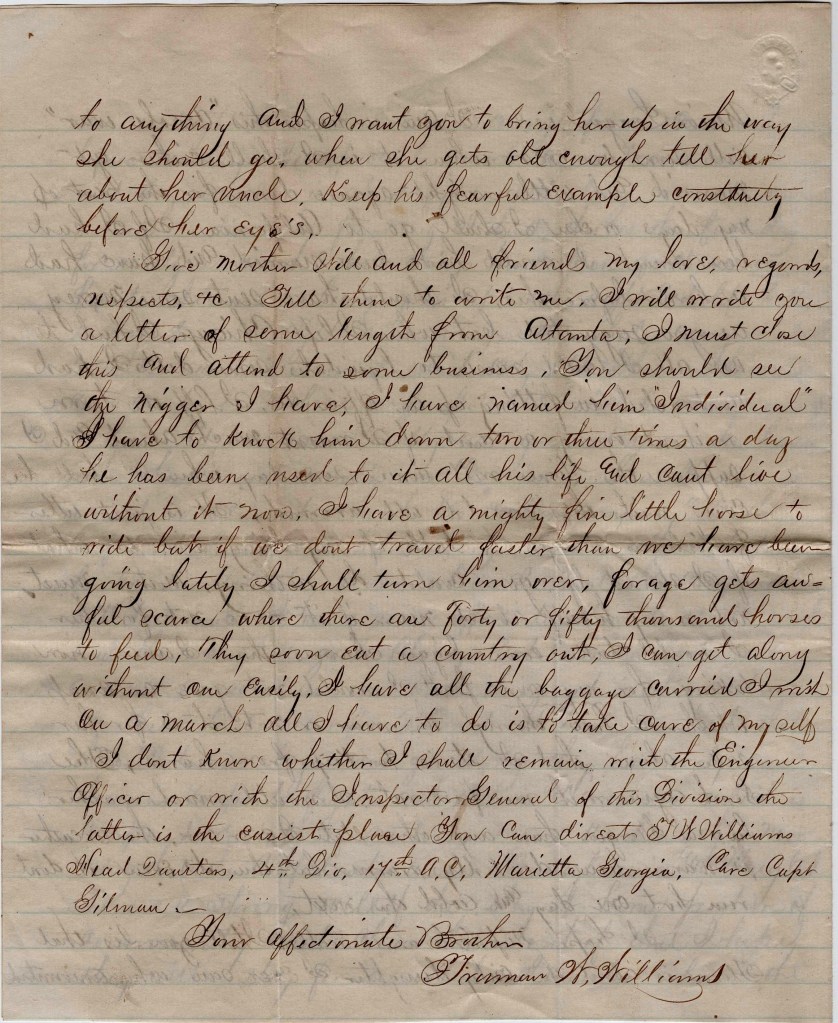

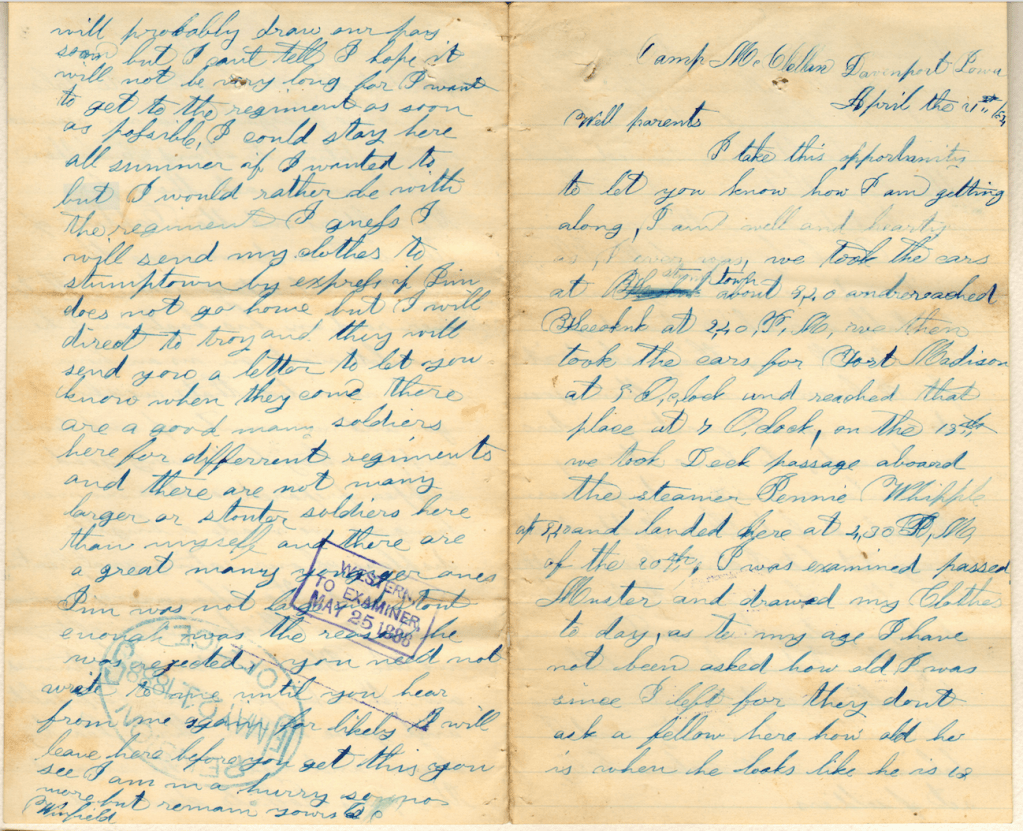
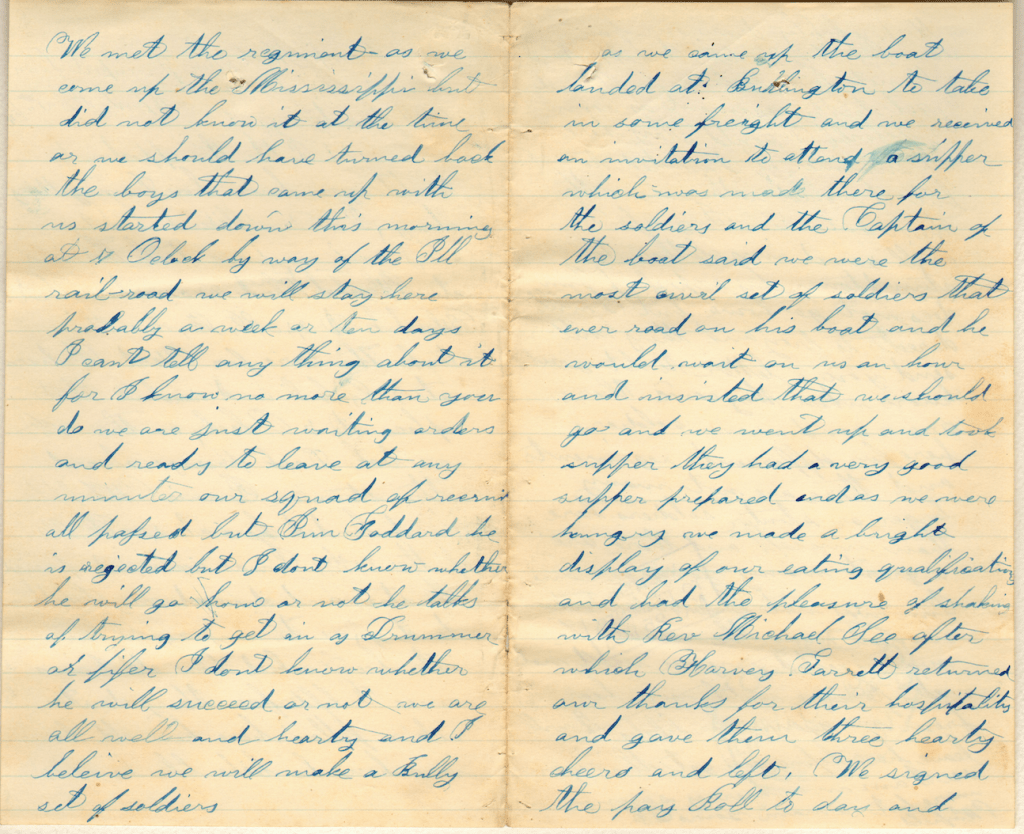

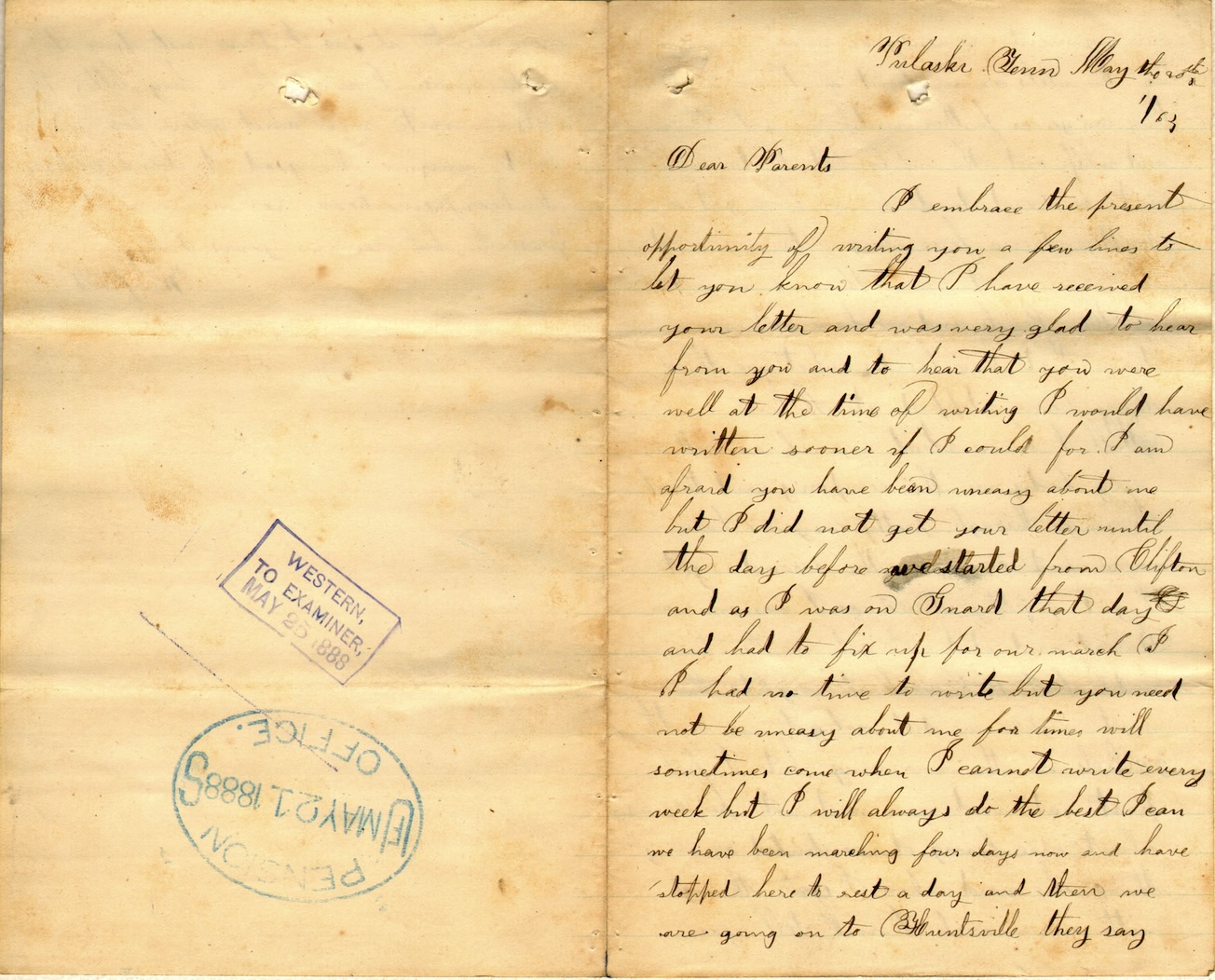

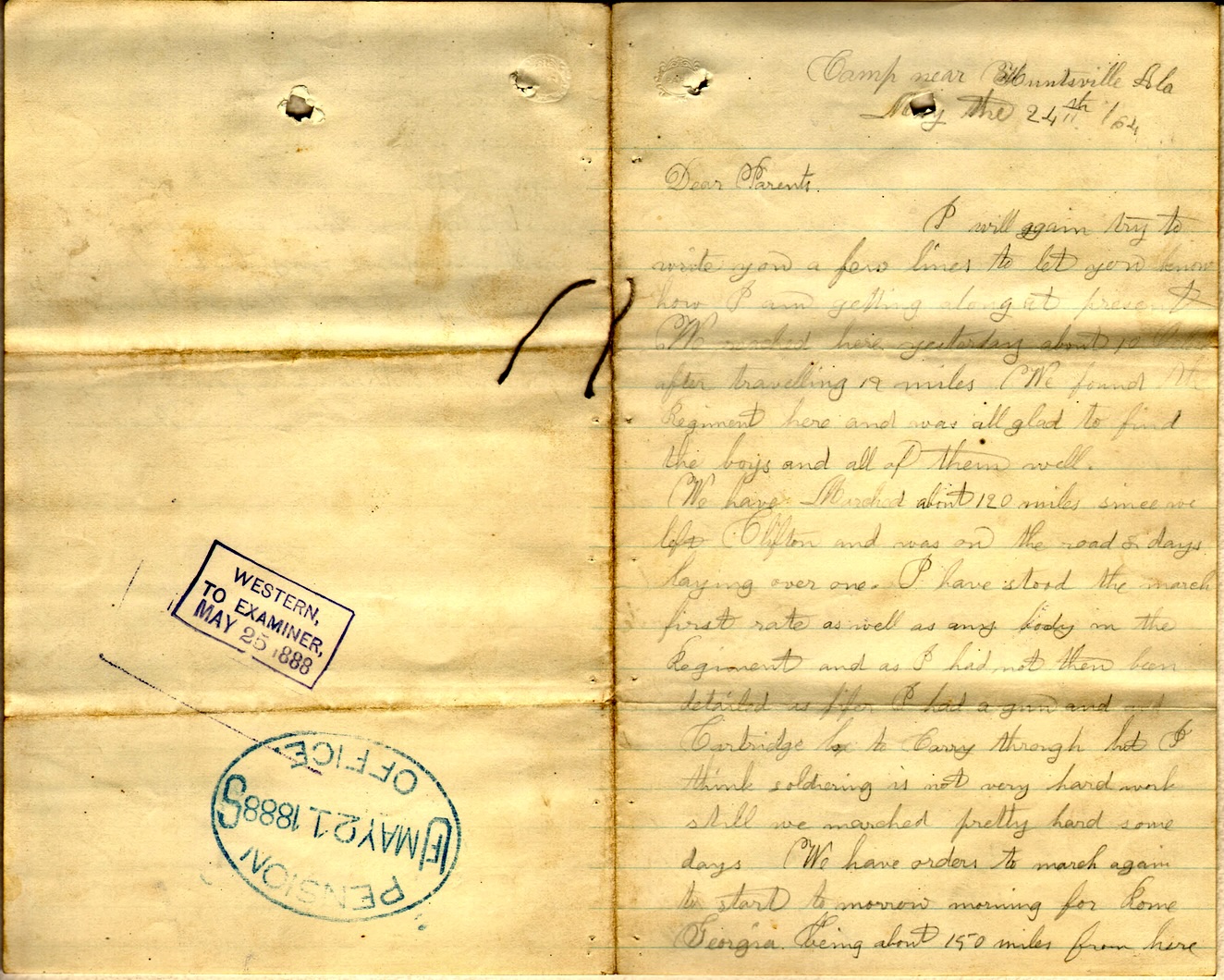

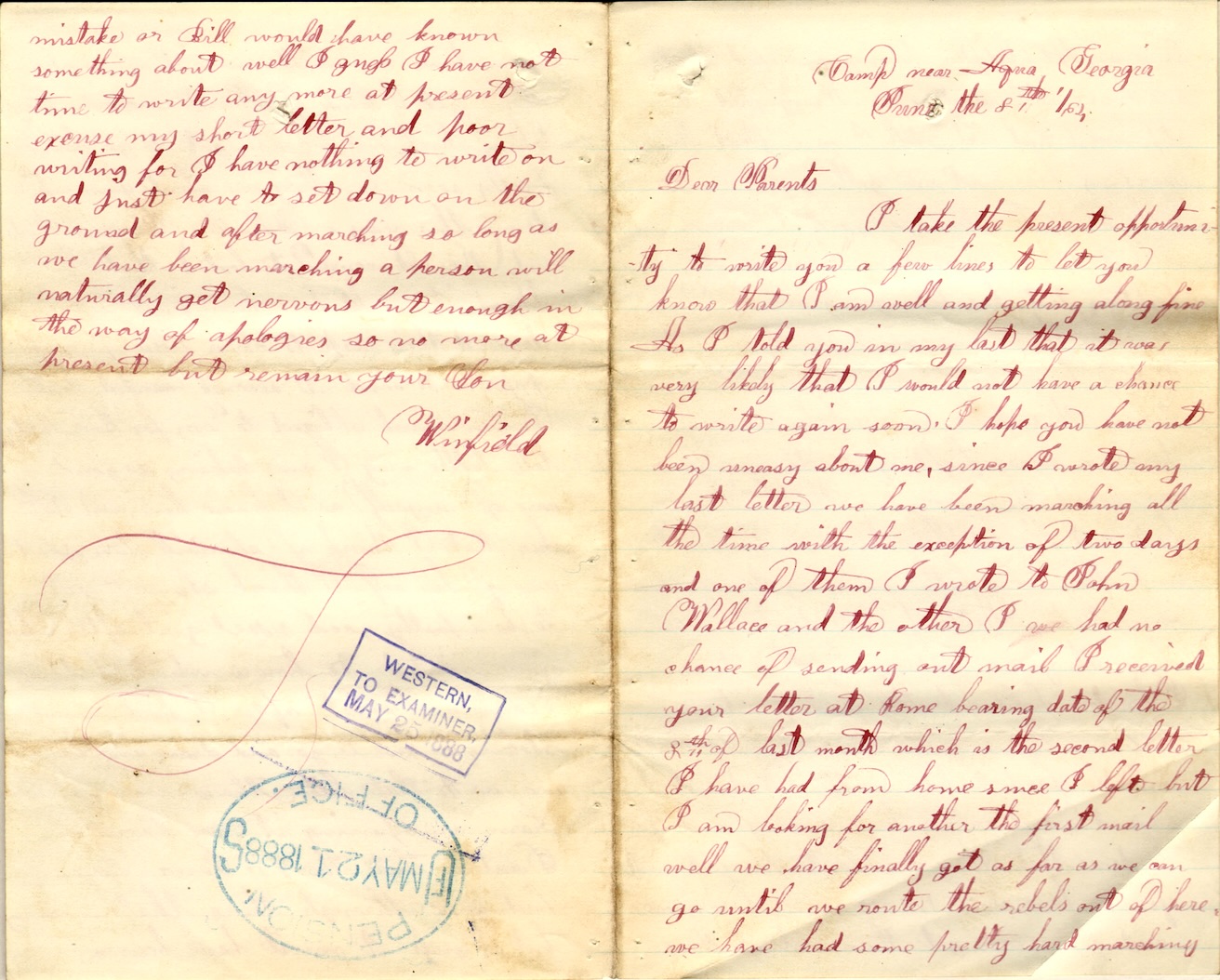
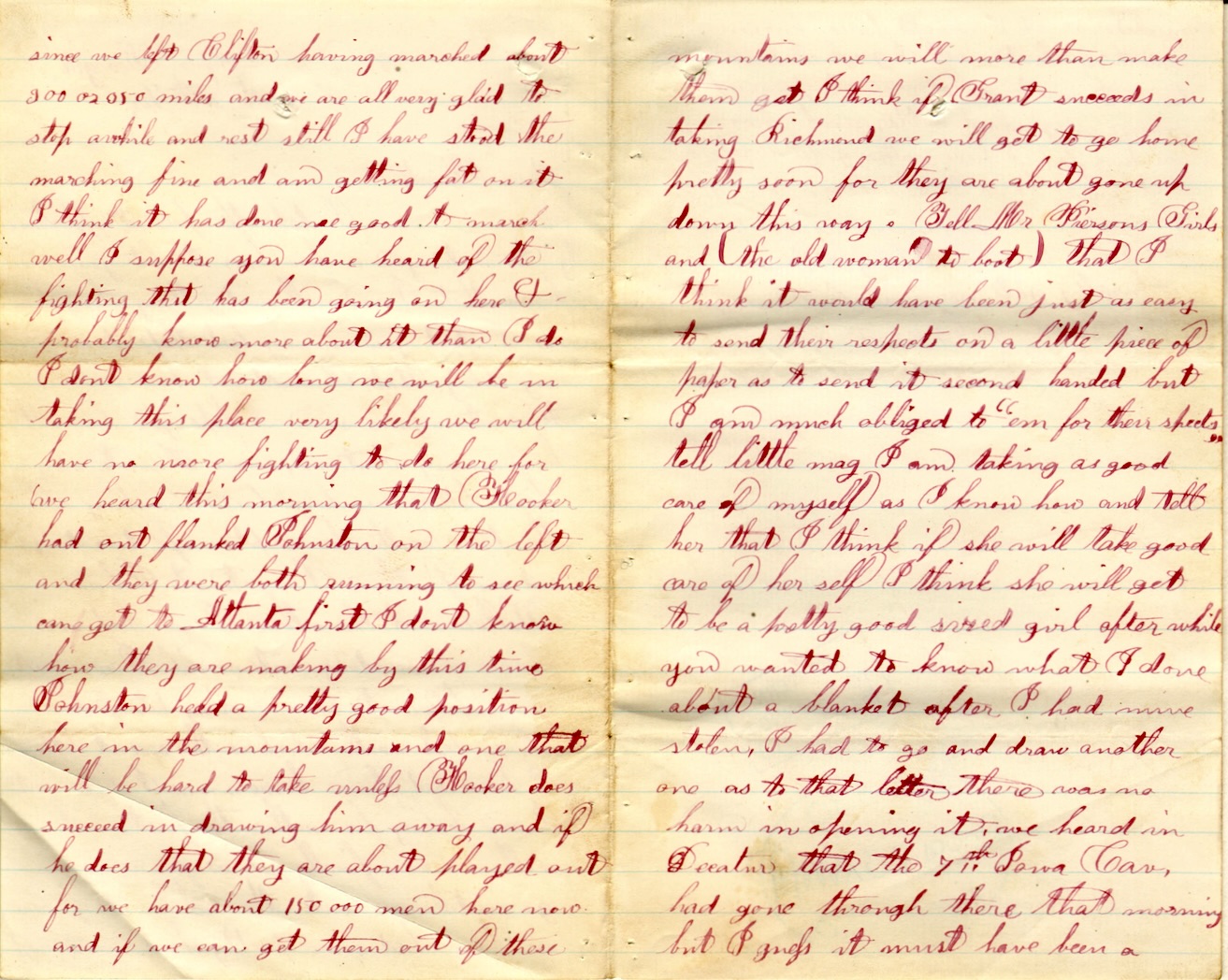
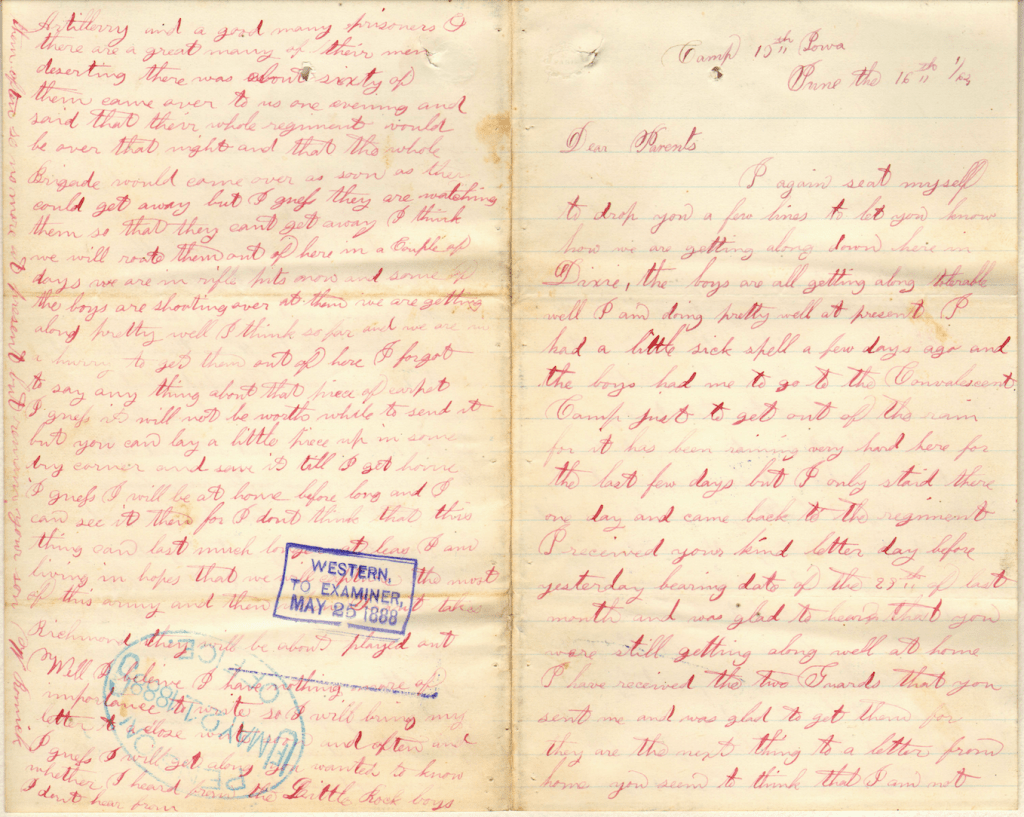





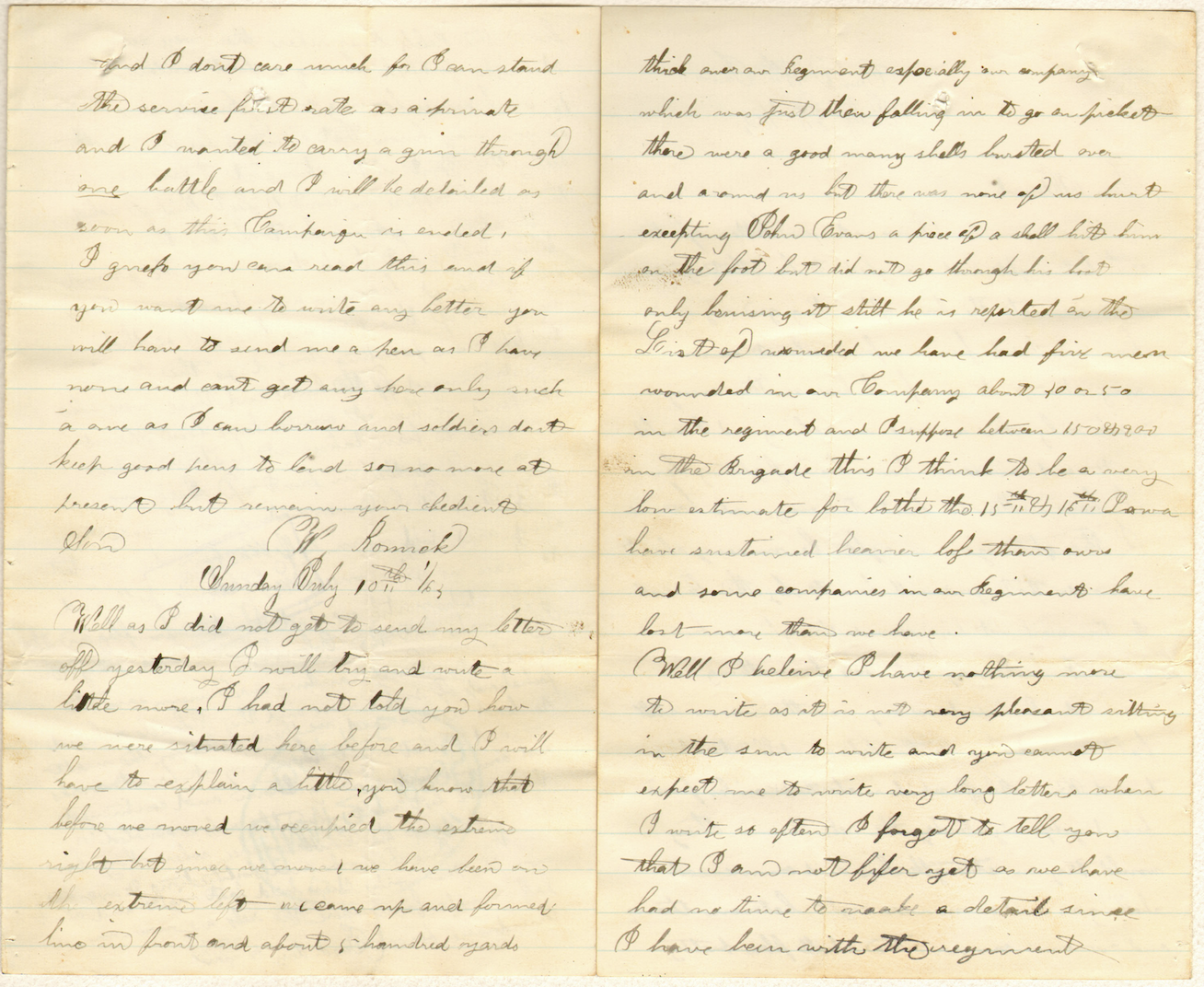


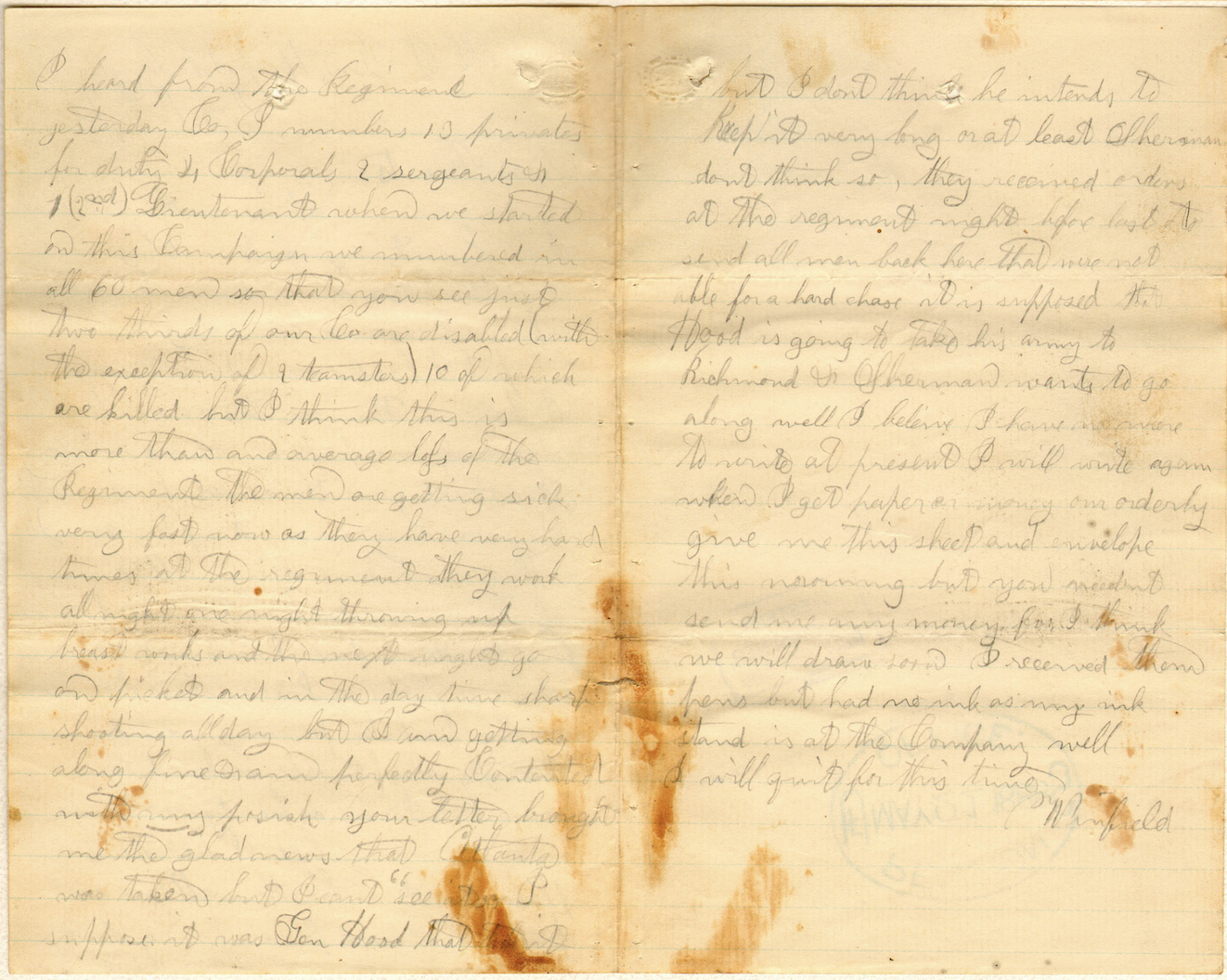
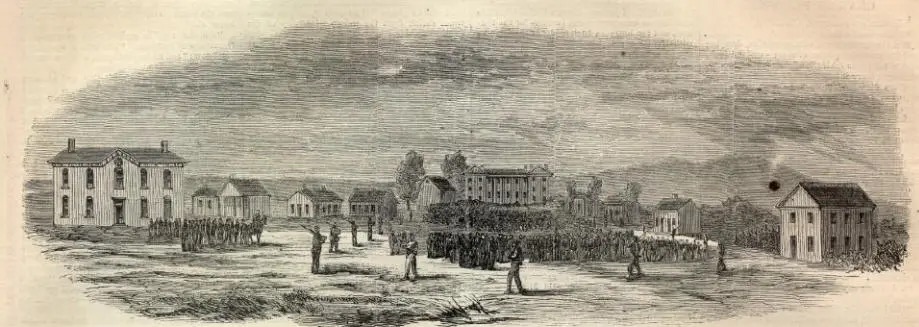
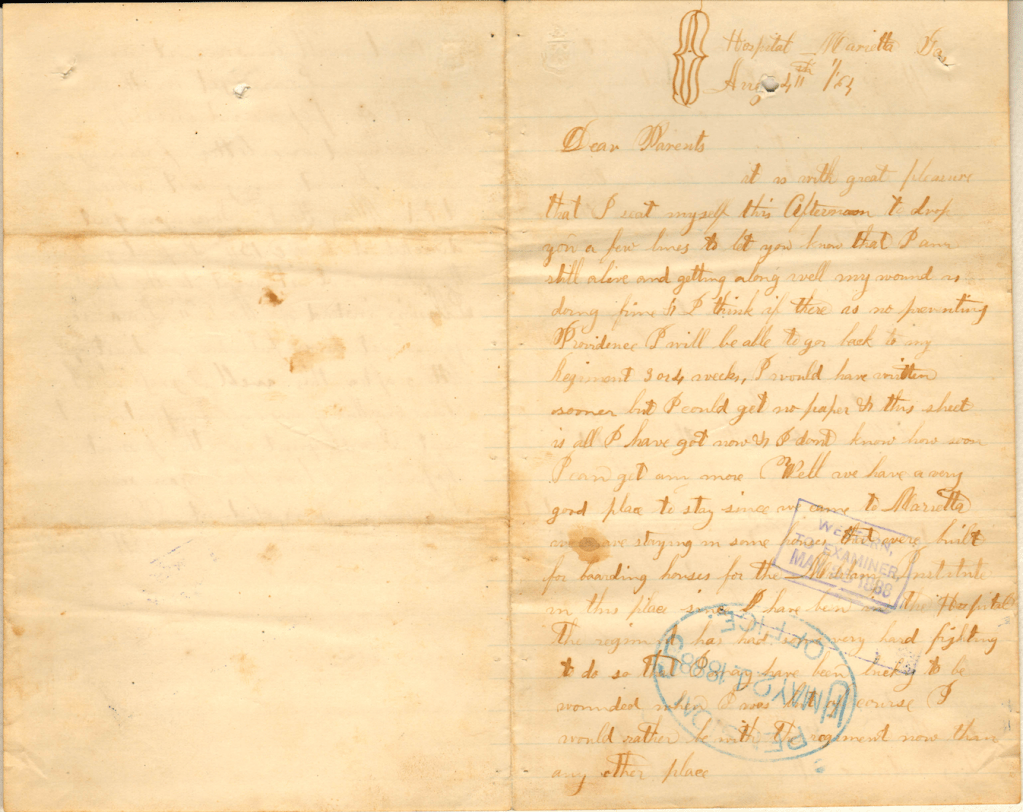
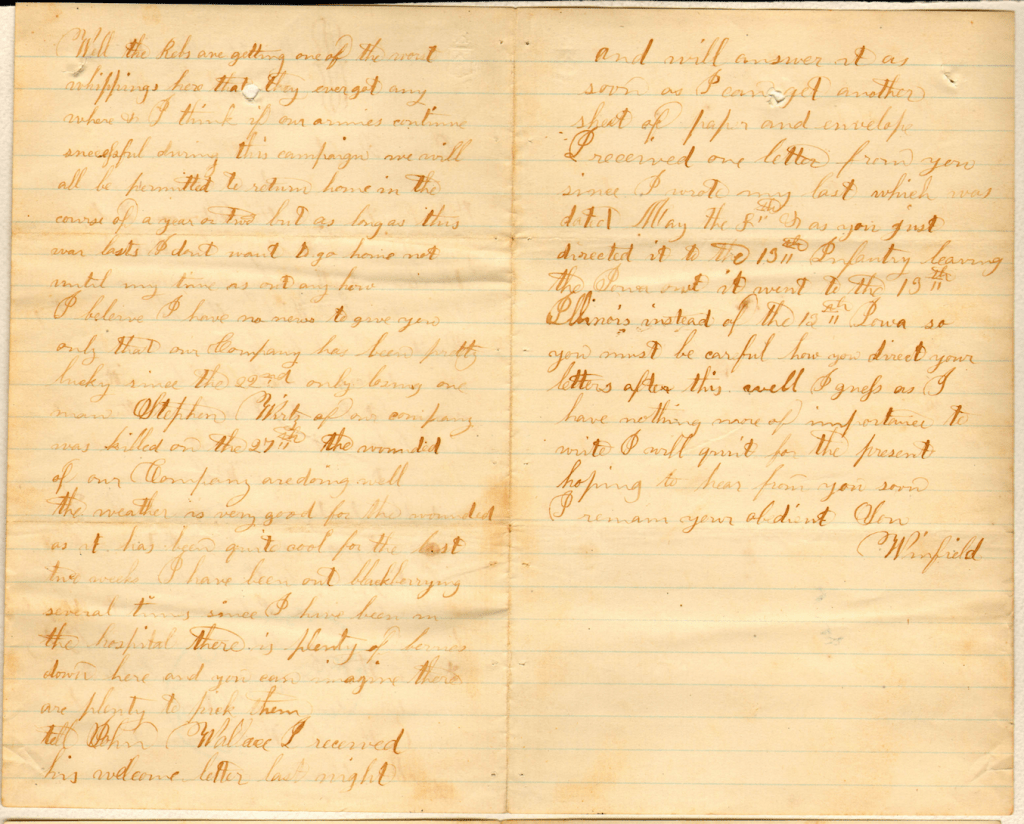
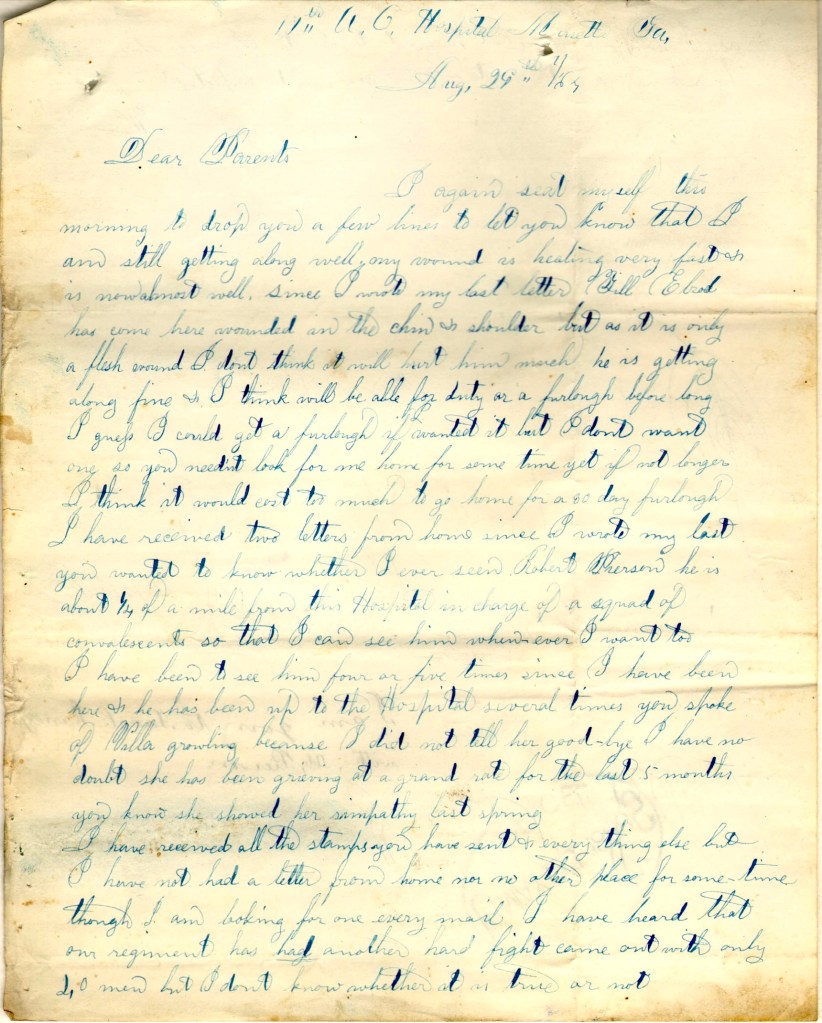


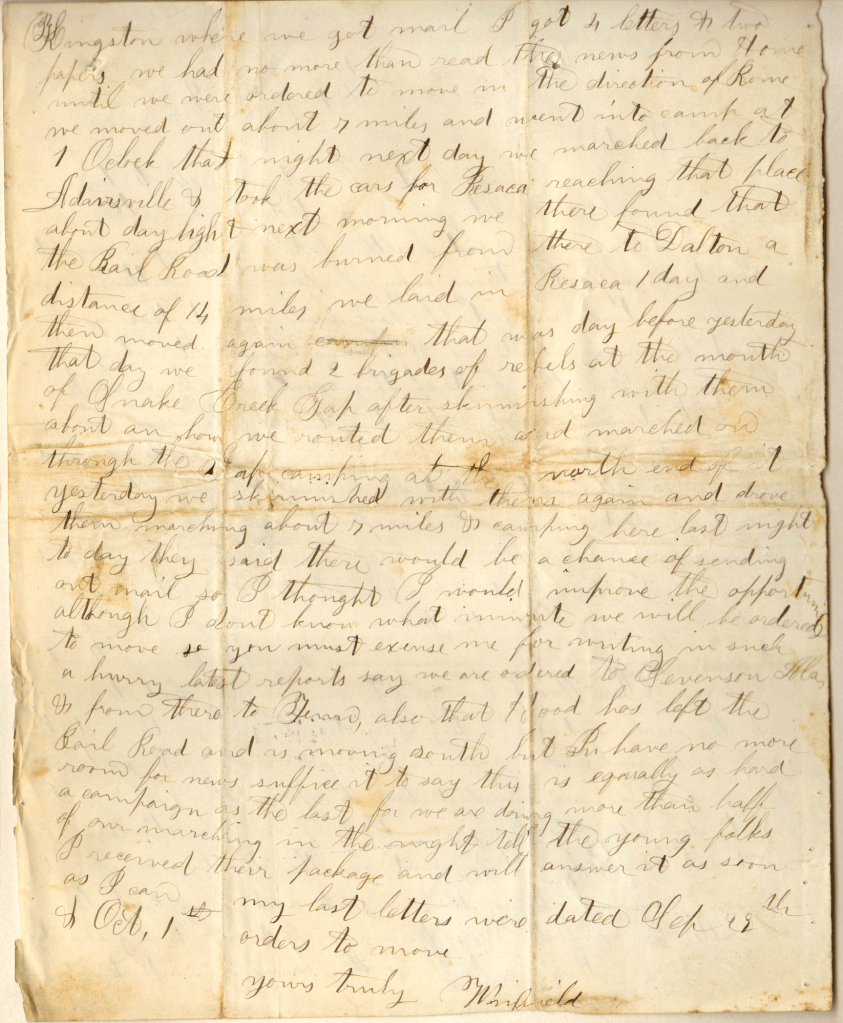

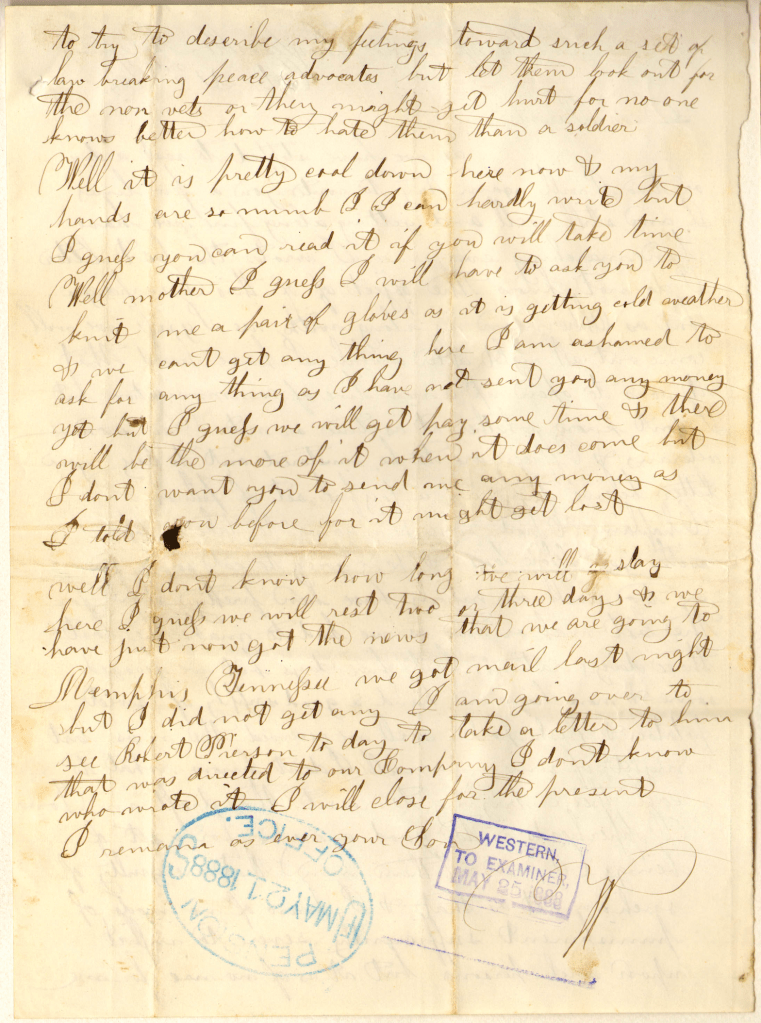


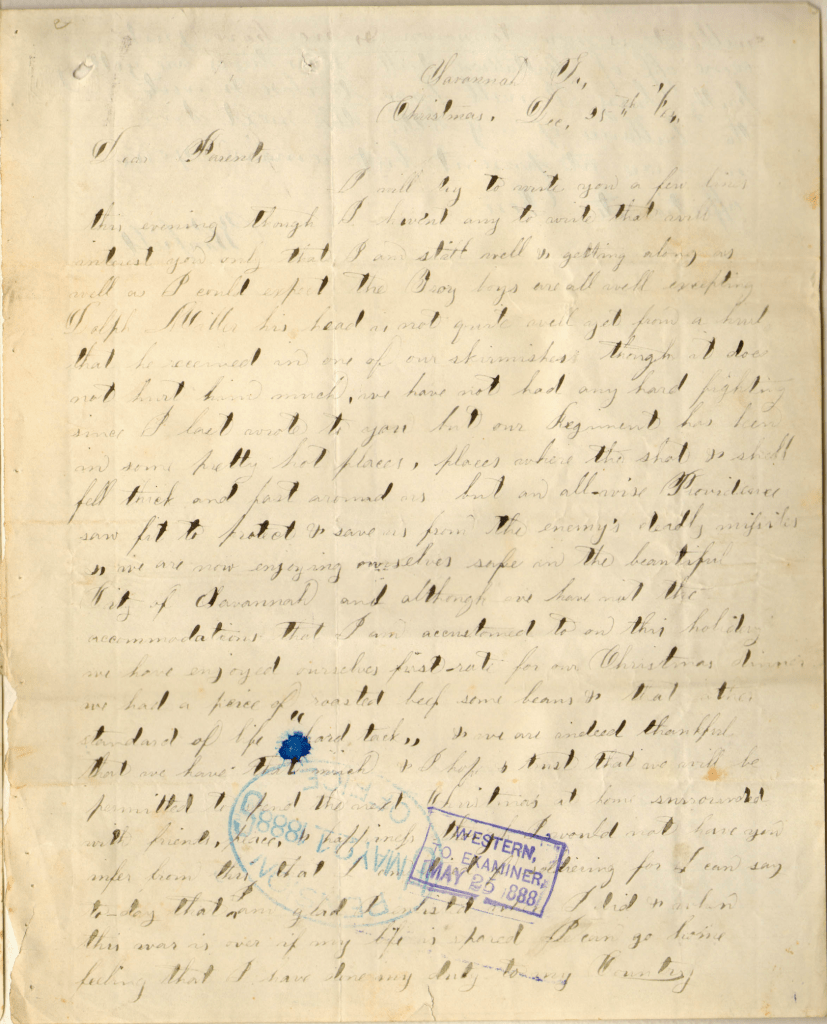

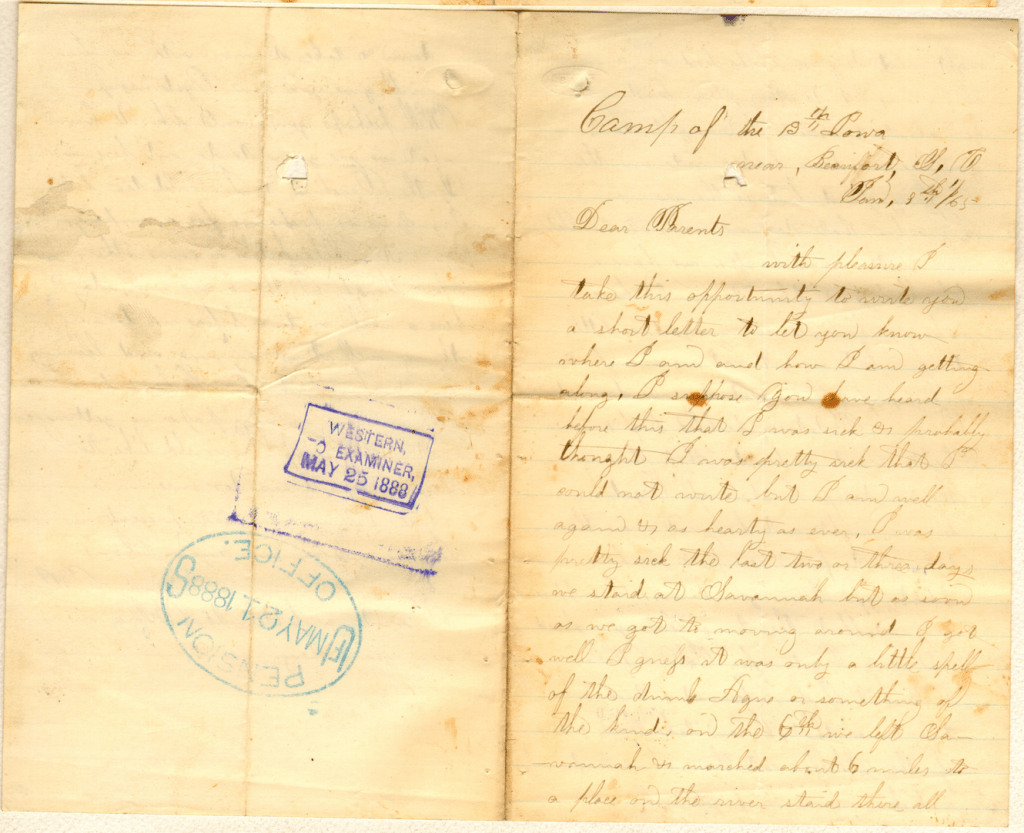

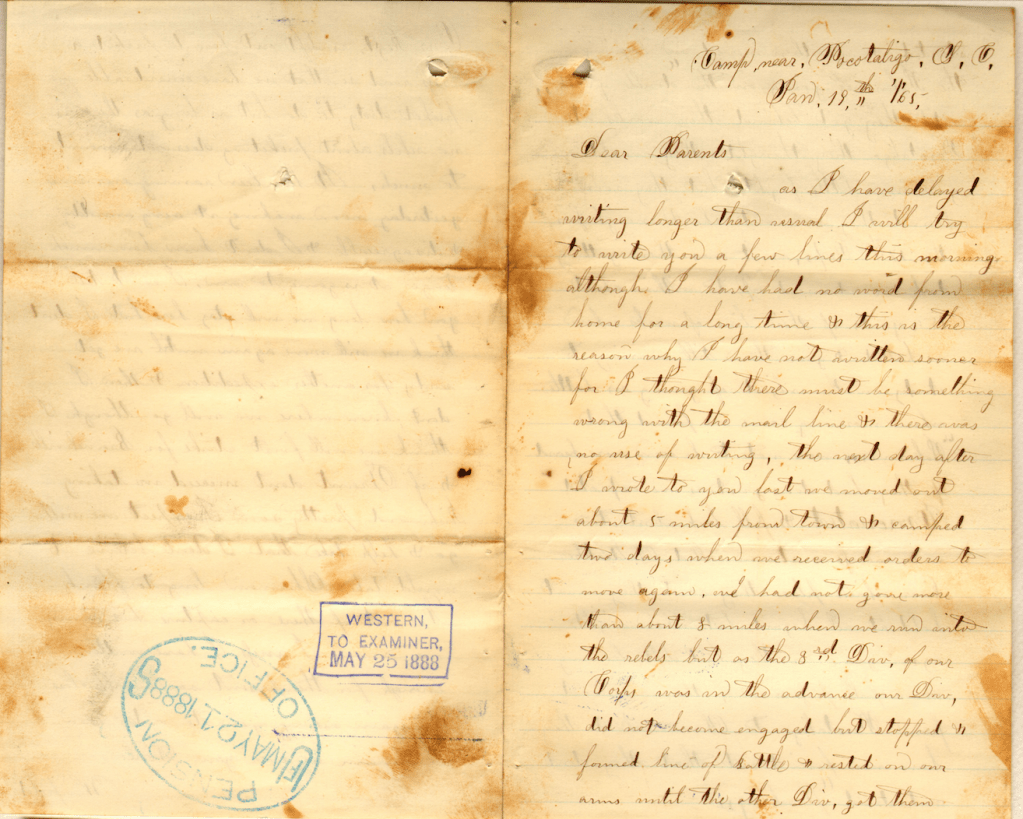


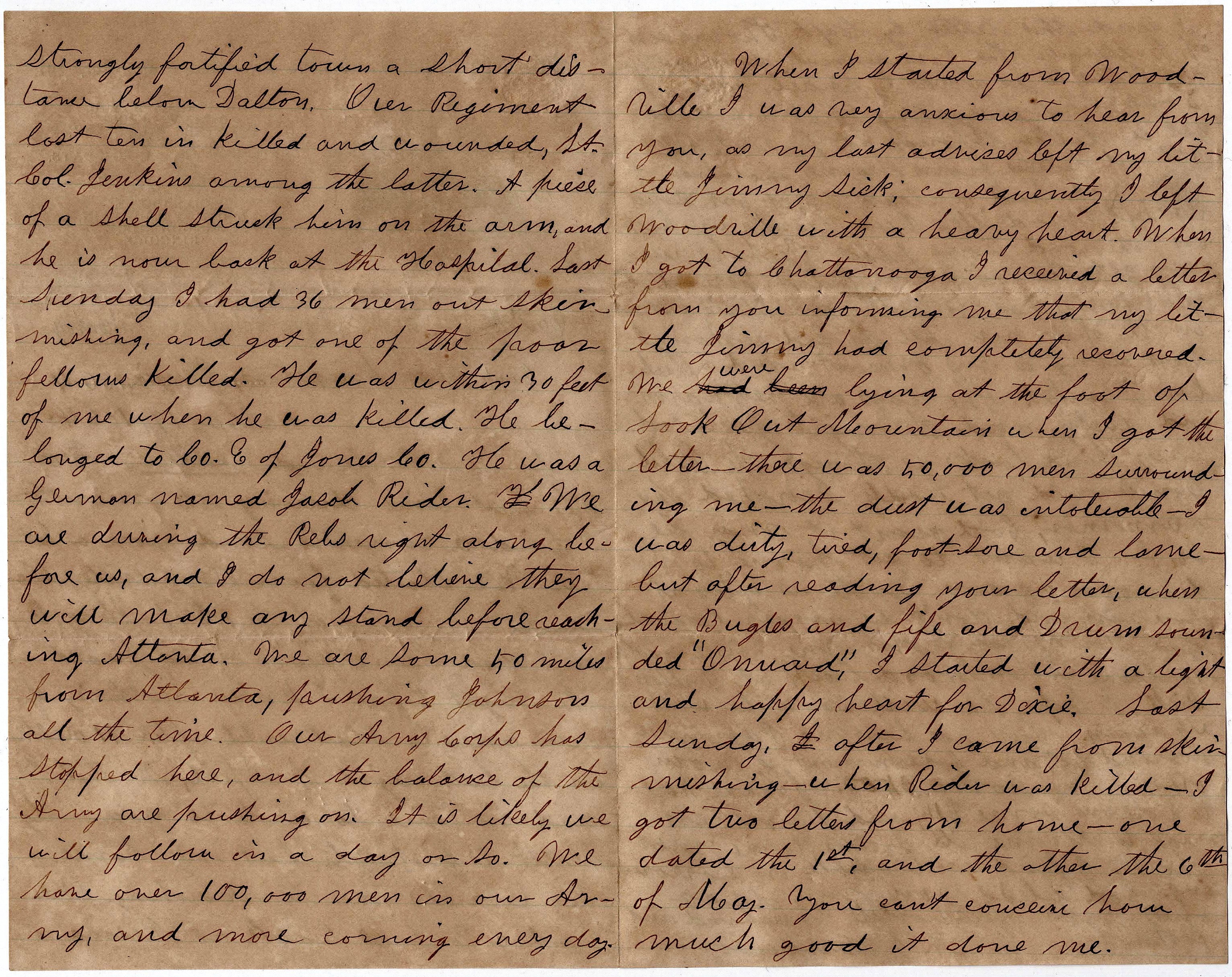
 Spared & Shared 23