Category Archives: Battery A, 1st Illinois Light Artillery

1864: James B. Dutch to James W. Porter

The following letter was written by James B. Dutch (1839-19xx) who enlisted as a recruit in Battery B, 1st Illinois Light Artillery (“Taylor’s Battery”) in Chicago in early August 1862 as a private. He was promoted to sergeant and then was selected a Lieutenant in the new Battery A after they consolidated with Battery B. The new consolidated Battery A and Battery H saw hard fighting before Atlanta and several member of Battery H were taken prisoner on 22 August 1864. They included John Thomas, John Frazier, William Scupham, William Heartt, Lewis Lake, Edward Ferry. Charles G. Siller, John F. Stranberg, Thomas Wilcox, A. C. Hall. F. Sweeney. William W. Cowlin, S. P. Coe. and Lieutenant Smyth. The Batteries were posted upon a high ridge on either side of a railroad cut that day and the enemy was able to approach the battery without notice due to the heavy smoke from skirmishing, attacking from both front and rear. Fortunately most of the members of the Battery were soon exchanged as mentioned in this letter.

Prior to his enlistment, James was a captain of a tug boat in Chicago harbor. After the war, he began business on the Board of Trade in Chicago.

[Note: This letter is from the private collection of Nick Kaup and was made available for transcription and publication on Spared & Shared by express consent.]

T R A N S C R I P T I O N
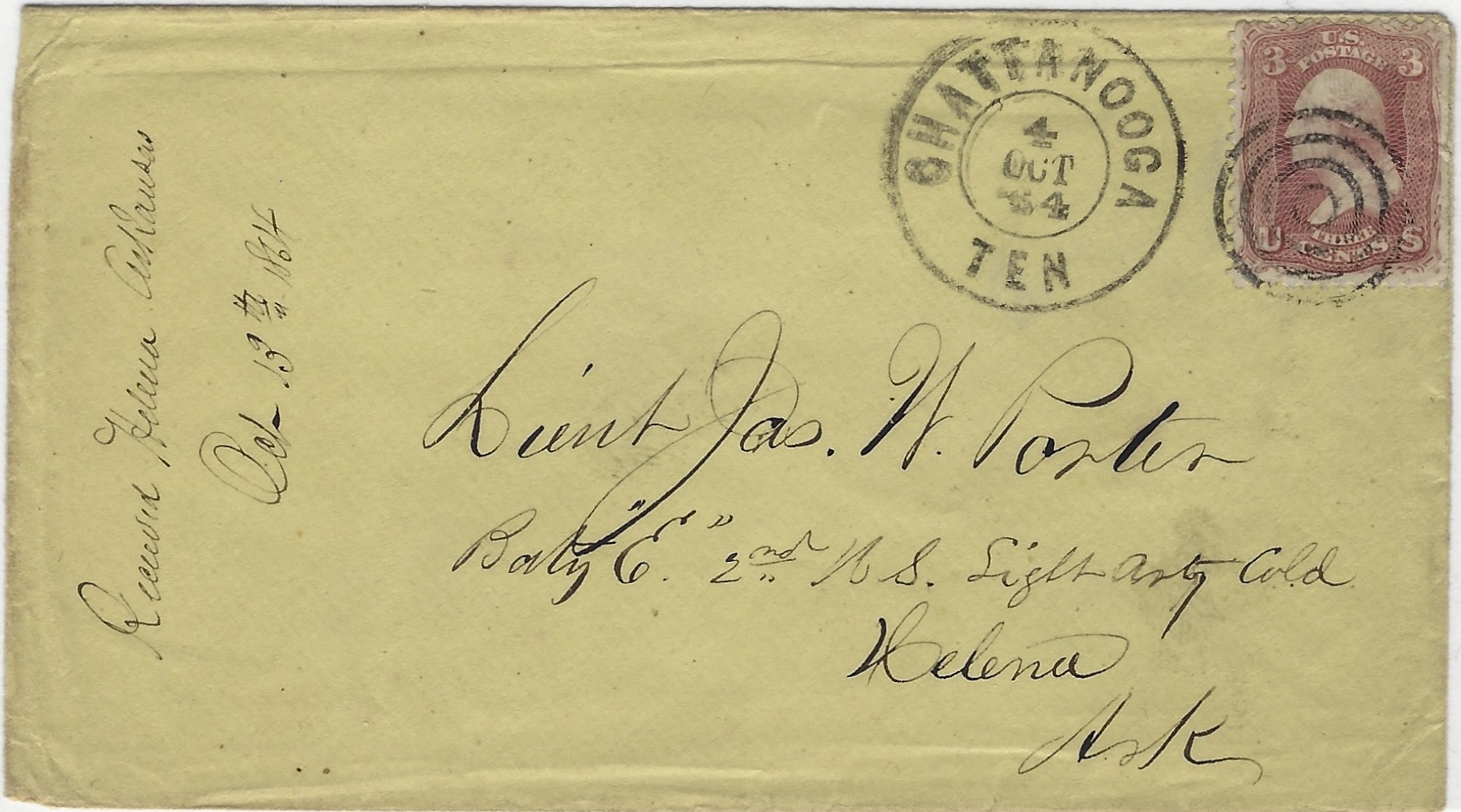
East Point, Georgia
September 25th 1864

Friend James,

Your kind letter of was received some time since but I have delayed the reply for the reason that I was daily expecting the arrival of our commissions and the permanent organization of the battery. The commissions have arrived. Lt. Smyth, Capt. Ed Wilcox, Sr. 1st, Harry Roberts, Jr. 1st, E. Colby, Sr. 2nd and myself as Jr. 2nd. We have all been mustered in except Smyth, who has not been exchanged yet, though his name was amongst those sent in for special exchange and agreed upon by Generals Sherman and Hood but for some reason or other, he has not been exchanged though we are expecting him every day. The boys captured on the 22nd have been exchanged and returned to the battery with the exception of Cowlan, Hatt and Sweenie for the old “H” boys and Davis, Chain and Grainge of the detailed men. Their appearance is proof enough of the hardship and suffering they have endured. But it is the same oft repeated story of barbarism and inhumanity. My only surprise is that they have lived through it.

Coe, Thomas, and Frazer have been discharged and have gone home feeling as happy as kings. By the way, you remember it was always a mystery to us how Coe happened to be taken. It was about the first question I asked him. He said when he arrived (with the limber of canister) at or near the foot of the hill, he halted the limber, dismounted, tied his horse and waited a moment or two expecting that we would send for the ammunition. But as no one came for it, he concluded that he was not seen and that he had better take up a couple of rounds and inform them of the arrival of ammunition. Opening the chest, he took out two cartridges and started for the guns and did not discover that the rebs had possession until he had arrived almost up to them when he turned and attempted to make his escape. But when he arrived where his horse was, he found a reb who with gun pointed, demanded his surrender, which he was obliged to do or be shot. He therefore surrendered and was marched to the rear.

Though they have suffered much and are still suffering from the effects of their treatment, still they do not regret their experience as it is something that [they] can be proud of. But, I assure you, they are not anxious for another occasion for pride.

With my kind regards to you, Chappel, and Bancroft, I remain very truly yours, — James B. Dutch

1862: George Gates to Sarah Jane (Sears) Servey

An unidentified Union teamster

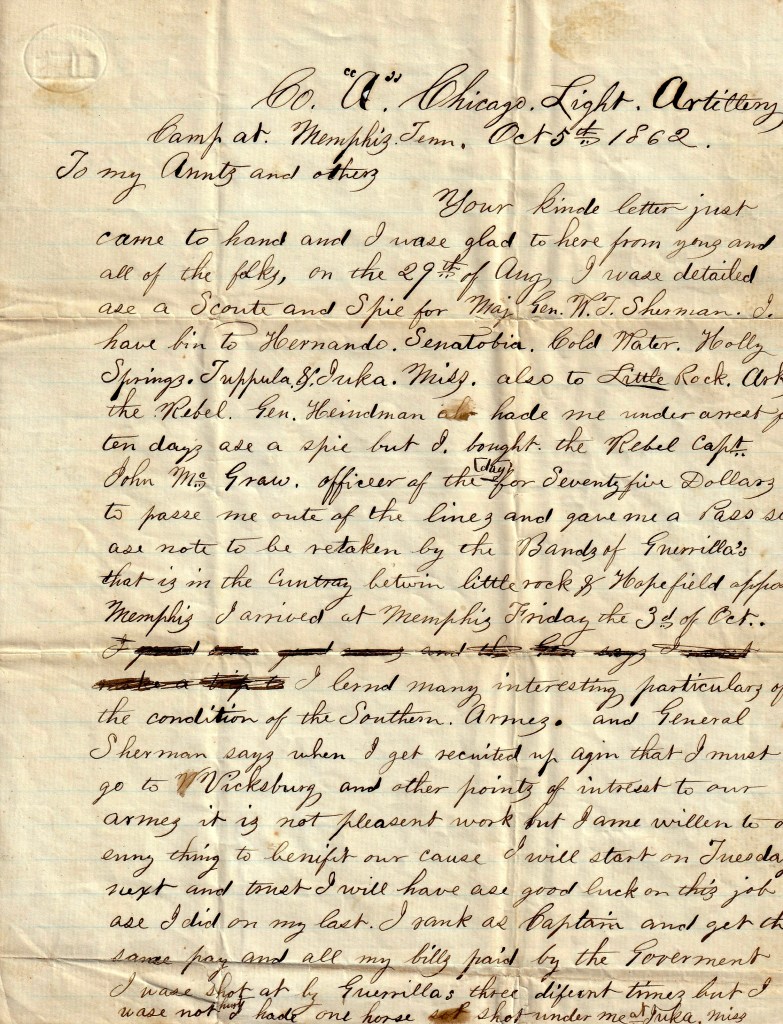
The following letter was written by George Gates (1838-1892), a native of Rochester, New York, who enlisted in July 1861 as a private in Co. A, Chicago Light Artillery. Prior to his enlistment, George was married to a woman named Rosa and working in Chicago as an omnibus driver. For the Chicago Light Artillery, George was assigned duties as a teamster and harness maker. At the time of his enlistment, he was described as standing 5′ 10″ tall, with dark hair and hazel eyes.

Besides noting George’s physical characteristics, they might have also have noted an overactive imagination for in this letter to his aunt in Rochester he claimed that he was detailed as a “scoute and spie” by direct authority of Gen. “Cump” Sherman himself, making his way by himself through Rebel territory in both Mississippi and Arkansas, and when taken prisoner as a spy in Little Rock, bribed his way to freedom. The owner of this letter informs me that George wrote another letter in February 1863 relating a similar tale of being captured in Jackson, Mississippi, taken to Vicksburg, and escaping by similar means carrying a detailed map of the Confederate fortifications. This map appears to look much like the map that appears in Harper’s Weekly on 7 March 1863 so it was no doubt available in military camps prior to that date.

In the History of Battery A, George’s name is only mentioned in conjunction with a letter that he wrote to Maj. Gen. Sherman from their camp near Kennesaw, Georgia, on 25 June 1864, in which he identifies himself as “a private of Battery A, 1st Ill. Light artillery” and offers the gift of a bridle and collar to the General as “a token of the high regard and esteem which all soldiers entertain towards you as our commander.” No mention is made of a former acquaintance. The letter was only acknowledged in the Battery history because of the General’s response in which he accepted the gift and praised the Battery for their service.

It is my impression that Gates was otherwise not looked upon favorably by his comrades in the Battery for after his name appears what was probably a nickname (“Gen. Debility”) implying he was probably “playing off” most of the time. Following the full reprint of Sherman’s reply to George’s letter, the author of the Battery history wrote, “Poor Gates did not do well after he war, but led a dissipated life in Chicago, dying in that city, in 1890, a homeless wanderer on the streets” —not a very kind thing to say about a comrade in arms, even if true. [See History of Battery A, by Charles Bill Kimbell, 1899]

[This letter is from the personal archives of Richard Weiner and was transcribed and published on Spared & Shared by express consent.]

Transcription

Co. A, Chicago Light Artillery
Camp at Memphis, Tennessee
October 5th 1862

To my Aunts and others,

Your kind letter just came to hand and I was glad to hear from you and all of the folks.

On the 29th of August, I was detailed as a scout and spy for Maj. W. T. Sherman. I have been to Hernando, Senatobia, Cold Water, Holly Springs, Tupelo & Iuka, Mississippi. Also to Little Rock, Arkansas. The Rebel Gen. [Thomas] Hindman had me under arrest for ten days as a spy but I bought the Rebel Captain John McGraw, 1 Officer-of-the Day, for seventy-five dollars to pass me out of the lines and gave me a pass so as not to be retaken by the bands of guerrillas that is in the country between Little Rock and Hopefield opposite Memphis.

I arrived at Memphis Friday the 3rd of October. I learned many interesting particulars of the condition of the Southern armies and General Sherman says when I get recruited up again that I must go to Vicksburg and other points of interest to our armies. It is not pleasant work but I am willing to do anything to benefit our cause. I will start on Tuesday next and trust I will have as good luck on this job as I did on my last.

I rank as Captain 2 and get the same pay and all my bills paid by the government. I was shot at by guerrillas three different times but I was not hurt. I had one horse shot under me at Iuka, Mississippi.


1 I have not been able to find any Capt. John McGraw (or MaGraw) in the Confederate Service in Little Rock (or elsewhere) in Fold 3 Military Records.

2 George Gates entered the service of Co. A, Chicago Light Artillery as a private and mustered out in 1864 as a private. There is no indication in his Fold 3 Military records that he was paid anything but a private’s pay.