Regrettably, with only the author’s initials provided, no envelope, and a lack of further details regarding his circumstances, I am unable to attribute this letter to a specific individual. The initials are “A. H. J.,” and he notes having sent a prior correspondence to his daughter from “Jackson Bow Station”—the location of which remains unknown to me. Nonetheless, the letter is compelling and reflects the insights of an older man who may or may not have been serving in the military, though I am inclined to believe he did. Written shortly after the Battle of Bull Run, the letter articulates his reflections on this pivotal conflict. He ascribes the Southern army’s success to the Providence of God, who he believes favors the people of the South and their cause. He further asserts that if the South were to abandon its strictly defensive strategy in favor of an offensive approach, the outcome of the war would likely result in loss, or at best, extend the conflict for “four or five years.”
T R A N S C R I P T I O N
August 12, 1861
Dear Daughter,
When I wrote you my last from Jackson Bow Station, I had sealed it when the 11 o’clock train arrived and that prevented my acknowledging the reception of the items sent me. I beg you accept my thanks for the kind attention to my request, and present my warm thanks to the Dr. for his kindness & especially his friends present. I have not yet trued it but will not doubt it superior quality being vouched for by its presenter. The gin is very good. Spirits must have risen much.
I am glad to see you so well employed with others improving comforts & necessaries for the soldiers who have so nobly sustained the honor of our country & given sure promise of success to our just cause. For such troops can never be subdued. And I believe the whole South, almost to a man, can & will send, if needed, to the battle just such spirits.
But my dear child, the more I read of the battle & see into its managed victory, I am the more impressed with the belief that praise is due to God. When I read of the terror that ceased the enemy & the fearful [ ] it produced in them, it strongly brought to mind the terror God produced in the army of the Syrians as they were besieging the city of Samaria. Oh, how great is God. He wills and the mighty warrior shrinks into the coward. Never did an American army run before. Never was Scott beaten, even by equal or superior in number. But here he was no only vanquished, but made to run for his life by those [ ] to [ ] crushed by the [ ] of His hand, by those He dispersed and half her number. I almost pity him [Scott]—so mortified, so disgraced, so fallen in his and his nation’s eyes & estimation. I already see signs of displacing him as not competent. They, in my [opinion] certainly had incompetent officers.
I only fear [Jefferson] Davis may commit the blunder of carrying the war into the enemy’s country. If he does, our army will be wasted and defeated. And we will [not have] a war on one year, [but] one of 4 or 5. Every man that is now growing tired of the war & unwilling to fight against us, will then be roused to fight for their homes & their country. Remain in the defensive and God will be with us. But let ambition or revenge rule us to carry the curse against women & children, & God will turn against our own soldiers [and we] will lose this war spirit, naturally so.
Affectionate remembrance to the Dr. & family. Your father, — A. H. J.
The following letters were written by Dr. Morris Joseph Asch, before and after the Battle of Bull Run in July 1861. Morris was born on July 4, 1833, and was the second son of Joseph Morris Asch (1802-1866) and Clarissa Ulman (1812-1869) of Philadelphia, Pennsylvania. His early education was mainly under private tutors and in the autumn of 1848 he entered the University of Pennsylvania where he was graduated on July 2, 1852, with the baccalaureate degree. His Master’s degree was received in course July 3, 1855. He was a member of the Alpha Chapter (University of Pennsylvania) of the P. K. E. fraternity. In the fall of 1852 he entered the Jefferson Medical College of Philadelphia from which he received the doctorate in 1855. Soon after graduation Dr. Asch was appointed clinical assistant to Dr. Samuel D. Gross, with whom he remained for several years.
Surgeon Morris Joseph Asch(World Biographical Encyclopedia)
When war was declared and his country called, it was but natural that he should enter the Army where three brothers had already volunteered. He passed the examination for assistant surgeon of the United States Army, which he entered on August 5, 1861. He was on duty at the surgeon-general’s office from August, 1861, to August, 1862. He subsequently became surgeon-in-chief to the Artillery Reserve of the Army of the Potomac, medical inspector Army of the Potomac, medical director of the 24th Army Corps, medical inspector of the Army of the James, staff surgeon of General P. H. Sheridan from 1865 to 1873. Some of the battles of the Civil War in which Dr. Asch participated were Chancellorsville, Mine Run, Gettysburg, The Wilderness and Appomattox Court House. On March 13, 1865, he was brevetted major for faithful and meritorious services during the war. He resigned from the Army of the Potomac on March 3, 1873, and entered into the practice of medicine in New York City, devoting himself largely though not exclusively to the study and treatment of diseases of the nose and throat and holding the position of surgeon to the throat departments of the New York Eye and Ear Infirmary and the Manhattan Eye and Ear Hospital. When the American Laryngological Association was formed he was one of its founders, and he was president in the work of the section of laryngology. [Source: American Medical Biographies]
Morris wrote the letters to his brother-in-law, George King—husband of Rachel Rosalie Asch (b. 1835). They were married in New York City in February 1853.
Letter 1
Washington [D. C.] July 10, 1861
Dear George,
I promised to write you and take the first opportunity to fulfill my engagement although I have nothing to write that you don’t see in the papers before I do. Nobody here is allowed to know anything. It is too near the enemy and if any information was afforded, the secessionists would know it before our own. I had expected to be sent into the field but instead I have been retained here to assist in establishing a military hospital. There are several here but a larger one is needed and to that duty I am assigned. It is abominable there is so much red tape to go through. If we want an ambulance or any important article, I go to the Surgeon General. He send me to the Medical Director. He approves and I go to General Mansfield. He approves and I go to the quartermaster. He says that he can’t give it without an order from Gen. Meigs. I go to him and he says that the President’s orders are not to issue anything except on Gen. Scott’s order. I go to Gen. Scott and he says that he can’t be troubled with such details. I go back to the quartermaster to ask what the devil he means by sending me on such a round and he says that there is no use coming for he hasn’t got what I want. That is the way that everything has to be done here so you can imagine what a pleasant time one has to establish a hospital with furniture for 400 men. But we are pretty nearly through and I hope that when the thing is in operation they will send me off with McDowell.
Provost Marshal’s Office in Alexandria, Virginia (LOC)
I went to Alexandria the other day and rode out to the outposts and round the pickets to Arlington. It is a real secession country. I asked in Alexandria where the Colonel lived and a fellow said that he didn’t know any such crowd. Shepard 1 the Provost Marshal said that they were tired of kicking the fellows but that it was the only thing that they could do with them. Alexandria looks deserted. You hardly see a soul in the streets. All the houses and stores are shut and the horses feet sounded as if we were in a deserted city.
Col. Noah Farnham led the 11th New York (Fire Zouaves) after the death of Elmer Ellsworth. Farnham was mortally wounded at 1st Bull Run. The Fire Zouaves were notorious for their lack of discipline.
From there we rode out to the [New York Fire] Zouave camp and saw [Col. Noah L.] Farnham and his men. They are good soldiers but need discipline. Farnham gave a captain some order about his men’s muskets and he said that he’d be damned if he would. There are some strong earth works around the town and whole round to Washington is one line of pickets and camps.
We took dinner at the Minnesota camp 2 (the best shots I ever saw hitting the target as big as your hat every shot at 230 yards) and from there passed through the camp to the earthworks of the 69th and from there to Arlington, Gen. McDowell’s headquarters, and from there to Washington. The entrenchments are very strong and extend over the whole round. We passed through the Garibaldi Guard on the march and they stoned us for going through their lines on a run. We had a couple of secession horses that were captured at Mathias Point by Capt. [James H.] Ward and the red shirts scared them. We went out as far as the pickets would let us towards Fairfax. We wanted to see the “seceshers” but didn’t get a chance. We were on horseback all day and was pretty well used up when we got home.
Give my love to Rachel and Judah and the children & let me hear from you. Regards to May. 3 Tell him his hats looked fine on the Garibaldi’s. Direct to Dr. Asch, USA, Washington D. C.
Yours, — Morris
A postwar image of Lt. Charles H. Shepard, Co. B, 5th Massachusetts Infantry. He served as Provost Marshal in Alexandria in July 1861. (Dave Morin Collection)
1 Lieutenant Charles H. Shephard of Co. B, 5th Massachusetts Infantry was serving as the Provost Marshal at the time of Morris’ visit to Alexandria in July 1861.
2The 1st Minnesota saw heavy fighting on Henry House Hill at 1st Bull Run. They were one of the last regiments to leave the field and suffered one of the highest number of casualties of the Union regiments engaged—49 killed, 107 wounded, and 34 missing. Just prior to advancing on Manassas, the regiment was encamped at Camp Forman at the reservoir on the Little River Turnpike near Alexandria.
3 Morris was probably referring to Lewis May, a hat maker at 43 Broadway in New York City. The letter suggests that the hats supplied to the Garibaldi Guards (39th New York) came from May. The regiment was famous for their distinctive Bersaglieri hats, red shirts, and black gaiters when they first took the field in 1861. Lewis was active in politics and was one of the featured speakers at Union Square War Meeting in April 1861 in which he encouraged the Germans to organize themselves into a regiment and march to Washington in its defense. German’s comprised the greatest percentage of the foreign born members of the 39th New York, Garibaldi Guard. [Source: New York Herald, 24 April 1861]
Letter 2
Columbian Hospital 1 July 29, 1861
Dear George
Now that things look a little better, I hope that you have got out of the desponding mood that you were in when you last wrote. In fact, there is no reason why you should not be. The thrashing that we got will only make us more alive to our deficiencies and our next army will be worth a dozen of the last. Anyhow, we hurt them as bad as they did us, and if it were not for the number of our prisoners that they have, I think that we would be the best off. But one government liberates every rebel that it catches and when they catch ours we have nothing to exchange.
As to the battle itself from all that I can hear from regulars who were not scared and from volunteers who were, our men had the best of it in every way until forced to give up by hunger & exhaustion. They had nothing to eat since the night before and our fine politician officers took them for miles into action on the double quick and then gave them no rest. The regulars found that their men couldn’t stand that game so they rested them for an hour or two before they went in again and then did good service. If it had not been for that cowardly panic, I believe that we would have remained masters of the field.
By the way, some of your New York Regiments behaved very well—the 69th and 71st and 14th [Brooklyn], but others lost the battle through their cowardice. The Fire Zouaves behaved in the most cowardly manner and could not be brought up for a charge—squatting and firing till they ran away and some have not turned up yet they ran so far. The enemy ran too. An officer told me that we charged and they ran. Then they charged and we ran. Then we charged and they ran. Then they charged and we ran farther and faster than they did. There is no doubt but that they must have been used up and scared or they would have advanced on Washington—for they could have taken it up to Wednesday for there was no discipline of any kind. Troops were straggling all over the country and there were not a half dozen regiments together. People were scared and if Beauregard had any chance of fighting he would have been here.
They say today that Johnston is about to attack Banks but I presume that he is prepared for him. The enemy’s lodd must have been severe. Our artillery worked well but we had not enough of it. An officer of Sherman’s Battery 2 told me that after silencing a battery, he went out to reconnoiter and saw a regiment of Louisiana Zouaves coming up a ravine to outflank them. They turned their guns—six pieces—on them and as they came in range, they let drive with grape and canister into them and made lanes right through them and routed them in short order.
[Capt. Romeyn] Ayres’ Battery got their range on a railroad crossing an open space between the woods where reinforcements were being brought up, and as the head of the train came in sight, let fly and smashed five cars with troops in all to pieces. A man who escaped from them and was employed by them in the hospital says that they have 2800 wounded. We have some of our wounded here but not many. Most of them are in town.
I have to thank you and May for that beautiful hat that you sent me. I mean to write to May soon but till I do, consider this as a joint letter to you both. The hat has been very much admired. It is the handsomest that has been seen here. You may imagine that I have to steal some time to write when I tell you that I have been four hours writing this letter. I am officer of the day and have to receive and discharge patients, attend to the business of the house, and even bury the dead—and consequently am hopping up and down every five minutes which accounts for the gaps in my letter. We have about 225 patients in the house and more coming in every hour.
Have you hot weather in New York? Here is is delightful. It is always cool and a pleasant breeze always blowing so that it scarcely seems to me that I am south of Philadelphia. I don’t know who your friend, the recruiting captain in Broadway, may be but I do know that he is a damned impertinent fellow and I will tell him so if I see him.
Give my love to Rachel and the children and Judah. Tell Ally 3 that I will bring him a secession sword of the first battlefield that I get to. My respects to the family. Ask May to write. Yours affectionately, — Morris
Direct to Columbian Hospital, Box 266, P.O., Washington
1 Built in 1820, the Columbian College was appropriated by the government on 13 July 1861 to be used as a hospital. It was located on Meridian Hill, west of 14th Street Road. The hospital was initially operated in the Washington Infirmary at the college until it burned in November 1861 at which time the hospital was relocated to the main College building.
2Co. E, 3rd U. S. Artillery, or more commonly called “Sherman’s Battery,” was commanded by Thomas W. Sherman.
3 “Ally” was Albert G. King, b. 1854, the son of George & Rachel (Asch) King.
Sherman’s Battery on the way to the Bull Run Battlefield (Harper’s Weekly)
A post war image of Harrison Guiles (Find-A-Grave)
The following letter was written by Harrison Guiles (1841-1896) who was born at at Charleston, Montgomery County, New York, on 17 January 1841, the son of William Guiles (1810-1877) and Margaret Rulison (1822-1916) of Conklin, Broome county, New York. At the age of twenty he enlisted (May 1861) in Co. F (the “Broom County Volunteers”), 27th New York Infantry and served two years when he was honorably discharged in 1863. This incredible letter was written on 6 August 1861, a couple weeks after the Battle of Manassas or 1st Bull Run in which the 27th New York Infantry participated, led by their Colonel Henry W. Slocum who was wounded in the day’s action. The regiment’s losses included 1 officer and 25 men killed; two officers and 42 enlisted men wounded. There were 60 reported missing.
Returning home after his term of service had ended, Harrison was married on the 12th of March 1864 to Miss Emma Jane Darling.
I can’t be certain but suspect the letter was written to Annis Dillon (1844-1926), the 15 year-old daughter of Hamlet Dillon (1812-1890) and Adelia Chapman (1817-1889) who lived in the same village as Harrison, Conklin, New York. She later married William Alexander Bowman (1829-1898)
T R A N S C R I P T I O N
Washington [D. C.] August 6, 1861
My friend,
I now take my pen in hand to tell you about those friends but I am sorry that I have bad news for you. The report that I received when I wrote before is all false—a [ ] rumor. Our friend [Frank] Gunther I think is a prisoner and for all that I know, it not in the land of the living now but I hope he is. He has not been heard from since he was seen at Fairfax and the probability is that he is now in their doctor’s hands and the others. [Sidney A.] McKune has not been heard from since the battle. Tybe [?] is here but not very well at present. And Spencer Whipple I heard that he is wounded but how true it is is more than I can tell. And myself, I am well and hope these [lines] will find you the same.
I received your letter yesterday and you may be assured that it come welcome too. And so they all will be that you write. I am having a very good time now, not having to drill much since we returned from the battlefield. My friend, that was a hard time. We was almost tired out and then marched clear back to Washington. I traveled 60 miles and never tasted food and fought four hours besides. It was enough to make one think of home. We expect to leave here before long. I hope so.
Annis, you must excuse my poor writing for I have been on duty the last twenty-four hours and you must know how one feels after being out all night. I think you do it. It’s very warm here and what is worse, the flies is very troublesome here. I am eating here in our old shanty and have nothing but a rough board to write on at that. I would like to be home to go to camp meeting this fall but I hardly think I will sometimes. I have had no [ ] and the time we had the fourth I feel like flying. But never mind. It will come out all right by and by. I wish that you could be here just to see the cavalry and soldiers perform. They have great old times. But it is no sport for me to settle from them.
Annis, this is a time that will make many a poor mother grieve and many a fair and loving maiden mourn for her true love that is in the battle. But I have no sweetheart to mourn for me if I chance to fall. But there is a kind mother to mourn for me but I must take my chance with the rest of my comrades. I have been once where the cannon’s deafening roar and where the rattle of musketry was all that I could hear except some poor wretch that chanced to fall. That was a time that would make the sturdy hearts fail. I must confess that I felt a little bit wretched when we first marched on the field. I could see the cannon balls as they struck the ground but it was nothing after I got used to it.
But I must draw to a close as it is most drill time. But you spoke about that speech. If the party should ever meet, I dare not state what I think. But some time I will tell you my opinion. But now give my best respects to [ ] and receive the kind wishes of your friend that perhaps you will never see again. Goodbye Annis. Write Often. It is my wish. — Harrison Guiles
Regrettably, the author’s identity of this unsigned essay remains a tantalizing mystery, with scant clues to piece together even a fleeting guess at authorship. If I had to wager, I’d propose it was penned by a young man from New York City—perhaps in his late teens—who harbored lofty theological ambitions and possibly attending classes in Litchfield, Connecticut. Despite my internet sleuthing, I’ve come up empty-handed; no evidence suggests this piece was ever published in a book or newspaper. My gut tells me it was likely a personal draft, perhaps intended for publication, yet its final resting place remains unknown.
Though it can’t be pinned to a specific hand, this essay vividly encapsulates the turmoil rippling through the Northern states from the moment the shots rang out over Fort Sumter until the rise of Gen. McClellan—who is described as “the gift of God to a devoted, loyal people.” Such language perfectly encapsulates the anxiety and fervor of the times, and invokes the belief that calamity will only befall a Nation that does not place its trust in God.
Transcription
New York [City] August 21, 1861
One month ago today occurred the battle and the panic of Bull’s Run and in that month thus following so great a national disaster, there has been time and cause for many hours of bitter thoughtfulness. We entered upon this serious crisis in our history with such a confidence in the right of our cause and the stability of our government that the determined effort to crush rebellion and annihilate that treasonable spirit which had been growing in our midst for years did not appear at the outset a formidable work to accomplish. But today, with no less confidence in our ultimate success and no less faith in Him who gave us the precious government for which we are contending, we are awake to the consciousness that God has given us a task to accomplish which we must perform in sorrow and the seed of which we must sow in tears. We know that we are not just passing beneath a cloud the end of which we cannot see, that in its deepest darkness there must be privations, sufferings and painful sacrifices, but we also feel with a conviction the intensity of which is sublimely prophetic that He who gave us so miraculously our existence as a Nation will never desert us in our terrible struggle to preserve that existence and that nationality under the government which He has always blessed to us.
The month just passed has seemed a breathing space in the commencement of a weary struggle. The mind has availed itself of a relief from immediate excitement to review the past few months of our eventful history and call up one by one the incidents that here give it so great an interest.
First came that Friday night on the 12th of April last when the scarcely credited intelligence fell on the ear that the bombardment of Fort Sumpter ad commenced. I went down to the news offices between 8 and 9 o’clock in the evening and read the announcement on the different bulletins with feelings strange and new. On the cars in the street, in every place of business, the expression passed from mouth to mouth, “The war has actually begun.” A nation went to a troubled slumber on that Friday night. Then followed the day of wild excitement when almost every home brought some fresh account of the disastrous and uneven siege until night closed in upon the week with the news that the gallant little garrison had been overpowered by besieging thousand and Sumpter had fallen into rebel hands. What a day was that Sabbath which followed the intense excitement of a few preceding hours. What a week did it open to an aroused and patriotic people. What a springing to arms. What an impetus towards Washington and the following Sabbath. Who ever saw a Sabbath like it in the City of New York? When the usual quietude of Sunday was broken by strains of martial music and churches were almost deserted in the eagerness to bid farewell to thousands who embarked that morning for the seat of war. I remember well the expression of our dear little pastor from the pulpit that morning: “It is hard, my brethren, for me to merge the patriot in the preacher.”
Patriotism swallowed up every other impulse on that day and those who lingered in God’s sanctuary to offer up their prayers felt as they had never felt before. How precious in the hour of peril was the “Rock of Ages” beneath which a Nation could find shelter and protection. The constant departure of regiments, the Great Union Meeting, the news of brave men cut down in the very commencement of their usefulness—Ellsworth, [ ], Greble, Withrop, and so recently, the noble Gen. Lyon. All these are fresh in our memories and our hearts.
The day that followed the battle of Bull’s Run when the news gradually reached New York was one of those the least of all likely to be forgotten. Morning brought us the news of a great victory but as the day come on, the story became reversed, a retreat in order, a complete rout, a panic, slaughter and destruction, anxious friends spoke low and tremblingly. Parents started for the Capitol. Mothers sat in tears and every face wore marks of deep anxiety. This was the most painful day of all. On the morning following I went to Litchfield and all along the route the sush for morning papers was eager and exciting. Each day succeeding brought less painful details until the public mind became possessed of every circumstance and reconciled itself to the unpleasant, unanticipated change in our affairs. And thus we stand today with a renewed confidence in the fresh leader of our forces, General McClellan, and the assurance that under his guidance, our army has now attained an almost invincible efficiency. The man seems to have risen for the emergency—the gift of God to a devoted, loyal people.
We have but one danger to guard against, a forgetfulness ofHim who alone can give us a victory. We must be Christian Patriots. We must bring our troubles and the acknowledgment of our sins to Him who will deliver us from both. We must be certain of success only through Him who alone can give it to us and with this certainty or with this Faith success is already ours. Today we stand looking into a future that must be eventful. The eyes of the world are upon us and our greatness which was never more apparent was never more strongly tested than now. At such a time there is the most urgent need and there should be the most earnest desire for the spirit of God to guide and direct us. Let us hope then that as a people we shall not be indifferent in seeking for it, or unsuccessful in obtaining it—the one being dependent upon the other, remembering always with a sacred zeal that “where the Spirit of God is, there is Liberty.” 1
1 “Where the Spirit of God is, there is Liberty.” 2 Corinthians 3:17.
The following letters were written by William Elmer Thorp (1841-1912), the son of Alfred Thorp (1815-1895) and Frances Relf (1817-1903) of Sherman, Chautauqua, New York. According to muster rolls, William enlisted in May 1861 at Elmira in Co. D, 21st New York Infantry. He was wounded in action at the Battle of Antietam on 17 September 1862 but survived and mustered out with his company in May 1863 after two years service.
[Note: These letters are housed in the Special Collection of the University of Iowa Library and have been digitized but have not been transcribed and made available on the internet.]
To read other letters by members of the 21st New York Infantry that have been transcribed and published on Spared & Shared, see: William Fox, Co. C, 21st New York (1 Letter) Peter Cozzens Doyle, Co. H, 21st New York (13 Letters) Ansel W. Dumphrey, Co. H, 21st New York (2 Letters)
Letter 1
Addressed to A. Thorp, Mina, New York
Elmira, New York May 12th 1861
Dear Parents,
You are no doubt expecting a letter from me and I take this opportunity of writing to you. I am now in Elmira as you see by the heading of this letter. The morning after I left you, I went to Mr. Sheldon’s and found were gone to Buffalo to enlist and that George Patterson was giving passes to volunteers so I went down to Westfield, got a pass, went to Buffalo & found the boys there. We looked all around town and looked at all the companies and finally joined Co. D—called so at present, but the name will probably be changed. We call it so because almost all the men are what used to form Co. D, 74th Regiment. It is called one of the best companies in Buffalo.
We had orders to march yesterday and started about 5 o’clock p.m. The whole of the old military companies and Fire Department of Buffalo turned out to escort us down to the depot but you will see the account in the Express probably. I will only say Main Street was decorated in splendid style, flags flying from every window, handkerchiefs waving, cannon roaring, bells ringing, and bands playing, making one of the grandest sights I ever beheld.
We arrived at Elmira at about 7 o’clock this morning and were greeted at every station and house along the road with tremendous cheers and waving flags or handkerchiefs and sometimes with cannon. People were in crowds at every place along the roads where we stopped. We are quartered for the present at a hall in this place and the other companies in different parts of the town.
I must not forget to tell you that Ira J. Sheldon and myself went down to the [Niagara] Falls one day and had a very pleasant trip. We went under the Falls on both sides and up to Lundy’s Lane Battleground. There is a large observatory there now and an old soldier who was in the fight went up with us and gave us a full description of the battle. Send this sheet of music over to Emma Pelton and tell her she must learn to play it for it is all the go now-a-days. I don’t think of any more news to write at present. Direct here to care of Capt. Wm. C. Alberger. He is my captain and a first rate one too.
Your son, — Wm. E. Thorp
Tell Jim and Billy and all the rest of the Boys to write to me and not wait for me to write first.
Letter 2
Camp Kalorama Washington D. C. July 12, 1861
Dear Parents,
As you wished me to write often, I am now seated to drop a few lines to you although I do not know as there is any more news in particular for me to tell you and I write this time with ink although it is sometimes very hard to get it when we are on the march. But as we have now been in camp here some time, we can get it but do not know whether we can fix it so that we can carry it but we shall try to do so.
Lewis wrote home the other day (he is one of the boys from Sherman) that we were going to march into Virginia last Wednesday and I did not know but you had heard of it. We had such orders but they were countermanded I suppose on account of our guns as the guns we then had were poor ones being old flint locks altered. But yesterday we marched down to the Arsenal and changed them for guns made at Harpers Ferry in 1852 and are very good guns but I don’t know now as we shall be able to get off as E. G. Spalding and some others are trying to get us for the National Guards and if they do, we shall have to stay here around the cuty. But us boys do not like that.
You know I wrote to you about what I should do at the end of the three months. Well some say we are in for two years anyway—that the state can turn us over to the United States for the whole time. We were sworn into the state service and some say they cannot so I don’t know how it will be (nor do not care much).
Felix [Mayburn] has been sick and the Captain is making out his discharge today so I presume he will be at home before a great while. He talks some of going by water to New York City and then home and I shall probably send some letters by him.
You wanted to know whether I wanted anything you could send me. There is nothing I now think of unless it is stamps which are rather hard to get hold of here now as we are not allowed to go out of camp and the franked ones we cannot get only once and a while. But if I can get out of camp, I am going to try to get R. E. Fenton to frank some for me.
The othre day I met a classmate from Oberlin who was in my class three. He is now a clerk in the patent office and we had a very good visit. He invited me to call on him when I come down to the city again and see him. I wrote a quite a number of letters to Mina the other day and suppose you have got them and answered them before this.
The Sheldon boys are all well and both on guard today. I suppose I shall be on tomorrow unless there are a quite a number absent from roll call. If there are, they will be put on as extra duty. We have now 12 men on guard from each company making 120 on guard every day. I am quite well at presemt and hope you are all the same.
You will excuse poor writing as my knee has to serve as a desk and I am in a hurry for supper is nearly ready. With best respects and love to all. I remain your affectionate son, — Wm. E. Thorp
A. Thorp F. Thorp
Letter 3
Fort Runyon Washington D. C. July 15th 1861
Dear Parents,
I wrote a letter to you day before yesterday but forgot to put it in the post office so of course it has not gone but I will write this and put it in with it and send it now. Since writing the other there has been a little change in our camp. Yesterday we got orders to start and come to this fort which is just at the end of the Long Bridge and is nothing but an earthwork but it is a good one and well laid out.
I think we shall probably stay here until our time is up to guard this fort and finish the rest of it as it is not yet quite finished on the side next to the river. We have a fine view of the Potomac from our camp and the canal runs about a quarter of a mile from our camp on the other side and we can see any quantity of camps from the breastworks and Fort Corcoran on the higher hill beyond us.
Some of the boys like the plan of stopping here but the most of them are for going on and get where we can do some of the fighting. Felix starts for home today. I believe he did not come across the river with us.
I received the paper Uncle George sent and was glad to get it. Please send one as often as you can as we all like to read it as it keeps us posted on what is going on at home.
You may direct the same as before. Yours on, — W. E. Thorp
Letter 4
Addressed to James M. Coveny, Mima, New York
Fort Runyon, Virginia 24th July 1861
Dear Cousin,
I received your kind letter on the 21st and should have answered it before but the truth of the business is I have been out on picket guard about six or seven miles out towards Fairfax Court House and as it may be interesting to you, I will give you a brief account of it. On Monday morning our troops came pouring into this fort after our defeat at Manassas Junction as thick as they could come. We did the best we could for them, giving them all of our rations both of bread and of coffee and I can tell you, Jim, it was a bad defeat—a perfect rout.
I will give you a short account of the battle as near as I can learn from those who were engaged in it. About two o’clock on last Sunday morning, our troops were called up and fell into ranks and formed their line of battle when they advanced on the enemy at Bulls Run about four miles this side of Manassas Junction. The rebels retreated and our troops followed on when the rebels opened on them with masked batteries, before this unknown to our men, and cut them up badly when some of them run when the New York Zouaves (Ellsworth’s) were charged upon by the Black Horse Cavalry but they stood the charge nobly, drove them back, and killed about two-thirds of them and forced them to retreat. Some of the southern regiments would march out amidst the smoke with the American flag flying, then our men would think they were firing into their own friends, would stop firing, when the rebels would open fire on them and all such tricks as that. But I must hurry along.
We took three of their batteries twice but were driven back by other batteries in the rear. At length, after fighting five hours, our men were obliged to retreat. Some of the regiments behaved nobly and fought well amongst which were the New York Fire Zouaves (Ellsworth’s), New York 69th which is the Irish regiment, the 79th which is the Scotch Highlander Regiment, and the 27th—all from New York. Also the Maine 2nd, I believe, and some of the Massachusetts & Wisconsin regiments and one regiment from Michigan. The New York 12th, they say, run like the devil.
But I have now told you about all I can about the battle from the accounts given me by the soldiers who came back to here. They came in very irregular, every man for himself without regard to any company or regiment and indeed a great many did not know where their officers were and some said their officers did not go in with them at all. And Jim, to express my candid opinion, it was all owing to our men having poor officers that we got licked so bad although we only had 45,000 men according to the best accounts I can get while the enemy had about 80,000 at the least.
But I will return to my going out on the picket guard. About 8 o’clock on Monday it commenced to rain and it kept raining until about midnight on Monday night, but about 11 or half past eleven, we got orders for our regiment to send out two companies of picket guards and companies C and D were chosen by the colonel for that purpose. So we got ready, each man taking his overcoat, blanket, haversack, canteen, two days rations, &c. of course his gun, cartridge box, &c. and started although the rain kept coming down and went over to the camp of the New Jersey 4th regiment and were joined by a couple of companies from there and marched out towards Fairfax about 6 or 7 miles to Bailey’s Crossroads where we stoped, throwed out pickets and our company took quarters in an old blacksmith shop for the night, some 60 of us in all. But by putting some boards up overhead and part of us sleeping up there, we got along very comfortable.
In the morning after taking our breakfast which was simply a few hard sea biscuits and a cup of coffee, we had orders to march back about a mile and a half to where we crossed the railroad and guard the railroad from the road to Roaches Mill-a distance of a mile and a half. So we were placed along six in a place to keep watch, two to watch and the others to relieve them once in two hours so that each two stood guard two hours and rested four—the same as in camp. The six I was in was Dan and Ira J. Sheldon, F. C. Lewis, and Wm. Porter, all Sherman boys (and Porter is the fellow who stood on the swivel at Sherman the day you soldiered it there) and Jas. Howson, a Fredonia boy. We built us a bower to keep out the weather, watched the track, and picked blackberries which were very thick and the largest I ever saw (if Virginia can beat us on anything, it must be blackberries).
Well, about five we got word that the enemy were within ten miles of us and that their cavalry were coming towards us so we rallied those who were outside of us and all had to stay together that last night. This morning we went down to where the captain and the rest of them staid and found them with one section of a battery of field pieces (which is two cannon). The battery was covered with bushes right side of the road and put so as to rake the road for some distance. We then went to work and fell trees and made a breastwork to defend us against cavalry and then the New York 24th Regiment came up and our two companies were ordered back to camp while they took our place. So here we are all sound.
But my sheet is nearly full so I will close with best respects and love to all. Your cousin, — W. E. Thorp
Dr. Peter Randolph Reamey(1829-1892), ca. 1853, Martinsville, Henry county, Virginia
The following letters were written by Peter Randolph Reamey (1929-1892) while serving as Captain of Co. H—“The Henry Guards”—24th Virginia Infantry. The company had previously organized, were uniformed and given arms in the fall of 1860 so that when the Civil War began in April 1861, they were the first company from Henry County to join the Confederate Army. In June 1861, their company was assigned to the 24th Virginia Regiment under the command of Col. Jubal Early and designated Co. H. They were present on the field at the Battle of Bull Run in July 1861 and though these five letters do not describe the battle, they were were all written in the days just before and after that engagement near Manassas.
The Daily Dispatch of 18 October 1860 (Richmond) informs us that the “Henry Guard” was organized in the fall of 1860 and P. R. Reamey was named their Captain.
Peter was a prominent figure in Henry county, Virginia, where he practiced medicine almost a decade before the Civil War, having graduated from the Medical College at Hampden & Sydney College in 1850. He began his education in his father’s school he kept a diary in his formative years that inform us he by the age of five he was studying English and Latin grammar, besides his other school branches. At seven, he entered Patrick Henry Academy under the late Joe. P. Godfrey, the principal. Here he added Greek, Sacred History and took examination on Caesar and Sallust. Before he was twelve years old he had finished practically all Latin and most of the Greek offered in the Colleges. He was a student at Sullivans College, at Columbus, Ohio, before moving on to medical school.
Biographical sketches of Peter’s wartime experiences are vague but imply that he served in the 24th Virginia until “after peace was declared” but a review of his military record at the National Archive reveals that Brig. Gen. Jubal A. Early accepted Peter’s resignation at Camp Pryor on 13 August 1861, just a week after the last of these four letters. He was succeeded by 1st Lieutenant H. H. Dyer. Those who knew Reamey claimed that he had “charming manners, a splendid physique, and a great vocabulary to display a brilliant intellect that soared beyond the heights of average men.” (The History of Henry County, Virginia.)
Two of Peters brothers served with him in the 24th Virginia and both of them died of typhoid fever near Manassas. John Starling Reamey (1830-1861) died on 6 August 1861 (his death is described in these letters), and Henry Clay Reamey died on 18 September 1861.
Peter’s letters make references to his slaves, some of whom were named Sooky, Perk, Dock, and Joannah. The 1860 Slave Schedules reveals that Reamey owned eight slaves ranging in age from 12 to 72, 4 males and four females.
Letter 1
[Note: The following transcript was found on Ancestry but there were no images of the letter so I cannot verify the accuracy of the transcript. There clearly were more of Reamey’s letters in a collection at one time but where they are now remains a mystery.]
June 11, 1861 Camp near Davis’ Ford on the Occoquan River Prince William Co., Virginia
My Dear Sallie—dearer to me now than ever,
I know Darling that you and our little ones have anxiously looked for a letter from me, and have felt some disappointment in not getting one, but I know that you will excuse me when I tell you that I could not write. I commenced a letter or so, but the thoughts of home blinded my eyes, & I had to ask Sam Shelton to write. Well! I need no say any more for if I commence it, I shall not be able to write atall.
You have doubtless heard of us as far as Lynchburg at which place we received many flattering notices as a company, &c., &c. and great attention from the ladies. We were quartered in a large tobacco factory in the midst of a terribly nasty population for want of a better place. A good many troops had been quartered there before and left behind them all the evidences of dirt & filth imaginable. Well our blankets were spread and our rolls called, sentinels posted, &c., &c, our provisions of bread & meat, with coffee & sugar & rice were dealt out, and with an unusual appetite all hands fell to work upon them, cooking & serving as a wagoner from Patrick—with your fingers. The captain’s tent was a negro quarter of the factory, occupied by them at the time, where the convenience of a table could be found and our chairs of trunks & boxes placed around it. To this our friends were invited to partake of the luxuries of fried fat meat & bread (bakers) with coffee from tin cups. It was right rough, but most of the boys fell to, with a better will than you would suppose. Our amusements at night were fiddling, dancing, singing, &c., &c. among the younger, & serious thoughts of home, wife, & children among the older. I hardly knew whether to laugh or cry. The fun at times was irresistibly ludicrous. But to see men who were used to a better society, to books, to ladies, to all the comforts of home compelled to eat and sleep as we did in Lynchburg was indeed painful. We couldn’t help thinking of what we had left.
To add to our distresses, our bowels were affected, and the greater part of us sick from one cause or other, mostly from the water which being limestone, and well water which percolated through the filth of the city before we drank it. We were greatly rejoiced therefore to receive orders to march to Manassas Junction, or rather to this place which is six miles in advance and to the right or east, immediately in a line between Acquia creek & Manassas. So out we marched Saturday morning to the depot, but in consequence of something on the part of the railroad officers, we had to be marched back to the Factory and didn’t get off until Sunday. We passed through Charlotteville, Orange CH, Culpepper CH, Gordonsville &c., and all along the road were cheered by the waving of handkerchiefs & flags & every demonstration of patriotism. Water was furnished us, bouquets given, &c., &c. At Gordonsville, our baggage car was detached and Holt & Buckner left as a guard, & we proceeded to Manassas Junction, at which place Gen. Beauregard is in command with some 10,000 men. Fortifications have been thrown up and are being thrown up all round for several miles. The Danville companies are there, several of whose members visited us and we them.
A cdv of Peter’s wife, “Sallie,” who died in 1866.
We stayed all night at Manassas, sleeping in a meadow of clover, in the open air, eating crackers and boiling meat (beef and bacon) on sharp sticks in the fire, our baggage tents, cooking utensils, &c. not getting in in time. Well, some few fellows, though who had no coffee nor could get any for love nor money, felt pretty blue and down in the mouth. On yesterday, we marched to this place through the hottest sun I ever felt. Our Maj. [J. P. Hammett] being on horseback it seems to me never thought of our being on foot & forced us very (unnecessarily too) fast, resting twice only by the wayside. The Henry Guards stood it better than any other company, Companies from Patrick, Mercer, Giles, Montgomery, &c. gave out, their men growing sick & faint & dropping by the roadside. Ah! It was awfully hot. Finally, we reached here and commenced work. We drill several times a day, & call the roll and report the sick & cook & eat and throw up fortifications, &c., &c. And this morning I believe most every man feels better than usual. The water here is pretty good but right scarce from the spring while at Manassas they had to dig wells & the water is miserable and very scarce. We had to beg for water at times like starving men for bread. Near this place there is small stream which is perhaps half as large as Smith River which is said to have a great many fish in it. I think I shall try it soon if we can remain here long enough. The country about Manassas is flat & level rather poor, but about this place it is rather more hilly & very full of pines.
I do not want you to think that we are dissatisfied. We are all pretty well and in right good spirits. Sam, Harry, John, and all are enjoying themselves, and Sam says he will write home this evening or tomorrow. He says that “he’d come back again if he was at home now.”
I have no time to write any more. The courier is about to start. There is heavy firing within hearing—perhaps within or near Fairfax C. H. 12 miles off & this letter may never reach you [but] perhaps it may. If so, it brings to you, Darling, & the little children, all the love a husband & a father can send to his family- Kiss the children & Dearest wife, remember me as always yours, P. R. Ramey
G. H. & the “boys” all send love to you, once more adieu, P. R. Reamey
Letter 2
June 20 1861 Camp Pryor 3 miles from Manassas Junction 1
My dear Sallie,
Your hastily written letter of the 17 arrived here about 10 minutes ago, together with several others from Henry Co. to the Henry Guards. I am sorry to find that you have once thought that “I have forgotten you.” Forgotten you Sallie! surely you never thought what you were writing when you penned that expression! I had tried to write to you, but I could not, from Lynchburg; I had asked Sam Shelton to write for me & he told me that he did so; I had written to you as soon as I arrived at Davis Ford (3 miles below here). I sent you a postscript in my letter to Mrs. Thomas, which letter I supposed you would read, and also wrote about you in my letter to Web. How could I forget you? Can a mother forget her baby? Can a father forget his children? can I forget you—the only woman I ever loved? Oh! that I could forget you Sallie until this war was over! Dearest Darling, I never can, I never will, I never, never forget you. The love pledged you 12 years ago at our bridal, is as yet entirely yours—only yours; the flame burns more brightly than ever in your husband’s breast. Don’t let the thought ever once enter your mind that I have forgotten that motto of our early love, “years change me not.” I ought to have written from Lynchburg, but if you only knew the thousand questions I had to answer each day, or the thousand things I had & have to attend to connected with this company; if you only knew the weakness of my heart whenever I begin to write—if you only knew half of the anxiety I feel about you and the children, you could never suspect me of infidelity to you. Sallie you never knew how intensely I loved you. [If] you can’t tell now, you never will know. Rest assured, however, that I am “yours only.”
I have written to [sister] Mary Ann 2 & have given you all the news of our moving to Occoquan town & back to camp near Davis Ford, and from there back toward this place &c., &c. We have had no fight as yet. Look for one shortly at Alexandria (27 miles distant). Our present camp is called Camp Pryor, I suppose after Roger A. I have not seen Beauregard yet, though he was and is yet at Manassas. I was at the Junction on yesterday. It is a horribly hot and nasty place. I dined with Col. Withers, Capt. Graves, Lieut. J. Smith, & Buford of the Danville Blues & Capt Claiborne of the Greys. Chas Irving has just left our camp for the Junction. He belongs to the Danville Greys. Maj. [Jubal] Early arrived here last night. He is Colonel of the Regiment now.
Dr. Semple is a sort of Hospital Steward, attends the sick to some extent, and superintends the medicine department of the Hospital which is as yet a mere pine bush shanty. John is the Quarter Master of our company, talks & “rips & rears” about wasting food, &c., &c., &c. much as usual. Harry and Sam and Buckness, Eli, & Bob, Barrows, Bullington, West, Gregory &c., &c. & Bryant are all well.
John Reamey, [William F.] Bullington & I have all been a little sick today—not much however. I am sort of afraid of the sun, it is awful hot here in middle of the day, but cool at night. The land here is very poor, & the people very far from feeling much interest in the war. We see but few people and those few very common stock. At Manassas there are about 15,000 men, well drilled & ready for a fight. About 200 were killed or disabled at a bridge near here the other day. You will see some recount of it in the papers, I suppose. Instead of 7 killed as reported at first, there were 200 of the enemy. Great rejoicing in camp about it!
Dr. [James] Semple sends his love to you & Mrs. Thomas. Says his spirits are better than any man’s in camp, he believes. Sam Shelton also. John [T.] Hamlett says he has written to you about the ring. [Brother] Harry got a very affectionate letter from Web a day or so ago. We both wrote back to him yesterday. Poor Daniel. I expect he is very lonesome. How is Ed’s practice? I hope he may do well. Tell him to read and study and think much—stay in his office and go to see any sort of a case that sends for him—to keep my books and journals all straight & write to me. Tell Aunt P[atsy] and Uncle S. and Obe & Sallie, and Mr. Putz & wife, and Old “Critur” & all the folks that I am well & often think of them. Respects to all who enquire. Love to Web & Mary and Kate if she be with you. Kiss our dear children. Make them say their lessons every day. Tell them to be good and kind to each other & to obey their mother.
Darling, what more shall I say to you. Think of me as still in every respect your own. Think, that while mountains may rise between us & rivers divide us, our eyes may watch the self same star [and] our prayers may ascend to the same “Father in Heaven.” Pray for me Sallie, that I may be spared to see you all again. Oh that I could this night clasp you to my bosom. Oh that I could see our little “darlings.” Does Johnny ever muster now? Kiss him especially for me. Give my love to Sooky, Perk, Dock, Joannah and all the negroes. Bill is fat & fine and sends his love. He wants to hear from home. Darling, good night. — P. R. Reamey
1 Camp Pryor was located at the junction of Davis’ Ford Road and Spring’s and Bland’s Fords Roads, three miles south of Manassas Junction.
2 Mary Ann (Reamey) Thomas (1834-1911) became the wife of Christopher Yancey Thomas (1818-1879) in 1858.
Letter 3
The village of Occuquan on Occoquan River
Prince William County, Va. June 27, 1861
Dear Sallie,
From the hills of the Occoquan, whence the noble Potomac is in full view, I seat myself darling to write you a few lines. We are now encamped near the same spot at which some 10 days ago we were located. It is upon the hills of the Occoquan River, immediately above the town of Occoquan which I am told was once a flourishing village but which now, in consequence of the war, is almost deserted. It is a noted resort of the Lincolnites as it is only three miles from the Potomac, and is visited occasionally by small boats, or sloops, on trading purposes, As a village, it is low down at the foot of the hills, immediately upon the river and inhabited by a most ordinary population, as far as my observation has extended. In the last Presidential election, it gave Lincoln a considerable majority, but since the approach of the Southern forces to the neighborhood, the friends of the Federalists have fled to parts unknown—though last night it was reported that there were spies around our camp.
Our march to this place was not disagreeable as it was when we came here before. The weather, though hot, was not so warm, nor did we travel as fast. And besides, we were allowed more water. You can scarcely imagine how we sigh for the good free stone water we have left behind us, for while the water here is not exactly limestone, yet it very impure and milky in its look, warm, and I should suppose 9from its appearance) abounding in animalculae! By the way, do you ever microscope it now? Have you found any new animals this summer?
This is one of the poorest counties I ever saw. The soil is white and sandy and vegetation is very far behind us in Henry [county]. Corn here is nothing like knee high upon an average. Clover and “hay grapes” are very indifferent and oats by no means good. Wheat and rye are better. I should suppose that they use guano upon their wheat.
We have seen but few ladies about here occasionally and but very rarely, some one of the fair sex wave us a handkerchief. But as large majority of the men and women too view us with seeming indifference—-
(Just here I was interrupted by a general cry of a ship upon the Potomac and when I stepped out, I was amused to hear the comments of our country fellows upon her passage—speed, business, &c., &c. “Boys, if we had a cannon, couldn’t we give her fits” &c., &c. “That’s a ship going up after a load of Yankees” says a fourth, &c., &c.
We are to have a sort of holiday today (I hear). We will have no drilling & I am glad of it for I am rather tired of the monotony of the camp. I long to be with you darling at times, and with those dear little ones who call my name so often. Duty alone brought me here and duty keeps me here else I should long since have flown to the arms of her whose
“Whose love is more than life to me And the one treasure that I prize above All else that earth can give—the one rich boon So dear, that if I lost it I should soon Lie in the grave’s cold bosom, is thy love! Love me then, ever, for I fain would be All unto thee love, that thou art to me.”
I wrote to you on yesterday as we were leaving Camp Pryor and I placed my hasty note within Sam’s letter to you. I do not know how it is that some of our letters go home & others do not, unless it be the fact that whenever we send our letters & postage to be mailed, our messengers destroy the letters & use the money for other purposes. From the Colonel down to the humblest private there has been a general complaint of the mails. I subscribe to the Daily Dispatch & have received but one number. I have written to you again and again, not less I think than six times, but I discover from your letter to Sam that you have received none or but one, and that you are disposed to think me neglectful of my promises! I can appreciate your feeling when others get letters & you do not, for I have experienced the same even here in camp. You may rest assured that so long as I am from you, I will endeavor to write every week at least. But if the mail fails to bring you a letter, don’t think that I have forgotten you so soon.
Well, taking all things into consideration, this rough roll & tumble life I think will suit me pretty well, but the weather is very hot and I suffer very much from the heat at times. I frequently wet my head, or wear green leaves in my hat in order to avoid sunstroke. This morning my throat is quite sore—perhaps from being caught in a slight shower on yesterday evening, but mostly from the fact that I stuck a fishbone in my throat in Lynchburg & it has been slightly sore ever since.
We have a prayer meeting every night, either in my tent or somebody else’s and I assure you, you hardly ever attended more quiet and orderly meetings than these are. I hope they may be productive of great good and result in the salvation of us all. I am trying to serve God, Sallie. I feel the need of all the religion in the world and I do hope that you will pray earnestly that all of us may be both valiant soldiers of our country but especially of the Cross of Christ.
I should be glad to hear from you oftener. Try and be cheerful and contented. Be resigned to the will of God in all things. Pray earnestly and constantly for that faith and confidence in Divine Providence that will enable you to say, “Not my will but thine, Oh Lord, be done.” Teach the children properly and teach them regularly. Take time for it. Don’t fret, don’t scold, be calm, but firm, gentle but inn earnest. Let them know that you mean what you say. Don’t hurry them over their books too fast. Let them learn well, whatever they do learn. Teach them, Sallie, to love each other, to be kind to each other, more particularly to Florence whom I think the boys are disposed to slight. If Johnny is still sick, tell Ed to make Condie’s powder eactly after the formula in his work on children. Don’t give him too much physic. Be cautious in his diet and make him wear a flannel bandage by belt around his bowels. You will find it of great service I think. I shall reserve the balance of my paper until I look around & see what can be seen about here, or until I get a chance to mail this letter to you safely. So now I bid you farewell. — P. R. R.
I have just walked some eighteen miles from Occoquan to Camp Pryor and the first duty I shall discharge after fixing up my tent is to write to you my darling “wifie.” I left Occoquan this morning (28th) and had a very pleasant march. On yesterday when I left off writing, I went down to the village a few hundred yards off & we caught a great many little catfish & perch & with good coffee and cornbread, we made a most capital dinner. Just above Occoquan village, the hills are very rough and full of the finest stone which has been quarried in order to furnish Washington and other places with materials for building. The Occoquan above these falls is but small. Below these rocks, however, the tide flows and it is navigable for small boats. It is quite a picturesque place. There is a cool spring, a dense shade, and thousands of rocks all over the river, with thousands of fish swimming around—perch, catfish, &c. The water is clear and very deep and you can see them swimming around everywhere. I should think it a delightful place to spend a few weeks and I was really sorry to leave there so soon. The Potomac looked really grand and our boys enjoy the sight as those wanderers through the desert enjoy the Nile to which you know I have eloquently alluded in days of yore.
Ed’s letter to Sam has just reached here. I am very glad to hear as favorably of Ed’s practice. Tell him to read and study and he is bound to succeed. Never mind who employs him and who does not, it will all come right after a while if he will do his part. He promises to write to me which I hope he will. He must excuse me if I do not always write back to him. My letters are I suppose generally read by the family and friends and as paper is very hard to get, and postage obliged to be paid in change, I really can’t afford it, even if I had time which I have not, for I assure you that I have but few moments to spare. I am applied to for everything and almost at every hour night and day. Indeed, to be Captain of a volunteer company is a post by no means desirable.
Poor C. I am told has lost nearly half of his men. Joe A. Allen has just landed here. He joined Capt. [William W.] Bentley’s company from Pulaski in Lynchburg. He is a very sober & I am in hopes he will make a good soldier. I got a very affectionate letter from Jimerson this evening. He writes as if it was very lonely about home. He says he can’t see my children without shedding tears! I hope you will send him by Ed or Web my kindest regards for his letter to me & John. George Jimerson stands it pretty well considering his fat. He is in pretty good spirits. Hardin [H.] Hereford is about as independent as a wood sawyer. He stands it right well but is awfully lazy. Sam Waller has never been sick atall since we left. John Hamlett is sick today. Also Bryant Charles & B. Rolin. Rolin is right sick. The hot weather is the cause of it I think—diarrhea mostly. Hale is yet sick. Bob Dandridge right sick last night but is out today.
Tell [sister] Mary Ann that her letters to Harry and me and John came through in due time [and] that I will try & write to her shortly. I should feel better if you would write. Surely I shall get a letter from you tomorrow night (Saturday). You have no idea how glad I should be to hear from you directly. I am very sorry that you have an idea that I am neglecting you, or forgetting my promises. I know that I have written to you frequently, and long letters generally, but as yet I have had but two from home. Rest assured that as long as I am able to write, or can mail a letter, that I shall write to you. This make a third letter to you in four days!!
My health is first rate today except a sun burnt neck, which pains me some. The country around here is extremely dry. There has been no rain about here for several weeks. The dust and heat are of course very oppressive for the soil is white and sandy & I think very poor. I met with the Prince William Cavalry today a a well some 10 miles below here. During our stop at that well on the day before yesterday I met a very intelligent lady who treated us very kindly. Today I found amongst the cavalry her husband who was a very clever fellow. The ladies hereabouts are very scarce, not much admired by our boys, as nice women are not often seen. Occasionally at our dress parade at 6 o’clock p.m., or upon our march to and fro, we meet some very nice ones who ride their horses admirably.
I suppose from all accounts that the crops in Henry [county] are very fine. I hope so. It seems to me as if Providence is evidently upon our side in everything. In the last fights heard of, it seems that the Yankees have been defeated again. I heard today that Maryland and Kentucky have both wheeled into line and that the Lincolnites are withdrawing from the State of Virginia. I hope it may be true but I am afraid it is too good to be true!! You all at home can form a better idea of the probable events of the future than we can. We get a dispatch once in a while and it is rather amusing to see the fellows sitting around to hear the news—to hear their comments, &c. &c.
Sam and I subscribed to the Daily Dispatch between us and at this moment, Sam is reading out here upon the grass, and Bob and Eli & Gregory & Sam Fontaine & Sam Sheffield & John & Isom are sitting around to listen. Bill Harris sends his love to his wife and children & to George & Starlie. How does Perk & Sooky & Dock and all of them come on! Do they seem to feel any interest in hearing from us? Except our own negroes in the regiment, I hardly ever see any negroes about here.
I hope you have a good garden. Oh! Sallie, how I could enjoy one of your dinners—a few snaps, a few potatoes, and such other vegetables as you have at home! I don’t know why it is I have never got a potato since I have been about here. I had a few snaps a day or so ago at Manassas. I get a few onions once in a while, and I tell you, I never knew how good onions are until here of late. And then I don’t have anybody to complain of my breath! A chicken is hardly in camp before his head is cut off and he is cooked in a “jiffy.” Our boys will all learn to be pretty good cooks during this campaign, I guess, for they have it to do every day three times. Bill Harris makes us splendid coffee for our tent, and so great is his reputation for good coffee, that we hardly ever eat a meal without company. James Waller of Patrick has two [illegible due to paper tear] in the Patrick Co. (Capt. A. M. Lynbrook). I have only seen one of them as yet. He seems to be a pretty good fellow.
Well, it is growing dark and I have nearly used up all my paper. I must close. You must be sure to remember me to all the kinfolks—to Mrs. Henry, Yencey, Putzel, Dillards, Smith, Meade, Joyner, Griggs, Bullington, &c. &c. &c. Tell Uncle Smith to write to me. Tell Web that Harry is a splendid soldier and has received high compliments from the Colonel. His health is very good. I don’t think he has missed a single drill unless he was on guard. We should like to see Daniel or Ed, or Jimerson or Jim Dyer down here. Send my respects to Dyer, Patrick, Putzel, and all my friends about there. Kiss the children for me darling. I love them more and more every day. Can’t you write a letter to me from them all, just as they dictate it? Sallie, farewell. Remember me as your own, — P. R. Reamey
Letter 4
At Mr. Brawner’s 1 near Manassas July 29, 1861
My Dear Sallie,
Your hasty letter of the 24th has just been sent to me from Camp Pryor where our regiment is again stationed. It finds me neither killed nor wounded but safely housed—and as well as you ever saw me—living like a Lord off the good things which Mrs. Brawner sets before me daily, three times! My being here is, as you are aware by this time (for I suppose you have my three last letters) in consequence of the illness of [brother] John 2 and Hale Fontaine, both of whom are yet very unwell. Hale had nearly recovered but relapsed. John, I think, would have been well if the Brawners could have remained at home during the late excitements but they were forced to fly, though as it turned out, not necessarily, for no Yankees came up this way. I hardly know what to think of John’s case. He spits up very freely, coughs not very hard, bowels tolerably good, tongue moist, and skin perspiring freely, kidneys acting well, yet his mind is confused & delirious & his pulse keeps too quick. This too is pretty much Hale’s case for I scarcely ever saw two cases so nearly alike.
I have just given John a letter from his wife to read but I do not believe that he can understand it. I am giving him quinine, a little morphine, and whiskey punch or julep occasionally, and feeding him pretty freely. I sent you word by letter to Girard that John was better but I don’t think he is well this morning. He is very feeble. Bill Harris & I stay here now. I don’t know how long I shall be permitted to do so, nor when we may have to move—perhaps not before fall—yet I know nothing about it. These people are the kindest I ever saw. Nothing too god for us, send anywhere, do anything for us, &c. &c. [They] will wash and mend for us in spite of our protestations!! I don’t think we could wish John in a better place. Mrs. B[rawner] is and has been emphatically our sister & our mother! When she heard of the battle the other day, she went to the hospital to enquire if any of the Henry Guards were wounded and fully fixed to bring them home with her! I think the Henry Guards will give her a piece of plate as a token of their appreciation of her kindness to them. Nor is it confined to the Guards for she has bed and feeds others every day almost.
I have written you so many little battle sketches that I will forbear at this time. Report here says that we have captured 67 pieces of artillery, and these certainly counted. Besides that, we have taken something like 3,000 prisoners! I have no idea when or where another battle will be fought—not shortly I presume! Col. [Jubal A.] Early has been promoted Brig. General! I am sorry that Bro. Joyner has lost the Chaplaincy. A Mr. Jones who preached at camp yesterday has been appointed I hear. I received a long letter from Joyner today. He speaks of coming down to see us anyhow. His letter gave me the first news of Web’s arrival at home. What sort of a tale does Daniel tell about the war? Harry was here on yesterday and says that the sick ones at the hospital are getting better. I suppose Jimerson will start home shortly as George is better. Charles B. is going about & nearly well. John Hamlett has been at the hospital for a week. I believe he is about well. I never thought that he was sick much.
Poor John. I feel sorry for him, Detested by everybody in the company, he is without friends & without means. He tries to some extent to ingratiate my favor but loses no opportunity to injure me and sow disaffection among my men. I understand he has written a piece about free negroes, &c. in the Whig. Have you seen it? He is meaner, Sallie, that I ever thought he was, unprincipled as he can be I am afraid. But I can’t help feeling sympathy for the poor fellow. Yet I scarcely think him deserving any. Just here I was agreeably interrupted by the appearance of Carter France and Col. Hughes from Stoke’ company who has a son in [A. M.] Lynbrook’s Company. Mr. Armstrong & Bill Bouldin also came up here today to see us.
Today (July 30th), John is very had. He lies in a dull stupid condition with a muttering delirium. I hardly think he will live without great change 24 hours! Perhaps before I close this letter his death may be announced. It is a mournful thing to die away from home but his condition with so many of his friends around him is infinitely better than two-thirds of the sick men. I neglected to tell you when speaking of Hamlett that he told me that his sister Julia had your ring & to tell you to apply to her for it. I told Web to tell you & told Sam to write to you about it. I have forgotten it whenever I was writing.
The weather here is extremely hot and we have a shower every evening or two. The crop of corn here is growing very fast, I am glad to hear of the fine crop in Henry county. I hope you are economical with your grass. You ought not to feed it away very fast. You ought to get rid of some of your cattle as you have too many. I doubt the propriety of more than one horse on the place as I think one will do all your necessary hauling. It would give me great pleasure to visit Martinsville even for a few days. Often indeed in imagination I am there & can see things just as I suppose they are. But htis pleasure must be denied until peace is declared or we are disbanded.
You can’t imagine what pleasure peace would give us. We are all sick of war and its horrors, although we are victors. Nothing but duty keeps us here. I have sent to the Examiner a reply to Mr. Wootton’s card. You will see it perhaps on Wednesday 31st, or in Saturday 3rd August. Please preserve it for future use. Show it to my friends that the reply may be as public as his attack. I don’t think he has made much out of the “flippant Captain” do you? If you should see it, write me word how it takes with the people generally. I can’t imagine what has become of Thomas? Why didn’t he write a card too? Hamlett’s card is signed “Taylor” I understand in the Whig and dated from Henry [county]. I shall stop here and await John’s case before closing my letter. I have written you three letters and Girard Jone since the fight. I hope you all are & will keep calm and quiet.
[July 31st] I have purposely kept my letter open until this morning in order that I might write you more favorable news about John. I am sorry that I cannot. Last night I thought he would certainly die before day but he is still alive though but little if any better. He lies in a stupor, muttering constantly about home. The C. H., and scenes in Henry [county]. His pulse is very feeble but I have hopes of his getting well as long as his bowels keep quiet. His condition is one of extreme danger however and I am afraid that before I can start this letter, that I shall have to speak of his death. The issues of life & death are with our Heavenly Father & I earnestly pray that his life may be spared, but not my will, but Thine oh Lord be done.
Hale Fontaine is considerably better I think. If he is prudent, he may get well. I entertain strong hopes of his recovery today. The rest of our sick at the Hospital are I hear improving, but I am sorry to say that one of the Henry Guards died last night. Tis [Peter Lane Creasy], a grandson of old Dutton Lane Norman from Irisburg. He had been laboring under pneumonia for several days I learn from Harry & Semple, the last of whom has been attending him. Harry stays here with me & John nearly very night & makes a good nurse. Bill [Harris] is also with us & John has everything in the way of attention that he would or could have at home. I buy ice for him every day and Mrs. Brawner cooks anything for him that he needs. I cannot do justice to this good woman. She is a thoroughly business lady with as kind a heart as ever beat and her husband is almost exactly like her—attentive to our every want. Our boys frequently come up to see John and our friends from Henry [county] have called several times to see him but he has never been well enough to enjoy their company. He barely recognizes them & drops off with a stupor again.
I received a letter from Mrs. Joyner with yours. I wish you would express my acknowledgements for the favor when you see him and tell him that I will try & write shortly. Say to Mr. & Mrs. Putzel that if I had my pen, ink and paper along, I should have written to them before now, but that while on the march our tents, trunks, knapsacks, and all were left behind and we could not write even when we had time for want of these articles. There are a good many to whom I should like to write but I am really unwilling to discriminate and have but little opportunity to write to anybody—not even to you. I steal the time, however, to do this as it affords me always a pleasure (a melancholy one though frequently) to write to you. I feel much disappointed too when I fail to get a letter from you. How much pleasure would it be to see you darling. Remember me to all my friends in and about town—especially old C. folks. I am your own, — P. R. R.
1 John C. Brawner and his wife Jane (Clark) Brawner were tenant farmers on the property which consisted of approximately 160 acres on the turnpike near Groveton. The farm was actually the property of George Douglas who purchased it in the late 1840s but who died in October 1855 at the age of 36, leaving it in the possession of his wife, 20 years-old Augusta Gaines and her father, Thomas Gaines. Augusta moved in with her mother in Gainesville and began to rent to the Brawners in 1857. It is common knowledge that the Brawner’s were forced to leave their home during the fighting on 28 August 1862, but it was not known they also vacated the house a year earlier at First Manassas.The property was referred to as “Bachelor’s Hall” in land tax records in 1851. It has been described as a two-story, four-room Georgian-style house.
2 John Starling Reamey (1830-1861) “had the reputation of possessing more native talent, the strongest sense, and keenest insight into character, of any member of his family: was ordinarily intelligent, a pleasant companion, impressing strangers favorably, and, in his family circle, much beloved. When in 1861, the war broke out, he was, like all his brothers, conservative, and anxious to have the Union preserved, but, having a great deal of sectional feeling and State pride, when Virginia went out they went with her. When his brothers and the friends and companions of his youth started for the army, John would not remain behind, yet was strangely impressed with the believe that he would never return. The hardships and exposures of camp life soon told upon his health, and he was prostrated by that dreadful typhoid scourge which destroyed so many young men upon that fatal Manassas ground. He lay sick in a private house which was betwixt the two armies, and too sick to be removed to the general hospital, on the day of the first Manassas battle. His brothers, by military necessity, were obliged to leave him and assume their own positions. The house, being in range of the battle, was deserted by all its occupants save an old negress, who remained with John. What were the feelings of the poor fellow as he heard the quick artillery and the bursting shells as they flew around the lonely house in the roar of battle, the cries of the wounded and dying, the whirling, mingling, sounds and shouts of the victorious or the vanquished, will never be known, for when, after the battle, his brothers Peter and Henry hastened to him, he was in a raging delirium and knew them not. Death soon released him from his sufferings, and on that famous battleground, “He sleeps on in the grave where his comrades have laid him.” He married in 1853, Mrs. Elizabeth Harston Dillard, by whom he had four children. [A Genealogy & Family Memorial, page 214]
Letter 5
Brawner’s near Manassas August 7th 1861
My Dear Darling,
You have no doubt been somewhat prepared for the sad announcement I have to make of John’ death! He died on yesterday, Tuesday morning, Aug 6th, about half after six o’clock. He had scarcely been conscious except for a few moments at a time, for a week, and even then hardly to be called so. There was no opportunity therefore to “send a message to friends” nor to make any preparation for Eternity! His only expression in regard to religion was that he was willing to die in his Universalist faith, but this was made I fear without that reflection which men would like to have at such a time. He had become seriously inclined & no doubt prayed during his illness often for he was a man of prayer as I know from various remarks in camp. This barely affords a hope of his salvation. God alone can tell the result. I had been with him for the past 10 days, and Harry much of the time. Dr. Semple & [Surgeon Sterling] Neblett also visited him frequently. I think he died from gangrene of the lungs, as a consequence of the fever. You may rest assured that we used every exertion to save him, that he did not suffer for anything we could obtain.
The family as I have written you before were remarkably kind & attentive, supplying everything in the way of diet &c., &c. I sent to Richmond for a metallic coffin and have just received a telegraph dispatch that it will reach here this evening. He will be buried in Mr. Brawner’s family ground and when we can remove him, we will bring him home to be buried at Marrowbone [Plantation].
George & I tried to get Gen. Early to let us carry him home, but he wouldn’t consent, I suppose for the reason that too many applications similar might be made & it takes too many healthy men to go with a corpse home! & they need the soldiers here. Some of these times, I hope we can remove him. It may fall to others to discharge this duty after the war is over, and it may have to be done for us; I hope not however. I hope we may live through the war. We have just lost another one of the [Henry] Guards named “General Purdy”—this makes three. [The] Franklin [Rifles] volunteers [of Co. B] have lost several. I believe ten in all. We shall perhaps move from here in a day or two, but I don’t know where—perhaps over towards the battle ground again. I will let you know when we move.
It is very hot and the health of the regiment is very bad. I think that a Mr. Fair of our company is likely to die. I hope he may recover, however. I got a letter from Bryant last night full of good wishes, &c. Charles Bryant came over to see us from the hospital a few days ago. He looks thin, but is much improved of late. Sam Sheffield also was here.
Tell Ed I suppose he can join our company but I advise him to stay at home. Henry [county] will furnish enough volunteers I suppose without him and his presence at home is or ought to be needed. He would soon get tired here for at best, it is a hard life—full of dangers in camp or on the field. Say to Mrs. Ballington that B is very well. Also to Mrs. [James F.] Gregory, Mrs. Holt & [Thomas L.] West their husbands are well. Sam & Harry & I are all very well. Hale F[ontaine] is better. George is a little complaining—better this morning he wrote me word Bill Harris has been a very faithful nurse for John Green has been sick, but has got well I believe. Sam Shelton has been appointed post master temporarily, excusing him from drill. It suits him first rate.
Please assure Mrs. [Elizabeth Hairston Dillard] Reamey of our attention to John and all else I have written about him. Did Mrs. Thomas, Mrs. Putzel, and Aunt Patsy get my letters to them? Excuse my short letter. I feel very melancholy about John, and have nothing to write. Kiss our dear children, Darling, and always think of me as yours only. — P. R. Reamey
The following letter was written by Capt. Gideon J. Jenkins (1815-1893) of Co. K, 17th New York Infantry (the “Westchester Chasseuers”). Gideon was born and raised in Warsaw, Wyoming county, New York, where he worked principally in the mercantile business before the Civil War, including a two year stint in the State Assembly. At the outbreak of hostilities, Gideon stepped up to recruit the boys of Company K in his hometown and was awarded the command of it as they marched off to defend Washington D. C. toting their percussion muskets and wearing their uniforms—“light blue pants and dark blue jackets of strict regulation pattern.” The regiment was held in reserve, in garrison at Fort Ellsworth at the time of the Battle of First Manassas, though we learn from this letter that Gideon’s Company K was guarding government property in Alexandria on the day of the “Great Battle.”
Gideon’s account of the great skeddadle of McDowell’s army after the battle—still in flight in the early morning hours of the following day—is quite remarkable. He wrote the letter his wife of 25 years, Mary Amelia (Hovey) Jenkins (1816-1894), informing her that “Don’t worry about us. We may die. We may get killed or wounded, but some of us will never run.” Serving with him in the same regiment were his two sons—Charles Victor (“Vic”) Jenkins (b. 1839), and Adelbert (“Del”) H. Jenkins (b. 1841), both of whom are mentioned in this letter.
Being in his mid forties, however, the rigors of camp life proved to be too much for Gideon and he fell victim to typhoid fever, so debilitating that he was forced to resign his commission in December 1861, after only seven months service. In 2021, I transcribed another letter by a member of Gideon’s company named Manser M. Dunbar who also wrote from Fort Ellsworth, though a month later. In it, Manser mentions Gideon’s already having become ill: “I am sorry that our Captain is sick and First Lieutenant. All the commissioned officer we have is 2nd Lieutenant but I guess we will get along some way. We must hope for the best and do our duty in all cases and leave the rest with Providence.” [See 1861: Manser M. Dunbar to his Parents on Spared & Shared 22.]
McDowell’s Army in General Stampede towards Arlington Heights following defeat at Bull Run,
Transcription
Fort Ellsworth July 26, 1861
Dear Mary,
When I wrote you last we were in the city of Alexandria guarding government property. On Sunday was the Great Battle. Sunday night 11 o’clock, the order came to me to form my company in front of our quarters if I heard the bell ring as if for a fire and wait further orders, and you can imagine I was not in very good condition for sleep. But at 1 o’clock I was fast asleep when the order came from Gen. Bunion to arouse my men and march forthwith to join my regiment at Fort Ellsworth, 2 miles from our quarters.
I aroused the men, packed up, & marched to the fort, arriving about 3 a.m. [We] spread our blankets on the ground, lay down, and in two minutes was fast asleep, and I presume all the men were in the same condition notwithstanding we supposed from the excitement about us that we might be attacked at any moment. At 5 a.m. we were aroused—that is, our company and one other—& ordered to march to the main road about 100 rods [550 yards] from the fort & stop the flying soldiers. I formed my company across the road & placed a guard around a ten-acre lot & as they arrived, turned them in. Such another scene I hope I may never witness—officers & soldiers flying in all shapes on foot, on horseback with horses cut from baggage trains, from cannon, & all other vehicles. Some poor fellow now & then would succeed in climbing into a baggage wagon on its bed, but the most were on foot pressing forward for dear life, although there was no enemy within fifteen miles. The fact is, the most of the officers & men engaged in that battle were cowards. I probably stopped 8,000 men during the forenoon besides there were vast numbers that went other roads.
During the forenoon, it commenced raining & rained hard all day, & about all night. Just at dark we pitched our tents & after getting our suppers, we turned in on damp straw with our clothes as wet as they could well be—overcoats & all. Well, I never slept sounder in my life. I took no cold & have suffered none from it yet. For the last two days my company have been felling the timber around the fort so as to give us a fair view & also prevent troops from approaching unseen. We are now in good health & spirits. The men have never felt as well since we left home as now. There are but few in the hospital & they are all comfortable. How long we shall remain here I cannot tell. You will know from the papers when we move & what happens to us before we could inform you by letter.
Don’t worry about us. We may die. We may get killed or wounded, but some of us will never run. The Col. wanted to appoint Vic Sergeant Major of the regiment, but I told him I could not spare him as he was the only one I could depend on in time of need. He is a brave good boy. Del is acting now as Sergt. Major & if he does as well as I think he will, he will be appointed. G is an officer in the Col.’s staff and ranks next to ensign. Vick & Dell are well & in good spirits. I am as hearty as ever. Eat pork & bread with a good relish.
Dear Mary, I think of you continually. My heart is at home. Make yourself as comfortable as possible. Write often. Give my love to Frank. Vick & Dell send their love to you & for all. Goodbye for the present. Yours, — G. H. Jenkins
The following brief diary was kept by 25 year-old Gilbert D. Wilkinson (1836-Aft1910) who enlisted in Co. F, 4th Alabama Infantry on 26 April 1861 at Huntsville, Alabama. Gilbert’s name was recorded as “George” in the company records and may be found under both names but I’ve used Gilbert since this appears to have been his birth name. Gilbert was with his regiment in the early days of the war until he was “severely wounded through both thighs” at the First Battle of Manassas on 21 July 1861. He was taken to a hospital at Charlottesville for treatment but, being permanently disabled, was never able to return to his regiment and served until November 1864 as a hospital steward while he pursued “studies at the University.” He was officially discharged on 11 July 1865.
A record in his military file written by his surgeon claimed that “this man was very badly wounded at the 1st Battle of Manassas in July 1861 in the thighs & suffered a compound fracture of the left femur in the upper third. After a struggle of six or eight months, during which time the issue was regarded as very doubtful, he recovered with the loss of three inches of the shaft of the bone & consequent shortening to that extent. For a year or more he acted as Ward Master in one of the wards of this hospital [at Charlotte] with extreme fidelity but with great and at length increasing suffering which compelled him to solicit a retirement. He was retired by a Field Board and ordered to report to the Medical Director, W. A. Carrington, for assignment.”
Piecing together Gilbert’s ancestry proved to be a little difficult but we know he was born in 1836 in Missouri from his military records and that his actual name was Gilbert instead of George. This led me to the family of Livingston Wilkinson (1806-1881) and his wife, Rainey H. Granger (18xxx-1843). Livingston and Rainey were married in Lafayette county, Missouri, in 1832, and were living in Johnson county, Missouri in 1837. By the time of the 1850 US Census, Lafayette had remarried (his first wife dying in 1843) and was living in Washington county, Texas, working as a mechanic. 14 year-old Gilbert was enumerated in his father’s household at that time. By the time of the 1860 US Census, 24 year-old Gilbert was no longer living with his father in Texas. Presumably he was working as a mechanic somewhere in the South—possibly in Alabama.
After the war, Gilbert returned to Texas. He was enumerated in the 1910 US Census in Houston, Texas—a 74 year-old widower and an “out of work” physician, residing as a “patient” in the Houston Infirmary and Sanitarium, Ward 6, managed by Dr. Joseph R. Stuart. He may have died not long afterwards, of broken body and mind.
A sample of Gilbert D. Wilkinson’s Handwriting
[Note: This diary transcript, never before published, was provided to me for publication on Spared & Shared by the express consent of Greg Starbuck, one-time owner of the diary. He sold the diary about 30 years ago to a dealer who subsequently sold it to a customer but it was reportedly lost in the mail and only Greg’s xerox copy of the diary and his transcript survives.]
Transcription
Col. Egbert J. Jones, 4th Alabama Infantry, was mortally wounded at the Battle of First Manassas
May 1861, Harpers Ferry—Orders of the day, one company drill, three battalion drills, and one dress parade at half past six by orders of Egbert J. Jones, Colonel of the Fourth regiment of Alabama Volunteers. Commanding officer at this place—Gen. Joseph Johnston, late of the U. S. Army and commander in the Utah expedition in 1858.
June 5th 1861—This day it rained all day and also yesterday. No appearance of clear weather. Everything has a dull appearance.
June 8th 1861, Harpers Ferry. After waiting two days on the skirmish line, we at last received orders to march, having in the meantime blown up the bridges and public buildings—sacredly respecting all private property—and taking the Pike road towards Winchester. Marched all day and encamped three miles beyond Charlestown.
June 17th—Wheeled to the right and marched towards Martinsburg rapidly. After marching 17 miles, we encamped at a little place called Bunker’s Hill. Plenty of good water but no whiskey and the weather pretty warm. And here I will add that we shall never forget the numerous acts of kindness shown us all along our line of march and especially at the town of Charlestown. God bless the ladies of that place. At Bunker’s Hill there are a great many union men.
June 18th—Waited here to see what movement the federal troops would take. In the meantime, having formed our line of battle, our men being anxious to fight but perfectly cool and collected. About 10 o’clock the federal troops having re-crossed the Potomac river in haste, we were ordered to Winchester where we expected to rest. Marched 10 miles and encamped.
Monday the 19th—[with]in four miles of that place [Winchester]. Remained here until Wednesday the 21st when we moved up into Winchester and were formed into a brigade under the command of Brigadier General Bee of South Carolina. Provisions plenty, [but] no whiskey. Here we were reviewed by Gen. Johnston—the commanding officer of this department who expressed himself pleased with our movements.
This Thursday 28th, camp guards all round the camps. Very rigid orders and very difficult to get out of camp on business or pleasure. The ladies as usual [are] vying with each other in showing us acts of kindness. Our sick in the hospitals—of which, by the way, we have but few—being treated with every kindness. The Mississippians and Tennesseans have quite a number here in the hospitals owing to the severe exposure whilst on their journey to Virginia.
Our boys are in good spirits and pleased with their officers but would like to fight the Northerners and go home. Here the boys receive their letters and money from home regularly and many other things which are calculated to reconcile a soldier to his hard lot. We receive papers from home and other places by which we are enabled to see into the operations taking place elsewhere. A great many amusing incidents come off in our camp such as a small fisticuff now and then, and wrestling, tumbling, evading the camp guards, raising merry hell generally. Here you will see some reading a Bible or a paper, some writing, some playing cards for sport, some cooking, some smoking, some sleeping, some walking the slow and solemn sentry round whist others are being put through the manual of arms or the evolution.
This flag may have been manufactured between February 21 and November 17, 1860 by J. O. Belknap, 28 Dauphin St., Mobile, Alabama [Note 1]. It was issued to the Canebrake Rifle Guards (Co. D, 4th Alabama Infantry) prior to their departure for Virginia and was last carried during a dress parade at Harpers Ferry, Virginia in June 1861. No subsequent information concerning the history of the flag has been located.[Alabama Dept. of Archives & History]
It would be worth six months of a man’s lifetime to see the Fourth Alabama Volunteer regiment cooking and preparing to cook, the most of whom are the sons of the best families of Alabama—wealthy and educated—rolling up their sleeves [and] going into it with determination, if not cheerfulness, some bringing water, some browning coffee, some frying meat, and others making dough for bread. It is truly laughable to think how I have seen them at home—the proudest in the land—now stooping to do this which at home they would die before they do. But war is a leveler of all distinctions and what won’t men do when home and country and liberty are involved? Beneath the tall and white bowled cotton stalk lines coiled the vindictive rattlesnake and beneath this engraving are written these words, “Noli me tangere” [“Touch me not”].
Friday June 29th—The weather is moderately warm. The wind balmily and steadily sweeps across the green orchards and groves and the ripening wheat fields all around the Blue Ridge belt—the horizon forming a scene as the eye need look upon. And still our minds run back to the dear old homes and pleasant faces we left behind us and which we may never see again. Still in imagination we hear the sweet voices of those we love, and silently in our hearts we chant that to us holy name—Alabama, Alabama. — G. D. Wilkinson of Huntsville.
June the 29th—this evening we moved from our very pleasant camp in between two hills to a high shady grove [though] we are not quite so conveniently situated as to water. Everyone seems pleased. Myself and mess are better fixed in our tenting arrangements than we have been since our enlistment. Besides, we have one of the finest views from the back of our camp that is to be seen in many a day’s travel. It is night and reveille is sounding for roll call, so I must close my diary for today. — G. D. Wilkinson.
Saturday, June 30th—This day was passed in the usual drill and in picking raspberries of which a great many abound in the fields and fence corners. In the afternoon, some of the boys treed a squirrel and such yelling and hollering as took place then would have frightened even the Yankees.
Sunday, June the last— It is raining and gloomy with nothing of special interest passing. This day has been by adoption our regimental marching day, but we are permitted to rest this one Sunday I suppose by default with a regimental inspection of arms. By way of amusement, some of the boys are very much disappointed, having laid off to visit the city and flirt with the girls. Amongst the number, none the more so than your humble servant. Orders have been given not to suffer anyone to pass until the inspection is over. — G. D. Wilkinson
Monday, July 1st 1861—This day has passed without anything transpiring worthy of notice but same military routine of a soldier, duty, and camp life. The weather continues pleasant and agreeable. It is a great many degrees cooler here than it is in Alabama or Tennessee at this season of the year. The ripening wheat and grain fields now are in their golden yellow. The farmers are already gathering in their store and I must say, I never saw such another crop as will be gathered from this valley—the beautiful valley of Virginia.
Tuesday, the 2nd July, 1861—This day at one o’clock precisely, we received orders to be ready to march in ten minutes time, Gen. [Joe] Johnston having received a dispatch from Col. [Thomas] Jackson that his command was then engaged in furious combat with the enemy in overwhelming odds under the command of General Patterson at Martinsburg some 22 miles distant from this place. Col. Jackson’s command is the advance guard of the Army of the Shenandoah. At the tap of the drum, our regiment fell into line and amidst the most vociferous cheering, rapidly took up the line of march followed by the other regiments of our brigade & also two others—in all, about eight thousand strong. We left our tents standing, taking nothing but our knapsacks and guns.
[We] reached the little town of Bunker’s Hill at dark, camped, and some of our companies got their suppers whilst others having no cooking utensils, lay down on the hard ground to seek rest and repose—probably the last this side of the cold grave. The clouds looked lowering, but luckily we were spared this the most unpleasant mishap of a soldier’s career—a cold rain at night without tents. Gradually towards ten, the clouds cleared away and full in the North, a blazing comet met our gaze. It was truly sublime. Its tail almost spanned the heavens. Its head in the direction we are marching. What it may portend, I cannot tell—if anything. In all probability, [it’s] some heavenly visitant sent to mark the fratricidal strife now forced upon us. It is said that a comet appeared in the time of the great Napoleon, at three of the most interesting periods of his eventful career—the rise, the zenith of his fame, and his fate.1
1 “The celestial body soon became known as ‘The War Comet’ and as the comet blazed across the Northern sky in early July, it soon became visible to those in the theater of war…Each clear night, the comet became visible in the summer sky and soldiers and citizens alike gawked at its fiery splendor and reflected on what the comet’s appearance meant to them and to their country…The great comet of 1861 gradually grew more distant, and disappeared from the night sky by late summer. The question of what the object foretold was soon settled—even as the comet flew overhead, the armies of North and South engaged on the battlefield at Bull Run.” [A Civil War Soldier Reflects on the Comet of 1861, Emerging Civil War, 25 October 2017]
July 3rd1861—Precisely at three o’clock our troops were wakened at the tap of the drum and immediately and in good order fell into line of march. Noiselessly and rapidly we moved onward until we reached the little town of Darkesville to which the Virginia regiments had fallen back to after the fight. We reached this place just as the first gray streaks of dawn were gilding the East and at once prepared for refreshing the inner man. Some went to cooking, some strayed off to the village to hunt something to eat, whilst others too tired for either, stretched their wearied limbs beneath the shade of the tall trees which grew around. [It was] here [that] another one of those painful episodes in the carelessness handling of firearms occurred. A soldier, a fine young man in the prime of manhood, lay reclining in profound sleep upon the ground. A companion of his, more wakeful, was sitting beside him arranging his pistols after reloading them. Through some mishap, the pistol exploded—the ball taking effect in his sleeping friend’s back, severing the spinal column [and] producing a frightful, if not mortal wound. What must have been the feelings of him who unintentionally had ruined—if not killed—his best friend. I will not attempt to describe them.
After breakfast and a careful reconnaissance, Gen. Johnston moved his columns forward and took up his position in battle array one mile beyond this town fully expecting that Gen. Patterson—the commander of the Lincoln forces, now reinforced to 20 thousand strong—would immediately attack us. Our position is a splendid place for positioning sharp shooters and skirmishers, a branch of war in which our troops far excel the Yankees. The regiment to which I belonged had a grove in its rear wherein to camp and fall back upon. Here we found many springs of excellent water—a thing appreciated by our soldiers after their furious marching through the heat and dust. Our men stacked their arms in front of their position and took to the shade, prepared to fall in whenever the enemy should make their appearance, which he declined to do and this night we lay down to rest quietly again.
July 4th 1861—This the birthday of American Independence eighty odd years ago—the day on which our forefathers pledged their lives, their fortunes, and their sacred honor in defense of their liberties. We fully expected to fight our (now no more) brothers of the North on precisely the same issues, but the gods decreed it otherwise. Old Pat [Patterson] refused to come to town as we passed the day in quietness with nothing but the hope of meeting the Yankees to interest us or drive dull care away. I forgot to mention that this morning we were aroused at three o’clock and silently took our place beside our guns, each man covering as much ground as he could lie upon, prepared to spring the arms at a moment’s warning.
July 5th 1861—This morning we arose somewhat later owing perhaps to the many disappointments we have been subject to in not meeting the enemy. Our force at this place amounts so far as I can learn to near fifteen thousand fighting men. The sick whom we were compelled to leave behind in Winchester are pouring into camp and our ranks are fuller now than they have been for some time. I have seen several members of the fighting Fifth regiment of Virginia who were engaged with the Yankees. They all revel in stating that they killed a great many more than they lost. Their loss was only two killed and seven wounded whilst from everything we can gather, the Yankees must have lost some two hundred. We have taken thus far in this “war” near eighty of their men prisoner—amongst them one or two lieutenants and one captain and one lieutenant-colonel.
I must not forget to mention the great kindness with which I was treated when hungry and tired by a couple of ladies in Darkesville. They gave me a nice breakfast and treated me with various marks of kindness, refusing to receive any pay besides. I made the acquaintance of two very handsome young ladies—daughters of the postmasters of Darksville, the Misses Mysongs.
“It is reported in the camps this evening that Gen. Patterson sent word to Johnston that if he would stack some arms and go home, he would let him off on favorable terms. General Johnston sent back an answer that if he would wait patiently he would bring them down to him and save them the trouble of coming after them.”
—George D. Wilkinson, 4th Alabama, 5 July 1861
The day passed off with nothing of special interest except flying rumors. The enemy are said to have received reinforcements, increasing their force to twenty-five thousand men and plenty of cannon. They fortified Martinsburg immediately after occupying it and we should have been on them before this time. It is reported in the camps this evening that Gen. Patterson sent word to Johnston that if he would stack some arms and go home, he would let him off on favorable terms. General Johnston sent back an answer that if he would wait patiently he would bring them down to him and save them the trouble of coming after them.
July 6th 1861—All quiet this morning. Visited the camps of the 4th Virginia regiment and met an old friend of mine, Pat Feagan. Just as I reached camp, the pickets came running in with the news that the federal troops were advancing and had fired on them. Then commenced a scene I shall never forget. The men raised such a shout as shook the forest around and flew to arms and fell into ranks with an alacrity I never witnessed before, eager to cross bayonets with the foe. Oh! it was a joyous sight for a general to see his soldiers so inspired by the proximity of battle. Can an army of such material be conquered? I do not think they can. Our ranks rapidly took the positions assigned them and waited with perfect coolness the approach of the enemy. After waiting for some hours, it was discovered that the enemy were not advancing and once again we were marched back to camp and in the evening the company to which I belong were ordered out on picket guard.
July 7th 1861—This morning came off picket and found that we were ordered to fall back on Winchester. Gen. Johnston finding that he was outflanked, and that the enemy were strongly entrenched besides receiving large reinforcements rendering an attack on him rash and ill timed, issued an address to the army under him stating that for four days he had with vastly inferior numbers offered battle to the enemy, but that he had refused to accept it, that the army would now fall back to a more convenient and healthy position where he could strike a more effective blow when necessary, and once we turned our backs to the foe, sadly and grumblingly, although we could not help approving the policy of the move. We arrived at our old quarters at Winchester about five o’clock, wearied somewhat after marching fifteen long miles.
July 8th, 9th, 10th, and 11th—Nothing of interest [occurred]. The health of the troops is good. The weather is pleasant. The boys have recovered from the fatigue of the march. More troops are arriving daily. Our strength must [now] be somewhat near twenty thousand. We are planting cannon in the heights and throwing up breastworks in the valleys around the town. There is said to be mutiny in the enemy’s camp. Our letters do not come regularly [but] in every respect we are comfortable enough, cheerful, prepared to fight [and] eager and anxious for the fray.
July 12th, 1861—Nothing of special note took place today. The customary drill, the usual amusements, & the batteries are still in course of creation. Our regiment was highly complimented whilst on dress parade by the commander of the brigade. He said that ours was the best dress parade he had seen since he was in the old U. S. A. This announcement was received by our boys with vociferous applause. Last night the hardest rain fell I think I ever witnessed. It fell in torrents, drenching everything.
July 13th, 1861—All quiet. Weather cool and raining.
July 16th, 1861—This day the federal troops attacked our mounted pickets with a battery of flying artillery, killing several and dispensing the balance on the 13th. Our cavalry under Col. [J. E. B.] Stuart attacked a regiment of federal infantry and slew thirty or more, losing one man—Col. Stuart himself being wounded. Just before dark, our troops were moved to their position in case of an attack and everything put in readiness for their warm reception.
July 17th 1861—The night wore off without any alarm and the sun broke again in unclouded splendor upon this beautiful valley and still nobody hurt. This evening our troops moved back to quarters and peace and quiet reigned supreme.
[July] 18th 1861—-This morning at the reveille came to order to strike tents, pack baggage, and prepare.
July 8th 1861 [Composed at] Camp near Winchester
A small portion of the Don Troiani Painting of the 4th Alabama at 1st Bull Run
On Darks hill where the sun was high and nary a cloud was in the sky, And many a soldiers heart beat high With hopes of coming victory.
The camp fires burning all aglow, the sentinel tramped to and fro; whilst wakeful for the coming foe And still perhaps impatiently
Beyond within the sentry’s post, the pride of Alabama’s host; A thousand eager hearts almost repose in all security.
And there are some prone at the cards, And others swearing fast and hard and others mimicking the bard of Avon, a droller minstrel.
There you may hear the sleeper’s snore, and some rehearse the news of war, and others wrestle, run, or spar with I might say impunity.
And there are some whose hopes run high, and there are some whose eyes are dry and some almost in mode to cry, at news from home and relatives.
And there a slim [James H.] Brown with constant grin, and trouble shouting for his tin; And [Jerome B.] Williams raising hell again, and full of fun and deviltry.
There’s Sandy White; who sweats try And [Robert N.] Hilburn of the lying squad; and [Jasper N.] Risoner with his smile and nod a laughing trio certainly.
There’s [E. Wilton] Croxton with a devil’s wit, and [William G.] Cunningham all gas and grit; and [John B.] Worthem with his face all lit, with smiles and make incessantly.
The following letter was written by John H. Griffin whom I am not able to identify conclusively. There were a couple of soldiers by that name in the Confederate service from Virginia but there is nothing in their records that would link them to Botetourt county.
Peachy Gilmer Breckinridge
Griffin wrote the letter to Emma Walker (Gilmer) Breckinridge, the wife of Cary Breckinridge (1796-1867) of Fincastle, Botetourt county, Virginia. He wrote the letter to let her know that her “boys” had all survived the Battle of Manassas (First Bull Run). Emma had three sons who served the Confederacy in uniform. The eldest son, Peachy Gilmer Breckinridge (1835-1864) entered the service as Captain of Co. K, 28th Virginia Infantry and later transferred to the 2nd Virginia Cavalry. A second son, James Breckinridge (1837-1865) entered the service as a 1st Sergeant in the 30th Virginia Cavalry (later designated 2nd Virginia Cavalry). The third son, Cary Breckinridge, Jr. (1839-1918), entered the service as a 2nd Lieutenant with his brother in the 30th Virginia Cavalry. Cary was the only one to survive the war of the three.
All three boys participated in the First Battle of Manassas. The 28th Virginia was attached to the Fifth Brigade commanded by Col. P. St. George Cocke. The 30th Virginia Cavalry was attached to the 1st Brigade commanded by Brig. Gen. Milledge L. Bonham.
Transcription
Addressed to Mrs. Cary Breckinridge, Fincastle P. O., Botetourt county, Va.
Gordonsville, [Virginia] 24 July 1861
Dear Madam,
I left Manassas yesterday & promised your brother William to perform the very pleasant duty of informing you of the safety of your Boys. I sincerely congratulate you & your family on the result & especially that they should have shared the honor of contributing to so glorious a victory—which must lead to such important results.
The property captured is estimated to be worth not less than a million of dollars ($1,000,000).
Very respectfully & truly yours, — Jno. H. Griffin
This partial letter was written by 28 year old Augustus White (b. 1833) of Auburn, Androscoggin county, Maine, who served as a private in Co. H, 1st Maine Infantry (3months). There were several soldiers by that name but the key to his identity was the name and location of his camp near Columbia College on Meridian Hill in Washington D. C. This regiment was organized at Portland, Maine, and was mustered into service on 3 May 1861 and was mustered out on 5 August 1861. They did not participate in the Battle of Bull Run. Rather, they were ordered across the Chain Bridge on 20 July 1861 and held that position until the afternoon of 24 July 1861.
In his letter, Augustus conveys the hearsay news he received from those returning from the battlefield and repeats rumors of atrocities carried out by Confederates who murdered wounded and sick Union soldiers.
[Note: This letter is from the personal collection of Richard Weiner and is published on Spared & Shared by express consent.]
Confederate soldiers bayonetting the wounded Union Soldiers after the Battle of Bull Run, Harper’s Weekly
Transcription
Washington D. C. Meridian Hill Camp Jackson July 24th 1861
[portion of letter missing]
…thing for our troops to get drove but they did. But they fought like tyrants. This fight was at Bulls Run last Sunday. Ellsworth Zouaves was well cut up but they cut 2 to 1 besides taking 600 cavalry all but three and put them to an ever lasting death. The Maine regiments was scattered. Two or three of the New York regiments was cut up. The fight lasted 9 hours. Our troops—or the Right Wing—retreated but we now hold the battlefield. I expect that there was a fight that way today for the balloon was up.
If nothing happens but good luck, I shall be to home soon and then I will tell you all that I can about it. The boys haint found out yet what they are fighting.
31 July 1861 Cincinnati Daily Commercial article about “The Barbarism of the Rebels” killing wounded Union soldiers in the Sudley Church used as a hospital.
The rebels played a yankee trick in good shape but we will whip them yet for we can do it—that’s so. The boys are all hell bent to kill the whole of them for don’t you think that at the last fight when our troops retreated, they followed them up and cut the throats of our wounded and entered a hospital and bayoneted and stove the brains out of the sick and then burned the hospital. That is damn hard but they will catch it the next time we get at them.
I don’t think of any more to write now for I am coming home soon. Then you know that I am in for a good time. I want you to get me some good old girl that will do…
[portion of letter missing]
…matter with me. From your old friend, — Augustus White
In haste. Don’t wait again for I shan’t stop here long enough to write another letter. Goodbye until I see you with my eyes.

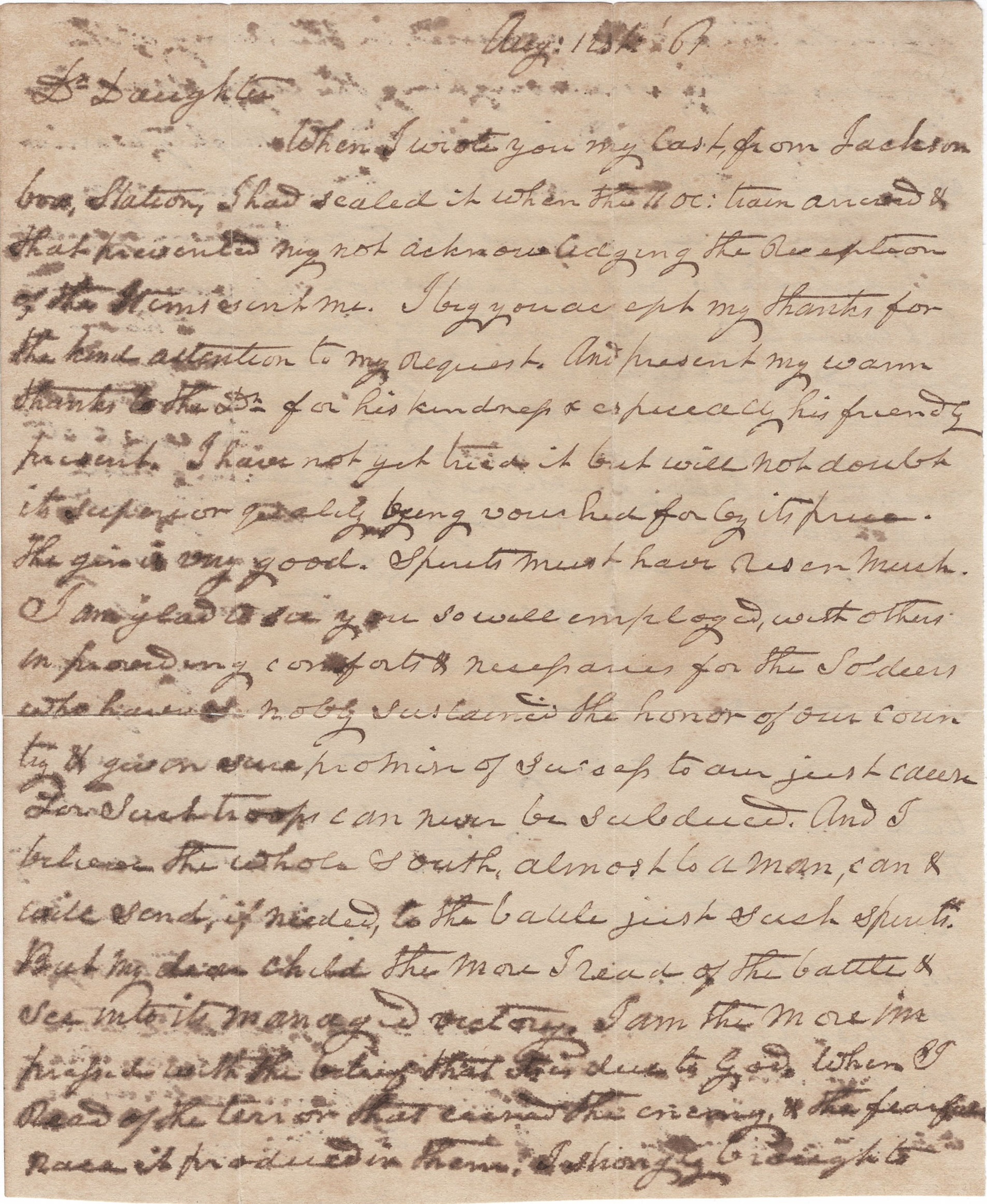

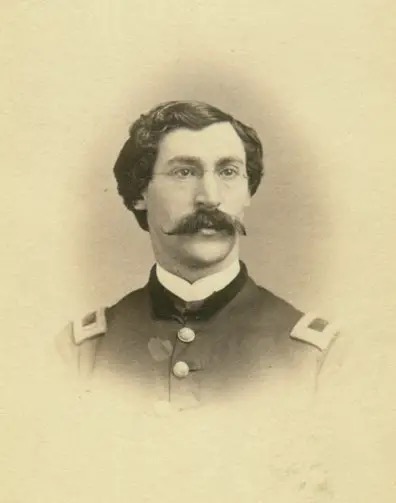
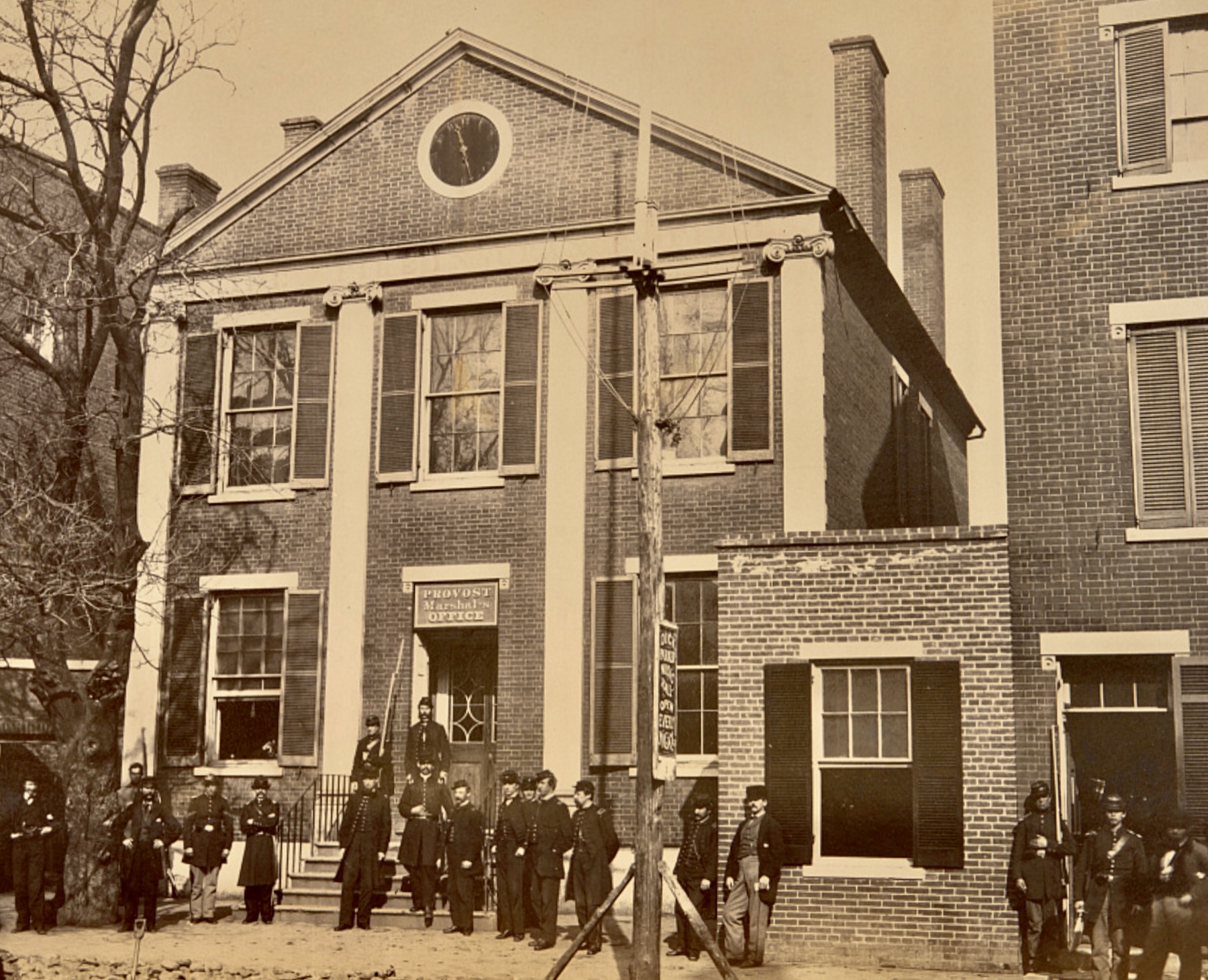
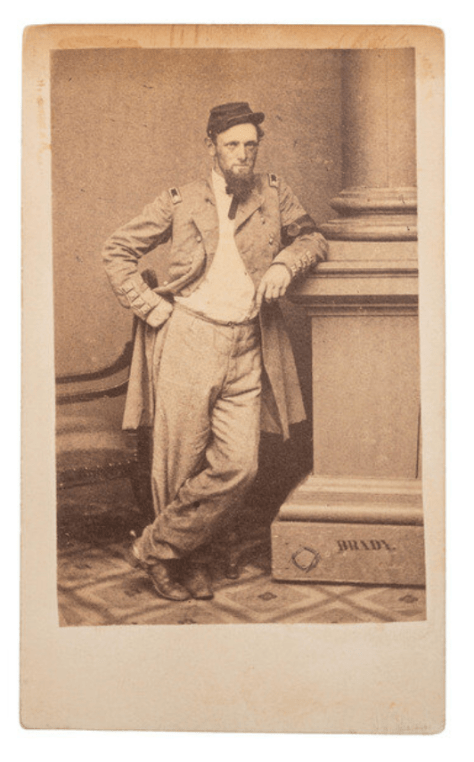


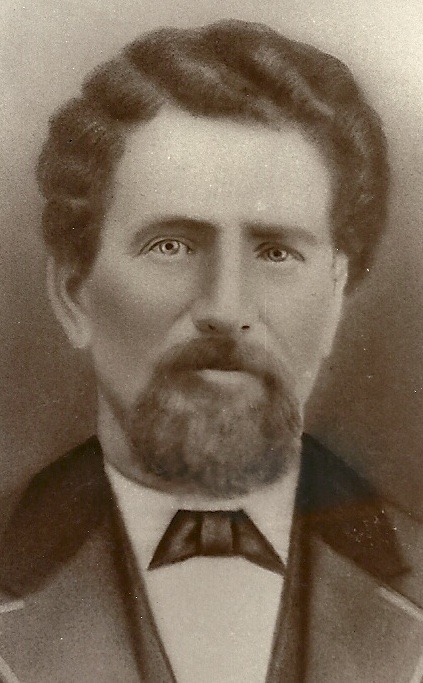


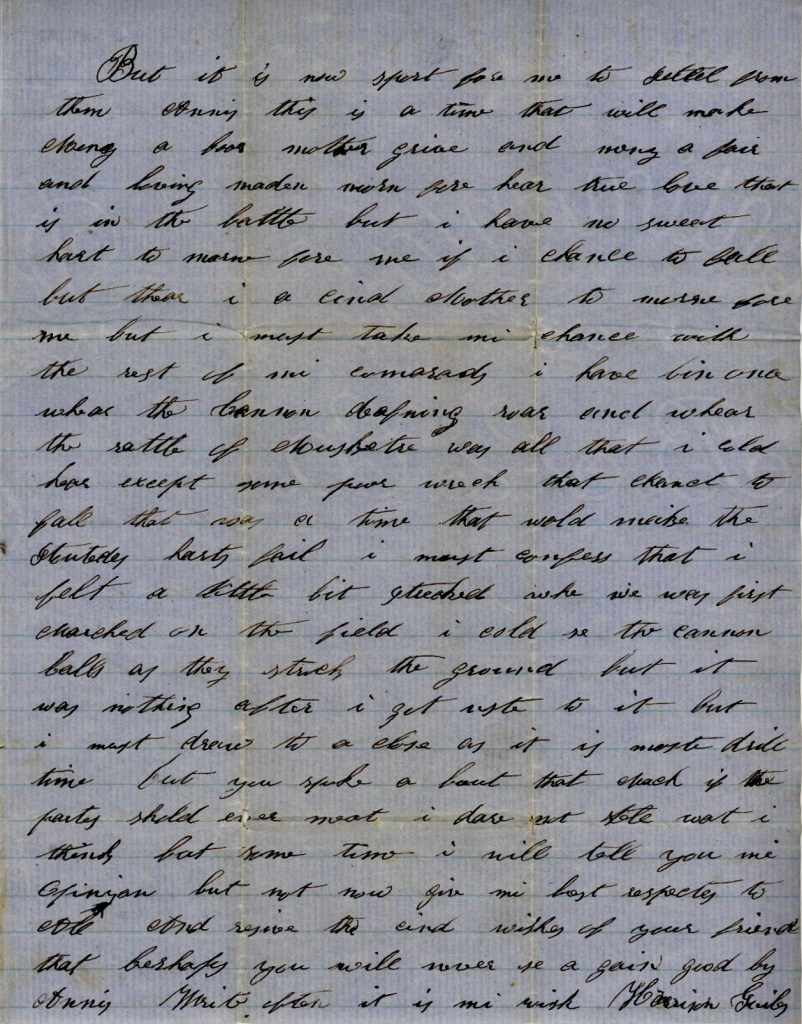


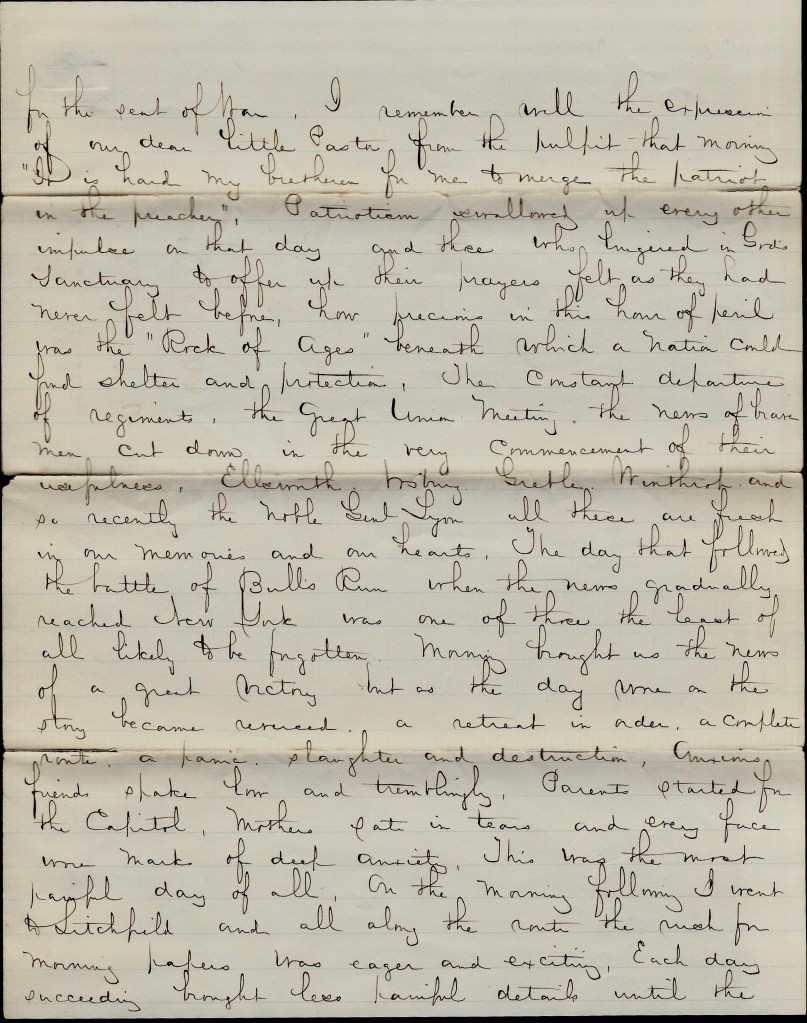
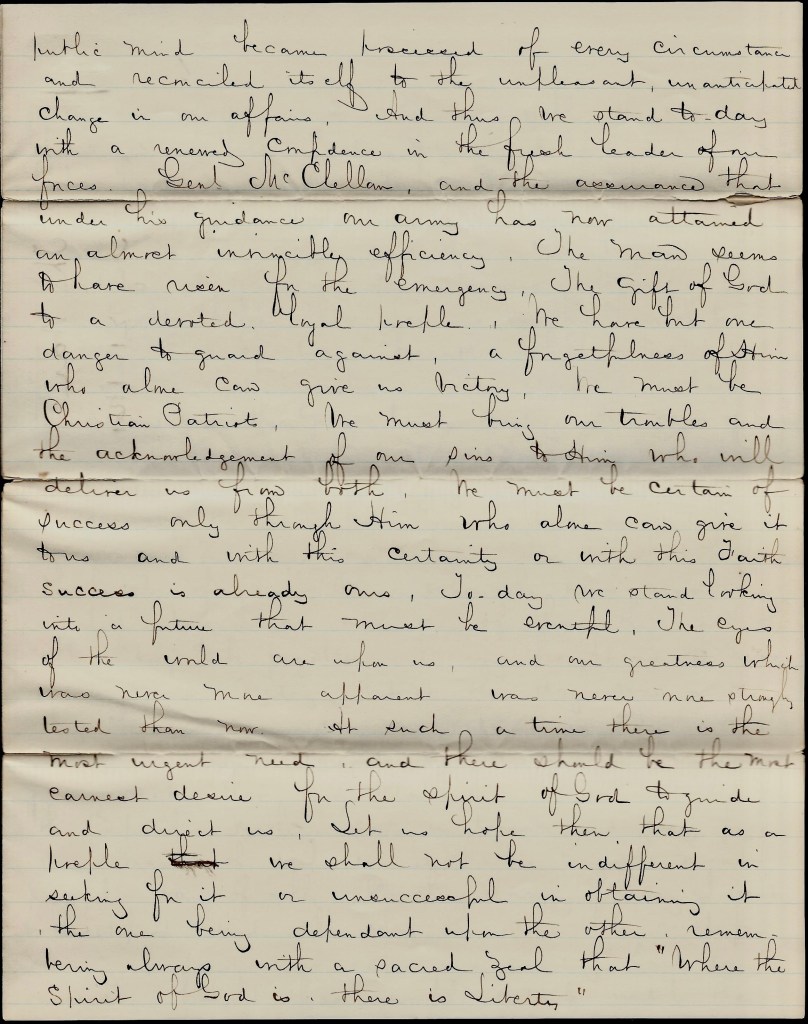


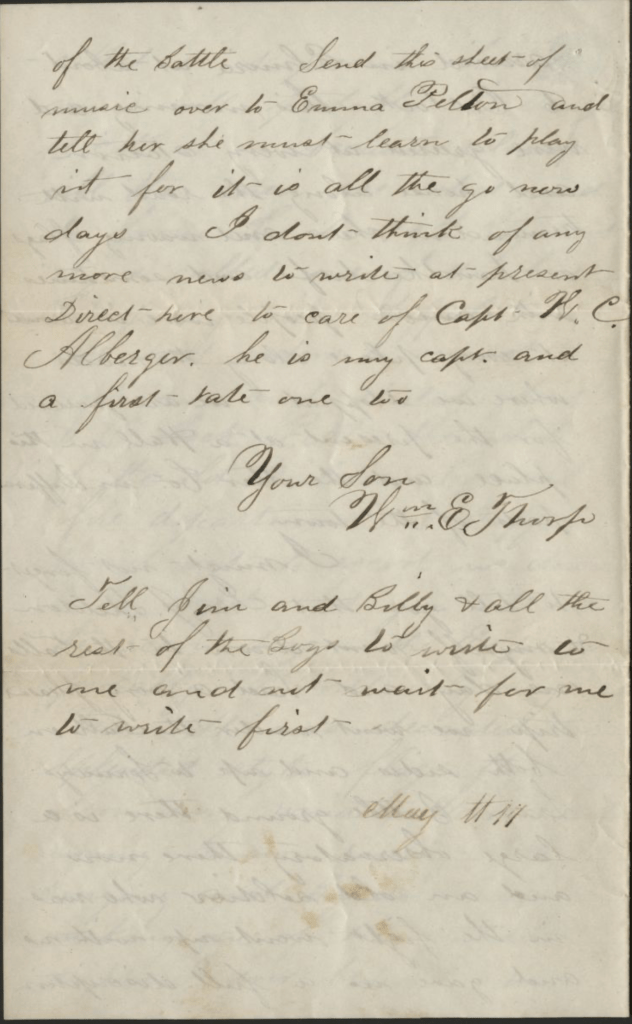

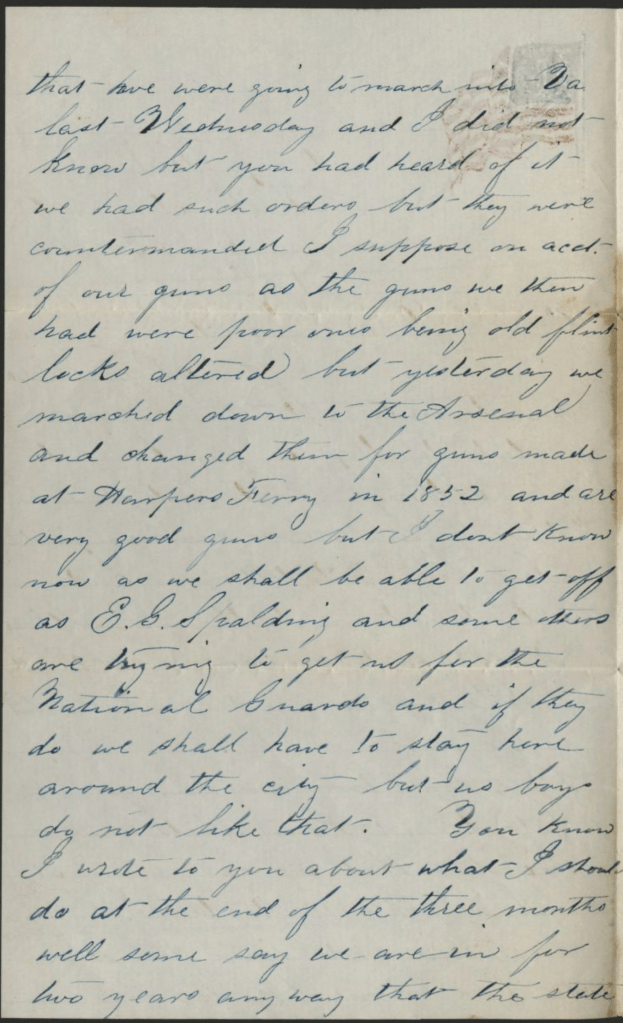
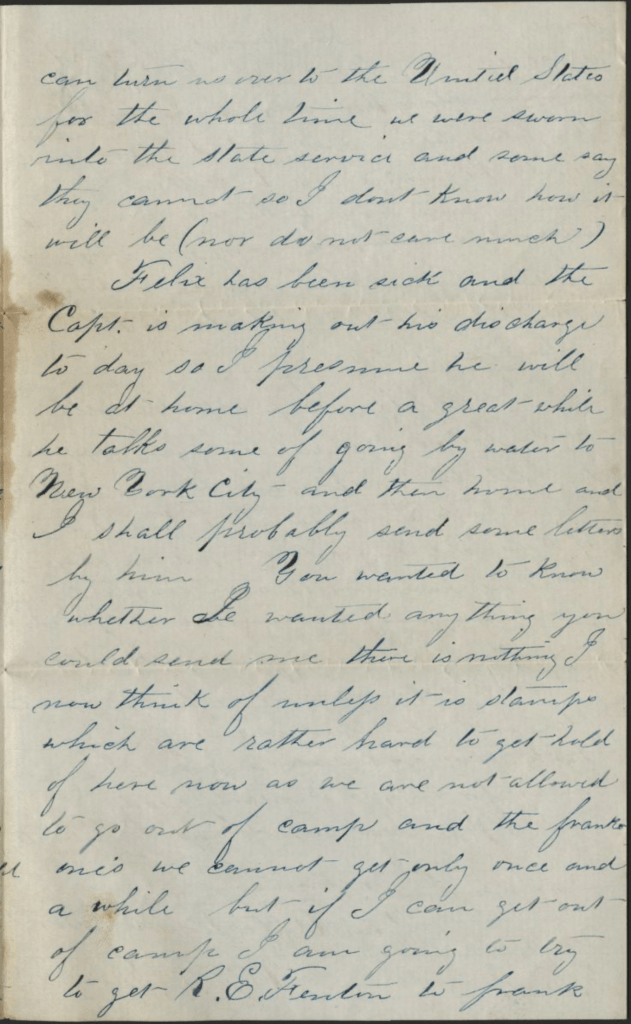
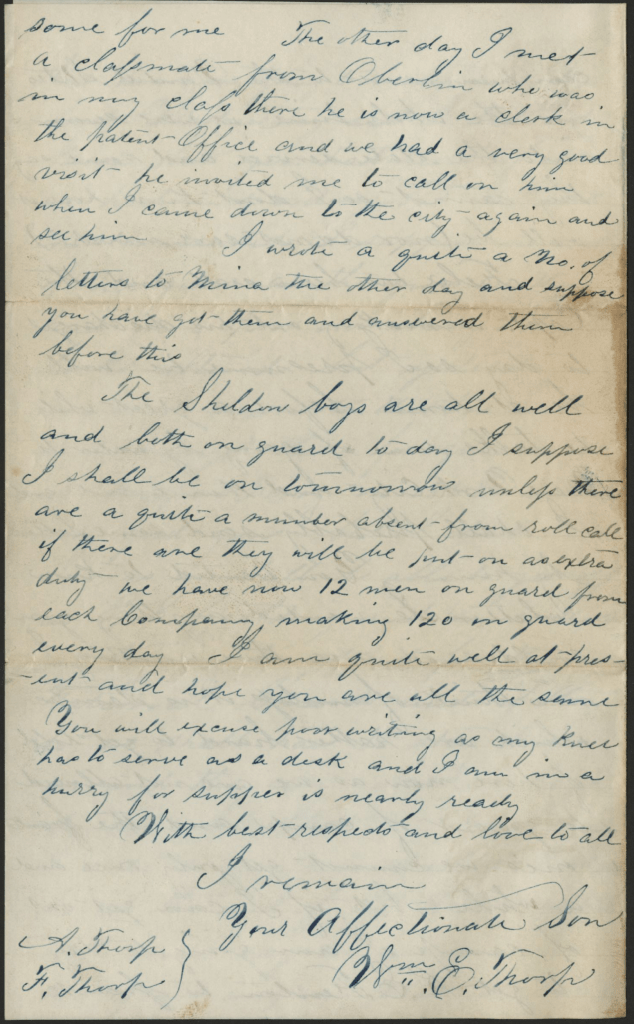

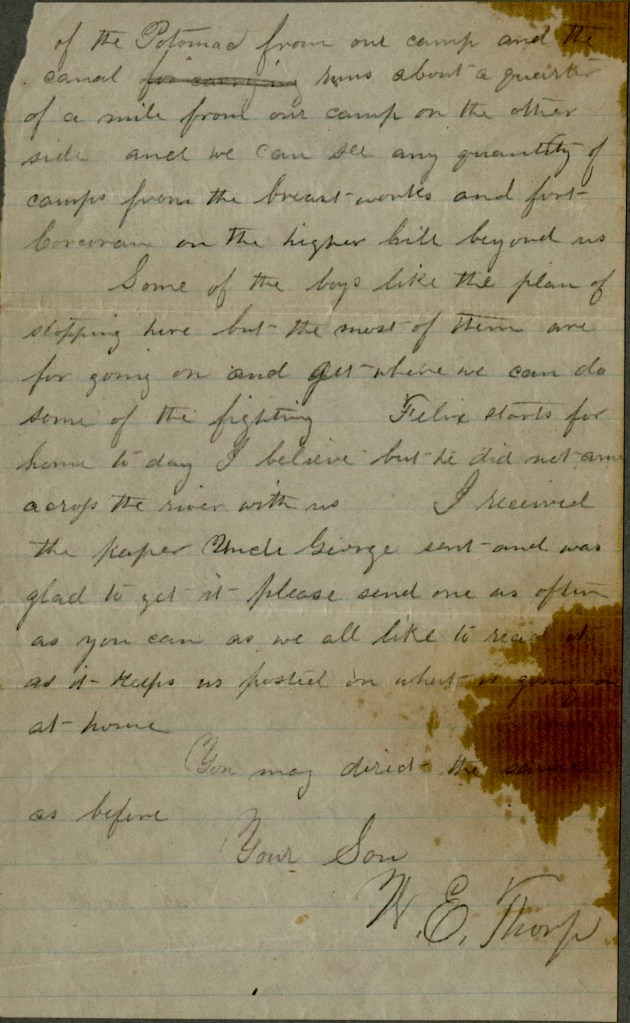
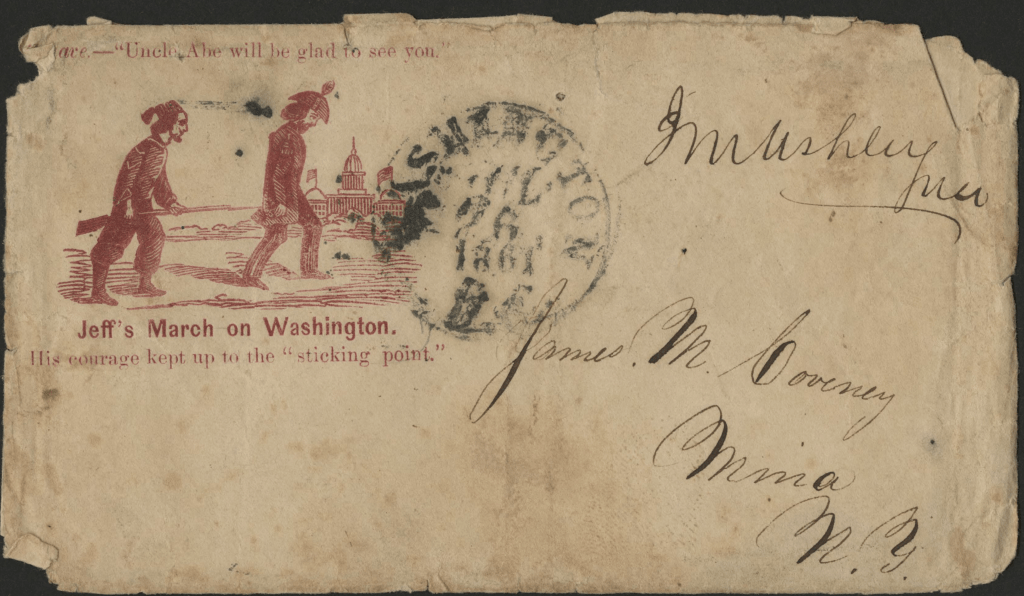
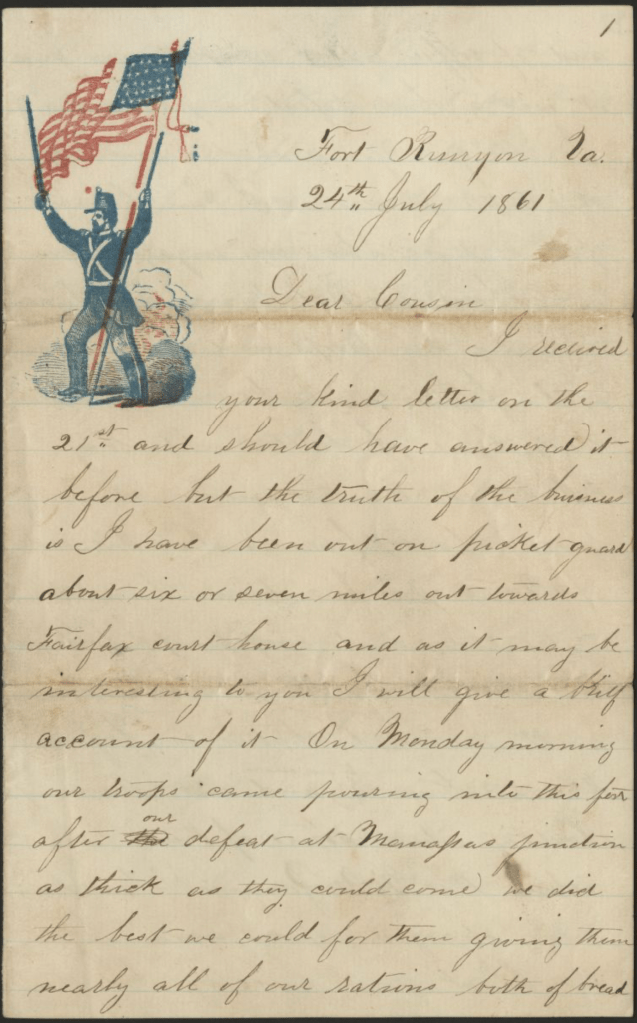

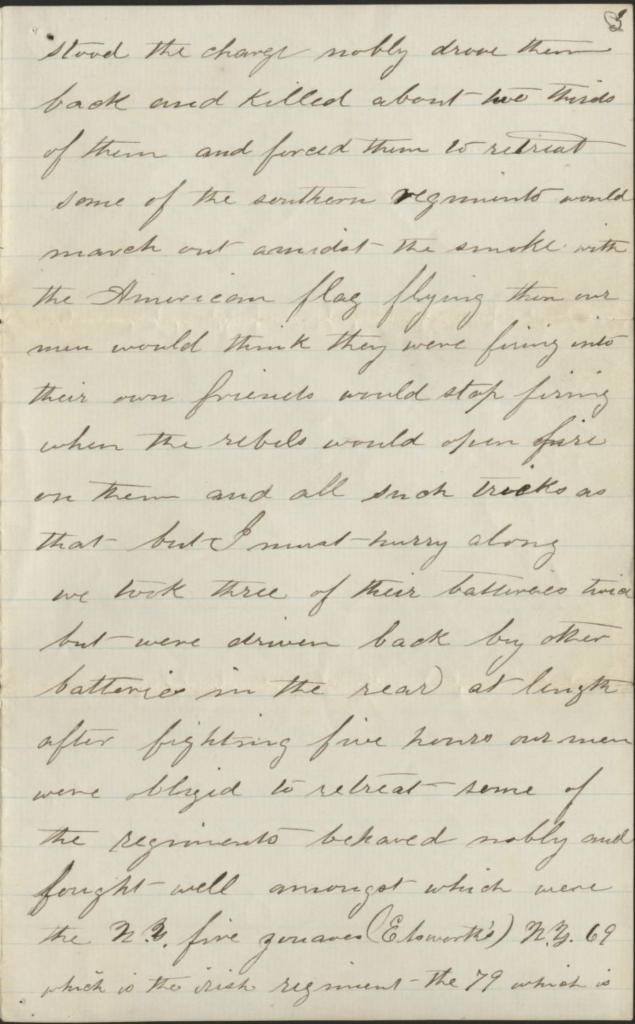
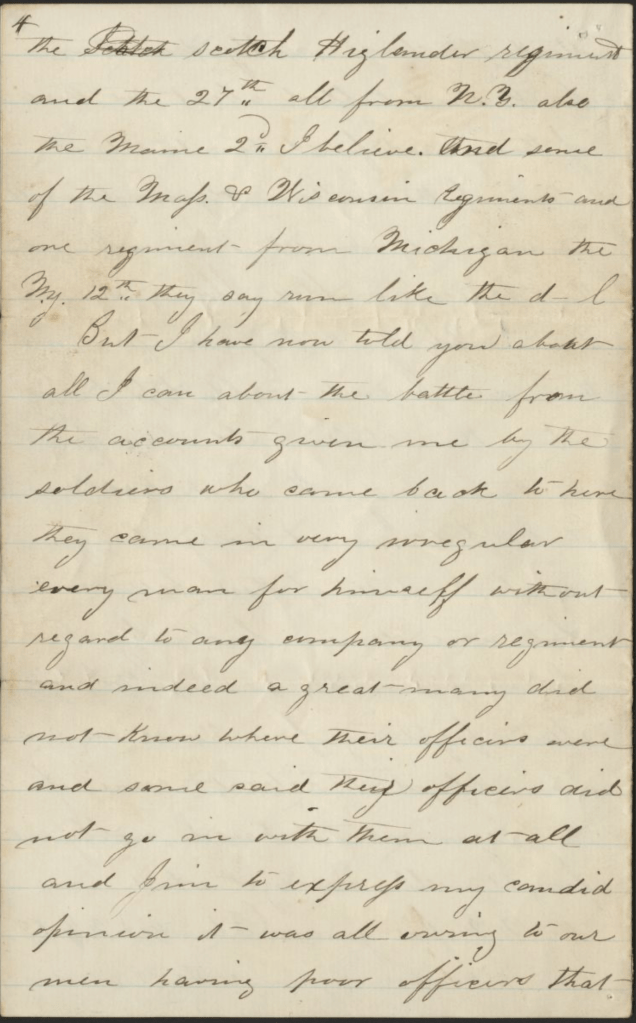

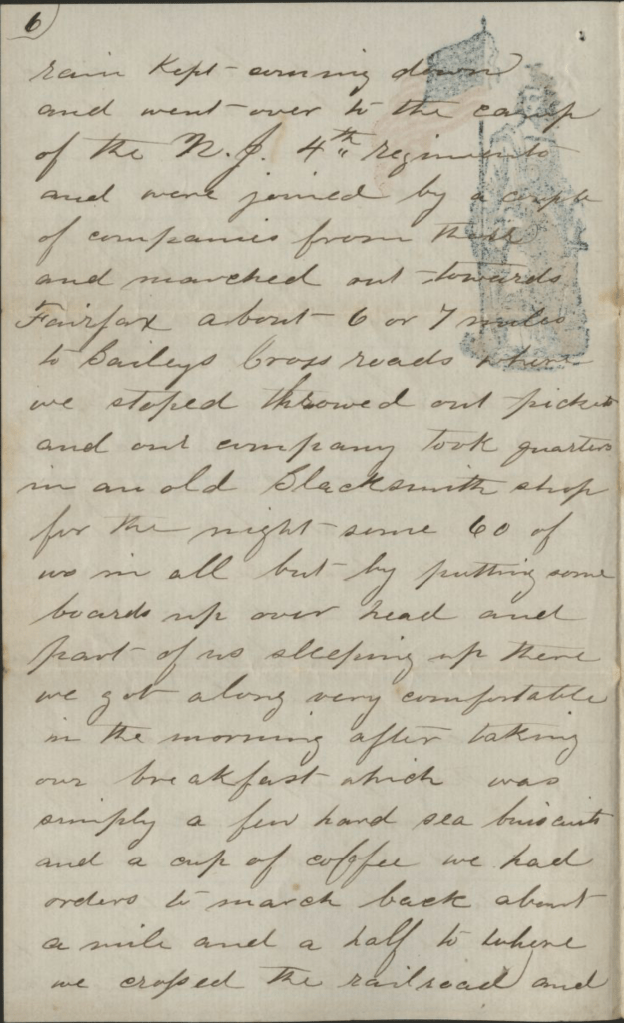
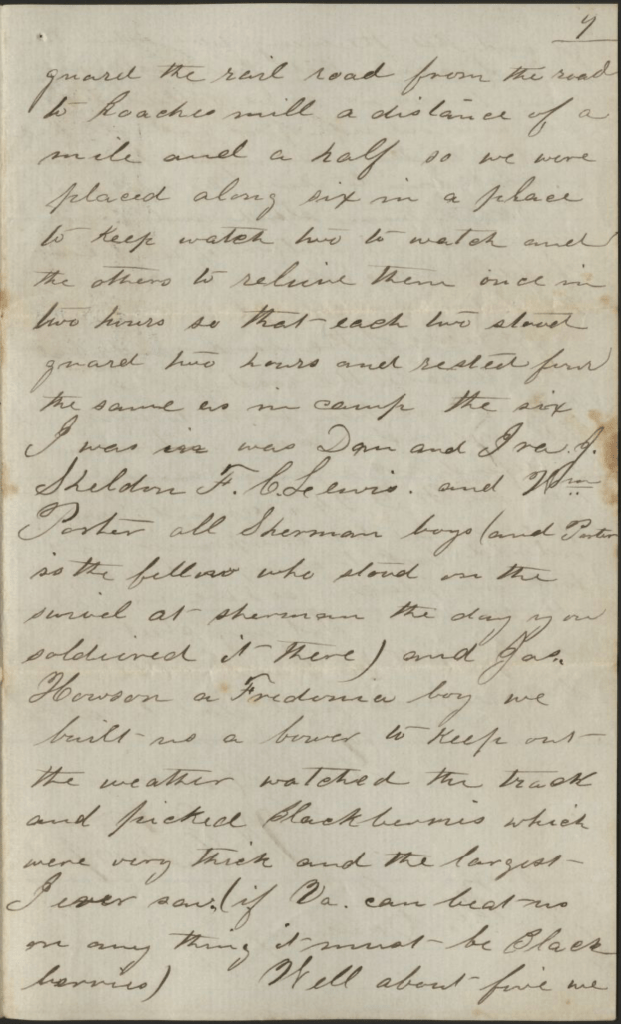

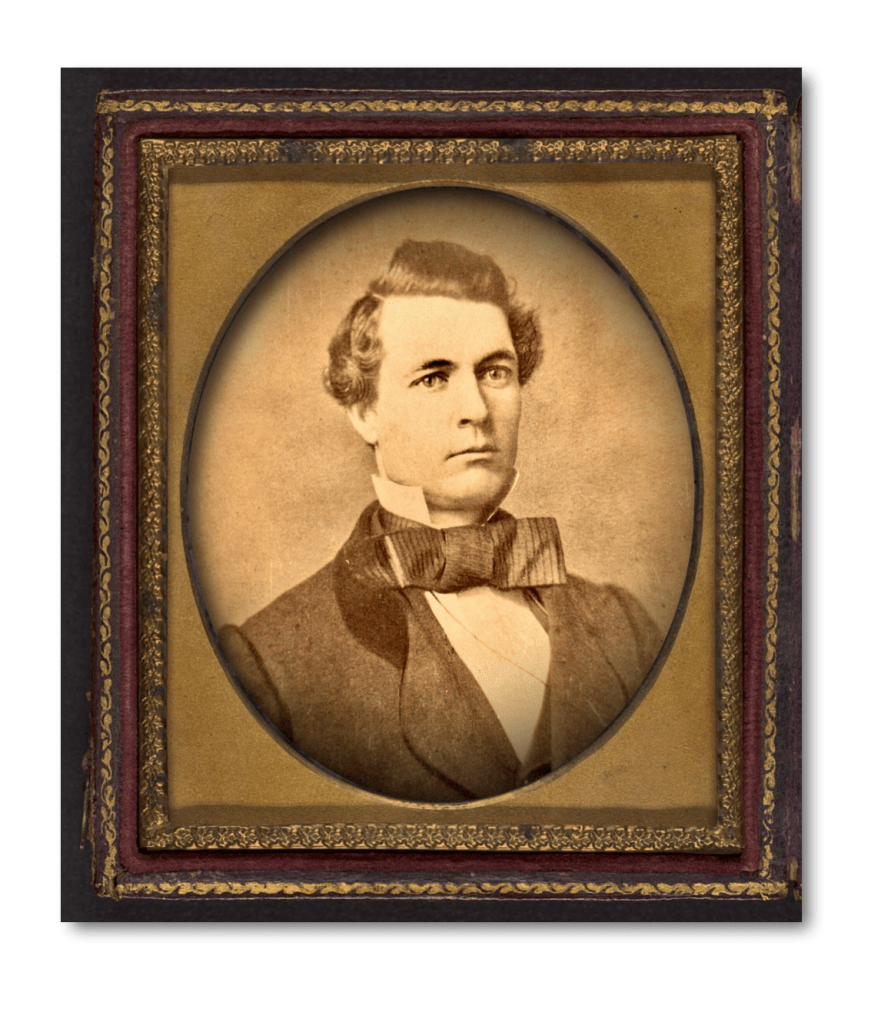


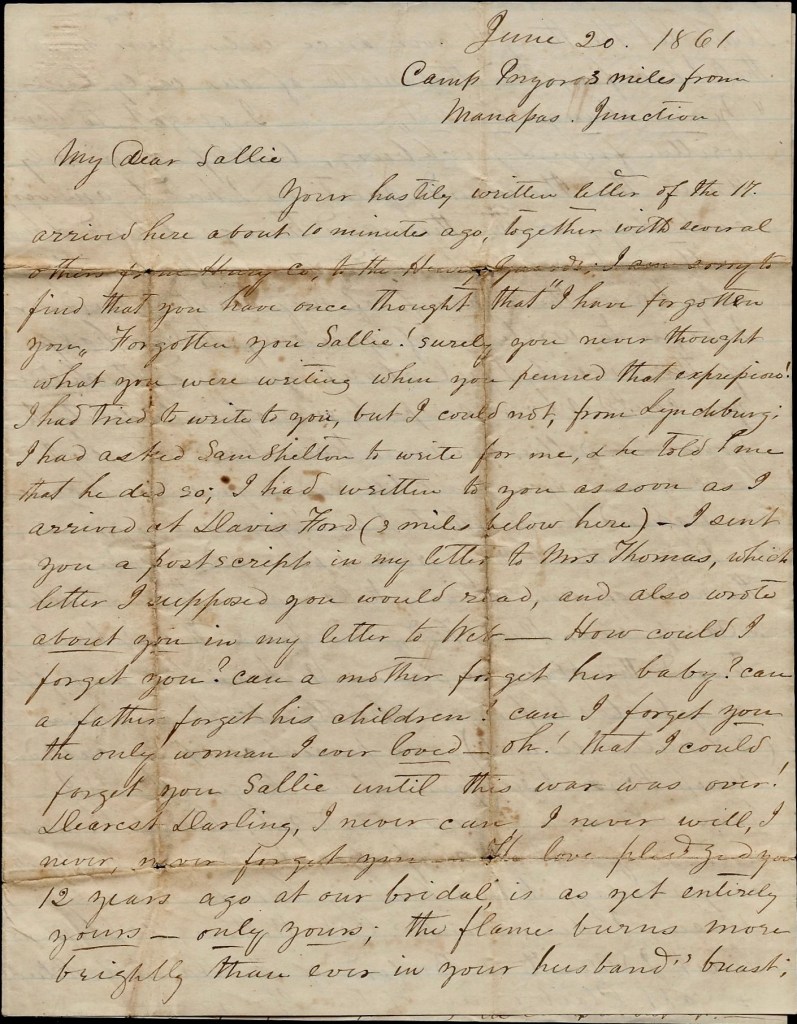
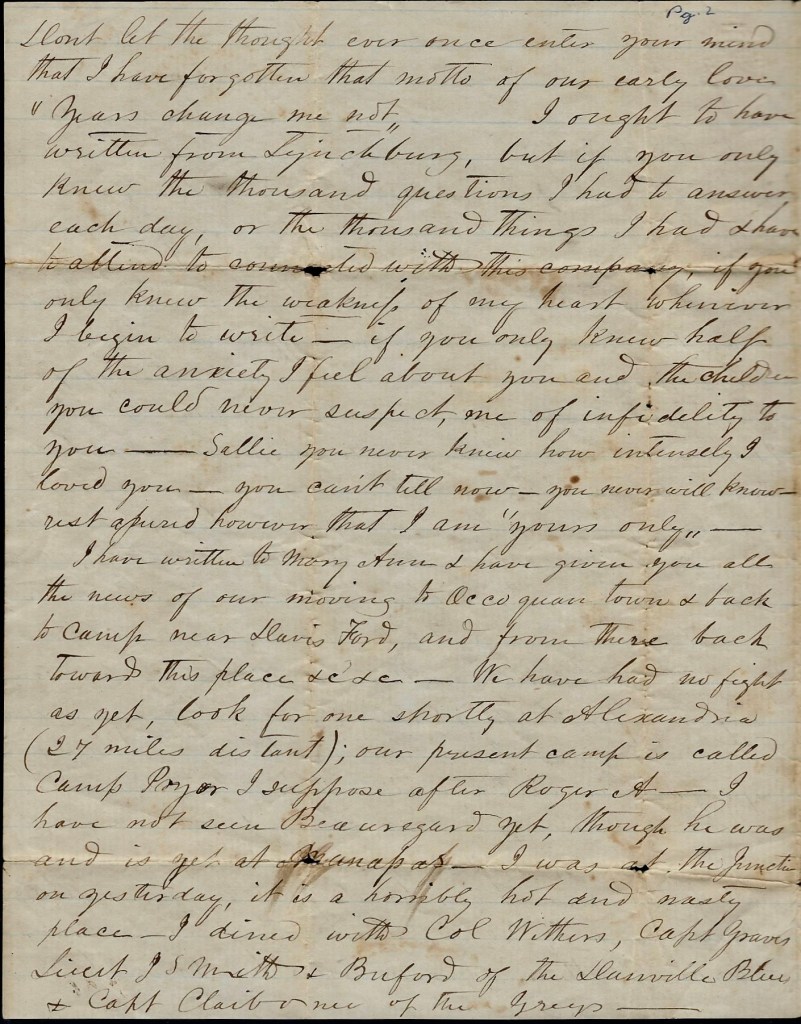


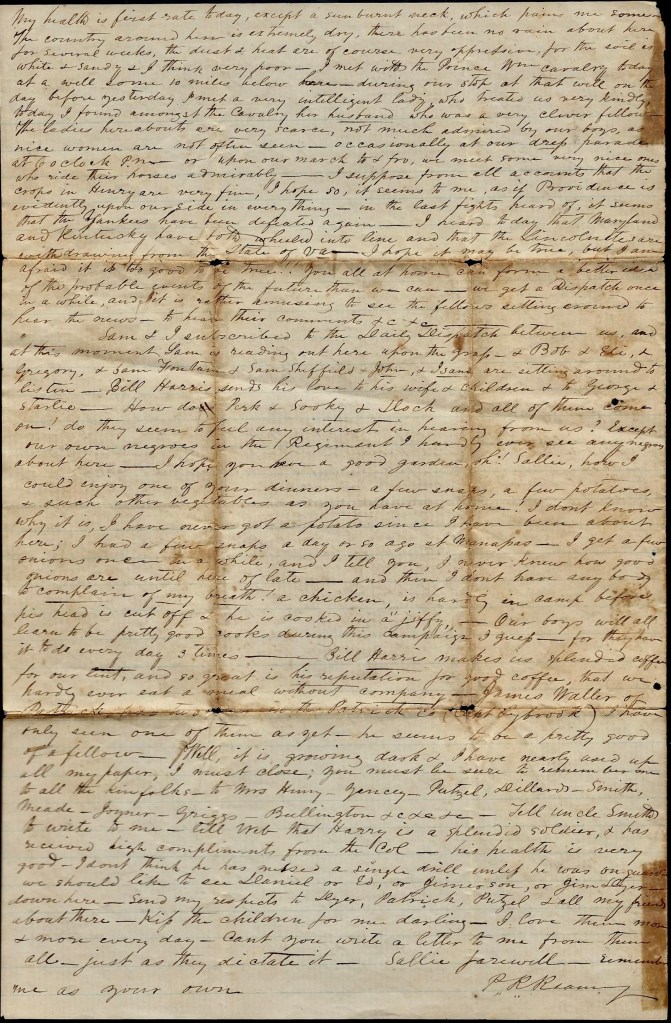
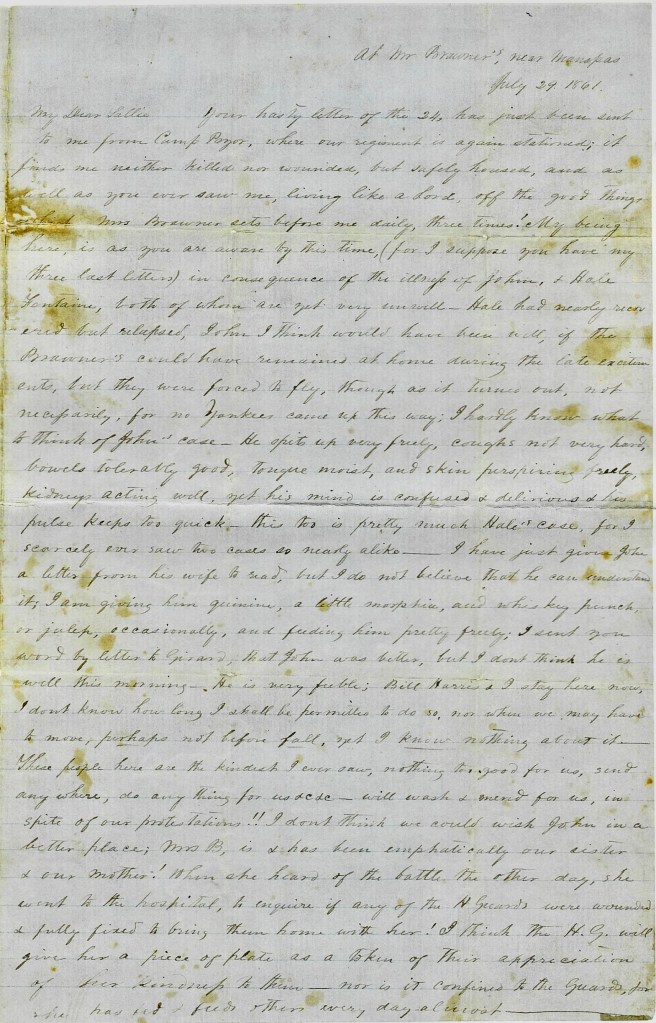


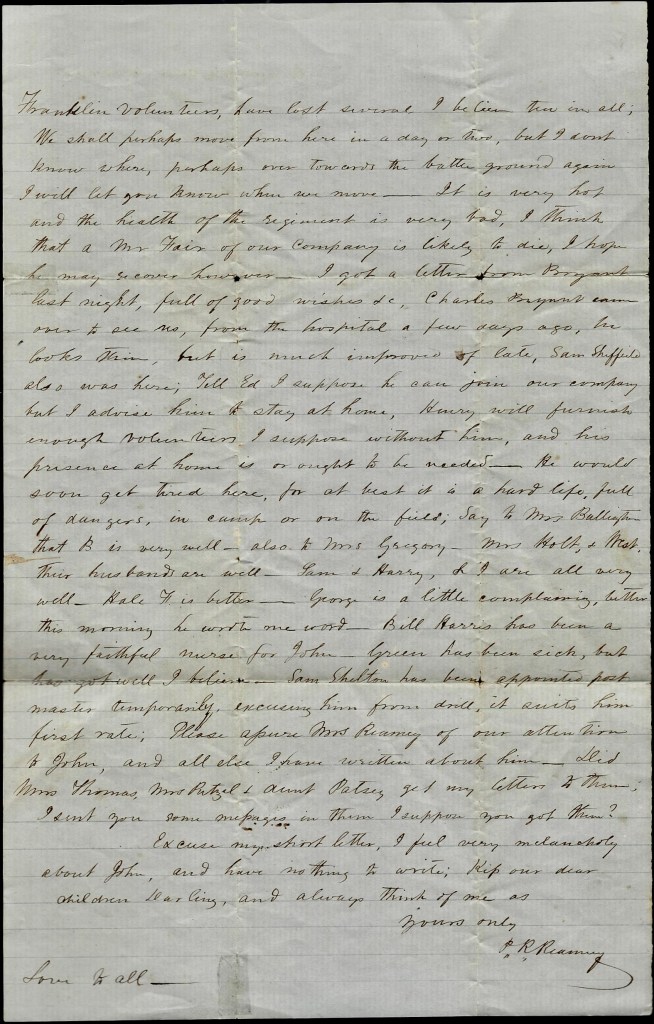




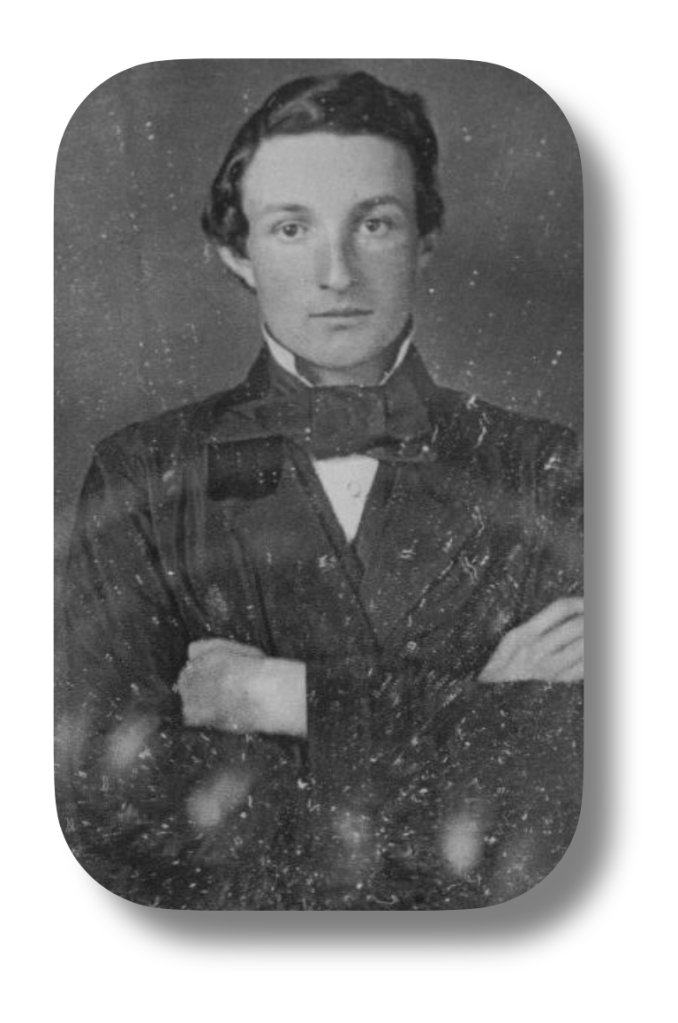
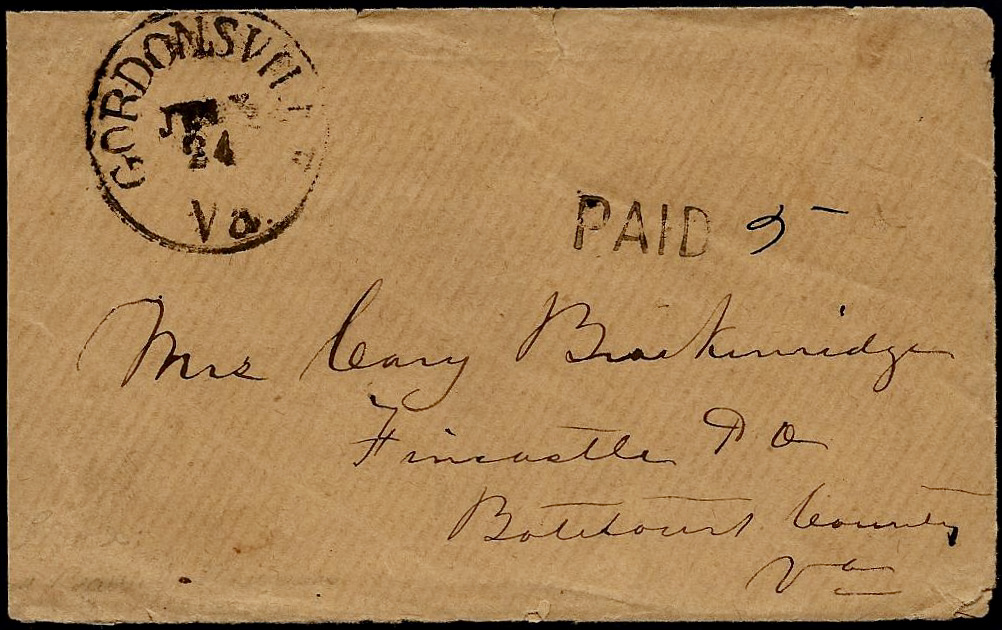

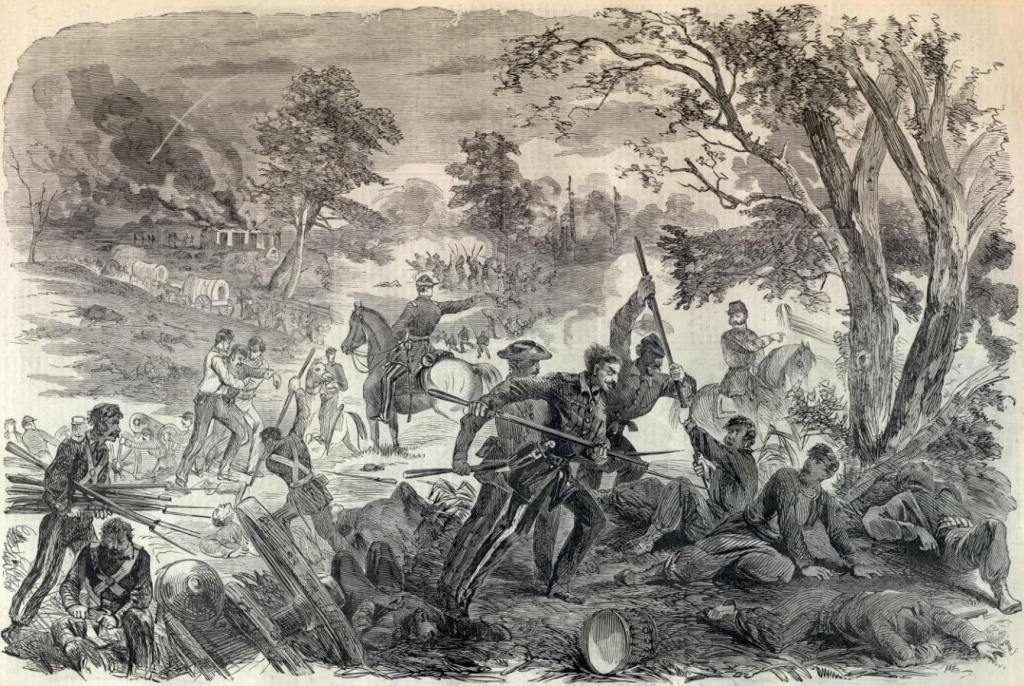


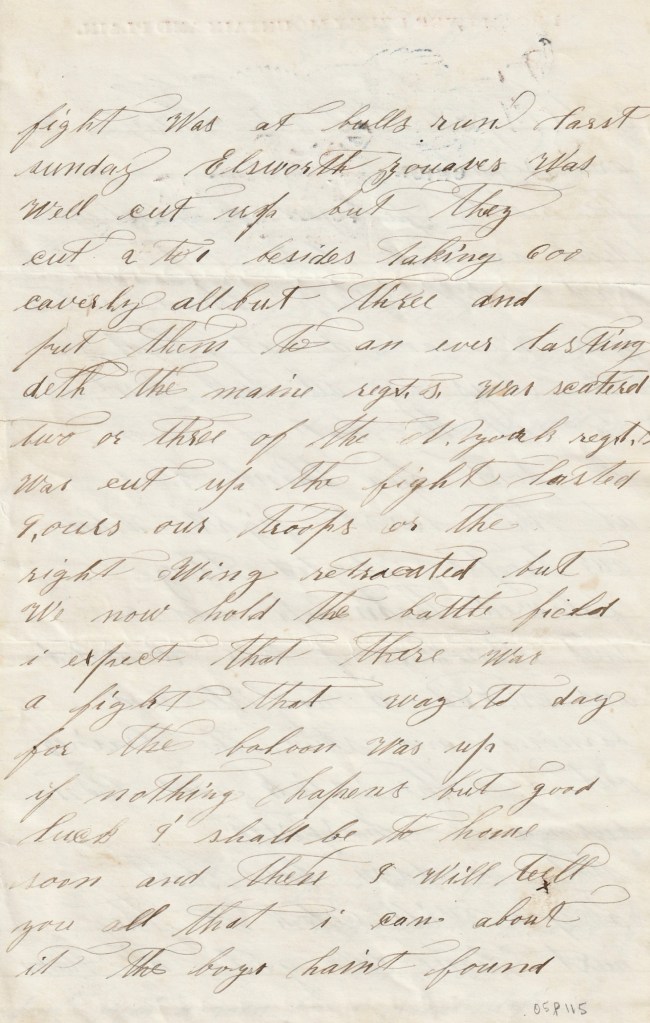
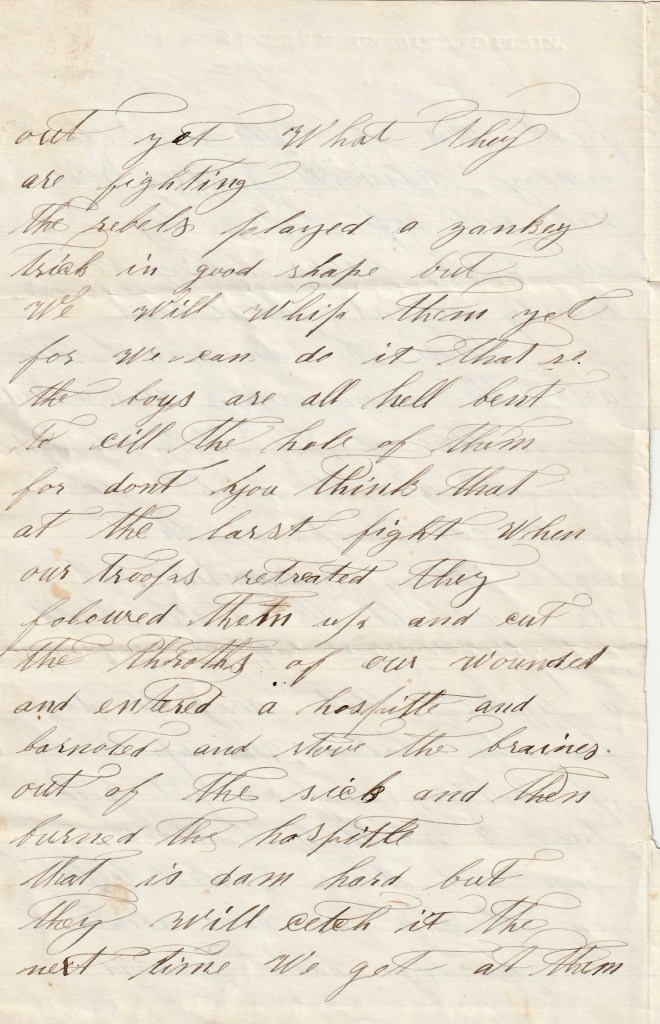

 Spared & Shared 23