
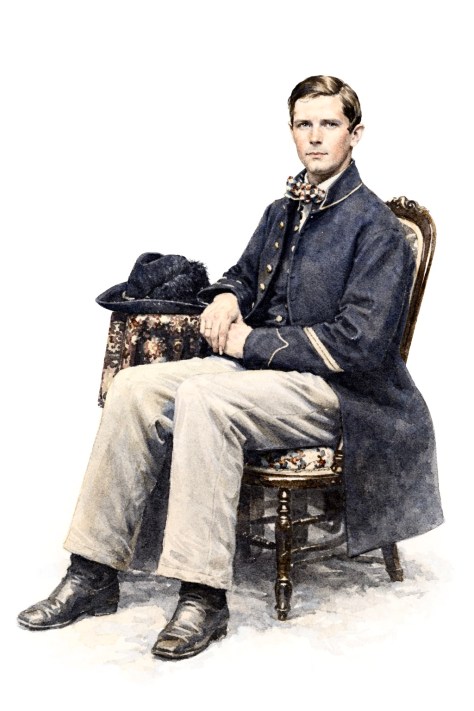
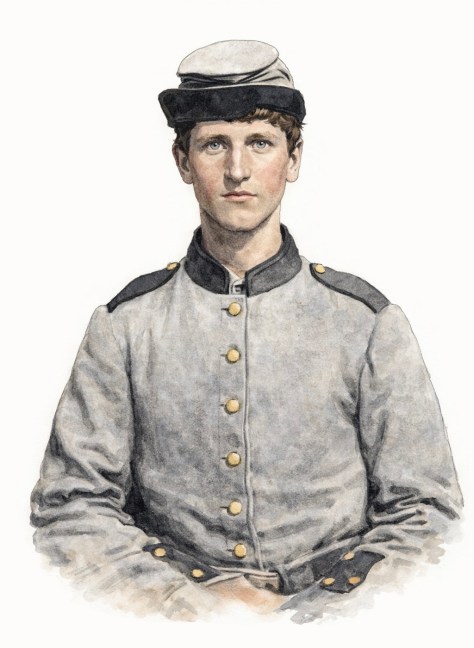
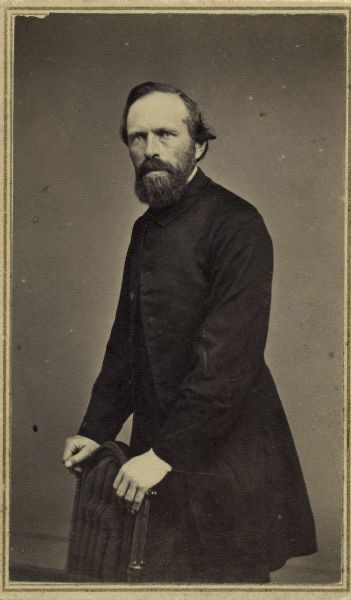
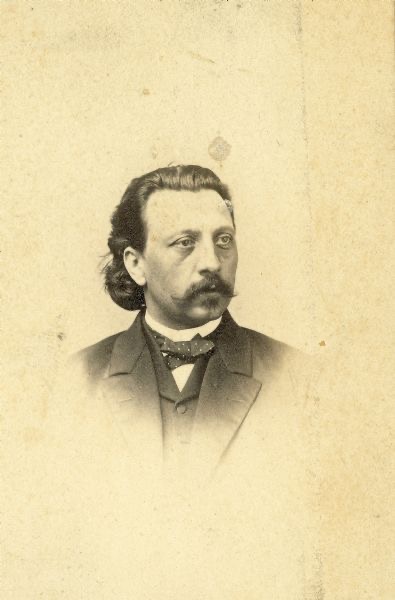
The following letters were written by Spencer H. Bronson (1842-1930), the son of Rev. Major Tyler Bronson (1802-1880) and Matilda Hotchkiss (1812-1872) of Fountain Prairie, Columbia county, Wisconsin. Spencer enlisted in Co. B, 7th Wisconsin Infantry in May 1861 with his older brothers, Elisha (“Eli”) Bronson (1834-1862) and Manly Tyler Bronson (1839-1863). Eli was killed on 17 September 1862 at Antietam, Maryland. Manly died at Belle Plains, Virginia, on 26 March 1863. Spencer survived the war—his memory forever preserved in witnessing the assassination of President Lincoln [see the Journal Sentinel]. He did not pass through the war unscathed, however. He was wounded on 28 August 1862 in the Battle of Gainsville, Va., again at the Battle of Fitzhugh Crossing, Va. on 29 April 1863, and once again on Day 1 at Gettysburg where he because a prisoner of war and confined at Libby Prison and Belle Island in Richmond. He was exchanged in August 1863 but lost his teeth due to scurvy. After he returned to his regiment, he was wounded again in the Battle of the Wilderness and sent to a hospital in Washington D. C. where he was transferred into the Veteran Reserve Corps. The doctor reports included in his pension file make gruesome reading. Aside from losing the two brothers previously mentioned, Spencer lost another brother, 1st Lt. Edward Hotchkiss Bronson of Co. K, 32nd Wisconsin Infantry.
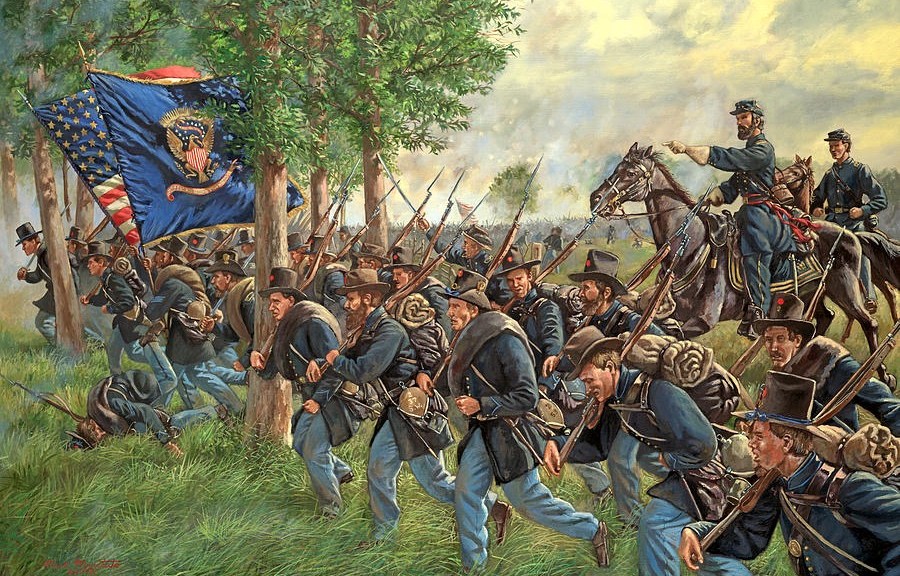
Civil War buffs will recognize the 7th Wisconsin Infantry as one of the five regiments that composed the vaunted Iron Brigade—also known as the “The Black Hats” or “Black Hat Brigade.” Two letters transcribed and previously posted on Spared & Shared by Spencer’s brother Manly can be found at 1861-62: Manly T. Bronson to Friends.
Letter 1
Camp Lincoln
April 10, 1862
Dear Friends,
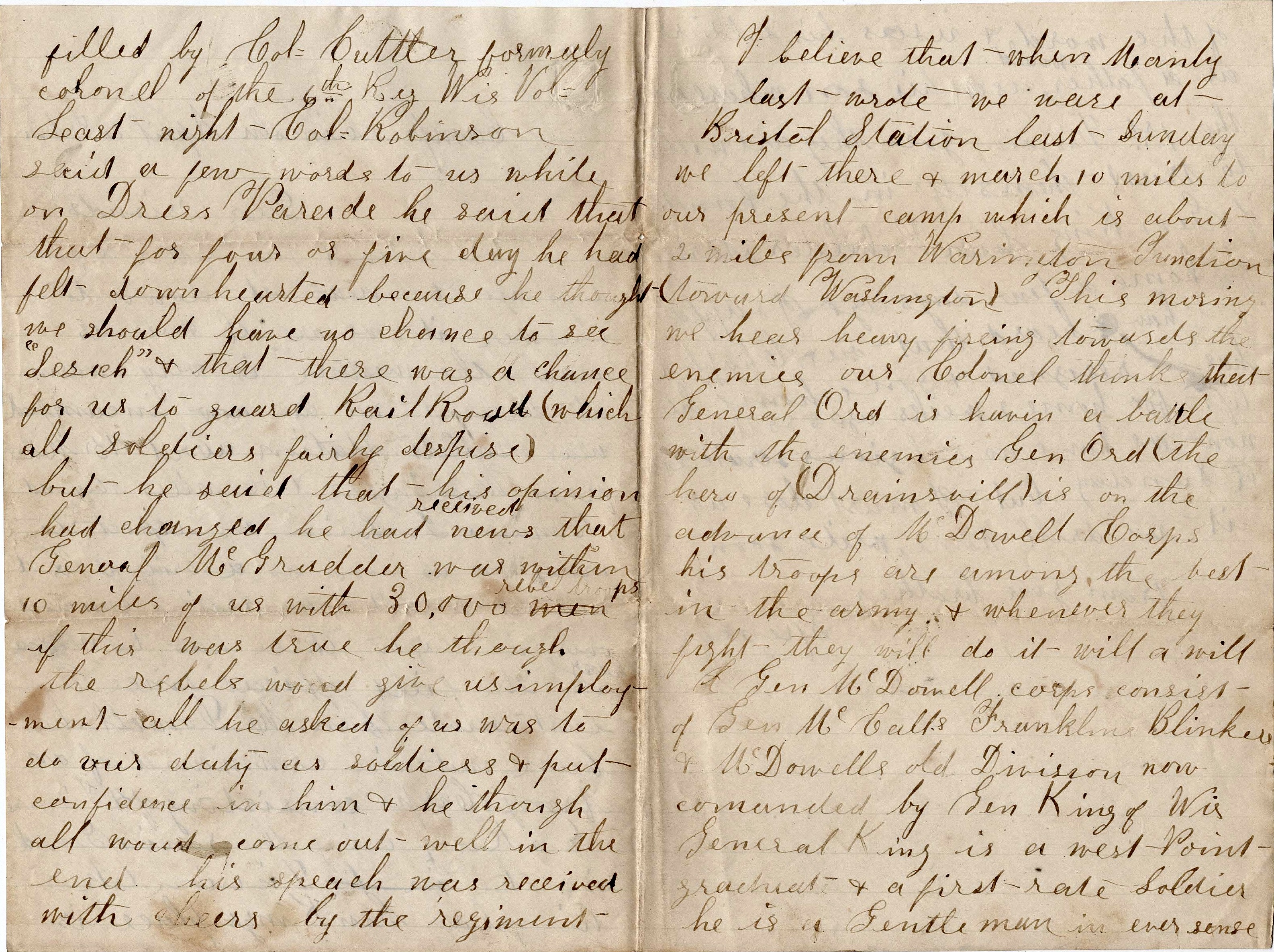
We received your letter a few days ago and I now sit down to answer it. We are all well as usual. The weather is very warm at present. we are now encamped near Catlett’s Station about 45 miles from Washington & 16 miles beyond Manassa Junction. We expect to move on as soon as a bridge is fixed near us so that the artillery can cross over in safety. There has been some change in the field officers since I last wrote. Gen. McDowell has been put in command of an Army Corps consisting of 4 Divisions. Gen. King being the Senior General in the Division takes his place. Gen. King’s place is filled by Col. Cutler, formerly Colonel of the 6th Regt. Wisconsin Volunteers.
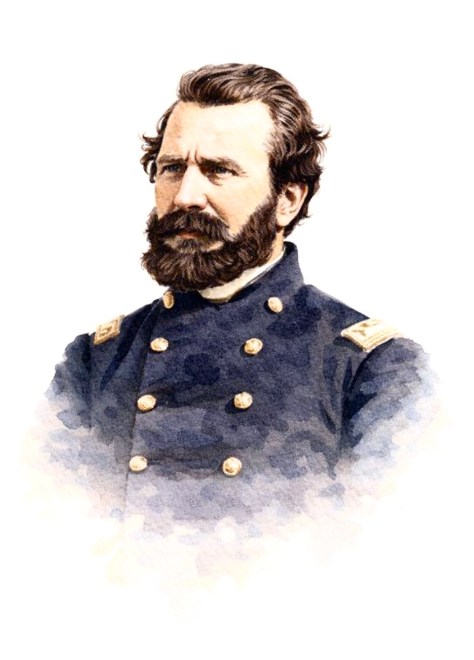
Last night Col. [William W.] Robinson said a few words to us while on Dress Parade. He said that for four or five days he had felt downhearted because he thought we should have no chance to see “secesh” and that there was a chance for us to guard the railroad (which all soldiers fairly despise). But he said that his opinion had changed. He had received news that General Magruder was within 10 miles of us with 30,000 rebel troops. If this was true, he thought the rebels would give us employment. All he asked of us was to do our duty as soldiers & put confidence in him & he thought all would come out well in the end. His speech was received with cheers by the regiment.
I believe that when [brother] Manly last wrote, we were at Bristol Station. Last Sunday we left there & marched 10 miles to our present camp which is about two miles from Warrenton Station (toward Washington). This morning we hear heavy firing towards the enemy. Our Colonel thinks that General Ord is having a battle with the enemy. Gen. Ord (the hero of Dranesville) is on the advance of McDowell’s Corps. His troops are among the best in the army and whenever they fight, they will do it with a will. Gen. McDowell’s Corp consists of Gen. McCall’s, Franklin’s, Blinker’s, and McDowell’s old division, now commanded by Gen. King of Wisconsin. General King is a West Point graduate and a first rate soldier. He is a gentleman in every sense of the word & uses his soldiers as a father would use his son. Wherever the 1st Division goes, they are willing to trust themselves in the hands of Gen. King.
Lieutenant Batchelder started for home a few days ago. I suppose you have heard that our Chaplain has resigned and gone home. He left for home two weeks ago so that now we have no religious services of Sunday. But I must close as it is drill time. Write soon. From your brother. — Spencer
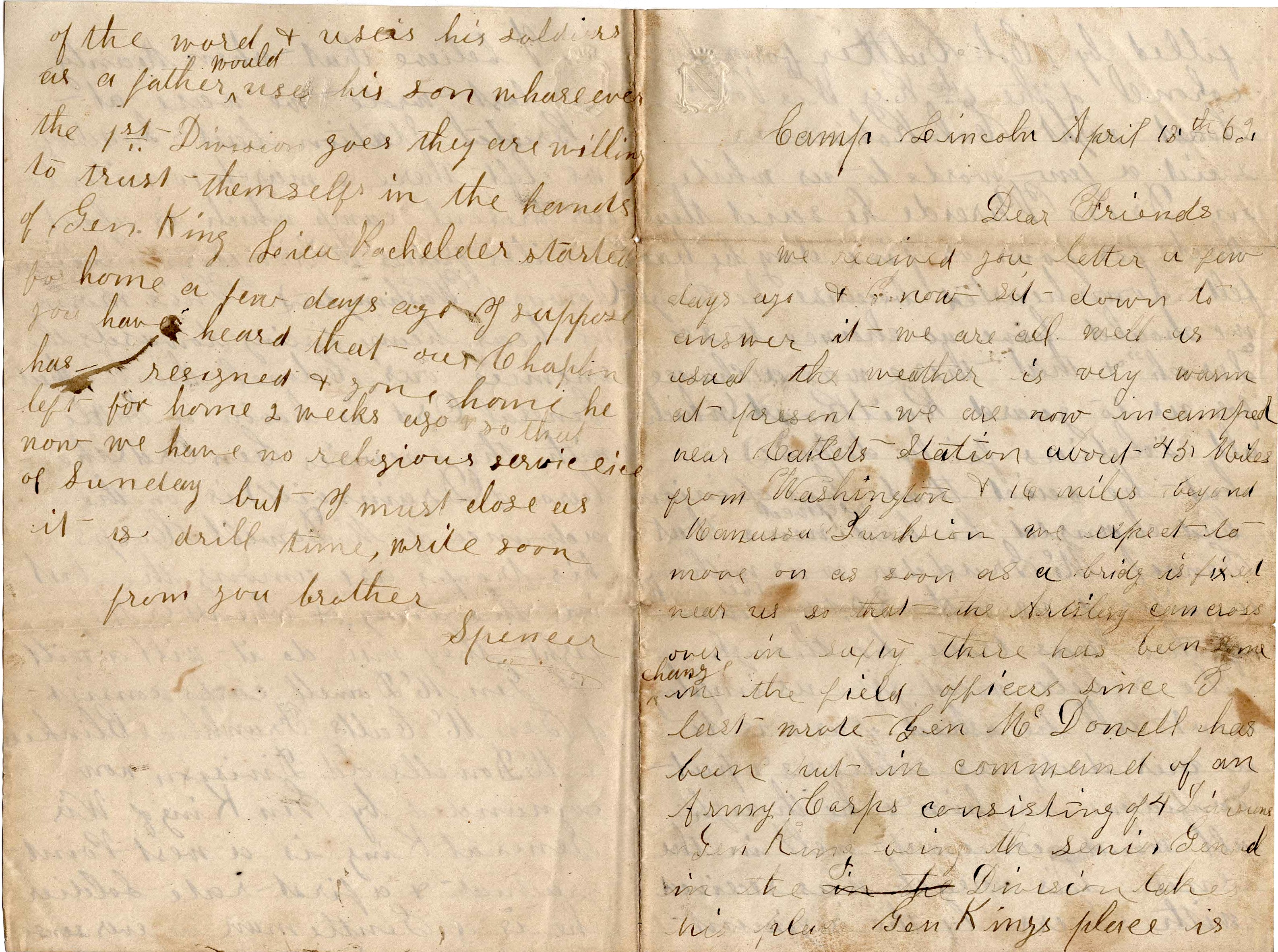
Letter 2
Camp Lincoln
April 19th 1862
Dear Friends
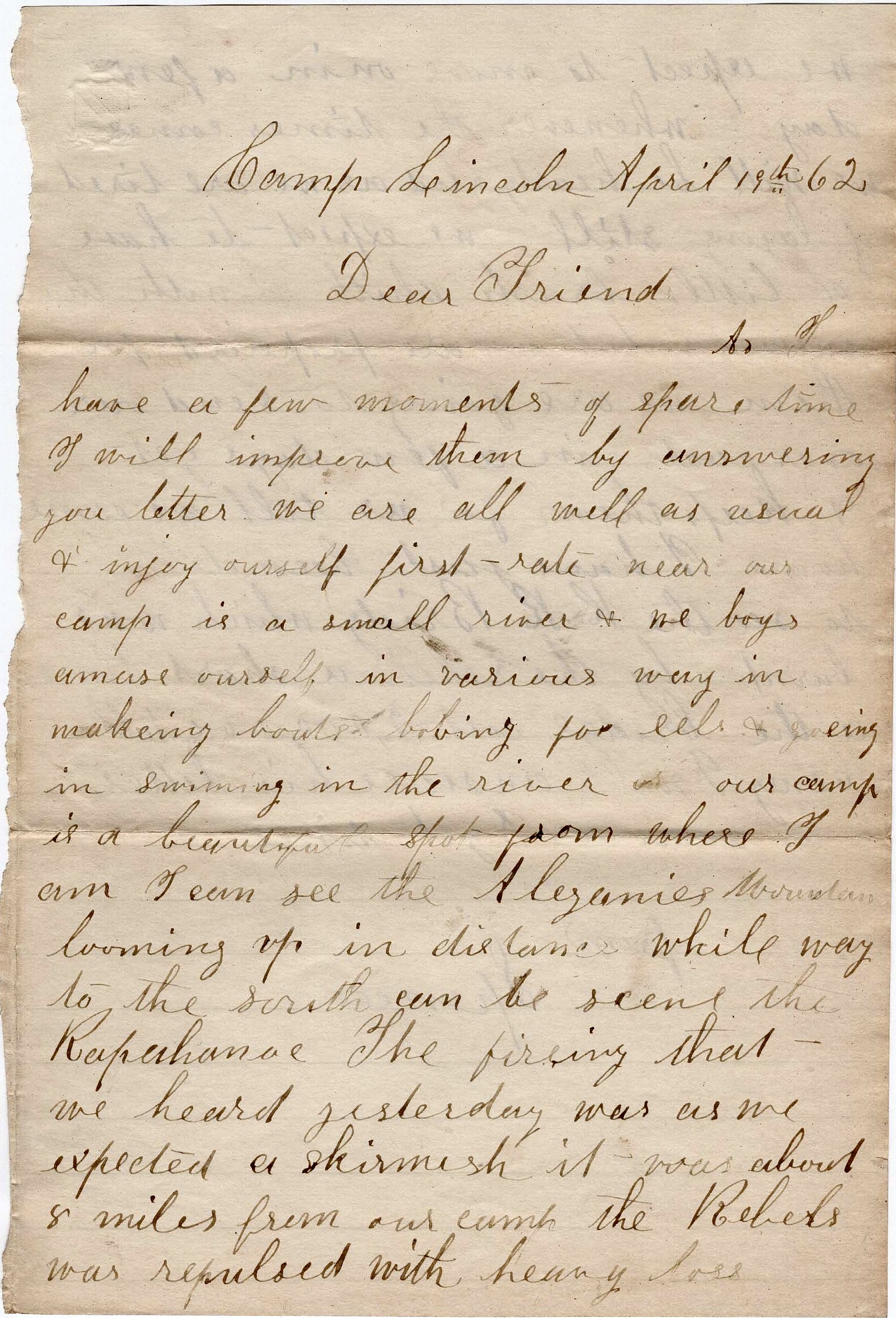
As I have a few moments of spare time, I will improve them by answering your letter. We are all well as usual & enjoy ourselves first rate. Near our camp is a small river & we boys amuse ourselves in various ways in making boats and bobbing for eels and going in swimming in the river. Our camp is a beautiful spot. From where I am, I can see the Alleghany Mountains looming up in distance while way to the south can be seen the Rappahannock.
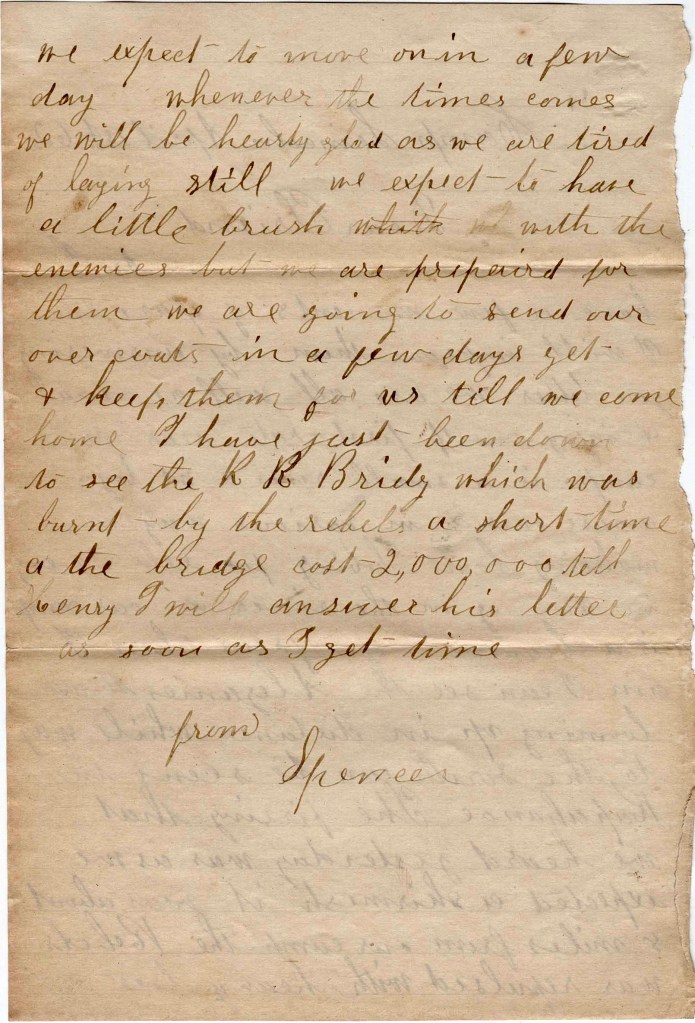
The firing that we heard yesterday was as we expected a skirmish. It was about 8 miles from our camp. The rebels was repulsed with heavy loss. We expect to move on in a few days. Whenever the time comes, we will be heartily glad as we are tired of laying still. We expect to have a little brush with the enemy but we are prepared for them. We are going to send our overcoats [home] in a few days. Get and keep them for us till we come home.
I have just been down to see the railroad bridge which was burnt by the rebels a short time ago. The bridge cost 2,000. Tell Henry I will answer his letter as soon as I get time. From Spencer
Letter 3
January 26th 1863
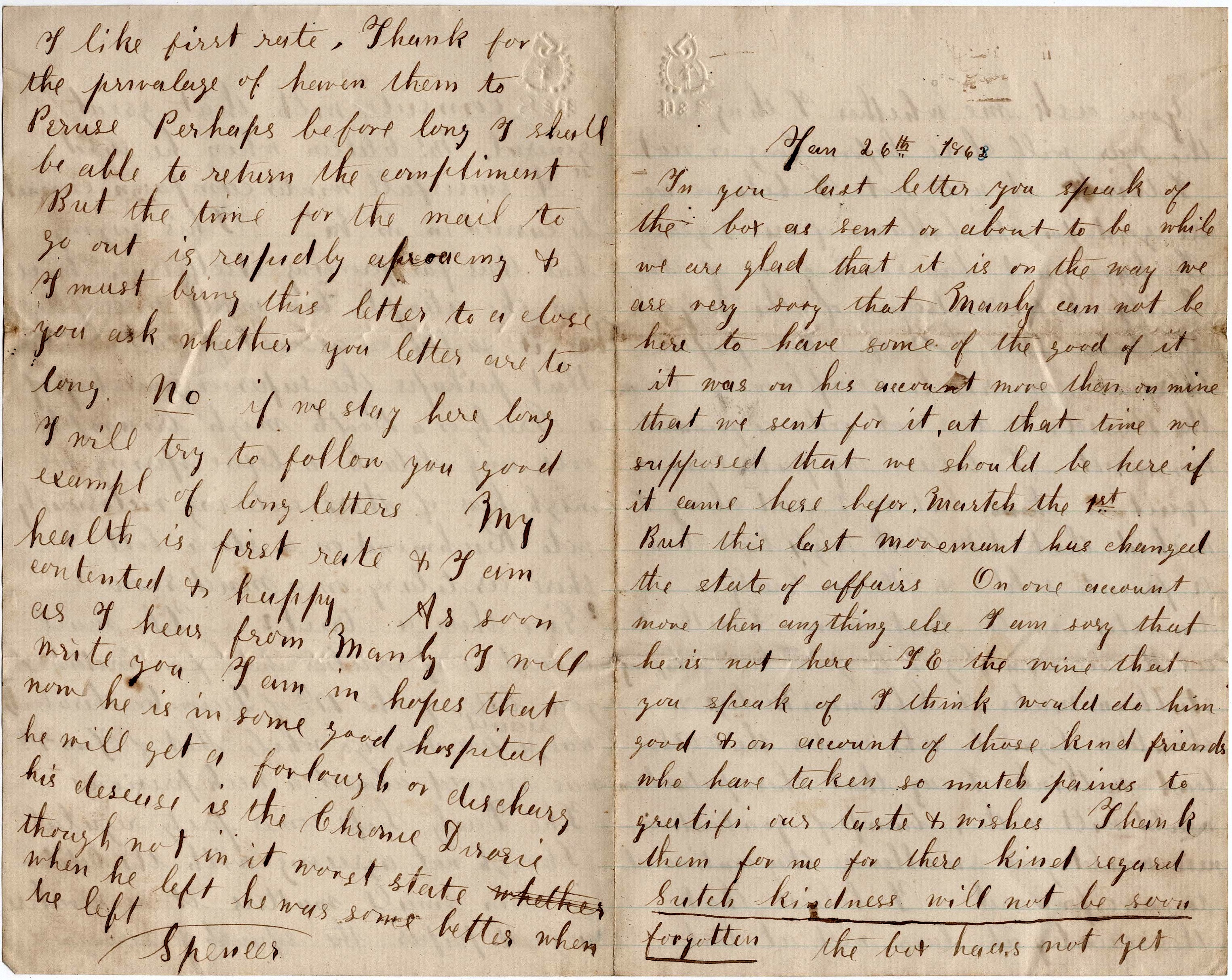
In your last letter you spoke of the box as sent, or about to be. While we are glad that it is on the way, we are very sorry that Manly cannot be here to have some of the good of it. It was on his account more than on mine that we sent for it. At that time we supposed that we should be here if it came here before March the 1st. But this last movement has changed the state of affairs. On one account more than anything else, I am sorry that he is not here. T. E. the wine that you speak of, I think would do him good and on account of those kind friends who have taken so much pains to gratify our tastes & wishes, thank them for me for their kind regards. Such kindness will not be soon forgotten. The box has not yet….
[missing a page]
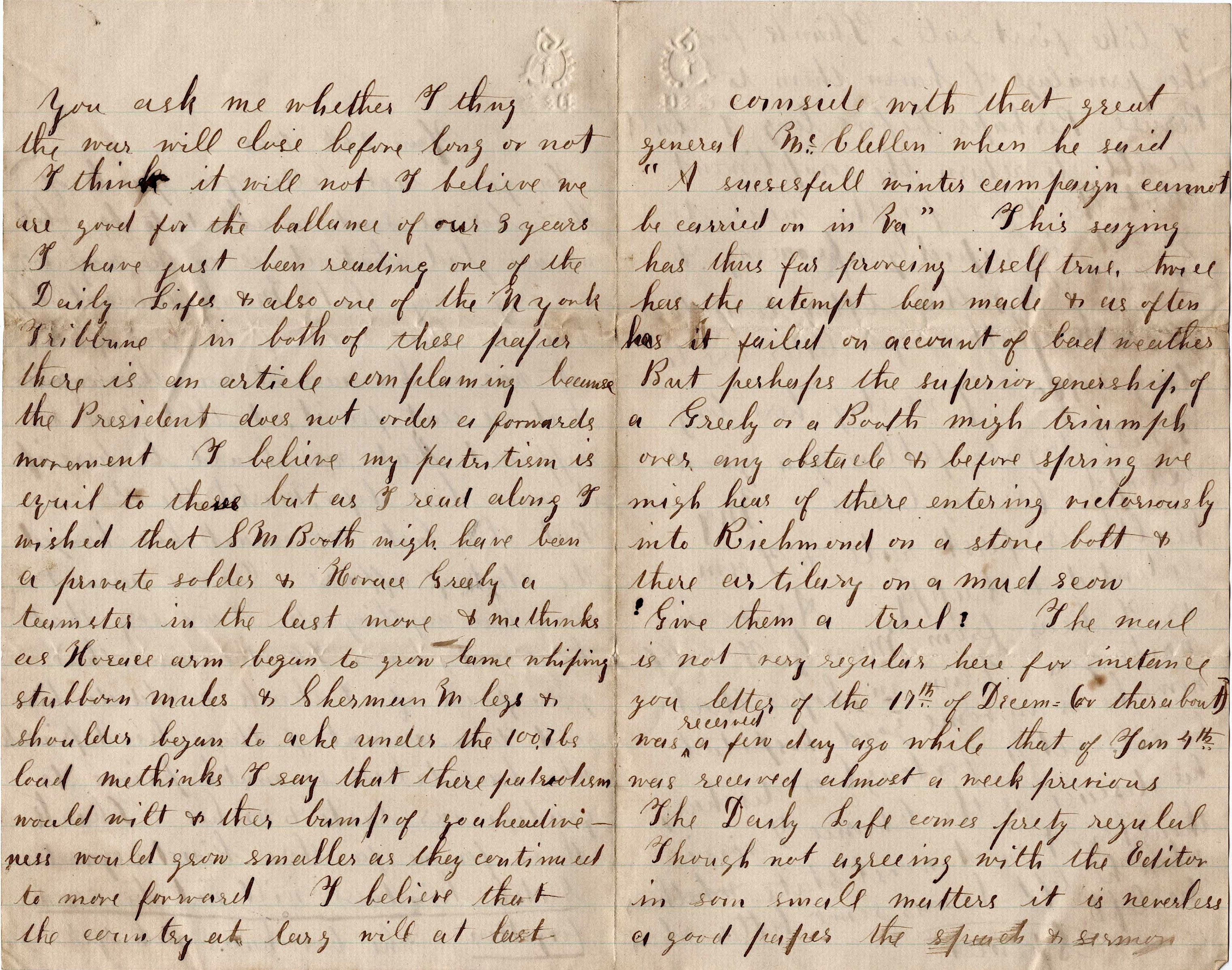
…consider with that great General McClellan when he said, “A successful winter campaign cannot be carried on in Virginia.” This saying has thus far proven itself true. Twice has the attempt been made & as often has it failed on account of bad weather. But perhaps the superior generalship of a Greeley or a Booth might triumph over any obstacle & before spring we might hear of their entering victoriously into Richmond on a stone bolt & their artillery on a mud scow. Give them a trial.
The mail is not very regular here. For instance, your letter of the 17th of December (or thereabout) was received almost few days ago while that of January 4th was received almost a week previous. The Daily Life comes pretty regular. Though not agreeing with the Editor in some small matters, it is nevertheless a good paper. The speech & sermons I like first rate. Thank you for the privilege of having them to peruse. Perhaps before long I shall be able to return the compliment. But the time for the mail to go out is rapidly advancing & I must bring this letter to a close. You ask whether your letters are too long. No! If we stay here long, I will try to follow youyr good example of long letters.
My health is first rate & I am contented & happy. As soon as I hear from Manly, I will write you. I am in hopes that now he is some good hospital, he will get a furlough or discharge. His disease is the chronic diarrhea though not in its worst state when he left. He was some better when he left. — Spencer
Letter 4
Camp near Belle Plains
February 7th 1863
Dear Friends,
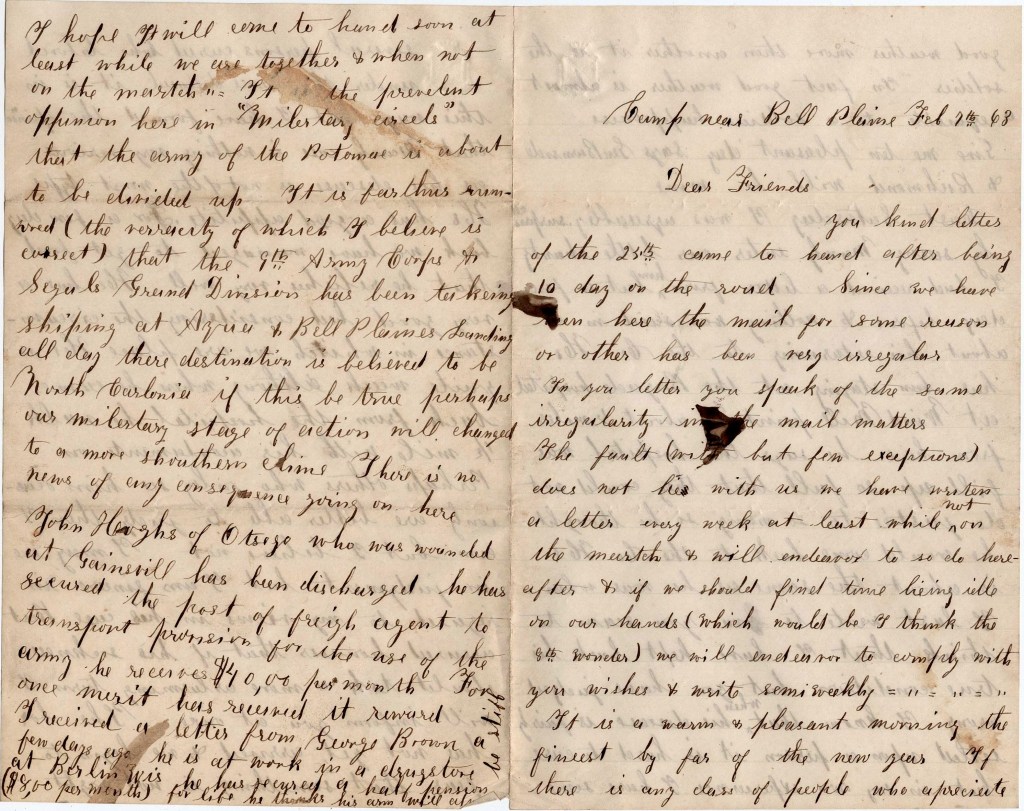
Your kind letter of the 25th came to hand after being 10 days on the road. Since we have been here, the mail for some reason or other has been very irregular. In your letter you speak of the same irregularity in the mail matters. The fault (with but few exceptions) does not lie with us. We have written a letter every week at least while not on the march & will endeavor to so do hereafter. And if we should find time lying idle on our hands (which would be I think the 8th Wonder), we will endeavor to comply with your wishes & write semi-weekly.
It is a warm and pleasant morning—the finest by far of the new year. If there is any class of people who appreciate good weather more than another, it is the soldier. In fact, good weather is almost a requisite to a soldier’s happiness. Give me ten pleasant days says Gen. Burnside, and Richmond will be mine.
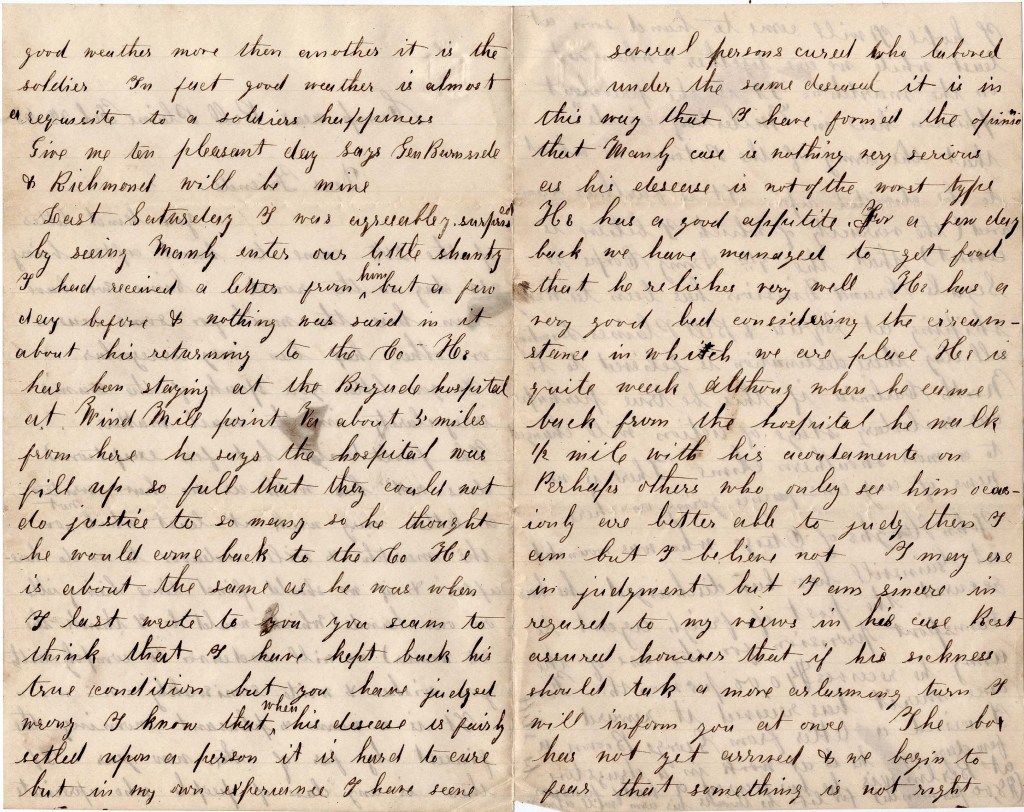
Last Saturday I was agreeably surprised by seeing Manly enter our little shanty. I had received a letter from him but a few days before & nothing was said in it about his returning to the company. He has been staying at the Brigade hospital at Wind Mill Point, Va., about 5 miles from here. He says the hospital was filled up so full that they could not do justice to so many so he thought he would come back to the company. He about the same as he was when I last wrote to you. You seem to think that I have kept back his true condition but you have judged wrong. I know that when his disease is fairly settled upon a person it is hard to cure but in my own experience, I have seen several persons cured who labored under the same disease. It is in this way that I have formed the opinion that Manly’s case is nothing very serious as his disease is not of the worst type. He has a good appetite. For a few days back, we have managed to get food that he relishes very well. He has a very good bed considering the circumstance in which we are placed. He is quite weak although when he came back from the hospital, he walked half a mile with his accoutrements on. Perhaps others who only see him occasionally are better able to judge than I can but I believe not. I may error in judgement but I am sincere in regard to my views in his case. Rest assured, however, that if his sickness should take a more alarming turn, I will inform you at once.
The box has not yet arrived and we begin to fear that something is not right. I hope it will come to hand soon at least while we are together & when not on the march. It is the prevalent opinion here in “Milertery circels” that the Army of the Potomac is about to be divided up. It is thus far rumored that (the veracity of which I believe is correct) that the 9th Army Corps & Sigel’s Grand Division has been taking shipping at Aquia & Belle Plain Landing all day. Their destination is believed to be North Carolina. If this be true, perhaps our military stage of action will be changed to a more southern climate. There is no news of any consequence going on here.
John Hughes of Otsego who was wounded at Gainesville has been discharged. He has secured the post of freight agent to transport provision for the use of the army. He receives $40 per month. For once, merit has received its reward. I received a letter from George Brown a few days ago. He is at work in a drugstore at Berlin, Wisconsin. He has secured a half pension ($8 per month) for life. He thinks his arm will always be stiff.
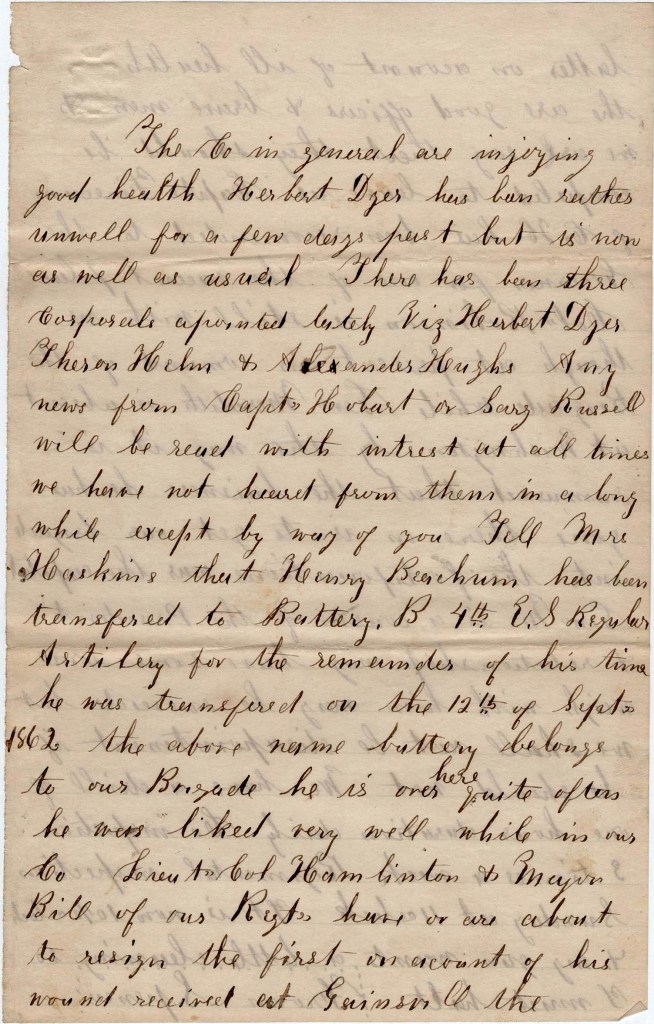
The company in general are enjoying good health. Herbert Dyer has been rather unwell for a few days past but is now as well as usual. There has been three corporals appointed lately—viz: Herbert Dyer, Theron Helm, & Alexander Hughs. Any news from Capt. [Martin C.] Hobart or Gary Russell will be read with interest at all times. We have not heard from them in a long while except by way of you. Tell Mrs. Haskins that Henry Beecham has been transferred to Battery B, 4th US Regular Artillery for them remainder of his time. He was transferred on the 12th of September 1862. The above named battery belongs to our brigade. He is over here quite often. He was liked very well while in our company. Lieut. Col. [Charles A.] Hamilton & Major [George] Bill of our regiment have or are about to resign the first on account of his wound received at Gainesville, the latter on account of ill health. They are good officers & brave men & we are sorry that they should be compelled to leave us.
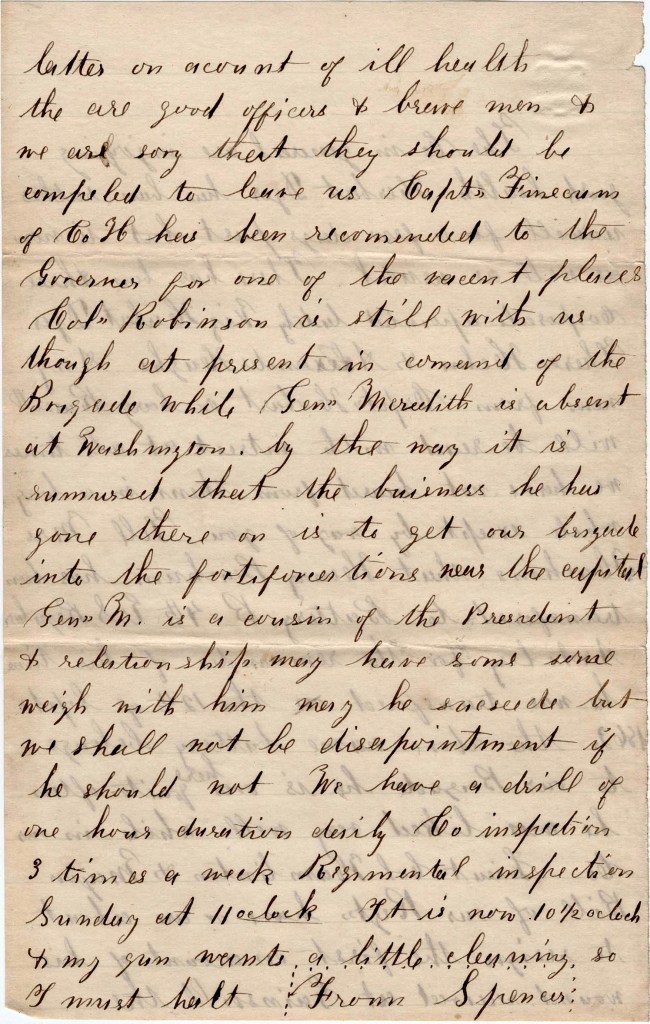
Capt. [Mark] Finnicum of Co. H has been recommended to the Governor for one of the vacant places. Col. Robinson is still with us though at present in command of the Brigade while Gen. [Solomon] Meredith is absent at Washington. By the way, it is rumored that the business he has gone there on is to get our brigade into the fortifications near the Capitol. Gen. Meredith is a cousin of the President and relationship may have some weight with him. May he succeed but we shall not be disappointed if he should not. We have a drill of one hour duration daily, company inspection three times a week, regimental inspection Sunday at 11 o’clock. It is now 10:30 o’clock & my gun wants a little cleaning, so I must halt. From Spencer
Letter 5
Camp near Belle Plains
March 25th [1863]
Dear Friend,
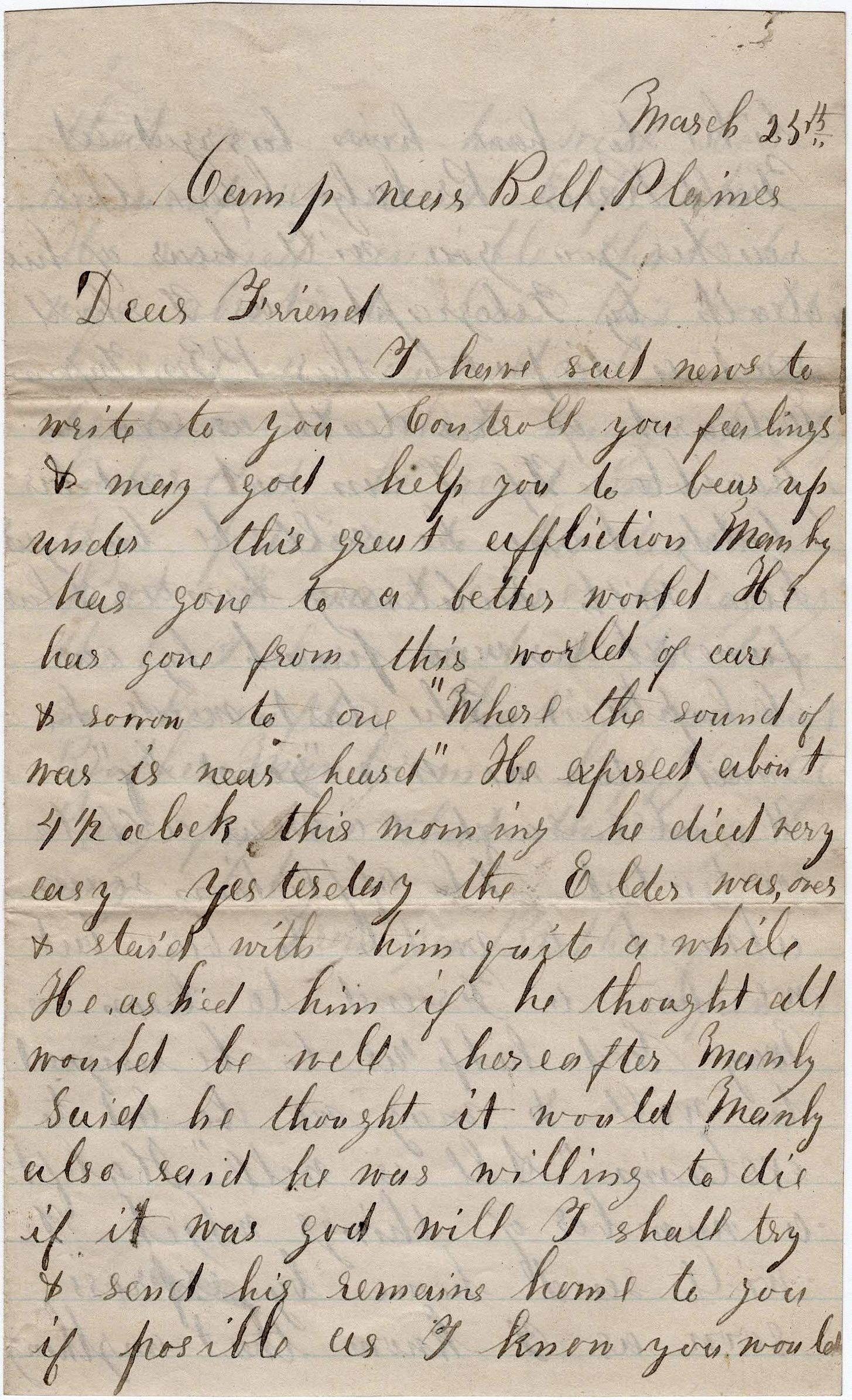
I have sad news to write to you. Control your feelings and may God help you to bear up under this great affliction. Manly has gone to a better world. He has gone from this world of care & sorrow to one “Where the sound of war is never heard.” He expired about 4.30 o’clock this morning. He died very easy.
Yesterday the Elder was over & staid with him quite a while. He asked him if he thought all would be well hereafter. Manly said he thought it would. Manly also said he was willing to die if it was God’s will.
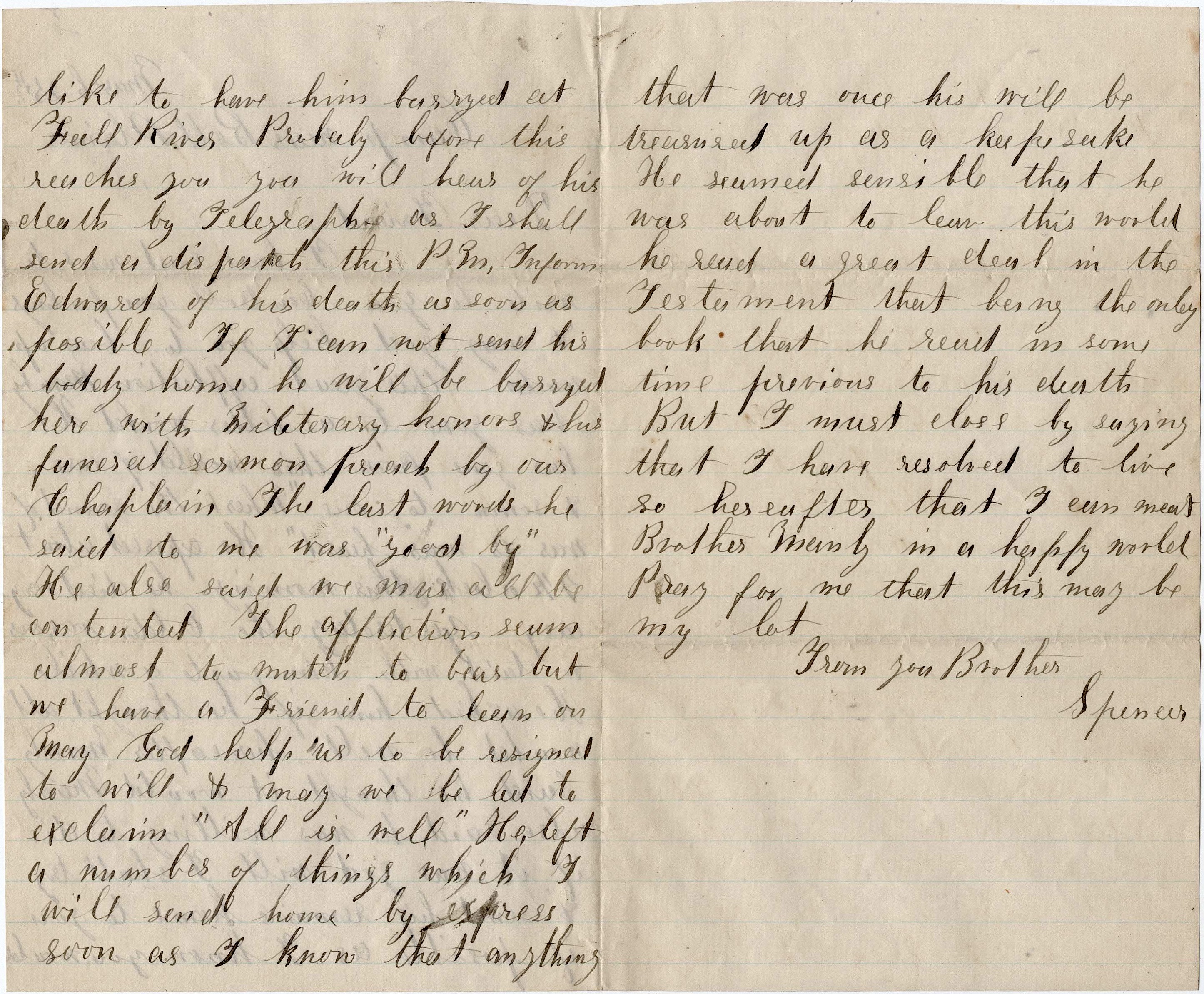
I shall try and send his remains home to you if possible as I know you would like to have him buried at Fall River. Probably before this reaches you, you will hear of his death by telegraph as I shall send a dispatch this p.m. Inform Edward of his death as soon as possible. If I cannot send his body home, he will be buried here with military honors & his funeral sermon preached by our chaplain. The last words he said to me was “goodbye.” He also said we must all be contented.
The affliction seems almost to much to bear but we have a Friend to lean on. May God help us to be resigned to [His] will and may we be led to exclaim, “All is well.” He left a number of things which I will send home by express soon as I know that anything that was once his will be treasured up as a keepsake. He seemed sensible that he was about to leave this world. He read a great deal in the Testament—that being the only book that he read in some time previous to his death.
But I must close by saying that I have resolved to live so hereafter that I can meet brother Manly in a happy world. Pray for me that this may be my lot. From your brother, — Spencer
Letter 6
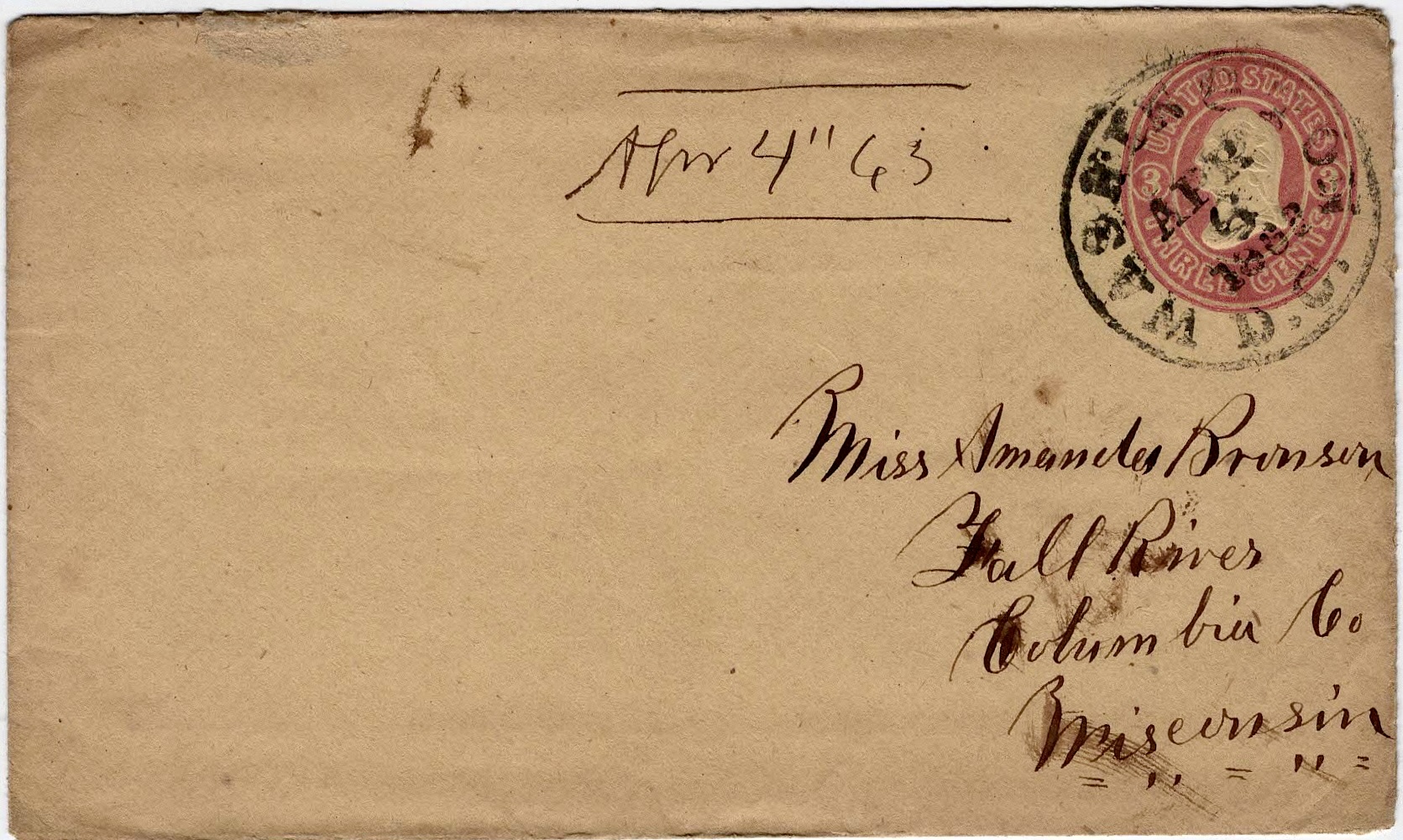
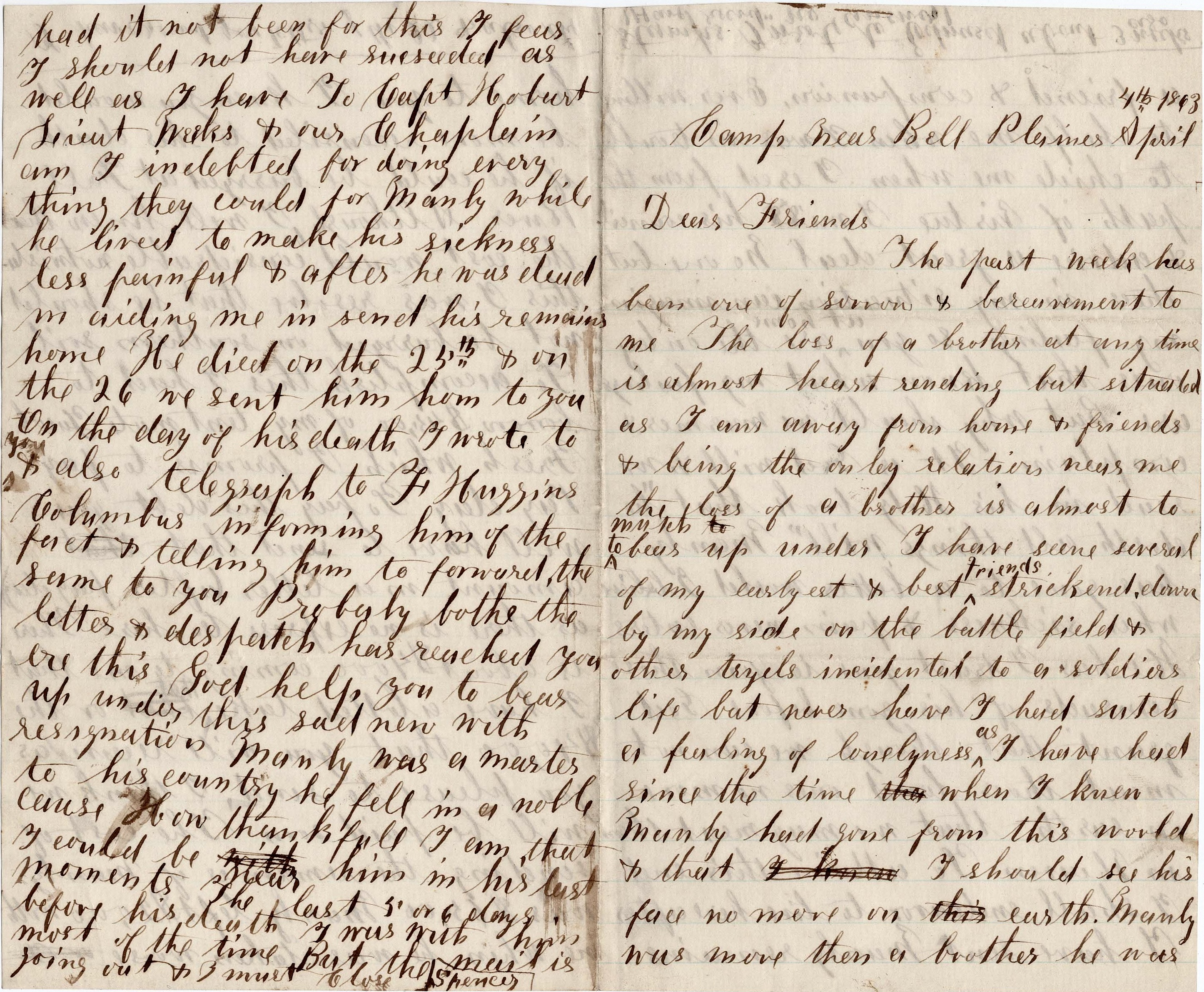
Camp near Belle Plains
April 4th 1863
Dear Friends,
The past week has been one of sorrow & bereavement to me. The loss of a brother at any time is almost heart rending but situated as I am away from home and friends and being the only relation near me, the loss of a brother is almost to much to bear up under. I have seen some of my earliest and best friends stricken down by my side on the battlefield & other trials incidental to a soldier’s life, but never have I had such a feeling of lonliness as I have had since the time when I knew Manly had gone from this world & that I should see his face no more on earth. Manly was more than a brother. He was a friend & companion, ever willing to help me when I was in trouble, to chide me when I erred from th path of virtue. I miss his counsel and advice a great deal. No one but those in my situation can imagine my feelings so you at home are the only ones that know what my feelings are.
But why should we murmur & complain. It is God’s will & we read in his Holy book that “He doeth all things well.” Manly has gone to a better world, I believe, where sickness & pain never enters. He has, I trust, gone to join those comrades of his gone before. God grant that though we cannot meet those loved ones no more on earth, that we may meet them in Heaven. To attain this end, I shall endeavor to live hereafter.
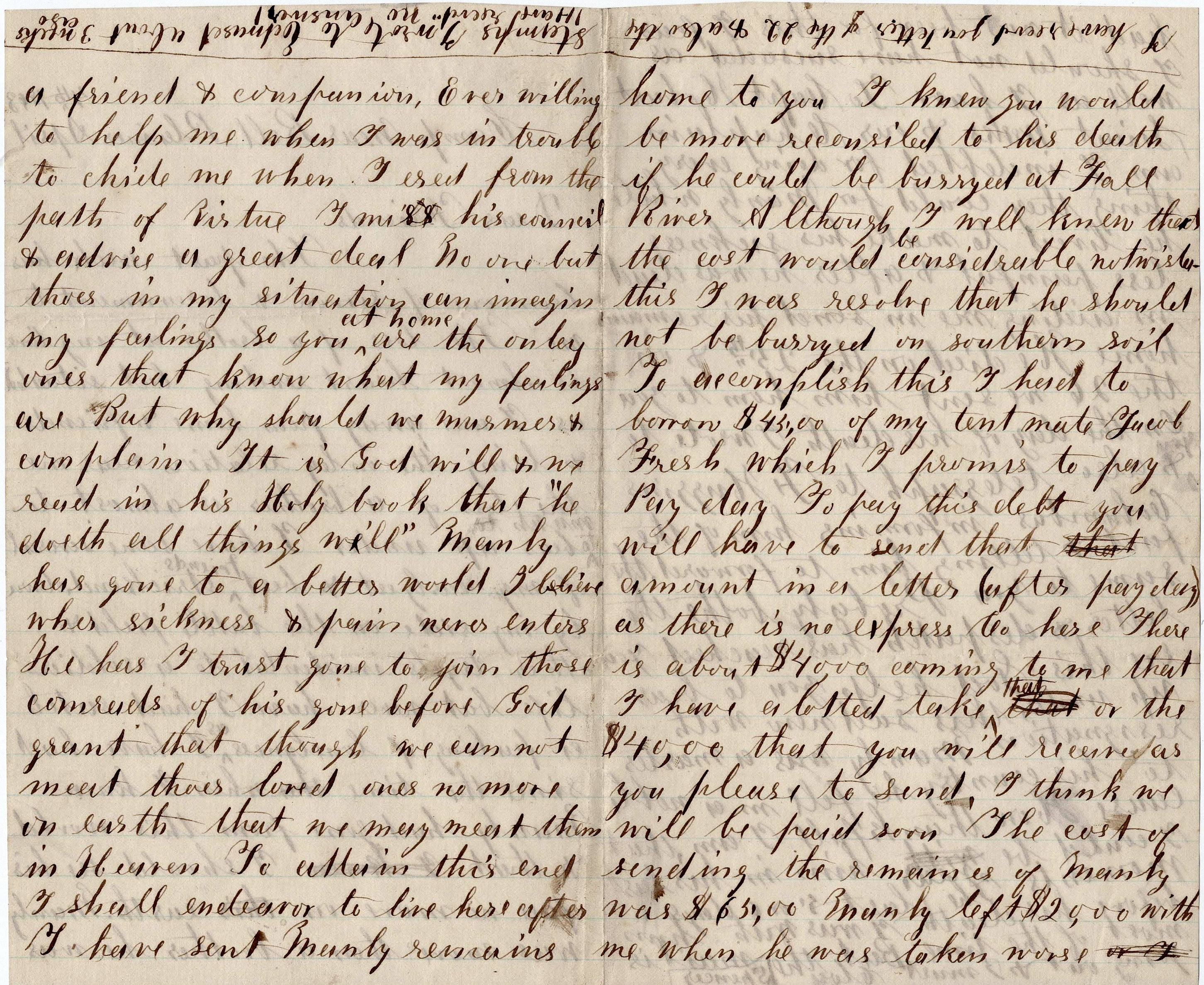
I have sent Manly’s remains home to you. I knew you would be more reconciled to his death if he could be buried at Fall River. Although I well knew that the cost would be considerable, notwithstanding this, I was resolved that he should not be buried on southern soil. To accomplish this, I had to borrow $45 of my tent mate Jacob Fresh which I promise to pay [on] pay day. To pay this debt, you will have to send that amount in a letter (after payday) as there is no express to here, There is about $40 coming to me that I have allotted. Take that or the $40 that you will receive as you please to send. I think we will be paid soon. The cost of sending the remains of Manly was $65. Manly left $20 with me when he was taken worse. Had it not been for this, I fear I should not have succeeded as well as I have.
To Capt. [Martin C.] Hobart, Lieut. [Charles E.] Weeks, & our Chaplain [Eaton] am I indebted for doing everything they could for Manly while he lived to make his sickness less painful. And after he was dead in aiding me in sending his remains home. He died on the 25th & on the 26th we sent him home to you. On the day of his death, I wrote to you and also telegraphed to F. Huggins, Columbus [Wisconsin], informing him of the fact that & telling him to forward the same to you. Probably both the letter and dispatch has reached you ere this. God help you to bear up under this sad news with resignation. Manly was a martyr to his country. He fell in a noble cause. How thankful I am that I could be near him in his last moments. The last five or six days before his death I was with him most of the time. But the mail is going out & I must close. — Spencer
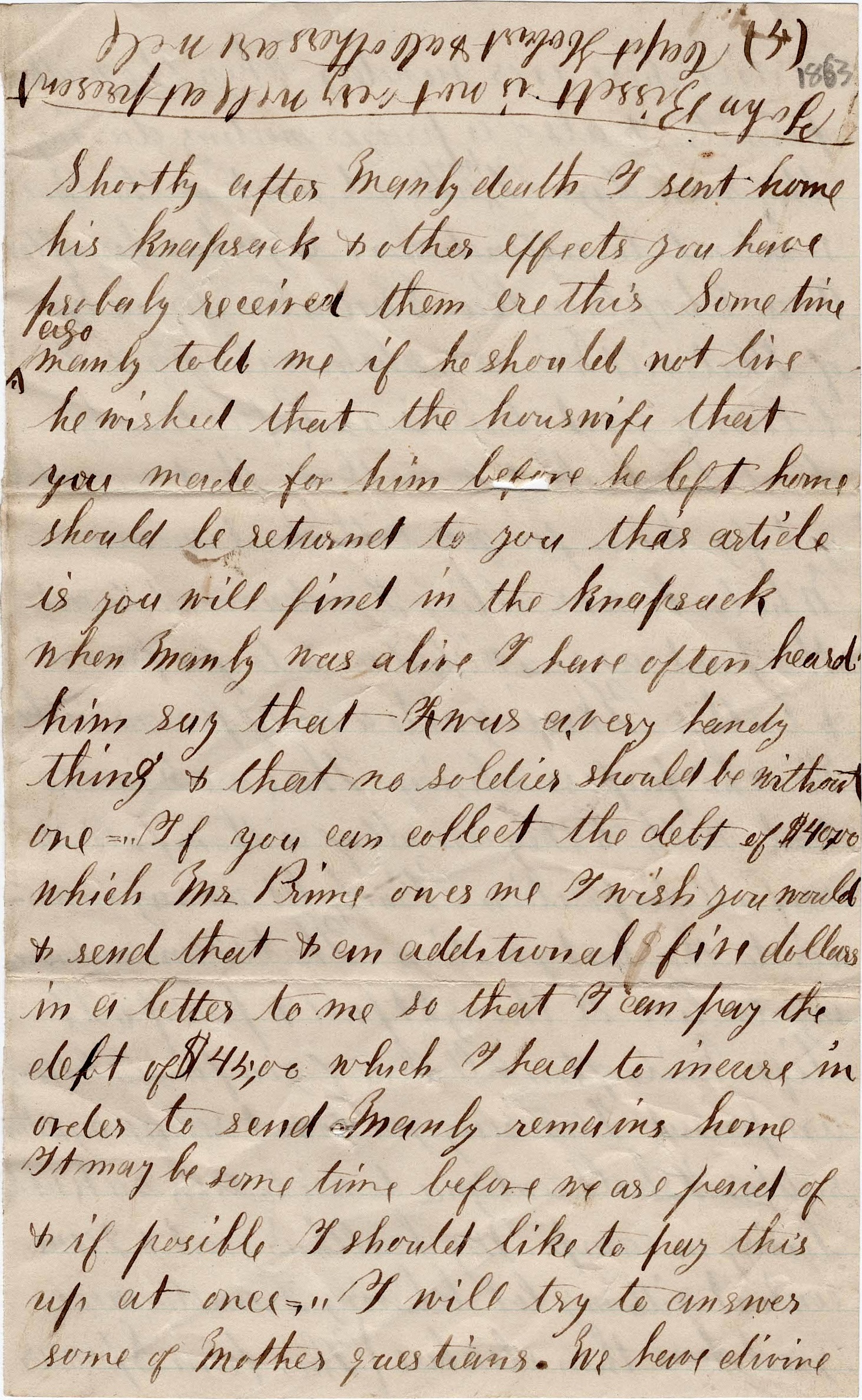
Shortly after Manly’s death, I sent home his knapsack & other effects. You have probably received them ere this. Some time ago Manly told me if he should not live, he wished that the housewife [sewing kit] that you made for him before he left home should be returned to you. This article you will find in the knapsack. When Manly was alive, I have often heard him say that it was a very handy thing & that no soldier should be without one. If you can collect the debt of $40 which Mr. Prime owes me, I wish you would send that and an additional five dollars in a letter to me so that I can pay the debt of $45 which I had to incur in order to send Manly’s remains home. It may be some time before we are paid off and if possible, I should like to pay this up at once.
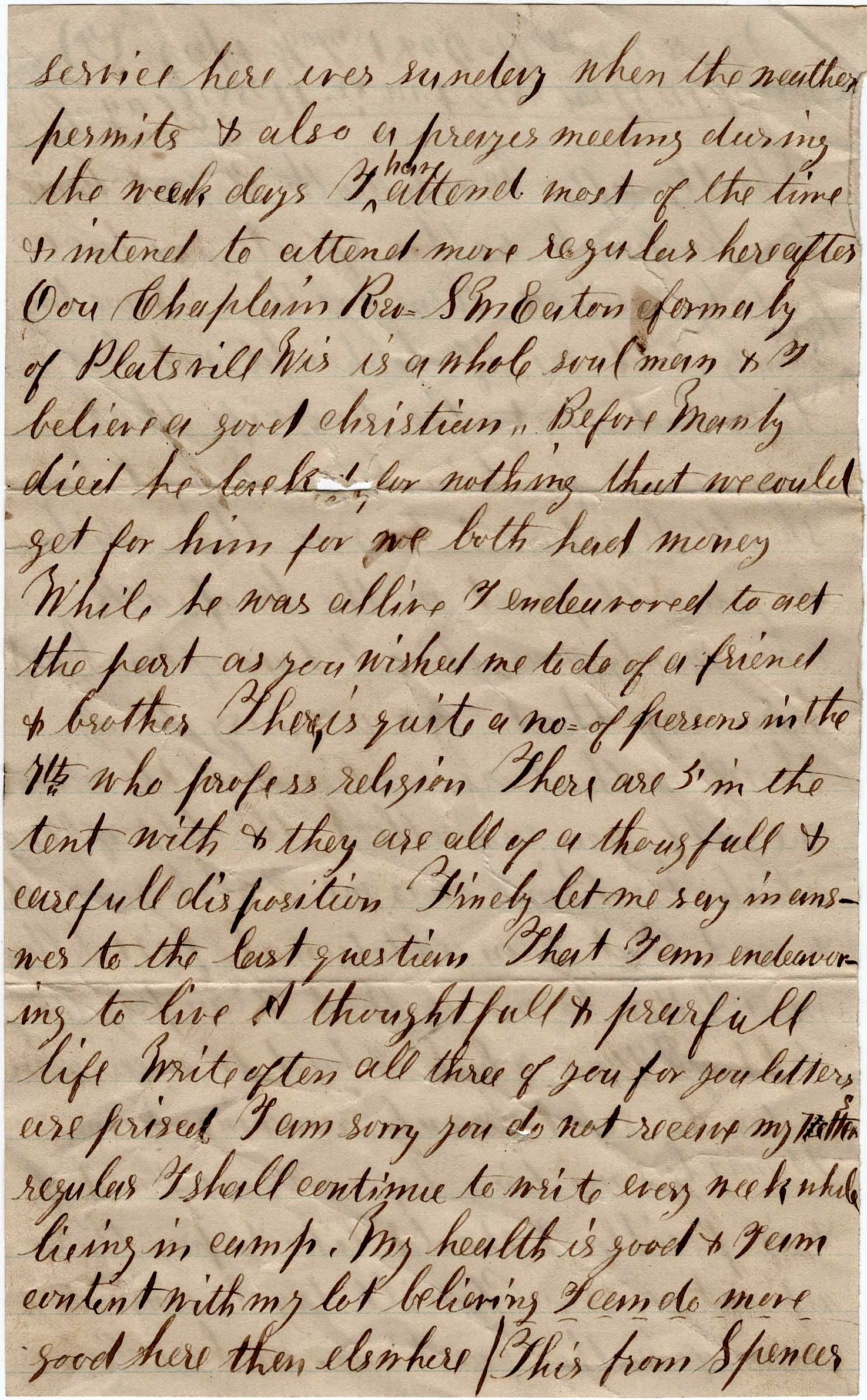
I will try to answer some of Mother’s questions. We have Divine service here every Sunday when the weather permits & also a prayer meeting during the week days. I have attended most of the time & intend to attend more regular hereafter. Our Chaplain, Rev. S[amuel W[itt] Eaton, formerly of Platteville, Wisconsin, is a whole soul man & I believe a good Christian. Before Manly died, he lacked for nothing that we could get for him for we both had money. While he was alive, I endeavored to act the part as you wished me to do of a friend and brother. There is quite a number of persons in the 7th who profess religion. There are five in the tent with [me] and they are all of a thoughtful & careful disposition. Finally let me say in answer to the last question that I am endeavoring to live a thoughtful and prayerful life.
Write often, all three of you, for your letters are prized. I am sorry you do not receive my letters regular. I shall continue to write every week while living in camp. My health is good and I am content with my lot, believing I can do more good here than elsewhere. This from, — Spencer
John Bissett is not very well at present. Capt. Hobart & all others are well.
Letter 7
Camp near Belle Plains. Va.
April 12th 1863
Dear Friends,
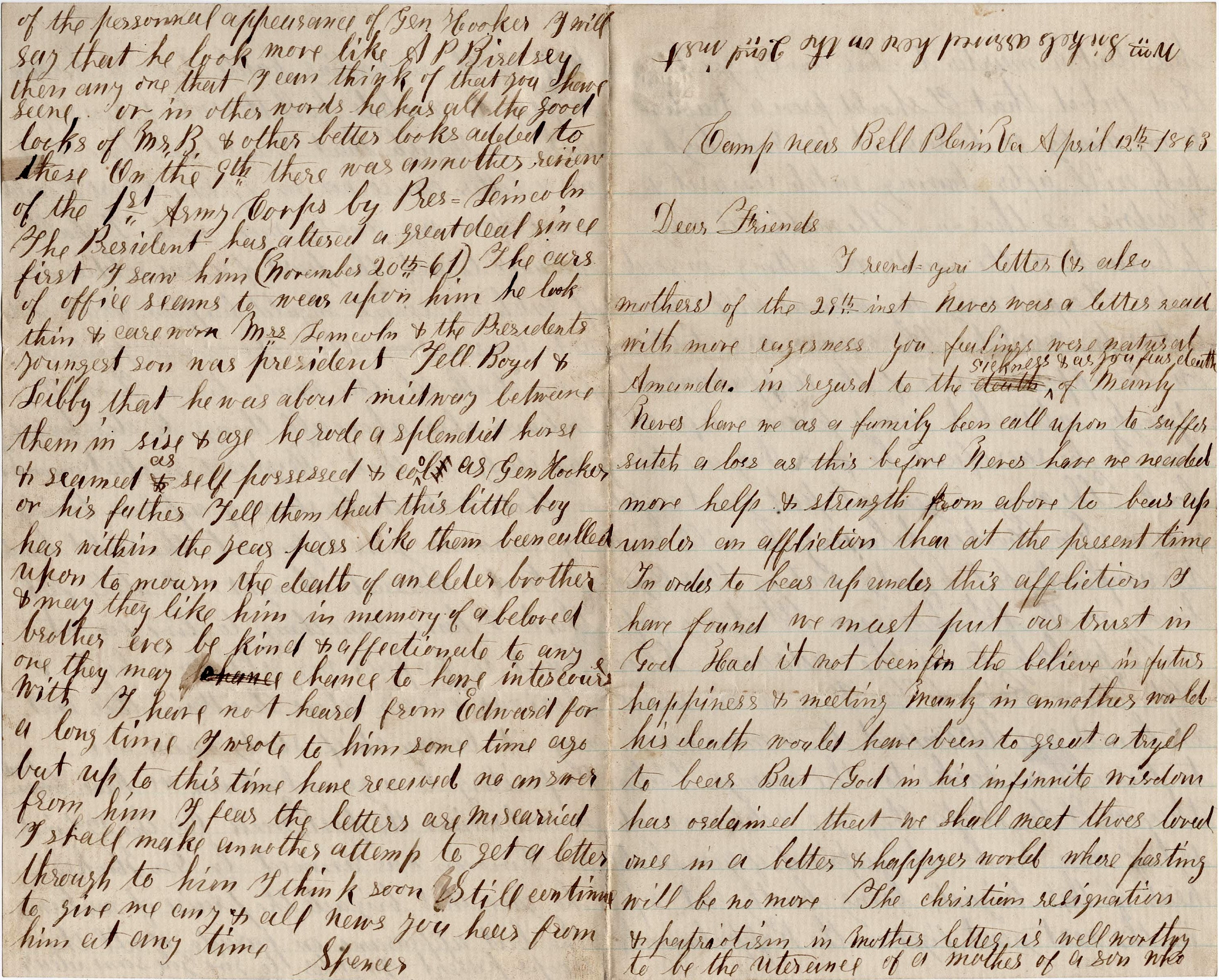
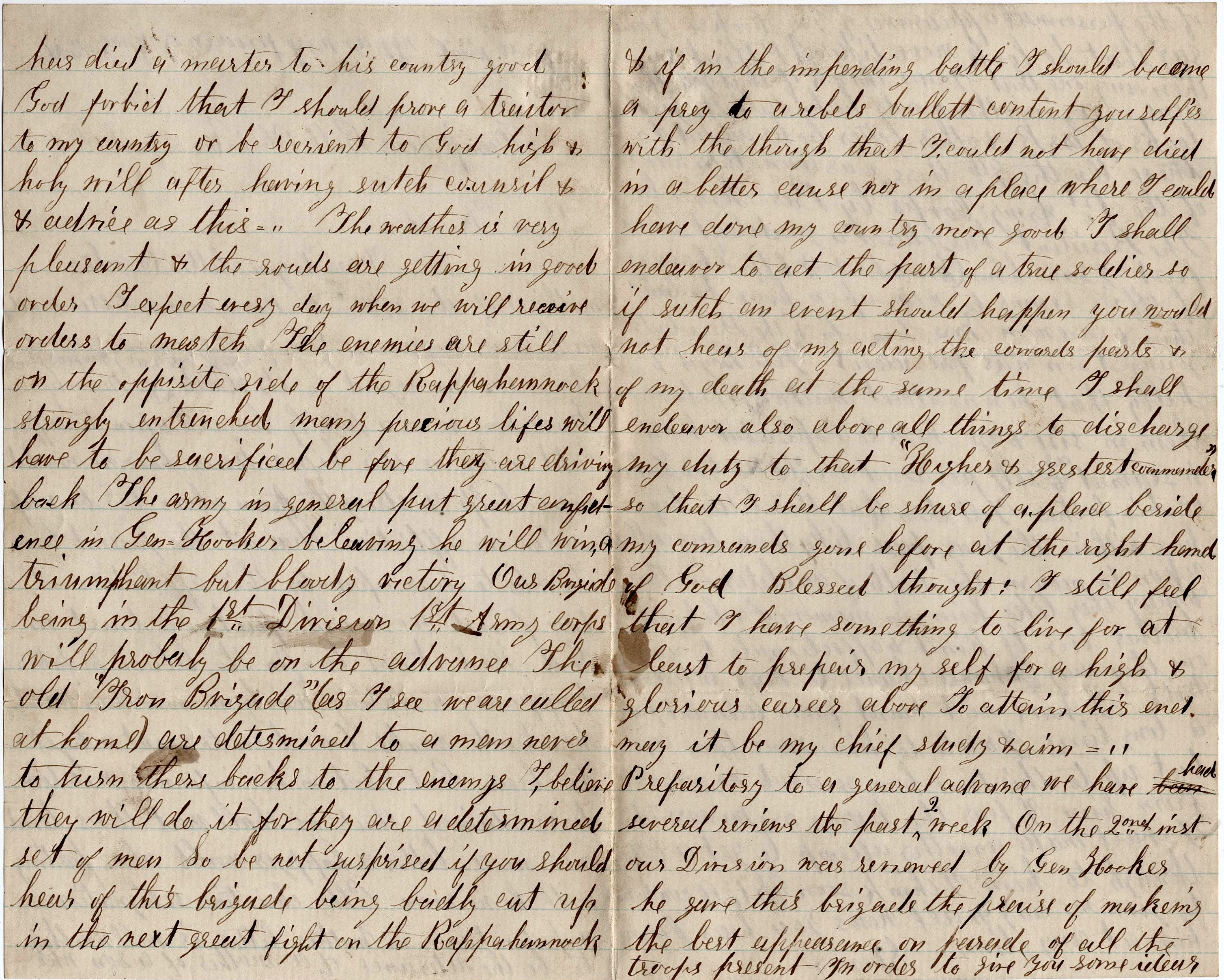
I received your letter (and also Mother’s) of the 29th inst. Never was a letter read with more eagerness. Your feelings were natural, Amanda. In regard to the sickness & as you fear death of Manly, never have we as a family been called upon to suffer such a loss as this before. Never have we needed more help & strength from above to bear up under an affliction than at the present time. In order to bear up under this affliction, I have found we must put our trust in God. Had it not been for the belief in future happiness & meeting Manly in another world, his death would have been too great a trial to bear. But God in His infinite wisdom has ordained that we shall meet those loved ones in a better & happier world where parting will be no more. The Christian resignation & patriotism in Mother’s letter is well worthy to be the utterance of a Mother of a son who has died a martyr to his country. God forbid that I should prove a traitor to my country or be recreant to God’s high & holy will, after having such counsel and advice as this.
The weather is very pleasant & the roads are getting in good order. I expect every day when we will receive orders to march. The enemy are still on the opposite side of the Rappahannock, strongly entrenched. Many precious lives will have to be sacrificed before they are driven back. The army in general put great confidence in Gen. Hooker, believing he will win a triumphant but bloody victory. Our Brigade being in the 1st Division, 1st Army Corps, will probably be on the advance. The old “Iron Brigade” (as I see we are called at home) are determined to a man never to turn their backs to the enemy. I believe they will do it for they are a determined set of men. So be not surprised if you should hear of this brigade being badly cut up in the next great fight on the Rappahannock.
And if in the impending battle, I should become a prey to a rebel’s bullet, content yourselves with the thought that I could not have died in a better cause nor in a place where I could have done my country more good. I shall endeavor to act the part of a true soldier. So if such an event should happen, you would not hear of my acting the coward’s part & of my death at the same time. I shall endeavor also above all things to discharge my duty to that “Higher & greatest Commander” so that I shall be sure of a place beside my comrades gone before at the right hand of God. Blessed thought. I still feel that I have something to live for, at least to prepare myself for a high and glorious career above. To attain this end, may it be my chief study & aim.
Preparatory to a general advance, we have had several reviews the past two weeks. On the 2nd inst. our Division was reviewed by Gen. Hooker. He gave this brigade the praise of making the best appearance on parade of all the troops present. In order to give you some idea of the personal appearance of Gen. Hooker, I will say that he looks more like A. P. Birdsey than anyone that I can think of that you have seen, or in other words, he has all the good looks of Mr. B & other better looks added to these.
On the 9th there was another review of the 1st Army Corps by President Lincoln. The President has altered a great deal since first I saw him (November 20th 1861). The cares of office seems to wear upon him. He looks thin and careworn. Mrs. Lincoln & the President’s youngest son was present. Tell Boyd and Libby that he was about midway between them in size & age. He rode a splendid horse and seemed as self possessed as & cool as General Hooker or his father. Tell them that this little boy has within the year past, like them, been called upon to mourn the death of an older brother & may they, like him, in memory of a beloved brother, ever be kind and affectionate to anyone they may chance to have intercourse with.
I have not heard from Edward for a long time. I wrote to him some time ago but up to this time have received no answer from him. I fear the letters are miscarried. I shall make another attempt to get a letter through to him I think soon. Still continue to give me any and all news you hear from him at any time. — Spencer
William Sickles arrived here on the 2nd inst.
Letter 8
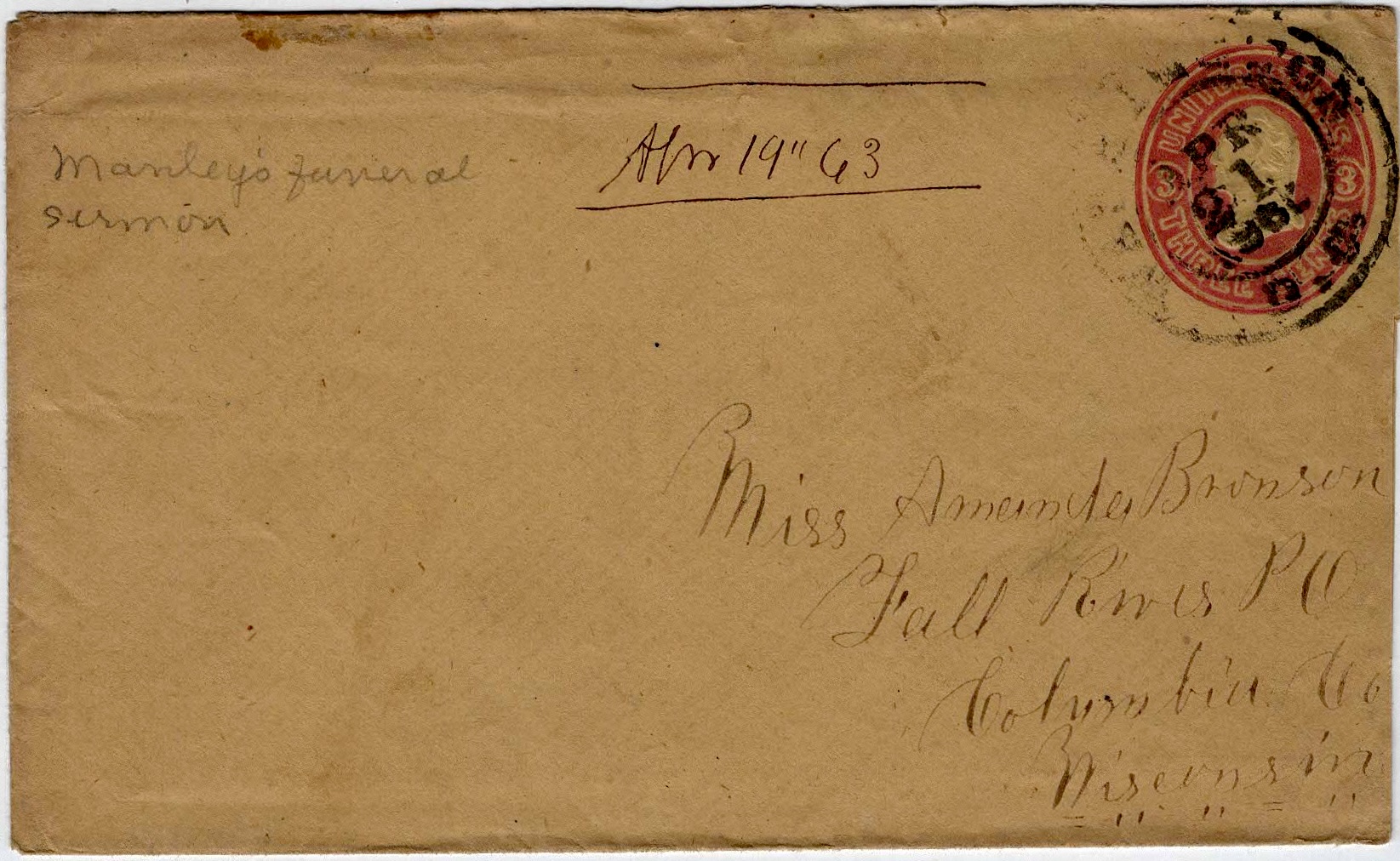
Camo near Belle Plains, Va.
April 19, [1863]
Dear Friends,
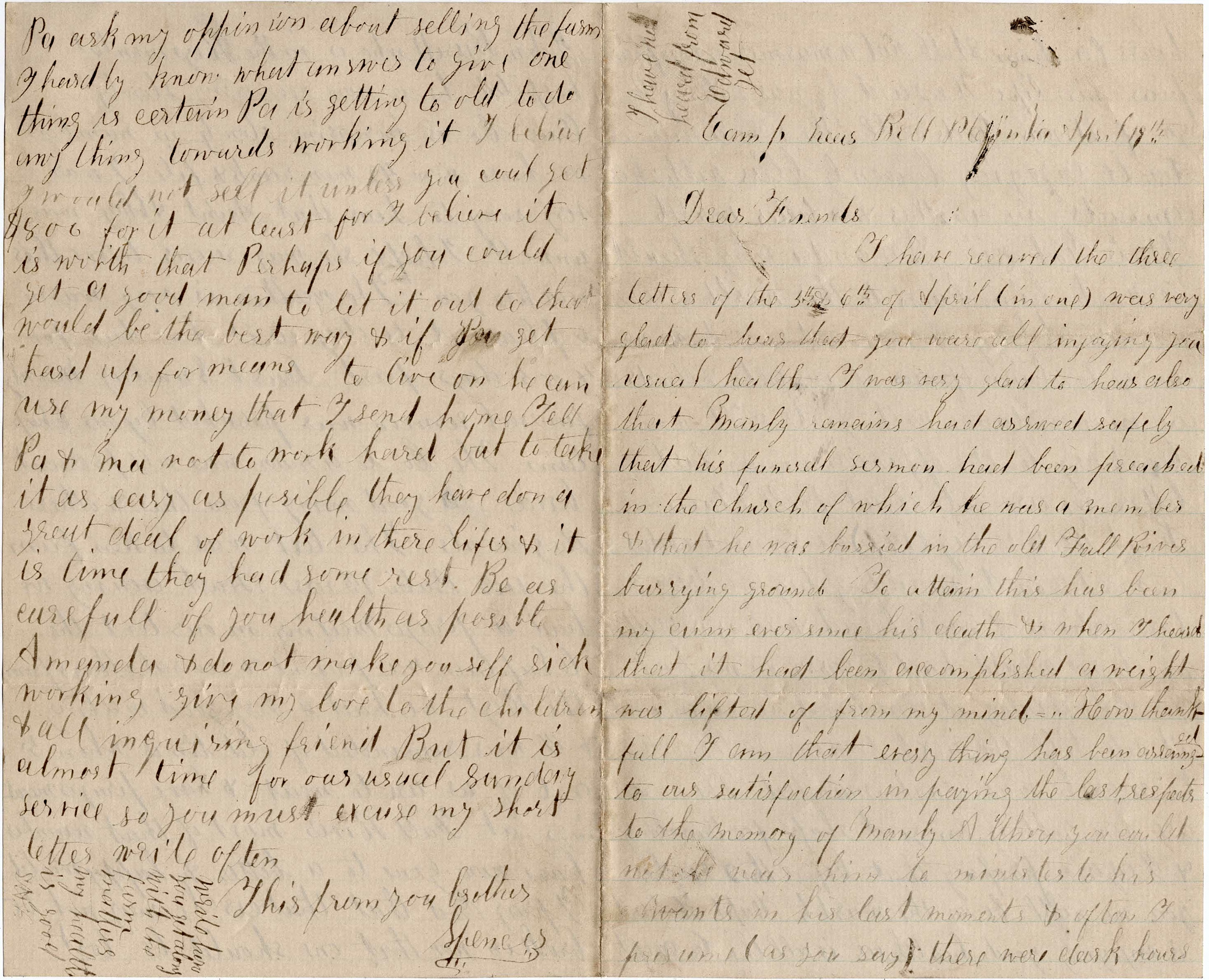
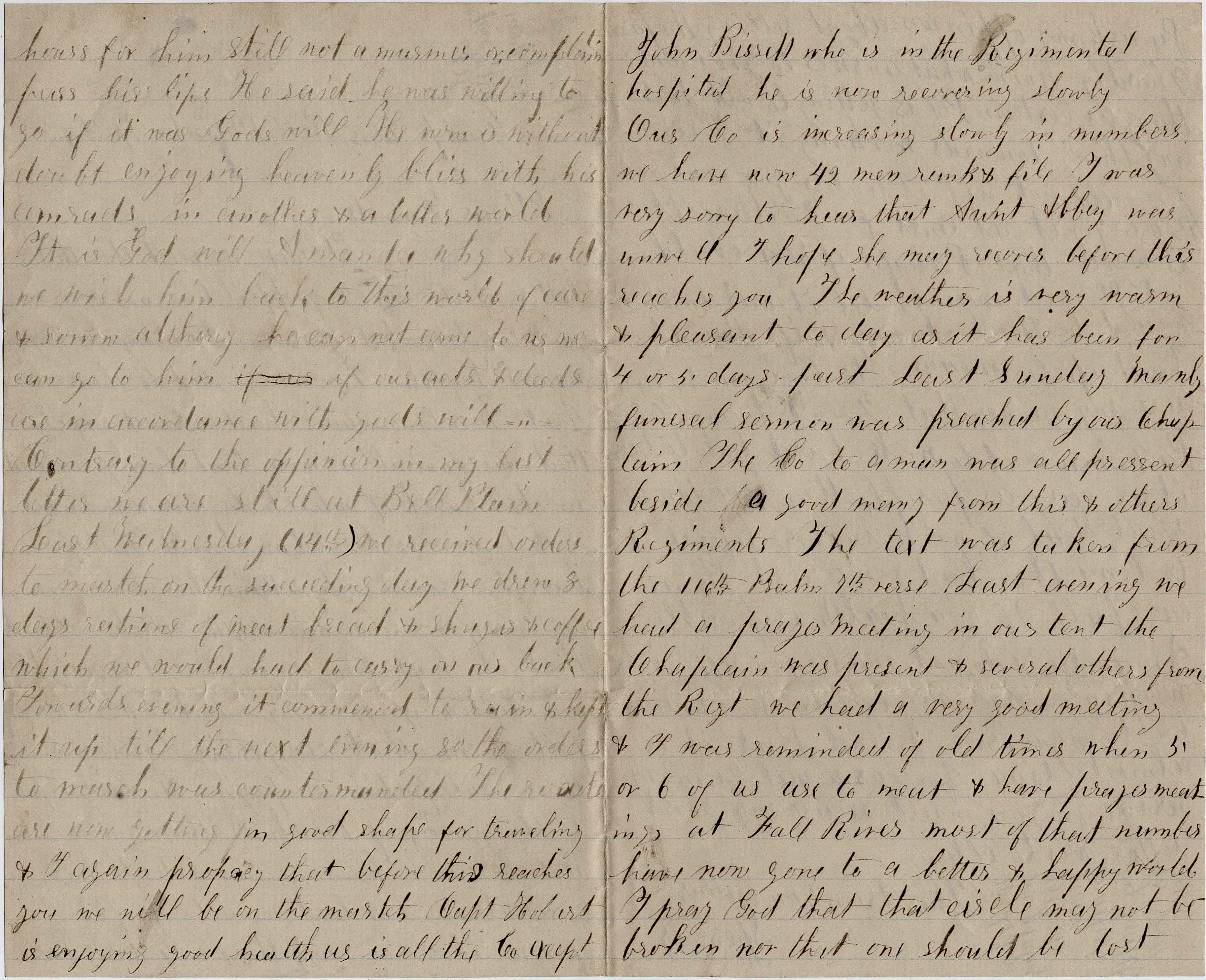
I have received the three letters of the 5th & 6th of April (2 in one). Was very glad to hear that you were all enjoying your usual health. I was very glad to hear also that Manly’s remains had arrived safely, that his funeral sermon had been preached in the church of which he was a member & that he was buried in the Old Fall River burying ground. To attain this has been my aim ever since his death. And when I heard that it had been accomplished, a weight was lifted off from my mind. How thankful I am that everything has been arranged to our satisfaction in paying the last respects to the memory of Manly. Although you could not be near him to minister to his wants in his last moments & often I presume (as you say) there were dark hours hours for him, still not a murmur or complaint passed his lips. He said he was willing to go if it was God’s will. He now is without doubt enjoying heavenly bliss with his comrades in another and a better world. It is God’s will, Amanda. Why should we wish him back to this world of care and sorrow. Although he cannot come to us we can go to him if our acts & deeds are in accordance with God’s will.
Contrary to the opinion in my last letter, we are still at Belle Plains. Last Wednesday (14th) we received orders to march on the succeeding day. We drew 8 days rations of meet, bread, and sugar & coffee which we would have to carry on our back. Towards evening it commenced to rain and kept it up till the next evening so the orders to march was countermanded. The roads are now getting in good shape for traveling & I again prophecy that before this reaches you, we will be on the march.
Capt. Hobart is enjoying good health, as is all the company except John Bissell who is in the regimental hospital. He is now recovering slowly. Our company is increasing slowly in numbers. We have now 42 men, rank & file.
I was very sorry to hear that Aunt Abby was unwell. I hope she may recover before this reaches you. The weather is very warm & pleasant today as it has been for 4 or 5 days past. Last Sunday Manley’s funeral sermon was preached by our Chaplain. The company to a man was all present besides a good many from this and other regiments. The text was taken from the 116th Psalms, 7th verse. Last evening we had a prayer meeting in our tent. The Chaplain was present and several others from the regiment. We had a very good meeting & I was reminded of old times when 5 or 6 of us use to meet & have prayer meetings at Fall River. Most of that number have gone to a better and happy world. I pray God that that circle may not be broken nor that one should be lost.
Pa asked my opinion about selling the farm. I hardly know what answer to give. One thing is certain, Pa is getting too old to do anything towards working it. I believe I would not sell it unless you could get $800 for it at least for I believe it is worth that. Perhaps if you could get a good man to let it out to them would be the best way to go & if you get hard up for means to live on, he can use my money that I send home. Tell Pa & Ma not to work hard but to take it easy as possible. They have done a great deal of work in their lives & it is time they had some rest. Be as careful of your health as possible, Amanda, and do not make yourself sick working. Give my love to the children and all enquiring friends.
But it is almost time for our usual Sunday service so you must excuse my short letter. Write often. This from your brother, – Spencer
Letter 9
Camp near Belle Plains, Va.
April 26th 1863
Dear Sister,
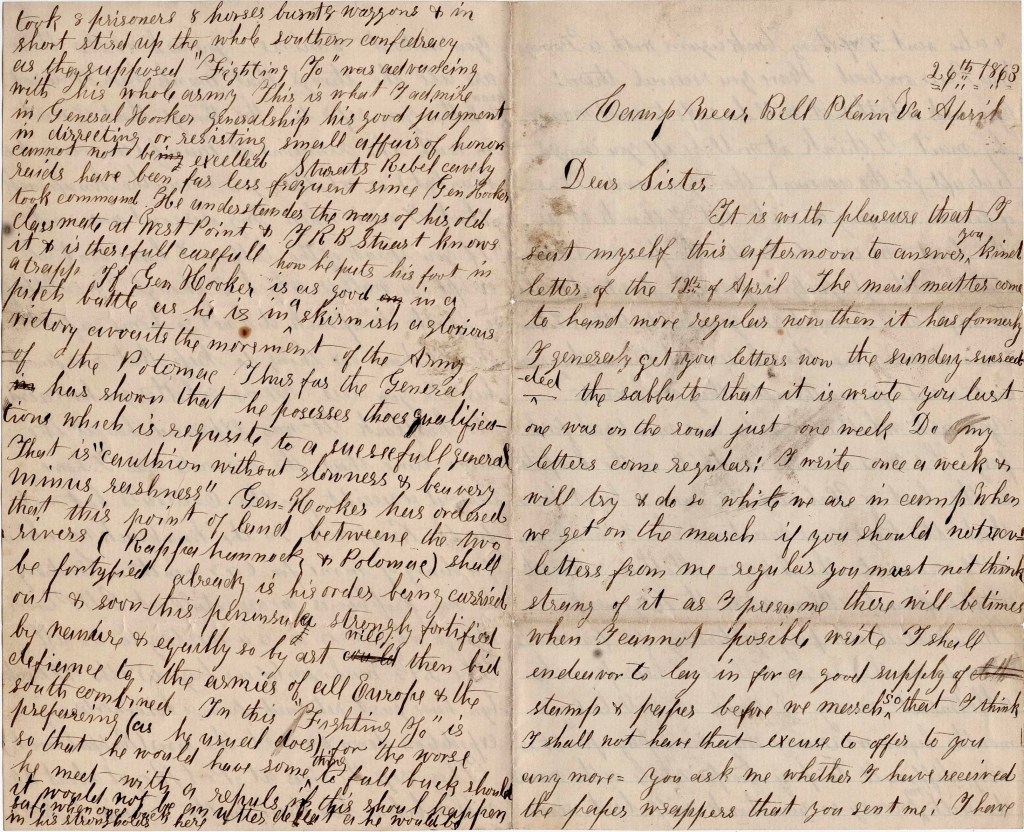
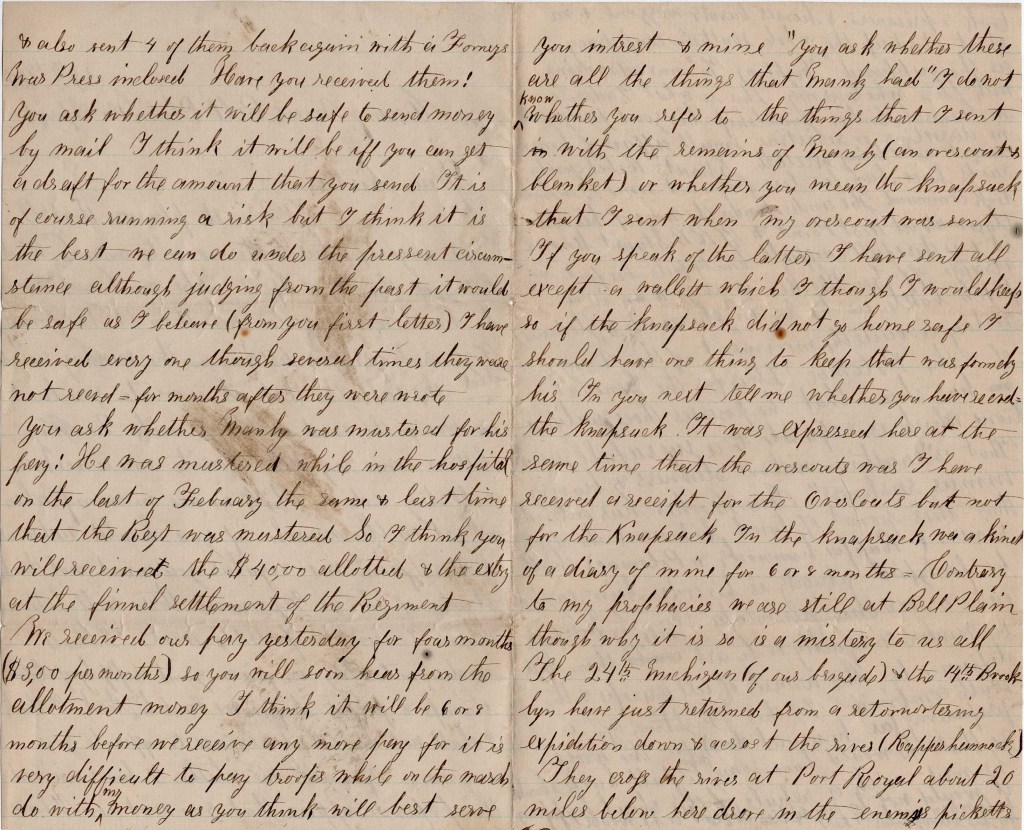
It is with pleasure that I seat myself this afternoon to answer your kind letter of the 12th of April. The mail matter comes to hand more regular now than it has formerly. I generally get your letters now the Sunday succeeding the Sabbath that it is wrote. Your last one was on the road just one week. Do my letters come regular? I write once a week & will try & do so while we are in camp. When we get on the march, if you should not receive letters from me regular, you must not think strange of it as I presume there will be times when I cannot possibly write. I shall endeavor to lay in for a good supply of stamps and paper before we march so that I think I shall not have that excuse to offer to you anymore. You ask me whether I have received the paper wrappers that you sent me. I have and also sent four of them back again with a Forney’s War Press enclosed. Have you received them?
You ask whether it wil be safe to send money by mail. I think it will be if you can get a draft for the amount that you send. It is of course running a risk but I think it is the best we can do under the present circumstances. Although judging from the past, it would be safe as I believe (from your first letter) I have received every one though several times they were not received for months after they were wrote.
You ask whether Manly was mustered for his pay. He was mustered while in the hospital on the last of February, the same and last time the regiment was mustered so I think you will receive the $40 allotted and the extra at the final settlement of the regiment. We received our pay yesterday for four months ($3 per month) so you will soon hear from the allotment money. I think it will be 6 or 8 months before we receive any more pay for it is difficult to pay troops while on the march. Do with my money as you think will best serve your interest and mine.
You ask whether these are all the things that Manly had. I do not know whether you refer to the things that I sent with the remains of Manly (an overcoat and blanket) or whether you mean the knapsack that I sent when my overcoat was sent. If you speak of the latter, I have sent all except a wallet which I thought I would keep so if the knapsack did not get home safe, I should have one thing to keep that was formerly his. In your next, tell me whether you have received the knapsack. It was expressed here at the same time that the overcoats was. I have received a receipt for the overcoats but not for the knapsack. In the knapsack was a kind of diary of mine for 6 or 8 months.
Contrary to my prophesies, we are still at Belle Plains though why it is so is a mystery to us all. The 24th Michigan (of our brigade) and the 14th Brooklyn have just returned from a reconnoitering expedition down and across the river (Rappahannock). They crossed the river at Port Royal about twenty miles below here, drove in the enemy’s pickets, took 8 prisoners, 8 horses, burnt 8 wagons, and in short stirred up the whole Southern Confederacy as they supposed “Fighting Jo” was advancing with his whole army. This is what I admire in General Hooker’s generalship—his good judgement in directing or resisting small affairs of honor cannot be excelled. Stuart’s Rebel cavalry raids have been far less frequent since Gen. Hooker took command. He understands the ways of his old classmate at West Point & T. R. B. Stuart knows it. And it is therefore careful how he puts his foot in a trap.
Gen. Hooker is as good in a pitch battle as he is in a skirmish. A glorious victory awaits the movement of the Army of the Potomac. Thus far the general has shown that he possesses those qualifications which is requisite to a successful general. That is “caution without slowness & bravery minus rashness.” Gen. Hooker has ordered that this point of land between the two rivers (Rappahannock & Potomac) shall be fortified. Already is his order being carried out and soon this peninsula will be strongly fortified by [ ] & equally so by artillery. Then bid defiance to the armies of all Europe & the South combined. In this, “Fighting Jo” is preparing (as he usually does) for the worse so that he would have something to fall back on should he meet with a repulse. If this should happen, it would not be an utter defeat as he would be in his stronghold here.
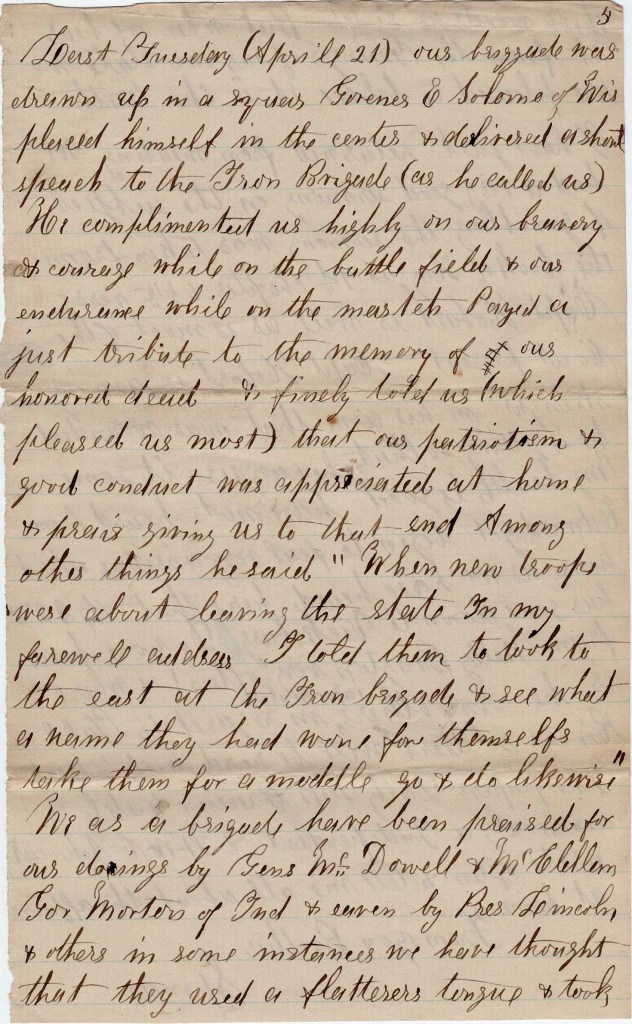
Last Thursday (April 21) our brigade was drawn up in a square. Governor E[dward] Salomon of Wisconsin placed himself in the center & delivered a short speech to the Iron Brigade (as he called us). He complimented us highly on our bravery & courage while on the battlefield & our endurance while on the march. He paid a just tribute to the memory of our honored dead and finally told us (which pleased us most) that our patriotism & good conduct was appreciated at home & praise given us to that end. Among other things, he said, “When new troops were about leaving the state, in my farewell address I told them to look to the East at the Iron Brigade & see what a name they had won for themselves. Take them for a model. Go and do likewise.”
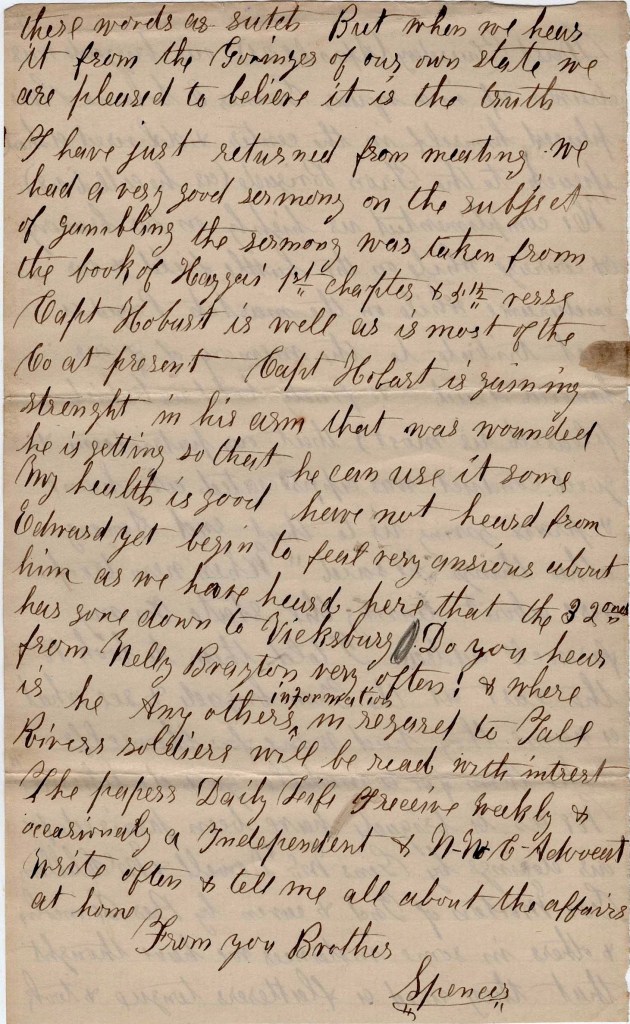
We as a brigade have been praised for our doings by Gen’s. McDowell & McClellan, Gov. Morton of Indiana, and even President Lincoln & others. In some instances we have thought that they used a flatterer’s tongue & took their words as such. But when we hear it from the Governor of our own state, we are pleased to believe it is the truth.
I have just returned from meeting. We had a very good sermon on the subject of gambling. The sermon was taken from the Book of Haggai 1st Chapter & 5th verse. Capt. Hobart is well as is most of the company at present. Capt. Hobart is gaining strength in his arm that was wounded. He is getting so that he can use it some. My health is good. Have not heard from Edward yet. Begin to feel very anxious about him as we have heard here that the 32nd [Wisconsin] has gone down to Vicksburg. Do you hear from Nelly Brayton very often? And where is he? Any other information in regard to Fall River’s soldiers will be read with interest. The papers Daily Life I receive weekly & occasionally an Independent & N. W. C. Advocate. Write often and tell me all about the affairs at home. From your brother, — Spencer
Letter 10
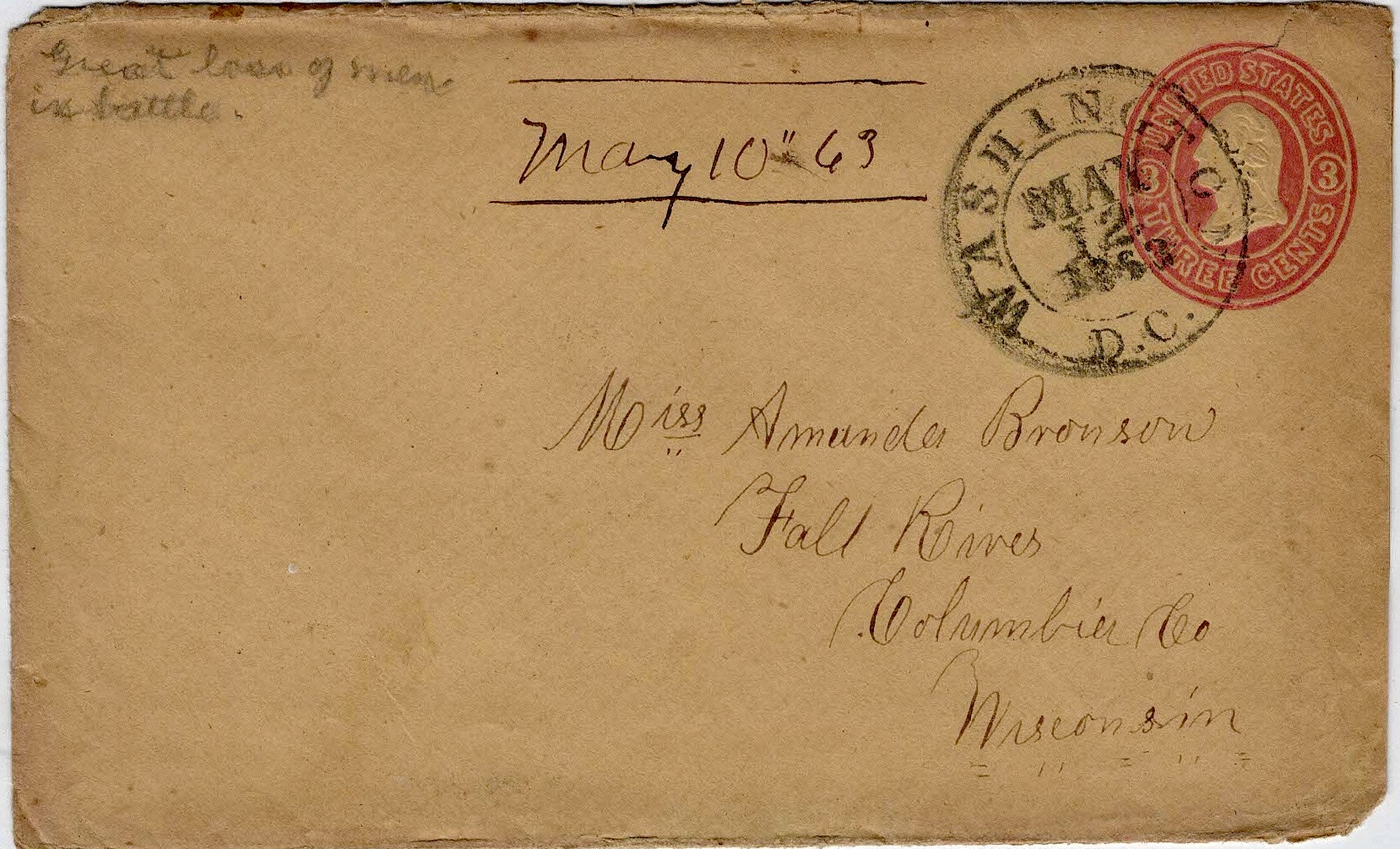
Camp near White Oak Church, Va.
May 10th 1863
Dear Sister,
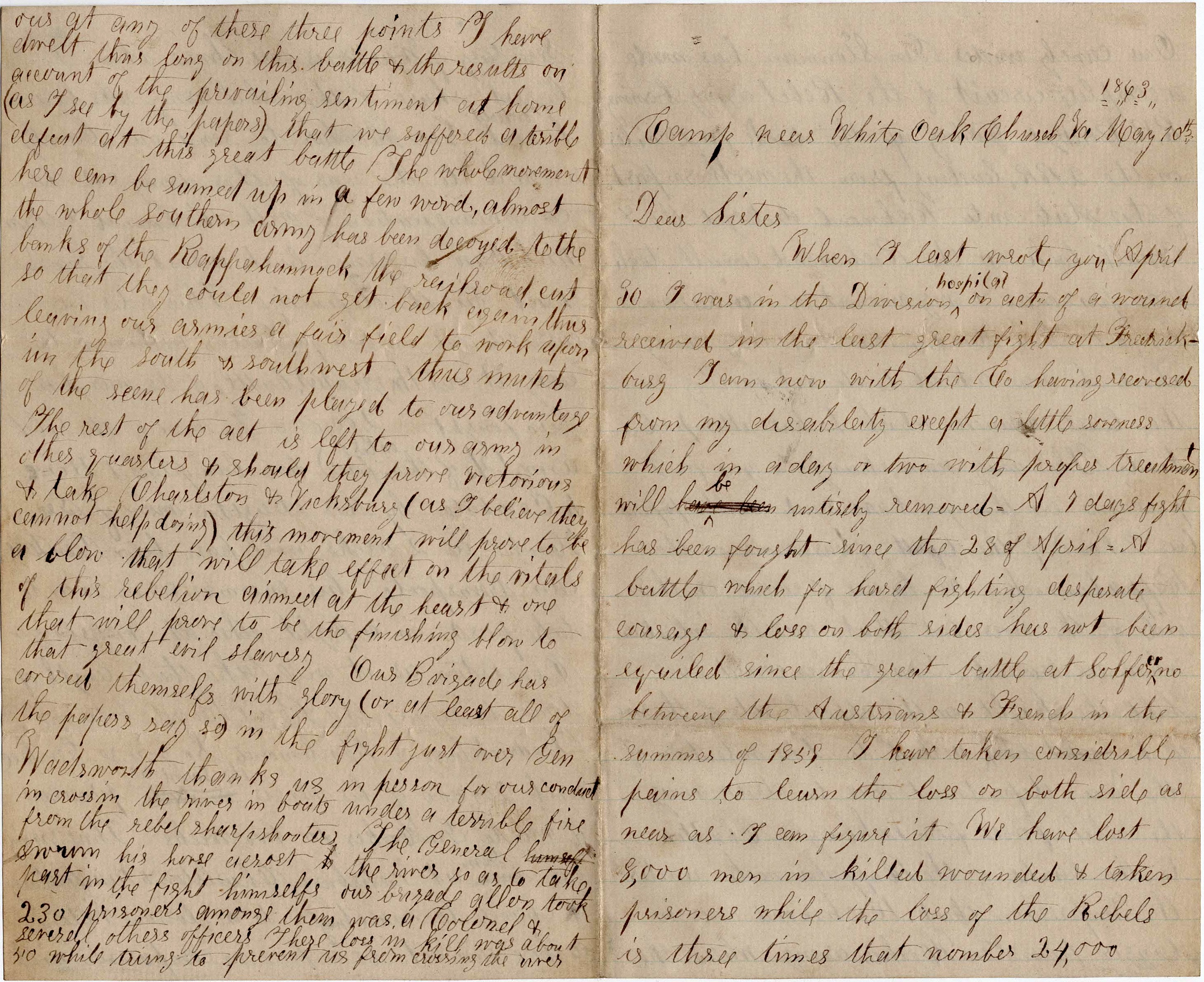
When I last wrote you April 30th, I was in the Division hospital on account of a wound received in the last great fight at Fredericksburg. I am now with the company, having recovered from my disability except a little soreness which in a day or two with proper treatment will be entirely removed. A 7 days fight has been fought since the 28th of April—a battle which for hard fighting, desperate courage and loss on both sides has not been equaled since the great battle at Solferino between the Austrians & French in the summer of 1859. I have taken considerable pains to learn the loss on both sides as near as I can figure it. We have lost 8,000 men in killed, wounded and taken prisoners while the loss of the Rebels is three times that number [or] 24,000.
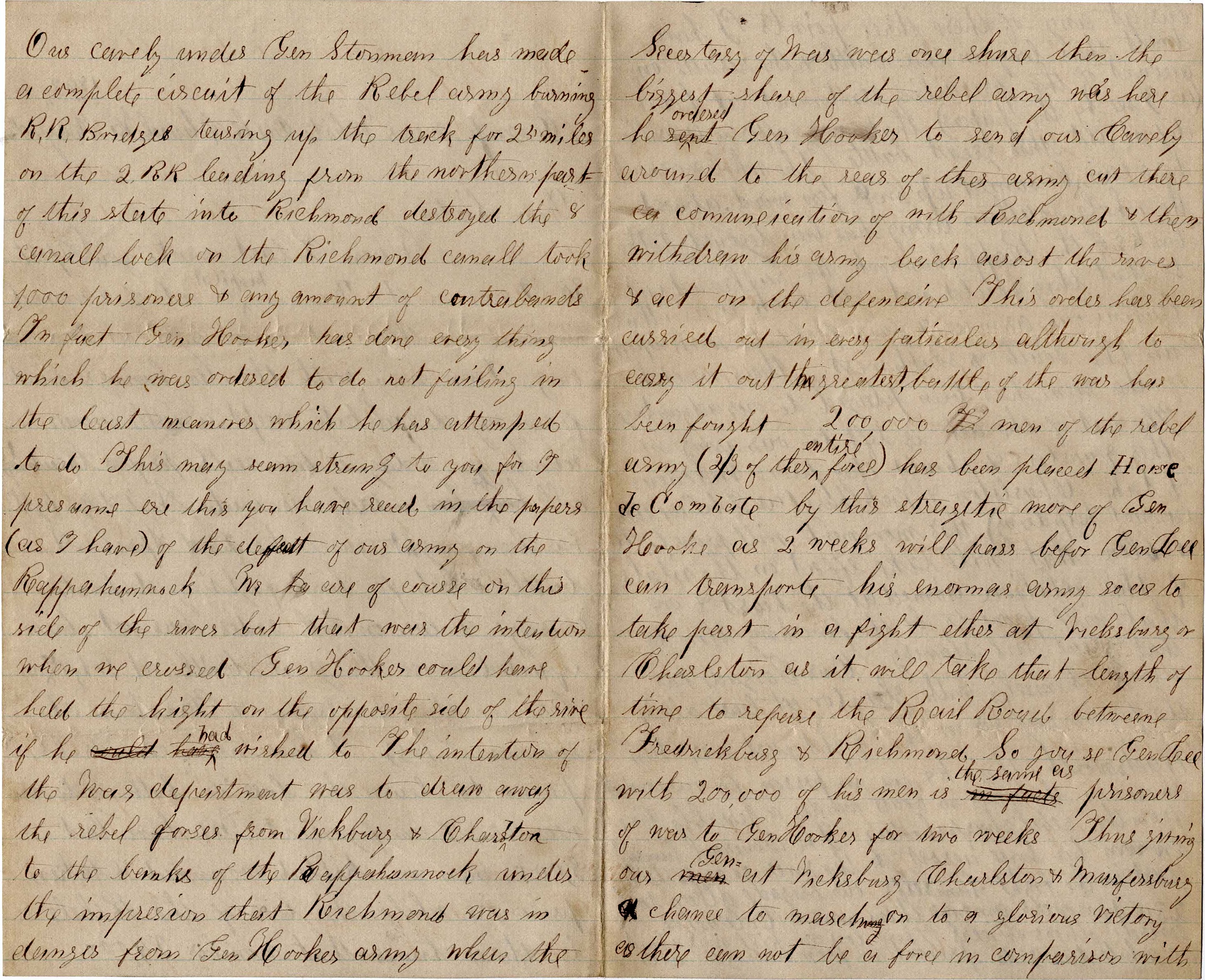
Our cavalry under Gen. Stoneman has made a complete circuit of the Rebel army, burning railroad bridges, tearing up the track for 25 miles on the two railroads leading from the northern part of this state into Richmond, destroyed the 8 canal locks on the Richmond canal, took 1,000 prisoners, and any amount of contrabands. In fact, Gen. Hooker has done everything which he was ordered to do, not failing in the least manner which he has attempted to do. This may seem strange to you for I presume ere this you have read in the papers (as I have) of the defeat of our army on the Rappahannock. We are of course on this side of the river but that was the intention when we crossed. Gen. Hooker could have held the heights on the opposite side of the river if he had wished to. The intention of the War Department was to draw away the rebel force from Vicksburg and Charleston to the banks of the Rappahannock under the impression that Richmond was in danger from Gen. Hooker’s army. When the Secretary of War was once sure that the biggest share of the rebel army was here, he ordered Gen. Hooker to send our cavalry around to the rear of their army, cut the communications off with Richmond, and then withdraw his army back across the river & act on the defensive.
This order has been carried out in every particular although to carry it out the greatest battle if the war has been fought. 200,000 men of the rebel army (two-thirds of their entire force) has been placed Hors de combat by this strategic move of Gen. Hooker as two weeks will pass before Gen. Lee can transport his enormous army so as to take part in a fight either at Vicksburg or Charleston as it will take that length of time to repair the railroad between Fredericksburg & Richmond. So you see, Gen. Lee with 200,000 of his men is the same as prisoners of war to Gen. Hooker for two weeks, thus giving our generals at Vicksburg, Charleston, and Murfreesboro a chance to march on to a glorious victory as there cannot be a force in comparison with ours at any of these points.
I have dwelt thus long on this battle & the results on account of the prevailing sentiment at home (as I see by the papers) that we suffered a terrible defeat at this great battle. The whole movement here can be summed up in a few words—almost the whole Southern army has been decoyed to the banks of the Rappahannock, the railroad cut so that they could not get back again, thus leaving our armies a fair field to work upon in the South and Southwest. Thus much of the scene has been played to our advantage. The rest of the act is left to our army in those quarters & should they prove victorious & take Charleston & Vicksburg (as I believe they cannot help doing) this movement will prove to be a blow that will take effect on the vitals of this rebellion aimed at the heart & one that will prove to be the finishing blow to that great evil slavery.
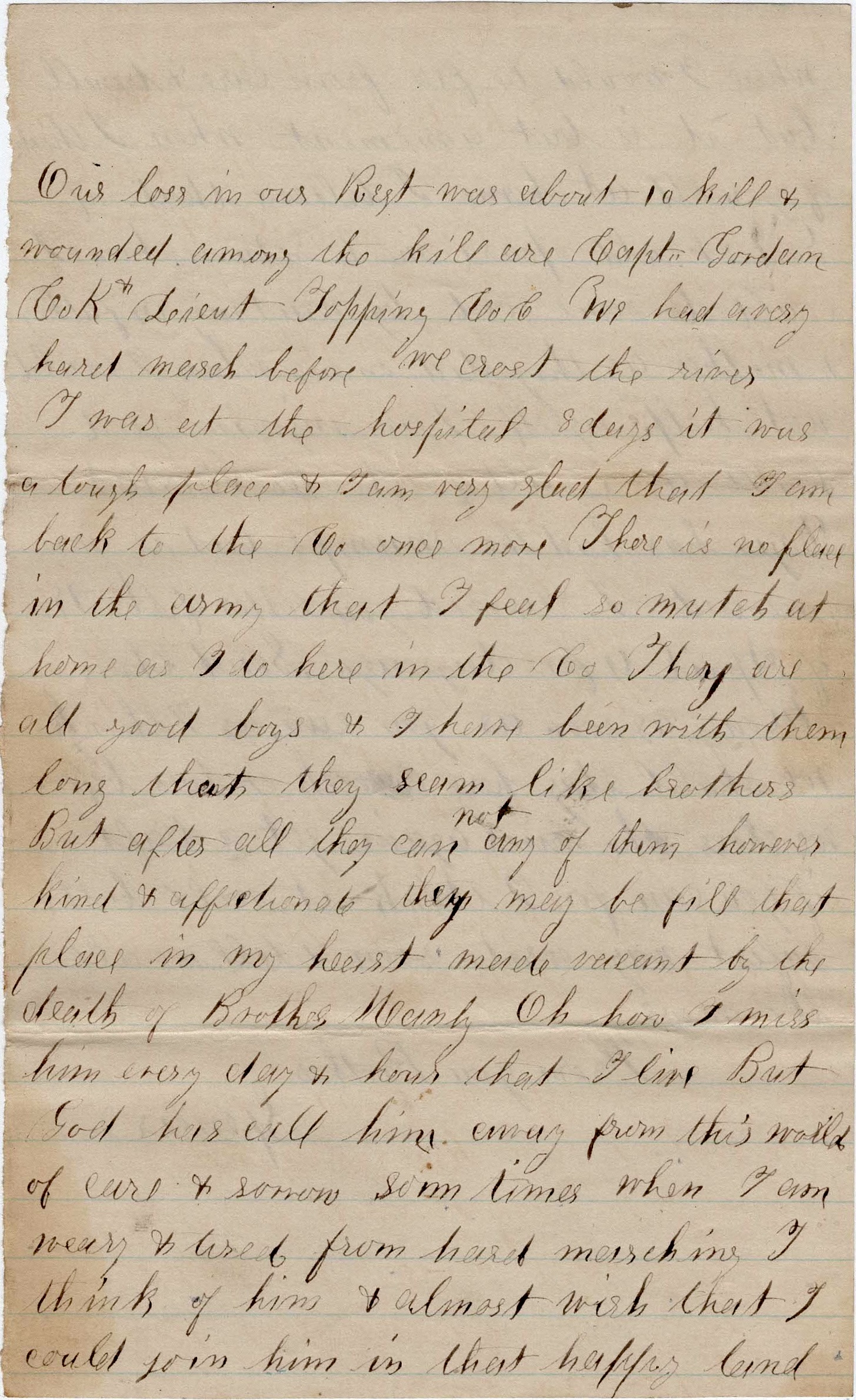
Our Brigade has covered themselves with glory (or at least all of the papers say so) in the fight just over. Gen. Wadsworth thanks us in person for our conduct in crossing the river [at Fitzhugh’s Crossing] in boats under a terrible fire from the rebel sharpshooters. The General swam his horse across the river so as to take part in the fight himself, Our Brigade also took 230 prisoners. Among them was a Colonel & several other officers. Their loss in killed was about 50 while trying to prevent us from crossing the river. Our loss in the regiment was about ten killed and wounded. Among the killed are Capt. [Alexander] Gordon, Co. K, Lieutenant [William O.] Topping Co. C.
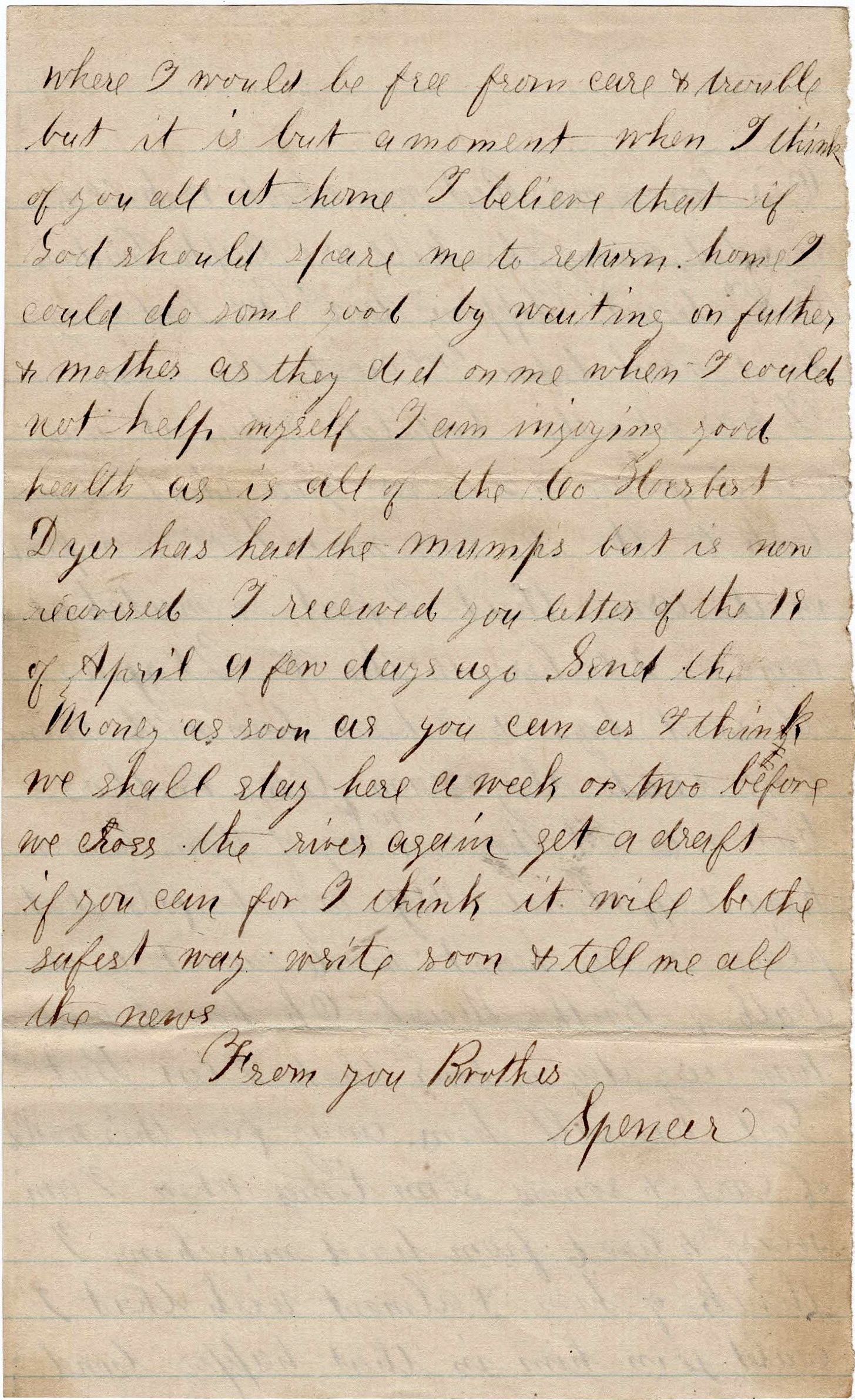
We had a very hard march before we crossed the river. I was at the hospital 8 days. It was a tough place & I am very glad that I am back to the company once more. There is no place in the army that I feel so much at home as I do here in the company. They are all good boys & I have been with them [so] long that they seem like brothers. But after all, they cannot any of them, however kind and affectionate they may be, fill that place in my heart made vacant by the death of brother Manly. Oh! how I miss him every day and hour that I live. But God has called him away from this world of care and sorrow. Sometimes when I am weary and tired from hard marching, I think of him and almost wish that I could join him in that happy land where I would be free from care and trouble. But it is but a moment when I think of you all at home. I believe that if God should spare me to return home, I could do some good by waiting on father & mother as they did on me when I could not help myself.
I am enjoying good health as is all of the company. Herbert Dyer has had the mumps but is now recovered. I received your letter of the 19th of April a few days ago. Send the money as soon as you can as I think we shall stay here a week or two before we cross the river again. Get a draft if you can for I think it will be the safest way. Write soon and tell me all the news. From your brother, — Spencet
Letter 11
Camp near Warrenton Station
June 14th, [1863]
Dear Sister,
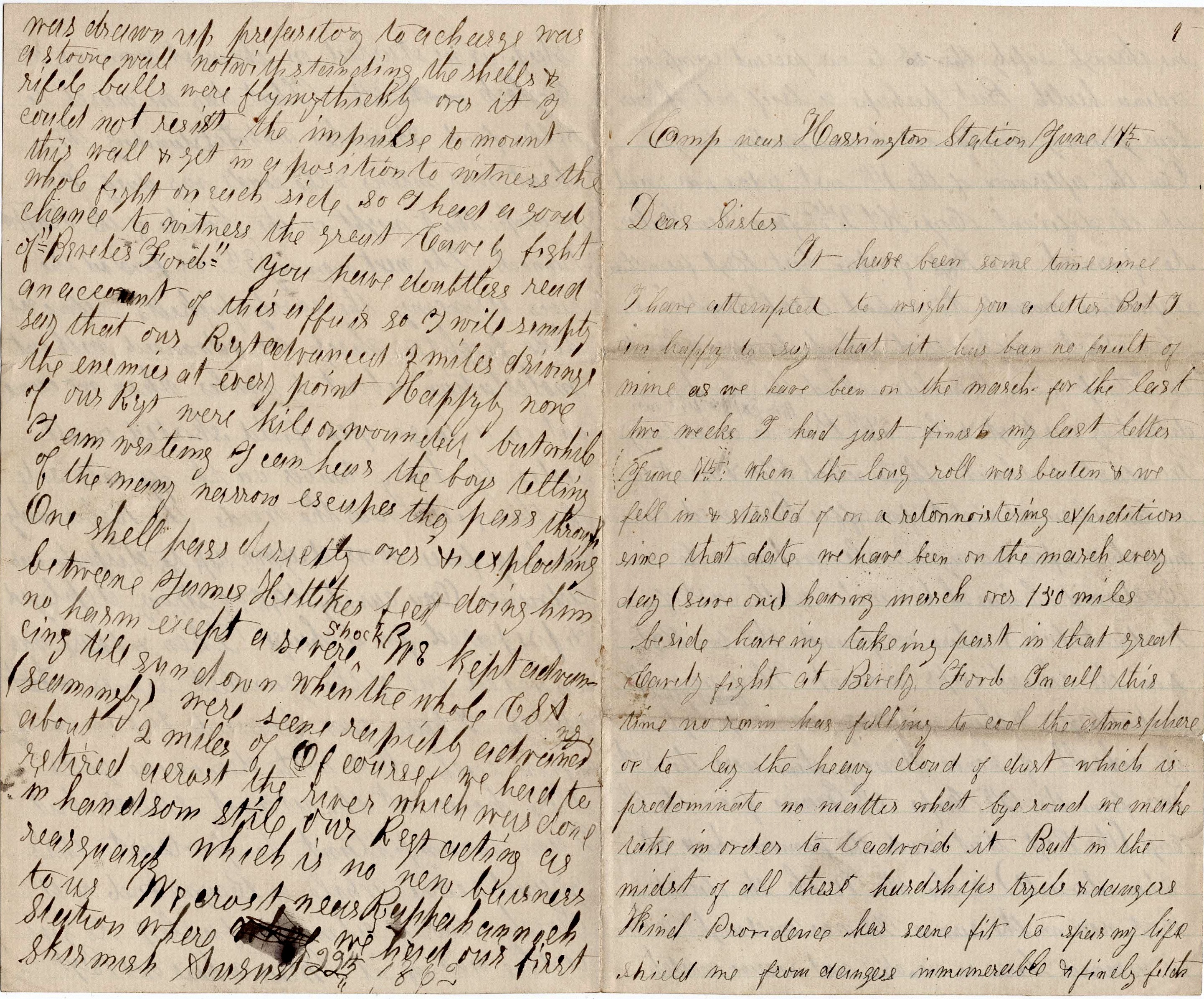
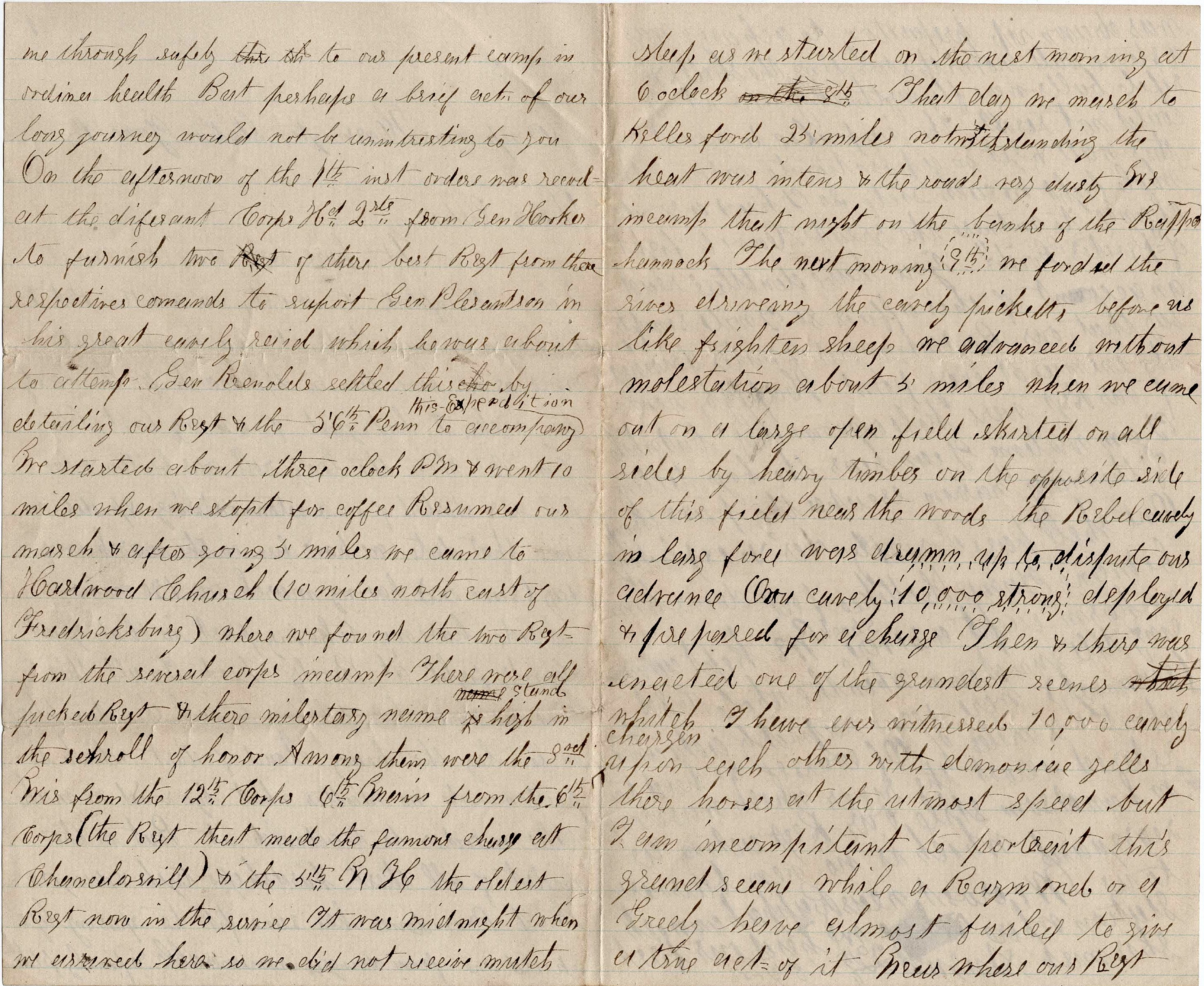
It has been some time since I have attempted to write you a letter but I am happy to say that it has been no fault of mine as we have been on the march for the last two weeks. I had just finished my last letter (June 1st) when the long roll was beaten & we fell in & started off on a reconnoitering expedition. Since that date we have been on the march every day (save one), having marched over 150 miles besides having taken part in that great cavalry fight at Beverly’s Ford [on June 9th]. In all this time, no rain has fallen to cool the atmosphere or to lay the heavy cloud of dust which is predominant no matter what bi-road we may take in order to avoid it. But in the midst of all these hardships, trials, and dangers, kind Providence has seen fit to spare my life, shield me from dangers innumerable, & finally fetch me through safely to our present camp in ordinary health. But perhaps a brief account of our long journey would not be uninteresting to you.
On the afternoon of the 1st inst., orders was received at the different Corps Headquarters from Gen. Hooker to furnish two of their best regiments from their respective commands to support Gen. Pleasanton in his great cavalry raid which he was about to attempt. Gen. Reynolds settled this by detailing our regiment and the 56th Pennsylvania to accompany this expedition. We started about three o’clock p.m. and went 10 miles when we stopped for coffee. Resumed our march & after going 5 miles we came to Hartwood Church (10 miles northeast of Fredericksburg) where we found the two regiments from the several corps in camp. They were all picked regiments & their military name stands high in the scroll of honor. Among them were the 3rd Wisconsin from the 12th Corps, 6th Maine from the 6th Corps (the regiment that made the famous charge at Chancellorsville) & the 5th New Hampshire—the oldest regiment now in the service.
It was midnight when we arrived here so we did not receive much sleep as we started on the next morning at 6 o’clock. That day we marched to Kelly’s Ford 25 miles notwithstanding the heat was intense & the roads very dusty. We encamped that night on the banks of the Rappahannock. The next morning (9th) we forded the river, driving the cavalry pickets before us like frightened sheep. We advanced without molestation about 5 miles when we came out on a large open field skirted on all sides by heavy timber. On the opposite side of this field near the woods, the rebel cavalry in large force was drawn up to dispute our advance. Our cavalry (10,000 strong) deployed and prepared for a charge. Then & there was enacted one of the grandest scenes which I have ever witnessed. 10,000 cavalry charging upon each other with demoniac yells, their horses at the utmost speed. But I am incompetent to portrait this grand scene while a [Henry] Raymond [of the NY Times] or a [Horace] Greeley [of the NY Tribune] have almost failed to give a true account of it.
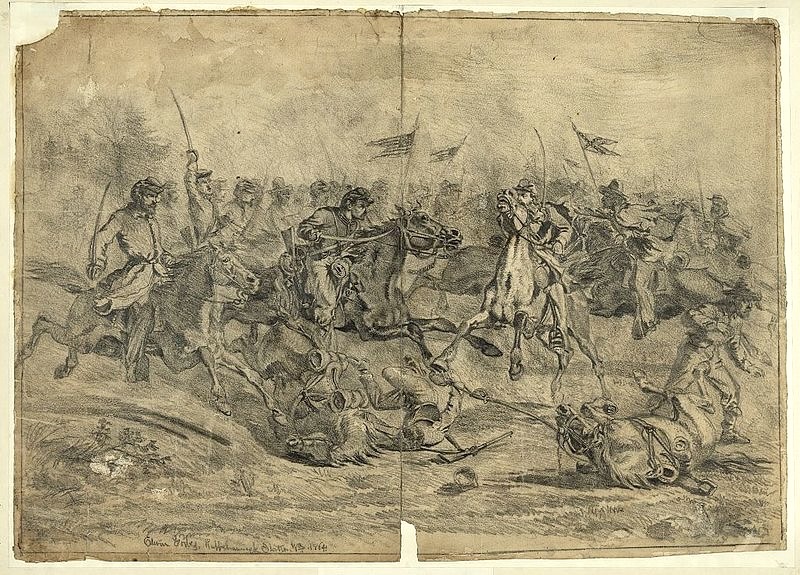
Near where our regiment was drawn up, preparatory to a charge, was a stone wall. Notwithstanding the shells and rifle balls were flying thickly over it, I could not resist the impulse to mount this wall & get in a position to witness the whole fight on each side, so I had a good chance to witness the great cavalry fight of “Beverly’s Ford.” You have doubtless read an account of this affair so I will simply say that our regiment advanced two miles, driving the enemy at every point. Happily none of our regiment were killed or wounded. But while I am writing, I can hear the boys telling of the many narrow escapes they passed through. One shell passed directly over & exploding between James Helliker’s feet, doing him no harm except a severe shock. We kept advancing till sundown when the whole CSA (seemingly) were seen rapidly advancing about two miles off. Of course, we had to retire across the river which was done in handsome style, our regiment acting as rear guard which is no new business to us. We crossed near Rappahannock Station where we had our first skirmish August 22nd 1862.
June 18th.
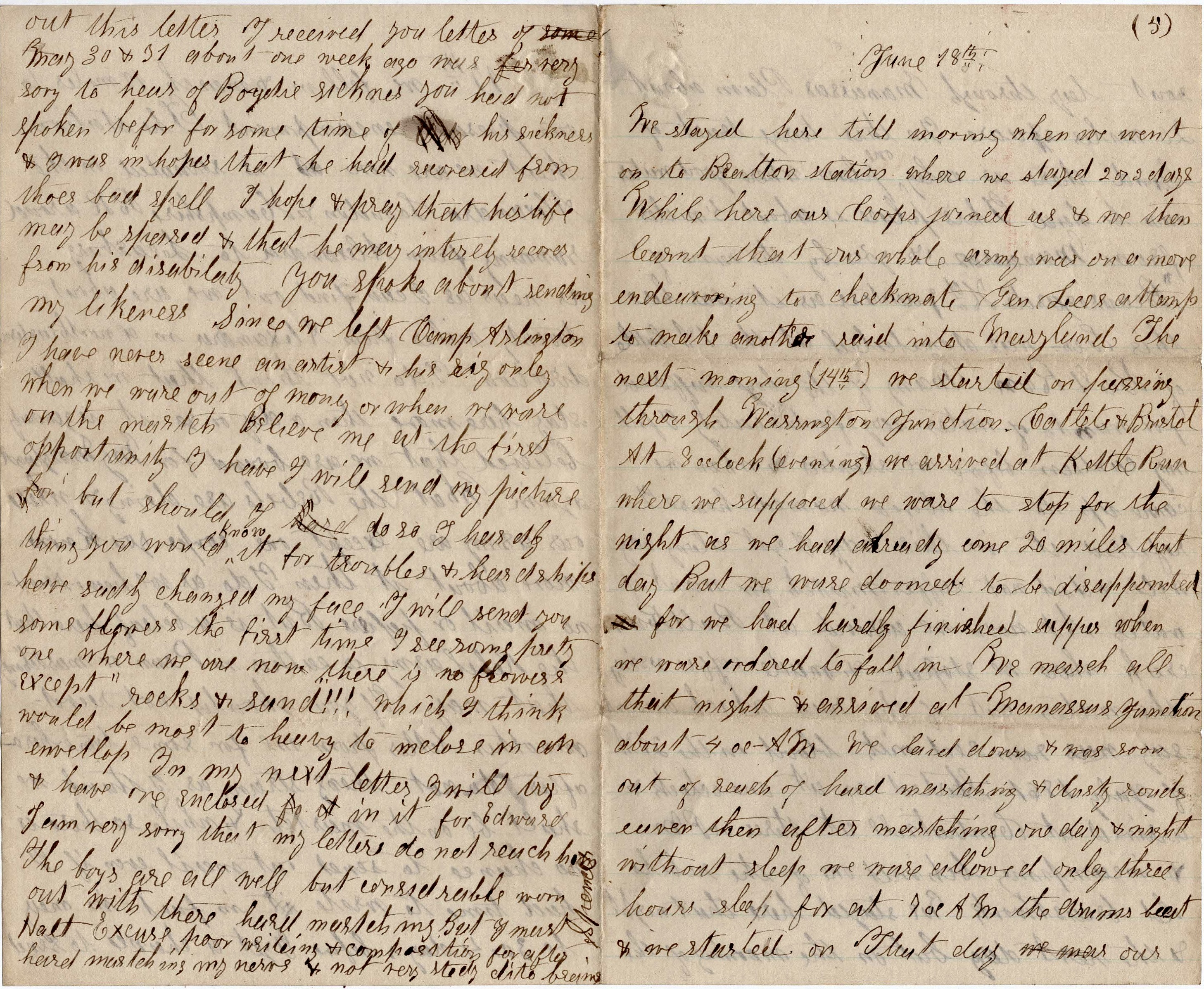
We stayed here till morning when we went on to Bealeton Station where we stopped 2 or 3 days. While here, our Corps joined us & we then learned that our whole army was on a move, endeavoring to checkmate Gen. Lee’s attempt to make another raid into Maryland.
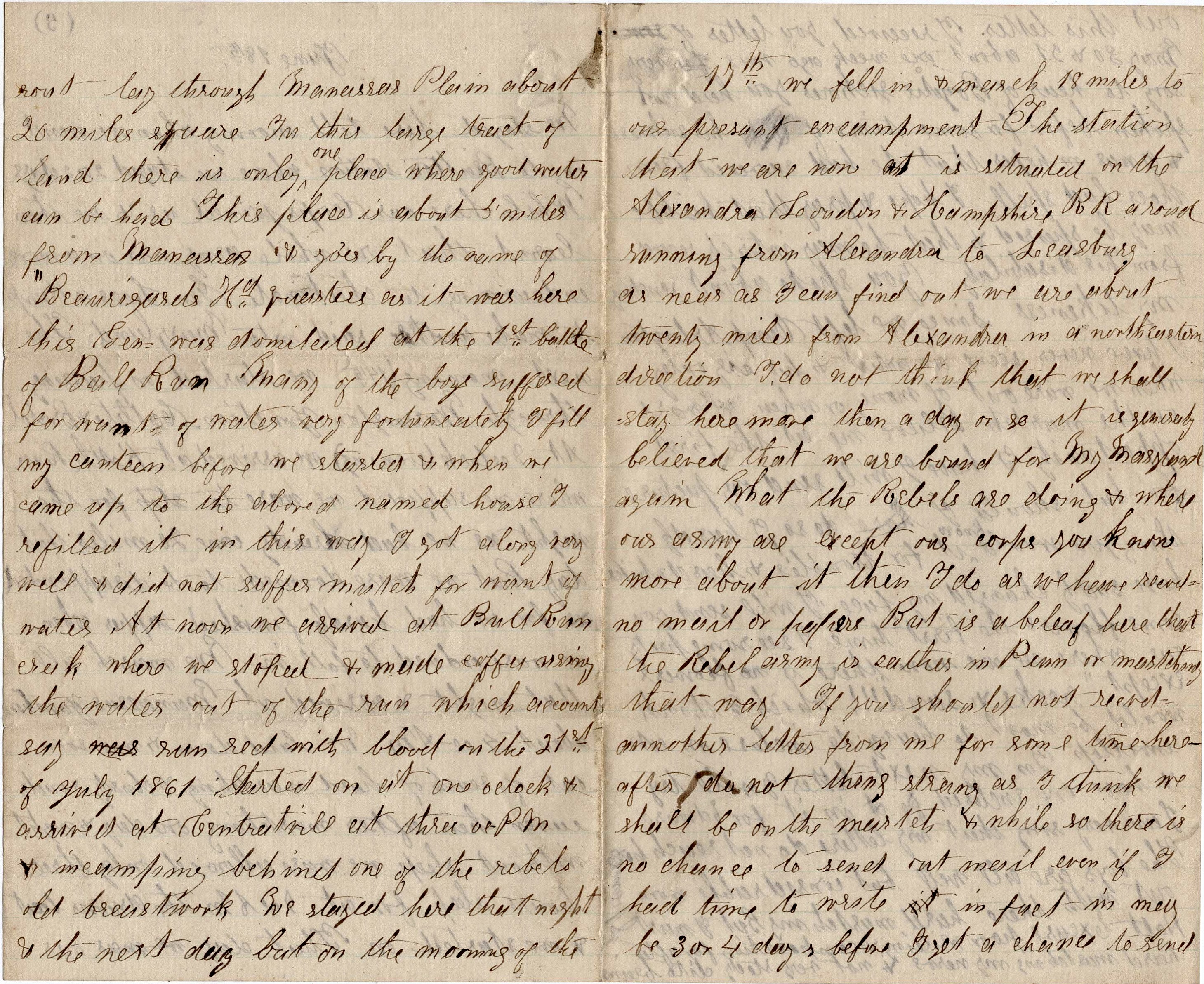
The next morning (14th) we started on pressing through Warrenton Junction, Catlett’s & Bristol. At 8 o’clock (evening) we arrived at Kettle Run where we supposed we were to stop for the night as we had already come 20 miles that day. But we were doomed to be disappointed for we had hardly finished supper when we were ordered to fall in. We marched all that night & arrived at Manassas Junction about 4 o’clock a.m. We laid down & was soon out of reach of hard marching & dusty roads. Even then, after marching one day and night without sleep, we were allowed only three hours sleep for at 7 o’clock a.m., the drums beat and we started on. That day our rout lay through Manassas Plain, about twenty miles square. In this large tract of land there is only one place where good water can be had. This place is about 5 miles from Manasses & goes by the name of “Beauregard’s Headquarters” as it was here this General was domiciled at the 1st Battle of Bull Run. Many of the boys suffered for want of water. Very fortunately I filled my canteen before we started & when we came up to the above named house, refilled it. In this way I got along very well & did not suffer much for want of water.
At noon we arrived at Bull Run Creek where we stopped & made coffee using the water out of the run which accounts say ran red with blood on the 21st of July 1861. Started on at one o’clock & arrived at Centerville at three o’clock p.m. and encamped behind one of rebel’s old breastworks. We stayed here that night and the next day but on the morning of the 17th, we fell in and marched 18 miles to our present encampment. The station that we are now at is situated on the Alexandria, Loudoun & Hampshire [AL&H] Railroad—a road running from Alexandria to Leesburg. As near as I can find out, we are about twenty miles from Alexandria in a northeastern [northwestern] direction. I do not think that we shall stay here more than a day or so. It is generally believed that we are bound for My Maryland again. What the rebels are doing & where our army are—except our Corps—you know more about it than I do as we have received no mail or papers. But [there] is a belief here that the rebel army is either in Pennsylvania or marching that way.
If you should not receive another letter from me for some time hereafter, do not think [it] strange as I think we shall be on the march and while so, there is no chance to send out mail, even if I had time to write. In fact, it may be three or four days before I get a chance to send out this letter. I received your letter of May 30 & 31 about one week ago. Was very sorry to hear of Boydie’s sickness. You had not spoken before for some time of his sickness & I was in hopes that he had recovered from those bad spells. I hope and pray that his life may be spared & that he may entirely recover from his disability.
You spoke about sending my likeness. Since we left Camp Arlington, I have never seen an artist & his rig—only when we were out of money or when we were on the march. Believe me, at the first opportunity I have, I will send my picture. But should I do so, I hardly think you would know it for troubles and hardships have sadly changed my face. I will send you some flowers the first time I see some pretty ones. Where we are now, there is no flowers except rocks and sand!!! which I think would be most too heavy to enclose in an envelope. In my next letter, I will try & have one enclosed in it for Edward. I am very sorry that my letters do not reach him.
The boys are all well but considerable worn out with their hard marches. But I must halt. Excuse my poor writing & composition for after hard marching, my nerves are not very steady. From Spencer
Letter 12
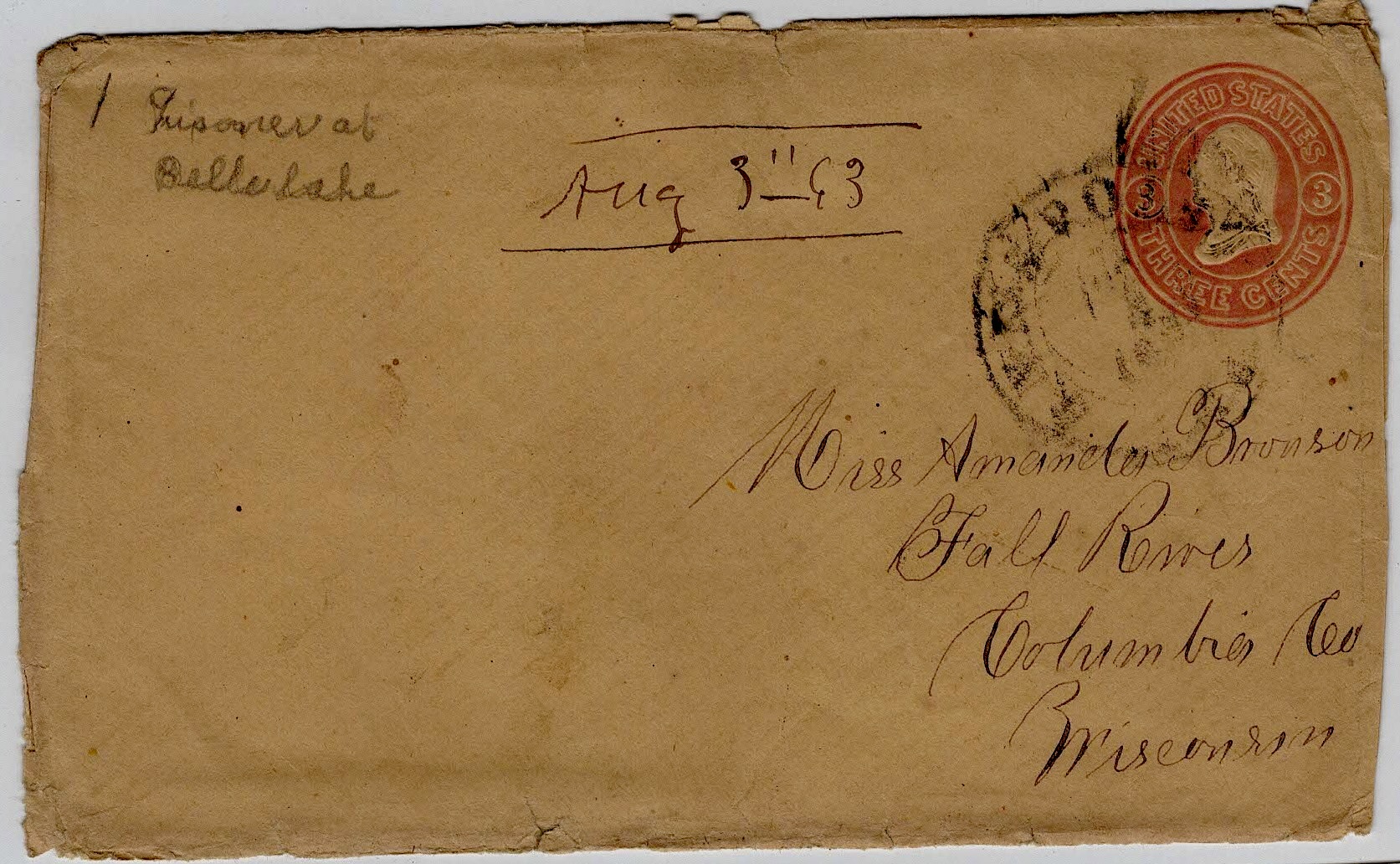
College Green Barracks
Annapolis, Md
August 3rd [1863]
Dear Friends,
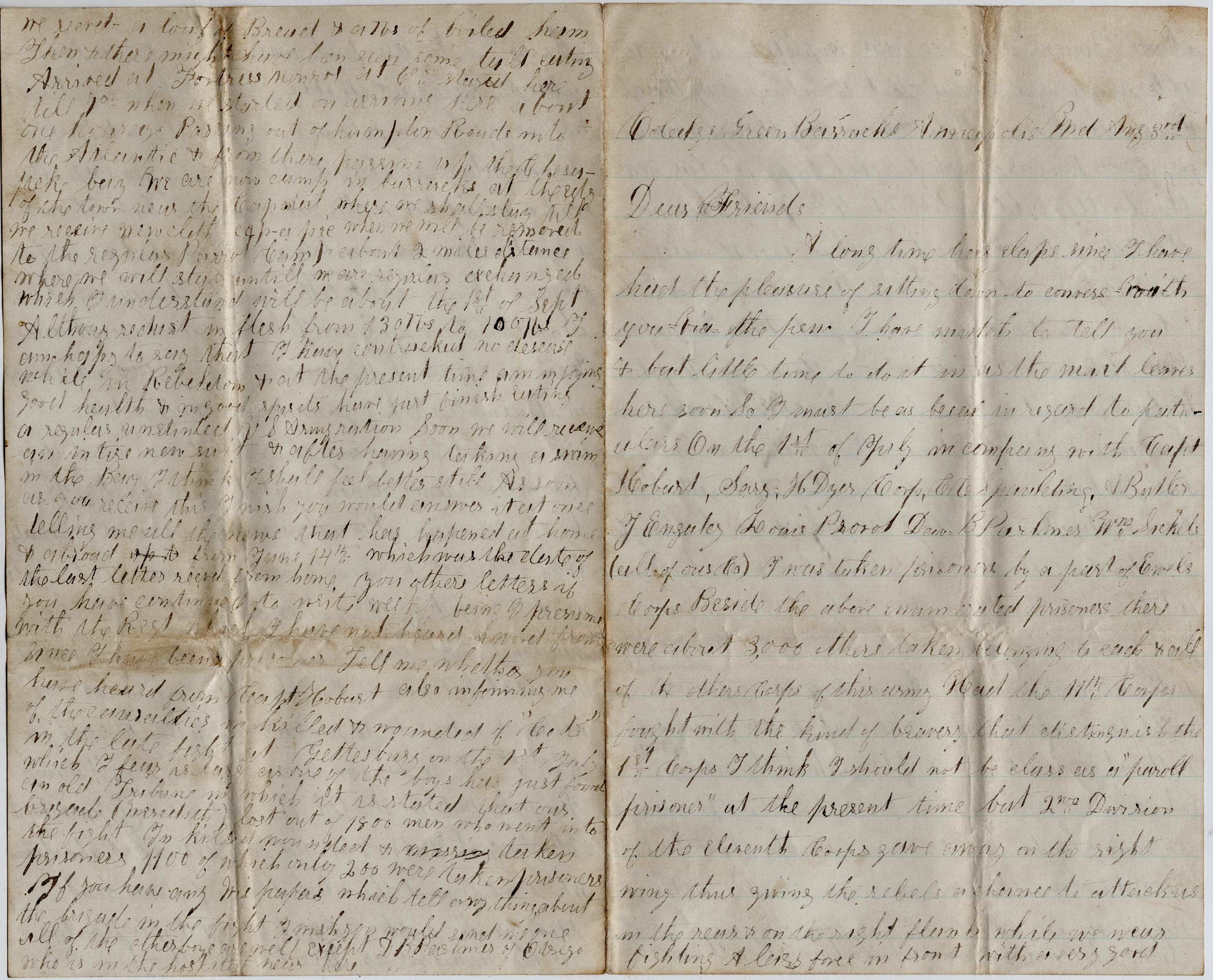
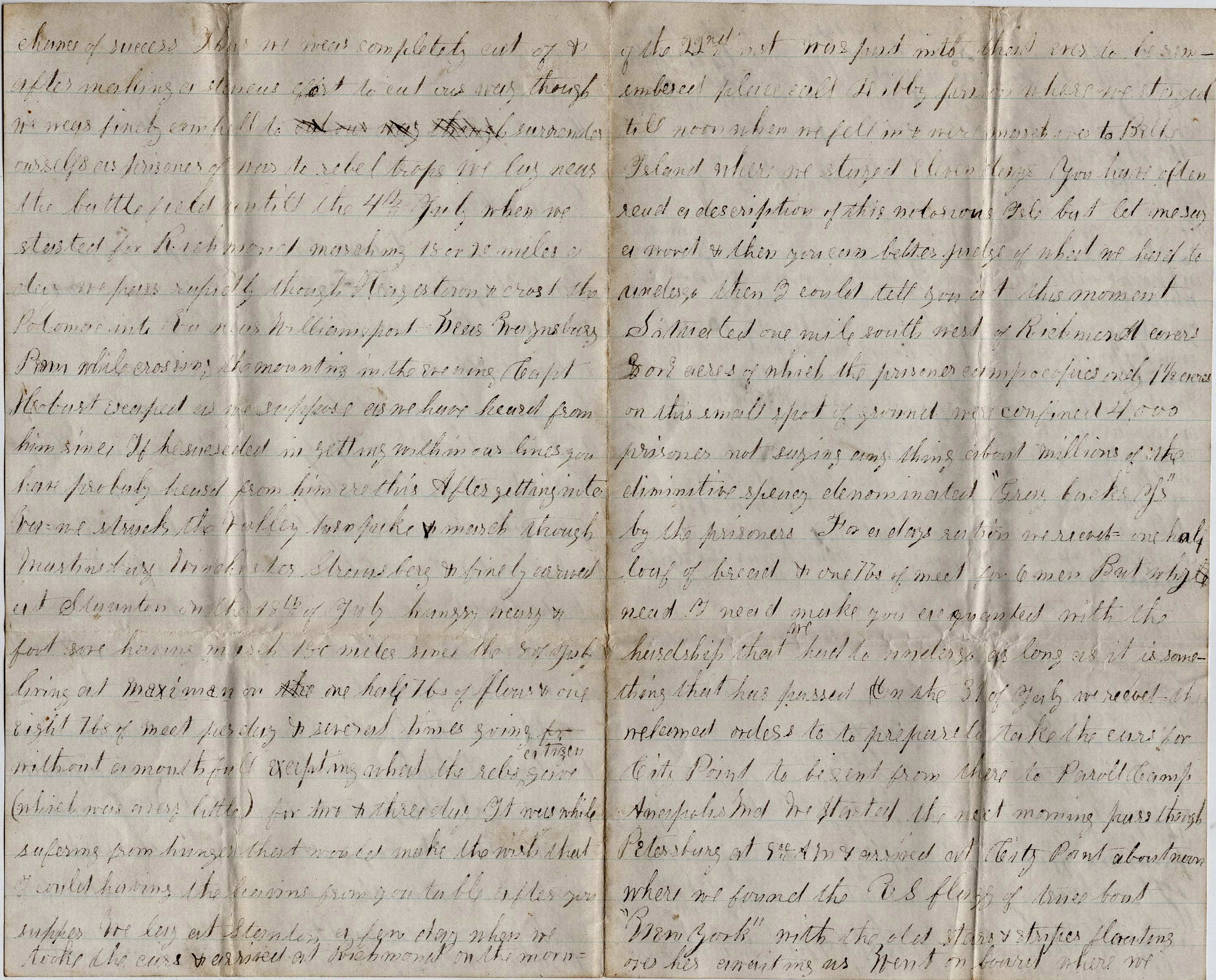
A long time has elapsed since I have had the pleasure of sitting down to converse with you via the pen. I have much to tell you & but little time to do it in as the mail leaves here soon, so I must be as brief in regard to particulars.
On the 1st of July, in company with Capt. [Martin] Hobart, Sergt. H[erbert] Dyer, Corp. C[harles] C. Spaulding, & A[lbert] Butler, J[ulius] Engleckee, Louis Privost, David B. Palmer, Wm. Sickels (all of our Co.), I was taken prisoner by a part of Ewell’s Corps. Besides the above enumerated prisoners, there were about 3,000 others taken belonging to each & all of the other corps of this army. Had the 11th Corps fought with the kind of bravery that distinguished the 1st Corps, I think I should not be classed as a “parole prisoner” at the present time. But the 2nd Division of the 11th Corps gave way on the right wing, thus giving the rebels a chance to attack us in the rear & on the right flank while we were fighting a large force in our front with a very good chance of success. Thus we were completely cut off & after making a strenuous effort to cut our way through, we were finally compelled to surrender ourselves as prisoners of war to rebel troops.
We lay near the battlefield until the 4th of July, when we started for Richmond, marching 18 or 20 miles a day. We passed rapidly through Hagerstown & crossed the Potomac into Virginia near Williamsport. Near Waynesburg, Pennsylvania, while crossing the mountains in the evening, Capt. Hobart escaped, as we suppose, as we have not heard from him since. If he succeeded in getting within our lines, you have probably heard from him ere this.
After getting into Virginia, we struck the Valley turnpike & marched through Martinsburg, Winchester, Strasburg, & finally arrived at Staunton on the 18th of July, hungry, weary, & foot sore, having marched 180 miles since the 8th of July, living at maximum on one half lb. of flour & one eighth lb. of meat per day, & several times going without a mouthful, excepting what the rebel citizens gave (which was very little) for two & three days. It was while suffering from hunger that I would make the wish that I could have my leavings from your table after your supper.
We lay at Staunton a few days, when we took the cars & arrived at Richmond on the morning of the 22nd inst., and were put into that ever-to-be-remembered place called Libby Prison, where we stayed till noon, when we fell in & were marched over to Belle Island, where we stayed eleven days. You have often read descriptions of this notorious Isle, but let me say a word, & then you can better judge of what we had to undergo than I could tell you at this moment. Situated about one mile southwest of Richmond covers 8 or 9 acres of which the prison camp occupies only 1½ acres. On this small spot of ground were confined 4,000 prisoners, not saying anything about millions of the diminutive spiny denominated “Grey Backs” by the prisoners.
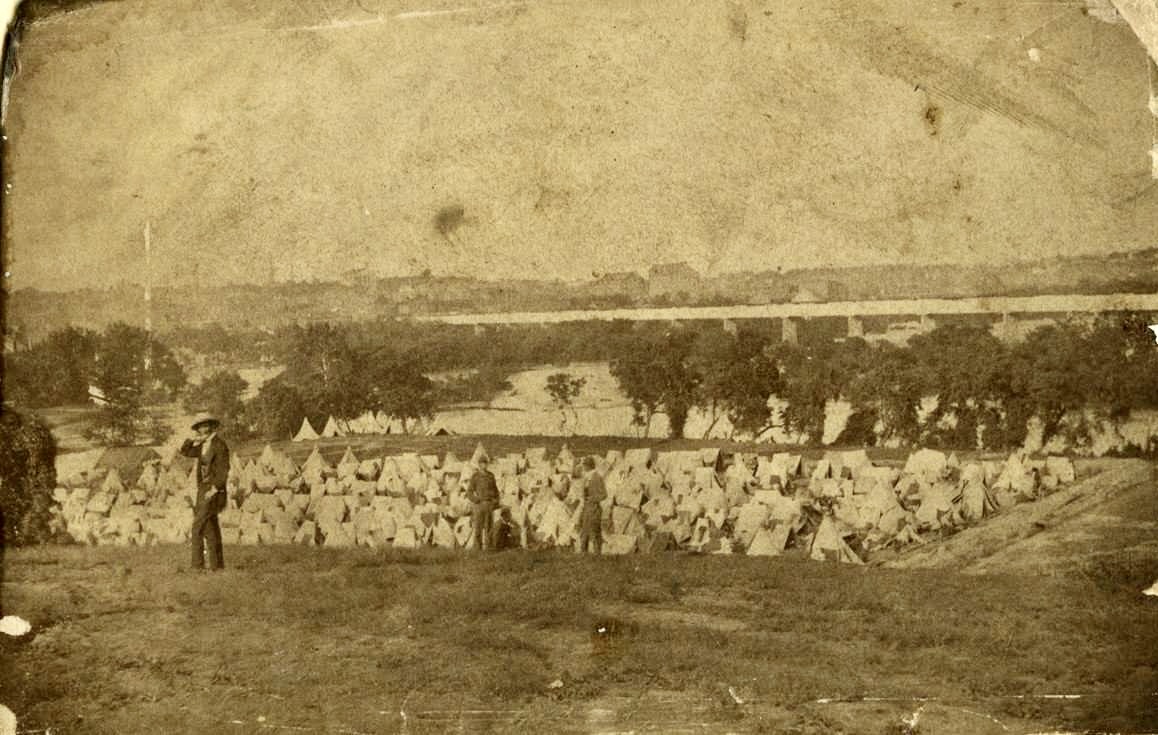
For a day’s ration we received one half loaf of bread & one lb. of meat for 6 men. But why need I make you acquainted with the hardship that we had to undergo as long as it is something that has passed.
On the 31st of July, we received the welcomed orders to prepare to take the cars for City Point, to be sent from there to Parole Camp, Annapolis, Md. We started the next morning, passed through Petersburg at 9 a.m. & arrived at City Point about noon, where we found the U. S. Flag of truce boat, New York, with the old stars & stripes floating over her awaiting us. We went on board & there received a loaf of bread & a lb. of boiled ham. Then & there might have been seen some tall eating.
Arrived at Fortress Monroe at 6 o’clock, stayed there till 7 o’clock, when we started on, arriving here about one hour ago. Passing out of Hampton Roads into the Atlantic & from there passing up the Chesapeake Bay, we are now camped in barracks at the edge of the town near the Capitol where we shall stay till we receive new clothing & are removed to the regular Parole Camp about 2 miles distant, where we will stay until we are regularly exchanged, which I understand will be about the 1st of September.
Although reduced in flesh from 130 lbs. to 100 lbs., I am happy to say that I have contracted no disease while in Rebeldom, & at the present time am enjoying good health & in good spirits. I have just finished eating a regular, untainted U.S. Army ration. Soon we will receive an entire new suit, & after taking a swim in the Bay, I think I shall feel better still.
As son as you receive this, I wish you would answer it at once, telling me all the news that has happened at home and abroad from June 14th which was the last letter received from home; your other letters if you have continued to write weekly being, I presume with the regiment which I have not heard a word from since I have been a prisoner. Tell me whether you have heard of Capt. Hobart, also informing me of the casualties in killed & wounded of Co. B in the late fight at Gettysburg on the 1st July, which I fear is large, as one of the boys has just found an old Tribune in which it is stated that our brigade (Meredith’s) lost out of 1,800 men who went into the fight, in killed, wounded, & taken prisoners, 1,100, of which only 200 were taken prisoners.
If you have any Wisconsin papers which tell everything about the brigade in the fight, I wish you would send me one. All of the others are well except D. B. Palmer of Otsego who is in the hospital near here.
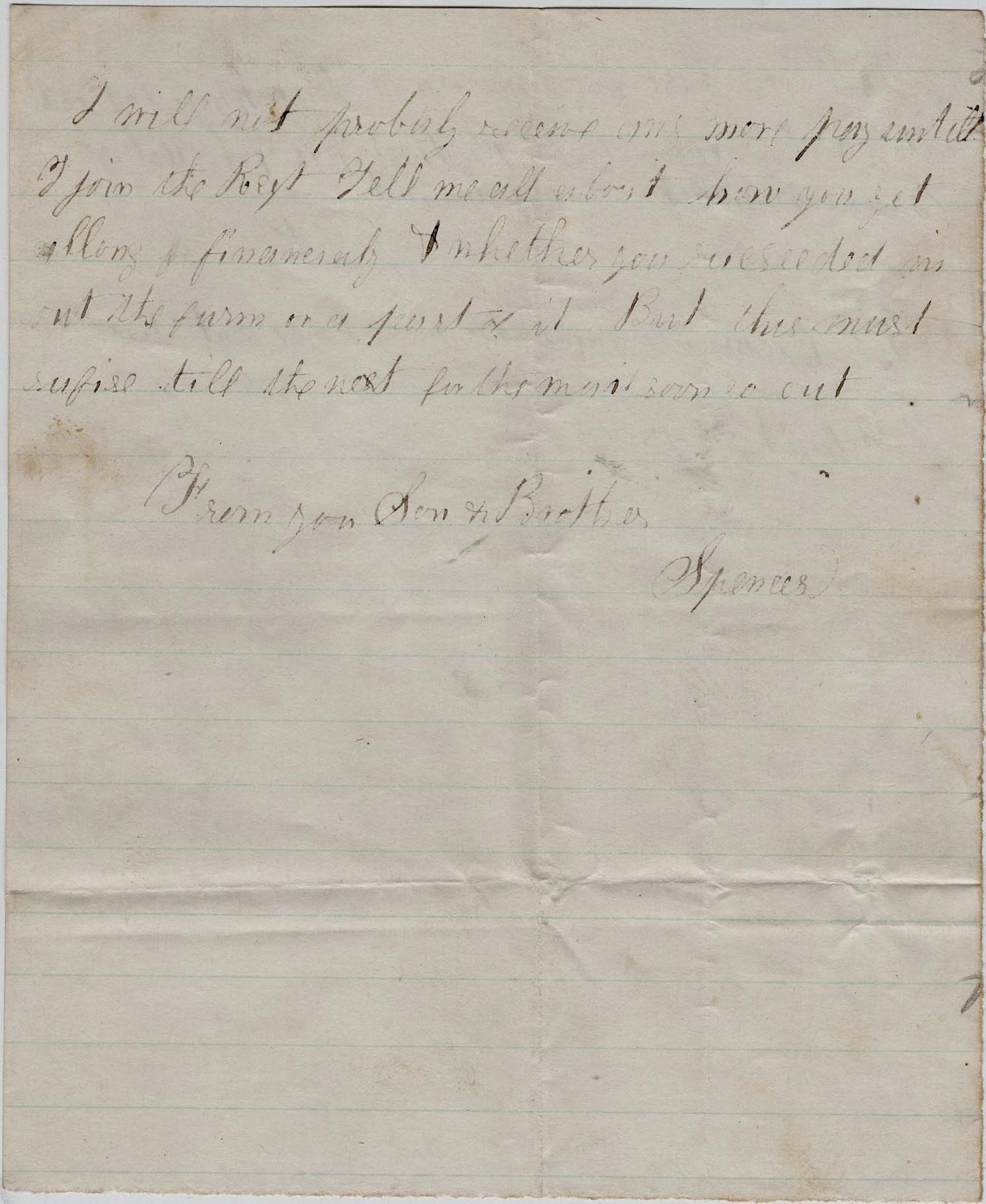
I will not probably receive more pay until I join the regiment. Tell me all about how you get along & whether you succeeded in [letting] out the farm or a part of it. But this must suffice till the next. From your son & brother, — Spencer
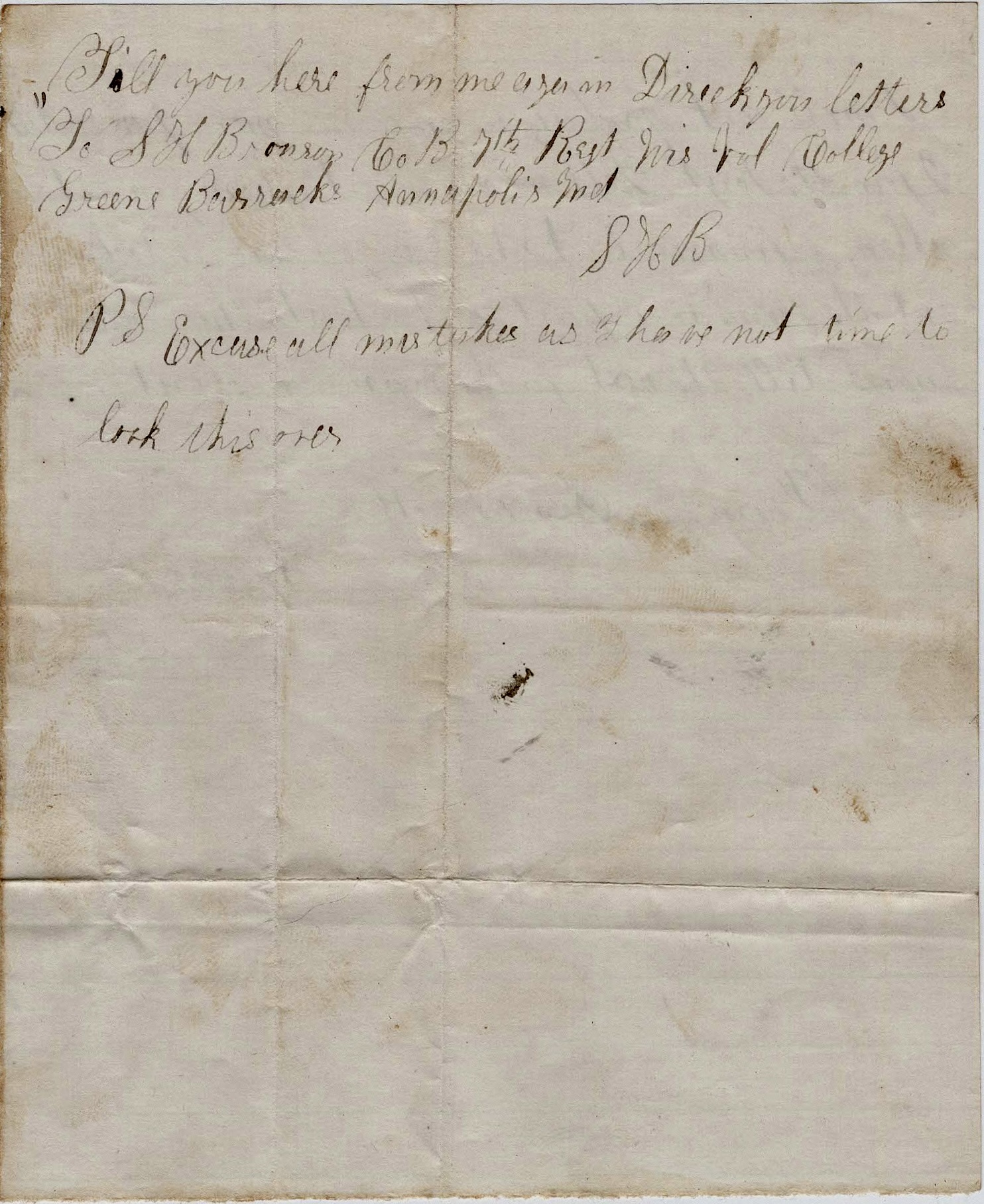
Till you hear from me again, direct your letters to S. H. Bronson, Co. B, 7th Regt., Wisconsin Vol., College Greene Barracks, Annapolis, Md. — S. H. B.
P. S. Excuse all mistakes as I have not time to look this over.
Letter 13
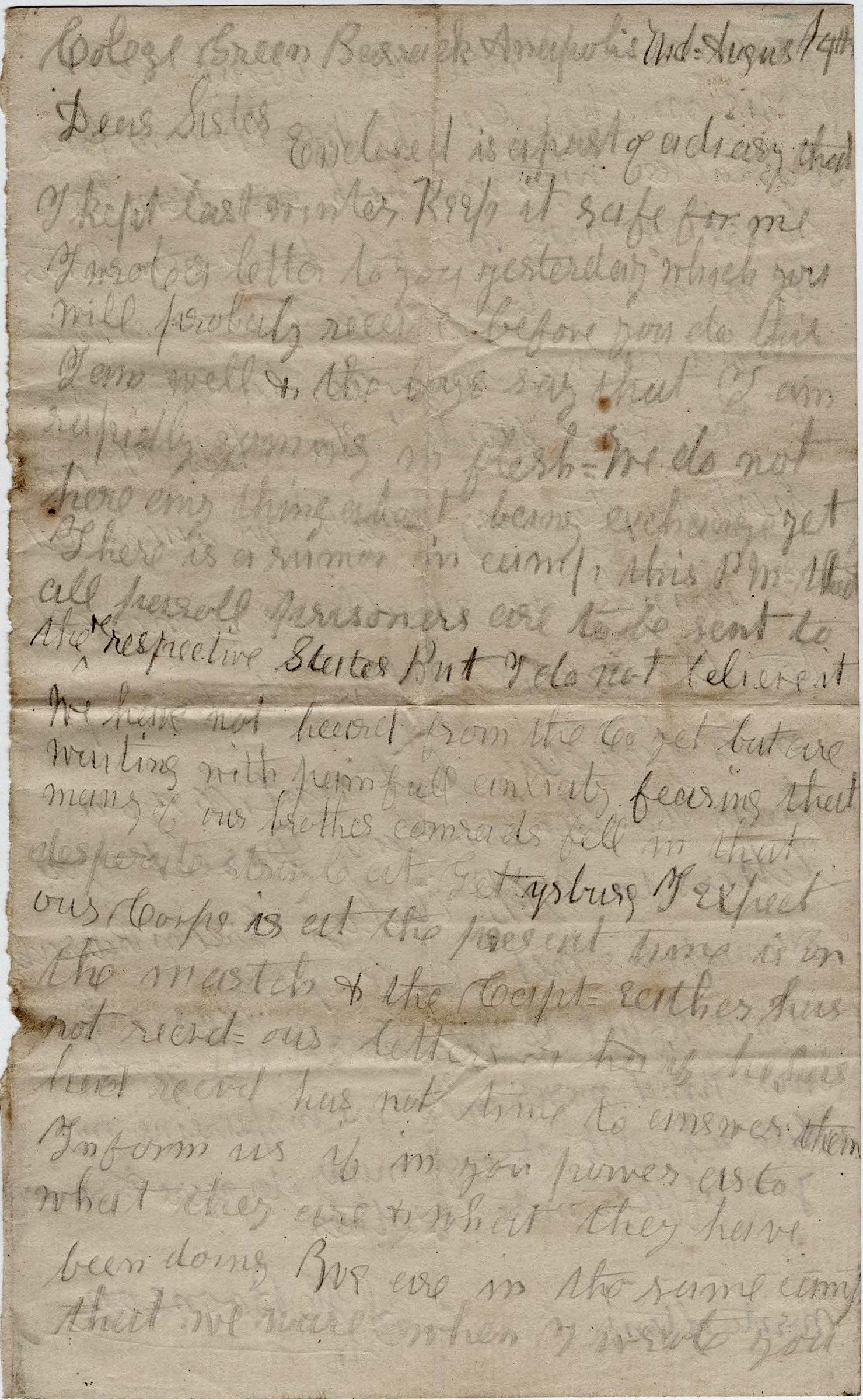
College Green Barracks
Annapolis, Maryland
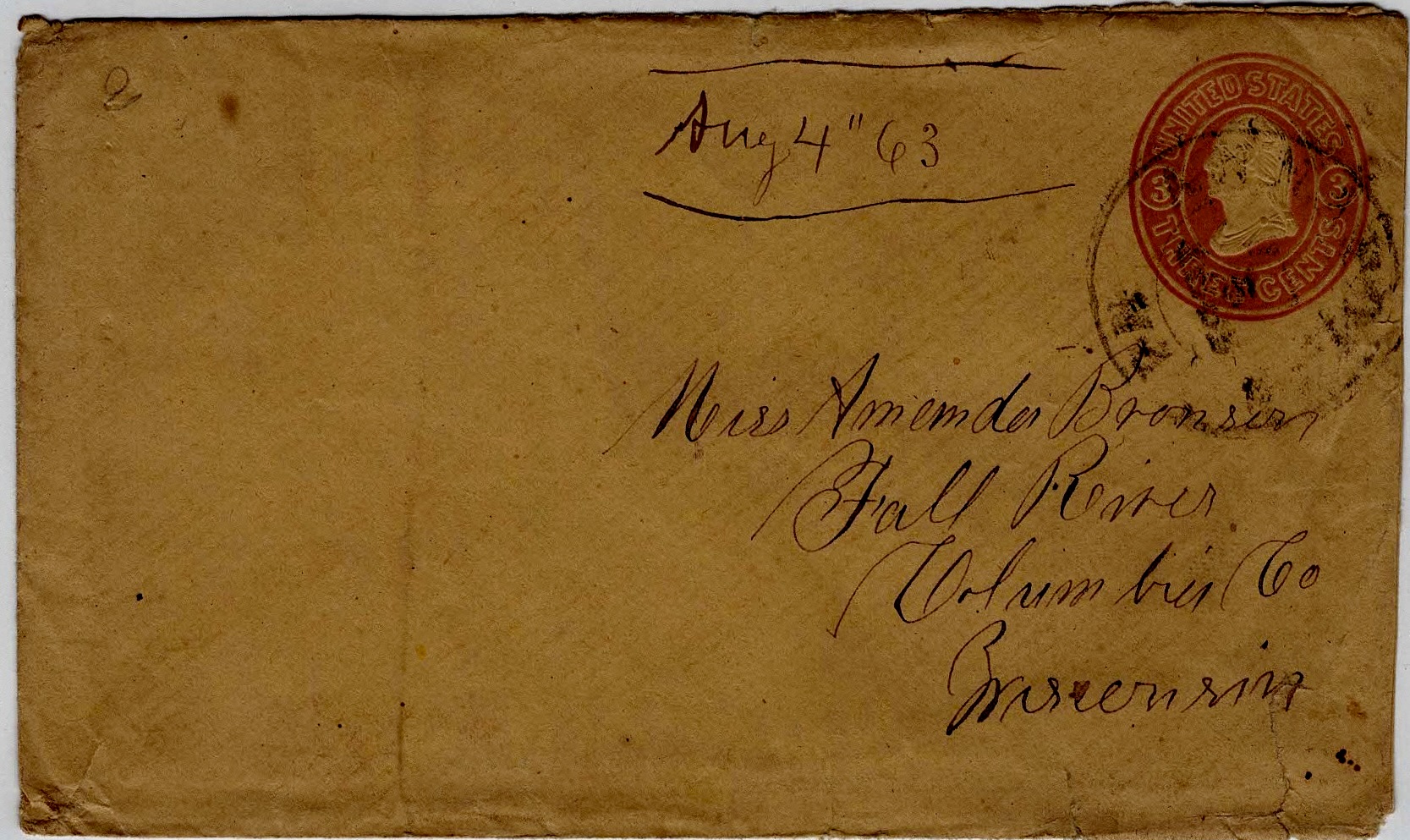
August 4th [1863]
Dear Sister,
Enclosed is a part of a diary that I kept last winter. Keep it safe for me. I wrote a letter to you yesterday which you will probably receive before you do this. I am well & the boys say that I am rapidly gaining in flesh. We do not hear anything about being exchanged yet. There is a rumor in camp this p.m. that all paroled prisoners are to sent to their respective states but I do not believe it. We have not heard from the company yet but are waiting with painful anxiety fearing that many of our brother comrades fell in that desperate struggle at Gettysburg. I expect our corps is at the present time on the march and the Captain either has not received our letters or if he has received, has not time to answer them. Inform us if in your power as to what they are and what they have been doing.
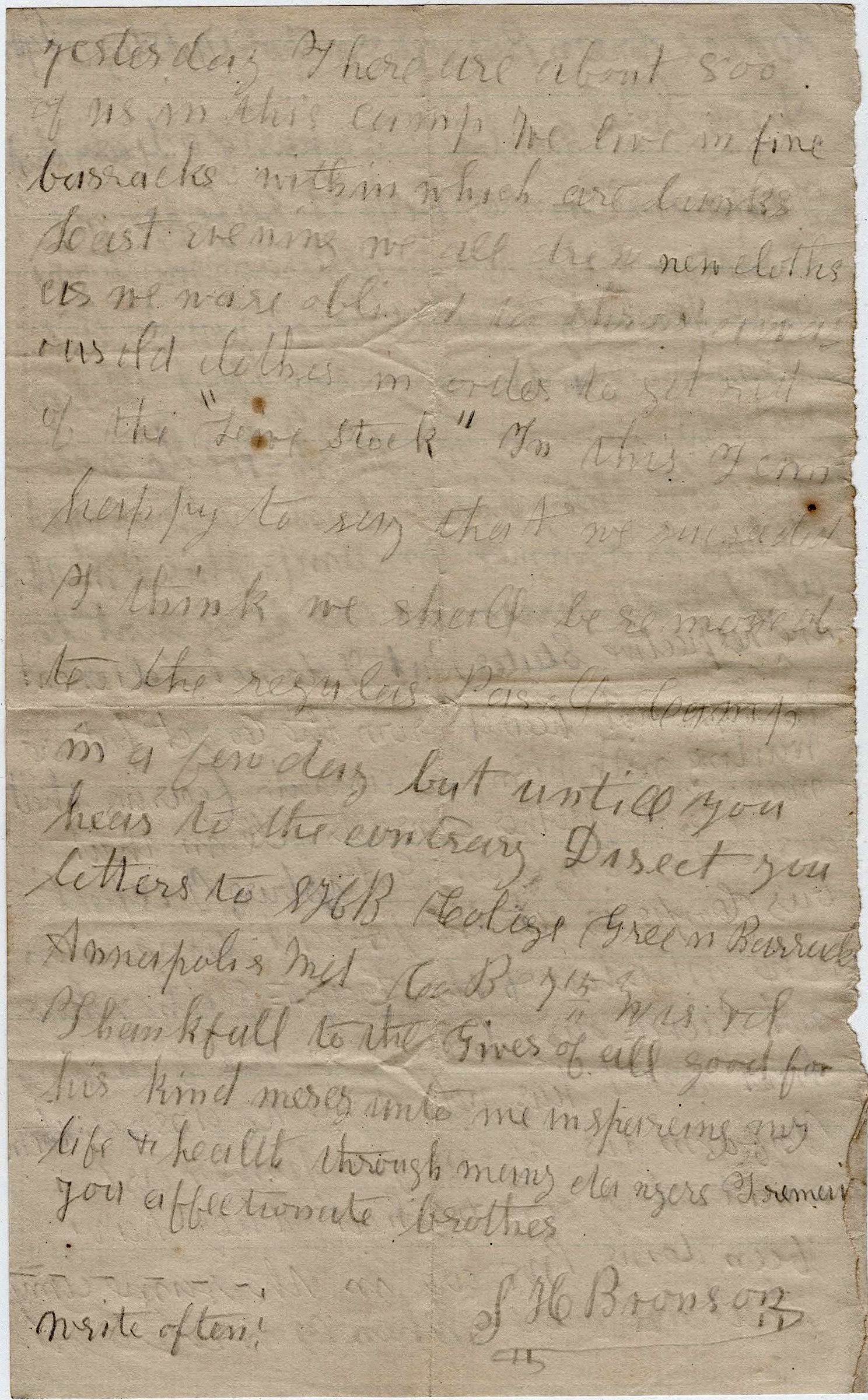
We are in the same camp that we were when I wrote you yesterday. There are about 500 of us in this camp. We live in fine barracks within which are bunks. Last evening we all drew new clothes as we were obliged to throw away our old clothes in order to get rid of the “livestock.” In this, I am happy to say that we succeeded. 1
I think we shall be removed to the regular Parole Camp in a few days but until you hear to the contrary, direct your letters to S. H. B., College Green Barracks, Annapolis, Md. Co. B, 7th Wisconsin Vols.
Thankful to the giver of all good for His kind mercy unto me in sparing my life and health through many dangers, I remain your affectionate brother, — S. H. Bronson
Write often.
1 “St. John’s College was taken over by the Union Army, which used it as a parole camp and later as a military hospital in 1863. Named the “College Green Barracks,” St. John’s served as a landing ground for soldiers in need of fresh clothes and medical attention after being released from Confederate prisons. Wooden barracks were built on the back of campus, each housing around 150 men. These temporary residents reportedly threw their old clothes and shoes into College Creek after receiving new supplies, according to Union Army captain Henry Martyn Lazelle.” [Source: Halloween in Annapolis is a Spooky Affair, thanks to the Spirits of St. John’s College]
 Spared & Shared 23