
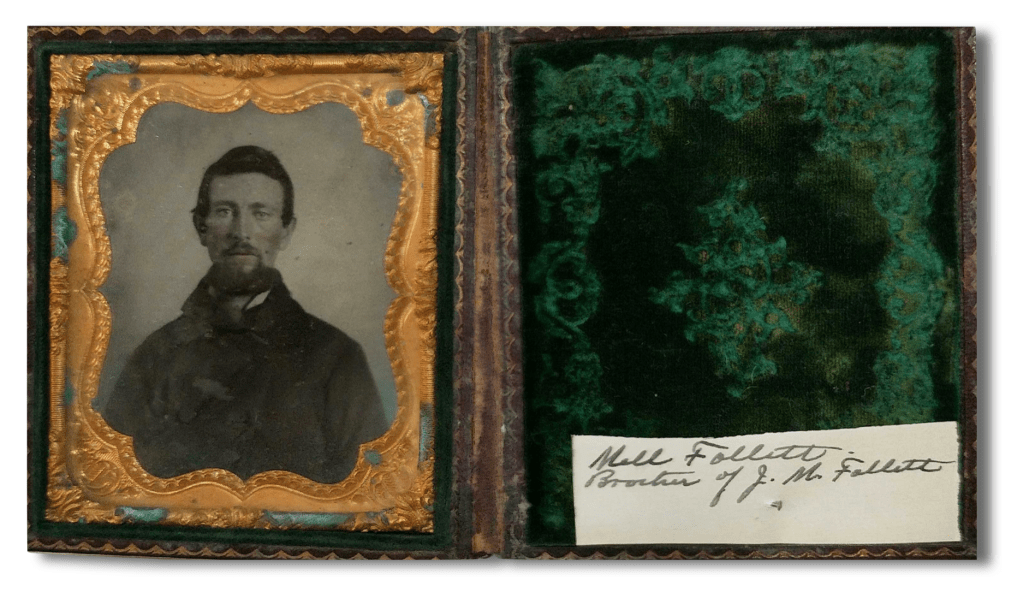
This letter was written by Melville (“Mell”) Cox Follett (1836-1903), the son of Abram Hyatt Follett (1808-1895) and Loraine Everest Meacham (1807-1895).
Mell enlisted on 4 September 1861 in Co. A, 42nd Illinois Infantry. At the time of his enlistment he was described as standing 5 foot 10 inches tall, with blue eyes and brown hair. Mell’s obituary claims that when he was wounded in the Battle of Chickamauga, he laid on the field for several hours before he was conveyed to a field hospital where he remained three weeks. He was later taken to a hospital in Nashville where he was eventually discharged for disability—his wounded knee never fully recovering. When he returned home he was given a job as a drug store clerk and then as a post office clerk, city clerk, and marshal. He served as the City Clerk of Moline, Rock Island, Illinois from 1881 to 1885. The “rheumatism” pain in his leg never subsided, however, and at the age of 67, he finally committed suicide by drinking carbolic acid.
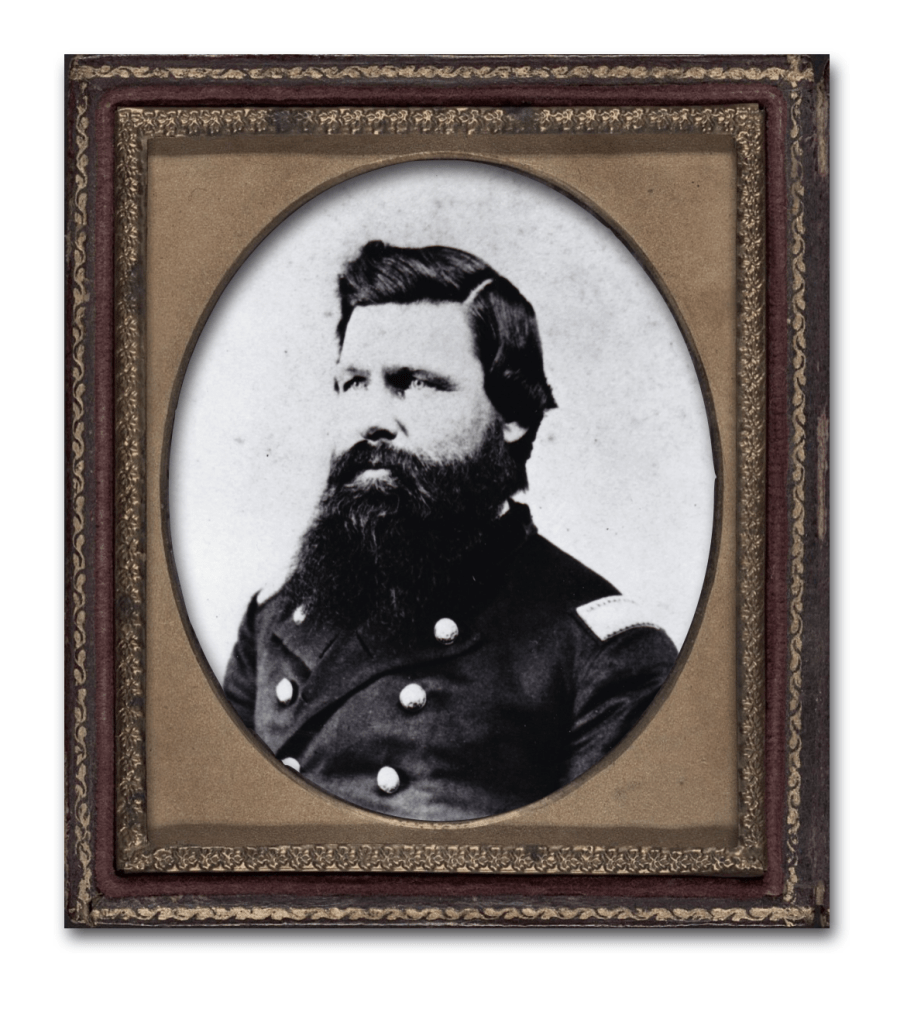
Mell had two older brothers who also served in the Civil War. John Meacham Follett (1832-1908) of Galesburg, Knox county, Illinois, served in Co. H, 33rd Illinois Infantry. See 1863: John Meacham Follett to Jortense Beauharnais Follett. William Follett (1835-1864) served in Co. C, 112th Illinois Infantry. He was killed on 14 May 1864 at the Battle of Resaca.
Mell wrote the letter to the daughters of his sister, Mary Janette (Follett) Benedict, the wife of Elijah Foster Benedict (1825-1888) who was serving at the time as a sergeant in Co. C, 112th Illinois Infantry.
Mell kept a diary during the Civil War, a portion of it is transcribed and posted below his letter that describes his ordeal from the time he was wounded until he reached Chattanooga. [The Ohio State University Archives]
Transcription
General Hospital No. 3
Chattanooga, Tennessee
November 20th [1863]
Dear Girls—Mary & Susie,
You will be somewhat surprised to receive a letter from your Soldier uncle at this time but I assure you that you have not been forgotten. I want to tell you about my wound so that you may tell your mother how I am getting along.
I am now sitting up with a chair behind me, my wounded limb in a sling and I am feeling first best. The wound does not run much and I think is doing finely. So you see, girls, I am in a fair way to recover. Father is still with me and I think his coming saved my life as I was very low when he came and by his good nursing, he saved me. I am still very weak but am gaining strength daily and hope soon to be able to go home.
Girls, I hope you will go to school as long as you can and improve your time so that your mother will be proud of you and when your father get home he will hardly know his girls. Mary, you will study, I know, and Sue, you must keep up with your class. Tell your mother that I received her kind letter and father answered it. Give Miss Nowers my best respects and your mother my love and when you see grandmother, tell her I am getting well. I am too weak to write any more.
Your grandfather sends love to your mother and all the children. Yours with much love. — Mell C. Follett


Portion of Mell’s Diary
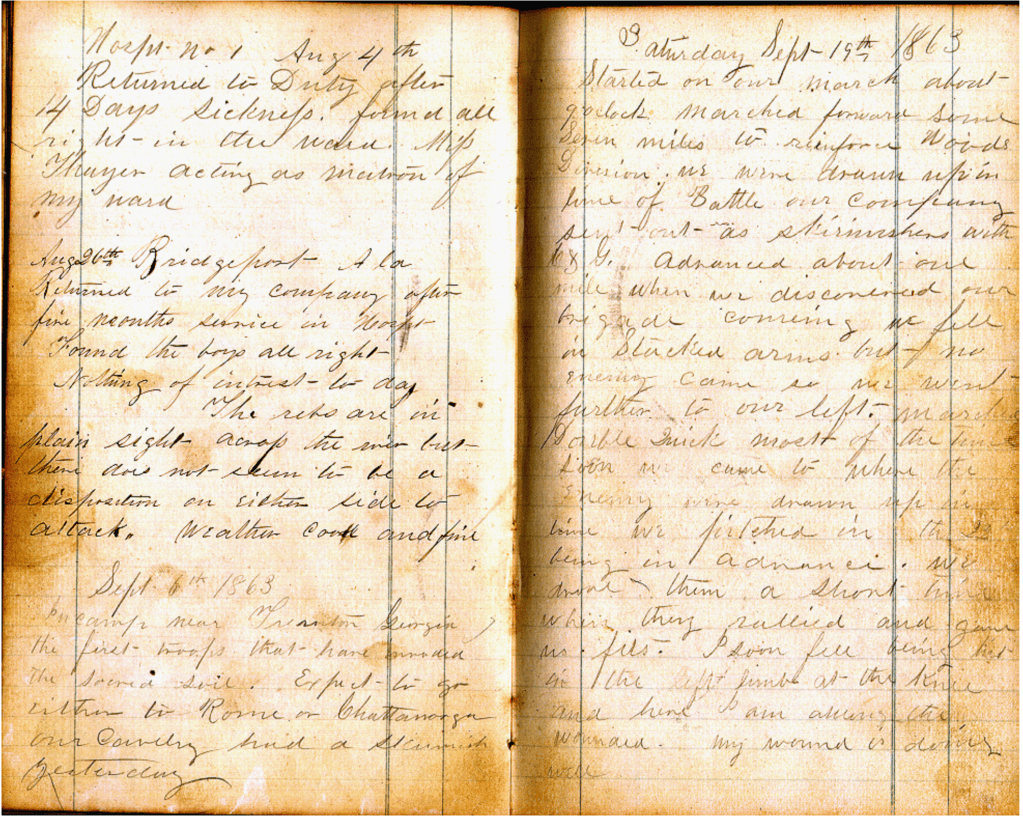
Sept. 6, 1863:
In camp near Trenton Georgia the first troops that have invaded Georgia soil. Expect to go either to Rome or Chatanooga. Our cavalry had a skirmish yesterday.
Saturday Sept. l9th:
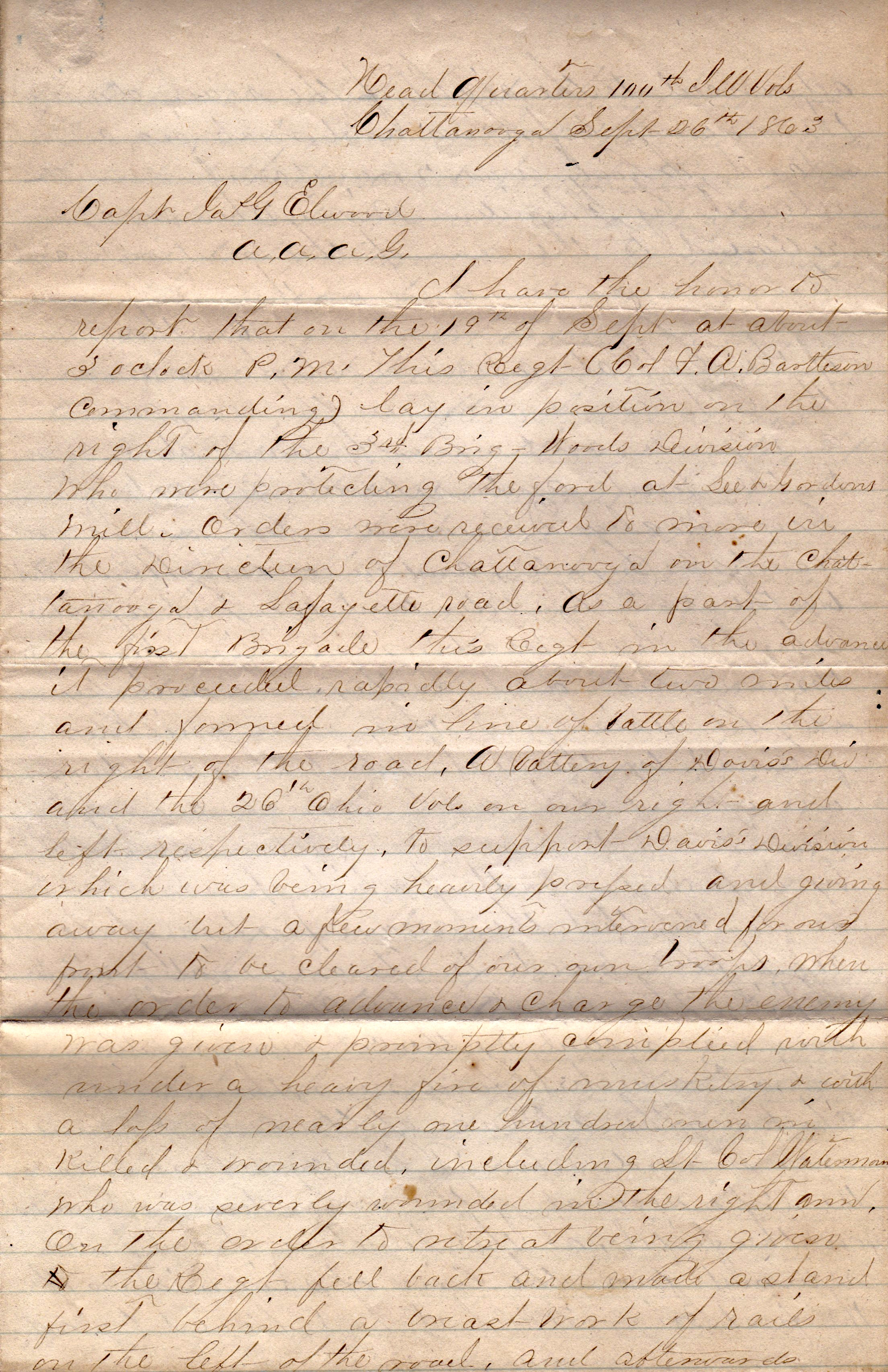
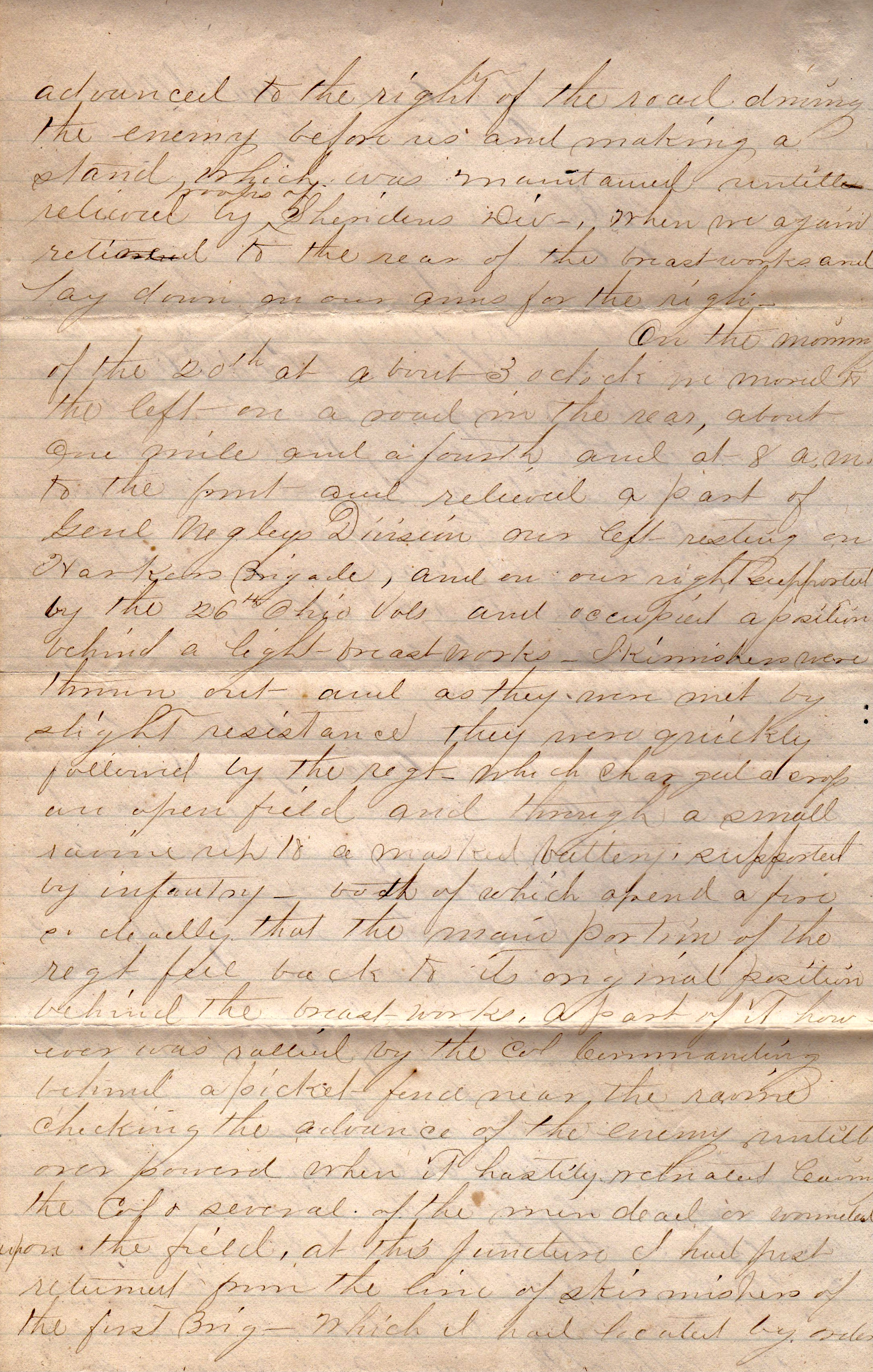
Started on our march about 9 o’clock. Marched forward about seven miles to reinforce Woods division. We were drawn up of battle our company sent out as skirmishers with H & G. about one mile when we discovered our brigade coming. We fell in stacked arms but no enemy came so we went further to our left. Marched double quick most of the time. Soon we came to where the enemy were drawn up in line. We pitched in then being in advance. We drove them a short time when they rallied gave us fits. I soon fell being hit in the left limb at the knee and here I am among the wounded. My wound is doing well.

Sept. 20th:
Weather cool and splendid. Was taken prisoner today by the enemy. So we may expect a trip through to Richmond as soon as we get able to be moved. So far they have treated us with respect. Our captors belong to the lst Ky. Cavalry. We are living on sow belly and hard tack. No news of our division.
Sept. 21st:
Wound still very painful. Dr. thinks he may have to amputate but I hope it may be saved without. I am resigned to my fate—let it come as it will. Such is war.
Sept. 22nd:
My wound still more painful than before. Dr. examined and thinks he will be justified in trying to save it without amputating. Rebs all through our camp but do nothing only trade hats with the boys. Have not heard from the Regt. since the fight.
Sept. 23rd;
Nothing of importance today. My wound very painful. About out of provisions and the Rebs say they cannot furnish us. The enemy took all but the eight or ten men with them of the nurses so we are short of help.
Sept. 24th:
Had an awful night of it last night. We are lying on the naked ground and I became so worn out that I thought I could not live until morning. My wound is very troublesome and gives me more pain than I can tell. Smith of my company is on my left and he discovered that he was completely covered with maggots. Poor fellow how he suffered.

Sept. 25th:
Weather warm and sultry. Passed another miserable night. Never was in such pain. Hope my wound is going well. Our forces are still at Chatanooga and will probably stay here, Braggs army to the contrary and notwithstanding. Bacon and John Tole are still in the field badly wounded. Part of the boys were paroled yesterday and are to report at Atlanta. We are living on boiled wheat that being all that we can get. How the boys suffer. The Rebs furnish us nothing to eat.
Sept. 26th:
Just one week ago today I was wounded. How slow time passes. My wound does not improve any as I can see. There are so many of us here that the surgeons cannot get around to all each day. Some of the slightly wounded will leave here today to try the realities of prison life in Richmond. No news from our army.
Sept. 28th:
Did not feel like writing yesterday as I was in too much pain. Nothing new today the same old feelings the same aching pains. We are living on boiled wheat and corn meal. All goes well. The Doc thinks my wound is improving. Wrote home today.
Sept. 29th:
Still in the same bed of pain. Know of nothing new.
Sept. 30th:
Were all paroled last night and as soon as convenient will be moved inside our own lines. Thank God for that.
Oct. lst:
Were put in ambulances before daylight but did not start until 8 o’clock.

Hauled about six miles when we halted for the rest of the train. I never knew what pain was before. It seemed at times as though I must die. We did not arrive until 10 o’clock at night. Got stuck in a pond hole and could not get out for two hours and then were helped out by the 10th South Carolina Regt. My wound is considered to be improving. I never shall have full use of it again. Such is a soldiers life. I shall be a cripple for the rest of my days.
Oct. 2nd:
Wound much better after resting. Kind friends are all around me and offer to do all in their power for me. Thank God Dr. Hansen has the care of me.
Oct. 3rd:
For the first time since I got my wound I slept all night. I think with Drs. Hansen and Mills and my good spirits I shall soon be able to start for home. I.G. Neaps sent me 2.00 this morning. He is one of God’s noblemen. Cousin Joe came in this morning with his uniform on. He makes a fine looking officer. Gates of my company shaved me and cut my hair this morning.
Nov. 4th:
All has been a blank. My wound has kept me delirious most of the time. Thank God I am gaining. No one heard from home.
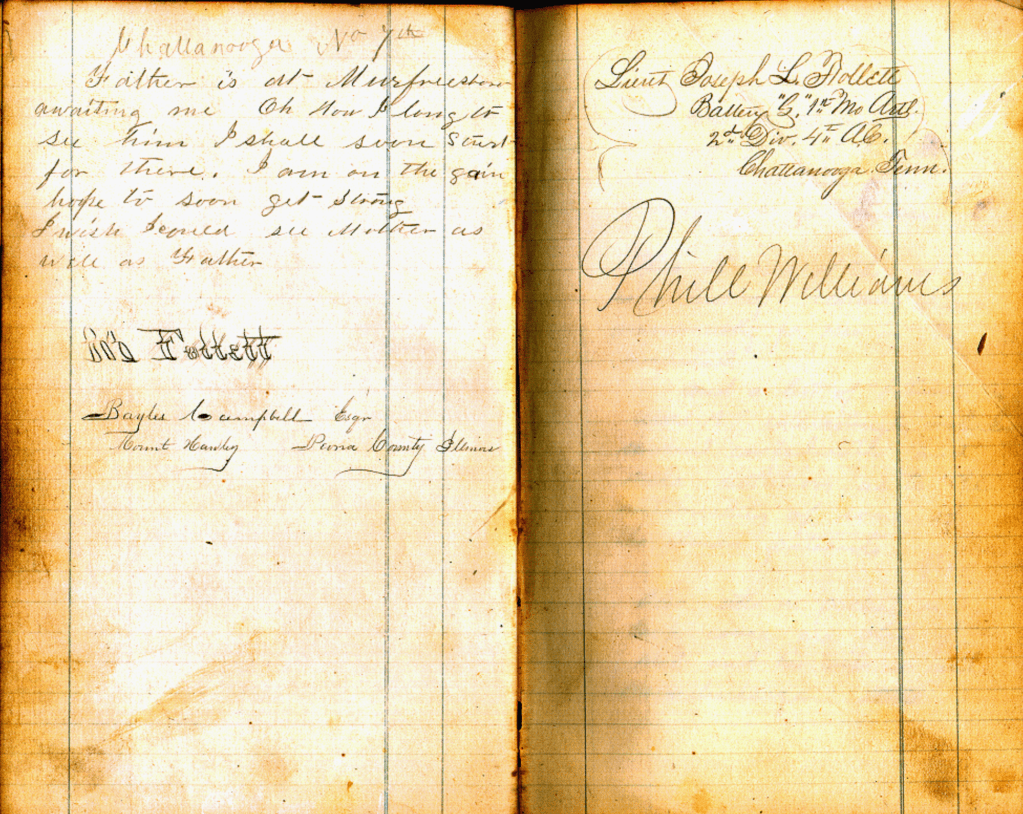
Chattanooga Nov. 7th:
Father is at Murfreesboro awaiting me. Oh how I long to see him. I shall soon start for there. I am on the gain hope to soon fet strong. I wish I could see mother as well as father.

 Spared & Shared 23