The following letter was written by James M. Covert (b. 1842) who enlisted at Venango county as a private in April 1861 in Co. C, 10 Pennsylvania Reserves (39th Pennsylvania Volunteers). At the time of his enlistment, he was described as a 5 foot 8 inch tall, blue-eyes, dark-haired shoemaker from Butler county, Pennsylvania. He reenlisted in December 1863 and was taken prisoner at Bethesda Church on 30 May 1864. After his exchange, he was transferred to the 191st Pennsylvania to finish out his enlistment.
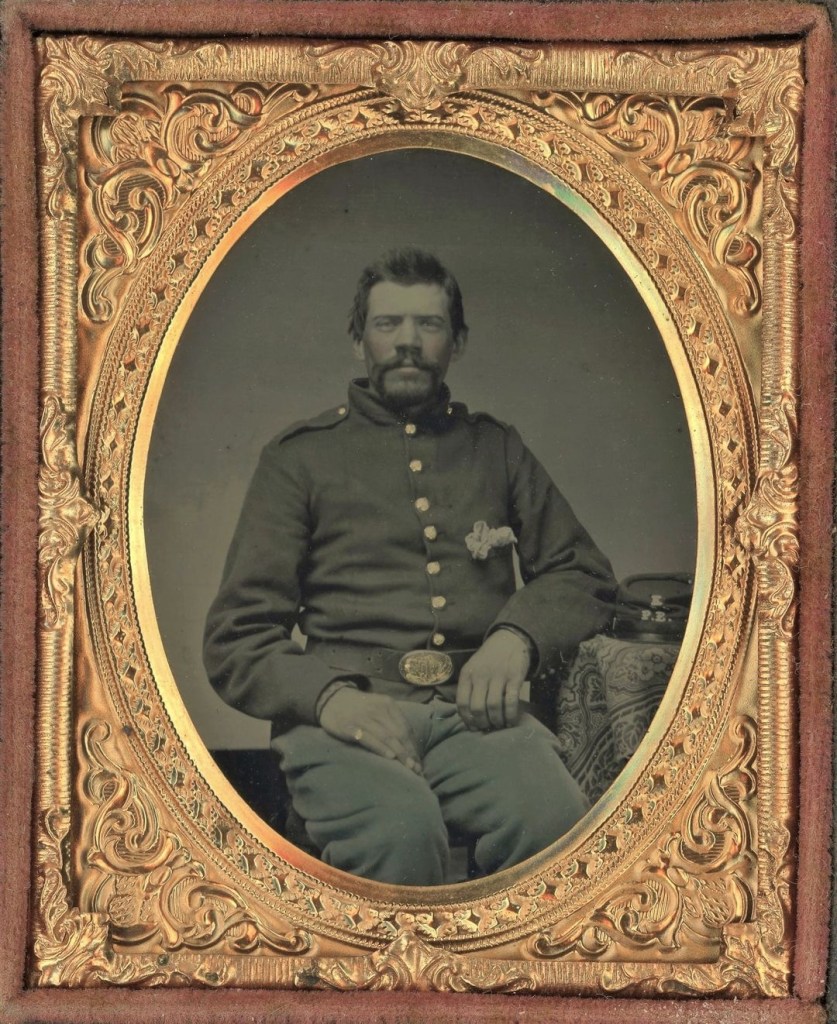
I could not find an image of James but here is a tintype of Joseph Alvin Weaver (1839-1910) who also served in the 39th Pennsylvania Regiment and was in the fight at Dranesville. The image was taken on the day of his enlistment in 1861. (Ancestry.com)
T R A N S C R I P T I O N
Camp Pierpont [near Langley, Va.] December 26th [1861]
Dear Sister,
I received your letter and was glad to hear from you and to hear that you were all well. I am well at present, hoping these few lines may find you enjoying the same blessing.
Since I wrote to you we have had a little fight. On Friday last we started–that is the 3rd Brigade and the Kane Rifle Company [“Bucktails”] with Easton’s Battery of 4 cannon, and three or four companies of artillery. We were out 12 miles. That was where we was to get the forage. We [had] three and a half companies of the 10th [Pennsylvania Reserves] Regiment with the wagons. Then we went on to Dranesville where we was attacked by the rebels. They had four regiments of infantry, 4 pieces of cannon, [and] 700 cavalry. We fought for one and a half hours, They retreated, leaving the dead and wounded on the field. We killed 160 of them. I do not know how many wounded or how many prisoners we took.
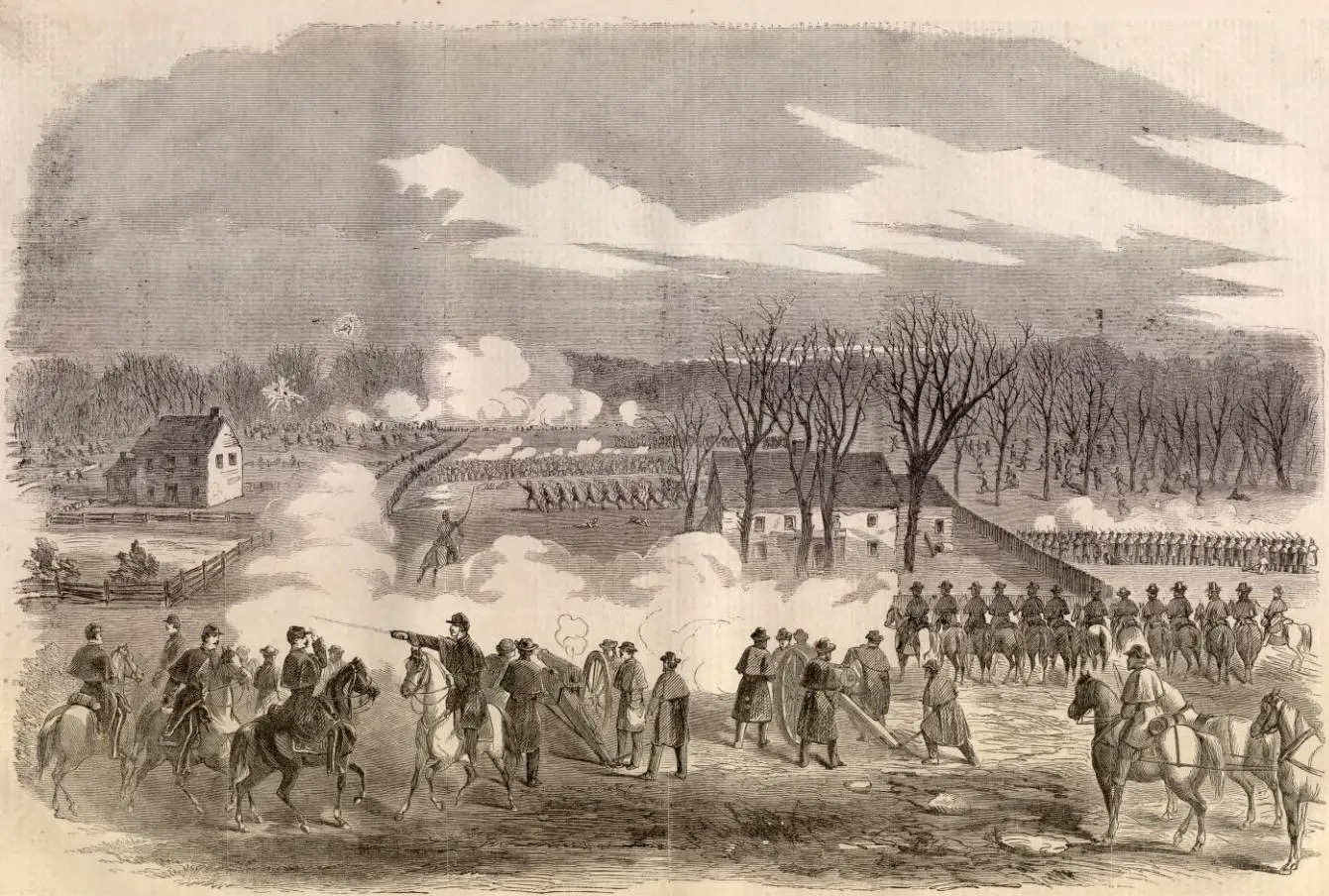
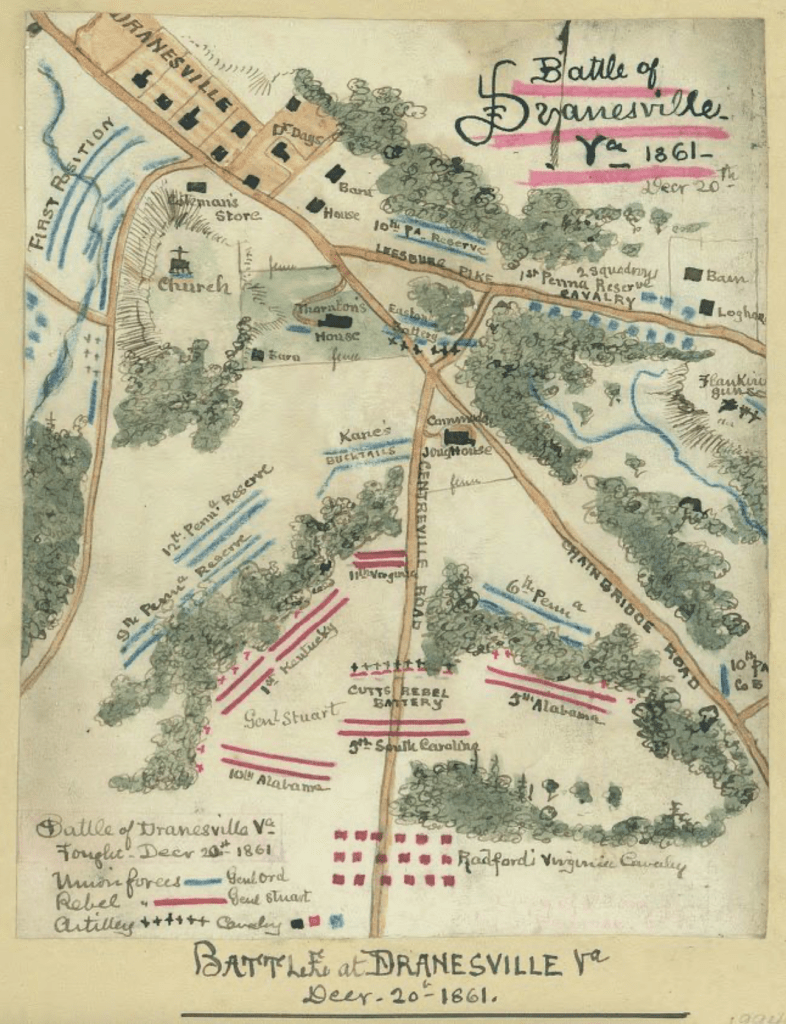
The Battle of Dranesville, Va., December 20th 1861, was little more than a skirmish but was cited as the first Federal victory of the war on Southern soil. The action itself centered around the intersection of the Georgetown and Leesburg Pikes.
We only lost 7 men, 48 wounded. They took 2,000 bushels of corn & things too numerous to mention. We took also 70 guns & overcoats and blankets without number. They never got so completely routed since the war began in so short a time. The first shells they throwed was at out regiment & never touched a man. John West [?] is well. Looks stout as any man in the company.
You must not be so down hearted as you say you are. Let things to come be right and all will be well. Do not fret yourself about your misfortune. It will not make it any better cheery. Do not let your spirits go down. If folks laugh, let them laugh. It does not hurt you. Make this life as happy as possible and try and secure your place in the next.
The weather is getting pretty cold here. We had a dull Christmas. One day here is just like another one. I hope the rebellion will be put doen ere long. I got a letter from cousin Jacob [ ]. They live in Jefferson City. They are all well at present. They looked for an attack on that city pretty soon. I will close my letter by sending my respects to Mr. and Mrs. Jennings and yourself. Goodbye, — J. M. Covert
The following letter was written by Charles Frederick Urban (1838-1916) of Co. H, 13th Pennsylvania Reserves (42nd Pennsylvania Infantry), also known as the 1st Pennsylvania Rifles, Kane’s Rifles, or simply the “Bucktails.” Charles enlisted on 1 August 1861. He was wounded on 19 August 1864 in the fighting at Weldon Railroad and was taken prisoner. He was released in March 1865.
Charles was born in Saxony (Germany) and was laboring as a stone mason in Lebanon, Lebanon county, Pennsylvania, when he volunteered to fight for the stars and stripes. He was barely literate and I had to interpolate a bit to make any sense of his letter.
The letter appears to have been datelined from Pierpont on December 1 but I suspect the fighting described refers to the Battle of Dranesville which occurred on 20 December 1861. It was in that battle that Col. Thomas L. Kane was wounded (though not in the penis, that I am aware of).
The Battle of Dranesville
Transcription
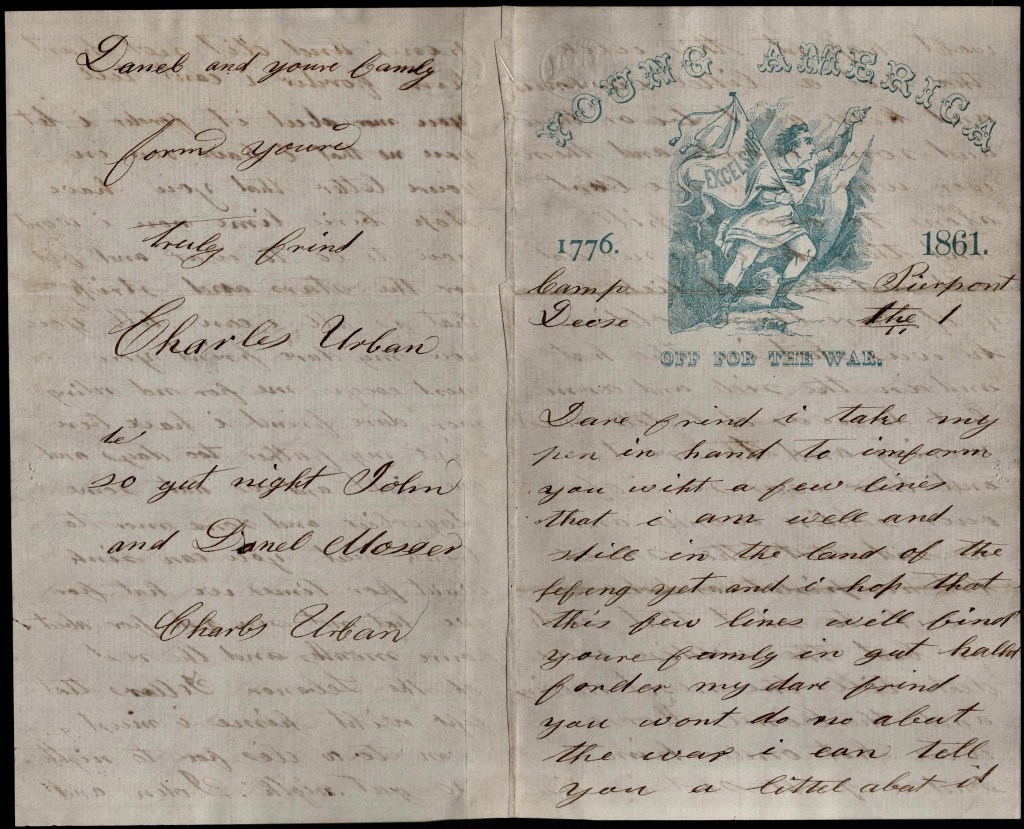
Camp Pierpont [near Langley, Va.] December 1, [1861]
Dear friend,
I take my pen in hand to inform you with a few lines that I am well and still in the land of the living yet and I hope that this few lines will find your family in good health.
My dear friend, you wanted to know about the war. I can tell you a little about it what happened this week. They had a little [ ] and killed two or three and some wounded and them that were wounded we carried along to our hospital and when he was near dead, said he could lick four of our Union Soldiers. He was shot in the head and in the side and arm, but he was dead the next morning and the rest [too]. There was one of our soldiers wounded and he said that they should get his pistol and shoot that secesh but the soldier was dead the next morning. The Colonel’s horse was shot under him and a [ ] shot in his penis and did not hurt him further. I cant tell you more about it.
Further, I let you know that I have seen in your letter that you have stopped berry time now [and] I want you to come to war and fight for the stars and stripes. That is all I can tell you now, my dear friend. You must excuse me for not writing more. Dear friend, I have been with my father two days and one night and we had some Lager beer and some more to drink, but you can see what fun times we had for we have not seen each other for about four months and the rest of the Lebanon fellers that left with him.
I must come to a close for tonight. So good night John and Danel and your family. From your true friend, — Charles Urban
These letters were written by Edson Emery (1833-1915) and Philo Emery (1836-1864) of Co. E, 2nd Vermont Infantry. They were the sons of Joel Emery (1787-1860) and Lucy Goddard (1797-1878) of Tunbridge, Vermont. The few letters were once part of a very large collection that had been in private hands for decades and yet had never transcribed and published before. There were 77 letters penned by either Edson or Philo—or both—while serving in the 2nd Vermont Infantry that I published in 2020 on Spared & Shared 19. Most of those letters, like these few, were sent to their brother Leonard who managed the family farm when he was not in the service, or to their mother—a semi-literate widow who saw four sons and one son-in-law go off to fight for the Union. One of her sons and her son-in-law did not survive the war.
The two other sons who served in the Union army were Silas Goddard Emery (1816-1884) and Leonard Emery (1829-1884). Both served in the 12th Vermont Infantry—a 9-month’s regiment organized in the late summer of 1862.
Obituary notice for Philo Emery, Vermont Journal (Windsor, Vermont), dated 9 July 1864:
“At Armory Square Hospital, Washington D. C., Philo Emery, of Tunbridge, aged nearly 28 years. He was a member of the 2nd Regiment of Vermont Vols. When the war broke out, he hastened to offer his services to his country. He passed through all the engagements in which his regiment participated up to the battle of the Wilderness on the 5th day of May. In this battle, he was seriously wounded in the knee. He was carried to the hospital and died June 9th. Mr. Emery was a good soldier, faithful to his duties to the Army and his government. He died as a Christian dies. His last message to his friends at home was, ‘Tell them I die right.’ His ashes repose among his native hills besides those of other members of his family.”
Obituary Notice for Edson Emery:
“Edson Emery was born in Tunbridge July 26, 1833, a son of Joel and Lucy (Goddard) Emery, and was the last of their nine children. He grew to young manhood in his native town, worked on the railroad, engaged in the drover business and interested himself in several pursuits until the Civil War broke out. Then he enlisted in Co. E, 2d Vermont Regiment twelve days after the Fort Sumter was fired upon and saw three years hard service. He was in 22 battles—the first battle of Bull Run, the Yorktown siege of five weeks, Lee’s Mills, Williamsburg, Fair Oaks, Golden’s Farm, Savage Station, White Oak Swamp, Malvern Hill, second battle of Bull Run, South Mountain, Antietam, Fredericksburg, Marye’s Heights, Chancellorsville, Gettysburg, Rappahannock Station, Mine Run, the Wilderness, Spotsylvania, Bethsaida Church and Cold Harbor. When the regiment was in front of Petersburg his term expired and he returned to the North.
He had three brothers—Silas, Leonard and Philo—and a brother-in-law [Jasper Lyman] in the army with him. Philo Emery was wounded and died. Mr. Edson Emery was never seriously hurt in the storms of lead he had so often to face but he bore the scars of a good many flesh wounds. During all his service, he kept a diary which is a faithful story of the stirring events in which he participated and reveals a keen eye and discerning mind.
On May 20, 1866, Mr. Emery married Jennie Gay of Gaysville,” the daughter of Paul W. and Phalina (Abbott) Gay.
Edson Emery’s Civil War Diary and papers, 1861-1863 are housed in the Special Collections of the Universities of Vermont Libraries in Burlington, Vt.
Philo Emery’s two diaries, (1861-1862) and (1863-1864), are housed in the Jack & Shirley Silver Special Collections Library at the University of Vermont in Burlington.
Letter 1
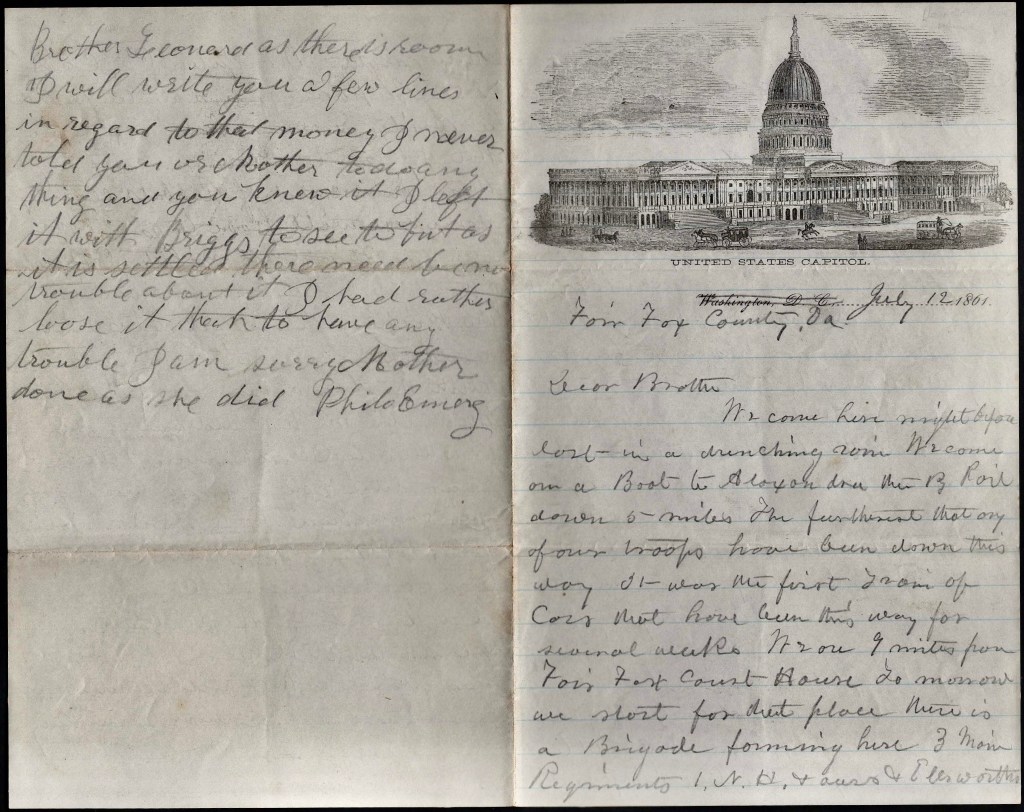
Fairfax County, Virginia July 12, 1861
Dear Brother,
We come here night before last in a drenching rain. We come on a boat to Alexandria, then by rail down 5 miles—the furthest that any of our troops have been down this way. It was the first train of cars that have been this way for several weeks. We are nine miles from Fairfax Court House. Tomorrow we start for that place. There is a brigade forming here—three Maine Regiments, 1 New Hampshire, and ours. Ellsworth’s Zouaves—they act as scouts &c., and about 50 pieces of cannon. We expect to meet about 6 or 7 thousand rebels at the Court House.
We had a very hard march from our camp to the boat—about two and a half miles; thermometer up to 200 in the shade. There was over 100 fainted and fell by the way & if we should have had to march a might further, they would all give out. Gen. Scott wrote to the Colonel if he ever done the trick again, he should take his commission away.
At Washington, Philo was taken with the measles & several others. We sent them to the hospital. They stayed a little while, got out and run away. They got here yesterday. They are now in our camp hospital. I think he is doing well. We shall have to leave them here, I suppose, or they will have to stay in the cars. They did one night.
Montpelier companies—Co. A and Co. B—have gone out to guard a bridge & word has just come that they want more men. They say there is a band of rebels close by. Someone will have to go. I have been on guard all night [as] corporal of the guard. I have not been on the picket guard yet.
There is a good many of the regiment sick with the summer complaint & measles. One has died out of the Brattleboro Company—diphtheria. I received your letter & one from Jasper the day we came here. Why don’t you write often? You will direct to Washington D. C., Co. E, 2nd Regt. Vermont V. M.
We shall get it. Write as soon as you get this. Philo will write soon. Yours, –Edson Emery
Brother Leonard, as there is room I will write you a few lines in regard to that money. I never told you or Mother to do anything and you knew it. I left it with Briggs to see to but as it is settled, there need be no trouble about it. I had rather lose it than to have any trouble. I am sorry Mother done as she did. — Philo Emery
Letter 2
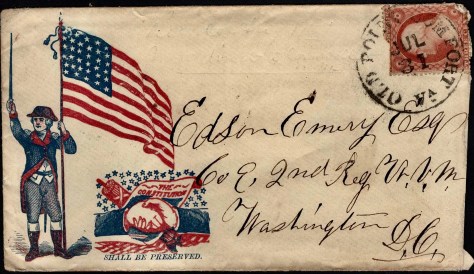
Obviously this envelope did not carry this letter because it’s addressed to Edson (the author of the letter)
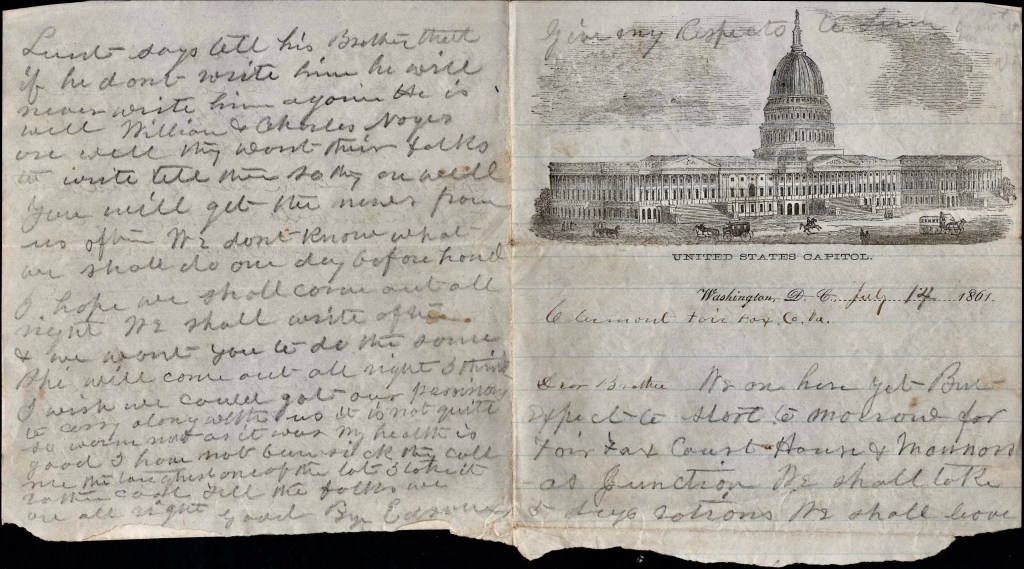
Washington D. C. July 14, 1861
Clermont, Fairfax County, Virginia
Dear Brother,
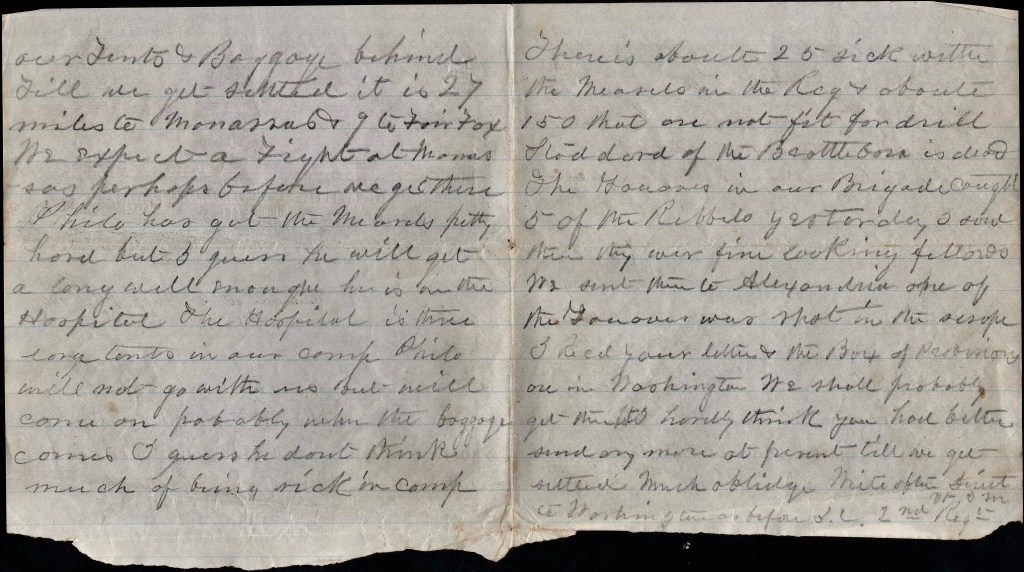
We are here yet but expect to start tomorrow for Fairfax Court House & Manassas Junction. We shall take 5 days rations. We shall leave our tents & baggage behind till we get settled. It is 27 miles to Manassas & 9 to Fairfax. We expect a fight at Manassas—perhaps before we get there. Philo has got the measles pretty hard but I guess he will get along well enough. He is in the hospital. The hospital is three large tents in our camp. Philo will not go with us but will come on probably when the baggage comes. I guess he don’t think much of being sick in camp. There is about 25 sick with the measles in the regiment & about 150 that are not fit for drill.
Stoddard of Brattleboro is dead. The Zouaves in our brigade caught five of the rebels yesterday, I saw them. They were fine looking fellows. We sent them to Alexandria. One of the Zouaves was shot in the scrape.
I received your letter and the box of provisions over in Washington. We shall probably get them. I hardly think you had better send any more at present till we get settled. Much obliged. Write often. Direct to Washington as before. 2nd Regiment Vermont V. M.
Lieutenant says tell his brother that if he don’t write him he will never write him again. He is well. William & Charles Noyes are well. They want their folks to write. Tell them so. They are well. You will get the news from us often, We don’t know what we shall do one day before hand, I hope we shall come out all right. We shall write often & we want you to do the same. Phi will come out all right, I think, I wish he could come along with us. It is not quite so warm now as it was. My health is good. I have not been sick. They call me the toughest one of the lot. I take it rather cool. Tell the folks we are all right. Goodbye, — Edson
Letter 3
Patriotic image on Edson’s Letter
Bush Hill, Virginia August 8, 1861
Dear Brother,
I received your letter last night. George Derrell is going home today & I will send this line by him. Also [Moses] Glines, [Daniel] Pember, and Horace Wills are going home on furloughs. It is very warm weather. We have begun to drill some every day. The boys don’t pick [it] up very fast.
The sore throat prevails some. Some have died and others complain some but I think they will manage it all right.
You say you don’ know where we are. Well, sir, we are about 4 miles south of Alexandria on the line of the railroad & about 14 miles south of Washington. We run the mail to Washington & back every day. The boat runs from Alexandria to Norfolk [?] several times a day. But we talk of leaving this brigade & going up to Chain Bridge above Washington about 8 miles. If we go there, we shall be with the 3rd Vermont Infantry and the others when they come in. [We will] have a Vermont Brigade.
We are now further advanced toward the rebels than any other regiment. We are close by them. Last night the report was that we should be attacked but it proved false as well as all other of the alarms.
Glines will carry that money. George is pretty well loaded down with letters, &c. I wrote you a few days ago & sent you a paper. Write often & direct as before. Yours truly, — Edson Emery
Letter 4
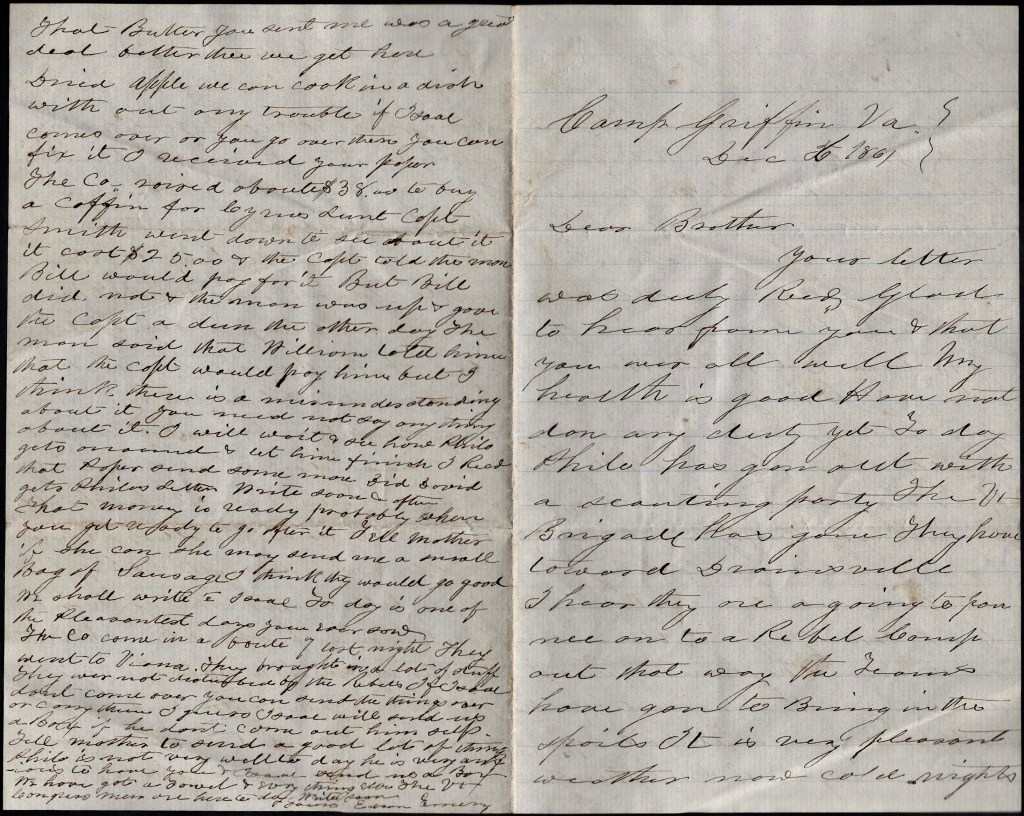
Camp Griffin, Virginia December 6, 1861
Dear brother,
Your letter was duly received. Glad to hear from you and that you were alll well. My health is good. Have not done any duty yet today. Philo has gone out with a scouting party. The Vermont Brigade has gone. They have [gone] toward Dranesville. I hear they are a going to pony [?] on to a Rebel camp out that way. The teams have gone to bring in the spoils.
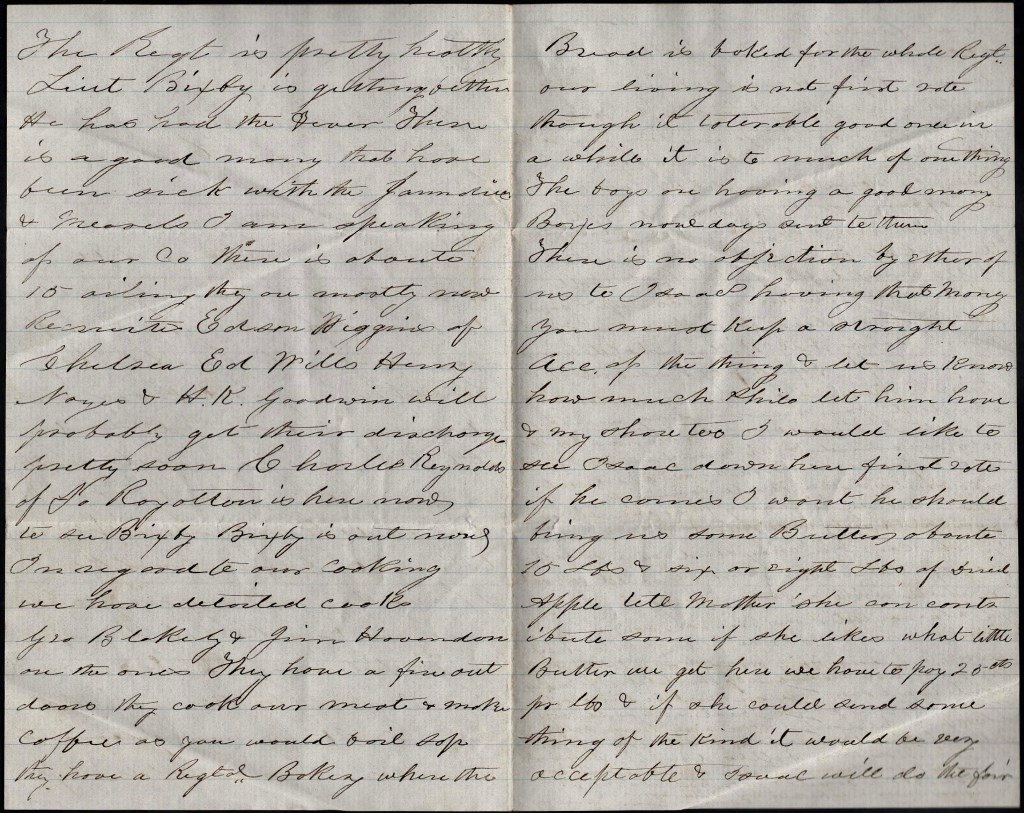
It is very pleasant weather now. Cold nights. The regiment is pretty healthy. Lieut. Bixby is getting better. He has had the fever. There is a good many that have been sick with the jaundice & measles. I am speaking of our company. There is about 15 ailing. They are mostly now recruits. Edson Wiggins of Chelsea, Ed Wills, Henry Noyes, & H. K. Goodwin will probably get their discharge pretty soon. Charles Reynolds of South Royalton is here now to see Bixby. Bixby is out now.
In regard to our cooking, we have detailed cooks. George Blakely & Jim Hovendon are the ones. They have fire out doors. They cook our meat and make coffee as you would boil soup. They have a regimental bakery where the bread is bakes for the whole regiment. Our living is not first rate though it is tolerable good. Once in a while it is too much of one thing. The boys are having a good many boxes now days sent to them. These is no objection to either of us to such an act…
I would like to see Isaac down here first rate. If he comes, I want he should bring me some butter—about 10 lbs. and six or eight lbs. of dried apples. Tell Mother she can contribute some is she likes. What little butter we get here we have to pay 20 cents per pound & if she could send something of the kind, it would be very acceptable & Isaac will do the favor. That butter you sent me was a great deal better than we get here. dried apples we can cook in a dish without any trouble if Isaac comes over or you go over there, you can fix it. I received your paper.
The company raised about $38 to buy a coffin for [Corp.] Cyrus [W.] Lunt. Capt. Smith went down to see about it. It cost $25 & the captain told the man Bill would pay for it. But Bill did not & the man was up and gave the captain a dun the other day. The man said that William told him that the captain would pay him but I think there is a misunderstanding about it. You need not say anything about it. I will wait and see how Philo gets around and let him finish…
Today is one of the pleasantest days you ever saw.
The company came in about 7 last night. They went to Vienna. they brought in a lot of stuff. They were not disturbed by the rebels…
Yours, — Edson Emery
Letter 5
Patriotic Image—“Vermont Soldier” poem.
Headquarters 2nd Vermont Regiment Camp Griffin, Va. December 20, 1861
Dear Brother,
Your letter & two papers was duly received. Very glad to hear from you. This afternoon there is heavy cannonading north of here toward Great Falls & Leesburg. Our regiment & most of the Vermont regiments have just started. Also the batteries & cavalry. Whether they will engage the enemy, I can’t tell. I should think by noise they were having some fighting. It looks some like rain this afternoon. Philo has gone. I did not go—my feet are very tender & I am pretty lame. [See Battle of Dranesville]
The rebels tried to cross the river above here the other day but were driven back. Gen. McCall’s Division went out early this morning. The rebels are closing in upon us. They are anxious for a fight. They want we should chase them down to Bull Run or Centerville. Then they will fight us. But I hardly think they come—that by keeping them where they are is whipping them fast enough.
We received a letter from Briggs last night. Caroline has a very bad eye. They are going down to Isaac’s to Christmas. Philo says he don’t think he will have you send any drawers. He has some. Brigg’s will help toward the box. Tell Mother to send a lot of good things—sausage, butter, &c. &c. You might put in a small piece of fresh pork if it is so cold weather, & some cookies, sweetened doughnuts, and if handy, a piece of cheese. You need not send any wheat bread. We have that here. But send anything good for we don’t get much that is good here. Dried apples goes well. But the sausage, I think I can eat. I wish you would get me a Memorandum Book at the book store at Bethel & have Isaac put it in the box. It will cost about 25 cents & you can charge it to me. Get one about 5 or 6 inches long and about 3 inches wide, well bound, and strap over. The inside to be an almanac, a space for every day in the year, and a cash account. Get a good one for I need one for next year & have none. You or Isaac or someone get it and send it.
Also, tell Ann to get four feet of blue tape about half inch wide. I want it to put on my arm to show the rank which I hold. I am the third corporal now. You can pay her. It will not be much—perhaps five or ten cents. Here it would be six times that.
As to our state money, we have not drawn any but we think we will next payday. Philo and I can draw $84 of state pay. Philo 42 and I the same, and we shall send about $40 of US pay which will make a good sum to let out. We lay up our money to what most of them do but it is dearly earned. Therefore you must do all you can for us. We have taken their lives in their hands. It is no small affair.
I will wait for Philo to come in. Tell Florence we will write her a letter pretty soon. Yours, — Edson
December 21. Philo came in about 8 last night. They went to Dranesille or a most there but did not see the enemy. McCall had driven them back. McCall killed and took 79 of the rebels & any quantity of blankets, overcoats, &c. &c. The boys had a hard march [of] 20 miles. They groaned some when they got back.
P. S. Our next pay will come about the 20th of January. Then we will send all.
I could not find an image of Julian but here is an unidentified member of Co. K, 44th New York Infantry who looks to be about Julian’s age. The “P. E.} on his hat stands for “People’s Ellsworth Zouaves” which is how they were originally designated. (Dan Binder Collection)
The following letter was written by Pvt. Julian Knowlton (1834-1881) of Co. A, 44th New York Infantry. The 44th was organized at Albany, New York, and was transported to Washington D. C. in late October 1861 where they were attached to Butterfield’s Brigade, Fitz-John Porter’s Division of the Army of the Potomac. They did not see their first action until the siege of Yorktown in April 1862. Julian was captured in action during the Battle of Gaines’ Mills but soon paroled. He then was wounded in the Battle of Gettysburg on the second day of fighting, having participated in turning back Longstreet’s assault on the Union left. A member of Co. A later wrote of that day: “Our regiment lost very heavy; 111 out of 300. Our company lost more than any other company in the regiment, 22 out of 40, had 5 killed. Each company cared for their wounded. [Julian] Knowlton, from Forestville, was badly wounded in the knee. I helped carry him off from the field. The last I heard from him, he was doing well. Both of my tent mates were wounded.—After we had carried our wounded of from the field, we then buried our dead. Three boys from our company together with myself, carried four of our dead comrades back. It seemed hard, I tell you. They had stood right beside us, in the ranks all through everything until now.” Though Julian survived the war, his right leg continued to cause him pain, and it was finally amputated in 1880. He died the following year in Elliott, Ford county, Illinois.
The letter was datelined from Camp Butterfield on Christmas day, 1861—just five days after the Battle of Dranesville—a skirmish really—in which both sides suffered relatively low casualties. The Union infantry regiments engaged in the fight included the 9th, 12th and 13th Pennsylvania Reserves (the latter being designated the 42nd Pennsylvania, the 1st Pennsylvania Rifles, or more popularly referred to as “Kane’s Bucktails”). Julian’s younger brother, Byron (“By”) D. Knowlton (1842-1923) was a member of Co. D in the Bucktails but we learn from Julian’s letter that By was not in the battle. Rather, he was on guard duty at their camp on the day of the battle.13th Pennsylvania Reserves, Officially designated the 42nd Pennsylvania Volunteer Infantry, the unit was also known as the 13th Pennsylvania Reserves, the 1st Pennsylvania Rifles, and the Kane Rifles.
Julian and Byron were the sons of William and Mary Ann (Whipple) Knowlton of Forestville, Chautauqua county, New York. Though unnamed, Julian no doubt wrote the letter to his brother Jerome (b. 1836).
Transcription
Camp Butterfield [December] 25, 1861
Dear Brother,
It is with pleasure I resume my pen to inform you that I received your letter and was very glad to hear from you and to hear that you were well. I was glad to hear that you received the money that I sent you. I began to think that you had not received it. I am as well as usual and I hope that these few lines will find you enjoying the same blessing.
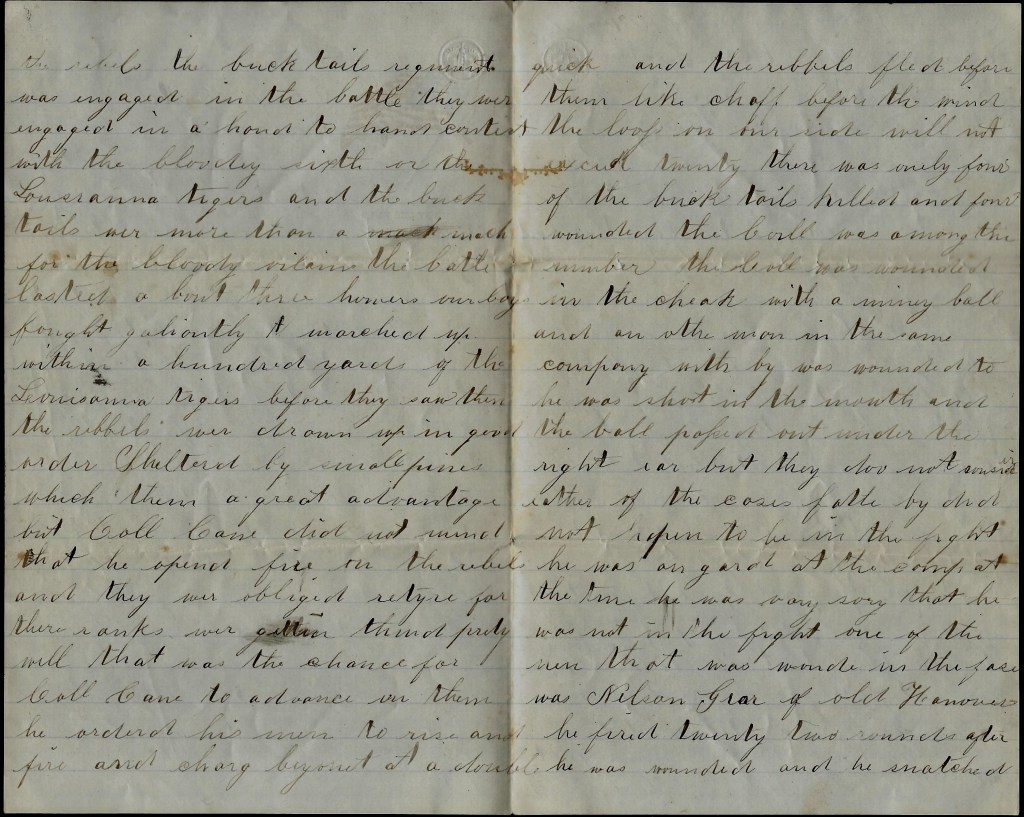
We still remain in our old camp but I do not think that we shall not remain here long for the rebels are getting rather bold of late. They have made several charges on our pickets and our men had quite a battle. There was three regiments of our men engaged with four or five regiments of the rebels. The Bucktails regiment was engaged in the battle. They were engaged in a hand-to-hand contest with the Bloody Sixth or the Louisiana Tigers and the Bucktails were more than a match for the bloody villains.
The battle lasted about three hours. Our boys fought gallantly. It marched up within a hundred yards of the Louisiana Tigers before they saw them. The rebels were drawn up in good order sheltered by small pines which [give] them a great advantage but Col. [Theodore L.] Kane did not mind that. He opened fire on the rebels and they were obliged to retire for their ranks were gettin’ thinned pretty well. That was the chance for Col. Kane to advance on them. He ordered his men to rise and fire and charge bayonet at a double quick and the rebels fled before them like chaff before the wind.
The loss on our side will not exceed twenty. There was only four of the Bucktails killed and four wounded. The Colonel was among the number. The Colonel was wounded in the cheek with a minié ball and one other man in the same company with By [Byron] was wounded too. He was shot in the mouth and the ball passed out under the right ear but they do not consider either of the cases fatal. By did not happen to be in the fight. He was on guard at the camp at the time. He was very sorry that he was not in the fight. One of the men that was wounded in the face was Nelson Geer 1 of old Hanover. He fired twenty-two rounds after he was wounded and he snatched a sword from the sheath of a dead rebel and fetched it off as a trophy. The boys brought of numerous things such as revolvers and watches and rifles, &c.
I was over to see By yesterday. The boys were in fine spirits. They have got themselves a very comfortable encampment. I saw Nelt Geer. He looked rather hard. His face was very badly swollen but he does not mind that.
I have nothing of importance to communicate but what I have already written so I will speak of our business. I shall send you twenty or twenty-three dollars the first of next month and I want you to settle my account at the farmers and if there is anything left, I want you to pay Pierce that five dollars that you got him for me. I am owing W. M. Gardner a little but I cannot pay him now as I see. Give my respects to all enquiring friends. Give my respects to Mr. Pierce and tell him that I am much obliged to him. In haste, — J. Knowlton
About the things of mine that you spoke of, you can keep until I give you different orders. I think that they [ ] as well as they are.
Julian’s letter asserts that the Bucktails faced the Louisiana Tigers at Dranesville but he was mistaken. The Confederate forces consisted of Kentucky, Virginia, Alabama, and South Carolina troops under the command of General Stuart.
1 Nelson Theodore Geer (1842-1895) of Warren county, served as a private in Co. D (the “Raftsman Guard”), 42nd Pennsylvania Rifles. He enlisted in May 1861 and was discharged for wounds in March 1863.He was first wounded in the Battle of Dranesville on 20 December 1861 and wounded a second time at the Battle of Antietam on 17 September 1862.
This early-war tintype of an unidentified soldier was probably a member of Kane’s Rifle Regiment. Note the bucktail on the side of his cap. ( Dale Niesen Collection)
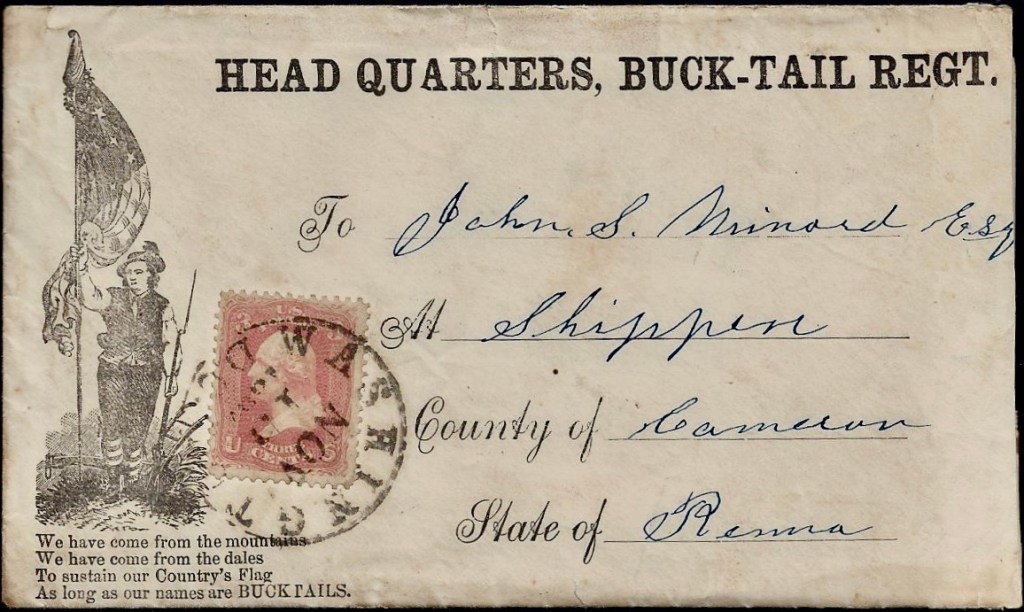
This letter was written by Seneca Freeman Minard (1837-1914) of Shippen, Cameron county, Pennsylvania, who mustered into the Kane Rifle Regiment of the Pennsylvania Reserve Corps (13th Pennsylvania Reserves, 42nd Pennsylvania Infantry)—better known as the “Bucktail Regiment”—on 1 June 1861 as a private in Co. C. At the time of his enrollment he was described as standing 5′ 9.5″ tall, with black hair, and blue eyes. He gave his occupation just prior to his enlistment as “lumberman.”
At some point Seneca appears to have been promoted to a corporal but there are no muster-out records for him and a note in the regimental history indicates that Seneca deserted his regiment though no date was given. The 1890 Veteran Schedule records him as a resident of Milton, Rock county, Wisconsin and states that he served 2.5 years.
Seneca’s letter describes the Battle of Dranesville that took place between Confederate forces under Brig. General J. E. B. Stuart and Union forces under Brig. Gen. Edward O. C. Ord on 20 December 1861 in Fairfax county, Virginia.
Transcription
Addressed to John S. Minard, Esq., at Shippen, Camden county, Penna.
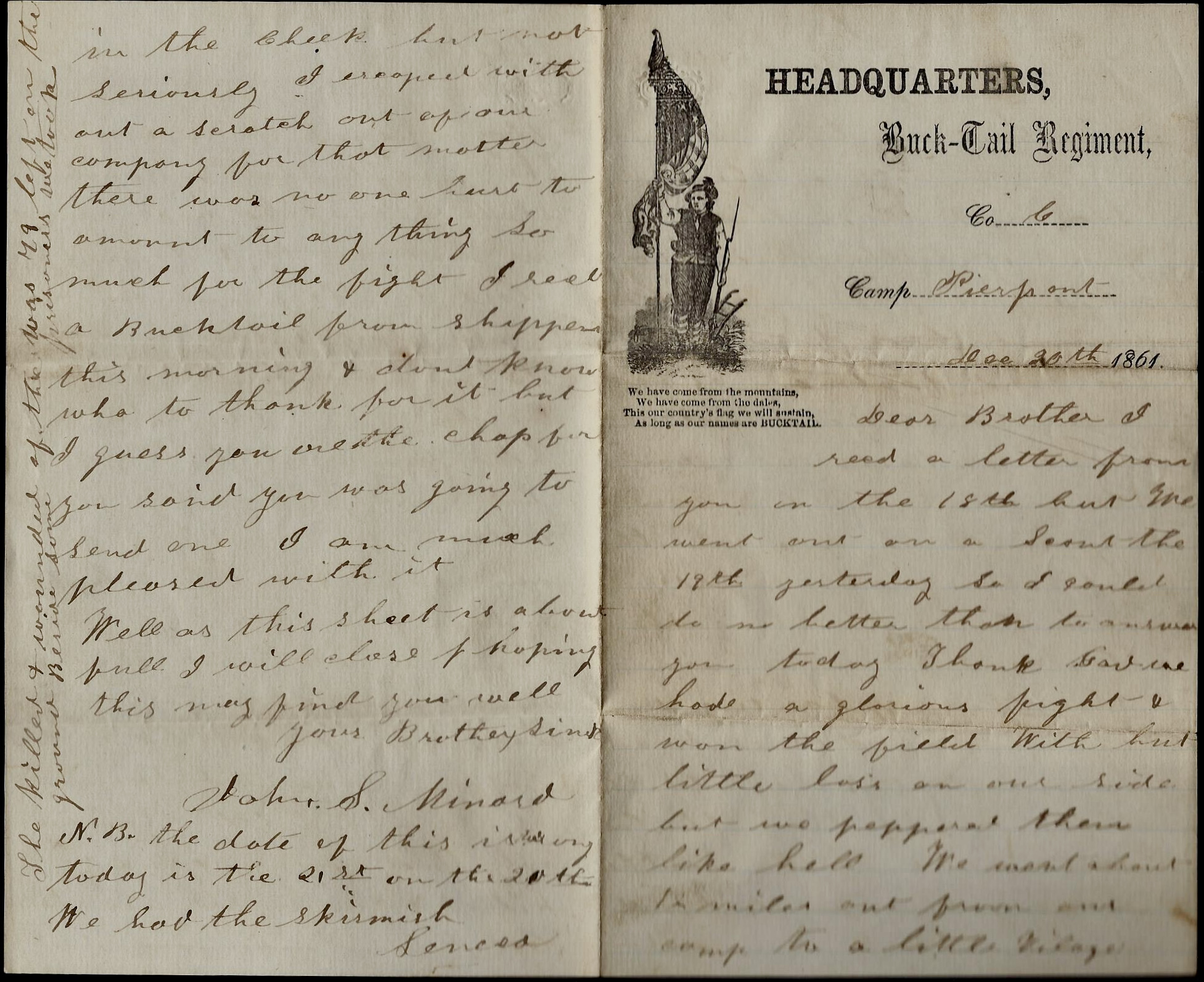
Headquarters, Bucktail Regiment Co. C, Camp Pierpont December 20th 1861
Dear Brother,
I read a letter from you on the 18th but we went out on a scout the 19th yesterday so I could do no better than to answer you today, thank God. We had a glorious fight & won the field with but little loss on our side but we peppered them like hell. We went about two miles out from our camp [on the Leesburg pike] to a little village called Dranesville. After scouting around there for about an hour we run into a nest of them stationed in a thick grove of little pines. They had four pieces of artillery and about four or five thousand footmen as near as we could find out.
The Bucktails were on the ground first and consequently were in the hottest of the fight. We were coming along the road & one of our [men] saw them planting a cannon in a crossroad to our left and he told the Colonel of it. Then the Colonel took us in behind a large brick house for shelter. we had hardly taken our position when they opened fire on us. The grapeshot and bomb shells flew like hail among us but we laid down as close to the ground as we could hug and they couldn’t do us much harm. But we did not have to stay here long until our big guns got on the ground and then we went in on our shape & within half an hour from the time our cannons got there, we were masters of the field.
Our loss was about ten killed and fifteen wounded—the most of them slightly. There was only three of our regiment killed and five or six wounded. [Lt.-]Col. [Thomas Leiper] Kane was wounded in the cheek but not seriously. 1 I escaped without a scratch. Out of our company, for that matter, there was no one hurt to amount to anything. So much for the fight.
I received a Bucktail from Shippen this morning & don’t know who to thank for it but I guess you are the chap for you said you was going to send one. I am much pleased with it.
Well as this sheet is about full, I will close hoping this may find you well.
Your brother, — Seneca
to John S. Minard
N. B. The date of this is wrong. Today is the 21st. On the 20th we had the skirmish. — Seneca
The killed and wounded of the [Rebs] was 79 left on the ground besides some prisoners we took.
1 Lt. Col. Kane was struck in the face by a ball that pierced his upper jaw. He halted just long enough to tie a bandage and resumed his position at he lead of his men.












 Spared & Shared 23