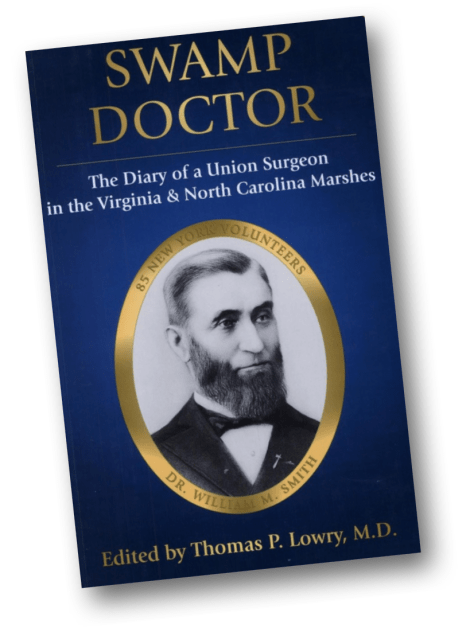
Surgeon William M. Smith, 85th New York (M. Brady)
This letter was written by Dr. William Merwin Smith, Surgeon of the 85th New York Infantry, relaying to a friend at home in western NY his experiences and his analysis of the Battle of Fair Oaks on May 31 where the 85th took heavy losses. Born in Patterson, NJ, the son of a physician, Smith was already a twice widowed general practitioner living in Elmira, New York with his two young children when he enlisted as surgeon on 10/29/61. Smith remained with the 85th until 17 June 1863 when he resigned.
Fair Oaks represented the first significant battle experience for the 85th. As he describes in his letter (and consistent with what appears elsewhere), the 85th (at the time part of Casey’s Division) heroically held off a much larger Confederate force until they were forced to retreat, in the process losing most of their camp possessions, along with 34 killed or wounded. A substantial portion of the letter deals with Smith’s frustration and anger with top leadership, particularly McClellan, who he despised (for reasons similar to those expressed by other Union soldiers at the time).
Dr. Smith’s annotated diary, actually his second diary—the first being lost at Fair Oaks, was published in 2001 by Dr. Thomas P. Lowry (Stackpole Books). This highly detailed and very thoughtful diary begins in the aftermath of Fair Oaks (several days after the present letter was written). This letter, the only one cited in the book, is included within Appendix A, because of its contextual importance to the diary’s early content (as far as I know, the letter has so far never been posted on the web).
[Note: This letter was provided to me from a private collection (RW) for transcription and publication on Spared & Shared by express consent.]
T R A N S C R I P T I O N
Camp near Long Bridge, Virginia June 11th 1862
My dear sir,
Your favor of the 20th ult., came to hand in due time. Since that time you know we have had a terrible collision with the rebels. Much has been said of Casey’s Division by the jealousy of generals chiefly, & correspondents who are the hangeron’s of these generals & who were not on the battle ground of Casey’s Division, nor indeed dare be, with one exception—Bulkley of the Herald, & he gives a very different story to the public. It is sufficient for imported men to know what they will know despite misrepresentation, that the battle commenced between 12 and 1 p.m. and that the less than six thousand men of Casey’s command held a force, never estimated less that forty thousand men, until nearly four o’clock p.m.; certainly three hours & without a regiment to reinforce & sustain them, although Couches line of battle was less than 200 rods behind us, sustaining a loss in killed and wounded of fully one fourth the number with which they went into battle.
I remained under fire in the immediate vicinity of the ranks, dressing the wounded until the overwhelming force of the enemy had out flanked right and left our line of battle and wounded men were struck a second time while being dressed and several horses had been shot down near the orderly who was holding my own. Consequently I know the tenacity & bravery with which most of the regiments of this Division fought. The 103rd Pennsylvania broke early in the action 7 rushed pell mell on Couch’s line. They did not receive or give a single volley. Their conduct gave character to the whole. The 85th [New York] in particular fought until enveloped by the columns of the enemy. The character of the remarks by the Press and McClellan’s first telegram has greatly discouraged the brave men in this and other regiments composing this Division. No Division has suffered half as much since they landed at Fortress Monroe from neglect & exposure as this. They landed with 13,000 men. Today cannot bring into line 5,000 effective men. If ever a truthful history of the campaign shall be written, a dark responsibility and disgraceful neglect will be laid at the door of some of the managers.
My health is very poor. I have worked myself threadbare in trying to keep my Department shipshape amid all the disadvantages of my want of means, help, &c. And now, after struggling with my ailment through the dank swamps, pestiferous malaria, weary marches, long days and nights of labor with the sick and wounded, my health does not improve within a few days, I shall return for a short time to see if the free bracing air of my native hills will not restore me to myself.
McClellan waits for reinforcements. Unless the gunboats achieve a signal and unexpected success, the battle of Richmond yet remains to be fought. Give my regards to friends. Yours truly, — W. M. Smith
The following letter was written by Israel S. Geer (1822-1881) while serving as captain of Co. C, 3rd Regiment Michigan Infantry. Israel began his service in the 3rd Michigan on 13 May 1861 as a sergeant in Co. D, but was promoted to sergeant major and then captain of Co. C on 26 December 1861. He was residing in Hastings, Barry County, Michigan just prior to the war. Co. C was a challenging command. It was made up largely of German and Dutch immigrants, many of whom lived on the west side of the Grand River in Grand Rapids. This company was the descendant of the old Grand Rapids Rifles, also known as the “German Rifles,” a prewar local militia company composed solely of German immigrants.
On May 6, 1864 he was wounded (shot fracture of right leg with subsequent primary amputation of thigh in lower third) and taken prisoner at the Battle of the Wilderness, Orange County, Virginia; his surgeon being a Confederate doctor. He was paroled at Richmond, Virginia on September 12, 1864 and was mustered out on September 21, 1864 at the expriation of his term. He had fought in the battles of Bull Run, Yorktown, Williamsburg, Fair Oaks, Richmond, Charles City Crossroads, Malvern Hill, Manassas, Fredericksburg, Chancellorsville, Wilderness, Virginia and Gettysburg, Pennsylvania.
Transcription
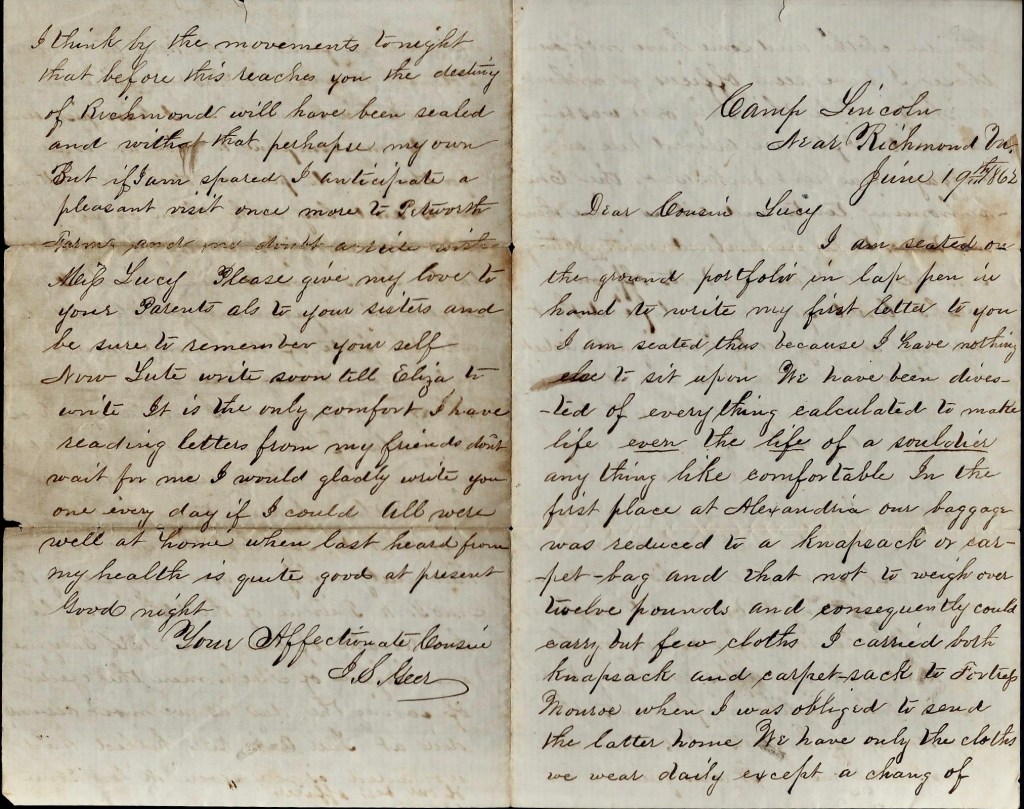
Camp Lincoln Near Richmond, Virginia June 19, 1862
Dear Cousin Lucy,
I am seated on the ground, portfolio in lap, pen in hand to write my first letter to you. I am seated thus because I have nothing else to sit upon. We have been divested of everything calculated to make life—even the life of a soldier—anything like comfortable. In the first place, at Alexandria our baggage was reduced to a knapsack or carpet bag and that not to weigh over twelve pounds and consequently could carry but few clothes. I carried both knapsack and carpet sack to Fortress Monroe when I was obliged to send the latter home. we have only the clothes we wear except a change of under clothes and some have not even those. I have seen officers go without a shirt while their only one was being washed.
After we arrived here our baggage was sent back across the Chickahominy, tents and all, so since them we have been encumbered with nothing. I have not had my boots off in four weeks and you may depend that we are a very seedy looking set indeed. I will be glad when this war is over. If it was not for the looks of the thing and the disposition I have to carry through what I undertake, I would resign and go home.
It is one constant scene of excitement. Not one moment’s quiet rest from one week’s end to another. Nothing to be heard night or day but the roar of cannon or the crack of rifles. Nothing to be seen but warlike implements, the glittering of bayonets, and dead and wounded men. It was quiet when we were in front of the Rebel army on the Potomac to what it has been since we came to the Peninsula.
I have just been out to my company to give an order for the men to put on their accoutrements and lay with them on all night and be ready for an immediate attack. It is now eleven o’clock p.m. A general engagement which will decide the fate of Richmond may be expected to commence at any moment.
I should speak of the battles of Williamsburg and Fair Oaks but you have most likely read much more of them than I have time to write. Suffice it to say that the Michigan 3rd done their duty nobly as you may see by the New York Tribune of the 12th inst. Also the Herald of the same date. They give our Brigade of Michigan men the credit of saving the day as we most assuredly did at Fair Oaks. Our killed and wounded is very severe. We lost some of our best officers.
I think by the movements tonight that before this reaches you, the destiny of Richmond will have been sealed and with that, perhaps my own. But if I am spared, I anticipate a pleasant visit once more to Petworth Farm and no doubt a ride with Miss Lucy. Please give my love to your parents. Also to your sister and be sure to remember yourself. Now, Lute, write soon. Tell Eliza to write. It is the only comfort I have—reading letters from my friends. Don’t wait for me. I would gladly write you one every day if I could. All were well at home when last heard from. My health is quite good at present. Good night.
The following letters were written by Abel Starkey (1816-1864) of Boston who enlisted on 13 June 1861 as a private in Co. F, 11th Massachusetts Infantry—one of only three Massachusetts regiments to participate in the First Battle of Bull Run. The regiment spent the early fall of 1861 helping to build fortifications around Washington. In October, the 11th was stationed at Budd’s Ferry in Indian Head, Maryland where they remained on picket duty for the winter of 1861–1862. The 11th Massachusetts Infantry saw its first combat during the Peninsular Campaign in the spring of 1862. They were heavily engaged during the Second Battle of Bull Run, participated in the Battle of Fredericksburg, and suffered severe casualties at the Battle of Chancellorsville and the Battle of Gettysburg.
Presumably Abel was with his regiments throughout these engagements and was with them as well when the regiment marched into the Wilderness in May 1864 in Hancock’s Second Corps where they were engaged heavily on the Plank Road on 5 and 6 May 1864. It was Abel’s last fight. He died of wounds on 7 May 1864.
Abel wrote these letters to his older brother, Horace Starkey (1814-1872), a farmer near Rockford, Winnebago county, Illinois.
Other letters I’ve transcribed by members of the 11th Massachusetts:
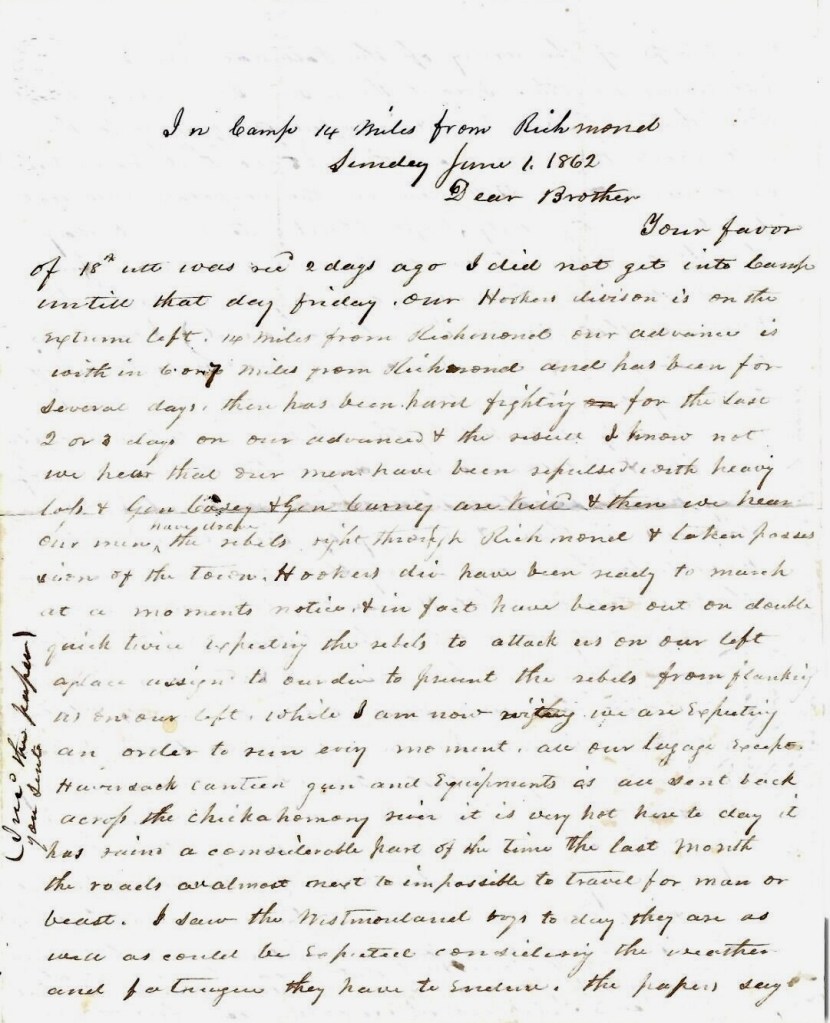
In Camp 14 miles from Richmond Sunday, June 1, 1862
Dear Brother,
Your favor of the 18th instant was received 2 days ago. I did not get into camp until that day Friday. Our (Hooker’s) division is on the extreme left, 14 miles from Richmond. Our advance is within 6 or 7 miles from Richmond and has been for several days. There has been hard fighting for the last 2 or 3 days on our advance & the result I know not. We hear that our men have been repulsed with heavy losses & Gen. Casey & Gen. Carney are killed. And then we [also] hear our men drove the Rebels right through Richmond & taken possession of the town. Hooker’s Division have been ready to march at a moments notice & in fact have been out on double quick twice expecting the Rebels to attack us on our left—a place assigned to our division to prevent the Rebels from flanking us on our left. While I am now writing, we are expecting an order to run any moment.
All our luggage, except haversack, canteen, gun and equipments, is all sent back across the Chickahominy river. It is very hot here today. It has been raining a considerable part of the time the last month. The roads are almost next to impossible to travel for man or beast. I saw the Westmoreland boys today. They are as well as could be expected considering the weather and fatigue they have to Endure. The papers say our troops of the Army of the Potomac are in excellent health. I don’t think so—to say nothing about those that have been killed or wounded on our right last week. There is more than 25,000 that have been sent home or are still in the hospitals and not fit to do any duty. Capt. Barker told me today that the 2d New Hampshire Regiment could not muster over five hundred men that were able to go into battle (He told me that Abijah French was dead).
I came in the rear from Williamsburg and was 11 days coming. Took my own time. The houses on the main road were mostly deserted by the white population excepting families & seldom I saw any of them and nearly every house vacated. There were more or less sick soldiers in them & many of them turned into hospitals.
There was nearly three thousand sick in the hospitals at White House landing and more arriving daily and taking the steamboat for Fortress Monroe, Baltimore, Philadelphia, New York &c. News has just come in that we had drove the Rebels & taken lots of prisoners. I have not heard from home since I wrote you last. Two or three letters came in my absence & were sent back to White House Landing in our Captain’s trunk. I am well & hearty. Tell [your daughter] Ella I am very much obliged to her for the letter she sent me & tell her to write again. Tell her also that Jeff Davis was not quite patriotic to hang himself. Stanton’s Michigan Regt. encamped near us at Yorktown. They are away in the advance now. I will see Lewis Webster when we come near them again. Give my regards to your family and write again. Respectfully yours—Abel Starkey.
We are Off.
Letter 2
Addressed to Mr. Horace Starkey, Rockford, Illinois
Camp Fair Oaks 6 Miles below Richmond June 21, 1862
Dear Brother,
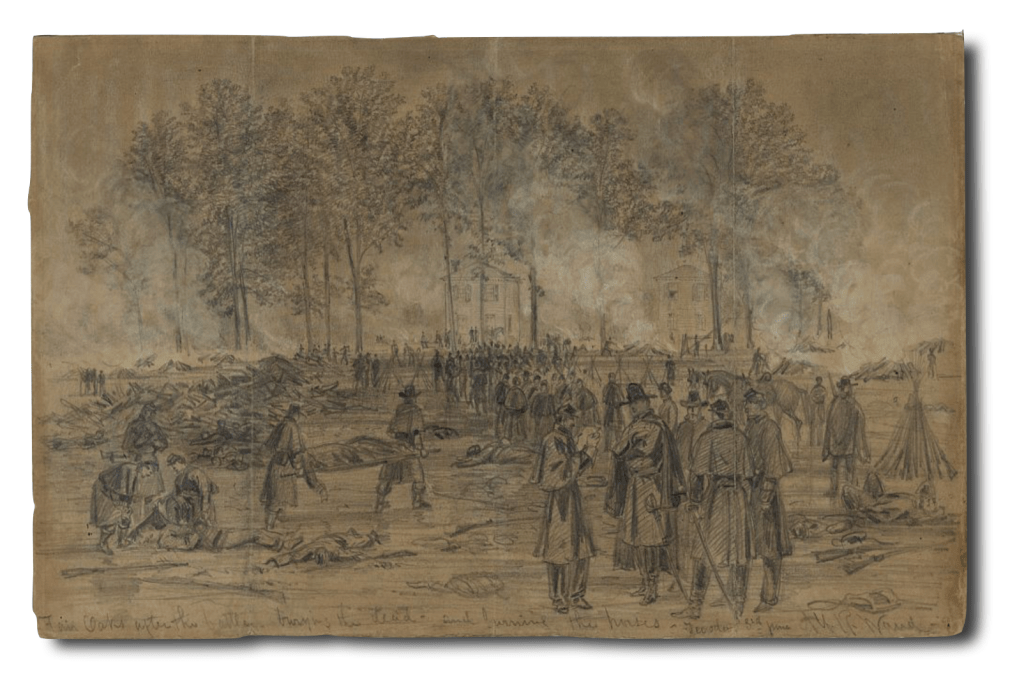
The Grand Army of the Potomac are spread out from James River to Chickahominy River & how much further I do not know, but quite a distance. Hooker’s Division is encamped on the same ground that Casey’s was at the time the battle was fought 3 weeks ago. When we came here, the ground was covered with dead men and horses, broken gun carriages, muskets, accoutrements, &c. It was 4 days after the battle. The men and horses were perfectly alive with maggots. It would make a well man spew to look at them and then the smell was enough to knock a whole regiment end ways. We covered the men over with dirt as well as we could & piled wood on the horses & burnt them. The air begins to seem fit to breathe again.
Burying the dead and burning the horses on the battlefield of Fair Oaks
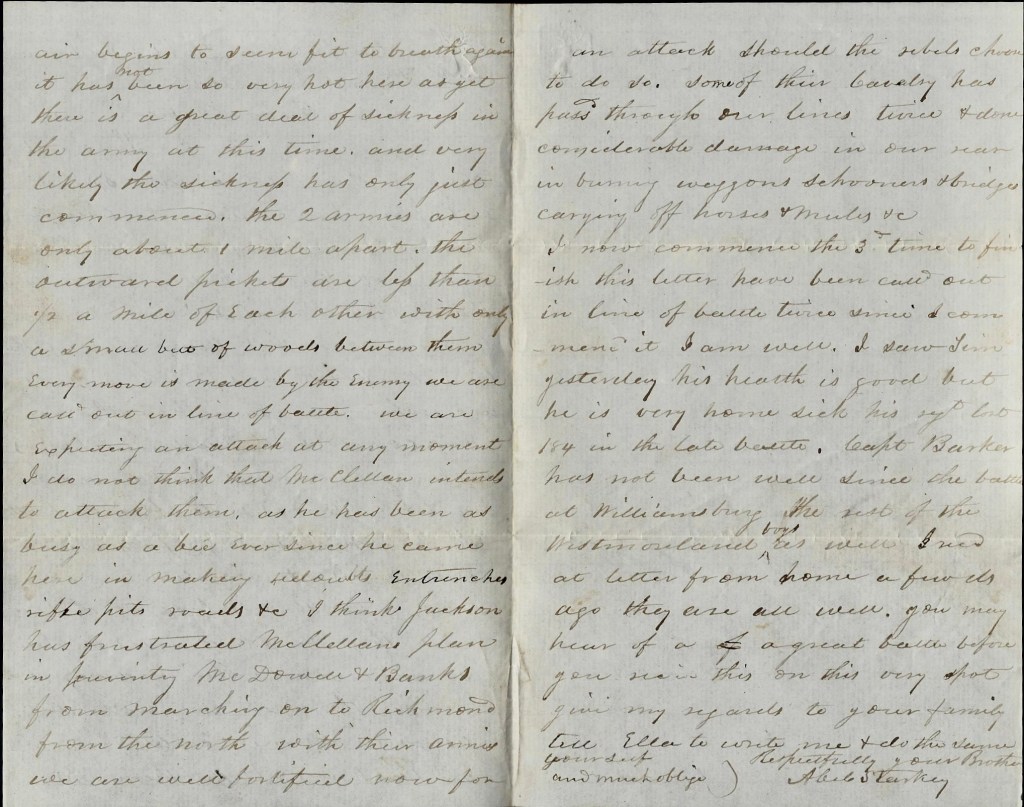
It has not been so very hot here as yet. There is a great deal of sickness in the army at this time and very likely the sickness has only just commenced. The two armies are only about 1 mile apart. The outward pickets are less than half a mile of each other with only a small bit of woods between them. Every move [that] is made by the enemy, we are called out in line of battle. We are expecting an attack at any moment. I do not think that McClellan intends to attack them as he has been as busy as a bee ever since he came here in making redoubts, entrenches, rifle pits, roads, &c. I think [Stonewall] Jackson has frustrated McClellan’s plan in preventing McDowell and Banks from marching on to Richmond from the North with their armies.
We are well fortified now for an attack should the rebels choose to do so. Some of their cavalry has passed through our lines twice and done considerable damage in our rear in burning wagons, schooners, & bridges, carrying off horses and mules, &c.
I now commence the 3rd time to finish this letter. Have been called out in line of battle since I commenced it. I am well. I saw Tim yesterday. His health is good but he is very homesick. His regiment lost 184 in the late battle. Capt. Barker has not been well since the battle at Williamsburg. The rest of the Westmoreland boys are well. I received a letter from home a few days ago. They are all well. You may hear of a great battle before you receive this on this very spot. Give my regards to your family. Tell Ella to write me & do the same yourself and much oblige. Respectfully your brother, — Abel Starkey
This letter was written by Charles Eliphalet Walbridge (1841-1913) to his brother, George Walbridge, while serving in Co. H, 100th New York Infantry and later as the Assistant Quarter Master at Bermuda Hundred in Butler’s Command.
Charles E. Walbridge was born in Buffalo on 24 July 1841. Shortly after the death of his father—George B. Walbridge, a well known merchant of Buffalo—Charles left school and entered the employ of Pratt & Co., who were at that time the most extensive hardware dealers in the city. He remained with them until September, 1861, when he enlisted in the 100th Regiment, New York Infantry, and was made second lieutenant of Co. H. He served with this regiment until 1864, being promoted to first lieutenant in July, 1862, and to captain in January, 1863. In February, 1864, he was commissioned by the president as captain and Assistant Quarter Master (AQM) of volunteers. In February, 1865, he was brevetted major, and shortly after was appointed chief quartermaster of the Tenth Army Corps, with the rank of lieutenant colonel. After receiving his discharge Walbridge stayed for several months in the South. He purchased surplus horses and mules from the army and sold them to Southerners who were affected by Sherman’s march.
In 1866 he returned to Buffalo and re-entered the service of his former employers, remaining until 1869, when he engaged in business for himself. In 1884 the firm of Walbridge & Co. was formed and it became one of the largest hardware establishments in Buffalo. He married Annie F. Noble of Brooklyn in 1868 and they started their lives together in Buffalo. The Walbridges left a considerable paper trail dating from the 1840s up to 1913, the year of Charles Walbridges death.
In this lengthy letter, Charles gives a description of the Battle of Fair Oaks (or Seven Pines) in which the 100th New York participated and in which they suffered severe losses. The regiment was in Casey’s Division of Keyes’ 4th Corps and were among the first troops engaged, having been overwhelmed and driven back through their encampment, losing most everything but what they wore and carried with them into battle that morning. Charles’ account attempts to put the best spin on their performance but other Corps and Divisions had much less complimentary things to say about Casey’s Division. It would be Hooker’s and Kearny’s Divisions of Heintzelman’s 3rd Corps that had to make the charge through the “slashing” referenced in Charles’ letter.
Waud’s sketch of bayonet charge made by Sickle’s Excelsior Brigade at Fair Oaks on 1 June 1862
Transcription
About a mile west of Bottom’s Bridge, Va. Saturday, June 7th, 1862
Dear George,
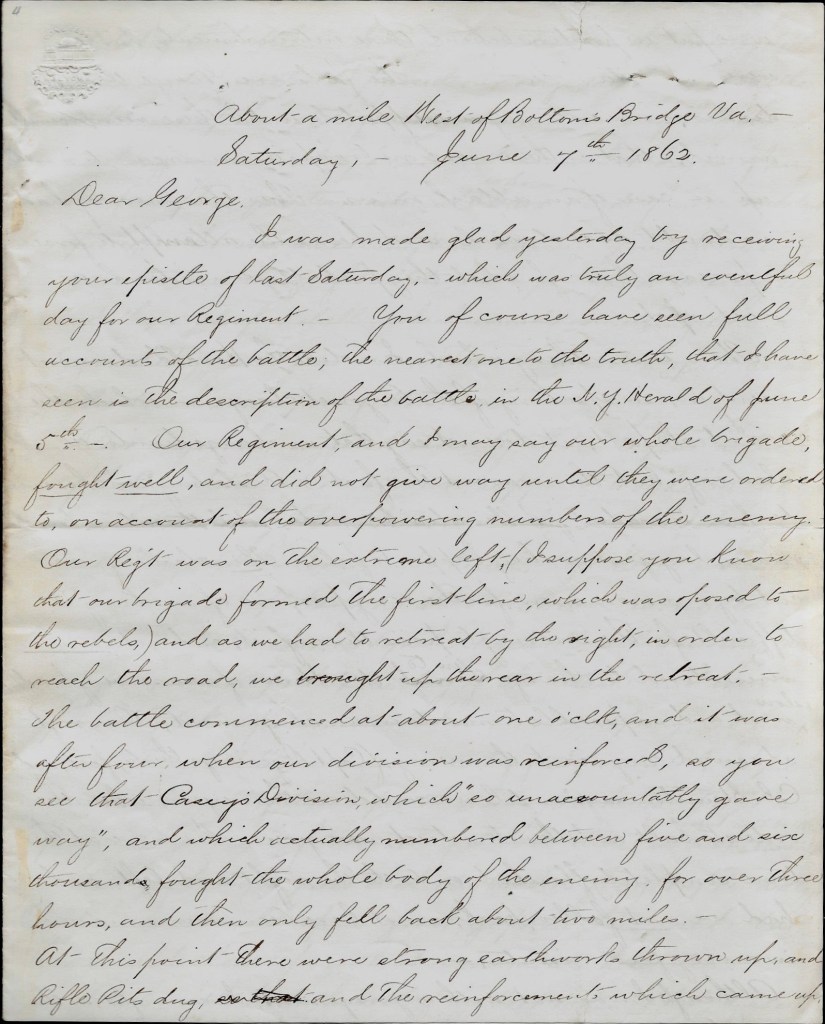
I was made glad yesterday by receiving your epistle of last Saturday which was truly an eventful day for our regiment. You of course have seen full accounts of the battle. The nearest one to the truth that I have seen is the description of the battle in the N. Y. Herald of June 5th. Our regiment—and I may say our whole brigade—fought well, and did not give way until they were ordered to, on account of the overpowering numbers of the enemy.
Our regiment was on the extreme left (I suppose you know that our brigade formed the first line which was opposed to the rebels) and as we had to retreat by the right in order to reach the road, we brought up the rear in the retreat. The battle commenced at about one o’clock, and it was after four when our division was reinforced, so you see that Casey’s Division, which “so unaccountably gave way,” and which actually numbered between five and six thousand, fought the whole body of the enemy for over three hours and then only fell back about two miles.
At this point there were strong earthworks thrown up and rifle pits dug and the reinforcements which came up were put in position behind these entrenchments, but then were not attacked. The facts are, George, that our division was entirely unsupported until these reinforcements arrived; that is—there were no troops in our rear to march up in case of an attack on us. This the enemy had no doubt ascertained and hence the attempt to force a passage through what they probably considered a weak spot.
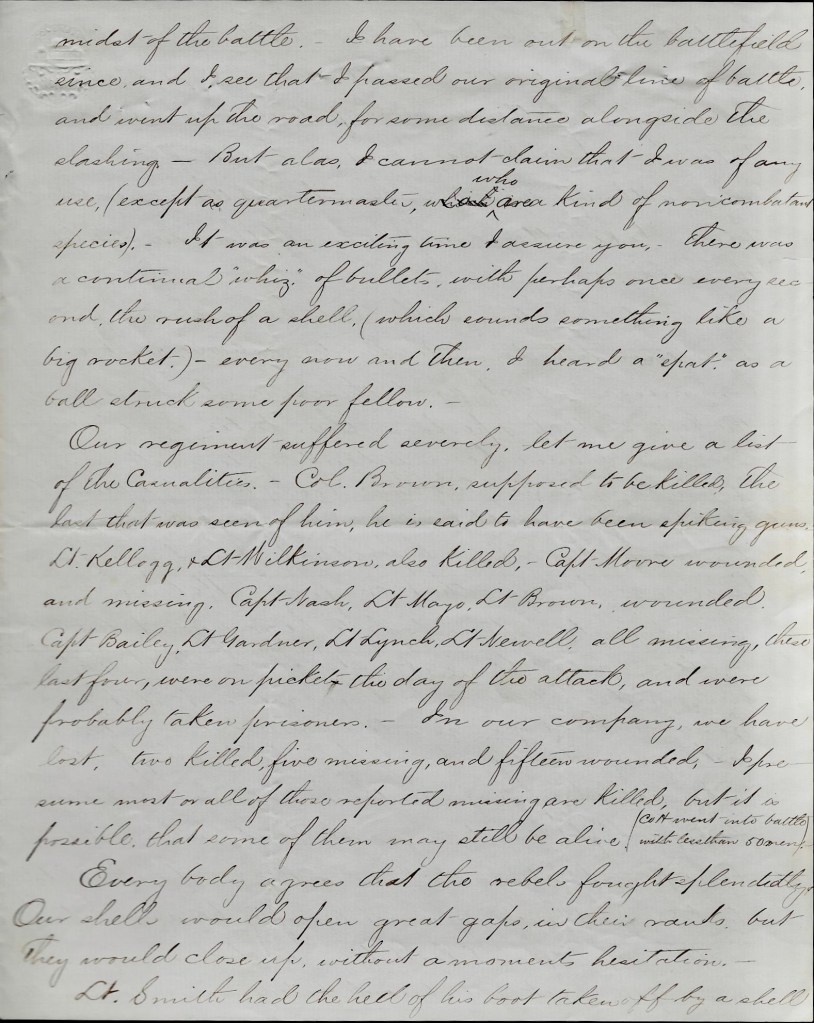
There is one thing which I notice the Herald does not mention in speaking of the bayonet charge in which the 100th took part. It does not say that we charged into a “slashing” but this was the fact. A “slashing” or “cheveaux de fris” is made by felling timber and just letting trees, branches, and leaves, lay just as they happen to fall. This slashing was cut by our own men for the purpose of making it difficult for the enemy to pass through it; and yet our men were ordered to charge into it. It was of course very hard & slow work and impossible to maintain an alignment. Our regiment advanced very near to the enemy (Capt. Dye says thirty feet, and Col. Staunton says “until we could very see their eyes.”) when the orders to halt, and then to retreat, were given. We were at this time completely flanked on both the right and left and had we not fallen back, must have been surrounded in a very few minutes.
Although I was not with my regiment, I was right in the midst of the battle. I have been out on the battlefield since and I see that I passed our original line of battle and went up the road for some distance alongside the slashing. But alas, I cannot claim that I was on any use (except as quartermaster who are a kind of noncombatant species). It was an exciting time I assure you. There was a continual “whiz” of bullets with perhaps once every second, the rush of a shell (which sounds something like a big rocket) and every now and then I heart a “spat” as a ball struck some poor fellow.
Our regiment suffered severely. Let me give a list of the casualties. Col. Brown [is] supposed to be killed. The last that was seen of him, he is said to have been spiking guns. Lt. Kellogg & Lt. Wilkinson, also killed. Capt. Moore wounded and missing. Capt. Nash, Lt. Mayo, Lt. Brown, wounded. Capt. Bailey, Lt. Gardner, Lt. Lynch, Lt. Newell, all missing. These last four were on picket the day of the attack and were probably taken prisoners. In our company we have lost two killed, five missing, and fifteen wounded. I presume most or all of those reported missing are killed, but it is possible that some of them may still be alive (Co. H went into battle with less than 50 men).
“Everybody agrees that the rebels fought splendidly. Our shells would open great gaps in their ranks but they would close up without a moment’s hesitation.”
— Charles E. Walbridge, Co. H, 100th New York Infantry, 7 June 1862
Everybody agrees that the rebels fought splendidly. Our shells would open great gaps in their ranks but they would close up without a moment’s hesitation.
Lt. Smith had the heel of his boot taken off by a shell and the heel of his foot somewhat bruised by the same missive, but was hurt in no other way. Capt. Dye was not hurt. The latter is now quite unwell. I have taken him to a house about five miles from here where, although there is no family but the owner himself, he can take better care of himself than he could in the field.
I am still acting Q. M. and I can assure you I have enough to do. The Quartermaster’s Sergeant and Commissary Sergeant are both sick and absent from the regiment so that I perform their duties as well as my own. I have been intending to write home for a long time but have truly been too busy to do it. Your letter has been the first I have received for a good while. Before that, I had one from Louise, and before that one from Mother.
I was quite astonished to hear about the volunteering excitement in Buffalo. That would have indeed been “a bully regiment” if it had gone. Don’t you go into any such thing without asking my advice first, which I shall be happy to give when called upon. I think you would enjoy being a Light Guard very much, besides which it will be very useful to you to have a knowledge of military tactics for America must hereafter be a military nation, and for at least ten years to come, every other man you meet will be well posted in all military matters.
You cannot imagine how surprised I was to see my letter to Mother after the battle of Williamsburg published in the Commercial. I would prefer not to have any more published as they are not fit “for the public gaze.”
There is glorious news today from Halleck’s Army though you probably heard it day before yesterday, and by this time have probably received full particulars. Ten thousand prisoners and fifteen thousand stands of arms is a big thing.
I am looking for the Paymaster to show himself before long. You know I haven’t been paid yet for March & April. Will you please ask Butler if he ever paid Tryon anything on my account? Please get a bill of Tryon and also one of Metzger and send them to me, as I don’t remember the amounts but would know if I should see the bills. I do not know whether I am entitled to Q. M. pay for the time I have been acting or not but shall apply for it anyhow. I received a letter yesterday from Denniston of L & I. J. White’s dated the 20th. I also received a paper from him some days ago. Please give him my sincere thanks for both. He wrote me a very kind brotherly letter, which it did me good to read.
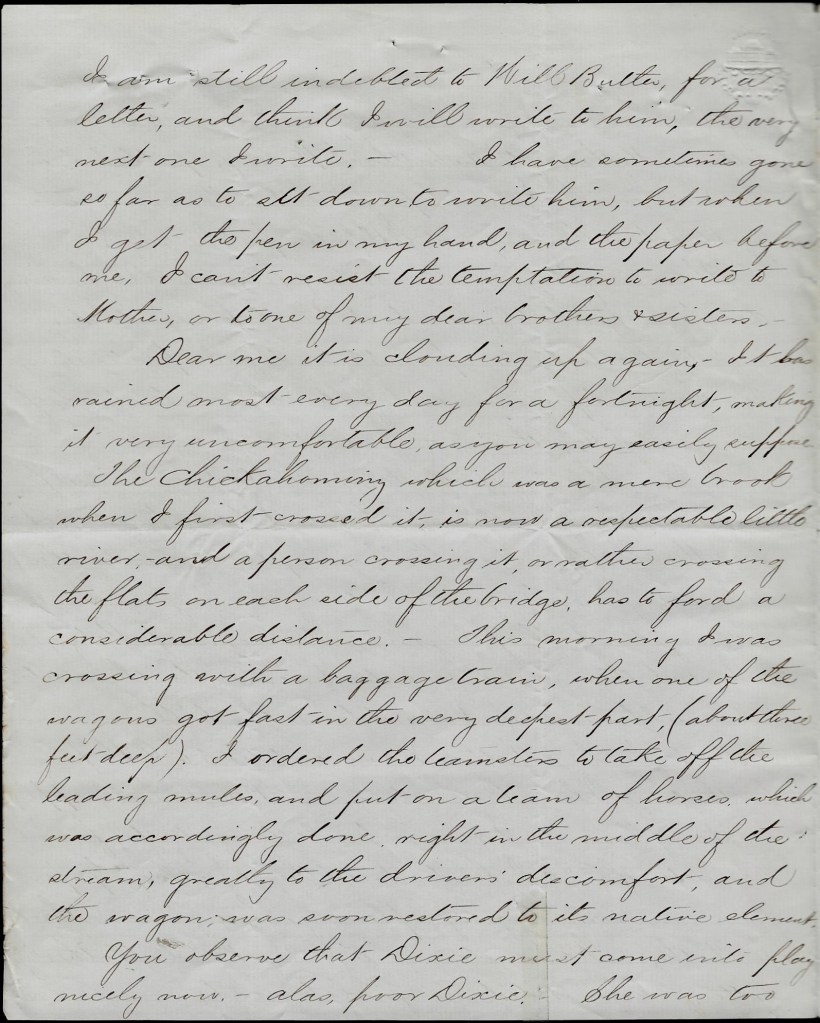
I am still indebted to Will Butler for a letter and think I will write to him the very next one I write. I have sometime gone so far as to sit down to write him but when I get the pen in my hand and the paper before me, I can’t resist the temptation to write to Mother, or to one of my dear brothers and sisters.
Dear me it is clouding up again. It has rained most every day for a fortnight, making it very uncomfortable as you may easily suppose.
The Chickahominy—which was a mere brook when I first crossed it—is now a respectable little river and a person crossing it, or rather crossing the flats on each side of the bridge, has to ford a considerable distance. This morning I was crossing with a baggage train, when one of the wagons got fast in the very deepest part (about three feet deep). I ordered the teamsters to take off the leading mules and put on a team of horses which was accordingly done right in the middle of the stream, greatly to the drivers discomfort and the wagon was soon restored to its native element.
You observe that Dixie must come into play nicely now. Alas, poor Dixie. She was too young to be ridden much. Besides, I have a government horse, so I left Dixie in the company when I became Quartermaster to carry the Captain & Lieutenant’s baggage. I had several offers to buy her, but didn’t care to accept any of them. The day of the battle, Washington had turned her loose to graze and when the balls began to fly pretty thick, he tried to catch her but she was inclined to be frisky and wouldn’t be caught, so she had to be “abandoned to the enemy.” Lieut. Smith & the Capt. lost their overcoats, blankets, etc. and the Capt. lost his knapsacks. Lieut. S’s fortunately was across the Chickahominy with the balance of the baggage.
I suppose that the “Michigan Estate” will prove to be a substantial benefit to our finances. Has Mr. Miller been around lately to see about it? Oh George, you don’t know how much I would like to see you all again. Well good bye for this time. Give Mother a kiss for me and my love to all the rest. Yours affectionately, — Charlie
I am much obliged for the envelope and stamp you have sent me in the last few letters. I have received just now. I have no lack of the former. Keep an account of stamps in which you send me. You know my salary is a good deal larger than yours & of course I want to pay all that you spend for me.
An unidentified member of Co. K, 1st US Chasseurs (65th NY Infantry) wearing the distinctive uniform and M1858 Hardee Hat (W. Griffing Collection)
The following letter was written in pencil by a soldier who served in the 65th New York Infantry, otherwise known as the 1st U. S. Chasseurs. The companies in this regiment were recruited principally as follows: A, C, G and I in New York City; B in Maine, Rhode Island and the Hudson river counties; D in New York city and Troy; E in New York City, Connecticut and Rhode Island; F and H in New York City and Rhode Island, and K in New York City and Ohio. The Chasseurs faced their baptism of fire at the Battle of Fair Oaks on 31 May-June 1, 1862 during McClellan’s Peninsula campaign. In addition to wearing a chasseur uniform, the regiment were distinct for choosing to wear M1858 uniform hats (more popularly known as Hardee hats) rather than the kepis.
Though it is certain the author served in the 1st US Chasseurs—most likely in Co. D or Co. K—he only signed his name “Josie” and there is no accompanying envelope nor additional identifying information in the letter itself to state with certainly who he was. The letter came to me for transcription attributed to Joseph P. Baugher [Actually Joseph T.] (1844-1921) of Co. K but a search of the company records reveals that Joseph was detached from the regiment in February 1862 “on western gunboat service and was discharged therefrom.” This record could have been an error, however. Joseph lived his entire life near Tiffin, Ohio, and his burial record only lists his service in the 65th New York Infantry—nothing else.
Regardless of who wrote the letter, it is a great first hand account of the Battle of Fair Oaks from the perspective of a member of the 1st US Chasseurs who “covered themselves with glory” and where “not a man flinched” on the field.
Transcription
Camp on battlefield of Seven Pines June 7th 1862
My dear parents,
I suppose by this time you have heard of the great battle near Richmond which commenced at one o’clock on Saturday [31 May] and ended about noon the next day [1 June] by the enemy skedaddling & leaving the field in possession of the brave soldiers of the North. I received a letter from home on Saturday a short time after writing & mailing an answer.
The noise of cannons and musketry was heard directly to the front of our camp. We were soon under arms, ready to take part in the encounter with the hated rebels. Our Colonel was ordered to take the regiment to the right of the [York River] railroad to prevent being flanked. At this place the shell flew over our heads like fun, doing no damage however as the range was too high. The noise as they came whizzing by sounded rather unpleasant at first, causing the men as well as officers to bob their heads, but we soon became used to that & we stood like men & soldiers ready to do our best for the glorious cause in which we had enlisted.
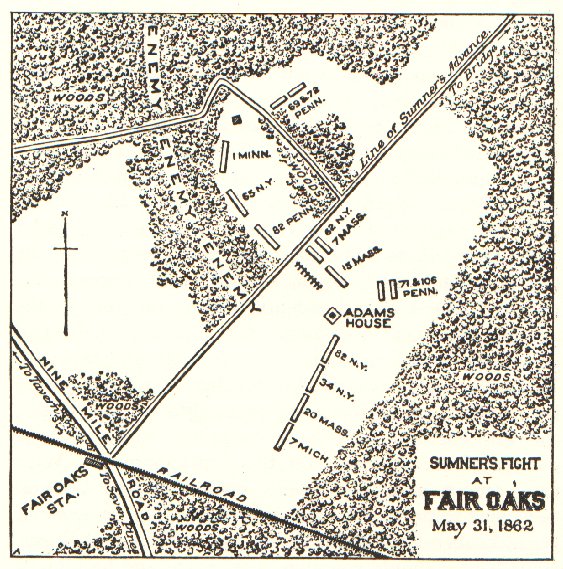
The Union line after Sumner’s troops arrived to join the 65th New York Infantry who were deployed behind a fence from which they “were loading and firing like demons.”
We soon received news that the Union forces were being driven back & that the rebels were at that time in the camps we had occupied not thirty minutes before. Such news made us feel of course rather low spirited. We fell back about half a mile and awaited anxiously for the rebels to make their appearance. After remaining at this place about 15 minutes, the right of Sumner’s line of reinforcements could be seen coming through the woods to the rear. This I can assure you was a welcomed sight. As soon as Sumner’s men had reached the field, we were ordered to double quick & take position in front of the woods on our right. We had no sooner halted than we received a sharp volley from the rebels who were at that time concealed in the woods. Without waiting for orders, we gave one in return.
“After I had fired, I hardly knew what to do but a second volley from the enemy brought me to my senses & I came to the conclusion that I had better reload. After this, I became perfectly cool and we let them have it thick and heavy for over two hours and a half…”
After I had fired, I hardly knew what to do but a second volley from the enemy brought me to my senses & I came to the conclusion that I had better reload. After this, I became perfectly cool and we let them have it thick and heavy for over two hours and a half—the enemy attempting several times to charge upon us but we would reserve our fire and when they came near, let them have it again & back they would go. I fired over 30 rounds, several times taking deliberate aim. The enemy skedaddled a little after dusk & the Chasseurs have the satisfaction of knowing that their first fight has been a victory.
After the firing was over, we turned our attention to our dead and wounded comrades. Our company lost three in killed and seven wounded; the regiment about forty & the brigade 650. The man to my right was killed; the one in front of him wounded, & I came so near that there was no fun in it—my cheek being grazed. It did not hurt me, however, so I am ready for the next battle which we expect will take place before the week is out. McClellan says it will no doubt be more bloody than the last. 1
After I had assisted in removing the wounded to the hospital and placing the dead together, I took a smoke out of the pipe which Pa gave me before leaving home & lay down where I had stood fighting and slept sound until morning—or at least daybreak when we stood under arms until about six o’clock when the rebels made their appearance intending to give us a second trial. Our regiment fired a couple of volleys when we were relieved by another regiment that had not been engaged the day previous & took a position in the woods where we remained during the day. The engagement ended about noon, the enemy being defeated.
For over 24 hours I had nothing to eat as our rations were left in camp. The next day a few crackers were brought to us and I can tell you they tasted good. We have lost all our clothes, &c. except what was on our backs as our knapsacks were left behind & destroyed by the rebels when they entered our camps. The government is going to make them good to us, I believe. I can tell you soldiering is a hard life. After our next battle, if I live through it & we reach Richmond, I shall try to get my discharge if it is possible. I can then retire with honor as I think I shall have done my share of duty in the way of fighting, &c.
When I write again, I shall no doubt have a bloody battle to describe. I hope I may come out of it safe but I am ready for it. My powder is dry, my musket (my best friend at present) in perfect order, & I shall have to take my chance with the rest. The enemy have commenced shelling us again so we will have to stand under arms again I suppose. So I must close. Goodbye. Love to all. Write very soon and often to your son, — Josie
1 According to Capt. William Halsted of Co. D, 65th New York Infantry, “Capt. Higgenbotham’s Co. [K] and mine took the worst of the fight….I lost in killed and wounded more than one-fifth of my company. Our regiment lost in killed and wounded 32 [actually 9 killed and 22 wounded]. Our men have covered themselves with glory. Not a man flinched in the field….We held our post for nearly two hours under a terrific fire. Not a cartridge was wasted. We went to work with 60 cartridges and my company averaged 40 left at night.” [Calvin Packard Civil War Battlefield Collection]
This letter was written by Capt. Horatio Nelson Hunt (1826-1896) of Leon, Cattaraugus county. Horatio enlisted on 15 September 1861 and was commissioned 1st Lieutenant of Co. K, 64th New York Infantry. He was promoted to Captain of his company on 24 May 1862, just one week before he was wounded in the fighting at Fair Oaks, Virginia. Less than three weeks later he sat down to write his wife, Jane (Murdock) Hunt (1826-1899) and his seven children the following letter.
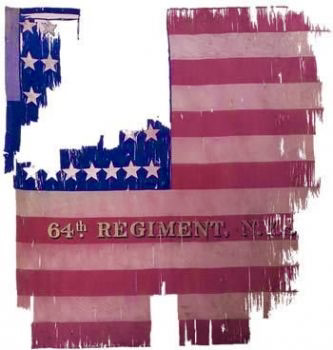
The Battle Flag of the 64th NYSV
His parents were Sherebial Hunt (1801-1889) and Anna Reed (1799-1846) of Bristol county, Massachusetts. Horatio was a cooper by trade.
For the 64th New York Infantry, Fair Oaks (or Seven Pines) was their first real emersion in combat. They performed remarkable well—“with great steadiness under a fire which killed or wounded 173 of its members.” Among those wounded in action from Co. K at Fair Oaks, besides Capt. Hunt, were Conrad Auchmire, Wayne V. Bloodgood, Joseph Bower, Nathaniel T. Cooper, Albert W. Dye, George Francis, Joseph Furnace, Galette Gilbert, Joseph Gooden, Gustavus Grover, Charles M. Ingraham, Patrick Maign, William Marsh, Fergus Merriman, Thomas P. W. Palmer, Delos E. Pember, Samuel Penner, and George W. Wellman.
Letter 1
Addressed to Mrs. H. N. Hunt, Leon, Catt. County, N. Y.
Fair Oaks, Virginia June 19th 1862
Dear Wife and children,
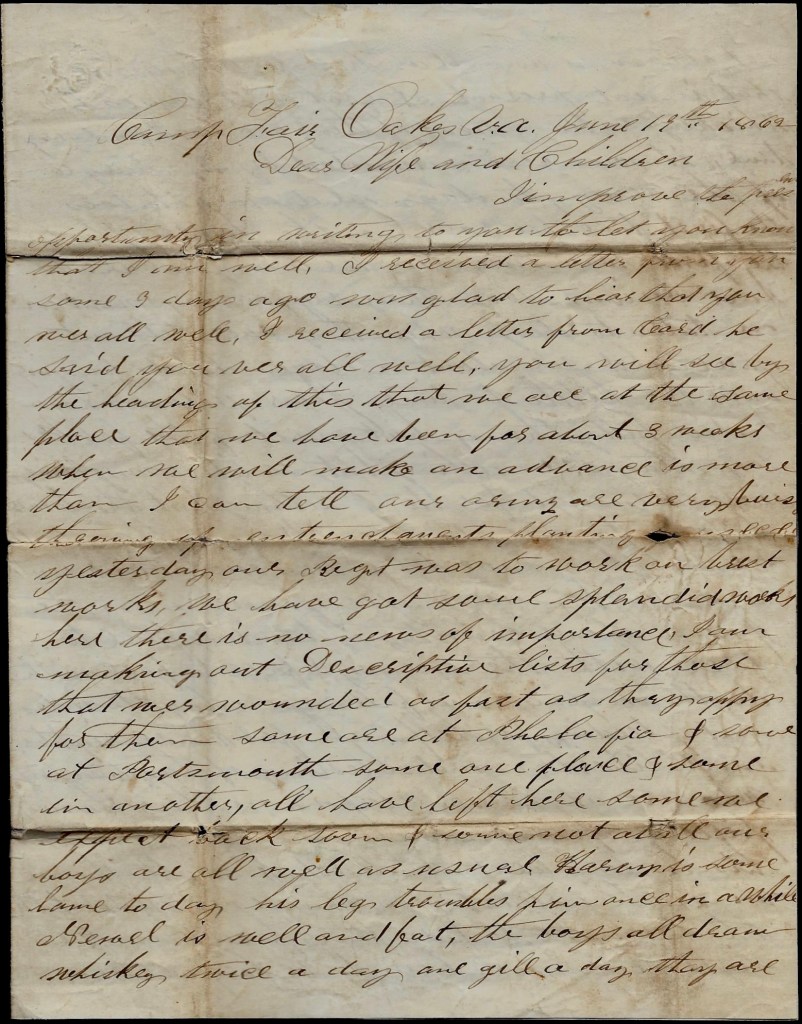
I improve the present opportunity in writing to you to let you know that I am well. I received a letter from you some 3 days ago. Was glad to hear that you was all well. I received a letter from Card. He said you were all well.
You will see by the heading of this that we are at the same place that we have been for about 3 weeks. When we will make our advance is more than I can tell. Our army are very busy throwing up entrenchments, planting [illegible]. Yesterday our regiment was to work on breastworks. We have got some splendid works here. There is no news of importance. I am making out Descriptive lists for those that were wounded as fast as they apply for them. Some are at Philadelphia 1 & some at Portsmouth, some one place & some in another. All have left here. Some are expected back soon & some not at all. Our boys are all well as usual. Harvey is some lame today. His leg troubles him once in awhile. N___ is well and fat. The boys all dram whiskey twice a day and gill a day. They are not allowed to sell or transfer it. Anyone that not present at roll call loses his whiskey ration. Most of them all are on hand every time. It was recommended by the surgeon of the army today.
We draw potatoes the first time for 3 or 4 months, dried apples for the first time since in the army. We have to have onions soon they say. Our boys went in on taters today. When they were still out you could see about a dozen heads hanging over the kettle to time. Poor fellows. How I did pity them. But most of the folks say they are nothing but soldiers. Anything is good enough for them. Nothing but the [illegible]. Oh how I wish they could see what I have seen just once. Once would be enough. Men—yes, young men—the pride of our country, standing face to face with the enemy & face to face with death, dropping and falling on both sides and pleading for help all for their rights and liberties and blessings of those to enjoy who are at home sleeping on their downy pillows of ease, while the soldier walks his lonely beat at the dead of night. Shame on such patriotism. Shame on such talk. They ought to hide their faces from the sight of human beings. We forgive them.
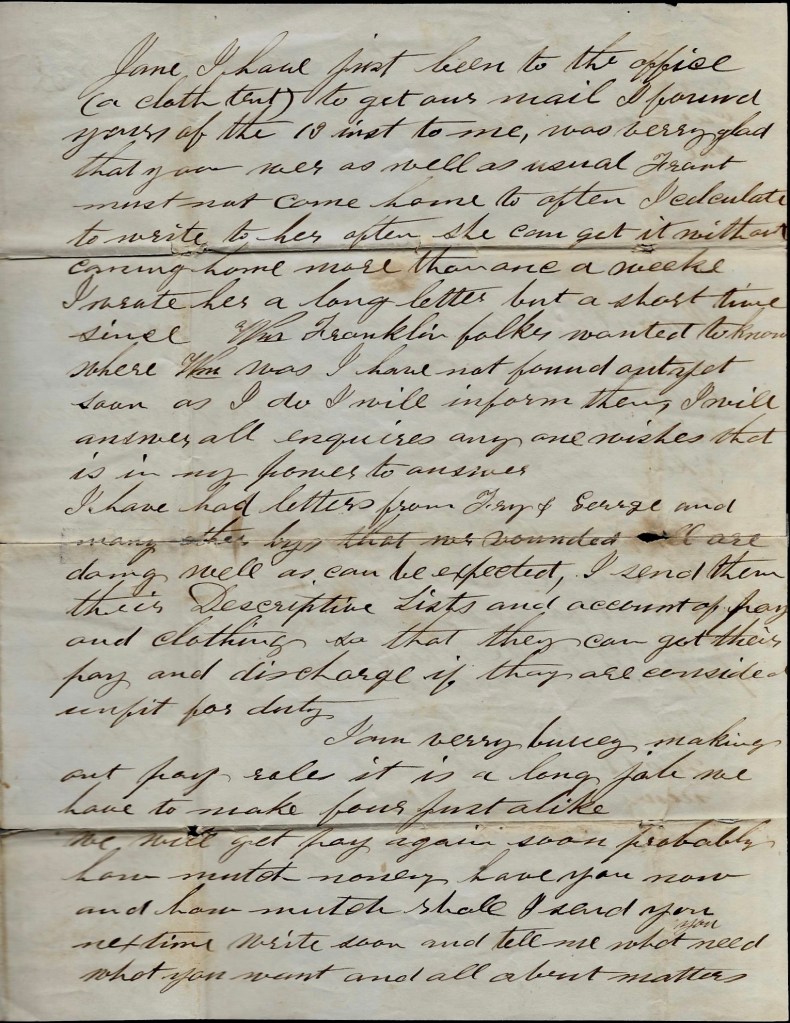
Jane, I have just been to the office (a cloth tent) to get our mail. I found yours of the 13th inst. to me. Was very glad that you were as well as usual. Frant must not come come too often. I calculated to write to her often. She can get it without come home more than once a week. I wrote her a long letter but a short time since. Mr. Franklin’s folks wanted to know where William was. I have not found out yet. As soon as I do, I will inform them. I will answer all enquiries anyone wishes that is in my power to answer.
I have had letters from Fry & George [Wellman] and many other boys that was wounded. All are doing well as can be expected. I sed them their Descriptive lists and account of pay and clothing so that they can get their pay and discharge if they are considered unfit for duty.
I am very busy making our pay rolls. It is a long job, We have to make four just alike. We will get pay again soon probably. How much money have you now and how much shall I send you next time. Write soon and tell me what you ned, what you want, and all about matters. I send in this a gold pen and silver case and pencil to Frant. She must be careful of it and not lose it for it is a good one.
I want you to get someone to look at the wing part of the house and see what is the least they will underpin it for with lime and mortar in a good workmanlike manner. Ledge stone wall to commence ten inches below the top of the ground in a ditch filled with small stone. All for cash when done and accepted. Perhaps Corydon will see to it for you. When it is done, the southeast corner or the whole [ ] must be leveled up for it has sagged some.
I send my love to you and the children. Goodbye for this time. Write soon all news. Yours truly, — H. N. Hunt
1 One of the members of the 64th NYSV sent to Philadelphia for the treatment of wounds received at Fair Oaks was Daniel Wiley Lafferty of Co. A. His wound resulted in the loss of the 3rd finger on his left hand. See his letter of 25 June 1862.
Letter 2
[Note: The following letter is from the private collection of Greg Herr and was transcribed and published on Spared & Shared by express consent.]
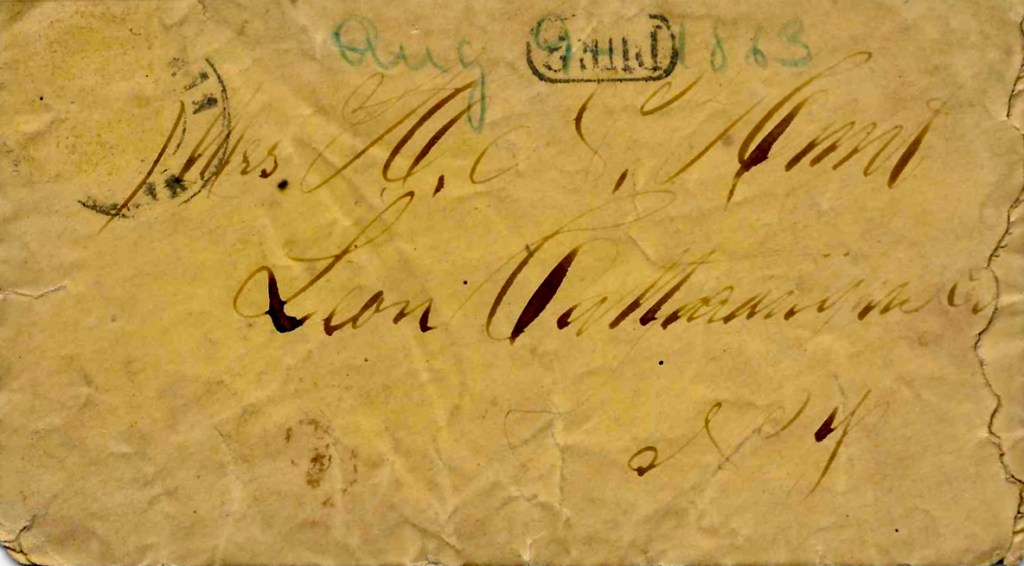
Addressed to Mrs. H. N. Hunt, Leon, Cattaraugus county, New York
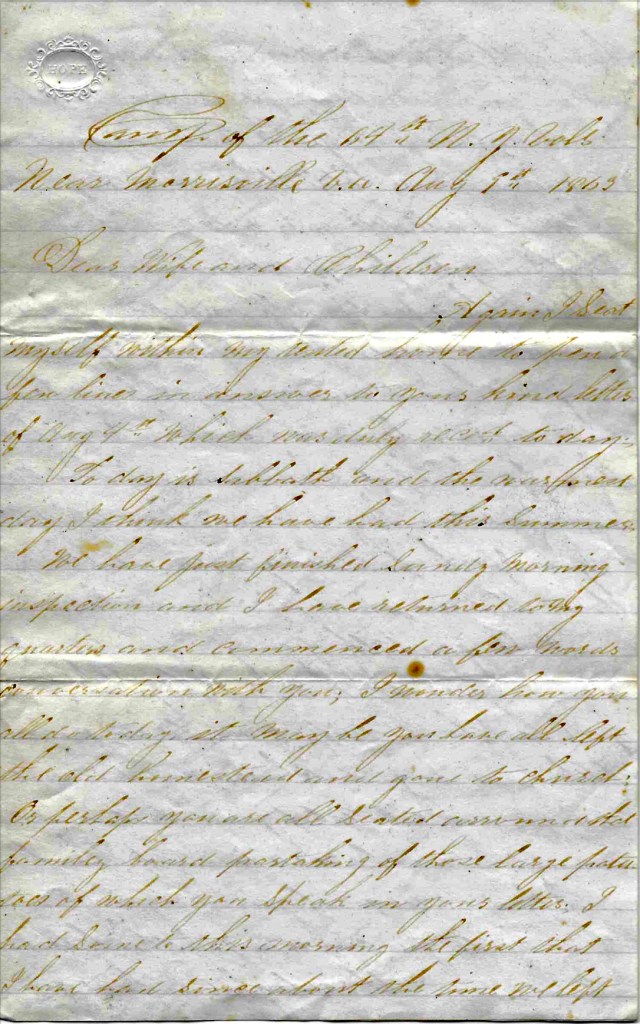
Camp of the 64th New York Vols. Near Morrisville, Virginia August 9th 1863
Dear Wife and children,
Again I seat myself within my tented home to pen a few lines in answer to your kind letter of August 4th which was dul received today.
Today is Sabbath and the warmest day I think we have had this summer. We have just finished Sunday morning inspection and I have returned to my quarters and commenced a few words conversation with you. I wonder how you all do today. It may be you have all left the old homestead and gone to church. Or perhaps you are all seated around the family board partaking of those large potatoes of which you speak in your letter. I had some this morning—the first that I have had since about the time we left Falmouth. I guess I must tell you where and how I got them for fear you will will have some bad feelings or you’ll be sending some in your letters to me. Still, if you want sympathy about it, I will tell you. Well, you see our Chaplain got a few potatoes somewhere and he boiled them for himself and had 4 left not one bit larger than walnuts. He was going to throw them away. My 1st Lieutenant saw him and said he would take them so we had them for breakfast this morning. I had two and Lieutenant two. So you see we’ve had new potatoes.
You speak of its being warm weather up there. That’s no name for it down here.
I see you talk of going a journey to Elmira and think it will be good for your health. Now if it would do you a little good to go to Elmira, would it not do you a great deal of good to come down and make me a visit? I think you had better go if you can gain anything by it; you can do as you think best about going. I should be glad to have you go.
I suppose it can safely be said that we have gone into camp. How long we will remain, I can’t say. It is said we are to remain here until the drafted men are in to fill up the regiments. There is now only about one company of men in our regiment. I think it is less than 100 men for duty. I have 3 men, 1 corporal, 1 musician, and 1 pioneer in my company making 6 in all. Big thing, ain’t it? I am a member of a general court martial in session everyday at Gen. Coldwell’s Headquarters. The court are trying commissioned officers for different offenses. We have to sit from 3 to 6 hours each day. The excuses me from all other duty.
We are getting very good food again. Soft bread, ham, &c, but no vegetables yet.
John Mosher came from Washington yesterday with a load of sutler’s goods. He sold out in one day and has gone to Washington today for more goods.
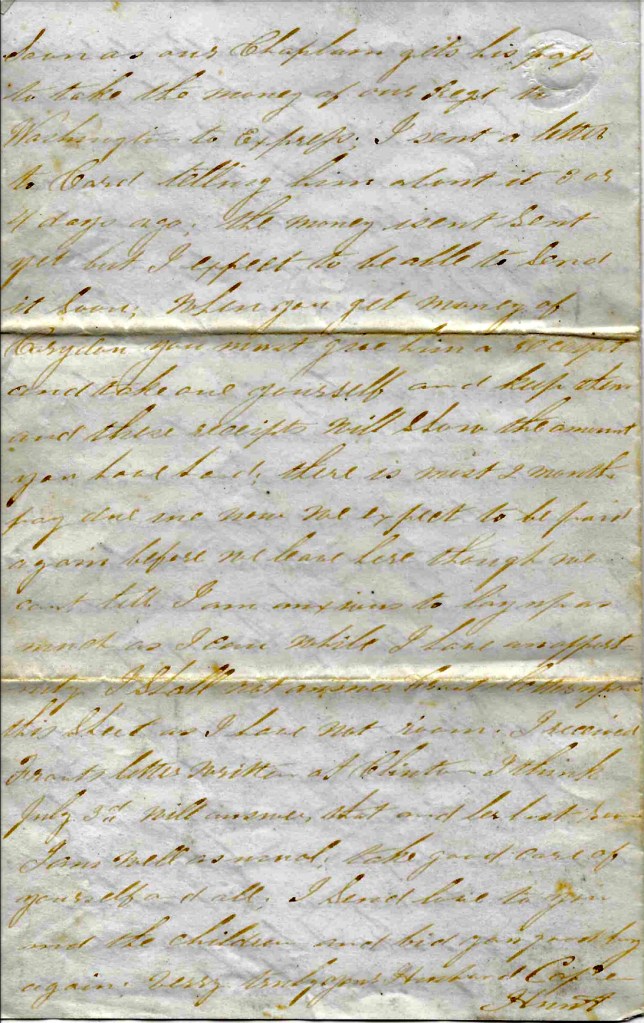
We were paid again last week. I received $253.65. I had put up in a package $225.00. Shall send it to Cord soon as our Chaplain gets his pass to take the money of our regiment to Washington to express. I sent a letter to Cord telling him about it 3 or 4 days ago. The money isn’t sent yet but I expect to be able to send it soon. When you get money of Caryolon, you must give him a receipt and take one yourself and keep them and these receipts will show the amounts you have had. There is most 2 months pay due me now. we expect to be paid again before we leave here though we can’t tell. I am anxious to lay upon as much as I can while I have an opportunity. I shall not answer Frank’s letter upon this sheet as I have not room. I received Frank’s letter written at Clinton I think July 3rd. Will answer that and her last soon.
I am well as usual, take good care of yourself and all. I send love to you and the children and bid you goodbye again. Very truly yours husband, — Capt. Hunt




















 Spared & Shared 23