Category Archives: Battle of Franklin

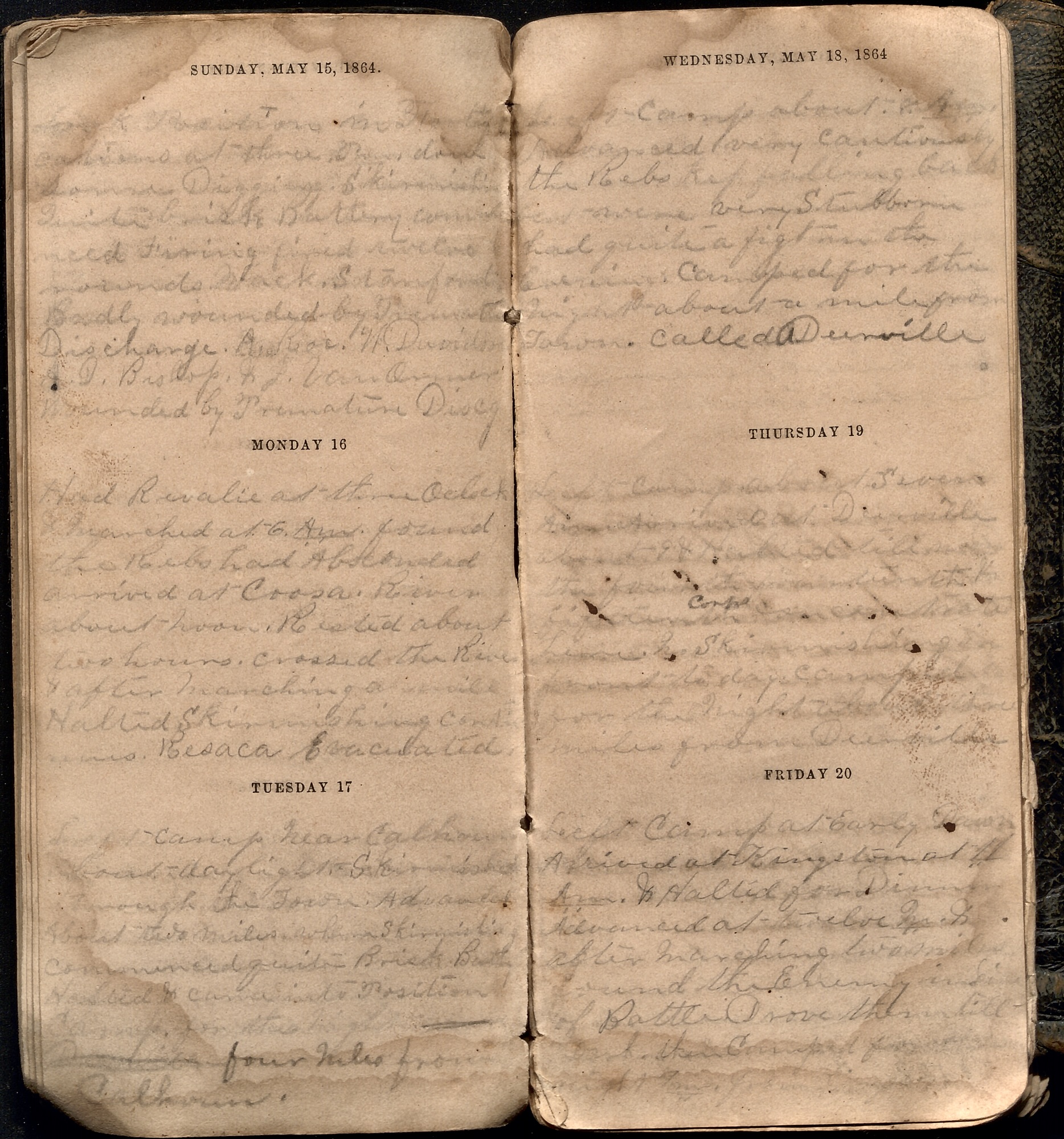
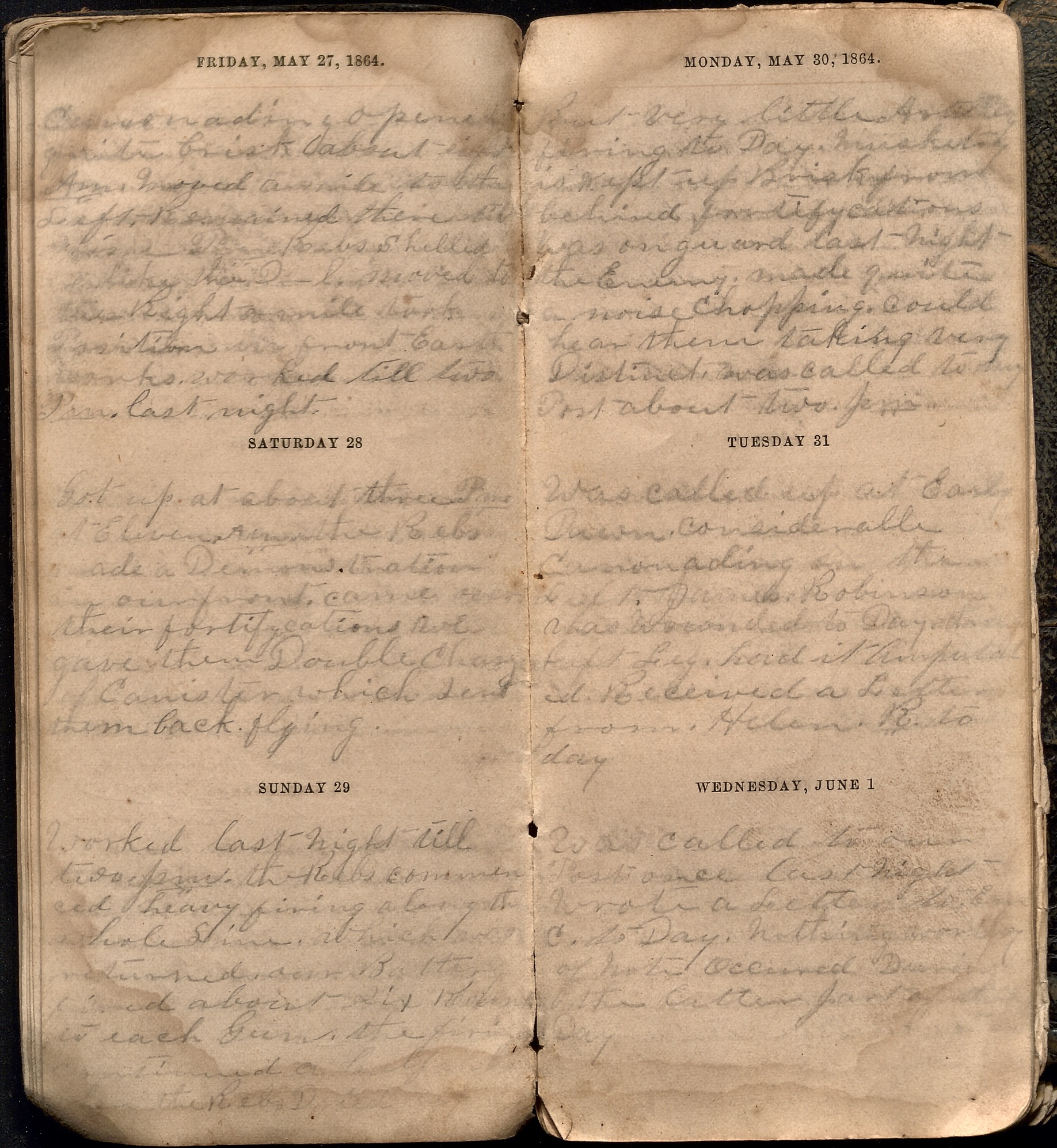
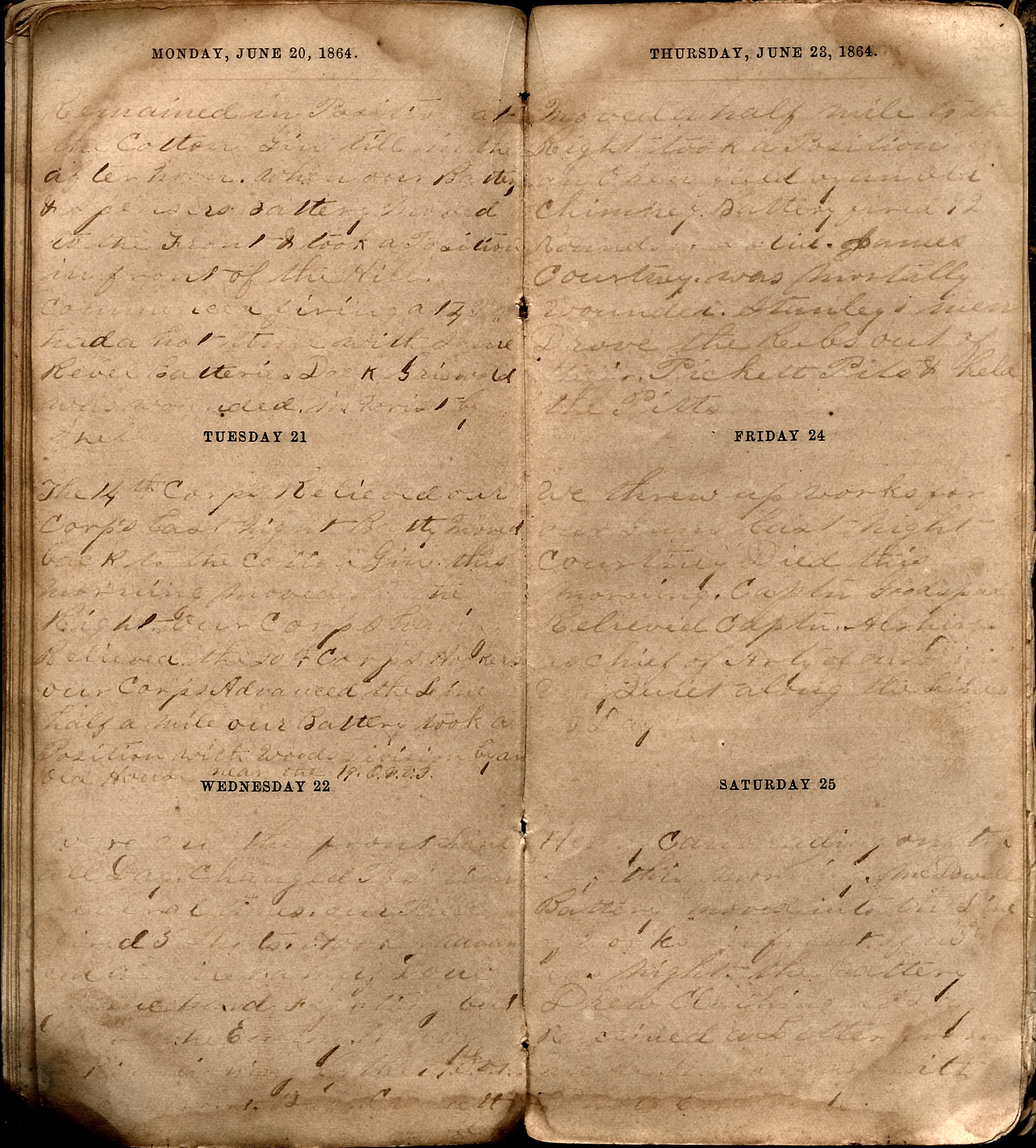
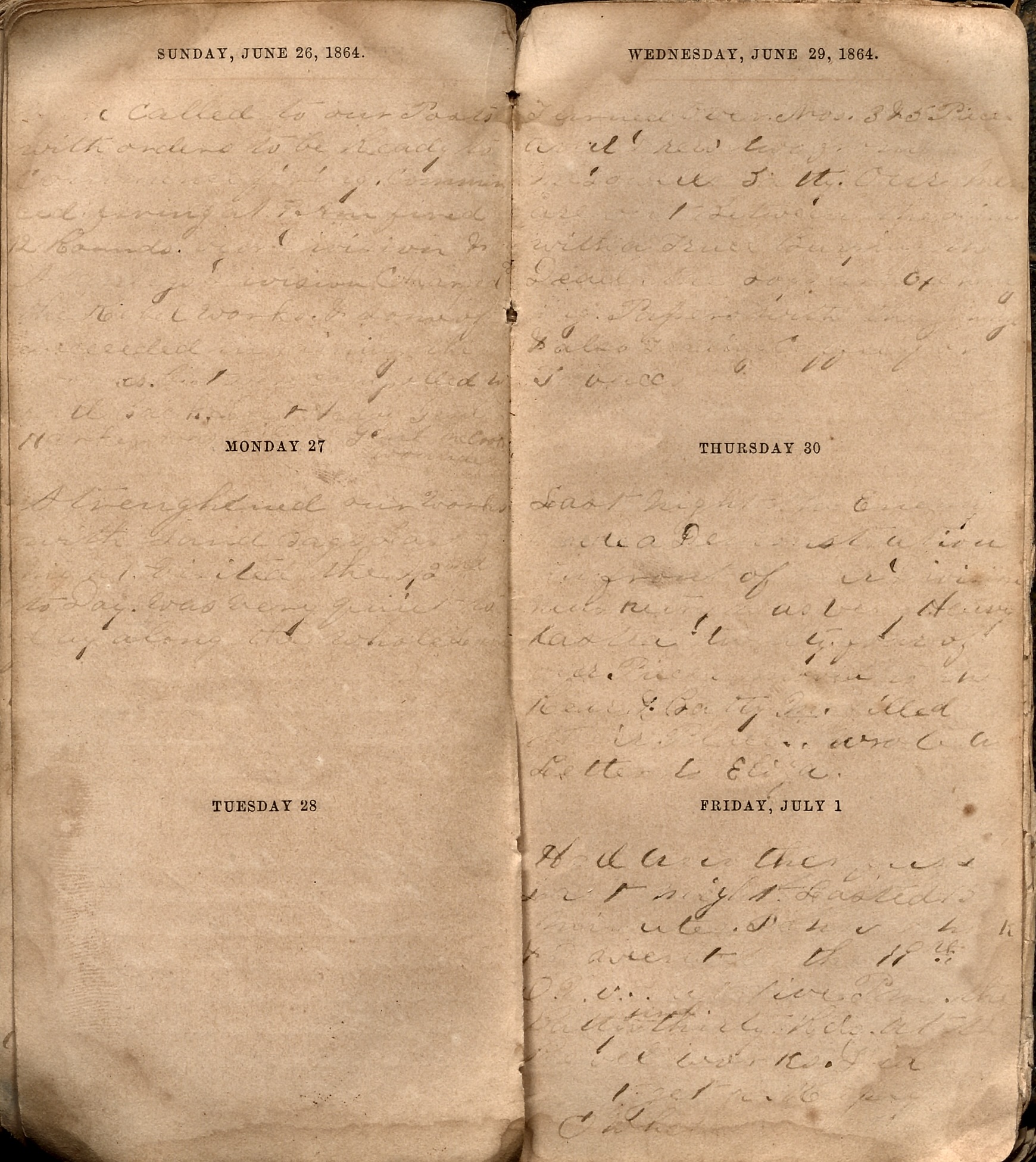
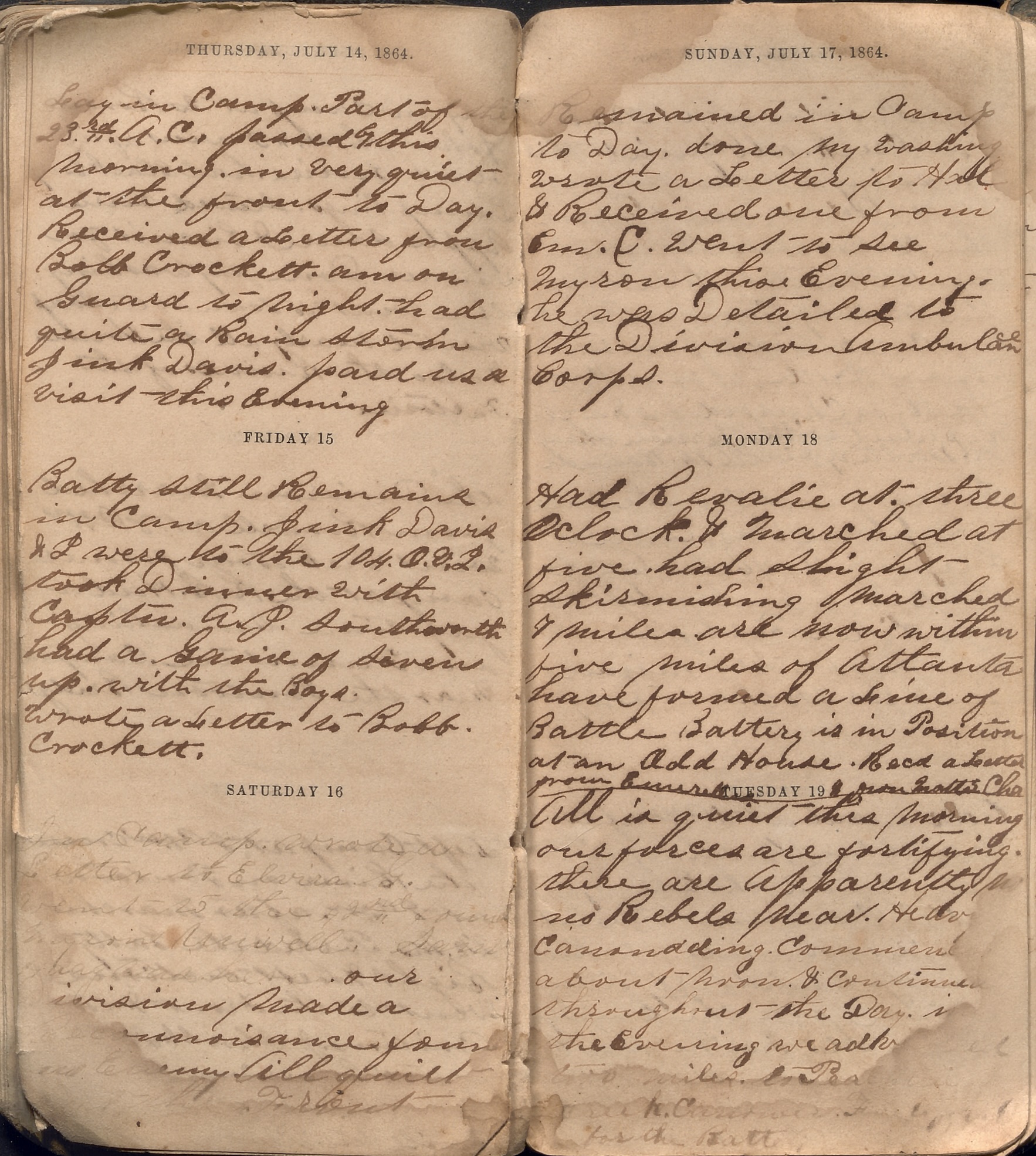
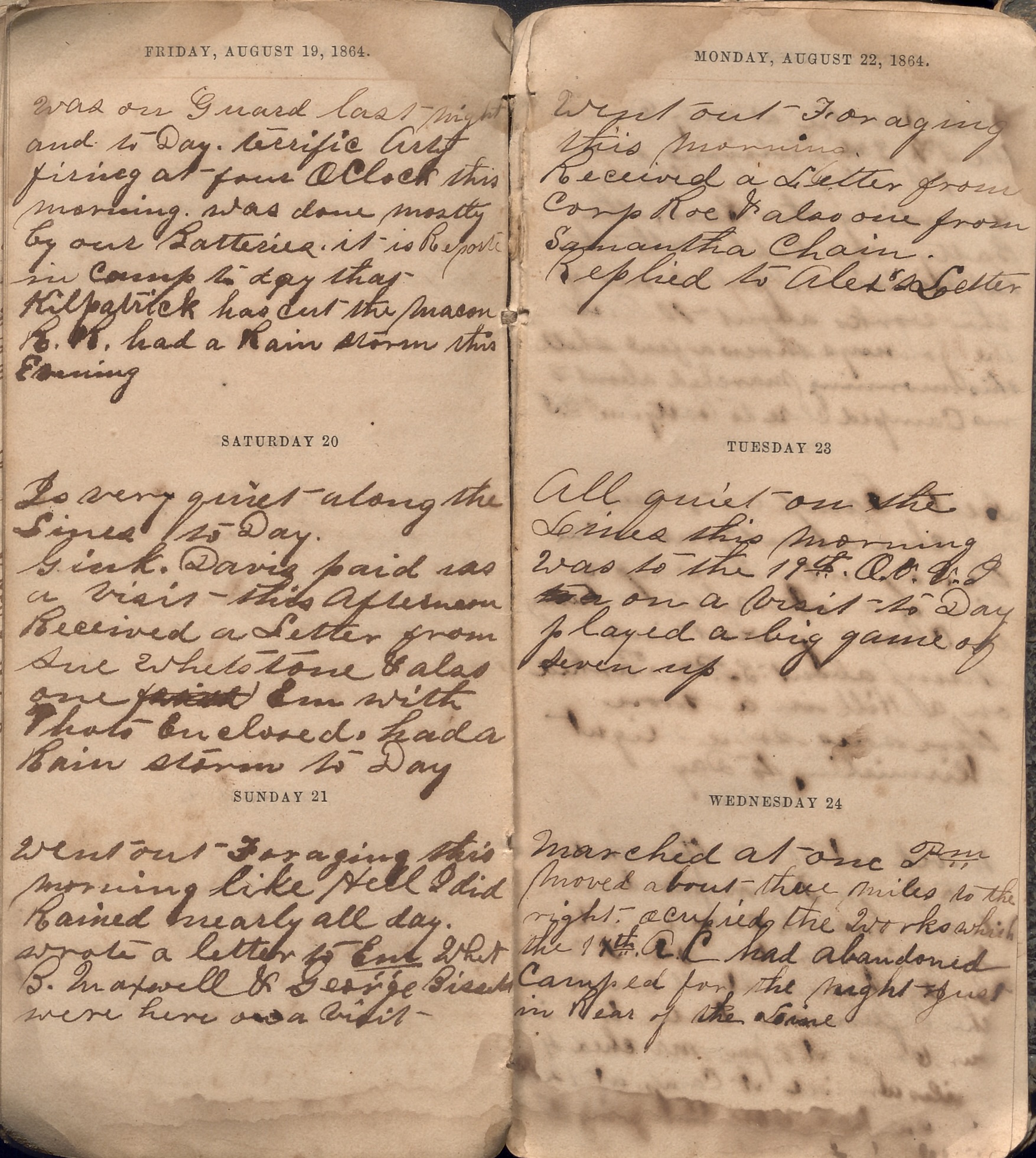
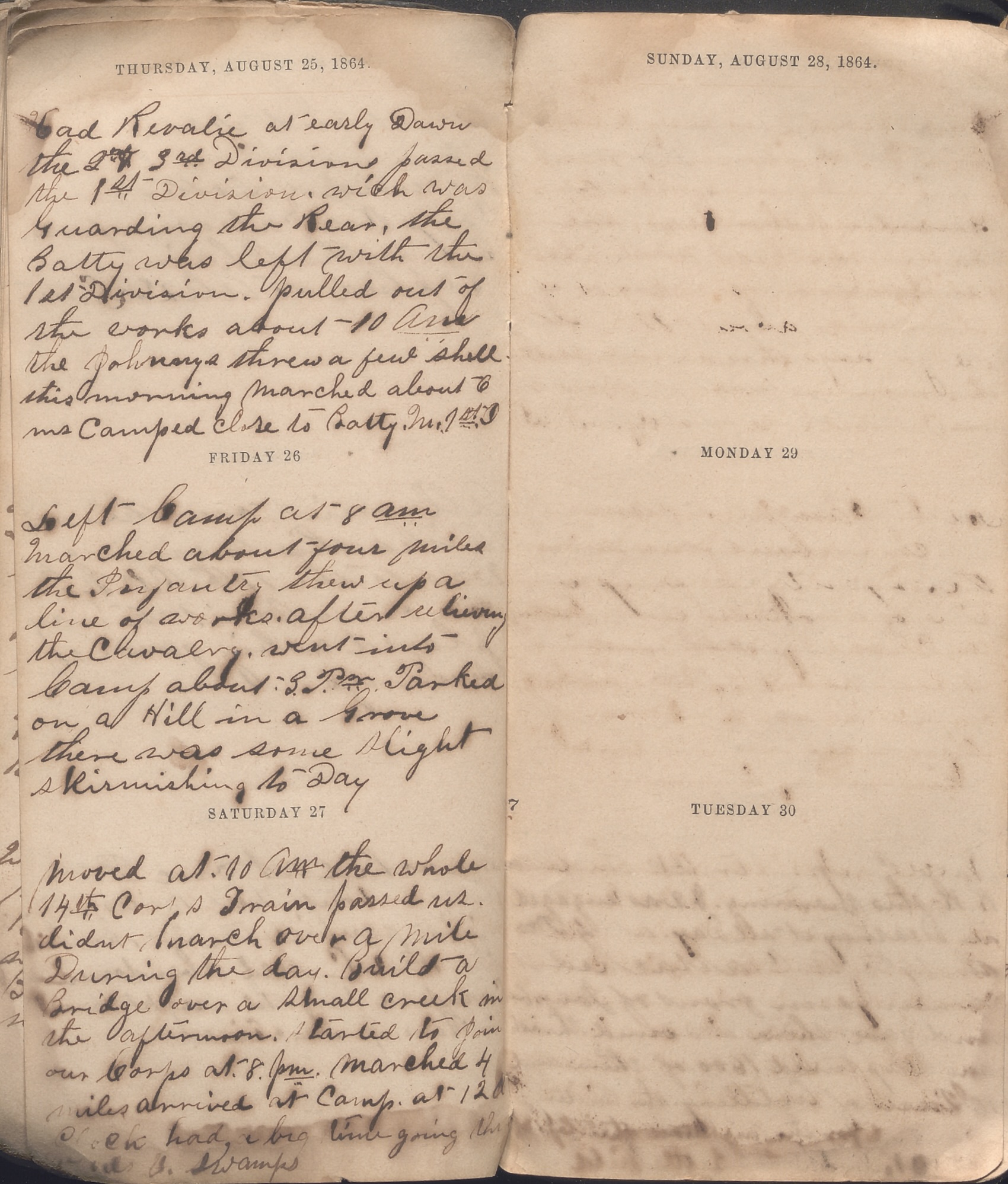
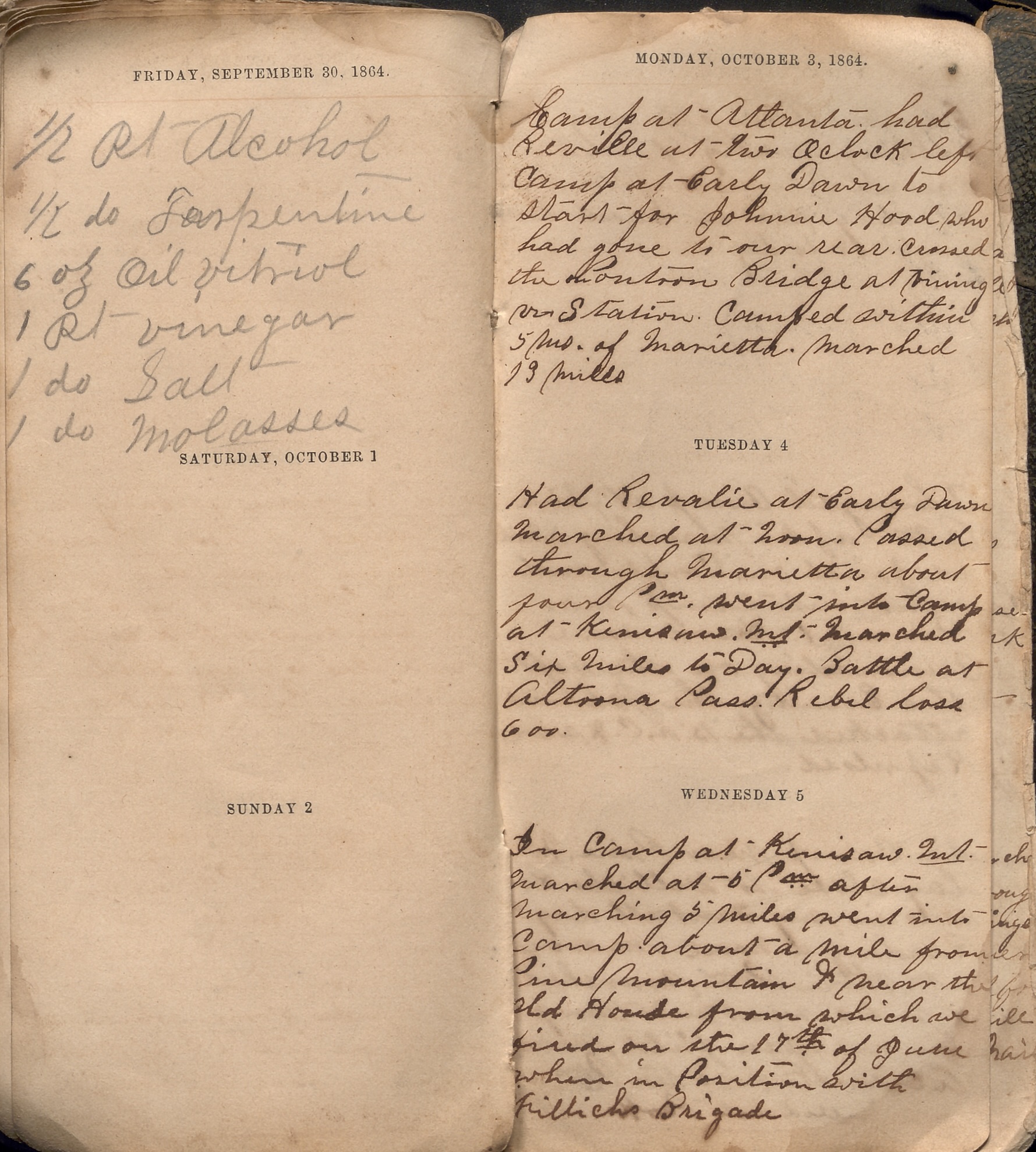
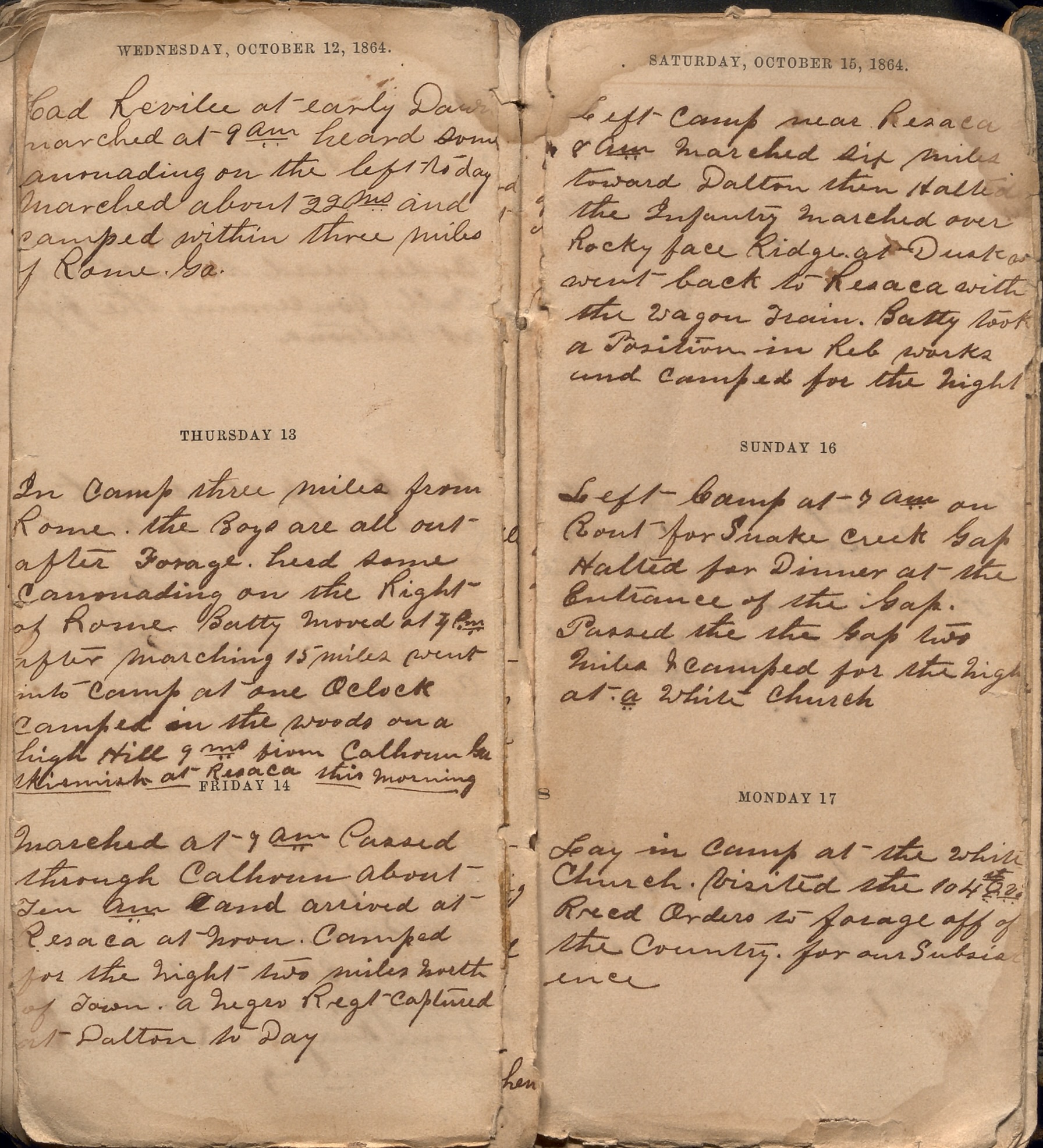
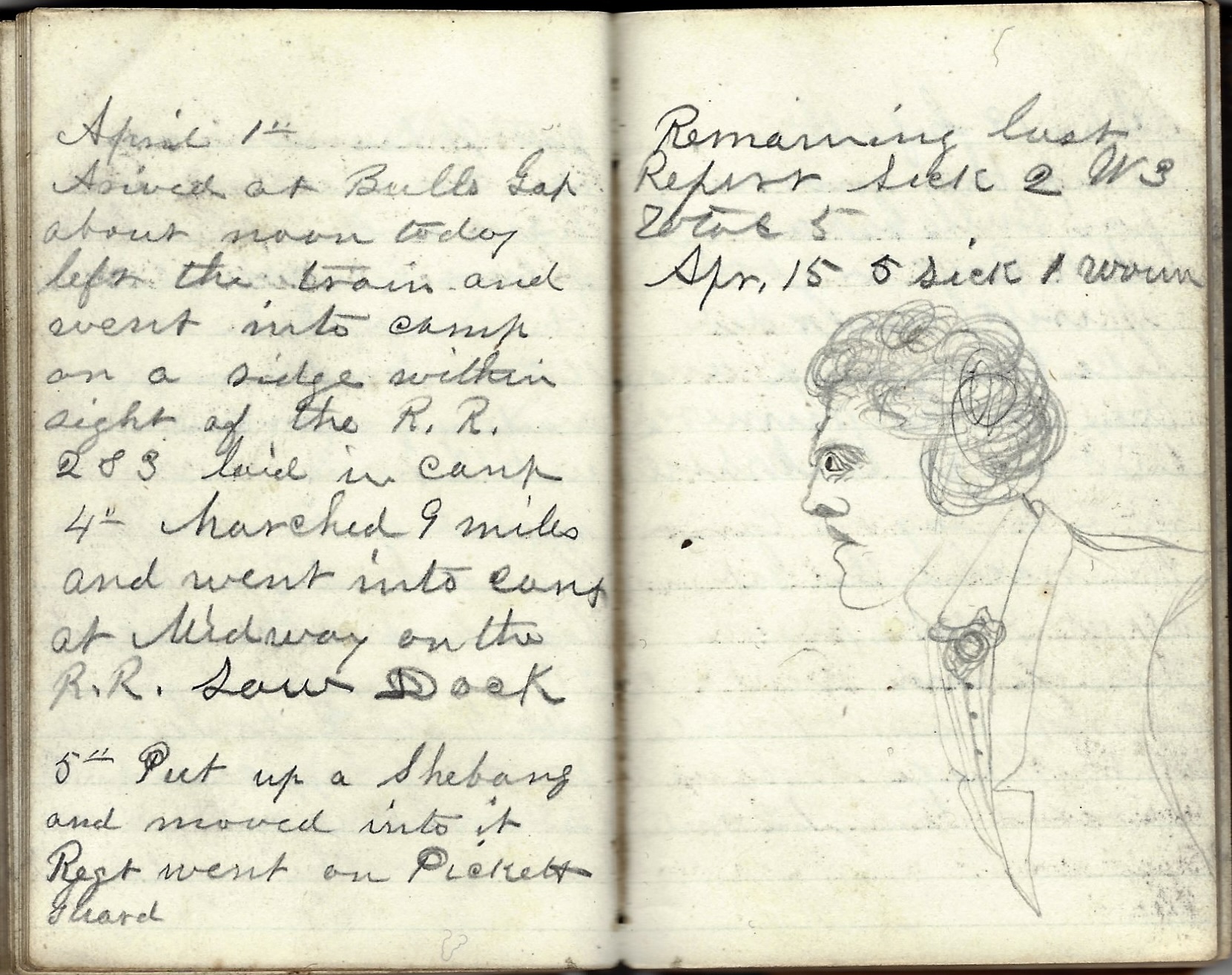
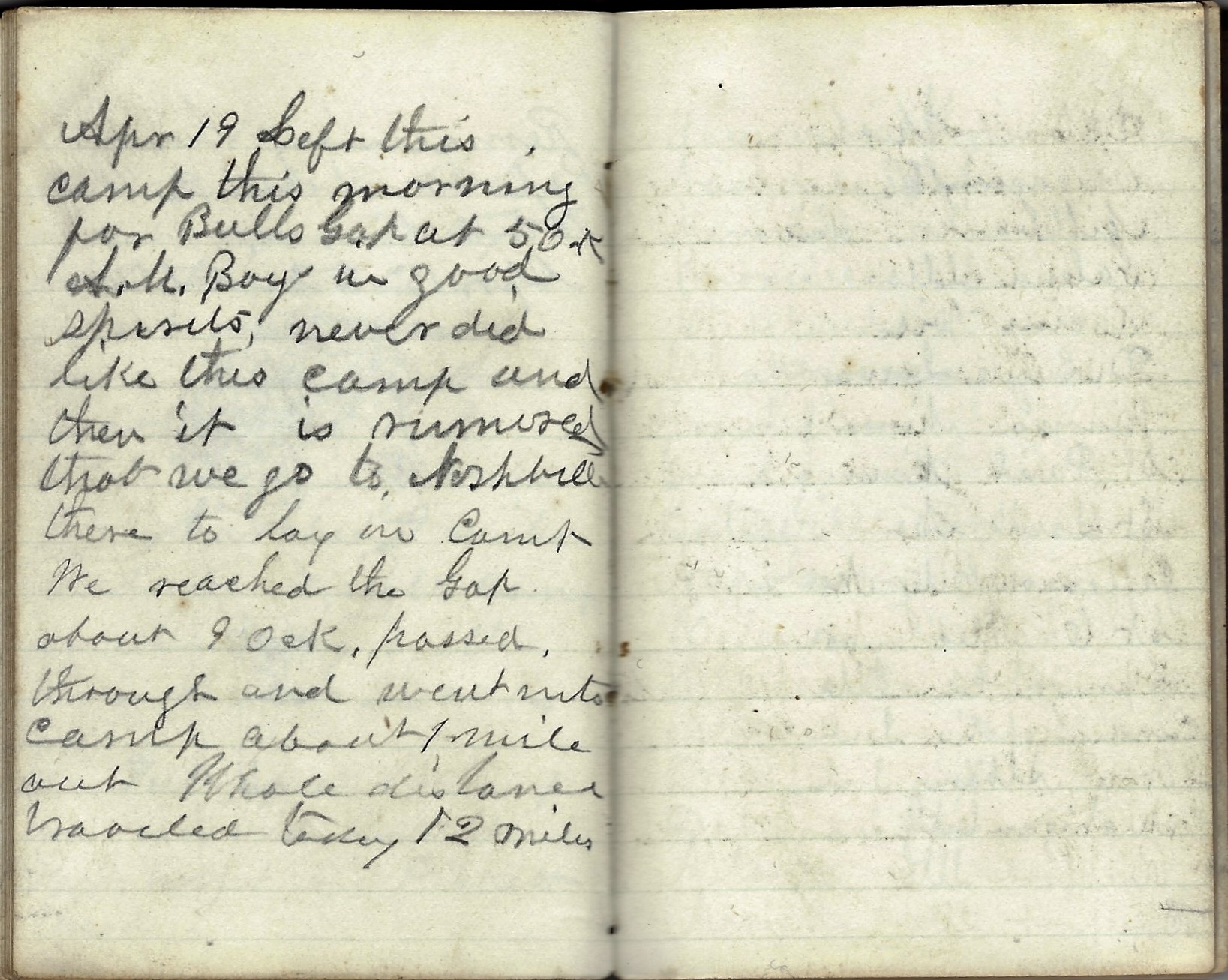
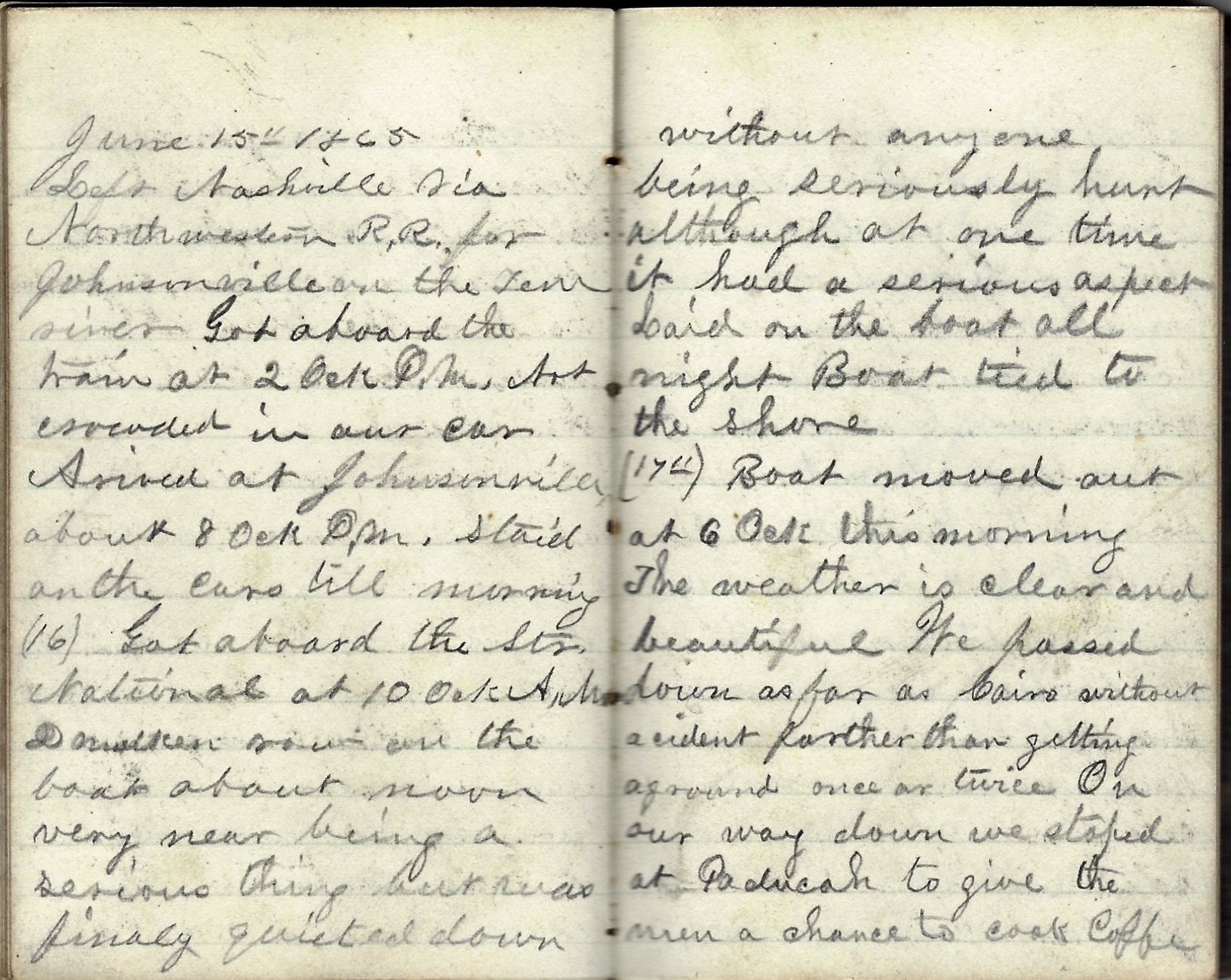
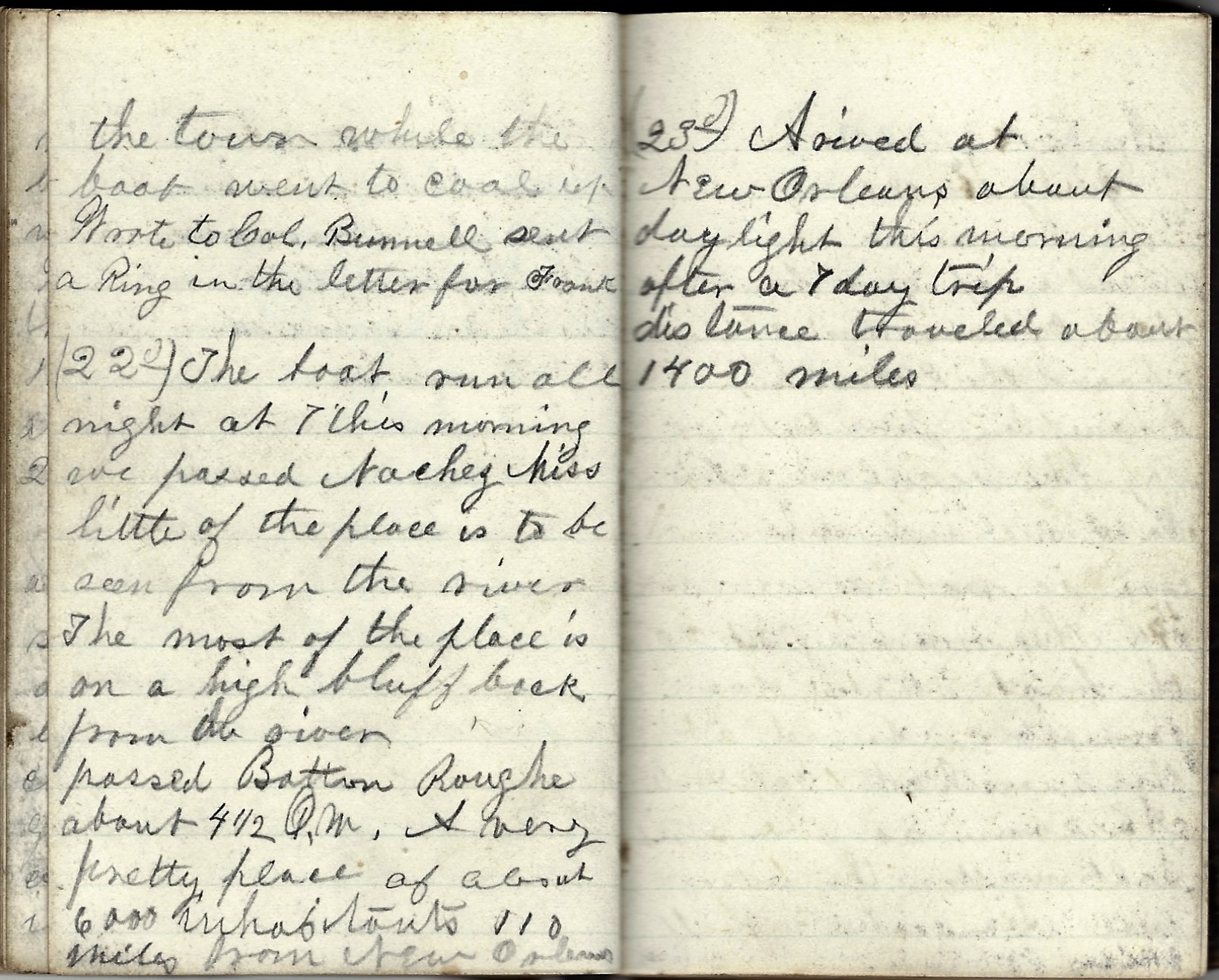
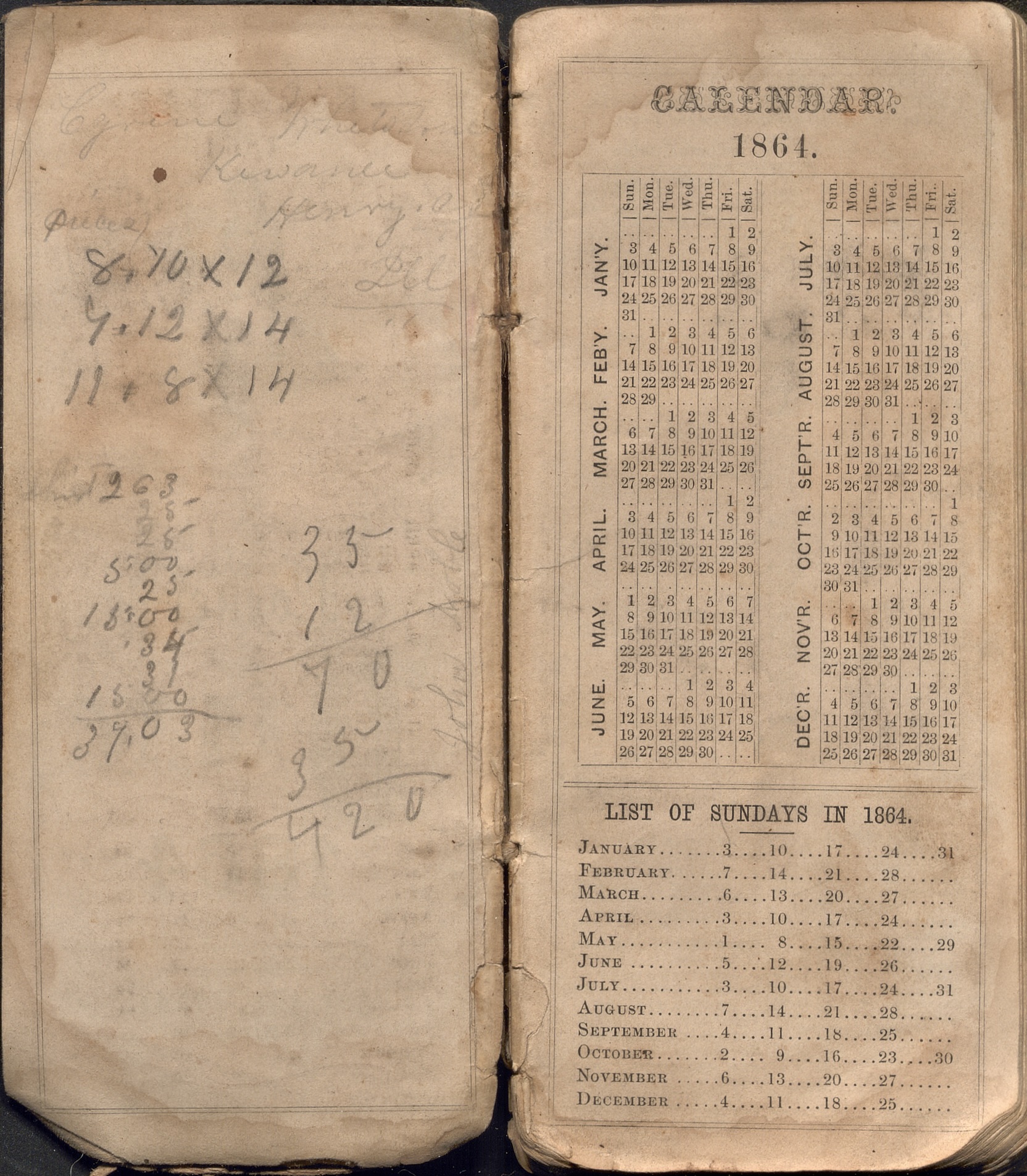
The 1864 Diary of Cyrenius Whetstone, Goodspeed’s Battery

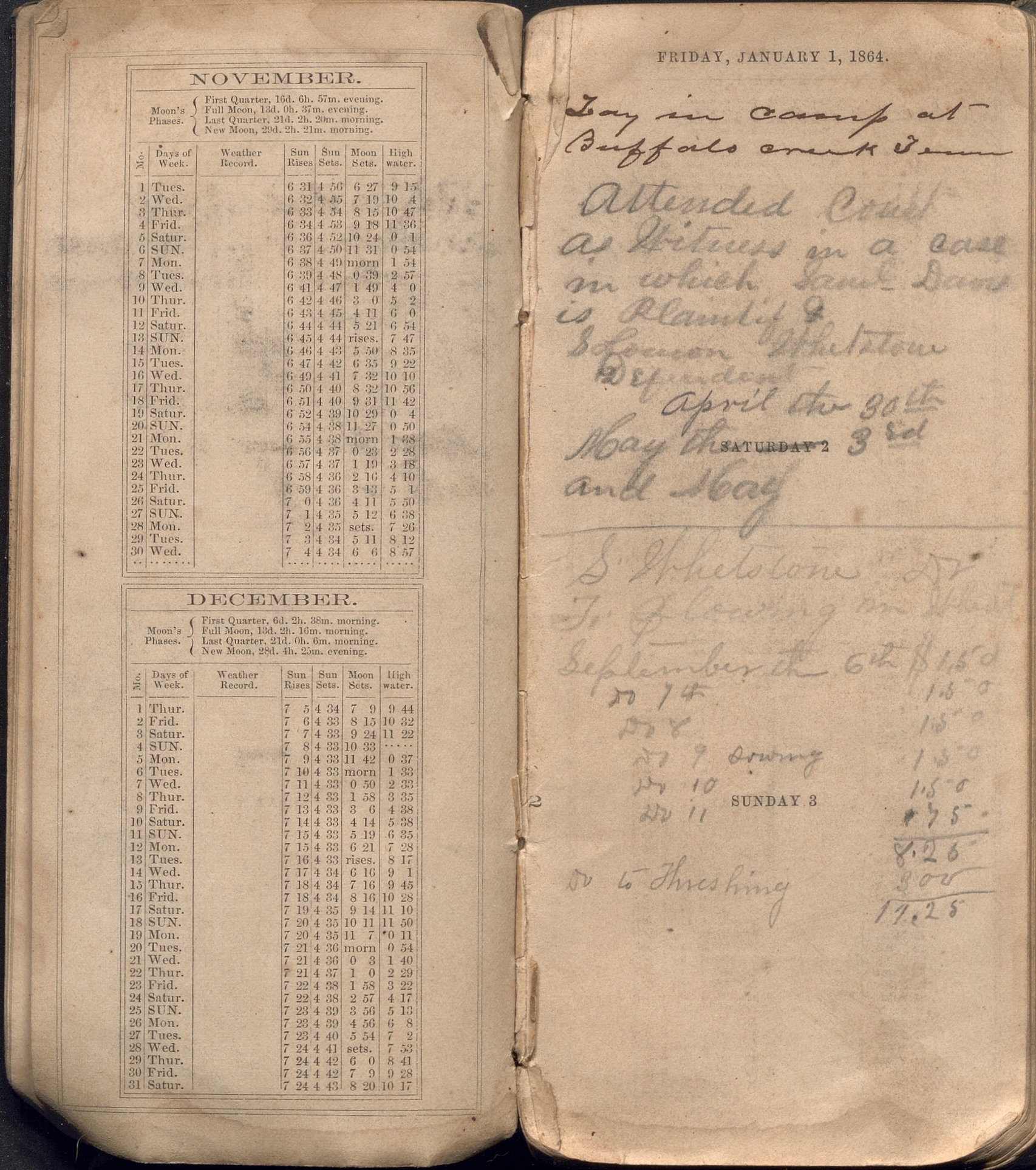
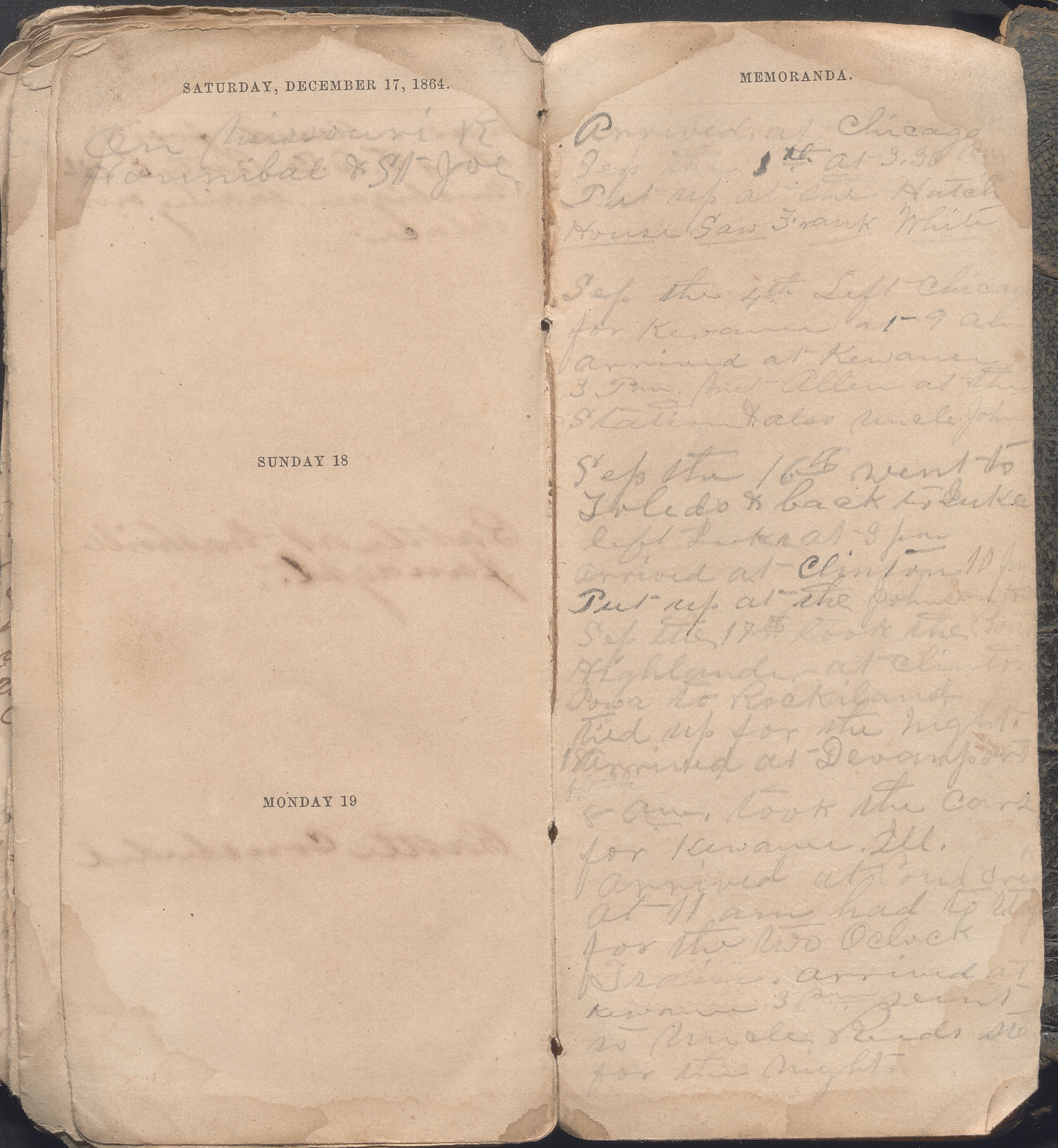
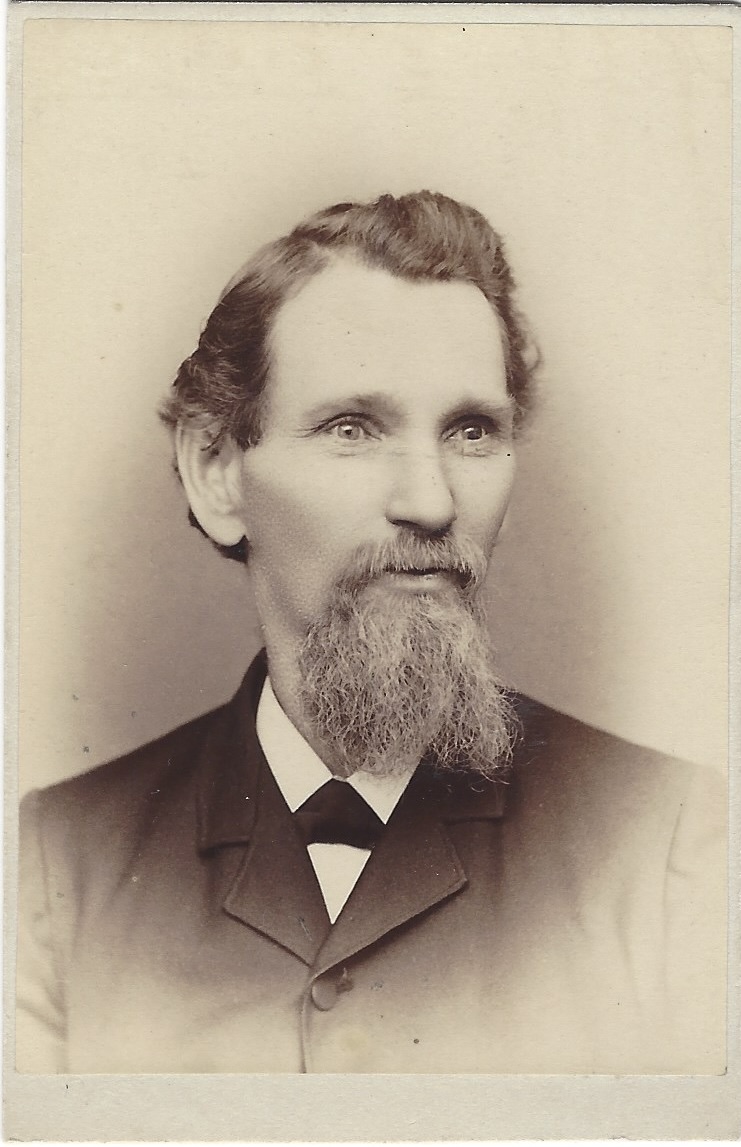
The following diary was kept by Cyrenius Whetstone (1839-1922) of New Baltimore, Stark county, Ohio. He enlisted in Battery A, 1st Ohio Light Artillery (“Goodspeed’s Battery”) on 25 September 1861 and served until 31 July 1865. He was married to Charlotte (“Lottie”) Scovel in 1879. He was the son of Solomon Whetstone (1810-1873) and Catherine D. Stickler (1808-1860). A pension record gives his date and place of death as 26 June 1922 at Rock Falls, Illinois.

A brief biographical sketch appears in a history of the battery which reads: “Cyrenius Whetstone enlisted with the Battery at its organization and served with it in all the marches through Kentucky and Tennessee. At the Battle of Stones River, after his gun squad had lost its gun, he used a musket in the day’s battle with the 42nd Illinois Volunteer Infantry. He also participated in the battles of Liberty Gap and Chickamauga, and in the whole of the campaign to and from Atlanta during 1864; was promoted to Corporal on the 13th of September, 1864. Discharged at Cleveland, Ohio, on July 31st 1865.”

Battery A was mustered into national service for three-years at Camp Chase, Columbus, Ohio, in September 1861. They were immediately moved to Gallipolis, Ohio and assigned to Brigadier General Cox and on 22 October 1861 ordered to report to General A.M. McCook, at Camp Nevin, Kentucky. By 1862 the unit had moved to Green River; Louisville; Nashville; Pittsburgh Landing; and the advance on Corinth. Still assigned to McCook they marched to Florence, Alabama; Battle Creek; Jasper; Decard Station; Winchester; Tullahoma; Shelbyville; and Nashville. With General Buell, they marched into Kentucky and fought at Dog Walk and Bowling Green, Kentucky. They also fought with General Rosecrans at Stones River.

In 1863 Battery A was combined with the 20th OIB and Simonson’s Indiana Battery to constitute an artillery brigade in the Army of the Cumberland’s Second Division. The brigade accompanied McCook at Tullahoma; Liberty; Hoovers Gap and over Sand Mountain. They fought with gallantry in the battle of Chickamauga, and for defense of Chattanooga. On October 18th, 1863, Battery A reported to General Speer, at Sale Creek. They advanced through East Tennessee to relive Burnside at Knoxville, and had daily engagements with confederate cavalry until the middle of January 1864.

The unit mustered out at the beginning of 1864, but by February, after a 30 day furlough, most of the men rejoined the unit in Cincinnati, Ohio. Battery A first returned to Nashville, and then on to Catoosa Springs, where they joined the Second Division, Fourth Army Corps, with General Sherman. After joining Sherman’s Army, the unit moved on to Gallatin, Tennessee. Towards the end of the war Battery A was sent to New Orleans with Stanley’s Division, and remained there until they were finally mustered out of national service on July 31, 1865. By the end of the war, the battery had lost 15 men killed in action and 33 to disease. A free book on the History of Goodspeed’s Battery can be found online written by Henry M. Davidson.

This diary spans the year 1864 with the rendezvous of the Battery at Cincinnati until after the Battle of Nashville in mid December 1864.

For those interested in reading letters transcribed by Spared & Shared written by members of the 1st Ohio Light Artillery, among its various Batteries, see:

Albert D. Clark, Battery A, 1st Ohio Light Artillery (1 Letter)
Joseph M. Tomlinson, Battery A, 1st Ohio Light Artillery (1 Letter)
Thomas Corwin Potter, Battery B, 1st Ohio Light Artillery (1 Letter)
Thomas Corwin Potter, Battery B, 1st Ohio Light Artillery (5 Letters)
William Henry Olds, Battery C, 1st Ohio Light Artillery (1 Letter)
Hiram T. Gilbert, Battery D, 1st Ohio Light Artillery (1 Letter)
Charles C. Bark, Battery E, 1st Ohio Light Artillery (6 Letters)
Benjamin F. Hard, Battery G, 1st Ohio Light Artillery (1 Letter)
Jacob Stein, Battery K, 1st Ohio Light Artillery (1 Letter)
Perry J. Ramsower, Battery L, 1st Ohio Light Artillery (1 Letter)

This diary is the property of Evan Iannone and was made available for transcription and publication on Spared & Shared by express consent.

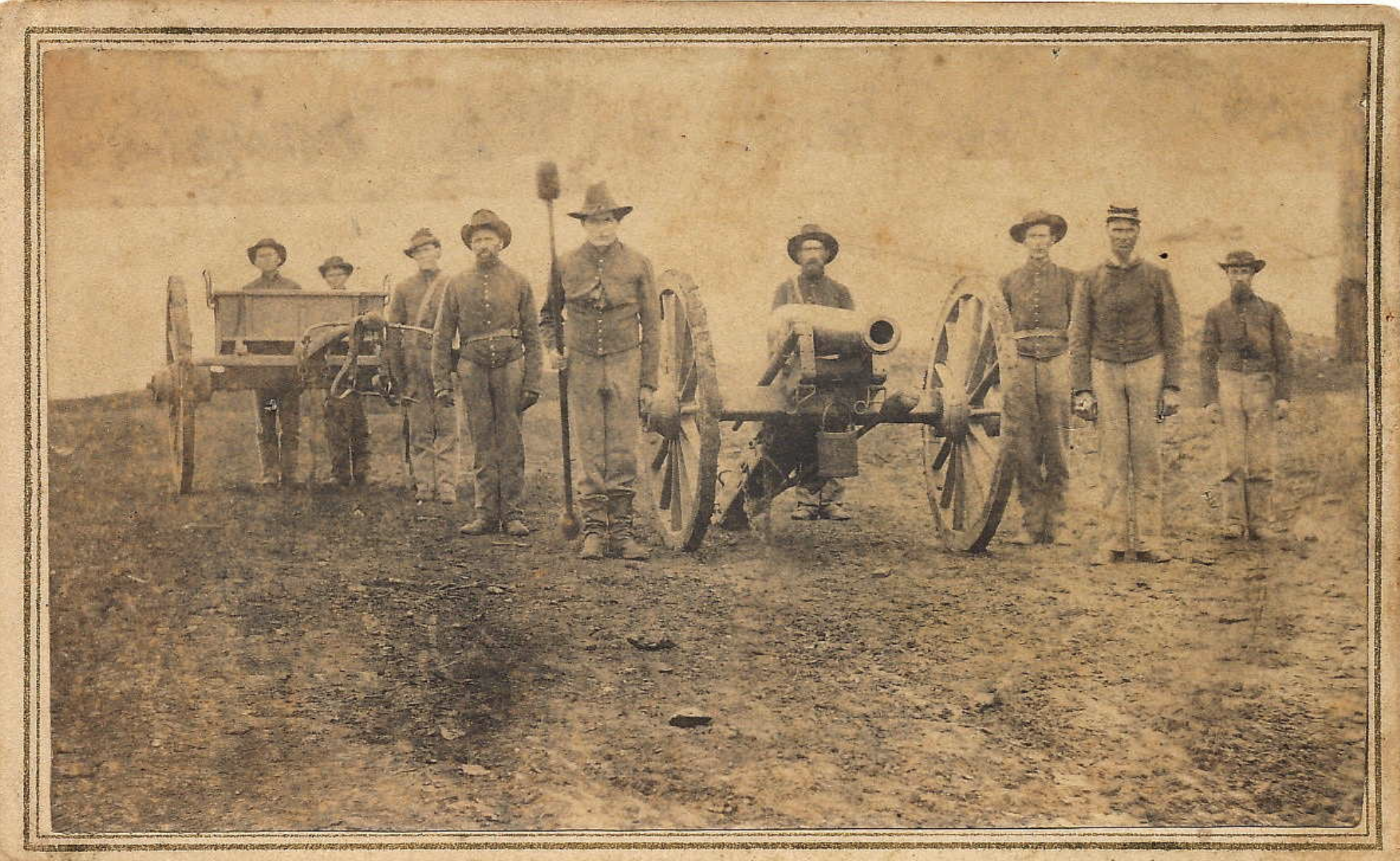
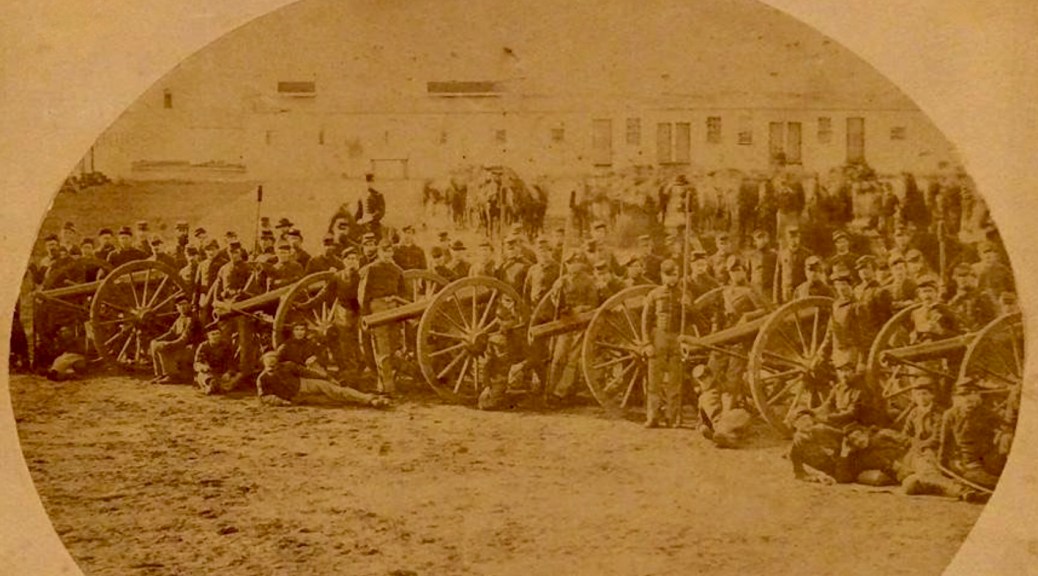
Identified as Battery A, 1st Ohio Light Artillery, by Larry Strayer in the book, Chickamauga by Time-Life Books. The original albumen photograph is said to have been taken by the Nashville firm of A.S. Morse.

T R A N S C R I P T I O N

Friday, January 1, 1864—Lay in camp at Buffalo Creek, Tennessee.

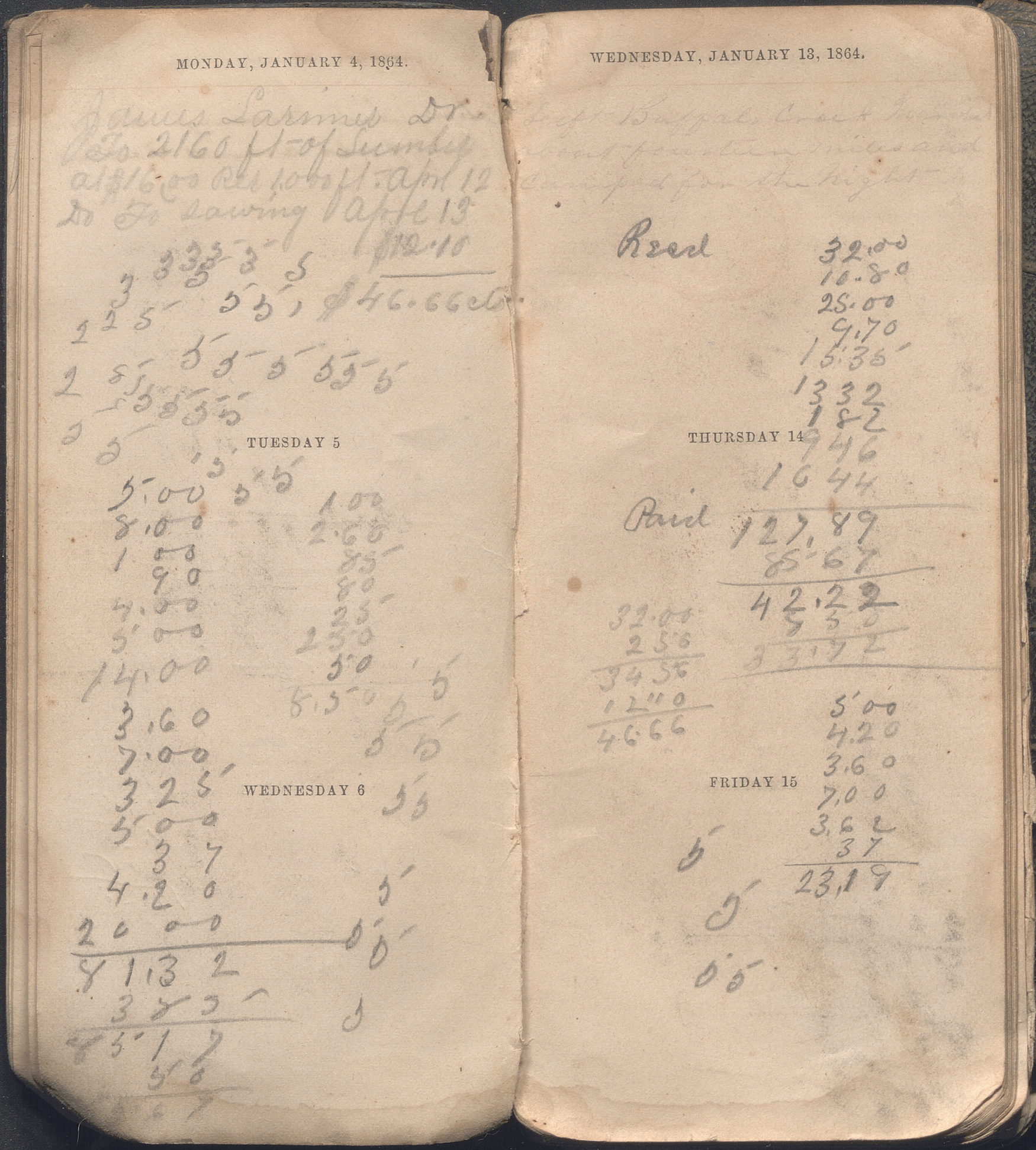
Wednesday, January 13, 1864—Left Buffalo Creek, Marched about fourteen miles and camped for the night.

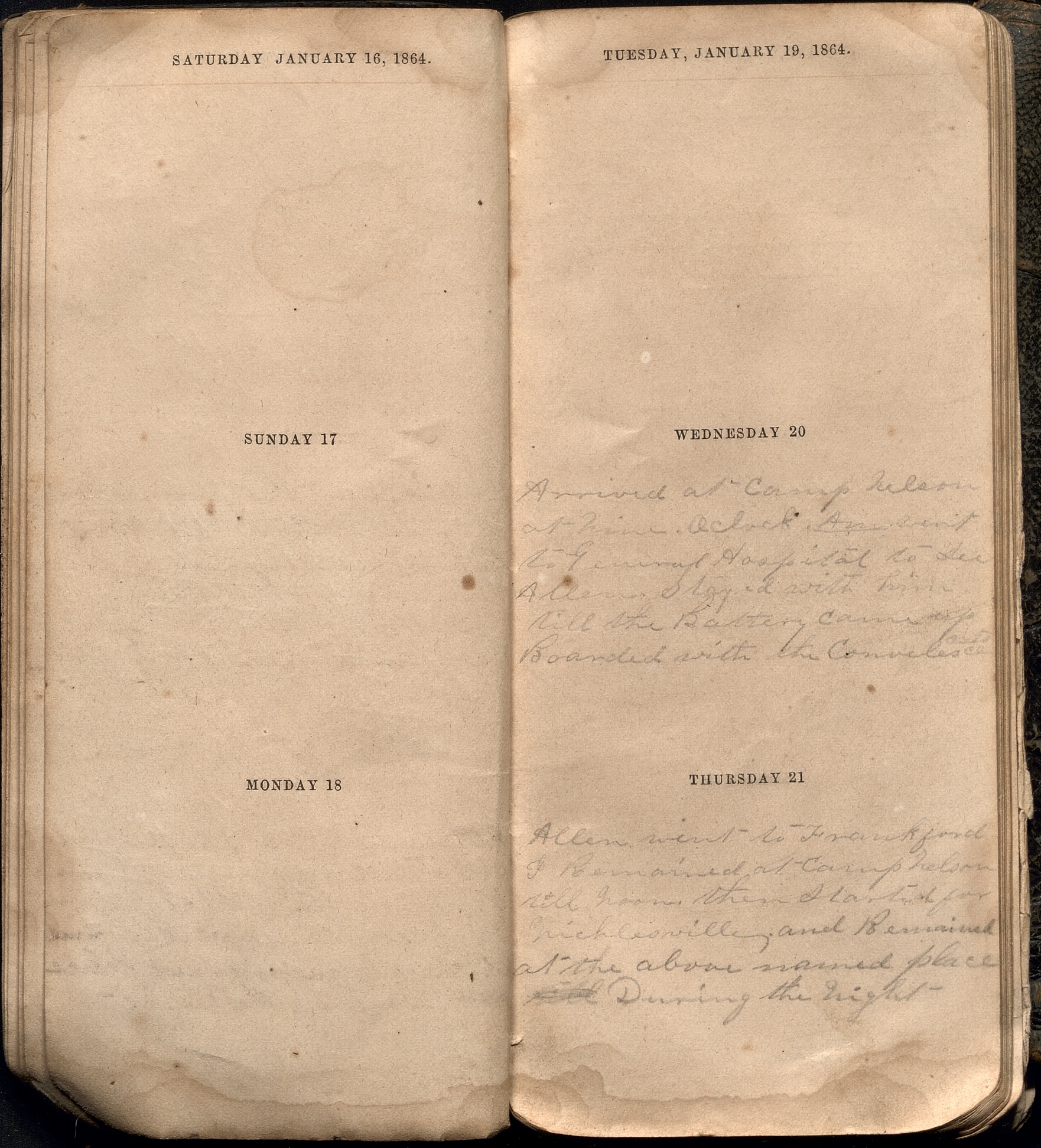
Wednesday, January 20, 1864—Arrived at Camp Nelson at nine o’clock a.m. Went to General Hospital to see [brother] Allen [104th OVI]. Stayed with him till the Battery came up. Boarded with the convalescents.

Thursday, January 21, 1864—Allen went to Frankfort. I remained at Camp Nelson till noon. Then started for Nicholasville and remained at the above named place during the night.

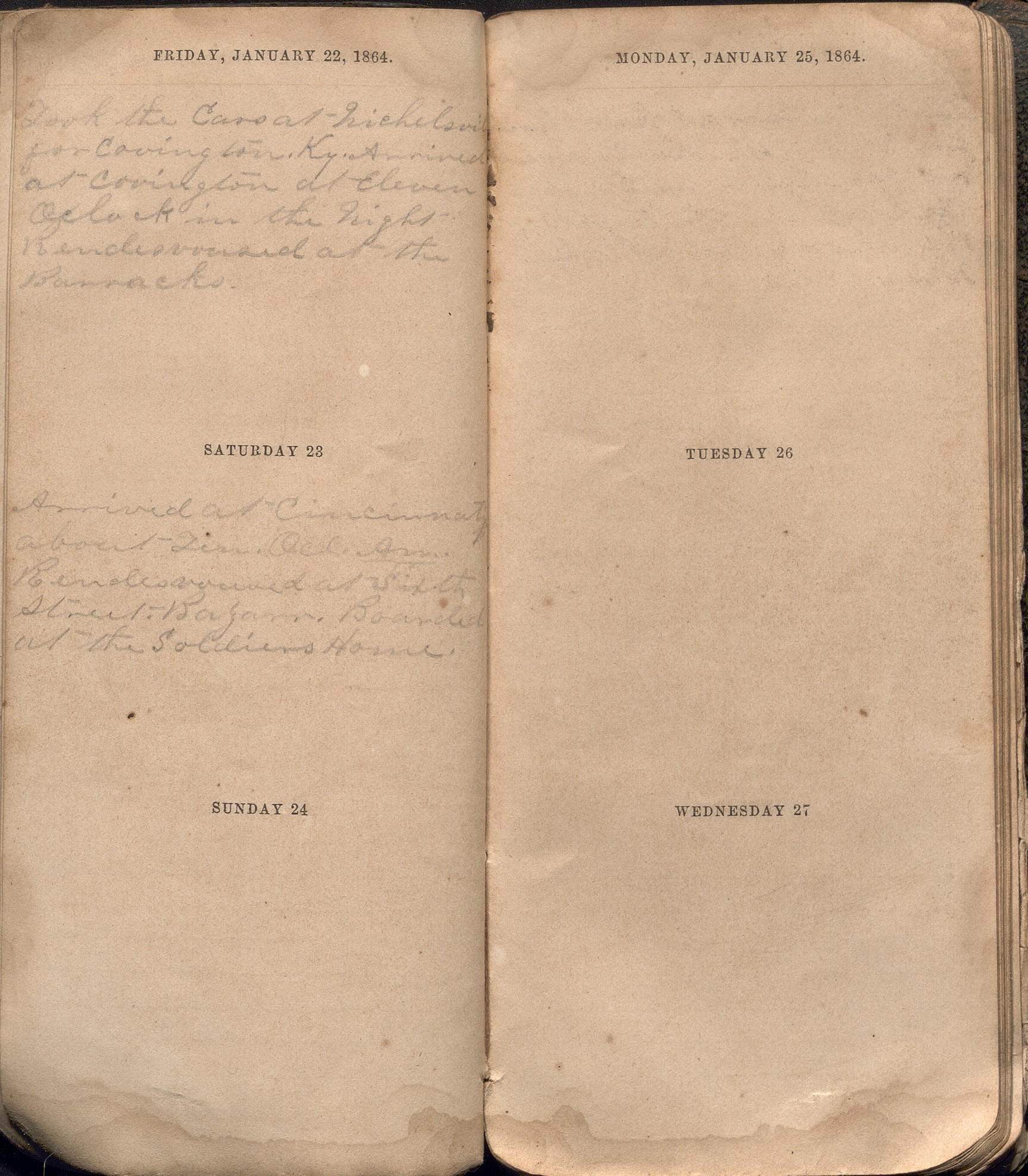
Friday, January 22, 1864—Took the cars at Nicholasville for Covington, Kentucky. Arrived at Covington at 11 o’clock in the night. Rendezvoused at the barracks.

Saturday, 23, 1864—Arrived at Cincinnati about ten o’clock a.m. Rendezvoused at Sixth Street Bazaar. Boarded at the Soldiers’ Home.

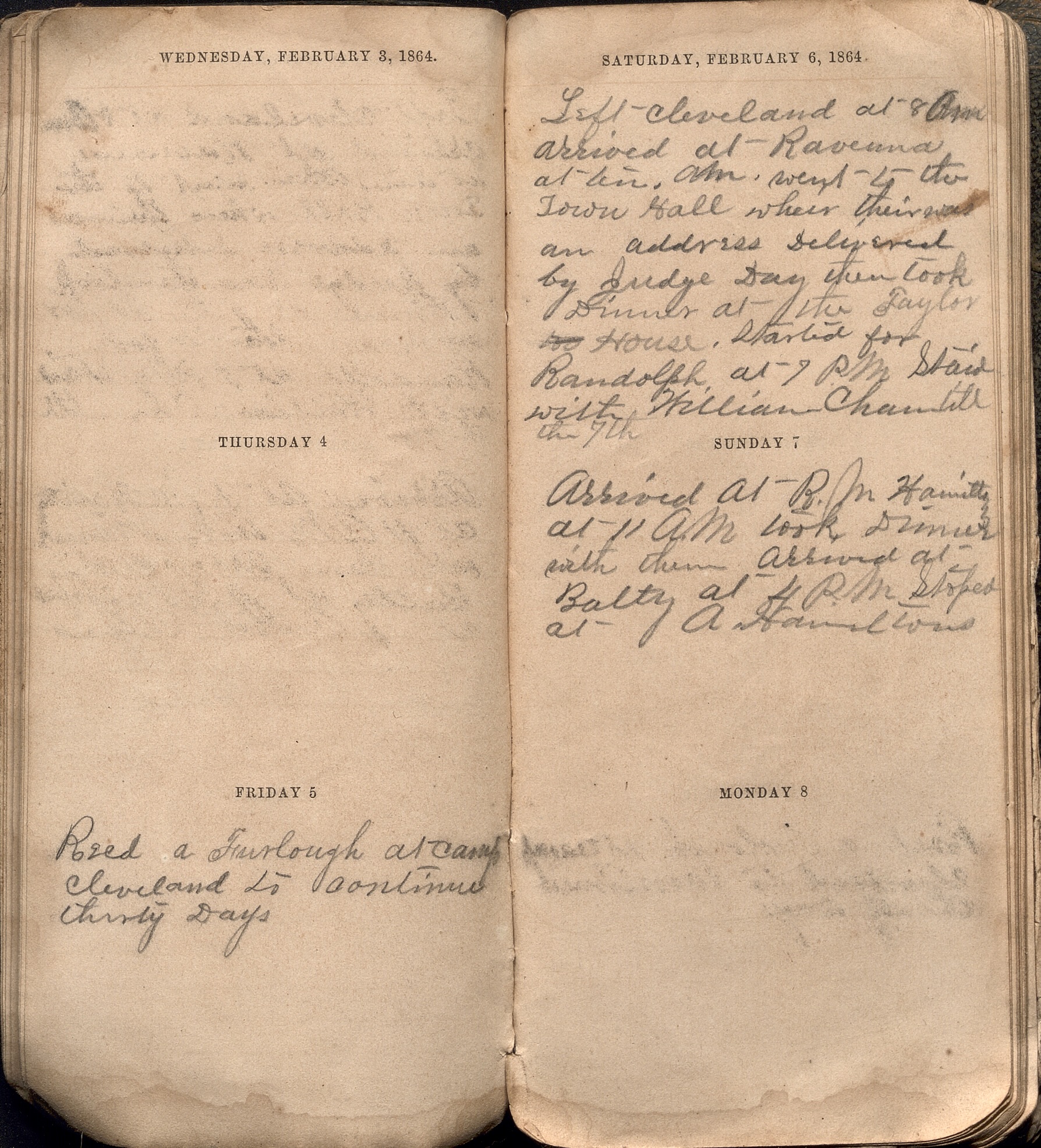
Monday, February 1, 1864—Took the cars at Cincinnati for Cleveland at 6 a.m. Arrived at Cleveland at 4 p.m. Took supper at the Depot and lodging at the New England Hotel.

Friday, February 5, 1864—Received a furlough at Camp Cleveland to continue 30 days.

Saturday, February 6, 1864—Left Cleveland at 8 a.m. Arrived at Ravenna at ten a.m. Went to the Town Hall where there was an address delivered by Judge Day. Then took dinner at the Taylor House. Started for Randolph at 7 p.m. Stayed with William Ch___ the 7th.

Sunday, February 7, 1864—Arrived at R, M. Hamilton’s at 11 a.m. Took dinner with them. Arrived at Balty [New Baltimore, Stark county, OH] at 4 p.m. Stopped at A. Hamilton’s

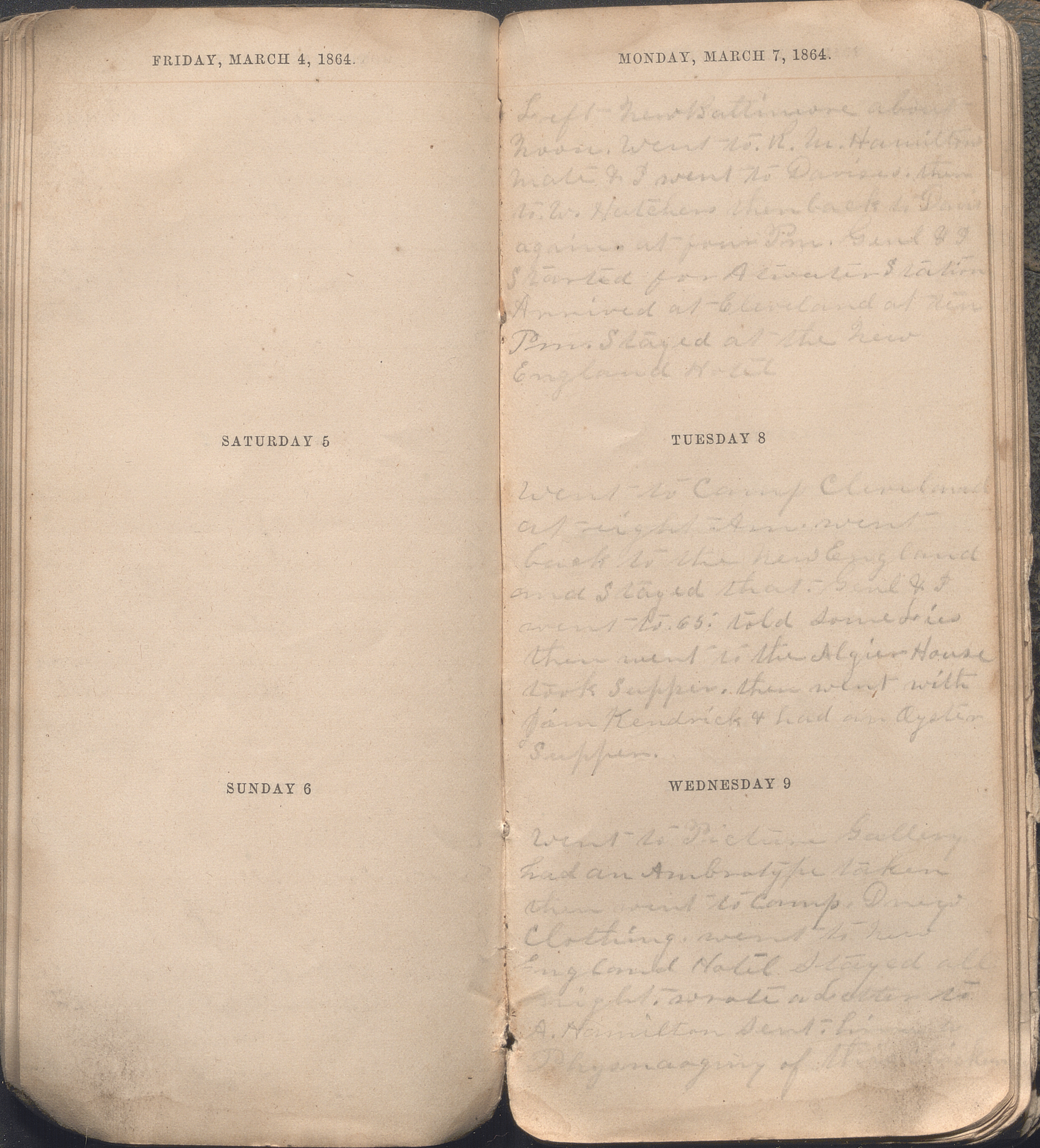
Monday, March 7, 1864—Left New Baltimore about noon. Went to R. M. Hamilton’s. Mate & I went to Davis’s, then to W. Hutchen’s, then back to Davis’s again. At 4 p.m., Genl. & I started for Atwater Station. Arrived at Cleveland at 10 p.m. Stayed at the New England Hotel.

Tuesday, March 8, 1864—Went to Camp Cleveland at 8 a.m. Went back to the New England Hotel and stayed that. Genl. and I went to 65, told some lies, then went to the Algier House, took supper, then went with Jim Kendrick and had an oyster supper.

Wednesday, March 9, 1864—Went to Picture Gallery. Had an Ambrotype taken. Then went to Camp. Drew clothing. Went to New England Hotel. Stayed all night. Wrote a letter to A. Hamilton. Sent him physiognomy of those taken.

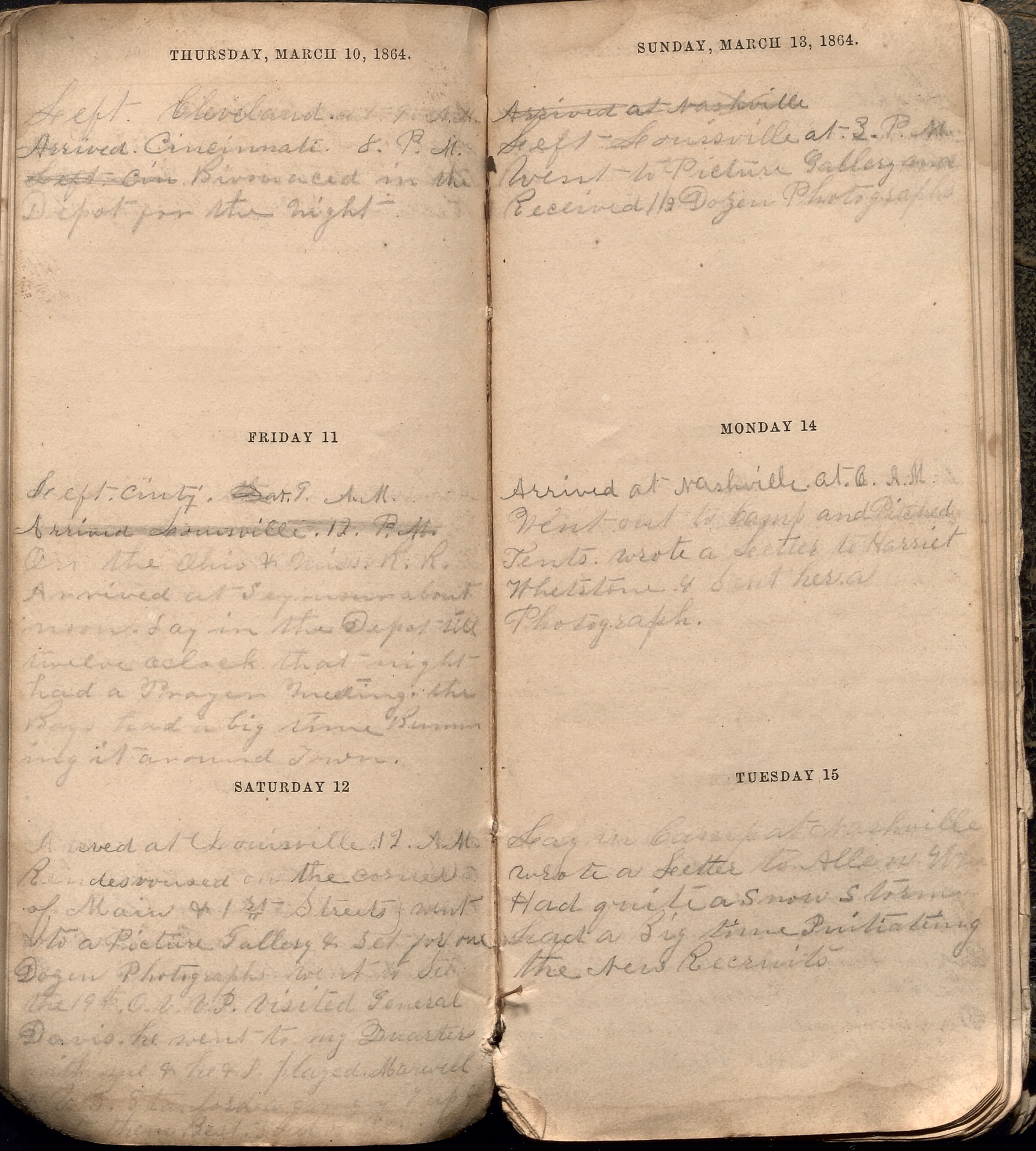
Thursday, March 10, 1864—Left Cleveland at 9 a.m. Arrived Cincinnati at 8 p.m. Bivouacked in the Depot for the night.

Friday, March 11, 1864—Left Cincinnati at 9 a.m. Arrived Louisville 12 p.m. On the Ohio and Mississippi Railroad. Arrived at Seymour about noon. Stay in the depot till twelve o’clock that night. Had a prayer meeting. The Boys had a big time bumming it around town.

Saturday, March 12, 1864—Arrived at Louisville 12 a.m. Rendezvoused on the corner of Main and 1st Streets. Went to a Picture Gallery and sat for one dozen photographs. Went to see the 19th Ohio Vol. Vet. Infantry. Visited Jink Davis. He went to my quarters with me & he and I played [illegible].

Sunday, March 13, 1864—Left Louisville at 3 p.m. Went to Picture Gallery and received half dozen photographs.

Monday, March 14, 1864—Arrived at Nashville at 6 a.m. Went out to camp and pitched tents. Wrote a letter to Harriet Whetstone & sent her a photograph.

Tuesday, March 15, 1864—Lay in camp at Nashville. Wrote a letter to Allen. We had quite a snow storm. Had a big time initiating the new recruits.

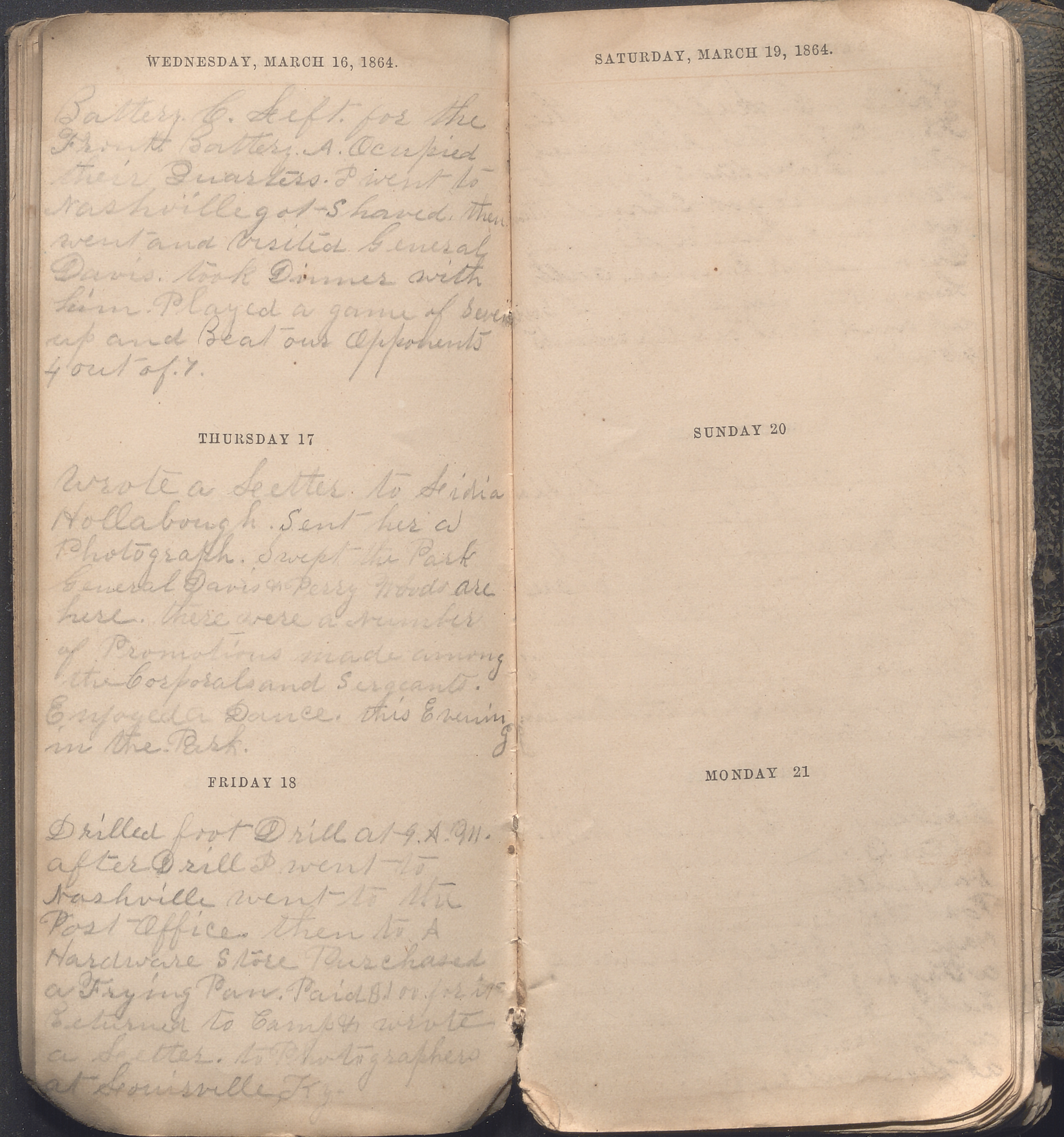
Wednesday, March 16, 1864—Battery C left for the front. Battery A occupied their quarters. I went to Nashville, got shaved, then went and visited Jink Davis. Took dinner with him. Played a game of Seven-Up and beat our opponents 4 out of 7.

Thursday, March 17, 1864—Wrote a letter to Lidia Hollabough. Sent her a photograph. Swept the park. Jink Davis & Perry Woods are here. There were a number of promotions made among the corporals and sergeants. Enjoyed a dance this evening in the Park.

Friday, March 18, 1864—Drilled foot drill at 9 a.m. After drill I went to Nashville. Went to the Post Office. Then to a hardware store. Purchased a frying pan. Paid $1 for it. Returned to camp and wrote a letter to photographers at Louisville, Ky.

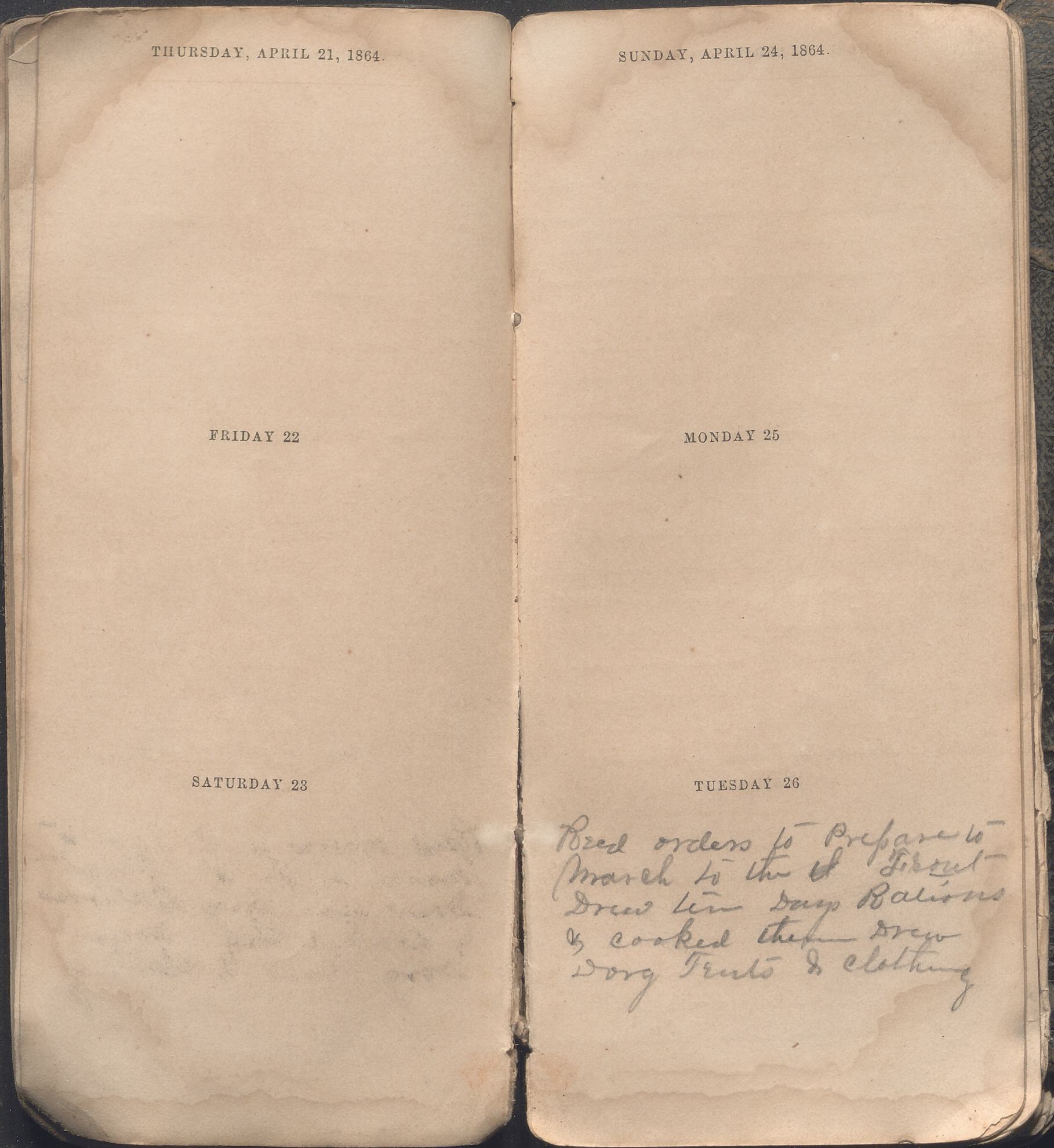
Tuesday, April 26, 1864—Received orders to prepare to march to the front. Drew ten days rations & cooked them. Drew dog tents and clothing.

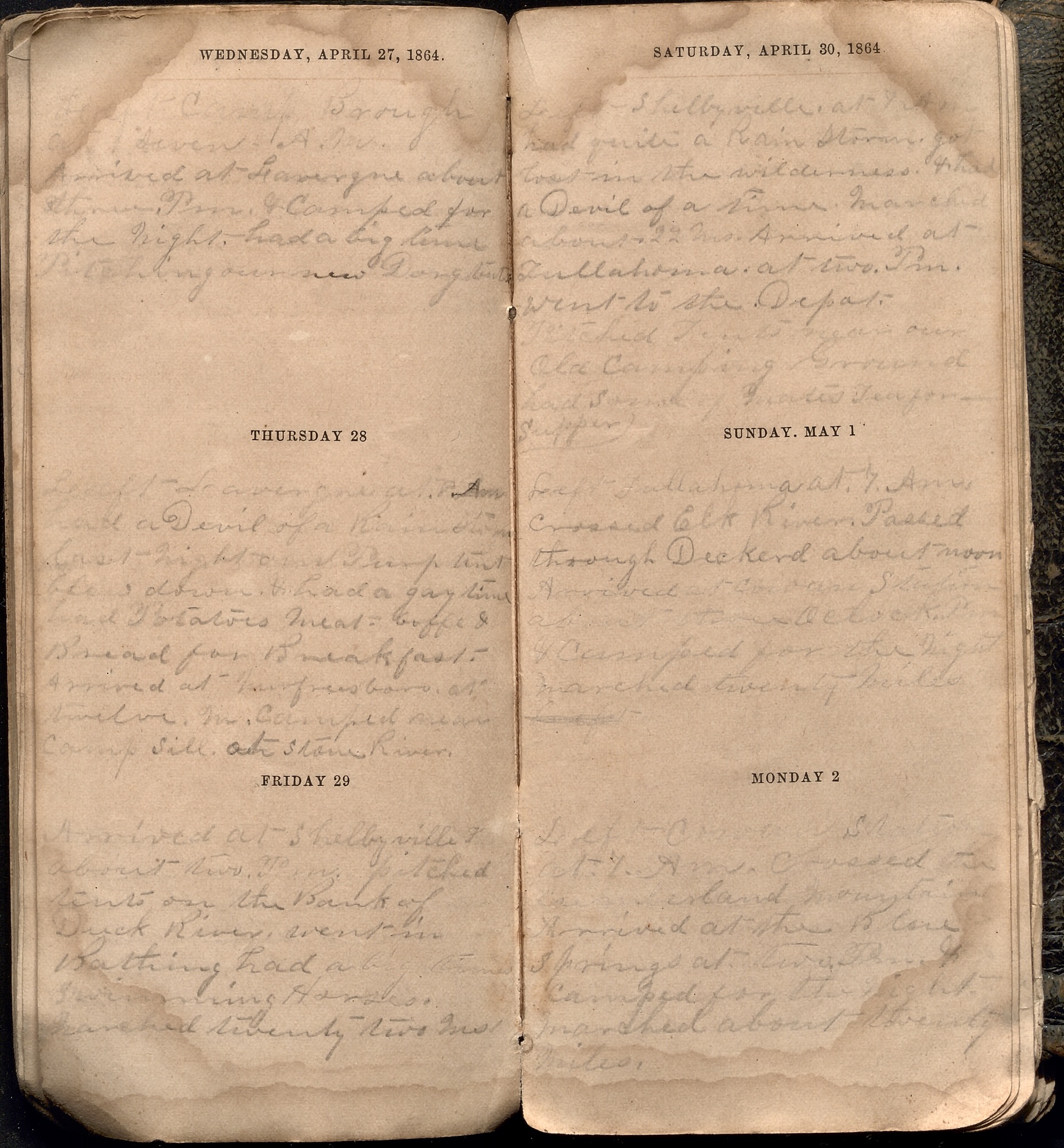
Wednesday, April 27, 1864—Left Camp Brough at 7 a.m. Arrived at Lavergne about three p.m. and camped for the night. Had a big time pitching our new dog tents.

Thursday, April 28, 1864—Left Lavergne at 8 a.m. Had a devil of a rain storm last night and pump tent blew down & had a gay time. Had potatoes, meat, coffee and bread for breakfast. Arrived at Murfreesboro at 12 M. Camped near Camp Sill at Stone River.

Friday, April 29, 1864—Arrived at Shelbyville about 2 p.m. Pitched tents on the bank of Duck River. Went in bathing. Had a big time swimming horses. Marched 22 miles.

Saturday, April 30, 1864—Left Shelbyville at 7 a.m. Had quite a rain storm. Got lost in the wilderness & had a devil of a time. Marched about 22 miles. Arrived at Tullahoma at 2 p.m. WEnt to the Depit. Pitched tents near our old camping ground. Had some of Mate;s tea for supper.

Sunday, May 1, 1864—Left Tullahoma at 7 a.m. Crossed Elk River. Passed through Decherd about noon. Arrived at Cowan Station about ten o’clock p.m. and camped for the night. Marched 20 miles.

Monday, May 2, 1864—Left Cowan Station at 7 a.m., crossed the Cumberland Mountains. Arrived at the Blue Springs at two p.m. and camped for the night. Marched about 20 miles.

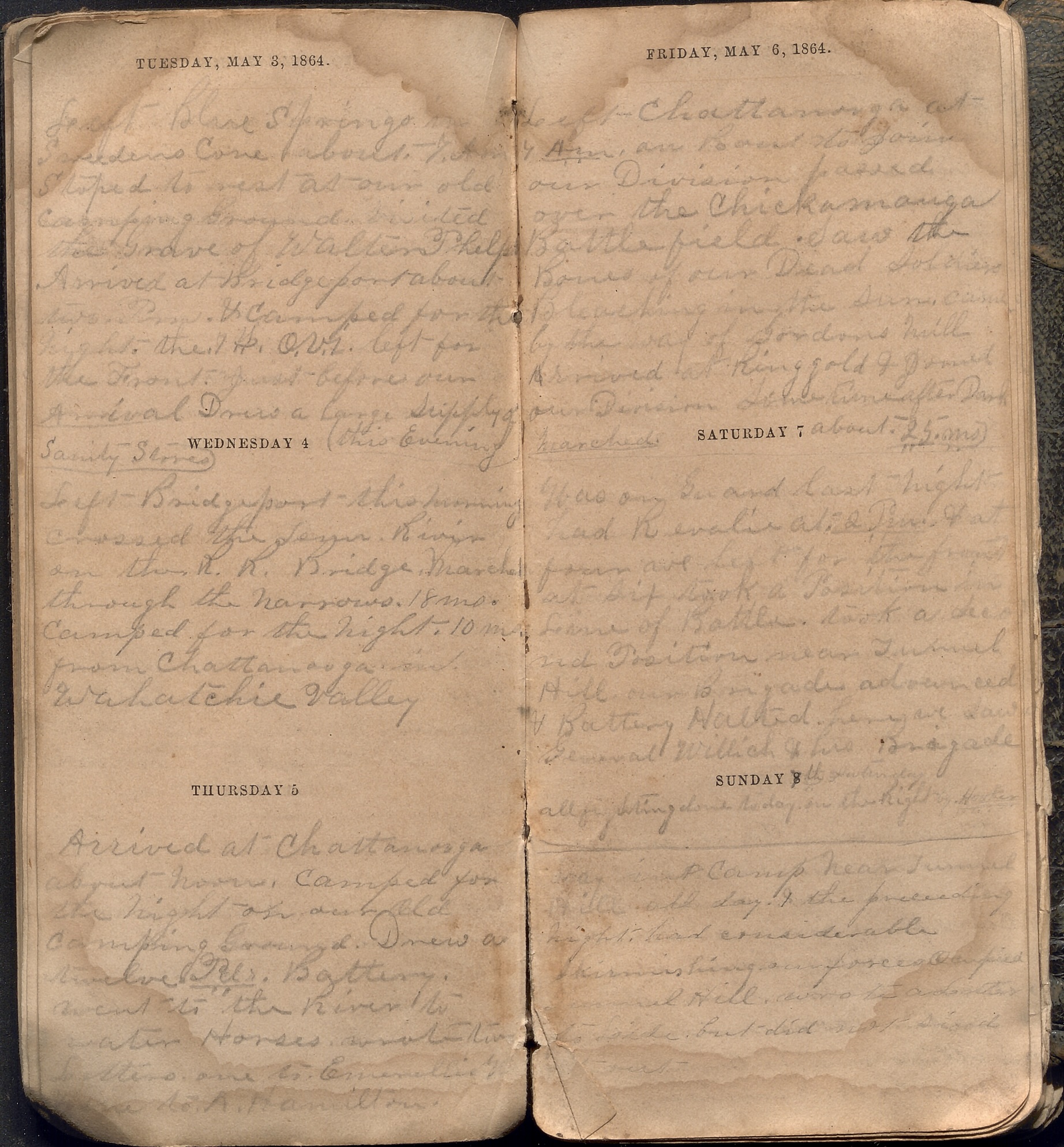
Tuesday, May 3, 1864—Left Blue Springs in Sweden’s Cove about 7 a.m. Stopped to rest at our old camping ground. Visited the grave of Walton Phelps. Arrived at Bridgeport about two p.m. & camped for the night. The 7th OVI left for the front just before our arrival. Drew a large supply of Sanitary stores.

Wednesday, May 4, 1864—Left Bridgeport this morning. Crossed the Tennessee River on the railroad bridge. Marched through the narrows 18 miles. Camped for the night 10 miles from Chattanooga in Wahatchie Valley.

Thursday, May 5, 1864—Arrived at Chattanooga about noon. Camped for the night on our old camping ground. Drew a 12-pound Battery. Went to the river to water horses. Wrote two letters—one to Emeline & one to A. Hamilton.

THE ATLANTA CAMPAIGN

Friday, May 6, 1864—Left Chattanooga at 7 a.m. on road to join our Division. Passed over the Chickamauga Battlefield. Saw bones of our dead soldiers bleaching in the sun. Came by the way of Gordon’s Mill. Arrived at Ringgold & joined our Division sometime after dark. Marched about 25 miles.

Saturday, May 7, 1864—Was on guard last night. Had reveille at 2 a.m. and at four. We left for the front at six. Took a position in line of battle. Took a 2nd position near Tunnel Hill. Our Brigade advanced & battery halted. Here we saw General Willich & his Brigade. All fighting done today on the right by Hooker.

Sunday, May 8, 1864—Stayed in camp near Tunnel Hill all day and the preceding night. Had considerable skirmishing. Our forces occupied Tunnel Hill. Wrote a letter to Lide but did not send it out.

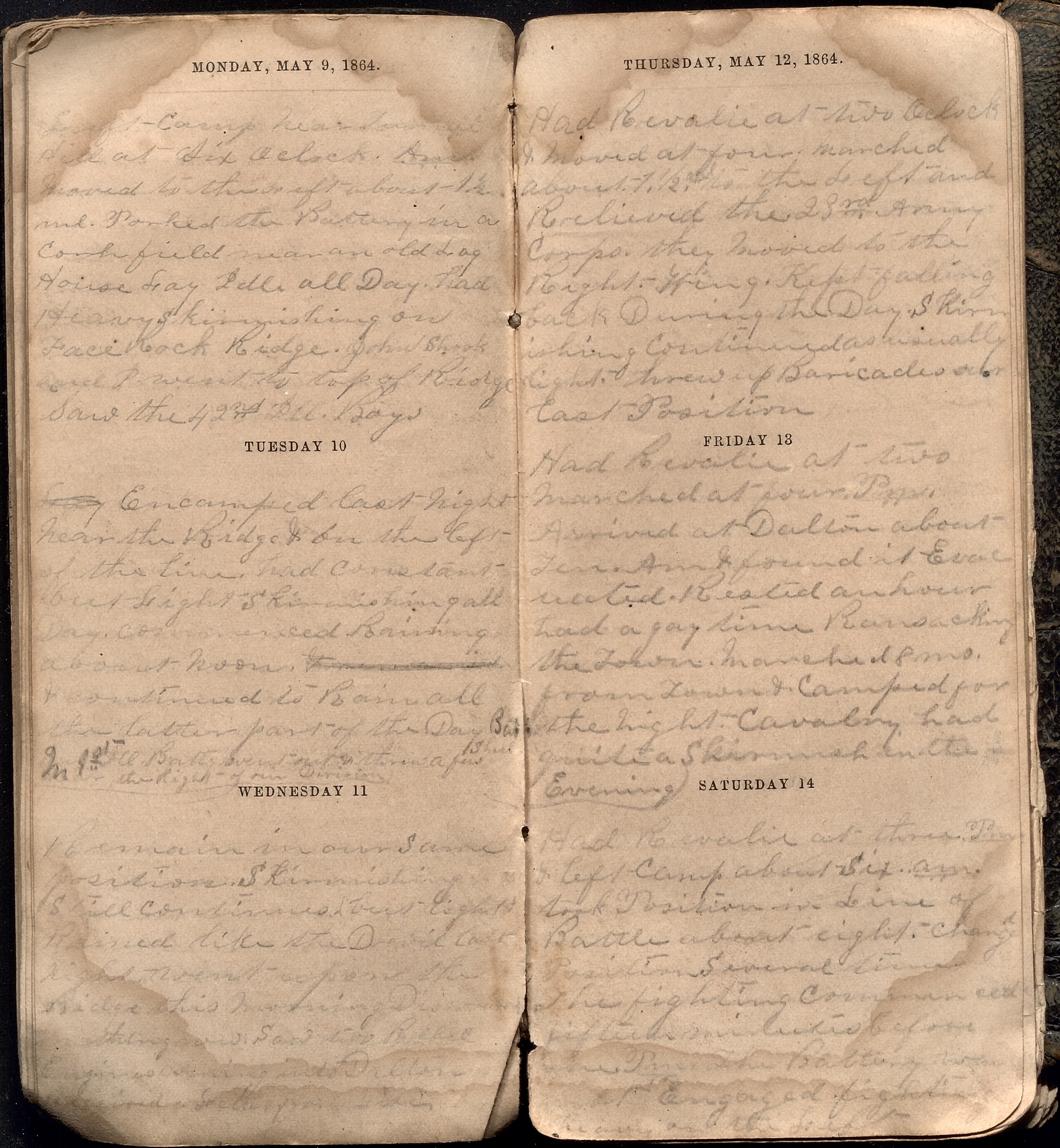
Monday, May 9, 1864—Left camp near Tunnel Hill at 6 o’clock and moved to the left about 1.5 miles Parked the Battery in a corn field near an old log house. Lay idle all day. Had heavy skirmishing on Face Rock [Rocky Face] Ridge. John Shook and I went to top of ridge. Saw the 42nd Illinois Boys.

Tuesday, May 10, 1864—Encamped last night near the ridge and on the left of the line. Had constant but light skirmishing all day. Commenced raining about noon and continued to rain all the latter part of the day. Battery M, 1st Ohio Battery went out & threw a few shell on the right of our Division.

Wednesday, May 11, 1864—Remain in our same position. Skirmishing still continues but light. Rained like the Devil last night. Went upon the ridge this morning. Nothing new. Saw two Rebel engines coming into Dalton [illegible].

Thursday, May 12, 1864—Had reveille at two o’clock & moved at four. Marched about 7.5 miles to the left and relieved the 23rd Army Corps. They moved to the right wing. Kept falling back during the day. Skirmishing continued as usually light. Threw up barricades at last position.

Friday, May 13, 1864—Had reveille at two. Marched at four a.m. Arrived at Dalton about ten and found it evacuated. Rested an hour. Had a gay time ransacking the town. Marched 8 miles from town and camped for the night. Cavalry had quite a skirmish in the evening.

Saturday, May 14, 1864—Had reveille at 3 a.m. Left camp about 6 a.m. Took position in line of battle about eight. Changed position several times. The fighting commenced fifteen minutes before one p.m. The Battery was not engaged. Fighting heavy on the left.

Sunday, May 15, 1864—Took position in fortifications at 3 p.m. Done some digging. Skirmishing quite brisk. Battery commenced firing. Fired 12 rounds. Vack [Victor B.?] Stanford badly wounded by premature discharge. Darius Roe, W[ilson] Davidson, A[uston] D. Bishop, & J. Van Ornum wounded by premature discharge.

[Editor’s note: Victor B. Stanford was wounded in the Battle of Resaca and died on 4 June 1864 at Chattanooga. Regrettably, it appears that his wounds were due to a premature discharge of their own guns—not enemy fire. The other four men listed appear to have been wounded in the same manner though not mortally.]

Monday, May 16, 1864—Had reveille at 3 o’clock & marched at 6 a.m. Found the Rebs had absconded. Arrived at Coosa River about noon. Rested about two hours. Crossed the river and after marching a while, halted. Skirmishing continues. Resaca evacuated.

Tuesday, May 17, 1864—Left camp near Calhoun about daylight. Skirmished through the town. Advanced about two miles when skirmishing commenced quite brisk. Battery halted and came into position. Camped for the night four miles from Calhoun.

Wednesday, May 18, 1864—Left camp about 8 a.m.. Advanced very cautiously. The Rebs falling back but were very stubborn. Had quite a fight in the evening. Camped for the night about a mile from town called Deerville.

Thursday, May 19, 1864—Left Camp about 7 a.m. Arrived at Deerville about 9 & halted till noon. The [illegible]/ Skirmishing in front today. Camped for the night about [ ] miles from Deerville.

Friday, May 20, 1864—Left camp at early dawn. Arrived at Kingston at 11 a.m. and halted for dinner. Advanced at 12 M & after marching two miles found the enemy in line of battle. Drove them till dark, then camped for the night.

Saturday, May 21, 1864—Moved back from the front about a mile & camped for a day or two’s rest. Perry Woods was here today. Went with him to the 19th OVI. Jink Davis came with me when I returned to my quarters. In the evening went to the 42nd Illinois.

Sunday, May 22, 1864—Lay in camp. Done my washing & played poker during the remainder of the day. In the evening Clint Allen & I went to see some Rebel prisoners and had quite a conversation with them.

Monday, May 23, 1864—We still remain in camp. [Gen.] Thomas’s Headquarters which were located near us moved this morning. Left camp about noon. Arrived at the river and crossed about 9 o’clock. Marched about 11 miles. Went into camp at midnight.

Tuesday, May 24, 1864—Left camp at 7 a.m. Marched through the pine regions about ten miles. Camped in a narrow valley. Was detailed to cut a road through the woods. Rained like the very Devil. Were five miles in the rear of our Division.

Wednesday, May 25, 1864—Left camp about 8 a.m. Had to double teams to ascend the ridge. The country traveled over today is very hilly & is but very thinly settled. The timber is principally pine. Water rather scarce. Heavy fighting in front of Dallas. Commenced at 5.

Thursday, May 26, 1864—Camped in a wheat field last night. Had a rain storm. Remained in camp till about 6 p.m., then started to join our Division which was then at the front, a distance of about five miles. Arrived at front about 8 p.m. Went in line. No. 1 & 2 went on picket.

Friday, May 27, 1864—Cannonading opened quite brisk about six a.m. Moved a mile to the left. Remained there till [ ]. The Rebs shelled us like the Devil. Moved to the right a mile, took position in front earthworks. Worked till 2 a.m. last night.

Saturday, May 28, 1864—Got up at about 3 a.m. At 11 a.m., the Rebs made a demonstration in our front. Came over their fortifications. We gave them double charge of canister which sent them back flying.

Sunday, May 29, 1864—Worked last night till two a.m. The Rebs commenced heavy firing along the whole line which was returned. Our Battery fired about six rounds to each gun. The firing continued a half hour when the Rebs dried up.

Monday, May 30, 1864—But very little artillery firing today. Musketry is kept up brisk now from behind fortifications. Was on guard last night. The enemy made quite a noise chopping. Could hear them talking very distinct. Was called to my post about 2 a.m.

Tuesday, May 31, 1864—Was called up at early dawn. Considerable cannonading on the left. James Robinson was wounded today in the left leg. Had it amputated. Received a letter from Helen R. today.

[Editors Note: James T. Robinson died on June 25, 1864, at Chattanooga, Term., of wounds received in action at Dalton, Ga.]

Wednesday, June 1, 1864—Was called to our post once last night. Wrote a letter to Em C. today. Nothing worthy of note occurred during the latter part of the day.
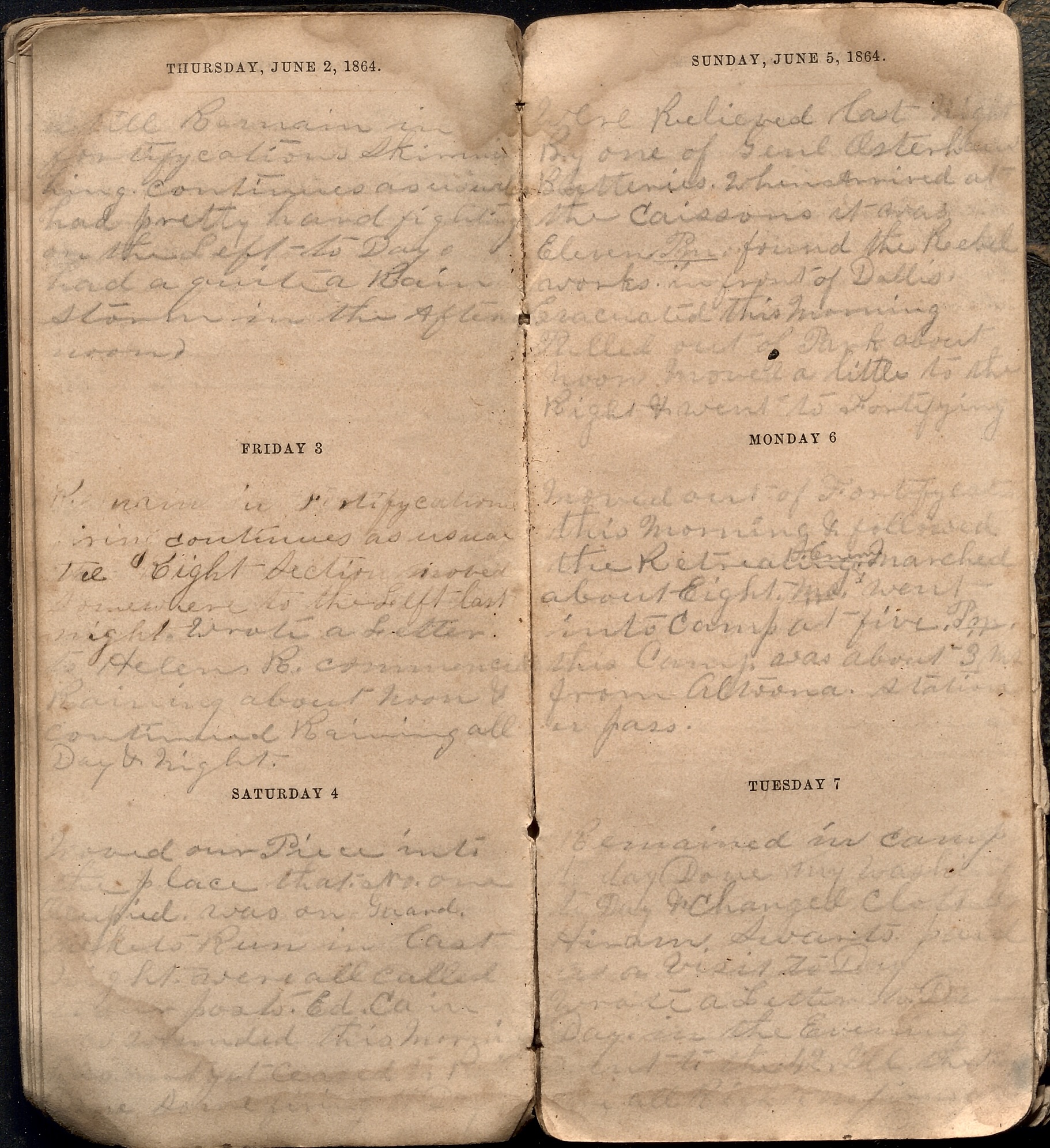
Thursday, June 2, 1864—Still remain in fortifications. Skirmishing continues as usual. Had pretty hard fighting on the left today. Had quite a rain storm in the afternoon.

Friday, June 3, 1864—Remain in fortifications. Firing continues as usual. The right section moved somewhere to the left last night. Wrote a letter to Helen R. Commenced raining about noon & continued raining all day and night.

Saturday, June 4, 1864—Moved our piece into the place that No. 1 occupied. Was on guard. Pickets run in last night. Were all called to our posts. Ed[ward] Cain was wounded this morning. [illegible]

Sunday, June 5, 1864—Were relieved last night by one of Genl. Osterhaus’ Bsatteries. When arrived at the caissons, it was a.m. Found the Rebel works in front of Dallas evacuated this morning. Pulled out of Park about noon. Moved a little to the right and went to fortifying.

Monday, June 6, 1864—Moved out of fortifications this morning and followed the retreating Rebels. Marched about 8 miles and went into camp at 5 p.m. This camp was about 3 miles from Altoona Station pass.

Tuesday, June 7, 1864—Remained in camp today. Done my washing today & changed clothes. Hiram Swartz paid us a visit today. Wrote a letter today. In the evening went to the 42nd Illinois [illegible].

Wednesday, June 8, 1864—Remained in camp. Wrote a letter to Samantha Chain. Perry Woods came to see us today. Commenced raining at 1 p.m. Went to see Davis Boys in the evening. Saw D. Reichard. He is looking well.

Thursday, June 9, 1864—Still remain in camp. Several of our boys who have been prisoners returned today and brought us the sad intelligence that Vack Stanford died on the 5th. Jink Davis was here today and also some of the 42nd Illinois Boys.

Friday, June 10, 1864—Left camp at 8 a.m. Marched very slow & cautiously. Passed Hooker’s Corps. Arrived at the front in the evening. There was but very little firing done today. Marched about three miles.

Saturday, June 11, 1864—Camped at an old house last night. Rained like the very devil. Marched at about 9 a.m. Advanced very cautiously. Went into park near the lines in the evening. Marched about two miles but very little firing today.

Sunday, June 12, 1864—Still continues to rain. Gen. Woods’ Division passed from our left toward the right. Wrote a letter to Ben Switzer. Heard but very little firing today. Rained all day without ceasing.

Monday, June 13, 1864—Ceased raining about 2 p.m. Went out to the lines today. Called at Harker’s Headquarters for mail. Did not get any. Skirmishing continues but light.

Tuesday, June 14, 1864—Cannonading heavy this morning. Was on guard last night. It is reported that McPherson captured a thousand prisoners on the left yesterday. [ ] up at noon. Heavy skirmishing at 5 p.m. Moved a mile to the left front and camped for the night. Reb Gen. Polk killed.

Wednesday, June 15, 1864—Marched at noon. After going a mile, the Battery came into position and on our way to this place I came across Myron. Skirmishing heavy today. The 42nd [Illinois] was engaged. Myron was with the regiment. Came to our gun and stayed all night with me.

Thursday, June 16, 1864—Moved our gun to the front and throwing good works. All the pieces but Nos. 2 & 3 done some firing. In the evening, the Battery moved three hundred yards to the front & took position in [illegible].

Friday, June 17, 1864—Was on guard last night. Our skirmishers advanced at early dawn & found the Rebel works evacuated. Battery moved at 8 a.m. Heavy skirmishing & cannonading commenced at noon. At 5 p.m. the Battery came to position at an old house a little [ ] Brigade. Fired 20 rounds to a gun.

Saturday, June 18, 1864—Moved three hundred yards to the front. Found the enemy again in force & fortified. Battery remained here all day. Rained like the Devil. Battery fired 470 rounds. [Archibald A.] McMasters was hurt by a primer which he supposed had failed. Stepped in & pulled it out just as the [illegible] is changed.

[Editor’s note: Muster rolls indicate that Archibald A. McMasters “was wounded June 18, 1864, in battle of Kennesaw Mountain, Ga.”]

Sunday, June 19th, 1864—Moved at 8 a.m. The Rebs having again evacuated [illegible].

Monday, June 20, 1864—[see Battle of Kennesaw Mountain] Remained in position at the cotton gin till in the afternoon when our battery & Spencer’s Battery [H] moved to the front & took a position in front of the hill. Commenced firing at 4 p.m. Had a hot time with some Rebel batteries. Dock [Levi] Griswold was wounded in wrist by a shell.

Tuesday, June 21, 1864—The 14th Corps relieved our Corps last night. Battery moved back to the cotton gin this morning. Moved to the right, our Corps having relieved the 20th Corps Hookers. Our Corps advanced the line half a mile. Our Battery took a position with Wood’s Division by an old house near the 19th OVVI.

Wednesday, June 22, 1864—Were on the front line all day. Changed position several times. Our piece fired 5 shots [illegible]. Hooker [?] advanced the line with some hard fighting but [?] the enemy [illegible].

Thursday, June 23, 1864—Moved a half mile to the right and took a position in open field by an old chimney. Battery fired 72 rounds of solid [shot]. Stanley’s men drove the Rebs out of their picket pits & held the pits.

Friday, June 24, 1864—We threw up works for our guns last night. [James] Courtney died this morning [of wounds in field hospital near Kennesaw Mountain]. Captain [Wilbur F.] Goodspeed relieved Captain [Charles] Aleshire as Chief of Artillery of our Division, Very quiet along the lines all day.

Saturday, June 25, 1864—Heavy cannonading on the line this morning. [Samuel M.] McDowell’s Battery moved into the line of works in front of us in night. The Battery drew clothing. I received a letter [illegible].

Sunday, June 26, 1864—Were called to our posts with orders to be reeady to commence firing. Commenced firing at 9 a.m. Fired 12 rounds. Our Division & Stanley’s Division charged the Rebel works &some of [them] succeeded in taking the works but were compelled to fall back. Heard today Gen’l. [Charles G.] Harker was killed. [Daniel] McCook wounded.

Monday, June 27, 1864—Strengthened our works with sand bags last night. Visited the 42nd [Illinois Boys] today. Was very quiet today along the whole line.

Tuesday, June 28, 1864—[no entry]

Wednesday, June 29, 1864—Turned our Nos. 3 & 5 pieces and drew two from McDowell’s Battery. Our men are out between the lines with a [Flag of] Truce burying the dead. The boys are exchanging papers with the enemy and also trading coffee for tobacco.

Thursday, June 30, 1864—Last night the enemy made a demonstration in front of our Division. Musketry was very heavy [while it] lasted. Twenty-four of our pieces [ ] to the rear & Battery M filled their places. Wrote letter to Eliza.

Friday, July 1, 1864—Had another [ ] last night. Lasted 15 minutes. John Shook and I went to the 19th OVI. At 5 p.m. the Battery fired 30 rounds at the Rebel works [illegible].
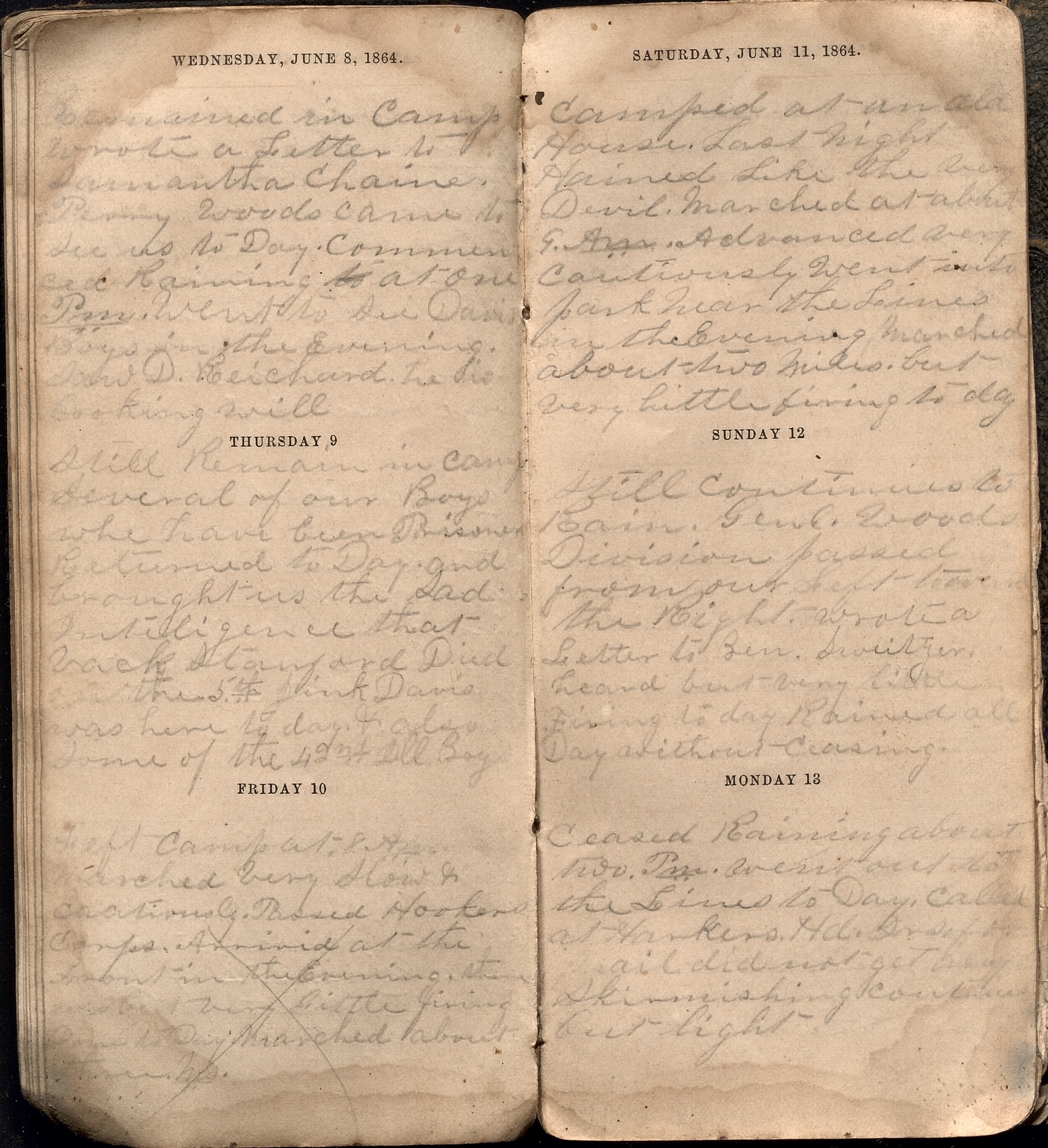
Saturday, July 2, 1864—Were called to our posts at four. Commenced firing at 6 a.m Fired ten rounds. In the evening our Division moved a mile and a half to the left to relieve one Division of the 14th Army Corps. The Battery relieved Battery I of our regiment.

Sunday, July 3, 1864—Got up this morning & found the enemy had evacuated their position in front of Kennesaw Mountain. Moved at 6 a.m. Arrived at Marietta about noon. Passed to the right of the town. Marched 9 miles.

Monday, July 4, 1864—Camped in a field by the railroad. Was on guard last night. Reveille at 4 o’clock. Lieutenant [Henry C.] Grant’s Section & Battery M moved to the front. Found the enemy again fortified. Remained by the Battery. Moved out. Camp by an old house in a [ ] orchard.

Tuesday, July 5, 1864—Moved at 6 a.m. The Rebs had good works which they left very hastily. Skirmishing continued at 4 p.m. We arrived at the Chattahoochee River [and found] the enemy have again taken up a very strong position on the south side of the river. I went on the hill where Atlanta could be seen.

Wednesday, July 6, 1864—Last night we took position on a ridge near the river. The Pioneers built works for the Battery this morning. We strengthened our works. Gen. Thomas & a number of Corps generals were here. The Battery was ordered to fire at Reb picket pits. Fired two rounds.

Thursday, July 7, 1864—Wrote a letter to Sue Whetstone. At 6 p.m., Battery fired 18 rounds. At 8, all the artillery in the Corps had orders to fire, our Battery giving the signal. Battery fired 72 rounds. This firing was done to attract the attention of the Rebs while Schofield laid a pontoon [bridge] across the river. Was a [success?].

Friday, July 8, 1864—Rebel pontoon bridge was moved last night. Is very quiet along the lines today. The Johnny Rebs & Yanks went in battling with each other. Built a bowery over our gun today.

Saturday, July 9, 1864—At 7 a.m, our Division started on an expedition up the river to a town by the name of Roswell, distance 16 miles. Arrived there at 5 p.m. The infantry crossed the river. Several men died from sun stroke. The heat was intense.

Sunday, Jul 10, 1864—Battery is lying in Roswell. Heavy cannonading on the right of us. Is supposed to be Schofield. Two Divisions of the 16th Army Corps came in today, crossed the river, and relieved our Division. Received a letter from Allen.

Monday, July 11, 1864—Lay in camp at Roswell. John Shook and I went after blackberries. Had blackberry dumplings, stewed berries, apple sauce & biscuit for dinner. Done my washing, then went to town after soap. Visited nearly all the houses & also the ruins of the factories.

Tuesday, July 12, 1864—The Division marched from Roswell at 8 a.m. Went back to our former camp at the railroad. Had a gay time smashing our furniture. Camped near the pontoon bridge.

Wednesday, July 13, 1864—Left camp at 8 a.m., crossed the river on pontoon [bridge] at 9 a.m. After marching 2.5 miles, parked the Battery. Right and Left sections went to the front and took position. John Shook and I went after berries. Wrote letter to Ell. Worked on fortifications till ten p.m.

Thursday, July 14, 1864—Lay in camp. Part of the 23rd Army Corps passed by this morning. Is very quiet at the front today. Received a letter from Robb Crockett. Am on guard tonight. Had quite a rain storm. Jink Davis paid us a visit this evening.

Friday, July 15, 1864—Battery still remains in camp. Jink Davis and I were to the 104th OVI. Took dinner with Captain Andrew J. Southworth [of Co. B]. Had a game of Seven Up with the Boys. Wrote a letter to Robb Crockett.
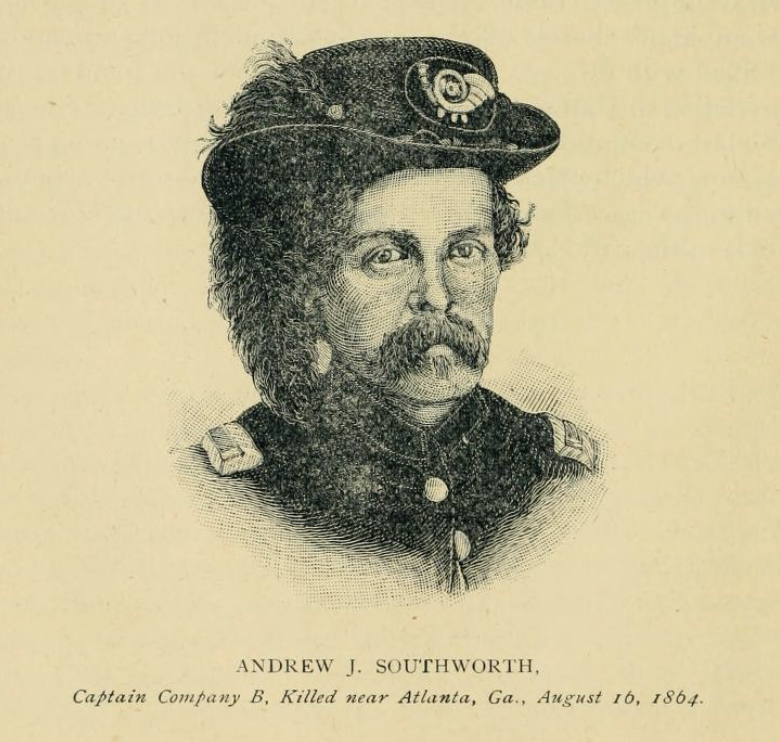
From the History of the 104th Ohio Volunteer Infantry, page 56.

Saturday, July 16, 1864—In camp. Wrote a letter to Elvira G. Went to the 42nd [Illinois] and found [illegible]. Our Division made a reconnaissance. Found the enemy. All quiet at the front.

Sunday, July 17, 1864—Remained in camp today. Done my washing. Wrote a letter to Hal and received one from Em. Went to see Myron this evening. He was detailed to the Division Ambulance Corps.

Monday, July 18, 1864—Had reveille at 3 o’clock. Marched at 5 Had slight skirmishing. Marched 7 miles. Are now within 5 miles of Atlanta. Have formed a line of battle. Battery is in position at an old house. Received a letter from [ ].

Tuesday, July 19, 1864—All is quiet this morning. Our forces are fortifying. There are apparently [ ] Rebels near. Heavy cannonading commenced about noon & continued throughout the day. In the evening we advanced two miles to Battle Creek [illegible].

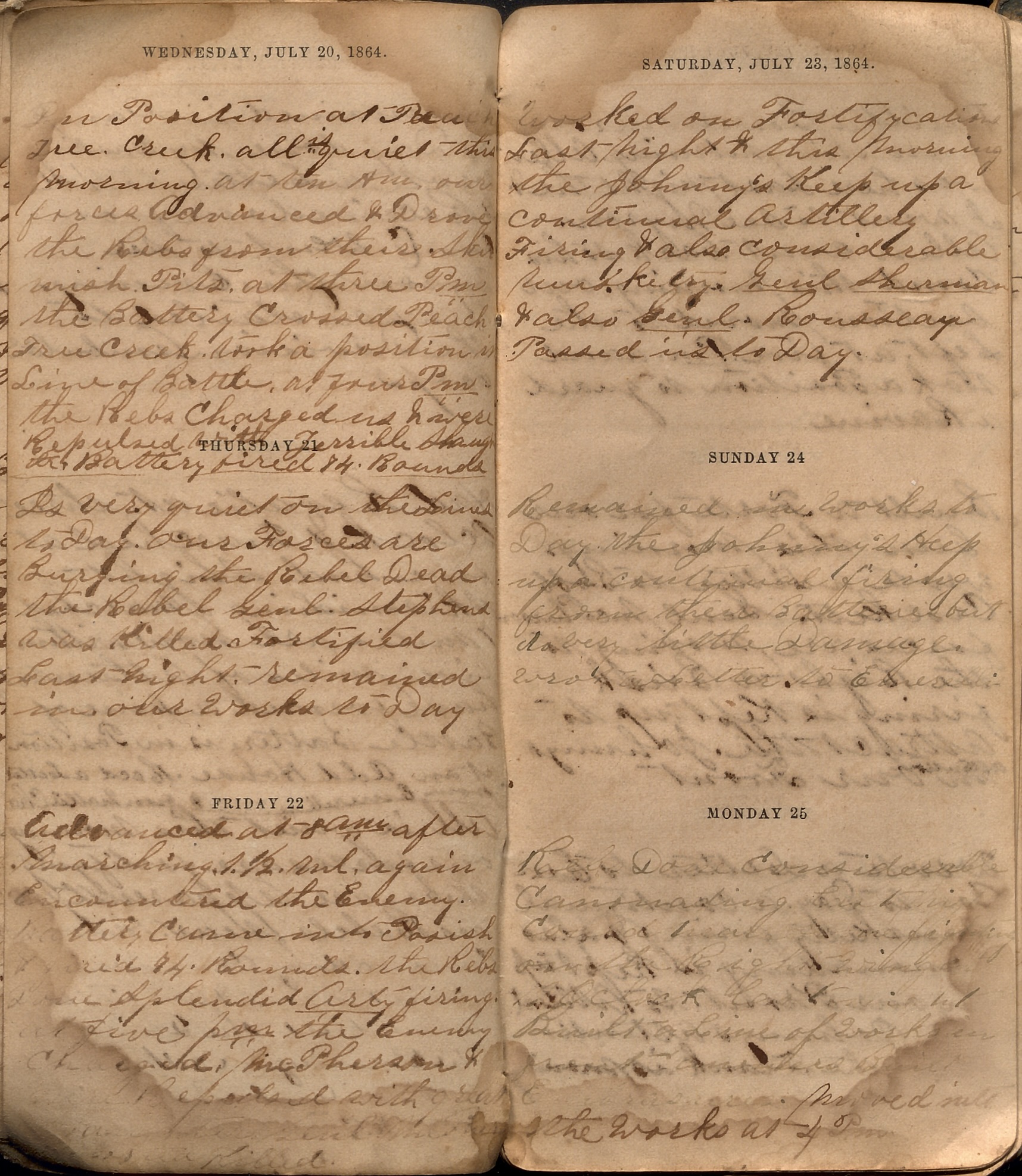
Wednesday, July 20, 1864—In position at Peach Tree Creek. All is quiet this morning. At 10 a.m., our forces advanced & drove the Rebs from their skirmish pits. At 3 p.m., the Battery crossed Peach Tree Creek [and] took a position in line of battle. At 4 p.m., the Rebs charged us & were repulsed with terrible slaughter. Battery fired 74 rounds.
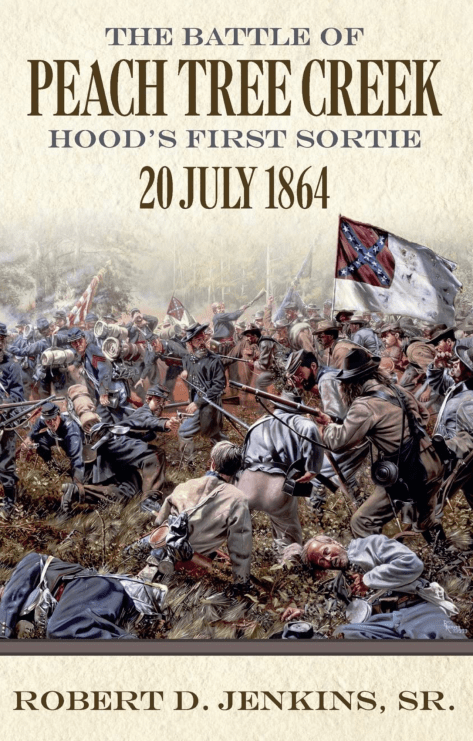
Robert Jenkins’ book, published in 2021, explores this battle in detail.

[Editor’s Note: “When Sherman began his final push toward Atlanta, he divided his forces, sending Thomas’s Army of the Cumberland directly toward the city and ordering Schofield’s Army of the Ohio and McPherson’s Army of the Tennessee around Atlanta to the east. Hood viewed this as an opportunity to strike a blow for the Confederacy. In order to approach Atlanta, Thomas’s army had to cross Peachtree Creek in several places. Johnston had been aware of that while still in command and had devised a plan to attack Thomas’s soldiers at the time of the crossing. When the crossing took place on July 20, Hood implemented Johnston’s plan. Unfortunately for the Southerners, Thomas’s army had already crossed the creek when the attack began at about 4:00 p.m., instead of the planned time of 1 p.m. The assault initially showed some promise, but the Federals were able to hold their ground, eventually punishing the Rebels with high casualties. The Battle of Peachtree Creek cost the Confederacy nearly 5,000 men killed, wounded, and captured or missing, compared to about 1,700 for the Union.” Source: Ohio Civil War]

Thursday, July 21, 1864—Very quiet on the lines today. Our forces are burying the Rebel dead. The Rebel General [Clement Hoffman] Stevens [of Georgia Brigade] was killed. Fortified last night. Remained in our works today.

Friday, July 22, 1864—Advanced at 8 a.m. After marching 1.5 miles, again encountered the enemy. Battery came into position and fired 74 rounds. The Rebs done splendid artillery firing. At 5 p.m., the enemy charged McPherson & was repulsed with great loss. Hear Gen. McPherson was killed.

Saturday, July 23, 1864—Worked on fortifications last night and this morning. The Johnnies keep up a continual artillery firing & also considerable musketry. Gen. [William T.] Sherman & also Gen. [Lovell] Rousseau passed us today.

Sunday, July 24, 1864—Remained in works today. The Johnnies keep up a continuous firing from their batteries but do very little damage. Wrote a letter to Em___.

Monday, July 25, 1864—Rebs done considerable cannonading last night. Could hear them fighting on the Right Wing at 12 o’clock last night. Built a line of works in front. Cannoneers built embrasures. Moved into the works at 4 p.m.

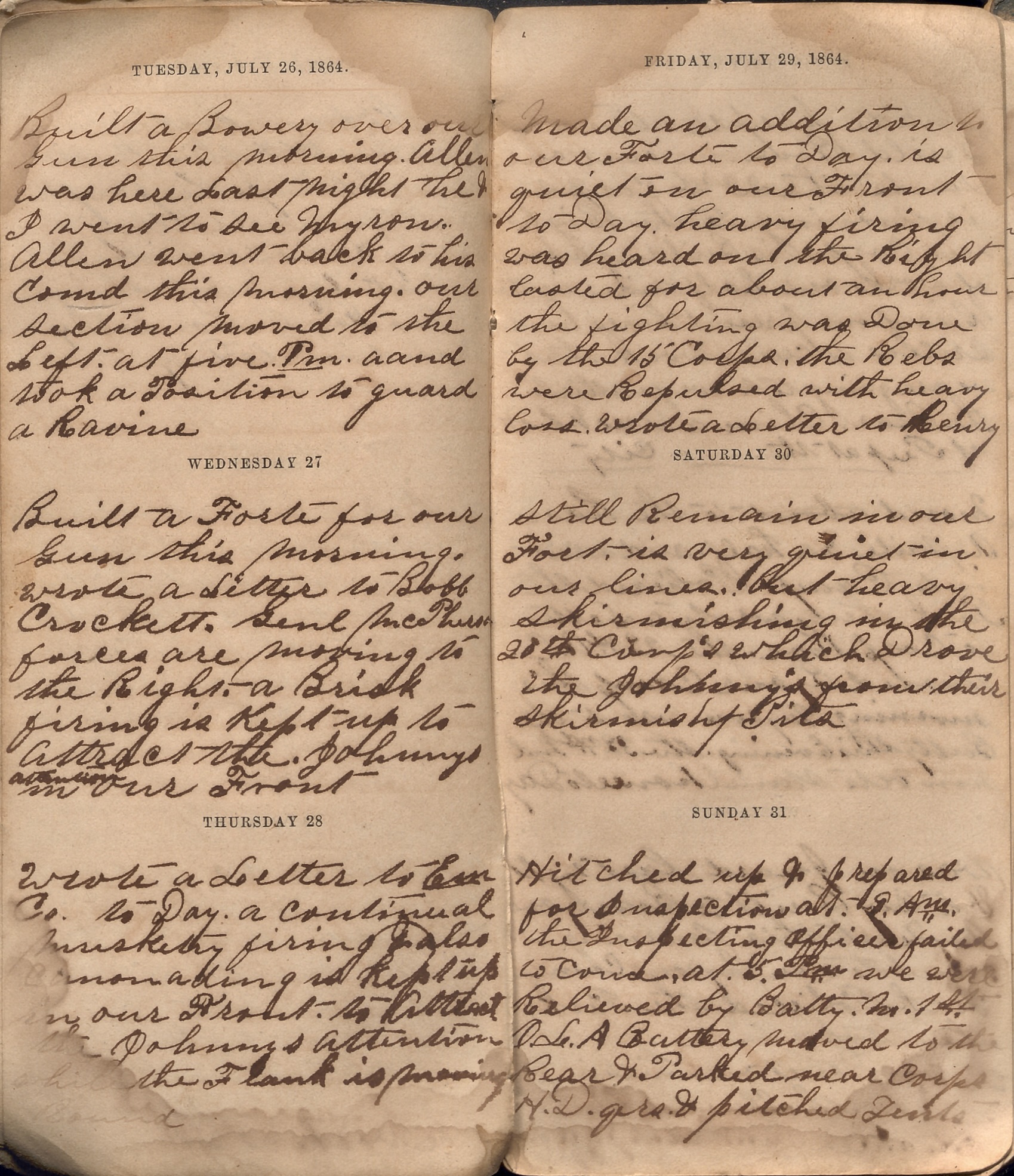
Tuesday, July 26, 1864—Built a bowery over our gun this morning. Allen was here last night. He and I went to see Myron. Allen went back to him command this morning. Our section moved to the left at five p.m. and took a position to guard a ravine.

Wednesday, July 27, 1864—Built a fort for our gun this morning. Wrote a letter to Bobb Crockett. Gen. McPherson’s forces are moving to the right. A brisk firing is kept up to attract the Johnnies’ attention in our front.

Thursday, July 28, 1864—Wrote a letter to Em today. A continual musketry firing & also cannonading is kept up in our front to attract the Johnnies’ attention while the flank is moving round.

Friday, July 29, 1864—Made an addition to our fort today. Is quiet in our front today. Heavy firing was heard on the right. Lasted for about an hour. The fighting was done by the 15th Corps. The Rebs were repulsed with heavy loss. Wrote a letter to Henry.

Saturday, July 30, 1864—Still remain in our fort. Is very quiet in our lines but heavy skirmishing in the 20th Corps which drove the Johnnies from their skirmish pits.

Sunday, July 31, 1864—Hitched up and prepared for inspection at 9 a.m. The inspecting officer failed to come. At 5 p.m., we were relieved by Battery M, 1st O. L. A. Battery moved to the rear and parked near Corps Headquarters & pitched tents.

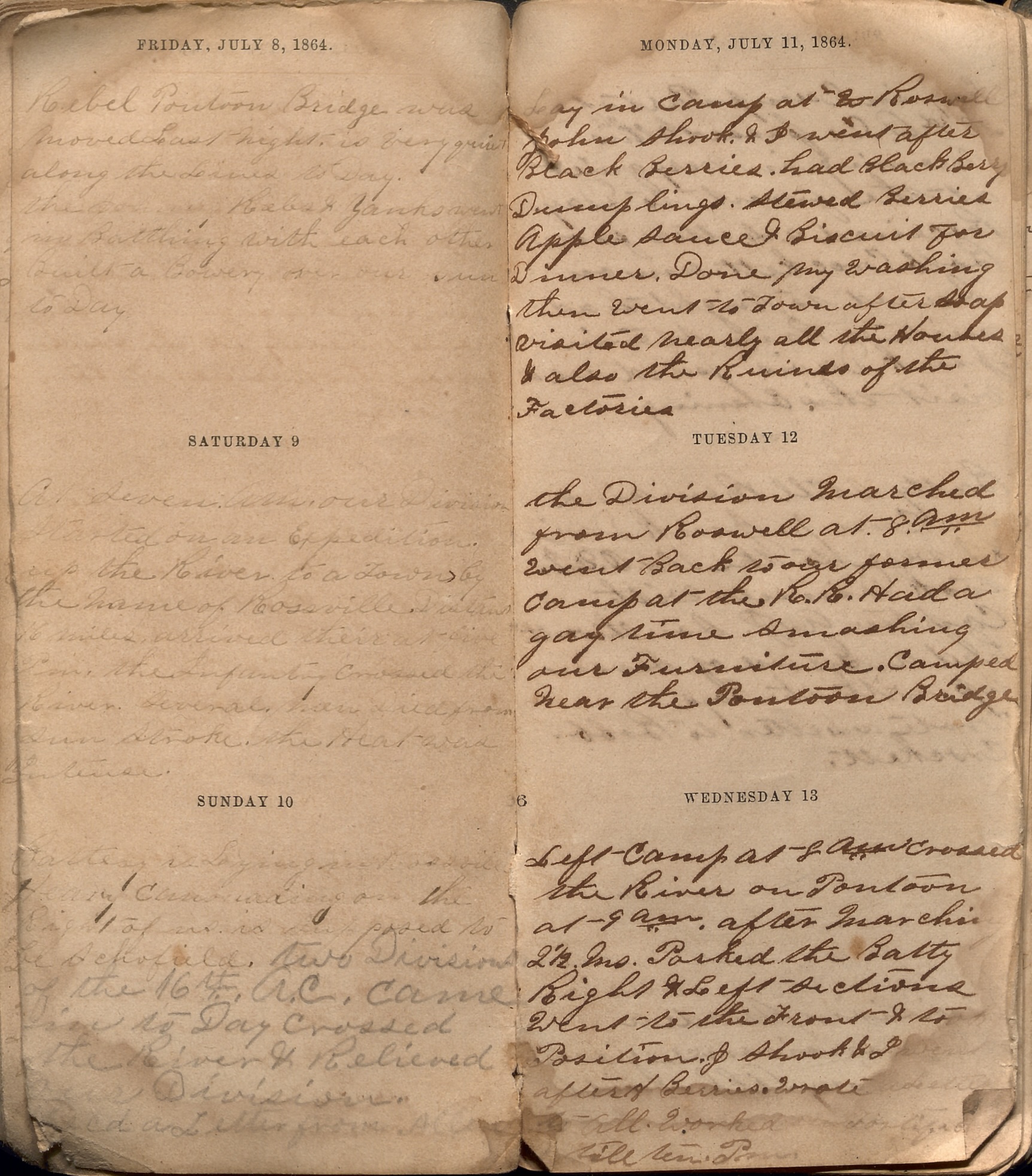
Monday, August 1, 1864—Made preparations to build boweries over our tents. The 23rd Corps is moving to the right. Our Corps is building a line of works one half mile in the rear of our present lines. Have orders to cease work—that we are going to move further to the rear. Climb a tree and took a peep at the City [of Atlanta].

Tuesday, August 2, 1864—Moved to the rear a mile and a half and went into camp. Policed the Park. Then write a letter to Corp. Roe. The 23rd Army Corps moved by our camp this morning. Myron was to the Battery this evening. The 32nd Indiana non vets started home today.

Wednesday, August 3, 1864—Was on guard last night & today. Built a bowery over my tent this morning. Went to see Myron. Came back, policed the Park, then took a shave. Is very quiet on the lines today. The skirmish line advanced but had to fall back again.

Thursday, August 4, 1864—Policed the Park this morning. The Boys went out foraging today. In the afternoon, I took a stroll along the lines. Visited Jink [Jenkins] Davis. Returned to camp and had some green corn and apple sauce for supper.

Friday, August 5, 1864—Joseph Ulm and I done our washing this morning. Heavy cannonading on the right. Received a letter from A. Hamilton and also one from A. Whetstone.

Saturday, August 6, 1864—Took our carriages to the creek today and washed them. Prepare for inspection [illegible].

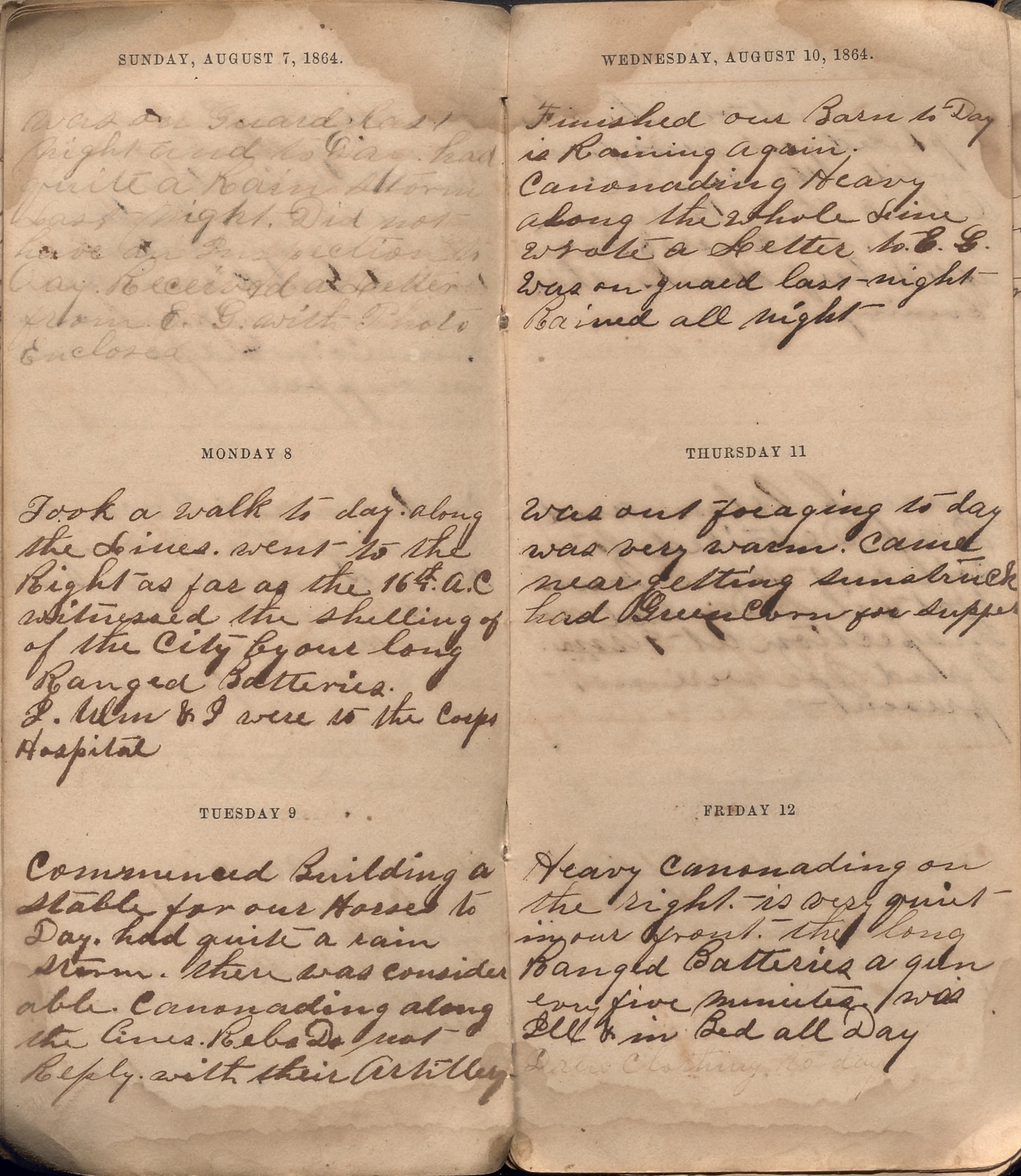
Sunday, August 7, 1864—Was on guard last night and today. Had quite a rain storm last night. Did not have an inspection today. Received a letter from E. G. with photo enclosed.

Monday, August 8, 1864—Took a walk today along the lines. Went to the right as far as the 16th Army Corps. Witnessed the shelling of the City by our long ranged batteries. Joseph Ulm and I were to the Corps Hospital.

Tuesday, August 9, 1864—Commenced building a stable for our horses today. Had quite a rain storm. There was considerable cannonading along the lines. Rebs do not reply with their artillery.

Wednesday, August 10, 1864—Finished our barn today. Is raining again. Cannonading heavy along the whole line. Wrote a letter to E. G. Was on guard last night. Rained all night.

Thursday, August 11, 1864—Was out foraging today. Was very warm. Came near getting sun struck. Had green corn for supper.

Friday, August 12, 1864—Heavy cannonading on the right. Is very quit in our front. The long ranged batteries [fire] a gun every five minutes. Was ill and in bed all day.

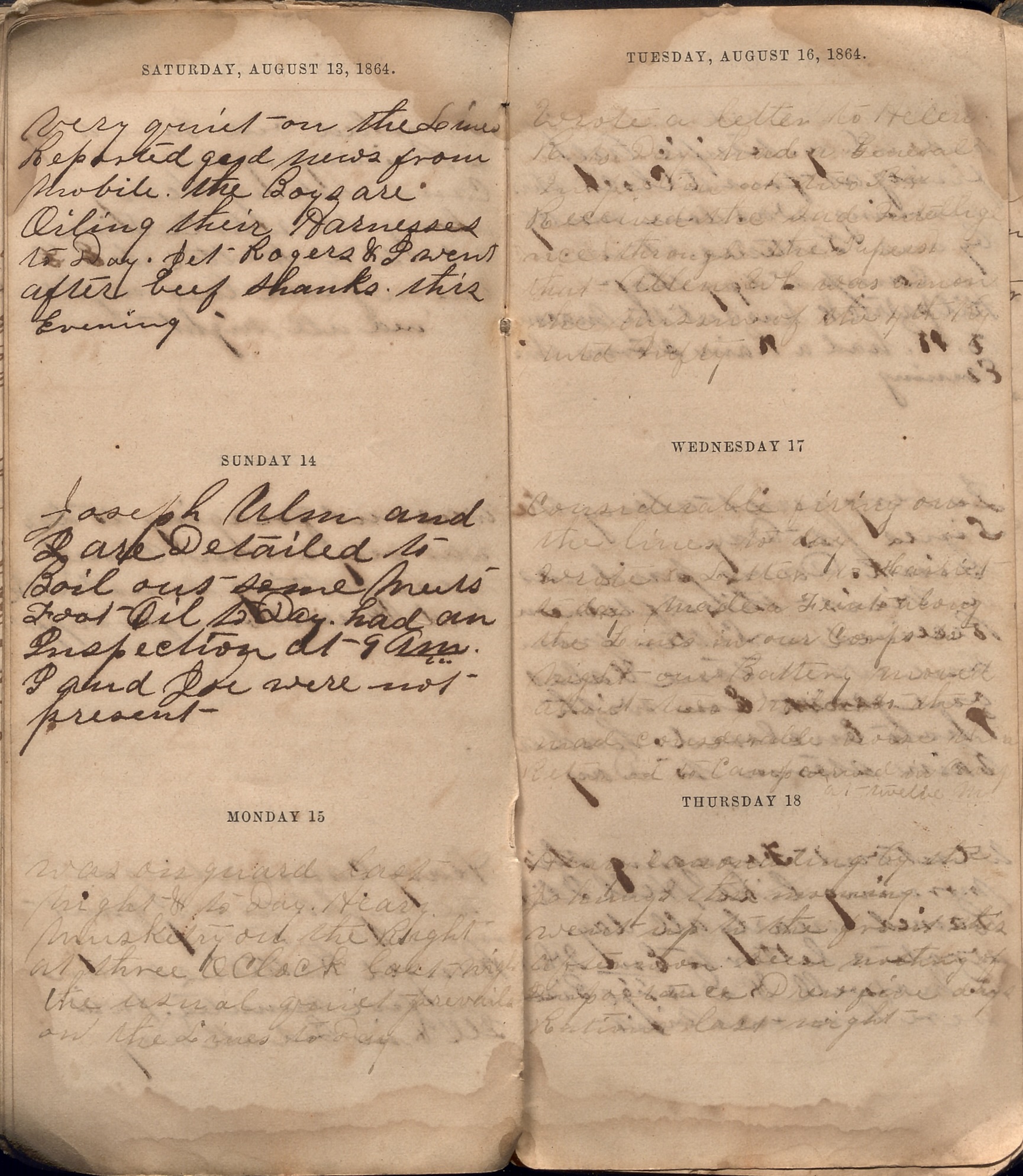
Saturday, August 13, 1864—Very quiet in the lines. Reported good news from Mobile. The boys are oiling their harnesses today. Jet [Justin] Rogers & I went after beef shanks this evening.

Sunday, August 14, 1864—Joseph Ulm and I are detailed to boil out some Neats’ Foot Oil today. Had an inspection at 9 a.m. I and Joe were not present.

Monday, August 15, 1864—Was on guard last night. Today heavy musketry on the right at 3 o’clock last night. The usual quiet prevailed on the lines today.

Tuesday, August 16, 1864—Wrote a letter to Helen R. today. Had a General Inspection at 2 p.m. Received the sad intelligence through the papers that Allen [S.] Whetstone was among the missing of the 4th Kentucky Mounted Infantry.

[Editor’s note: Allen S. Whetstone (1837-1909) Served in the 104th Ohio Infantry (U.S.A.) as private from August 11, 1862 to April 9, 1864. Served in the 4th Kentucky Mounted Infantry (U.S.A.) as first lieutenant from April 16, 1864 to December 9, 1864.]

Wednesday, August 17, 1864—Considerable firing on the lines today. Wrote a letter to Harriet today. Made a feint along the lines in our Corps tonight. Our Battery moved about two miles to [ ], made considerable noise, then returned to camp. Arrived in camp at 12 midnight.

Thursday, August 18, 1864—Heavy cannonading by the Johnnies this morning. Went up to the front this afternoon. Seen nothing of importance. Drew five days rations last night.

Friday, August 19, 1864—Was on guard last night and today. Terrific artillery firing at 4 o’clock this morning. Was done mostly by our batteries. It is reported in camp today that Kilpatrick has cut the Macon Railroad. Had a rain storm this evening.

Saturday, August 20, 1864—Is very quiet along the lines today. Jenk Davis paid us a visit this afternoon. Received a letter from Sue Whetstone & also one from Em with photo enclosed. Had a rain storm today.

Sunday, August 21, 1864—Went out foraging this morning—like Hell I did. Rained nearly all day. Wrote a letter to Em Whetstone. B. Maxwell and George Bissett were here on a visit.

Monday, August 22, 1864—Went out foraging this morning. Received a letter from Corp. Roe and also one from Samantha Chain. Replied to Alex’s letter.

Tuesday, August 23, 1864—All quiet in the lines this morning. Was to the 19th OVVI on a visit today. Played a big game of Seven Up.

Wednesday, August 24, 1864—Marched at 1 p.m. Moved about three miles to the right. Occupied the works which the 11th Army Corps had abandoned. Camped for the night just in rear of the line.

Thursday, August 25, 1864—Had reveille at early dawn. The 2nd & 3rd Divisions passed the 1st Division which was guarding the rear. The Battery was left with the 1st Division. Pulled out of the works about 10 a.m. The Johnnies threw a few shell this morning. Marched about 6 miles. Camped close to Battery M, 1st Ohio.

Friday, August 26, 1864—Left camp at 8 a.m. Marched about four miles. The infantry threw up a line of works after relieving the cavalry. Went into camp about 4 p.m. Parked on a hill in a grove. There was some slight skirmishing today.

Saturday, August 27, 1864—Moved at 10 a.m. The whole 14th Corps train passed us. Didn’t march over a mile during the day. Built a bridge over a small creek in the afternoon. Started to join our Corps at 8 p.m. Marched 4 miles. Arrived at camp at 12 o’clock. Had a big time going through a swamp.

August 28 through September 1, 1864 [No entries]

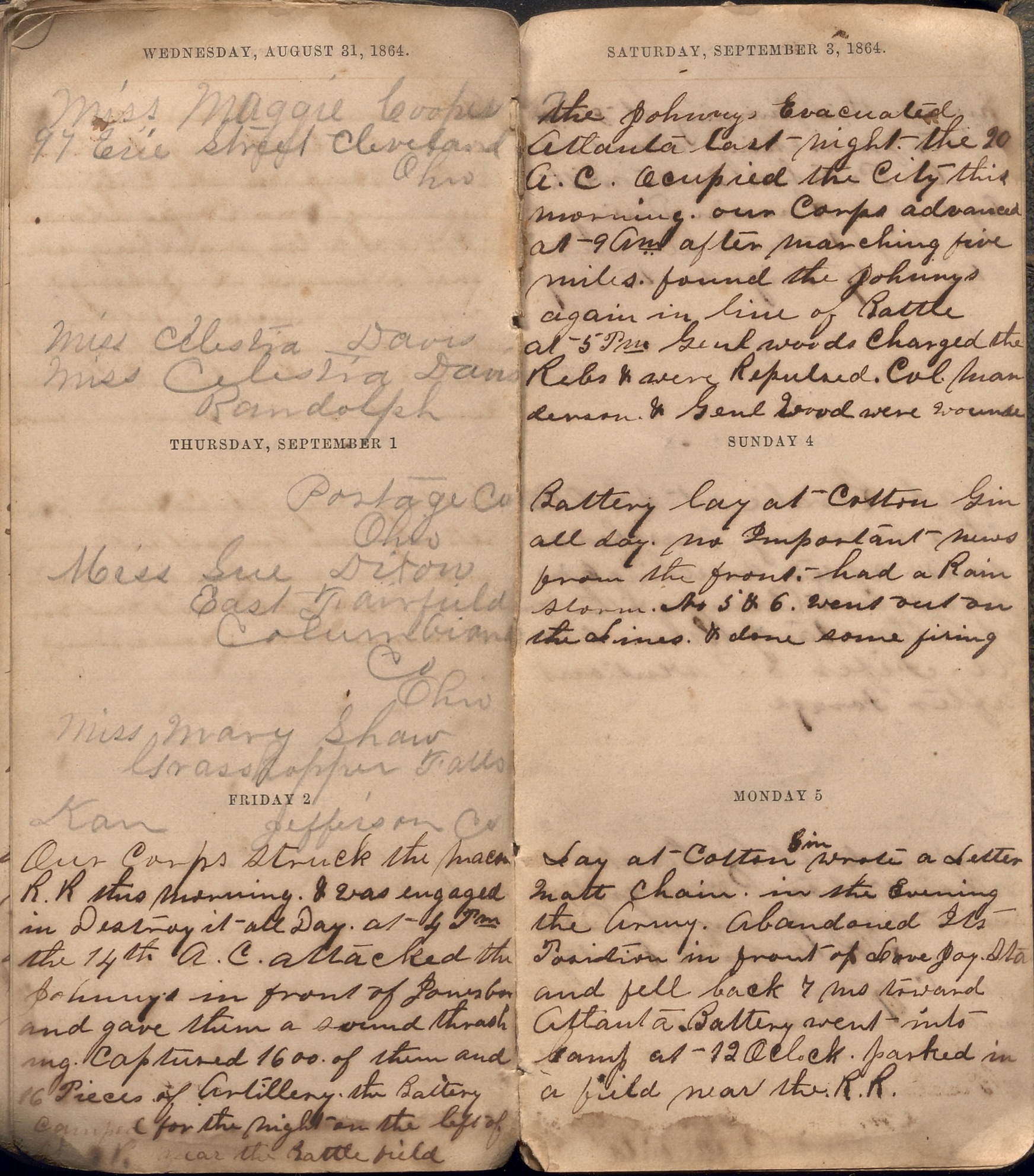
Friday, September 2, 1864—Our Corps struck the Macon Railroad this morning & was engaged in destroying it all day. At 4 p.m. the 14th Army Corps attacked the Johnnies in front of Jonesboro and gave them a sound thrashing. Captured 1600 of them and 16 pieces of artillery. The Battery camped for the night on the left of the RR near the battlefield.
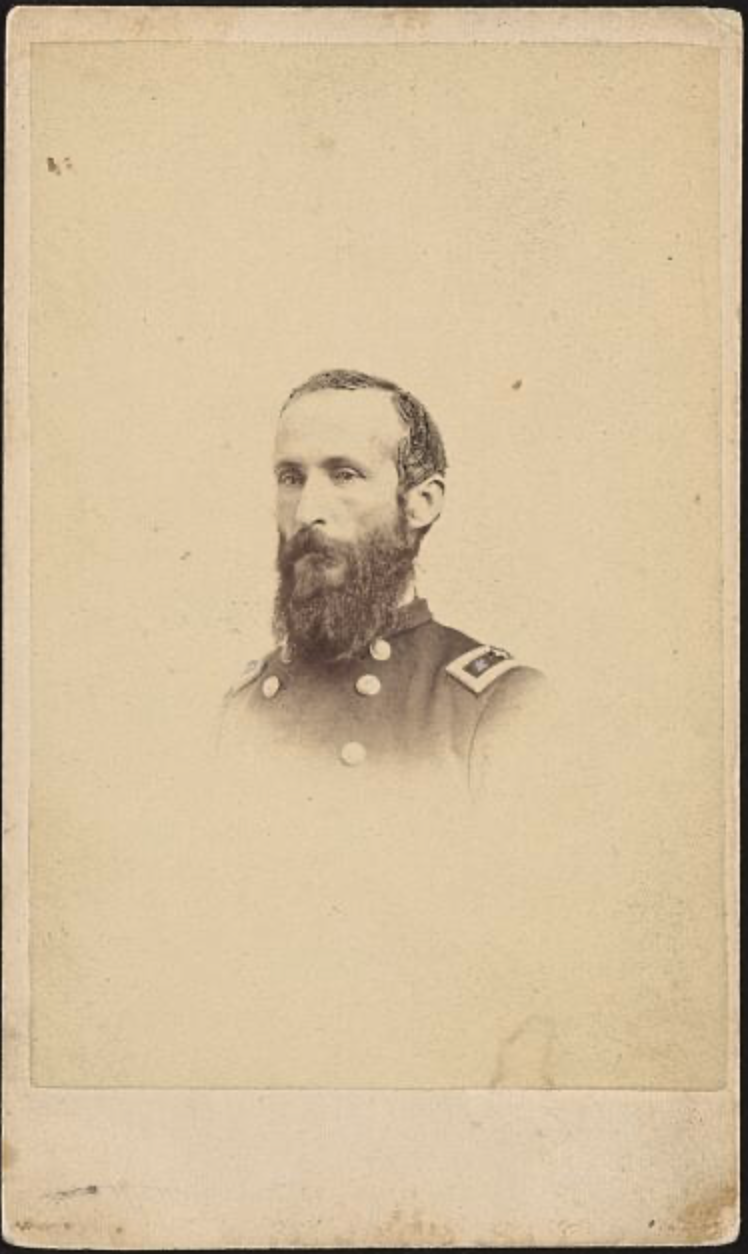
Major Gen. Thomas John Wood, 4th Cavalry US Army, suffered a leg wound in the Battle of Lovejoy’s Station.

Saturday, September 3, 1864—The Johnnies evacuated Atlanta last night. The 20th Army Corps occupied the city this morning. Our Corps advanced at 9 a.m. After marching five miles, found the Johnnies again in line of battle. At 5 p.m., Gen. Wood’s [cavalry] charged the Rebs [at Lovejoy’s Station] and were repulsed. Col. [Charles F.] Manderson and Gen. [Thomas John] Wood were wounded.

Sunday, September 4, 1864–Battery lay at cotton gin all day. No important news from the front. Had a rain storm. No. 5 & 6 went out on the lines & done some firing.

Monday, September 5, 1864—Lay at cotton gin. Wrote a letter to Matt Chain. In the evening the Army abandoned its position in front of Lovejoy Station and fall back 7 miles toward Atlanta. Battery went into camp at 12 o’clock. Parked in a field near the railroad.

Tuesday, September 6, 1864—Moved this morning at 8 a.m. After marching about 1.5 miles, pitched tents with orders to remain during the night. Marched with the Artillery Brigade today.

Wednesday, September 7, 1864—Had reveille at 2 o’clock this morning. Marched at 4. After marching 6 miles, went into camp within 7 miles of Atlanta. Joseph Ulm, Jacob Fifer, and I went out after forage.

Thursday, September 8, 1864—Arrived at Atlanta about two p.m. Went into camp on the Decatur Railroad a mile east of the City on the battlefield where McPherson fell.

September 9, 1864 through October 2, 1864 [No entries]

Monday, October 3, 1864—Camp at Atlanta. Had reveille at 2 o’clock. Left camp at early dawn to start for Johnnie Hood who had gone to our rear. Crossed the pontoon bridge at Vining Station. Camped within 5 miles of Marietta. Marched 13 miles.

Tuesday, October 4, 1864—Had reveille at early dawn. Marched at noon. Passed through Marietta about 4 p.m. Went into camp at Kennesaw Mountain. Marched 6 miles today. Battle at Altoona Pass. Rebel loss 600.

Wednesday, October 5, 1864—In camp at Kennesaw Mountain. Marched at 5 p.m. After marching 5 miles, went into camp about a mile from Pine Mountain & near the old house from which we fired on the 17th of June when in position with Willich’s Brigade.

Thursday, October 6, 1864—Lay in camp today. Nothing worthy of note occurred. Rain quite hard all day. Was on guard last night & today.

Friday, October 7, 1864—Changed camp at 9 a.m. After marching a mile, we joined our Corps and went into camp near Pine Mountain. Heard some cannonading on the left this evening. The Johnniesattacked the 15th ARmy Corps and were repulsed.

Saturday, October 8, 1864—In camp near Pine Mountain. Lay close to Willich’s Brigade. Was in my tent all day reading a novel. Moved at 3 p.m. Marched 8 miles. Went into camp in an open field near Acworth. Was 10 p.m. when we pulled into Park.

Sunday, October 9, 1864—Changed camp this morning at 10 a.m. Move about a mile. Our camp located near the railroad & close to Acworth. Had an order read to us at Roll Call concerning the fight at Altoona.

Monday, October 10, 1864—In camp at Acworth. Went out grazing horses. Returned to camp and marched at 3 p.m. Passed through Altoona at dusk. Arrived at Cartersville at 10 p.m. and camped for the night. Marched 9 miles.

Tuesday, October 11, 1864—Had reveille at 4 o’clock. Marched at early dawn. Passed through Cartersville. Arrived at Kingston at 2 p.m. and halted for dinner and held an election. Camped for the night in a woods a mile from Kingston. Received mail this evening.

Wednesday, October 12, 1864—Had reveille at early dawn. Marched at 9 a.m. Heard some cannonading on the left today. Marched about 22 miles and camped within three miles of Rome, Georgia.

Thursday, October 13, 1864—In camp three miles from Rome. The Boys are all out after forage. Heard some cannonading on the right of Rome. Battery moved at 4 p.m. After marching 15 miles, went into camp at one o’clock. Camped in the woods on a high hill 9 miles from Calhoun, Georgia. Skirmish at Resaca this morning.

Friday, October 14, 1864—Marched at 8 a.m. Passed through Calhoun about 10 a.m. and arrived at Resaca at noon. Camped for the night two miles north of town. A Negro Regiment captured at Dalton today.
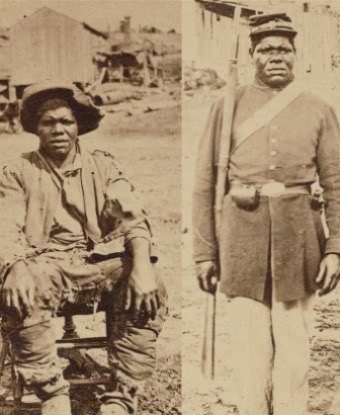
Hubbard Pryor show at the time of his enlistment (left) and after donning the uniform of the 44th USCT.

[Editor’s Note: The Negro regiment captured at Dalton, Georgia, was the 44th USCT consisting of about 600 Black soldiers and 150 white officers, who were guarding the railroad when they were surprised by General John Bell Hood’s forces. While white officers were quickly paroled, the Black soldiers faced re-enslavement or harsh conditions as prisoners, highlighting the brutal racial disparity in treatment during the Civil War, with one soldier, Hubbard Pryor, surviving to tell his story.] 

Saturday, October 15, 1864—Left camp near Resaca at 8 a.m. Marched six miles toward Dalton, then halted. The infantry marched over Rocky Face Ridge at dusk. We went back to Resaca with the wagon train. Battery took a position in Reb works and camped for the night.

Sunday, October 16, 1864—Left camp at 7 a.m. on route for Snake Creek Gap. Halted for dinner at the entrance of the Gap. Passed the Gap two miles & camped for the night at White Church.

Monday, October 17, 1864—Lay in camp at the White Church. Visited the 104th OVI. Received orders to forage off of the country for our subsistence.
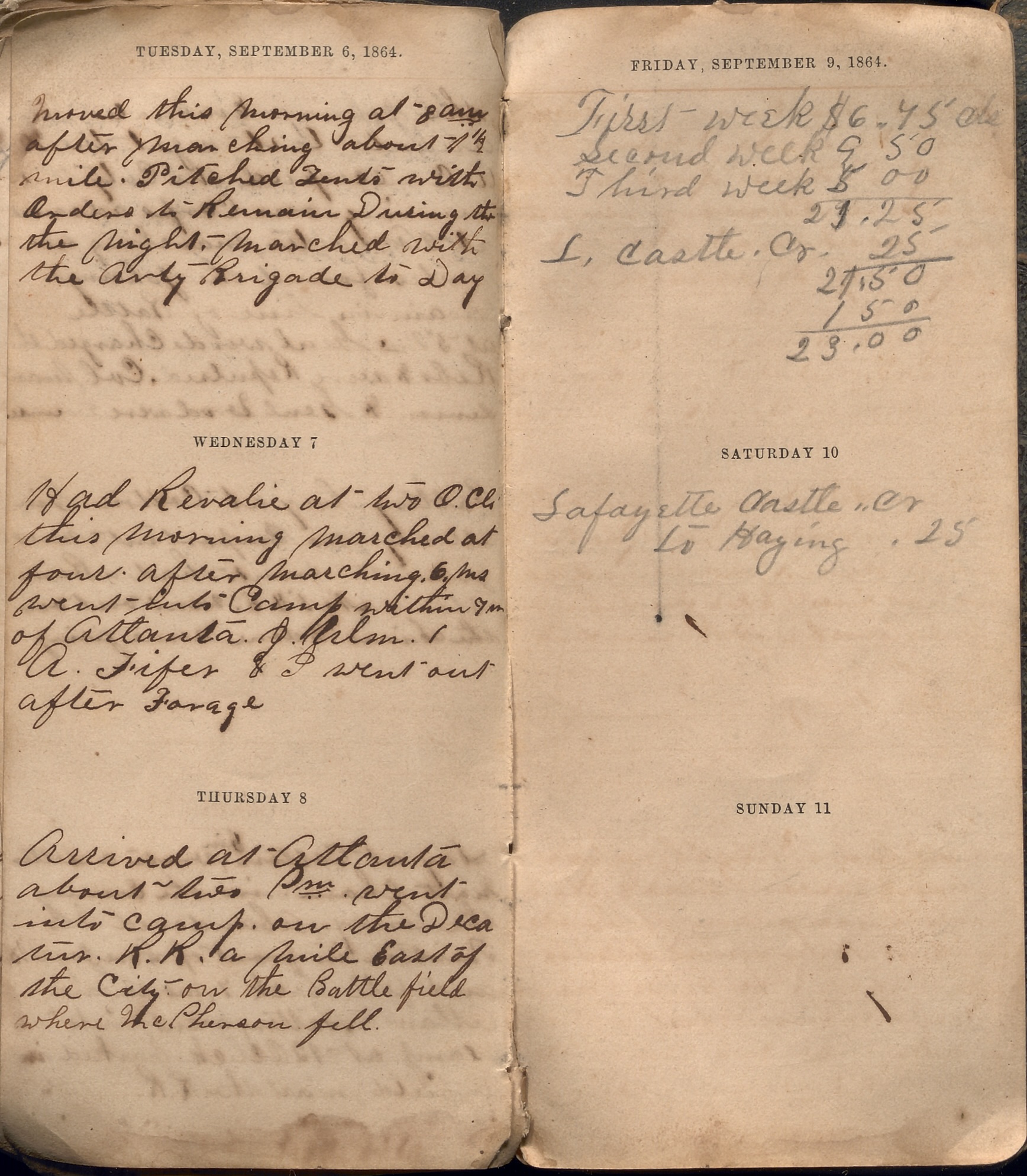
Tuesday, October 18, 1864—Left camp at the White Church at 8 a.m. Passed through Dug Gap. Marched 16 miles and camped in a hill in an open field.

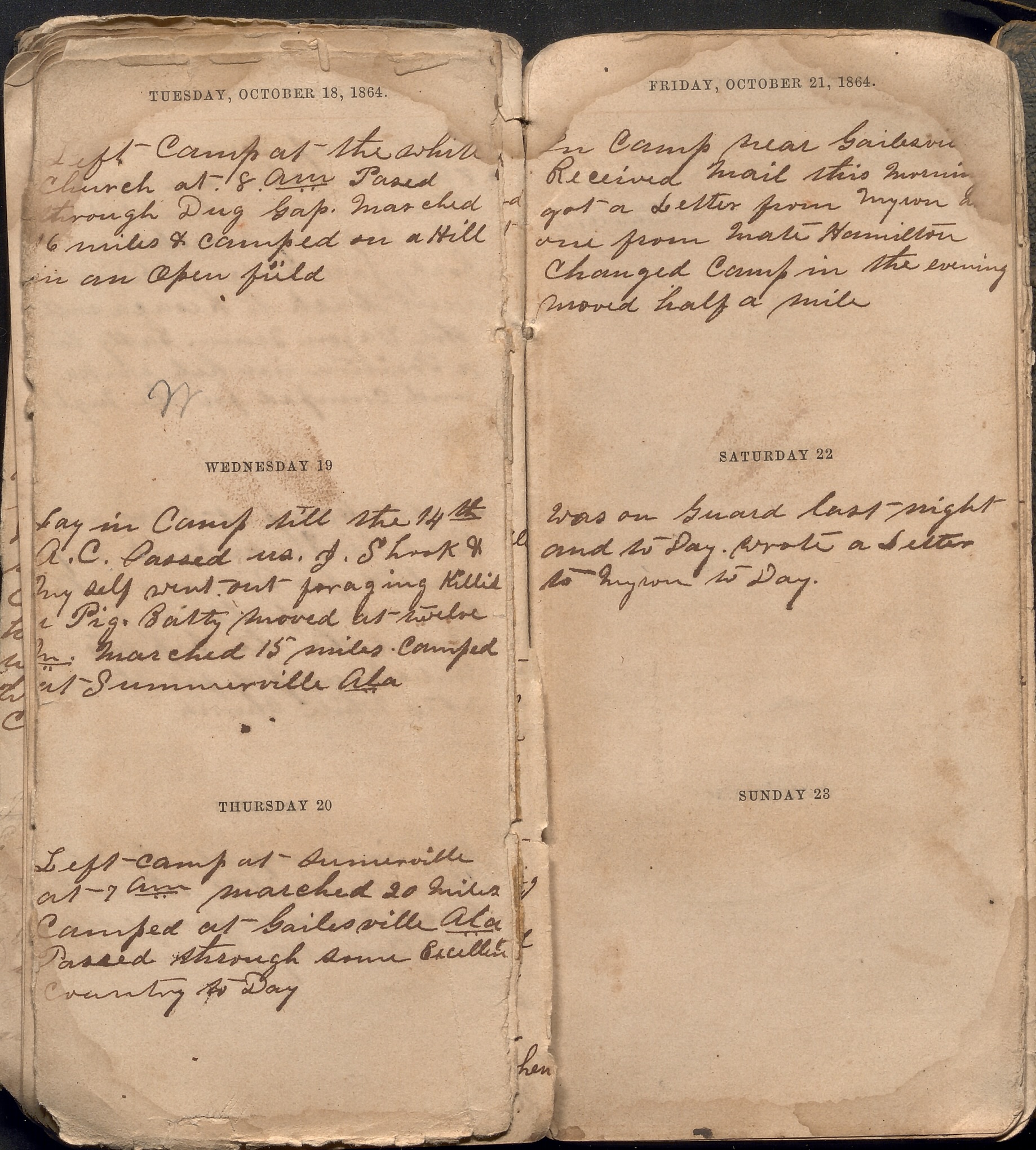
Wednesday, October 19, 1864—Lay in camp till the 14th Army Corps passed us. J. Shook and myself went out foraging. Killed a pig. Battery moved at 12 noon. Marched 15 miles. Camped at Summerville, Alabama.

Thursday, October 20, 1864—Left camp at Summerville at 7 a.m. Marched 20 miles. Camped at Gaylesville, Alabama. Passed through some excellent country today.

Friday, October 21, 1864—In camp near Gaylesville. Received mail this morning. Got a letter from Myron and one from Mate Hamilton. Changed camp in the evening. Moved half a mile.

Saturday, October 22, 1864—Was on guard last night and today. Write a letter to Myron today.

October 23, 1864 through November 26, 1864 [No entries]

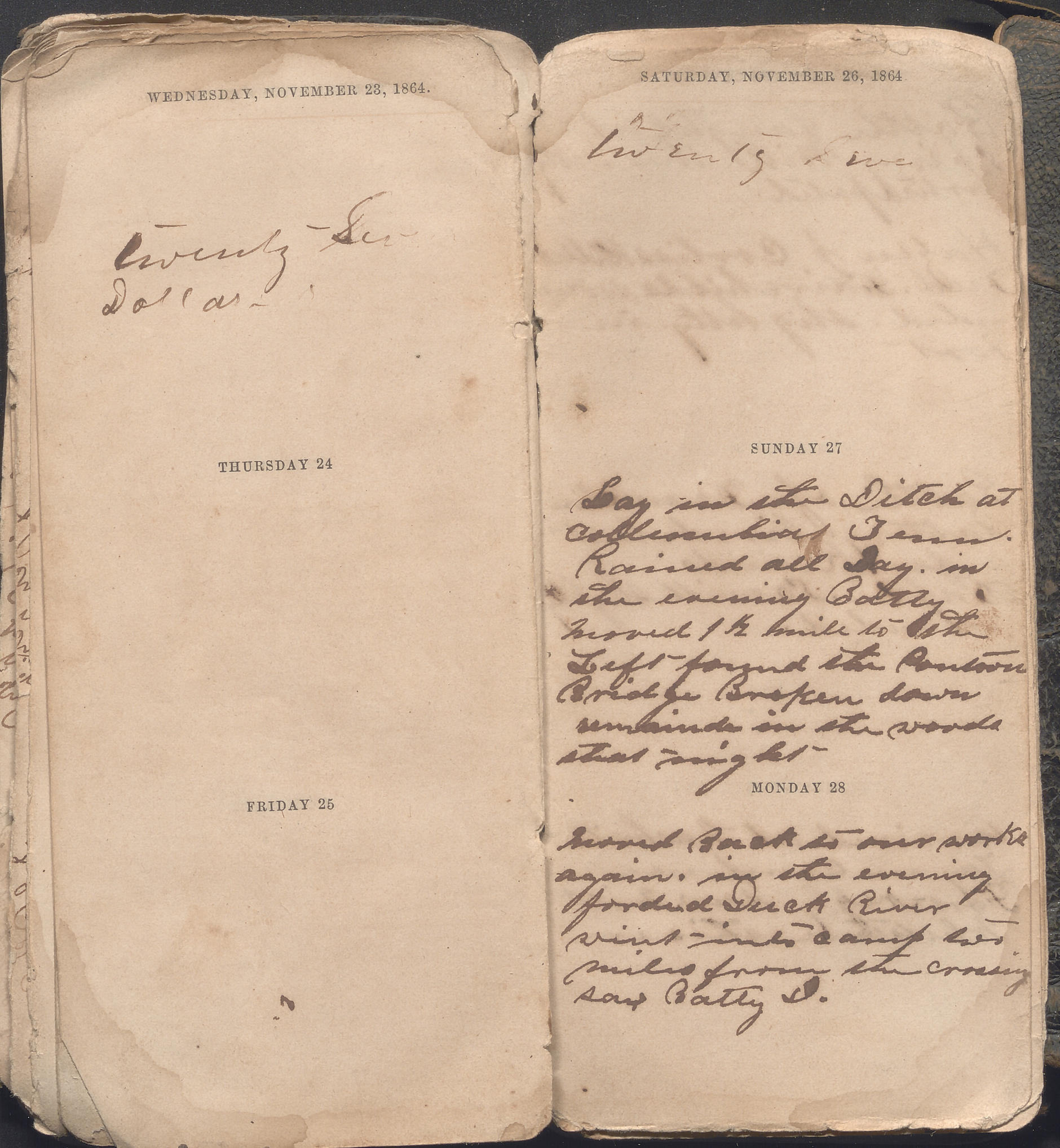
Sunday, November 27, 1864—Lay in ditch at Columbia, Tennessee. Rained all day. In the evening, Battery moved 1.5 miles to the left. Found the pontoon bridge broken down. Remained in the woods that night.

Monday, November 28, 1864—Moved back to our works again. In the evening forded Duck River. Went into camp two miles from the crossing. Saw Battery I.

Tuesday, November 29, 1864—Battle fought at Spring Hill. The battery participated. Hazen J. Corlis killed. Fred Fairchilds wounded slightly in foot.

[Editor’s Note: Whetstone records very little of this action though the role played by the Battery was significant. Gen. Stanley later admitted that, “The Union forces were only saved from irretrievable loss by the stubborn resistance which Battery A made with well directed volleys of shell and canister, and its concentration of fire under the direction of Capt. Goodspeed.” Source: History of Battery A by Henry M. Davidson, page 132.]

Wednesday, November 30, 1864—Battle of Franklin. Battery fired but a few rounds. Captain Scovill slightly wounded [in the breast by a musket ball].

Thursday, December 1, 1864—Arrived at Nashville. Lay in camp near Fort Negley. Saw Milt Whetstone this eve.

Friday, December 2, 1864—Moved a mile to the right. Took a position in the line on the Charlotte Pike.

December 2, 1864 through December 13, 1864 [No entries]

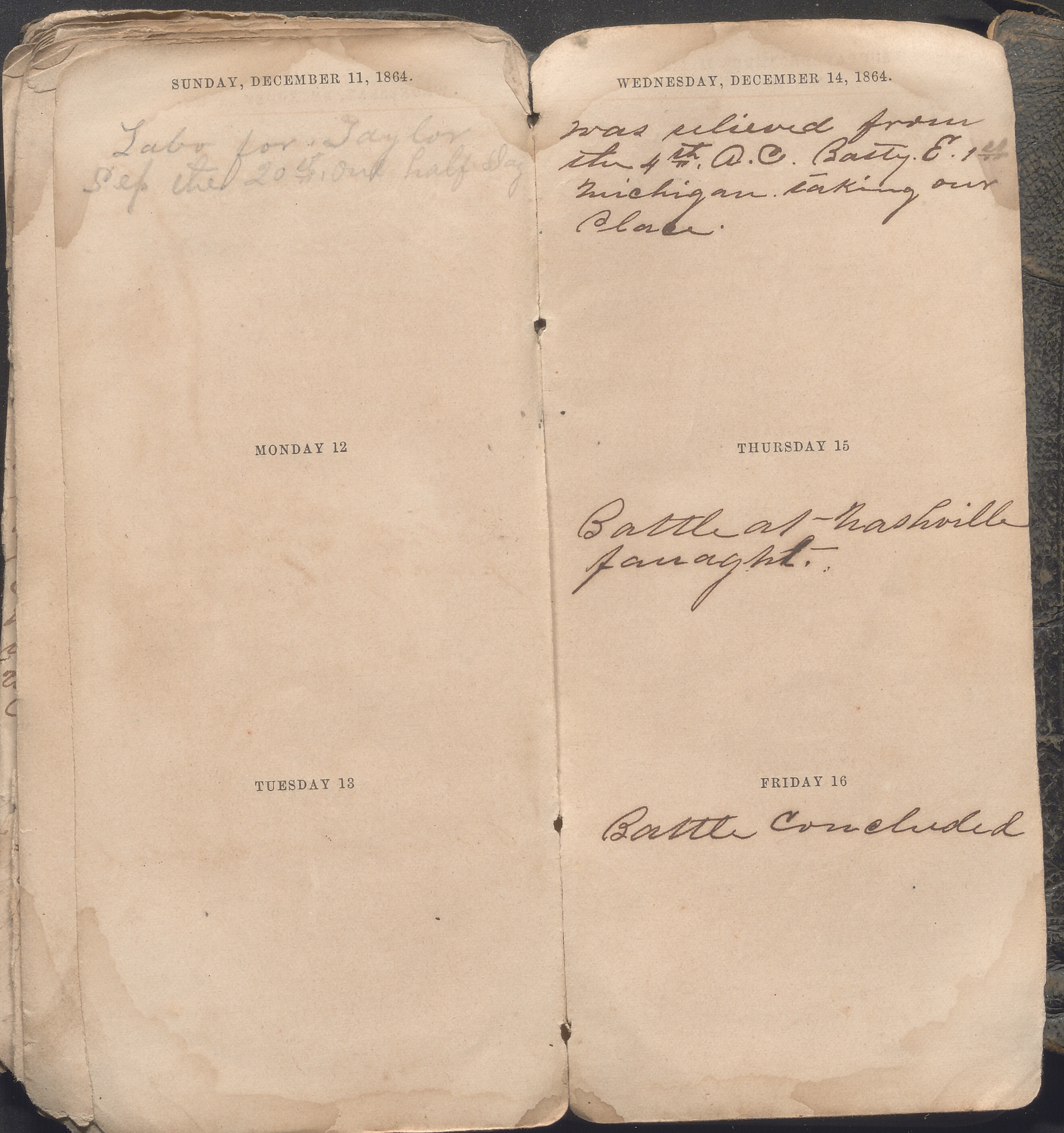
Wednesday, December 14, 1864—Was relieved from the 4th Army Corps. Battery E, 1st Michigan taking our place.

Thursday, December 15, 1864—Battle at Nashville fought.

Friday, December 16, 1864—Battle concluded.
Battery F, 1st Ohio Light Artillery (National Archives)

The 1864-65 Reuben Cross Norton Journal, 44th Illinois Infantry

Lt. Reuben Cross Norton, Co. G, 44th Illinois (1862)

The following journal was kept by Reuben Cross Norton (1838-1920), the son of Hoel Buell Norton (1797-1876) and Margaret Cross (1799-1866) of Rockford, Illinois. Reuben’s father was born in East Bloomfield, New York; his mother was born in Sligo, Ireland. The Norton’s were residing in Bridgewater, Michigan in the late 1830s when Reuben was born. They moved to Rockford, Illinois, in 1852. It’s noted that Reuben’s father’s name is spelled “Hoel” on his grave marker and in the cemetery records. Upon his death in 1876, he was remembered by his friends for his “strict integrity and probity.”

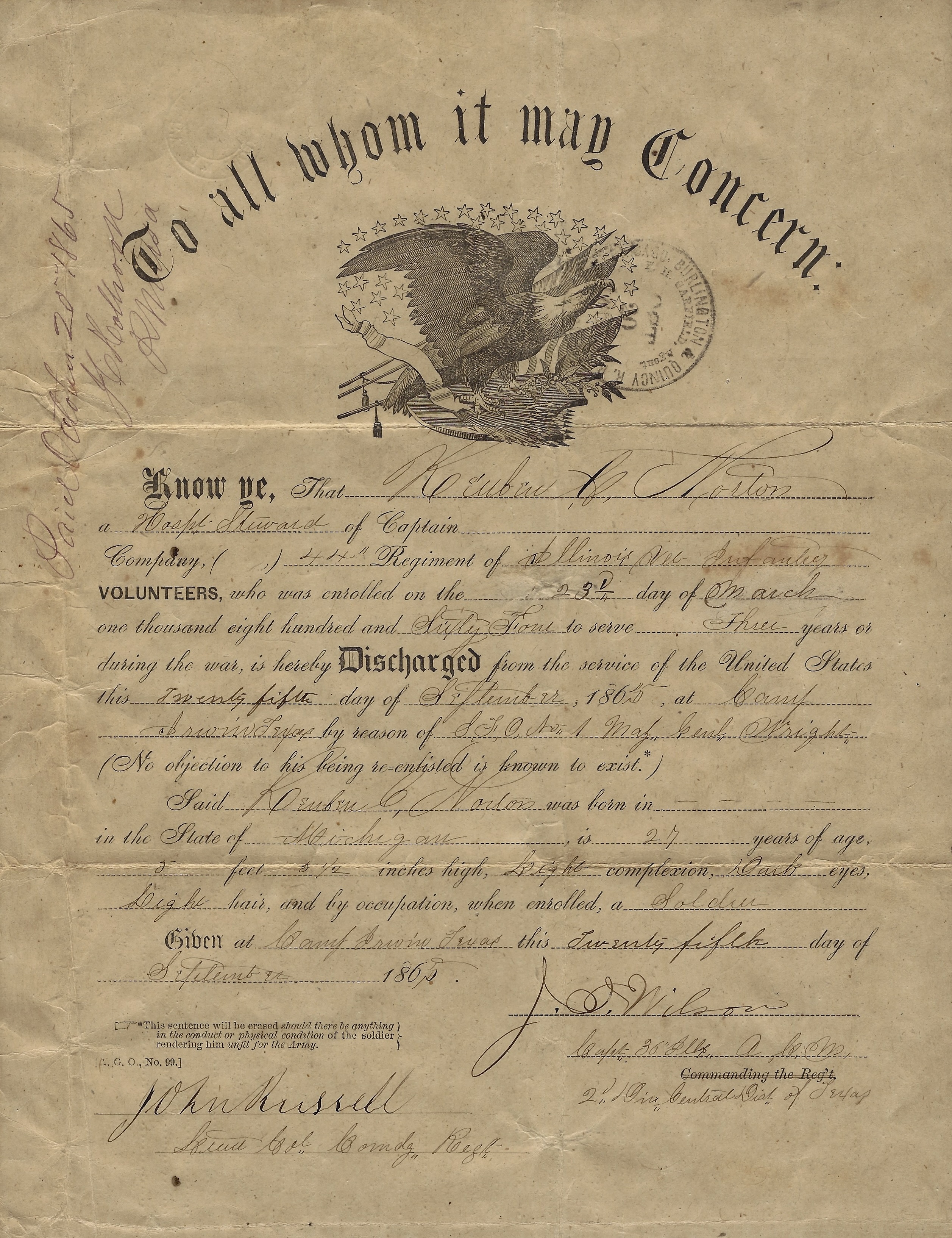
Reuben first entered the war in September 1861, enlisting in Co. G (the “Northwestern Rifles”), 44th Illinois Infantry, with his brother Marcus Norton. Reuben rose in the ranks and was commissioned 1st Lieutenant of Co. G in April 1862 but resigned in January 1863. Though a veteran, he was drafted into the same company on 30 March 1864 and served in the ranks of the 44th Illinois as a private throughout the Atlanta Campaign. After he was wounded in the Battle of Franklin in late November 1864, he was transferred to the Field & Staff (F&S) to serve as a hospital steward with Dr. Emery Merrifield. He remained in this capacity until 25 September 1865 when he mustered out of the regiment at Port Lavaca, Texas. At the time of his enlistment he was described as a dark-haired, dark-eyed mechanic who stood just shy of five and a half feet tall.

A post war cabinet card of Reuben

After he returned to civilian life, Reuben married Miss Flora M. Holbart in 1874 and settled in Rockford where he worked as a pattern maker in the Love Manufacturing Company. He died of pneumonia in 1920.

Several years ago I transcribed a couple of other letters by the Norton family. One was by Samuel Norton (1839-1926), Reuben’s younger brother who became a druggist in Rockford. He was a frequent correspondent with Reuben. See—1865: Samuel Norton to Reuben Cross Norton.

Another brother, Robert (“Bob”) F. Norton (1836-1918) moved to Minneoah, Minnesota, in 1854 and then enlisted in Co. B, 7th Minnesota Infantry, during the Civil War. See—1865: Robert F. Norton to Katie Hinds.

The journal, 1865 letter, and cdv of Reuben C. Nelson are all from the collection of Allen Cebula and made available for transcription and publication on Spared & Shared by express consent.

An AI enhanced image from a very poor quality tintype posted in the Norton Family Tree said to be Reuben’s parents, Robert and Margaret, with an older brother, William Norton who died in 1860.

R. C. Norton, Co. G, 44th Illinois Veteran Volunteers, 1st Brigade, 2nd Division, 4th Army Corps, Department of Cumberland

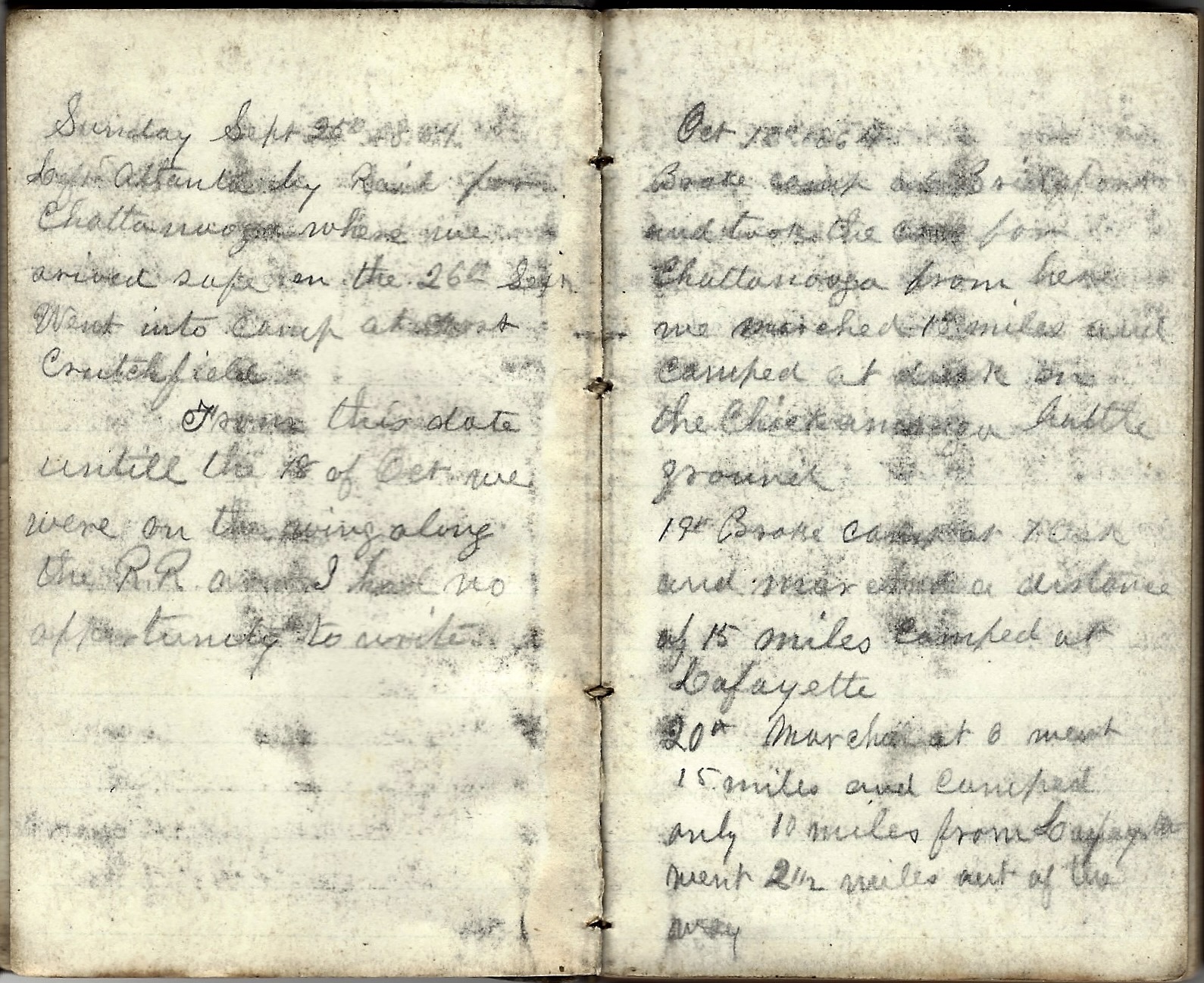
Sunday, September 25, 1864—Left Atlanta by rail for Chattanooga where we arrived safe on the 26th September. Went into camp at [ ] Crutchfield. From this date until the 18th of October we were on the wing along the railroad and I had no opportunity to write.

October 18, 1864—Broke camp at Bridgeport and took the cars for Chattanooga. From here we marched w3 miles and camped at dusk on the Chickamauga battleground.

19th—Broke camp 7 o’clock and marched a distance of 15 miles. Camped at Lafayette.

20th—Marched at 6. Went 15 miles and camped only 10 miles from Lafayette. Went 2.5 miles out of the way.

21st—Broke camp at 6 and marched to Alpine, a distance of 12 miles and camped for the night.

22nd—Laid by today. Did some foraging in the way of apples and sweet potatoes, pigs, sheep, and chickens were brought into camp by the thousand.

23rd—Still in camp. Forage wagons gone out again. Don’t know what we are laying here for. At noon I, together with about a dozen of the 44th, went to a mill about 6 miles from here and got a wagon load of flour. I rather like raiding. It brings a change of diet which is very beneficial to health.

24th—Still in camp. Orders to take anything that we need to eat. Our policy seems to be to clean this valley completely of forage so that the Rebs never can take advantage of it again to slip from our grasp.

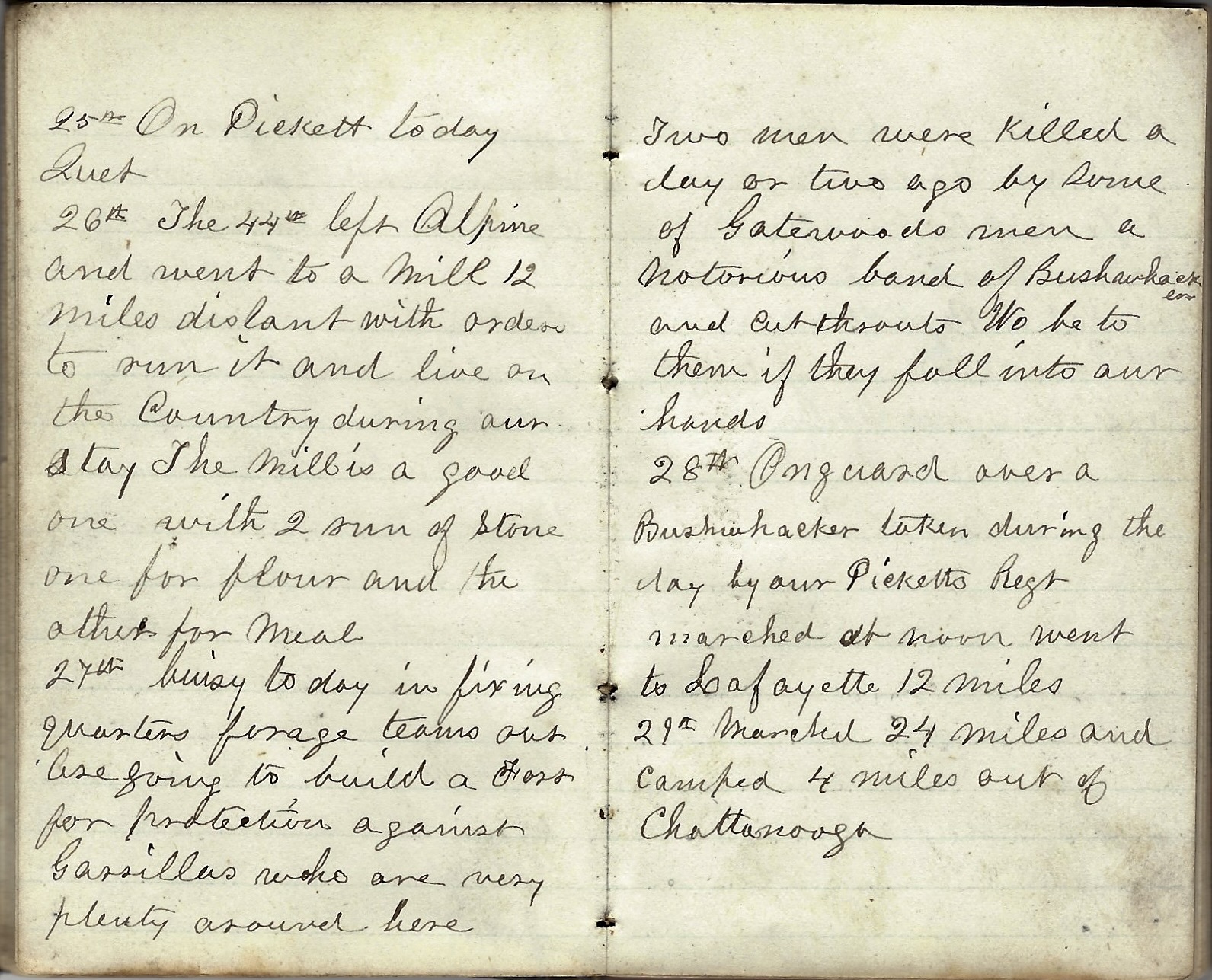
25th—On picket today. Quiet.

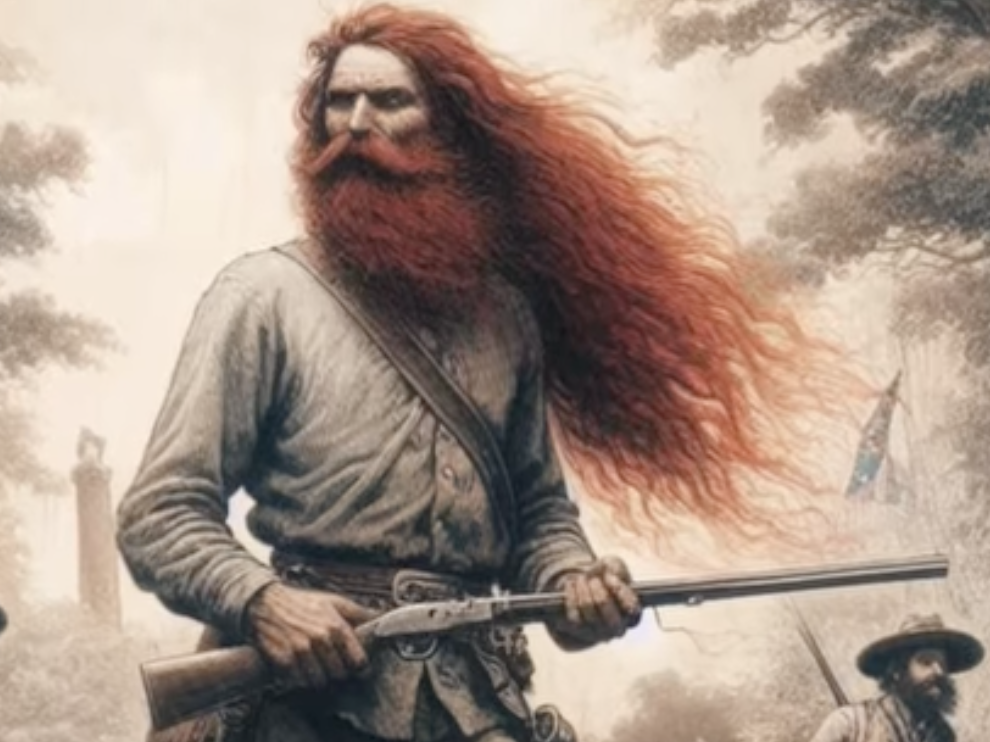
An artist’s rendition of the “Red-headed Beast of Georgia” (John Pemberton Gatewood)

26th—The 44th left Alpine and went to a mill 12 miles distant with orders to run it and live on the country during our stay. The mill is a good one with two run of stone—one for flour and the other for meal.

27th—Busy today inn fixing quarters. Forage teams out. Are going ot built a fort for protection against guerrillas who are very plenty around here. Two men were killed a day or two ago by some of Gatewood’s men—a notorious band of bushwhackers and cutthroats. Woe be to them if they fall into our hands.

[Editor’s Note: John Pemberton Gatewood (b. 1845) was a controversial guerrilla fighter from the Fentress county, Tennessee, raised amidst the conflicting loyalties of Confederate and Union supporters. During the Civil War, paranoia tore communities apart, leading to brutal rivalries. Known as the “Red-headed Beast of Georgia” for his size and wild hair, Gatewood’s ferocity stemmed from his family’s deep Confederate roots in East Tennessee, an area of Union sympathizers. He joined Champ Ferguson’s guerrillas when he learned of his family’s mistreatment by Union soldiers.]

28th—On guard over a bushwhacker taken during the day by our pickets. Regiment marched at noon. Went to Lafayette 12 miles.

29th—Marched 24 miles and camped 4 miles out of Chattanooga.

30th—Marched through town and camped on Lookout Creek at the foot of the mountain. Laid in this camp all day worked on Pay Rolls.

31st—Laid in same camp today. Pay rolls signed by the men.

November 1, 1864—Took the cars this morning at Chattanooga, Tennessee, for Athens, Alabama, where we arrived about two o’clock on the morning of the 2nd.

2nd—Left the cars and marched 3 miles and went into camp for the night.

3rd—Broke camp at 12 M and marched 10 miles. Rained all day. Slept cold all night.

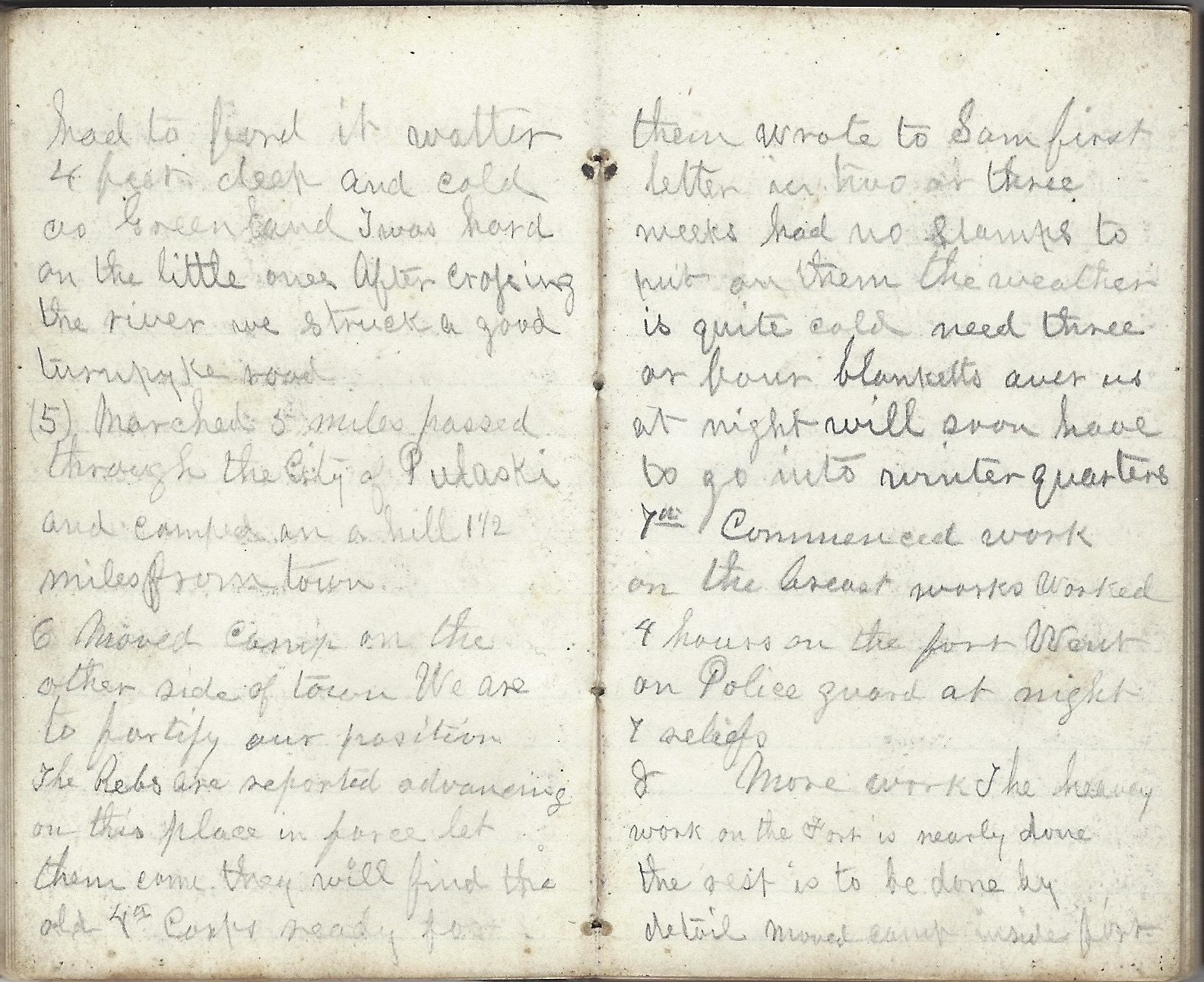
4th—Broke camp at 7 o’clock and marched 17 miles. Crossed the Elk River. Had to ford it. Water four feet deep and cold as Greenland. Twas hard on the little ones. After crossing the river, we struck a good turnpike road.

5th—-Marched 5 miles. Passed through the city of Pulaski and camped in a hill 1.5 miles from town.

6th—Moved camp on the other side of town. We are to fortify our position. The Rebs are reported advancing on this place in force. Let them come. They will find the old 4th Corps ready for them. Wrote to Sam first letter in two or three weeks. Had no stamps to put on them. The weather is quite cold. Need three or four blankets over us at night. Will soon have to go into winter quarters.

7th—Commenced work on the breastworks. Worked four hours on the fort. Went on police guard at night. 7 reliefs.

8th—More work. The heavy work on the fort is nearly done. The rest is to be done by detail. Moved camp inside fort.

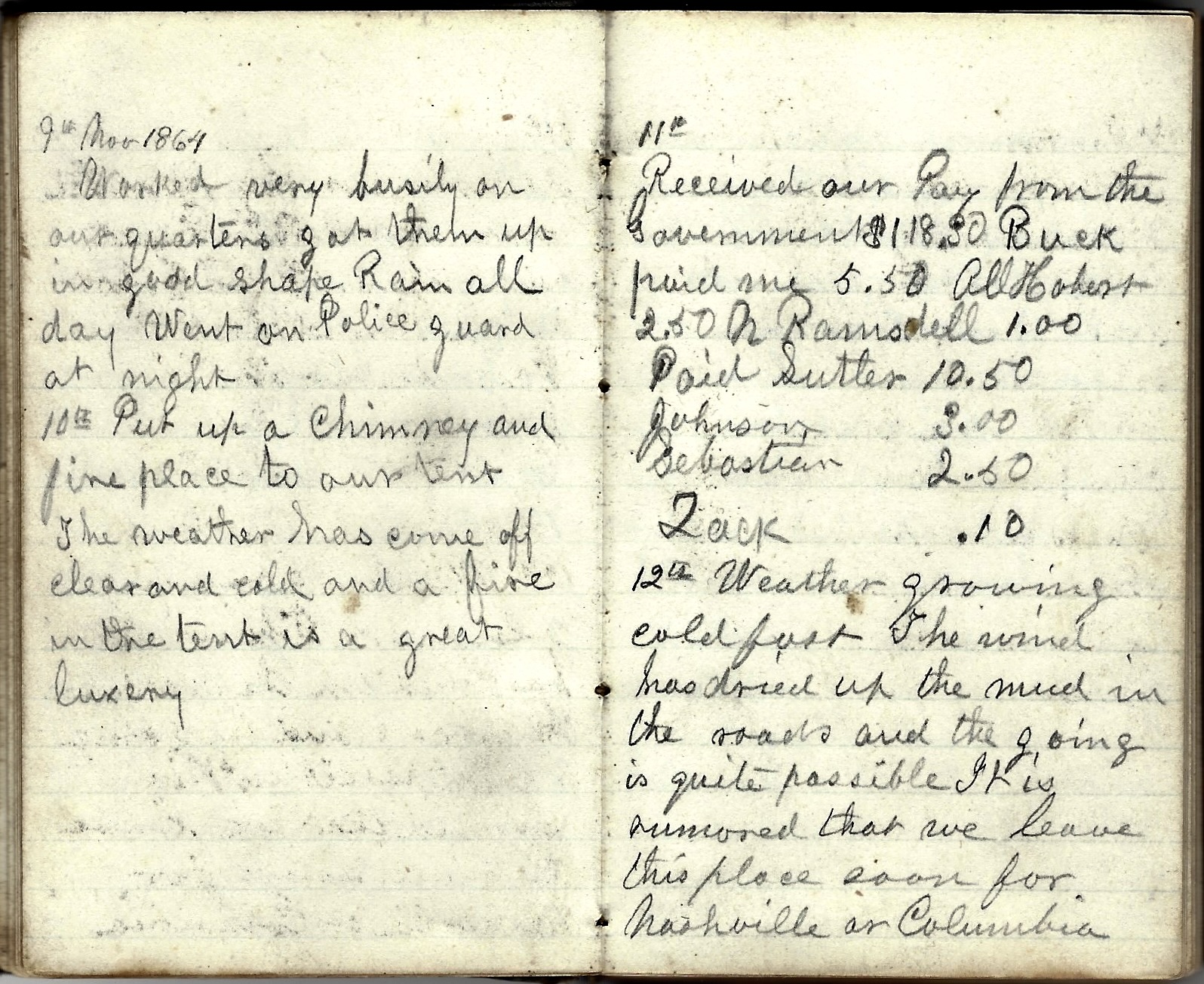
November 9, 1864—Worked very busily on our quarters. Got them up in good shape. Rain all day. Went on police guard at night.

10th—Put up a chimney and fireplace to our tent. The weather has come off clear and cold and a fire in the tent is a great luxury.

11th—Received our pay from the government. $118.30. Buck paid me $5.50. Al Hobart $2.50, N[at] Ramsdell $1.00. Paid sutler $10.50. Paid [Wilson] Johnson $3.00. Paid Sebastion $2.50. Paid Zack 10 cents.

12th—Weather growing cold fast. The wind has dried up the mud in the roads and the going is quite possible. It is rumored that we leave this place for Nashville or Columbia. How much reliance we may put in this grape vine, I cannot say. Time will tell. Are we never to have rest? Ever since the first of May we have been on the wing, not being in one place long enough to was our clothes hardly or at least we dare not commence the operation of washing for fear that we would be obliged to march before they would have time to dry and for us to carry wet clothes in addition to our load is out of the question.

13th—On picket guard today. Very strict orders. Are not allowed to sit down on post. Have to carry our guns at shoulder arms or right shoulder shift. The weather is very cold.

14th—Nothing unusual going on today. Had a mail but I got no letters. The recruits of the 36th Illinois came up today. Got a Spencer gun yesterday. Paid $25 for it.

15th—Rained all night last night. Lowery and black today. Wrote to Mac and Eliza. On police guard last night. Rain quite hard.

16th—Rain all day just for a change. Mud up to knees or less. Dress parade at 4 o’clock. Twenty men from the regiment in the line. The rest on guard.

17th—Rain. Rain. On police guard last night. Weather growing cold.

18th—A very material change in the weather. Rain just for a change. Nothing unusual going on. The usual camp routine.

Sgt. Benjamin Rolph of Co. B, 44th Illinois Infantry (Dan Binder Collection)

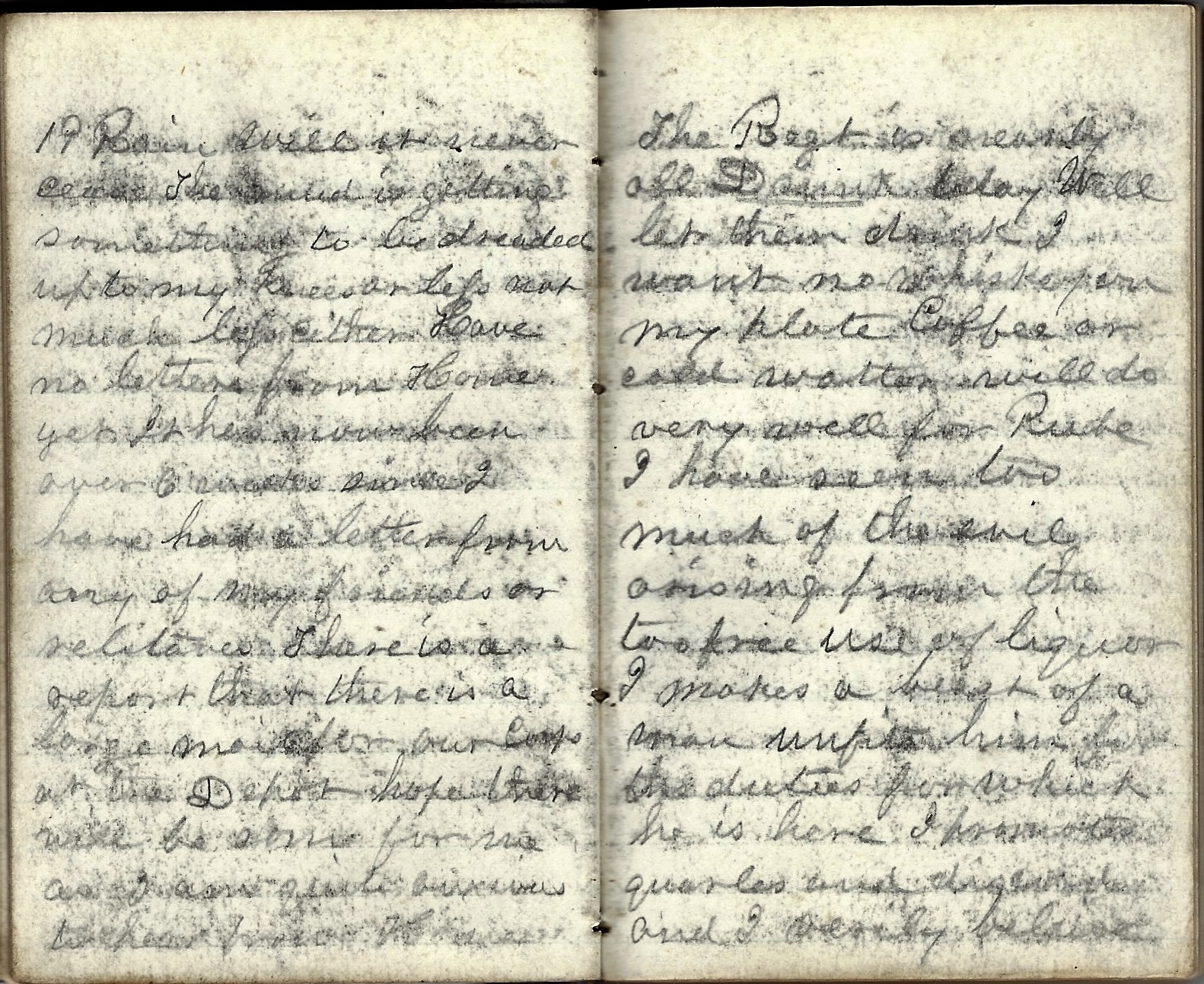
19th—Rain, will it never cease. The mud is getting something to be dreaded. Up to my knees or less. Not much less either. Have no letters from home yet. It has now been over 6 weeks since I have had a letter from any of my friends or relatives. There is a report that there is a large mail for our Corps at the depot. Hope there will be some for me as I am quite anxious to hear from home. The regiment is nearly all drunk today. Well let them drink. I was no whiskey on my plate. Coffee or cold water will do very well for Rube. I have seen too much of the evil arising from the too free use of liquor. It makes a beast of a man [and] unfits him for the duties for which he is here. It promotes quarrels and discord and I verily believe that the death of one quarter of our soldiers are occasioned through the agency of liquor.

20th—No rain today but the sky is overcast with clouds and weather is quite chilly. That large mail arrived at camp safe but there was none for me. Al stil receives from one to three a day, yet he writes but half as many as I do. Stamps are played out and none are to be had in this place. The indications are that we will soon be on the march again. On police guard tonight.

21st—Orders were received to march this morning but for some reason we did not go. Snow today quite hard.

22nd—Marched this morning at 8 o’clock. Our regiment led the division. Went 12 miles and camped at Linnville. Very cold. Freezing all day. On picket. Cold comfort.

23rd—Very cold today. Relieved from picket at dark this eve.

24th—At 12 M, broke camp. At 4 o’clock this morning marched to Columbia, a distance of 23 miles. Formed line of battle and got coffee. Slight skirmishing near town. Two hundred recruits joined the regiment today.

25th—Considerable skirmishing today. Our regiment took no part in it. Built breastworks at night. Our division moved round to the right.

26th—Battle commenced in earnest this morning. Worked last night on breastworks. No general engagement in our front. Rained nearly all day quite hard. Had orders to move this eve but did not march.

27th—Cloudy but no rain this morning. Skirmishing quite brisk. Fell back across the river. Mud knee deep in places. Crossed the river on pontoons.

28th—Moved about thre e miles to the left and formed our lines near and parallel to the river. Here we had orders to out up camp and make ourselves as comfortable as circumstances would permit. A sharp artillery was kept all day at the river. Also considerable skirmishing.

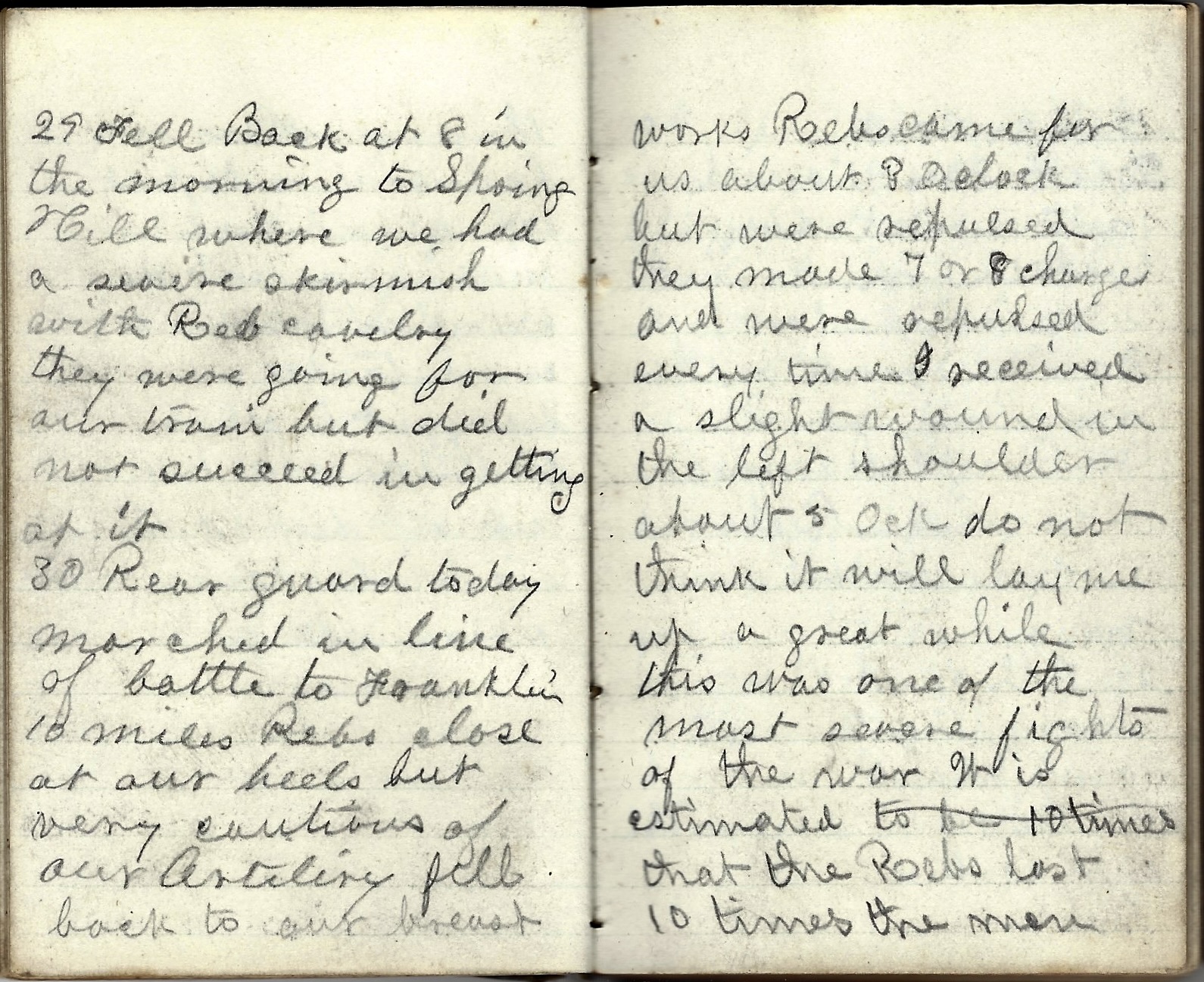
29th—Fell back at 8 in the morning to Spring Hill where we had a severe skirmish with Reb cavalry. They were going for our train but did not succeed in getting at it.

30th—Rear guard today. Marched in line of battle to Franklin 10 miles, Rebs close at our heels but very cautious of our artillery. Fell back to our breastworks. Rebs came for us about 3 o’clock but were repulsed. They made 7 or 8 charges and were repulsed every time. I received a slight would in the left shoulder about 5 o’clock. Do not think it will lay me up a great while. This was one of the most severe fights of the war. It is estimated that the Rebs lost 10 times the men that we did.

December 1, 1864—Wound quite sore today. Walked from Franklin to Nashville last night, 18 miles. Saw Doc this morning. Joined the regiment as soon as it came in. Rebs did not come on us today.
2nd—All quiet this morning. Moved camp about 1 mile to the right. Skirmishing still continues along the lines.

3rd—Appointed hospital steward to rank from the 15th September. All quiet today along the lines. Moved on to the front lines. Strengthened the works. Rebs showed themselves in considerable numbers in our front today. Wound doing finely. Got a letter from Mack with $4 worth of stamps.

4th—Wound getting better. Saw 7th Minnesota, Al Huff and Tom Hanly.

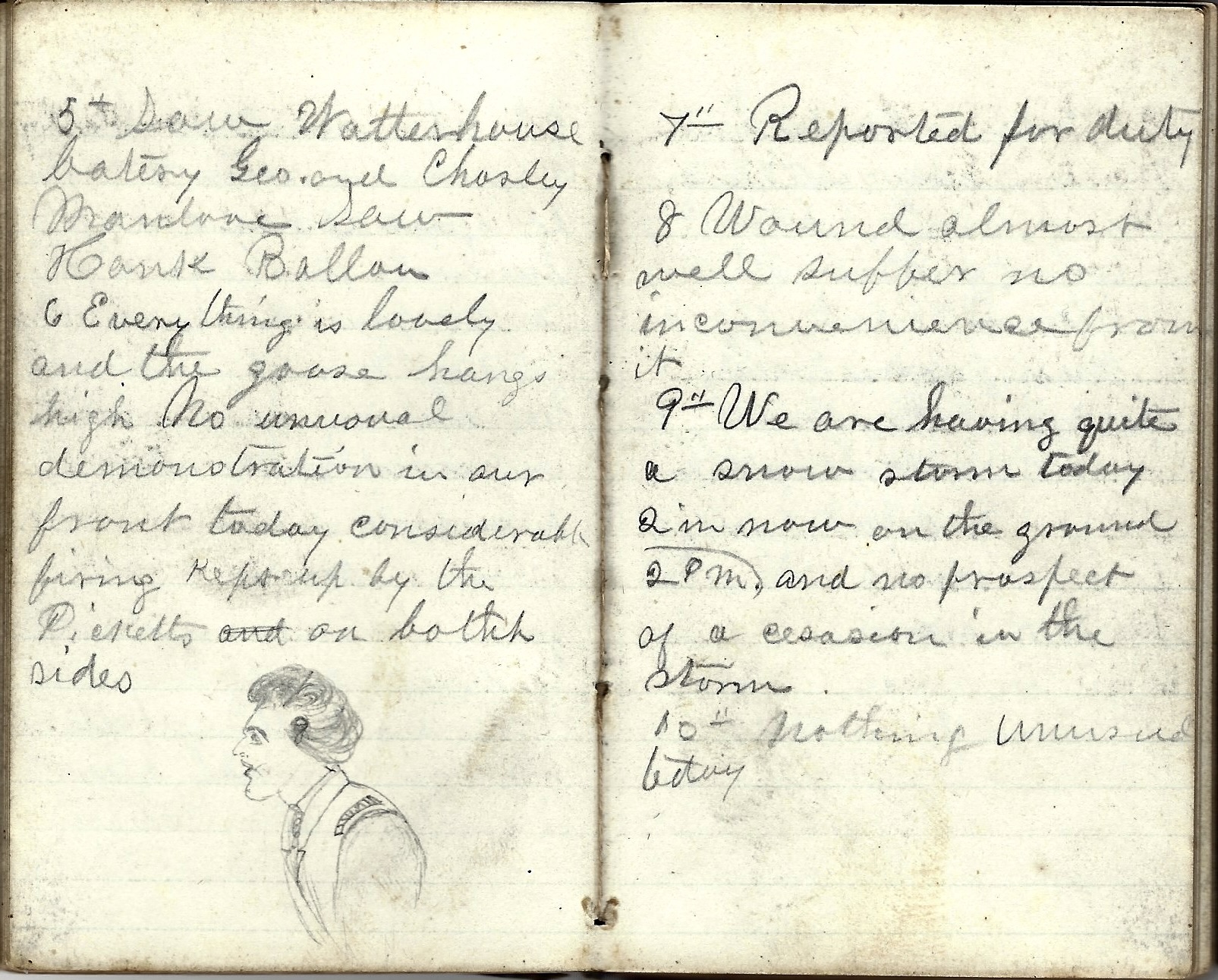
5th—Saw Waterhouse Battery. George and Charley Manlove. Saw Hank Ballou.

6th—Everthing is lovely and the goose hangs high. No unusual demonstration in our front today. Considerable firing kept up by the pickets on both sides

7th—Reported for duty.

8th—Wound almost well. Suffer no inconvenience from it.

9th—We are having quite a snow storm today. Two inches now on the ground. 2 p.m. and no prospect of a cessation in the storm.

10th—Nothing unusual today.

11th—Cold as Greenland today. Snow still on the ground. Sent three men to Division Hospital—Miller, Dutchman, and a man from Co. C. Had a letter from Sam yesterday. Al Haugh was here to dinner.

12th—Little warmer today. Sent 6 men to hospital. Harned from Co. G.

13th—Cold again/ Snow still on the ground.

14th—Went to town today. Nothing unusual on the lines.

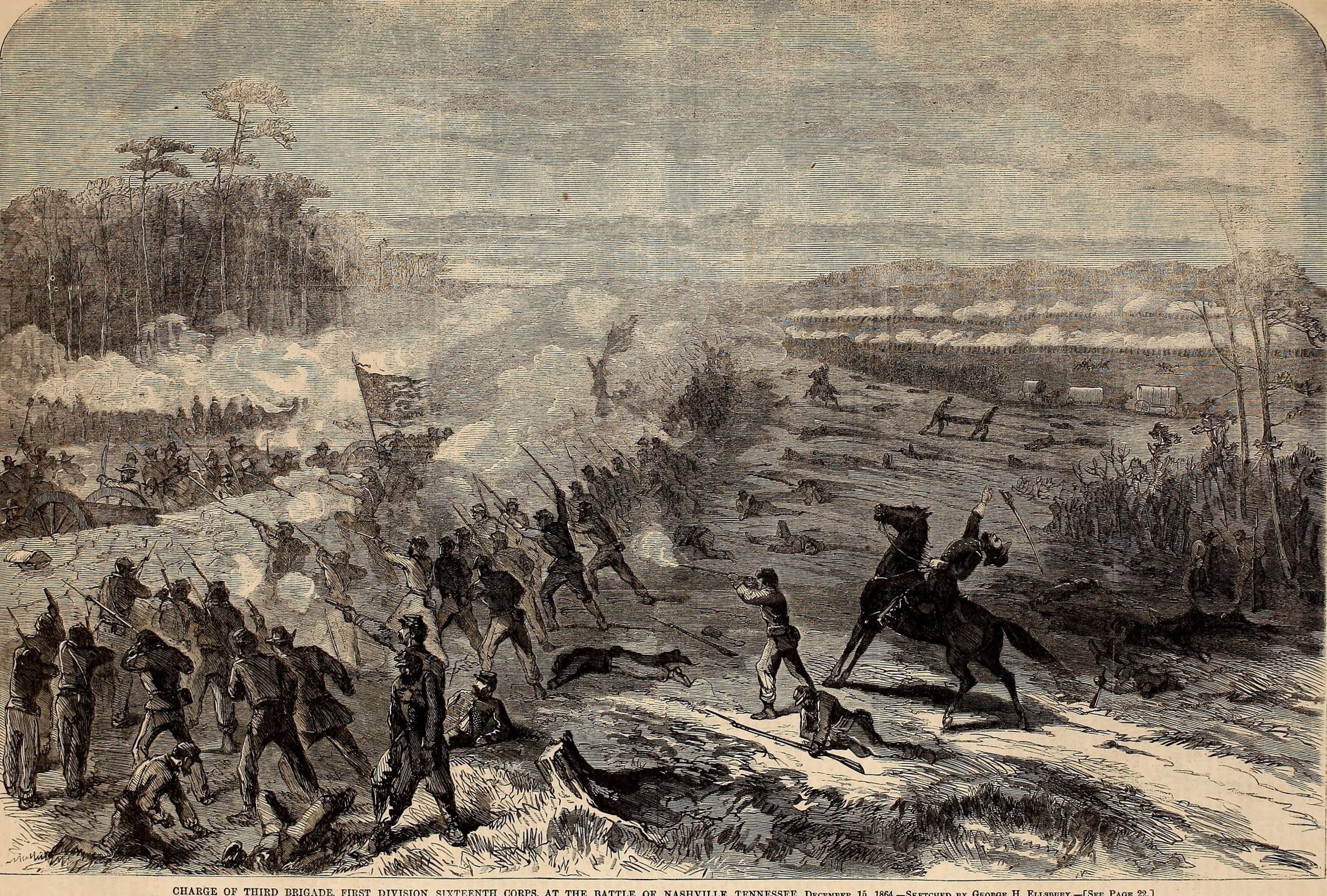
15th—Broke camp at 6 a.m. Brigade formed in front of the works. 44th as skirmish line to cover the Brigade inside the works. I went forward with the Brigade in company with Doc. [Emery A.] Merrifield. The Johnnies were driven out of their works. A large number of prisoners were taken and several pieces of artillery.

Battle of Nashville

16th—Regiment came up this morning. Went on the front line. There is a large number of or regiment wounded. How many it is impossible now to tell. The fight raged with great fury until night came on, shutting out the Rebs from our view. The 44th lost heavily owing to its being on the front line. The number lost was 35.

17th—Rebs in full retreat today. We are after them hot. Cavalry took in a large number of prisoners. Rebs lost in this battle 56 pieces of artillery and some 6 or 8 thousand small arms. Camped for the night near Franklin.

18th—Crossed the Harpeth River and marched 18 miles and camped in a cornfield, mud up to knees.

Boston Evening Transcript, 7 January 1865

19th—Found the Johnnies at Duck Creek. Went into camp for the night.

20th—Marched at 12 M. Crossed Duck Creek and went into camp 3 miles.

21st—Lay in camp all day. Snow and cold as Greenland. Received two letters from Eliza. Also from [ ]. Wrote an answer to both.

22nd—Laid in camp all day and at night marched about 4 miles and crossed Duck River. Passed through Columbia.

23rd—Marched at 2 p.m. Went about 4 miles and went into camp. Cavalry had a brisk skirmish with Forrest’s command.

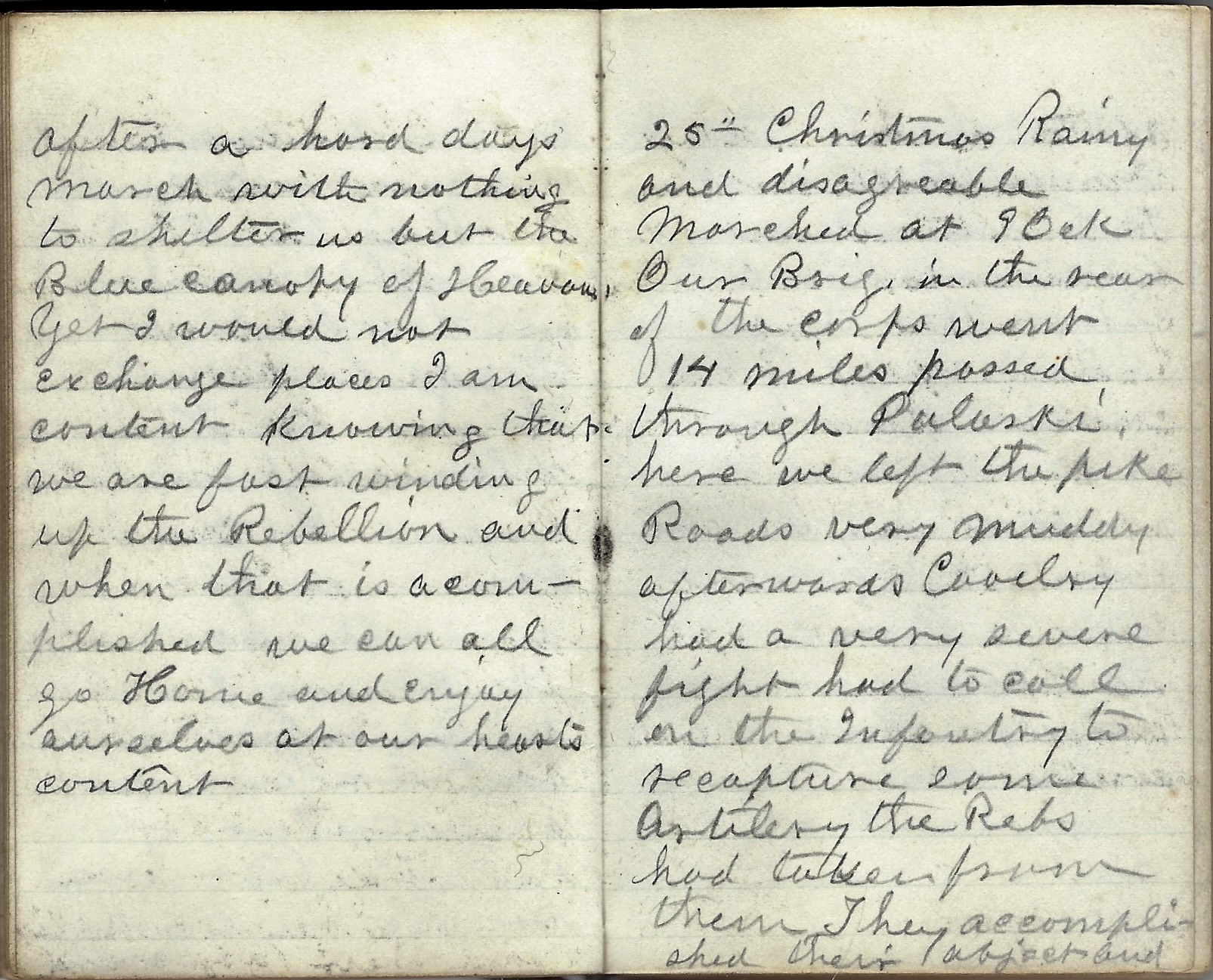
24th—Marched 16 miles and went into camp. Our Brigade led the Corps. Cavalry skirmishing all day briskly. Passed through Linnville today. Christmas eve. How different from last year at this time. I remember that at about this hour of the evening I was enjoying myself hugely with —— in a horse an cutter [sleigh] “two forty on the pike. But here we are in camp after a hard days march with nothing to shelter us but the blue canopy of Heaven. Yet I would not exchange places. I am content knowing that we are fast winding up the Rebellion and when that is accomplished, we can all go home and enjoy ourselves at our hearts content.

25th—Christmas. Rainy and disagreeable. Marched at 9 o’clock. Our Brigade in the rear of the Corps. Went 14 miles. Passed through Pulaski. Here we left the pike. Roads very muddy. Afterwards cavalry had a very severe fight. Had to call on the infantry to recapture some artillery the Rebs had taken from them. They accomplished their object and report has it took a Brigade of Rebel cavalry. There is another report in circulation to the effect that the Johnnies took a regiment of our cavalry. How true these reports are I am unable to say. At all events, it is evident that the Rebs were hard pressed as they left large quantities of ammunition for both artillery and small arms besides some 20 or 30 wagons.

26th—Laid by today to draw rations. Drew three to last five. Some rain last night but none during the day.

27th—Marched at 7 a.m. Went 10 miles. Went into camp in a high hill at 2.30 p.m. The roads are very muddy, 6 to 8 inches deep. Hard on artillery. Almost impossible to get along. Our cavalry is pecking at their rear, pushing them hard.

28th—Our Brigade led the Corps today. Marched 13 miles and went into camp about 3 o’clock. Roads not quite as bad today as they were yesterday. The day was clear and pleasant.

29th—Laid in camp today. Foraging parties gone out. The report is this morning that the Johnnies are all across the river. The Pioneers were all ordered to take the back track to repair the roads. The rumor is that we will all move back in the morning.

30th—Laid in camp today. Nothing unusual going on.

31st—Division marched at 9 o’clock. Took the back track as far as Lexington where we took the road for Athens. Our regiment rear guard for the train. Did not get into camp until 7 o’clock p.m. Drew three days rations to last five.

Oliver Rodgers of Co. G, 44th Illinois Infantry (Civil War in Tennessee Collection)

1865

January 1, 1865—The new year was ushered in bright and clear, not a cloud obscured the Heavens. The weather is quite cold but just right for marching. Broke camp at 8 o’clock and marched a distance of 8 miles. This we did without halting once. Although we made the distance without a halt, I never marched the same distance with as much ease. There is plenty of forage in this vicinity and the boys are improving their time to good advantage. They are coming into camp with hams and bacon with now and then a hog.

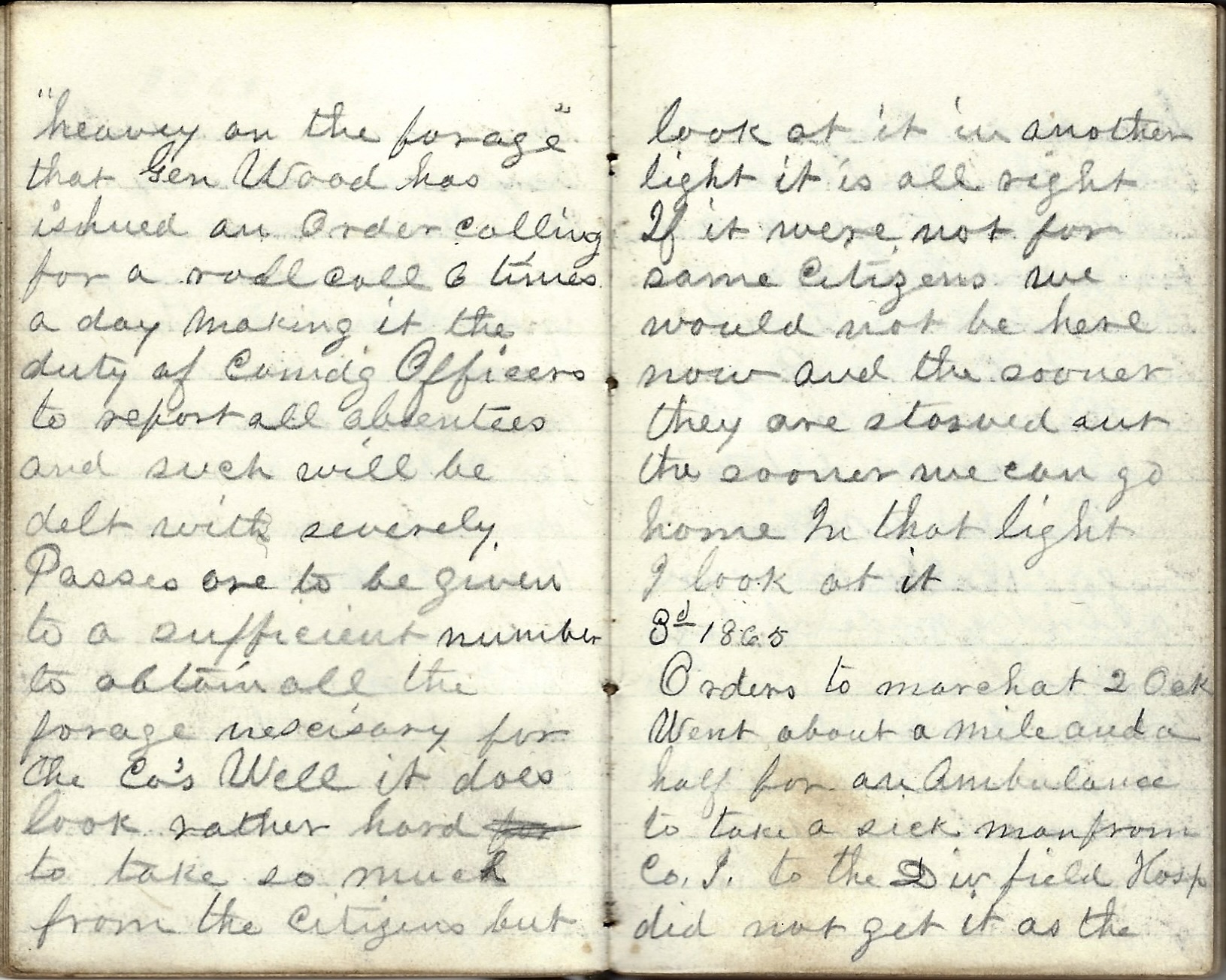
January 2nd 1865—Laid in camp today. 1st and 3rd Divisions are building a bridge across the Elk River. We will have to lay here until it is completed when we will again resume our march. The boys are going in so “heavy on the forage” that Gen. Wood has issued an order calling for a roll call six times a day making it the duty of commanding officers to report all absentees and such will be dealt with severely. Passes are to be given to a sufficient number to obtain all the forage necessary for the companies. Well, it does look rather hard to take so much from the citizens but look at it in another light, it is all right. If it were not for some citizens we would not be here now and the sooner they are starved out the sooner we can go home. In that light, I look at it.

3rd—Orders to march at 2 o’clock. Went about a mile and a half for an ambulance to take a sick man from Co. I to the Division Field Hospital. Did not get it as the Lieutenant in charge of the train thought it would be useless to go up to the Brigade and back again as the ambulances would have to pass the regiment on the march and the patient could be taken in. Marched 6 miles. Crossed the Elk River on a bridge made of logs and rails.

4th—Marched at daylight this morning. Went 22 [miles] and camped at sundown. Passed through Athens.

5th—Marched at daylight. Went 10 miles and got into camp at 11.30 o’clock. Struck a splendid pike in three miles of Huntsville. Made one of the quickest marches today that I ever did. Went four miles in one hour over the muddiest kind of road. Cavalry is nowhere to the Flying Infantry of the 1st Brigade.

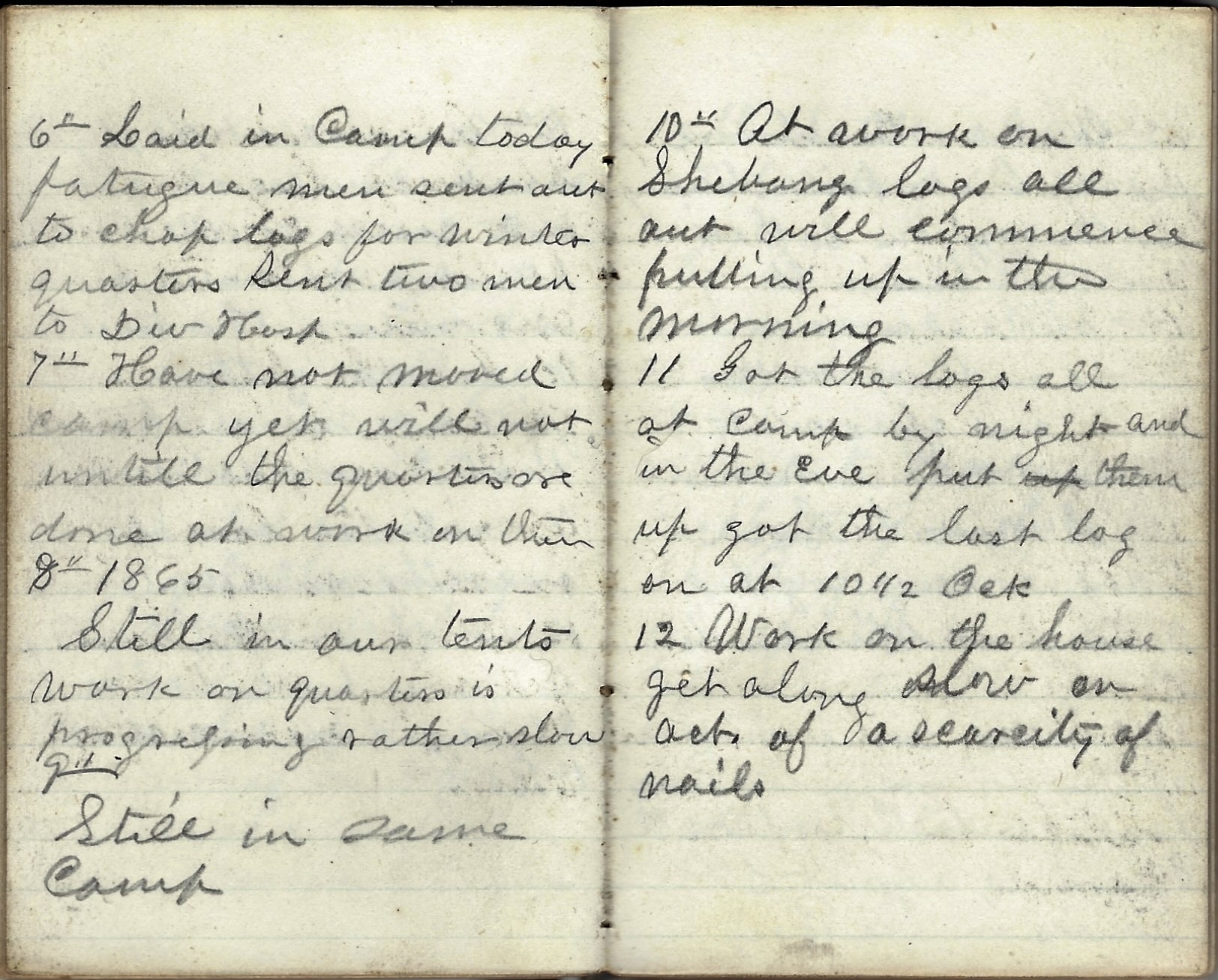
6th—Laid in camp today. Fatigue men sent out to chop logs for winter quarters. Sent two men to Division Hospital.

7th—Have not moved camp yet. Will not until the quarters are done at work on them.

8th—Still in our tents. Work on quarters is progressing rather slow.

9th—Still in same camp.

10th—At work on Shebang. Logs all cut. Will commence pulling up in the morning.

11th—Got the logs all at camp by night and in the eve put them up. Got the last log on at 10.30 o’clock.

12th—Work on the house. Get along slow on account of a scarcity of nails.

13th—Worked on the shebang. Put up bunks, built chimney, got the roof on so that we can live in it.

14th—Still at work on house. Moved in today. Weather mild and clear, Wrote to Eb and Colonel Bunnell.

15th—I wrote to Sam today concerning box. Sent for Spiritus Ter. &c.

16th—Getting somewhat settled down in the Brigade. Looks quite citified. There is about 500 houses in the Brigade, all built alike—or at least of the same size.
17th—Wrote to Dell. No unusual stir in camp today.

18th—Wrote to Pearly Sage, Rochester, Gambro county, Minnesota. The boys was inspected today by the Inspector, Capt. Layton. The weather continues fine. Reminds one of spring in the Northern States.

19th—Wrote to Eb. Also to R. F. Mercer, Nashville, concerning ballad, Battle of Nashville. Enclosed $5 for 100 copies. Also to [sister] Eliza. Col. Russell arrived in camp today. Dress Parade.

Huntsville, Alabama
January 19, 1865

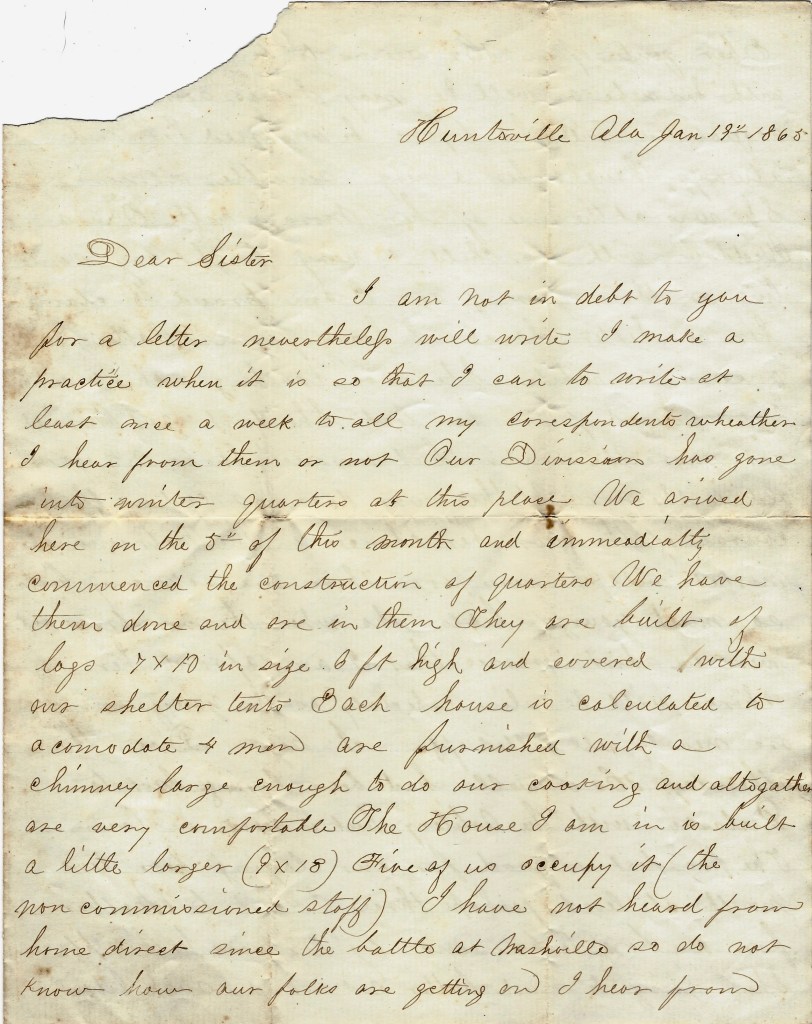
Dear Sister [Eliza],

I am not in debt to you for a letter. Nevertheless will write. I make a practice when it is so that I can to write at least once a week to all my correspondents whether I hear from them or not. Our Division has gone into winter quarters at this place. We arrived here on the 5th of this month and immediately commenced the construction of quarters. We have them done and are in them. They are built of logs 7×10 in size, 6 feet high and covered with our shelter tents. Each house is calculated to accommodate 4 men, are furnished with a chimney large enough to do our cooking, and altogether are very comfortable. The house I am in is built a little larger (9×18). Five of us occupy it 9the non-commissioned staff). I have not heard from home direct since the Battle of Nashville so do not know how our folks are getting on. I hear from Eber quite often. He seems to be [paper torn] with his wife as well he may. I was somewhat acquainted with her before he married her and always thought her a very sensible woman. She was at the time of her marriage with Ebe a widow with one child—a very bright boy some two or three years of age. I am proud to claim her as sister Sarah.


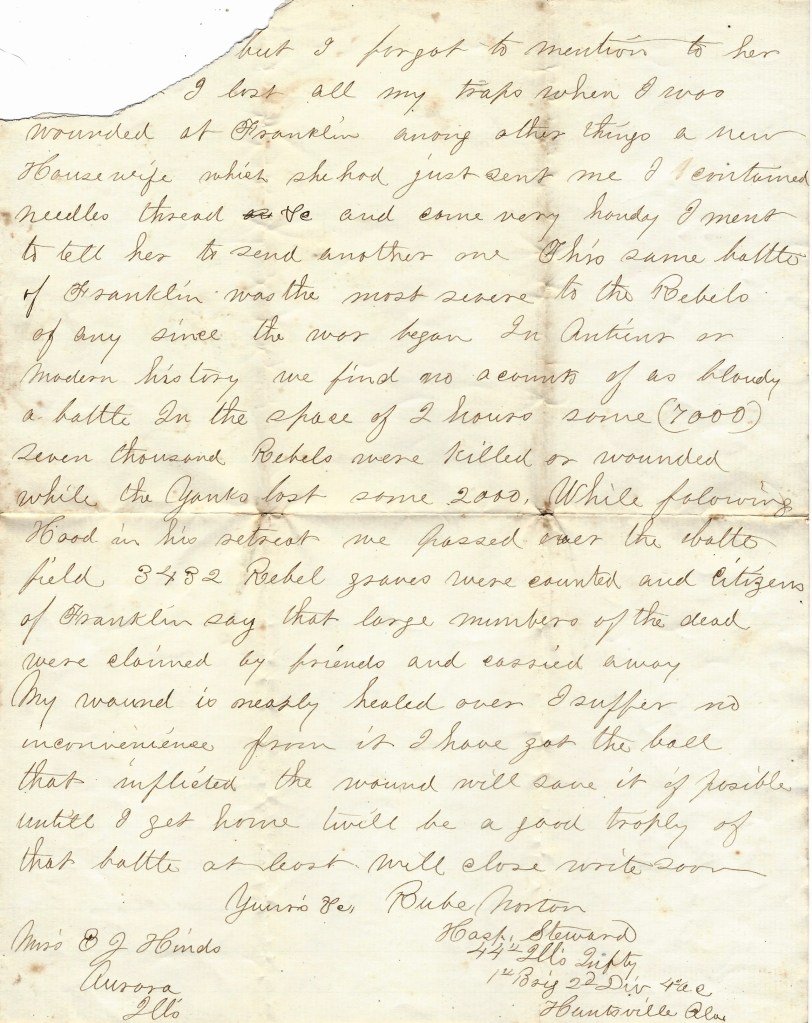
I hear from Hattie once in a while. She was teaching school when I heard from her last. She don’t get married yet. More the wonder. Let me see. She is 25 years old, is she not? If this war does not end in the course of the year, her chances in the matrimonial market will be very poor. There are so many girls—so much younger girls—who when the war broke out were in short dresses that I am afraid her chance will be slim, especially as the young men are nearly all killed off. I saw Doc the other day. he is well. Had been laying back to Pulaski with the artillery but is now in town. The prospect is good for our laying here two months at least, perhaps three. I sent to Mother for a box to be sent by Express to this place. She is going to send butter cake and such like [paper torn] but I forgot to mention her [paper torn].

I lost all my traps when I was wounded at Franklin. Among other things, a new housewife which she had just sent me. It contained needles, thread, &c. and came very handy. I meant to tell her to send me another one. This same Battle of Franklin was the most severe to the Rebels of any since the war began. In ancient or modern history we find no accounts of as bloody a battle. In the space of two hours, some (7,000) seven thousand Rebels were killed or wounded while the Yanks lost some 2,000. While following Hood in his retreat, we passed over the battlefield. 3432 Rebel graves were counted and citizens of Franklin say that large numbers of the dead were claimed by friends and carried away.

My wound is nearly healed over. I suffer no inconvenience from it. I have got the ball that inflicted the wound. Will save it if possible until I get home. T’will be a good trophy of that battle at least. Will close. Write soon. Yours, &c. — Rube Norton

Hospital Steward, 44th Illinois Infantry, 1st Brigade, 2nd Division, 4th Army Corps, Huntsville, Alabama.

To Miss E. J. Hinds, Aurora, Illinois

20th—Rain today and all night.

21st—Rain all day. Will have to pay for the fine weather we have been having lately.

22nd—Wrote to Hattie today. Nothing unusual in the wind.

23rd—Wrote to Monroe Carpenter.

24th—Nothing unusual going on in the regiment today.

25th—Ditto.

26th—Also ditto.

27th—Took our chimney down and rebuilt it. Draws like fun now. Weather still continues clear and cold. Ground froze to the depth of [ ]. Received a letter from Sam and answered it. [Fairy Bell poem]

The way a raw recruit was taken in and done for. The “Chappe” upon whom this trick was performed is a young man of German birth not overstocked with common sense but possessing self esteem enough for three common mortals.

We had been riding on the cars from one point to another for several days scarcely once getting off the train and had stopped at Bridgeport for the night. The Colonel let the boys get off the train and put up their tents. Consequently, they were in good spirits and rife for any fun. It was the first time Charley had ever been in camp and he was very much bewildered at the numerous camp fires and asked us a great many foolish questions in regard to them. To learn him a thing or two the “Scout” was gotten up.

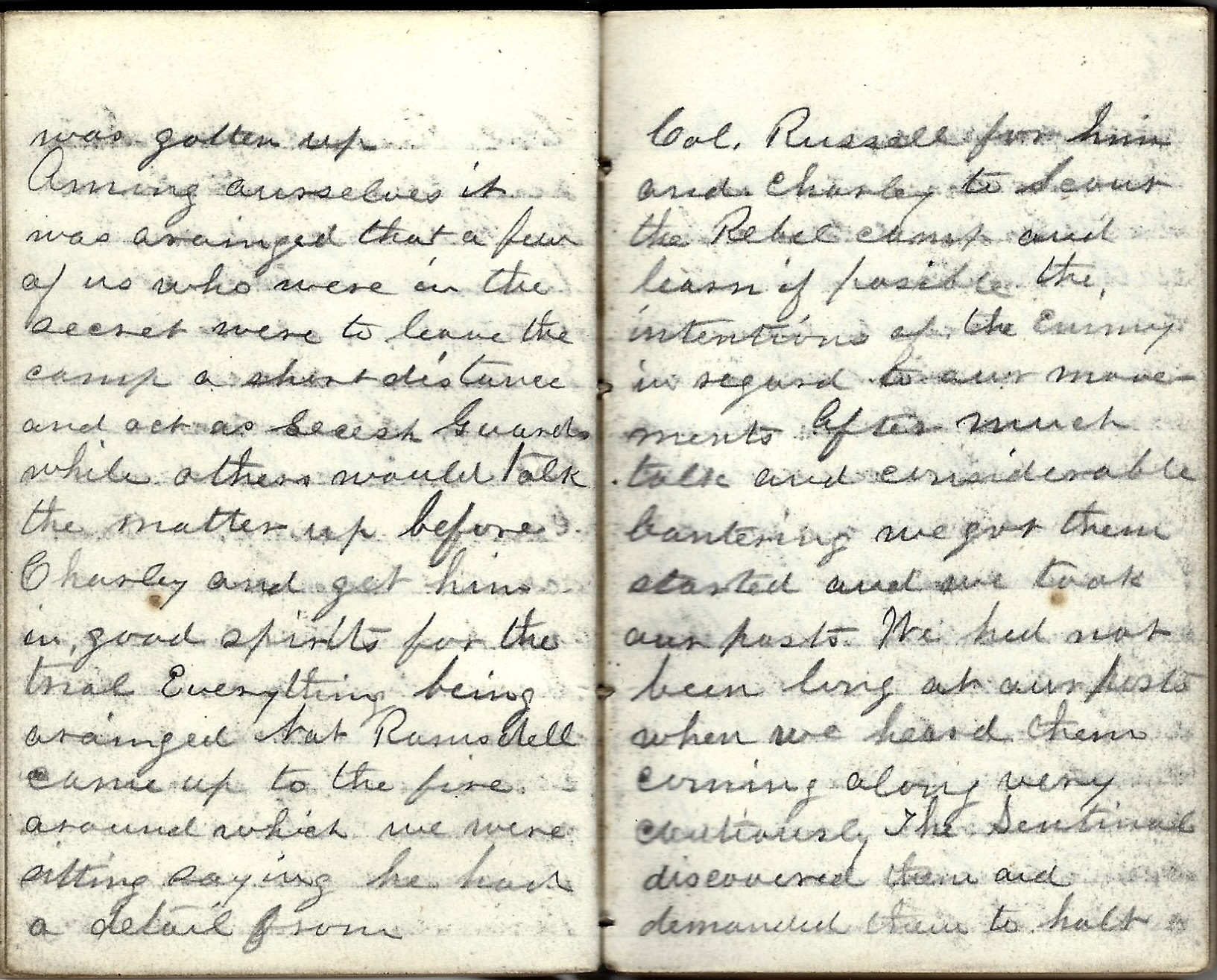
Among ourselves it was arranged that a few of us who were in the secret were to leave the camp a short distance and act as Secesh guards while others would talk the matter up before Charley and get him in good spirits for the trial. Everything being arranged, Nat Ramsdell came up to the fire around which we were sitting saying he had a detail from Col. Russell for him and Charley to scout the Rebel camp and learn if possible the intentions of the enemy in regard to our movements. After much talk and considerable bantering, we got them started and we took our posts. We had not been long at our posts when we heard them coming along very cautiously. The sentinel discovered them and demanded them to halt and make known their business. Nat answered that they were friends with the countersign. He advanced until near enough for his purpose when he dealt the unsuspecting sentinel a blow over the head with the butt of is gun which laid him out.

He then beckoned the now terrified Charley to come up assuring him the guard was past doing them harm, that they were now inside the Rebel lines and must proceed with the utmost caution. Charley came up trembling giving the body of the supposed Reb a wide berth and the two passed on. They had proceeded but a short distance when they run directly on a Battery (an old barrel filled with oyster cans). A few commands given in a loud voice caused them to come to a sudden halt. Nat turned and caught Charley by the arm and told him in a tone that sent a chill of horror through the boy’s frame that they had run on a masked battery and their on;y salvation was in flight. They started off on the run, taking the direction of our own camp (Charley in his fright supposed the fires in his front were those of the Rebel camp). Our whole party started in pursuit yelling out to stop the Yankee spies. This scared Charley nearly out of his wits causing him to make greater speed. It was all Nat could do to keep within sight of him but by making almost superhuman exertions, he succeeded. Of course they distanced us and finally eluded us altogether in the darkness.

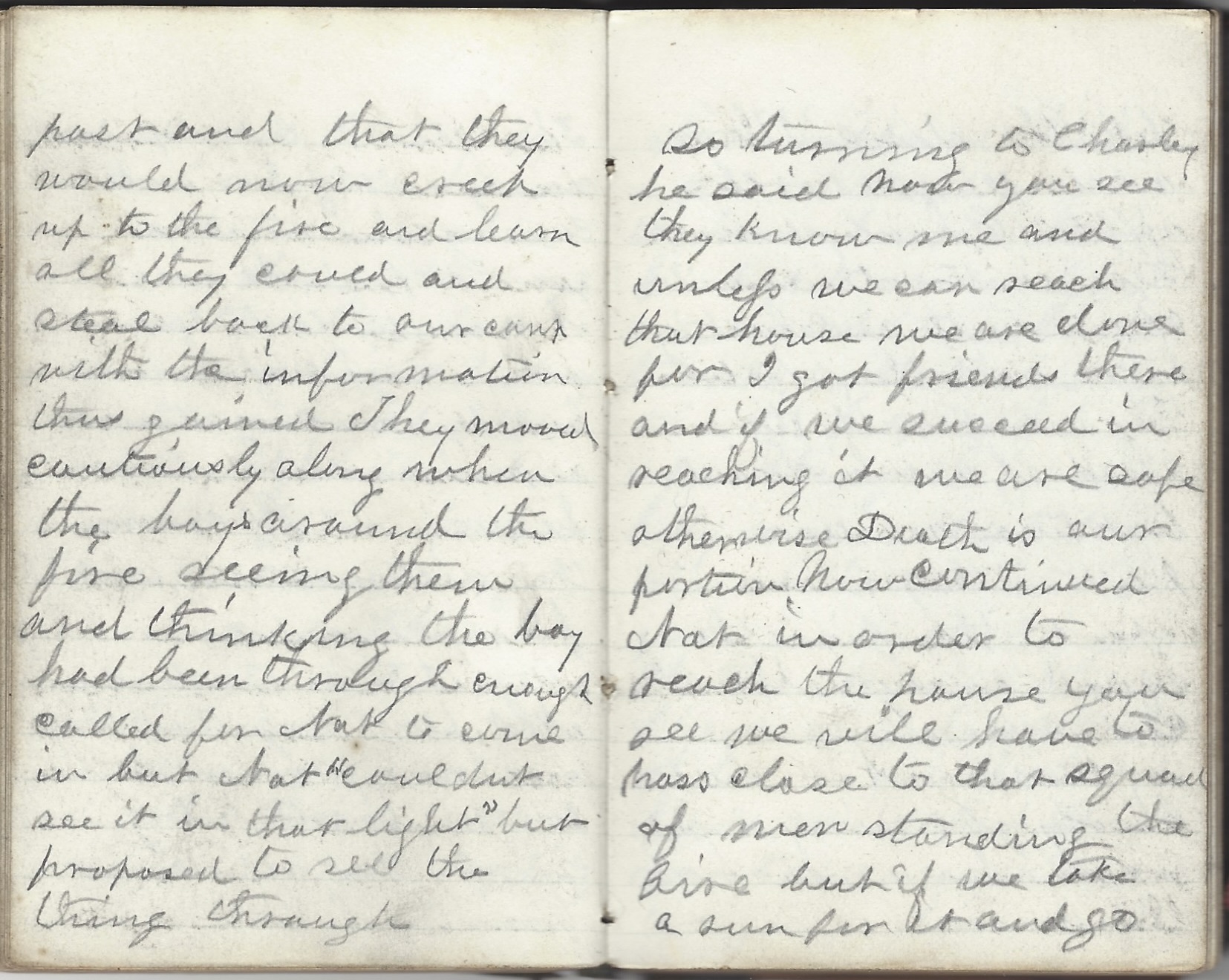
Nat, perceiving that they were not pursued, halted to take breath telling Charley that all danger from the guards was past and that they would now creep up to the fire and learn all they could and steal back to our camp with the information thus gained. They moved cautiously along when the boys around the fire, seeing them and thinking the boy had been through enough, called for Nat to come in. But Nat “couldn’t see it in that light” but proposed to see the thing through. So turning to Charley he said, “Now you see they know me and unless we can reach that house, we are done for. I got friends there and if we succeed in reaching it, we are safe. Otherwise, death is our portion. Now,” continued Nat,” in order to reach the house you see, we will have to pass close to that squad of men standing the fire, but if we take a run for it and go like the devil, I think we will make the siffle [?].”

Charley received these instructions with open mouth and beating heart and they started. They went with the speed of a whirlwind but twas no use. Just as they were opposite the fire, the squad charged them and succeeded in capturing Nat but Charley got away and would have reached the house had not Nat implored him in piteous tones not to leave him in that fix but to render him some assistance. Charley turned with the intention of helping him when the squad in a body made a dash for him at the same time, giving an unearthly yell. This was too much for Charley and he started off like a rocket. He made such speed that no attempt was made to capture him. In fact, t’would have been useless to have attempted his capture as a locomotive under full speed would have been a “slow coach” in regard to speed compared with his time made on that occasion.

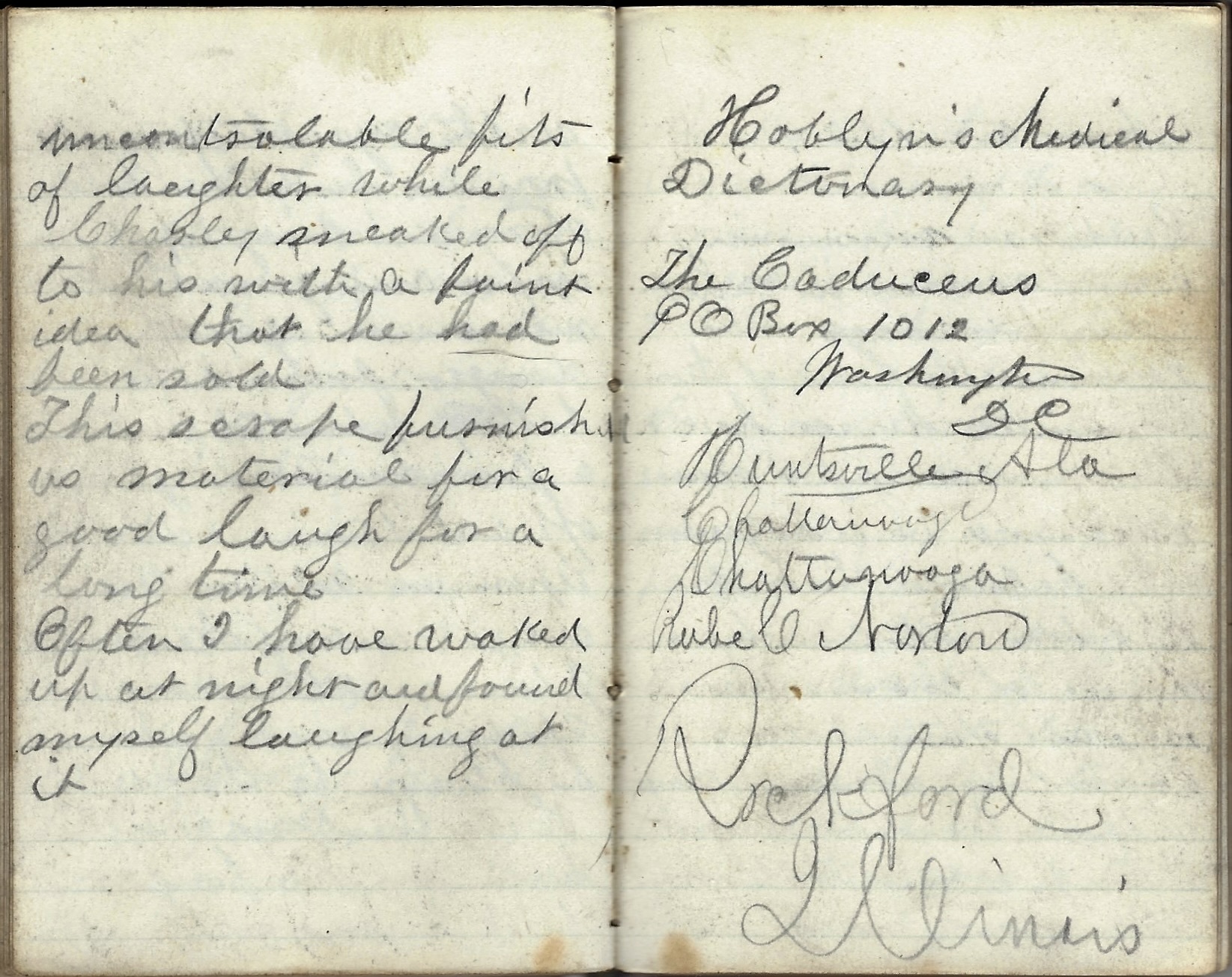
After wandering around among the numerous camps, he finally found his company. At sight of him the boys gathered around him to hear his adventures. With eyes starting from his head he told his story, winding up by informing us that we were in great danger from a Rebel battery planted only a few hundred yards off and trained directly upon us and unless we got out of that place and that right speedily, we would be blown to the devil. Here the boys could hold in no longer but burst into uncontrollable fits of laughter while Charley sneaked off to his with a faint idea that he had been sold. This scrape furnished us material for a good laugh for a long time. Often I have waked up at night and found myself laughing at it.

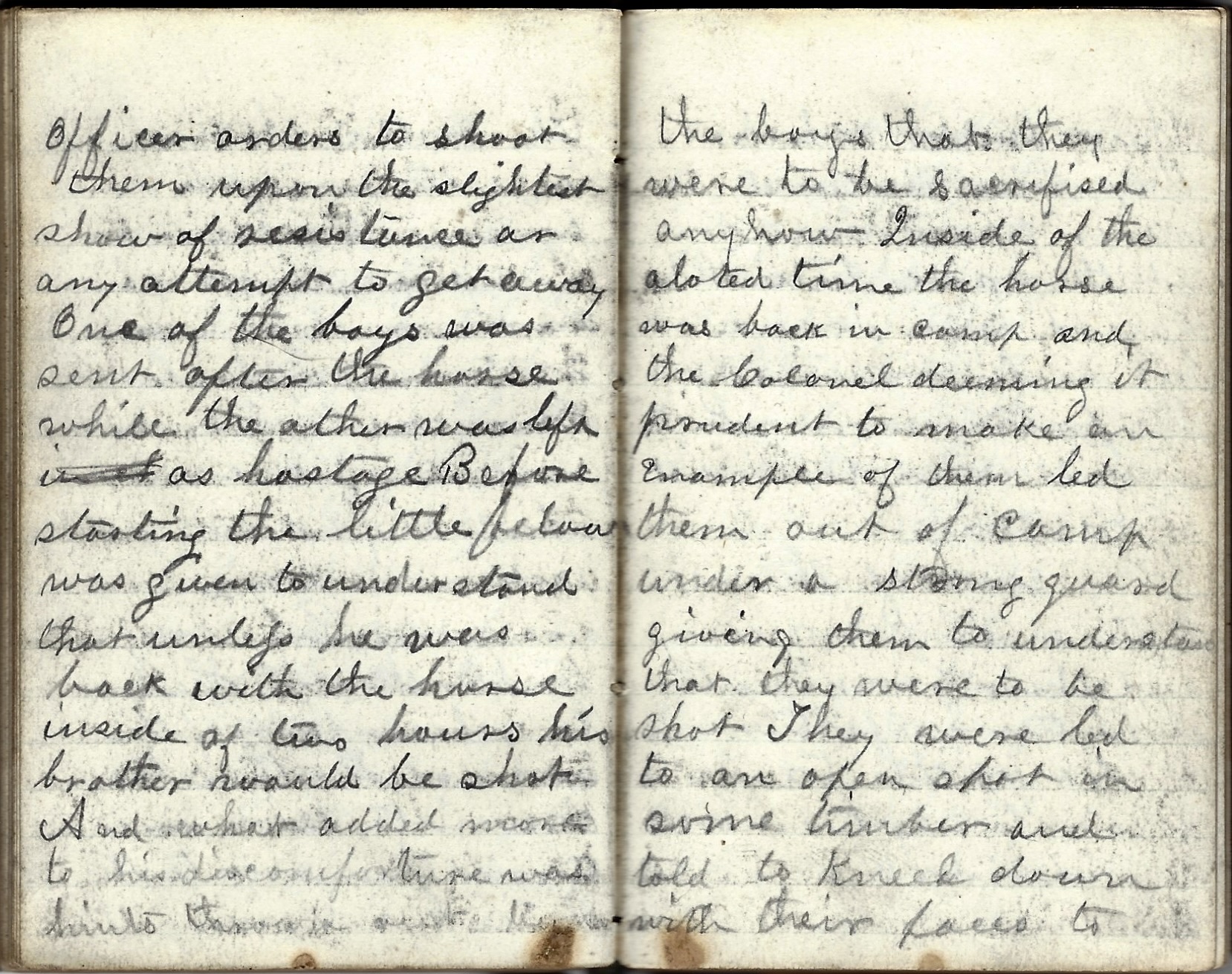
March 5, 1864—Quite an amusing scene occurred in camp a day or so ago. It seems that one of the regimental horses had been missing for several days and it was generally believed that it had been stolen by some of the Darkies who are often seen prowling around camp with the evident design of confiscating whatever they could lay hands upon.

Reuben’s unflattering sketch of a Negro

The Colonel [Wallace W. Barrett] had occasion to go to the rear of the camp for some purpose where he espied a couple of little Darkies in the act of hiding in a clump of bushes. He called to them in no gentle terms to come out which they did, seeing that further concealment was useless. By using terrible threats he learned the whereabouts of the animal. He then took them into camp and turned them over to the police guard giving the officer orders to shoot them upon the slightest show of resistance or any attempt to get away. One of the boys was sent after the horse while the other was left as hostage. Before starting, the little fellow was given to understand that unless he was back with the horse inside of two hours, his brother would be shot. And what added more to his discomfiture was him to thrown in [illegible] the boys that they were to be sacrificed anyhow.

Inside the allotted time, the horse was back in camp and the Colonel deeming it prudent to make an example of them led them out of camp under a strong guard giving them to understand that they were to be shot in some timber and told to kneel down with their faces to their homes which they were destined never to see more. At the same time the guard was drawn up in line awaiting the fatal word which would send them out of existence.

The cries of the little ones for mercy and their promises to do better in future if let off this time were truly ludicrous considering that it was not for a moment intended to carry the threat into execution. The Colonel. appearing to be softened by their entreaties told them he would give them a chance for their lives on the consideration that they would never be found within a mile of our camp again. They were to be given a start of 20 rods [110 yards] before a shot should be fired and then they were to trust their heels for the rest. This was enough for them. They waited to hear no more but jumped to their feet and started on the run. Lord how they did run. A shot fired over their heads tended to accelerate their speed and the last seen of them was their little woolly heads poking up and down as they made their tracks through the tall grass for the timber. I will venture to say they were never caught within the proscribed limits.

March 28, [1865]—Left camp at Huntsville this morning at 10 o’clock. Took the cars for Chattanooga where we arrived the next morning at 4.30 o’clock.

29th—Left Chattanooga this morning for Knoxville by the same train. We got some three miles beyond Cleveland when the train ahead of us ran off the track, killing one man and wounding several. The cars were badly smashed up and will detain us a long time. The train was mostly loaded with baggage and horses. Only a few men were on it. If the accident had happened to our train, the loss of life and limb would have been fearful. About dar, the wreck was removed and the track repaired. We again started on our way, There were four smashups on this road today. All severe.

30th—When we woke up this morning we were within 25 miles of Knoxville. Arrived at the latter place at 11 o’clock. Laid around waiting for orders until 1 o’clock when we moved out on the K & L Railroad and laid by for the night.

31st—At 4 p.m. left for Bull Gap. Run out 29 miles and laid over for the night.

April 1 [1865]—Arrived at Bulls Gap about noon today. Left the train and went into camp on a ridge within sight of the railroad.

2nd & 3rd—Laid in camp.

4th—Marched 9 miles and went into camp at Midway on the railroad. Saw Dock.

5th—Put up a shebang and moved into it. Regiment went on picket guard. Remaining last report sick=2, wounded=3. Total 5.

April 15th—5 sick, 1 wounded.

April 19th—Left this camp this morning for Bulls Gap at 5 o’clock a.m. Boys in good spirits. Never did like this camp and it is rumored that we go to Nashville, there to lay in camp. We reached the Gap about 9 o’clock. Passed through and went into camp about 1 mile out. Whole distance traveled today 12 miles.

June 15, 1865—Left Nashville via Northwestern Railroad for Johnsonville on the Tennessee River. Got aboard the train at 2 o’clock p.m. Now crowded in our car. Arrived at JOhnsonville at 8 o’clock p.m. Stayed on the cars till morning.

16th—Got aboard the steamer National at 10 o’clock a.m. Drunken row on the boat about noon, very near being a serious things but was finally quieted down without anyone being seriously hurt although at one time it had a serious aspect. Laid on the boat all night. Boat tied to the shore.

17th—Boat moved out at 6 o’clock this morning. The weather is clear and beautiful. We passed down as far as Cairo without accident farther than getting aground once or twice. On our way down we stopped at Paducah to give the men a chance to cook coffee.

18th—This morning found us still at Cairo. The boat has yet to coal up. Strong guards are out on shore to prevent the boys from getting into town while on the river two monitors are laying to keep them from getting out that way. Notwithstanding all this precaution, large numbers are off. It’s impossible to keep men on board. Left Cairo at 2 o’clock p.m. Stopped at Island No. 10 for supper. Laid up for the night a few miles below New Madrid. About 700 men deserted the Division since we left Nashville.

[June] 19th—On the move early this morning. Fine weather. Passed Fort Pillow at 8 o’clock a.m. Arrived in sight of Memphis at 2 o’clock p.m. where we were put off on an island while the boat went to coal up. No signs of mutiny now. While laying here the bodies of some 7 or 8 of the victims of the [April 27th] Sultana disaster were picked up and buried by our boys. They were very much decomposed. We were unable to find the P. O. address of but one. His was printed on his arm with India ink.

An artist’s rendering of the Sultana steamboat in flames, 27 April 1865.

20th—Boat came for us at 2 this morning and started down the river at daylight. The day is bright and clear—not a cloud to be seen. A gentle breeze blowing on the river which makes it quite pleasant riding. Cools the air off finely. Passed Helena about 9 o’clock a.m.. Not much of a town. Stopped at White River Landing for supper about 5 p.m. Passed Napoleon at dusk. This place was nearly all burned by our forces in retaliation for firing into our transports near the place. Laid up about four hours at an island.

21st—Weather fair as usual. Arrived at Vicksburg at 4 p.m. Laid opposite the town while the boat went to coal up. Wrote to Col. Bunnell. Sent a ring in the letter for Frank.

22nd—The boat run all night. At 7 this morning we passed Natchez, Mississippi. Little of the place is to be seen from the river. The most of the place is on a high bluff back from the river. Passed Baton Rouge about 4.30 p.m.—a very pretty place of about 6,000 inhabitants, 110 miles from New Orleans.

23rd—Arrived at New Orleans about daylight this morning after a 7 day trip. Distance traveled about 1400 miles.

July 16, 1865—Broke up our camp at New Orleans and shipped aboard the steamship Champion for Matagorda Bay. The vessel is a first class one and where we are is not overcrowded.

17th—This morning at 3 o’clock the boat started down the river. Arrived at the mouth at 1 o’clock p.m. As soon as we struck salt water, the boys were sea sick, myself among the rest though not as bad as some. It lasted on me only four hours while some were troubled three or four days.

18th—Out at sea. Saw shark, dolphin, and other saltwater fish. Nothing unusual.

19th—Out at sea. Nothing today.

20th—Arrived off the bay at dusk this eve. Dropped anchor 7 miles from shore.

21st—Still at anchor in sight of shore. No sign of getting to shore. Our boat can’t go over the bar. Draws too much water.

22nd—A propellor came this morning early and took the troops off the boat. Took us to Powderhorn on Matagorda Bay where we again shipped on schooners and went 14 miles farther and landed at a small fort at the head of the bay. From here we marched 6 miles into the country and camped for the night.

23rd—Marched this morn at daylight. Went 12 miles and went into camp. Tis supposed we will stop here about three weeks.

Out of Service

Sunday, September 24th, 1865—Our regiment was mustered out of service of the United States and Tuesday, 26th left our camp on the El Pulsador for Lavaca on the coast. Here we laid waiting for transportation until today, Sunday, October 1st. As yet there is no signs of getting off. The regiment have been quartered in houses during our stay in town.

For the last two or three days, I have been troubled with what the citizen doctors call Bonebreak Fever. Bonebreak it surely is for every bone in a person’s body is in pain. I have become very weak from the effects of the disease. Am now on the gain. Should be all right I think if I were away from this unhealthy shore.

[Editor’s Note: Bone break fever is another name for dengue fever, a viral infection transmitted by mosquitoes that causes symptoms like high fever, severe headaches, pain behind the eyes, and excruciating muscle and joint pain. While dengue does not actually cause bones to break, the intense aches and pains lead to its nickname. Most people with dengue recover in 1–2 weeks, but some develop severe dengue, which can be fatal.]

On the evening of the 1st, we got off from Lavaca via steamer Mustang. This boat took us to Indianola where we got aboard the ocean steamer Matagorda. The boat got under weigh at 11 o’clock a.m. and arrived at Galveston the next day at 8 o’clock a.m. She makes but poor time as her boilers are in poor condition. She runs under a ten pound pressure of steam making about 5 miles an hour. Arrived at New Orleans on the morning of the 6th at 2 a.m. Here we laid until the next day till 5 p.m. when we got aboard the U. S. Mail Steamer Elenora Carrol. Arrived at Vicksburg after a ride of 53 hours. Here we took on coal and again started on our way at 12 o’clock night. Today, Tuesday, we are about 50 miles above Vicksburg.

12th October [1865]—Thursday 12 M arrived at Memphis. Here we have a large freight to put off. Also to coal up. It is nearly three months ago that we were at this place on our way to Texas. How different our feelings. We have been just 95 hours coming from New Orleans 840 miles. We have yet 200 to go before we get off the boat.

Saturday the 14th October—At 12 M we arrived at Cairo after a trip of just one week. Distance 1040 miles. Left Cairo via Illinois Central Railroad at 4 o’clock p.m. same day for Springfield where we arrived at 4 p.m. next day. Went into Camp Butler. Here we laid until the 20th when we marched to town and got our pay and [ ]. Left for Chicago same night.


When this cruel war is over
no Irish need apply
For everything is lovely
and the goose hangs high
That young girl from New Jersey
Oh wilt thou be my bride
And off in the stilly night
We’ll all take a ride.

Let me kiss him for his mother
He’s a gay young gambolier
I’m going to fight wit Sigel
and de bully lager beer
Hunky boy is Yankee Doodle
When the cannons loudly roar
We are coming Father Abraham
Three hundred dollars more.

In the days when I was hard up
And my Mary Ann my Johnny
Was a shoemaker or any other man
The captain with his whiskers
and Annie of the vale
Along with Bob Ridley
A riding on the rail
On rock we used to sleep
Mother I’m going around the barn
I’m not myself at all, Mother
I’m a batchelor forlorn.

Mother is the battle over
What are the men about
How are you Horace Greely
does your Mother know you are out.
We won’t go home till morning
with the bold privateer
Annie Lisle and Zouave Johnny
riding in a railroad keer.

We are coming sister Mary
with the folks that put on airs
We are marching along
with the four and thirty stars.
You are way far away
So goodbye at the door
And did you see my sister
with the ring my mother wore.

Our Union starry banner
the flag of Washington
shall float victorious over
the land from Maine to Oregon.


Words to the tune of “Glory Hallelujah” about Jeff Davis


Items purchased from the sutler while keeping this journal.


Record of correspondence kept by Reuben C. Norton.


A ten dollar Confederate bill tucked into back pocket of Reuben’s journal.


A twenty dollar Confederate bill tucked into back pocket of Reuben’s journal.


Reuben’s Honorable Discharge Papers

Rockford Daily Register, March 8, 1920

1864: William Burgess Wall to Bethunia (Perkins) Wall

These letters were written by William Burgess Wall (1829-1909), a native of Virginia, who graduated from the Jefferson Medical College in 1853, and later served as a Surgeon with the 33rd Mississippi Infantry. William wrote the letters to his first wife, Bethunia Perkins (1840-1871) whom he married in 1856.

The second letter was written not long after the fall of Atlanta whereupon Hood took his army northwest and attempted to disrupt Sherman’s supply lines only to discover that Sherman had no intention of maintaining his supply line but rather to march across Georgia and live off the land. Hood then decided to march into Tennessee to attack elements of Thomas’s divided forces. The third letter was written on the march in Georgia. The fourth letter was written after Hood’s failed attempt to take Franklin, TN, and just before the Battle of Nashville. Following that defeat, Hood’s army was effectively destroyed.

Letter 1

Canton, Mississippi
January 10, 1864

Dear Wife,

It will be two weeks in the morning since you left though it seems to me to have been much longer. I reckon it is the same case with yourself. It is now Sunday night. We have had a quiet Sabbath. Andy came down last night. Brought the box safely. Henry Johnson & myself met him at the depot & we have today enjoyed some of its contents. Mitch Linden’s boy also brought him a box from home so we are faring finely at this time.

I was sadly disappointed when I asked Andy for my letter & he said Amus had it & that he was left. You can’t imagine how much I was misput. I want Amus to come along. When I opened the box & found that little slip of paper pinned on the flour sack with two short lines & your name, it did me some good. I have not taken everything out of the box yet. I am waiting for your letter supposing you have enumerated the articles sent though I have gone for enough in it to find cakes, wine, sausages (also some for Clay Baker), hams, flour, butter, candles, & sugar. The articles so far as tried are very fine for which accept my thanks. When I get your letter, I shall enjoy your present ten times more.

Mrs. Durden sent Mitch one pound cake, some custards, two small loafs [of] light bread, six dozen eggs (every one of them froze), one pound butter, six & half pounds sausages, one loaf or cake of sauce (she weighed the articles). I have not been surprised that Dennis didn’t come knowing how cold it was in Panola. I hope you didn’t freeze.

I have thought of you many times & seen you shivering near the fire since it has been so cold. I am a little anxious for Dennis to come on. I miss him in the cooking arrangements.

Well, I reckon you begin to want me to say something about coming home. Of course you will not think of looking for me until I have had time to eat up the goodies you sent me & how long that will be, I can’t exactly tell yet. I think, however, I will try & get a pass after Dr. McCarty gets back. He is now at home. His wife was extremely sick when he left here. She will hardly get well & it is uncertain when he will be back. You need not look for me before the 20th or last of the month & you needn’t feel disappointed if I don’t come then for I may not be able to get leave. I wish it was so that I could be there in time to meet with Jim Johnson. If he comes, give him my kindest regards. I think I shall write him in a few days. It would do me a great deal of good to see him. All of your acquaintances here are well. Weathersby has gone to bed. Henry Johnson is sitting by reading. Oh! what did Mannie & Laura say when you returned home without bringing them anything from me? Give them my love & kiss them for me. My love to Mrs. Oliver. Respects to all friends. Howdy & respects to the servants.

My health is as usual. How is yours? Have you gotten any liquor? If you haven’t sold any cotton since you went home, don’t sell any until you hear from me again unless you have some good & safe opportunity of sending it to the neighborhood of Memphis. I am not anxious for you to sell it anyway. Say nothing of this to anybody. Don’t tell anybody but what you have plenty of money when you don’t have an opportunity of sending a letter by hand & you wish to write. Send it by mail. I will stop now & write again soon. How much pork have you put up? Can you get Milton from Dupuy? If I do write short letters, I love for you to write long ones. Good night “dear.” As ever, your devoted husband, — W. B. Wall

Mitch Durding requested me the first time I wrote you to ask you to send the words of “The Vacant Chair” to him for Mrs. Brown. Oh! Bob & I had fun & sport out of Sam Brown on the board question. He was roughly plagued but denies serving the old lady.


Letter 2

Palmetto, Georgia
September 21, 1864

Dear Wife,

Yours of the 6th written in Carroll was received several days ago. I had mailed you a letter on the day before I received it & should have answered it immediately but we were in the act of moving. We got to this place—Palmetto, a depot on the Atlanta & West Point (Ga.) Railroad. The distance from here to Atlanta is about twenty-five (25) miles. There are many conjectures as to our destination. Some think we will remain here & many suppose we will go to the Blue Mountains, North Alabama. None of us know what Gen. Hood’s purposes are.

I informed you in my last that my resignation was not accepted. I was very much disappointed. I was much sorrier on your account than on my own. It is very hard for one who has been in a regiment & brigade as long as I have in this,. If he has properly discharged his duties & had good health, to get post duty. Though I shall make an effort at it as it will so no harm. You must make your calculation to remain in North Mississippi for I cannot move you away as long as I am in field service. I have no doubt my resignation would be accepted if tendered after this campaign is over but I don’t know now that I shall tender my resignation any more. I prefer you would not insist upon it although I know your great anxiety for me to be with you & at home. I wish you however always to tell me plainly how your health is & how everything gets along generally for upon these will mostly depend my actions. I do not wish to quit the service if I can possibly avoid it though I long to be at home again.

I requested you in my last to let me know how much money you could get for certain articles—ie.; the cotton on hand in bales & in the seed & the store house & how much the four percent certificates were worth. This I wanted to know intending to buy a negro or two if they could be had at reasonable prices. But of course I don’t want anything sold without I instruct you to do so as I may not wish to buy any negro atall. Keep the buggy you bought some time ago if you wish to do so & can take any care of, though I don’t think I would have bought it & paid cotton for it. I don’t want you to send me any clothes of any sort until I order them. I have just as many as I can take care of for the present.

You ask me to become guardian of your younger sisters & brother & that Willie is very anxious for me to do so at present. I should certainly take great pleasure in serving them in that way if I could, but I cannot take hold of it just now., but will as soon as circumstances will permit if the children desire it.

As to moving the negroes from the bottom, I think it best in all probability for them to stay there for the present in your Uncle John’s charge. I am sorry for the children & feel deeply concerned in their interest & am willing to do anything for them in my power. None of us know what is best to do at this time. I shall try to get a leave of absence when this campaign is over. It will probably not end before winter sets in. You must not think of visiting me. If you were here I could not be with you. I have strong hope that the war will end by next spring.

Where is little Kelly Oliver? He has not reported to his command. I saw Pryor Perkins yesterday. He is very well. All of your acquaintances are well so far as I know. How are William Hair, Clay Baker, & Alvey Middleton?

I think of you almost constantly & wonder how you are getting on. I know you miss Margaret. I hope you don’t have so much company as you used to. It would be more than I would like for you to wait upon. Take care of your provisions & don’t get out for if things are as high there as they are here, you would never be able to buy. Price of a few articles here. Flour from 0.75 to 1.oo pound, sweet potatoes $8 to $10 bushel, butter $5 to $8 lb., chickens half grown $2 to $3, young turkeys $5, sugar cane syrup or sorghum $10 to $15 gallon, & so on. I know these articles are not so high in Panola & I hope they never will be. Soldiers are getting pretty fair rations but not so much. But what they eat almost every part of a beef. They go to the butcher pens & get such parts as are not issued & would be thrown away, such for instance as the head, feet, livers, lights &c. I heard of one man the other day going off with the horns to make him a mess & I think the tails are very fine & delicate. This is no joke—at least you wouldn’t think so if you had seen my helping Dennis Shinn some the other day. Dr. Phillips (a surgeon that I am nearly always with) had a large mess of Mim today. There is another part still more delicate that I will tell you of when I see you.

Our army is here in line of battle but whether Gen. Hood expects a fight or not I have no idea. I don’t know how or when I can get this letter mailed. My regards to the neighbors generally. My love to Mrs. Oliver. Tell Laura and Mannie Papa wants to see them very much. Ask then if they want to see me. Kiss them for me. I hope you are still all well. That the Giver of all good may watch over, protect, and bless you all is my daily prayer. I thank Him for the health He has given me. Howdy & respects to the servants. Tell them to let me know how they get on with everything. Your devoted husband, — W. B. Wall

In addressing me it makes no difference what place I am at. Just address your letters as you have done & I will get them except instead of Hood’s Army, put it Army Tennessee. It is night. Everybody asleep. I had no pen & ink & have used as you see a pencil & written badly at that but suppose you can make out what I have written—at least enough of it. So goodnight dearest.

September 22nd. Since writing the below, I have learned that Kelly Oliver is with the regiment. I am now at the cook yard with Henry Johnson & will take dinner—that is, eat with him today. He says he is putting his best foot forward for me. Sends love.


Letter 3

[Note: The following letter was offered for transcription and publication on Spared & Shared by Darren Wheeler recently donated it to the museum in Cedartown.]

Army of Tennessee
[Cedar Town, Georgia]
October 8, 1864

My dear wife,

I think I will have an opportunity of sending this letter tomorrow where it can be mailed, but as there is doubt about it, and as it is night & I have to write by a fire light, you can easily understand why it will be short & badly written. I will try and give you all the points of particular interest.

We started on this trip the morning of the 29th September (I wrote you the night of the 28th). Our Division taped [?] the railroad north of Atlanta at Big Shanty, six miles from Kennesaw Mountain. Next morning pushed on to the next station (Acworth), captured 250 prisoners, tore up, completely destroyed some ten or fifteen miles of the railroad, lost five men killed & ten wounded (you know none of them), two of 33rd [Mississippi] were killed, 43 wounded.

Gen. [Samuel Gibbs] French’s Division attacked Altoona Station but was repulsed with heavy loss. Some four hundred killed and wounded. We then quit the railroad and moved in a westerly direction. We camped at Van Wert (a small town) last night. Tonight we are camped at Cedar Town about twelve miles from Rome. I can’t tell where we will go from here but think we will continue destroying Sherman’s transportation & likely go up into Tennessee. Sherman will I think be compelled to follow us, give up Atlanta & that portion of Georgia which he has overrun. I don’t think Gen. Hood designs to fight him when it can be avoided but by flank movements make him retrace his steps.

Our men are in the best of health & spirits I ever saw them. Day before yesterday was very rainy. It had rained the greater portion of the night before but we traveled on as if it had been perfectly clear & pleasant. Yesterday was clear and very warm. Today has been fair & cold. I have worn my overcoat all day. I have not heard a single man grumble on the trip at anything. The marching has been hard, rations sometimes short and soured before the men got them (There are cooking details who cook all the rations & then issue them) & when it rains much, they often sour before the men get them. This generally makes them grumble very much but this time I don’t believe a man has complained.

Just at this moment (since writing the above), I learn from the character of orders that our Corps will be sent on an expedition like a raid—where to, I don’t know or how long [we’ll] be gone. I can’t tell. We take nothing with us, either of medicines, baggage, or anything that can be dispensed with and only one piece of artillery to the Division, so I know we are going on a quick trip somewhere.

Well, I am glad to tell you that both myself and Albert (my horse) are in fine plight. So is Dennis. I have everything with me that I want—clothes, money, &c. I am very anxious to hear from you, but think it likely I will not for several weeks to come though you must continue to write regularly & often just as if the letters come straight to me for there is no telling which one I will get, Don’t be uneasy or disappointed if there should be a long interval without your hearing from me. I expect there will be for we will likely not be for some time nearer than fifty or a hundred miles of where a letter can be mailed to you. So be easy. I will write every opportunity.

I still think the war will close with this campaign. I am very anxious to see you and the children & Mrs. Oliver. Give them my love and kiss them for me. All of your acquaintances here are well. I hope your health has improved. I am writing under great disadvantages & you must do the best you can in making it out. I must stop now anyway as I am called to see one of Gen. [Winfield Scott] Featherston’s staff officers. Good night “my dear.” Howdy & respects to the servants. Regards to all the neighbors. Again, good night “Sweet one.” Your husband, — W. B. Wall


Letter 4

Army of the Tennessee
December 13, 1864

My dear Wife,

I have no news to write. I hope you have received some of the letters I have written lately as in them I gave you all the news from your relatives, which only amounted to they were well & doing tolerably well &c. No letter from you yet of later date than October 21st. The time seems very long to me. You have no doubt received several of mine written since then.

It snowed here about a week ago. It is still upon the ground. The weather has been quite cold. The thermometer standing from 12 to 15 degrees below zero all the time. You would probably like to know how I am situated. Well, Dr. [George C.] Phillips ¹ & myself took possession of a negro cabin that was nearly filled with corn. This we had thrown in the loft & to the back of the cabin leaving us about half the room. It is well pointed & has an excellent fireplace. We have some boxes & broken chairs to sit on. So you see we are doing finely. At night we put down hay & spread our blankets on that for sleeping. We get plenty fat beef to eat & have but little to do except make ourselves comfortable. I have had only one man to report to me sick this month & there wasn’t much the matter with him, I don’t know how the men out on the lines stand the cold as they do. They have no extra amount of clothing, but few blankets, & scarce of woods. They suffer with cold but endure it without much complaint. The wind is blowing fiercely today.

You will probably have killed hogs before you get this. Let me know how much you made. Will you have corn enough or have you bought more? Like all of us, I know you are anxious to learn what the army is doing & what it will do next. Well all I can tell you is we have dug trenches & are lying in them, hoping the enemy will attack us. I have no thought we will attack them at Nashville. And as to what we will do next, I can give no intimation for I have not the least knowledge of Gen. Hood’s intentions.

Now when will the war end? This is a hard question & one I am entirely unable to answer, I have no thought it will ever end in our subjugation. It makes me sad to think of being separated from you so much & so long, but I hope before a great while to be where you can at least visit me occasionally, Don’t allow yourself to become despondent but try to keep cheerful—looking forward to a better day. I shall try & visit Sally Perkins again. I love her very much. Tell Laura & Mannie not to forget Papa. Hug & kiss them for me. Much love to Mrs. Oliver. I feel under deep & lasting obligations to her for her kindness to you & the children. Regards to all the neighbors. Tell all the servants howdy & tell them to take care of the stock & not let it stray off or starve. I hope next year if the war continues to be where I can come home more frequently or stay there all the time. I don’t wish to quit the service if I can remain in it & give home the necessary attention.

Love to Anna & Aggie, if they are with you, Tell Anna to write to me. I wrote you that [1st Sgt] Frank Robertson [Co. I] was killed on the 30th at Franklin & [2d] Lt. [Samuel B.] Brown [Co. I] had his arm broken. If I don’t get a letter from you by next mail, I shall be sadly disappointed & think you are sick.

Your devoted husband, — W. B. Wall

We are in camp four miles from Nashville, December 13, 1864


¹ George C. Phillips was a 25 year old physician in Tchula, Holmes County, Mississippi, when the war started. He enlisted as a private in Company G, “Black Hawk Rifles,” 22nd Mississippi Infantry, on August 12, 1861. He was appointed an assistant surgeon in the regiment on September 26, 1861.