
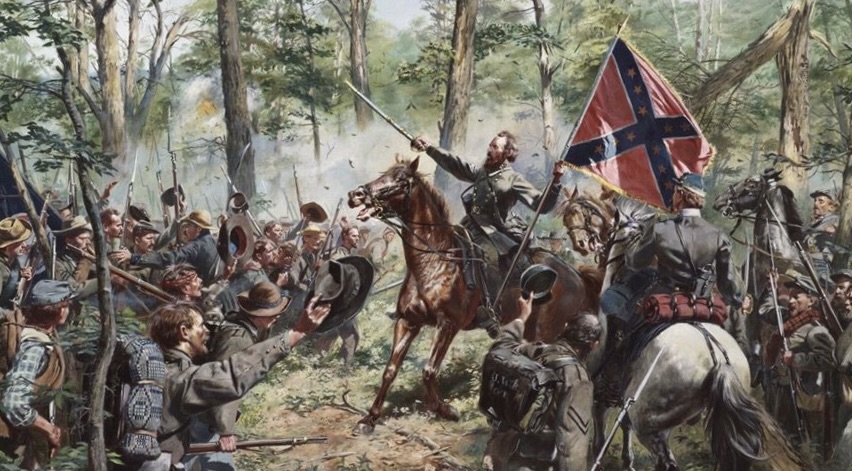
The following letters were written by James W. Carswell (1845-1862), the son of Joseph Carswell and Priscilla Gillean Baker (1826-1897) of Buena Vista, Marion county, Georgia. James enlisted on 15 June 1861to serve in Co. K (“Marion Guards”) of the 12th Georgia Infantry. He remained a private from the time of his enlistment until the date of his death on 28 August 1862, killed in action at 2nd Manassas.
For a 15 or 16-year-old boy who grew up in rural Georgia with limited educational opportunities, these letters are remarkable. James demonstrated notable insight and had a clear understanding of his circumstances and the crisis in which he found himself ensnared. His enthusiasm diminished during the dreary winter of 1861-62 in the Allegheny Mountains of northwest Virginia, prompting him to consider a multitude of ways for obtaining a discharge from military service. However, his patriotism was reignited in the spring, and he wrote to his parents, “I once desired a discharge but now nothing is further from my wishes. At that time, the prospects of the Confederacy were promising, and more men were at home than in the army, leading me to believe that my youth required me to be at home while others took my place. Now, however, all are called upon, and all must respond. The salvation of the Nation hinges on the promptness and patriotism of its citizenry.”
Letter 1
Richmond [Virginia]
June 27, 1861
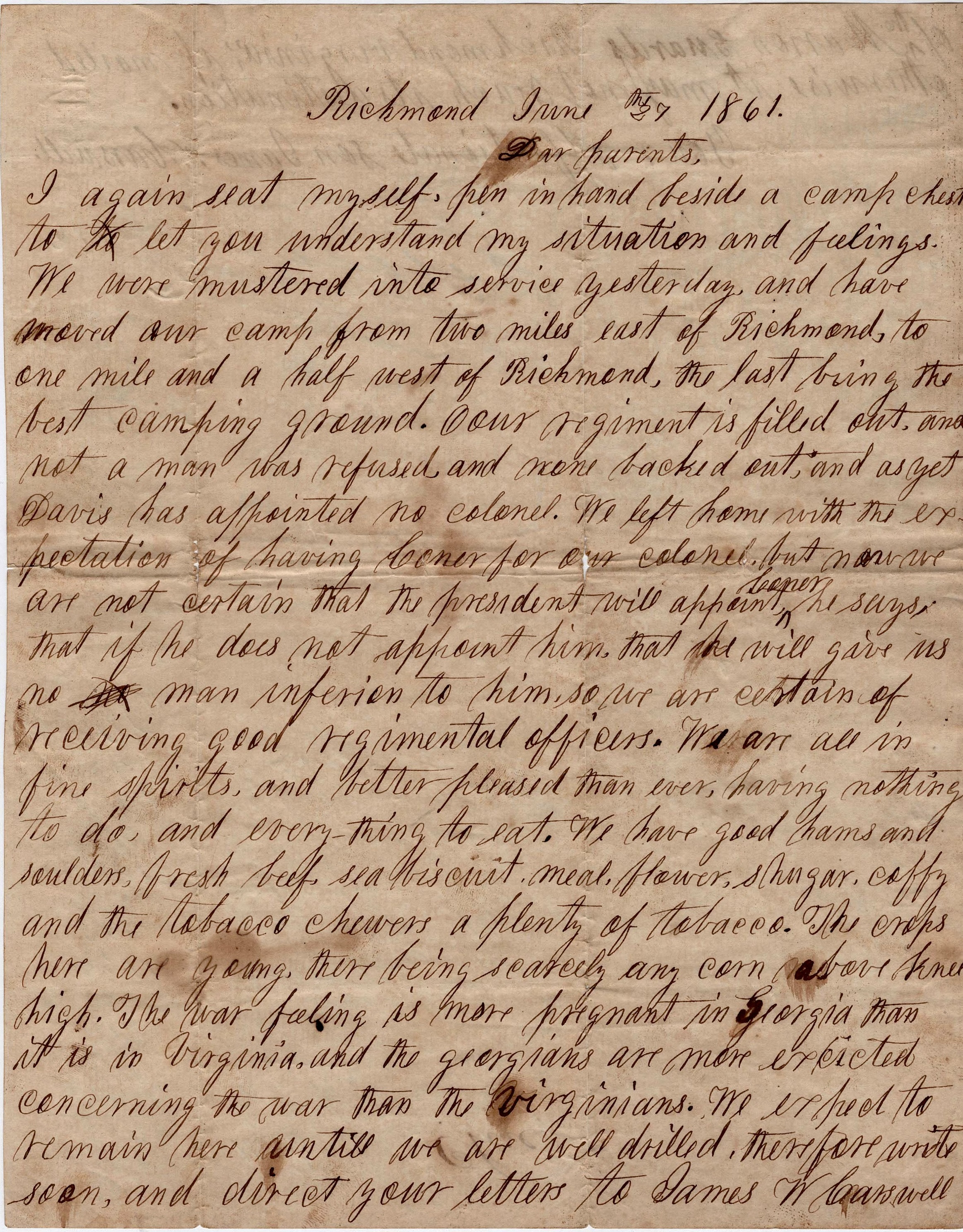
I again seat myself, pen in hand beside a camp chest to let you understand my situation and feelings. We were mustered into service yesterday and have moved our camp from two miles east of Richmond to one mile and a half west of Richmond, the last being the best camping ground. Our regiment is filled out and not a man was refused and none backed out, and as yet Davis has appointed no Colonel. We left home with the expectation of having [Zephania Turner] Conner for our Colonel but now we are not certain that the President will appoint Conner. He says that if he does not appoint him, that he will give us no man inferior to him so we are certain of receiving good regimental officers.
We are all in fine spirits and better pleased than ever, having nothing to do and everything to eat. We have good hams and shoulders, fresh beef, sea biscuit, meal, flour, sugar, coffee and the tobacco chewers a plenty of tobacco. The crops here are young, there being scarcely any corn above knee high.
The war feeling is more pregnant in Georgia than it is in Virginia and the Georgians are more excited concerning the war than the Virginians. We expect to remain here until we are well drilled. Therefore, write soon and direct your letters to James W. Carswell of the Marion Guards, Richmond Virginia. If mailed otherwise, it may not reach its destination.
Your affectionate son, — James W. Carswell
Letter 2
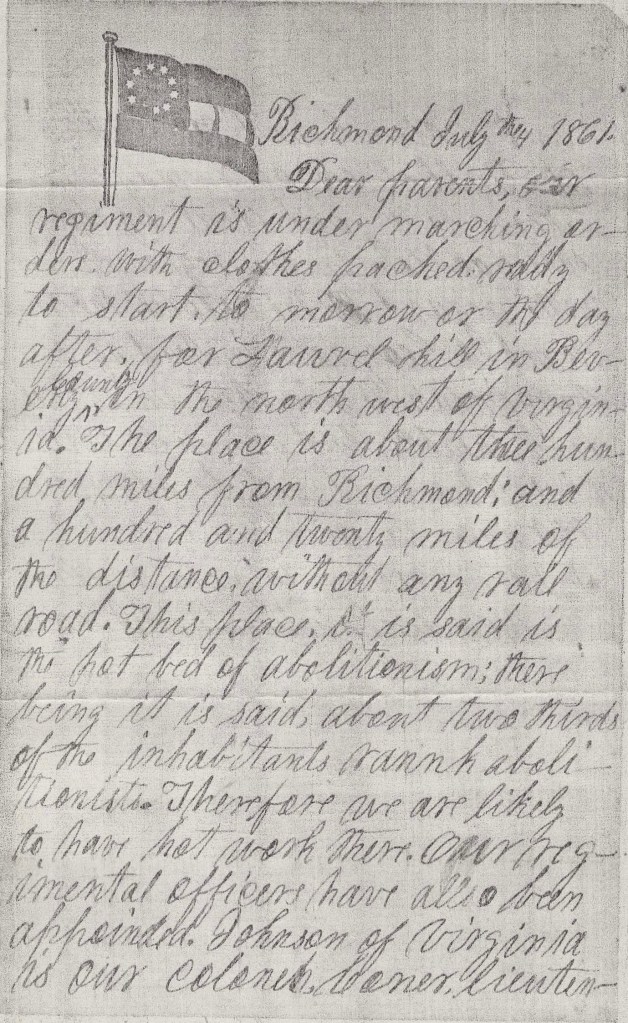
[Editor’s note: This letter is a photocopy of the original which has somehow become separated from the other letters in the collection; most likely kept for its rare patriotic Confederate flag illustration.]
Richmond [Virginia]
July the 4th 1861
Dear parents,
Our regiment is under marching orders with clothes packed ready to start tomorrow or the day after for Laurel Hill in Beverly county, in the northwest of Virginia. The place is about three hundred miles from Richmond and a hundred and twenty miles of the distance without any railroad. This place, it is said, is the hot bed of abolitionism, there being, itis said, about two-thirds of the inhabitants rank abolitionists. Therefore we are likely to have hot work there.
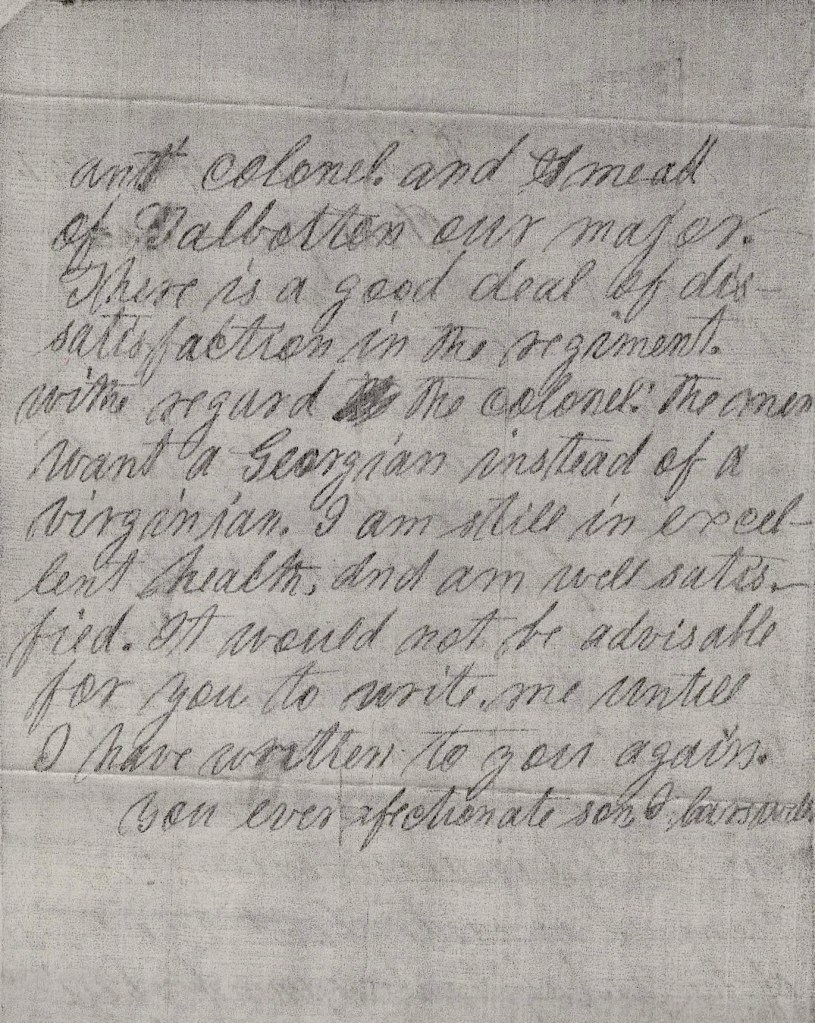
Our regimental officers have also been appointed. [Edward] Johnson of Virginia is our Colonel. [Z. T.] Conner, Lieutenant Colonel, and [Abner] Smead of Balbottom [?] our Major. There is a good deal of dissatisfaction in the regiment with regard to the colonel. The men want a Georgian instead of a Virginian.
I am still in excellent health and am well satisfied. It would not be advisable for you to write me until I have written to you again. Your ever affectionate son, — J. W. Carswell
Letter 3
Monterey, Highland county, Virginia
July 15, 1861
Dear Parents,
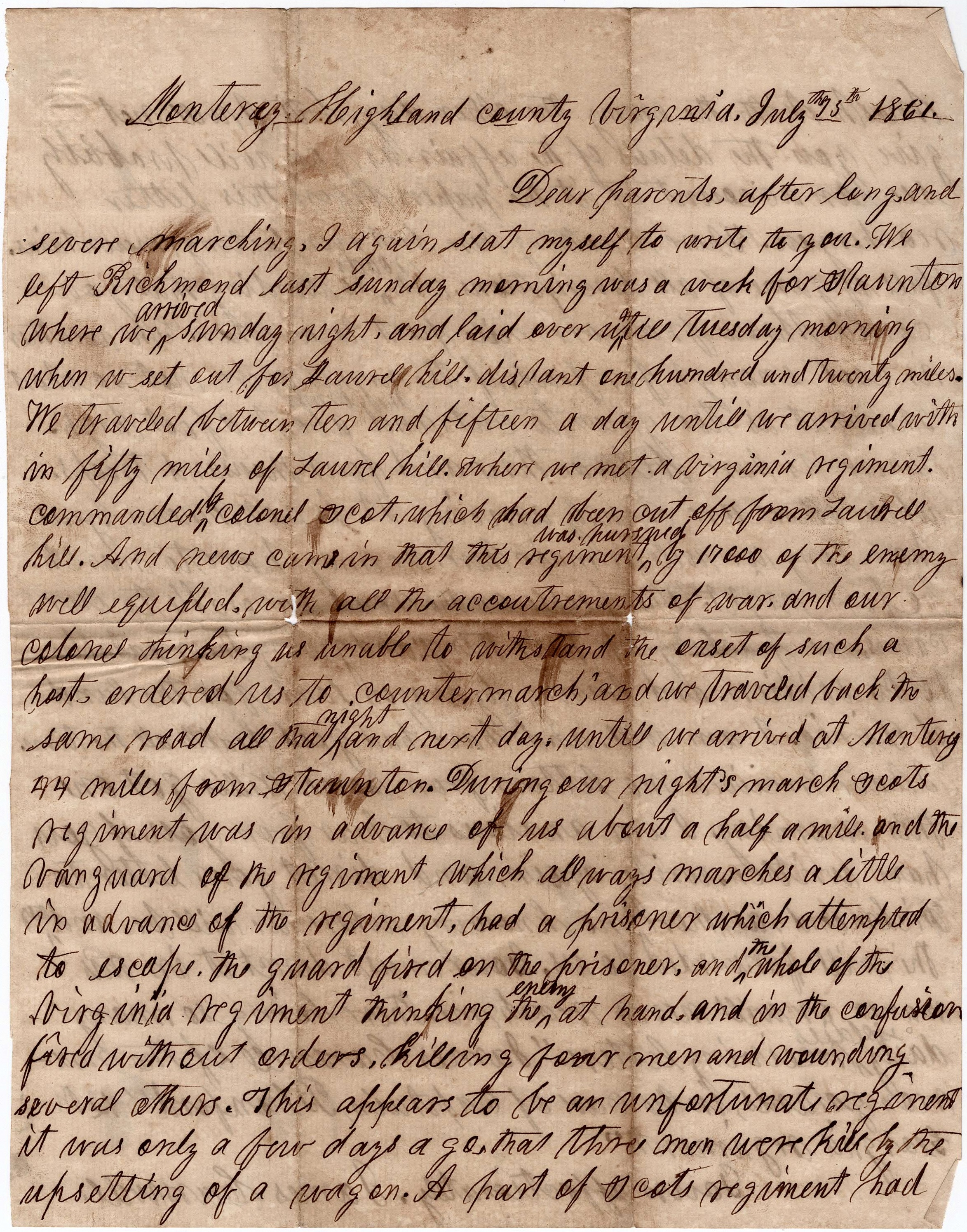
After long and severe marching, I again seat myself to write to you. We left Richmond last Sunday morning was a week for Staunton where we arrived Sunday night and laid over until Tuesday morning when we set out for Laurel Hill, distant one hundred and twenty-five miles. We traveled between ten and fifteen a day until we arrived within fifty miles of Laurel Hill where we met a Virginia regiment commanded by Colonel [William C.] Scott which had been cut off from Laurel Hill. And news came in that this regiment was pursued by 17,000 of the enemy well equipped with all the accoutrements of war, and our Colonel [Edward Johnson] thinking us unable to withstand the onset of such a host, ordered us to countermarch and we traveled back the same road all that night and the next day until we arrived at Monterey, 44 miles from Staunton.
During our night’s march, [William C.] Scott’s [44th Virginia] Regiment was in advance of us about a half a mile and the vanguard of the regiment which always marches a little in advance of the regiment had a prisoner which attempted to escape. The guard fired on the prisoner and the whole of the Virginia Regiment, thinking the enemy at hand, and in the confusion fired without orders, killing four men and wounding several others. This appears to be an unfortunate regiment. It was only a few days ago that three men were killed by the upsetting of a wagon.
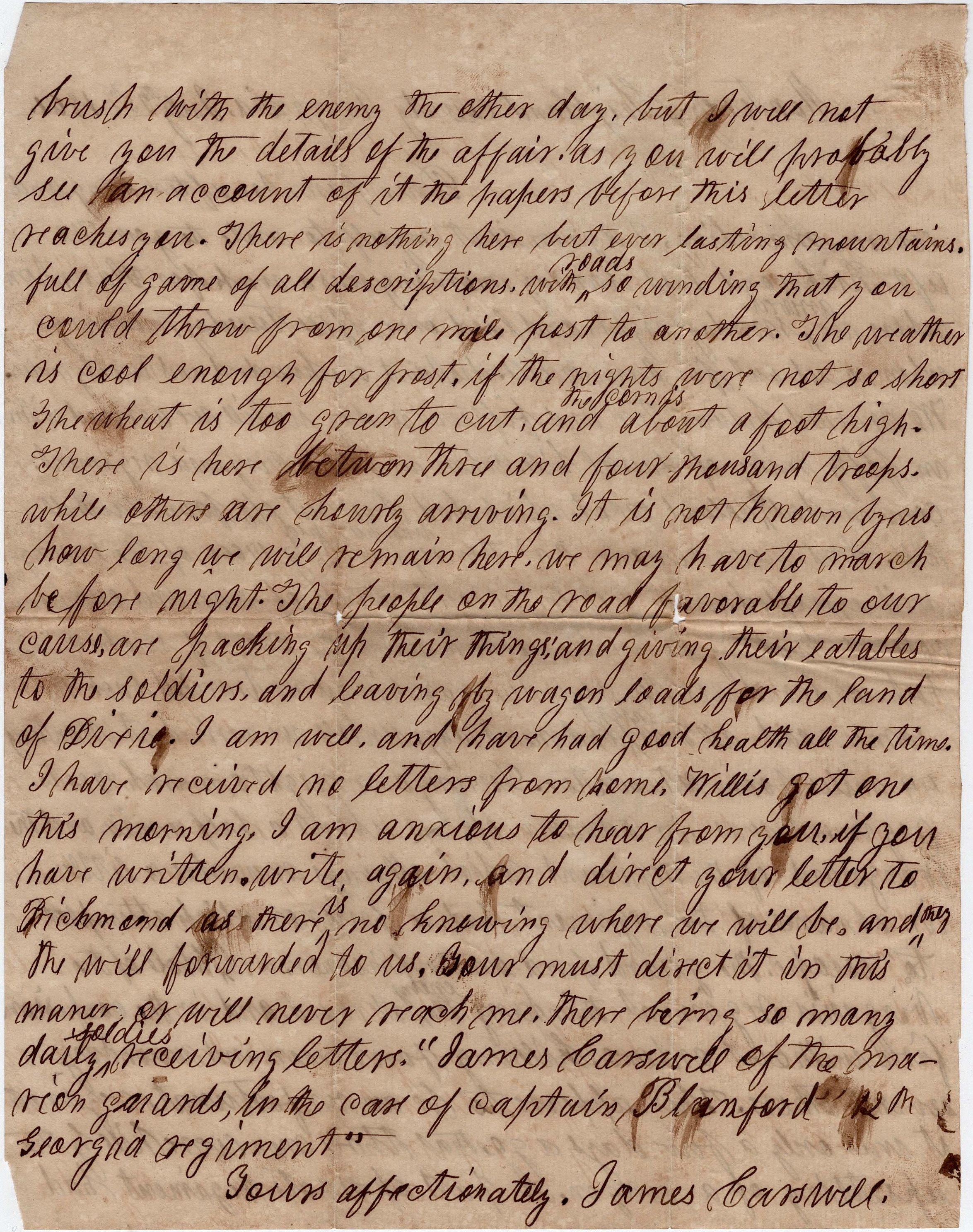
A part of Scott’s Regiment had a brush with the enemy the other day but I will not give you the details of the affair as you will probably see an account of it in the papers before this letter reaches you.
There is nothing here but everlasting mountains, full of game of all descriptions, with road so winding that you could throw from one mile post to another. The weather is cool enough for frost if the nights were not so short. The wheat is too green to cut and the corn is about a foot high. There is here between three and four thousand troops while others are hourly arriving. It is not known by us how long we will remain here. We may have to march before night.
The people on the road favorable to our cause are packing up their things and giving their eatables to the soldiers and leaving by wagon loads for the land of Dixie. I am well and have had good health all the time. I have received no letters from home. Willis [P. Burt] got one this morning. I am anxious to hear from you. If you have written, write again, and direct your letter to Richmond as there is no knowing where we will be and they will forward it to us. You must direct it in this manner or it will never reach me, there being so many daily soldiers receiving letters. “James Carswell of the Marion Guards [Co. K], in the care of Captain [Mark H.] Blanford, 12th Georgia Regiment.”
Yours affectionately, — James Carswell
Letter 4
Camp Jackson, Pocahontas county, Virginia
August 1, 1861
Dear Parents,
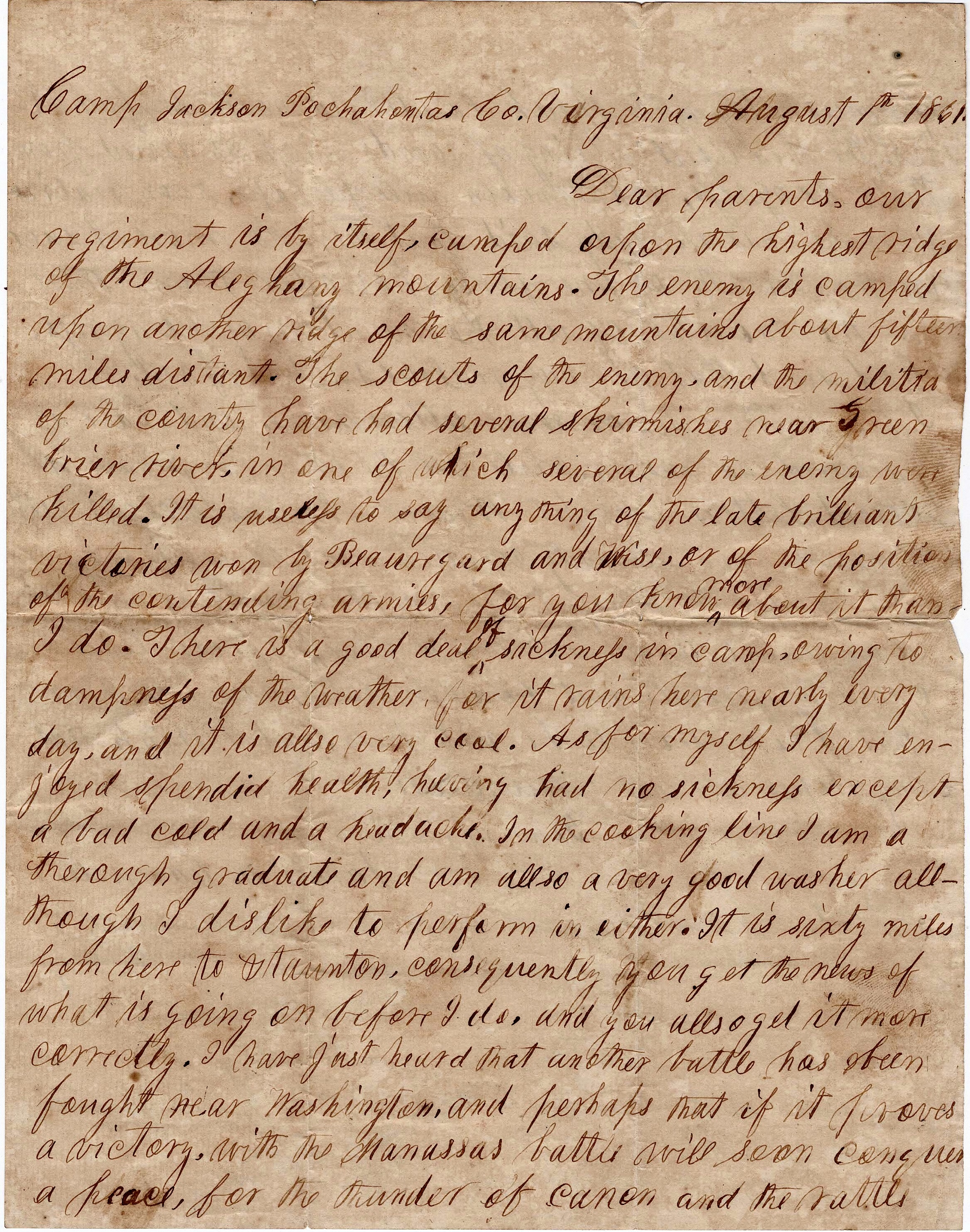
Our regiment is by itself, camped upon the highest ridge of the Alleghany Mountains. The enemy is camped upon another ridge of the same mountains about fifteen miles distant. The scouts of the enemy and the militia of the country have had several skirmishes near Greenbrier River in one of which several of the enemy were killed. It is useless to say anything of the late brilliant victories won by Beauregard and Wise or of the positions of the contending armies for you know more about it than I do.
There is a good deal of sickness in camp owing to the dampness of the weather for it rains here nearly every day and it is also very cool. As for myself, I have enjoyed splendid health, having had no sickness except a bad cold and a headache. In the cooking line I am a thorough graduate and am also a very good washer although I dislike to perform in either.
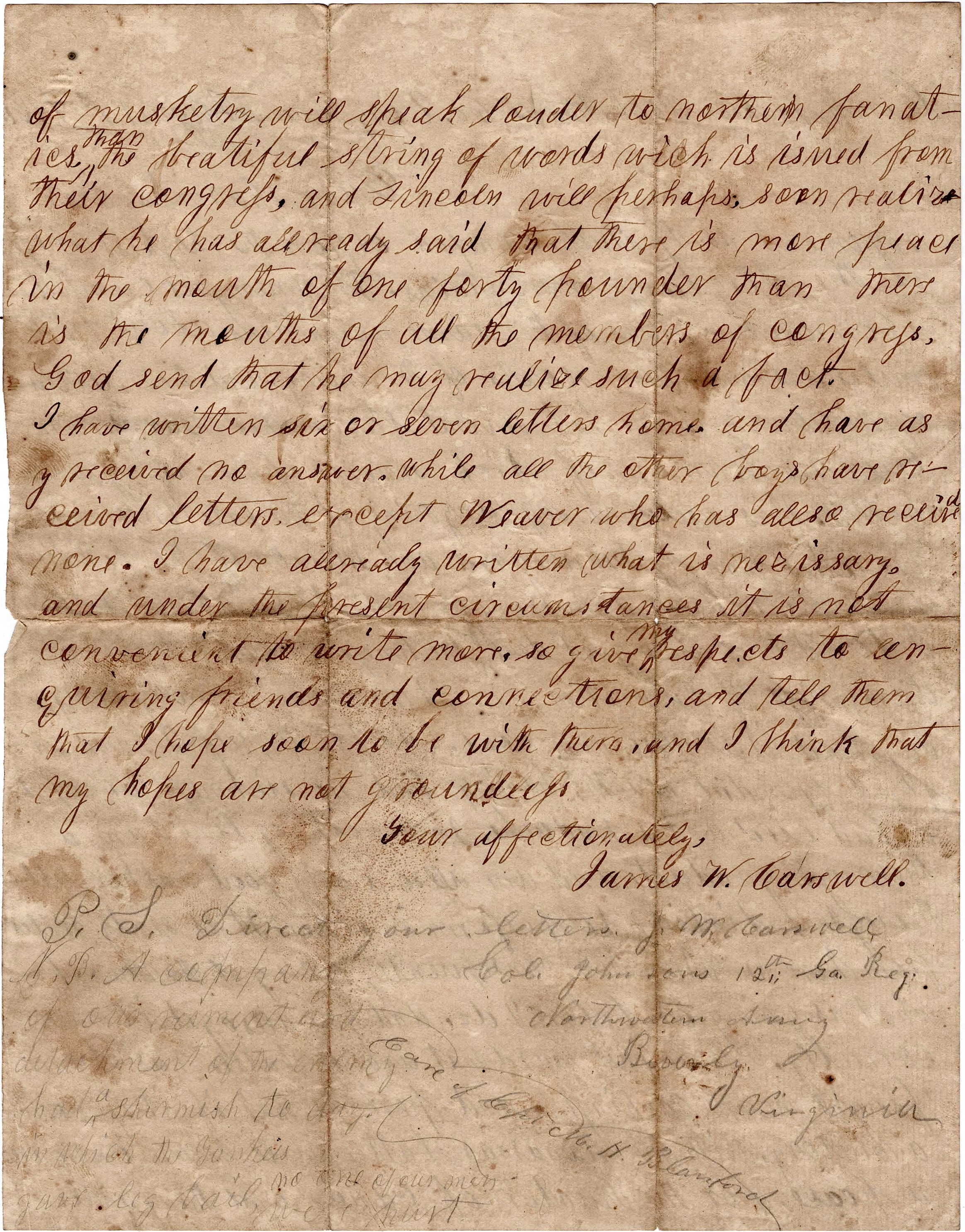
It is sixty miles from here to Staunton. Consequently you get the news of what is going on before I do and you also get it more correctly. I have just heard that another battle has been fought near Washington and perhaps that if it proves a victory, with the Manassas battle will soon conquer a peace, for the thunder of cannon and the rattle of musketry will speak louder to Northern fanatics than the beautiful string of words which is issued from their Congress, and Lincoln will perhaps soon realize what he has already said—that there is more peace in the mouth of one 40-pounder than there is [in] the mouths of all the members of Congress. God send that he may realize such a fact.
I have written six or seven letters home and have as yet received no answer while all the other boys have received letters except [John] Weaver who has also received none. 1 I have already written what is necessary and under the present circumstances it is not convenient to write more. So give my respects to enquiring friends and connections and tell them that I hope soon to be with them and I think that my hopes are not groundless.
Your affectionately, — James W. Carswell
P. S. Direct your letters to J. W. Carswell, College. Johnson 12th Georgia Regt., Northern Army, Beverly, Virginia.
N. B. A company of our regiment and detachment of the enemy had a skirmish today in which the Yankees gave leg bail. No one of our men were hurt.
1 John Weaver died of measles at Camp Alleghany on 1 September 1861.
Letter 5
Greenbrier river
September 1st 1861
Dear father and mother,
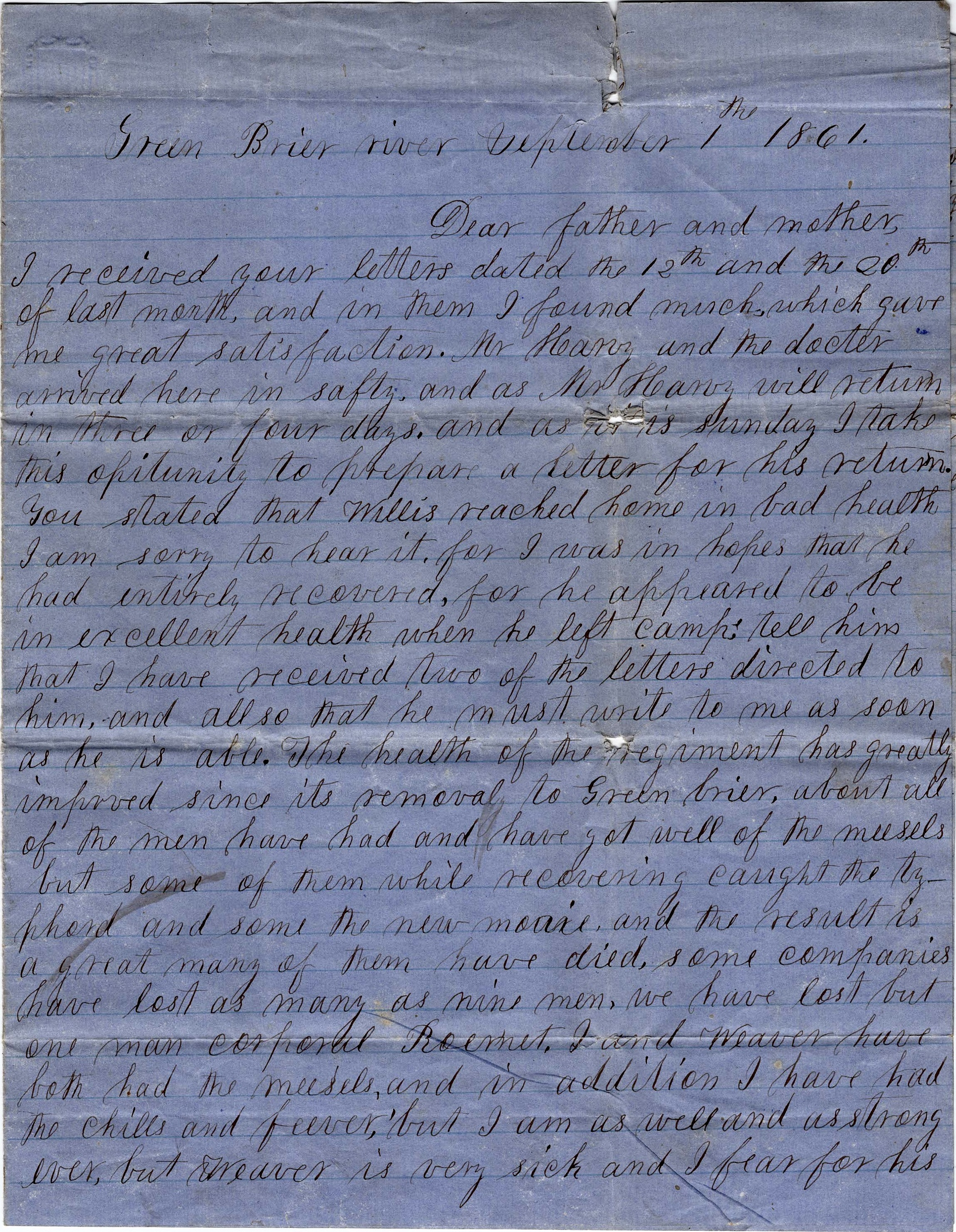
I received your letters daye the 12th and the 20th of last month and in them I found much which gave me great satisfaction. Mr. Harvey and the doctor arrived here in safety and as Mr. Harvey will return in three or four days and as it is Sunday, I take this opportunity to prepare a letter for his return. You stated that Willis [P. Burt] reached home in bad health. I am sorry to hear it for I was in hopes that he had entirely recovered for he appeared to be in excellent health when he left camp, Tell him that I have received two of the letters directed to him and also that he must write to me as soon as he is able. The health of the regiment has greatly improved since its removal to Greenbrier. About all of the men have had and have got well of the measles but some of them while recovering caught the typhoid and some of the new mo__ and the result is a great many of them have died. Some companies have lost as many as nine men. We have lost but one man—Corporal [William H.] Robinett. 1 I and Weaver have both had the measles and in addition I have had the chills and fever but I am as well and as strong as ever. But [John] Weaver is very sick and I fear for his life.
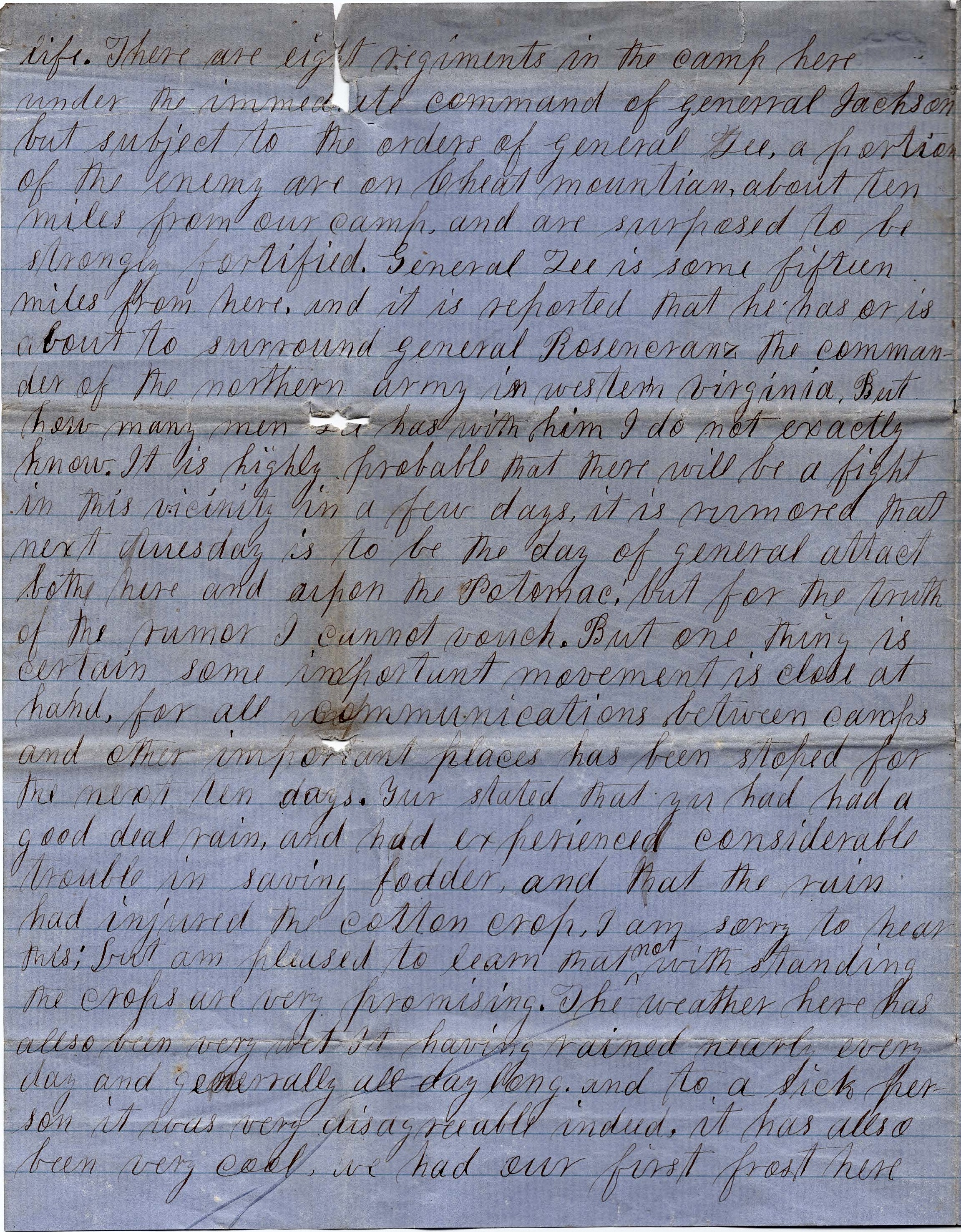
There are eight regiments in the camp here under the immediate command of General [Henry R.] Jackson, but subject to the orders of General [Robert E.] Lee. A portion of the enemy are on Cheat Mountain about ten miles from our camp and are supposed to be strongly fortified. General Lee is some fifteen miles from here and it is reported that he has or is about to surround General Rosecrans, the commander of the Northern army in western Virginia. But how many men he has with him, I do not exactly know. It is highly probable that there will be a fight in this vicinity in a few days. It is rumored that next Tuesday is to be the day of general attack, both here and upon the Potomac. But for the truth of the rumor, I cannot vouch. But one thing is certain, some important movement is close at hand for all communications between camps and other important places has been stopped for the next ten days.
You stated that you had had a good deal of rain and had experienced considerable trouble in saving fodder and that the rain had injured the cotton crop. I am sorry to hear this, but I am pleased to learn that notwithstanding the crops are very promising. The weather here has also been very wet, it having rained nearly every day and generally all day long. And to a sick person, it has been very disagreeable indeed. It has also been very cool. We had our first frost here on the fifteenth of last month and the weather has been cool ever since.
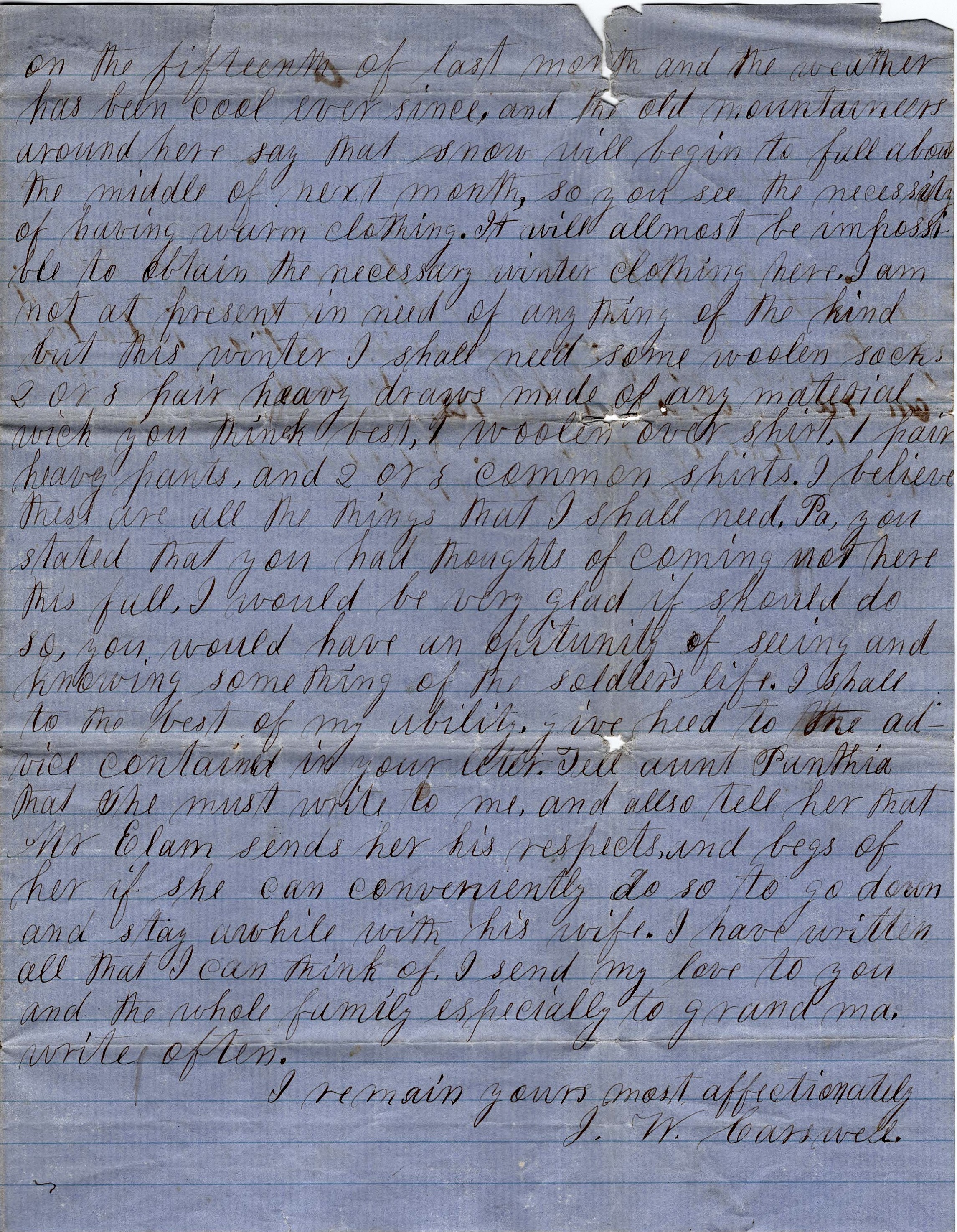
The old mountaineers around here say that snow will begin to fall about the middle of next month. So you see the necessity of having warm clothing. It will be almost impossible to obtain the necessary winter clothing here. I am not at present in need of anything of the kind but this winter I shall need some woolen socks, 2 or 3 pair heavy drawers made of any material which you think best, 1 woolen over shirt, 1 pair heavy pants, and 2 or 3 common shirts. I believe these are all the things that I shall need.
Pa, you stated that you had thoughts of coming out here this fall. I would be very glad if you should do so. You could have an opportunity of seeing and knowing something of the soldier’s life. I shall to the best of my ability give heed to the advice contained in your letter. Tell Aunt Panthia that she must write to me and also tell her that Mr. Elam sends her his respects and begs of her is she can conveniently do so to go down and stay awhile with his wife. I have written all that I can think of. I send my love to you and the whole family—especially to grandma. Write often. I remain yours most affectionately, — J. W. Carswell
1 Corp. William H. Robinett died of fever at Camp Allegany on 16 August 1861.
Letter 6
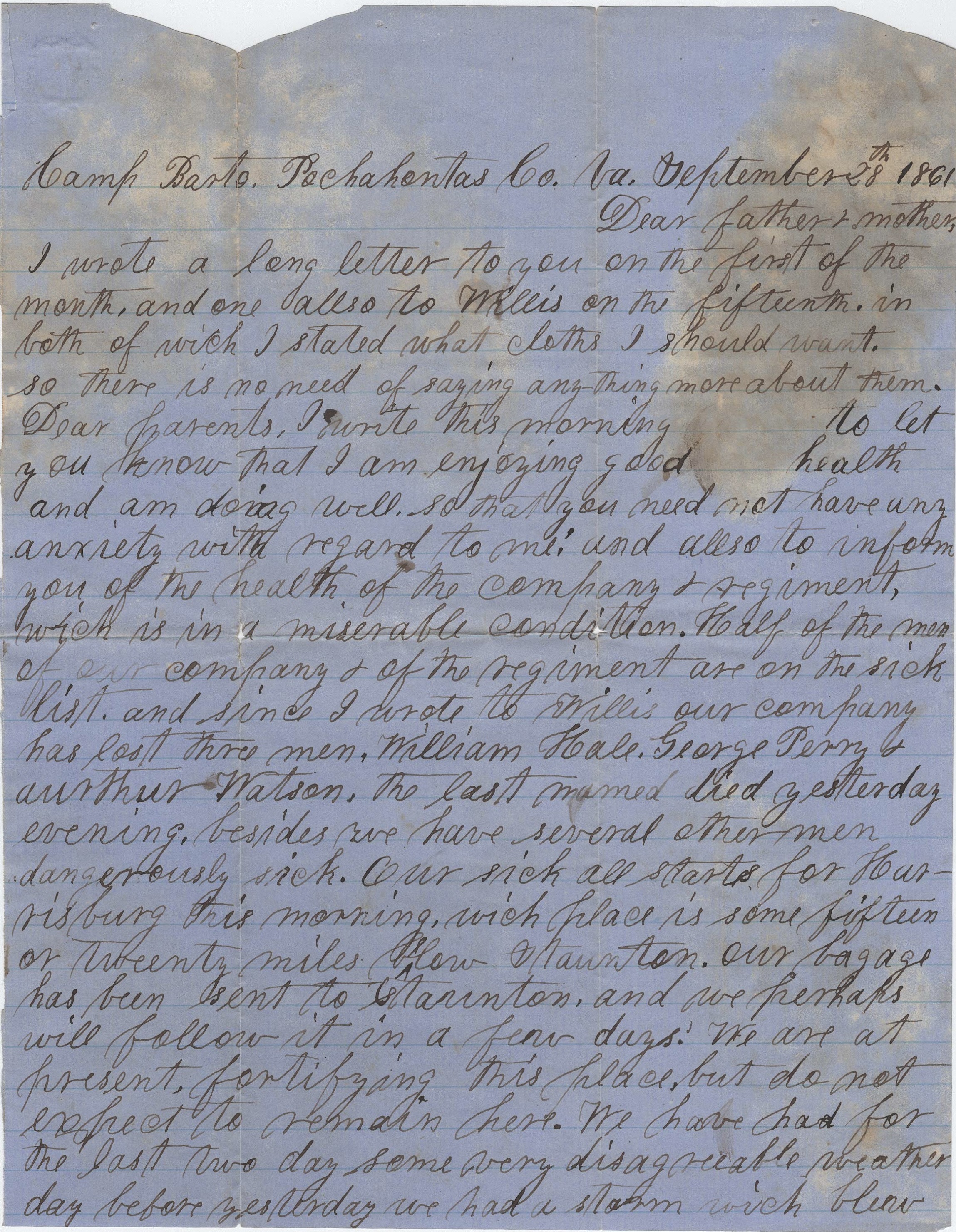
Camp Barto, Pocahontas county, Va.
September 28, 1861
Dear father and mother,
I wrote a long letter to you on the 1st of the month and one also to Willis [P. Burt] on the 15th in both of which I stated what clothes I should want so there is no need of saying anything more about them. Dear parents, I write this morning to let you know that I am enjoying good health and am doing well so that you need not have any anxiety with regard to me. And also to inform you of the health of the company & regiment which is in a miserable condition. Half of the men of our company & of the regiment are on the sick list and since I wrote to Willis, our company has lost three men—William Hale, George Perry, and Athrur Watson. The last named died yesterday evening. Besides we have several other men dangerously sick. Our sick all starts for Harrisburg this morning which place is some 15 or 20 miles below Staunton. Our baggage has been sent to Staunton and we perhaps will follow it in a few days.
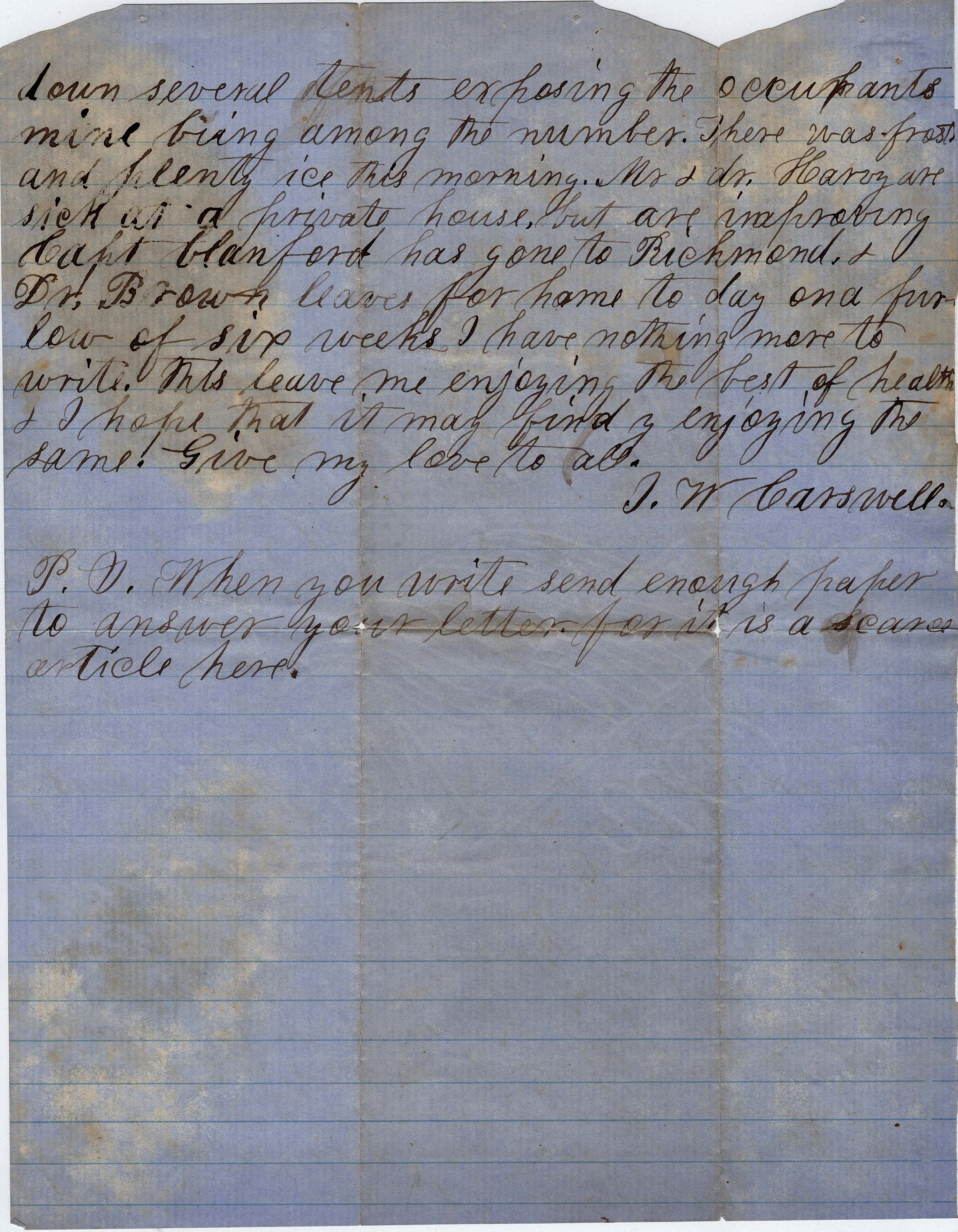
We are at the present fortifying this place but do not expect to remain here. We have had for the last two days some very disagreeable weather. Day before yesterday we had a storm which blew down several tents exposing the occupants, mine being among the number. There was frost and plenty of ice this morning. Mr. & Dr. Harvey are sick at a private house but are improving. Capt. Blanford has gone to Richmond & Dr. Brown leaves for home today and furlough of six weeks.
I have nothing more to write. This leaves me enjoying the best of health & I hope that it may find you enjoying the same. Give my love to all. — J. W. Carswell
P. S. When you write, send enough paper to answer your letter for it is a scarce article here.
Letter 7
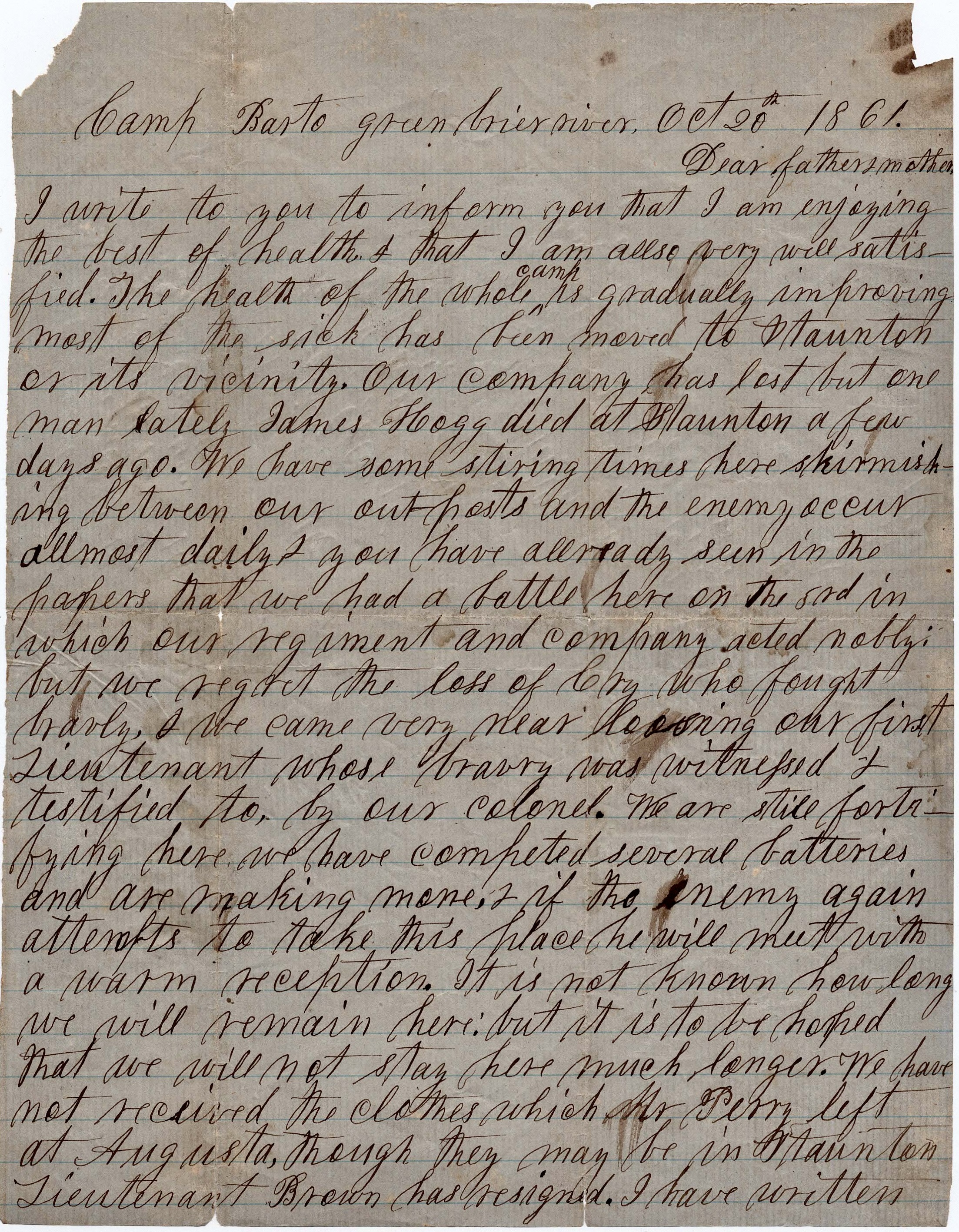
Camp Barto, Greenbrier river
October 20th 1861
Dear father and mother,
I write to you to inform you that I am enjoying the best of health & that I am also very well satisfied. The health of the whole camp is gradually improving, Most of the sick has been moved to Staunton or its vicinity. Our company has lost but one man lately. James [W.] Hogg died at Staunton a few days ago.
We have some stirring times here. Skirmishing between our outposts and the enemy occur almost daily. You have already seen in the papers that we had a battle here on the 3rd [see Battle of Greenbrier River] in which our regiment and company acted nobly. But we regret the loss of [Richard] Crye 1 who fought bravely & we came very near losing our 1st Lieutenant [James Robert McMichael] whose bravery was witnessed & testified to by our Colonel.
We are still fortifying here. We have completed several batteries and are making more. If the enemy again attempts to take this place, he will meet with a warm reception. It is not known how long we will remain here but it is to be hoped that we will not stay here much longer. We have not received the clothes which Mr. Perry left at Augusta though they may be in Staunton.
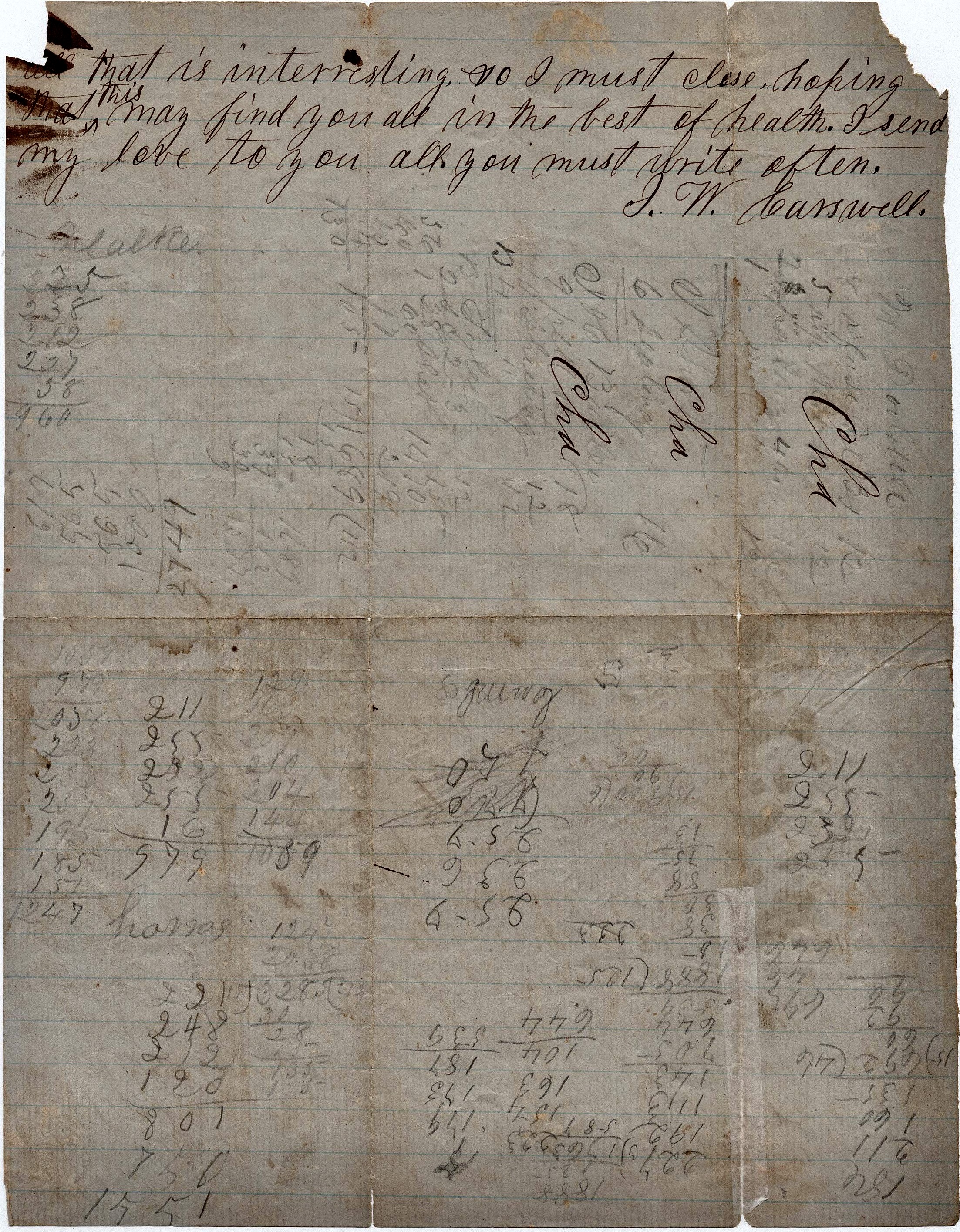
Lieutenant [James F.] Brown has resigned. I have written all that is interesting so I must close hoping that this may find you all in the best of health. I send my love to you all. You must write often. — J. W. Carswell
1 Pvt. Richard Crye was killed at Greenbrier river on 3 October 1861.
Letter 8
Camp Allegany, Pocahontas County, Va.
December 1st 1861
Dear father & mother,
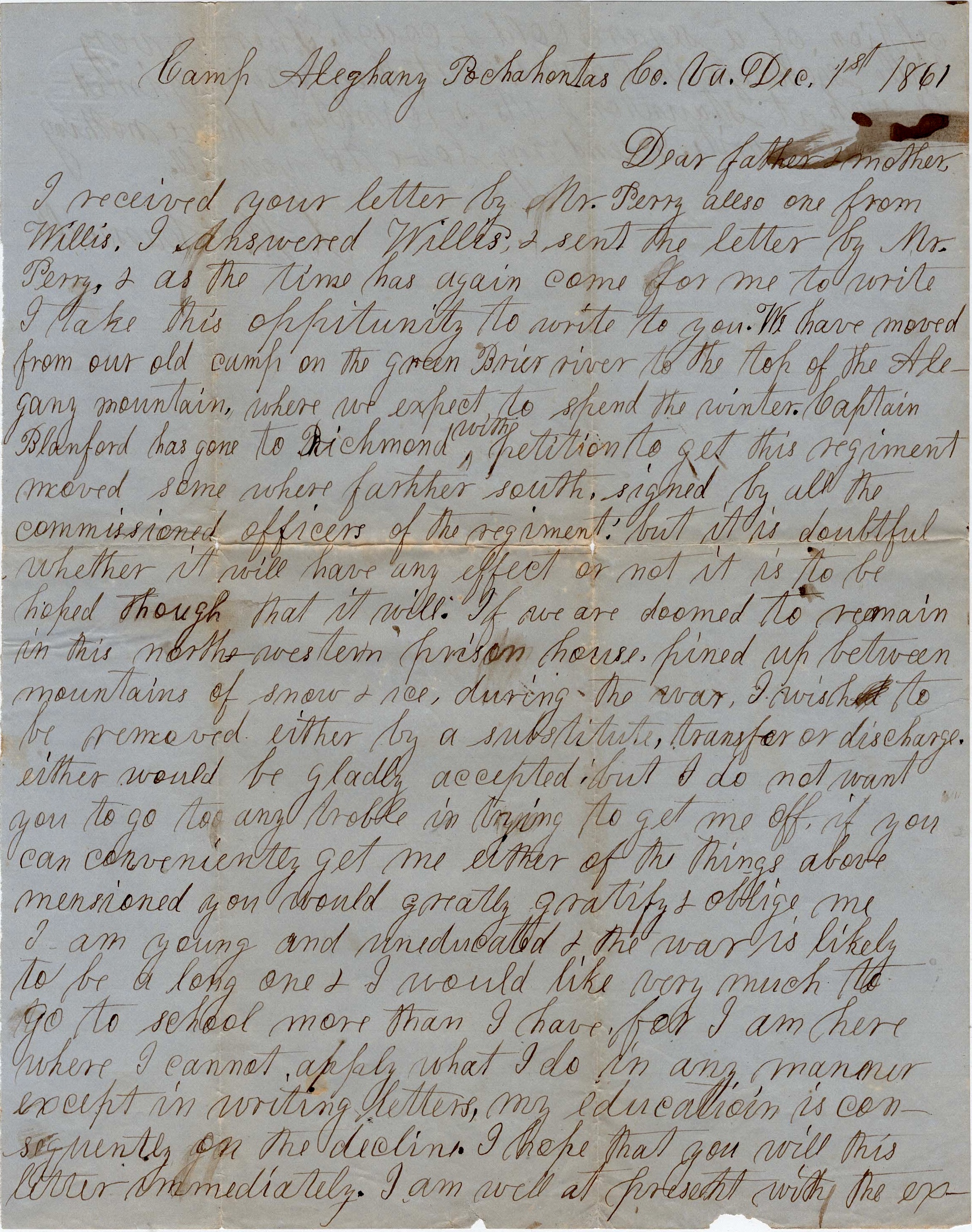
I received your letter by Mr. Perry. Also one from Willis [P. Burt]. I answered Willis’ and sent the letter by Mr. Perry & as the time has again come for me to write, I take this opportunity to write to you. We have moved from our old camp on the Greenbrier river to the top of the Alleghany Mountain where we expect to spend the winter. Captain Blanford has gone to Richmond with petition to get this regiment moved somewhere further south, signed by all the commissioned officers of the regiment. But it is doubtful whether it will have any effect or not. It is to be hoped, though, that it will.
If we are doomed to remain in this northwestern prison house, pinned up between mountains of snow and ice during the war, I wish to be removed either by a substitute, transfer, or discharge. Either would be gladly accepted, but I do not want you to go to any trouble in trying to get me off, If you can conveniently get me either of the things above mentioned, you would greatly gratify & oblige me.
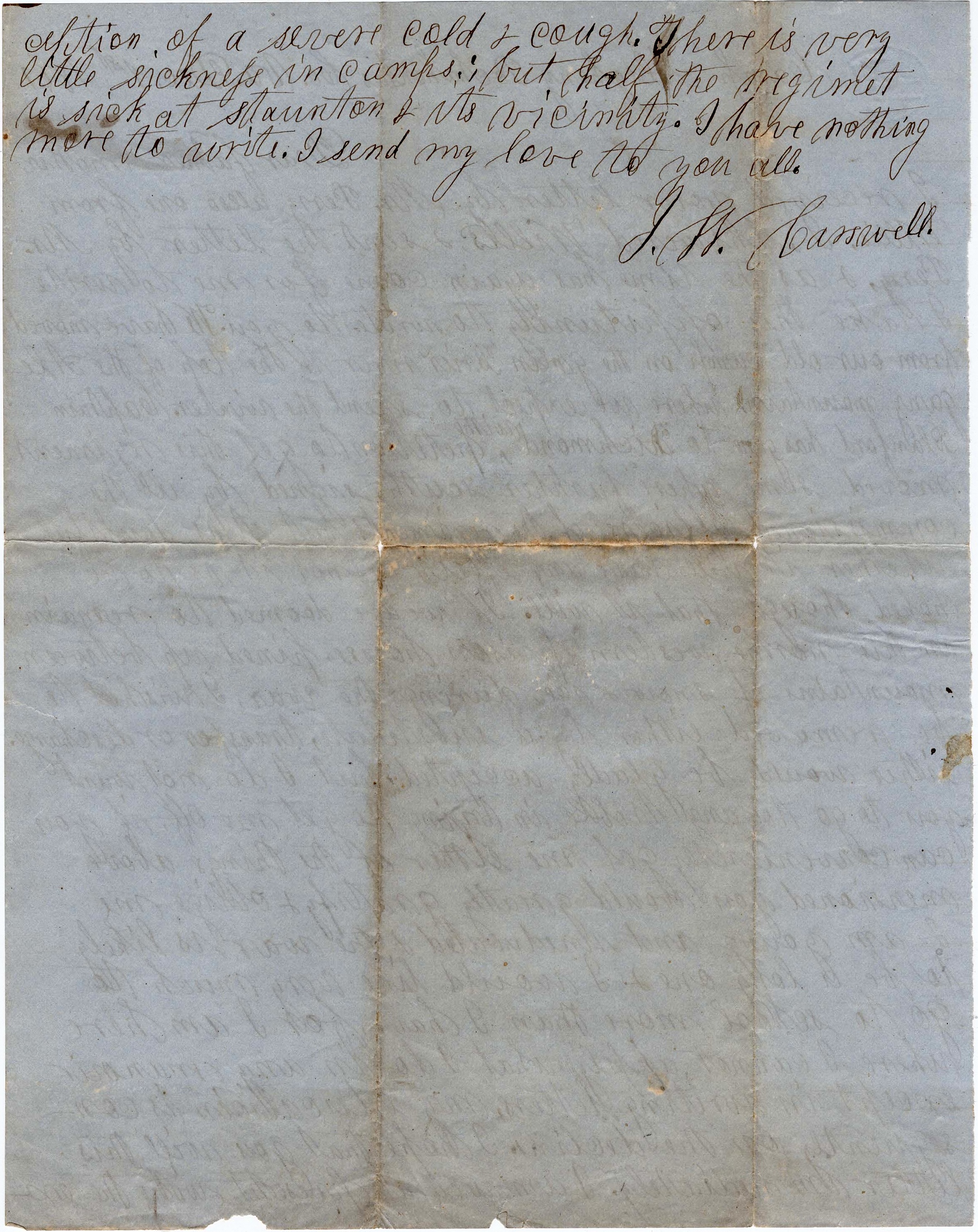
I am young and uneducated & the war is likely to be a long one & I would like very much to go to school more than I have for I am here where I cannot apply what I do in any manner except in writing letters. My education is consequently on the decline. I hope that you will this letter immediately. I am well at present with the exception of a severe cold & cough. There is very little sickness in camp but half the regiment is sick at Staunton & its vicinity. I have nothing more to write. I send my love to you all. — J. W. Carswell
Letter 9
Camp Alleghany, Pocahontas county, Va.
December 16th 1861
Dear father & mother,
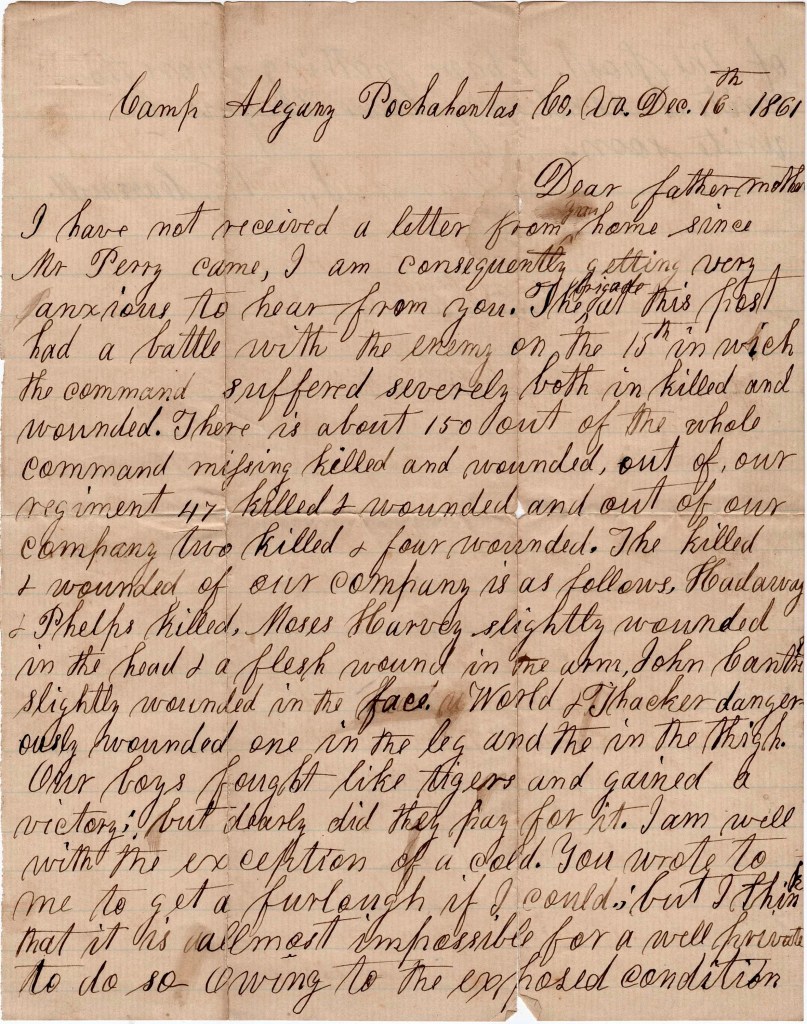
I have not received a letter from home since Mr. Perry came. I am consequently getting very anxious to hear from you. The brigade at this post had a battle [See Battle of Camp Allegheny] with the enemy on the 13th in which the command suffered severely both in killed and wounded. There is about 150 out of the whole command missing, killed and wounded. Out of our regiment, 47 killed & wounded, and out of our company two killed and four wounded. The killed & wounded of our company is as follows: [Wiley D.] Hadaway & [Augustus] Phelps killed, Moses [J.] Harvey slightly wounded in the head & a flesh wound in the arm, John [W.] Cantrell slightly wounded in the face, [Joseph W.] Worrell & [James A.] Thacker dangerously wounded—one in the leg and the [other] in the thigh.
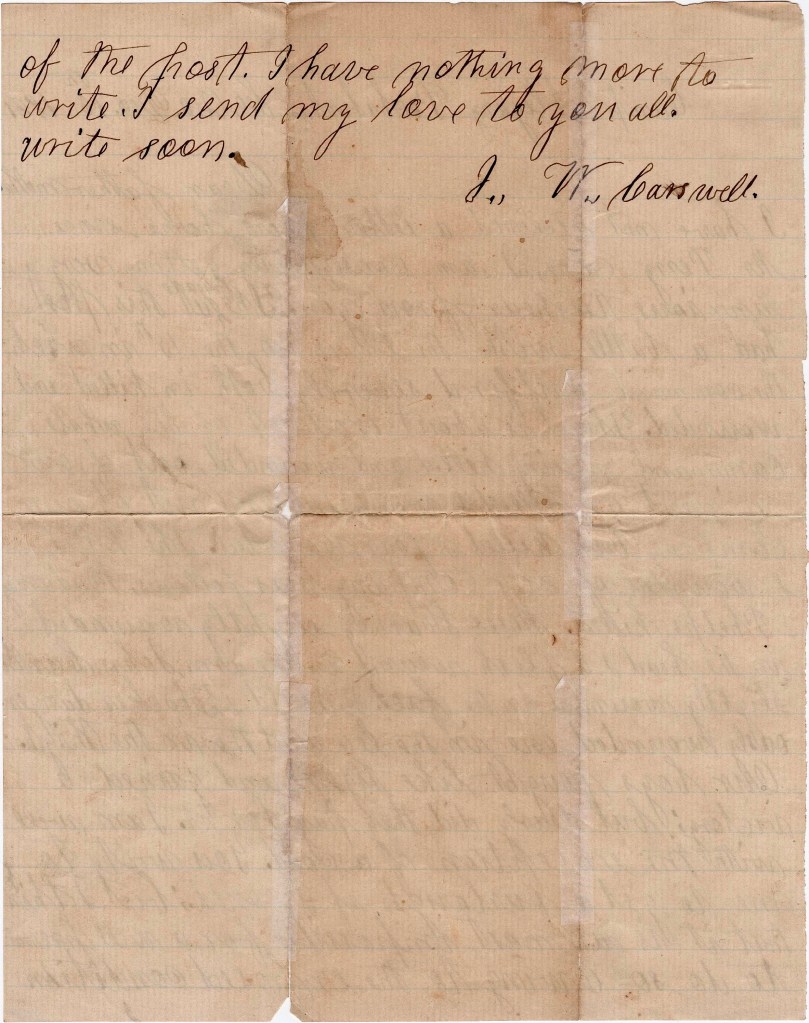
Our boys fought like tigers and gained a victory but dearly did they pay for it. I am well with the exception of a cold. You wrote to me to get a furlough if I could but I think that it is almost impossible for a well private to do, so owing to the exposed condition of the post, I have nothing more to write. I send my love to you all. Write soon. — J. W. Carswell
Letter 10
Alleghany, Pocahontas county, Va.
January 20, 1862
Dear father & mother,
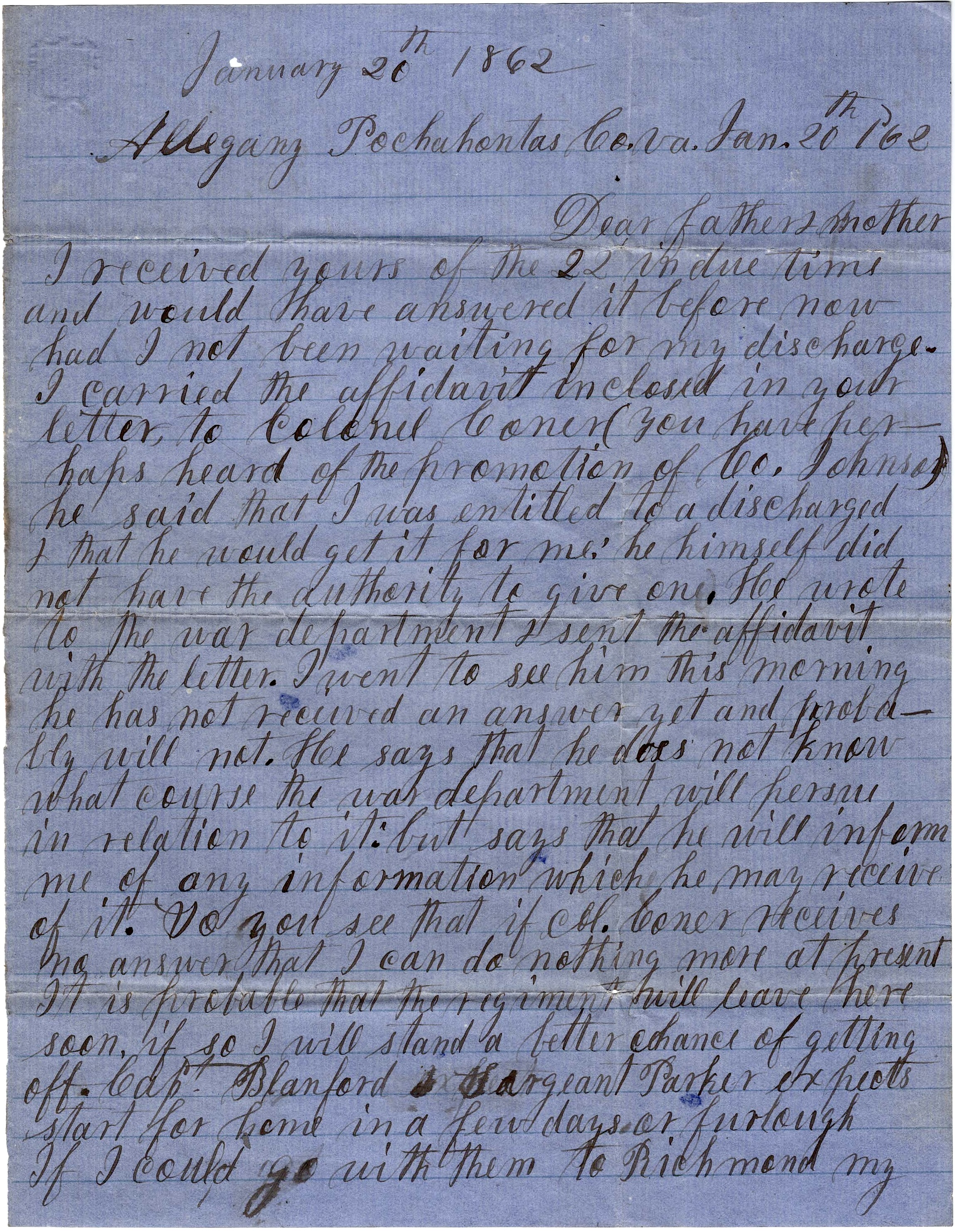
I received yours of the 22nd in due time and would have answered it before now had I not been waiting for my discharge. I carried the affidavit enclosed in your letter to Colonel [Zephania Turner] Conner (you have perhaps heard of the promotion of Col. Johnson). He said that I was entitled to be discharged & that he would get it for me; he miself did not have the authority to give one. He wrote to the War Department & sent the affidavit with the letter. I went to see him this morning. He has not received an answer yet and probably will not. He says that he does not know what course the War Department will pursue in relation to it but says that he will inform me of any information which he may receive of it. So you see that if Col. Conner receives no answer that I can do nothing more at present.
It is probable that the regiment will leave here soon. If so, I will stand a better chance of getting off. Capt Blanford & Sergt. [Nathaniel W.] Parker expects to start for home in a few days on furlough. If I could go with them to Richmond, my discharge would be almost certain but that I cannot do.
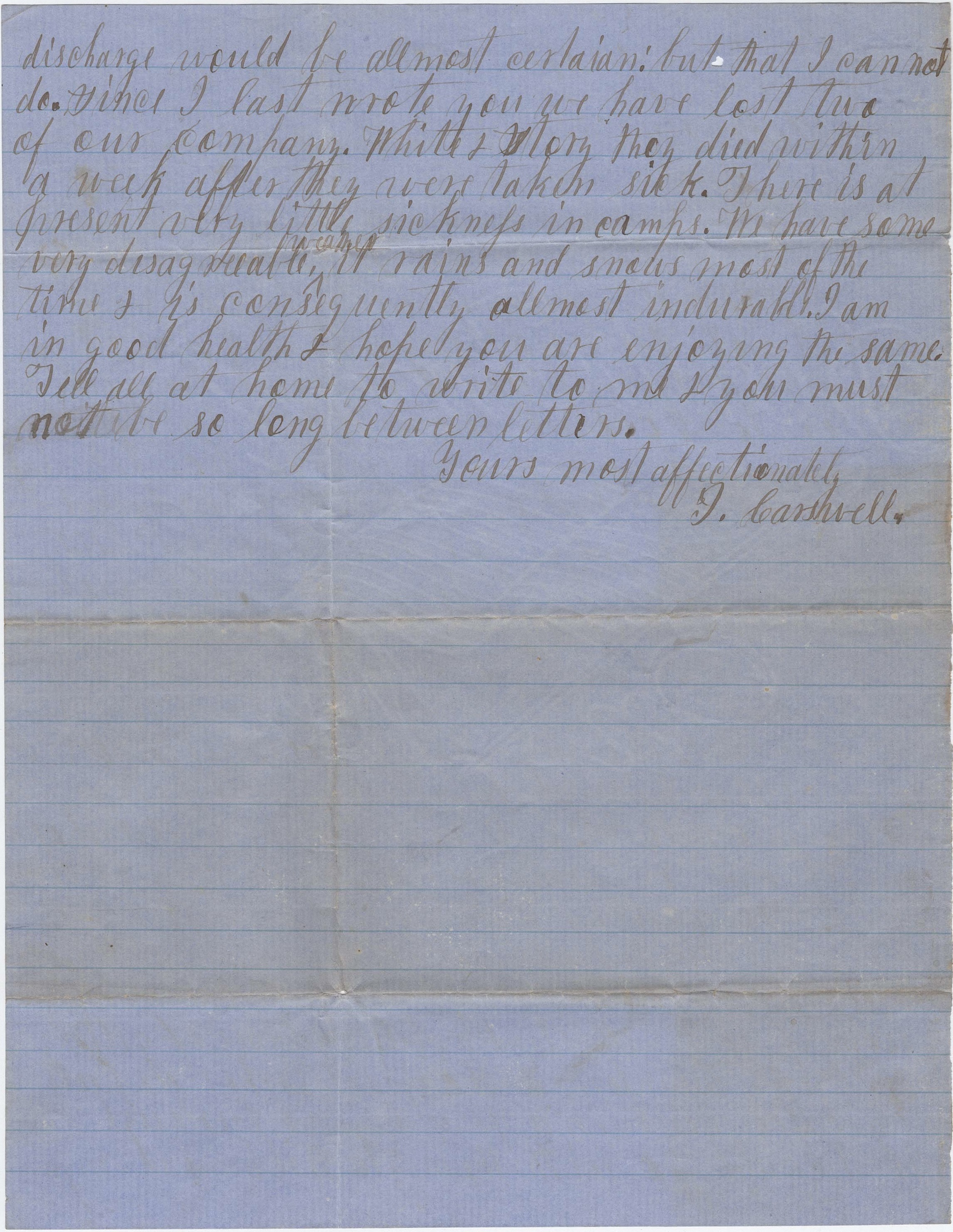
Since last I wrote you, we have lost two of our company—[Hugh] White and [William S.] Story. They died [of pneumonia] within a week after they were taken sick. There is at present very little sickness in camp. We have some very disagreeable weather. It rains and snows most of the time & is consequently almost indurable. I am in good health & hope you are enjoying the same. Tell all at home to write to me & you must not be so long between letters.
Yours most affectionately, — J. Carswell
Letter 11
Alleghany
February 10, 1862
Dear parents,
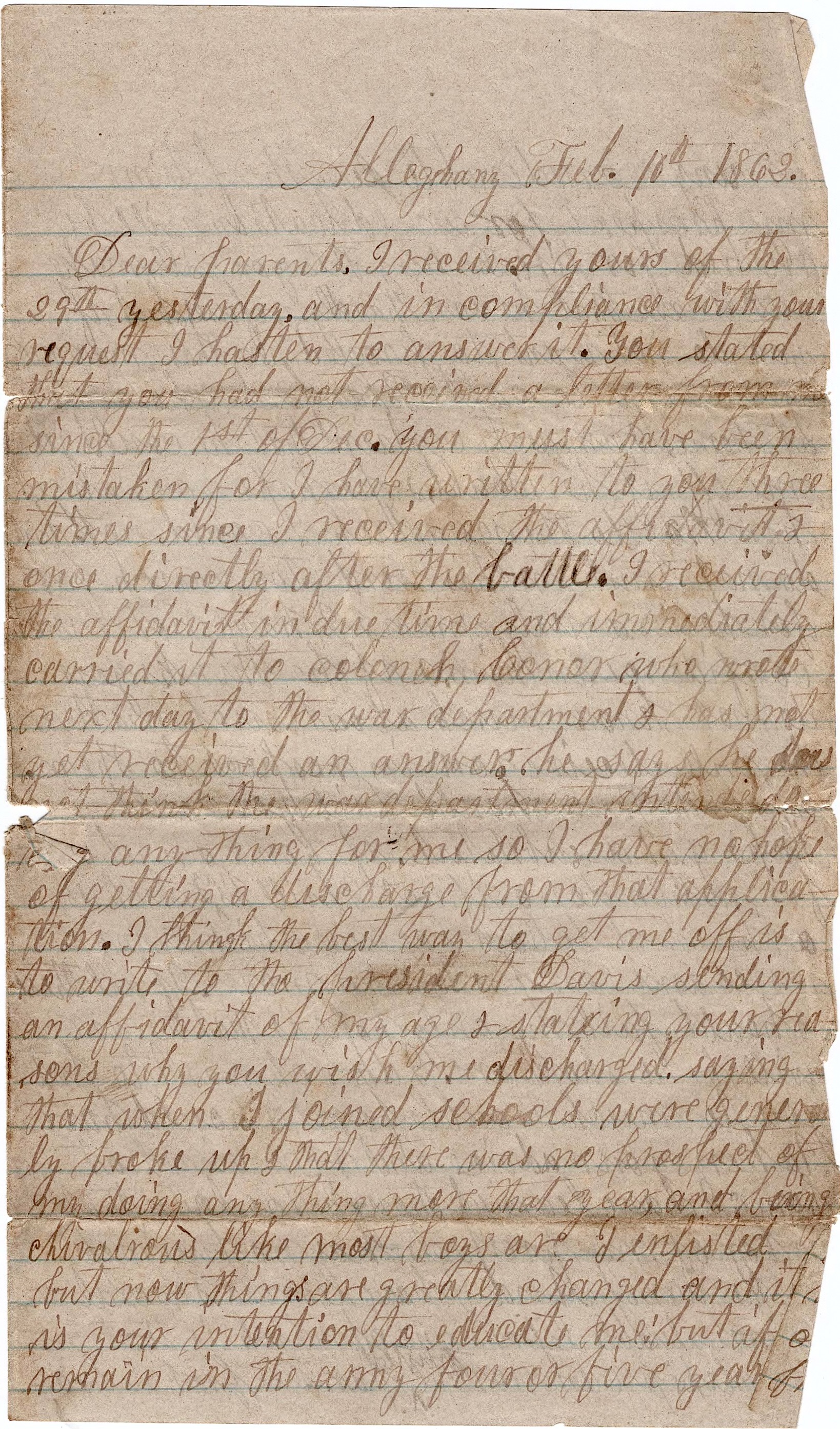
I received yours of the 29th yesterday and in compliance with your request, I hasten to answer it. You stated that you had not received a letter from me since the 1st of December. You must have been mistaken for I have written to you three times since I received the affidavit & once directly after the battle. I received the affidavit in due time and immediately carried it to Colonel Conner who wrote next day to the War Department & has not yet received an answer. He says he does not think the War Department intends to do anything for e so I have no hope of getting a discharge from that application.
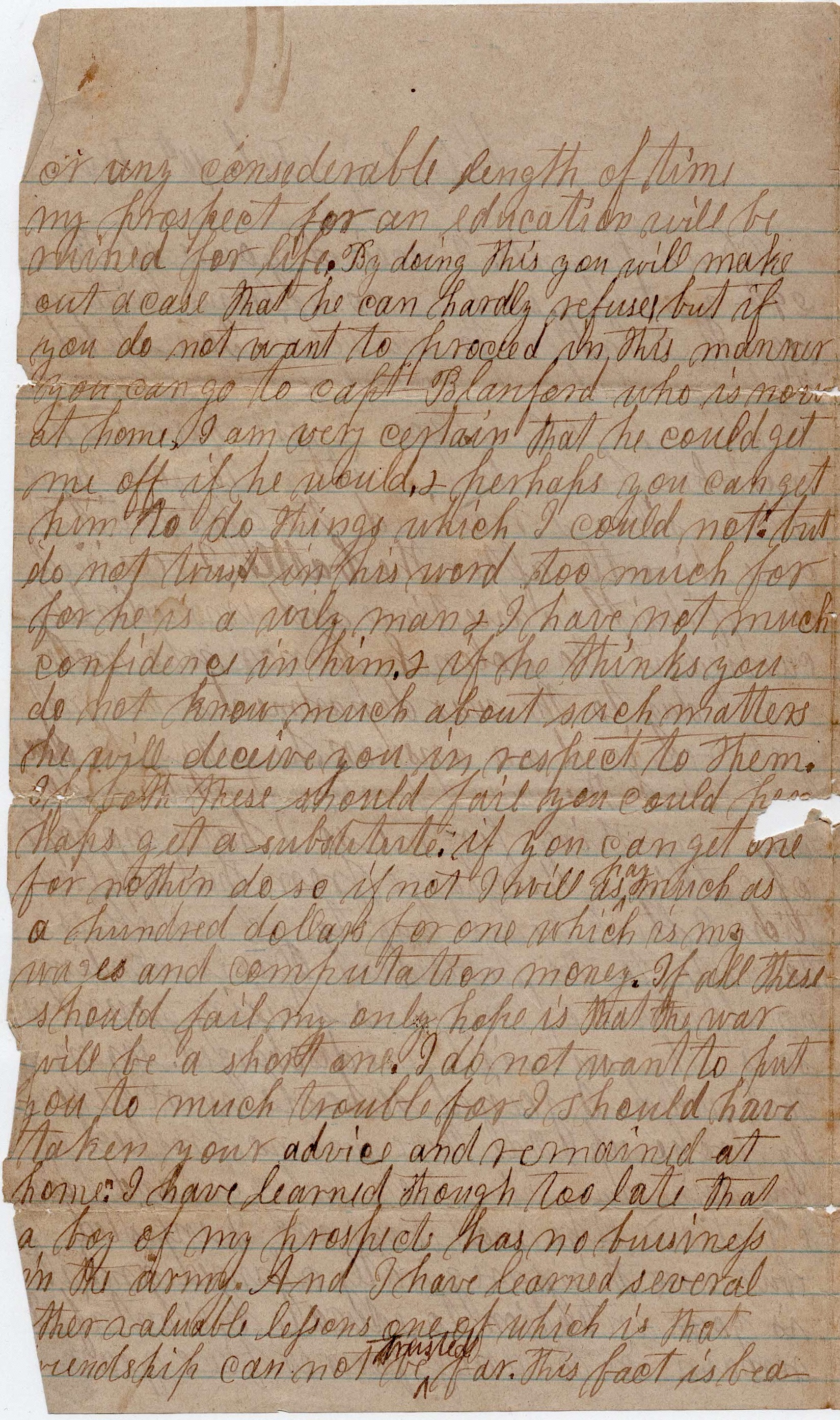
I think the best way to get me off is to write to President Davis sending an affidavit of my age & stating your reasons why you wish me discharged saying that when I joined, schools were generally broke up & that there was no prospect of my doing anything more that year, and being chivalrous like most boys are, I enlisted. But now things are greatly changed and it is your intention to educate me. But if I remain in the army four or five years, or any considerable length of time, my prospect for an education will be ruined for life. By doing this you will make out a case that he can hardly refuse. But if you do not want to proceed in this manner, you can go to Capt. Blanford who is now at home. I am very certain that he could get me off if he would. Perhaps you can get him to do things which I could not. But do not trust in his word too much for he is a wily man & I have not much confidence in him. And if he thinks you do not know much about such matters, he will deceive you in respect to them.
If both these should fail, you could perhaps get a substitute. If you can get one for nothing, do so. If not, I will pay as much as a hundred dollars for one which is my wages and commutation money. If all these should fail, my only hope is that the war will be a short one. I do not want to put you to much trouble for I should have taken your advice and remained at home. I have learned though too late that a boy of my prospects has no business in the army and I have learned several other valuable lessons—one of which is that friendship cannot be trusted far. This fact is [rest of letter is missing]
Letter 12
Alleghany, Pocahontas county, Va.
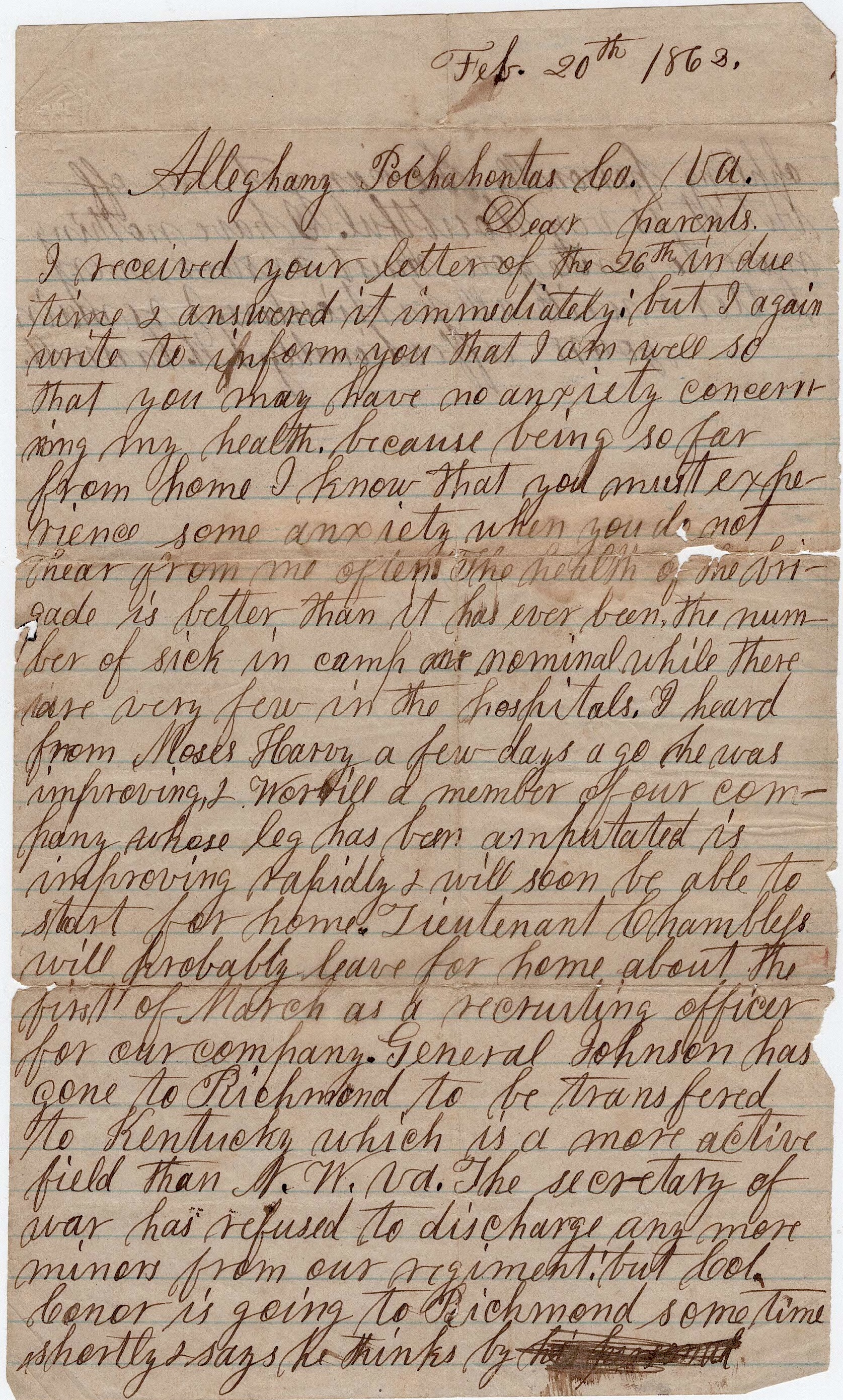
February 20th 1862
Dear parents,
I received your letter of the 26th in due time & answered it immediately, but I again write to inform you that I am well so that you may have no anxiety concerning my health because being so far from home I know that you must experience some anxiety when you do not hear from me often.
The health of the brigade is better than it has ever been, The number of sick in camp are nominal while there are very few in the hospitals. I heard from Moses Harvey a few days ago. He was improving & [Joseph] Worrell, a member of our company whose leg has been amputated, is improving rapidly & will soon be able to start for home. Lieut. [John T.] Chambliss will probably leave for home about the first of March as a recruiting officer for our company. General Johnson has gone to Richmond to be transferred to Kentucky which is a more active field than Northwest Virginia.
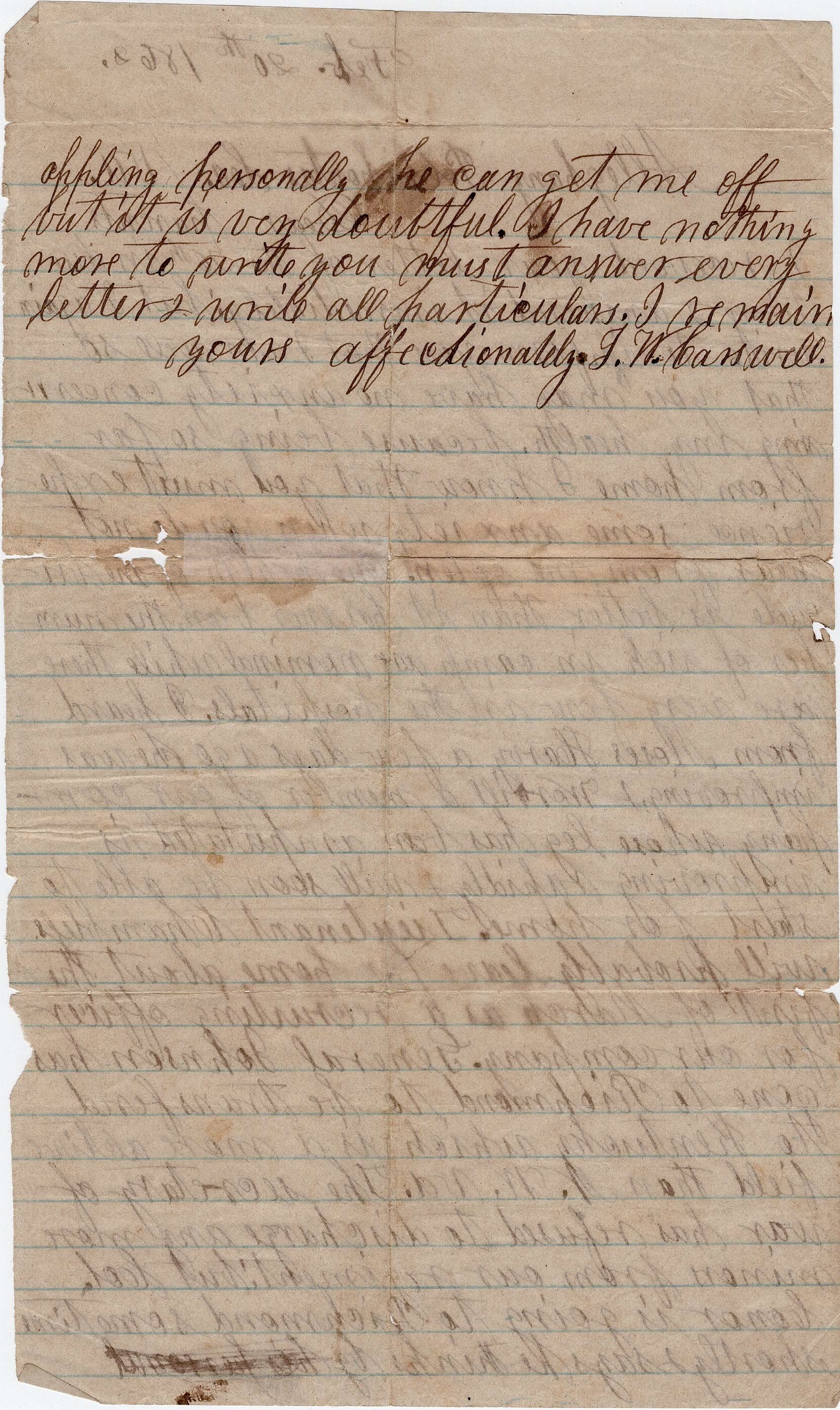
The Secretary of War has refused to discharge anymore minors from our regiment but Colonel Conner is going to Richmond some time shortly & says he thinks by his applying personally he can get me off, but it is very doubtful. I have nothing ,ore to write. You must answer every letter & write all the particulars. I remain yours affectionately, — J. W. Carswell
Letter 13
Alleghany, Pocahontas county, Va.
March 1st 1862
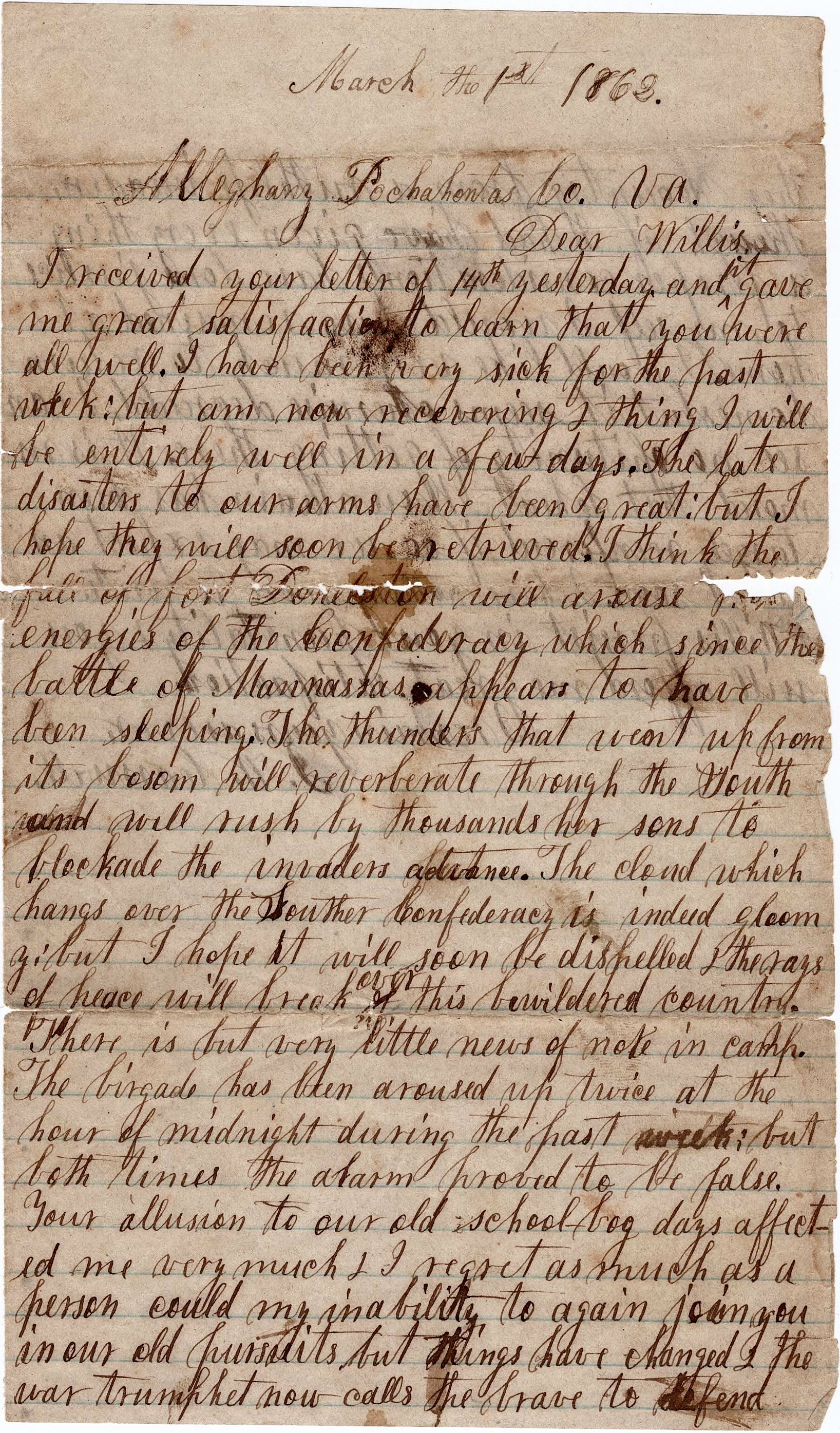
Dear Willis, 1
I received your letter of the 14th yesterday and it gave me great satisfaction to learn that you were all well. I have been very sick for the past week but am now recovering & think I will be entirely well in a few days. The late disasters to our arms [in Tennessee] have been great but I hope they will be soon be retrieved. I think the fall of Fort Donelson will arouse the energies of the Confederacy which since the Battle of Manassas appears to have been sleeping. The thunder that went up from its bosom will reverberate through the South and will rush by thousands her sons to blockade the invader’s advance. The cloud which hangs over the Souther Confederacy is indeed gloomy but I hope it will soon be dispelled & the rays of peace will break over this bewildered country.
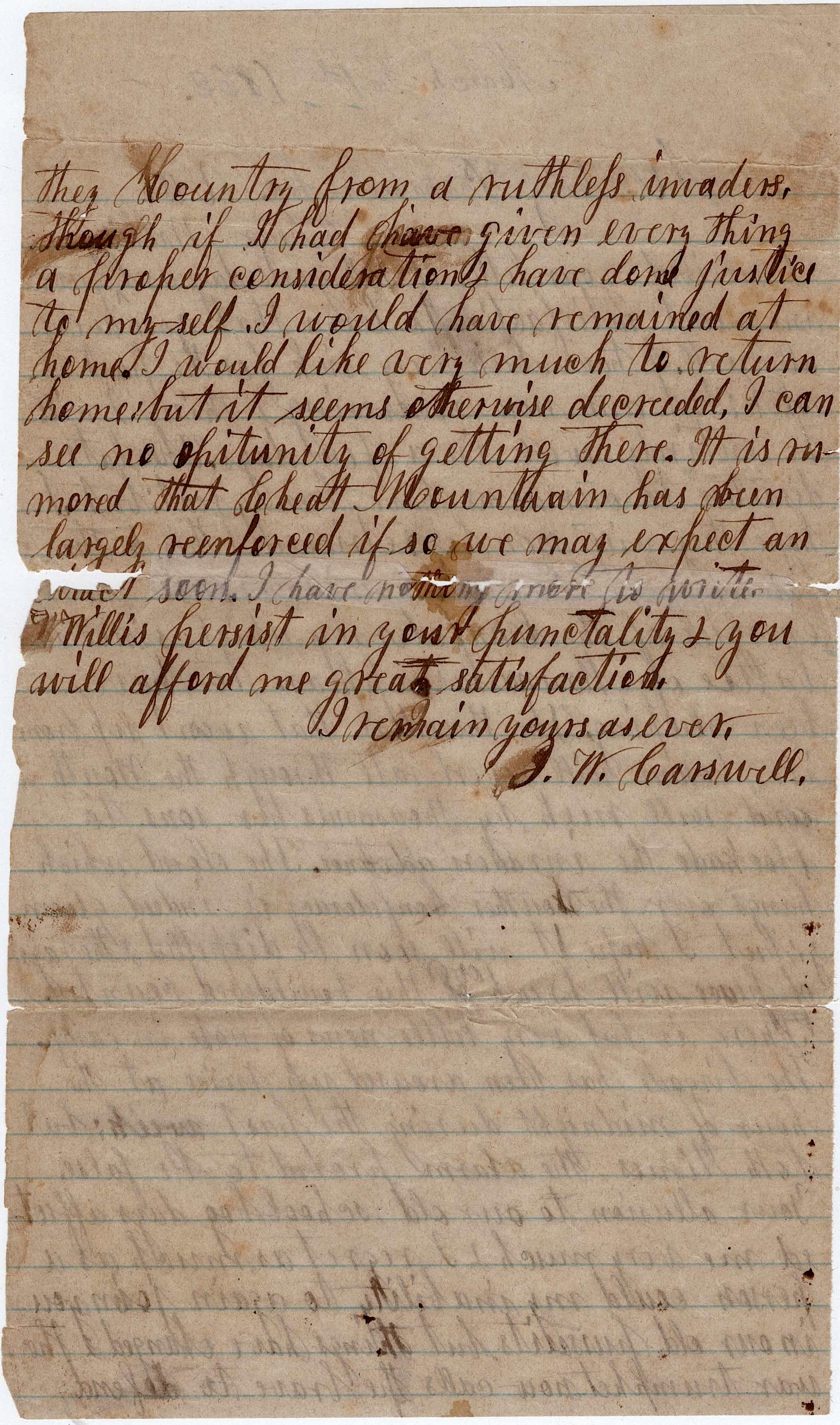
There is but little news of note in camp. The brigade has been aroused up twice at the hour of midnight during the past week but both times the alarm proved to be false. Your allusion to our old schoolboy days affected me very much. I regret as much as a person could my inability to again join you in our old pursuits but things have changed & the war trumpet now calls the brave to defend the country from a ruthless invader though if had have given everything a proper consideration & have done justice to myself, I would have remained at home. I would like very much to return home but it seems otherwise decreed, I can see no opportunity of getting there.
It is rumored that Cheat Mountain has been largely reinforced. If so, we may expect an attack soon. I have nothing more to write. Willis, persist in your punctuality & you will afford me great satisfaction. I remain yours as ever, — J. W. Carswell (1842-1904)
1 James addressed this letter to his friend Willis P. Burt (1842-1905) who enlisted with him in the Marion Guards but became seriously ill early a few weeks into his service and was discharged on disability at Camp Alleghany, Virginia, on 9 August 1861. The regimental surgeon declared Willis to be suffering from chronic rheumatism in the right hip and right leg.
Letter 14
Alleghany, Pocahontas County, Va.
March 11th 1862
Dear farther & mother,
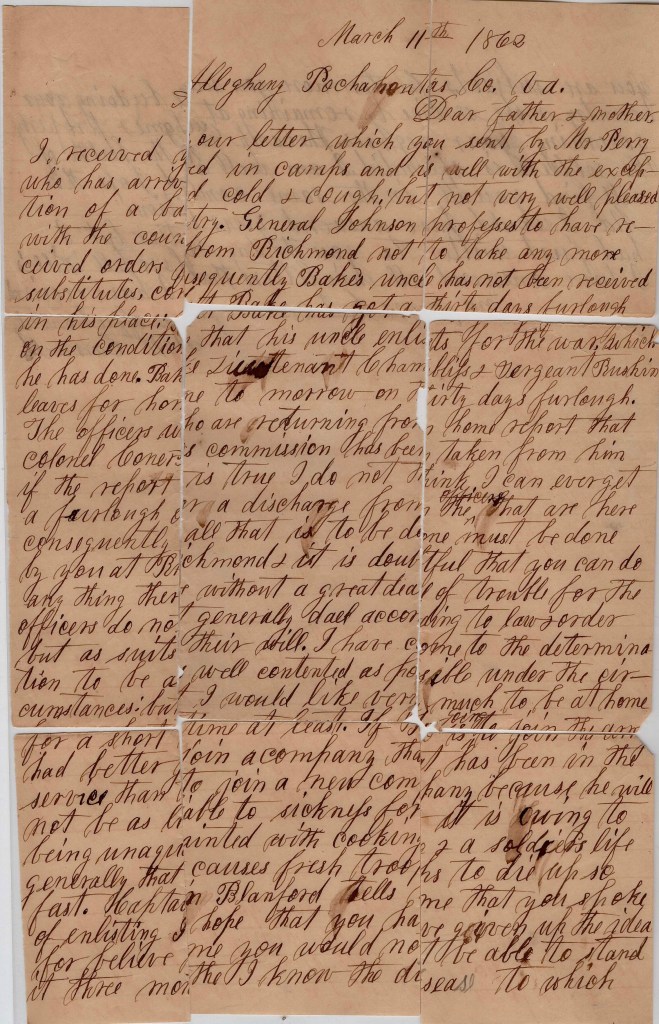
I received your letter which you sent by Mr. Perry who has arrived in camp and is well with the exception of a bad cold & cough, but not very well pleased with the country. General Johnson professes to have received orders from Richmond not to take any more substitutes. Consequently Bake’s uncle has not been received in this place but Bake [Willis Baker Perry] has got a thirty days furlough on the condition that his uncle enlists for the war which he has done. Bake, Lieut. [John] Chambliss, and Sergeant [Thomas J.] Rushin leaves for home tomorrow on thirty days furlough. The officers who are returning from home report that Colonel Conner’s commission has been taken from him. If the report is true, I do not think I can ever get a furlough or a discharge from the officers that are here. Consequently all that is to be done must be done by you at Richmond & it is doubtful that you can do anything there without a great deal of trouble for the officers do not generally deal according to law & order but as suits their will. I have come to the determination to be as well contented as possible under the circumstances. But I would like very much to be at home for a short time at least.
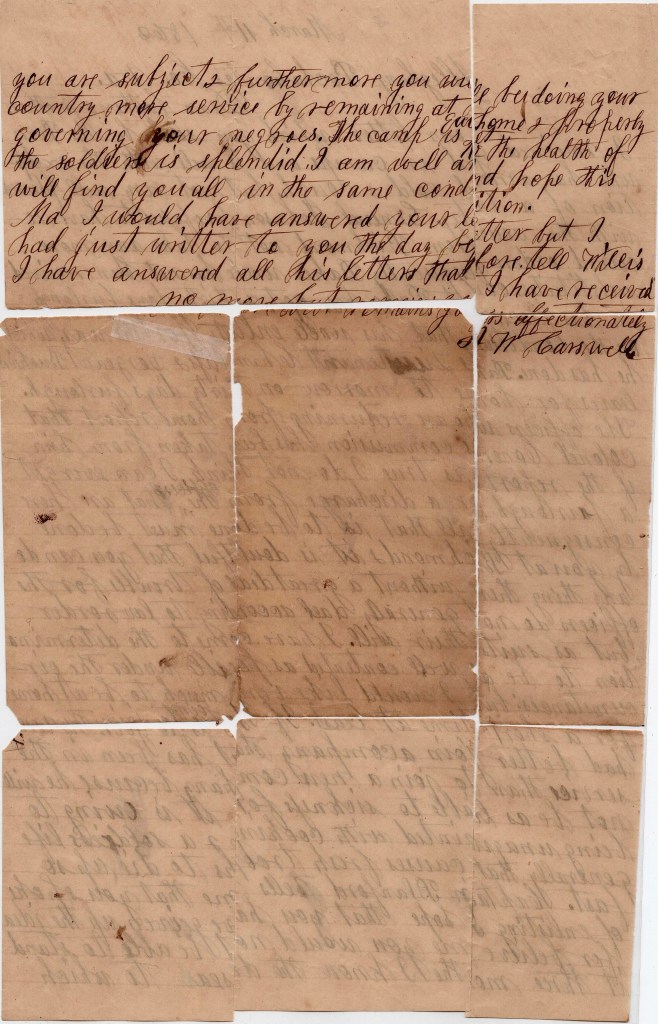
If [ ] is to join the army, he had better join a company that has been in the service than to join a new company because he will not be as liable to sickness for it is owing to being unacquainted with cooking & a soldier’s life generally that causes fresh troops to due up so fast. Captain Blanford tells me that you spoke of enlisting. I hope that you have given up the idea for believe me, you would not be able to stand it three months. I know the disease to which you are subject & furthermore you will be doing your country more service by remaining at home & properly governing your negroes.
The health of the soldiers is splendid. I am well and hope this will find you all in the same condition. Ma, I would have answered your letter but I had just written to you the day before. Tell Willis I have addressed all his letters that I have received. No more but remain yours affectionately. — J. W. Carswell
Letter 15
Alleghany, Pocahontas county, Va.
March 22, 1862
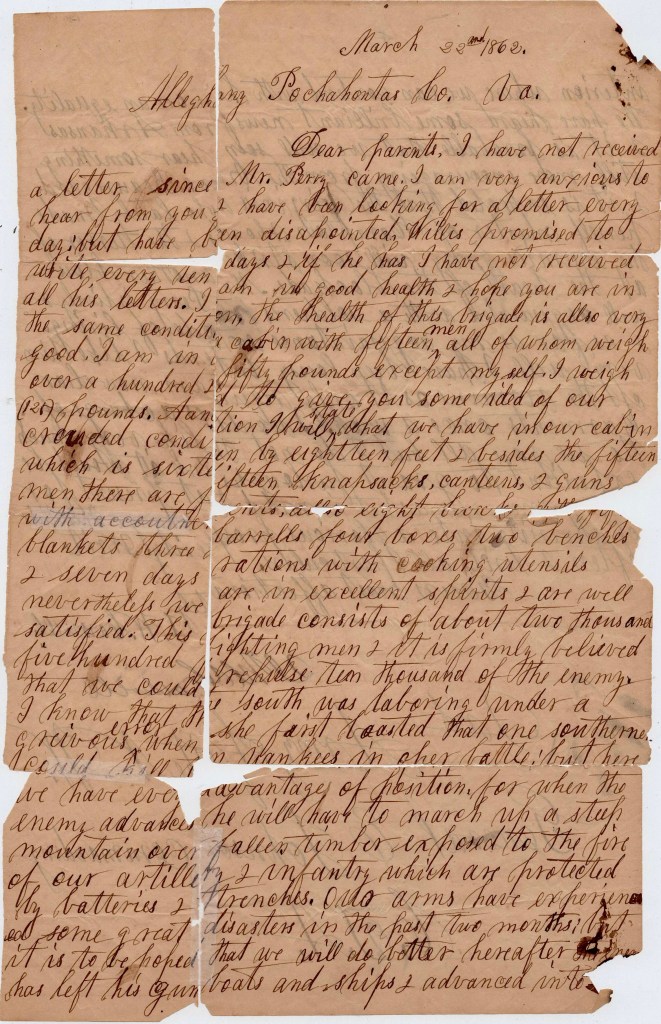
Dear Parents,
I have not received a letter since Mr. Perry came. I am very anxious to hear from you. I have been looking for a letter every day but have been disappointed. Willis [Burt] promised to write every ten days & if he has, I have not received all his letters.
I am in good health & hope you are in the same condition. The health of this brigade is also very good. I am in a cabin with fifteen men, all of whom weigh over a hundred and fifty pounds except myself. I weigh 125 pounds. And to give you some idea of our crowded condition, I will state that we have in our cabin which is sixteen by eighteen feet & besides the fifteen men there are fifteen knapsacks, canteens & guns with accoutrements. Also eight bunks with [ ] blankets, three barrels, four boxes, two benches & seven days rations with cooking utensils. Nevertheless we are in excellent spirits & are well satisfied.
This brigade consists of about two thousand, five hundred fighting men & it is firmly believed that we could repulse ten thousand of the enemy. I know that the South was laboring under a grievous error when she first boasted that one southernor could kill ten Yankees in battle, but here we have every advantage of position for when the enemy advance, he will have to march up a steep mountain over fallen timber exposed to the fire of our artillery & infantry which are protected by batteries & trenches. Our arms have experienced some great disasters in the past two months, but it is to be hoped that we will do better hereafter. The enemy has left his gunboats and ships and advanced into the interior where we can contend with him on an equality.
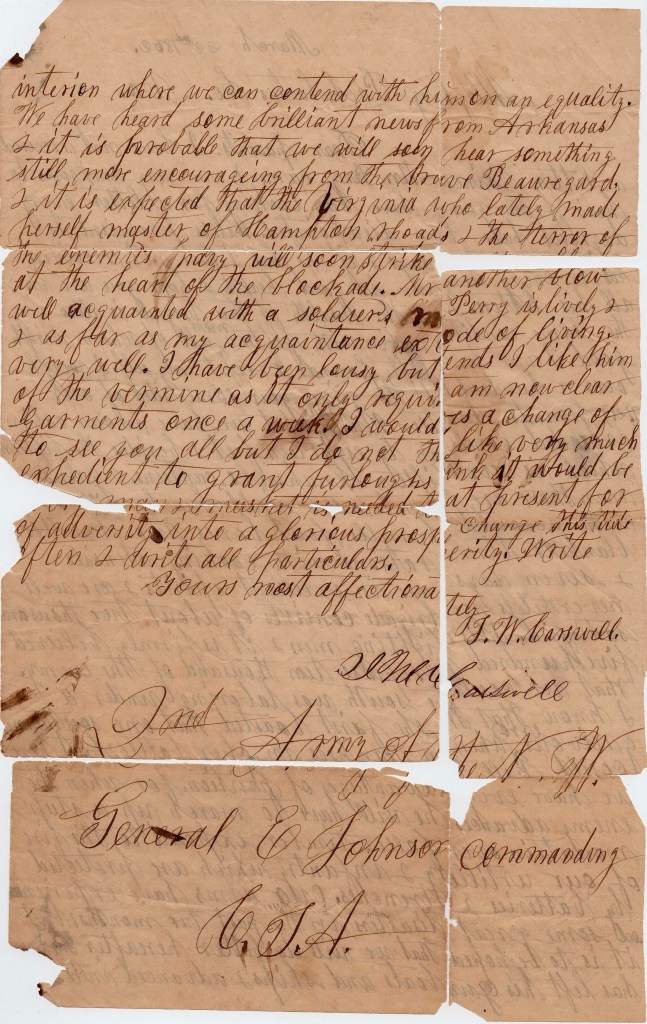
We have heard some brilliant news from Arkansas & it is probable that we will soon hear something still more encouraging from the brave Beauregard. And it is expected that the [CSS] Virginia who lately made herself master of Hampton Roads & the terror of the enemy’s Navy will soon strike another blow at the heart of the blockade.
Mr. Pery is lively & well acquainted with a soldier’s mode of living very well. I have been lousy but am now clear of the vermin as it only requires a change of garments once a week. I would like very much to see you all but I do not think it would be expedient to grant furloughs at present for every man musket is needed to change this tide of adversity into a glorious prosperity. Write often & write all particulars.
Yours most affectionately, — J. W. Carswell
2nd Army of the Northwest, General E. Johnson commanding, CSA
Letter 16
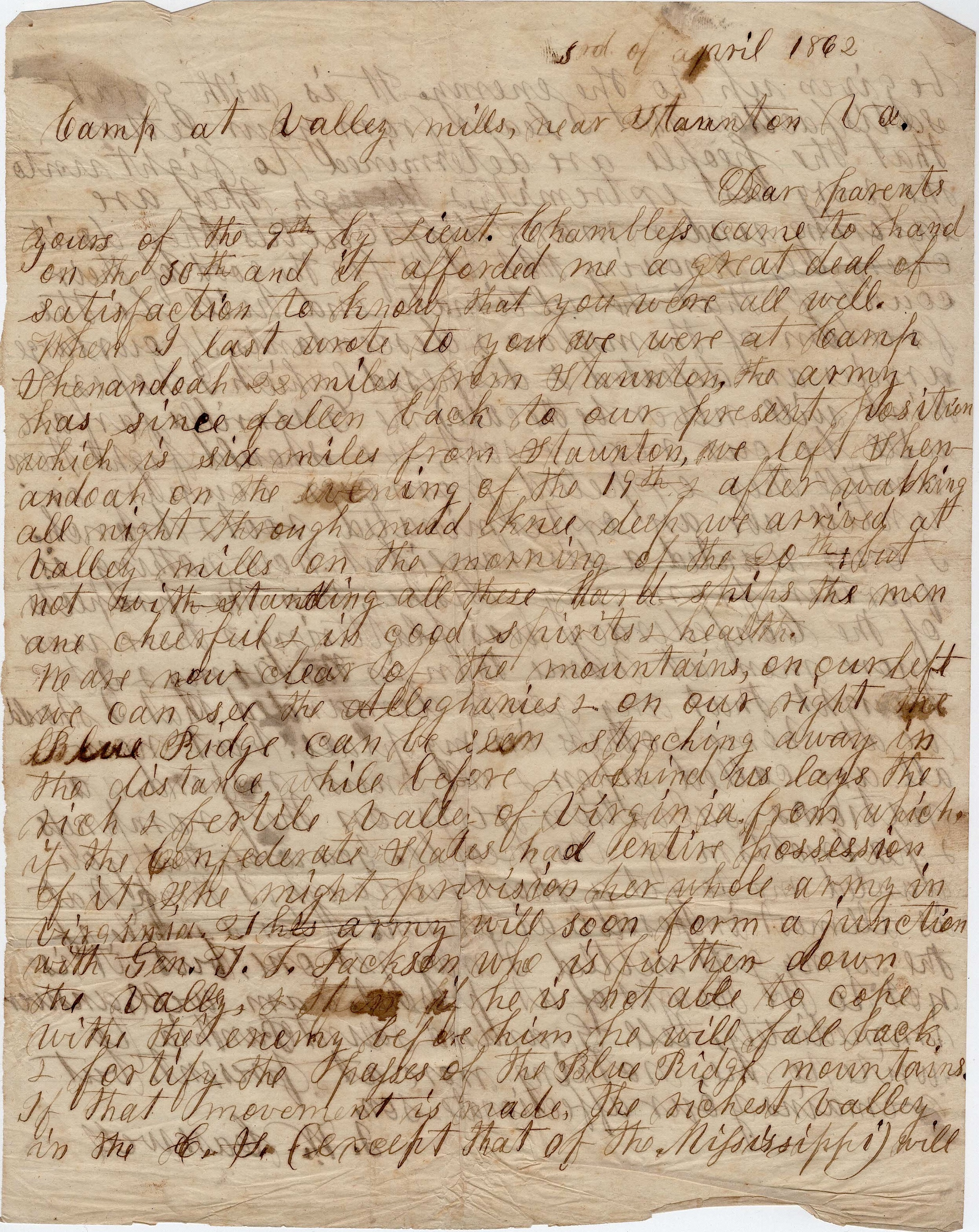
Camp at Valley Mills near Staunton, Va.
3rd of April 1862
Dear parents,
Yours of the 9th by Lieut. Chambliss came to hand on the 30th and it afforded me a great deal of satisfaction to know that you were all well.
When I last wrote to you we were at Camp Shenandoah 22 miles from Staunton. The army has since fallen back to our present position which is six miles from Staunton. We left Shenandoah on the evening of the 19th. After walking all night through mud knee deep, we arrived at Valley Mills on the morning of the 20th. But notwithstanding all these hardships, the men are cheerful & in good spirits & health.
We are now clear of the mountains. On our left we can see the Alleghanies & on our right the Blue Ridge can be seen stretching away in the distance, while before and behind us lays the rich and fertile Valley of Virginia from which, if the Confederate States had entire possession of it, she might provision her whole army in Virginia. This army will soon form a junction with Gen. T. J. [“Stonewall”] Jackson who is further down the Valley, and if he is not able to cope with the enemy before him, he will fall back & fortify the passes of the Blue Ridge mountains. If that movement is made, the richest valley in the C. S. (except that of the Mississippi) will be given up to the enemy.
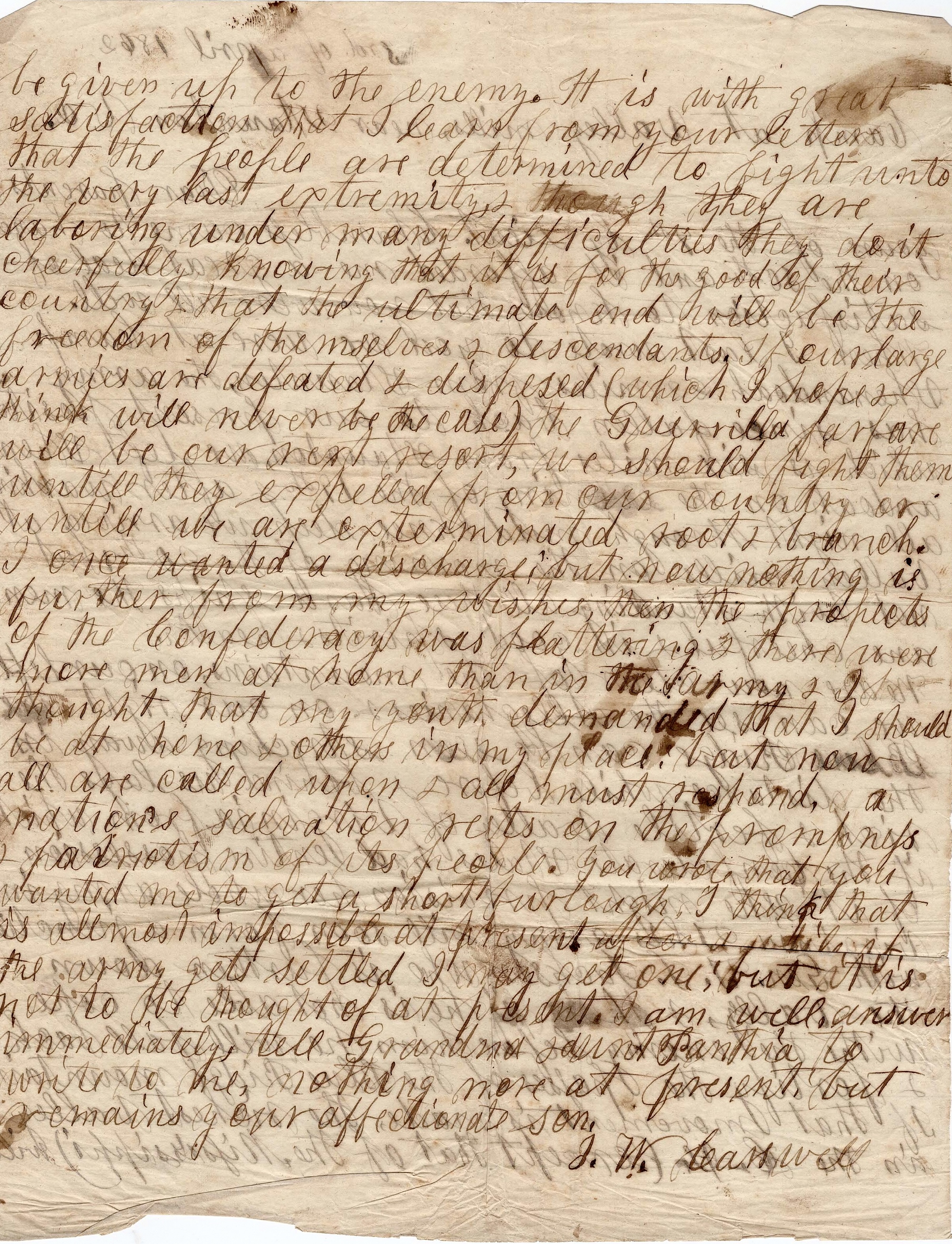
It is with great satisfaction that I learn from your letter that the people are determined to fight unto the very last extremities though they are laboring under many difficulties. They do it cheerfully knowing that it is for the good of their country & that the ultimate end will be the freedom of themselves & descendants. If our large armies are defeated & dispersed (which I hope I think will never be the case), the guerrilla warfare will be our next resort. We should fight them until they [are] expelled from our country or until we are exterminated, root & branch.
I once wanted a discharge but now nothing is further from my wishes. Then the prospects of the Confederacy was flattering & there were more men at home than in the army & I thought that my youth demanded that I should be at home & others in my place. But now all are called upon and all must respond. A Nation’s salvation rests on the promptness & patriotism of its people. You wrote that you wanted me to get a short furlough. I think that is almost impossible at present. After a while, if the army gets settled, I may get one. But it is not to be thought of at present.
I am well. Answer immediately. Tell Grandma, Aunt Panthia, to write to me. Nothing more at present but remains your affectionate son. — J. W. Carswell
Letter 17
Camp Shenandoah, Augusta county, Va.
April 18th 1862
Dear father and mother,
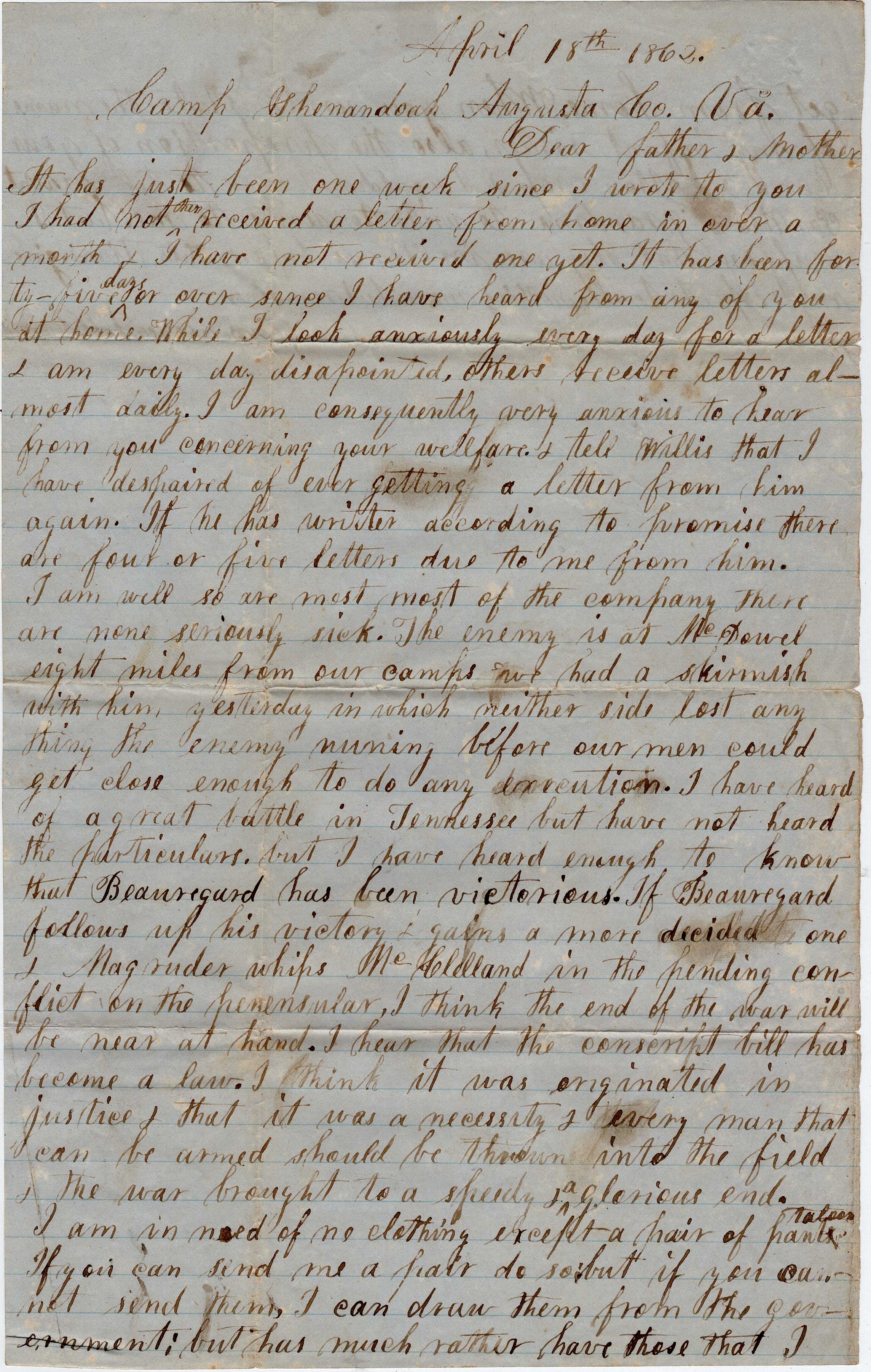
It has just been one week since I wrote to you. I had not received a letter from home in over a month & I have not received one yet. It has been 45 days or over since I have heard from any of you at home. While I look anxiously every day for a letter, I am every day disappointed. Others receive letters almost daily. I am consequently very anxious to hear from you concerning your welfare. And tell Willis that I have despaired of ever getting a letter from him again. If he has written according to promise, there are four or five letters due me from him.
I am well. So are most of the company. There are none seriously sick. The enemy is at McDowell eight miles from our camp. We had a skirmish with him yesterday in which neither side lost anything, the enemy running before our men could get close enough to do any execution. I have heard of a great battle in Tennessee [Shiloh] but have not heard the particulars buut I have heard enough to know that Beauregard has been victorious. If Beauregard follows up his victory & gains a more decided one & Magruder whips McClellan in the pending conflict on the Pensinsula, I think the end of the war will be near at hand.
I hear that the Conscript Bill has become a law. I think it was originated in justice & that it was a necessity & every man that can be armed should be thrown into the field & the war brought to a speedy & glorious end.
I am in need of no clothing except a pair of pantaloons. If you can send me a pair, do so. But if you cannot send them, I can draw them from the government but had much rather have those that I get from home. When you write, state the name of my infant sister. Also the proportion of your corn & cotton crops. And I would ask you to tell Aunt Panthia & Grandma to write to me but I suppose they are in Texas before this time. Give my respects to all. Nothing more, but remain yours as ever, — J. W. Carswell
Letter 18
Camp at Valley Mills, Augusta county, Va.
May the 5th 1862
Dear [brother] Oliver,
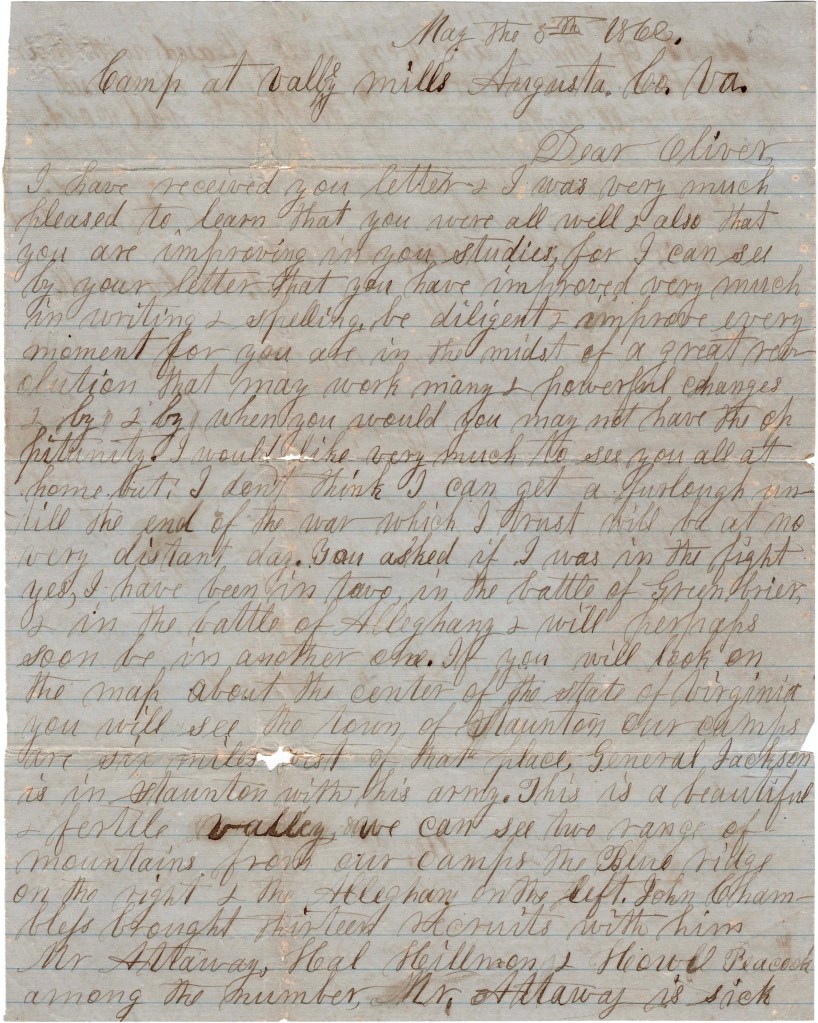
I have received your letter & I was very much pleased to learn that you were all well and also that you are improving in your studies for I can see by your letter that you have improved very much in writing and spelling. Be diligent and improve every moment for you are in the midst of a great revolution that may work many powerful changes by and by when you would you may not have the opportunity. I would like very much to see you all at home but I don’t think I can get a furlough until the end of the war which I trust will be at no very distant day.
You asked if I was in the fight. Yes, I have been in two—in the Battle of Greenbrier and in the Battle of Alleghany, and will perhaps soon be in another one. If you will look on the map about the center of the State of Virginia, you will see the town of Staunton. Our camps are six miles west of that place. General Jackson is in Staunton with his army. This is a beautiful and fertile valley. We can see two range of mountains from our camps—the Blue RIdge on the right and the Alleghany on the left. John Chambliss brought thirteen recruits with him—Mr. [William R.] Attaway, [Henry William] Hal Hilimon, & [Robert] Howell Peacock among the number. Mr. Attaway is sick.Most of them are very well pleased with their situation while others very much displeased. I am well with the exception of a bad cold.
Write as soon as you get this & state what you are studying. Also how far you have progressed. I have nothing more at present but remain your affectionate brother, — J. W. Carswell
Letter 19
Camp on road Augusta county, Va.
May 16th 1862
Dear parents,
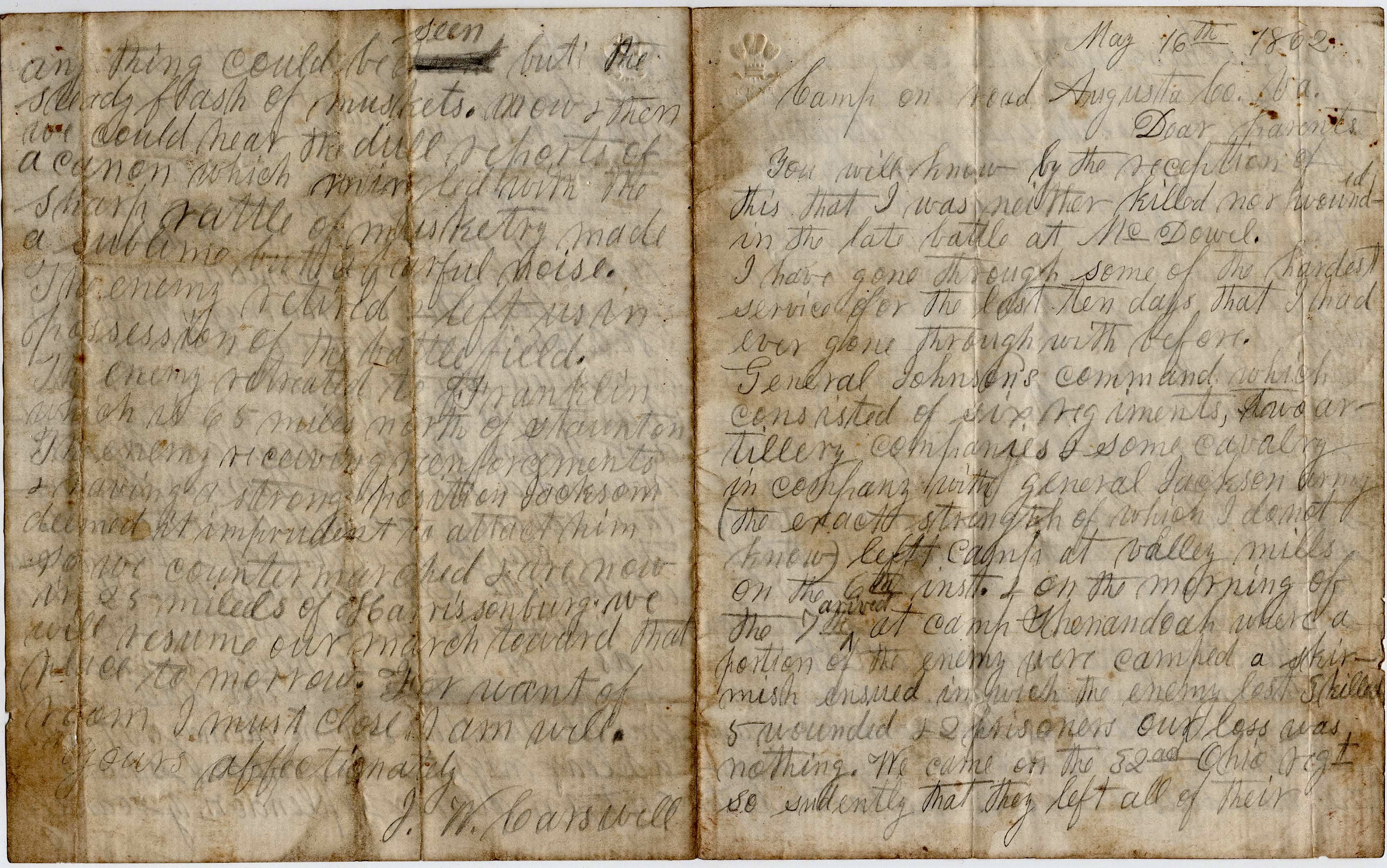
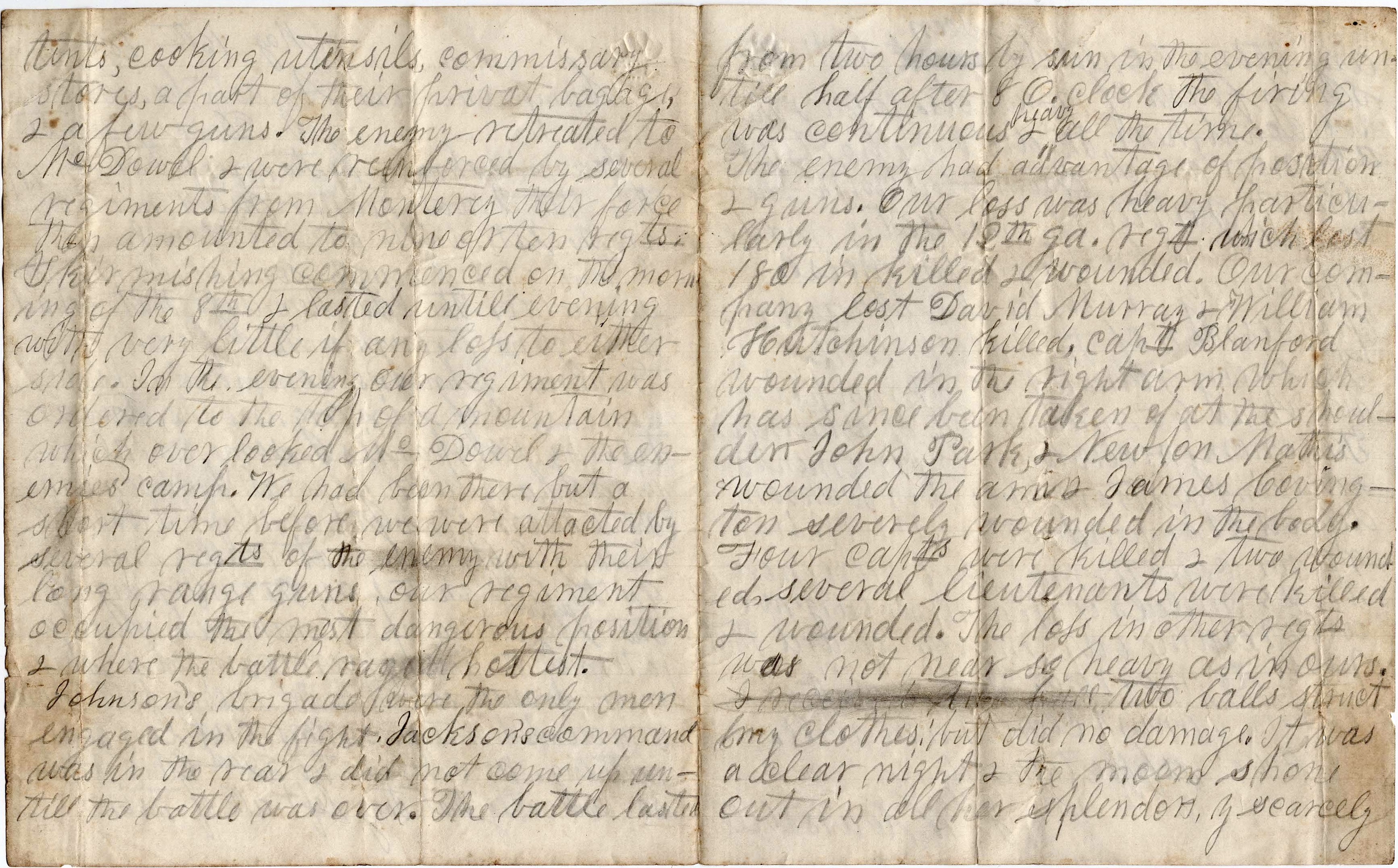
You will know by the reception of this that I was neither killed nor wounded in the late battle at McDowell. I have gone through some of the hardest service for the last ten days that had ever gone through with before.
General Johnson’s command which consisted of six regiments, two artillery companies, & some cavalry in company with General Jackson’s army (the exact strength of which I do not know) left camp at Valley Mills on the 6th inst. & on the morning of the 7th, arrived at Camp Shenandoah where a portion of the enemy were camped. A skirmish ensued in which the enemy lost 3 killed, 5 wounded & 2 prisoners. Our loss was nothing. We came on the 32nd Ohio Regiment so suddenly that they left all of their tents, cooking utensils, commissary stores, a part of their private baggage, and a few guns. The enemy retreated to McDowell & were reinforced by several regiments from Monterey. Their force then amounted to nine or ten regiments.
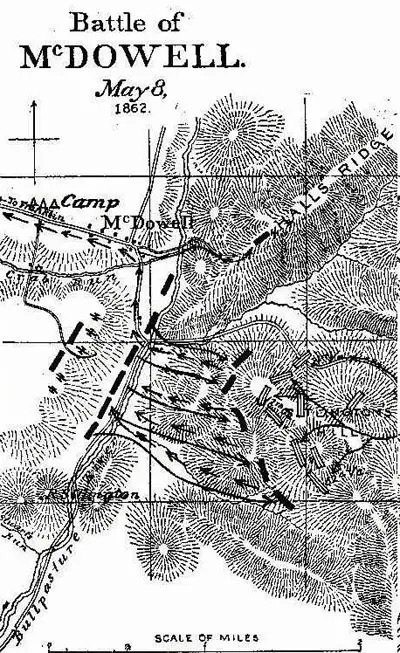
Skirmishing commenced on the morning of the 8th and lasted until evening with very little if any loss to either side. In the evening, our regiment was ordered to the top of a mountain which overlooked McDowell & the enemy’s camp. We had been there but a short time before we were attacked by several regiments of the enemy with their long range guns. Our regiment occupied the most dangerous position & where the battle raged hottest.
Johnson’s brigade were the only men engaged in the fight. Jackson’s command was in the rear & did not come up until the battle was over. The battle lasted from two hours by sun in the evening until after 8 o’clock. The firing was continuous & heavy all the time. The enemy had advantage of position & guns. Our loss was heavy, particularly in the 12th Georgia Regiment which lost 180 in killed & wounded. Our company lost David Murray & William Hutchinson killed, Capt. Blanford wounded in the right arm which has since been taken off at the shoulder, John Park & Newton Mathis wounded [in] the arms, James Covington severely wounded in the body. Four captains were killed & two wounded. Several lieutenants were killed & wounded. The loss in other regiments was not near so heavy as in ours. Two balls struck my clothes but did no damage.
It was a clear night & the moon shone out in all her splendor & scarcely anything could be seen but the steady flash of muskets. Now & then we could hear the dull reports of a cannon which mingled with the sharp rattle of musketry made a sublime but a fearful noise. The enemy retired & left us in possession of the battlefield. The enemy retreated to Franklin which is 65 miles north of Staunton. The enemy receiving reinforcements & having a stronger position, Jackson deemed it prudent [not] to attack him so we countermarched & are now in 25 miles of Harrisonburg. We will resume our march toward that place tomorrow. For want of room, I must close. I am well. Yours affectionately, — J. W. Carswell
Letter 20
[Note: Carwell datelined this letter May 12th but it was most certainly written on June 12, 1862. The deaths of his comrades mentioned in this letter confirm that it was June, not May.]
Camp on road Augusta County, Va.
May [June] 12th 1862
Dear parents,
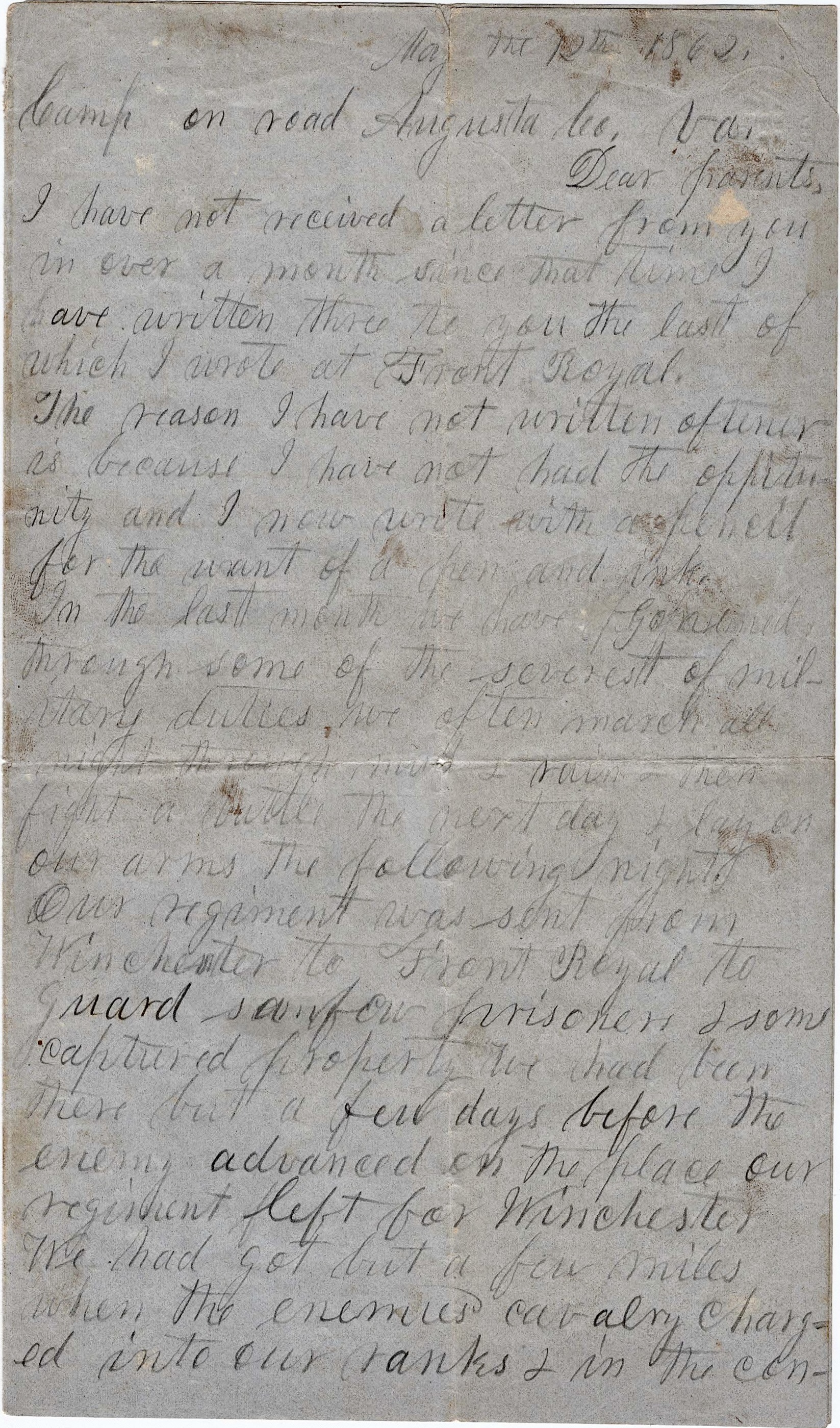
I have not received a letter from you in over a month. Since that time I have written three to you, the last of which I wrote at Front Royal. The reason I have not written oftener is because I have not had the opportunity and I now write with a pencil for the want of a pen and ink.
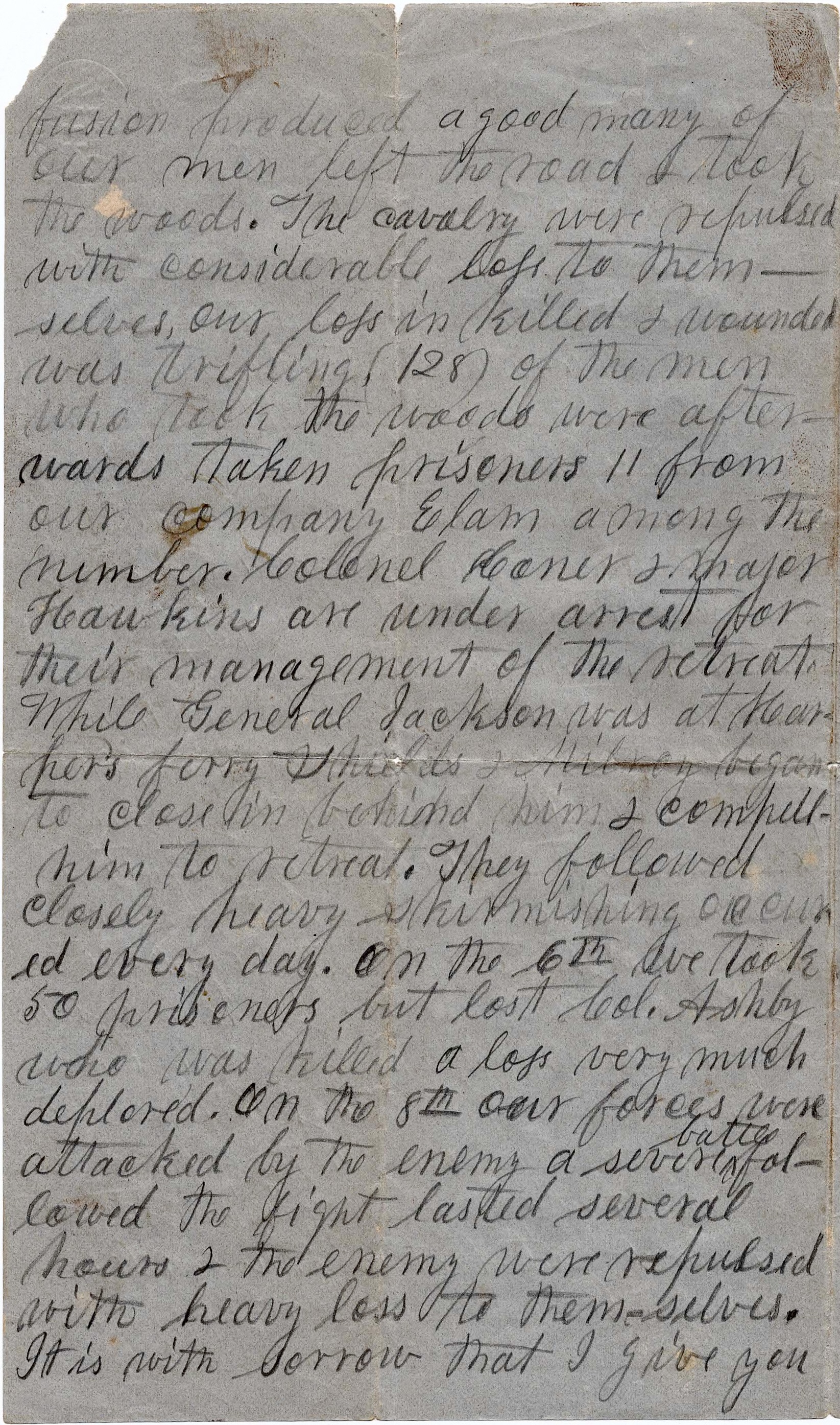
In the last month we have gone through some of the severest of military duties. We often march all night through mud & rain & then fight a battle the next day & lay on our arms the following night. Our regiment was sent from Winchester to Front Royal to guard some few prisoners and some captured property. We had been there but a few days before the enemy advanced on the place. Our regiment left for Winchester. We had got but a few miles when the enemy’s cavalry charged into our ranks & in the confusion produced, a good many of our men left the road & took the woods. The cavalry were repulsed with considerable loss to themselves. Our loss in killed & wounded was trifling (128). Of the men who took the woods were afterwards taken prisoner, 11 from our company—[William D.] Elam among the number. Colonel [Z. T.] Conner & Major [Willis A.] Hawkins are under arrest for their management of the retreat.
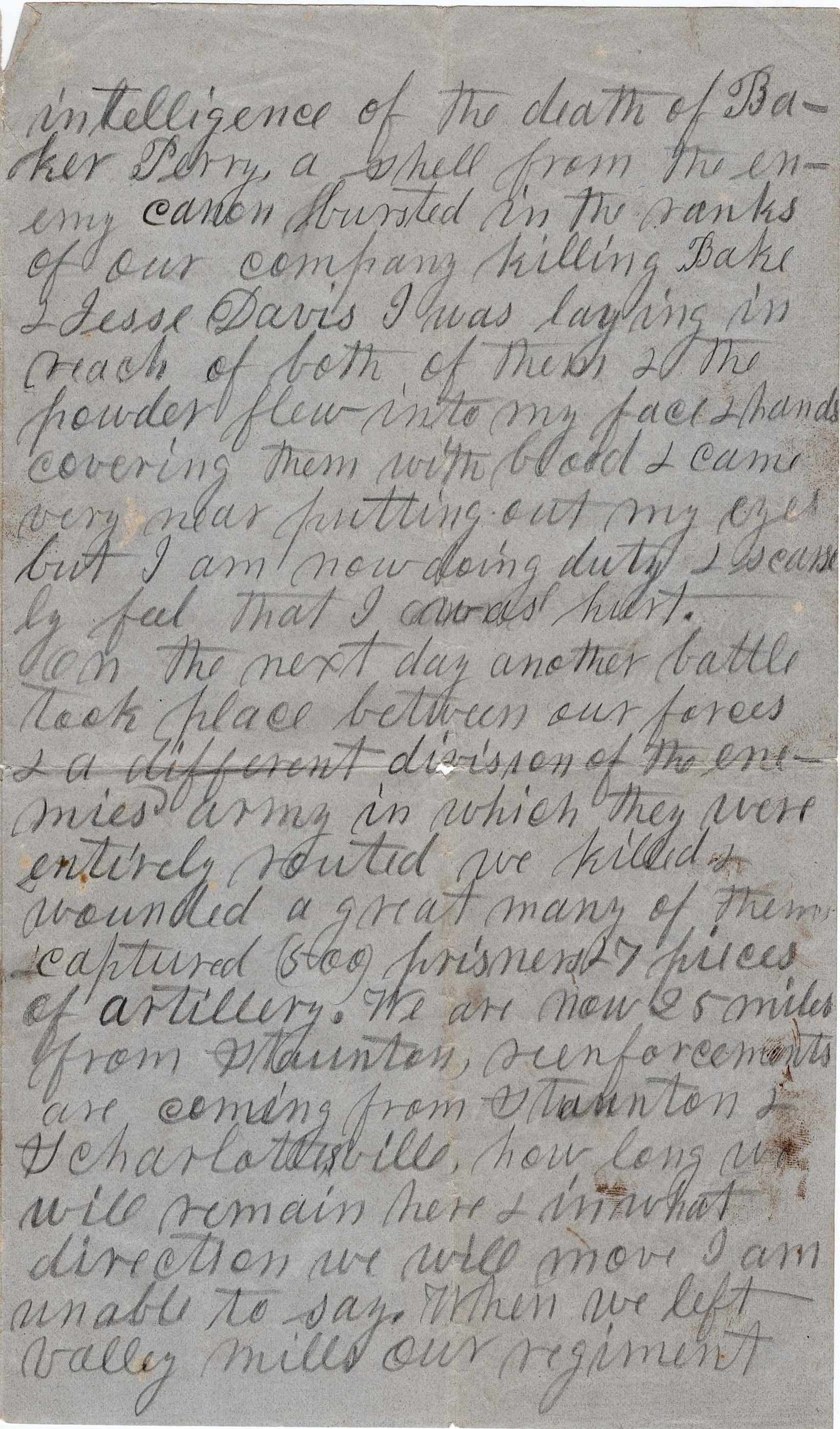
Was General Jackson was at Harper’s Ferry, Shields & Milroy began to close in behind him & compelled him to retreat. They followed closely—heavy skirmishing occurred every day. On the 6th we took 50 prisoners but lost Col. Ashby who was killed—a loss very much deplored. On the 8th our forces were attacked by the enemy and several battles followed. The fight lasted several hours & the enemy were repulsed with heavy loss to themselves. It is with sorrow that I give you intelligence of the death of [Willis] Baker Perry. A shell from the enemy cannon bursted in the ranks of our company killing Bake & Jesse Davis. 1 I was laying in reach of both of them & the powder flew into my face & hands, covering them with blood & came very near putting out my eyes. But I am now doing duty & scarcely feel that I was hurt.
On the next day another battle took place between our forces & a different division of the enemy’s army in which they were entirely routed. We killed & wounded a great many of them, captured 500 prisoners & 7 pieces of artillery.
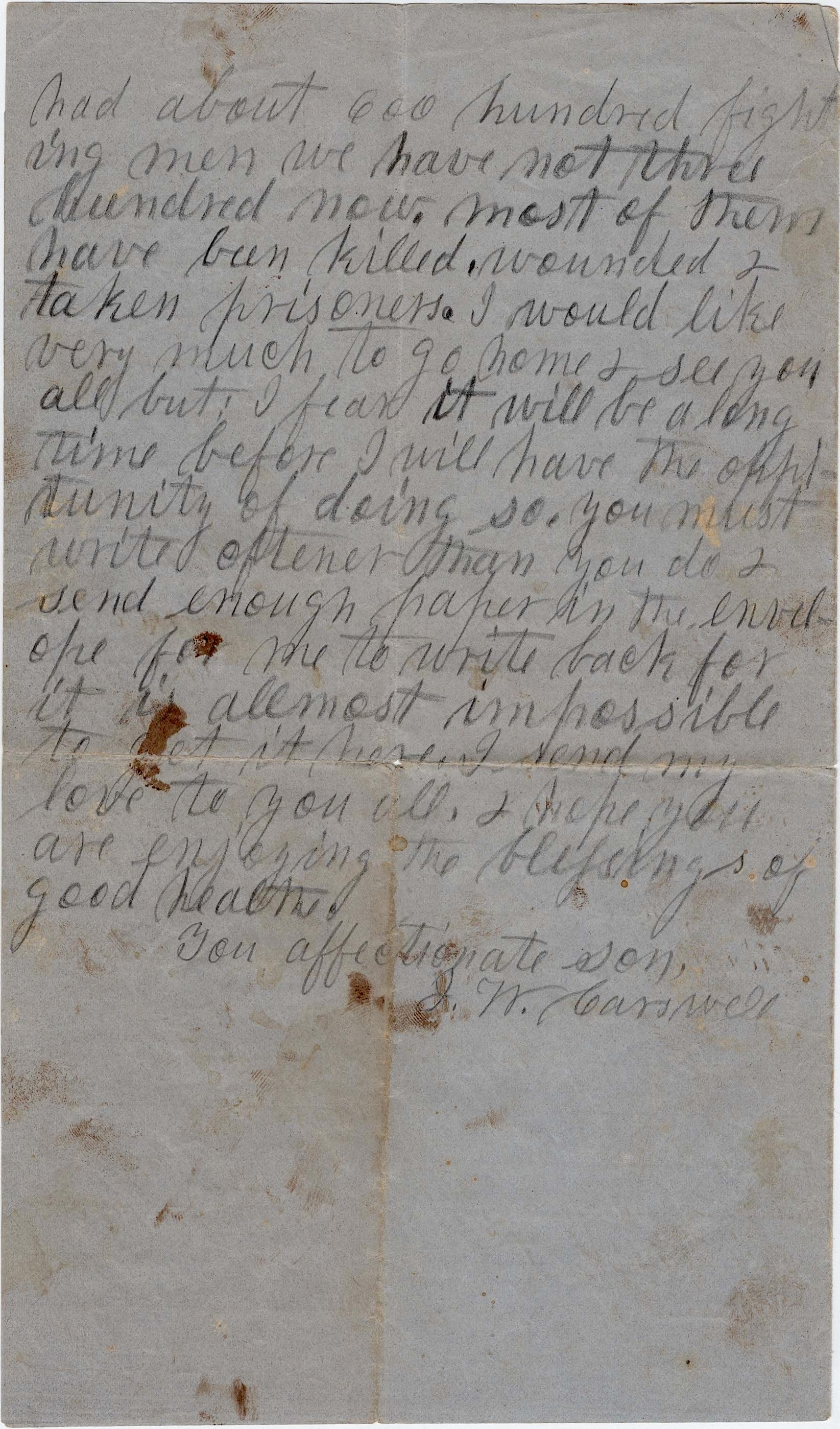
We are now 25 miles from Staunton. Reinforcements are coming from Staunton & Charlottesville. How long we will remain here & in what direction we will move, I am unable to say. When we left Valley Mills, our regiment had about 600 fighting men. We have not three hundred now. Most of them have been killed, wounded & taken prisoners. I would like very much to go home & see you all but I fear it will be a long time before I will have the opportunity of doing so. You must write oftener than you do & send enough paper in the envelope for me to write back for it is almost impossible to get it here.
I send my love to you all. I hope you are enjoying the blessings of good health. Your affectionate son, — J. W. Carswell
1 Willis Baker and Jesse Davis were killed at Port Republic on 9 June 1862.
Letter 21
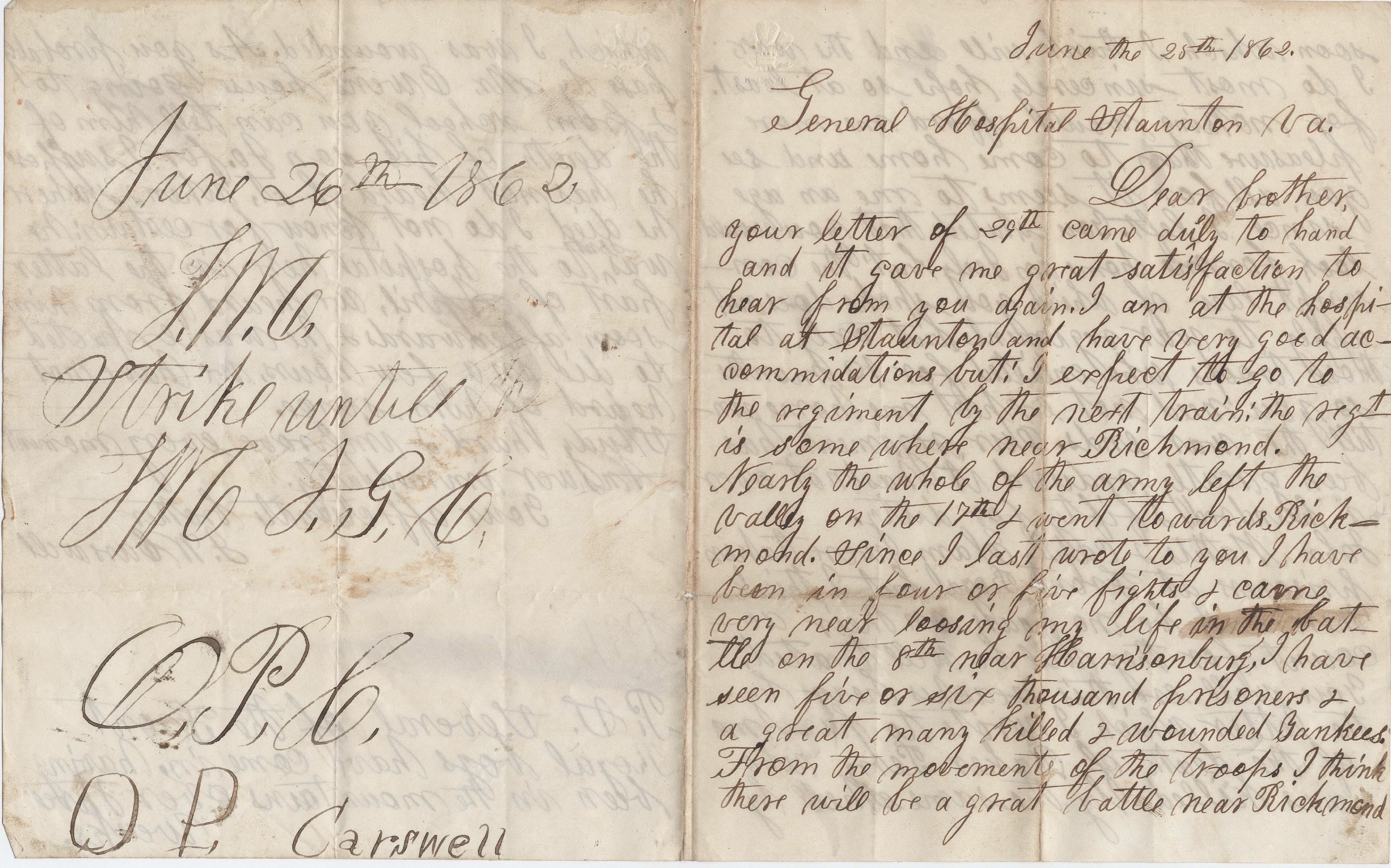
General Hospital, Staunton, Va.
June the 25th, 1862
Dear brother [Oliver],
Your letter of 29th came duly to hand and it gave me great satisfaction to hear from you again. I am at the hospital at Staunton and have very good accommodations but I expect to go to the regiment by the next train. The regiment is somewhere near Richmond. Nearly the whole of the army left the Valley on the 17th & went towards Richmond.
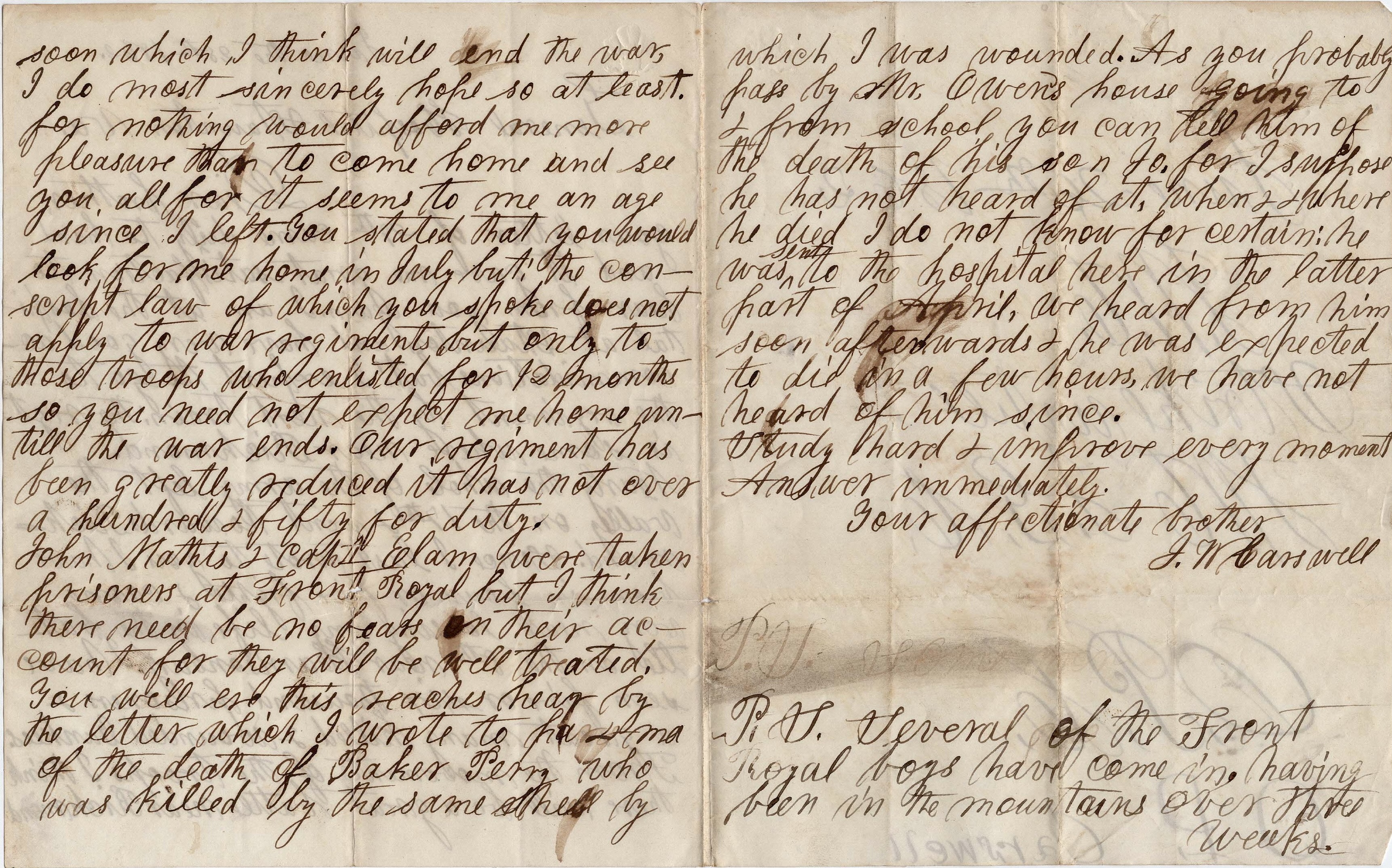
Since I last wrote to you I have been in four or five fights & came very near losing my life in the Battle of [Cross Keys on] the 8th [June] near Harrisonburg. I have seen five or six thousand prisoners & a great many killed & wounded Yankees. From the movement of the troops, I think there will be a great battle near Richmond soon which I think will end the war. I do most sincerely hope so at least for nothing would afford me more pleasure than to come home and see you all for it seems to me an age since I left.
You stated that you would look for me home in July but the Conscript Law of which you spoke does not apply to war regiments, but only to those troops who enlisted for 12 months so you need not expect me home until the war ends. Our regiment has been greatly reduced. It has not over a hundred and fifty for duty. John Mathis & Capt. Elam were taken prisoners at Front Royal but I think there need be no fears on their account for they will be well treated. You will ere this reaches hear by the letter which I wrote to pa and ma of the death of Baker Perry who was killed by the same shell by which I was wounded.
As you probably pass by Mr. Owen’s house going to and from school, you can tell him of the death of his son Jo for I suppose he has not heard of it. When & where he died, I do not know for certain. He was sent to the hospital here in the latter part of April. We heard from him soon afterwards & he was expected to die in a few hours. We have not heard of him since.
Study hard & improve every moment. Answer immediately. Your affectionate brother, — J. W. Carswell
P. S. Several of the Front Royal boys have come in having been in the mountains over three weeks.
Letter 22
Camp in Charles City County, Va.
July 7th 1862
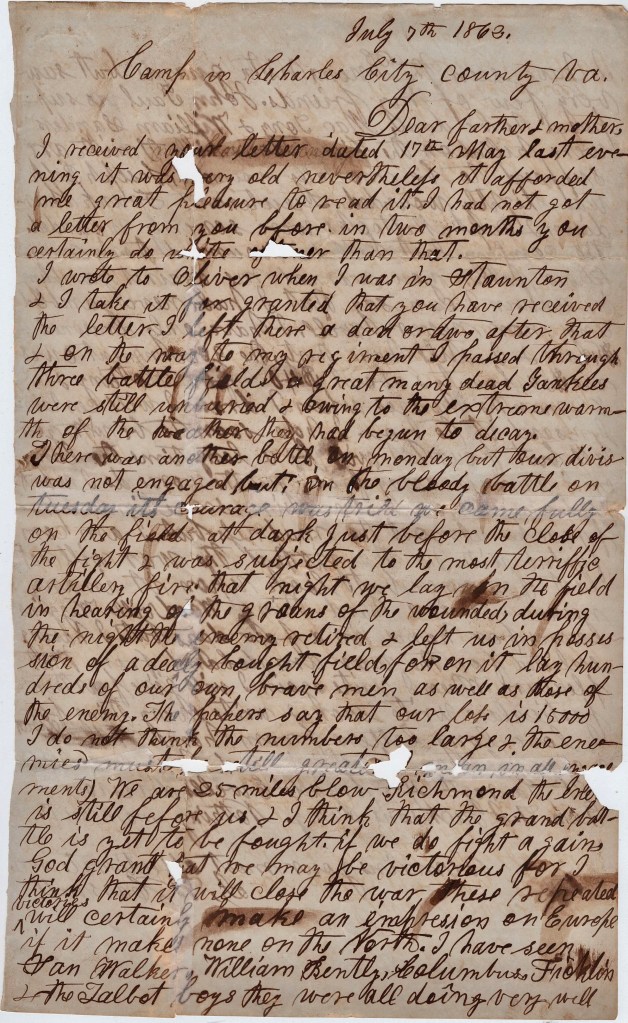
Dear father & mother,
I received your letter dated 17th May last evening. It was very old. Nevertheless it afforded me great pleasure to read it. I had not got a letter from you before in two months. You certainly so write oftener than that.
I wrote to Oliver when I was in Staunton & I take it for granted that you have received the letter. I left there a day or two after that & on the way to my regiment I passed through three battlefields. A great many dead Yankees were still unburied & owing to the extreme warmth of the weather, they had begun to decay. There was another battle on Monday but our division was not engaged but in the bloody battle on Tuesday its courage was tried. We came fully on the field [at Malvern Hill] at dark just before the close of the fight & was subjected to the most terrific artillery fire that night. We lay on the field in hearing of the groans of the wounded. During the night the enemy retired & left us in possession of a dearly bought field for on it lay hundreds of our own brave men as well as those of the enemy. The papers say that our loss is 15,000. I do not think the numbers too large & the enemy’s must be still greater [illegible].
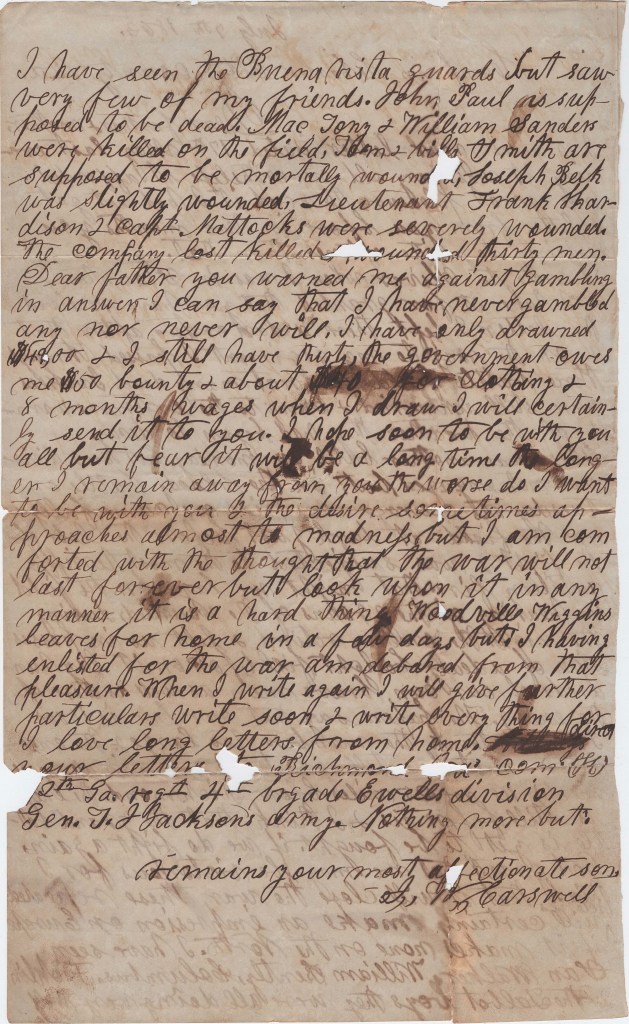
We are 25 miles below Richmond. The enemy is still before us & I think that the grand battle is yet to be fought. If we do fight again, God grant that we may be victorious for I think that it will close the war. These repeated victories will certainly make an impression on Europe if it makes none on the North. I have seen Sam Walker, William Bently, Columbus Ficklin, & the Talbot boys. They were all doing very well. I have seen the Buena Vista Guards but saw very few of my friends. John Paul is supposed to be dead. Mac Tony & Willim Sanders were killed on the field. Tom & Bill Smith are supposed to be mortally wounded. Joseph Belk was slightly wounded. Lieutenant Frank Hardison & Capt. Mattocks were severely wounded. The company lost killed & wounded thirty men.
Dear father, you warned me against gambling. In answer I can say that I have never gabled any nor never will. I have only drawed $49 & I still have thirty. The government owes me $50 bounty and about $40 for cloting & 8 months wages. When I draw, I will certainly send it to you. I hope soon to be with you all but fear it will be a long time. The longer I remain away from you the worse do I want to be with you & the desire sometimes approaches almost to madness. But I am comforted with the thought that the war will not last forever but look upon it in any manner, it is a hard thing.
Woodville Wiggins leaves for home in a few days but I, having enlisted for the war, am debarred from that pleasure. When I write again, I will give further particulars. Write soon and write everything for I love long letters from home. Your letters to Richmond now come to the 12th Ga. Regt., 4th Brigade, Ewell’s Division, Gen. T. J. Jackson’s army. Nothing more but remain your most affectionate son, — J. W. Carswell
Letter 23
Camp 7 miles north of Gordonsville, Va.
August 5th 1862
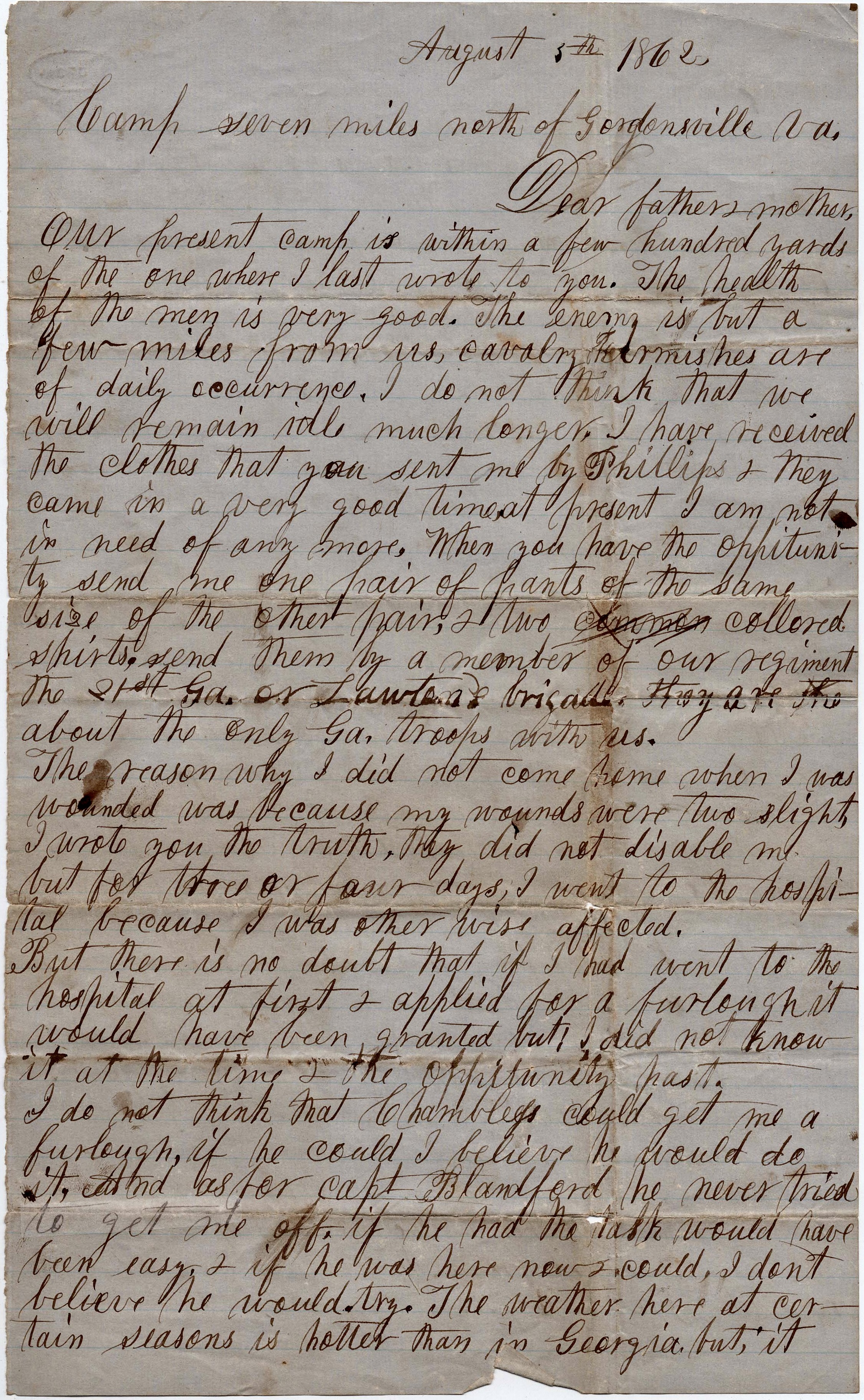
Dear father & mother,
Our present camp is within a few hundred yards of the one where I last wrote to you. The health of the men is very good, The enemy is but a few miles from us. Cavalry skirmishes are of daily occurrence. I do not think that we will remain idle much longer.
I have received the clothes that you sent me by Phillips & they came in a very good time. At present I am not in need of any more. When you have the opportunity to send me one pair of pants of the same size as the other pair, & two colored shirts, send them by a member of our regiment. The 21st Georgia, or Lawton’s Brigade—they are about the only Georgia troops with us.
The reason why I did not come home when I was wounded was because my wounds were too slight. I wrote you the truth. They did not disable me but for three or four days. I went to the hospital because I was otherwise affected. But there is no doubt that if I had went to the hospital at first & applied for a furlough, it would have been granted. But I did not know it at the time & the opportunity passed. I do not think that Chambliss would get me a furlough. If he could, I believe he would do it. And as for Capt. Blandford, he never tried to get me off. If he had, the task would have been easy & if he was here now & could, I don’t believe he would try.
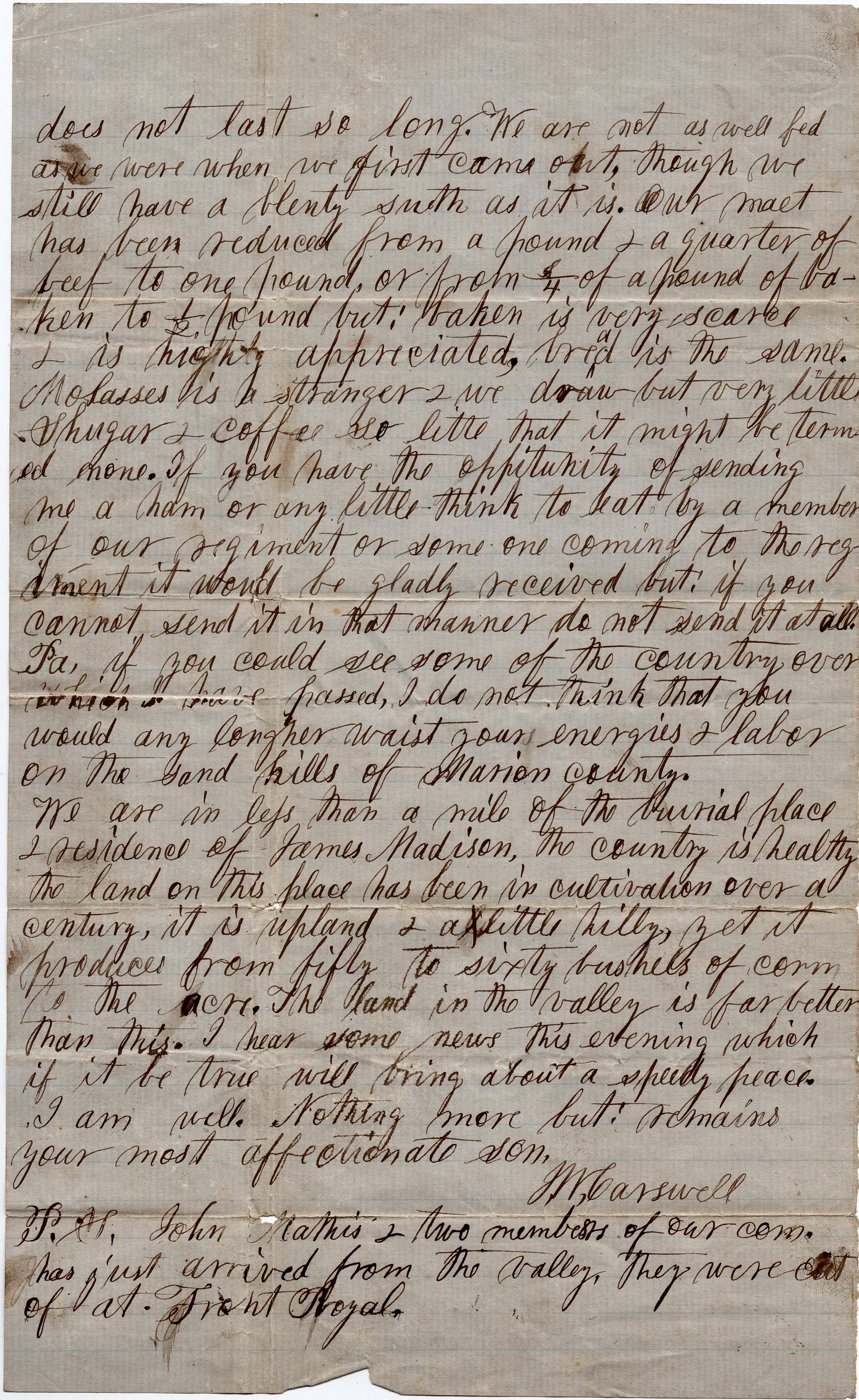
The weather here at certain seasons is hotter than in Georgia but it does not last so long. We are not as well fed as we were when we first came out though we still have plenty, such as it is. Out meat has been reduced from a pound and a quarter of beef to one pound or from 3/4th of a pound of bacon to half pound, but bacon is very scarce and is highly appreciated. Bread is the same. Molasses is a stranger & we draw but very little sugar & coffee—so little that it might be termed none. If you had the opportunity of sending me a ham or any little thing to eat by a member of our regiment or someone coming to the regiment, it would be gladly received. But if you cannot send it in that manner, do not send it at all. Pa, if you could see some of the country over which I have passed, I do not think that you would any longer waste your energy & labor on the sand hills of Marion County.
We are in less than a mile of the burial place & residence of James Madison. The county is healthy. The land on this place has been in cultivation over a century, It is upland & a little hilly, yet it produces from fifty to sixty bushels of corn to the acre. The land in the Valley is far better than this. I hear some news this evening which if it is true will bring about a speedy peace. I am well. Nothing more but remain your most affectionate son, — J. W. Carswell
P. S. John Mathis & two members of our company have just arrived from the Valley. They were cut off at Front Royal.
Letter 24
Camp 7 miles north of Gordonsville, Va.
August 14th 1862
Dear parents,
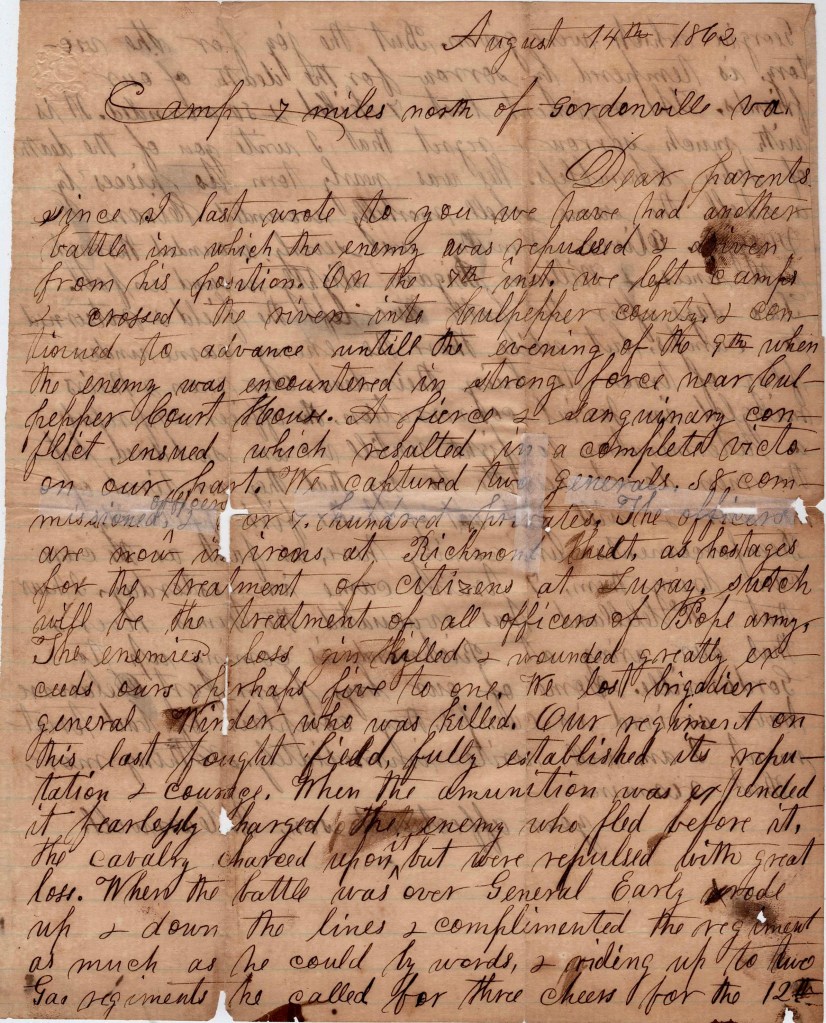
Since I last wrote to you we have had another battle in which the enemy was repulsed & driven from his position. On the 7th instant, we left camp and crossed the river into Culpeper county & continued to advance until the evening of the 9th when the enemy was encountered in strong force near Culpeper Court House. A fierce & sanguinary conflict ensued which resulted in a complete victory on our part. [see Battle of Cedar Mountain, or Slaughter’s Mountain] We captured two generals, 58 commissioned officers, & 6 or 7 hundred privates. The officers are now in irons at Richmond held as hostages for the treatment of citizens at Luray. Such will be the treatment of all officers of Pope’s army. The enemy’s loss in killed & woundeed greatly exceeds ours—perhaps five to one. We lost Brigadier General Winder who was killed. Our regiment on this last fought field fully established its reputation & courage. When the ammunition was expended, it fearlessly charged the enemy who fled before it. The cavalry charged upon it, but were repulsed with great loss.
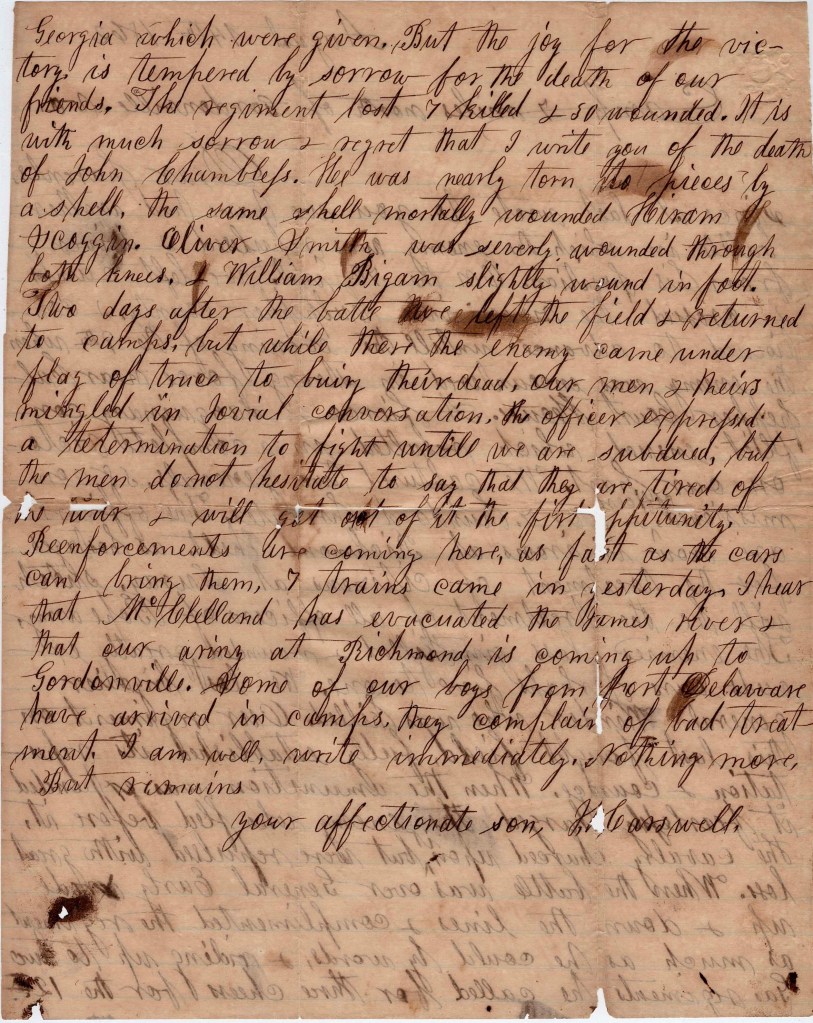
When the battle was over, General Early rode up and down the line & complimented the regiment as much as he could by words, & riding up to two Georgia regiments he called for three cheers for the 12th George which were given. But the joy for the victory is tempered by sorrow for the death of our friends. The regiment lost 7 killed and 30 wounded. It is with much sorrow & regret that I write you of the death of John Chambliss. He was nearly torn to pieces by a shell. The same shell mortally wounded Hiram Scoggins. Oliver Smith was severely wounded through both knees & William Bigham slightly wounded in the foot.
Two days after the battle, we left the field and returned to camps but while there, the enemy came under flag of truce to bury their dead. Our men & theirs mingled in jovial conversation. The officer expressed a determination to fight until we were subdued, but the men do not hesitate to say that they are tired of the war & will get out of it the first opportunity. Reinforcements are coming here as fast as the cars can bring them. Seven trains came in yesterday. I hear that McClellan has evacuated the James river & that our army at Richmond is coming up to Gordonsville. Some of our boys from Fort Delaware have arrived in camp. They complain of bad treatment.
I am well. Write immediately. Nothing more but remain your affectionate son, — J. W. Carswell
 Spared & Shared 23