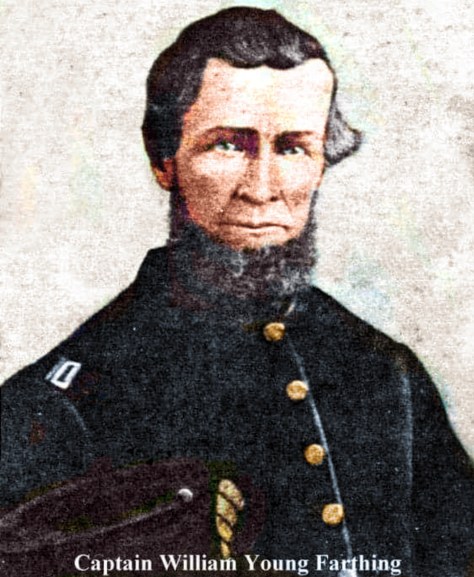
The following letter was penned by Paul Farthing (1821-1865), the son of Rev. William Watkins Farthing (1782-1827) and Polly Halliburton (1784-1844) hailing from Watauga County, North Carolina. At the age of 40, Paul was a farmer who enlisted in the 37th North Carolina Infantry on September 18, 1861. Just two months later, he received a commission as 1st Lieutenant of Company E—known as the “Watauga Minute Men”—under the command of his relative, Captain William Young Farthing. He was discharged on April 16, 1862, approximately a month after this letter was composed. Subsequently, he served as a sergeant in Company A of the 11th North Carolina Home Guard, ultimately being captured in North Carolina in mid-February 1865. As a prisoner of war, he was transported west to Chattanooga, then north to Louisville, and finally further north to Camp Chase, where he met his death in April 1865.
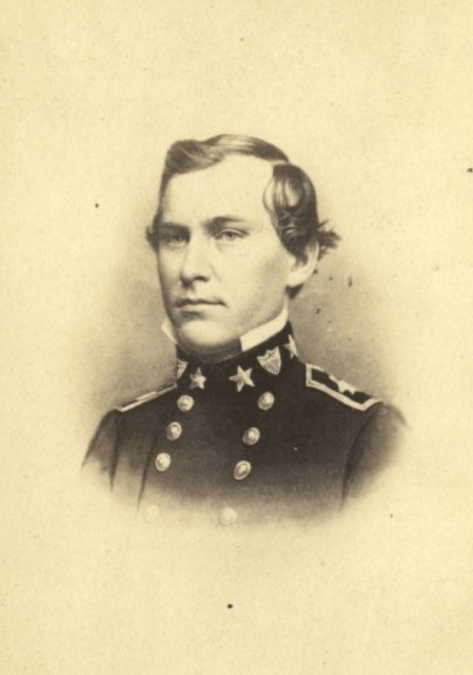
Lawrence O’Bryan Branch
Due to the absence of the captain, 1st Lieutenant Paul Farthing assumed command of Company E during the Battle of New Bern, which occurred on 14 March 1862. In his correspondence, Farthing recounts the events of the battle, revealing that Brigadier General Lawrence O’Bryan Branch sought to reinforce a weakened segment of the Confederate line by deploying part of the 37th North Carolina. Farthing’s reflections on the discussions and his profound hesitation to comply with Branch’s directive to essentially sacrifice this small contingent of three companies (approximately 100 men) in order to stem the Confederate retreat illuminate his internal conflict and apprehensions. Paul’s protest, and Branch’s reply, “if we had the hearts of men, show it,” left little doubt about the tense crisis of the moment. Branch was killed by a sharpshooter later in the year at Sharpsburg.
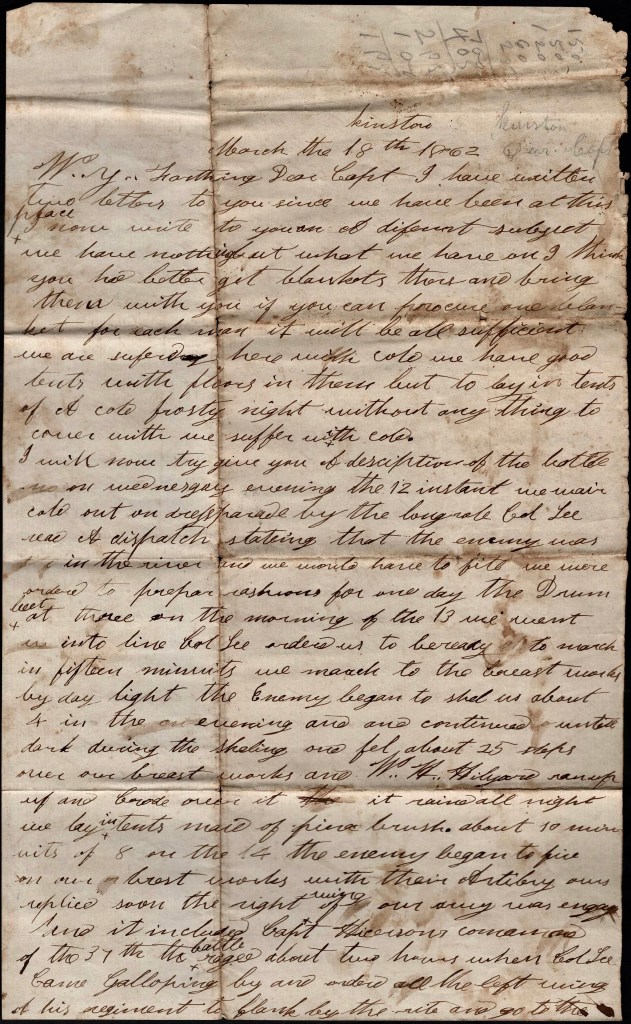
Transcription
Kinston, [North Carolina] March the 18th 1862
W. Y. Farthing. Dear Captain,
I have written two letters to you since we have been at this place. Now [I] write to you on a different subject. We have nothing but what we have on. I think you had better get blankets there and bring them with you. If you can procure one blanket for each man, it will be sufficient. We are suffering. here with cold. We have good tents with floors in them, but to lay in tents of a cold, frosty night without anything to cover with—we suffer with cold.
I will now try [to] give you [a] description of the battle. On Wednesday evening, the 12th instant, we were called out on dress parade by the Brigade Col. [Charles Cochrane] Lee [who] read a dispatch stating that the enemy was [present] in the [Neuse] River, and we would have to fight. We were ordered to prepare rations for one day. The drum beat at three on the morning of the 13th. We went into line. Col. Lee ordered us to be ready to march in fifteen minutes. We marched to the breastworks by daylight. The enemy [gunboats] began to shell us about 4 in the evening, and continued until dark. During the shelling, one fell about 25 steps over our breastworks, and W. H. Hilliard ran up and crowed over it. It rained all night. We lay in tents made of pine brush.
About 10 minutes of eight on the 14th, the enemy began to fire on our breastworks with their artillery. Ours replied. Soon the right wing of our army was engaged and it included Capt. [Charles N.] Hickerson’s command [Co. F] of the 37th. The battle raged about two hours when Col. Lee came galloping by and ordered all the left wing of his regiment to flank by the right and go to the railroad. We struck [on] the double quick and soon came to Grimes’ [Latham’s Battery] Artillery. I inquired for Col. [Reuben P.] Campbell [7th N.C. Inf., k.i.a. Gaines’ Mill 6-27-1862].
I should have stated that [Lt.] Col. [William M.] Barbour ordered us to report to Col. Campbell. They told us to go on—he was ahead (the balls were flying as thick as hailstones—our boys were glanced by several of them, but nobody was hurt). We went on and Col. Campbell’s adjutant came running [up] and said Col. Campbell was behind [us]—we had passed him. We faced about and marched off in the new direction when we received an order to go on to the railroad. We faced about and marched to that place. There we met [Brigadier] General [Lawrence O’Bryan] Branch. He ordered us to face about and meet our forces who were retreating before the enemy. He said that we had men enough to fight a good battle of ourselves (we had the commands of Captains [Jackson Lafayette] Bost [Co. D], [James M.] Potts [Co. F], and your own; not more than 100 men in all).
I protested against going back [but] his orders were to go, saying if we had the hearts of men, [then] show it. We faced about. The order was given to march. They went—but slow. We had not gone far before we saw Col. Barber. He told us to make our escape for we were defeated. We made our escape to the [railroad] cars, and all of your company got in but myself and [Pvt. William] Strickland. We made our way to New Berne, [and] from there we walked 9 miles and got on the [cars] and came here. — P. Farthing
The following letter was written by Benjamin Lewis Hall (1838-1931), the son of Pardon Bowen Hall (1793-1872) and Abby Billings (1802-1895) of Providence, Rhode Island. Benjamin was married to Emeline Carr in 1860.
In April 1861, Benjamin was working as a jeweler in Providence when he enlisted as a drummer boy in Co. A, 1st Rhode Island Regiment, and mustered out as a sergeant on 2 August 1861. He reenlisted on 13 December 1861 as a sergeant in Co. E, 5th Rhode Island and resigned his commission as Captain of Co. I on 5 May 1863.
In his letter, Benjamin informs his brother that he has survived the battle that resulted in the capture of New Bern, North Carolina, in March 1862. Though the 5th Rhode Island was not in the vanguard of the attacking column, he gives a lively portrayal of the march to and capture of the city.
[This letter is from the private collection of Rob Grandchamp and was made available for transcription and publication on Spared & Shared by express consent.]
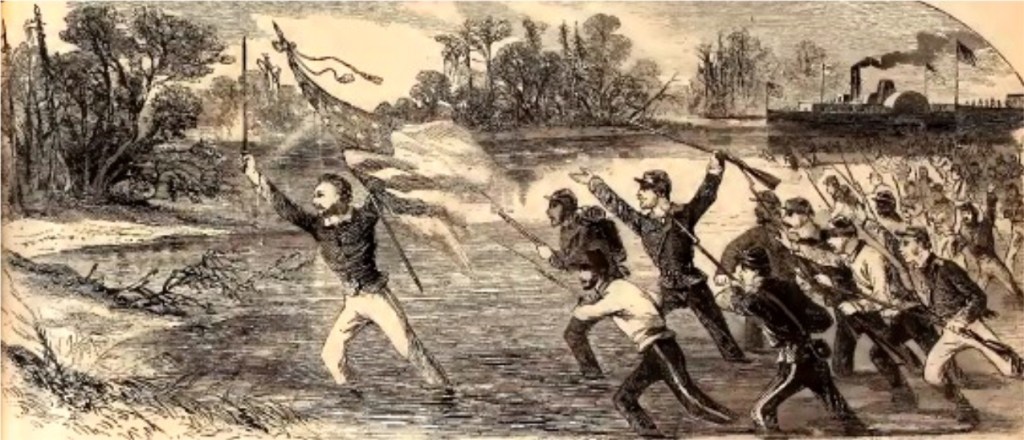
Union troops landing to begin their march on New Bern in March 1862
Transcription
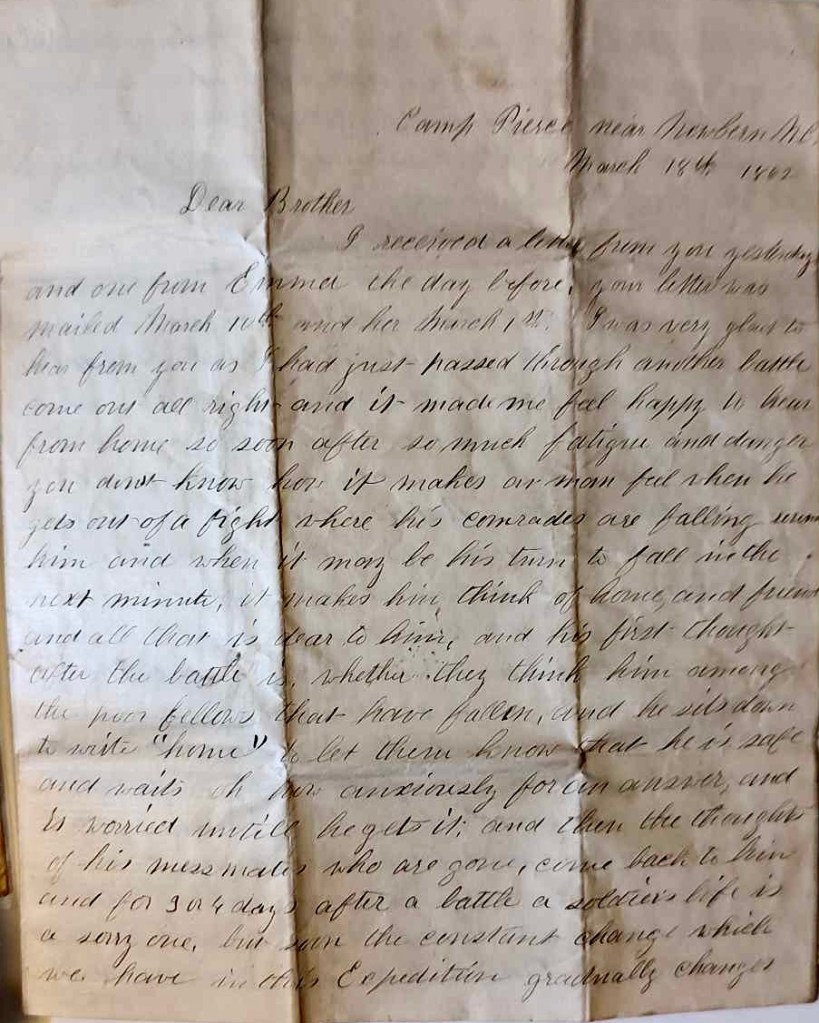
Camp Pierce near Newbern, North Carolina March 18th 1862
Dear Brother,
I received a letter from you yesterday and one from Emma the day before. Your letter wsa mailed March 10th and hers March 1st. I was very glad to hear from you as I had just passed through another battle. Come out all right and it made me feel happy to hear from home so soon after so much fatigue and danger. You don’t know how it makes a man feel when he gets out of a fight where his comrades are falling around him and when it may be his turn to fall in the next minute. It makes him think of home and friends and all that is dear to him, and his first thought after the battle is whether they think him among the poor fellows that have fallen, and he sits down to write “home” to let them know that he is safe and waits oh how anxiously for an answer, and is worried until he gets it. And then the thoughts of his messmates who are gone come back to him and for 3 or 4 days after a battle a soldier’s life is a sorry one. But soon the constant change which we have in this Expedition gradually changes his thoughts and he is soon busy thinking of what is going on around him and only when the roll is called and the names of the unfortunate ones are omitted does he for a moment recall the scenes of “the fight” and the many “good times” where the missing ones took part.
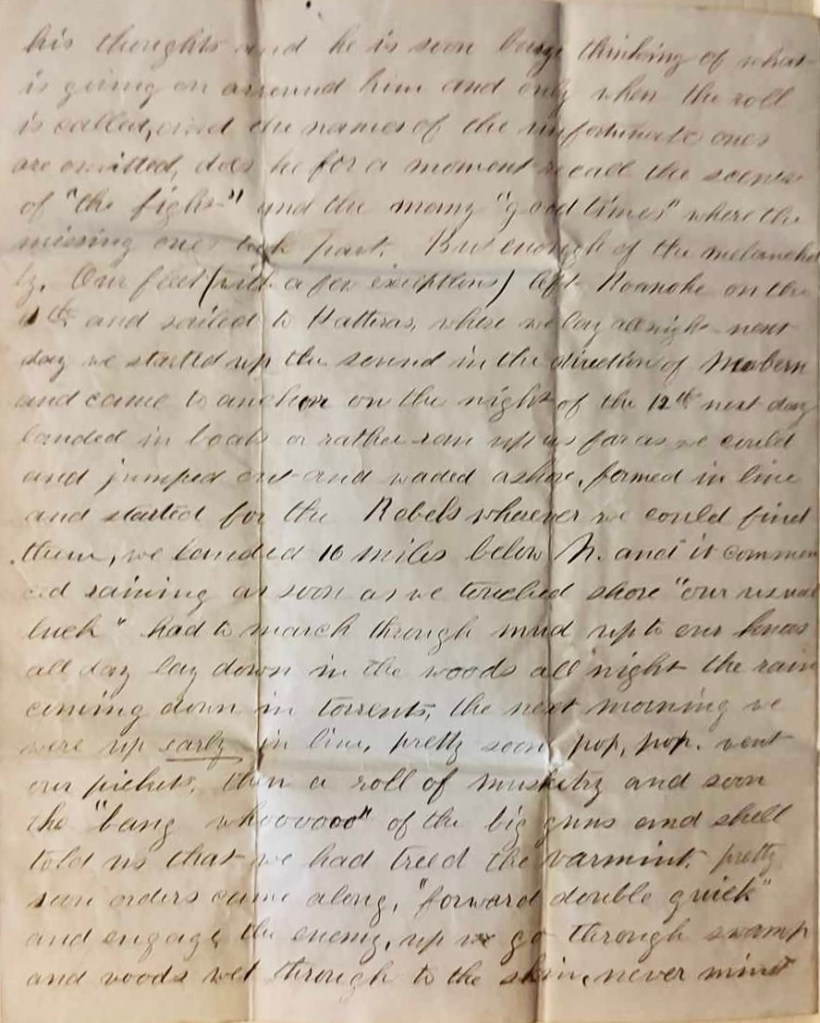
But enough of the melancholy. Our fleet (with a few exceptions) left Roanoke on the 11th and sailed to Hatteras where they lay all night. Next day we started up the sound in the direction of Newbern and came to anchor on the night of the 12th. Next day landed in boats, or rather ran up as far as we could and jumped out and waded ashore, formed in line and started for the Rebels wherever we could find them. We landed 16 miles below Newbern and it commenced raining as soon as we touched shore—“our usual luck.” Had to march through mud up to our knees all day, lay down in the woods all night, the rain coming down in torrents. 1
The next morning were up early in line. Pretty soon—pop, pop—went our pickets, then a roll of musketry, and soon the “band whooooo” of the big guns and shell told us that we had treed the varmint. Pretty soon orders came along, “Forward, double quick!” and engage the enemy. Up we go through swamp and woods, wet through to the skin, never mind boys, we have got a chance to pay the villains for making us march through the mud, “Give it to ’em lively boys!” over the batteries, rifle pits, breastworks, “Hurrah! There they go boys! There they run” and tell the old story, “Ribbils Licked.”
The Battle of New Bern, March 1862
They left as fast as they could on the railroad to Newbern, burning the bridge as they crossed over, some taking another road had to strip and swim the river, and I visited the city yesterday and the old “mokes” 2 say they went through the town like sheep, some without any clothes at all on their back, in such a hurry to get away from the “Damn Yankees” as the old “dark” said. Two or three days before these same fellows had been swaggering about town telling that we could shy around with our boats but wait till they caught us on land and they would teach us a lesson.
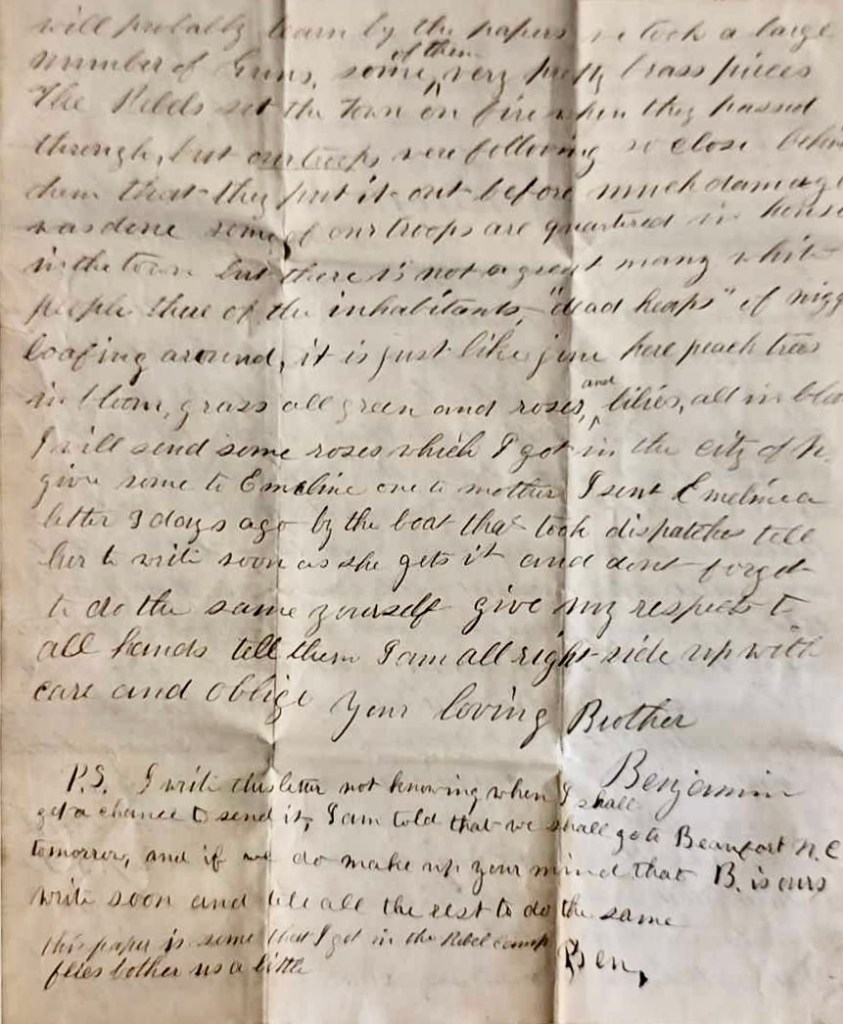
I was talking with an old Nig about his “massa.” He said that “Massa” told him he would whip us like dogs, but when he come running back, the “nig” said “Massa. where am de Yankees?” And “Massa” said, “Twant no use, if we get them blood hounds after us we might as well give up. It is said that some of the prisoners which were let go at Roanoke are here but I don’t know how true it is. I do not know how many men we have lost. You will probably learn by the papers. We took a large number of guns—some of them very pretty brass pieces.
The Rebels set the town on fire when they passed through but our troops were following so close behind them that they put it out before much damage was done. Some of our troops are quartered in houses in the town but there is not a great many white people there of the inhabitants. “Dead heaps” of niggers loafing around. It is just like June here—peach trees in bloom, grass all green, and roses and lilies all in bloom. I will send some roses which I got in the city of Newbern. Give some to Emeline, one to Mother. I sent Emeline’s letter 3 days ago by the boat that took dispatches. Tell her to write soon as she gets it and don’t forget to do the same yourself. Give my respects to all hands. Tell them I am all “right side up with care” and oblige your loving brother, — Benjamin
P. S. I write this letter not knowing when I shall get a chance to send it. I am told that we shall go to Beaufort, North Carolina, tomorrow and if we do, make up your mind that Beaufort is ours. Write soon and tell all the rest to do the same. This paper is some that I got in the Rebel camp. Flies bother us a little. — Ben
1 The regimental history informs us that, “Here, as at Roanoke Island, the water along shore was very shallow, and many of the men were compelled to leave the boats and wade to firm land; and, here as there, no sooner had the debarkation fairly commenced than rain began to fall again. Wet as the men were not time was lost at the landing, but as fast as they came ashore the line of march was at once taken up, with a skirmish line from the 24th Massachusetts well in advance. Under the effect of the marching men in front, the roads soon became almost impassable for those who followed, the sticky mud adhering to their feet and lower clothing at every step until they often became so heavy that the tired men could scarcely lift them. The time spent in landing and a march of about twelve miles over such terrible roads used up the whole day, and a half-rain, half-drizzle of the most aggravating character fell nearly all of the time. [p. 31]
2 Mokes (or Mooks) is a racial slur for negro, in common use in the 19th Century.
The following letter was written by Charles Lafayette Osborne (1834-1920) of Transylvania county, North Carolina. He enlisted at the age of 27 on 8 September 1861 as a private in Co. E, 25th North Carolina Infantry. He was promoted as ordnance sergeant in May 1862 and appointed 2nd Lieutenant on 23 July 1862 and 1st Lieutenant one week later. The 25th North Carolina served in Gen. Ransom’s Brigade of Gen. Longstreet’s Corps. The regiment fought at Antietam and near the famous stone wall on Maryes Heights at Fredericksburg. Charles was present and accounted for until 10 February 1865 when he was transferred to the 65th North Carolina (6th N. C. Cavalry) because of his inability to “stand infantry service in the summer season.”
Charles was the son of Jeremiah Osborne (1802-1890) and Mary Rebecca Fletcher (1807-1887). He was married to Mollie Killian (1841-1924) in August 1863.
Charles wrote the letter to his sister-in-law, Mariah (Merrill) Osborne (1831-1914)—the widow of Joseph McDowell Osborn (1832-1859).
[Note: I have spelled Charles’ surname “Osborne” because that’s the way it appears on his headstone but it might also be found in records as “Osborn.”]
Transcription
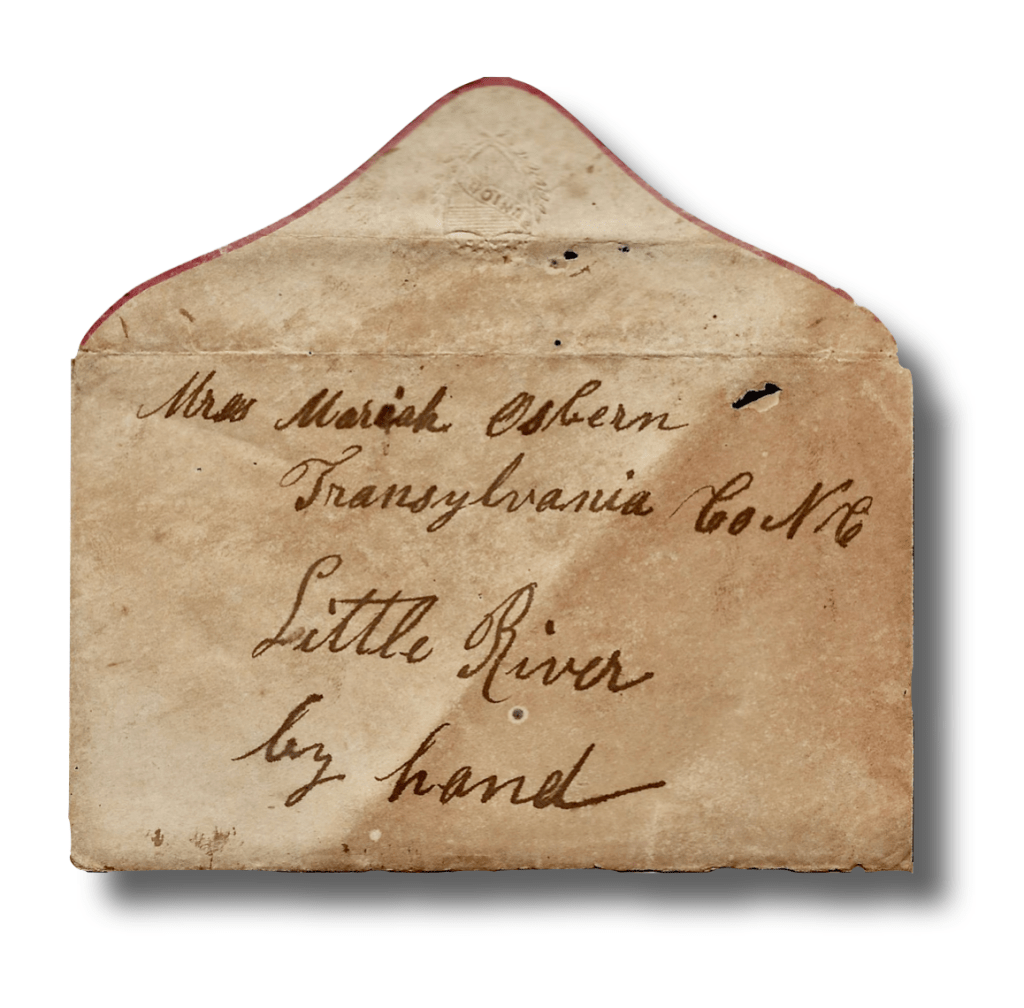
Addressed to Mrs. Mariah Osborn, Little River, Transylvania county, North Carolina, by hand
Pamlico Station, Lenoir county, N. C. Camp Ransom April 6th 1862
Sister Mariah,
Having some leisure hours, I take the pleasure of penning you a few lines hoping they will safely each you and find you enjoying good health, and getting on prosperously in this time of pressure. I have hither to been neglectful in writing to you together with other friends, but it has not been by any design or ill will on my part, but nearly neglect.
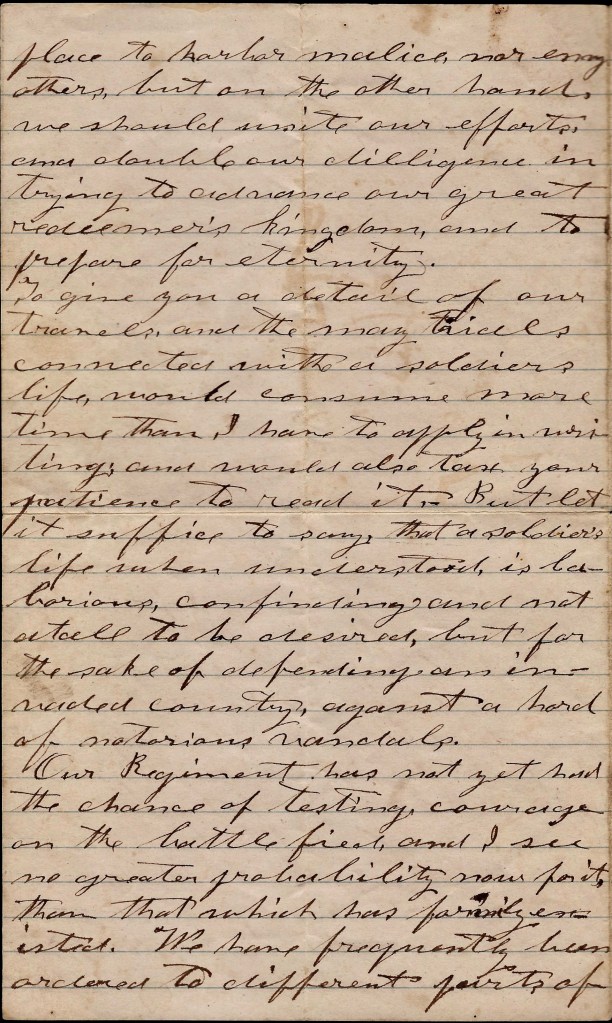
If I know my heart, I feel interested in your prosperity, love you as a sister, because you was married to one of my best brothers and has ever treated me with respect. I hope if there is any disrespectable feelings existed between you and any of us that they may be quickly obliterated and erased from memory’s page, and crushed into oblivion to appear no more. This is no time nor place to harbor malice, nor any others, but on the other hand, we should unite our efforts and double our diligence in trying to advance our great redeemer’s kingdom and to prepare for eternity.
To give you a detail of our travels and the many trials connected with a soldier’s life would consume more time than I have to apply in writing, and would also task your patience to read it. But let it suffice to say that a soldier’s life when understood is laborious, confining, and not at all to be desired, but for the sake of defending an invaded country against a hoard of notorious vandals.
Our regiment has not yet had the chance of testing courage on the battlefield and I see no greater probability now for it than that which has formerly existed. We have frequently been ordered to different parts of the state (and even out of their state) where a fight was pending, but always get there too late to see any bloodshed, but we cannot tell what another day may bring forth, under such critical times.
Our regiment has recently been united with some others in forming a brigade under the command of General Ransom. We find a great many soldiers here, some infantry, some cavalry, and some artillery, and with their drums, bugles, and brass bands together with the constant chattering of mischievous soldiers, would present quite a terrifying aspect—especially to those who have never witnessed such a scene.
We are now stationed close to the Neuse River about thirty miles from Newbern, though we have troops along the road to Goldsboro. Our pickets go daily near Newbern and occasionally pick up a Yankee or a disloyal citizen. This is a fine country and susceptible of producing almost any sort of grain. The bottoms are extensive and rich and possessed by good farms. Water is tolerably good and the weather is moderate.
Provisions are scarce and high. Salt is hardly to be purchased at any price. It is quite evident that poor people will soon begin to suffer.
Most of our regiment have enlisted for the war and are getting several recruits. The fight at Newbern is not yet definitively reported. It is rumored that our side lost near few hundred and the Yankees about fifteen hundred but I suppose without accuracy.
How does Person enjoy himself since his second choice of married life? I suppose well. I must close. Let us here how you are doing. Letters directed to Goldsboro will come to us. Give respects to all my friends. Fraternally, — C. L. Osborn
The following letter was written by Charles Warren (1835-1920) who entered the service as a sergeant in Co. B, 11th Connecticut Infantry, and soon after their first Battle of Newbern, described here, was promoted to 1st Sergeant. Warren later (July 1863) became Captain of Co. G, then Major (November 1864) and in command of the entire regiment in the last stages of the war. He was mustered out as the Colonel of the 11th Connecticut and after the war published a regimental history. Indeed, near the end of this letter he confesses, “It seems to me that I could write a volume about what I see.”
An obituary published on 4 November 1920 in The Press (Stafford Springs, Connecticut) informs us that Warren was “one of the most respected men in Stafford” when he died, having lived most of his life in the town. It says he worked as a young man in a local mill until 1850 when he entered into a partnership with Henry Thrall in the whole sale leather business in Boston which is where he worked until the Civil War began. He then returned home to join the 11th Connecticut, rose through the ranks to lead it by war’s end, and proudly asserted that he had participated in each and every battle in which the regiment was engaged.
After the war, Warren returned to Stafford where he entered the mercantile business and carried on with it until he sold out in 1881 to take a position as President of the Stafford Savings Bank.
In this letter, Warren gives us an incredible, eye-witness account of the Battle of Newbern in which the 11th Connecticut played a prominent role in what would be the first of many battles. We learn that it made quite an impression on him, as he related to his Boston friend, “It was a sickening sight that met us—dead horses, mangled men, broken cannon, knapsacks, guns, &c. were strewn in every direction. I shall never forget that sight—never, never. It is the sad side of a victory & no one knows anything about it until they see it as it is.”
[Note: This letter is from the personal collection of Richard Weiner and was transcribed and published on Spared & Shared by express consent.]
Transcription
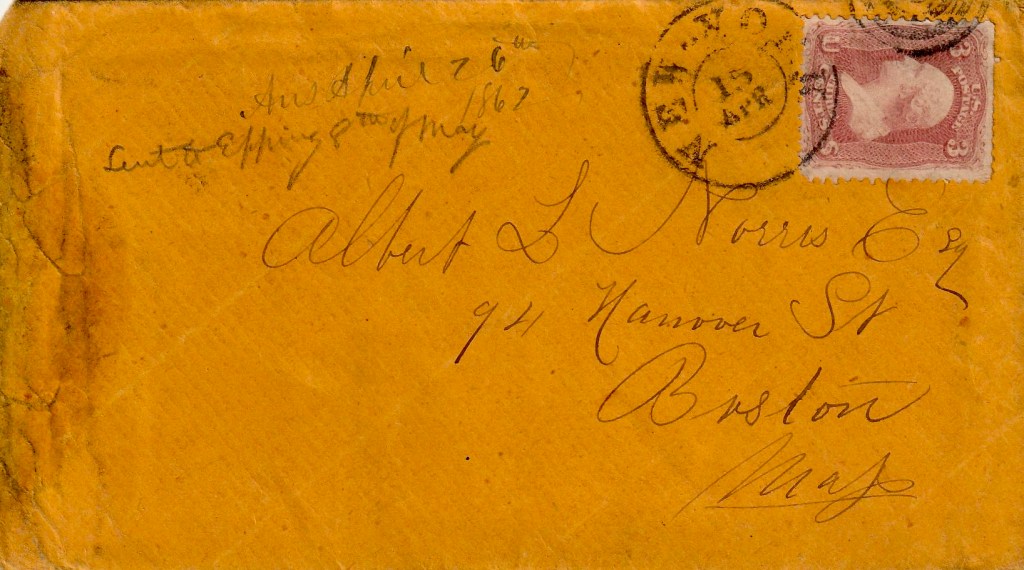
Addressed to Albert L. Norris, Esq., 94 Hanover Street, Boston, Mass.
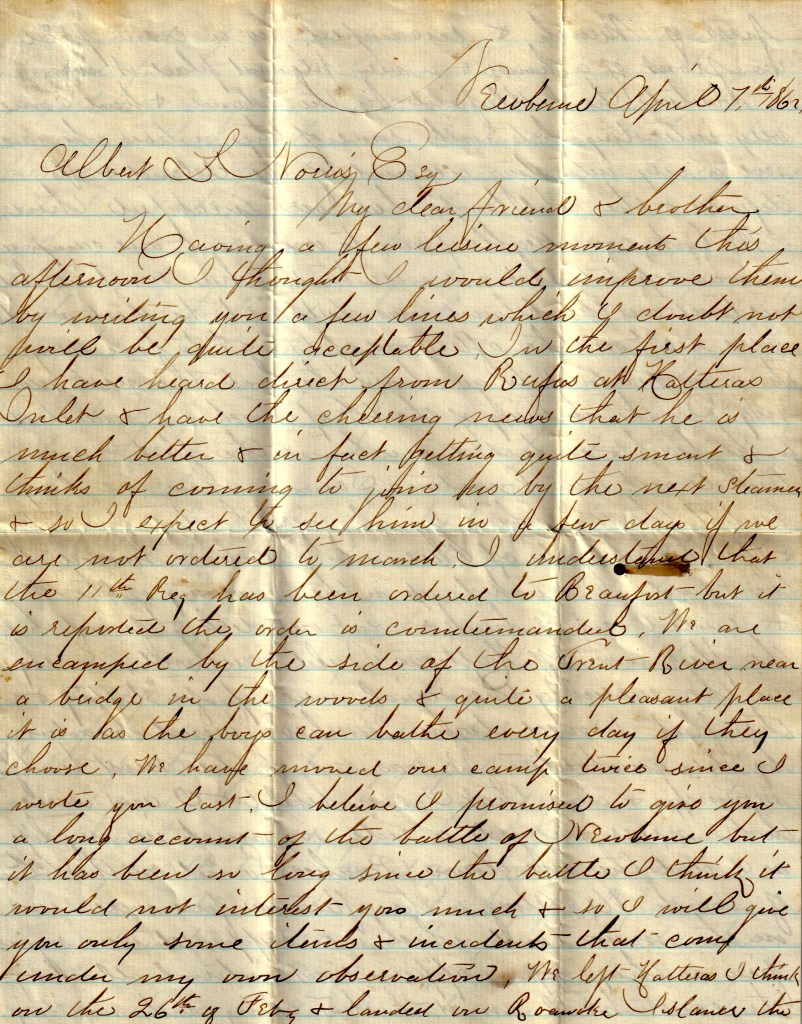
Newbern [North Carolina] April 7, 1862
Albert L. Norris, Esq. My friend and brother,
Having a few leisure moments this afternoon, I thought I would improve them by writing you a few lines which I doubt not will be quite acceptable. In the first place, I have heard direct from Rufus at Hatteras Inlet & have the cheering news that he is much better & in fact, getting quite smart & thinks of coming to join us by the next steamer & so I expect to see him in a few days if we are not ordered to march. I understand that the 11th Regiment has been ordered to Beaufort but it is reported the order is countermanded. We are encamped by the side of the Trent River near a bridge in the woods & quite a pleasant place it is as the boys can bathe every day if they choose. We have moved our camp twice since I wrote you last.
I believe I promised to give you a long account of the Battle of Newbern but it has been so long since the battle, I think it would not interest you much & so I will give you only some items & incidents that came under my observation.
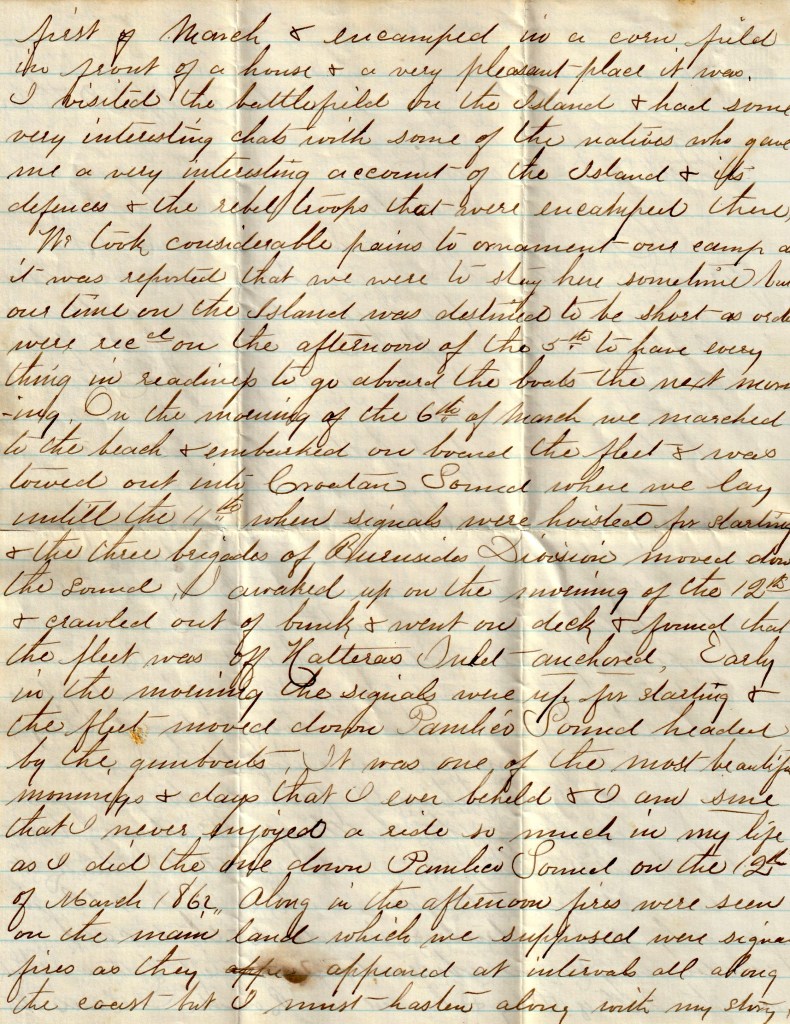
We left Hatteras I think on the 26th of February and landed on Roanoke Island the first of March & encamped in a corn field in front of a house & a very pleasant place it was. I visited the battlefield on the island and had some very interesting chats with some of the natives who gave me a very interesting account of the island and its defenses and the rebel troops that were encamped there. We took considerable pains to ornament our camp as it was reported that we were to stay here some time but out time on the island was destined to be short as orders were received on the afternoon of the 5th to have everything in readiness to go aboard the boats the next morning.
On the morning of the 6th of March, we marched to the beach and embarked on board the fleet and was towed out into Croatan Sound where we lay until the 11th when signals were hoisted for starting & the three brigades of Burnside’s Division moved down the Sound. I awaked up on the morning of the 12th and crawled out of bunk & went on deck & found that the fleet was off Hatteras Inlet anchored. Early in the morning the signals were up for starting & the fleet moved down Pamlico Sound headed by the gunboats. It was one of the most beautiful mornings & days that I ever beheld & I am sure that I never enjoyed a ride so much in my life as I did the one down Pamlico Sound on the 12th of March 1862.
Along in the afternoon, fires were seen on the mainland which we supposed were signal fires as they appeared at intervals all along the coast but I must hasten along with my story.
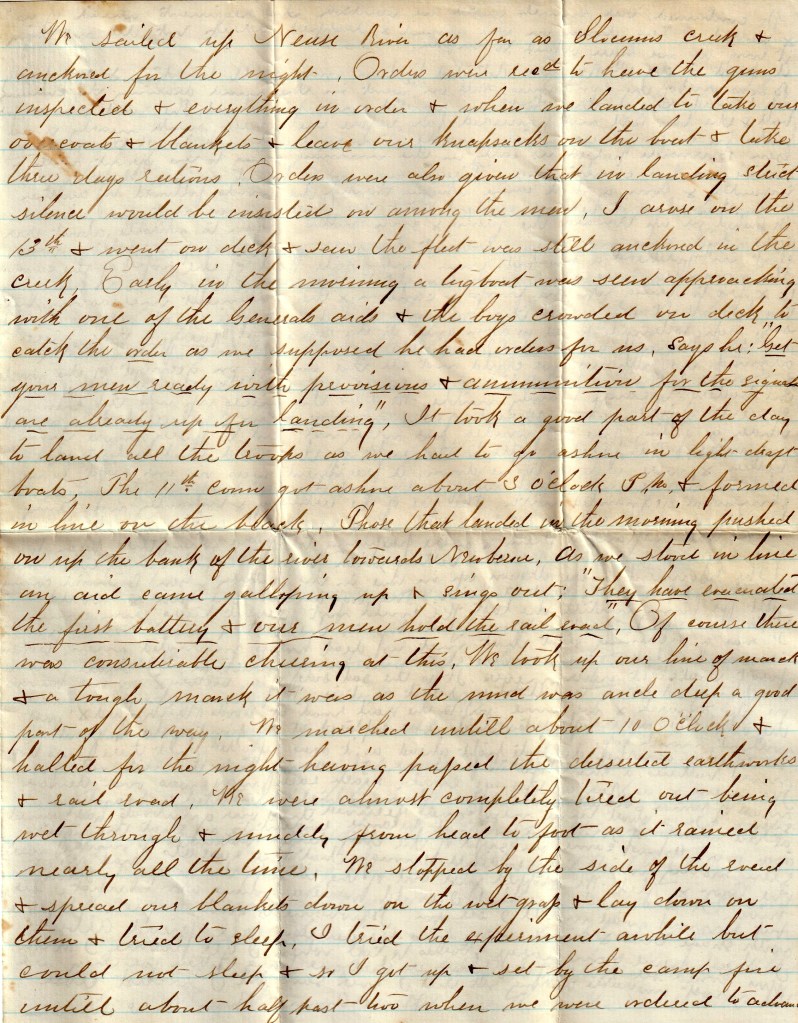
We sailed up Neuse River as far as Slocum’s Creek and anchored for the night. Orders were received to have the guns inspected & everything in order & when we landed to take our overcoats & blankets & leave our knapsacks on the boat & take three days rations. Orders were also given that in landing, strict silence would be insisted on among the men. I arose on the 13th & went on deck & seen the fleet was still anchored in the creek. Early in the morning a tugboat was seen approaching with one of the Generals aides & the boys crowded on deck to catch the order as we supposed he had orders for us. Says he, “Get your men ready with provisions and ammunition for the signals are already up for landing.” It took a good part of the day to land all the troops as we had to go ashore in light draft boats.
The 11th Connecticut got ashore about 3 o’clock p.m. and formed in line on the beach. Those that landed in the morning pushed on up the bank of the river towards Newbern. As we stood in line, an aide came galloping up and sings out, “They have evacuated the first battery & our men hold the railroad.” Of course there was considerable cheering at this.
We took up our line of march & a tough march it was as the mud was ankle deep a good part of th way. We marched until about 10 o’clock & halted for the night having passed the deserted earthworks and railroad. We were almost completely tired out, being wet trough and muddy from head to foot as it rained nearly all the time. We stopped by the side of the road and spread our blankets down on the wet grass and lay down on them and tried to sleep. I tried the experiment awhile but could not sleep and so I got up and sat by the camp fire until about half past two when we were ordered to advance.
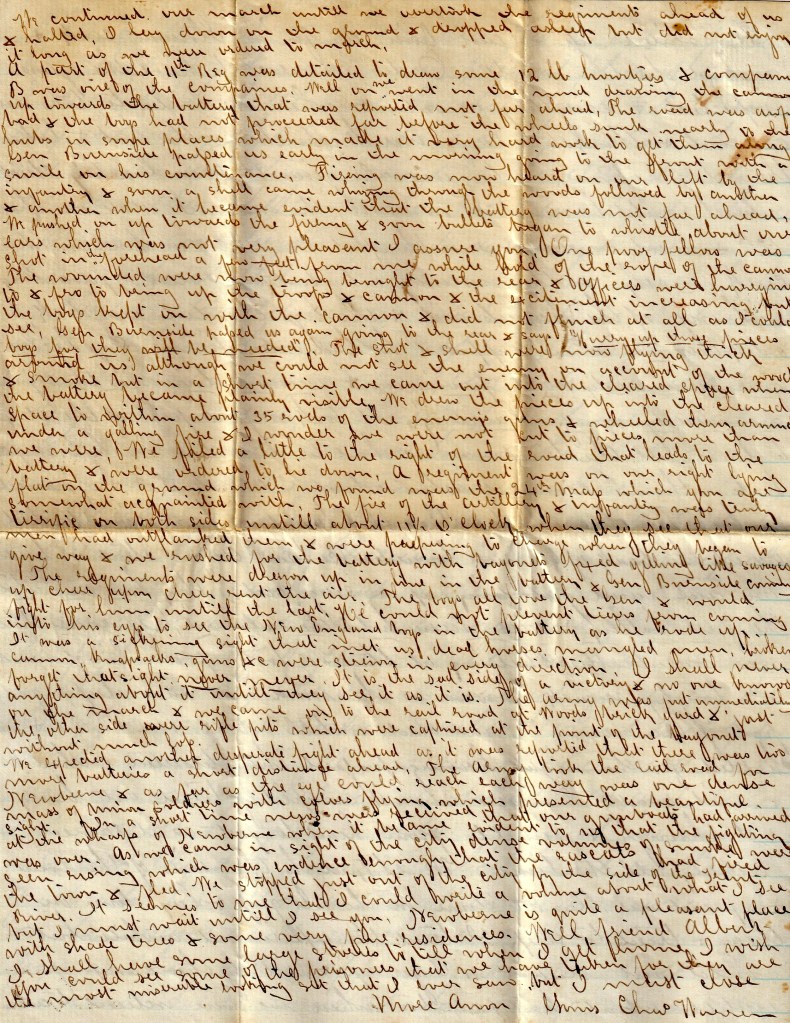
We continued our march until we overtook the regiments ahead of us and halted. I lay down on the ground & dropped asleep but did not enjoy it long as we were ordered to march. A part of the 11th [Connecticut] Regiment was detailed to draw some 12-pound howitzers & Co. B was one of the companies. Well, on we went in the mud drawing the cannons up towards the battery that was reported not far ahead. The road was awful bad & the boys had not proceeded far before the wheel sunk nearly to the hubs in some places which made it very hard work to get them along.
Gen. Burnside passed us early in the morning going to the front with a smile on his countenance. Firing was now heard on our left by the infantry and soon a shell came whizzing through the woods followed by another and another. When it became evident that the battery was not far ahead, we pushed on up towards the firing and soon bullets began to whistle about our ears which was not very pleasant, I assure you. One poor fellow was shot in the forehead a few feet from me while he had hold of the rope of the cannon. The wounded were now being brought to the rear & officers were hurrying to and fro to bring up the troops and cannon & the excitement increasing but the boys kept on with the cannon & did not flinch at all as I could see.
Gen. burnside passed us again going to the rear and says, “Hurry those pieces, boys, for they will be needed!” The shot and shell were now flying thick around us although we could not see the enemy on account of the woods and smoke but in a short time we came out into the cleared space where the battery became plainly visible. We drew the pieces up into the cleared space to within about 35 rods [200 yards] of the enemy’s guns and wheeled them around under a galling fire & I wonder we were not cut to pieces more than we were.
We filed a little to the right of the road that leads to the battery and were ordered to lie down. A regiment was on our right lying flat on the ground which we found were the 24th Massachusetts which you are somewhat acquainted with. The fire of the artillery and infantry was truly terrific on both sides until about 11:30 o’clock when they see that our men had outflanked them and were preparing to charge when they began to give way & we rushed for the battery with bayonets fixed, yelling like savages.
Map shows the 11th Connecticut Infantry advancing by the railroad and then ordered to the right to replace the 27th Massachusetts (under the “S” in FOSTER), on the left side of the Old Beaufort Road, the 24th Massachusetts on the right side of that same road. The two howitzers are planted in the middle of the road near the edge of the clearing.Directly opposite the swampy clearing ahead lay the Confederate works anchored by the 16 guns of Brem’s and Latham’s Batteries.
The regiments were drawn up in line of the battery and Gen. Burnside coming up, cheer upon cheer rent the air. The boys all love the General and would fight for him until the last. He could not prevent tears from coming into his eyes to see the New England boys in the battery as he rode up.
It was a sickening sight that met us—dead horses, mangled men, broken cannon, knapsacks, guns, &c. were strewn in every direction. I shall never forget that sight—never, never. It is the sad side of a victory & no one knows anything about it until they see it as it is.
The army was just immediately on the march and we come on to the railroad at Woods brick yard and just the other side were rifle pits which were captured at the point of the bayonet. We expected another desperate fight ahead as it was reported that there was two more batteries a short distance ahead. The army took the railroad for Newbern and as far as the eye could reach each way was one dense mass of Union soldiers with colors flying which presented a beautiful sight.
In a short time, news was received that our gunboats had arrived at the wharf at Newbern when it became evident to us that the fighting was over. As we came in sight of the city, dense volumes of smoke were seen rising which was evidence enough that the rascals had fired the town and fled. We stopped just out of the city by the side of the Trent River. It seems to me that I could write a volume about what I see but I must wait until I see you.
Newbern is quite a pleasant place with shade trees and some very fine residences. Well, friend Albert, I shall have some large stories to tell when I get home. I wish you could see some of the prisoners that we have taken for they are the most miserable looking set that I ever saw. But I must close. More anon.










 Spared & Shared 23