Sgt. William M. Vanzant, 1st Iowa Light Artillery (Special Collections, Iowa State University)
This letter was written by George W. Rownd (1842-1864), the son of James Quincy Rownd (1810-1905) and Caroline Brown (1817-1894) of Cedar Falls, Black Hawk county, Iowa. George’s surname name was entered in the Muster Rolls as “Round” when he was entered the 1st Iowa Light Artillery in August 1861. He was discharged for disability in late November 1863 and died early in 1864 at a Union Hospital in Helena, Arkansas.
George’s letter provides us with a great account of the Battle of Pea Ridge (or Elkhorn Tavern). A similar letter written by William Vanzant of the same Battery who wrote to his brother Henry and sister-in-law Nancy on March 14, 1862 from Arkansas’ Sugar Creek Camp. In the letter, William describes the Battle of Pea Ridge which took place during the early part of the Civil War in northwestern Arkansas. The letter is from the Van Zandt Family Papers. The collection’s description and finding aid is available online: https://www.scribd.com/document/84127758/Battle-of-Pea-Ridge-Letter-by-William-Vanzant-transcript
The 1st Iowa battery of four 6-pounders was able to turn and confront Price’s attacking Missourians until they were overrun, but their stand allowed the rest of the division of Col. Eugene A. Carr to arrive to oppose the Confederate drive. Unlike many of the commanders on both sides at Pea Ridge, Carr was a professional soldier, a graduate of West Point, and a cavalryman who had served on the frontier – characteristics he also shared with Van Dorn. Although he was wounded three times in the battle he remained on the field directing his division and was promoted to brigadier general and later awarded the Medal of Honor for his service here.[Civil War Talk]
Transcription
This envelope does not go with the letter; it’s from the collection of Alan Magary.
March 14 [1862] Sugar Creek, Benton county, Arkansas
Dear Parents,
A few days ago or just after the fight, I wrote you a few lines to let you know that I had come out safe. It was then nine o’clock at night and we was going to leave camp at seven in the morning which did not give me time to describe that part of the battle which I witnessed.
On Friday morning, after allowing us plenty of time to cook and eat our breakfast, we was ordered to harness and hitch up and away we went toward Springfield. After we had gone a few hundred yards, a rumor became prevalent that a few of the enemy had gained our rear and that we were sent to dislodge them. We soon found out that their small force consisted of the whole force of Price’s army and some two thousand Indians.
Our battery set the ball a rolling if I except Sigel’s fight on Thursday. The fight commenced about eleven o’clock at the Elkhorn Tavern, the right section turned to the wast and the left section and center section kept on about four hundred yards north. At the Elkhorn, the center section got tangled up with some mule teams and the left section or two guns had to bear the fire of a full battery of six guns. But we were not idle. We were sending shot and shell amongst them in a hurry and they were sending shell, shot, and canister at us and they fell around us like hail. Kirk [W.] Henry, Captain Jones, Lieutenant Gambell, Sergeant [H. R.] Horr, William Seldon, William [F.] Conner, Clark Woodmancy, John Easton, Corp. [D. J.] Duval, Samuel Black, and some three or four more wounded. Reese Parkhurst 1 and Gustavis Gustavison 2 and William Hall were killed.
After fighting against three times our number for more than an hour, our four guns retired and the six guns of the Dubuque Battery marched into our places but they did not stay long during the day. They drove us back to some open fields south of the Elkhorn Tavern. Here we made a stand. Our infantry fell to the rear of the artillery and on came the rebels whooping and yelling, flags a waving. In fact, they made sure if having us all in their power. But a few well directed rounds from twelve guns sent them in search of timber and then the splinters sent them farther when we again took possession of the Elkhorn Tavern. But in a few moments they again drove us back and here the Dubuque Battery lost three of their guns.
It was now dark and we retired into camp leaving the enemy in possession of the field, So you see on the right wing we ewre rather worsted while they were completely whipped out on the left wing. We again took the field before daylight Saturday morning and the fight commenced at sunrise and about ten o’clock they was on the retreat.
It is late and I must bring my letter to a close. If you have some postage stamps convenient, you may send me a few. I cannot get them here for neither love nor money. I have seen men offering ten cents apiece for them and cannot get them at that. The boys from the Falls are all well and enjoying good spirits. On the battlefield, not one of them flinched. The boys in the Dubuque Battery that I know are all well except Lieutenant McClure whose horse was shot under him and fell on him, hurting him severely. No more at present. Give my love to all enquiring friends. Write soon. Direct your letters as before. From your affectionate son, — G. W. Round
1 The report of the Battery by its commander, Capt. Junius Jones, states that Reese Parkhurst was killed early in the action, a cannon ball taking off his leg, and another shot striking him in the head.
2 Gustavison had his right leg shot off by a solid shot and died of shock and amputation.
I could not find an image of James but here is one of Jerome H. Sessions who also served in Co. K, 9th Iowa Infantry. (Collection of Al & Claudia Niemiec)
The following letter was written by Pvt. James Knox Polk McCoy (1845-1862) of Tipton, Cedar county, Iowa, who enlisted on 14 September 1861 in Co. K, 9th Iowa Infantry and was killed on 7 March 1862 at the Battle of Pea Ridge, Arkansas. Although the muster records indicate that he was 18 years old at the time of enlistment, he was not. He was born in August 1845 so he would have only been 16 when he enlisted and when he died.
James was the son of George William McCoy (1814-1881) and Harriet Sarah Nye (1822-1906). He wrote the letter to his older sister, Laura Lavinia (McCoy) Willard (1841-1915). Laura was only 16 when she married James G. Willard, 13 years her senior, in 1857.
[Note: This letter is from the private collection of Mike Huston and was transcribe and published on Spared & Shared by express consent.]
“Thin Blue Line, Battle of Pea Ridge,” by Daniel Hoffbauer. The painting depicts the 9th Iowa in action north of Elkhorn Tavern, with Lt. Col. Francis Jay Herron on his horse. They suffered 35% casualties, the most of any Union regiment in the battle. Herron was wounded, caprured and received the Medal of Honor for his actions.
Transcription
Camp Herron December 13th 1861
Dear Sister,
I received yours today. It found me well and I hope that these few lines will find you the same. I got a letter from Pamela and have written two letters to her since I have not got any answer, You know that I told you that we was a going away from here. We are here yet. I don’t know how long that we will be here for there is a good many regiments a leaving here and a going to Jefferson county as they are a fighting there now and I expect that from all accounts that we will go there too.
I will tell you why I keep up a correspondence with Karen [?] for it not because I love her at all. I do it just to pass the time away and to keep up good spirits. I am sure that he may sit up with her from June to all eternity and give his picture to her and his body, soul and all, to her for what I care for I am not any beau of hers. I would get my picture taken and send it to you if I could get it taken to suit me but I cannot so I will not have it taken at all.
I am glad to hear that the money I sent has got home safe. I would like to see you all and I hope that the time will come when I may see you. Dear sister, I have no more to write at present. You needn’t say anything about what I have said and I trust that you won’t.
It is very warm down here now. Your affectionate brother, — J. K. P. McCoy
to Laura L. Willard
I will send a lock of my hair in my next letter. Dear sister, fare you well.
The following letters were written by Pvt. Benjamin Franklin (“Frank”) Cook (1841-1924) of Co. A, 25th Illinois Volunteers. His muster records inform us that he was a single, 20 year-old farmer with dark hair and blue eyes from Georgetown, Vermilion county, Illinois and that he towered over his comrades at 6 foot 3 inches tall. He entered the service on 1 June 1861 and remained with them until 19 August 1863 when he transferred into the 1st USCT at Winchester, Tennessee.
Frank’s parents were Enos Cook and Malinda Harris of Vermilion county, Illinois. He wrote the letter to his cousin, Josephine Cook (1847-1924), the daughter of Henderson Cook and Lucinda Trout of Georgetown, Vermilion county, Illinois.
Frank’s second letter mentions briefly the Battle of Pea Ridge that was fought on 7-8 March 1862 near Elkhorn Tavern in Arkansas. “Many of our bravest men fell, ” he told his cousin, adding, “I saw the noble-hearted soldiers laying upon the battlefield with their heads and arms shot off, weltering in their blood. Upon the Rebel side the slaughter was tremendous.”
The first four letters in this collection were written while Frank served in the 25th Illinois Infantry; the last four letters were written after he had transferred out of the regiment to accept a commission as a lieutenant in Co. E, 12th United Stated Colored Troops (USCT).
[Note : These letters are from the Sic Parvis Magna, Gratias Jesu Collection and remain in private hands. They were made available expressly for transcription and publication on Spared & Shared.]
Letter 1
St. Louis [Missouri] August 16th 1861
Dear Cousin,
I had not forgotten your folks but I cannot write to all my friends at once, nor very often. I happened to have a little leisure [time] this evening and I thought you would like to hear from us so I take my seat on the ground under my tent and using a little box for a table, I proceed to write you a few lines in a great hurry to tell you how we are getting along here in this land of slaves.
We are now encamped at the Arsenal Park, St. Louis. We live in tents made out of muslin. They are about 8 feet long and 7 feet wide and run up to a sharp top. We have to stoop down to get into them. There is seven of us occupying one tent. Some of them have 10 men crowded into them so that you can guess that we haven’t much room for kitchen or parlor.
I saw a letter just now that you wrote to Edgar [Jackson] in which you stated that you heard that we had to eat sea crackers and water. That is not so. We did have to live on sea crackers one night but we have plenty to eat now. Some of the boys grumble at what they have to eat or rather the quantity which they have to do on. The reason of that is they have lost their appetites and found a dogs in place of their own. We have a negro hired to cook for us all. He charges 70 cents per month for each man. We have first rate beds to sleep on. They are made out of our blankets spread down on the soft side of a plank or the ground with a little straw sprinkled over it. We feel first rate of a morning when we get up off of our beds.
Uncle Sam gave us a nice blue blanket apiece and a pair of new shoes, a splendid gun, and numerous other little presents. We got the guns last night. We have to drill three hours each day and stand on guard once in a while. I was on guard last night. Sylvester [Cook] is on today. This is the hardest work that we have to do. Maybe you would like to know what we do when we are not on duty? Well we can’t do much of anything the most of the time for there is so much noise all around us. Some of the boys are playing cards. Others are singing, some doing one thing and one another. Sometimes they have prayer meeting. Sometimes a dance. There are plenty of fiddlers in the regiment. Of Sundays we have preaching. But I can’t tell you anymore at present.
Tell John to be a good boy. Tell Uncle Thomas’s folks that I wish them all well but can’t write to them at present. I remain your affectionate cousin, — B. F. Cook
Write
Dear Uncle, I thought perhaps that in addition to what ideas you might gather from Josephine’s letter I would give you a few from yesterday’s proceedings which might be interesting to you. Yesterday morning St, Louis was put under martial law. Last night we expected a muss. Consequently our regiment was armed and the guards were doubled. I was on guard at the arsenal on the south wall next to the river. During the day there was 7,000 troops passed up the rive to St. Louis where they took the cars as we supposed for Springfield in the state. There was three prisoners brought ito the Arsenal yesterday. You must excuse this horrible writing for therer are two boys waiting for the paper that I write with. Tell father that I received his letter and was very grateful for the change and will answer as soon as I can. Yours, — B. F. Cook
Letter 2
Camp Welfrey, Arkansas March 16th 1862
Dear Cousin Josephine,
As I have not written to you for a long time, I thought that I would write you a short letter and tell you how we are getting along. Well we have seen some pretty hard times since we left Rolla in Missouri. We have marched about three hundred miles over all kinds of road and all kinds of weather. We have marched from morning till night over frozen ground while the snow was falling thick and fast upon us, and at night have no bed except our blankets spread down upon the cold, damp ground. And again we have marched all day through mud and rain, and at night had to cut brush or gather up cornstalks to keep our blankets out of the mud.
We have always had plenty to eat so far when we have had time to cook. When Uncle Sam can’t get provisions to us, we have to take it from the inhabitants, but when they are at home we always leave them enough to do them a while. A great many of them have left their homes and gone south leaving almost everything they possessed. When this is the case, we don’t leave them much.
A few days ago we fought a great battle and won a great victory. Many of our bravest men fell. I saw the noble-hearted soldiers laying upon the battlefield with their heads and arms shot off, weltering in their blood. Upon the Rebel side the slaughter was tremendous. But I have not time to tell you much about the battle. If you will go to our house, you can read a letter which I wrote to father in which I described the battle more fully.
Well, Josephine, I suppose that you are going to school. If you are, my advice to you is to learn all you can for you can hardly appreciate the value of an education now but when you are your own woman, you will then see its value. How I wish that I could be at school now instead of being out here in Arkansas.
Tell John that I said for him to be a good boy and go to school and make a man of himself in spite of the world. And tell Katy that she must be a good girl and when I come home, I will bring her and Emma some nice presents. Give my love to your mother and father and tell them to write to me. And write to me yourself.
I remain your affectionate cousin, — B. F. Cook
P. S. You must forgive me for not paying postage for we can’t get stamps out here. Direct your letters to St. Louis in care of Captain Clark of the 25th Illinois Volunteers.
Letter 3
Nashville, Tennessee November 17th 1862
Dear Cousin Josephine,
As I have a little time this evening, I will try to write you a letter, but you must not think strange if it does not amount to much for I cannot find very much to write about at this time. Our present camp is situated on the northern bank of the Cumberland river, just opposite the City of Nashville. We received our tents a few days ago and are now pretty well fixed for living in regular soldier style and you may guess that the 25th Illinois boys know about as well how to make themselves comfortable when they have a half chance as the most of soldiers.
It is supposed by the General Commanding our Division (Gen. Jeff C. Davis) that we will hold this post all winter. If this be so, we will have a good time this fall putting up our winter quarters. I am in hopes, however, that the tarnel war will end before Christmas for I want to come home and take dinner at your house on that day. I often wish that I could be at your mother’s table and eat of her good cookeries when we are scarce of hard bread and pork. I will tell you what we had for dinner today which was a little extra. We had cornbread and meat and stewed pumpkins. Coffee bean. Was not that a splendid dinner?
Josephine, you must not think that I am grumbling at the fare for I am as hearty as a bear. I weighed the other day one hundred and eighty pounds. Don’t you think I am a “big boy” for certain? If we stay here till after we get our pay, I intend to get my picture taken and send it home so that you can all see me for I am afraid I will not get to come home very soon.
Elwood Hadden was here just now. He belongs to McNutt’s Company in the 73rd Illinois. He says that Marquis Hawes is very sick and is expecting his father to see him. I suppose that George Baker, James Hall, and Clark Brant are at home by this time as they started some time ago. Those fellows in the new regiments are not very well satisfied. They are nearly all homesick. They have not learned how to take a joke cooly like the old soldiers. If the 25th Illinois boys can get plenty to eat and wear, and plenty of fighting to do, they never grumble.
Sylvestor [Cook] is well and considers himself as good as the best of them. Alonzo and Edgar [Jackson] is learning to play on a bugle. I believe that all of our boys are well except John Ryan. He I believe is getting a discharge from the service.
Tell Katy that I often think of her and when I come home I intend to bring her and Emma a nice present. Tell John that he is big enough to write a letter and I would like to read one from him very much. Give my love to your mother and father and all the folks. Your cousin, — B. F. Cook
Letter 4
[Nashville, Tennessee] [December 1862]
Sunday night
Well JOsephine, while I am here “away down in Tennessee” in my old smoky tent trying to write you a letter, where are you? Are you at church where the pretty girls always go? Are you at home with Pa, Ma, Katy and Johnny and little “Sigel” talking over the events of the day, cravking hickory nuts or reading some nice book? I am all alone except our colored [ ] Cane, the cook, and he is so sound asleep that he don’t know his head from a washtub. The horns are blowing and the drums are beating Tattoo which means for everybody to go to bed. But they may blow their brains out and beat their drum heads in. I am not going to bed till I finish this letter.
As you told me how you was getting along at school, I must tell you how I am getting along with the war. There are two fellows in my mess besies me and “Cane”—the quartermaster’s clerk, and Joseph Carson, my assistant. Wright is a first rate little fellow. So is Carson. But Cane—he is blacker than—well, I can’t think of anything as black as “Cane” unless it would be a stack of “black cats.” But Cane is not so bad as he is black. He can make very good bread and not get one bit of black into it for you see the black won’t rub off. But I’ll tell you what is so. He burned some of the black off of one of his hands one day and he was very proud of it, So much so that he kept it—the white spot—tied up in a rag for a long time. Our mess, you see, is very small. Consequently we get along finely. I will try to content myself with this mess until the war ends. Then I intend to start a new mess entirely. I won’t have but one person in it. If you see any right pretty and smart young lady, just tell her about me. She must be a good cook for I intend to turn Cane off when I start the new mess for I can’t afford to have more than two cooks in my mess after I leave Uncle Sam. I will be one cook; she the other.
Tell Katy I would like very much to see her “Little Sigel” and that I intend to bring her a present when I come home from the war. Tell your mother that as I can’t be at her Christmas feast this year, to invite the biggest eater in yours to eat my share for no common little man could fill the bill. Tell John to have all the fun he can on Christmas day but not make himself sick.
Write soon. From your cousin, — B. F. Cook
Letter 5
Murfreesboro, Tennessee February 9th 1863
Dear cousin Josephine,
I have just finished reading your very interesting letter bearing date February 1st 1863 and have seated myself to answer it as well as I can. So,Josephine, while you are at home surrounded by your little brother, sister, Mother and Father, never think that I am traveling over any trouble whatever. I never voluntarily draw a damper over my feelings on any account. I have learned long since to make the best of everything. If the sun shines and everything seems bright and lovely, I try to make my feelings accord with nature. In other words, to appreciate God’s blessings. On the other hand, if clouds of darkness gather round me, and new troubles and difficulties place themselves in my path, I only summon all my courage and make one grand charge right over them but never despond. Gloominess only visits those who accept her company.
We had a grand ball here on New Years. It lasted several days and I assure you, we had a lively time of it—one that will not be soon forgotten as it carried sorrow to many a mother’s heart. Many, many have youths yielded up their lives to sutain our glorious cause and rescue from the grasp of traitors our Nation’s emblems.
Our company was very fortunate, it is true. Yet it was not unscathed. Poor George Brady received his death warrant here. Thomas Agnew is fearfully wounded. So is Mike Beckel. They—poor fellows—will never again respond to the bugle’s call. Other too were hurt but not so seriously as those I have mentioned.
I am pleased to hear that you have a good school and I exhort you, Josephine, to improve your opportunity to learn, for you can place no value upon an education. It is beyond price. It is no fault of your teacher that he requires you to write compositions for you can do nothing else so much calculated to improve your language and strengthen your mind. I also think that the teacher acts very judiciously in giving you the subject on which he wishes you to write as this enables you to set your mind immediately to work upon the subject instead of sending it out in search of some favorite theme. Besides, you by this means acquire a habit of writing upon the subject, or any subject, placed before your mind for consideration. Would to God that my opportunities for receiving an education had not been cut short so soon. I can conceive of nothing that would give me so much pleasure today as to be allowed the privilege of returning to school for the little learning which I had already acquired affords me more happiness than all other things. Besides, for htis reason, I lose as little time as I can even while I am in the army. I always find something to study in my leisure hours. At present, I am studying Abercrombie’s Mental Philosophy. I find it rather interesting but not as good a work as Upham’s which I studied before I left home.
Tell your mother that she was quite welcome to the picture or I would not have sent it, but if she exhibits it as you said and some of the fair ones should fall in love with it, I shall have to acknowledge myself under a thousand obligations for I have spent no little pains to induce someone to fall in love with the original, but all in vain. However, I shall feel more hopeful in the future as you think the girls are all determined to have soldiers for husbands. But I fear you underestimate the value of promising young lads at home. They may be worth more than you think for.
As to my mess, it has changed some since I wrote you before. Old Cane has left us. Our present cook is a young fellow with black hair, black eyes, and (I had like to have said rosy cheeks) fat cheeks—his face is as round as the full moon. We have plenty to eat and drink. Plenty of clothes and good beds to sleep on. In short, we have a huge old time. Excuse me, I forgot to mention our other boy. He is as black as any other nigger. We keep him to do chores and sing for us. He is a jolly Nig. I guess that considering all things, I can stand it the war out—especially as you promise to give me a pretty mess mate when I come home.
Tell Jane Smith that I will consider her case, but I had much rather here from her personally as I would be much better enabled to judge how smart she is by her correspondence. As to her qualities as a cook, I shall have to judge afterwards. Helen Yapp—bless her little picture. Tell her that she shall have a man and a soldier too if I have to search the whole army over to find one that will please her fairly. Tell her to write ,e another nice letter like the one that she and Sarah Thompson wrote me a long time ago and I will tell here about the bravest of the brave boys that fought at Murfreesboro.
Sylvester [Cook] is well as ever, and is out after the butternuts now. He was gone when your father’s letter came to camp so I opened and read it for him. Edgar [Jackson] is in camp. He was taken prisoner at the Battle of Stones River and was paroled. Consequently he cannot go out against the Rebs until he is exchanged. Alonzo is out with the company. Wm. Hesler was here but did not get to see George as he was with the company also. He started home day before yesterday.
The weather is very warm here today. Spring will be here in a few more weeks. I hear this minute a bird singing his songs of spring. Dinner is ready and I have run short for ideas so that I will have to cease writing for the present. This leaves me well and hearty. Give my love to all enquiring friends. I remain your affectionate cousin, — B. F. Cook
Letter 6
Section 38, N & NW [Nashville & Northwestern] Railroad 1 December 12th 1863
Dear Cousin Josephine,
I received your letter of the eighth of November some time ago but have been to busy to answer until the present hour. You must not think hard of me for not writing in answer to yours sooner for it is owing to no indisposition on my part, but owing to circumstances which I am not able to govern. And I assure you that I am always glad to get a letter from you or any of my connections or friends.
I am glad to hear you have a good school and a good teacher. Let me advise you as I always have done before, to take the advantage held out to you for gaining an education. Waste no time while you are young, for you cannot always enjoy the privileges of youth. Tell John that it is very right for him to love the little girls, and be polite to them. But he must not think so much about them or talk so much about them as to neglect his books if he wishes to become a good and noble man and a blessing to the society he lives in.
I am sorry to say that I have never been able to learn anything in relation to our cousin Alonzo. I fear he has found a grave in the land of traitors. But let us hope not. [– Frank]
1 Construction on the Nashville & Northwestern Railroad began in the fall of 1863, supervised by the 1st Michigan Engineers. Several thousand conscripted African Americans made up the bulk of the work force. Companies of the 12th and 13th United States Colored Infantries guarded the laborers from raids by Confederate troops and guerillas. Steamboats carried supplies up the Tennessee River to Johnsonville. The Nashville and Northwestern then carried the supplies to Nashville, where they were shipped to Gen. William T. Sherman’s army in Georgia.
Letter 7
Camp 12th US Colored Troops Section 53 N&NW Railroad February 4th 1864
Dear Cousin Josephine,
I have received your kind letter of the 26th of January. Am happy to know that you are all well and can say in return that I never enjoyed better health in my life than at the present time. And besides, am having a good share of fun. As I have not time to write much this time, I will just tell you about some new cousins I have found from the station with the train loaded with provisions a few days ago. I stopped at a house near the road in order to allow the wagons to get ahead as I could travel much faster on horseback than the train could move through the mud. I found the house to be occupied by some very fine people who by the way were not brought up in these parts. The family consists of three handsome young ladies, their father and step mother. Their name is Harris. I first tried to claim kin with the old man but he could not see that we were related as his parents had come from a different part of the world from that which my fore parents of that name emigrated. But the young ladies and myself agreed that we must at least be cousins or let it be as it would, we would play that we were cousins while I was in this place so that I would have a good excuse for visiting them often. My near cousins names are as follows—Sallie, Carrie, and Missouri. Sallie is the prettiest. Now our officers don’t know but what we really are cousins. The girls will ask them about “Cousin Frank” and look as honest as preachers. Carrie looks very much like you or at least like you use to.
You think me selfish for wishing to see but one? I didn’t mean to say that I did not care to see any of the others but that I had one favorite in the number. But I don’t like to tell who it is that I would rather see. Give my love to all, I remain your affectionate cousin, — Frank
Letter 8
Camp 12th U.S.C.T. March 9th 1864
Dear cousin Josephine,
I have just received your letter written on the last day of February. It found me well and enjoying myself as usual. I was as usual very glad to get your letter and to hear that all are well at home. I am very sorry indeed to hear of such a sad accident as that which happened in Caroll Moore’s family. It must have been a severe trial for Mrs. Moore. I am pleased to know that Capt. Clark has made his escape from the rebels. I wish all the prisoners in Libby could be as successful. 1 I am sorry that Sylvester [Cook] has to go back to the regiment for he will not see as easy a time there as in the fort. I have not been back to see my new cousins since I wrote you last, but Sallie has been married lately to an officer in the 13th U. S. C. T.
You need not be alarmed about my falling in love with any of the girls in Tennessee for I am going to marry and Illinois girl when this cruel war is over. But I must tell you what some Tennessee ladies said about me—but you must not accuse me of egotism. I was out foraging last Saturday and Sunday. I stayed all night in Vernon, Tennessee and one of my men overheard some ladies when he was on guard talking about the Lieutenant. He says that they all agreed that he (the Lieutenant) was the best looking Yankee they had ever seen. I thought that was quite a compliment. Since I wrote you last, we have quite an addition to our family. The 2nd Lieutenant’s wife and baby have come down from Illinois to pay him a visit. I don’t know how long they will stay. Since their arrival, the Capt. and I have built us a new house, as you know it was no more than polite in us to give up our old one to the Lieutenant and his family. But we have not lost anything by the change (for we went to Williamsville and knocked the side off of an old store house and tore up the floor and built us a cozy little cottage with a nice little window and a fireplace with a mantle board over it.
You must excuse me for this time for I am so sleepy that I can hardly see what I am writing. Give my love to all. I remain yours truly, — Frank
1 I believe Frank is referring to Capt. Terrence Clark of the 79th Illinois Infantry who was captured at the Battle of Chickamauga in September 1863 and taken to Libby Prison in Richmond, Virginia. He arrived at Libby Prison on 29 September. By 25 October he and others had hatched a plan to tunnel out of Libby Prison. See Tunnel Escape.
Letter 9
Camp Section 18, N. N. W. R. Tennessee September 4, 1864
My dear cousin.
I was very much pleased this evening to receive your good letter of the 29th of last month. You do me great injustice cousin by supposing that I don’t want to hear from you because you failed to get my last letter, or rather because you failed to get an answer to your last. There are none of my relatives whose letters are more welcome than are those of my cousin Josephine. You must remember that the mails are very uncertain at times, and also that a soldier cannot always do as he wishes. I have seen the time when I would have been glad of the privilege of writing letters to my friends when I could not. When I get a letter I always try to answer immediately but often I cannot, and having a great many things to think of, sometimes I forget to whom letters are due. So after this when you write to me and in due time do not get a reply, write again and again if necessary, but never get angry or suppose that I don’t care to hear from you for then you wrong yourself and your cousin. There is never any time lost in writing letters even if we never get answers to them.
We have had some excitement here within the last week. Forrest and Wheeler have been within twenty-five miles of us with between five and six thousand men. Our forces from Nashville had quite a fight with him at Lavergne and Franklin but they whipped him and started him on his way to “Dixie” with a heavy force at his heels. We were on the lookout for some of the raiders to give us a call and some of them did come within four miles of us. Our colored boys seem very much slighted. They are anxious to show their ability to fight rebels. You would have been pleased to have seen them and heard them talk during the excitement. As we had just received a fresh supply of ammunition and the detachment above us on the road was almost out, it became necessary for us to loan them a few boxes until their came up. When they were being carried from the fort and placed in the wagon, the boys gathered around and watched the transfer with as visible signs of sorrow depicteds on every feature of their rough and black, but honest faces as though they were witnessing the burial of their nearest and best friend. What a contrast between these sable defenders of the flag and the cursed Copperheads of the North and their brethren—the rebels of the South. These blacks are willing to throw their lives, if necessary, into the clutches of death to save a government from dissolution that has ever been anything but a blessing to them as a people, while the rebels, north and south, are anxious to see the destruction of the government that has always been a source of the greatest blessings ever enjoyed by any people.
You must excuse these blots for its in fault of my pen. Strange as it may seem, we haven’t a good pen in our shebang. We will have some soon, however. We have had very hot weather here for the last few days. Fruit is in great abundance here—peaches especially are splendid. I was astonished at the prices of articles with you. We buy all the articles you mentioned except dry goods fully as cheap as you do. We have bought potatoes at $1.50 per bushel. I can’t tell when I will come home. Don’t look for me till you see me coming. Tell Aunt Lucinda that I would like very much indeed to be at the barbecue of her pig but I don’t know whether I will have the privilege or not. Mrs. Lieut. D. G. Cooke has gone home. She concluded she could not make it convenient to go by Georgetown. The Lieutenant expects her back soon. I have nothing more of interest to write. I believe so I will close. Give my love to Pa, Ma, Johnny and Katy and the baby, and reserve a portion for yourself. Write often as convenient and I wil answer. Tell all the friends to write. I am your affectionate cousin, — B. F. Cook
Please don’t show this to anyone. It is so blotted I am ashamed of it. — Frank
No. 2
Well, Josephine, who told you that I had found a little Tennessee wife? If I have a wife in Tennessee, or any other state, I have never had the pleasure of making her acquaintance. If anyone will be so good as to tell me where I can find her, I will be under lasting obligations to them. I think it very doubtful whether I get home this winter or not. Don’t look for me until you see me coming. I would be very happy indeed could I be permitted to spend the Holidays at home this winter but I fear I shall not. I wish that I could have been at the party you spoke of in your letter. Not so much for the part as for the happiness it would give me to meet one of the persons spoke of in your letter. You may guess who that person was but I can’t tell you just now.
Give my love to your Ma and Pa, Katy, John and little Sigel. Remember me kindly to all my friends if I have any.
As I have lately been promoted to a 1st Lieutenancy, you will have to direct to Lt. B. F. Cook, Co. E, 12th USC Troops, N & N W Railroad, Tennessee
This Corporal from the 36th Illinois Volunteers wears the Army regulation dress hat, complete with: bugle, company letter, Jefferson Davis eagle, and ostrich plume, though the hat is pinned up incorrectly per regulations as was done by the 36th. He wears a flannel Federal Issue shirt underneath a state issued jacket, which featured a nine button front, epaulets, and two buttons on each sleeve cuff. His trousers feature a 1/2 inch stripe designating his rank as a Corporal. He wears standard Issue brogans. His accouterments; a bayonet and scabbard, cap pouch, and cartridge box, are all worn on his belt. He does not have a shoulder strap for his cartridge box, as these were at the time, omitted from issue at the St. Louis Depot. He wears full marching order, including a Federal Issue painted haversack and canteen with leather strap. He also carries a full double bag knapsack, with his blanket rolled on top. Inside his knapsack he carries extra socks, an extra shirt, a gum blanket folded in the middle, a fatigue blouse, forage cap, and any additional personal items he can fit. [Alton Jaeger Guards Website]
The following letters were written by James Betts Sifleet (1841-1863) who came to the United States with his parents from Kent, England, prior to the Civil War. The family settled in Verona, Grundy county, Illinois. His parents names were Robert Thomas Sifleet (1817-1893) and Sarah Betts (1819-1871). The Sifleet’s had two son’s that served in the Civil War—James, and his younger brother George Thomas Fleet (1842-1863. Neither son came home.
James enlisted in September 1861 as a private in Co. F, 36th Illinois Infantry—the “Fox River Regiment.” He died on 10 January 1863 in a Nashville Hospital from an infected wound received during the Battle of Stone Rivers [See The 36th Illinois Infantry at the Battle of Stones River]. His brother George served in Co. D, 127th Illinois Infantry and died of disease on 25 April 1863 at Youngs Point, Louisiana.
To read other letters by members of the 36th Illinois Infantry that I have transcribed and posted on Spared & Shared, see:
[Note: The image in the header is from the Alton Jaeger Guards, portraying the 36th Illinois Infantry. They began forming in early August 1861 at Camp Hammond near Aurora, Illinois. They would take part in action at Pea Ridge, Perryville, Stone’s River, Chickamauga, Missionary Ridge, the Atlanta Campaign, Franklin, and Nashville.]
Letter 1
[Camp Hammond, Aurora, Illinois] September 18, 1861
Dear Friends,
I now take the pleasure of writing these few lines to you hoping to find you in good health as, thank God, it leaves us at present. This letter is to let you know that I arrived here safe yesterday morning. I cannot tell you how long we shall be here. It is hard to tell for some say we are a going Friday [and some] say we are a going to be here two or three weeks yet. The fact is, I don’t believe anyone on the ground knows. I should not be surprised if we went this week nor if we stayed two or three weeks. I shall not write but a few lines so as to let you know that I am well.
I think often of what you said when I was coming away. I think that you could not mean exactly what you said. I suppose you think that I am under great temptations. It is true that we are surrounded by evil but still there are good people here as there are anywhere.
I went to a prayer meeting last night in one of the tents. It was one pleasant meeting to me. We can have as good prayer meetings here as anywhere. We have our God here as well as there, so dear Mother, I hope you think different from what you did when I come away. And remember that it is a good cause for which I am fighting. I believe that God called me to fight and will put my trust in Him. And if I should fall in the battlefield, I hope to meet you in heaven where there is no more parting and where there will be no war, but peace and harmony and serving God. So let us live here in this world as true Christians. Pray for me that I may hold out as a true Christian until the end.
I am writing just as I feel. I feel happy in my tent. We have not got our uniforms yet. I shall write often if I do not write much. It is likely I shall not get letters that come from [you] as well as you can from me. I must now conclude with my love to you and all inquiring [friends].
Please give William Huggett 1 love to you all, to his grandmother, and tell her he was very glad to have a letter from [her] and was thankful for advice and he intends to take it [and] do the best he can. So no more from your affectionate son, — James Sifleet
Care of Capt. Olson, Fox River Regiment, Aurora, Illinois
You will have to write your directions pretty clear because they are large.
1 William Huggett enlisted in the same company at the same time as James. He was mortally wounded (like James) at the Battle of Stone River.
Letter 2
Camp Rolla, Missouri October 13, 1861
Dear father and mother, brother and sister,
I now take the pleasure of writing these few lines to you hoping to find you in good health as thank God this leaves me at present. I received your kind and welcome [letter] yesterday and I can tell you, I was very glad to get it although I was sorry to hear of the horse dying. I suppose likely you have had another letter by this time from me.
I am enjoying myself well living here and trying to serve God. This last week there has been prayer meetings every night but one and it rained and I expect they will continue by the help of God. But it is terrible to hear the cursing and swearing going on around us. I am surprised when I think about it, [especially] when they are expecting to go to battle and no knowing when they may be called away into eternity adn to stand before God to give an account for themselves before the Great High God.
I went to meeting this morning. It was a good meeting. Our first lieutenant [was there]. There was quite a congregation there. The meeting was out in the woods and most of us took along our blankets and sat down on the ground. There will be prayer meeting tonight. There was prayer meetings this morning before the other meeting.
You wrote in your letter about [how] you expected it was hard for me to write. To be sure, it is not so pleasant writing as it is to home, but I have time to write and so I shall write often. This is the 12th letter I have wrote since I have been here, 8 for myself and four for others. And I expect I shall write often and I will send you all the news here. I wish you would send me your papers as often as you can.
I don’t know what you hear about Camp Rolla. There was a report that we had give up this place to the secessionists but it is not true. When that is true, you may expect we have had a hard fight. For the last week we have been expecting to fight but I have about given it up now. We some expected General Price here with his large force. If he had come, we should have done the best we could. We have a good fight place here. One day this last [week] we heard a fight but where it was, we could not tell. It might have been 50 or 60 miles from here. We heard the canons along in the morning and they was heard right along until about midnight.
Our picket guards were drove in the other night but as soon as they come in, there was more went out. They go out 10 or 12 miles and sometimes 20. I went to [see] the Morris boys as soon as I got your letter. The [ ] boys had received a letter. Job nor any of the rest of the boys had not got any letter but they were very glad to hear from the folks to hear they were all well. The boys are all well. Vyrus Brayton has got a sore wrist. I expect it was sprained but it is getting better now.
I was glad to hear from Mrs. Thompson and the rest of the folks there. Please give my love to Mr. Day and tell him to pray for the soldiers for thy need his prayers. Give my love to all my friends and accept the same yourselves. So no more from your affectionate son, — James Sifleet
William Huggett sends his best respects to you and all inquiring friends. He has not heard from his folks yet.
Letter 3
Camp Rolla, Missouri October 21, 1861
Dear father and mother,
I now take the pleasure of writing a few more to you wishing to find you in good health as this leaves me at present. Being as the mail does not go till morrow, I thought I would write you a little more about a soldier’s life. Yesterday we had a good meeting. There was about 7 or 800 present. We sat down on our blankets on the ground and the rest sat on the stools that they made. Then we had a pleasant prayer meeting in the evening. It was a good one. There was plenty to lead in prayer and talking of the love of the blessed Savior. The longer I am here the more I find there is that are striving to serve God and last night I felt more fully resolved that I would strive to walk nearer to God than I have done. I find the opportunity far better than I expected to find it to meet with my Christian friends.
While I was writing in here Saturday night, I was aroused about 10 o’clock by the firing of a gun. There was a man that undertook to pass one of the guards of cavalry and the guard shot him—not dead, but so as to hurt him pretty bad. It’s rather poor business to undertake to pass the guards after night without the pass word, even if it was the Colonel. He cannot pass without giving the password.
On Sunday morning about 6 o’clock, two of the guards out of the 4th Iowa Regiment were running up to each other at charge bayonet and one of their guns went off and shot the other through the head and killed him dead on the spot. It will probably learn the guards not to be fooling with loaded guns. There is another man in the hospital that was wounded by a careless discharge of a musket and was shot so bad our chaplain said he cannot live more than two or three days. He does not belong to our regiment but he sent down to our prayer meeting last night to have us pray for him. There was some great prayers offered up in his behalf.
There is a good many people come here for protection—some of them that have laid in the bushes two or three days in fear of being killed by the enemy. There is some at the fort that are run away and have joined the home guards to fight for their country.
Civilian refugees take shelter in the Union camps in Rolla, Missouri (Frank Leslie’s Illustrated Newspaper, 1862)
Our company is on guard today. I went on at 9 o’clock and come off at 11 and I shall go on again at 3, then off at 5, and then go on at 9, off at 11, and then on again at 3 and off at 5. Now I will tell you something about our standing on guard in the night. If we see anyone coming near our beats, we say, “Who comes there?” If they answer, “A friend with the countersign,” we say, “Advance friend and give the countersign.” If a friend without, we halt him and call for the Corporal of the Guard. Then he comes and we find out who it is. If it is someone that will not halt, we directly cock our gun ready to shoot and if he does not stop, we shoot him. When we go on guard, we wear our belts with the cartridge boxes and cap boxes. On all our belts there is a large buckle with “U. S.” on it. If there is any gun shot off on the ground, there is soon plenty there because there is not a gun to be shot off within half a mile of the ground without it is done on duty. Every morning when the guards come off, they have to go and shoot their guns off.
Today we have got a large overcoat each. They are good and warm. They come down below our knees. I must now conclude for this time as this is a pretty good lot of news, so no more from your affectionate son, — James Siffert
Letter 4
Camp Rolla, Missouri October 28th 1861
Dear father and mother, brother and sister,
I now take the pleasure of answering your kind and welcome letter which I received yesterday wishing to find you in good health as I am thankful it leaves me at present. this is the third letter I have received from you. There is no trouble about getting letters here. My last letter got here on Friday night but the mail did not get here in the camp till after 9 o’clock and so I did not get it till yesterday as I went out about two miles on picket guard. There was six sent out. I volunteered to go out in another man’s place as I felt I would like the privilege of catching a secessionist but we did not see any.
Cotton boll plucked from the field
There is a great deal of difference between being picket guard and guarding round the tent. Out there in the night, we sit down and lay down in the brush and keep ourselves in readiness for to shoot. But we did not get any chance. I was glad I got a chance to go out to see a little of the country. I seen some small corn fields and a few log gouses. The people here are a pretty hard-looking set. While I was out, I got some cotton just as it grows. The hull that it grows in is just about like a hickory husk and about the [same] size. And in this letter you will find some cotton with the seeds in just as it grows. I forgot to tell you I received two papers from you as well as the letters and was very thankful to receive them and I hope you will continue to send them.
After I got home yesterday in the afternoon at three, I went to meeting and there was a good many there. The Colonel came round to us before meeting and said that if they did not come, they would be fetched at the point of the bayonet. Then after that meeting we had class meeting and after that in the evening, we had a prayer meeting and they was all good meetings. I rejoice that I ever started in that glorious cause and that I started to come to the war as I greatly think I am needed here although I am surrounded by sin. Yet God is giving me grace to hold out his servant. I am happy to say that we have such good meetings.
I have been up to the fort to work today. There was 40 from this regiment up there to work today besides about 80 or 90 secessionists to work there. We have about 100 secession prisoners here and if we can see any more, we will have more.
I will tell you something about the fort. 1 I was digging in the entrenchments today. The place where we was digging is about 14 feet wide on the top and about 7 feet deep where it is finished and the dirt is wheeled up so that the bank is about 18 feet from the bottom of the ditch. It would be pretty hard climbing up there but I don’t think we shall ever have to use the fort in this war.
You spoke about my money in your letter. I will with the greatest pleasure in the world send you my money when I can get it. So no more. From your son, — James Sifleet
1 James does not give the name of the fort but it seems certain he was referring to the same fort that was eventually dubbed Fort Wyman, named after Col. John B. Wyman of the 13th Illinois Regiment who worked on its construction after the 36th Illinois. See newspaper article below.According to Larry Wood, a freelance write specializing in the history of the Ozarks, “Two forts were constructed, one called Fort Detty on the north side of town on what is now the campus of the University of Missouri-Rolla and the other called Fort Wyman located just south of town along present-day US Highway 63. In addition, a network of earthworks and trenches surrounded the town, the courthouse was fortified with rifle pits, and a strong headquarters encampment was located west of town.” [See “Rolla During the Civil War”]
A 114 page diary written by Lyman Gibson Bennett (1832-1904), an enlisted soldier of the 36th Illinois Regiment, is now part of the Western Historical Manuscript. It is the source of this article.
View of Fort Wyman; the village of Rolla in the background.
Letter 5
Camp Rolla, Missouri November 4, 1861
Dear parents,
I now take the pleasure of writing these few lines to you wishing at the same time to find you in good health as thank God I am at present. I expect to receive a letter tonight as the train has just come in. It is over a week since I have received any letter. I like to get a letter as often as once a week if it is possible for you to send it. It is with a glad heart that I write this letter to you as I am enjoying myself in the work of God. Since I have been writing, I have received two letters—one from George Jellingham [?] and one from you.
Dear sister, I am glad I have got your likeness and George’s but yours does not look very natural, I don’t think. But George’s looks very natural. I was very glad you write so much and George getting home too. You wrote about the likeness. I should be very glad to receive all your likenesses. You did not say what you thought of my last likeness that I sent to you as I suppose Anne Rumney fetched over to you. Tell Mrs. Seamark that if she wants my likeness I will send it to her as soon as I can. I shall be very glad to receive a letter from any of you. I know that if you all knew how glad we are to receive letters, you would write often. I never was so anxious for letters as I have been since I have been here. I wrote a letter to Mrs. Rumney. I have not heard whether she got it or not. I hope to get a letter sometime soon. I received a letter from Anne Rumney and I intend to answer it as soon as I can.
I have been to work to the fort today. I do not know if I shall go tomorrow or not. Now I will tell you a little news about this place. Our Lieutenant Colonel left here last Wednesday with about 60 men, cavalry, and something turned up so that our Colonel left here Friday night about sundown with about 650 men—about 200 cavalry, and the rest infantry. [There were] about 400 men from our regiment and the rest from another regiment here. There is about 2,000 men yet left to fight here. We have been expecting to be attacked now. For the three last nights, we have not taken any clothes off and we have had our guns loaded and we have slept on them all night, ready at any time in case of necessity. And we are stil under the same orders although not supposed to be in much danger. I should have liked very much to have went with the boys but our company did not go. We do not know where they are a going.
Last night the messenger arrived here from them. He left them 50 miles from here yesterday morning [where] they traveled. We do not know if they will come back again or not. We somewhat expect to have to follow them. The boys are all well and in good spirits, ready to travel. The boys send their best respects to you and George Finch and the rest of the folks. I will write again in a day or two as I must send this letter now to get it to go with this mail. Please give my love to all the friends and accept the same yourself. From your affectionate, — James Sifleet
Letter 6
Camp Rolla, Missouri December 10th 1861
Dear Brother [George Sifleet],
You may think that I never intend to answer all the letters that I get. I hope these few lines will find you in good health as this leaves me at present.
I have had good health so far ever since I have been in the army. It is just three months today since I enlisted in the United States service and I like it better than I expected to for I expected to have pretty hard times. I did not enlist because I thought I would like it but because I thought mu country needed me. I do not think you would like soldiering very well. You would not get your meals just as you would like and you could not say and do just as you would like to all the time. And besides all that, this is a hard place for such a young man as you are. You said in your last letter that you wished you was a soldier. You may better wish that you are not. But I am getting to be a good soldier now [that] I know how to handle my gun.
There is about 20,000 soldiers here and ours is the best regiment and the best drilled regiment here. We are ready for a fight at any time. We have got plenty to load our guns with. Secesh should come now. We should like to have Old Price come along here with his army now. We have got a good fort here and a few pretty large guns besides a lot of flying artillery. I should like to hear them roar for awhile.
We have got the best weather here I ever saw this time of the year. Down in the hollows there is just as green grass as I ever saw. I judge you have not such weather in Vienna. I will send a paper and I want Ike Nelson to get the song on the first page and learn to sing it for I want him to sing it when I come home. I do not know when that will be. It may be soon and it may be a good while. It feels a little cooler tonight. I shall direct this letter to father so that you will get it. In with this you will find a piece wrote about camp life—the first time I ever tried to write any piece—and it is not composed very good. I hope you will not laugh at it. So no more. From your brother, — James Sifleet
To George Sifleet
Letter 7
Camp Rolla, Missouri December 27, 1861
Dear friends,
I now sit down to answer your kind and welcome letter which I received last night. I was glad to hear that you was all well. I am pretty well except I have a bad cold. The health of our regiment is much better than it was. I hope these few lines will find you all well. I do not know of much news to send this time. I will send this with what I have wrote in the last few evenings just for the fun of it.
You will see the last day I have not finished for the want of room but I will send you the rest some other time and I will send you two papers–oone for Mrs. Seamark and one for you. They are both the same date. You will see on the 3rd page a piece that our company had written. Our company took over 200 of these papers today. There is not but little news in them so it will not be much trouble to read them. They are about the right size for George to read. This is the best paper that Rolla can afford.
You may wonder why I have not said anything in my last two or three letters about the meetings. I am sorry to say they are all broke up. I fear there is not much Christian about our chaplain. I do not think he has acted so lately. It appears that all he cares about is to get big wages. He has [been] arrested for cheating Uncle Sam and I guess he will be put him right through. We had better be without a chaplain than such a one as he is. I suppose you have read his letter that he has wrote to the Northwestern Christian Advocate? His name is [George G.] Lyon. 1 I saw one paper that states there was several conversions every week. That was a lie. I [at]tended the meetings and I did not see but one conversion since I have been in a camp. I tell you this is a hard place for any young man that thinks of trying to serve the Lord. I feel glad that I have started to serve the Lord before I came here.
I suppose you have wondered how we spent Christmas. This you will see by the writing the account of the day. I hope we shall have as good a time on New Year’s day. I wish you all a happy new year. Last Sunday it snowed about all day and it was pretty cool in our tents although we can stand it much better than I expected we should. I suppose we don’t have it so cold here as it is there.
We have more signs of leaving now than we have had before. Our Colonel had orders to get the things ready that he needed so as he could march and the two gentlemen that came from Newark went and made a call on General [Franz] Sigel and he told them we should have something to do pretty soon but I do not think we shall leave for a good while. I do not see any more signs of fighting than I did when I was at home.
Job Whybrow is well and we send our best respects to you all. From your son, — James Sifleet
Camp Rolla, Mo., 36th Illinois Regiment, Co. F
1 George G. Lyon (b. 1824 in Fayette county, Pa.) was appointed the Chaplain of the 36th Illinois on 20 August 1861 and was mustered in on 23 September 1861. He mustered out of the regiment on 11 June 1862 at Washington D. C., to take effect on 1 April 1862. He gave his residence as Woodstock, McHenry county, Illinois.The Woodstock Sentinel of 26 February 1862, published a notice that “Rev. George G. Lyon of this place…has been acquitted of the charges preferred against him by an officer of the regiment.”
Letter 8
[Curtis’ Campaign] January 16, 1862
Dear father,
I now take the pleasure of writing these few lines wishing to find you in good health as I am thankful to say this leaves me at present. We left Camp Rolla about 2 o’clock Tuesday. The brass band came with us and played about two miles. Then they went back and we marched on about a mile and a half and then we commenced sweeping the ground and pitching our tents, building fires, and everyone was very busy. We cut some hazel brush to lay on. We went to bed pretty early. Our feathers was pretty hard that night.
In the morning about 2 o’clock the boys began to get up. Pretty soon we all got up and before daylight we had our tents and everything loaded, ready for start. But we had to stand and wait around until about 10 o’clock for the other regiments. Then we started and we walked quick time with our knapsacks and everything to carry.
Now I will tell you what we have to carry. I have got to carry my blanket that is 12 feet long and 4 feet wide, and a Indian rubber blanket 6 feet long and 3 feet wide, 1 pair of britches, two pair of socks, two shirts, a big overcoat, my gun cartridge box with 8 cartridges in it. This is about all. I forgot—there is [also] my haversack with my dinner in it and my canteen to carry water in. This makes a pretty heavy load for old Jim to travel with his lame foot, but I guess I will hobble along. We traveled about 10 miles, then we had a job to cross the Little Piney River. Some waded right through and the rest of us come across on logs. We had a great time when we got across. Then we set our tents for the night. Then went to work and cooked our suppers and at 6 o’clock I was detailed to go out on picket guard and stood guard until 12 o’clock. Then I came to camp and laid down till morning. But it was so cold that I did not sleep. Then we got up, got breakfast and struck tents, and then we commenced marching.
We marched 9 miles in three hours. Then we had to stop until we made a bridge over the Big Piney River with wagons. We had 15 wagons with boards reaching from one wagon to another. Then we crossed the street and camped where the secesh have camped before. We took 200 blankets and 12 hogs. These the boys stole and we eat them and the first team we can find, we will take it to carry our knapsacks.
I must close with my best respects to you all. Direct the same as before. From your affectionate son, — James Sifleet.
This will have to do for this time and I will write again in a few days.
Letter 9
Arkansas February 10, 1862
Dear Father & Mother,
I now sit down to write a few lines to let you know that I am alive and well after the dreadful battle [of Pea Ridge]. I suppose you will be very uneasy until you do hear from me. I shall not write anything about the battle now as I have not time to write but it was, I believe, the heaviest battle that has been fought. It lasted three days and then Price and his army was whipped.
You will see the full accounts in the paper so I will not write while the fight was some of the boys found letters that they had wrote so that we see that the secesh took our mail but before long we shall be able to bring the news more to you. So no more at present. From your son, — James Sifleet
Direct the same as before.
Letter 10
[Six miles into] Arkansas February 19th 1862
Dear parents,
As there is some talk of a chance to send a few lines to you, I thought I would send you a few lines just to let you know that I am well as I hope these few lines will find you. This is the first time we have stopped since we left Lebanon.
We are now about 205 miles from Rolla. We have seen some pretty tough times sure. We have drove Price out of Springfield. our advance guard had a fight with Price’s pickets just before we got to Springfield. None of our men was killed but there was a secesh killed. Then Price cleared out of Springfield that night and ever since we have been following him up and fighting with some of his men every day. We have killed a good many of their men but they did not kill any of ours until day before yesterday. Then there was 9 killed and 7 or 8 wounded and quite a lot of horses killed. But we killed about 100 of their men. We do not know certain the number. They came in yesterday with a flag of truce to bury their men. The infantry has not had any chance to fight yet but the cavalry and some of the artillery [have]. But the game is not played out yet. We expect to keep following him up. I guess he does not like to be followed up so close. We are now about six miles in Arkansas.
Now I must draw my letter to a close as I want to rest as much as possible. It may be a long while before you hear from me again but don’t be alarmed for the Lord is on our side. So give my best respects to all the friends and accept the same from yours on, — James Sifleet
Direct to Rolla as usual.
Letter 11
Camp Rienzi Tishomingo county, State of Mississippi June 16th [1862]
Dear Father and Mother, Sister and Brother,
I now sit down to answer your kind and welcome letter which I received yesterday. This leaves me enjoying good health and I hope it will find you all the same. I received two letters from you yesterday. One was posted 23rd April; the other 28th May. One had a letter from England in it. I do not know whether you have answered it yet or not. I will write a few lines in a day or two and send it to you so if you have not answered it, you can send it.
You told in your letter about Mrs. Whitton. I had heard of it before. That is a scandalous shame that she should go and leave him with them children and he a cripple. I was sorry to hear of the news of Mr. Weldon’s son but you spoke of the other son being here in front of Corinth expecting a fight every day. But little did you think then at the time you wrote that as well as Mr. Weldon’s having a brave son in the army expecting to be in the great battle in Corinth, that you had a brother there. But before this time you have found it out.
I have not seen the boys yet that you spoke of. I have not seen their regiment but since I have been here, I have seen quite a number boys that I know. You will see I am making a good many mistakes. You must excuse them for it rains and the boys are making such a noise I can’t help it. I am glad to see you write such a good letter. I tell you it is getting hot sure now. I have certainly got in the South now. I do not know anything about his long we shall stay here. Neither do I know whether any of the army are leaving or not. You can tell by the newspapers as soon as I can. I know we are here. There is no bounds [?] when we may have to fight. We have to be ready at any time so that if the rebels come, they will find us ready to give them the best we have in our cartridge boxes. We may never have to fight, but as long as we are in the service, we intend to be ready for them.
William Huggett is down at Hamburg Landing. He is pretty sick. He has been sick now for about a month. There is quite a good many sick. I fear a good many will be cut off by sickness. Three or four days ago one of the boys of this regiment died and last night another one died. I believe he will be sent home. I thank God I have had such good health. I have been through many hardships since I have been in the service but my Savior has been through with me and helped me through my troubles. But this is a hard place for a Christian. I hope that the time is not far when we shall be able to meet again and go to meeting together.
I must close wit mine and Job’s best respects to you all from your son, — James Sifleet, 36th Illinois Regt., Co. F, Hamburg Landing, Tennessee
Mother, pray for me.
Letter 12
Camp near Rienzi [Mississippi] August 19, 1862
Dear parents and sister,
I now take the pleasure of writing a few lines in answer to two letters which I have just received. I was very glad to receive them to know that you was all well as I am thankful to say this leaves me at present. One of the letters had eight postage stamps in it. I am glad to get them for I sent the last one away last night with a few lines to you.
We moved out here today and we have got pretty well fixed again so that we can live comfortable. We are about a mile and a half from our regiment. There is another company here from our regiment besides us. We are here to protect a battery of artillery and it is here to protect us so you see that we are both here for to do that. Then we are here to protect them that are in Rienzi. Then if the enemy is too strong for us we shall fall back to Rienzi and they will protect us. Then we will join together and each man protect himself.
I don’t know as I have ever told you that artillery is one of the best of supports for us yet. It can’t do anything without us infantry. It was with artillery that Sigel wiped the rebels at Pea Ridge with on the last day. Te artillery drove the rebels yet without the infantry, they could not have done anything scarcely. Now when we fight, there is always infantry lying by the side of the artillery so as to protect it from a charge by the enemy. A good share of our regiment laid under the fire of the cannon at the Battle of Pea Ridge.
Well, the time is coming fast when we shall have to commence to operate again. We do not know but what we may have to fight here before we are prepared to go forward. Every day or two we hear that enemy is advancing on us but they have not got along yet. About a week ago,m the battery and two companies that was and all the cavalry went out to attack a force of secesh said to be 3 or 4,000. They was about 15 miles from here getting things for their army. But they heard our men was after them andn they left. Our men got about a hundred horses and mules that they had to leave because they was in such a hurry to get away before our men got there and about a hundred head of fat cattle. That is not the first time they have been routed in that way for they have had to get up and skedaddle in the night and out at Ripley, they did not have time to dress themselves. When we hear of any such men within our reach, we send out men in the night after them. Now if there is any such thing going on, we shall be about the first men to go if there is any need of any besides cavalry.
Well, I shall have plenty of time to write now for we do not have so much guarding to do here so I shall need lots of postage stamps. We have not got our pay yet but we are expecting to get it every day. We have a good camping ground here in the shady timber. We can get all the fruit we want. You said you was glad to think we had some good things. I can tell you we have had first rate times since we have been here. We are well rested now and when it gets cool, we shall go to work in earnest. I hope the new troops will be in the field pretty soon.
August 20th. Last night was the first night we was here we had a prayer meeting. It makes my heart glad to think we can have meetings now. I have just received another letter from you with eight more postage stamps in it. There is a few lines from Miss McConnell. I want you to tell me if she has any relations around there. I will write again on Sunday. Then I will answer all that I received from you in this letter this morning. I must close for the present. From your son, — James Sifleet
Job is some better. He joins with me in sending best respects to you all.
Letter 13
Bowling Green [Kentucky] November 3rd 1862
Dear parents and sister,
I now take the pleasure of writing a few lines to you wishing to find you in good health as this leaves me at present. I received a letter from you this evening that was dated 26th October. I was glad to hear that you was well. Job is well. William Huggett returned yesterday from the hospital. He is well again. We was glad to see him come back again. He looks some whiter than he did when he left us and he does not look like we do—all tanned up. We have seen some hardships since we left Louisville. We have marched over 300 miles on short rations. We was just one month without our tents but we have them now and we have got a fire in it now and we are sitting around it enjoying ourselves. We have round tents now. They run to a peak and a hole in the top so we build a fire in the center of the tent.
I suppose you would like to know a little about the State of Kentucky. It is the best state we have been in since we have been in the service. It is a rich state. It has the best earth that I have seen in America. We have plenty good fat beef since we left Louisville. We arrived here at Bowling Green on Saturday. I expect we shall soon start for Nashville. We are drawing some clothing that we need. I shall draw a new overcoat so that father can take mine to wear or any other clothing that is to home belonging to me. I wish you could have my old clothes that I have to throw away but it is no use of wishing for that won’t get them home.
Elizabeth said in the letter that she was a going to send me a needle book but she did not say when nor how she was a going to send them. I have a diary book that I think I shall send home and a likeness I had taken some time ago but it will take a number of postage stamps and maybe I shall not send them soon.
Give my best respects to all inquiring friends and accept the same yourselves. From your son, — James Sifleet
36th Regt., Co. F, Louisville, Kentucky
Do not neglect writing as the letters will follow us.
Letter 14
Camp on Mill Creek near Nashville [TN] November 28, 1862
Dear Father and Mother and Sister,
I now take the opportunity of writing a few lines to you wising to find you in good health as this leaves me at present. I received your kind and welcome letter on Monday with eight postage stamps in it, dated November 16th. You wished for me to send you the date of our letters. It would be trouble for me to tell you some for I have received some without any date but I will try and tell you when you date them.
In my last letter I told you that I heard the secesh pickets stood but little ways from ours. Our pickets saw some of them. They would come up and look at our pickets and then go back. Yesterday morning at 3 o’clock we got up, eat breakfast, and at 5 o’clock we commenced marching with four other regiments—the 2nd and 15th Missouri, 44th and 88th Illinois. We marched outside of our pickets. The 2nd Missouri was on the lead. They deployed as skirmishers on each side of the road. When we got about a mile from our picket and we run on to the secesh pickets, then skirmishing commenced and it was kept up all along for three or four miles. Then we came in sight of their camp. Then we halted and formed a line of battle and fired some cannon and drove them from their camp. Then we advanced a little further and stayed there until noon and the secesh did not return. Then we came back to camp.
We heard some pretty heavy cannonading over on the left of us by some other division. The cars run clear through to Nashville now and I suppose as soon as we get a lot of provisions here we shall move forward. I do not now how many was killed and wounded. We took a few prisoners—one captain—all along the road yesterday when we was going forward. We found the houses deserted. Some of them left breakfast on the table. When we came back, we found most of the folks in their houses again.
I do not know of any more news to tell you at present. I will send a few lines in this letter for to go to England. I received a letter from George since he has been at Memphis. He was well. Job is well and sends his best respects to you all. From your son, — James Sifleet
The following letters were written by Robert Gooding (1834-1864) of Co. E, 59th Illinois Infantry. Robert was 25 years old when he first enlisted at Marine, Illinois, as a private in Co. D, 59th Illinois Infantry. Upon his enlistment in July 1861, Robert was described as a 5’9″ tall, brown-haired, brown-eyed farmer. He was later promoted to 2nd Lt. on 15 March 1862 and to 1st Lt. on 30 January 1864. He was killed in action on 16 December 1864 at Overton’s Hill during the Battle of Nashville.
A large number of Robert’s letters are housed at the State Historical Society of Missouri. See Robert Gooding Letters (C0323) but they are not published on-line.
Robert Gooding was the son of Robert Gooding (1791-1885) and Mary Frances Jones (1795-1872) of Clinton county, Illinois. He was married to Frances (“Fanny”) Collins Shepard (1839-1860) in August 1858 but she died in July 1860 leaving him without any children.
Battle of Pea Ridge or Elkhorn Tavern
Letter 1
[Benton county, Arkansas] March 14, 1862
Still at the same camp and nothing of any importance has occurred to make any change. Everything appears to be quiet since the fight [see Battle of Pea Ridge]—only the death of Lieutenant [Albert H.] Stookey who died last night. He has been sick some two weeks with the typhoid fever. I regret his death very much for he was a fine fellow, good hearted, and no ways self conceited which made him beloved by all his company. Poor fellow. He is now trying the realities of another world. Our Orderly has gone to bury him today. He is about 8 miles from here where he died. I am sorry the chaplain is not here.
The belief is we that we will be reinforced soon and will move Southward. The governor of this state has called out every able-bodied man to drive us out of the state. They had in the last fight some 30,000 men while we had not half that number but many of them had just come out to fight that one battle to drive us back out of the state and some men don’t run off the first fire. Men is not going to fight such fellows as we are just from their quiet firesides. [Gen. Sterling] Price makes the people believe that we are a set of thieves, burning houses and killing women and children and of course they all would turn out to protect their homes.
Oh, how I would like to see you and talk with you. They are the worst fooled people and the worst blinded to what the Government is and it wants to carry out as though they never lived in it. Why, these people is to be pitied greatly. They know not what they do. They have been kept blinded for a number of years back but they will have to pay very high to learn better and a great cost on their side to teach them their folly. But I hope they will soon learn better.
We are now living on nothing comparatively but we are looking for our train in soon. It rained very hard here last night and the weather is warm and the grass has begun to grow. But this is a very poor country and I reckon it never will be worth anything again. War ruins any country.
I am told that there is a man living close here by the name of Potts. Perhaps it is David. I’ll try and see him if I can. There was a hundred men last night detailed to go twelve miles to get a lot of arms said to be stacked by [Benjamin] McCulloch’s men saying he was dead and they would fight under no other general but they have not returned yet. It may not be so well. We soon will be in another [fight] and I suppose that will be the last here. Price is at Boston Mountains 40 miles from here. When we get over this shock, we will move.
Well, brother, I would like to see you all but I hope you all will remember [me] in your prayers and if I never see you any more on earth, I hope to meet you in heaven. Be faithful to the end. God help us all in my prayer. Farewell. Write soon brother.
From—Robert Gooding, in the Federal army.
This is considered a large battle and I guess it is a death blow to Rebels here. No more. Excuse bad writing.
Letter 2
[Note: The following letter was published in the White River Valley Historical Quarterly, Vol. 35, No. 2 (Fall 1995) and published here to add context to the previous letter.]
Camp near Forethought on White river, Stone Co, Missouri April 13, 1862
Dear Brother,
I must try and write to you again to let you know that I am well and hearty though there has been nothing transpired of any note since I last wrote but we have moved from where we were our first days march on the road back towards Springfield. Then we turned to the east marched some 60 miles in this direction over a horrible mountains country and through pine forests and nothing but one mountain after another and no settlement at all, but it was somewhat interesting to the soldier, the beautiful pine and cedar and high cliffs of rock and many other curiosities. This is one remarkable country for fine streams of pure running water, James river is one of those clear streams. We crossed it on a bridge made of wagons. You can see the bottom 5 & 6 feet deep when that is said all is said of its good qualities.
Our army is in good health and a jocular set of fellows you never saw. They have got harden to everything that is hard. They have made up their minds there is nothing too hard for a soldier and I believe it. We are all in good hopes now that the war will soon be to an end from the great victories on our side lately.
We would think so indeed was that not a telling thing at Island No. 10 that rather beat Pea Ridge. Tell those Secesh at home for me that I have tried their brother’s pluck and tell them that one Secesh is not enough [for] 5 union men. But on the other hand, 5 is not enough for one of us, but it is a fact that we can fight 5 times our number. I am not surprised at their not fighting any better. It is the cause that makes a man fight the most. [Those] that I talked with do not know what they are fighting for. They are impressed that the government wants to set the Negro free among them. Well, let them think what they may. They are about played out. A few more blows will satisfy them that coercion is strong medicine administered with powder.
I believe it is thought that Price has gone down the Arkansas River. He undoubtedly started that way the last we heard from him. I suppose we will follow him as long as we can fix a way to get across White River which will not be long, but we cannot move fast in this rough country. There is a great many creeks to cross which impedes infantry very much but we can move as fast as he can.
Since the battle [Pea Ridge], we have been reinforced several thousand. Our strength is plenty strong for all the Butternuts that can be brought against us—that is a name the boys has given them since the battle, their dress looks so much like the nut.
You better believe we have some wild boys in the army. As a general thing they are brave and noble-hearted fellows. This is Sabbath evening and today by order of Secretary Chase that every chaplain of every regiment offer prayer to the God of hosts for the great victories over the traitors of our once happy government. So our chaplain responded to the request and I enjoyed it very much.
Monday morning and evening. I feel this morning as though I would like to see you all and to be on my farm and see my stock—especially the horses. I would like to take a ride on old grey and see old Herk [Hercules]. Tell Frank to take good care of them and the trees in the yard and I will make him a good present when I get home, if ever.
Vin Stookey has been after his brother. He came the morning before we left that place. I went with him to take up his brother [and] we went over the battlefield. He picked up some of the canon balls to take home. It was a great sight to them and to anyone to see the timber rent all to pieces. A person would wonder how any escaped. It is true the balls was as thick as hail, but for my part I did not feel a bit alarmed; all I thought about was to clean them out and we knew then was a big job ahead of us. [James M.] Mcintoch & [Benjamin] McCulloch was killed by our division, that is Jeff Davis’ [Division]. He is an old bully and is well thought of as a General. Lieutenant Stookey died on the 3rd of March, he was a fine fellow. He give me his pistol before he died which I will keep as long as I live. Poor fellow. He has gone to try the realities of another world. I hope he is better off than we are.
That left a vacancy for a Lieut. and the boys said they was a going to have a say so in it. It justly belong to the orderly Benee Goodner and they told the captain that I had to be the 2nd Lieutenant. So it was left to a vote and I was elected by a big majority. The orderly could not stand it and he applied for a transfer to the 3rd Illinois Calvary and he got it so he is not in our company anymore.
I think this is the best office in the company. You get big pay and have nothing to carry but your saber, and can pass any lines that a captain can and are a perfect gentleman in every sense; a little strap on your shoulder makes a good deal of difference in a man’s position in the army. I have found that to be a fact.
I must brag a little on our captain. He is a noble fellow and he is very sorry that he was not in the battle with us. We had no idea of a fight when he left and he I know did not think of such a thing or he would not have left. Don’t any of you think that he left us for fear of a fight; if you do it is a mistaken idea, he is a lovely young captain.
I believe I got nothing more to write. Give my love to all. You must write oftener. I wrote to you before about seeing David Potts and that he was coming back there and he wanted you to tell Loami [?] to save some of his land for him. So no more, but remain your affectionate brother.
— R. Gooding, 2nd Lieutenant, Co. E, 59th Illinois Vols.



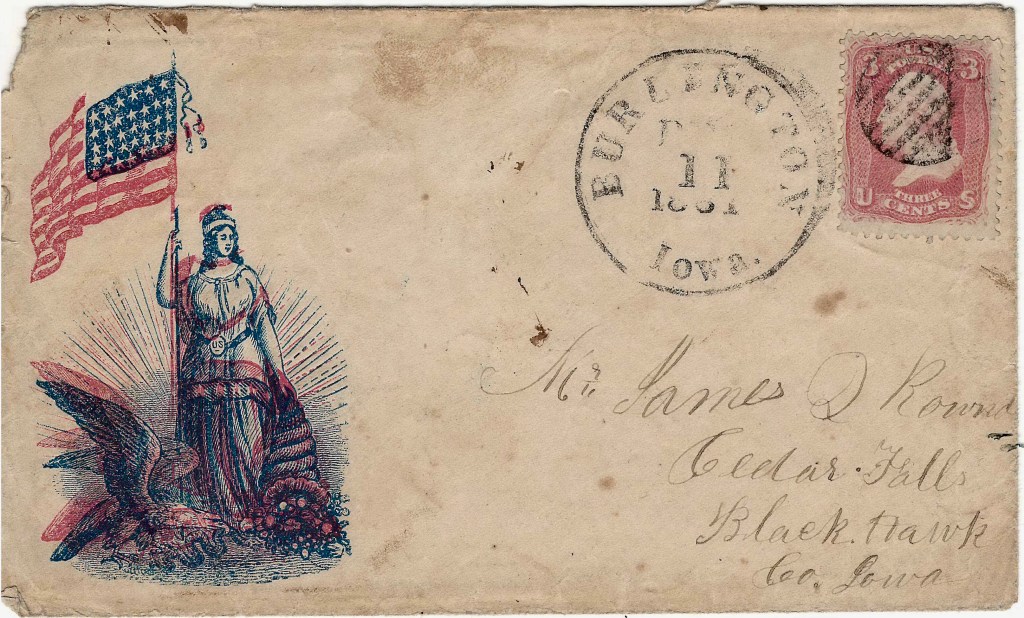
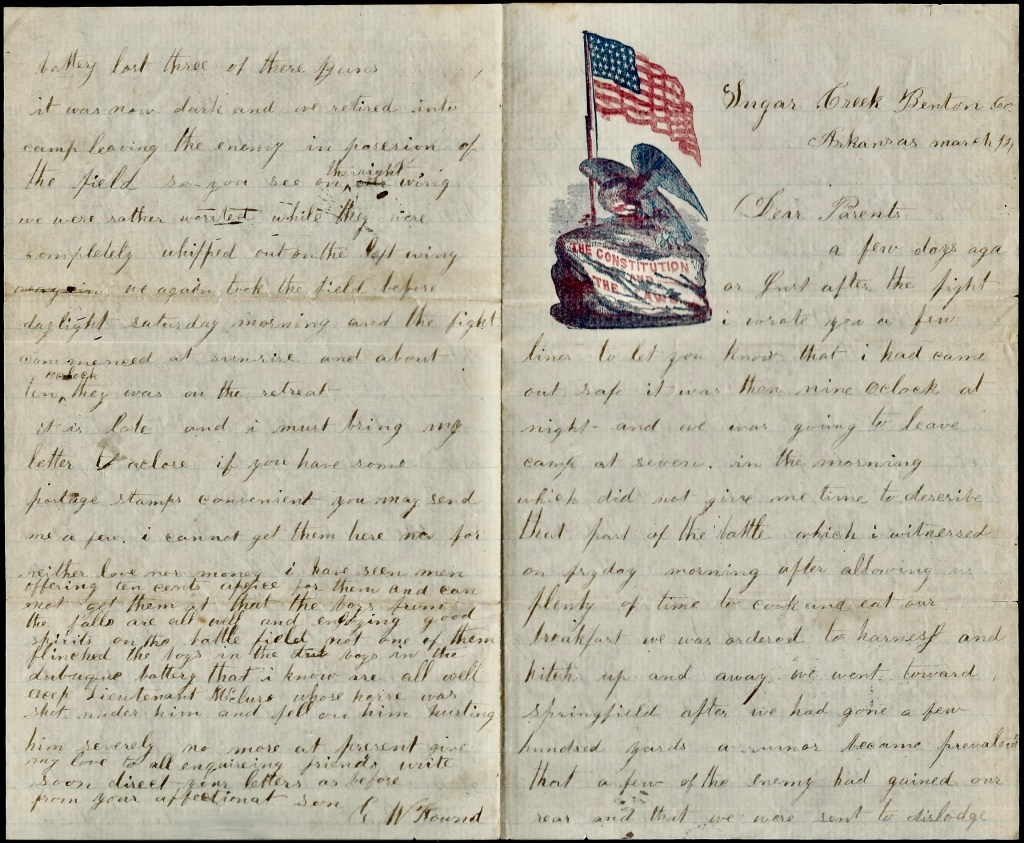

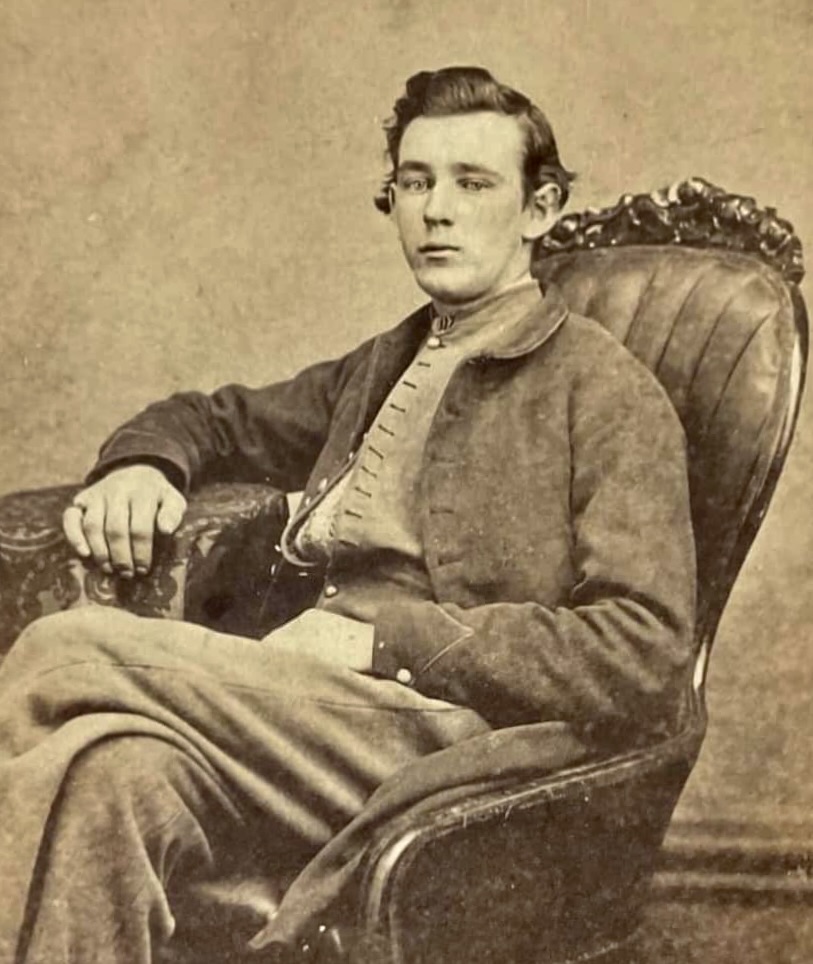

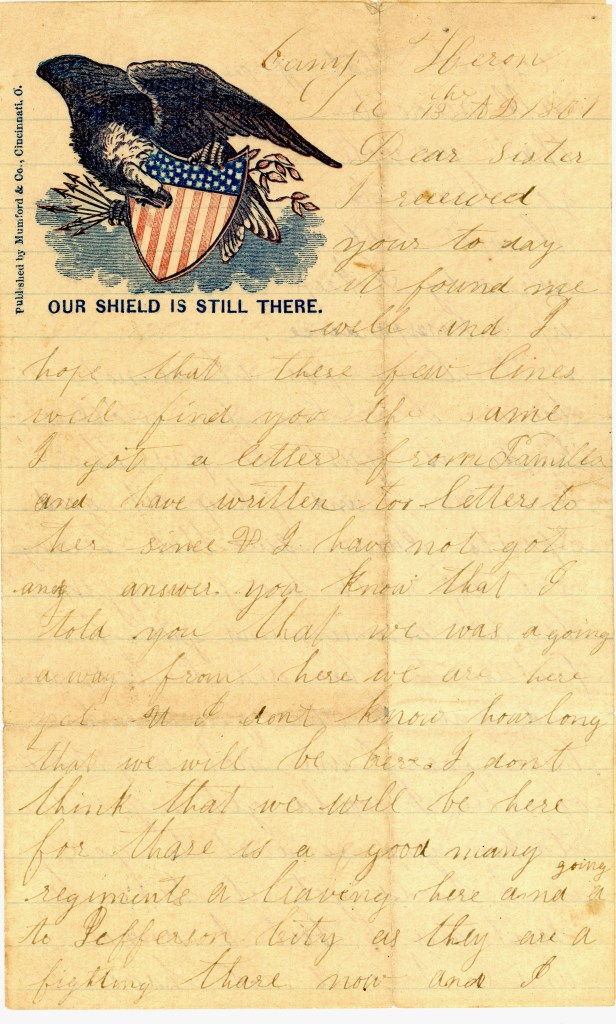


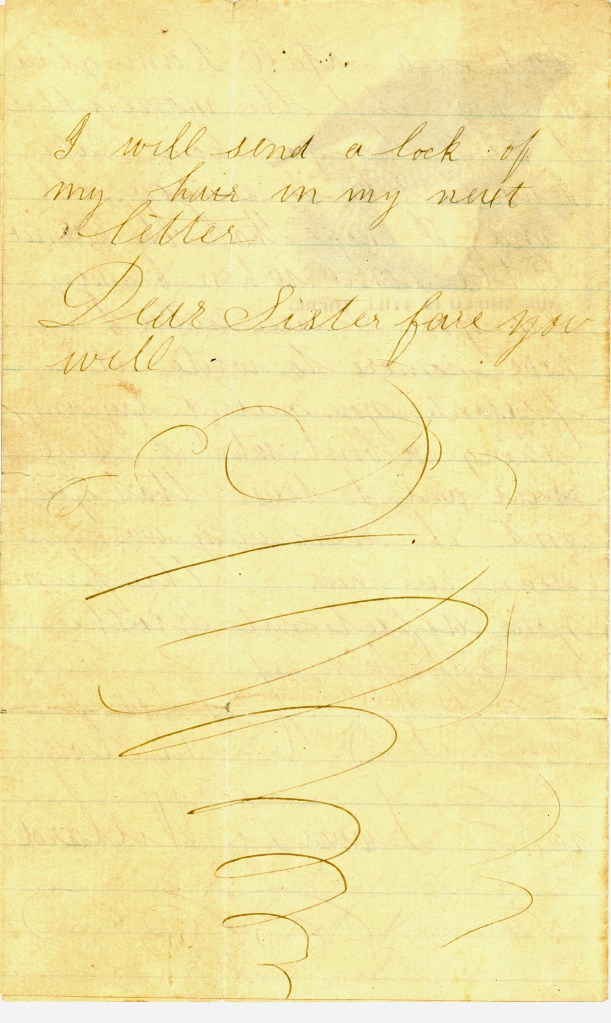
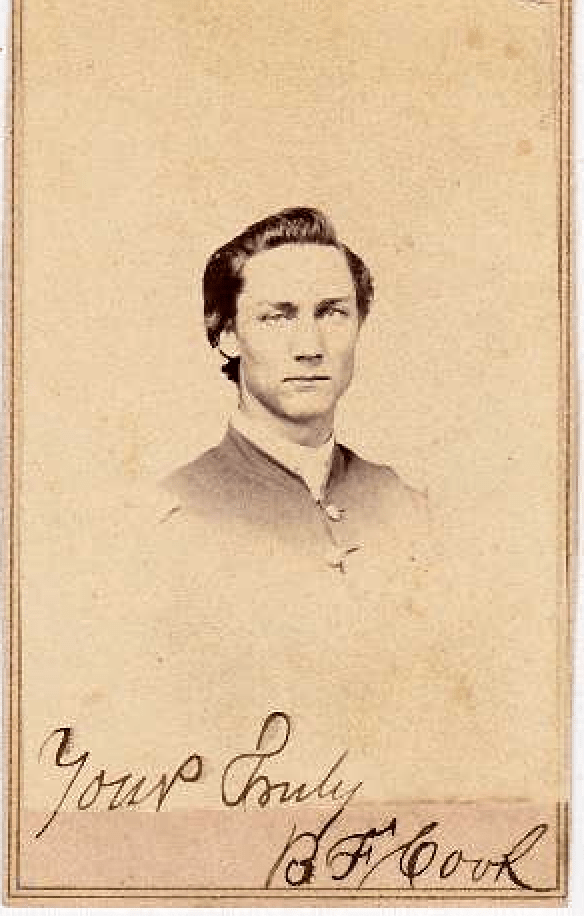
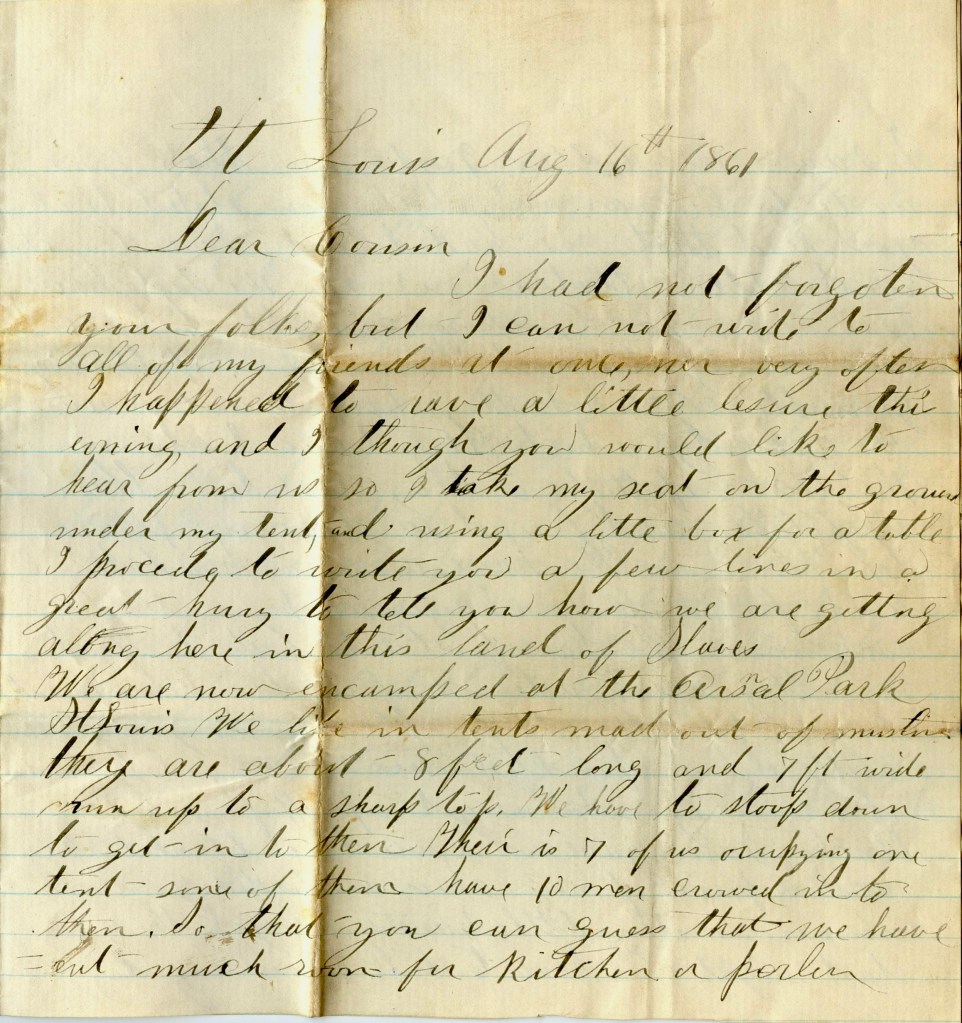
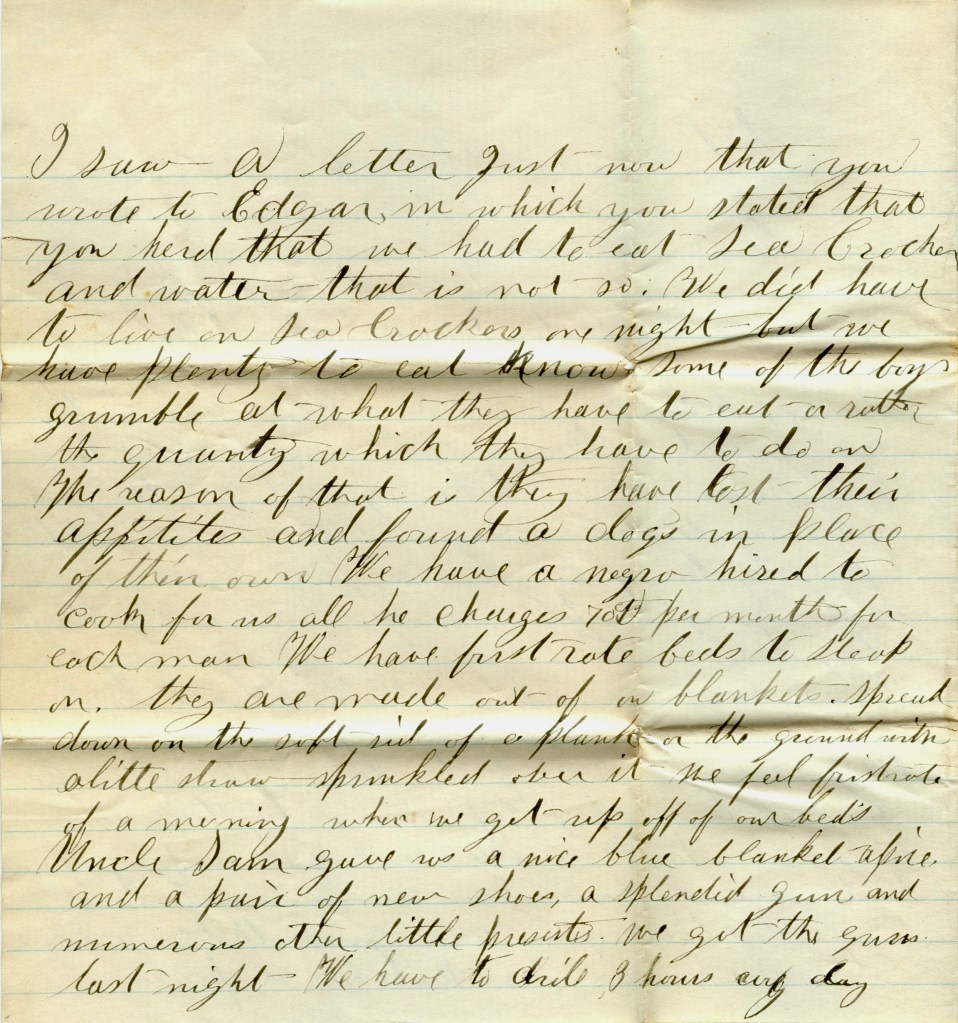


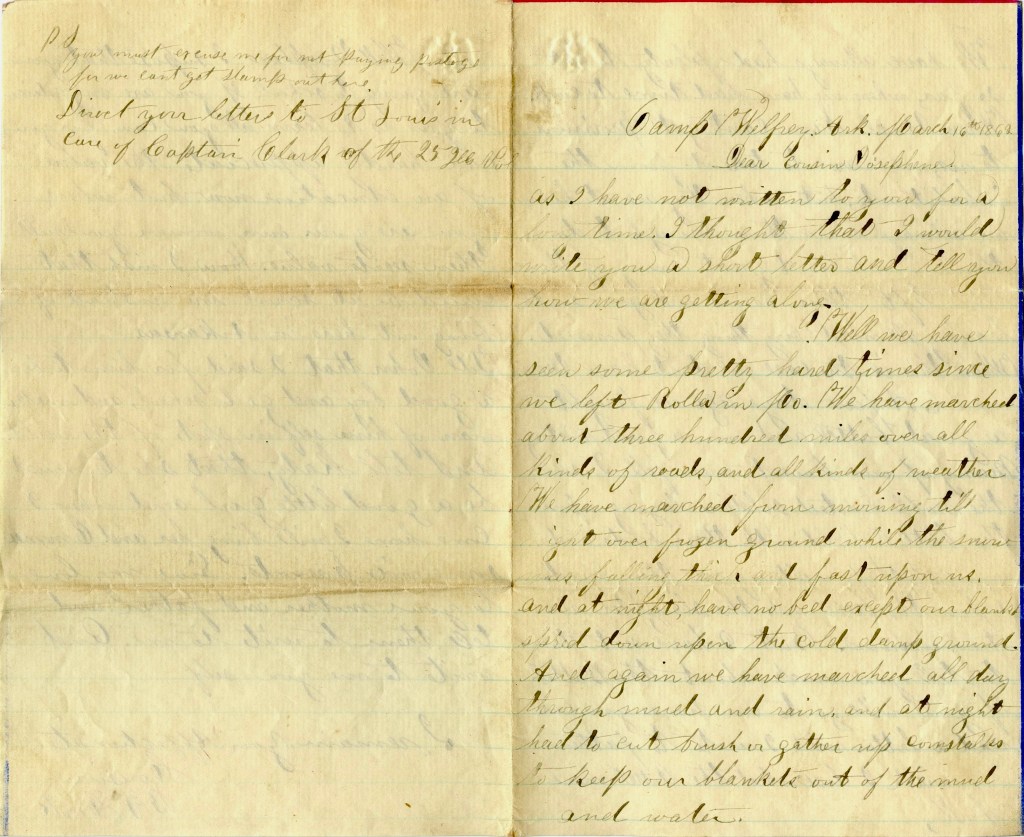

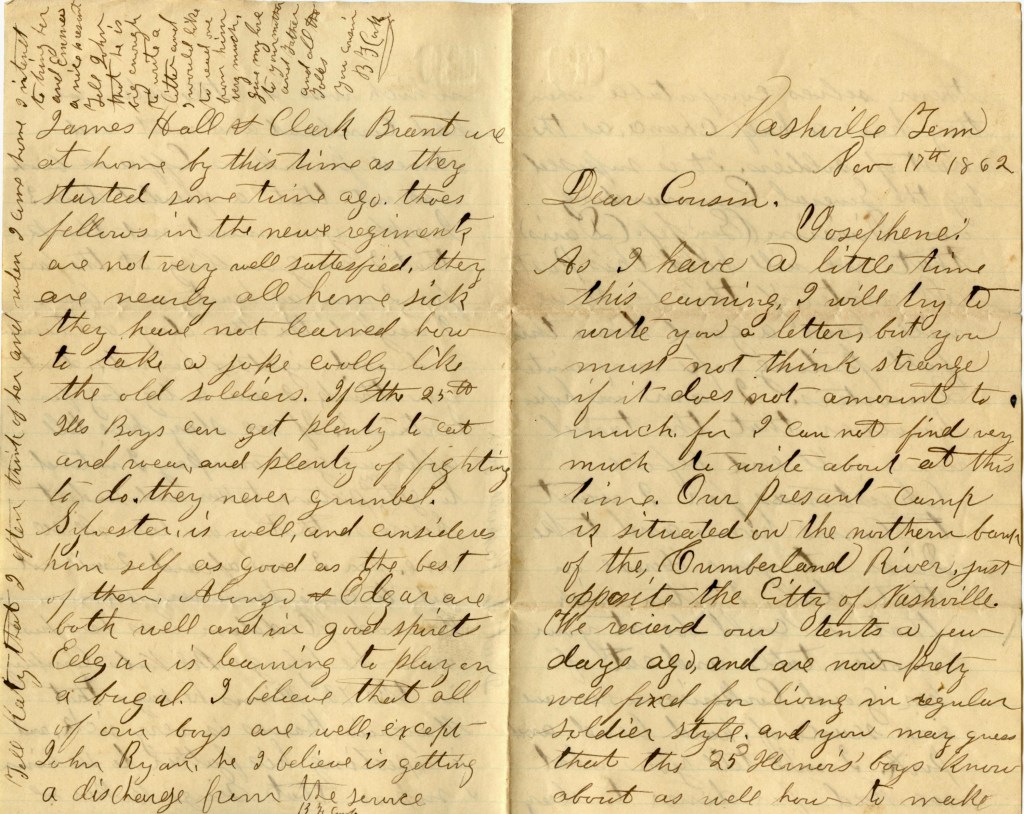

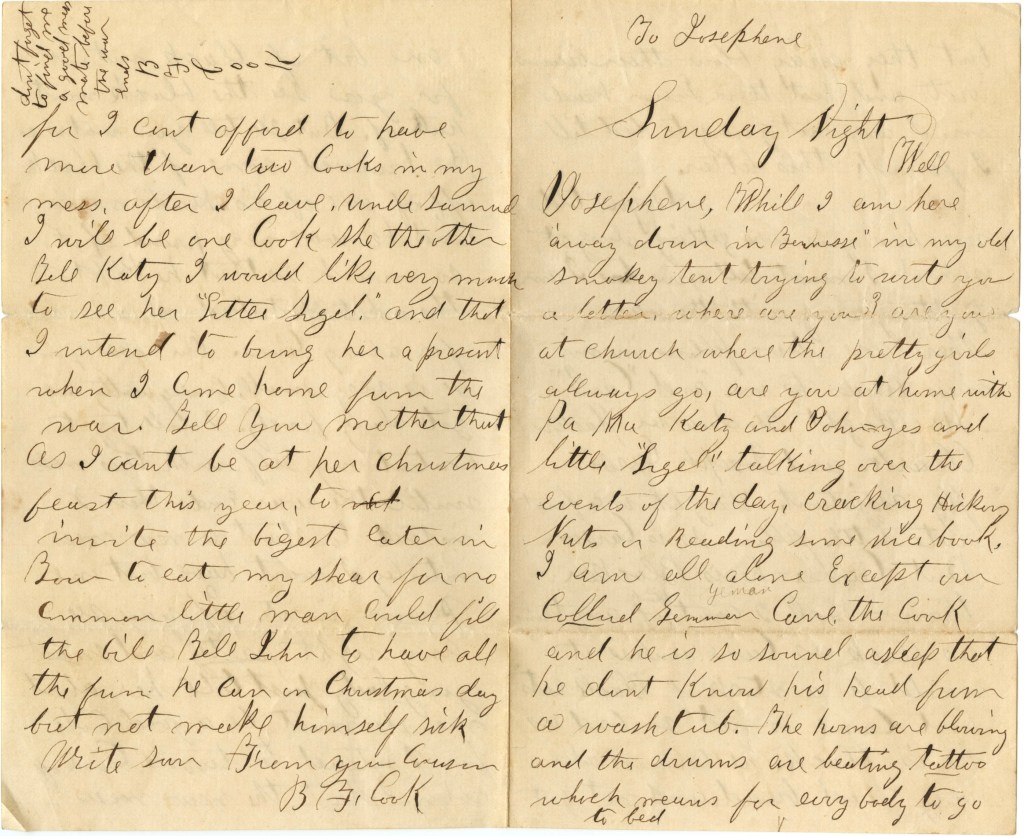

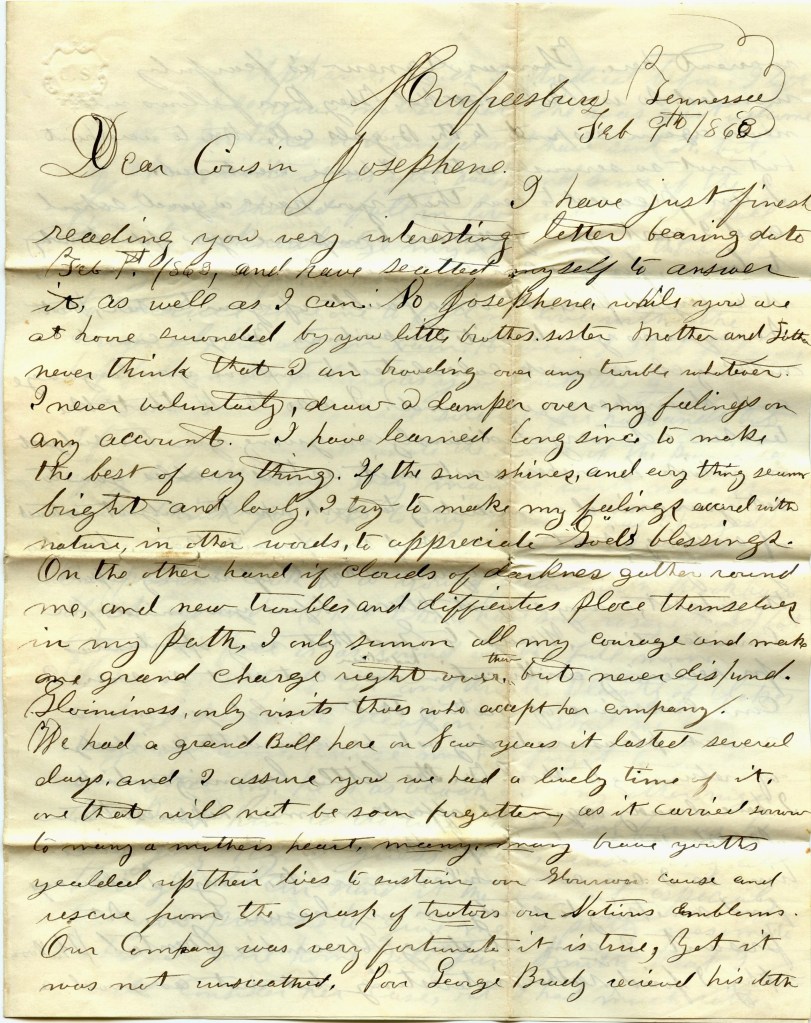
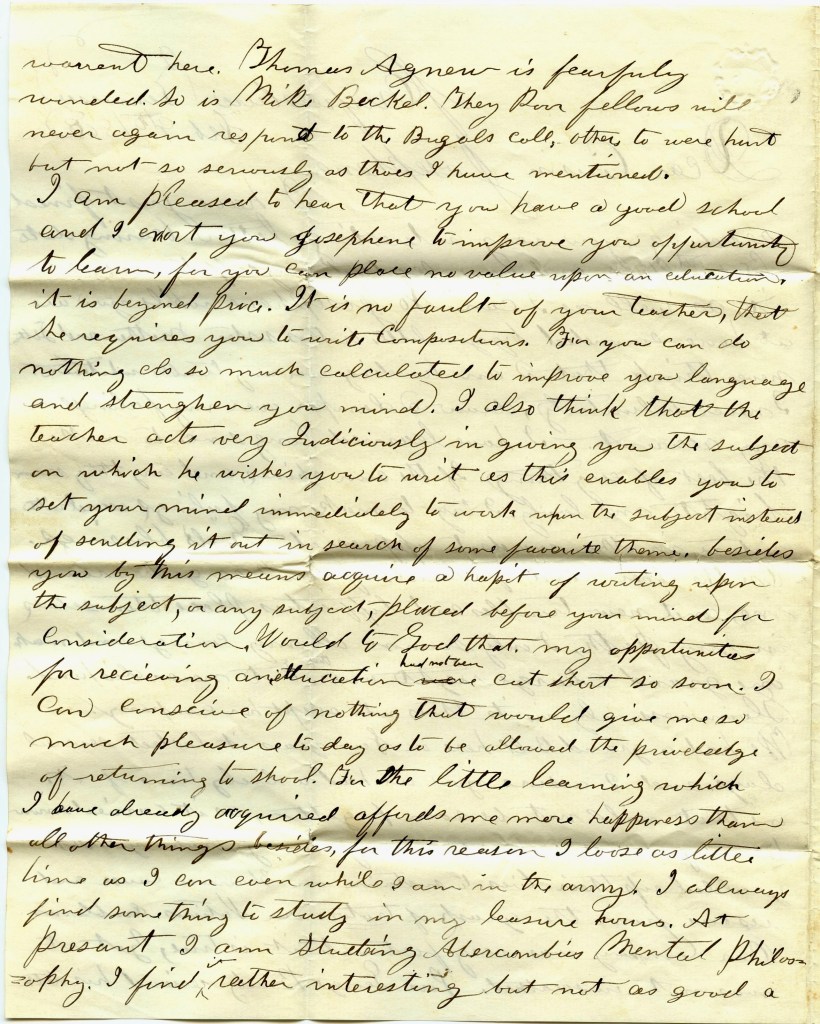


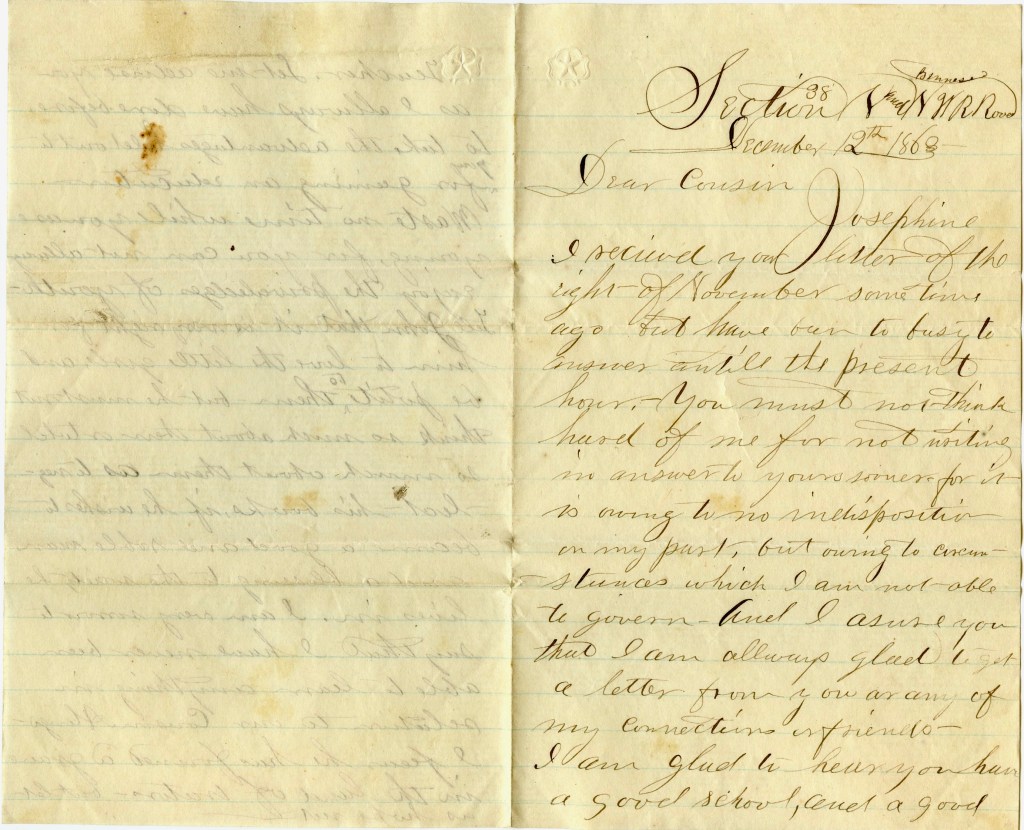
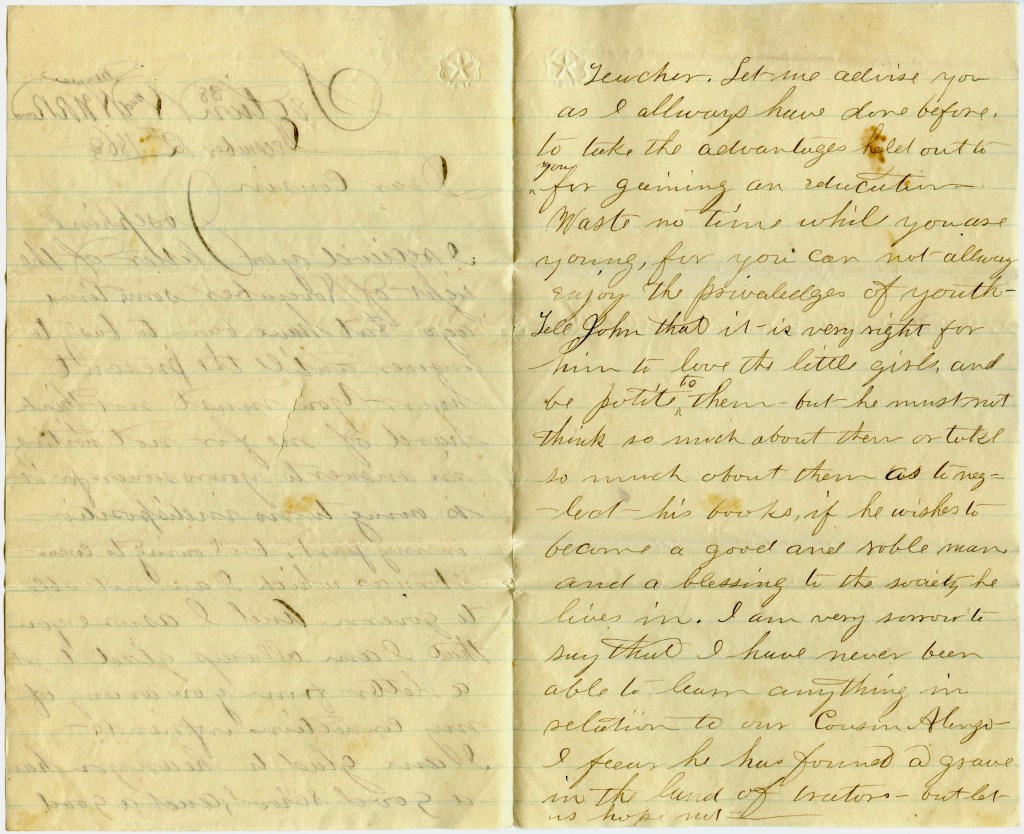

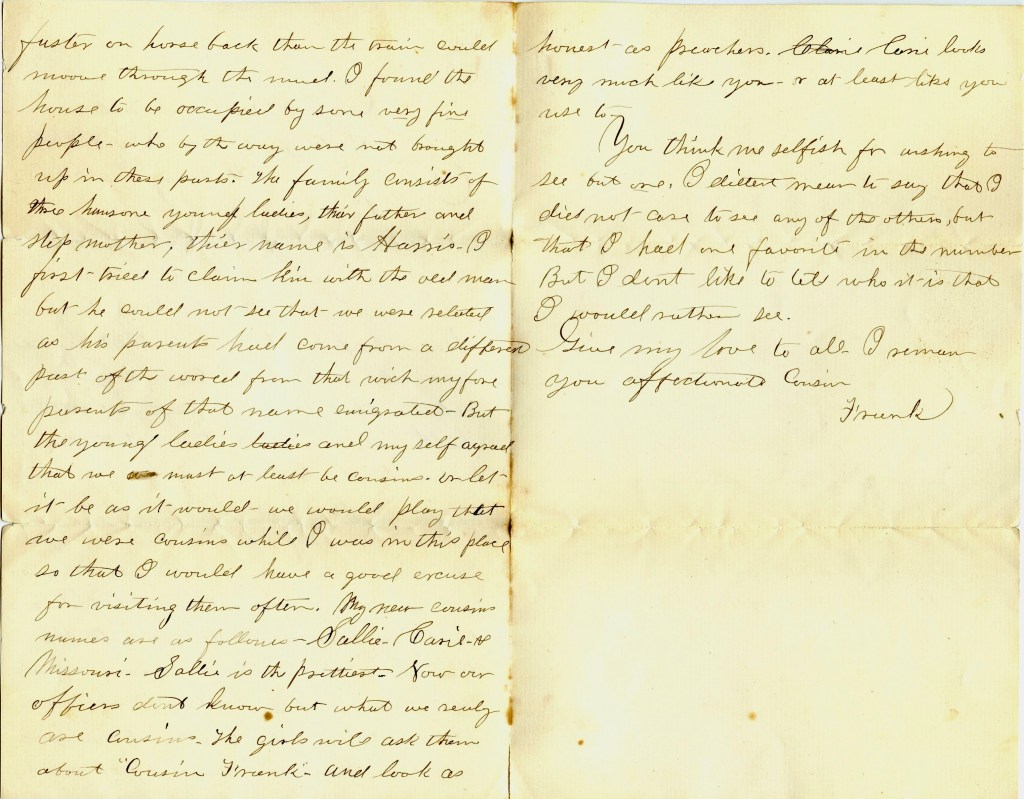
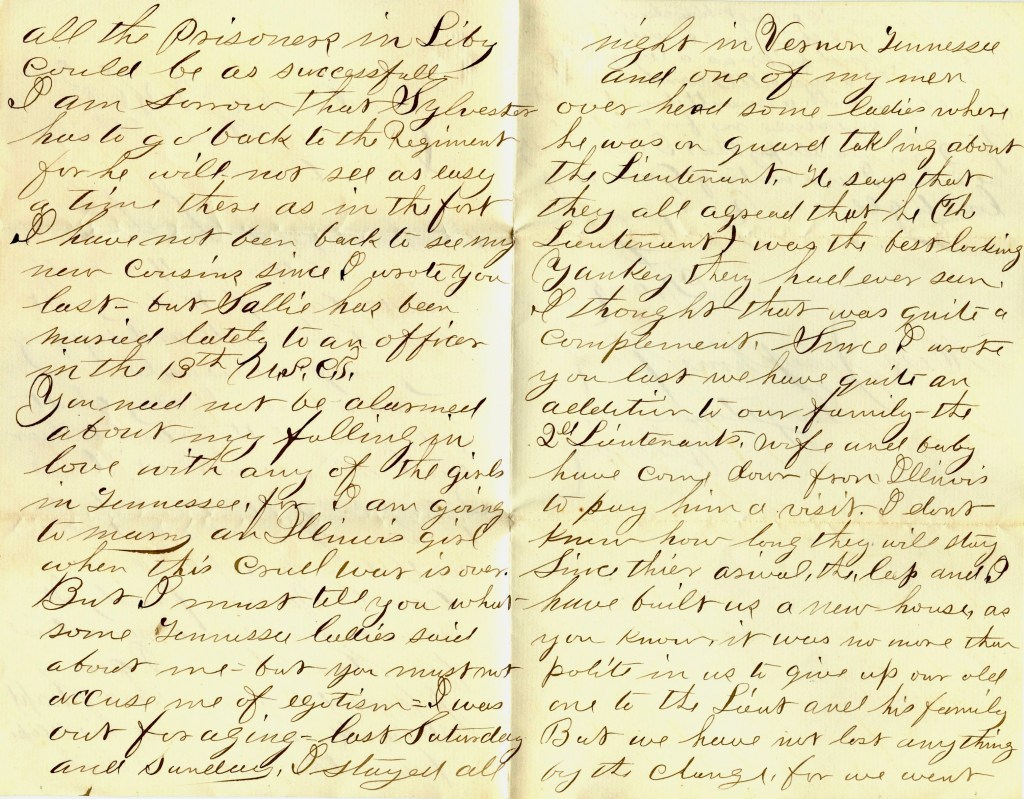
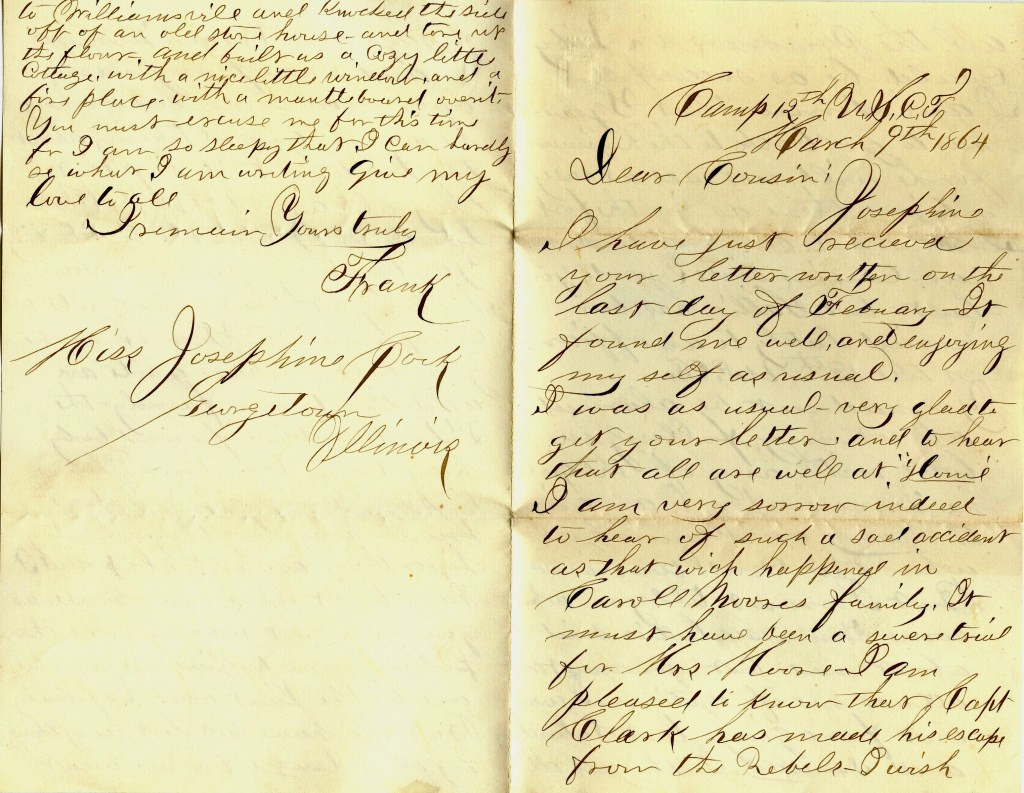
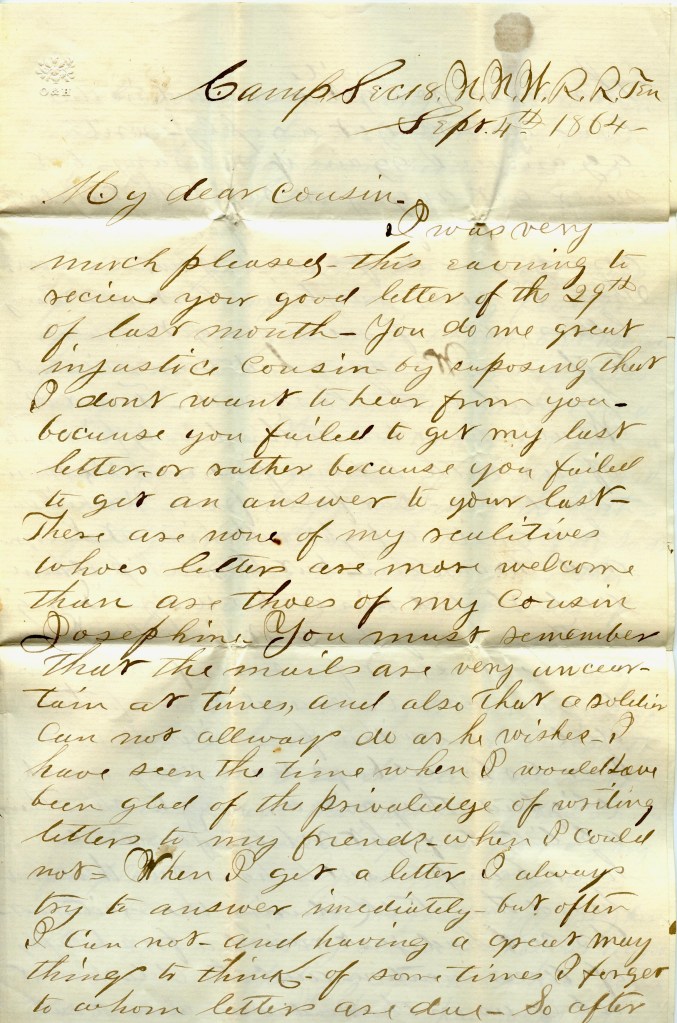


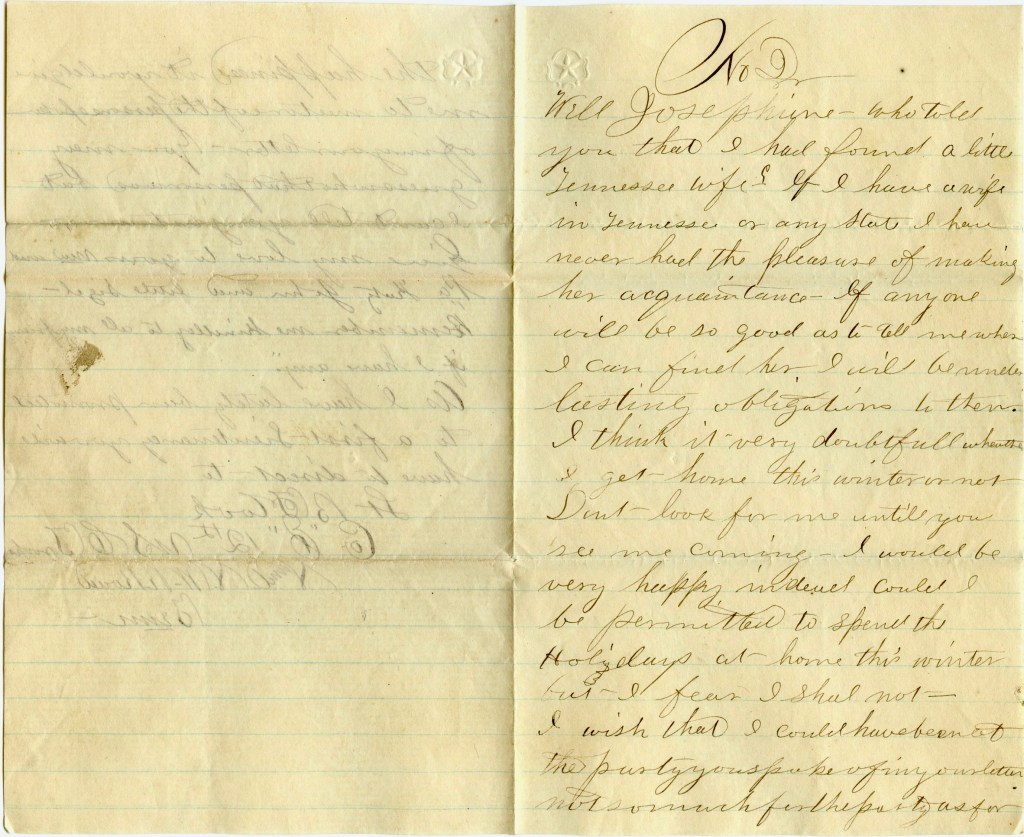
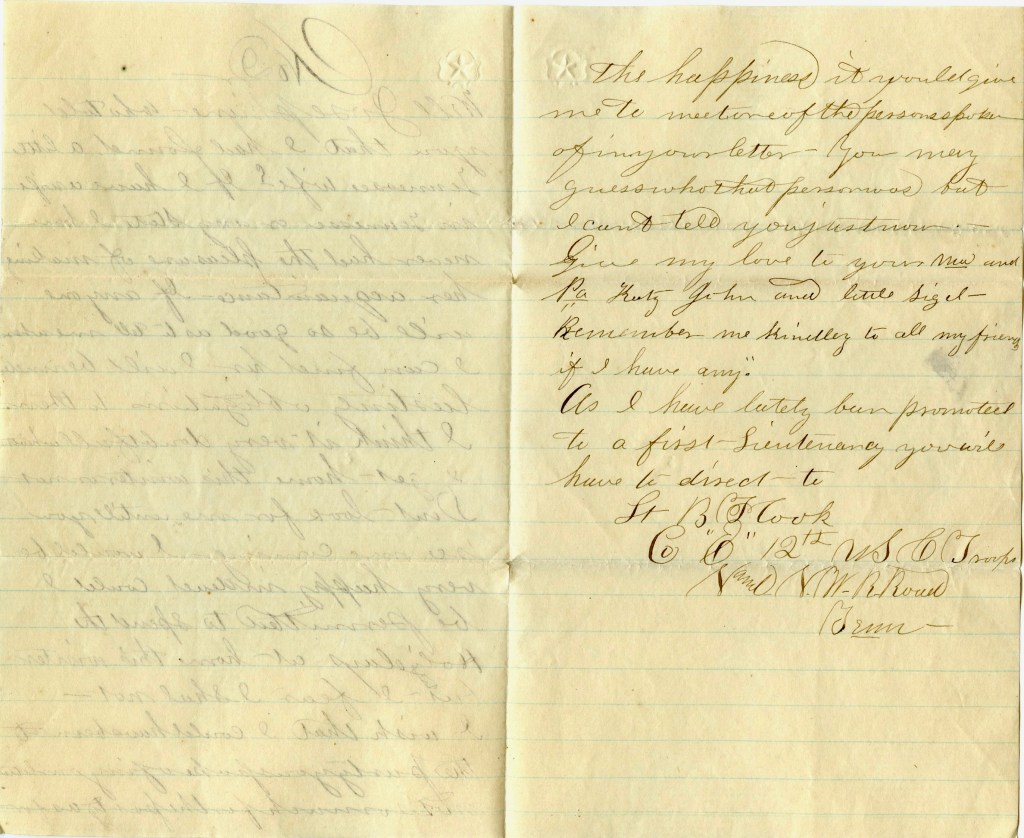
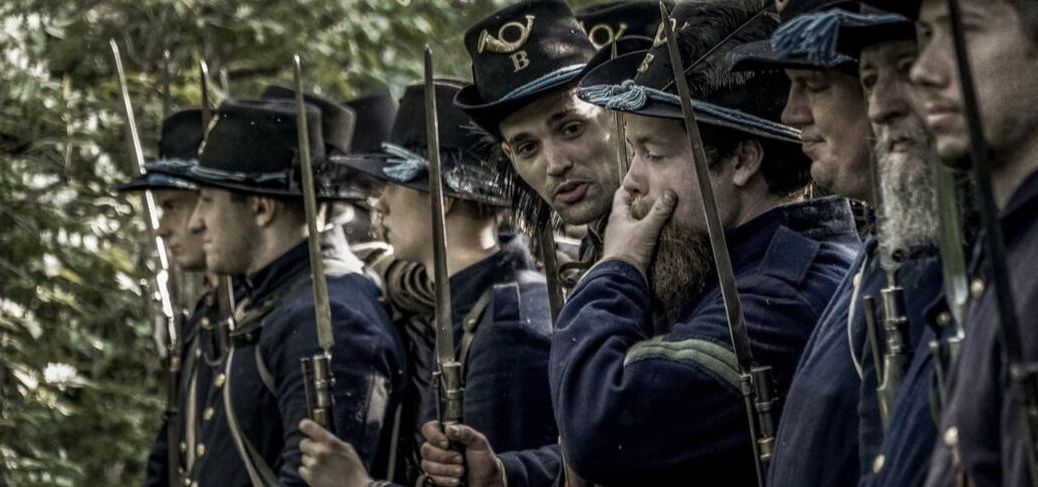
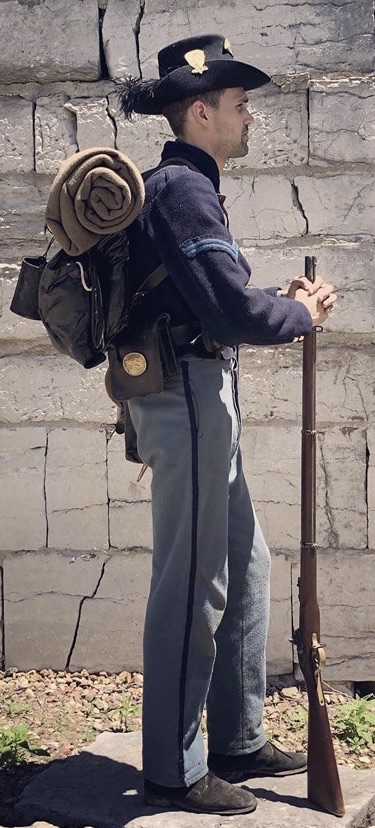
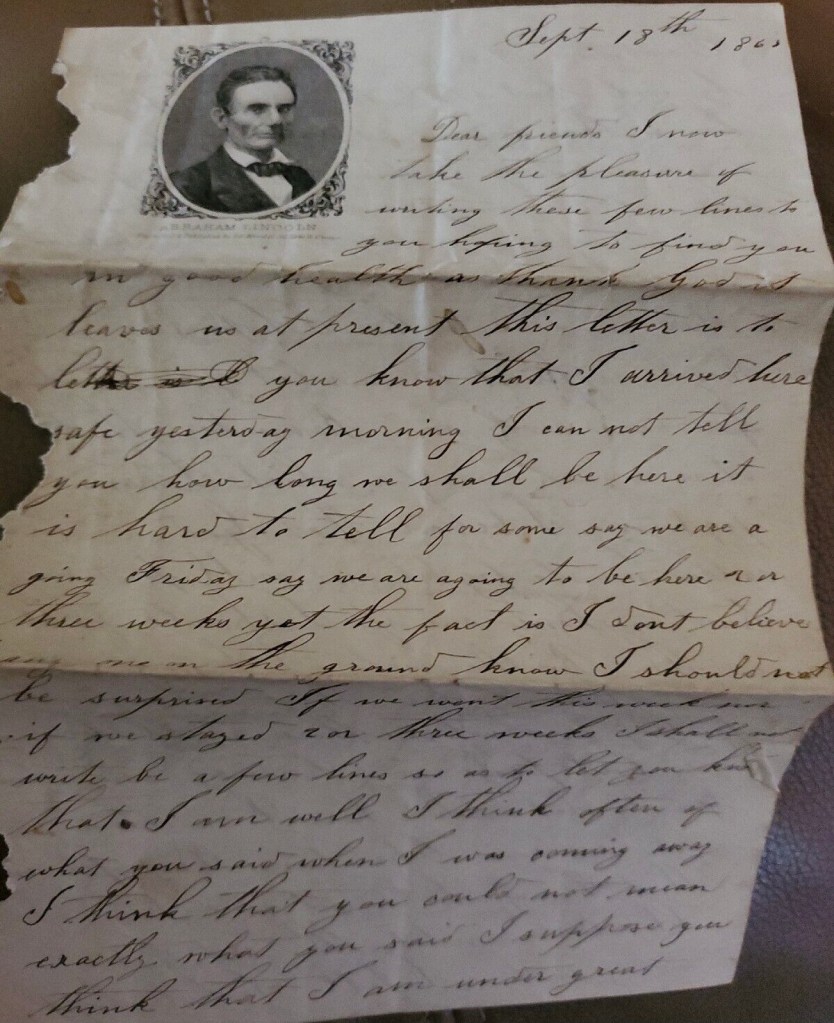
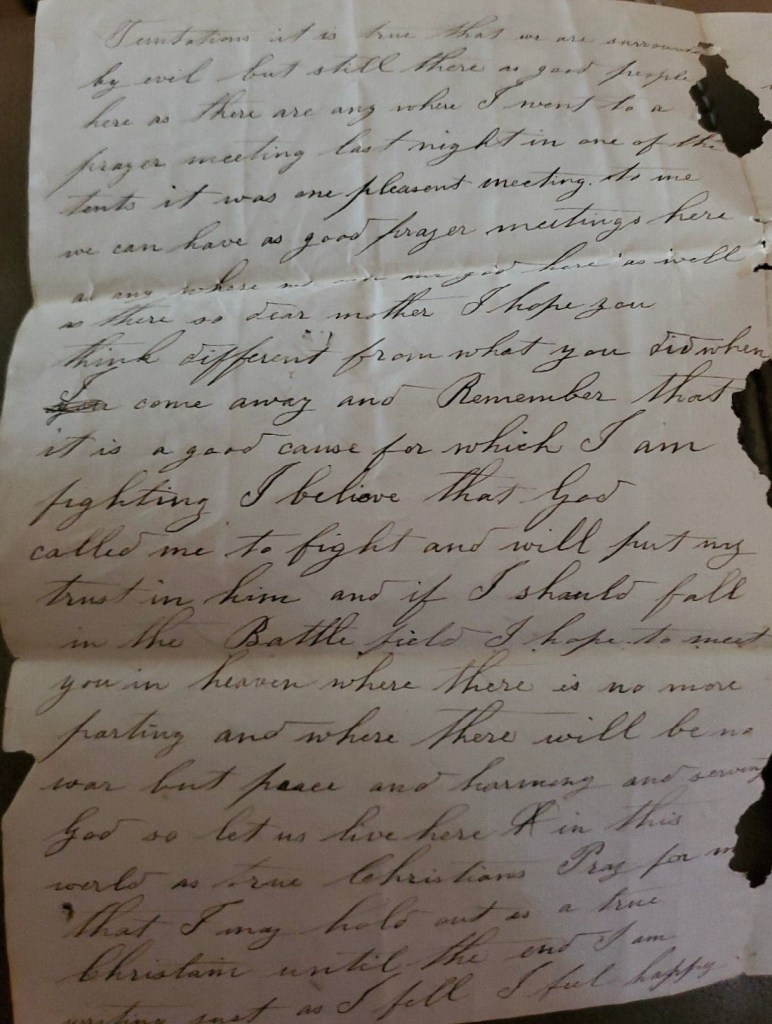
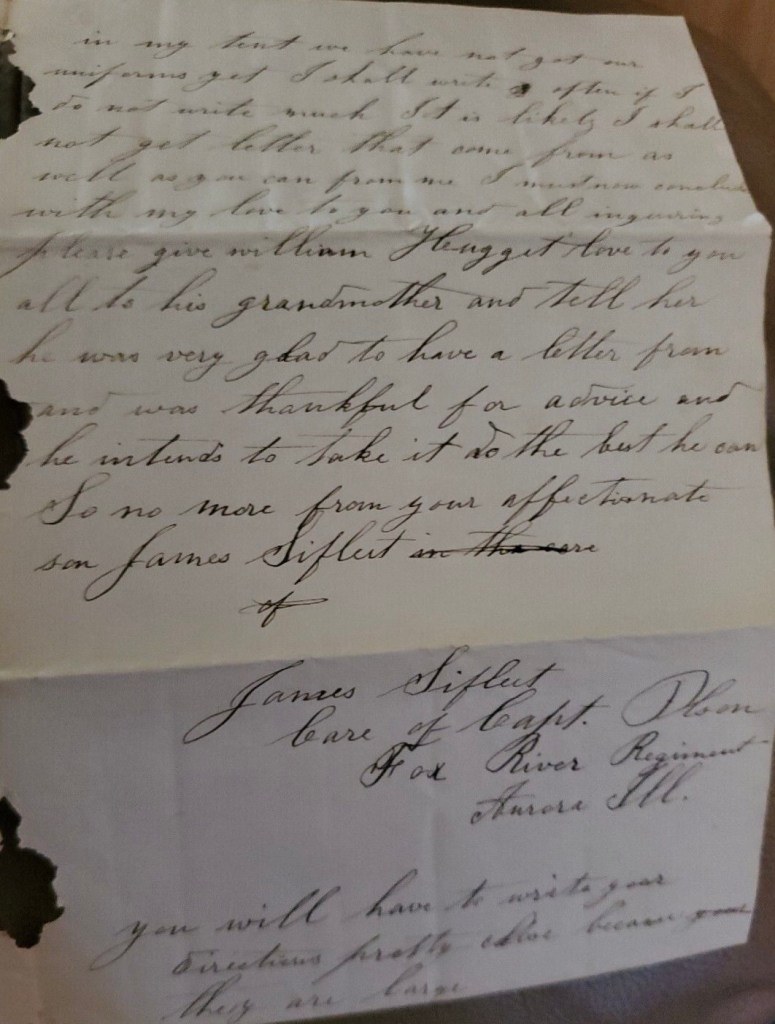
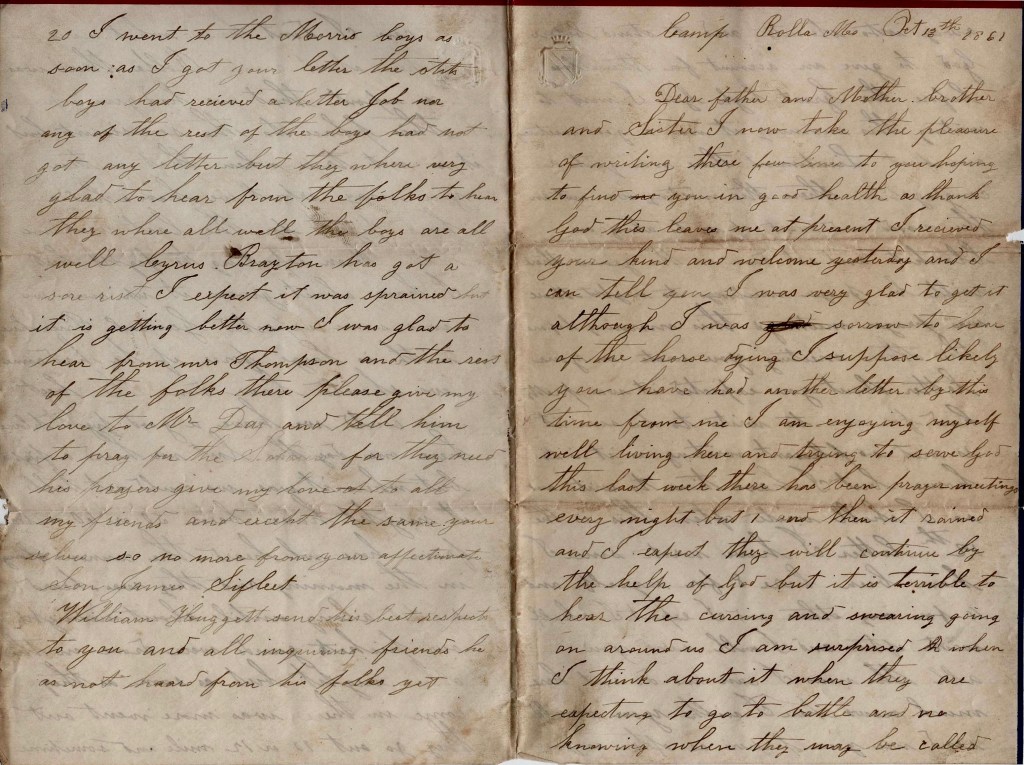

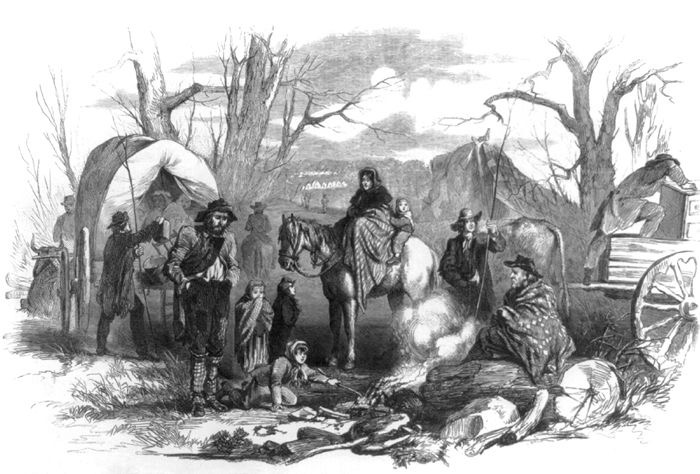
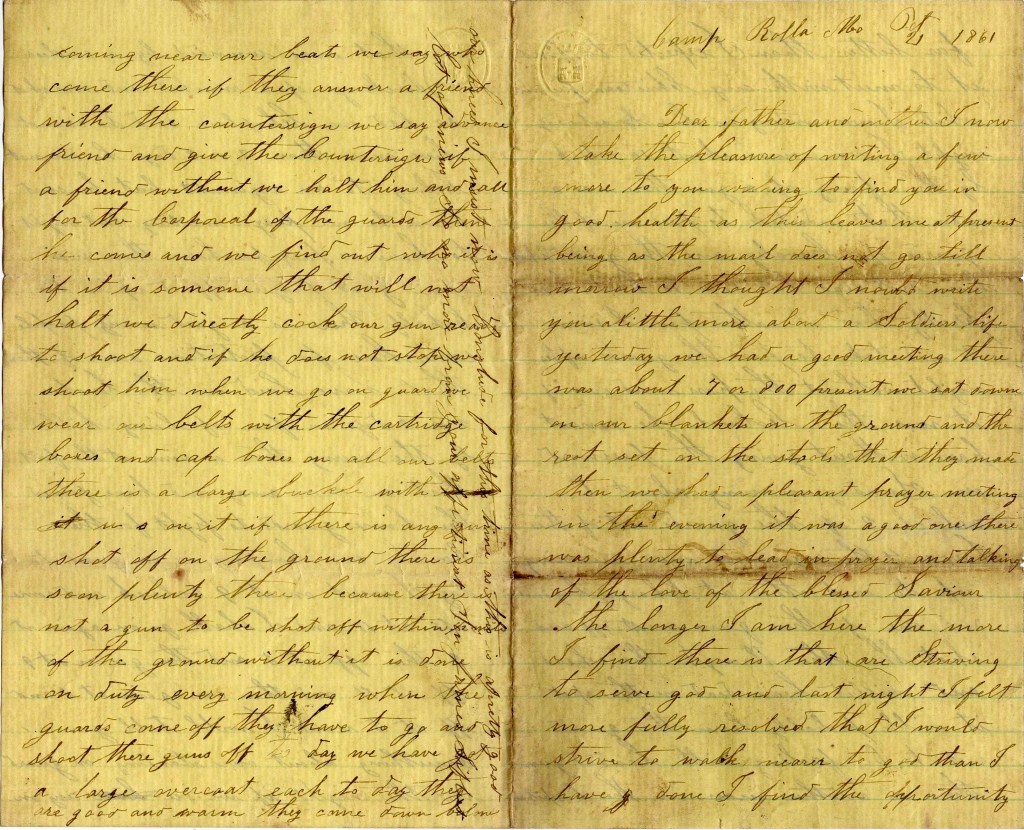
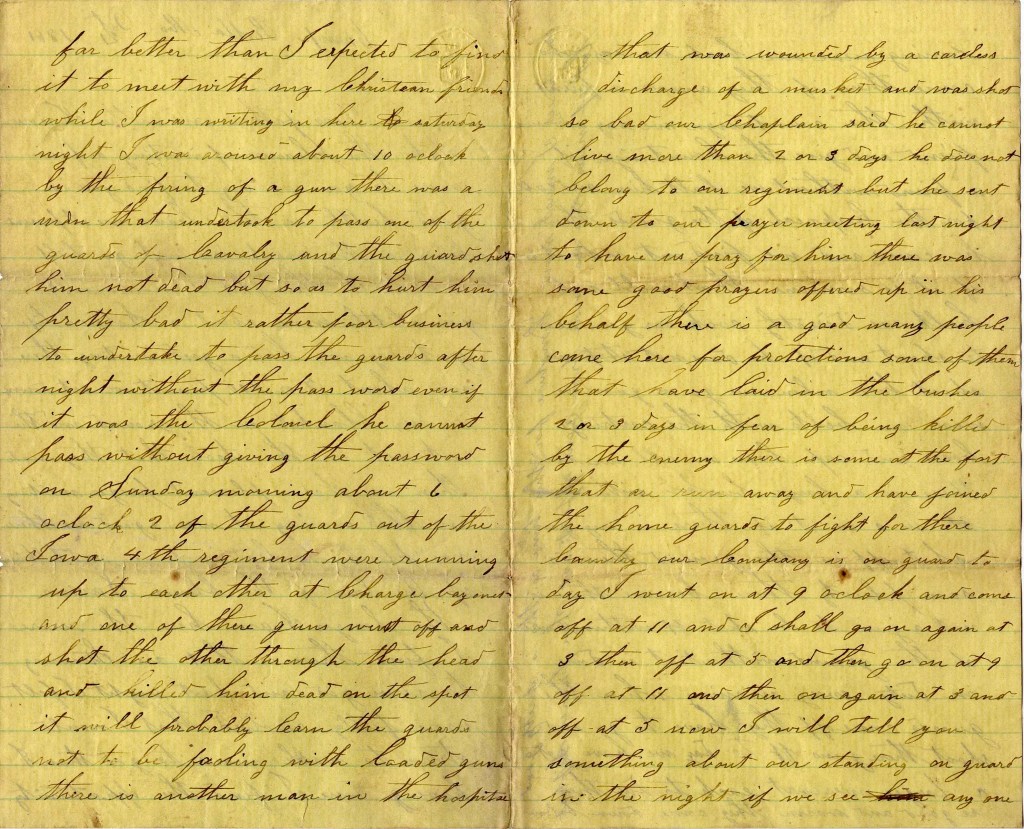

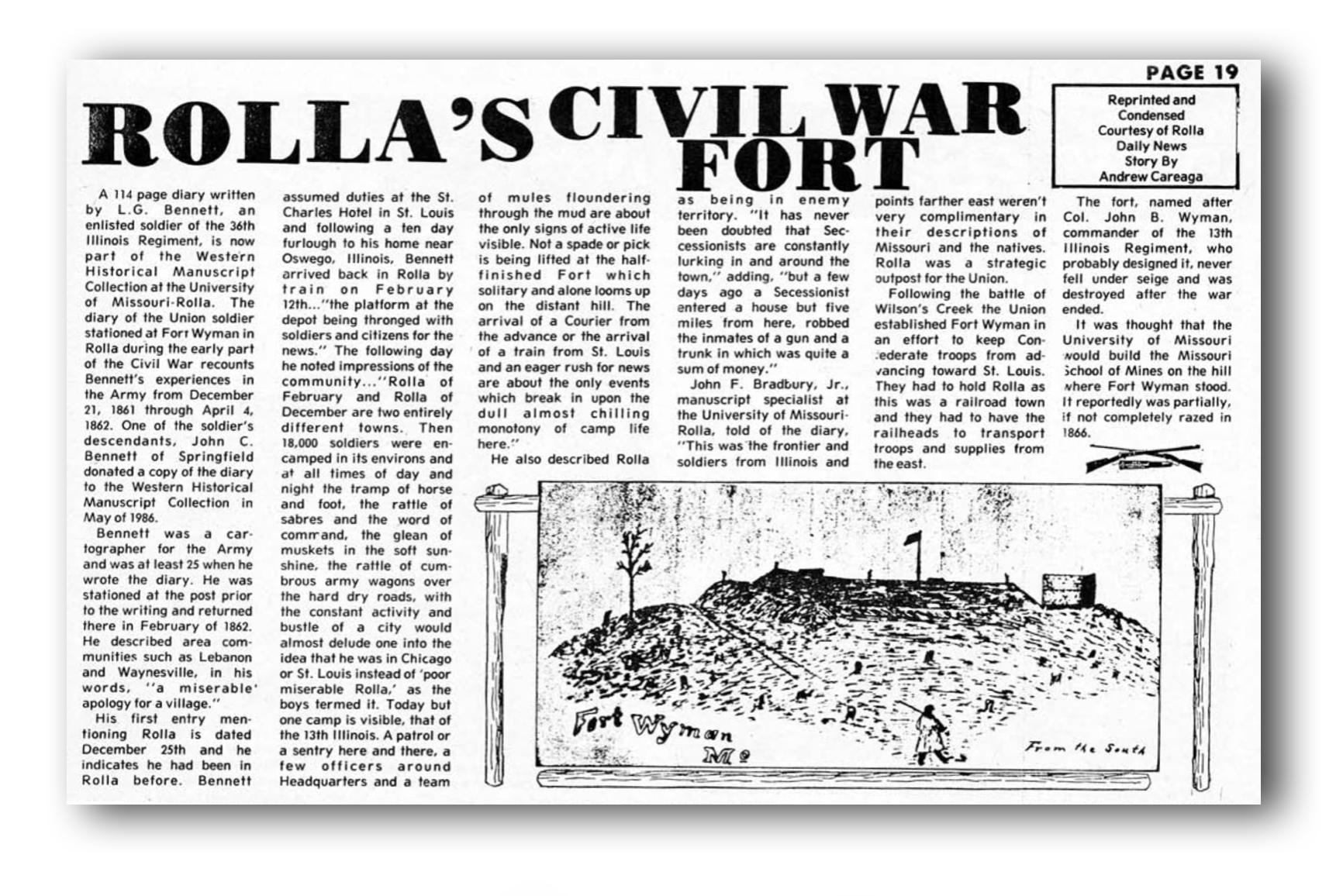
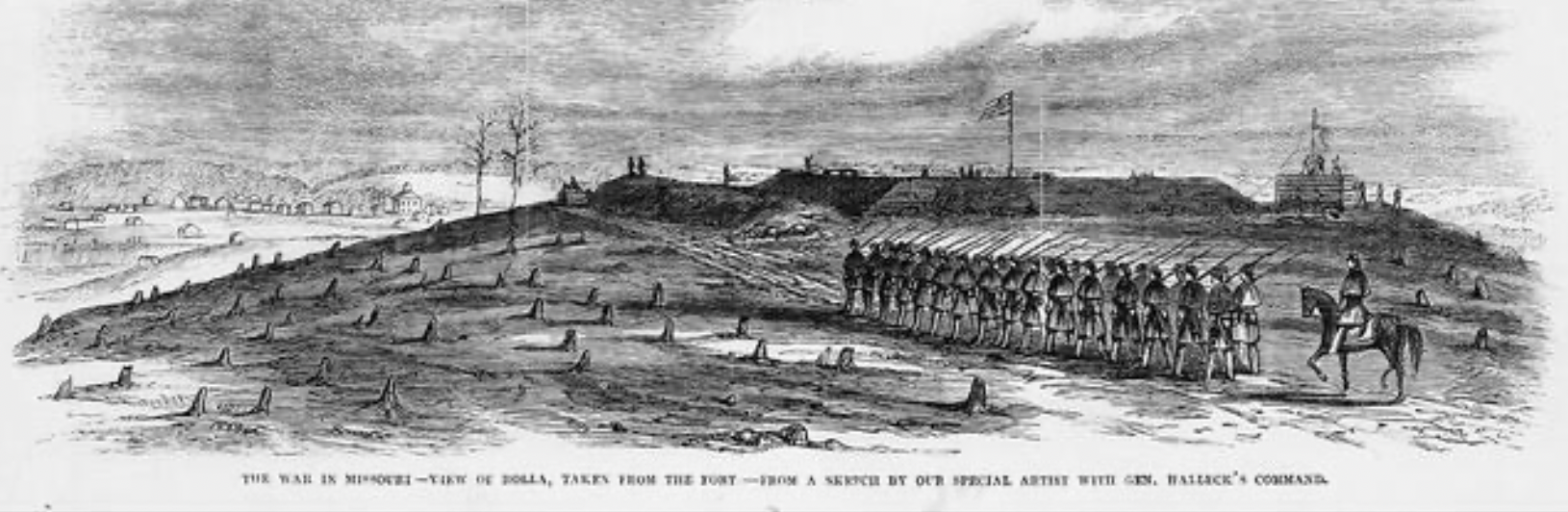
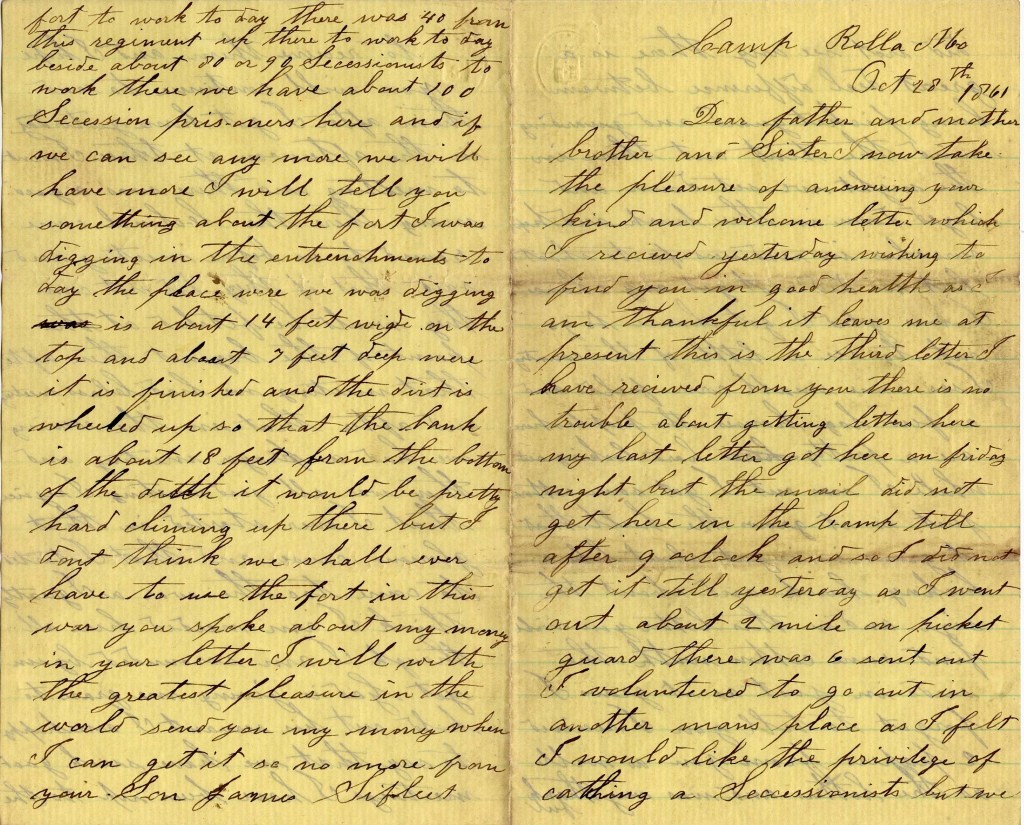

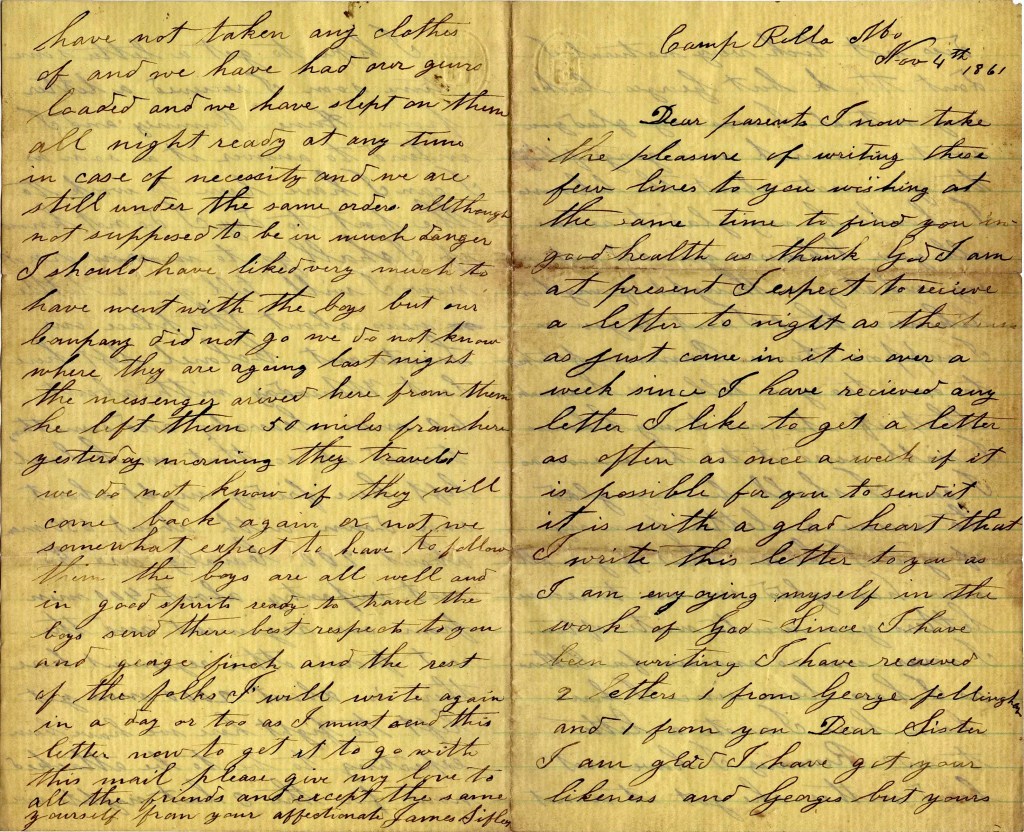
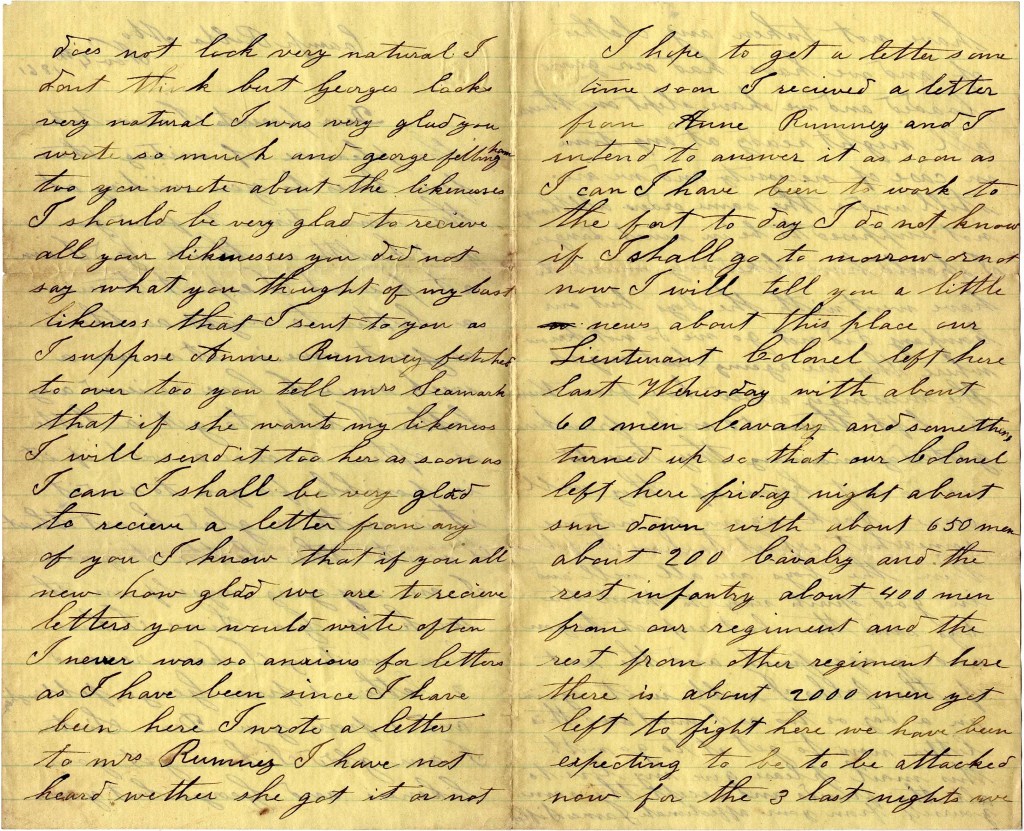

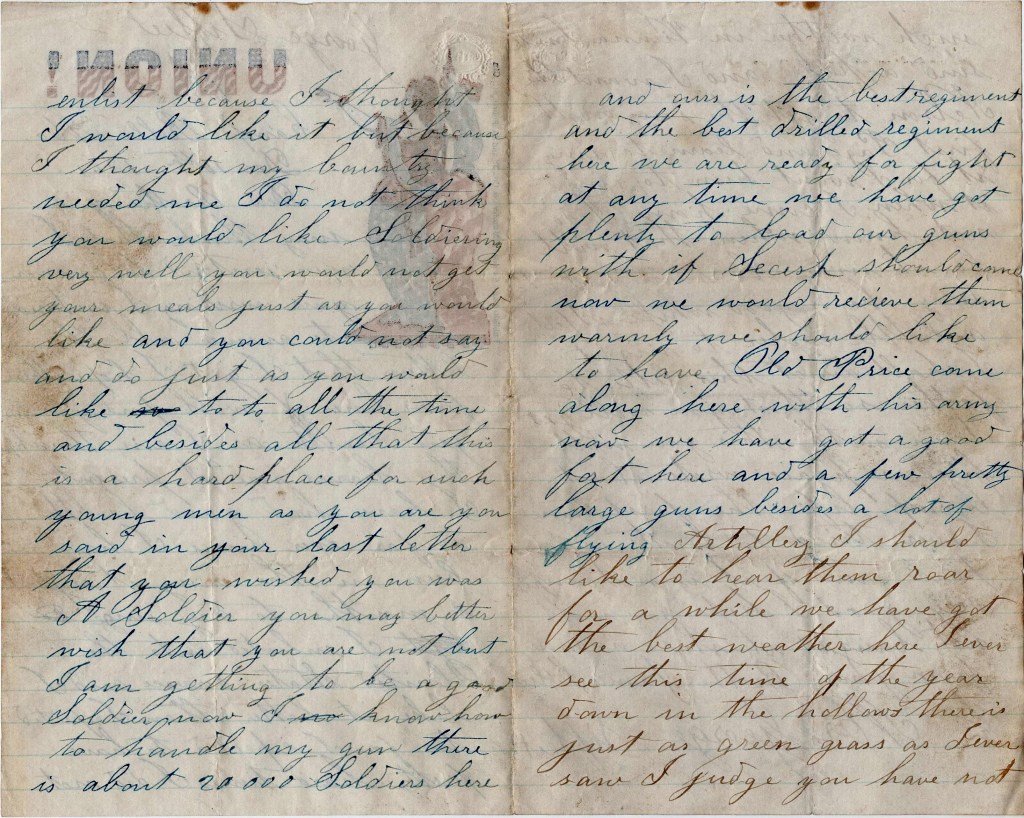



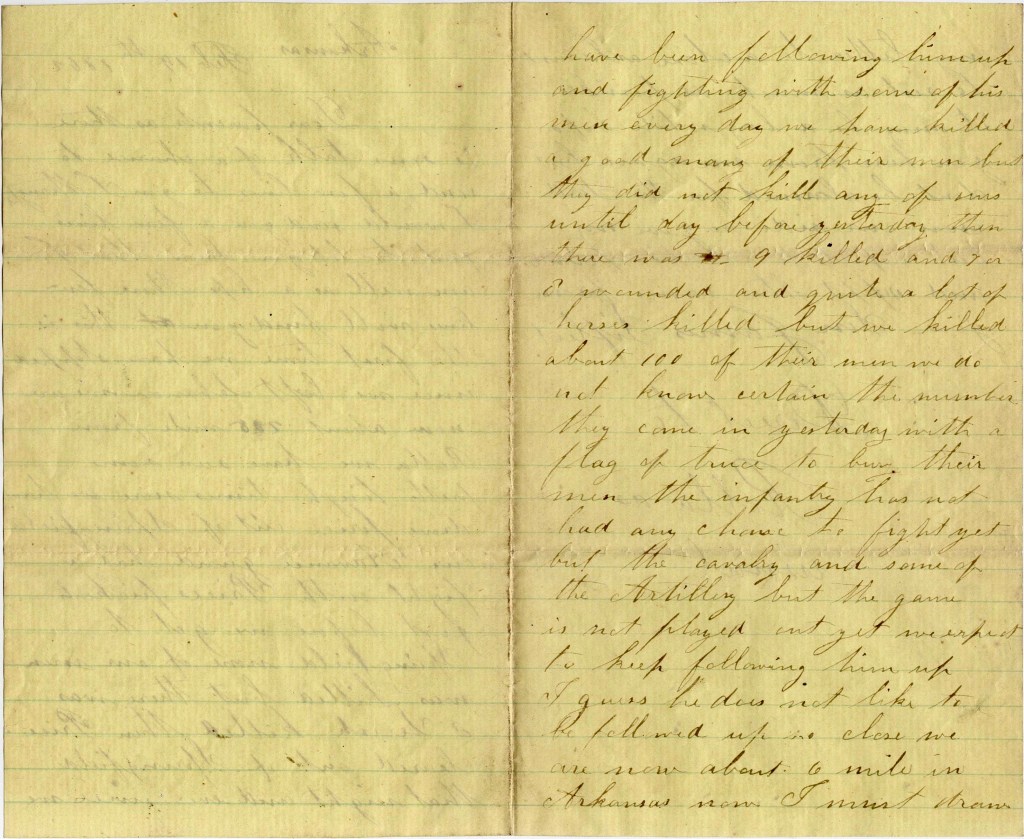

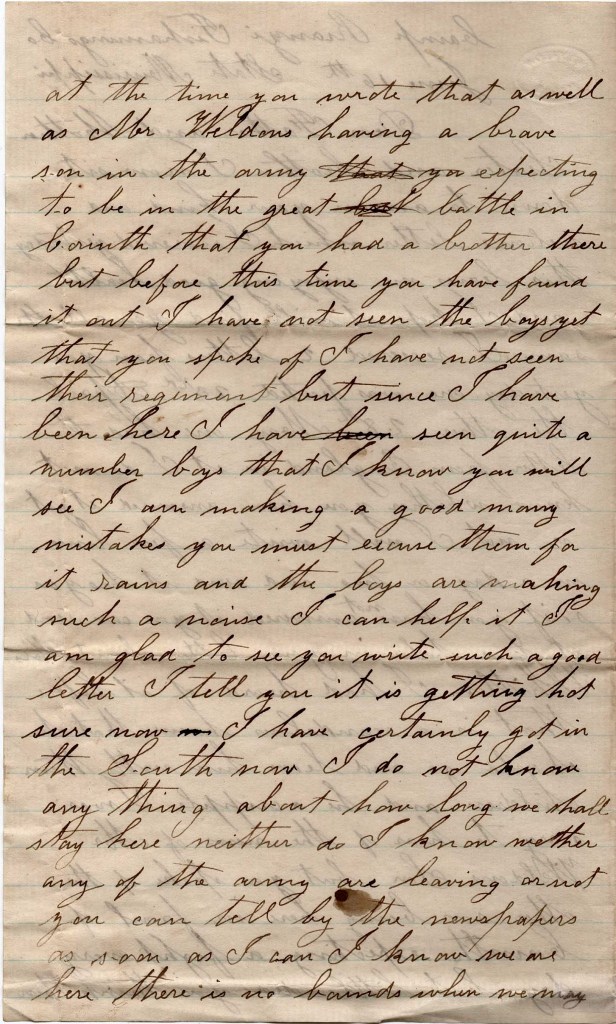

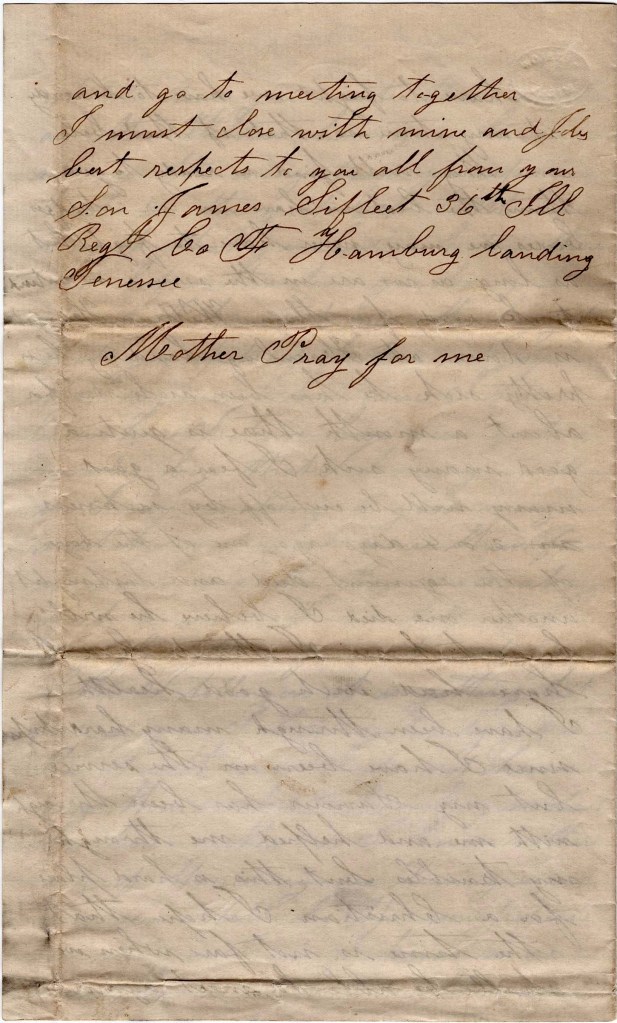


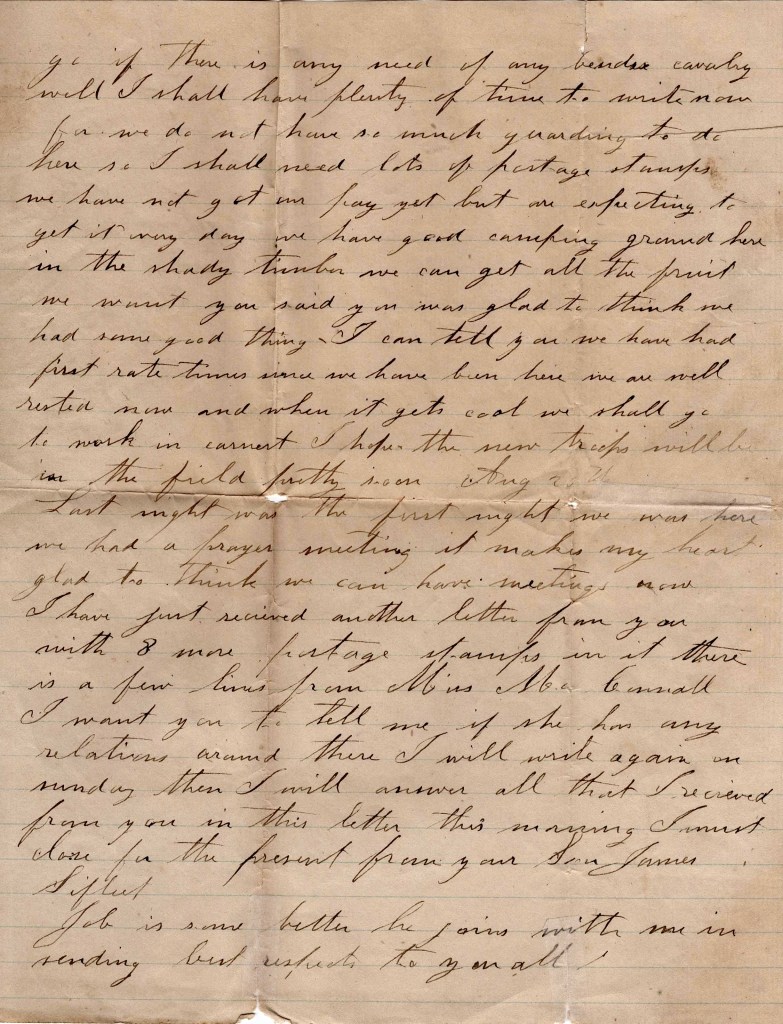

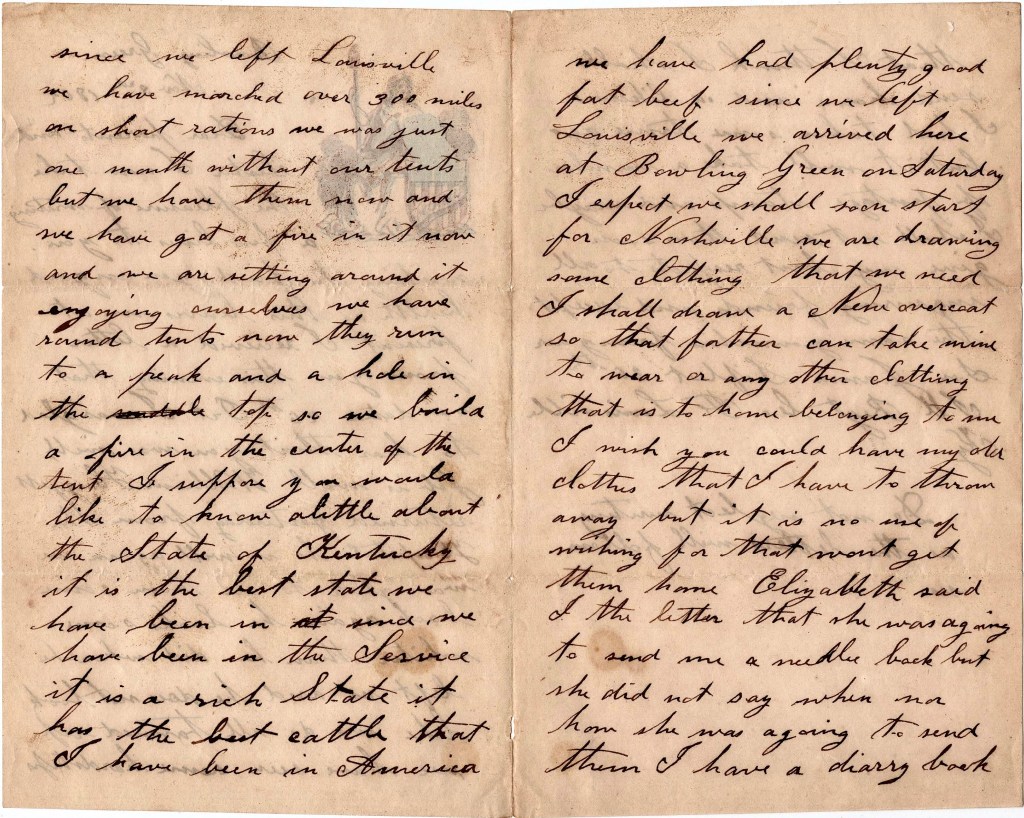
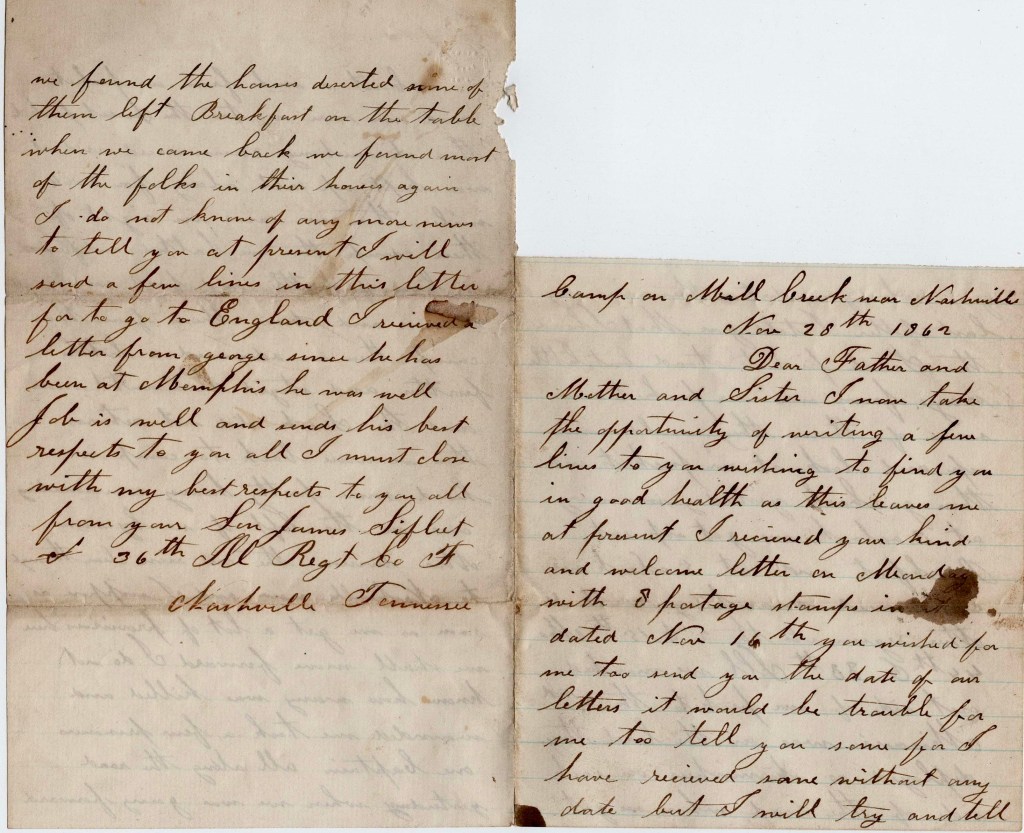
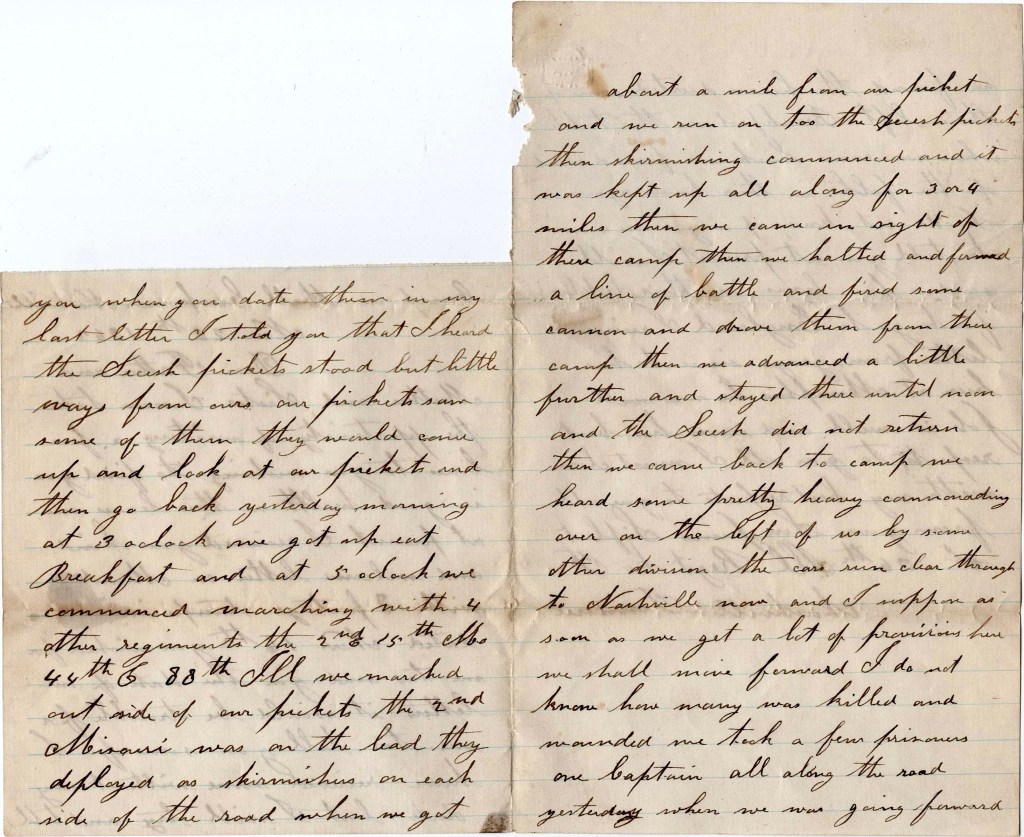
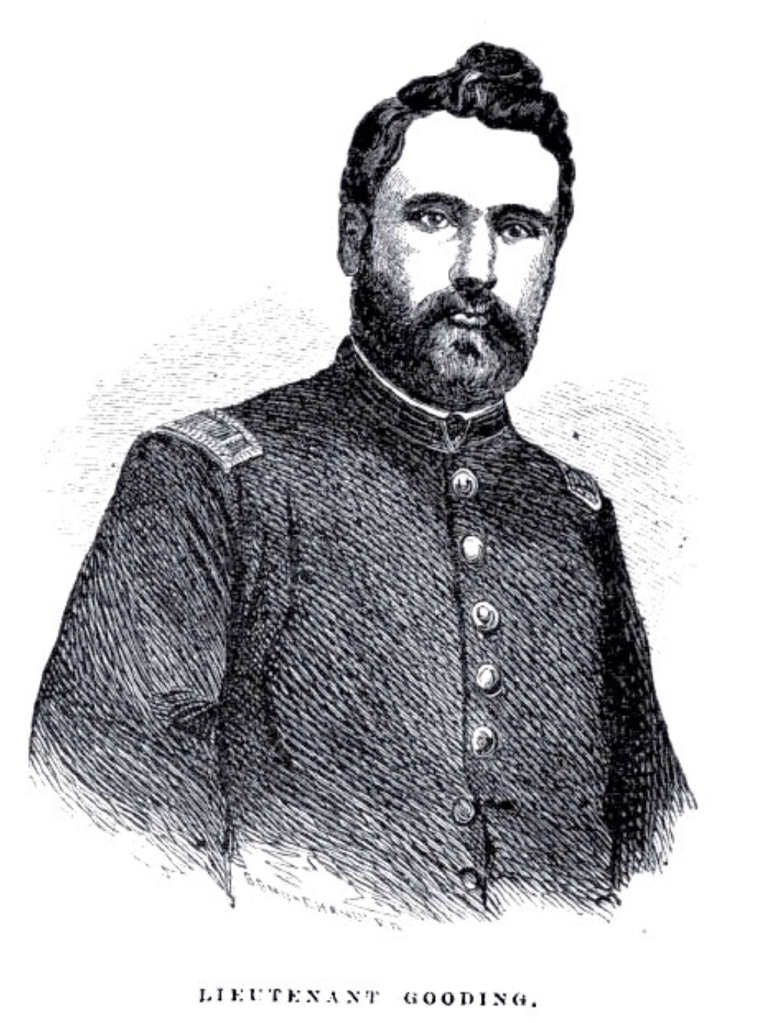

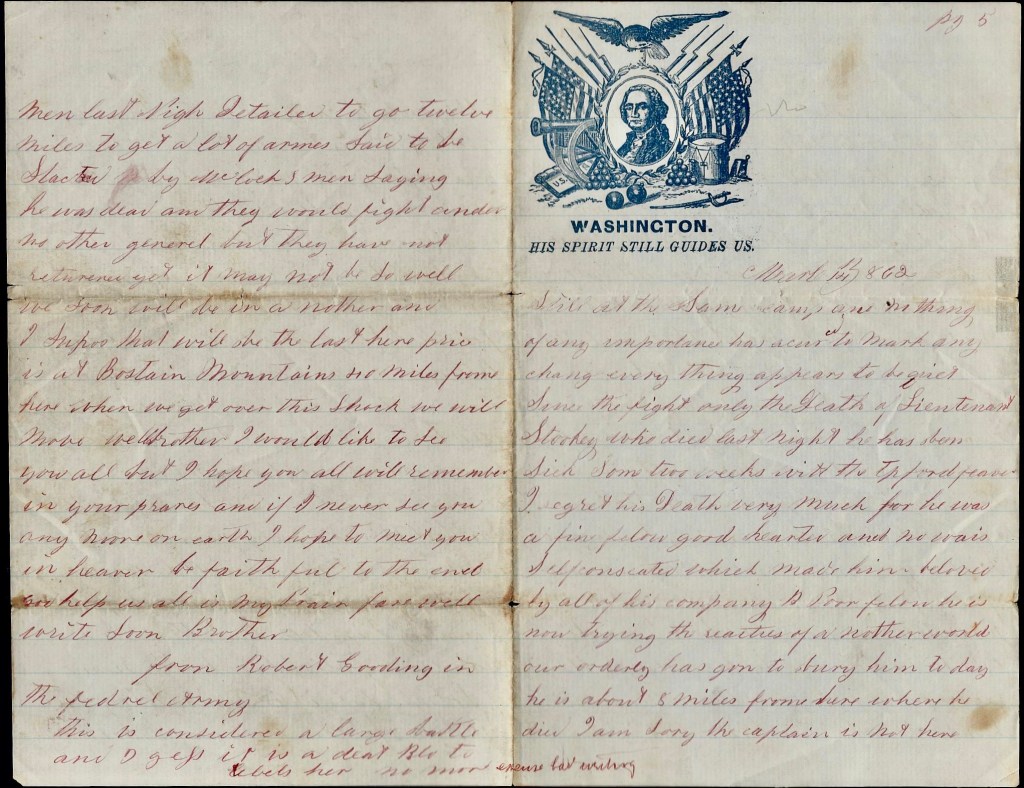
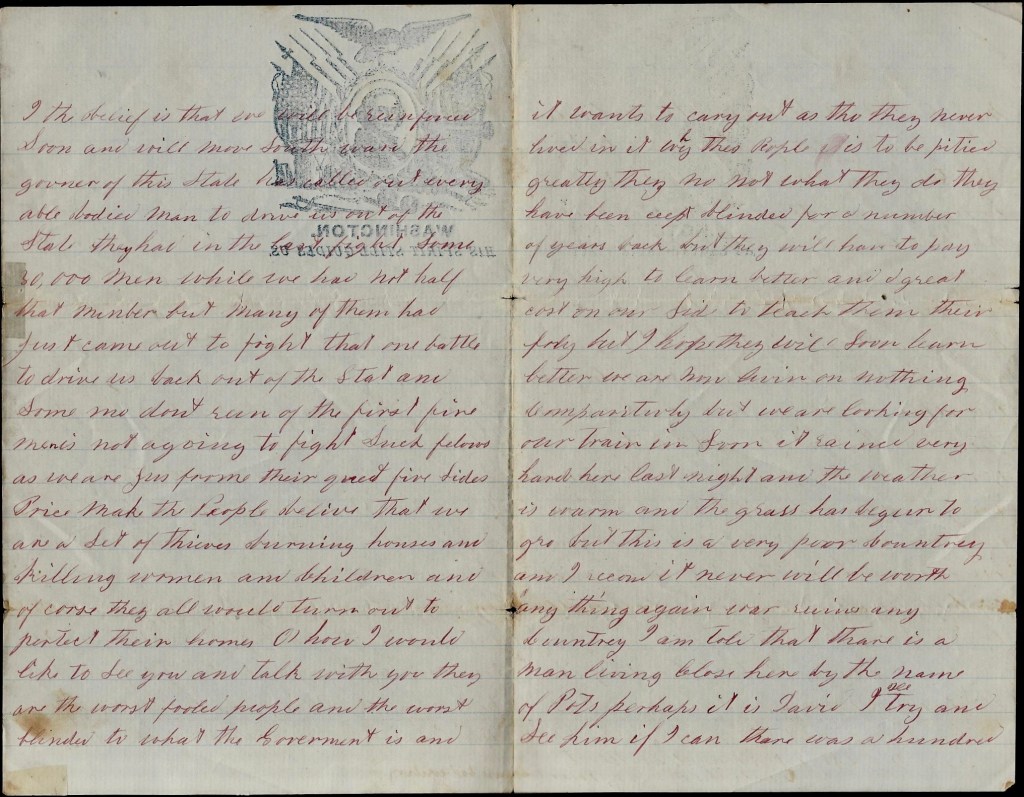
 Spared & Shared 23