Category Archives: Benton Barracks

1861: James McCollister to William Brooks

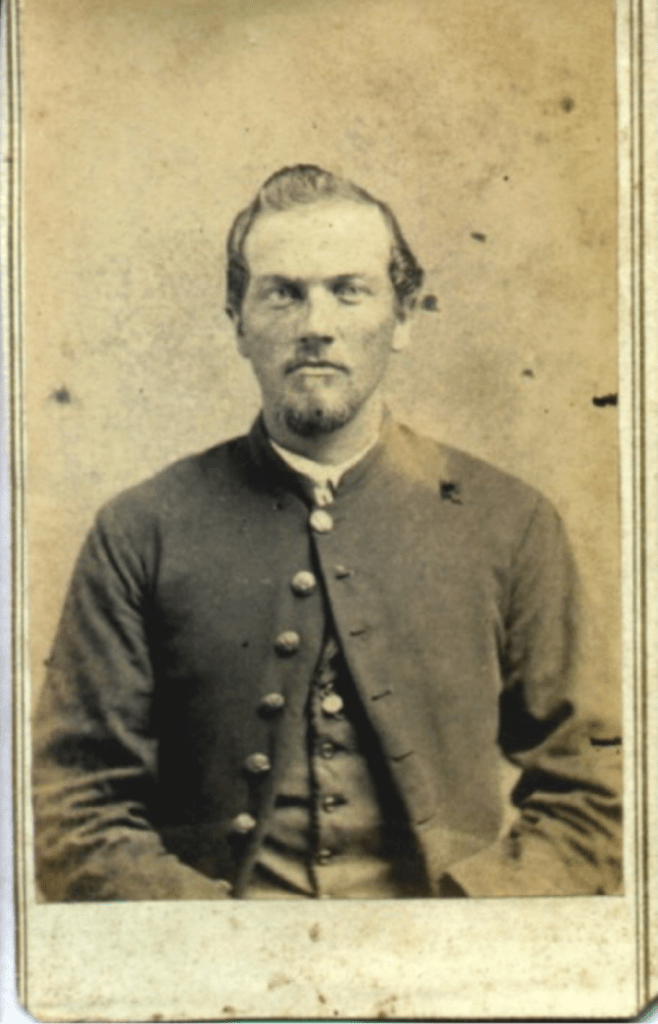
I could not find an image of James but here is one of Pvt. George Hepenstall of Co. G, 2nd Iowa Cavalry (Iowa Civil War Images)

The following letter was written by 29 year-old Pvt. James McCollister of Co. B, 2nd Iowa Cavalry. The regiment was organized in the fall of 1861 and left the State for Benton Barracks, Missouri, on 7 December 1861. They remained on duty there until mid-February 1862. In his book, Hawkeyes on Horseback, author Stephen Z. Starr described the regiment as being composed of  “lawyers, politicians, newspaper editors and businessmen who had been instrumental in raising the regiment. Their single common characteristic—apart from patriotism—was a total ignorance of all things military. For that reason, and with a display of moral and political courage not at all common among state governors, then or later, Kirkwood offered the colonelcy of the regiment to an “outsider,” an officer of the Regular Army, Captain Washington L. Elliott of the Third United States Cavalry.”

James McCollister (1832-1920) was born in Seneca county, Ohio, the son of John McCollister and Rachel Martin. In the 1860 Census he was enumerated in Story City, Story county, Iowa, with his 55 year-old mother, Rachel McCollister. He was married in 1865 to Ruth Amanda. Adams (1840-1880) and resided in Seneca county, Ohio, after he was discharged from the service. He died in Jerry City, Wood county, Ohio, and lies buried next to his second wife, Sarah McLaughlin (1844-1931).

T R A N S C R I P T I O N

Benton Barracks
St. Louis, Missouri
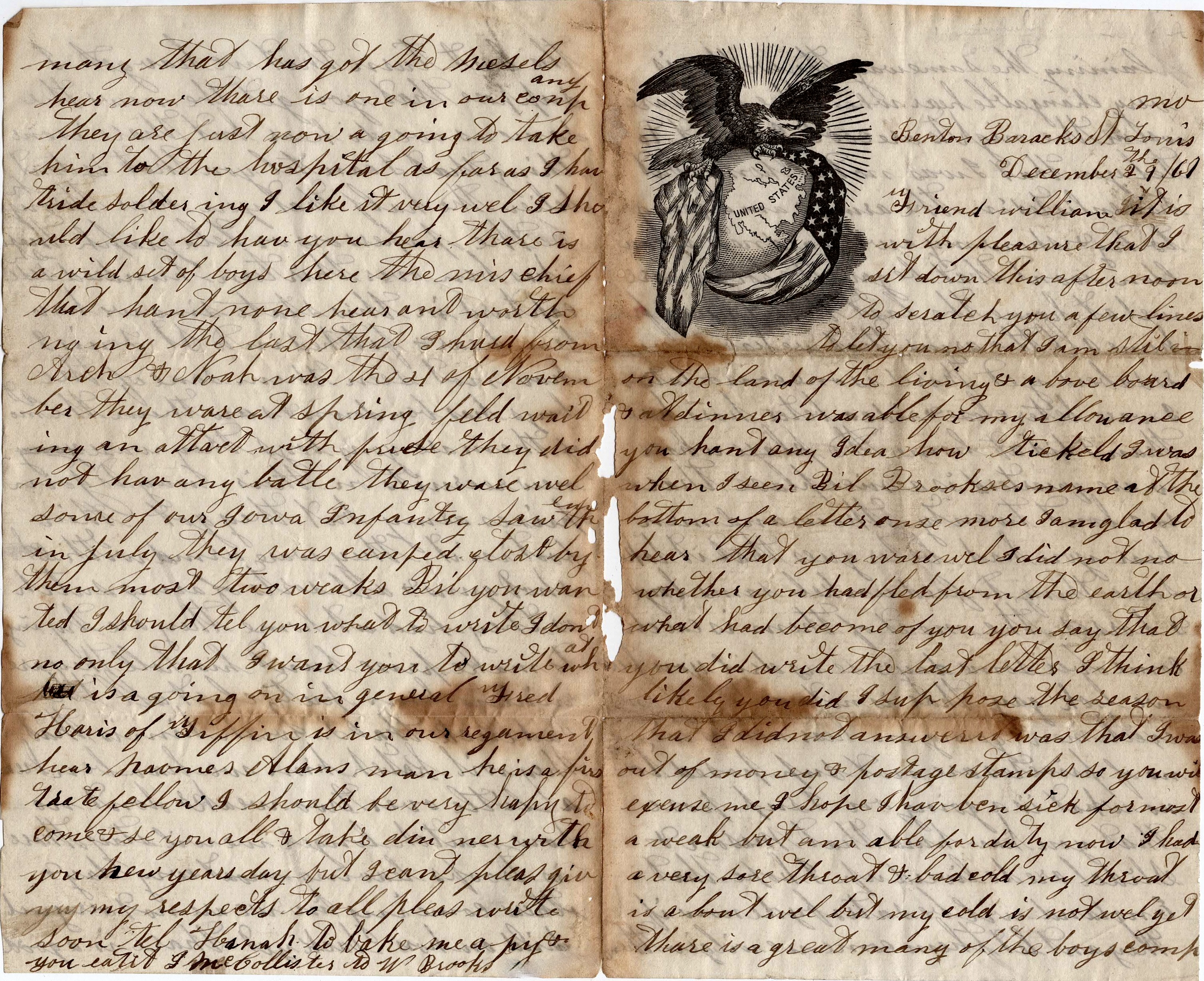
December 29th 1861

Friend William,

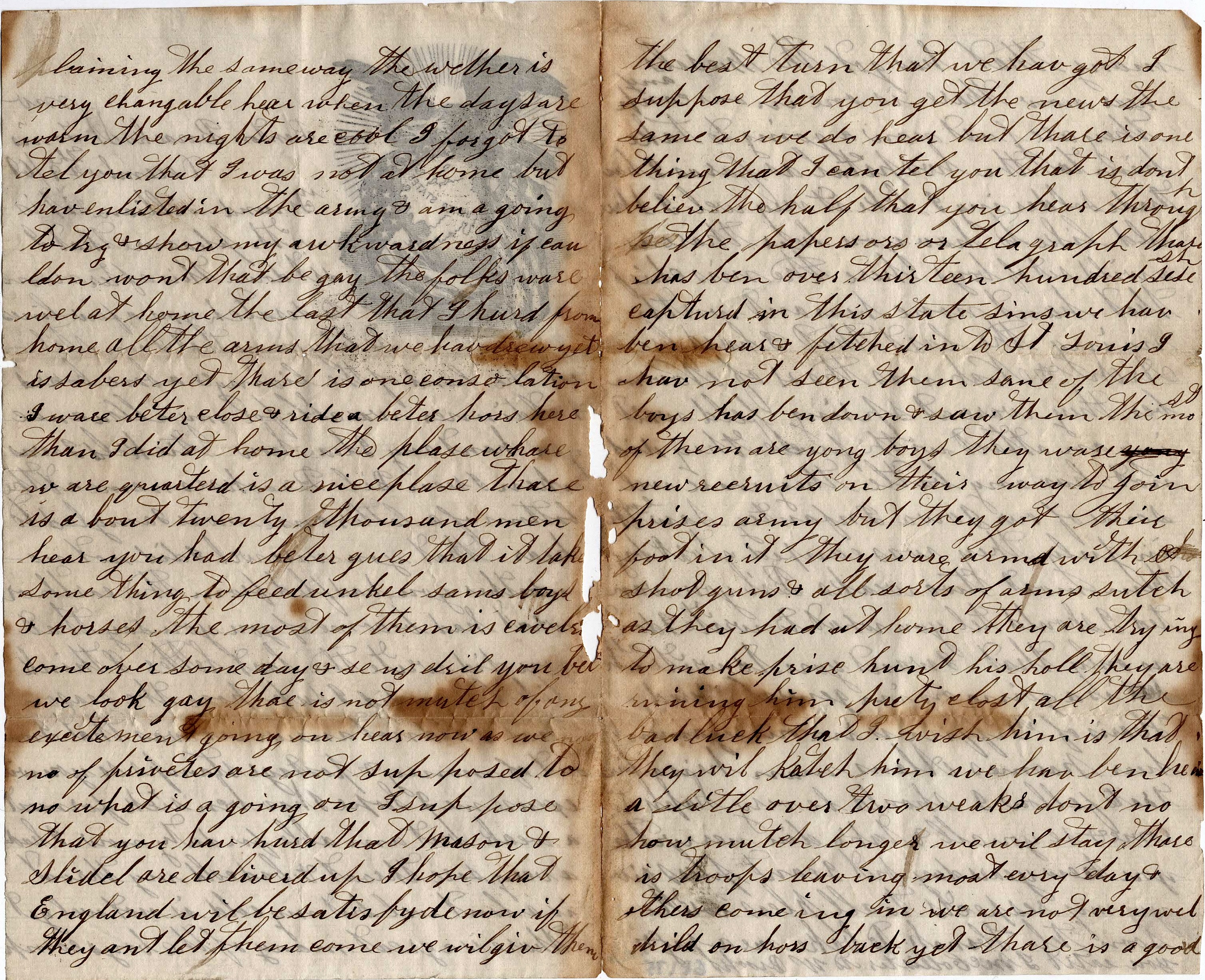
It is with pleasure that I sit down this afternoon to scratch you a few lines to let you know that I am still in the land of the living & above board & at dinner was able for my allowance. You han’t any idea how tickled I was when I seen Bill Brooks’ name at the bottom of a letter once more. I am glad to hear that you were well. I did not know whether you had fled from the earth or what had become of you. You say that you did write the last letter. I think likely you did. I suppose the reason I didn’t answer was that I was out of money & postage stamps so you will excuse me. I have been sick for most a week but am able for duty now. I had a very sore throat & bad cold. My throat is about well but my cold is not well yet. There is a great many of the boys complaining the same way. The weather is very changeable here when the days are warm. The nights are cool. I forgot to tell you that I was not at home but have enlisted in the army & am a going to try and show my awkwardness if called on. Won’t that be gay? The folks were well at home the last that I heard from home.

All the arms that we have drew yet is sabers, yet there is one consolation. I wear better clothes and ride a better horse here than I did at home. The place where we are quartered is a nice place. There is about twenty thousand men here. You had better guess that it takes something to feed Uncle Sam’s boys & horses. The most of them is cavalry come over some days since drill. You bet we look gay. There is not much of an excitement going on here now as we know of. Privates are not supposed to know what is a going on.

I suppose that you have heard that Mason & Slidel are delivered up. I hope that England will be satisfied now. If they ain’t, let them come. We will give them the best turn that we have got. I suppose that you get the news the same as we do here but there is one thing that I can tell you [and] that is don’t believe the half that you hear through the papers or telegraph. There has been over thirteen hundred secesh captured in this state since we have been here & fetched into St. Louis. I have not seen them. Some of the boys has been down & saw them. The most of them are young boys. They were new recruits on their way to join Price’s army but they got their foot in it. They were armed with shotguns & all sorts of arms such as they had at home. They are trying to make Price hunt his hole. They are running him pretty close. All the bad luck that I wish him is that they will catch him.

We have been here a little over two weeks. Don’t know how much longer we will stay. There is troops leaving most every day & others coming in. We are not very well drilled on horseback yet. There is a good many that has got the measles here now. There is one in our company. They are just now a going to take him to the hospital.

As far as I have tried soldiering, I like it very well. I should like to have you here. There is a wild set of boys here [full of] the mischief. There ain’t none here ain’t worth knowing. The last that I heard from Arch & Noah was the 21st of November. They were at Springfield waiting an attack with Price. They did not have any battle. They were well. Some of our Iowa infantry saw them in July. They was camped close by them two weeks.

Bill, you wanted I should tell you what to write. I don’t know—only that I want you to write what is a going on in general. Fred[erick A.] Harris 1 of Tiffin [Ohio] is in our regiment here—Naomia Allen’s man. He is a first rate fellow. I should be very happy to come & see you all & take dinner with you New Year’s Day but I can’t. Please give my respects to all. Please write soon. Tell Hannah to bake me a pie & you eat it. — J. McCollister

to W. Brooks


1 Frederick A. Harris (1825-1892) married Naomia R. Allen (1836-1908) in March 1854 in Seneca County, Ohio. In 1860, the couple were enumerated in Cass, Hamilton county, Iowa. Frank enlisted in Co. F, 2nd Iowa Cavalry and was soon promoted to 3rd Battalion Commissary Sergeant.
1861-62: George S. Bishop to his Mother

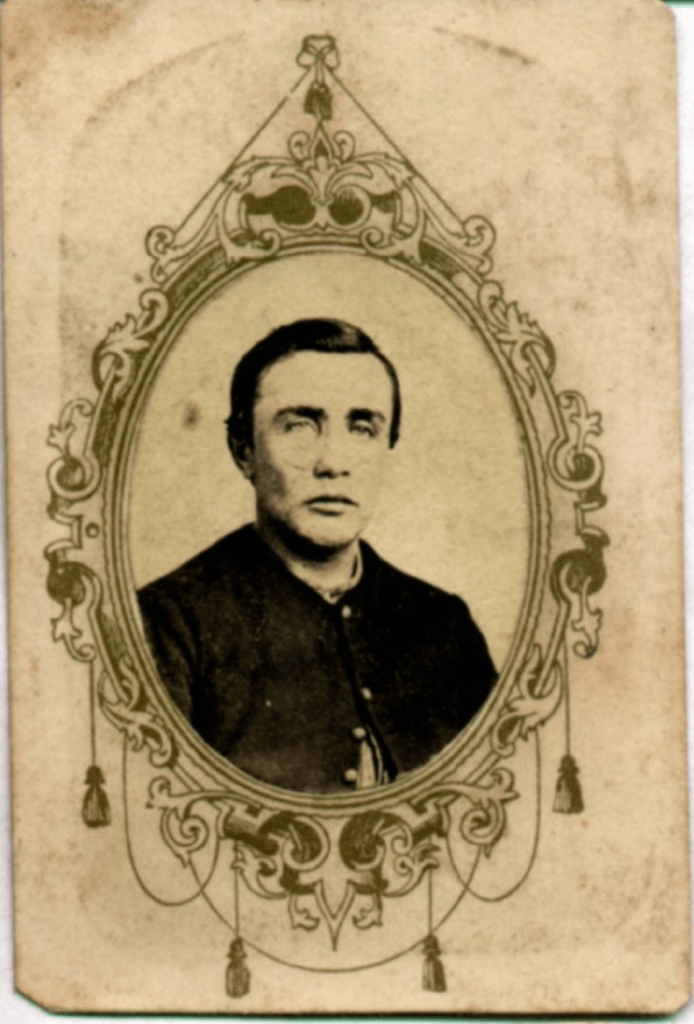
I could not find an image of George but here is a tintype of Henry Westerhouse who enlisted in Co. H, 2nd Michigan Cavalry. (Kim Frank Collection)

These letters were written by George S. Bishop (1834-1865), the son of Edmond B. and Sophronia Bishop who came to Oakfield Township, Kent county, Michigan from New York State prior to 1850. George enlisted as a Private on September 10, 1861 at the age of 25, and in Company F, 2nd Michigan Cavalry on October 02 1861.   Family stories indicate George fell off a river boat on his way home after the war ended and he drowned.

Several of George’s transcribed letters have found their way onto the website of the Montcalm County, MIGenWeb (courtesy of the Flat River History Museum) under the title, George S. Bishop—Civil War Letters. One of these letters was also written at Benton Barracks just one week prior to the following letter in which George wrote, “We are armed with good sabers and the flashing steel is everywhere seen. We are soon to have a good revolving rifle. Sharps will be the one we will have, also a revolving Colt pistol that will fire 14 shots without loading. Tis not very likely that we will ever be in a battle, yet it is a good thing to have good arms if we ever come to it. We will soon lay the ground over with rebels. They can’t hurt us much for we will be in motion riding up and firing and then away across the plain.”

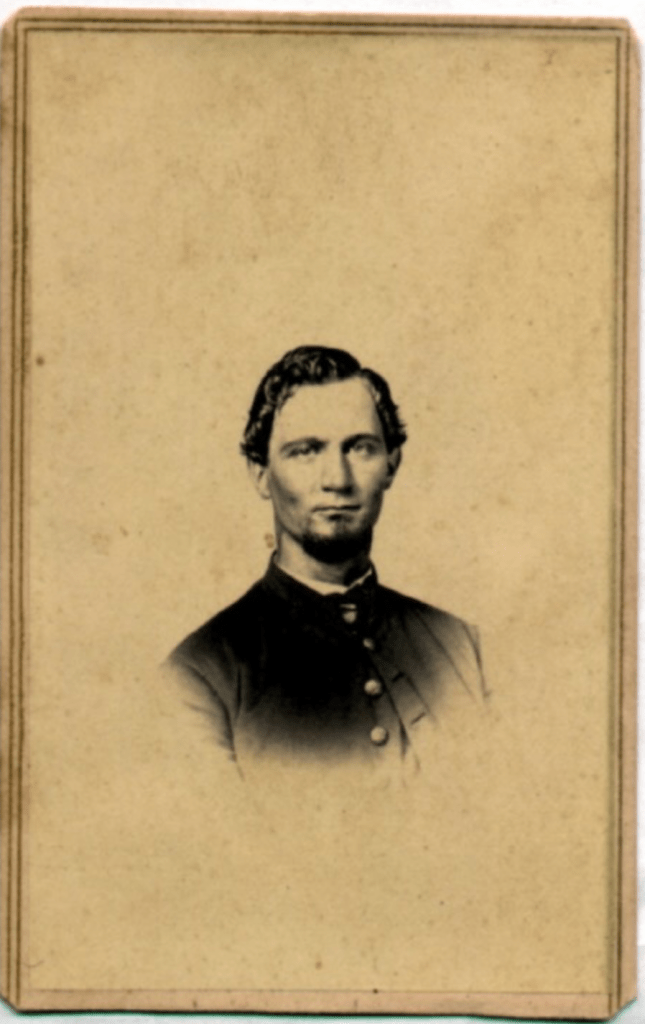
While researching George, I stumbled upon the following images of some of his comrades in Co. F. They were posted on Civil War Faces Facebook by Rae Swan who found them all in the photo album of Joel S. Beeman, a saddler in the 2nd Michigan Cavalry, Co. F.

Letter 1

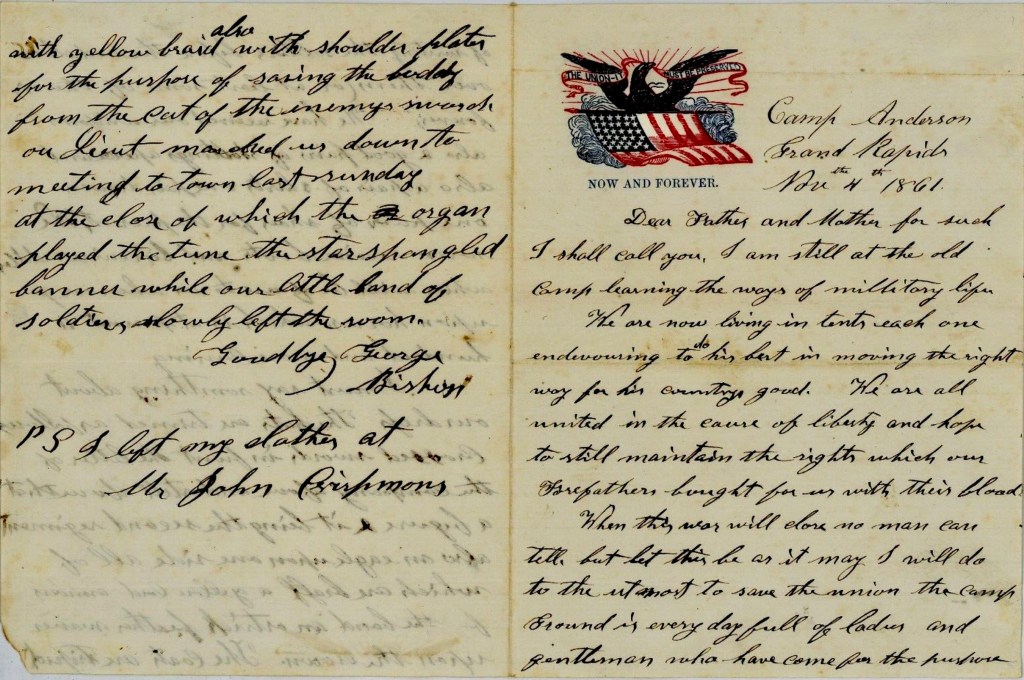
Camp Anderson
Grand Rapids
November 4th 1861

Dear Father and Mother, for such I shall call you.

I am still at the old camp learning the ways of military life. We are now living in tents, each one endeavoring to do his best in moving the right way for his country’s good. We are all united in the cause of liberty and hope to still maintain the rights which our forefathers bought for us with their blood.

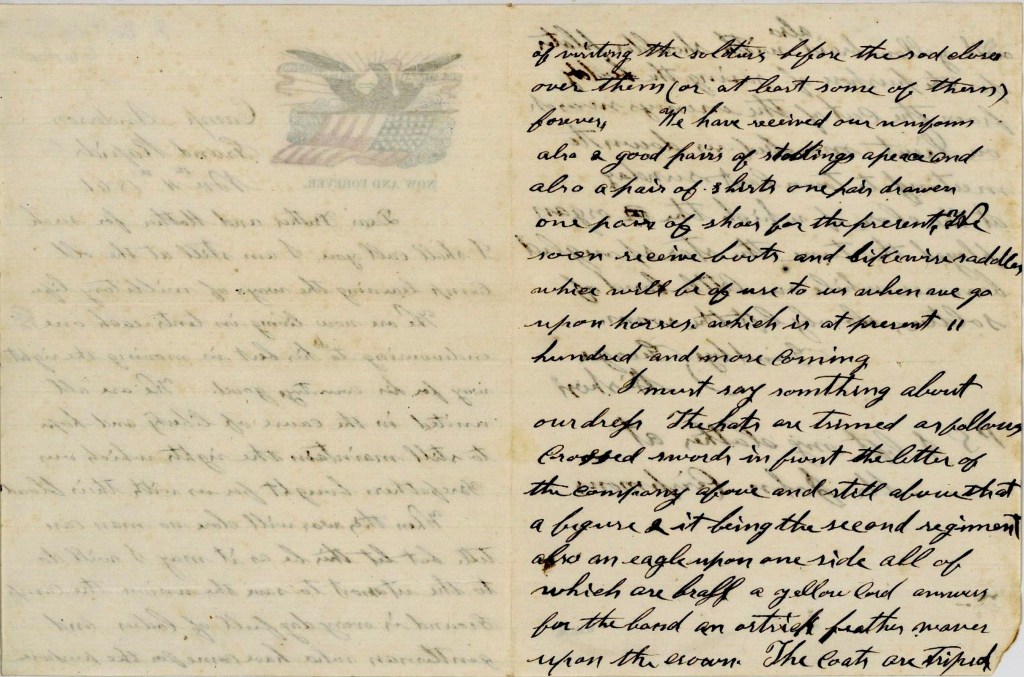
When this war will close, no man can tell but let this be as it may, I will do to the utmost to save the Union. The camp ground is everyday full of ladies and gentlemen who have come for the purpose of visiting the soldier before the sod closes over them (or at least some of them) forever.

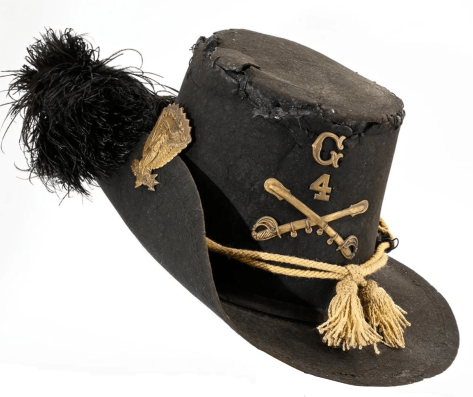
The hardy hat issued to the members of the 2nd Michigan Cavalry were like this one of the 4th Michigan Cavalry, Co. G.

We have received our uniform. Also a good pair of stockings apiece and also a pair of shirts, one pair drawers, one pair of shoes for the present and soon receive boots, and likewise saddles which will be of use to us when we go upon horses which is at present 11 hundred and more coming.

I must say something about our dress. The hats are trimmed as follows—crossed swords in front, the letter of the company above, and still above that a figure 2, it being the second regiment. Also an eagle upon one side, all of which are brass. A yellow cord answers for the band. An ostrich feather waves upon the crown.

The coats 1 are striped with yellow braid, also with shoulder plates for the purpose of saving the body from the cut of the enemy’s sword.

Our lieutenant marched us down to meeting last Sunday at the close of which the organ played the tune, the Star Spangled Banner while our little band of soldiers slowly let the room. Goodbye, — George Bishop

P. S. I let my clothes at Mr. John Crisman’s.

1 The jackets of the 2nd Michigan Volunteer Cavalry were supplied by Sykes & Company.


Letter 2

Benton Barracks 1
St. Louis, Missouri
January 8th 1862

Dear Mother,

I received your letter last night and was glad to hear from you and find that you were all well. I should have been very glad if you had sent some things for a New Year present but I consider it just as well for you showed your good will in thinking of it and doing the best you could.

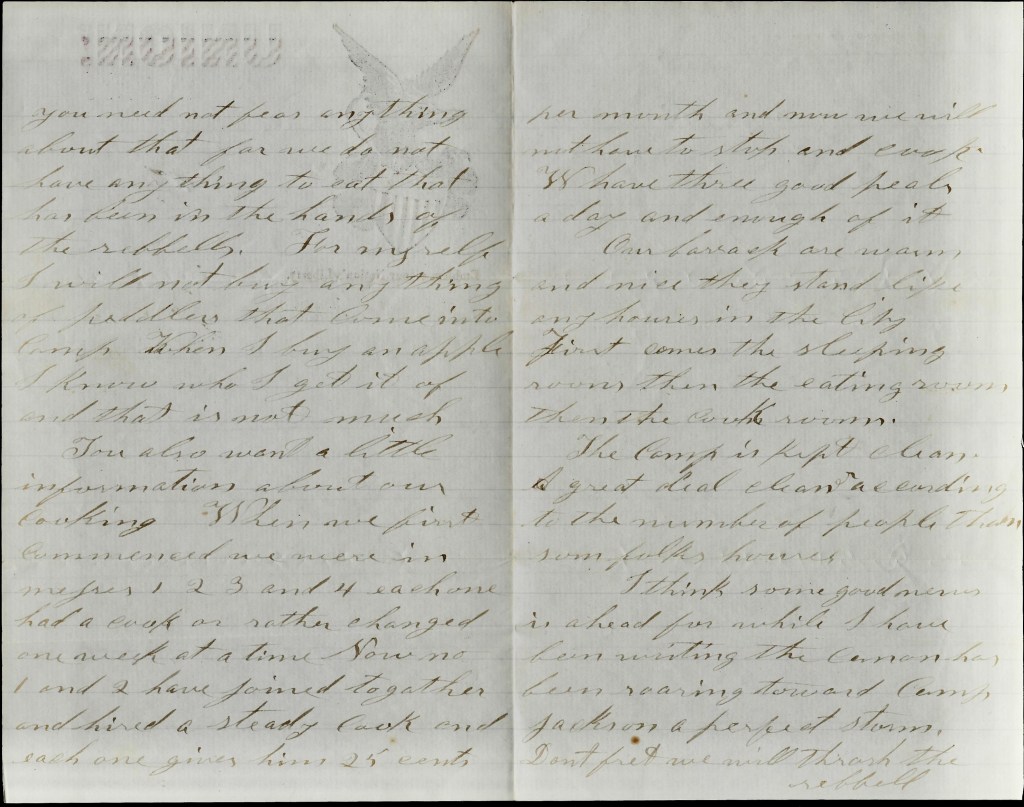
You wanted to know if there had been any soldiers poisoned. There was a story something about poisoning but it was a good while ago. You need not fear anything about that for we do not have anything to eat that has been in the hands of the rebels. For myself, I will not buy anything of peddlers that come into camp. When I buy an apple, I know who I get it of and that is not much.

You also want a little information about our cooking. When we first commenced we were in messes 1, 2, 3, and 4. Each one had a cook or rather changed one week at a time. Now No. 1 & 2 have joined together and hired a steady cook and each one gives him 25 cents per month, and now we will not have to stop and cook. We have three good meals a day and enough of it.

Our barracks are warm and nice. They stand like any house in the City. First comes the sleeping room, then the eating room, then the cook room. The camp is kept clean—a great deal cleaner according to a number of people than some folks’ homes.

I think some good news is ahead for while I have been writing, the cannon has been roaring toward Camp Jackson a perfect storm. Don’t fret. We will thrash the rebels. I know it takes off some change to write and of course I can’t expect you to send me a letter every time I write to you, but I want you to write as often as you can and I will send you some money so that you will not lose anything by it. I am again well and hope you will keep the same. Give my love to Father and the children. Goodbye, — George S. Bishop

1 Jefferson Barracks was a training facility for the Union army that was located on the site of the present-day St. Louis Fairgrounds in North St. Louis. In January 1862, it consisted of five buildings that could accommodate up to 30,000 soldiers. The orginal buildings were 740 feet long and 40 feet wide.

1862: L. J. Mead to R. W. Mead

The author of this letter remains unidentified. He may have have been a member of either the 24th Missouri Infantry or the 1st Nebraska Infantry as both regiment moved from Helena, Arkansas, to Sulphur Spring, Missouri in early October 1862—an event that was mentioned in this letter. His name appears to read, “S. J. Mead” but I may be mistaken. He mentions sending money by Express to Brownsville. There was a town named Brownsville in Saline county, Missouri, that changed its name to Sweet Springs after the Civil War. There was a Mead family enumerated in the 1860 US Census in Jefferson, Saline county, Missouri but the 20 year-old Lemuel J. Mead does not appear to have had military service prior to 1863 and I can’t find a Mead in the 24th Missouri Infantry.

Transcription

[St. Louis, Missouri]
October 13th 1862

Folks at home,

As I have changed my place of abode to Old Benton Barracks again, I thought I would write and let you know where I was and how I am getting along. I am not very well at the present time. I am complaining of my right lung being affected and the chronic diarrhea. Our regimental Dr. gave me a furlough two two weeks ago and I got all ready to come home except getting it signed by the Post Surgeon and just the evening before I went to him, orders came for no more furloughs to be signed which knocked me out of getting to come. I then was gave my Descriptive Roll and sent to St. Louis to the Convalescent Hospital at the barracks.

The Regiment came up as far as Sulphur Springs 25 miles below St. Louis. We had a very worrisome trip of about 600 miles on the boat and but little to eat on the trip. I am at a good place now and plenty to eat of everything. I do not know whether I can get to come home from here or not for there is so many sick here and they won’t give a furlough unless a man is at the point of death. But I am going to try and see or else I am going to get a discharge from the service if possible just as soon as I can get it.

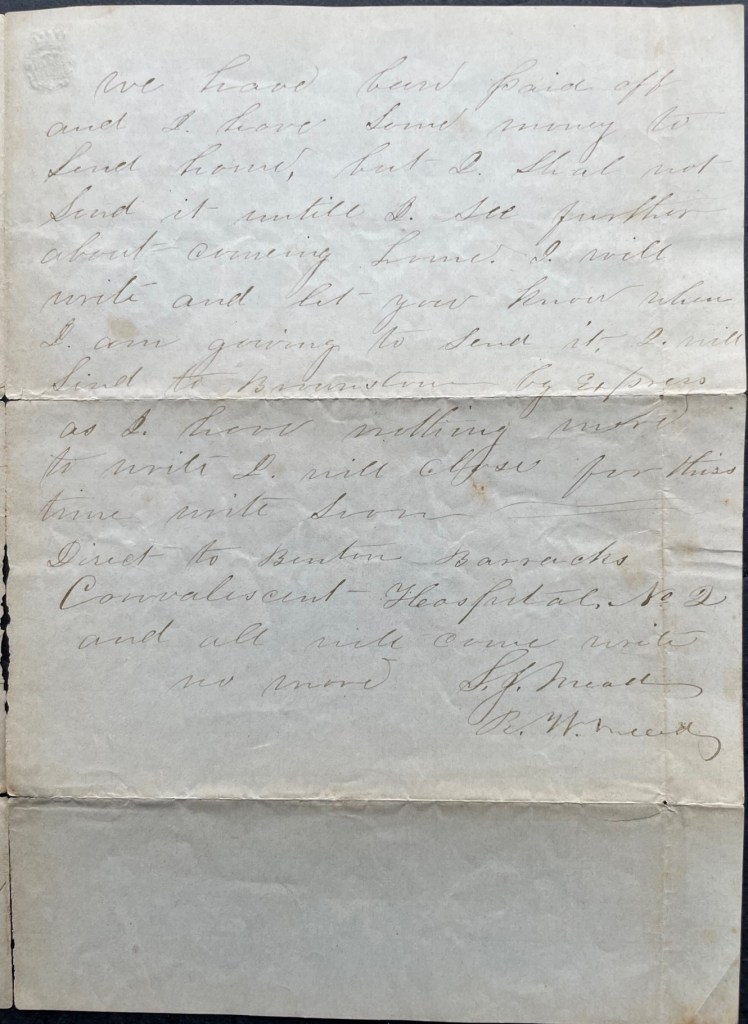
We have been paid off and I have some money to send home, but I shall not send it until I see further about coming home. I will write and let you know when I am going to send it. I will send to Brownstown by Express. As I have nothing more to write, I will close for this time. Write soon.

Direct to Benton Barracks, Convalescent Hospital No. 2 and all will come right. No more. — S. J. Mead

R. W. Mead

1863: George Erwin Comstock to George Throop

George Erwin Comstock

The following letter was written by George Erwin Comstock (1839-1911), the son of Isaac W. Comstock (1808-1883) and Catherine W. Erwin (1809-1852) of Fayette county, Iowa. Erwin enlisted as a private in Co. C, 12th Iowa Infantry on 14 September 1861 and was promoted to a corporal on 8 December 1862. Erwin was with his regiment at Shiloh where they fought valiantly the first day, holding back the enemy until Buell’s army arrived. Erwin was among the number taken prisoner on that day while the few remaining members of the 12th were assigned to the “Union Brigade.”

Erwin’s letter was datelined in late February 1863 at Benton Barracks in St. Louis after they had been exchanged and were ready to be reorganized. We learn from the letter that many of the members took french leave to make visits home while they were awaiting exchange.

After the war, Erwin became a butcher and settled in Westfield.

Erwin wrote his letter to his friend, Sgt. George Throop (later Lieutenant), with the Chicago Mercantile Battery. See Throop-Vaughan family papers, 1838-1928.

See also:
Owen Weed Nims, Co. I, 12th Iowa (1 Letter)
Edward H. Wells, Co. I, 12th Iowa (1 Letter)

To read more: A Perfect Picture of Hell: Eyewitness Accounts by the Civil War Prisoners from the 12th Iowa by High H. Genoways and Ted Genoways, 1998.

A large albumen image of members of Company C 12th Iowa Infantry taken at Benton Barracks on January 8, 1863. These soldiers were all captured in the Hornet’s Nest on April 6, 1862, and this image was taken shortly after their parole.
The following excerpt is found on page 161 of “The University Recruits Company C 12th Iowa Infantry U.S.A 1861-1866” by Charles B. Clark and Roger B. Bowen.
“Captain Warner struck a deal with a photographer in St. Louis by which a member of Company C could have a dozen photographs taken for $3.00, a twenty-five percent reduction. Warner would keep a photograph of each man, send a second to Miss Elizabeth Sorin at Upper Iowa University, with ten going to the Company member. This became a big project, lasting until departure from St. Louis in April. Numerous trips had to be taken into the City for sittings, for picking up the photographs, mailing some, trading others. Woods (Philo Woods) sent a couple of photographs home, mailed one to sister Samantha, traded another to Henry Grannis, old Upper Iowa University chum and color bearer for Company C and the 12th Iowa. A group picture of Company C was also taken and appears on the next page.”

Image from the collection of Michael Huston.

Transcription

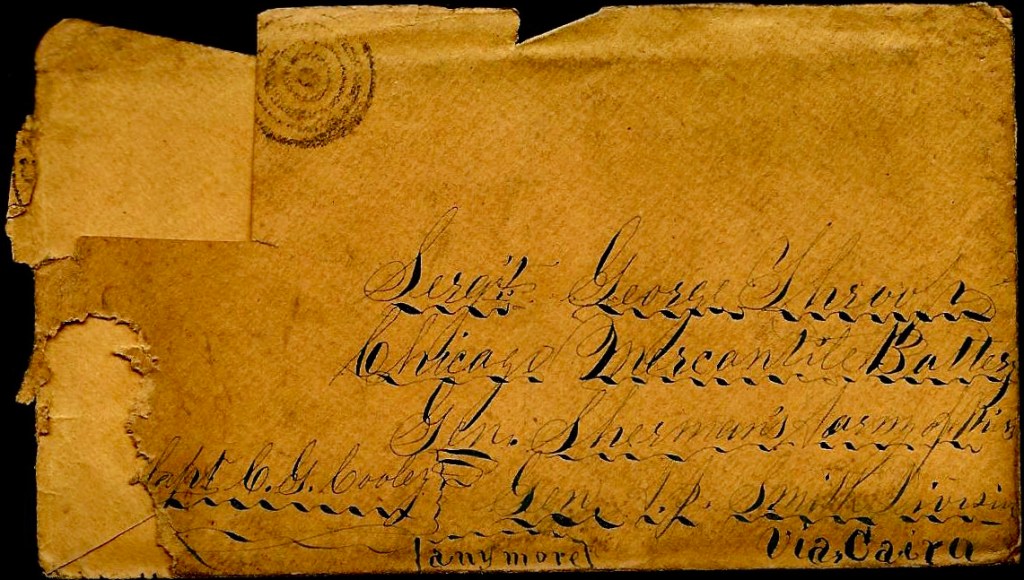
Addressed to George Throop, Chicago Mercantile Battery, Gen. Sherman’s Army of Mississippi, Gen. A. J. Smith’s Division
Capt. C. G. Cooley

Benton Barracks
St. Louis, Missouri
February 25th 1863

Dear Friend George,

Perhaps ere this you have thought that I was a going to keep silent, but not so. But to begin with, I ask your pardon for not writing as I agreed to. Since I last saw you, I have ben home [and] had a grand time, I assure you. I remained at St. Louis about a month after leaving Chicago last fall before I received pay after which I took a french furlough, that being the only way as Gen. Halleck had issued an order that no furloughs should be given to any except wounded soldiers. This cut us out and Benton Barracks, I assure you, is any place but a good one for soldiers in our condition—the ague handing around some (ailing me) other thing and some another, but all in a poor condition. Notwithstanding, it was a direct violation of the military law yet they instantly saw the need of our going somewhere to recruit and thought that home would be as good a place as any. But of course did not say it out loud, but we were not so dull of apprehension but what we were bold enough to venture. Consequently, off we went.

I started in about two hours after I got my pay. One principal difficulty was to get out of the Barracks which was pretty well guarded at the gates and there being so many going at a time we were afraid it would cause suspicion. That was one reason I hurried off so. I made out to get out all night but as you well know by this time, it wants a soldier that has seen a little service. At any rate, I only had five sentinels to pass at one gate all within 3 rods of each other, but on I went with[out] any particular trouble.

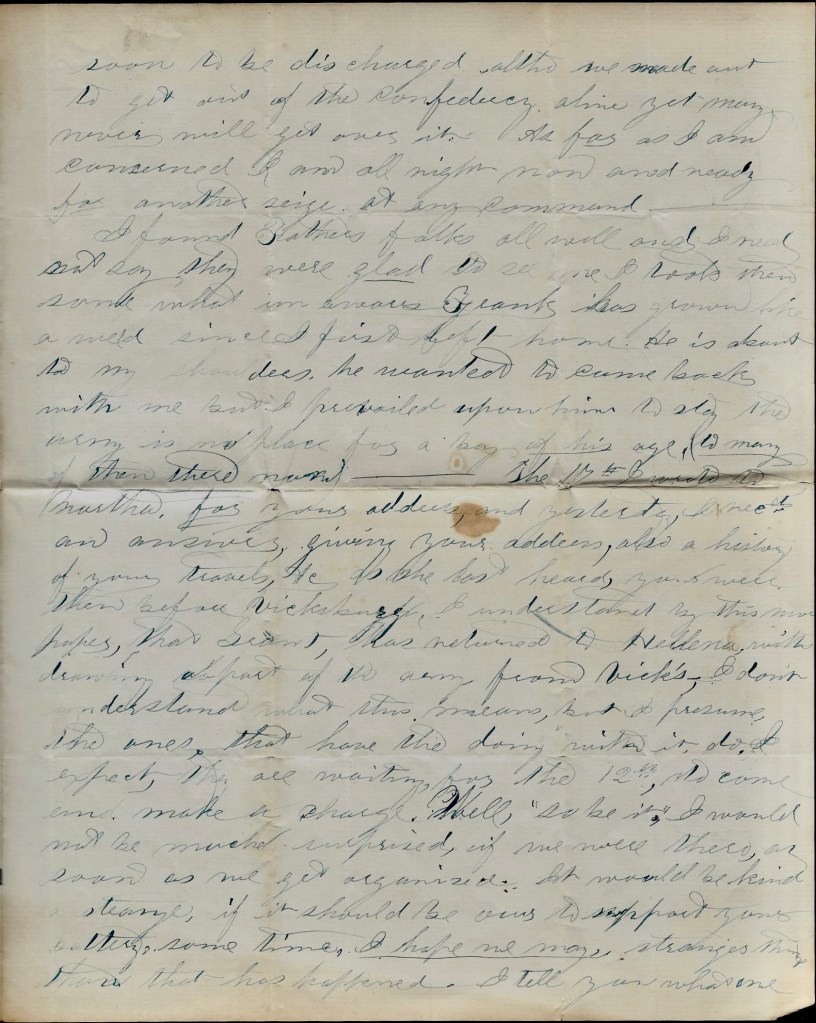
In going home, I did not go by the way of Chicago, consequently did not see your folks. We remained at home 4 weeks when we received the official orders that we were exchanged and to report at Benton Barracks by the 1st of January which we did with a hearty good will—every man that was able. Some of our company were left at home because they were not able to come. Considerable many have been discharged and we are badly broken up. Out of the 105 men that first went in to camp with all in the full bloom of youth have dwindled away to a small squad. There are twenty-five of us here and 16, I believe that are in the Union Brigade. Some of these are soon to be discharged. Although we made out to get out of the Confederacy alive, yet many never will get over it. As far as I am concerned, I am all right now and ready for another siege at any command.

I found Father’s folks all well and I need not say they were glad to see me. I took them somewhat unawares. [My brother] Frank has grown like a weed since I first left home. He is about to my shoulders. He wanted to come back with me but I prevailed upon him to stay. The army is no place for a boy at his age (too many of them there now).

The 17th I wrote to Martha for your address and yesterday I received an answer giving your address, also a history of your travels, &c. as she last heard. You were then before Vicksburg. I don’t understand what this means but I presume the ones that have the doing with it do. I expect that are waiting for the 12th to come and make a charge. Well, “so be it.” I would not be much surprised if we were there as soon as we get organized. It would be kind of strange if it should be us to support your battery some time. I hope we may. Stranger things that that has happened.

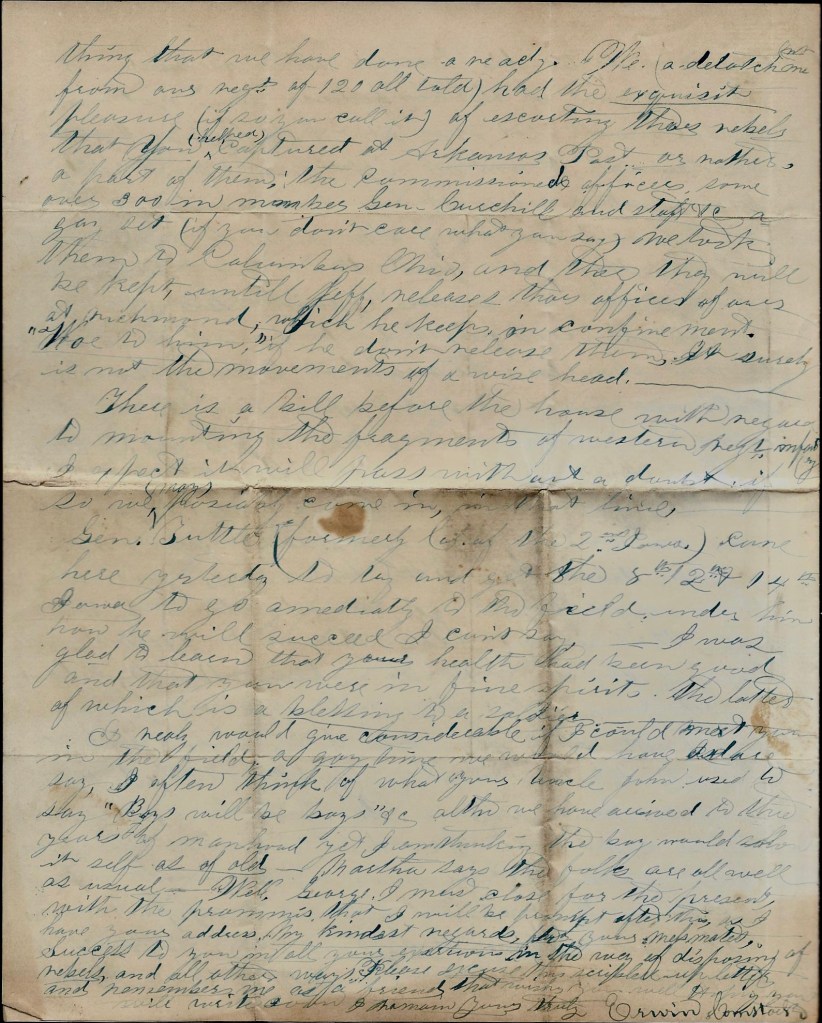
I tell you what one thing we have done already. We (a detachment from our regiment of 120 all told) had the exquisite pleasure (if so you call it) of escorting those rebels that you helped capture at Arkansas Post, or rather a part of them, the commissioned officers some, over 300 in number, Gen. [Thomas] Churchill and staff, &c. a gas set (if you don’t care what you say). We took them to Columbus, Ohio, and there they will be kept until Jeff releases those officers of ours at Richmond which he keeps in confinement. “Woe to him,” if he don’t release them. It surely is not the movements of a wise head.

There is a Bill before the House with regard to mounting the fragments of wester regiments (infantry_. I expect it will pass without a doubt. If so, we may possibly come in, in that time.

Gen. Tuttle (formerly Colonel of the 2nd Iowa) came here yesterday to try and get the 8th, 12th, and 14th Iowa to go immediately to the field under him. How he will succeed, I can’t say.

I was glad to learn that your health had been good and that you were in fine spirits, the latter of which is a blessing to a soldier.

I really would give considerable if I could meet you in the field. A gay time we would have, I dare say. I often think of what your Uncle John use to say, “Boys will be boys,” &c. Although we have arrived to the years of manhood, yet I am thinking the boy would stay itself as of old. Martha says the folks are all well as usual. Well, George, I must close for the present with the promise that I will be prompt after this as I have your address. My kindest regards to your messmates. Success to you in all your exertions in the way of disposing of rebels, and all other ways. Please excuse this scribbled up letter and remember me as a friend that wishes you well. Hoping you will write soon, I remain yours, truly, — Erwin Comstock