This beautifully written letter was penned by Cardella E. Brown (1841-1896) who was a clerk at the Connecticut Mutual Insurance Company in Hartford, Connecticut in 1860. His parents were divorced and he lived with his mother in Hartford while his father lived in New York City with his second wife and Cardella’s brother Gerald and sister Lulette, while Brown’s other brother Henry was employed as a printer in Boston.
In September, 1861, Brown was mustered in as a Corporal in Co. B of the 6th Connecticut Regiment. He served three years and muster rolls record that he was discharged in September 1864 as a Sergeant. It’s presumed that Cardella elected to stay with the army following his discharge to serve as a civilian in the commissary. Suffering from depression, Cardella shot himself in 1896 at the age of fifty-five, leaving a widow and three sons—one of whom was named Cardella Drake Brown (the “Drake,” no doubt, from his “Uncle Drake” who is mentioned in this letter.)
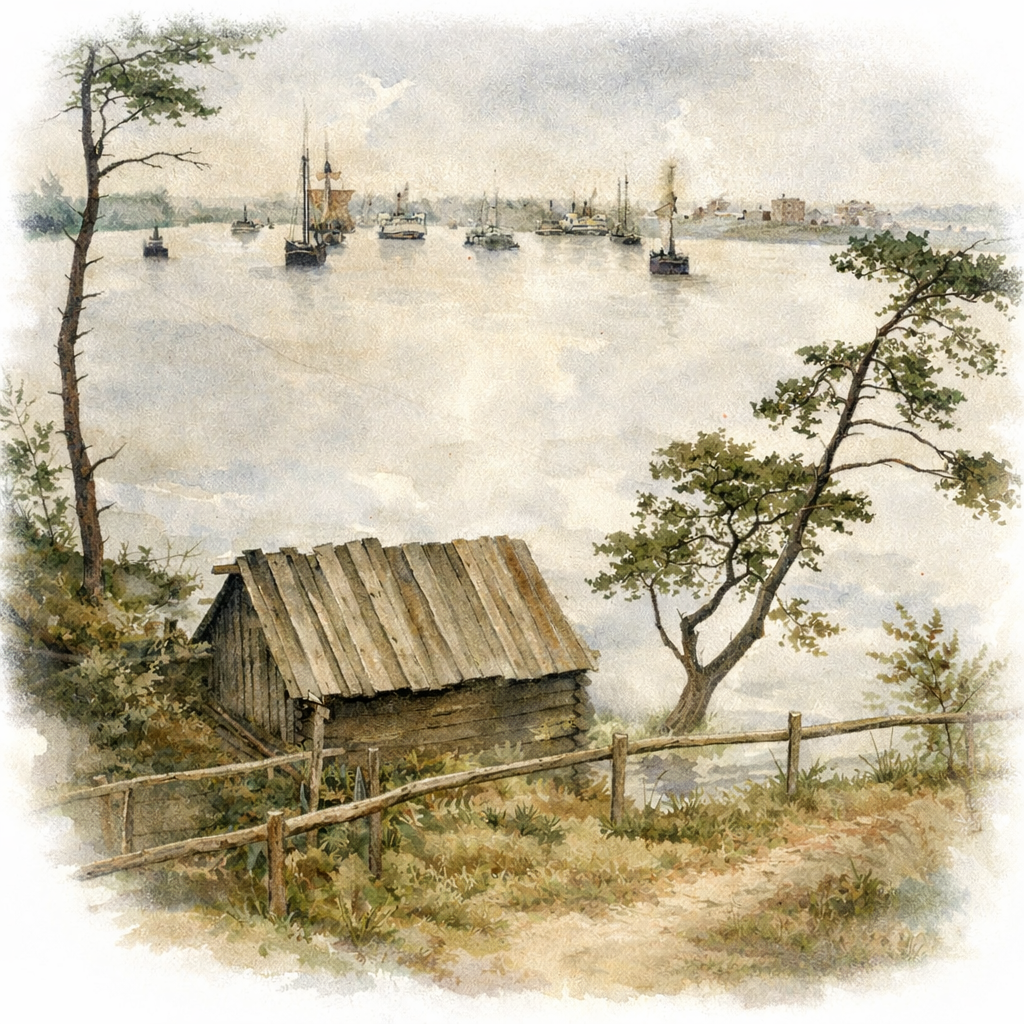
James’ Landing, Virginia in 1864
The Huntington library holds three volumes belonging to Cardella E. Brown. The first is a letterpress copybook containing approximately 100 outgoing personal letters Brown wrote from 1859 to 1861 while he was living in Hartford, Connecticut and working as a clerk at Connecticut Mutual Insurance Company. The letters are addressed to Brown’s parents, siblings, a cousin, and other family members and friends. The detailed and candid letters are written in a conversational tone devoid of usual epistolary formalities. The letters comment on a wide range of topics, including Brown’s personal life and sexuality, goings on in Hartford, and state and national politics of the 1860 election year. He talks in detail about Stephen A. Douglass, the anticipated secession of South Carolina, the Buchanan administration, and the hanging of John Brown. [Archived @ The Huntington]
T R A N S C R I P T I O N
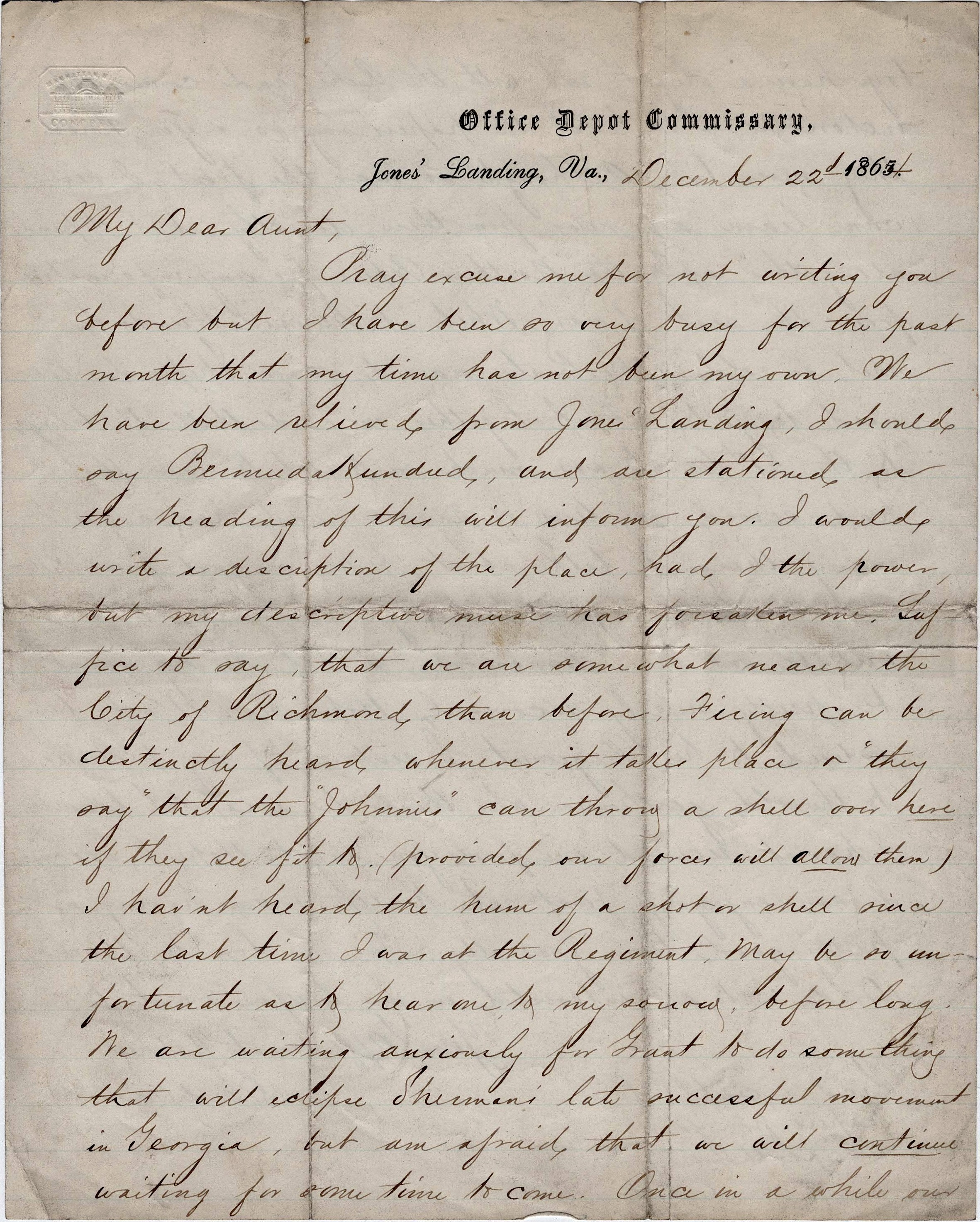
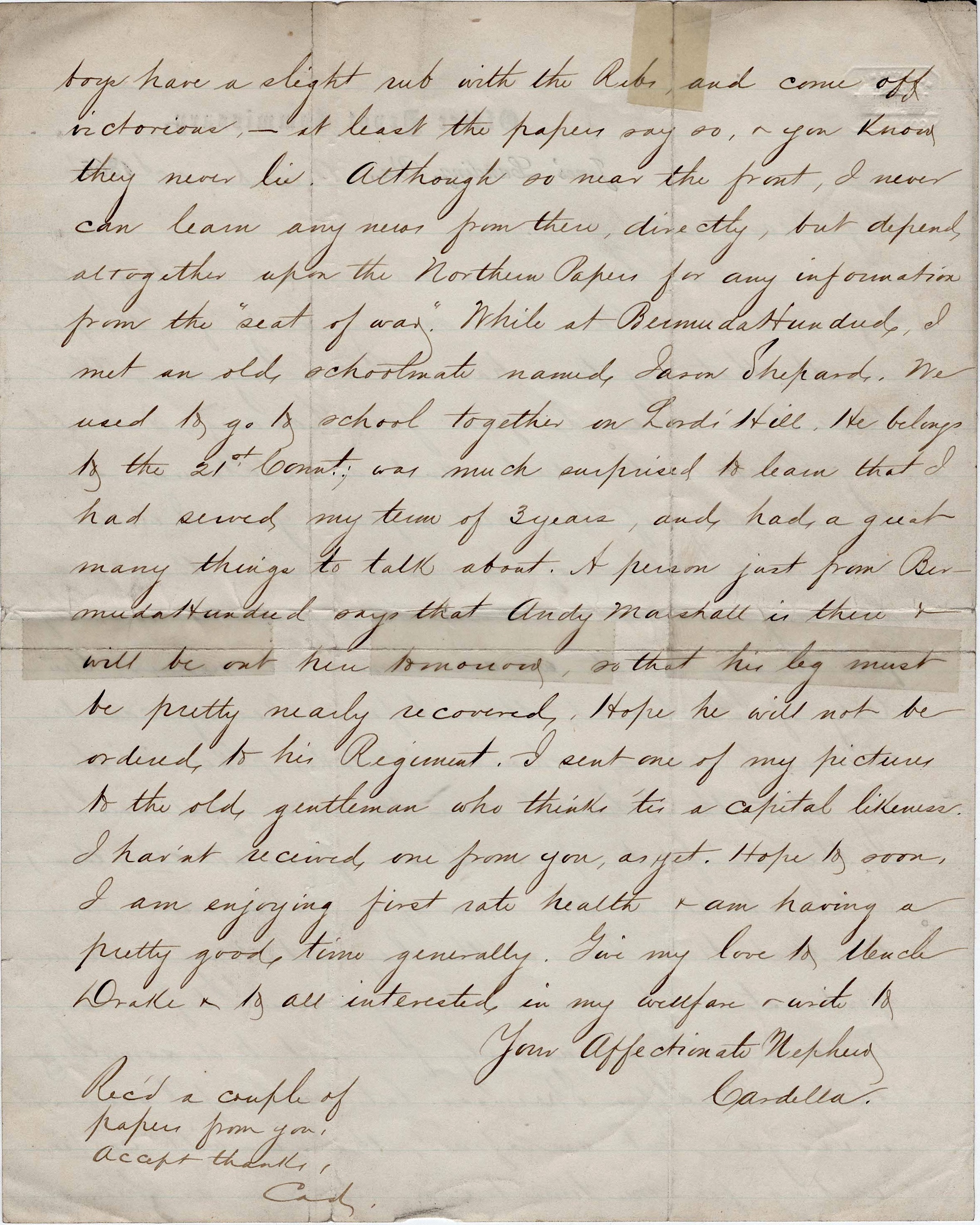
Office Depot Commissary Jones’ Landing, Va. December 22d 1864
My dear Aunt,
Pray excuse me for not writing you before but I have been so very busy for the last month that my time has not been my own. We have been relieved from Jones’ Landing—I should say Bermuda Hundred—and are stationed as the heading of this will inform you. I would write a desription of the place had I the power but my descriptive muse has forsaken me. Suffice to say that we are somewhat nearer the City of Richmond than before. Firing can be distinctly heard whenever it takes place & “they say” that the “Johnnies” can throw a shell over here if they see fit to (provided our forces will allow them). I haven’t heard the hum of a shot or shell since the last time I was at the Regiment. May be so unfortunate as to hear one to my sorrow before long.
We are waiting anxiously for Grant to do something that will eclipse Sherman’s late successful movement in Georgia, but I am afraid that we will continue waiting for some time to come. Once in a while our boys have a slight rub with the Rebs and come off victorious—at least the papers say so, & you know they never lie. Although so near the front, I never can learn any news from there directly, but depend altogether upon the Northern papers for any information from the “seat of war.”
While at Bermuda Hundred, I met an old schoolmate named Jason Shepard. We used to go to school together on Lord’s Hill [in Hartford]. He belongs to the 21st Connecticut. Was much surprised to learn that I had served my term of three years and had a great many things to talk about. 1
A person just from Bermuda Hundred says that Andy Marshall is there & will be out here tomorrow, so that his leg must be pretty nearly recovered. Hope he will not be ordered to his Regiment. 2
I sent one of my pictures to the old gentleman who thinks tis a capital likeness. I haven’t received one from you as yet. Hope to soon. I am enjoying first rate health & am having a pretty good time generally. Give my love to Uncle Drake & to all interested in my welfare or write to your affectionate nephew, – Cardella
Received a couple of papers from you. Accept thanks, — Card.
1 Jason J. Shepard (1841-1916) served in Co. A of the 21st Connecticut Infantry from 5 September 1862 until 22 November 1863 when he was transferred to the US Signal Corps. He was discharged from th service in June 1865.He was born in western Massachusetts but in 1860 was residing in Hartford, Connecticut. After the war he married and settled in Hartford until late in life when he moved to California.
2 Andrew Marshall was the 2nd Lieutenant of Co. B, 6th Connecticut Infantry.
The following letter was only signed “John” and leaves us with too few clues to confirm his identity but he was most certainly a member of the U. S. Signal Corps attached to Gen. Benjamin F. Butler’s Army of the James which was encamped on Bermuda Hundred.
“Although telegraphy was used extensively during the Petersburg campaign, signal trees, towers and buildings remained vital tools for each army to observe the movements of the enemy from an elevated vantage point. Information gained from such observations could then be relayed through all available means of communication, including signaling by flag or torch. Military uses of these locations included artillery spotting, mapping, and photography. The fourth estate also climbed these posts as special artists drew the siege lines and battlefields and reported war news.”
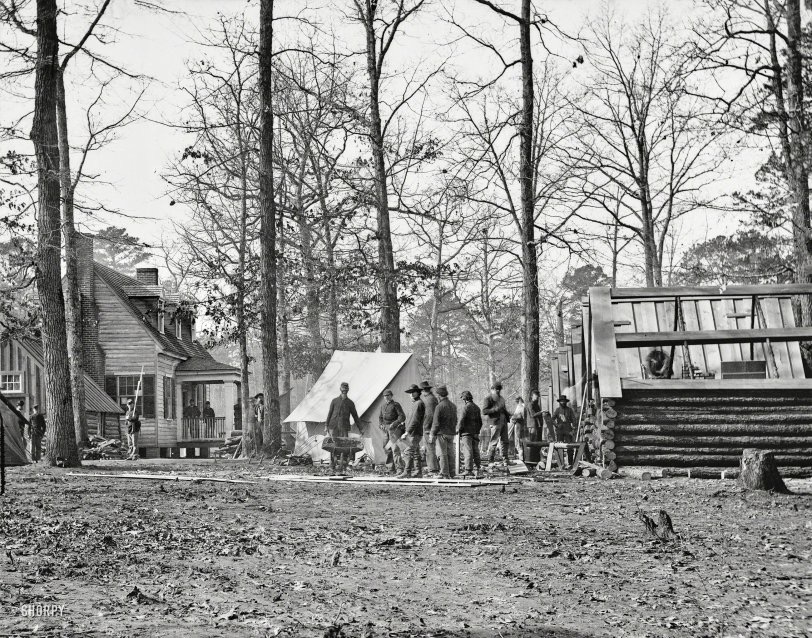
1864. “Bermuda Hundred, Virginia. Headquarters of Gen. Benjamin Butler.” Future congressman and governor of Massachusetts. Wet plate glass negative from the Civil War Photograph Collection, Library of Congress.
T R A N S C R I P T I O N
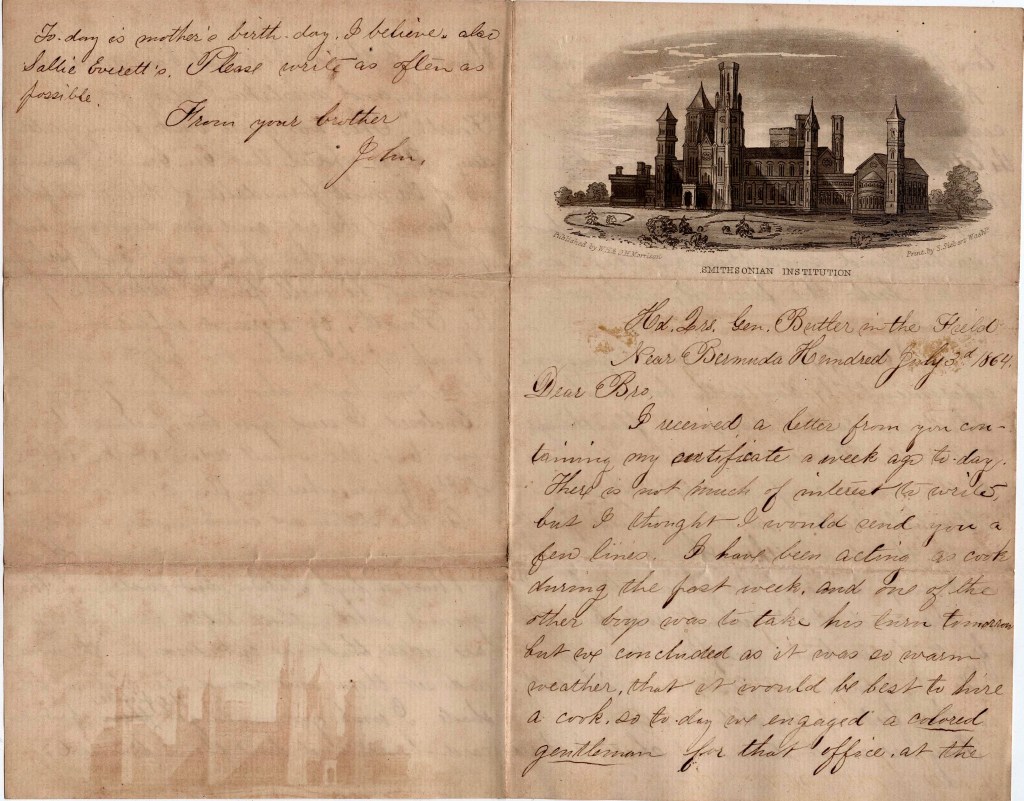
Headquarters Gen. Butler in the Field Near Bermuda Hundred July 3rd 1864
Dear Brother,
I received a letter from you containing my certificate a weeks ago today. There is not much of interest to write but I thought I would send you a few lines.
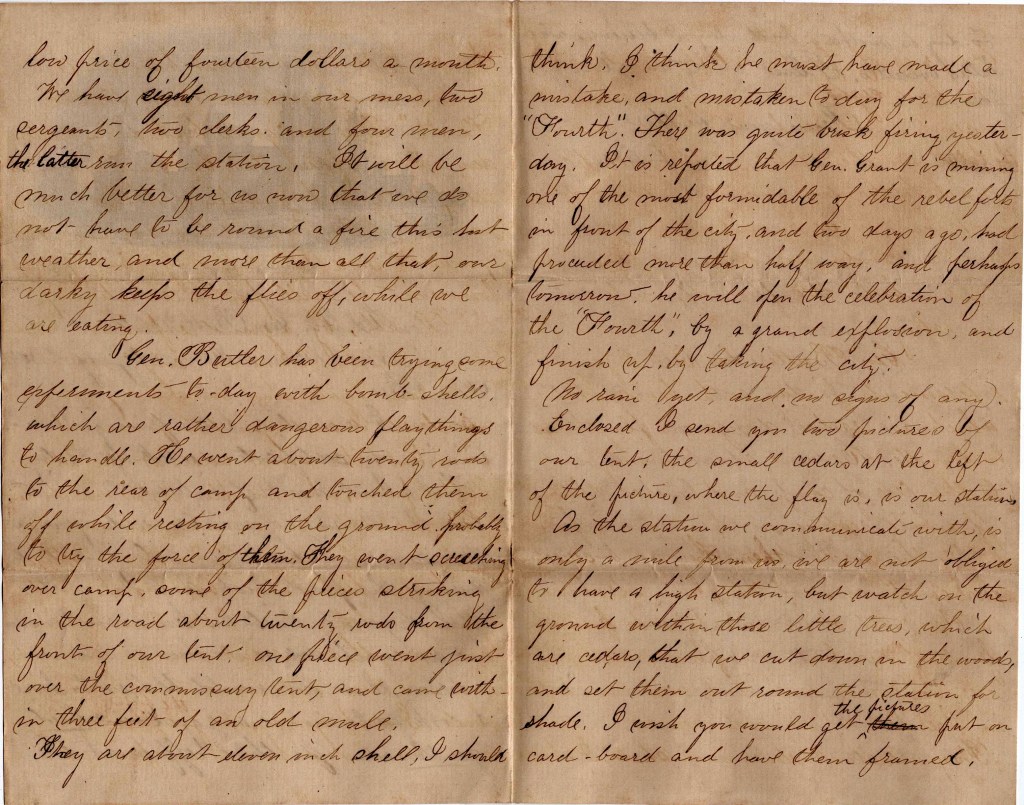
I have been acting as cook during the past week and one of the other boys was to take his turn tomorrow but we concluded as it was so warm weather that ut would be best to hire a cook, so today we engaged a colored gentleman for that office at the low price of fourteen dollars a month. We have eight men in our mess—two sergeants, two clerks, and four men. The latter run the [signal] station. It will be much better for us now that we do not have to be round a fire this hot weather and more than all that, our darky keeps the flies off while we are eating.
Gen. [Benjamin F.] Butler has been trying some experiments today with bomb shells which are rather dangerous play things to handle. He went about twenty rods [110 yards] to the rear of camp and touched them off while resting on the ground, probably to try the force of them. They went screeching over camp, some of the pieces striking in the road about twenty rods from the front of our tent. One piece went just over the commissary tent and came within three feet of an old mule. They are about eleven inch shell, I should think. I think he must have made a mistake and mistaken today for the “Fourth.”
There was quite brisk firing yesterday. It is reported that Gen. Grant is mining one of the most formidable of the rebel forts in front of the city and two days ago had proceeded more than half way 1 and perhaps tomorrow he will open the celebration of the “Fourth” by a grand explosion and finish up by taking the city.
No rain yet and no signs of any. Enclosed I send you two pictures of our tent. The small cedars at the left of the picture, where the flag is, is our station. As the station we communicate with is only a mile from us, we are not obliged to have a high station, but watch on the ground within those little trees, which are cedars, that we cut down in the woods and set them out round the station for shade. I wish you would get the pictures put on cardboard and have them framed.
“As the station we communicate with is only a mile from us, we are not obliged to have a high station, but watch on the ground.” William Waud Sketch. Night signalling by torches across the James River.
Today is mother’s birthday. I believe also Sallie Everett’s. Please write as often as possible. From your brother, — John
1 Digging the mine for the Battle of the Crater started on June 25, 1864. The Union miners, primarily from the 48th Pennsylvania Infantry Regiment, including many experienced coal miners, made rapid progress, sometimes digging 40 feet a day. By July 17, 1864, they had excavated a shaft reaching 511 feet (510.8 feet according to one source), bringing the mine to a point 20-22 feet below the Confederate position at Elliott’s Salient. Although the exact date when the mine was “half done” is not specified, it can be inferred from the available information that the main shaft, which extended under the Confederate lines, was approximately completed by mid-July, around July 17th. The lateral tunnel was then dug and completed by July 23rd, and the mine was packed with explosives by July 27th. The explosives were detonated on the morning of July 30, 1864.
The following letter was written by John R. Heafer (1845-1864), the 19 year-old son of John Heafer (b. 1820) and Nancy (b. 1826) who moved with his family from Charleston, Jefferson county, Virginia, to a farm in Bloomington, McLean county, Illinois in the 1850s. John was serving as a private in Co. B, 39th Illinois Infantry when he wrote this letter from Bermuda Hundred in June 1864.
He was carried on the muster rolls as “Hafter” which may explain why he can’t be found under his given name. Unfortunately he did not survive the war. He was killed along with many other comrades in his regiment on 13 October 1864 in the Battle of Darbytown Road. The Union advance was repulsed with heavy casualties and John’s body was left on the field.
John wrote the letter to his sister, Sarah (“Sallie”) Heafer (b. 1844), the wife of William M. Steele, a former soldier in Co. A, 94th Illinois Infantry and a teamster working in Bloomington. He later became a minister..
From the Regimental History of the 39th Illinois Infantry
Transcription
Near Bermuda Hundred June 4th 1864
Dear Sister,
I received your letter of the 25th of May this morning and was glad to hear from you. I have not been well for a few days but am well this morning. I have not had much time to write since we have had so much fighting to do and I have not felt much like either. We had another fight [see Ware Bottom Church] on the 20th of last month. I guess you have heard about it by this time. Our loss was pretty heavy. We had to make a charge on the Rebels rifle pits. We had a skirmish yesterday. We lost 31 men. That makes 250 men we have lost since we have been here. If we keep on that way, we will soon play out.
Lt. Algernon Cox Sweetser of Co. B, 39th Illinois Infantry(LOC)
Lieut. [Algernon Cox] Sweetser was wounded yesterday in both legs. One had to come off. 1 We have some fighting every day now. When the Rebs commence to throw shell over, we all have to skedaddle to the breastworks. The shells burst all over our camp. There was a bullet went through my tent the other day. It hit just where I lay but I happened to be out. This is the first letter I have got from home for some time. I think you might [write] oftener. I expect we will have a big fight here some day. I would like to see Sallie’s baby. I hope she will get along well. I am expecting a letter from Mat every day. I suppose it is pretty dry in Bloomington now. But for all that, I would like to be there. I think I could enjoy myself pretty well.
I don’t feel much like writing today and I will have to go on picket tonight so I will not write much more. Your brother, — John
P. S. My love to all the family and Sallie and the baby. My love to all the friends. — John
Please send some stamps.
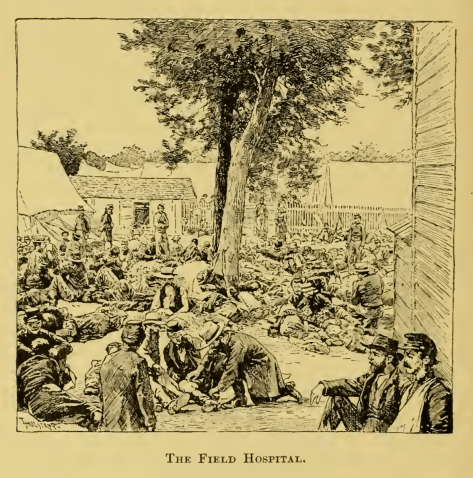
1 The regimental history Lieutenant Al. C. Sweetser of Company B was wounded through both legs. The wound of the left leg was not serious, the ball making merely a flesh wound. The right limb fared worse, the bullet passing through the knee- joint and so disrupting the articulation that amputation at the lower third of thigh became necessary. We shall never forget the courage and fortitude of Lieutenant Sweetser while on the operating-table, or while suffering for long months at Chesapeake hospital by reason of hospital gangrene and the subsequent operations that become necesssary from the necrosis of bone. He came back to the field hospital on a stretcher, calmly smoking a cigar, and after an examination, when told that he must sacrifice a limb, he said, “Well, ‘Doc,’ just go to work, and do the very best you can for me.” Lieutenant Sweetser was a brave and gallant officer.” (pp. 201-202)
The following letter was written by John R. Heafer (1845-1864), the 19 year-old son of John Heafer (b. 1820) and Nancy (b. 1826) who moved with his family from Charleston, Jefferson county, Virginia, to a farm in Bloomington, McLean county, Illinois in the 1850s. John was serving as a private in Co. B, 39th Illinois Infantry when he wrote this letter from Bermuda Hundred in July 1864.
He was carried on the muster rolls as “Hafter” which may explain why he can’t be found under his given name. Unfortunately he did not survive the war. He was killed along with many other comrades in his regiment on 13 October 1864 in the Battle of Darbytown Road. The Union advance was repulsed with heavy casualties and John’s body was left on the field.
John wrote the letter to his sister, Sarah (“Sallie”) Heafer (b. 1844), the wife of William M. Steele, a former soldier in Co. A, 94th Illinois Infantry and a teamster working in Bloomington. He later became a minister.
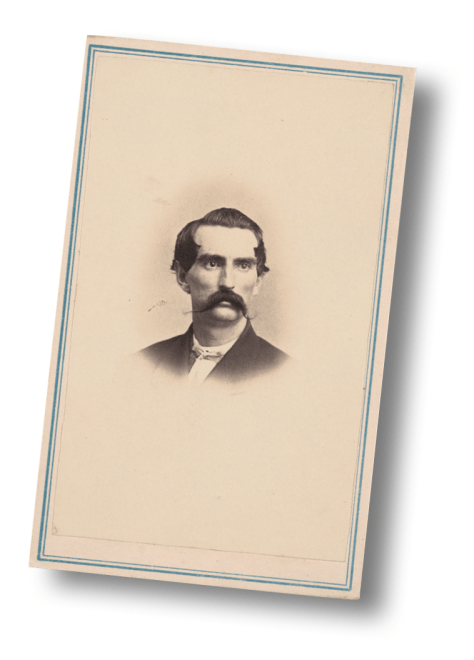
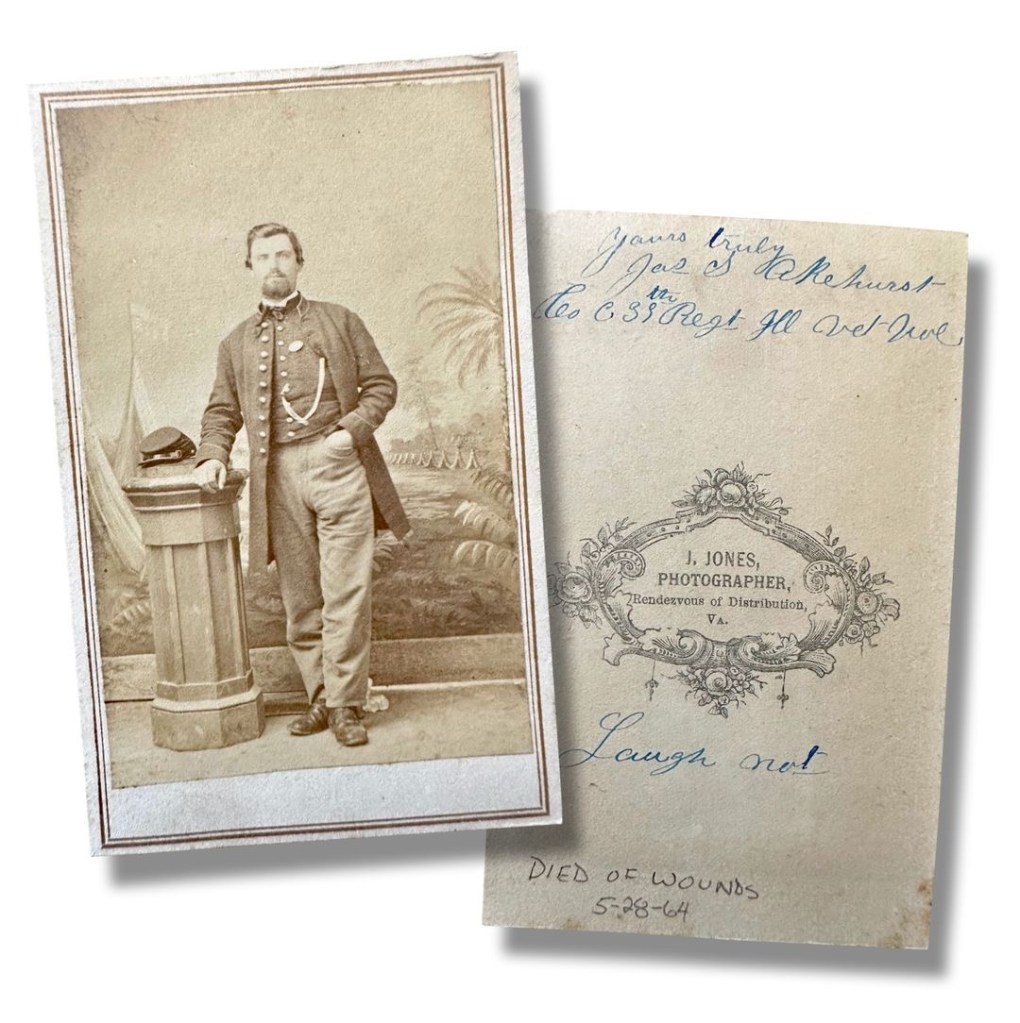
I could not find an image of Robert, but here is a cdv of James S. Akehurst (1843-1864) of Pontiac, Illinois, not previously published to my knowledge. James served as a private in Co. C, 39th Illinois Infantry. He enlisted in October 1861 and was wounded on 20 May 1864 at Drewry’s Bluff, Virginia. The wound to his left arm was so severe it required amputation but the procedure did not save him—he died on 28 May 1864 at Hampton, Virginia. The news must have come as quite a shock to his wife, Elizabeth, who had promised to love and respect James “till death do us part” only three months earlier. James’ image was taken in front of a backdrop that features tropical type vegetation suggesting the cdv was probably taken in 1863 while the regiment was on the South Carolina coast. (Courtesy of Claudia & Al Niemiec Collection)
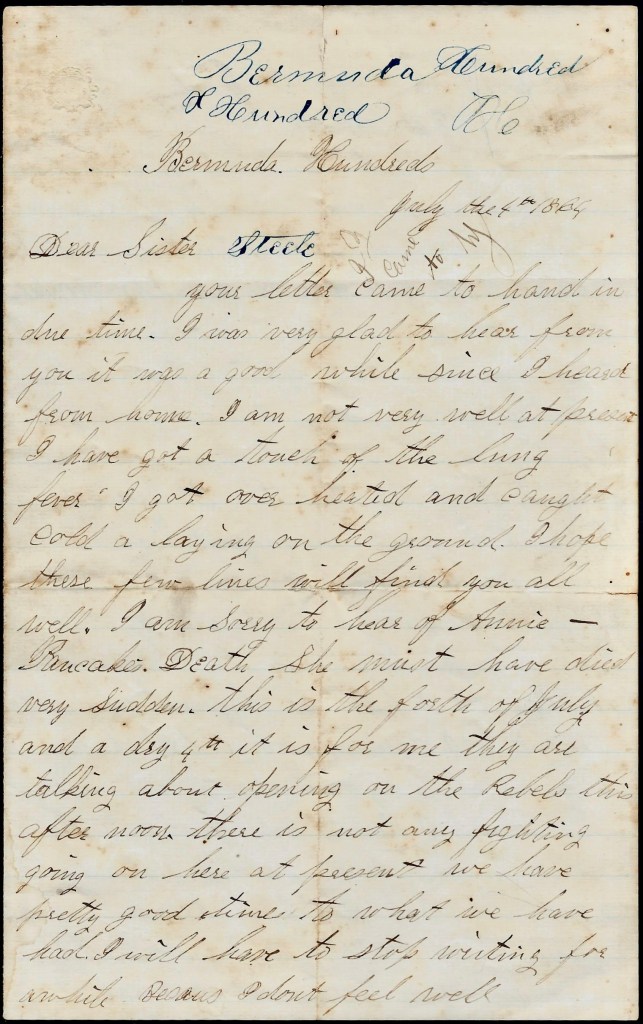
Transcription
Bermuda Hundred [Virginia] July 4th 1864
Dear Sister,
You letter came to hand in due time. I was very glad to hear from you. It was a good while since I heard from home. I am not very well at present. I have got a touch of the lung fever. I got over heated and caught cold a laying on the ground. I hope these few lines will find you all well. I am sorry to hear of Annie Pancake’s death. 1 She must have died very sudden.
This is the Fourth of July and a dry 4th it is for me. They are talking about opening on the Rebels this afternoon. There is not any fighting going on here at present. We have pretty good times to what we have had. I will have to stop writing for a while because I don’t feel well.
July 7th, Thursday. Dear sister, I will commence and finish this letter and I am better. I was very sick for a few days in my quarters and was getting worse until the doctor came to see me and saw me to the Convalescent Hospital. I am better now. The doctor says I have not got the lung fever. I guess I have got the pleurisy. I think I will soon get over it.
The weather is very warm here but it is cool enough in the hospital tent. You will have to excuse this writing as I have to lay on my side to write. I commenced this letter a few days ago but could not finish it. I told Ed[win] Wolcott to write me a letter because I thought I would not be able to write for some time but I guess I can a little yet. But you need not expect many.
There is good news here now. They are fighting at Petersburg. But we can’t hear anything from Grant. The rebels are deserting by hundreds. I have seen a good many go by here today. I will have to come to a close. My love to all. — John R. Hafer
P. S. Be sure and send the photograph.
Mr. John R. Heafer, Co. B, 39th Regt. Illinois Vols., 1st Brigade, 1st Division, 10th A. C.
1 Ann Marie Pancake (1847-1864) died on 20 June 1864 when she was 17 years old. She is buried in Evergreen Memorial Cemetery in Bloomington.
The following brief letter was written by 35 year-old 1st Sergeant William Bredow of Waterville, Oneida county, New York, who enlisted in Co. E, 81st New York Infantry to serve three years. He was promoted from private to corporal in February 1862, to sergeant in July 1862, and to 1st Sergeant in January 1864 when he re-enlisted as a veteran. In February 1865 he was commissioned a 1st Lieutenant and he mustered out as the Captain of Co. H in August 1865.
I believe that William Bredow was born in Germany in 1836 and came to the United States in 1843 when he was seven years old.
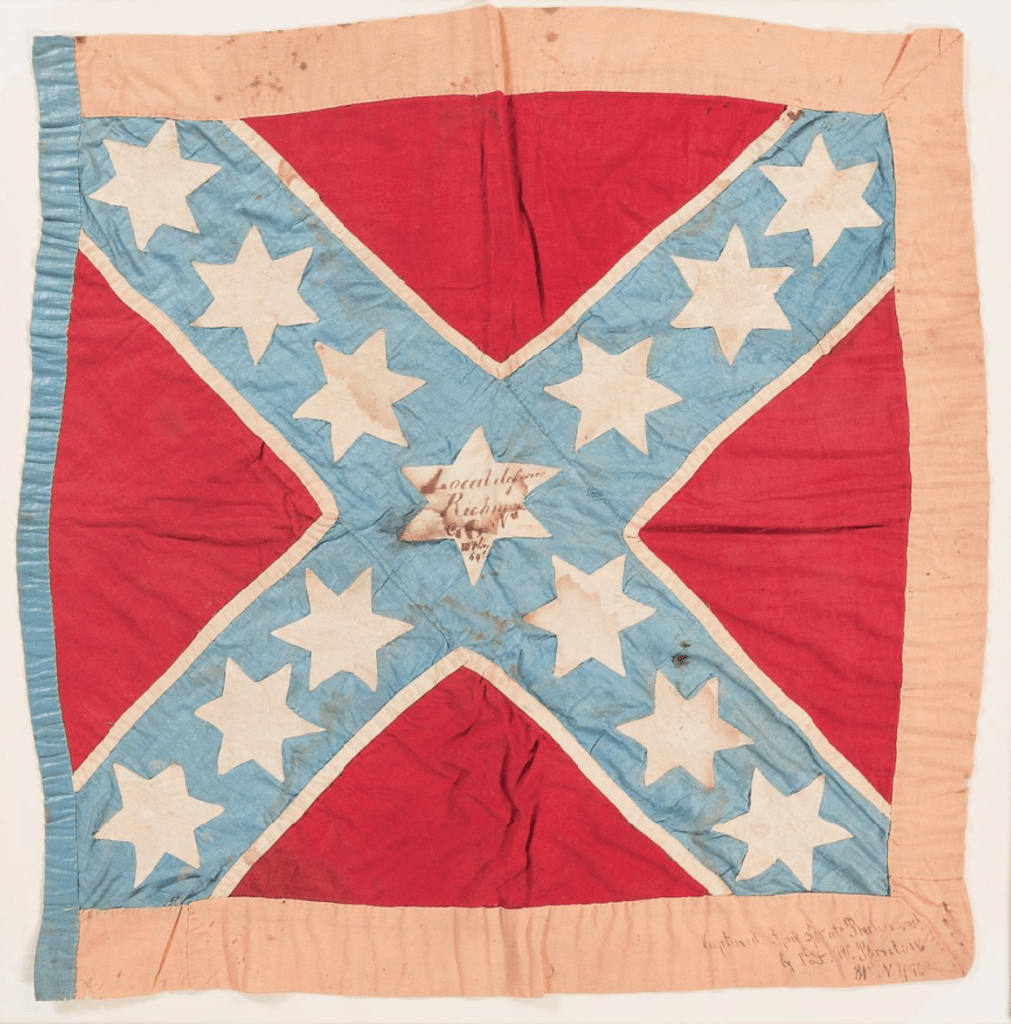
A small Confederate battle flag (24 inches by 25 inches) marked “Local defence/Richmond/Co. G/10th Va/10th May 1864″ and marked, Captured April 3rd 65 at Richmond by 1st Lt. W. Bredow, 81st NY Vols.” sold at auction recently for $55,000.
Note: This letter is from the personal collection of Greg Herr and was made available for transcription and publication on Spared & Shared by express consent.
Transcription
In front of Petersburg, Virginia near Bermuda Hundred September 16th 1864
Friend Tailiur!
I received your letter dated the 14th this month and am very much surprised to learn that you got no letter from me. I wrote one the next day as your brother-in-law Mr. Day in Hampton. The other I wrote the 11th this month. In the latter I answered you all the questions about payroll and so on and told you the news about our regiment. I hope you got both letters by this time. Your trunk is left by Captain [Lewis B.] Porter 1 in the storehouse in Norfolk.
I hope your leg will get well pretty soon and will not trouble you much. Everything is quiet here since you left. No excitement at all except this morning a couple boys were shot on picket by fooling with their guns. [John] Daily 2 out of Company B was brought in this morning about 5 o’clock shot through his buttocks, and now about half hour ago, [Francis P.] Graves 3 of Company I shot by Thomas McDonald 4 through the bowels.
Lieutenant [Maurice P.] Tidd joined the regiment yesterday. The boys sent their love to you. Hoping you got my letter by this time. I remain your friend, — W. Bredow
1 Lewis B. Porter was 30 years old when he enlisted on 5 September 1861 at Oswego to serve three years in Co. D, 81st New York Infantry. He was promoted to 1st Sergeant in August 1862, commissioned a 2nd Lt. in November 1862, and made Captain of Co. K in June 1864. He was wounded in action at Chaffin’s Farm, Va. two weeks after this letter was written and died of his wounds on 15 November 1864 at Fort Monroe, Va.
2 John Daly [or Dailey] was 36 years old when he enlisted at Oswego as a private in Co. B. in the fall of 1861. He was wounded “while on picket near Bermuda Hundred” and mustered out on 25 May 1865.
3 Francis (“Frank”) P. Graves of Rome, New York, was 19 when he enlisted in August 1862 to serve in Co. I with his brothers. He was wounded in action on 23 June 1864 at Cold Harbor but was standing duty on picket at Bermuda Hundred when he was “accidentally killed.”
4 Thomas McDonald was 18 when he enlisted on 14 December 1861 at Rome, New York to serve in Co. I. He was wounded in action at Cold Harbor on 3 June 1864 but survived the war.
I could not find an image of Christian but here is a cdv of David B. Prosser who served with him in Co. D, 104th P. V. (Photo Sleuth)
The following letter was written by Christian B. Grossman (1838-1913), the son of a pottery maker of Rockhill, Bucks county, Pennsylvania named Christena Grossman and his wife Catharine.
According to muster records, Christian Grossman enlisted on 17 September 1861 in Co. D, 104th Pennsylvania Infantry and he was promoted to Hospital Steward on 15 October 1864. He was discharged from the service on 25 August 1865 at Portsmouth, Virginia.
After the war he married and moved to Philadelphia where he initially also worked as a potter like his father. Then, by 1880, he entered the restaurant business.
Christian’s letter includes a description of the Battle of Trent’s Reach which took place between 23-25 January 1865 on the James River. In that battle a powerful flotilla of Confederate warships attempted to break the blockade on the James River and attack Grant’s supply base at City Point, but they were foiled and withdrew back up the river to Richmond.
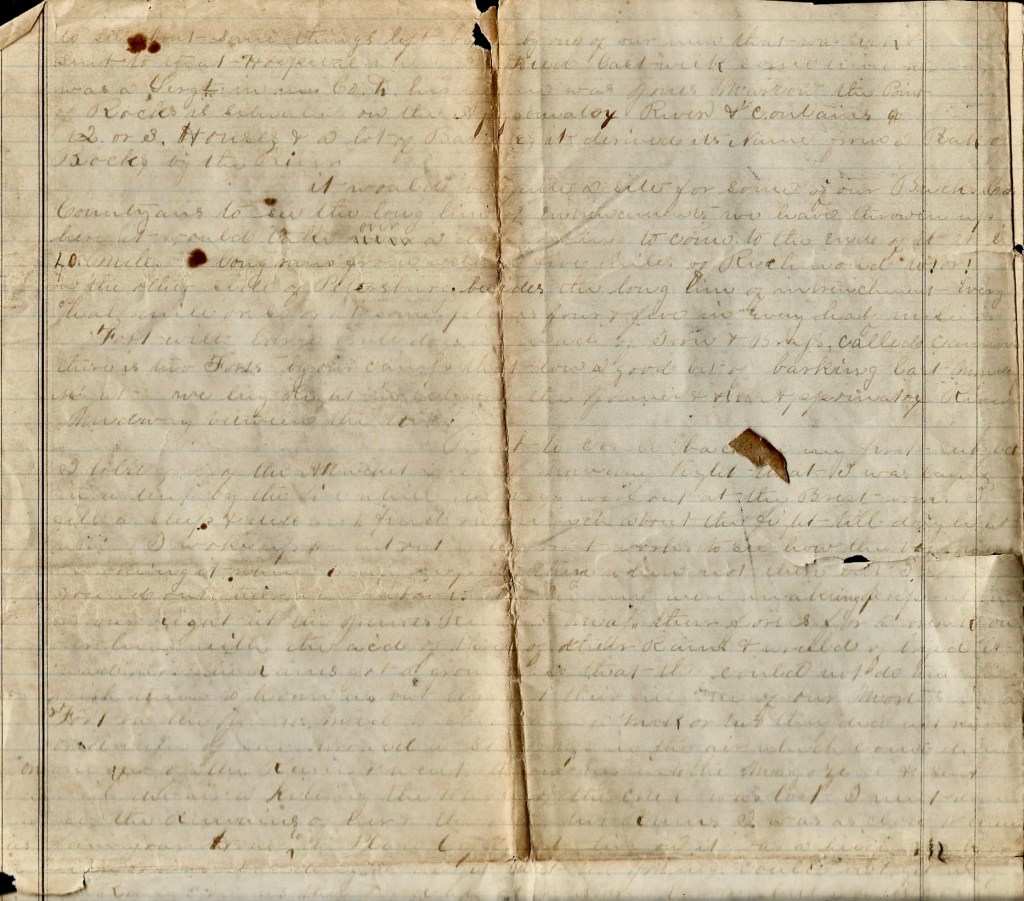
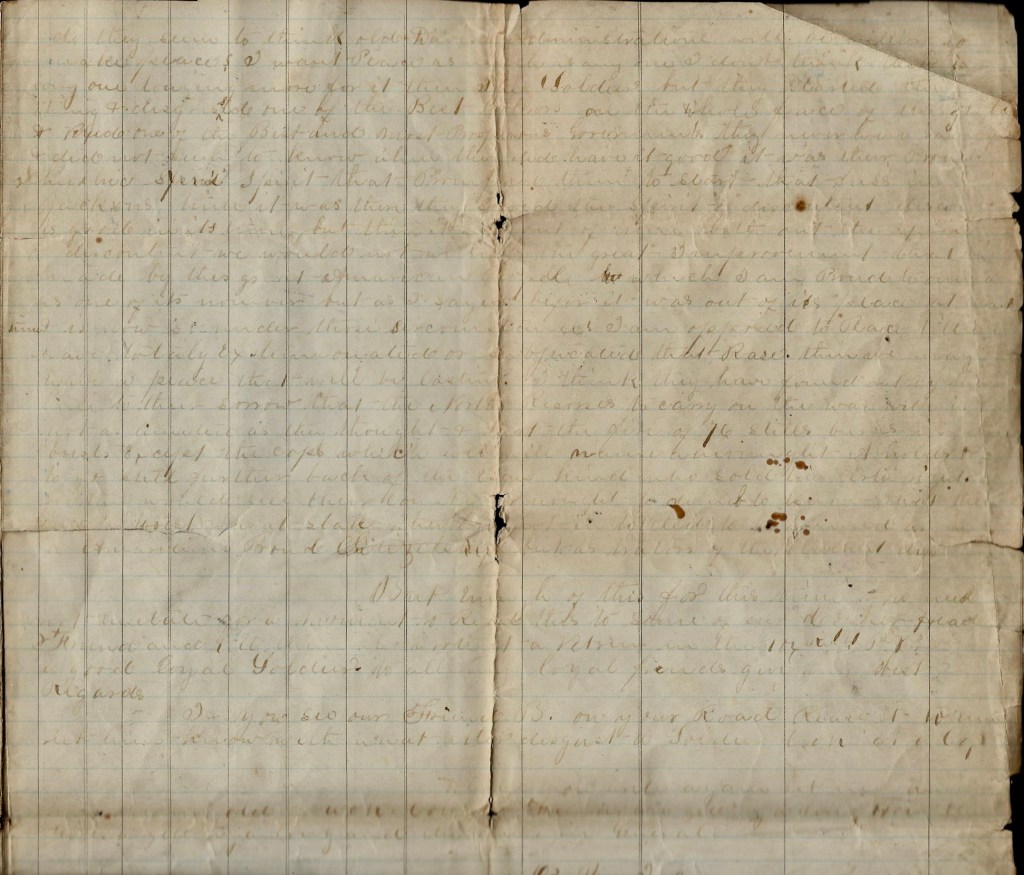
[Note: I have only transcribed approximately two-thirds of the letter as the ink has faded and it is difficult to make it out.]
Transcription
Bermuda Front January 28, 1865
Dear Friend,
Having waited for a letter from you in answer to my last written in the Valley and not getting any, I thought I would try again. It may surprise you to see such a long but as I have nothing much to do, I thought I might as well pass my time away with writing as anything else.
In the first place, I will admit a mistake I made in my last to you. I wrote that we had a snow 8 feet deep. I intended to say 8 inches deep for that is all it was but that was deep for that part of the country.
Since that letter was written we have made a change in our residence. We now reside at Bermuda Front on the James River within 9 miles of Richmond in what used to be Butler’s Department & in close proximity with the Johnnies. We are so near that on picket, we can see each other & talk together. There is a sort of contract entered into by our men, or our pickets and the Reb pickets, not to fire on each other while on picket so they stand out and talk to each other for quite a spell at a time.
For a week or two back, we heard their bands play & drums beat but now it seems to be quiet. It’s generally thought that they have taken some of their force away from here to work on the Danville Railroad that was damaged so much from the last heavy rain but whether they took their force away or not, I take notice they tried to show themselves. Last Sunday and Monday night they made an attack on our picket line from the James River down till the point of our camp which is but a few thousand yards from the picket line. They made several charges but every time bravely met by our pickets and sent back in a hurry feebler than they came. I have since heard that they were short in wood and tried to advance their line to take a strip of woods. Our pickets held but they could not [ ]….
It is a most awful hard thing when a man must stand out all night at them breastworks to keep watch to see that the enemy does not surprise & the nights so dark that you cannot see any distance ahead of you & then so cold that you almost freeze & every once in awhile a ball going over you with its song, “zip, zip.” I do not need to take a gun nor do I need to fight. My business is in the rear of the fight, to help to dress the wounded. Last time when the Rebs made the attack, the regiment was out to the breastworks all night. I lay in a tent by the fire sleeping & have made up my mind to take it easy & stick to the boys by the breastworks for there is as much or more danger going to the rear as there is staying here.
It is now bed time. The drums are beating all around so I will finish it tomorrow. My man just put pork on to cook for breakfast so I thought I would write awhile while it is cooking. I have now been writing a half of an hour. It is a rather slow process to write this way. A have a small book on my bunk on which I have to pull the paper along to keep it on the book so to make it easier to write. But a good night to you all and hoping I may sleep as well as you and not be molested by the rebs.
Sunday, 29th, one o’clock pm. I will now resume my writing again. I can not bid you a good morning for its too late so I will bid you a good afternoon. In the first place, I must say I had a good nights sleep. The Johnnies did not try anything. They behaved themselves well. I hope they will continue to do so in the future.
I have just been down to the Point of Rocks Hospital about two miles from here to see about some things by one of our men that was sent to that hospital last week some time. He was a sergeant in Co. D. His name was Jonas Marton. 1 The Point of Rocks is situated on the Appomattox River and contains two or three houses and a lot of barracks. It derives its name from a Peak of Rocks by the river.
It would be quite a sight for some of our Bucks countyans to see the long lines of entrenchments we have thrown up here. It would take over a days walking to come to the end of it. It’s 40 miles long. Runs from within 5 miles of Richmond to the other side of Petersburg. Besides the long line of entrenchments, every half mile or so, or in some places four and five, in ever half mile is a fort with large Bull dogs made of iron and brass called cannon. There is two forts by our camp that done a good deal of barking last Monday night. We lay right in [ ] the James & Appomattox River midway between the two.
But to come back to my first subject, I told you of the attack we had the very night that I was laying in my tent by the fire while our boys were out at the breastworks. I fell asleep & did not find out much about the fight till daylight when I woke up….
…I was standing along side of one of our guns–a 30-pound Parrott gun that was shelling the other two Rams….but not doing them much harm for the iron coat on them was too much for it. The shell would splinter to pieces on her just as though they were pumpkins. The rams…both got off and started back to Richmond…..that ended the fight. There was four or five wounded on our side and quite an artillery loss to the enemy. I was telling you that I found our men or regt. gone from the camp. I found they had gone up to the James River to meet the rebs…When they come, they seen the boat go up and also seen a man go up in the smoke. I heard it when it went up and seen the smoke and afterwards the wreck. I got some papers off of it that blowed over where I was standing. There is a report that they are going to try us again soon brought in by a deserter from their army who came in last night. We have had quite a lot of them come in. Sometime back over 30 came in. They are fine looking young men.
If the Johnnies want to try us again, they are welcome to come. They take the daytime for it. I think we will show them a modus operandi. They little think of our men in line every morning at 5 o’clock ready…Our regiment drawed new guns last week and turned in the old ones. They now have the latest, improved rifles called the Springfield Rifle made in ’61.
You will please excuse me if this incompetent writing don’t seem to meet your approbation. I will now chance the subject again.
What do the people in Old Bucks county seem to think of the Blair Peace Initiative? Do they seem to think Old Davis’s Administration will be willing to make peace? I want peace as much as anyone. I don’t think there is anyone longing for it more than the soldiers, but they started the thing and disgraced one of the best colors on the face of the globe and ruined one of the best and most prosperous governments. They never were [ ] and did not seem to know when they did have it good. It was their proud, chivalric spirit that provoked them to start that fuss in Jackson’s time. It was then they started the spirit of discontent…I am opposed to peace till we have totally exterminated or subjugated that race. Then we may be a place that will be lasting. I think they have found out to their sorrow that the North’s resources to carry on the war was not as limited as they thought and that the fire of ’76 still burns in their breasts, except the Cops [copperheads]…to dumb to know what was at stake…But enough of this for this time.
Oh yes, I came near forgetting to tell you we just got through building a house…of logs and plastered with mud. It is 8 by 11 feet and 7 feet high, tile all around, and I have a little warm stove in it. The chimney is made of logs and plastered inside with a [ ] on the top. The roof of my house is canvass. Today we made a table. Our bunk is made of staves also split out of pine logs. We live gay for to be so close to the Johnnies…I can say with safety better than any other Nation on the globe for there never was any better.
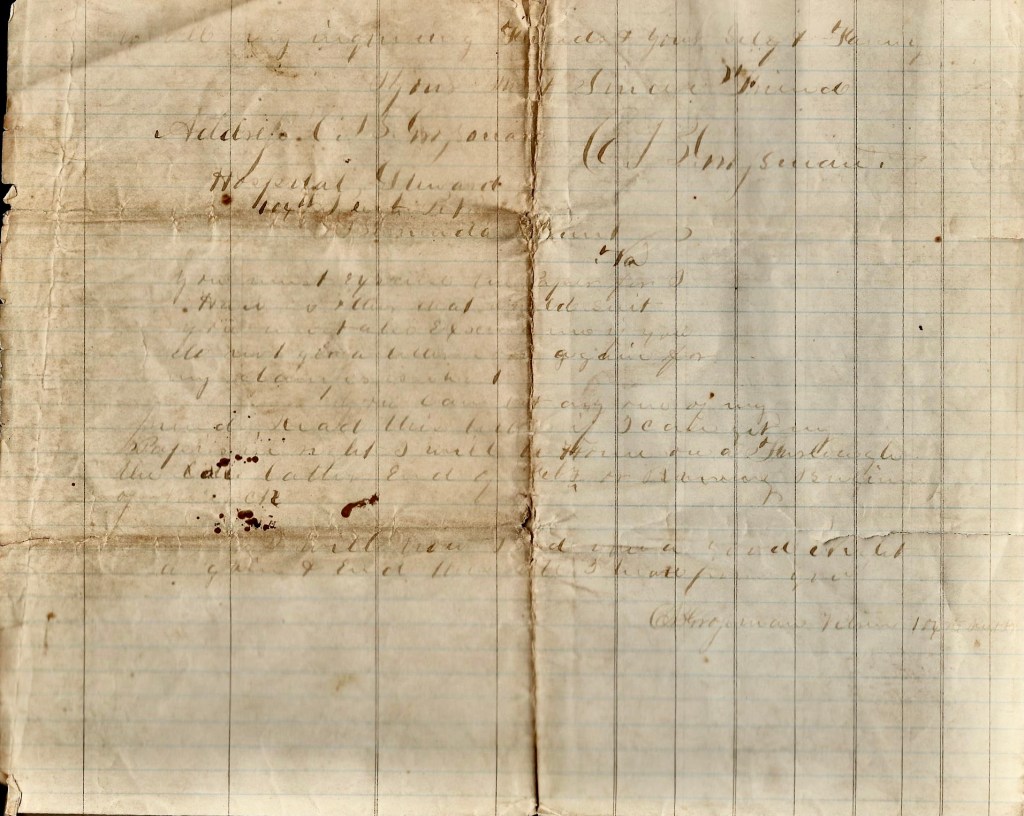
But I must come to a close hoping this may find you well. Just excuse poor writing and blunders that I could not avoid….Give my love love to all my enquiring friends and yourself and Fannie. Your most sincere friend.
—C. B. Grossman
Address: C. B. Grossman, Hospital Steward, 104th regt. Penn. Volunteers, Bermuda Front, Va.
1 Sergt. Jonas Martin died at the Point of Rocks Hospital on 24 January 1865. He was buried in the National Cemetery at City Point, Section F, Division 1, Grave 138.
I could not find a photograph of Daniel Worthley but here’s an early-war ambrotype of a Massachusetts man. (Dan Binder Collection)
This letter was written by Private Daniel Edward Worthley (1836-1913) of Co. I of the 26th Massachusetts Infantry. This regiment was organized in the fall of 1861 and spent the first three years of the war in the Department of the Gulf. In July 1864, they were transferred to the Army of the Shenandoah and were on the Bermuda Hundred front from mid-July to the 1st of August when they were sent to the valley to participate in Sheridan’s Valley Campaign. They would see some serious fighting in the day’s ahead—at Third Winchester, Fisher’s Hill, and Cedar Creek. After the last named battle, Worthley and 44 other men of the 26th Massachusetts were captured while guarding a forage train at Newton, Virginia. He was exchanged in February 1865 and mustered out at Savannah.
Daniel was the son of Luke Worthley (1809-1878) and Elizabeth Poor (1810-1891) of Andover, Essex county, Massachusetts. He mustered out of the regiment in August 1865. Daniel’s siblings included Phebe Marian Worthley (1836-1913), Lewis T. Worthley (1842-1924), Abbie R. Worthley (1844-1901), and Luke Worthley (1849-1901).
You see by the above that we are at last in Old Virginia. We started from New Orleans on the 11th instant & arrived here today. We had a pretty fair voyage—some rainy towards the end of it.
I suppose that I may have not got letters sent to me lately for two of the New Orlean mail steamers have been lost. The Locust Point was sunk off the coast of New Jersey and the Electric Spark captured by the rebels steamer Florida off the coast of North Carolina. I think I can get a reply to my letters in about 5 or 6 days now. That will be quite pleasant & I want you to write immediately. I have not heard whether you have got the money that I sent by Express.
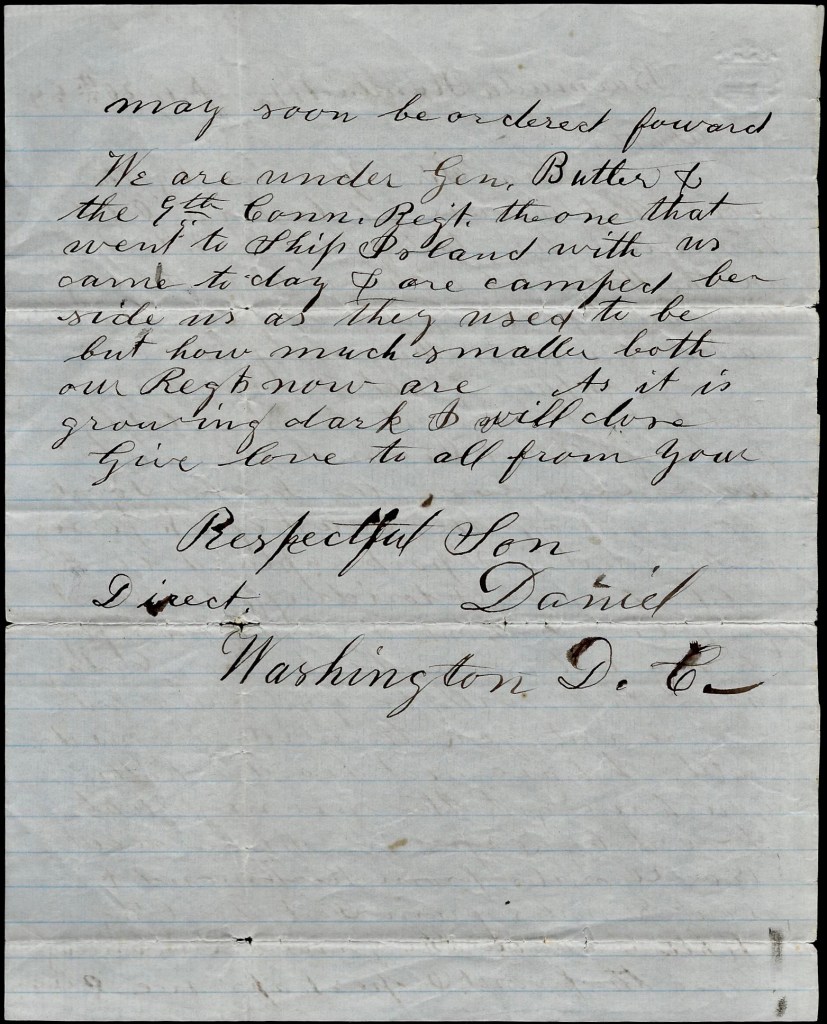
We are about 15 or 20 miles from Richmond & about 8 miles from Fort Darling. While I write, the guns are booming along the front & perhaps we may soon be ordered forward.
We are under Gen. Butler & the 9th Connecticut Regiment—the one that went to Ship Island with us 1—came today & are camped beside us as they used to be. But how much smaller both our regiments now are. As it is growing dark, I will close. Give love to all. From your respectful son, — Daniel
Direct to Washington D. C.
1 The 9th Connecticut and the 26th Massachusetts were the first of twenty-seven Union infantry regiments to see service on Ship Island during the Civil War. They sailed together aboard the SS Constitution in late November 1861 and reached Ship Island on 2 December 1861.










 Spared & Shared 23